

Let
 $F$
be a non-Archimedean, locally compact field with residual characteristic
 $p$
. Let
 $\mathscr{W}_{F}$
be the Weil group of a separable closure
 $\bar{F}/F$
. For a real variable
 $x\geqslant 0$
, let
 $\mathscr{R}_{F}(x)=\mathscr{W}_{F}^{x}$
be the corresponding ramification subgroup of
 $\mathscr{W}_{F}$
and
 $\mathscr{R}_{F}^{+}(x)$
the closure of
 $\bigcup _{y>x}\mathscr{R}_{F}(y)$
. We use the conventions of [Reference SerreSer68] here, so that
 $\mathscr{R}_{F}(0)$
is the inertia group
 $\mathscr{I}_{F}$
and
 $\mathscr{R}_{F}^{+}(0)$
is the wild inertia group
 $\mathscr{P}_{F}$
in
 $\mathscr{W}_{F}$
. If
 $\mathscr{G}$
is any of this list of locally profinite groups,
 $\widehat{\mathscr{G}}$
will denote the set of equivalence classes of irreducible, smooth, complex representations of
 $\mathscr{G}$
. We shall be concerned with the ramification structure of certain
 $\unicode[STIX]{x1D70E}\in \widehat{\mathscr{W}}_{F}$
, that is, the structure of the restricted representations
 $\unicode[STIX]{x1D70E}\,|\,\mathscr{R}_{F}(x)$
and
 $\unicode[STIX]{x1D70E}\,|\,\mathscr{R}_{F}^{+}(x)$
, for
 $x>0$
.
On the other side, let
 $\mathscr{A}_{n}^{0}(F)$
denote the set of equivalence classes of irreducible, cuspidal, complex representations of the general linear group
 $\operatorname{GL}_{n}(F)$
,
 $n\geqslant 1$
, and set
 $\widehat{\operatorname{GL}}_{F}=\bigcup _{n\geqslant 1}\mathscr{A}_{n}^{0}(F)$
. For
 $\unicode[STIX]{x1D70B}\in \widehat{\operatorname{GL}}_{F}$
, write
 $\text{gr}(\unicode[STIX]{x1D70B})=n$
to indicate
 $\unicode[STIX]{x1D70B}\in \mathscr{A}_{n}^{0}(F)$
. Such a representation
 $\unicode[STIX]{x1D70B}$
contains a simple character
 $\unicode[STIX]{x1D703}_{\unicode[STIX]{x1D70B}}$
in
 $\operatorname{GL}_{n}(F)$
[Reference Bushnell and KutzkoBK93] and, up to conjugation, only one [Reference Bushnell and HenniartBH13]. The endo-class
 $\unicode[STIX]{x1D6E9}_{\unicode[STIX]{x1D70B}}$
of
 $\unicode[STIX]{x1D703}_{\unicode[STIX]{x1D70B}}$
is therefore uniquely determined by
 $\unicode[STIX]{x1D70B}$
. Let
 $\mathbf{\mathscr{E}}(F)$
denote the set of endo-classes of simple characters over
 $F$
. (For the notion of endo-class, see [Reference Bushnell and HenniartBH96] or the summary in any of [Reference Bushnell, Diamond, Kassei and KimBus14, Reference Bushnell and HenniartBH03, Reference Bushnell and HenniartBH13].)
Denote by
 $\unicode[STIX]{x1D70B}\mapsto ^{\,\text{L}}\unicode[STIX]{x1D70B}$
the Langlands correspondence
 $\widehat{\operatorname{GL}}_{F}\rightarrow \widehat{\mathscr{W}}_{F}$
[Reference Harris and TaylorHT01, Reference HenniartHen00, Reference Laumon, Rapoport and StuhlerLRS93, Reference ScholzeSch13]. Writing
 $\unicode[STIX]{x1D70E}=^{\,\text{L}}\unicode[STIX]{x1D70B}$
, the fine structure of the endo-class
 $\unicode[STIX]{x1D6E9}_{\unicode[STIX]{x1D70B}}$
and the ramification structure of
 $\unicode[STIX]{x1D70E}$
determine each other [Reference Bushnell and HenniartBH17, 6.5 Corollary]. The relationship is expressed via a certain Herbrand function
 $\unicode[STIX]{x1D6F9}_{\unicode[STIX]{x1D6E9}_{\unicode[STIX]{x1D70B}}}$
attached to the endo-class
 $\unicode[STIX]{x1D6E9}_{\unicode[STIX]{x1D70B}}$
. In this paper we consider a particularly interesting class of representations, comprising what we call Carayol representations. We compute the associated Herbrand functions. We list the functions which arise as Herbrand functions. We interpret the results in terms of the ramification structure of the associated Galois representations, from which we extract information about the Langlands correspondence.
We review the background from [Reference Bushnell and HenniartBH17] with as little formality as possible. If
 $\unicode[STIX]{x1D70B}\in \widehat{\operatorname{GL}}_{F}$
and
 $\unicode[STIX]{x1D70E}=^{\,\text{L}}\unicode[STIX]{x1D70B}\in \widehat{\mathscr{W}}_{F}$
, the endo-class
 $\unicode[STIX]{x1D6E9}_{\unicode[STIX]{x1D70B}}$
determines the restriction
 $\unicode[STIX]{x1D70E}\,|\,\mathscr{P}_{F}$
. More precisely,
 $\unicode[STIX]{x1D70E}$
defines an element
 $[\unicode[STIX]{x1D70E}]_{0}^{+}$
of the orbit space
 $\mathscr{W}_{F}\backslash \widehat{\mathscr{P}}_{F}$
, namely the orbit of irreducible components of
 $\unicode[STIX]{x1D70E}\,|\,\mathscr{P}_{F}$
. The Langlands correspondence induces a canonical bijection ([Reference Bushnell and HenniartBH03, 8.2 Theorem], [Reference Bushnell and HenniartBH14b, 6.1])
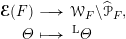 $$\begin{eqnarray}\begin{array}{@{}rll@{}}\mathbf{\mathscr{E}}(F)\ & \longrightarrow \ & \mathscr{W}_{F}\backslash \widehat{\mathscr{P}}_{F},\\ \unicode[STIX]{x1D6E9}\ & \longmapsto \ & ^{\,\text{L}}\unicode[STIX]{x1D6E9}\end{array}\end{eqnarray}$$
by
 $$\begin{eqnarray}[\hspace{0.0pt}^{\,\text{L}}\unicode[STIX]{x1D70B}]_{0}^{+}=^{\,\text{L}}\unicode[STIX]{x1D6E9}_{\unicode[STIX]{x1D70B}},\quad \unicode[STIX]{x1D70B}\in \widehat{\operatorname{GL}}_{F}.\end{eqnarray}$$
Results developed in [Reference Bushnell and HenniartBH96, Reference Bushnell and HenniartBH99, Reference Bushnell and HenniartBH03, Reference Bushnell and HenniartBH05a, Reference Bushnell and HenniartBH05b, Reference Bushnell and HenniartBH10] and particularly [Reference Bushnell and HenniartBH14b] show that the map (A) is central to understanding of the Langlands correspondence.
The starting point of [Reference Bushnell and HenniartBH17] is that each of the sets
 $\mathbf{\mathscr{E}}(F)$
,
 $\mathscr{W}_{F}\backslash \widehat{\mathscr{P}}_{F}$
carries a canonical ultrametric. That on
 $\mathbf{\mathscr{E}}(F)$
, denoted by
 $\mathbb{A}$
, is built on the fact that simple characters are characters of compact groups carrying canonical filtrations, and those filtrations provide a medium via which the characters may be compared. The ultrametric
 $\mathbb{A}$
relates to Swan exponents of pairs of representations, as defined from the local constants of [Reference Jacquet, Piatetski-Shapiro and ShalikaJPS83, Reference ShahidiSha84]. Let
 $\unicode[STIX]{x1D6E9}\in \mathbf{\mathscr{E}}(F)$
and choose
 $\unicode[STIX]{x1D70B}\in \widehat{\operatorname{GL}}_{F}$
such that
 $\unicode[STIX]{x1D6E9}_{\unicode[STIX]{x1D70B}}=\unicode[STIX]{x1D6E9}$
. There is a unique continuous function
 $\unicode[STIX]{x1D6F7}_{\unicode[STIX]{x1D6E9}}(x)$
,
 $x\geqslant 0$
, such that
 $$\begin{eqnarray}\unicode[STIX]{x1D6F7}_{\unicode[STIX]{x1D6E9}}(\mathbb{A}(\unicode[STIX]{x1D6E9},\unicode[STIX]{x1D6E9}_{\unicode[STIX]{x1D70C}}))=\frac{\text{sw}(\check{\unicode[STIX]{x1D70B}}\times \unicode[STIX]{x1D70C})}{\text{gr}(\unicode[STIX]{x1D70B})\,\text{gr}(\unicode[STIX]{x1D70C})},\end{eqnarray}$$
for any
 $\unicode[STIX]{x1D70C}\in \widehat{\operatorname{GL}}_{F}$
. The function
 $\unicode[STIX]{x1D6F7}_{\unicode[STIX]{x1D6E9}}$
is piecewise linear, strictly increasing and convex. It is given by an explicit formula [Reference Bushnell and HenniartBH17, (4.4.1)] derived from the conductor formula of [Reference Bushnell, Henniart and KutzkoBHK98, 6.5 Theorem].
We call
 $\unicode[STIX]{x1D6F7}_{\unicode[STIX]{x1D6E9}}$
the structure function of
 $\unicode[STIX]{x1D6E9}$
.
The ultrametric on
 $\mathscr{W}_{F}\backslash \widehat{\mathscr{P}}_{F}$
, denoted by
 $\unicode[STIX]{x1D6E5}$
, is defined by comparing representations via the canonical filtration of
 $\mathscr{P}_{F}$
by ramification groups: for
 $\unicode[STIX]{x1D70E},\unicode[STIX]{x1D70F}\in \widehat{\mathscr{W}}_{F}$
,
 $$\begin{eqnarray}\unicode[STIX]{x1D6E5}([\unicode[STIX]{x1D70E}]_{0}^{+},[\unicode[STIX]{x1D70F}]_{0}^{+})=\inf \{x>0:\operatorname{Hom}_{\mathscr{ R}_{F}(x)}(\unicode[STIX]{x1D70E},\unicode[STIX]{x1D70F})\neq 0\}.\end{eqnarray}$$
The ultrametric
 $\unicode[STIX]{x1D6E5}$
likewise relates to Swan exponents of tensor products of pairs of representations of
 $\mathscr{W}_{F}$
[Reference HeiermannHei96]. For
 $\unicode[STIX]{x1D70E}\in \widehat{\mathscr{W}}_{F}$
, there is a unique continuous function
 $\unicode[STIX]{x1D6F4}_{\unicode[STIX]{x1D70E}}(x)$
,
 $x\geqslant 0$
, such that
 $$\begin{eqnarray}\unicode[STIX]{x1D6F4}_{\unicode[STIX]{x1D70E}}(\unicode[STIX]{x1D6E5}([\unicode[STIX]{x1D70E}]_{0}^{+},[\unicode[STIX]{x1D70F}]_{0}^{+}))=\frac{\text{sw}(\check{\unicode[STIX]{x1D70E}}\otimes \unicode[STIX]{x1D70F})}{\dim \unicode[STIX]{x1D70E}\cdot \dim \unicode[STIX]{x1D70F}},\end{eqnarray}$$
for all
 $\unicode[STIX]{x1D70F}\in \widehat{\mathscr{W}}_{F}$
. The function
 $\unicode[STIX]{x1D6F4}_{\unicode[STIX]{x1D70E}}$
is piecewise linear, strictly increasing and convex. It is given by a formula derived from the ramification structure of
 $\unicode[STIX]{x1D70E}$
, reproduced in (2.2.2) below. If
 $\unicode[STIX]{x1D6F4}_{\unicode[STIX]{x1D70E}}$
is smooth at
 $x$
, its derivative satisfies
 $$\begin{eqnarray}\unicode[STIX]{x1D6F4}_{\unicode[STIX]{x1D70E}}^{\prime }(x)=\dim \operatorname{End}_{\mathscr{ R}_{F}(x)}(\unicode[STIX]{x1D70E})/(\dim \unicode[STIX]{x1D70E})^{2}.\end{eqnarray}$$
We call
 $\unicode[STIX]{x1D6F4}_{\unicode[STIX]{x1D70E}}$
the decomposition function of
 $\unicode[STIX]{x1D70E}$
: it depends only on the orbit
 $[\unicode[STIX]{x1D70E}]_{0}^{+}$
.
If
 $\unicode[STIX]{x1D6E9}\in \mathbf{\mathscr{E}}(F)$
, set
 $\unicode[STIX]{x1D6F9}_{\unicode[STIX]{x1D6E9}}=\unicode[STIX]{x1D6F7}_{\unicode[STIX]{x1D6E9}}^{-1}\circ \unicode[STIX]{x1D6F4}_{\unicode[STIX]{x1D70E}}$
, for any
 $\unicode[STIX]{x1D70E}\in \widehat{\mathscr{W}}_{F}$
such that
 $[\unicode[STIX]{x1D70E}]_{0}^{+}=^{\,\text{L}}\unicode[STIX]{x1D6E9}$
. The Langlands correspondence respects Swan exponents of pairs and
 $\dim (\text{}^{\,\text{L}}\unicode[STIX]{x1D70B})=\text{gr}(\unicode[STIX]{x1D70B})$
,
 $\unicode[STIX]{x1D70B}\in \widehat{\operatorname{GL}}_{F}$
, so
 $$\begin{eqnarray}\unicode[STIX]{x1D6F9}_{\unicode[STIX]{x1D6E9}}(\unicode[STIX]{x1D6E5}(\text{}^{\,\text{L}}\unicode[STIX]{x1D6E9},^{\,\text{L}}\unicode[STIX]{x1D6EF}))=\mathbb{A}(\text{}\unicode[STIX]{x1D6E9},\unicode[STIX]{x1D6EF}),\quad \unicode[STIX]{x1D6EF}\in \mathbf{\mathscr{E}}(F).\end{eqnarray}$$
The function
 $\unicode[STIX]{x1D6F9}_{\unicode[STIX]{x1D6E9}}$
is called the Herbrand function of
 $\unicode[STIX]{x1D6E9}$
. It is continuous, strictly increasing and piecewise linear.
If we take the view that
 $\unicode[STIX]{x1D6E9}\in \mathbf{\mathscr{E}}(F)$
has been given, in terms of the standard classification from [Reference Bushnell and KutzkoBK93], it is a simple matter to write down the function
 $\unicode[STIX]{x1D6F7}_{\unicode[STIX]{x1D6E9}}$
. The Interpolation Theorem [Reference Bushnell and HenniartBH17, 7.5] shows, in principle, how to compute
 $\unicode[STIX]{x1D6F9}_{\unicode[STIX]{x1D6E9}}$
directly from
 $\unicode[STIX]{x1D6E9}$
, without reference to
 $^{\,\text{L}}\unicode[STIX]{x1D6E9}$
. It yields the decomposition function
 $\unicode[STIX]{x1D6F4}_{\unicode[STIX]{x1D70E}}$
and therefore a numerical account of the ramification structure of
 $\unicode[STIX]{x1D70E}$
, just in terms of
 $\unicode[STIX]{x1D6E9}$
. The Interpolation Theorem is not easy to apply directly, but it is the foundation of much of what we do here.
We specify the classes of representation on which we focus.
Let
 $\unicode[STIX]{x1D6E9}\in \mathbf{\mathscr{E}}(F)$
. Assuming, as we invariably do, that
 $\unicode[STIX]{x1D6E9}$
is non-trivial, it is the endo-class of a simple character
 $\unicode[STIX]{x1D703}\in \mathscr{C}(\mathfrak{a},\unicode[STIX]{x1D6FD})$
attached to a simple stratum
 $[\mathfrak{a},m,0,\unicode[STIX]{x1D6FD}]$
in some matrix algebra
 $\text{M}_{n}(F)$
(following the conventions of [Reference Bushnell and KutzkoBK93]). In particular,
 $\unicode[STIX]{x1D6FD}\in \operatorname{GL}_{n}(F)$
and the algebra
 $F[\unicode[STIX]{x1D6FD}]$
is a field: one says that
 $F[\unicode[STIX]{x1D6FD}]$
is a parameter field for
 $\unicode[STIX]{x1D6E9}$
. The positive integers
 $\deg \unicode[STIX]{x1D6E9}=[F[\unicode[STIX]{x1D6FD}]\,:\,F]$
and
 $e_{\unicode[STIX]{x1D6E9}}=e(F[\unicode[STIX]{x1D6FD}]|F)$
are invariants of
 $\unicode[STIX]{x1D6E9}$
. The slope
 $\unicode[STIX]{x1D70D}_{\unicode[STIX]{x1D6E9}}$
of
 $\unicode[STIX]{x1D6E9}$
, defined by
 $\unicode[STIX]{x1D70D}_{\unicode[STIX]{x1D6E9}}=m/e_{\mathfrak{a}}$
, where
 $e_{\mathfrak{a}}$
is the period of the hereditary
 $\mathfrak{o}_{F}$
-order
 $\mathfrak{a}$
, is likewise an invariant of
 $\unicode[STIX]{x1D6E9}$
. If
 $\unicode[STIX]{x1D70B}\in \widehat{\operatorname{GL}}_{F}$
satisfies
 $\unicode[STIX]{x1D6E9}_{\unicode[STIX]{x1D70B}}=\unicode[STIX]{x1D6E9}$
, then
 $\unicode[STIX]{x1D70D}_{\unicode[STIX]{x1D6E9}}=\text{sw}(\unicode[STIX]{x1D70B})/\text{gr}(\unicode[STIX]{x1D70B})$
. However, neither
 $\unicode[STIX]{x1D703}$
nor
 $\unicode[STIX]{x1D6E9}$
determines the parameter field
 $F[\unicode[STIX]{x1D6FD}]$
: see the later parts of § 6.
Say that
 $\unicode[STIX]{x1D6E9}\in \mathbf{\mathscr{E}}(F)$
is totally wild if
 $\deg \unicode[STIX]{x1D6E9}=e_{\unicode[STIX]{x1D6E9}}=p^{r}$
, for an integer
 $r\geqslant 0$
. If
 $\unicode[STIX]{x1D6E9}$
is totally wild, say that it is of Carayol type if
 $\deg \unicode[STIX]{x1D6E9}>1$
and the integer
 $e_{\unicode[STIX]{x1D6E9}}\unicode[STIX]{x1D70D}_{\unicode[STIX]{x1D6E9}}$
is not divisible by
 $p$
. Let
 $\mathbf{\mathscr{E}}^{\text{C}}(F)$
denote the set of endo-classes
 $\unicode[STIX]{x1D6E9}\in \mathbf{\mathscr{E}}(F)$
that are totally wild of Carayol type. We aim to calculate
 $\unicode[STIX]{x1D6F9}_{\unicode[STIX]{x1D6E9}}$
for all
 $\unicode[STIX]{x1D6E9}\in \mathbf{\mathscr{E}}^{\text{C}}(F)$
.
We concentrate on this case for two reasons. First, [Reference Bushnell and HenniartBH17, 7.1 Proposition] reduces the problem of calculating Herbrand functions to the totally wild case. Second, we have to work with simple characters. The definition of simple character in [Reference Bushnell and KutzkoBK93] is rigidly hierarchical in nature and proofs are almost always inductive along this hierarchy. The first inductive step concerns the case where the element
 $\unicode[STIX]{x1D6FD}$
(as above) is minimal over
 $F$
[Reference Bushnell and KutzkoBK93, (1.4.14)]. For totally wild endo-classes, this is the Carayol case.
On the other side, say that
 $\unicode[STIX]{x1D70E}\in \widehat{\mathscr{W}}_{F}$
is totally wild if the restriction
 $\unicode[STIX]{x1D70E}\,|\,\mathscr{P}_{F}$
is irreducible. In particular,
 $\dim \unicode[STIX]{x1D70E}=p^{r}$
, for some
 $r\geqslant 0$
. Denote by
 $\widehat{\mathscr{W}}_{F}^{\text{wr}}$
the set of totally wild elements of
 $\widehat{\mathscr{W}}_{F}$
. An endo-class
 $\unicode[STIX]{x1D6E9}\in \mathbf{\mathscr{E}}(F)$
is then totally wild if and only if there exists
 $\unicode[STIX]{x1D70E}\in \widehat{\mathscr{W}}_{F}^{\text{wr}}$
such that
 $[\unicode[STIX]{x1D70E}]_{0}^{+}=^{\,\text{L}}\unicode[STIX]{x1D6E9}$
(cf. [Reference Bushnell and HenniartBH14b, §6]). Say that
 $\unicode[STIX]{x1D70E}\in \widehat{\mathscr{W}}_{F}^{\text{wr}}$
is of Carayol type if
 $\dim \unicode[STIX]{x1D70E}\neq 1$
and
 $p$
does not divide
 $\text{sw}(\unicode[STIX]{x1D70E})$
. Thus
 $\unicode[STIX]{x1D70E}\in \widehat{\mathscr{W}}_{F}^{\text{wr}}$
is of Carayol type if and only if
 $[\unicode[STIX]{x1D70E}]_{0}^{+}=^{\,\text{L}}\unicode[STIX]{x1D6E9}$
, for some
 $\unicode[STIX]{x1D6E9}\in \mathbf{\mathscr{E}}^{\text{C}}(F)$
. We shall see that these representations
 $\unicode[STIX]{x1D70E}$
exhibit a family of quite singular properties, reflecting the special nature of the endo-classes
 $\unicode[STIX]{x1D6E9}\in \mathbf{\mathscr{E}}^{\text{C}}(F)$
.
We review our main results. They are organized into three principal theorems, that complement and support each other, followed by a substantial application.
For any
 $\unicode[STIX]{x1D6E9}\in \mathbf{\mathscr{E}}(F)$
, the Herbrand function
 $\unicode[STIX]{x1D6F9}_{\unicode[STIX]{x1D6E9}}(x)$
satisfies
 $\unicode[STIX]{x1D6F9}_{\unicode[STIX]{x1D6E9}}(0)=0$
and
 $\unicode[STIX]{x1D6F9}_{\unicode[STIX]{x1D6E9}}(x)=x$
for
 $x\geqslant \unicode[STIX]{x1D70D}_{\unicode[STIX]{x1D6E9}}$
[Reference Bushnell and HenniartBH17, 6.2 Proposition]. The derivative
 $\unicode[STIX]{x1D6F9}_{\unicode[STIX]{x1D6E9}}^{\prime }(x)$
has only finitely many discontinuities in the interesting region
 $0<x<\unicode[STIX]{x1D70D}_{\unicode[STIX]{x1D6E9}}$
: we call them the jumps of
 $\unicode[STIX]{x1D6F9}_{\unicode[STIX]{x1D6E9}}$
. When
 $\unicode[STIX]{x1D6E9}\in \mathbf{\mathscr{E}}^{\text{C}}(F)$
, the function
 $\unicode[STIX]{x1D6F9}_{\unicode[STIX]{x1D6E9}}(x)$
is convex in the region
 $0\leqslant x\leqslant \unicode[STIX]{x1D70D}_{\unicode[STIX]{x1D6E9}}$
. The reasons for this are simple (§ 2.4), but the property is very useful.
Theorem 1. Let
 $\unicode[STIX]{x1D6E9}\in \mathbf{\mathscr{E}}^{\text{C}}(F)$
. The graph
 $y=\unicode[STIX]{x1D6F9}_{\unicode[STIX]{x1D6E9}}(x)$
,
 $0\leqslant x\leqslant \unicode[STIX]{x1D70D}_{\unicode[STIX]{x1D6E9}}$
, is symmetric with respect to the line
 $x+y=\unicode[STIX]{x1D70D}_{\unicode[STIX]{x1D6E9}}$
. That is,
 $$\begin{eqnarray}\unicode[STIX]{x1D70D}_{\unicode[STIX]{x1D6E9}}-x=\unicode[STIX]{x1D6F9}_{\unicode[STIX]{x1D6E9}}(\unicode[STIX]{x1D70D}_{\unicode[STIX]{x1D6E9}}-\unicode[STIX]{x1D6F9}_{\unicode[STIX]{x1D6E9}}(x)),\quad 0\leqslant x\leqslant \unicode[STIX]{x1D70D}_{\unicode[STIX]{x1D6E9}}.\end{eqnarray}$$
Theorem 1 has a satisfying converse. The group of characters of
 $U_{F}^{1}$
acts on the set
 $\mathbf{\mathscr{E}}(F)$
following the natural twisting action of characters of
 $F^{\times }$
or
 $\mathscr{W}_{F}$
on
 $\widehat{\operatorname{GL}}_{F}$
or
 $\widehat{\mathscr{W}}_{F}$
. We denote this action by
 $(\unicode[STIX]{x1D712},\unicode[STIX]{x1D6E9})\mapsto \unicode[STIX]{x1D712}\unicode[STIX]{x1D6E9}$
. It has the property
 $\unicode[STIX]{x1D6F9}_{\unicode[STIX]{x1D712}\unicode[STIX]{x1D6E9}}=\unicode[STIX]{x1D6F9}_{\unicode[STIX]{x1D6E9}}$
[Reference Bushnell and HenniartBH17, 7.4 Proposition]. We obtain the following corollary.
Corollary. Let
 $\unicode[STIX]{x1D6E9}\in \mathbf{\mathscr{E}}(F)$
be totally wild of degree
 $p^{r}$
, for some
 $r\geqslant 1$
, and suppose that
 $\unicode[STIX]{x1D70D}_{\unicode[STIX]{x1D6E9}}\leqslant \unicode[STIX]{x1D70D}_{\unicode[STIX]{x1D712}\unicode[STIX]{x1D6E9}}$
for all characters
 $\unicode[STIX]{x1D712}$
of
 $U_{F}^{1}$
. The function
 $\unicode[STIX]{x1D6F9}_{\unicode[STIX]{x1D6E9}}$
then has the symmetry property (B) if and only if
 $\unicode[STIX]{x1D6E9}\in \mathbf{\mathscr{E}}^{\text{C}}(F)$
.
Theorem 1, together with some preliminary calculations, suggests the definition of a family of elementary functions. Let
 $r\geqslant 1$
and let
 $E/F$
be a totally ramified field extension of degree
 $p^{r}$
. Let
 $m$
be a positive integer not divisible by
 $p$
and set
 $\unicode[STIX]{x1D70D}=m/p^{r}$
. Let
 $\unicode[STIX]{x1D713}_{E/F}$
be the classical Herbrand function of
 $E/F$
[Reference DeligneDel84, Reference SerreSer68]. Define
 $c$
by the equation
 $c+p^{-r}\unicode[STIX]{x1D713}_{E/F}(c)=\unicode[STIX]{x1D70D}$
. There is then a unique function
 $^{2\,\!}\unicode[STIX]{x1D6F9}_{(E/F,\unicode[STIX]{x1D70D})}(x)$
, defined for
 $0\leqslant x\leqslant \unicode[STIX]{x1D70D}$
, such that the graph
 $y=^{2\,\!}\unicode[STIX]{x1D6F9}_{(E/F,\unicode[STIX]{x1D70D})}(x)$
is symmetric with respect to the line
 $x+y=\unicode[STIX]{x1D70D}$
and
 $^{2\,\!}\unicode[STIX]{x1D6F9}_{(E/F,\unicode[STIX]{x1D70D})}(x)=p^{-r}\unicode[STIX]{x1D713}_{E/F}(x)$
, for
 $0\leqslant x\leqslant c$
. Functions of this form will be called bi-Herbrand functions.
Our strategy is to identify
 $\unicode[STIX]{x1D6F9}_{\unicode[STIX]{x1D6E9}}$
,
 $\unicode[STIX]{x1D6E9}\in \mathbf{\mathscr{E}}^{\text{C}}(F)$
, as a specific bi-Herbrand function. Let
 $\deg \unicode[STIX]{x1D6E9}=p^{r}$
. There is a simple stratum
 $[\mathfrak{a},m,0,\unicode[STIX]{x1D6FC}]$
in
 $\text{M}_{p^{r}}(F)$
such that
 $\unicode[STIX]{x1D6E9}$
is the endo-class of some
 $\unicode[STIX]{x1D703}\in \mathscr{C}(\mathfrak{a},\unicode[STIX]{x1D6FC})$
. Thus
 $F[\unicode[STIX]{x1D6FC}]/F$
is totally ramified of degree
 $p^{r}$
and
 $p$
does not divide
 $m=-\unicode[STIX]{x1D710}_{F[\unicode[STIX]{x1D6FC}]}(\unicode[STIX]{x1D6FC})$
. In this notation,
 $\unicode[STIX]{x1D70D}_{\unicode[STIX]{x1D6E9}}=m/p^{r}$
. If
 $\Vert \mathscr{C}(\mathfrak{a},\unicode[STIX]{x1D6FC})\Vert$
denotes the set of endo-classes of elements of
 $\mathscr{C}(\mathfrak{a},\unicode[STIX]{x1D6FC})$
, then
 $\Vert \mathscr{C}(\mathfrak{a},\unicode[STIX]{x1D6FC})\Vert \subset \mathbf{\mathscr{E}}^{\text{C}}(F)$
.
The set
 $\Vert \mathscr{C}(\mathfrak{a},\unicode[STIX]{x1D6FC})\Vert$
is not well adapted to our purposes, because the function
 $\unicode[STIX]{x1D6E9}\mapsto \unicode[STIX]{x1D6F9}_{\unicode[STIX]{x1D6E9}}$
is not constant there. Indeed, it may vary widely: see 7.2 Theorem 1. To overcome this problem, we specify a non-empty subset
 $\mathscr{C}^{\star }(\mathfrak{a},\unicode[STIX]{x1D6FC})$
of
 $\mathscr{C}(\mathfrak{a},\unicode[STIX]{x1D6FC})$
, using an explicit formula given in 7.1 below: we say that
 $\unicode[STIX]{x1D703}$
conforms to
 $\unicode[STIX]{x1D6FC}$
to indicate
 $\unicode[STIX]{x1D703}\in \mathscr{C}^{\star }(\mathfrak{a},\unicode[STIX]{x1D6FC})$
. Let
 $\Vert \mathscr{C}^{\star }(\mathfrak{a},\unicode[STIX]{x1D6FC})\Vert$
denote the set of endo-classes of characters
 $\unicode[STIX]{x1D703}\in \mathscr{C}^{\star }(\mathfrak{a},\unicode[STIX]{x1D6FC})$
.
Theorem 2. Let
 $\unicode[STIX]{x1D6E9}\in \mathbf{\mathscr{E}}^{\text{C}}(F)$
have degree
 $p^{r}$
and
 $\unicode[STIX]{x1D70D}_{\unicode[STIX]{x1D6E9}}=m/p^{r}$
. There is a simple stratum
 $[\mathfrak{a},m,0,\unicode[STIX]{x1D6FC}]$
in
 $\text{M}_{p^{r}}(F)$
such that
 $\unicode[STIX]{x1D6E9}\in \Vert \mathscr{C}^{\star }(\mathfrak{a},\unicode[STIX]{x1D6FC})\Vert$
. For any such stratum,
 $$\begin{eqnarray}\unicode[STIX]{x1D6F9}_{\unicode[STIX]{x1D6E9}}(x)=^{2\,\!}\unicode[STIX]{x1D6F9}_{(F[\unicode[STIX]{x1D6FC}]/F,\unicode[STIX]{x1D70D}_{\unicode[STIX]{x1D6E9}})}(x),\quad 0\leqslant x\leqslant \unicode[STIX]{x1D70D}_{\unicode[STIX]{x1D6E9}}.\end{eqnarray}$$
Theorem 2 has the following consequence.
Corollary. Let
 $E/F$
be a totally ramified field extension of degree
 $p^{r}$
,
 $r\geqslant 1$
, and let
 $m$
be a positive integer not divisible by
 $p$
. There exists
 $\unicode[STIX]{x1D6E9}\in \mathbf{\mathscr{E}}^{\text{C}}(F)$
, with parameter field
 $E/F$
, such that
 $$\begin{eqnarray}\unicode[STIX]{x1D6F9}_{\unicode[STIX]{x1D6E9}}(x)=^{2\,\!}\unicode[STIX]{x1D6F9}_{(E/F,m/p^{r})}(x),\quad 0\leqslant x\leqslant m/p^{r}=\unicode[STIX]{x1D70D}_{\unicode[STIX]{x1D6E9}}.\end{eqnarray}$$
The corollary is an effective tool for constructing representations of
 $\mathscr{W}_{F}$
with specified ramification properties. An application of the technique is given in 9.7.
Our third result looks at the problem from the Galois side. Let
 $\unicode[STIX]{x1D70E}\in \widehat{\mathscr{W}}_{F}^{\text{wr}}$
be of Carayol type and dimension
 $p^{r}$
. Define
 $\unicode[STIX]{x1D6E9}\in \mathbf{\mathscr{E}}^{\text{C}}(F)$
by
 $[\unicode[STIX]{x1D70E}]_{0}^{+}=^{\,\text{L}}\unicode[STIX]{x1D6E9}$
. As
 $r\geqslant 1$
, the function
 $\unicode[STIX]{x1D6F9}_{\unicode[STIX]{x1D6E9}}$
has at least one jump [Reference Bushnell and HenniartBH17, 7.7]. If
 $\unicode[STIX]{x1D6F9}_{\unicode[STIX]{x1D6E9}}$
has exactly one jump, we say that
 $\unicode[STIX]{x1D70E}$
is H-singular. In § 8, we analyse the structure of such representations in some detail: they belong to a rather special class of ‘Heisenberg representations’ (as one says).
Without restriction on the number of jumps, define a number
 $c_{\unicode[STIX]{x1D6E9}}$
by the equation
 $$\begin{eqnarray}c_{\unicode[STIX]{x1D6E9}}+\unicode[STIX]{x1D6F9}_{\unicode[STIX]{x1D6E9}}(c_{\unicode[STIX]{x1D6E9}})=\unicode[STIX]{x1D70D}_{\unicode[STIX]{x1D6E9}},\quad \unicode[STIX]{x1D6E9}\in \mathbf{\mathscr{E}}^{\text{C}}(F).\end{eqnarray}$$
By the symmetry of Theorem 1,
 $c_{\unicode[STIX]{x1D6E9}}$
is a jump of
 $\unicode[STIX]{x1D6F9}_{\unicode[STIX]{x1D6E9}}$
if and only if
 $\unicode[STIX]{x1D6F9}_{\unicode[STIX]{x1D6E9}}$
has an odd number of jumps and, in that case,
 $c_{\unicode[STIX]{x1D6E9}}$
is the middle one.
Theorem 3. Let
 $\unicode[STIX]{x1D70E}\in \widehat{\mathscr{W}}_{F}^{\text{wr}}$
be of Carayol type and dimension
 $p^{r}$
. Let
 $\unicode[STIX]{x1D6E9}\in \mathbf{\mathscr{E}}^{\text{C}}(F)$
satisfy
 $^{\,\text{L}}\unicode[STIX]{x1D6E9}=[\unicode[STIX]{x1D70E}]_{0}^{+}$
.
(1) The restriction
 $\unicode[STIX]{x1D70E}\,|\,\mathscr{R}_{F}^{+}(c_{\unicode[STIX]{x1D6E9}})$
is a direct sum of characters.
(2) Let
$\unicode[STIX]{x1D709}$
be a character of
$\mathscr{R}_{F}^{+}(c_{\unicode[STIX]{x1D6E9}})$
occurring in
$\unicode[STIX]{x1D70E}$
, let
$\mathscr{W}_{L_{\unicode[STIX]{x1D709}}}$
be the
$\mathscr{W}_{F}$
-stabilizer of
$\unicode[STIX]{x1D709}$
, and let
$\unicode[STIX]{x1D70E}_{\unicode[STIX]{x1D709}}$
be the natural representation of
$\mathscr{W}_{L_{\unicode[STIX]{x1D709}}}$
on the
$\unicode[STIX]{x1D709}$
-isotypic subspace of
$\unicode[STIX]{x1D70E}\,|\,\mathscr{R}_{F}^{+}(c_{\unicode[STIX]{x1D6E9}})$
. The field extension
$L_{\unicode[STIX]{x1D709}}/F$
is totally ramified of degree dividing
$p^{r}$
and
$\unicode[STIX]{x1D70E}=\operatorname{Ind}_{L_{\unicode[STIX]{x1D709}}/F}\,\unicode[STIX]{x1D70E}_{\unicode[STIX]{x1D709}}$
. Moreover, (D)$$\begin{eqnarray}\unicode[STIX]{x1D6F9}_{\unicode[STIX]{x1D6E9}}(x)=p^{-r}\unicode[STIX]{x1D713}_{L_{\unicode[STIX]{x1D709}}/F}(x),\quad 0\leqslant x\leqslant c_{\unicode[STIX]{x1D6E9}}.\end{eqnarray}$$
(3) If
$\unicode[STIX]{x1D6F9}_{\unicode[STIX]{x1D6E9}}$
has an odd number of jumps, then
$\unicode[STIX]{x1D70E}_{\unicode[STIX]{x1D709}}$
is irreducible, totally wild, H-singular, of Carayol type and of dimension
$p^{r}\big/[L_{\unicode[STIX]{x1D709}}\,:\,F]\neq 1$
.(4) If
$\unicode[STIX]{x1D6F9}_{\unicode[STIX]{x1D6E9}}$
has an even number of jumps, then
$\unicode[STIX]{x1D70E}_{\unicode[STIX]{x1D709}}$
is a character and
$[L_{\unicode[STIX]{x1D709}}\,:\,F]=p^{r}$
.






By symmetry, relation (D) determines
 $\unicode[STIX]{x1D6F9}_{\unicode[STIX]{x1D6E9}}$
completely. Any two choices of the character
 $\unicode[STIX]{x1D709}$
are
 $\mathscr{W}_{F}$
-conjugate, so the same applies to the field
 $L_{\unicode[STIX]{x1D709}}$
. The field extension
 $L_{\unicode[STIX]{x1D709}}/F$
is not usually Galois but, after a suitable tamely ramified base field extension, it has a canonical presentation as a tower of elementary abelian extensions faithfully reflecting the ramification structure of
 $\unicode[STIX]{x1D70E}$
.
The canonical presentation of
 $\unicode[STIX]{x1D70E}$
as an induced representation,
 $$\begin{eqnarray}\unicode[STIX]{x1D70E}=\operatorname{Ind}_{L_{\unicode[STIX]{x1D709}}/F}\,\unicode[STIX]{x1D70E}_{\unicode[STIX]{x1D709}}=\operatorname{Ind}_{\mathscr{W}_{L_{\unicode[STIX]{x1D709}}}}^{\mathscr{ W}_{F}}\,\unicode[STIX]{x1D70E}_{\unicode[STIX]{x1D709}},\end{eqnarray}$$
is derived from arithmetic considerations. It can claim to be more natural than anything provided by a purely group-theoretic approach.
The restrictions
 $\unicode[STIX]{x1D70E}\,|\,\mathscr{R}_{F}(x)$
,
 $\unicode[STIX]{x1D70E}\,|\,\mathscr{R}_{F}^{+}(x)$
follow a clear pattern, underlying the symmetry property of Theorem 1. To give the flavour, suppose there are at least two jumps. Let
 $j$
be the least and
 $\bar{\jmath }$
the greatest. The restriction
 $\unicode[STIX]{x1D70E}\,|\,\mathscr{R}_{F}(j)$
is irreducible, while
 $\unicode[STIX]{x1D70E}\,|\,\mathscr{R}_{F}^{+}(\bar{\jmath })$
is a multiple of a character. The restriction
 $\unicode[STIX]{x1D70E}\,|\,\mathscr{R}_{F}^{+}(j)$
is a multiplicity-free direct sum of irreducible representations while
 $\unicode[STIX]{x1D70E}\,|\,\mathscr{R}_{F}(\bar{\jmath })$
is a direct sum of characters, its isotypic components being the restrictions of the irreducible components of
 $\unicode[STIX]{x1D70E}\,|\,\mathscr{R}_{F}^{+}(j)$
. The pattern repeats for the second and penultimate jump, and so on.
We now have two expressions, (C) and (D), for the Herbrand function
 $\unicode[STIX]{x1D6F9}_{\unicode[STIX]{x1D6E9}}$
of
 $\unicode[STIX]{x1D6E9}\in \mathbf{\mathscr{E}}^{\text{C}}(F)$
. Together they show how to read the algebraic structure of the decompositions
 $\unicode[STIX]{x1D70E}\,|\,\mathscr{R}_{F}(x)$
,
 $x>0$
, directly from the presentation
 $\unicode[STIX]{x1D6E9}\in \Vert \mathscr{C}^{\star }(\mathfrak{a},\unicode[STIX]{x1D6FC})\Vert$
. Our final tranche of results treats this in some detail.
In the same context, the number
 $c_{\unicode[STIX]{x1D6E9}}$
(as in part 6 above) and the function
 $\unicode[STIX]{x1D6F9}_{\unicode[STIX]{x1D6E9}}$
, as
 $\unicode[STIX]{x1D6E9}$
ranges over
 $\Vert \mathscr{C}^{\star }(\mathfrak{a},\unicode[STIX]{x1D6FC})\Vert$
, depend only on
 $\unicode[STIX]{x1D6FC}$
. We therefore denote them by
 $c_{\unicode[STIX]{x1D6FC}}$
and
 $\unicode[STIX]{x1D6F9}_{\unicode[STIX]{x1D6FC}}$
, respectively. Let
 $j_{\infty }(\unicode[STIX]{x1D6FC})=j_{\infty }(F[\unicode[STIX]{x1D6FC}]|F)$
be the largest jump of the classical Herbrand function
 $\unicode[STIX]{x1D713}_{F[\unicode[STIX]{x1D6FC}]/F}$
. The definition of
 $^{2\,\!}\unicode[STIX]{x1D6F9}_{(F[\unicode[STIX]{x1D6FC}]/F,\unicode[STIX]{x1D70D}_{\unicode[STIX]{x1D6E9}})}$
and Theorem 2 show that
 $\unicode[STIX]{x1D6F9}_{\unicode[STIX]{x1D6FC}}$
has an even number of jumps if and only if
 $j_{\infty }(\unicode[STIX]{x1D6FC})<c_{\unicode[STIX]{x1D6FC}}$
.
Let
 $\mathscr{G}^{\star }(\unicode[STIX]{x1D6FC})$
be the set of
 $\unicode[STIX]{x1D70E}\in \widehat{\mathscr{W}}_{F}^{\text{wr}}$
such that
 $[\unicode[STIX]{x1D70E}]_{0}^{+}\in ^{\,\text{L}}\Vert \mathscr{C}^{\star }(\mathfrak{a},\unicode[STIX]{x1D6FC})\Vert$
.
Theorem 4A. If
 $\unicode[STIX]{x1D70E},\unicode[STIX]{x1D70F}\in \mathscr{G}^{\star }(\unicode[STIX]{x1D6FC})$
, the representations
 $\unicode[STIX]{x1D70E}\,|\,\mathscr{R}_{F}^{+}(c_{\unicode[STIX]{x1D6FC}})$
,
 $\unicode[STIX]{x1D70F}\,|\,\mathscr{R}_{F}^{+}(c_{\unicode[STIX]{x1D6FC}})$
are equivalent. In particular, any character
 $\unicode[STIX]{x1D709}$
of
 $\mathscr{R}_{F}^{+}(c_{\unicode[STIX]{x1D6FC}})$
occurring in
 $\unicode[STIX]{x1D70E}\,|\,\mathscr{R}_{F}^{+}(c_{\unicode[STIX]{x1D6FC}})$
also occurs in
 $\unicode[STIX]{x1D70F}\,|\,\mathscr{R}_{F}^{+}(c_{\unicode[STIX]{x1D6FC}})$
.
All representations
 $\unicode[STIX]{x1D70E}\in \mathscr{G}^{\star }(\unicode[STIX]{x1D6FC})$
therefore give rise to the same conjugacy class of field extensions
 $L_{\unicode[STIX]{x1D709}}/F$
and the associated representations
 $\unicode[STIX]{x1D70E}_{\unicode[STIX]{x1D709}}$
all have the same dimension
 $p^{r}/[L_{\unicode[STIX]{x1D709}}\,:\,F]$
.
To go further, there is a second field extension to be taken into account. If
 $\unicode[STIX]{x1D70C}\in \widehat{\mathscr{W}}_{F}$
has dimension
 $n$
, let
 $\bar{\unicode[STIX]{x1D70C}}:\mathscr{W}_{F}\rightarrow \text{PGL}_{n}(\mathbb{C})$
be the associated projective representation. The kernel of
 $\bar{\unicode[STIX]{x1D70C}}$
is of the form
 $\mathscr{W}_{E}$
, where
 $E/F$
is finite and Galois. One calls
 $E/F$
the centric field of
 $\unicode[STIX]{x1D70C}$
. Returning to the main topic, let
 $\widetilde{L}_{\unicode[STIX]{x1D70E},\unicode[STIX]{x1D709}}/L_{\unicode[STIX]{x1D709}}$
be the centric field of the H-singular representation
 $\unicode[STIX]{x1D70E}_{\unicode[STIX]{x1D709}}\in \widehat{\mathscr{W}}_{L_{\unicode[STIX]{x1D709}}}^{\text{wr}}$
. The extension
 $\widetilde{L}_{\unicode[STIX]{x1D70E},\unicode[STIX]{x1D709}}/L_{\unicode[STIX]{x1D709}}$
is Galois. It is non-trivial if and only if
 $\dim \unicode[STIX]{x1D70E}_{\unicode[STIX]{x1D709}}>1$
, that is,
 $^{2\,\!}\unicode[STIX]{x1D6F9}_{(F[\unicode[STIX]{x1D6FC}]/F,\unicode[STIX]{x1D70D}_{\unicode[STIX]{x1D6E9}})}$
has an odd number of jumps.
Let
 $w_{\unicode[STIX]{x1D6FC}}=w_{F[\unicode[STIX]{x1D6FC}]/F}$
be the wild exponent (1.6.1) of the field extension
 $F[\unicode[STIX]{x1D6FC}]/F$
. We consider two cases. Say that
 $\unicode[STIX]{x1D6FC}$
is
 $\star$
-exceptional if
 $j_{\infty }(\unicode[STIX]{x1D6FC})=c_{\unicode[STIX]{x1D6FC}}$
and the integer
 $l_{\unicode[STIX]{x1D6FC}}=m-w_{\unicode[STIX]{x1D6FC}}$
is even and positive. Otherwise, say that
 $\unicode[STIX]{x1D6FC}$
is
 $\star$
-ordinary. (This terminology is suggested by the usage of [Reference KutzkoKut84], but is not equivalent to it.)
For our next result, we fix a character
 $\unicode[STIX]{x1D709}$
of
 $\mathscr{R}_{F}^{+}(c_{\unicode[STIX]{x1D6FC}})$
occurring in
 $\unicode[STIX]{x1D70E}\in \mathscr{G}^{\star }(\unicode[STIX]{x1D6FC})$
and abbreviate
 $L=L_{\unicode[STIX]{x1D709}}$
,
 $\widetilde{L}_{\unicode[STIX]{x1D70E}}=\widetilde{L}_{\unicode[STIX]{x1D70E},\unicode[STIX]{x1D709}}$
. Let
 $T_{\unicode[STIX]{x1D70E}}/F$
be the maximal tame sub-extension of
 $\widetilde{L}_{\unicode[STIX]{x1D70E}}/L$
. Let
 $d_{\unicode[STIX]{x1D70E}}$
be the number of characters
 $\unicode[STIX]{x1D712}$
of
 $\mathscr{W}_{L}$
such that
 $\unicode[STIX]{x1D719}\otimes \unicode[STIX]{x1D70E}_{\unicode[STIX]{x1D709}}\cong \unicode[STIX]{x1D70E}_{\unicode[STIX]{x1D709}}$
.
Theorem 4B.
(1) If
$\unicode[STIX]{x1D6FC}$
is
$\star$
-ordinary, then
$\widetilde{L}_{\unicode[STIX]{x1D70E}}=\widetilde{L}_{\unicode[STIX]{x1D70F}}$
, for all
$\unicode[STIX]{x1D70E},\unicode[STIX]{x1D70F}\in \mathscr{G}^{\star }(\unicode[STIX]{x1D6FC})$
.(2) If
$\unicode[STIX]{x1D6FC}$
is
$\star$
-exceptional, then
$T_{\unicode[STIX]{x1D70E}}=T_{\unicode[STIX]{x1D70F}}$
and
$d_{\unicode[STIX]{x1D70E}}=d_{\unicode[STIX]{x1D70F}}$
, for all
$\unicode[STIX]{x1D70E},\unicode[STIX]{x1D70F}\in \mathscr{G}^{\star }(\unicode[STIX]{x1D6FC})$
. There are at most
$d_{\unicode[STIX]{x1D70E}}$
Galois extensions of the form
$\widetilde{L}_{\unicode[STIX]{x1D70F}}/L$
,
$\unicode[STIX]{x1D70F}\in \mathscr{G}^{\star }(\unicode[STIX]{x1D6FC})$
.


The bound in part (2) is achieved when
 $[T_{\unicode[STIX]{x1D70E}}\,:\,L]$
is not divisible by
 $p$
. (In general, we do not know what happens here, but
 $p$
can divide
 $[T_{\unicode[STIX]{x1D70E}}\,:\,L]$
: see 9.6 Example.) In part (1), the set
 $\mathscr{G}^{\star }(\unicode[STIX]{x1D6FC})$
bears a canonical structure as principal homogeneous space over an easily described group of characters of
 $L^{\times }$
.
We give an overview of our methods and the layout of the paper.
Section 1 is a free-standing account of the classical Herbrand functions
 $\unicode[STIX]{x1D713}_{E/F}$
,
 $\unicode[STIX]{x1D711}_{E/F}$
of a finite field extension
 $E/F$
. For Galois extensions
 $E/F$
, much of what we need can be deduced from the standard account in [Reference SerreSer68]. We develop the same level of detail for non-Galois extensions, starting from Deligne’s notes [Reference DeligneDel84].
The development proper starts with § 2. We introduce the main players and fix the basic notation. We take a simple stratum
 $[\mathfrak{a},m,0,\unicode[STIX]{x1D6FC}]$
in the matrix algebra
 $\text{M}_{p^{r}}(F)$
,
 $r\geqslant 1$
, as in part 4 above, and a simple character
 $\unicode[STIX]{x1D703}\in \mathscr{C}(\mathfrak{a},\unicode[STIX]{x1D6FC})$
of endo-class
 $\unicode[STIX]{x1D6E9}$
. Thus
 $\unicode[STIX]{x1D6E9}\in \mathbf{\mathscr{E}}^{\text{C}}(F)$
and
 $\unicode[STIX]{x1D70D}_{\unicode[STIX]{x1D6E9}}=m/p^{r}$
. The Interpolation Theorem of [Reference Bushnell and HenniartBH17] readily yields
 $\unicode[STIX]{x1D6F9}_{\unicode[STIX]{x1D6E9}}(x)=p^{-r}\unicode[STIX]{x1D713}_{F[\unicode[STIX]{x1D6FC}]/F}(x)$
in the range
 $0\leqslant x\leqslant \unicode[STIX]{x1D70D}_{\unicode[STIX]{x1D6E9}}/2$
. In the region
 $\unicode[STIX]{x1D70D}_{\unicode[STIX]{x1D6E9}}/2<\unicode[STIX]{x1D6F9}_{\unicode[STIX]{x1D6E9}}(x)\leqslant \unicode[STIX]{x1D70D}_{\unicode[STIX]{x1D6E9}}$
it interprets the value
 $\unicode[STIX]{x1D6F9}_{\unicode[STIX]{x1D6E9}}(x)$
in terms of intertwining properties of certain simple strata.
Section 3 is devoted to the proof of Theorem 1. The argument is couched almost entirely in terms of Galois representations. Take
 $\unicode[STIX]{x1D70E}\in \widehat{\mathscr{W}}_{F}^{\text{wr}}$
of dimension greater than
 $1$
. After a tame base field extension, [Reference Bushnell and HenniartBH17, 8.3 Theorem] gives a sufficiently canonical presentation
 $\unicode[STIX]{x1D70E}=\operatorname{Ind}_{K/F}\,\unicode[STIX]{x1D70F}$
, where
 $K/F$
is cyclic of degree
 $p$
. After an elementary change of variables, the jumps of
 $\unicode[STIX]{x1D6F4}_{\unicode[STIX]{x1D70F}}$
are among those of
 $\unicode[STIX]{x1D6F4}_{\unicode[STIX]{x1D70E}}$
but one or two of them are ‘flattened’, in an obvious sense. One of these is invariably the first. If
 $\unicode[STIX]{x1D70E}$
is of Carayol type, the other is the last: this follows from an application of the conductor formula of [Reference Bushnell, Henniart and KutzkoBHK98, 6.5 Theorem], which also gives a relation between the first and last jumps. One may then assume that
 $\unicode[STIX]{x1D70F}$
has the symmetry property and proceed by induction on dimension.
Section 4 makes a transition back to the GL side. The combination of convexity and symmetry imposes significant restrictions on the piecewise linear graph
 $y=\unicode[STIX]{x1D6F9}_{\unicode[STIX]{x1D6E9}}(x)$
in the relevant region
 $0\leqslant x\leqslant \unicode[STIX]{x1D70D}_{\unicode[STIX]{x1D6E9}}$
. We abstract these properties in the definition of the bi-Herbrand function
 $^{2\,\!}\unicode[STIX]{x1D6F9}_{(E/F,\unicode[STIX]{x1D70D})}$
. Much of the section is devoted to listing elementary, but useful, geometric properties of the graphs of
 $\unicode[STIX]{x1D6F9}_{\unicode[STIX]{x1D6E9}}$
and
 $^{2\,\!}\unicode[STIX]{x1D6F9}_{(E/F,\unicode[STIX]{x1D70D})}$
. Our strategy is to identify
 $\unicode[STIX]{x1D6F9}_{\unicode[STIX]{x1D6E9}}$
as a bi-Herbrand function. In many cases, one can do that immediately; see 4.6 Example. This simple case also has a role in the more complicated arguments that follow.
Sections 5 and 6 are highly technical in nature, preparing the way for the arguments of § 7. In § 5, we use the Interpolation Theorem to identify, via some delicate intertwining and conjugacy arguments, a subset of
 $\Vert \mathscr{C}(\mathfrak{a},\unicode[STIX]{x1D6FC})\Vert$
on which the Herbrand function
 $\unicode[STIX]{x1D6F9}_{\unicode[STIX]{x1D6E9}}$
takes the expected value
 $^{2\,\!}\unicode[STIX]{x1D6F9}_{(F[\unicode[STIX]{x1D6FC}]/F,\unicode[STIX]{x1D70D}_{\unicode[STIX]{x1D6E9}})}$
. The specification of this set, which we temporarily call
 $\mathscr{L}_{\unicode[STIX]{x1D6FC}}$
, is quite subtle. There is nothing canonical or natural about
 $\mathscr{L}_{\unicode[STIX]{x1D6FC}}$
, but it is a vital computational device.
The set
 $\mathscr{C}(\mathfrak{a},\unicode[STIX]{x1D6FC})$
does not determine
 $\unicode[STIX]{x1D6FC}$
, although it does determine
 $\mathfrak{a}$
and the integer
 $m$
. Let
 $\text{P}(\mathfrak{a},\unicode[STIX]{x1D6FC})$
be the set of
 $\unicode[STIX]{x1D6FD}\in \operatorname{GL}_{p^{r}}(F)$
for which
 $[\mathfrak{a},m,0,\unicode[STIX]{x1D6FD}]$
is a simple stratum satisfying
 $\mathscr{C}(\mathfrak{a},\unicode[STIX]{x1D6FD})=\mathscr{C}(\mathfrak{a},\unicode[STIX]{x1D6FC})$
. In § 6 we examine various ways in which one can construct elements
 $\unicode[STIX]{x1D6FD}$
of
 $\text{P}(\mathfrak{a},\unicode[STIX]{x1D6FC})$
while keeping track of the relation between the sets
 $\mathscr{L}_{\unicode[STIX]{x1D6FC}}$
and
 $\mathscr{L}_{\unicode[STIX]{x1D6FD}}$
.
In § 7 we first define the subset
 $\mathscr{C}^{\star }(\mathfrak{a},\unicode[STIX]{x1D6FC})$
of simple characters
 $\unicode[STIX]{x1D703}\in \mathscr{C}(\mathfrak{a},\unicode[STIX]{x1D6FC})$
that conform to
 $\unicode[STIX]{x1D6FC}$
. We show that, if
 $\unicode[STIX]{x1D703}^{\prime }\in \mathscr{C}(\mathfrak{a},\unicode[STIX]{x1D6FC})$
, there exists
 $\unicode[STIX]{x1D6FC}^{\prime }\in \text{P}(\mathfrak{a},\unicode[STIX]{x1D6FC}^{\prime })$
to which
 $\unicode[STIX]{x1D703}^{\prime }$
conforms. The calculations in §§5 and 6 give a first result (7.2 Theorem 1) from which Theorem 2 follows.
With § 8 we return to the Galois side. We first recast the general theory of representations of, loosely speaking, Heisenberg type and so identify the class of representations with Herbrand function having a single jump. This is in preparation for § 9, where we prove Theorem 3. That result is given in two tranches. In the first, (9.2), we assume that
 $\unicode[STIX]{x1D70E}$
is ‘absolutely wild’, in the sense that its centric field extension is totally wildly ramified. The argument there develops the method of § 3.
The general case is presented separately as 9.5 Corollary. The transition to the general case is, we found, surprising in both its simplicity and its exactness. It marks a change in direction in the paper. Until the end of § 7 we rely on the fact that, when using the Interpolation Theorem to compute the Herbrand function, one can impose an arbitrary finite, tamely ramified, base field extension while losing no control: the method is illustrated in the proof of 2.6 Proposition and then used repeatedly until the end of the proof of 9.2 Theorem. From 9.5 Corollary on, we have to take account of the tame structures destroyed by such a process. Theorems 4A and 4B follow in § 10, where we combine and compare the main results of §§7 and 9.
Some parts of Theorems 4 are foreshadowed, often in more detail, in the classical literature of dimension
 $p$
[Reference HenniartHen84, Reference KutzkoKut80, Reference KutzkoKut84, Reference MœglinMœ90]. There is a device from [Reference MœglinMœ90] that allows us to remove the distinction between ordinary and exceptional elements
 $\unicode[STIX]{x1D6FC}$
, provided
 $p\neq 2$
. We summarize this in 10.6, and then briefly review the historical context.
Background and notation
General notations are quite familiar:
 $\mathfrak{o}_{F}$
is the discrete valuation ring in
 $F$
,
 $\mathfrak{p}_{F}$
is the maximal ideal of
 $\mathfrak{o}_{F}$
and
 $\unicode[STIX]{x1D710}_{F}$
is the normalized additive valuation. For
 $k\geqslant 1$
,
 $U_{F}^{k}$
is the congruence unit group
 $1+\mathfrak{p}_{F}^{k}$
. Similarly, if
 $\mathfrak{a}$
is a hereditary
 $\mathfrak{o}_{F}$
-order in some matrix algebra, then
 $U_{\mathfrak{a}}^{k}=1+\mathfrak{p}^{k}$
, where
 $\mathfrak{p}$
is the Jacobson radical
 $\operatorname{rad}\mathfrak{a}$
of
 $\mathfrak{a}$
. For real
 $x$
,
 $x\mapsto [x]$
is the greatest integer function.
If
 $E/F$
is a finite field extension, then
 $\unicode[STIX]{x1D713}_{E/F}$
,
 $\unicode[STIX]{x1D711}_{E/F}$
are the classical Herbrand functions discussed in § 1. If
 $E/F$
is Galois and
 $\unicode[STIX]{x1D6E4}=\operatorname{Gal}(E/F)$
, then
 $\unicode[STIX]{x1D6E4}_{a}$
,
 $\unicode[STIX]{x1D6E4}^{a}$
,
 $a\geqslant 0$
, are the ramification subgroups of
 $\unicode[STIX]{x1D6E4}$
in the lower, upper numbering conventions of [Reference SerreSer68]. The symbols
 $\mathscr{W}_{F}$
,
 $\widehat{\mathscr{W}}_{F}$
,
 $\mathscr{P}_{F}$
,
 $\widehat{\mathscr{P}}_{F}$
,
 $\widehat{\operatorname{GL}}_{F}$
,
 $\mathbf{\mathscr{E}}(F)$
,
 $^{\,\text{L}}\unicode[STIX]{x1D6E9}$
,
 $[\unicode[STIX]{x1D70E}]_{0}^{+}$
,
 $\mathscr{R}_{F}(x)$
,
 $\mathscr{R}_{F}^{+}(x)$
all retain the meaning given them in the introduction. Notation concerned with simple characters is all taken from [Reference Bushnell and KutzkoBK93, Reference Bushnell and HenniartBH96]. For the special cases considered here, full definitions are given in 2.1–2.3. The broader summary in [Reference Bushnell, Diamond, Kassei and KimBus14] may be found helpful. Certain special notations recur sporadically. Their definitions may be found as follows:
 $\unicode[STIX]{x1D70D}_{\unicode[STIX]{x1D6E9}}$
(2.1),
 $\unicode[STIX]{x1D70D}_{\unicode[STIX]{x1D70E}}$
(2.2),
 $\widehat{\mathscr{W}}_{F}^{\text{wr}}$
(3.2),
 $\widehat{\mathscr{W}}_{F}^{\text{awr}}$
(3.2),
 $\mathbf{\mathscr{E}}^{\text{C}}(F)$
(2.3),
 $j_{\infty }(E|F)$
(1.5),
 $w_{E/F}$
(1.6),
 $\mathscr{C}^{\star }$
(7.1).
1 Classical Herbrand functions
Let
 $E/F$
be a finite, separable field extension. As we go through the paper, we rely on properties of the classical Herbrand function
 $\unicode[STIX]{x1D713}_{E/F}$
and its inverse
 $\unicode[STIX]{x1D711}_{E/F}$
. For Galois extensions
 $E/F$
, many of these are to be found in [Reference SerreSer68]. In the general case, we develop them from the outline in [Reference DeligneDel84]. Beyond that, we need estimates of the jumps of
 $\unicode[STIX]{x1D713}_{E/F}$
, that is, the discontinuities of the derivative
 $\unicode[STIX]{x1D713}_{E/F}^{\prime }(x)$
,
 $x>0$
. With only minor changes, the formalism applies equally well to inseparable extensions
 $E/F$
: we indicate how this is done in 1.7.
We conclude the section with what seems to be a novel result on the structure of a broad class of totally ramified extensions. We do not need this until near the end of the paper but it fits well in the present context. The reader may wish to skip that, or even the entire section, referring back to it as needed.
1.1
Let
 $E/F$
be a finite Galois extension. The Herbrand function
 $\unicode[STIX]{x1D713}_{E/F}(x)$
is defined, for
 $x\geqslant -1$
, in [Reference SerreSer68, IV § 3] but we shall always assume
 $x\geqslant 0$
. If
 $K/F$
is a Galois extension contained in
 $E$
, the fundamental transitivity property
 $\unicode[STIX]{x1D713}_{E/F}=\unicode[STIX]{x1D713}_{E/K}\,\circ \,\unicode[STIX]{x1D713}_{K/F}$
holds. If the finite separable extension
 $E/F$
is not Galois, we follow [Reference DeligneDel84]. Let
 $E^{\prime }/F$
be a finite Galois extension containing
 $E$
. The function
 $\unicode[STIX]{x1D713}_{E^{\prime }/E}$
is positive and strictly increasing, so we may set
 $$\begin{eqnarray}\unicode[STIX]{x1D713}_{E/F}=\unicode[STIX]{x1D713}_{E^{\prime }/E}^{-1}\circ \unicode[STIX]{x1D713}_{E^{\prime }/F}.\end{eqnarray}$$
Because of the transitivity property for Galois extensions, this definition does not depend on the choice of
 $E^{\prime }/F$
. The relation
 $$\begin{eqnarray}\unicode[STIX]{x1D713}_{E/F}=\unicode[STIX]{x1D713}_{E/K}\circ \unicode[STIX]{x1D713}_{K/F}\end{eqnarray}$$
then holds for any tower
 $F\subset K\subset E$
of finite separable extensions. In all cases,
 $\unicode[STIX]{x1D711}_{E/F}$
shall be the inverse function for
 $\unicode[STIX]{x1D713}_{E/F}$
,
 $$\begin{eqnarray}\unicode[STIX]{x1D711}_{E/F}\circ \unicode[STIX]{x1D713}_{E/F}(x)=x=\unicode[STIX]{x1D713}_{E/F}\circ \unicode[STIX]{x1D711}_{E/F}(x),\quad x\geqslant 0.\end{eqnarray}$$
Lemma.
(1) If
$K/F$
is finite and tamely ramified, then
$\unicode[STIX]{x1D713}_{K/F}(x)=ex$
, where
$e=e(K|F)$
.(2) If
$E/F$
is finite separable and
$K/F$
is finite and tamely ramified, with
$e(K|F)=e$
, then
$\unicode[STIX]{x1D713}_{EK/K}(x)=e(EK|E)\,\unicode[STIX]{x1D713}_{E/F}(x/e)$
. If
$E/F$
is totally wildly ramified, then
$\unicode[STIX]{x1D713}_{EK/K}(x)=e\,\unicode[STIX]{x1D713}_{E/F}(x/e)$
.





Proof. Part (1) follows immediately from the definitions here and in [Reference SerreSer68]. By (1.1.2) and part (1),
 $\unicode[STIX]{x1D713}_{EK/F}(x)=\unicode[STIX]{x1D713}_{EK/K}\circ \unicode[STIX]{x1D713}_{K/F}(x)=\unicode[STIX]{x1D713}_{EK/K}(ex)$
. On the other hand,
 $\unicode[STIX]{x1D713}_{EK/F}(x)=\unicode[STIX]{x1D713}_{EK/E}\circ \unicode[STIX]{x1D713}_{E/F}(x)=e(EK|E)\unicode[STIX]{x1D713}_{E/F}(x)$
, whence part (2) follows.◻
The lemma reduces most questions to the totally wildly ramified case.
1.2
We list some properties of the graph
 $y=\unicode[STIX]{x1D713}_{E/F}(x)$
,
 $x\geqslant 0$
.
Proposition 1. Let
 $E/F$
be a finite separable extension and write
 $e=e(E|F)=e_{0}p^{r}$
, where
 $e_{0}$
is an integer not divisible by
 $p$
.
(1) The function
$\unicode[STIX]{x1D713}_{E/F}$
is continuous, piecewise linear, strictly increasing and convex.(2) If
$x$
is sufficiently large, then
$\unicode[STIX]{x1D713}_{E/F}^{\prime }(x)=e$
.(3) There exists
$\unicode[STIX]{x1D716}>0$
such that
$\unicode[STIX]{x1D713}_{E/F}(x)=e_{0}x$
, for
$0\leqslant x<\unicode[STIX]{x1D716}$
.(4) The derivative
$\unicode[STIX]{x1D713}_{E/F}^{\prime }$
is continuous except at a finite number of points.


Proof. All assertions are standard when
 $E/F$
is Galois, and (2)–(4) then follow from (1.1.2) in general. In (1), the first two properties are clear while, by (3),
 $\unicode[STIX]{x1D713}_{E/F}^{\prime }(x)=e_{0}\geqslant 1$
for
 $x$
positive and sufficiently small. It is enough, therefore, to show that
 $\unicode[STIX]{x1D713}_{E/F}$
is convex. By 1.1 Lemma (2), we need only prove that
 $\unicode[STIX]{x1D713}_{EK/K}$
is convex for some finite tame extension
 $K/F$
. We choose
 $K/F$
to be the maximal tame sub-extension of the normal closure
 $E^{\prime }/F$
of
 $E/F$
. This reduces us to the case in which
 $E^{\prime }/F$
is totally wildly ramified. If
 $E=F$
, there is nothing to prove, so assume otherwise. The proper subgroup
 $\operatorname{Gal}(E^{\prime }/E)$
of the finite
 $p$
-group
 $\operatorname{Gal}(E^{\prime }/F)$
is contained in a normal subgroup of index
 $p$
. That is, there is a Galois sub-extension
 $F^{\prime }/F$
of
 $E/F$
of degree
 $p$
. In the relation
 $\unicode[STIX]{x1D713}_{E/F}=\unicode[STIX]{x1D713}_{E/F^{\prime }}\circ \unicode[STIX]{x1D713}_{F^{\prime }/F}$
, the function
 $\unicode[STIX]{x1D713}_{F^{\prime }/F}$
is convex since
 $F^{\prime }/F$
is Galois. By induction on degree,
 $\unicode[STIX]{x1D713}_{E/F^{\prime }}$
is convex, whence so is
 $\unicode[STIX]{x1D713}_{E/F}$
.◻
This technique of the proof of the proposition will be used again, so we make a formal definition.
Definition. Let
 $E/F$
be a finite separable extension, with normal closure
 $E^{\prime }/F$
. Say that
 $E/F$
is absolutely wildly ramified if
 $E^{\prime }/F$
is totally wildly ramified.
In the notation of the definition, let
 $K/F$
be the maximal tame sub-extension of
 $E^{\prime }/F$
. The extension
 $EK/K$
is then absolutely wildly ramified. From the proof of Proposition 1, we extract a useful property.
Gloss. If
 $E/F$
is absolutely wildly ramified, there exists a Galois extension
 $F^{\prime }/F$
, of degree
 $p$
, such that
 $F^{\prime }\subset E$
.
We give a second application.
Proposition 2. Let
 $E/F$
be finite, separable and totally wildly ramified. If
 $\unicode[STIX]{x1D713}_{E/F}$
is smooth at
 $x$
, then the value
 $\unicode[STIX]{x1D713}_{E/F}^{\prime }(x)$
is a non-negative power of
 $p$
.
Proof. The result is standard when
 $E/F$
is Galois. Otherwise, let
 $K/F$
be finite and tamely ramified. Part (2) of 1.1 Lemma implies that the result holds for
 $E/F$
if and only if it holds for
 $EK/K$
. It is therefore enough to treat the case of
 $E/F$
absolutely wild. As in the Gloss, let
 $F^{\prime }/F$
be a sub-extension of
 $E/F$
that is Galois of degree
 $p$
. The extension
 $F^{\prime }/F$
has the desired property since it is Galois. By induction on the degree, we may assume that it holds equally for
 $E/F^{\prime }$
. The proposition then follows from the transitivity relation
 $\unicode[STIX]{x1D713}_{E/F}=\unicode[STIX]{x1D713}_{E/F^{\prime }}\circ \unicode[STIX]{x1D713}_{F^{\prime }/F}$
.◻
1.3
As in the Galois case, the function
 $\unicode[STIX]{x1D713}_{E/F}$
reflects properties of the norm map
 $\text{N}_{E/F}:E^{\times }\rightarrow F^{\times }$
.
Proposition. Let
 $E/F$
be a finite separable extension. Let
 $\unicode[STIX]{x1D712}$
be a character of
 $F^{\times }$
such that
 $\text{sw}(\unicode[STIX]{x1D712})=k\geqslant 1$
. The character
 $\unicode[STIX]{x1D712}\circ \text{N}_{E/F}$
of
 $E^{\times }$
then has the following properties:
(1)
$\text{sw}(\unicode[STIX]{x1D712}\circ \text{N}_{E/F})\leqslant \unicode[STIX]{x1D713}_{E/F}(k)$
;(2) if
$\unicode[STIX]{x1D713}_{E/F}^{\prime }$
is continuous at
$k$
, then
$\text{sw}(\unicode[STIX]{x1D712}\circ \text{N}_{E/F})=\unicode[STIX]{x1D713}_{E/F}(k)$
.



Proof. The result is standard when
 $E/F$
is Galois [Reference SerreSer68, V Proposition 9].
Suppose next that
 $E/F$
is tamely ramified and set
 $e=e(E|F)$
. Thus
 $\unicode[STIX]{x1D713}_{E/F}(x)=ex$
,
 $x\geqslant 0$
. If
 $\unicode[STIX]{x1D712}$
is a character of
 $F^{\times }$
with
 $\text{sw}(\unicode[STIX]{x1D712})=k\geqslant 1$
, then
 $\text{sw}(\unicode[STIX]{x1D712}\circ \text{N}_{E/F})=ek$
and there is nothing to prove.
Transitivity now reduces us to the case where
 $E/F$
is totally wildly ramified. Also, if
 $K/F$
is a finite tame extension, the result holds for
 $E/F$
if and only if it holds for
 $EK/K$
. We may therefore assume that
 $E/F$
is absolutely wildly ramified. Let
 $F^{\prime }$
be a field,
 $F\subset F^{\prime }\subset E$
, such that
 $F^{\prime }/F$
is Galois of degree
 $p$
(as in 1.2 Gloss). The result holds for the extension
 $F^{\prime }/F$
and so, in general, by induction on
 $[E\,:\,F]$
.◻
Definition. A jump of
 $\unicode[STIX]{x1D713}_{E/F}$
is a point
 $x>0$
at which the derivative
 $\unicode[STIX]{x1D713}_{E/F}^{\prime }$
is not continuous. Let
 $J_{E/F}$
denote the set of jumps of
 $\unicode[STIX]{x1D713}_{E/F}$
.
The set
 $J_{E/F}$
is finite by 1.2 Proposition 1(4).
Corollary. Let
 $E/F$
be totally wildly ramified, and let
 $K/F$
be a finite tame extension, with
 $e=e(K|F)$
. If
 $\unicode[STIX]{x1D712}$
is a character of
 $K^{\times }$
with
 $\text{sw}(\unicode[STIX]{x1D712})=k\geqslant 1$
, such that
 $e^{-1}k\notin J_{E/F}$
, then
 $$\begin{eqnarray}\text{sw}(\unicode[STIX]{x1D712}\circ \text{N}_{EK/K})=\unicode[STIX]{x1D713}_{EK/K}(k)=e\,\unicode[STIX]{x1D713}_{E/F}(e^{-1}k).\end{eqnarray}$$
Proof. The second equality is 1.1 Lemma, whence
 $J_{EK/K}=eJ_{E/F}$
. The result now follows from the proposition.◻
1.4
Another familiar property extends to the general case.
Proposition. Let
 $E/F$
be a finite separable extension. If
 $\unicode[STIX]{x1D716}>0$
, then
 $$\begin{eqnarray}\begin{array}{@{}rcl@{}}\mathscr{R}_{F}(\unicode[STIX]{x1D716})\cap \mathscr{W}_{E}\ & =\ & \mathscr{R}_{E}(\unicode[STIX]{x1D713}_{E/F}(\unicode[STIX]{x1D716})),\\ \mathscr{R}_{F}^{+}(\unicode[STIX]{x1D716})\cap \mathscr{W}_{E}\ & =\ & \mathscr{R}_{E}^{+}(\unicode[STIX]{x1D713}_{E/F}(\unicode[STIX]{x1D716})).\end{array}\end{eqnarray}$$
Proof. If
 $E/F$
is Galois, the result follows from [Reference SerreSer68, IV Proposition 14]. The case of
 $E/F$
tame readily follows. If
 $K/F$
is a finite tame extension, the result therefore holds for
 $E/F$
if and only if it holds for
 $EK/K$
(cf. 1.1 Lemma). Thus we need only treat the case where
 $E/F$
is absolutely wildly ramified. There is a Galois sub-extension
 $F^{\prime }/F$
of
 $E/F$
of degree
 $p$
. If
 $F^{\prime }=E$
, there is nothing to do, so we assume otherwise. We have
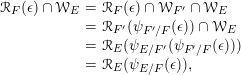 $$\begin{eqnarray}\begin{array}{@{}rcl@{}}\mathscr{R}_{F}(\unicode[STIX]{x1D716})\cap \mathscr{W}_{E}\ & =\ & \mathscr{R}_{F}(\unicode[STIX]{x1D716})\cap \mathscr{W}_{F^{\prime }}\cap \mathscr{W}_{E}\\ \ & =\ & \mathscr{R}_{F^{\prime }}(\unicode[STIX]{x1D713}_{F^{\prime }/F}(\unicode[STIX]{x1D716}))\cap \mathscr{W}_{E}\\ \ & =\ & \mathscr{R}_{E}(\unicode[STIX]{x1D713}_{E/F^{\prime }}(\unicode[STIX]{x1D713}_{F^{\prime }/F}(\unicode[STIX]{x1D716})))\\ \ & =\ & \mathscr{R}_{E}(\unicode[STIX]{x1D713}_{E/F}(\unicode[STIX]{x1D716})),\end{array}\end{eqnarray}$$
by induction on
 $[E\,:\,F]$
. The second assertion follows.◻
For a sharper result of this kind, see 1.9 Corollary 2 below.
1.5
Let
 $j_{\infty }(E|F)$
be the largest element of
 $J_{E/F}$
.
Proposition. Let
 $E/F$
be separable and totally wildly ramified. If
 $\bar{E}/F$
is the normal closure of
 $E/F$
, then
 $j_{\infty }(\bar{E}|F)=j_{\infty }(E|F)$
.
Proof. Let
 $K/F$
be a finite tame extension. The result then holds for
 $E/F$
if and only if it holds for
 $EK/K$
. We may therefore assume that
 $E/F$
is absolutely wildly ramified.
The relation
 $\unicode[STIX]{x1D713}_{\bar{E}/F}=\unicode[STIX]{x1D713}_{\bar{E}/E}\circ \unicode[STIX]{x1D713}_{E/F}$
implies that
 $$\begin{eqnarray}J_{\bar{E}/F}=J_{E/F}\cup \unicode[STIX]{x1D713}_{E/F}^{-1}(J_{\bar{E}/E}).\end{eqnarray}$$
We have to show that
 $j_{\infty }(E|F)$
is the largest element of this set. Set
 $\unicode[STIX]{x1D6E4}=\operatorname{Gal}(\bar{E}/F)$
and
 $\unicode[STIX]{x1D6E5}=\operatorname{Gal}(\bar{E}/E)$
. The definition of
 $\unicode[STIX]{x1D6E4}_{x}$
[Reference SerreSer68, IV § 1] gives
 $\unicode[STIX]{x1D6E5}_{x}=\unicode[STIX]{x1D6E4}_{x}\cap \unicode[STIX]{x1D6E5}$
, for all
 $x\geqslant 0$
. Let
 $k_{\infty }$
be the largest jump of
 $\unicode[STIX]{x1D6E4}$
in this numbering. Thus
 $\unicode[STIX]{x1D6E4}_{k_{\infty }}\neq \{1\}=\unicode[STIX]{x1D6E4}_{k_{\infty }+\unicode[STIX]{x1D700}}$
, for all
 $\unicode[STIX]{x1D700}>0$
. As
 $\bar{E}/F$
is the least Galois extension containing
 $E$
, so
 $\bigcap _{\unicode[STIX]{x1D6FE}\in \unicode[STIX]{x1D6E4}}\unicode[STIX]{x1D6FE}\unicode[STIX]{x1D6E5}\unicode[STIX]{x1D6FE}^{-1}=1$
. That is,
 $\unicode[STIX]{x1D6E5}$
has no non-trivial subgroup normal in
 $\unicode[STIX]{x1D6E4}$
. Since
 $\bar{E}/F$
is totally wildly ramified,
 $\unicode[STIX]{x1D6E4}_{k_{\infty }}$
is central in
 $\unicode[STIX]{x1D6E4}$
, so
 $\unicode[STIX]{x1D6E5}_{k_{\infty }}=\unicode[STIX]{x1D6E4}_{k_{\infty }}\cap \unicode[STIX]{x1D6E5}$
is normal in
 $\unicode[STIX]{x1D6E4}$
, whence
 $\unicode[STIX]{x1D6E5}_{k_{\infty }}=1$
. The largest jump of
 $\unicode[STIX]{x1D6E5}$
is therefore strictly less than
 $k_{\infty }$
. Translating back, the largest jump
 $j_{\infty }(\bar{E}|E)$
of
 $\unicode[STIX]{x1D713}_{\bar{E}/E}$
is strictly less than
 $\unicode[STIX]{x1D713}_{E/F}(j_{\infty }(E|F))$
.◻
1.6
Let
 $E/F$
be a finite separable extension. Denote by
 $d_{E/F}$
the differental exponent of
 $E/F$
: thus
 $\mathfrak{p}_{E}^{d_{E/F}}$
is the different of
 $E/F$
. Define the wild exponent
 $w_{E/F}$
of
 $E/F$
by
 $$\begin{eqnarray}w_{E/F}=d_{E/F}+1-e(E|F).\end{eqnarray}$$
We record, for use throughout the paper, some basic facts involving the wild exponent.
Lemma. Let
 $E/F$
be finite, with
 $E\subset \bar{F}$
.
(1) If
$F\subset K\subset E$
, then $$\begin{eqnarray}w_{E/F}=e(E|K)w_{K/F}+w_{E/K}.\end{eqnarray}$$
(2) If
$\unicode[STIX]{x1D70F}$
is an irreducible representation of
$\mathscr{W}_{E}$
, then In particular,$$\begin{eqnarray}\text{sw}(\operatorname{Ind}_{E/F}\,\unicode[STIX]{x1D70F})=(\text{sw}(\unicode[STIX]{x1D70F})+w_{E/F}\,\dim \unicode[STIX]{x1D70F})\,f(E|F).\end{eqnarray}$$
where$$\begin{eqnarray}w_{E/F}=\text{sw}(\operatorname{Ind}_{E/F}\,1_{E})/f(E|F),\end{eqnarray}$$
$1_{E}$
is the trivial character of
$\mathscr{W}_{E}$
.


Proof. Assertion (1) follows from the multiplicativity property of the different and a short calculation. Part (2) follows from the corresponding properties of the Artin exponent [Reference SerreSer68, ch. VI § 2]. ◻
The main business of the subsection concerns estimates relating the wild exponent
 $w_{E/F}$
to the largest jump
 $j_{\infty }(E|F)$
of
 $\unicode[STIX]{x1D713}_{E/F}$
.
Proposition. If
 $E/F$
is separable and totally wildly ramified of degree
 $p^{r}$
, then
 $$\begin{eqnarray}\unicode[STIX]{x1D713}_{E/F}(x)=p^{r}x-w_{E/F},\quad x\geqslant j_{\infty }(E|F).\end{eqnarray}$$
Proof. Let
 $K/F$
be tamely ramified with
 $e=e(K|F)$
. Thus
 $w_{EK/K}=e\,w_{E/F}$
by the lemma. The result therefore holds for
 $E/F$
if and only if it holds for
 $EK/K$
. Taking
 $K/F$
to be the maximal tame sub-extension of the normal closure of
 $E/F$
, we reduce to the case where
 $E/F$
is absolutely wildly ramified. Part (2) of 1.2 Proposition 1 implies that there is a constant
 $c_{E/F}$
such that
 $\unicode[STIX]{x1D713}_{E/F}(x)=p^{r}x-c_{E/F}$
, for
 $x\geqslant j_{\infty }(E|F)$
. We show that
 $c_{E/F}=w_{E/F}$
.
Let
 $F^{\prime }/F$
be a sub-extension of
 $E/F$
that is Galois of degree
 $p$
. In this case,
 $j_{\infty }(F^{\prime }|F)$
is the only jump of
 $\unicode[STIX]{x1D713}_{F^{\prime }/F}$
, and it equals
 $w_{F^{\prime }/F}/(p-1)$
[Reference SerreSer68, V § 3]. The proposition thus holds for
 $F^{\prime }/F$
. If
 $E/F$
is Galois, we may assume inductively that
 $c_{E/F^{\prime }}=w_{E/F^{\prime }}$
. So, taking
 $x$
sufficiently large, we get
 $$\begin{eqnarray}\displaystyle p^{r}x-c_{E/F} & = & \displaystyle \unicode[STIX]{x1D713}_{E/F^{\prime }}(\unicode[STIX]{x1D713}_{F^{\prime }/F}(x))=\unicode[STIX]{x1D713}_{E/F^{\prime }}(px-w_{F^{\prime }/F})\nonumber\\ \displaystyle & = & \displaystyle p^{r}x-p^{r-1}w_{F^{\prime }/F}-w_{E/F^{\prime }}=p^{r}x-w_{E/F},\nonumber\end{eqnarray}$$
by the lemma. Thus
 $c_{E/F}=w_{E/F}$
when
 $E/F$
is Galois.
Suppose that
 $E/F$
is not Galois. The normal closure
 $E^{\prime }/F$
of
 $E/F$
is totally wildly ramified by hypothesis. So, with
 $p^{s}=[E^{\prime }\,:\,F]$
and
 $x$
sufficiently large, we get
 $$\begin{eqnarray}\displaystyle \unicode[STIX]{x1D713}_{E^{\prime }/F}(x) & = & \displaystyle p^{s}x-w_{E^{\prime }/F}=\unicode[STIX]{x1D713}_{E^{\prime }/E}(\unicode[STIX]{x1D713}_{E/F}(x))\nonumber\\ \displaystyle & = & \displaystyle p^{s-r}(p^{r}x-c_{E/F})-w_{E^{\prime }/E}.\nonumber\end{eqnarray}$$
Thus
 $w_{E^{\prime }/F}=e(E^{\prime }|E)c_{E/F}-w_{E^{\prime }/E}$
, and the lemma implies
 $c_{E/F}=w_{E/F}$
.◻
Corollary. Let
 $E/F$
be totally wildly ramified of degree
 $p^{r}$
. If
 $j_{\infty }=j_{\infty }(E|F)$
is the largest jump of
 $\unicode[STIX]{x1D713}_{E/F}$
, then
 $$\begin{eqnarray}(p^{r}-1)j_{\infty }\geqslant w_{E/F}\geqslant p^{r-1}(p-1)j_{\infty }\geqslant p^{r}j_{\infty }/2.\end{eqnarray}$$
Moreover,
 $w_{E/F}=(p^{r}-1)j_{\infty }$
if and only if
 $j_{\infty }$
is the only jump of
 $\unicode[STIX]{x1D713}_{E/F}$
.
Proof. Since
 $\unicode[STIX]{x1D713}_{E/F}(x)\geqslant x$
for all
 $x\geqslant 0$
, the first inequality follows directly from the proposition, likewise the final remark.
Observe that
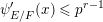 $\unicode[STIX]{x1D713}_{E/F}^{\prime }(x)\leqslant p^{r-1}$
, for all points
 $0<x<j_{\infty }$
at which the derivative is defined (1.2 Proposition 2). The function
 $\unicode[STIX]{x1D717}(x)=\unicode[STIX]{x1D713}_{E/F}(x)-p^{r-1}x$
is therefore decreasing on the interval
 $0<x<j_{\infty }$
. Thus
 $\unicode[STIX]{x1D717}(j_{\infty })\leqslant 0$
, or
 $p^{r}j_{\infty }-w_{E/F}\leqslant p^{r-1}j_{\infty }$
, as required.◻
1.7
If
 $E/F$
is a finite, purely inseparable extension, we set
 $\unicode[STIX]{x1D713}_{E/F}(x)=x$
,
 $x\geqslant 0$
. If
 $E/F$
is a finite extension, define
 $$\begin{eqnarray}\unicode[STIX]{x1D713}_{E/F}=\unicode[STIX]{x1D713}_{E/E_{0}}\circ \unicode[STIX]{x1D713}_{E_{0}/F}=\unicode[STIX]{x1D713}_{E_{0}/F},\end{eqnarray}$$
where
 $E_{0}/F$
is the maximal separable sub-extension of
 $E/F$
. Assuming
 $E\neq E_{0}$
, the derivative of
 $\unicode[STIX]{x1D713}_{E/F}$
satisfies
 $\unicode[STIX]{x1D713}_{E/F}^{\prime }(x)<[E\,:\,F]$
for all
 $x$
. We therefore set
 $j_{\infty }(E|F)=\infty$
when
 $E/F$
is not separable. With these definitions, all the results of 1.1–1.3, 1.5 and 1.6 remain valid.
1.8
We anticipate a phenomenon arising later on, in §§5 and 6.
Let
 $E/F$
be totally ramified of degree
 $p^{r}$
,
 $r\geqslant 1$
. Thus
 $E=F[\unicode[STIX]{x1D6FC}]$
, where
 $\unicode[STIX]{x1D6FC}$
is a root of an Eisenstein polynomial
 $f(X)=X^{p^{r}}+a_{1}X^{p^{r}-1}+\cdots +a_{p^{r}-1}X+a_{p^{r}}\in \mathfrak{o}_{F}[X]$
, and one has
 $d_{E/F}=\unicode[STIX]{x1D710}_{E}(f^{\prime }(\unicode[STIX]{x1D6FC}))$
.
Set
 $a_{0}=1$
. If
 $E/F$
is inseparable, the coefficient
 $a_{j}$
is zero unless
 $j\equiv 0\hspace{0.6em}({\rm mod}\hspace{0.2em}p)$
. Each term
 $(p^{r}-j)a_{j}\unicode[STIX]{x1D6FC}^{j-1}$
in
 $f^{\prime }(\unicode[STIX]{x1D6FC})$
vanishes, giving
 $d_{E/F}=w_{E/F}=\infty$
.
Proposition. Suppose
 $E/F$
is separable and totally ramified of degree
 $p^{r}$
. There is an integer
 $k$
such that
 $0\leqslant k\leqslant p^{r}-1$
, and
 $$\begin{eqnarray}d_{E/F}=\min _{0\leqslant j\leqslant p^{r}-1}\unicode[STIX]{x1D710}_{E}((p^{r}-j)a_{j}\unicode[STIX]{x1D6FC}^{j-1})\equiv k-1\hspace{0.6em}({\rm mod}\hspace{0.2em}p^{r}).\end{eqnarray}$$
In particular,
 $w_{E/F}\equiv k\hspace{0.6em}({\rm mod}\hspace{0.2em}p)$
. If
 $F$
has characteristic
 $p$
, then
 $k\not \equiv 0\hspace{0.6em}({\rm mod}\hspace{0.2em}p)$
.
Proof. For
 $0\leqslant j\leqslant p^{r}-1$
, the term
 $(p^{r}-j)a_{j}\unicode[STIX]{x1D6FC}^{j-1}$
is either zero or
 $$\begin{eqnarray}\unicode[STIX]{x1D710}_{E}((p^{r}-j)a_{j}\unicode[STIX]{x1D6FC}^{j-1})\equiv j-1\hspace{0.6em}({\rm mod}\hspace{0.2em}p^{r}).\end{eqnarray}$$
This gives the expression for
 $d_{E/F}$
. If
 $F$
has characteristic
 $p$
, any term with
 $j\equiv 0\hspace{0.6em}({\rm mod}\hspace{0.2em}p)$
has valuation
 $\infty$
and the second assertion follows.◻
If
 $F$
has characteristic zero, an Eisenstein polynomial
 $f(X)=X^{p}-a$
gives a field extension
 $E/F$
of degree
 $p$
such that
 $w_{E/F}\equiv 0\hspace{0.6em}({\rm mod}\hspace{0.2em}p)$
.
1.9
We prove a simple, but under-appreciated, result concerning absolutely wildly ramified extensions
 $E/F$
(1.2 Definition). It reappears naturally in the analysis of representations in § 9.
Let
 $E/F$
be a finite separable extension. As before, let
 $J_{E/F}$
be the set of jumps of the piecewise linear function
 $\unicode[STIX]{x1D713}_{E/F}$
. For
 $x>0$
, define
 $$\begin{eqnarray}w_{x}(E|F)=\lim _{\unicode[STIX]{x1D716}\rightarrow 0}\unicode[STIX]{x1D713}_{E/F}^{\prime }(x+\unicode[STIX]{x1D716})/\unicode[STIX]{x1D713}_{E/F}^{\prime }(x-\unicode[STIX]{x1D716}).\end{eqnarray}$$
By 1.2 Proposition 2,
 $w_{x}(E|F)$
is a non-negative power of
 $p$
while
 $w_{x}(E|F)>1$
if and only if
 $x\in J_{E/F}$
.
If
 $E/F$
is a finite Galois extension with
 $\operatorname{Gal}(E/F)=\unicode[STIX]{x1D6E4}$
, we use the notation
 $\unicode[STIX]{x1D6E4}^{y+}=\bigcup _{z>y}\unicode[STIX]{x1D6E4}^{z}$
, and similarly for the lower numbering.
Proposition. Let
 $E/F$
be separable and absolutely wildly ramified. Let
 $a$
be the least element of
 $J_{E/F}$
.
(1) The number
$a$
is an integer and there exists a character
$\unicode[STIX]{x1D712}$
of
$F^{\times }$
such that
$\text{sw}(\unicode[STIX]{x1D712})=a$
and
$\unicode[STIX]{x1D712}\circ \text{N}_{E/F}=1$
.(2) Let
$D=D_{(1)}(E|F)$
be the group of characters
$\unicode[STIX]{x1D712}$
of
$F^{\times }$
such that
$\text{sw}(\unicode[STIX]{x1D712})\leqslant a$
and
$\unicode[STIX]{x1D712}\circ \text{N}_{E/F}=1$
. All non-trivial elements of
$D$
have Swan exponent
$a$
, and
$D$
is elementary abelian of order
$w_{a}(E|F)$
.(3) If
$E_{1}/F$
is class field to the group
$D$
, then
$F\subset E_{1}\subset E$
,
$\unicode[STIX]{x1D713}_{E_{1}/F}(a)=a$
and $$\begin{eqnarray}J_{E/E_{1}}=\unicode[STIX]{x1D713}_{E_{1}/F}(J_{E/F})\smallsetminus \{a\}.\end{eqnarray}$$





Proof. We proceed by induction on
 $[E\,:\,F]$
. If
 $[E\,:\,F]=p$
then, since
 $E/F$
is absolutely wild, it is Galois and there is nothing to do. Assume, therefore, that
 $[E\,:\,F]\geqslant p^{2}$
. Since
 $E/F$
is absolutely wild, there is a Galois extension
 $F^{\prime }/F$
, of degree
 $p$
, contained in
 $E$
(1.2 Gloss). There is a character
 $\unicode[STIX]{x1D719}$
of
 $F^{\times }$
, of order
 $p$
, that vanishes on the group of norms from
 $F^{\prime }$
. Choose
 $F^{\prime }$
so as to minimize
 $\text{sw}(\unicode[STIX]{x1D719})$
. The integer
 $c=\text{sw}(\unicode[STIX]{x1D719})$
is a jump of
 $\unicode[STIX]{x1D713}_{E/F}$
(1.3 Proposition), so
 $c\geqslant a$
. We show that
 $c=a$
.
Suppose, for a contradiction, that
 $c>a$
. Thus
 $a=\unicode[STIX]{x1D713}_{F^{\prime }/F}(a)$
is a jump of
 $\unicode[STIX]{x1D713}_{E/F^{\prime }}$
and indeed its least jump. By inductive hypothesis,
 $a$
is an integer and there is a character
 $\unicode[STIX]{x1D712}$
of
 ${F^{\prime }}^{\times }$
such that
 $\unicode[STIX]{x1D712}\circ \text{N}_{E/F^{\prime }}=1$
. Since
 $c>a$
, there is a unique character
 $\unicode[STIX]{x1D712}_{1}$
of
 $F^{\times }$
such that
 $\unicode[STIX]{x1D712}=\unicode[STIX]{x1D712}_{1}\circ \text{N}_{F^{\prime }/F}$
. The character
 $\unicode[STIX]{x1D712}_{1}$
has order
 $p$
, while
 $\text{sw}(\unicode[STIX]{x1D712}_{1})=a$
and
 $\unicode[STIX]{x1D712}_{1}\circ \text{N}_{E/F}=1$
. The extension
 $F_{1}^{\prime }/F$
that is class field to
 $\unicode[STIX]{x1D712}_{1}$
has the properties required of
 $F^{\prime }/F$
but
 $\text{sw}(\unicode[STIX]{x1D712}_{1})<\text{sw}(\unicode[STIX]{x1D719})$
. This contradicts our hypothesis, and proves (1).
In (2), the group
 $D$
is an abelian
 $p$
-group, since
 $[E\,:\,F]$
is a power of
 $p$
. Let
 $\unicode[STIX]{x1D712}$
be a character of
 $F^{\times }$
and suppose that
 $\text{sw}(\unicode[STIX]{x1D712})=b$
,
 $1\leqslant b<a$
. Since
 $b\notin J_{E/F}$
,
 $\unicode[STIX]{x1D712}\circ \text{N}_{E/F}$
is not trivial by 1.3 Proposition, so
 $\unicode[STIX]{x1D712}\notin D$
. This proves the first assertion in (2). On the other hand, if
 $\unicode[STIX]{x1D712}\in D$
,
 $\unicode[STIX]{x1D712}\neq 1$
, then
 $\unicode[STIX]{x1D712}^{p}\in D$
and
 $\text{sw}(\unicode[STIX]{x1D712}^{p})<\text{sw}(\unicode[STIX]{x1D712})$
. Therefore
 $\unicode[STIX]{x1D712}^{p}=1$
and it follows that
 $D$
is elementary abelian.
To calculate the order of
 $D$
, we first use part (1) to choose
 $\unicode[STIX]{x1D712}\in D$
,
 $\unicode[STIX]{x1D712}\neq 1$
. Let
 $F^{\prime }/F$
be class field to
 $\unicode[STIX]{x1D712}$
. In particular,
 $F^{\prime }\subset E$
and
 $F^{\prime }/F$
is cyclic of degree
 $p$
. The Herbrand function
 $\unicode[STIX]{x1D713}_{F^{\prime }/F}$
has one jump, lying at
 $a$
, and
 $w_{a}(F^{\prime }|F)=p$
. Composition with
 $\text{N}_{F^{\prime }/F}$
gives a homomorphism
 $D_{(1)}(E|F)\rightarrow D_{(1)}(E|F^{\prime })$
with kernel of order
 $p$
, generated by
 $\unicode[STIX]{x1D712}$
. The function
 $\unicode[STIX]{x1D713}_{E/F^{\prime }}$
has no jump strictly less than
 $a$
, and
 $w_{a}(E|F^{\prime })=p^{-1}w_{a}(E|F)$
. If
 $w_{a}(E|F^{\prime })=1$
, then
 $D_{(1)}(E|F^{\prime })$
is trivial, whence
 $D_{(1)}(E|F)$
has order
 $p=w_{a}(E|F)$
. Assume therefore that
 $D_{(1)}(E|F)$
has order at least
 $p^{2}$
, whence
 $D_{(1)}(E|F^{\prime })$
has order at least
 $p$
.
Let
 $E_{1}^{\prime }/F^{\prime }$
be class field to the character group
 $D_{(1)}(E|F^{\prime })$
. Inductively, we can assume that
 $|D_{(1)}(E|F^{\prime })|=w_{a}(E|F^{\prime })$
, so
 $\unicode[STIX]{x1D713}_{E/E_{1}^{\prime }}$
has least jump strictly greater than
 $a$
. If
 $\unicode[STIX]{x1D6E5}=\operatorname{Gal}(F^{\prime }/F)$
, then
 $\unicode[STIX]{x1D6E5}=\unicode[STIX]{x1D6E5}^{a}=\unicode[STIX]{x1D6E5}_{a}$
. Thus
 $\unicode[STIX]{x1D6E5}$
acts trivially on
 $U_{F^{\prime }}^{1}/U_{F^{\prime }}^{1+a}$
. It follows that the extension
 $E_{1}^{\prime }/F$
is Galois, of degree
 $pw_{a}(E|F^{\prime })=w_{a}(E|F)$
and
 $\unicode[STIX]{x1D713}_{E_{1}^{\prime }/F}$
has a unique jump, lying at
 $a$
. Therefore
 $\operatorname{Gal}(E_{1}^{\prime }/F)$
is elementary abelian and class field to a subgroup of
 $D_{(1)}(E|F)$
. Comparing orders, this subgroup is the whole of
 $D_{(1)}(E|F)$
, so
 $E_{1}^{\prime }=E_{1}$
and
 $D_{(1)}(E|F)$
has order
 $w_{a}(E|F)$
.
This completes the proof of (2).
We now have
 $$\begin{eqnarray}\unicode[STIX]{x1D713}_{E_{1}/F}(x)=\left\{\begin{array}{@{}ll@{}}x, & 0\leqslant x\leqslant a,\\ a+p^{s}(x-a), & a\leqslant x,\end{array}\right.\end{eqnarray}$$
where
 $p^{s}=[E_{1}\,:\,F]=w_{a}(E|F)$
. The function
 $\unicode[STIX]{x1D713}_{E/E_{1}}$
has no jump
 $j$
such that
 $j<a$
. At
 $a=\unicode[STIX]{x1D713}_{E_{1}/F}(a)$
,
 $w_{a}(E|E_{1})=1=w_{a}(E|F)/w_{a}(E_{1}|F)$
, so
 $a\notin J_{E/E_{1}}$
. On the other hand, if
 $b>a$
, then
 $b$
is not a jump of
 $\unicode[STIX]{x1D713}_{E_{1}/F}$
and therefore
 $w_{\unicode[STIX]{x1D713}_{E_{1}/F}(b)}(E|E_{1})=w_{b}(E|F)$
. In other words,
 $b$
is a jump of
 $E/F$
if and only if
 $\unicode[STIX]{x1D713}_{E_{1}/F}(b)$
is a jump of
 $E/E_{1}$
. Part (3) follows immediately.◻
Corollary 1. Let
 $E/F$
be separable and absolutely wildly ramified. Let
 $$\begin{eqnarray}j_{1}<j_{2}<\cdots <j_{t}\end{eqnarray}$$
be the set of jumps of
 $\unicode[STIX]{x1D713}_{E/F}$
. There is a unique tower of fields
 $$\begin{eqnarray}F=E_{0}\subset E_{1}\subset E_{2}\subset \cdots \subset E_{t}=E\end{eqnarray}$$
with the following properties.
(1) For
$1\leqslant k\leqslant t$
, the extension
$E_{k}/E_{k-1}$
is elementary abelian of degree
$w_{j_{k}}(E|F)$
.(2) For
$1\leqslant k\leqslant t$
, the function
$\unicode[STIX]{x1D713}_{E_{k}/E_{k-1}}$
has a unique jump, namely
$\unicode[STIX]{x1D713}_{E_{k-1}/F}(j_{k})$
.


Proof. One applies the proposition to the absolutely wildly ramified extension
 $E/E_{1}$
and iterates.◻
We refer to the tower (1.9.2) as the elementary resolution of the absolutely wild extension
 $E/F$
. It gives a factorization
 $$\begin{eqnarray}\unicode[STIX]{x1D713}_{E/F}=\unicode[STIX]{x1D713}_{E_{t}/E_{t-1}}\circ \unicode[STIX]{x1D713}_{E_{t-1}/E_{t-2}}\circ \cdots \circ \unicode[STIX]{x1D713}_{E_{2}/E_{1}}\circ \unicode[STIX]{x1D713}_{E_{1}/F}\end{eqnarray}$$
in which each factor
 $\unicode[STIX]{x1D713}_{E_{k}/E_{k-1}}$
,
 $1\leqslant k\leqslant t$
, has exactly one jump.
We conclude with an application needed in § 10.
Corollary 2. Let
 $E/F$
be a finite separable extension that is not tamely ramified. If
 $j_{\infty }=j_{\infty }(E|F)$
is the largest jump of
 $\unicode[STIX]{x1D713}_{E/F}$
then
 $$\begin{eqnarray}j_{\infty }(E|F)=\operatorname{inf}\{x\in \mathbb{R}:\mathscr{R}_{F}(x)\subset \mathscr{W}_{E}\}.\end{eqnarray}$$
In particular,
 $\mathscr{W}_{E}$
contains
 $\mathscr{R}_{F}^{+}(j_{\infty })$
but not
 $\mathscr{R}_{F}(j_{\infty })$
.
Proof. The assertion is unaffected by tamely ramified base field extension, so we may assume that
 $E/F$
is absolutely wild. We use the notation of Corollary 1 and proceed by induction on the number,
 $t$
say, of jumps. If
 $t=1$
, then
 $E=E_{1}/F$
is elementary abelian with a single jump
 $j_{1}=j_{\infty }(E|F)$
. Every non-trivial character
 $\unicode[STIX]{x1D712}\in D_{(1)}(E|F)$
has Swan exponent
 $j_{1}$
and so is trivial on
 $\mathscr{R}_{F}^{+}(j_{1})$
, but not on
 $\mathscr{R}_{F}(j_{1})$
. Since
 $\mathscr{W}_{E}$
is the intersection of the kernels of all
 $\unicode[STIX]{x1D712}\in D_{(1)}(E|F)$
, the assertion follows.
So we take
 $t>1$
. Inductively we may assume that
 $$\begin{eqnarray}\operatorname{inf}\{x:\mathscr{R}_{E_{1}}(x)\subset \mathscr{W}_{E}\}=j_{\infty }(E|E_{1})=\unicode[STIX]{x1D713}_{E_{1}/F}(j_{\infty }(E|F)).\end{eqnarray}$$
For
 $x>j_{1}=\unicode[STIX]{x1D713}_{E_{1}/F}(j_{1})$
, we have
 $\mathscr{R}_{F}(x)=\mathscr{R}_{E_{1}}(\unicode[STIX]{x1D713}_{E_{1}/F}(x))$
by the first case and 1.4 Proposition. The assertion now follows.◻
2 Certain simple characters
The first part of this section provides a brief aide-mémoire for those facts and methods from [Reference Bushnell and HenniartBH96, Reference Bushnell and HenniartBH17, Reference Bushnell and KutzkoBK93] that will be used frequently. It relies on parts 2 and 3 of the introduction for background but is focused on the detail of the special cases with which we are concerned. The later §§2.4–2.7 give partial results concerning Herbrand functions in those special cases. The notation we set out here remains standard throughout the paper.
2.1
Let
 $\mathbf{\mathscr{E}}(F)$
be the set of endo-classes of simple characters over
 $F$
. When working with this set, we follow the scheme of [Reference Bushnell and HenniartBH17, 4.2] (apart from one minor adjustment of notation).
To each
 $\unicode[STIX]{x1D6E9}\in \mathbf{\mathscr{E}}(F)$
one attaches positive integer invariants
 $\deg \unicode[STIX]{x1D6E9}$
,
 $e_{\unicode[STIX]{x1D6E9}}$
and a non-negative rational invariant
 $\unicode[STIX]{x1D70D}_{\unicode[STIX]{x1D6E9}}$
. (In [Reference Bushnell and HenniartBH17],
 $\unicode[STIX]{x1D70D}_{\unicode[STIX]{x1D6E9}}$
is
 $m_{\unicode[STIX]{x1D6E9}}$
.) We will never be concerned with the case
 $\unicode[STIX]{x1D70D}_{\unicode[STIX]{x1D6E9}}=0$
, so assume
 $\unicode[STIX]{x1D70D}_{\unicode[STIX]{x1D6E9}}>0$
. Let
 $\unicode[STIX]{x1D707}_{F}$
be a character of
 $F$
of level one. By definition,
 $\unicode[STIX]{x1D707}_{F}$
is trivial on
 $\mathfrak{p}_{F}$
, but not trivial on
 $\mathfrak{o}_{F}$
. There exist a simple stratum
 $[\mathfrak{a},m,0,\unicode[STIX]{x1D6FD}]$
in a matrix ring
 $\text{M}_{n}(F)$
and a simple character
 $\unicode[STIX]{x1D703}\in \mathscr{C}(\mathfrak{a},0,\unicode[STIX]{x1D6FD},\unicode[STIX]{x1D707}_{F})$
of endo-class
 $\unicode[STIX]{x1D6E9}$
. (Here, we have used the full notation of [Reference Bushnell and KutzkoBK93, (3.2.1), (3.2.3)], but we almost invariably abbreviate it to
 $\mathscr{C}(\mathfrak{a},\unicode[STIX]{x1D6FD})$
.) The algebra
 $E=F[\unicode[STIX]{x1D6FD}]$
is a field and
 $$\begin{eqnarray}\deg \unicode[STIX]{x1D6E9}=[E\,:\,F],\quad e_{\unicode[STIX]{x1D6E9}}=e(E|F),\quad \unicode[STIX]{x1D70D}_{\unicode[STIX]{x1D6E9}}=m/e_{\mathfrak{a}},\end{eqnarray}$$
where
 $e_{\mathfrak{a}}$
is the
 $\mathfrak{o}_{F}$
-period of the hereditary
 $\mathfrak{o}_{F}$
-order
 $\mathfrak{a}$
. We shall say that
 $\unicode[STIX]{x1D703}$
is a realization of
 $\unicode[STIX]{x1D6E9}$
on
 $[\mathfrak{a},m,0,\unicode[STIX]{x1D6FD}]$
, and that
 $E/F$
is a parameter field for
 $\unicode[STIX]{x1D6E9}$
.
While
 $\deg \unicode[STIX]{x1D6E9}$
,
 $e_{\unicode[STIX]{x1D6E9}}$
and
 $\unicode[STIX]{x1D70D}_{\unicode[STIX]{x1D6E9}}$
are invariants of
 $\unicode[STIX]{x1D6E9}$
, there will often be many choices for the field extension
 $E/F$
, even up to isomorphism. The number
 $\unicode[STIX]{x1D70D}_{\unicode[STIX]{x1D6E9}}$
has a useful interpretation. If
 $\unicode[STIX]{x1D70B}\in \widehat{\operatorname{GL}}_{F}$
contains a simple character of endo-class
 $\unicode[STIX]{x1D6E9}$
, then, in the notation of the introduction,
 $\unicode[STIX]{x1D70D}_{\unicode[STIX]{x1D6E9}}=\text{sw}(\unicode[STIX]{x1D70B})/\text{gr}(\unicode[STIX]{x1D70B})$
.
Let
 $\unicode[STIX]{x1D70E}\in \widehat{\mathscr{W}}_{F}^{\text{wr}}$
. Thus
 $\unicode[STIX]{x1D70E}=^{\,\text{L}}\unicode[STIX]{x1D70B}$
, for some
 $\unicode[STIX]{x1D70B}\in \widehat{\operatorname{GL}}_{F}$
. If
 $\unicode[STIX]{x1D6E9}$
is the endo-class of a simple character contained in
 $\unicode[STIX]{x1D70B}$
, then
 $\text{sw}(\unicode[STIX]{x1D70E})=\text{sw}(\unicode[STIX]{x1D70B})$
and
 $$\begin{eqnarray}\text{sw}(\unicode[STIX]{x1D70E})/\dim \unicode[STIX]{x1D70E}=\text{sw}(\unicode[STIX]{x1D70B})/\text{gr}(\unicode[STIX]{x1D70B})=\unicode[STIX]{x1D70D}_{\unicode[STIX]{x1D6E9}}.\end{eqnarray}$$
2.2
Attached to
 $\unicode[STIX]{x1D6E9}\in \mathbf{\mathscr{E}}(F)$
is a structure function
 $\unicode[STIX]{x1D6F7}_{\unicode[STIX]{x1D6E9}}(x)$
,
 $x\geqslant 0$
, as defined in the introduction. It is given by the explicit formula (4.4.1) of [Reference Bushnell and HenniartBH17] which we do not need to repeat: for the special cases considered here, see (2.4.1) below. If
 $\unicode[STIX]{x1D70B}\in \widehat{\operatorname{GL}}_{F}$
contains a simple character of endo-class
 $\unicode[STIX]{x1D6E9}$
, the definition gives
 $$\begin{eqnarray}\unicode[STIX]{x1D6F7}_{\unicode[STIX]{x1D6E9}}(0)=\text{sw}(\check{\unicode[STIX]{x1D70B}}\times \unicode[STIX]{x1D70B})/\text{gr}(\unicode[STIX]{x1D70B})^{2}.\end{eqnarray}$$
Let
 $\unicode[STIX]{x1D70E}\in \widehat{\mathscr{W}}_{F}$
. The orbit
 $[\unicode[STIX]{x1D70E}]_{0}^{+}\in \mathscr{W}_{F}\backslash \widehat{\mathscr{P}}_{F}$
and the canonical map
 $\mathbf{\mathscr{E}}(F)\rightarrow \mathscr{W}_{F}\backslash \widehat{\mathscr{P}}_{F}$
,
 $\unicode[STIX]{x1D6E9}\mapsto ^{\,\text{L}}\unicode[STIX]{x1D6E9}$
, are as in the introduction.
Attached to
 $\unicode[STIX]{x1D70E}$
is a decomposition function
 $\unicode[STIX]{x1D6F4}_{\unicode[STIX]{x1D70E}}(x)$
,
 $x\geqslant 0$
, defined as follows [Reference Bushnell and HenniartBH17, (3.1.2)]. Let
 $\unicode[STIX]{x1D70E}$
act on the vector space
 $V$
, so that the semisimple representation
 $\check{\unicode[STIX]{x1D70E}}\otimes \unicode[STIX]{x1D70E}$
acts on
 $X=\check{V}\otimes V$
. For
 $\unicode[STIX]{x1D6FF}>0$
, let
 $X(\unicode[STIX]{x1D6FF})$
be the space of
 $\mathscr{R}_{F}^{+}(\unicode[STIX]{x1D6FF})$
-fixed points in
 $X$
. This has a unique
 $\mathscr{R}_{F}^{+}(\unicode[STIX]{x1D6FF})$
-complement
 $X^{\prime }(\unicode[STIX]{x1D6FF})$
in
 $X$
. The spaces
 $X(\unicode[STIX]{x1D6FF})$
,
 $X^{\prime }(\unicode[STIX]{x1D6FF})$
provide semisimple, smooth representations of
 $\mathscr{W}_{F}$
. One sets
 $$\begin{eqnarray}\unicode[STIX]{x1D6F4}_{\unicode[STIX]{x1D70E}}(\unicode[STIX]{x1D6FF})=(\dim \unicode[STIX]{x1D70E})^{-2}(\unicode[STIX]{x1D6FF}\dim X(\unicode[STIX]{x1D6FF})+\text{sw}\,X^{\prime }(\unicode[STIX]{x1D6FF})).\end{eqnarray}$$
The function
 $\unicode[STIX]{x1D6F4}_{\unicode[STIX]{x1D70E}}$
depends only on the orbit
 $[\unicode[STIX]{x1D70E}]_{0}^{+}\in \mathscr{W}_{F}\backslash \widehat{\mathscr{P}}_{F}$
.
Obviously,
 $\unicode[STIX]{x1D6F4}_{\unicode[STIX]{x1D70E}}(0)=\text{sw}(\check{\unicode[STIX]{x1D70E}}\otimes \unicode[STIX]{x1D70E})/(\dim \unicode[STIX]{x1D70E})^{2}$
. Let
 $\unicode[STIX]{x1D70E}=^{\,\text{L}}\unicode[STIX]{x1D70B}$
,
 $\unicode[STIX]{x1D70B}\in \widehat{\operatorname{GL}}_{F}$
, and let
 $\unicode[STIX]{x1D6E9}$
be the endo-class of a simple character contained in
 $\unicode[STIX]{x1D70B}$
. Since the Langlands correspondence preserves Swan exponents of pairs, we have
 $$\begin{eqnarray}\unicode[STIX]{x1D6F4}_{\unicode[STIX]{x1D70E}}(0)=\frac{\text{sw}(\check{\unicode[STIX]{x1D70E}}\otimes \unicode[STIX]{x1D70E})}{(\dim \unicode[STIX]{x1D70E})^{2}}=\frac{\text{sw}(\check{\unicode[STIX]{x1D70B}}\times \unicode[STIX]{x1D70B})}{\text{gr}(\unicode[STIX]{x1D70B})^{2}}=\unicode[STIX]{x1D6F7}_{\unicode[STIX]{x1D6E9}}(0).\end{eqnarray}$$
Definition 1. Let
 $\unicode[STIX]{x1D6E9}\in \mathbf{\mathscr{E}}(F)$
and let
 $\unicode[STIX]{x1D70E}\in \widehat{\mathscr{W}}_{F}$
satisfy
 $[\unicode[STIX]{x1D70E}]_{0}^{+}=^{\,\text{L}}\unicode[STIX]{x1D6E9}$
. Define the Herbrand function
 $\unicode[STIX]{x1D6F9}_{\unicode[STIX]{x1D6E9}}$
of
 $\unicode[STIX]{x1D6E9}$
by
 $\unicode[STIX]{x1D6F9}_{\unicode[STIX]{x1D6E9}}=\unicode[STIX]{x1D6F7}_{\unicode[STIX]{x1D6E9}}^{-1}\circ \unicode[STIX]{x1D6F4}_{\unicode[STIX]{x1D70E}}$
.
The function
 $\unicode[STIX]{x1D6F9}_{\unicode[STIX]{x1D6E9}}$
is continuous, strictly increasing and piecewise linear. It does not depend on the choice of
 $\unicode[STIX]{x1D70E}$
in its definition. It satisfies
 $\unicode[STIX]{x1D6F9}_{\unicode[STIX]{x1D6E9}}(0)=0$
and
 $\unicode[STIX]{x1D6F9}_{\unicode[STIX]{x1D6E9}}(x)=x$
for
 $x\geqslant \unicode[STIX]{x1D70D}_{\unicode[STIX]{x1D6E9}}$
.
Definition 2. A jump of
 $\unicode[STIX]{x1D6F9}_{\unicode[STIX]{x1D6E9}}$
is a point
 $x$
,
 $0<x<\unicode[STIX]{x1D70D}_{\unicode[STIX]{x1D6E9}}$
, at which
 $\unicode[STIX]{x1D6F9}_{\unicode[STIX]{x1D6E9}}^{\prime }$
is not continuous.
In many cases, the derivative
 $\unicode[STIX]{x1D6F9}_{\unicode[STIX]{x1D6E9}}^{\prime }$
has a discontinuity at
 $\unicode[STIX]{x1D70D}_{\unicode[STIX]{x1D6E9}}$
, but it holds no interest so we exclude it as a jump. The derivative
 $\unicode[STIX]{x1D6F9}_{\unicode[STIX]{x1D6E9}}^{\prime }$
takes only finitely many values, and the function
 $\unicode[STIX]{x1D6F9}_{\unicode[STIX]{x1D6E9}}$
has only finitely many jumps.
We often use the following property. Let
 $K/F$
be a finite, tamely ramified field extension and set
 $e=e(K|F)$
. Let
 $\unicode[STIX]{x1D6E9}^{K}\in \mathbf{\mathscr{E}}(K)$
be a
 $K/F$
-lift of
 $\unicode[STIX]{x1D6E9}$
[Reference Bushnell and HenniartBH96, 9.7]. By [Reference Bushnell and HenniartBH17, 7.1 Proposition],
 $$\begin{eqnarray}\unicode[STIX]{x1D6F9}_{\unicode[STIX]{x1D6E9}}(x)=\unicode[STIX]{x1D6F9}_{\unicode[STIX]{x1D6E9}^{K}}(ex)/e,\quad x\geqslant 0.\end{eqnarray}$$
In Galois-theoretic terms, if
 $\unicode[STIX]{x1D70E}\in \widehat{\mathscr{W}}_{F}$
and
 $[\unicode[STIX]{x1D70E}]_{0}^{+}=^{\,\text{L}}\unicode[STIX]{x1D6E9}$
, then
 $^{\,\text{L}}(\unicode[STIX]{x1D6E9}^{K})=[\unicode[STIX]{x1D70F}]_{0}^{+}\in \mathscr{W}_{K}\backslash \widehat{\mathscr{P}}_{K}$
, for some irreducible component
 $\unicode[STIX]{x1D70F}$
of
 $\unicode[STIX]{x1D70E}\,|\,\mathscr{W}_{K}$
: this follows from [Reference Bushnell and HenniartBH14b, 6.2 Proposition].
2.3
Let
 $\unicode[STIX]{x1D6E9}\in \mathbf{\mathscr{E}}(F)$
. Say that
 $\unicode[STIX]{x1D6E9}$
is totally wild if
 $\deg \unicode[STIX]{x1D6E9}=e_{\unicode[STIX]{x1D6E9}}=p^{r}$
, for an integer
 $r\geqslant 0$
. So if
 $\unicode[STIX]{x1D6E9}$
is totally wild and if
 $E/F$
is a parameter field for
 $\unicode[STIX]{x1D6E9}$
, then
 $E/F$
is totally ramified of degree
 $p^{r}$
. If
 $\unicode[STIX]{x1D6E9}$
is totally wild and
 $K/F$
is a finite tame extension, then
 $\unicode[STIX]{x1D6E9}$
has a unique
 $K/F$
-lift and that lift is totally wild.
Suppose that
 $\unicode[STIX]{x1D6E9}\in \mathbf{\mathscr{E}}(F)$
is totally wild of degree
 $p^{r}$
. Say that
 $\unicode[STIX]{x1D6E9}$
is of Carayol type if
 $r\geqslant 1$
and the integer
 $p^{r}\unicode[STIX]{x1D70D}_{\unicode[STIX]{x1D6E9}}$
is not divisible by
 $p$
(cf. [Reference CarayolCar84]).
Notation.
Let
 $\mathbf{\mathscr{E}}^{\text{C}}(F)$
denote the set of
 $\unicode[STIX]{x1D6E9}\in \mathbf{\mathscr{E}}(F)$
that are totally wild of Carayol type.
Let
 $\unicode[STIX]{x1D6E9}\in \mathbf{\mathscr{E}}^{\text{C}}(F)$
have degree
 $p^{r}$
. There is a simple stratum
 $[\mathfrak{a},m,0,\unicode[STIX]{x1D6FC}]$
in
 $M=\text{M}_{p^{r}}(F)$
carrying a realization of
 $\unicode[STIX]{x1D6E9}$
. We describe this following the definitions in [Reference Bushnell and KutzkoBK93, ch. 3]. The integer
 $m$
is
 $p^{r}\unicode[STIX]{x1D70D}_{\unicode[STIX]{x1D6E9}}$
, the field extension
 $E=F[\unicode[STIX]{x1D6FC}]/F$
is totally ramified of degree
 $p^{r}$
and
 $\mathfrak{a}$
is the unique hereditary
 $\mathfrak{o}_{F}$
-order in
 $M$
that is stable under conjugation by
 $E^{\times }$
. The integer
 $m=-\unicode[STIX]{x1D710}_{E}(\unicode[STIX]{x1D6FC})$
is not divisible by
 $p$
, so the element
 $\unicode[STIX]{x1D6FC}$
is minimal over
 $F$
, in the sense of [Reference Bushnell and KutzkoBK93, (1.4.14)]. We form the group
 $$\begin{eqnarray}H^{1}(\unicode[STIX]{x1D6FC},\mathfrak{a})=U_{E}^{1}\,U_{\mathfrak{ a}}^{1+[m/2]}.\end{eqnarray}$$
Set
 $\unicode[STIX]{x1D707}_{M}=\unicode[STIX]{x1D707}_{F}\circ \text{tr}_{M}$
, where
 $\text{tr}_{M}:M\rightarrow F$
is the matrix trace. Define a function
 $\unicode[STIX]{x1D707}_{M}\ast \unicode[STIX]{x1D6FC}$
on
 $M$
by
 $$\begin{eqnarray}\unicode[STIX]{x1D707}_{M}\ast \unicode[STIX]{x1D6FC}(x)=\unicode[STIX]{x1D707}_{M}(\unicode[STIX]{x1D6FC}(x-1)),\quad x\in M.\end{eqnarray}$$
In particular,
 $\unicode[STIX]{x1D707}_{M}\ast \unicode[STIX]{x1D6FC}$
represents a character of the group
 $U_{\mathfrak{a}}^{1+[m/2]}$
. It is trivial on
 $U_{\mathfrak{a}}^{1+m}$
but non-trivial on
 $U_{\mathfrak{a}}^{m}$
. The set
 $\mathscr{C}(\mathfrak{a},\unicode[STIX]{x1D6FC})=\mathscr{C}(\mathfrak{a},0,\unicode[STIX]{x1D6FC},\unicode[STIX]{x1D707}_{M})$
consists of all characters
 $\unicode[STIX]{x1D717}$
of
 $H^{1}(\unicode[STIX]{x1D6FC},\mathfrak{a})$
such that
 $\unicode[STIX]{x1D717}\,\big|\,U_{\mathfrak{a}}^{1+[m/2]}=\unicode[STIX]{x1D707}_{M}\ast \unicode[STIX]{x1D6FC}\,\big|\,U_{\mathfrak{a}}^{1+[m/2]}$
. By hypothesis, there exists
 $\unicode[STIX]{x1D703}\in \mathscr{C}(\mathfrak{a},\unicode[STIX]{x1D6FC})$
of endo-class
 $\unicode[STIX]{x1D6E9}$
.
Remarks.
(1) The endo-class of any
$\unicode[STIX]{x1D717}\in \mathscr{C}(\mathfrak{a},\unicode[STIX]{x1D6FC})$
is totally wild of Carayol type.(2) Characters
$\unicode[STIX]{x1D717}_{1},\unicode[STIX]{x1D717}_{2}\in \mathscr{C}(\mathfrak{a},\unicode[STIX]{x1D6FC})$
are endo-equivalent if and only if they are equal; this follows from [Reference Bushnell and KutzkoBK93] (3.3.2) and is peculiar to this situation.(3) In the same vein, let
$t$
be an integer,
$0\leqslant t\leqslant [m/2]$
. The restricted characters
$\unicode[STIX]{x1D717}_{i}\,|\,H^{1+t}(\unicode[STIX]{x1D6FC},\mathfrak{a})$
intertwine if and only if they are equal.




In (3),
 $H^{1+t}(\unicode[STIX]{x1D6FC},\mathfrak{a})$
means
 $H^{1}(\unicode[STIX]{x1D6FC},\mathfrak{a})\cap U_{\mathfrak{a}}^{1+t}$
.
2.4
We specialize to the case of
 $\unicode[STIX]{x1D6E9}\in \mathbf{\mathscr{E}}^{\text{C}}(F)$
.
Proposition. Let
 $\unicode[STIX]{x1D6E9}\in \mathbf{\mathscr{E}}^{\text{C}}(F)$
have degree
 $p^{r}$
. Choose
 $\unicode[STIX]{x1D70E}\in \widehat{\mathscr{W}}_{F}$
such that
 $[\unicode[STIX]{x1D70E}]_{0}^{+}=^{\,\text{L}}\unicode[STIX]{x1D6E9}$
.
(1) The function
$\unicode[STIX]{x1D6F7}_{\unicode[STIX]{x1D6E9}}$
satisfies (2.4.1)$$\begin{eqnarray}\unicode[STIX]{x1D6F7}_{\unicode[STIX]{x1D6E9}}(x)=\left\{\begin{array}{@{}ll@{}}\unicode[STIX]{x1D6F7}_{\unicode[STIX]{x1D6E9}}(0)+p^{-r}x,\quad & 0\leqslant x\leqslant \unicode[STIX]{x1D70D}_{\unicode[STIX]{x1D6E9}},\\ x,\quad & x\leqslant \unicode[STIX]{x1D70D}_{\unicode[STIX]{x1D6E9}}.\end{array}\right.\end{eqnarray}$$
(2)
$\unicode[STIX]{x1D6F9}_{\unicode[STIX]{x1D6E9}}(0)=0$
and
$\unicode[STIX]{x1D6F9}_{\unicode[STIX]{x1D6E9}}(x)=x$
, for
$x\geqslant \unicode[STIX]{x1D70D}_{\unicode[STIX]{x1D6E9}}$
.(3) There exists
$\unicode[STIX]{x1D700}>0$
such that $$\begin{eqnarray}\unicode[STIX]{x1D6F9}_{\unicode[STIX]{x1D6E9}}^{\prime }(x)=\left\{\begin{array}{@{}ll@{}}p^{-r},\quad & 0<x<\unicode[STIX]{x1D700},\\ p^{r},\quad & \unicode[STIX]{x1D70D}_{\unicode[STIX]{x1D6E9}}-\unicode[STIX]{x1D700}<x<\unicode[STIX]{x1D70D}_{\unicode[STIX]{x1D6E9}}.\end{array}\right.\end{eqnarray}$$
(4) The function
$\unicode[STIX]{x1D6F9}_{\unicode[STIX]{x1D6E9}}$
is convex in the region
$0<x<\unicode[STIX]{x1D70D}_{\unicode[STIX]{x1D6E9}}$
.(5) If
$0<x<\unicode[STIX]{x1D70D}_{\unicode[STIX]{x1D6E9}}$
, then
$0<\unicode[STIX]{x1D6F9}_{\unicode[STIX]{x1D6E9}}(x)<x$
.(6) The jumps of
$\unicode[STIX]{x1D6F9}_{\unicode[STIX]{x1D6E9}}$
are the discontinuities of
$\unicode[STIX]{x1D6F4}_{\unicode[STIX]{x1D70E}}^{\prime }(x)$
.(7) If
$\unicode[STIX]{x1D70D}_{\unicode[STIX]{x1D6E9}}=m/p^{r}$
then (2.4.2)$$\begin{eqnarray}\unicode[STIX]{x1D6F7}_{\unicode[STIX]{x1D6E9}}(0)=\unicode[STIX]{x1D6F4}_{\unicode[STIX]{x1D70E}}(0)=m(p^{r}-1)/p^{2r}.\end{eqnarray}$$


Proof. Part (1) is the definition (4.4.1) in [Reference Bushnell and HenniartBH17], and part (2) has already been noted. Part (3) is an instance of [Reference Bushnell and HenniartBH17, 7.6 Proposition]. The function
 $\unicode[STIX]{x1D6F4}_{\unicode[STIX]{x1D70E}}$
is convex (2.2.2), and so (4) follows from (1). Part (5) now follows from (4) and (3). Part (6) follows from (1). Part (7) follows from (2.2.1) and [Reference Bushnell and HenniartBH17, 4.1 Proposition].◻
2.5
Key arguments will rely on the Interpolation Theorem of [Reference Bushnell and HenniartBH17, 7.5]. We give an overview of that result, as it applies to
 $\unicode[STIX]{x1D6E9}\in \mathbf{\mathscr{E}}^{\text{C}}(F)$
.
Definition. A twisting datum over
 $F$
is a triple
 $(k,c,\unicode[STIX]{x1D712})$
in which
(1)
$k\geqslant 1$
is an integer;(2)
$c$
is an element of
$F$
such that
$\unicode[STIX]{x1D710}_{F}(c)=-k$
;(3)
$\unicode[STIX]{x1D712}$
is a character of
$F^{\times }$
, of Swan exponent
$k$
, such that $$\begin{eqnarray}\unicode[STIX]{x1D712}(x)=\unicode[STIX]{x1D707}_{F}\ast c(x),\quad x\in U_{F}^{1+[k/2]}.\end{eqnarray}$$


Let
 $\unicode[STIX]{x1D6E9}\in \mathbf{\mathscr{E}}^{\text{C}}(F)$
have degree
 $p^{r}$
. Suppose that
 $\unicode[STIX]{x1D6E9}$
is the endo-class of
 $\unicode[STIX]{x1D703}\in \mathscr{C}(\mathfrak{a},\unicode[STIX]{x1D6FC})$
, exactly as in 2.3. If
 $(k,c,\unicode[STIX]{x1D712})$
is a twisting datum over
 $F$
, the character
 $\unicode[STIX]{x1D712}\circ \det$
of
 $\operatorname{GL}_{p^{r}}(F)$
satisfies
 $$\begin{eqnarray}\unicode[STIX]{x1D712}(\det x)=\unicode[STIX]{x1D707}_{M}\ast c(x),\quad x\in U_{\mathfrak{a}}^{1+[p^{r}k/2]}.\end{eqnarray}$$
Following the discussion in [Reference Bushnell and HenniartBH17, 7.4], the quadruple
 $[\mathfrak{a},m,0,\unicode[STIX]{x1D6FC}+c]$
is a simple stratum in
 $M$
, such that
 $H^{1}(\unicode[STIX]{x1D6FC}+c,\mathfrak{a})=H^{1}(\unicode[STIX]{x1D6FC},\mathfrak{a})$
. The character
 $\unicode[STIX]{x1D712}\unicode[STIX]{x1D703}:x\mapsto \unicode[STIX]{x1D712}(\det x)\unicode[STIX]{x1D703}(x)$
,
 $x\in H^{1}(\unicode[STIX]{x1D6FC},\mathfrak{a})$
, lies in
 $\mathscr{C}(\mathfrak{a},\unicode[STIX]{x1D6FC}+c)$
. Denote by
 $\unicode[STIX]{x1D712}\unicode[STIX]{x1D6E9}$
the endo-class of
 $\unicode[STIX]{x1D712}\unicode[STIX]{x1D703}$
.
Let
 $\mathbb{A}$
be the ultrametric on
 $\mathbf{\mathscr{E}}(F)$
defined in [Reference Bushnell and HenniartBH17, 5.1] (see also the Notes below). We first give a preliminary version of the result, which follows from [Reference Bushnell and HenniartBH17, 7.3 Proposition].
Proposition 1. Let
 $k\geqslant 1$
be an integer that is not a jump of
 $\unicode[STIX]{x1D6F9}_{\unicode[STIX]{x1D6E9}}$
. If
 $(k,c,\unicode[STIX]{x1D712})$
is a twisting datum over
 $F$
, then
 $\unicode[STIX]{x1D6F9}_{\unicode[STIX]{x1D6E9}}(k)=\mathbb{A}(\unicode[STIX]{x1D712}\unicode[STIX]{x1D6E9},\unicode[STIX]{x1D6E9})$
. In particular,
 $\mathbb{A}(\unicode[STIX]{x1D712}\unicode[STIX]{x1D6E9},\unicode[STIX]{x1D6E9})$
depends only on
 $k$
, but not on
 $c$
or
 $\unicode[STIX]{x1D712}$
.
Notes.
(1) In the context of the proposition,
$\mathbb{A}(\unicode[STIX]{x1D712}\unicode[STIX]{x1D6E9},\unicode[STIX]{x1D6E9})=t/p^{r}$
, where
$t$
is the least integer such that the characters
$\unicode[STIX]{x1D703}\,|\,H^{1+t}(\unicode[STIX]{x1D6FC},\mathfrak{a})$
,
$\unicode[STIX]{x1D712}\unicode[STIX]{x1D703}\,|\,H^{1+t}(\unicode[STIX]{x1D6FC},\mathfrak{a})$
intertwine in
$\operatorname{GL}_{p^{r}}(F)$
; that is the definition of
$\mathbb{A}$
in this case.(2) The characters
$\unicode[STIX]{x1D703}\,|\,H^{1+t}(\unicode[STIX]{x1D6FC},\mathfrak{a})$
,
$\unicode[STIX]{x1D712}\unicode[STIX]{x1D703}\,|\,H^{1+t}(\unicode[STIX]{x1D6FC},\mathfrak{a})$
intertwine in
$\operatorname{GL}_{p^{r}}(F)$
if and only if they are conjugate in
$\operatorname{GL}_{p^{r}}(F)$
[Reference Bushnell and KutzkoBK93, (3.5.11)]. If this holds, the conjugation can be implemented by an element of
$U_{\mathfrak{a}}^{1}$
.(3) When
$k$
is a jump of
$\unicode[STIX]{x1D6F9}_{\unicode[STIX]{x1D6E9}}$
,
$\mathbb{A}(\unicode[STIX]{x1D712}\unicode[STIX]{x1D6E9},\unicode[STIX]{x1D6E9})$
may depend on
$\unicode[STIX]{x1D712}$
, not only on
$k$
.



We recall more about the notion of tame lifting, as it applies to
 $\unicode[STIX]{x1D6E9}\in \mathbf{\mathscr{E}}^{\text{C}}(F)$
. Let
 $K/F$
be a finite, tamely ramified field extension with
 $e(K|F)=e$
. We form simple characters over
 $K$
relative to the character
 $\unicode[STIX]{x1D707}_{K}=\unicode[STIX]{x1D707}_{F}\circ \text{Tr}_{K/F}$
of
 $K$
. There is a unique simple stratum in
 $\text{M}_{p^{r}}(K)$
of the form
 $[\mathfrak{a}^{K},em,0,\unicode[STIX]{x1D6FC}]$
. Setting
 $EK=K[\unicode[STIX]{x1D6FC}]\subset \text{M}_{p^{r}}(K)$
, there is a unique
 $\unicode[STIX]{x1D703}^{K}\in \mathscr{C}(\mathfrak{a}^{K},\unicode[STIX]{x1D6FC})$
such that
 $\unicode[STIX]{x1D703}^{K}(x)=\unicode[STIX]{x1D703}(\text{N}_{EK/E}(x))$
,
 $x\in U_{EK}^{1}$
. The endo-class
 $\unicode[STIX]{x1D6E9}^{K}$
of
 $\unicode[STIX]{x1D703}^{K}$
lies in
 $\mathbf{\mathscr{E}}^{\text{C}}(K)$
and is the unique
 $K/F$
-lift of
 $\unicode[STIX]{x1D6E9}$
. Combining Proposition 1 with (2.2.3), we obtain the following result.
Proposition 2. Let
 $K/F$
be a finite tame extension with
 $e=e(K|F)$
, and let
 $\mathbb{A}_{K}$
be the canonical ultrametric on
 $\mathbf{\mathscr{E}}(K)$
. Let
 $k\geqslant 1$
be an integer such that
 $k/e$
is not a jump of
 $\unicode[STIX]{x1D6F9}_{\unicode[STIX]{x1D6E9}}$
. If
 $(k,c,\unicode[STIX]{x1D712})$
is a twisting datum over
 $K$
, then
 $$\begin{eqnarray}\unicode[STIX]{x1D6F9}_{\unicode[STIX]{x1D6E9}}(k/e)=\unicode[STIX]{x1D6F9}_{\unicode[STIX]{x1D6E9}^{K}}(k)/e=\mathbb{A}_{K}(\unicode[STIX]{x1D712}\unicode[STIX]{x1D6E9}^{K},\unicode[STIX]{x1D6E9}^{K})/e.\end{eqnarray}$$
Proposition 2 summarizes the Interpolation Theorem.
2.6
Again let
 $\unicode[STIX]{x1D6E9}\in \mathbf{\mathscr{E}}^{\text{C}}(F)$
be of degree
 $p^{r}$
. Choose a simple stratum
 $[\mathfrak{a},m,0,\unicode[STIX]{x1D6FC}]$
in
 $M=\text{M}_{p^{r}}(F)$
carrying a realization
 $\unicode[STIX]{x1D703}\in \mathscr{C}(\mathfrak{a},\unicode[STIX]{x1D6FC})$
of
 $\unicode[STIX]{x1D6E9}$
(as in 2.3). We use the Interpolation Theorem to determine
 $\unicode[STIX]{x1D6F9}_{\unicode[STIX]{x1D6E9}}$
on half of (the interesting part of) its domain.
Proposition. Writing
 $E=F[\unicode[STIX]{x1D6FC}]/F$
, the Herbrand function
 $\unicode[STIX]{x1D6F9}_{\unicode[STIX]{x1D6E9}}$
satisfies
 $$\begin{eqnarray}\unicode[STIX]{x1D6F9}_{\unicode[STIX]{x1D6E9}}(x)=p^{-r}\,\unicode[STIX]{x1D713}_{E/F}(x),\quad 0\leqslant x\leqslant \unicode[STIX]{x1D70D}_{\unicode[STIX]{x1D6E9}}/2,\end{eqnarray}$$
where
 $\unicode[STIX]{x1D713}_{E/F}$
is the classical Herbrand function of 1.1, 1.7.
Proof. Let
 $k$
be an integer,
 $0<k<\unicode[STIX]{x1D70D}_{\unicode[STIX]{x1D6E9}}/2$
, which is not a jump of either function
 $\unicode[STIX]{x1D713}_{E/F}$
,
 $\unicode[STIX]{x1D6F9}_{\unicode[STIX]{x1D6E9}}$
. Let
 $(k,\unicode[STIX]{x1D712},c)$
be a twisting datum over
 $F$
. The character
 $\unicode[STIX]{x1D712}\circ \det$
of
 $\operatorname{GL}_{p^{r}}(F)$
is trivial on
 $U_{\mathfrak{a}}^{1+p^{r}k}$
. Since
 $p^{r}k\leqslant [m/2]$
, it is also trivial on the group
 $U_{\mathfrak{a}}^{1+[m/2]}$
. The character
 $\unicode[STIX]{x1D712}\unicode[STIX]{x1D703}:y\mapsto \unicode[STIX]{x1D712}(\det y)\unicode[STIX]{x1D703}(y)$
,
 $y\in H^{1}(\unicode[STIX]{x1D6FC},\mathfrak{a})$
, thus lies in
 $\mathscr{C}(\mathfrak{a},\unicode[STIX]{x1D6FC})$
(2.3). The characters
 $\unicode[STIX]{x1D712}\unicode[STIX]{x1D703}$
,
 $\unicode[STIX]{x1D703}$
intertwine on a group
 $H^{1+t}(\unicode[STIX]{x1D6FC},\mathfrak{a})=H^{1}(\unicode[STIX]{x1D6FC},\mathfrak{a})\,\cap \,U_{\mathfrak{a}}^{1+t}$
,
 $t\geqslant 0$
, if and only if they are equal there (2.3 Remark (3)). So, recalling 2.5 Note 1,
 $\mathbb{A}(\unicode[STIX]{x1D6E9},\unicode[STIX]{x1D712}\unicode[STIX]{x1D6E9})=t/p^{r}$
where
 $t$
is the least non-negative integer such that
 $\unicode[STIX]{x1D712}\circ \det$
is trivial on
 $U_{E}^{1+t}$
. We have
 $\unicode[STIX]{x1D712}\circ \det (y)=\unicode[STIX]{x1D712}\circ \text{N}_{E/F}(y)$
,
 $y\in E^{\times }$
. That
 $k$
is not a jump of
 $\unicode[STIX]{x1D713}_{E/F}$
implies
 $t=\unicode[STIX]{x1D713}_{E/F}(k)$
(1.3 Proposition) and the result follows from 2.5 Proposition 1 in this case.
In general, it is enough to prove the desired identity on a dense set of points
 $x$
satisfying
 $0<x<\unicode[STIX]{x1D70D}_{\unicode[STIX]{x1D6E9}}/2$
. Take
 $x=a/b$
, for positive integers
 $a$
and
 $b$
with
 $b$
not divisible by
 $p$
. Assume that
 $x$
is not a jump of
 $\unicode[STIX]{x1D713}_{E/F}$
or
 $\unicode[STIX]{x1D6F9}_{\unicode[STIX]{x1D6E9}}$
. Let
 $K/F$
be a finite, tamely ramified field extension with
 $e(K|F)=b$
. If
 $\unicode[STIX]{x1D6E9}^{K}$
is the unique
 $K/F$
-lift of
 $\unicode[STIX]{x1D6E9}$
, then
 $bx$
is not a jump of
 $\unicode[STIX]{x1D713}_{EK/K}$
or
 $\unicode[STIX]{x1D6F9}_{\unicode[STIX]{x1D6E9}^{K}}$
. The first case of the argument, 2.5 Proposition 2 and 1.1 Lemma together yield
 $$\begin{eqnarray}\unicode[STIX]{x1D6F9}_{\unicode[STIX]{x1D6E9}}(x)=\unicode[STIX]{x1D6F9}_{\unicode[STIX]{x1D6E9}^{K}}(a)/b=p^{-r}\unicode[STIX]{x1D713}_{EK/K}(a)/b=p^{-r}\unicode[STIX]{x1D713}_{E/F}(x),\end{eqnarray}$$
as required. ◻
Remark.
In the context of the proposition, there is no reason to demand that
 $E/F$
be separable. This condition can be imposed, at the cost of a technical argument, but it is easier and more natural to extend the definition of the classical Herbrand function as in 1.7.
2.7
Remaining in the situation of 2.6, we refine the other part of 2.4 Proposition (3). We use the concept of formal intertwining of strata (as in [Reference Bushnell and KutzkoBK93, 2.6]).
Proposition. Let
 $k$
be an integer,
 $0<k<\unicode[STIX]{x1D70D}_{\unicode[STIX]{x1D6E9}}$
, which is not a jump of
 $\unicode[STIX]{x1D6F9}_{\unicode[STIX]{x1D6E9}}$
. Let
 $t=p^{r}\unicode[STIX]{x1D6F9}_{\unicode[STIX]{x1D6E9}}(k)$
. If
 $2t>m$
, then
 $t$
is the least integer such that the strata
 $[\mathfrak{a},m,t,\unicode[STIX]{x1D6FC}]$
,
 $[\mathfrak{a},m,t,\unicode[STIX]{x1D6FC}+c]$
intertwine formally.
Proof. Let
 $l$
be an integer such that
 $2l>m$
. We have
 $$\begin{eqnarray}\left.\begin{array}{@{}rcl@{}}\unicode[STIX]{x1D703}(x)\ & =\ & \unicode[STIX]{x1D707}_{M}\ast \unicode[STIX]{x1D6FC}(x),\\ \unicode[STIX]{x1D712}\unicode[STIX]{x1D703}(x)\ & =\ & \unicode[STIX]{x1D707}_{M}\ast (\unicode[STIX]{x1D6FC}+c)(x),\end{array}\right\}\quad x\in H^{1+l}(\unicode[STIX]{x1D6FC},\mathfrak{a})=U_{\mathfrak{ a}}^{1+l}.\end{eqnarray}$$
In this situation, an element
 $g$
of
 $\operatorname{GL}_{p^{r}}(F)$
intertwines
 $\unicode[STIX]{x1D703}\,|\,U_{\mathfrak{a}}^{1+l}$
with
 $\unicode[STIX]{x1D712}\unicode[STIX]{x1D703}\,|\,U_{\mathfrak{a}}^{1+l}$
if and only if
 $g^{-1}(\unicode[STIX]{x1D6FC}+\mathfrak{p}^{-l})g\,\cap \,(\unicode[STIX]{x1D6FC}+c+\mathfrak{p}^{-l})\neq \emptyset$
, that is,
 $g$
intertwines the strata
 $[\mathfrak{a},m,l,\unicode[STIX]{x1D6FC}]$
,
 $[\mathfrak{a},m,l,\unicode[STIX]{x1D6FC}+c]$
formally. The result thus follows from 2.5 Proposition 1.◻
3 Functional equation
Let
 $\unicode[STIX]{x1D6E9}\in \mathbf{\mathscr{E}}^{\text{C}}(F)$
(2.3 Notation) be of degree
 $p^{r}$
. In particular,
 $r\geqslant 1$
. In this section, we uncover a profound and surprising property of the function
 $\unicode[STIX]{x1D6F9}_{\unicode[STIX]{x1D6E9}}$
.
3.1
The main result is the following theorem.
Theorem. Let
 $\unicode[STIX]{x1D6E9}\in \mathbf{\mathscr{E}}^{\text{C}}(F)$
be of degree
 $p^{r}$
,
 $r\geqslant 1$
. The Herbrand function
 $\unicode[STIX]{x1D6F9}_{\unicode[STIX]{x1D6E9}}$
satisfies
 $$\begin{eqnarray}\unicode[STIX]{x1D70D}_{\unicode[STIX]{x1D6E9}}-x=\unicode[STIX]{x1D6F9}_{\unicode[STIX]{x1D6E9}}(\unicode[STIX]{x1D70D}_{\unicode[STIX]{x1D6E9}}-\unicode[STIX]{x1D6F9}_{\unicode[STIX]{x1D6E9}}(x)),\quad 0\leqslant x\leqslant \unicode[STIX]{x1D70D}_{\unicode[STIX]{x1D6E9}}.\end{eqnarray}$$
For many arguments, it is convenient to have an alternative formulation of (3.1.1).
Symmetry. The function
 $\unicode[STIX]{x1D6F9}_{\unicode[STIX]{x1D6E9}}$
satisfies
 $0\leqslant \unicode[STIX]{x1D6F9}_{\unicode[STIX]{x1D6E9}}(x)\leqslant x$
, for
 $0\leqslant x\leqslant \unicode[STIX]{x1D70D}_{\unicode[STIX]{x1D6E9}}$
. In that range, the graph
 $y=\unicode[STIX]{x1D6F9}_{\unicode[STIX]{x1D6E9}}(x)$
is symmetric with respect to the line
 $x+y=\unicode[STIX]{x1D70D}_{\unicode[STIX]{x1D6E9}}$
.
The first assertion here is 2.4 Proposition (5). Reflection in the line
 $x+y=\unicode[STIX]{x1D70D}_{\unicode[STIX]{x1D6E9}}$
is the map

so the two formulations are indeed equivalent.
Before embarking on the proof of (3.1.1), we observe that it has a converse. As recalled in 2.5, the set
 $\mathbf{\mathscr{E}}(F)$
carries a canonical action
 $(\unicode[STIX]{x1D712},\unicode[STIX]{x1D6E9})\mapsto \unicode[STIX]{x1D712}\unicode[STIX]{x1D6E9}$
of the group of characters
 $\unicode[STIX]{x1D712}$
of
 $U_{F}^{1}$
. It has the property
 $\unicode[STIX]{x1D6F9}_{\unicode[STIX]{x1D712}\unicode[STIX]{x1D6E9}}=\unicode[STIX]{x1D6F9}_{\unicode[STIX]{x1D6E9}}$
[Reference Bushnell and HenniartBH17, 7.4 Proposition].
Corollary. Let
 $\unicode[STIX]{x1D6E9}\in \mathbf{\mathscr{E}}(F)$
be totally wild, with
 $\deg \unicode[STIX]{x1D6E9}=p^{r}$
,
 $r\geqslant 1$
. Suppose that
 $\unicode[STIX]{x1D70D}_{\unicode[STIX]{x1D6E9}}\leqslant \unicode[STIX]{x1D70D}_{\unicode[STIX]{x1D712}\unicode[STIX]{x1D6E9}}$
, for all characters
 $\unicode[STIX]{x1D712}$
of
 $U_{F}^{1}$
. The function
 $\unicode[STIX]{x1D6F9}_{\unicode[STIX]{x1D6E9}}$
satisfies (3.1.1) if and only if
 $\unicode[STIX]{x1D6E9}\in \mathbf{\mathscr{E}}^{\text{C}}(F)$
.
Proof. The hypothesis on
 $\unicode[STIX]{x1D6E9}$
is equivalent to
 $\unicode[STIX]{x1D70D}_{\unicode[STIX]{x1D6E9}}=ap^{t-r}$
, for integers
 $a\not \equiv 0\hspace{0.6em}({\rm mod}\hspace{0.2em}p)$
,
 $0\leqslant t<r$
[Reference Bushnell and HenniartBH17, 7.6 Remark]. In particular,
 $\unicode[STIX]{x1D6E9}\in \mathbf{\mathscr{E}}^{\text{C}}(F)$
if and only if
 $t=0$
. By [Reference Bushnell and HenniartBH17, 7.6 Proposition], there exist
 $\unicode[STIX]{x1D716}>0$
,
 $\unicode[STIX]{x1D6FF}>0$
, such that
 $$\begin{eqnarray}\unicode[STIX]{x1D6F9}_{\unicode[STIX]{x1D6E9}}^{\prime }(x)=\left\{\begin{array}{@{}ll@{}}p^{-r},\quad & 0<x<\unicode[STIX]{x1D716},\\ p^{r-t},\quad & \unicode[STIX]{x1D70D}_{\unicode[STIX]{x1D6E9}}-\unicode[STIX]{x1D6FF}<x<\unicode[STIX]{x1D70D}_{\unicode[STIX]{x1D6E9}}.\end{array}\right.\end{eqnarray}$$
If the functional equation holds for
 $\unicode[STIX]{x1D6E9}$
, then
 $t=0$
and so
 $\unicode[STIX]{x1D6E9}\in \mathbf{\mathscr{E}}^{\text{C}}(F)$
. The converse is the theorem.◻
The proof of (3.1.1) occupies the entire section. The first intermediate result, 3.4 Theorem, is entirely Galois-theoretic and applies to a relatively wide class of representations. The second, 3.5 Theorem, applies only to representations of Carayol type, and its proof depends on an intervention from the GL side, in the form of a case of the conductor formula of [Reference Bushnell, Henniart and KutzkoBHK98]. That result forms the first step in an inductive proof of the theorem above.
3.2
Let
 $\unicode[STIX]{x1D70E}\in \widehat{\mathscr{W}}_{F}$
. Let
 $\unicode[STIX]{x1D70D}_{\unicode[STIX]{x1D70E}}$
be the slope of
 $\unicode[STIX]{x1D70E}$
. That is,
 $$\begin{eqnarray}\begin{array}{@{}rcl@{}}\unicode[STIX]{x1D70D}_{\unicode[STIX]{x1D70E}}\ & =\ & \operatorname{inf}\{\unicode[STIX]{x1D716}>0:\mathscr{R}_{F}(\unicode[STIX]{x1D716})\subset \operatorname{Ker}\unicode[STIX]{x1D70E}\}\\ \ & =\ & \text{sw}(\unicode[STIX]{x1D70E})/\dim \unicode[STIX]{x1D70E},\end{array}\end{eqnarray}$$
by [Reference HenniartHen80, Théorème 3.5]. If
 $\unicode[STIX]{x1D70D}_{\unicode[STIX]{x1D70E}}>0$
, then
 $\unicode[STIX]{x1D70E}\,|\,\mathscr{R}_{F}(\unicode[STIX]{x1D70D}_{\unicode[STIX]{x1D70E}})$
does not contain the trivial character.
Definition. Let
 $\unicode[STIX]{x1D70E}\in \widehat{\mathscr{W}}_{F}$
.
(1) Say that
$\unicode[STIX]{x1D70E}$
is totally wild if the restriction
$\unicode[STIX]{x1D70E}\,|\,\mathscr{P}_{F}$
of
$\unicode[STIX]{x1D70E}$
to
$\mathscr{P}_{F}$
is irreducible. Let
$\widehat{\mathscr{W}}_{F}^{\text{wr}}$
be the set of totally wild elements
$\unicode[STIX]{x1D70E}$
of
$\widehat{\mathscr{W}}_{F}$
. Say that
$\unicode[STIX]{x1D70E}\in \widehat{\mathscr{W}}_{F}^{\text{wr}}$
is of Carayol type if
$p$
does not divide
$\text{sw}(\unicode[STIX]{x1D70E})$
and
$\dim \unicode[STIX]{x1D70E}\neq 1$
.(2) Let
$\unicode[STIX]{x1D70E}\in \widehat{\mathscr{W}}_{F}^{\text{wr}}$
have dimension
$p^{r}$
. Say that
$\unicode[STIX]{x1D70E}$
is absolutely wild if the associated projective representation
$\bar{\unicode[STIX]{x1D70E}}:\mathscr{W}_{F}\rightarrow \text{PGL}_{p^{r}}(\mathbb{C})$
factors through a finite Galois group
$\operatorname{Gal}(E/F)$
, with
$E/F$
totally wildly ramified. Write
$\widehat{\mathscr{W}}_{F}^{\text{awr}}$
for the set of absolutely wild elements
$\unicode[STIX]{x1D70E}$
of
$\widehat{\mathscr{W}}_{F}^{\text{wr}}$
.


We remark that, if
 $\unicode[STIX]{x1D70E}\in \widehat{\mathscr{W}}_{F}^{\text{wr}}$
, then
 $\dim \unicode[STIX]{x1D70E}=p^{r}$
, for some
 $r\geqslant 0$
.
Lemma. Let
 $\unicode[STIX]{x1D70E}\in \widehat{\mathscr{W}}_{F}^{\text{wr}}$
. Let
 $K/F$
be a finite, tamely ramified field extension and set
 $e(K|F)=e$
. The representation
 $\unicode[STIX]{x1D70E}^{K}=\unicode[STIX]{x1D70E}\,|\,\mathscr{W}_{K}$
is irreducible. It lies in
 $\widehat{\mathscr{W}}_{K}^{\text{wr}}$
and
 $$\begin{eqnarray}\unicode[STIX]{x1D6F4}_{\unicode[STIX]{x1D70E}}(x)=e^{-1}\unicode[STIX]{x1D6F4}_{\unicode[STIX]{x1D70E}^{K}}(ex),\quad x\geqslant 0.\end{eqnarray}$$
One may choose
 $K/F$
so that
 $\unicode[STIX]{x1D70E}^{K}\in \widehat{\mathscr{W}}_{K}^{\text{awr}}$
.
Proof. The relation between decomposition functions is [Reference Bushnell and HenniartBH17, 3.2 Proposition]. The projective representation
 $\bar{\unicode[STIX]{x1D70E}}$
factors through a finite Galois group
 $\operatorname{Gal}(E/F)$
. The second assertion holds when
 $K/F$
is the maximal tame sub-extension of
 $E/F$
.◻
3.3
Let
 $\unicode[STIX]{x1D70E}\in \widehat{\mathscr{W}}_{F}^{\text{wr}}$
. Directly from the definition recalled in (2.2.2),
 $\unicode[STIX]{x1D6F4}_{\unicode[STIX]{x1D70E}}(x)=x$
, for
 $x>\unicode[STIX]{x1D70D}_{\unicode[STIX]{x1D70E}}-\unicode[STIX]{x1D716}$
and some
 $\unicode[STIX]{x1D716}>0$
. Thus all discontinuities of
 $\unicode[STIX]{x1D6F4}_{\unicode[STIX]{x1D70E}}^{\prime }(x)$
lie in the region
 $0<x<\unicode[STIX]{x1D70D}_{\unicode[STIX]{x1D70E}}$
. We call such points the jumps of
 $\unicode[STIX]{x1D6F4}_{\unicode[STIX]{x1D70E}}$
.
We assemble some properties of absolutely wild representations.
Lemma 1. Let
 $\unicode[STIX]{x1D70E}\in \widehat{\mathscr{W}}_{F}^{\text{awr}}$
have dimension
 $p^{r}$
,
 $r\geqslant 1$
. Let
 $a$
be the least jump of the function
 $\unicode[STIX]{x1D6F4}_{\unicode[STIX]{x1D70E}}$
.
(1) The jump
$a$
is an integer and there exists a character
$\unicode[STIX]{x1D712}$
of
$\mathscr{W}_{F}$
, with
$\text{sw}(\unicode[STIX]{x1D712})=a$
, such that
$\unicode[STIX]{x1D712}\otimes \unicode[STIX]{x1D70E}\cong \unicode[STIX]{x1D70E}$
.(2) If
$\unicode[STIX]{x1D712}^{\prime }$
is a non-trivial character of
$\mathscr{W}_{F}$
such that
$\unicode[STIX]{x1D712}^{\prime }\otimes \unicode[STIX]{x1D70E}\cong \unicode[STIX]{x1D70E}$
, then
$\text{sw}(\unicode[STIX]{x1D712}^{\prime })\geqslant a$
.(3) The character
$\unicode[STIX]{x1D712}$
of (1) has order
$p$
. If
$K/F$
is the cyclic extension such that
$\mathscr{W}_{K}=\operatorname{Ker}\unicode[STIX]{x1D712}$
, there exists
$\unicode[STIX]{x1D70F}\in \widehat{\mathscr{W}}_{K}^{\text{awr}}$
such that
$\unicode[STIX]{x1D70E}\cong \operatorname{Ind}_{K/F}\,\unicode[STIX]{x1D70F}$
. The representation
$\unicode[STIX]{x1D70F}$
is uniquely determined up to conjugation by
$\operatorname{Gal}(K/F)$
.(4) Suppose, in (3), that
$r\geqslant 2$
. The representation
$\unicode[STIX]{x1D70F}$
is then of Carayol type if and only if
$\unicode[STIX]{x1D70E}$
is of Carayol type.


Proof. Parts (1)–(3) are [Reference Bushnell and HenniartBH17, 8.3 Theorem]. Let
 $w_{K/F}$
be the wild exponent of the extension
 $K/F$
(1.6.1). The formula
 $\text{sw}(\unicode[STIX]{x1D70E})=\text{sw}(\unicode[STIX]{x1D70F})+\dim (\unicode[STIX]{x1D70F})\,w_{K/F}$
(1.6 Lemma) gives
 $\text{sw}(\unicode[STIX]{x1D70E})\equiv \text{sw}(\unicode[STIX]{x1D70F})\hspace{0.6em}({\rm mod}\hspace{0.2em}p)$
and part (4) follows.◻
Continuing in the situation of Lemma 1, we gather some standard facts from § 1 and [Reference SerreSer68], for convenience of reference.
Lemma 2.
(1) The point
$a$
is the unique ramification jump of the extension
$K/F$
, in either upper or lower numbering.(2) The group
$\mathscr{W}_{K}\cap \mathscr{R}_{F}(a)$
is of index
$p$
in
$\mathscr{R}_{F}(a)$
and
$\mathscr{R}_{F}^{+}(a)\subset \mathscr{W}_{K}$
, while
$\mathscr{W}_{F}=\mathscr{W}_{K}\mathscr{R}_{F}(a)$
.(3) The following relations hold:
$$\begin{eqnarray}\displaystyle \mathscr{R}_{K}(\unicode[STIX]{x1D716}) & = & \displaystyle \left\{\begin{array}{@{}ll@{}}\mathscr{R}_{F}(\unicode[STIX]{x1D716})\cap \mathscr{W}_{K},\quad & 0<\unicode[STIX]{x1D716}\leqslant a,\\ \mathscr{R}_{F}(\unicode[STIX]{x1D711}_{K/F}(\unicode[STIX]{x1D716})),\quad & a<\unicode[STIX]{x1D716};\end{array}\right.\nonumber\\ \displaystyle \mathscr{R}_{K}^{+}(\unicode[STIX]{x1D716}) & = & \displaystyle \mathscr{R}_{F}^{+}(\unicode[STIX]{x1D711}_{K/F}(\unicode[STIX]{x1D716})),\quad a\leqslant \unicode[STIX]{x1D716}.\nonumber\end{eqnarray}$$
(4) The Herbrand function
$\unicode[STIX]{x1D711}_{K/F}$
is given by $$\begin{eqnarray}\unicode[STIX]{x1D711}_{K/F}(x)=\left\{\begin{array}{@{}ll@{}}x,\quad & 0\leqslant x\leqslant a,\\ a+(x-a)/p,\quad & a\leqslant x.\end{array}\right.\end{eqnarray}$$





3.4
As in the first part of the proof of 3.1 Theorem, we develop 3.3 Lemma 1 using the same notation. The first jump of
 $\unicode[STIX]{x1D6F4}_{\unicode[STIX]{x1D70E}}$
is at
 $a$
,
 $\unicode[STIX]{x1D712}$
is a character of
 $\mathscr{W}_{F}$
such that
 $\text{sw}(\unicode[STIX]{x1D712})=a$
and
 $\unicode[STIX]{x1D712}\otimes \unicode[STIX]{x1D70E}\cong \unicode[STIX]{x1D70E}$
. Again,
 $\mathscr{W}_{K}=\operatorname{Ker}\unicode[STIX]{x1D712}$
and
 $\unicode[STIX]{x1D70E}=\operatorname{Ind}_{K/F}\,\unicode[STIX]{x1D70F}$
,
 $\unicode[STIX]{x1D70F}\in \widehat{\mathscr{W}}_{K}^{\text{awr}}$
.
For
 $\unicode[STIX]{x1D716}>0$
, set
 $$\begin{eqnarray}\displaystyle d_{\unicode[STIX]{x1D716}}(\unicode[STIX]{x1D70E}) & = & \displaystyle \dim \operatorname{End}_{\mathscr{R}_{F}(\unicode[STIX]{x1D716})}(\unicode[STIX]{x1D70E}),\nonumber\\ \displaystyle d_{\unicode[STIX]{x1D716}}^{+}(\unicode[STIX]{x1D70E}) & = & \displaystyle \dim \operatorname{End}_{\mathscr{R}_{F}^{+}(\unicode[STIX]{x1D716})}(\unicode[STIX]{x1D70E}).\nonumber\end{eqnarray}$$
Since
 $\mathscr{R}_{F}(\unicode[STIX]{x1D716})$
,
 $\mathscr{R}_{F}^{+}(\unicode[STIX]{x1D716})$
are normal subgroups of the pro-
 $p$
group
 $\mathscr{P}_{F}$
, the integers
 $d_{\unicode[STIX]{x1D716}}(\unicode[STIX]{x1D70E})$
,
 $d_{\unicode[STIX]{x1D716}}^{+}(\unicode[STIX]{x1D70E})$
are non-negative powers of
 $p$
. Referring back to the definition (2.2.2) of
 $\unicode[STIX]{x1D6F4}_{\unicode[STIX]{x1D70E}}$
,
 $p^{-2r}d_{\unicode[STIX]{x1D716}}(\unicode[STIX]{x1D70E})$
is the left derivative of the piecewise linear function
 $\unicode[STIX]{x1D6F4}_{\unicode[STIX]{x1D70E}}$
at the point
 $\unicode[STIX]{x1D716}$
. Likewise,
 $p^{-2r}d_{\unicode[STIX]{x1D716}}^{+}(\unicode[STIX]{x1D70E})$
is the right derivative of
 $\unicode[STIX]{x1D6F4}_{\unicode[STIX]{x1D70E}}$
at
 $\unicode[STIX]{x1D716}$
. It follows that
 $d_{\unicode[STIX]{x1D716}}(\unicode[STIX]{x1D70E})=d_{\unicode[STIX]{x1D716}}^{+}(\unicode[STIX]{x1D70E})$
unless
 $\unicode[STIX]{x1D716}$
is a jump of
 $\unicode[STIX]{x1D6F4}_{\unicode[STIX]{x1D70E}}$
. If
 $\unicode[STIX]{x1D716}$
is a jump of
 $\unicode[STIX]{x1D6F4}_{\unicode[STIX]{x1D70E}}$
, then
 $w_{\unicode[STIX]{x1D716}}(\unicode[STIX]{x1D70E})=d_{\unicode[STIX]{x1D716}}^{+}(\unicode[STIX]{x1D70E})/d_{\unicode[STIX]{x1D716}}(\unicode[STIX]{x1D70E})$
is a positive power of
 $p$
. Since
 $$\begin{eqnarray}\unicode[STIX]{x1D6F4}_{\unicode[STIX]{x1D70E}}^{\prime }(x)=\left\{\begin{array}{@{}ll@{}}p^{-2r},\quad & 0<x<\unicode[STIX]{x1D6FF},\\ 1,\quad & \unicode[STIX]{x1D70D}_{\unicode[STIX]{x1D70E}}-\unicode[STIX]{x1D6FF}<x,\end{array}\right.\end{eqnarray}$$
for some
 $\unicode[STIX]{x1D6FF}>0$
, we have
 $$\begin{eqnarray}\mathop{\prod }_{\unicode[STIX]{x1D716}>0}w_{\unicode[STIX]{x1D716}}(\unicode[STIX]{x1D70E})=\mathop{\prod }_{\unicode[STIX]{x1D716}>0}d_{\unicode[STIX]{x1D716}}^{+}(\unicode[STIX]{x1D70E})/d_{\unicode[STIX]{x1D716}}(\unicode[STIX]{x1D70E})=p^{2r}.\end{eqnarray}$$
We make parallel definitions,

The quotient
 $w_{\unicode[STIX]{x1D716}}(\unicode[STIX]{x1D70E})/_{F\!}w_{\unicode[STIX]{x1D716}}(\unicode[STIX]{x1D70F})$
is a power of
 $p$
, and
 $$\begin{eqnarray}\mathop{\prod }_{\unicode[STIX]{x1D716}>0}w_{\unicode[STIX]{x1D716}}(\unicode[STIX]{x1D70E})/_{F\!}w_{\unicode[STIX]{x1D716}}(\unicode[STIX]{x1D70F})=p^{2}.\end{eqnarray}$$
Remark.
One can define
 $d_{\unicode[STIX]{x1D716}}(\unicode[STIX]{x1D70F})$
, etc., exactly as before, relative to the base field
 $K$
. One then has
 $_{F\!}d_{\unicode[STIX]{x1D716}}(\unicode[STIX]{x1D70F})=d_{\unicode[STIX]{x1D713}_{K/F}(\unicode[STIX]{x1D716})}(\unicode[STIX]{x1D70F})$
(cf. 3.3 Lemma 2), and similarly for the other functions. We use the notation
 $_{F\!}d_{\unicode[STIX]{x1D716}}(\unicode[STIX]{x1D70F})$
to simplify comparison between the two base fields
 $F$
and
 $K$
.
We continue with the notation from the start of the subsection: in particular,
 $\unicode[STIX]{x1D70E}\in \widehat{\mathscr{W}}_{F}^{\text{awr}}$
. We prove the following theorem.
Theorem. Let
 $\unicode[STIX]{x1D6FE}\in \operatorname{Gal}(K/F)$
,
 $\unicode[STIX]{x1D6FE}\neq 1$
. The quantity
 $$\begin{eqnarray}c=c_{K/F}(\unicode[STIX]{x1D70E})=\operatorname{inf}\{\unicode[STIX]{x1D716}>0:\operatorname{Hom}_{\mathscr{R}_{F}(\unicode[STIX]{x1D716})\cap \mathscr{W}_{K}}(\unicode[STIX]{x1D70F},\unicode[STIX]{x1D70F}^{\unicode[STIX]{x1D6FE}})\neq 0\}\end{eqnarray}$$
is independent of the choice of
 $\unicode[STIX]{x1D6FE}$
. The following properties hold.
(1)
$c\geqslant a$
.(2) If
$c>a$
, then
$w_{a}(\unicode[STIX]{x1D70E})/_{F\!}w_{a}(\unicode[STIX]{x1D70F})=w_{c}(\unicode[STIX]{x1D70E})/_{F\!}w_{c}(\unicode[STIX]{x1D70F})=p$
, while
$w_{\unicode[STIX]{x1D716}}(\unicode[STIX]{x1D70E})/_{F\!}w_{\unicode[STIX]{x1D716}}(\unicode[STIX]{x1D70F})=1$
for all other values of
$\unicode[STIX]{x1D716}>0$
.(3) If
$c=a$
, then
$w_{a}(\unicode[STIX]{x1D70E})/_{F\!}w_{a}(\unicode[STIX]{x1D70F})=p^{2}$
, while
$w_{\unicode[STIX]{x1D716}}(\unicode[STIX]{x1D70E})/_{F\!}w_{\unicode[STIX]{x1D716}}(\unicode[STIX]{x1D70F})=1$
for all other values of
$\unicode[STIX]{x1D716}>0$
.








Proof. Let
 $\unicode[STIX]{x1D716}>0$
. The irreducible components of the semisimple representation
 $\unicode[STIX]{x1D70F}\,|\,\mathscr{W}_{K}\cap \mathscr{R}_{F}(\unicode[STIX]{x1D716})$
are all
 $\mathscr{W}_{K}$
-conjugate and occur with the same multiplicity. Likewise for
 $\unicode[STIX]{x1D70F}^{\unicode[STIX]{x1D6FE}}\,|\,\mathscr{W}_{K}\cap \mathscr{R}_{F}(\unicode[STIX]{x1D716})$
. Consequently,
 $$\begin{eqnarray}\operatorname{Hom}_{\mathscr{R}_{F}(\unicode[STIX]{x1D716})\cap \mathscr{W}_{K}}(\unicode[STIX]{x1D70F},\unicode[STIX]{x1D70F}^{\unicode[STIX]{x1D6FE}})\neq 0\quad \Longleftrightarrow \quad \unicode[STIX]{x1D70F}^{\unicode[STIX]{x1D6FE}}\,|\,\mathscr{R}_{F}(\unicode[STIX]{x1D716})\cap \mathscr{W}_{K}\cong \unicode[STIX]{x1D70F}\,|\,\mathscr{R}_{F}(\unicode[STIX]{x1D716})\cap \mathscr{W}_{K}.\end{eqnarray}$$
This condition is surely independent of
 $\unicode[STIX]{x1D6FE}\neq 1$
. If
 $0<\unicode[STIX]{x1D716}<a$
, the function
 $\unicode[STIX]{x1D6F4}_{\unicode[STIX]{x1D70E}}$
is smooth at
 $\unicode[STIX]{x1D716}$
, whence
 $\unicode[STIX]{x1D70E}\,|\,\mathscr{R}_{F}(\unicode[STIX]{x1D716})$
is irreducible. It is induced from
 $\unicode[STIX]{x1D70F}\,|\,\mathscr{W}_{K}\cap \mathscr{R}_{F}(\unicode[STIX]{x1D716})$
, whence follows part (1) of the theorem.
To proceed, we need another litany of notation. Let
 $\unicode[STIX]{x1D716}>0$
and choose an irreducible component
 $\unicode[STIX]{x1D70E}_{\unicode[STIX]{x1D716}}$
of
 $\unicode[STIX]{x1D70E}\,|\,\mathscr{R}_{F}(\unicode[STIX]{x1D716})$
. Let
 $l_{\unicode[STIX]{x1D716}}(\unicode[STIX]{x1D70E})$
be the number of distinct
 $\mathscr{W}_{F}$
-conjugates of
 $\unicode[STIX]{x1D70E}_{\unicode[STIX]{x1D716}}$
, and
 $m_{\unicode[STIX]{x1D716}}(\unicode[STIX]{x1D70E})$
the multiplicity of
 $\unicode[STIX]{x1D70E}_{\unicode[STIX]{x1D716}}$
in
 $\unicode[STIX]{x1D70E}\,|\,\mathscr{R}_{F}(\unicode[STIX]{x1D716})$
. Thus
 $d_{\unicode[STIX]{x1D716}}(\unicode[STIX]{x1D70E})=l_{\unicode[STIX]{x1D716}}(\unicode[STIX]{x1D70E})m_{\unicode[STIX]{x1D716}}(\unicode[STIX]{x1D70E})^{2}$
while
 $l_{\unicode[STIX]{x1D716}}(\unicode[STIX]{x1D70E})m_{\unicode[STIX]{x1D716}}(\unicode[STIX]{x1D70E})$
is the Jordan–Hölder length of
 $\unicode[STIX]{x1D70E}\,|\,\mathscr{R}_{F}(\unicode[STIX]{x1D716})$
. All of these numbers are non-negative powers of
 $p$
.
Similarly, choose an irreducible component
 $\unicode[STIX]{x1D70E}_{\unicode[STIX]{x1D716}}^{+}$
of
 $\unicode[STIX]{x1D70E}_{\unicode[STIX]{x1D716}}\,|\,\mathscr{R}_{F}^{+}(\unicode[STIX]{x1D716})$
and define
 $l_{\unicode[STIX]{x1D716}}^{+}(\unicode[STIX]{x1D70E})$
,
 $m_{\unicode[STIX]{x1D716}}^{+}(\unicode[STIX]{x1D70E})$
in the same manner. Thus
 $d_{\unicode[STIX]{x1D716}}^{+}(\unicode[STIX]{x1D70E})=l_{\unicode[STIX]{x1D716}}^{+}(\unicode[STIX]{x1D70E})m_{\unicode[STIX]{x1D716}}^{+}(\unicode[STIX]{x1D70E})^{2}$
and
 $l_{\unicode[STIX]{x1D716}}^{+}(\unicode[STIX]{x1D70E})m_{\unicode[STIX]{x1D716}}^{+}(\unicode[STIX]{x1D70E})$
is the Jordan–Hölder length of
 $\unicode[STIX]{x1D70E}\,|\,\mathscr{R}_{F}^{+}(\unicode[STIX]{x1D716})$
, all being non-negative powers of
 $p$
.
In exactly the same way, let
 $\unicode[STIX]{x1D70F}_{\unicode[STIX]{x1D716}}$
be an irreducible component of
 $\unicode[STIX]{x1D70F}\,|\,\mathscr{W}_{K}\cap \mathscr{R}_{F}(\unicode[STIX]{x1D716})$
and
 $\unicode[STIX]{x1D70F}_{\unicode[STIX]{x1D716}}^{+}$
an irreducible component of
 $\unicode[STIX]{x1D70F}_{\unicode[STIX]{x1D716}}\,|\,\mathscr{W}_{K}\cap \mathscr{R}_{F}^{+}(\unicode[STIX]{x1D716})$
. We take
 $\unicode[STIX]{x1D70E}_{\unicode[STIX]{x1D716}}=\unicode[STIX]{x1D70F}_{\unicode[STIX]{x1D716}}$
for
 $\unicode[STIX]{x1D716}>a$
and
 $\unicode[STIX]{x1D70E}_{\unicode[STIX]{x1D716}}^{+}=\unicode[STIX]{x1D70F}_{\unicode[STIX]{x1D716}}^{+}$
for
 $\unicode[STIX]{x1D716}\geqslant a$
(cf. 3.3 Lemma 2).
Lemma 1. If
 $\unicode[STIX]{x1D6F4}_{\unicode[STIX]{x1D70E}}$
is smooth at a point
 $\unicode[STIX]{x1D716}>0$
then
 $\unicode[STIX]{x1D6F4}_{\unicode[STIX]{x1D70F}}$
is smooth at
 $\unicode[STIX]{x1D713}_{K/F}(\unicode[STIX]{x1D716})$
.
Proof. Suppose first that
 $\unicode[STIX]{x1D716}<a$
, so that
 $\unicode[STIX]{x1D713}_{K/F}(\unicode[STIX]{x1D716})=\unicode[STIX]{x1D716}$
. The definition of
 $a$
ensures that the function
 $\unicode[STIX]{x1D6F4}_{\unicode[STIX]{x1D70E}}$
is smooth at
 $\unicode[STIX]{x1D716}$
. The representation
 $\unicode[STIX]{x1D70F}$
is irreducible on
 $\mathscr{R}_{K}(a)=\mathscr{R}_{F}(a)\cap \mathscr{W}_{K}$
, and so also on
 $\mathscr{R}_{K}(\unicode[STIX]{x1D716})$
. It follows that
 $\unicode[STIX]{x1D6F4}_{\unicode[STIX]{x1D70F}}$
is smooth at
 $\unicode[STIX]{x1D716}$
.
The function
 $\unicode[STIX]{x1D6F4}_{\unicode[STIX]{x1D70E}}$
is not smooth at
 $a$
, so take
 $\unicode[STIX]{x1D716}>a$
. Since
 $\unicode[STIX]{x1D6F4}_{\unicode[STIX]{x1D70E}}$
is smooth at
 $\unicode[STIX]{x1D716}$
, [Reference Bushnell and HenniartBH17, 8.1 Proposition] shows that the representation
 $\unicode[STIX]{x1D70E}_{\unicode[STIX]{x1D716}}$
is irreducible on
 $\mathscr{R}_{F}^{+}(\unicode[STIX]{x1D716})$
and that
 $\unicode[STIX]{x1D70E}_{\unicode[STIX]{x1D716}}$
is not
 $\mathscr{W}_{F}$
-conjugate to
 $\unicode[STIX]{x1D712}\otimes \unicode[STIX]{x1D70E}_{\unicode[STIX]{x1D716}}$
, for any character
 $\unicode[STIX]{x1D712}\neq 1$
of
 $\mathscr{R}_{F}(\unicode[STIX]{x1D716})/\mathscr{R}_{F}^{+}(\unicode[STIX]{x1D716})$
. We have taken
 $\unicode[STIX]{x1D70F}_{\unicode[STIX]{x1D716}}=\unicode[STIX]{x1D70E}_{\unicode[STIX]{x1D716}}$
, so
 $\unicode[STIX]{x1D70F}_{\unicode[STIX]{x1D716}}$
is irreducible on
 $\mathscr{R}_{F}^{+}(\unicode[STIX]{x1D713}_{K/F}(\unicode[STIX]{x1D716}))=\mathscr{R}_{F}^{+}(\unicode[STIX]{x1D716})$
, and it is not
 $\mathscr{W}_{K}$
-conjugate to
 $\unicode[STIX]{x1D70F}_{\unicode[STIX]{x1D716}}\otimes \unicode[STIX]{x1D719}$
, for any non-trivial character
 $\unicode[STIX]{x1D719}$
of
 $\mathscr{R}_{F}(\unicode[STIX]{x1D713}_{K/F}(\unicode[STIX]{x1D716}))/\mathscr{R}_{F}^{+}(\unicode[STIX]{x1D713}_{K/F}(\unicode[STIX]{x1D716}))=\mathscr{R}_{F}(\unicode[STIX]{x1D716})/\mathscr{R}_{F}^{+}(\unicode[STIX]{x1D716})$
. Therefore
 $\unicode[STIX]{x1D6F4}_{\unicode[STIX]{x1D70F}}$
is smooth at
 $\unicode[STIX]{x1D713}_{K/F}(\unicode[STIX]{x1D716})$
, as required.◻
We assume henceforth that
 $\unicode[STIX]{x1D716}>a$
and use the notation introduced for Lemma 1. The
 $\mathscr{W}_{F}$
-stabilizer of (the isomorphism class of)
 $\unicode[STIX]{x1D70E}_{\unicode[STIX]{x1D716}}$
is of the form
 $G_{\unicode[STIX]{x1D716}}=\mathscr{W}_{E_{\unicode[STIX]{x1D716}}}$
, for a finite field extension
 $E_{\unicode[STIX]{x1D716}}/F$
. Likewise, let
 $G_{\unicode[STIX]{x1D716}}^{+}=\mathscr{W}_{E_{\unicode[STIX]{x1D716}}^{+}}$
denote the
 $\mathscr{W}_{F}$
-stabilizer of
 $\unicode[STIX]{x1D70E}_{\unicode[STIX]{x1D716}}^{+}$
. The
 $\mathscr{W}_{K}$
-stabilizer of
 $\unicode[STIX]{x1D70F}_{\unicode[STIX]{x1D716}}=\unicode[STIX]{x1D70E}_{\unicode[STIX]{x1D716}}$
is then
 $\mathscr{W}_{K}\cap G_{\unicode[STIX]{x1D716}}=\mathscr{W}_{KE_{\unicode[STIX]{x1D716}}}$
, and similarly for the objects labelled
 $+$
.
Lemma 2. If
 $\unicode[STIX]{x1D716}>a$
, then

The quotient of field degrees takes only the values
 $1$
and
 $p$
.
Proof. Since
 $\unicode[STIX]{x1D716}>a$
,
 $$\begin{eqnarray}\displaystyle m_{\unicode[STIX]{x1D716}}(\unicode[STIX]{x1D70E}) & = & \displaystyle \mathop{\sum }_{\unicode[STIX]{x1D6FE}\in \operatorname{Gal}(K/F)}\dim \operatorname{Hom}_{\mathscr{R}_{F}(\unicode[STIX]{x1D716})}(\unicode[STIX]{x1D70E}_{\unicode[STIX]{x1D716}},\unicode[STIX]{x1D70F}^{\unicode[STIX]{x1D6FE}})\nonumber\\ \displaystyle & = & \displaystyle \mathop{\sum }_{\unicode[STIX]{x1D6FE}\in \operatorname{Gal}(K/F)}\dim \operatorname{Hom}_{\mathscr{R}_{F}(\unicode[STIX]{x1D716})}(\unicode[STIX]{x1D70E}_{\unicode[STIX]{x1D716}}^{\unicode[STIX]{x1D6FE}},\unicode[STIX]{x1D70F}).\nonumber\end{eqnarray}$$
If
 $\unicode[STIX]{x1D70E}_{\unicode[STIX]{x1D716}}^{\unicode[STIX]{x1D6FE}}$
occurs in
 $\unicode[STIX]{x1D70F}$
, then
 $\unicode[STIX]{x1D70E}_{\unicode[STIX]{x1D716}}^{\unicode[STIX]{x1D6FE}}=\unicode[STIX]{x1D70E}_{\unicode[STIX]{x1D716}}^{\unicode[STIX]{x1D6FF}}$
, for some
 $\unicode[STIX]{x1D6FF}\in \mathscr{W}_{K}$
, and conversely. The sum is therefore effectively taken over
 $\unicode[STIX]{x1D6FE}\in \mathscr{W}_{K}\mathscr{W}_{E_{\unicode[STIX]{x1D716}}}/\mathscr{W}_{K}=\operatorname{Gal}(K/K\cap E_{\unicode[STIX]{x1D716}})$
, so
 $$\begin{eqnarray}m_{\unicode[STIX]{x1D716}}(\unicode[STIX]{x1D70E})=_{F\!}m_{\unicode[STIX]{x1D716}}(\unicode[STIX]{x1D70F})\,p/[K\cap E_{\unicode[STIX]{x1D716}}:F].\end{eqnarray}$$
By definition,
 $l_{\unicode[STIX]{x1D716}}(\unicode[STIX]{x1D70E})=[E_{\unicode[STIX]{x1D716}}:F]$
and
 $_{F\!}l_{\unicode[STIX]{x1D716}}(\unicode[STIX]{x1D70F})=[KE_{\unicode[STIX]{x1D716}}:K]=[E_{\unicode[STIX]{x1D716}}:F]/[K\cap E_{\unicode[STIX]{x1D716}}:F]$
. That is,
 $$\begin{eqnarray}l_{\unicode[STIX]{x1D716}}(\unicode[STIX]{x1D70E})=_{F\!}l_{\unicode[STIX]{x1D716}}(\unicode[STIX]{x1D70F})\,[K\cap E_{\unicode[STIX]{x1D716}}:F].\end{eqnarray}$$
Consequently,
 $$\begin{eqnarray}d_{\unicode[STIX]{x1D716}}(\unicode[STIX]{x1D70E})=_{F\!}d_{\unicode[STIX]{x1D716}}(\unicode[STIX]{x1D70F})\,p^{2}/[K\cap E_{\unicode[STIX]{x1D716}}:F]\end{eqnarray}$$
and, likewise,
 $$\begin{eqnarray}d_{\unicode[STIX]{x1D716}}^{+}(\unicode[STIX]{x1D70E})=_{F\!}d_{\unicode[STIX]{x1D716}}^{+}(\unicode[STIX]{x1D70F})\,p^{2}/[K\cap E_{\unicode[STIX]{x1D716}}^{+}:F].\end{eqnarray}$$
This proves the first assertion of the lemma.
As
 $[K\,:\,F]=p$
, the quotient
 $[K\cap E_{\unicode[STIX]{x1D716}}\,:\,F]/[K\cap E_{\unicode[STIX]{x1D716}}^{+}\,:\,F]$
may take only the values
 $1$
,
 $p^{\pm 1}$
. It remains to show that the case
 $[K\,\cap \,E_{\unicode[STIX]{x1D716}}\,:\,F]/[K\,\cap \,E_{\unicode[STIX]{x1D716}}^{+}\,:\,F]=p^{-1}$
cannot arise. In other words, we have to show that
 $K\,\cap \,E_{\unicode[STIX]{x1D716}}=F$
implies
 $K\,\cap \,E_{\unicode[STIX]{x1D716}}^{+}=F$
.
Suppose, therefore, that
 $K\cap E_{\unicode[STIX]{x1D716}}=F$
or, as amounts to the same,
 $G_{\unicode[STIX]{x1D716}}\mathscr{W}_{K}=\mathscr{W}_{F}$
. The restriction of
 $\unicode[STIX]{x1D70F}$
to
 $\mathscr{R}_{F}(\unicode[STIX]{x1D716})$
is a multiple of
 $\sum _{\unicode[STIX]{x1D6FF}}\unicode[STIX]{x1D70E}_{\unicode[STIX]{x1D716}}^{\unicode[STIX]{x1D6FF}}$
, with
 $\unicode[STIX]{x1D6FF}$
ranging over
 $G_{\unicode[STIX]{x1D716}}\cap \mathscr{W}_{K}\backslash \mathscr{W}_{K}$
, while
 $\unicode[STIX]{x1D70E}\,|\,\mathscr{R}_{F}(\unicode[STIX]{x1D716})$
is a multiple of
 $\sum _{\unicode[STIX]{x1D6FD}}\unicode[STIX]{x1D70E}_{\unicode[STIX]{x1D716}}^{\unicode[STIX]{x1D6FD}}$
, with
 $\unicode[STIX]{x1D6FD}\in G_{\unicode[STIX]{x1D716}}\backslash \mathscr{W}_{F}$
. Our hypothesis
 $K\cap E_{\unicode[STIX]{x1D716}}=F$
implies that the natural map
 $G_{\unicode[STIX]{x1D716}}\cap \mathscr{W}_{K}\backslash \mathscr{W}_{K}\rightarrow G_{\unicode[STIX]{x1D716}}\backslash \mathscr{W}_{F}$
is bijective. We conclude that
 $\unicode[STIX]{x1D70E}\,|\,\mathscr{R}_{F}(\unicode[STIX]{x1D716})=p\,\unicode[STIX]{x1D70F}\,|\,\mathscr{R}_{F}(\unicode[STIX]{x1D716})$
, whence
 $\unicode[STIX]{x1D70E}\,|\,\mathscr{R}_{F}^{+}(\unicode[STIX]{x1D716})=p\,\unicode[STIX]{x1D70F}\,|\,\mathscr{R}_{F}^{+}(\unicode[STIX]{x1D716})$
. Put another way,

so
 $K\cap E_{\unicode[STIX]{x1D716}}^{+}=F$
, as required.◻
For
 $c$
as in (3.4.2), observe that
 $$\begin{eqnarray}\operatorname{Hom}_{\mathscr{R}_{F}(c)\cap \mathscr{W}_{K}}(\unicode[STIX]{x1D70F},\unicode[STIX]{x1D70F}^{\unicode[STIX]{x1D6FE}})=0.\end{eqnarray}$$
Otherwise, the representation
 $\check{\unicode[STIX]{x1D70F}}\otimes \unicode[STIX]{x1D70F}^{\unicode[STIX]{x1D6FE}}$
would have an irreducible component
 $\unicode[STIX]{x1D706}$
for which
 $\operatorname{Ker}\unicode[STIX]{x1D706}$
contained
 $\mathscr{R}_{F}(c)\cap \mathscr{W}_{K}=\mathscr{R}_{K}(c^{\prime })$
, where
 $c^{\prime }=\unicode[STIX]{x1D713}_{K/F}(c)$
. In that case,
 $\operatorname{Ker}\unicode[STIX]{x1D706}$
would contain
 $\mathscr{R}_{K}(c^{\prime \prime })$
, for some
 $c^{\prime \prime }<c^{\prime }$
([Reference Bushnell and HenniartBH17, 2.1 Proposition 1]). That is,
 $\operatorname{Hom}_{\mathscr{R}_{K}(c^{\prime \prime })}(\unicode[STIX]{x1D70F},\unicode[STIX]{x1D70F}^{\unicode[STIX]{x1D6FE}})\neq 0$
, contrary to the definition of
 $c$
.
Lemma 3. If
 $\unicode[STIX]{x1D719}>c$
, then
 $w_{\unicode[STIX]{x1D719}}(\unicode[STIX]{x1D70E})/_{F\!}w_{\unicode[STIX]{x1D719}}(\unicode[STIX]{x1D70F})=1$
. If
 $c>a$
, then
 $w_{c}(\unicode[STIX]{x1D70E})/_{F\!}w_{c}(\unicode[STIX]{x1D70F})=p$
.
Proof. Let
 $\unicode[STIX]{x1D719}>c$
, so that
 $\operatorname{Hom}_{\mathscr{R}_{F}(\unicode[STIX]{x1D719})}(\unicode[STIX]{x1D70F},\unicode[STIX]{x1D70F}^{\unicode[STIX]{x1D6FE}})\neq 0$
. It follows that
 $\unicode[STIX]{x1D70F}$
is
 $\mathscr{R}_{F}(\unicode[STIX]{x1D719})$
-isomorphic to
 $\unicode[STIX]{x1D70F}^{\unicode[STIX]{x1D6FE}}$
, for all choices of
 $\unicode[STIX]{x1D6FE}$
. Therefore
 $\unicode[STIX]{x1D70E}\,|\,\mathscr{R}_{F}(\unicode[STIX]{x1D719})$
is a sum of
 $p$
copies of
 $\unicode[STIX]{x1D70F}\,|\,\mathscr{R}_{F}(\unicode[STIX]{x1D719})$
and so
 $\unicode[STIX]{x1D70E}\,|\,\mathscr{R}_{F}^{+}(\unicode[STIX]{x1D719})$
is a sum of
 $p$
copies of
 $\unicode[STIX]{x1D70F}\,|\,\mathscr{R}_{F}^{+}(\unicode[STIX]{x1D719})$
. This implies
 $w_{\unicode[STIX]{x1D719}}(\unicode[STIX]{x1D70E})=_{F\!}w_{\unicode[STIX]{x1D719}}(\unicode[STIX]{x1D70F})$
.
Suppose
 $c>a$
. We have
 $\operatorname{Hom}_{\mathscr{R}_{F}(c)\cap \mathscr{W}_{K}}(\unicode[STIX]{x1D70F},\unicode[STIX]{x1D70F}^{\unicode[STIX]{x1D6FE}})=0$
while
 $\operatorname{Hom}_{\mathscr{R}_{F}^{+}(c)}(\unicode[STIX]{x1D70F},\unicode[STIX]{x1D70F}^{\unicode[STIX]{x1D6FE}})\neq 0$
. The second property implies that
 $G_{c}^{+}\mathscr{W}_{K}=\mathscr{W}_{F}$
, whence
 $K\cap E_{c}^{+}=F$
(notation as in the proof of Lemma 2). The first property implies
 $G_{c}\mathscr{W}_{K}\neq \mathscr{W}_{F}$
, giving
 $K\subset E_{c}$
. From Lemma 2, we deduce that
 $w_{c}(\unicode[STIX]{x1D70E})/_{F\!}w_{c}(\unicode[STIX]{x1D70F})=p$
.◻
Consider now the situation at the point
 $a$
.
Lemma 4. Let
 $\unicode[STIX]{x1D6FE}$
generate
 $\operatorname{Gal}(K/F)$
.
(1) If
$\operatorname{Hom}_{\mathscr{R}_{F}^{+}(a)}(\unicode[STIX]{x1D70F},\unicode[STIX]{x1D70F}^{\unicode[STIX]{x1D6FE}})=0$
, then
$c>a$
and
$w_{a}(\unicode[STIX]{x1D70E})/_{F\!}w_{a}(\unicode[STIX]{x1D70F})=p$
.(2) If
$\operatorname{Hom}_{\mathscr{R}_{F}^{+}(a)}(\unicode[STIX]{x1D70F},\unicode[STIX]{x1D70F}^{\unicode[STIX]{x1D6FE}})\neq 0$
, then
$c=a$
and
$w_{a}(\unicode[STIX]{x1D70E})/_{F\!}w_{a}(\unicode[STIX]{x1D70F})=p^{2}$
.






Proof. The representation
 $\unicode[STIX]{x1D70E}\,|\,\mathscr{R}_{F}(a)$
is irreducible and

It follows that
 $\unicode[STIX]{x1D70F}$
is irreducible on
 $\mathscr{R}_{K}(a)=\mathscr{R}_{F}(a)\cap \mathscr{W}_{K}$
, and that the representations
 $\unicode[STIX]{x1D70F}^{\unicode[STIX]{x1D6FE}}\,|\,\mathscr{R}_{K}(a)$
,
 $\unicode[STIX]{x1D6FE}\in \mathscr{W}_{K}\backslash \mathscr{W}_{F}$
, are distinct.
Next,

The restrictions
 $\unicode[STIX]{x1D70F}^{\unicode[STIX]{x1D6FE}}\,|\,\mathscr{R}_{F}^{+}(a)$
are either disjoint or identical. If they are disjoint, then
 $$\begin{eqnarray}l_{a}^{+}(\unicode[STIX]{x1D70E})=_{F\!}l_{a}^{+}(\unicode[STIX]{x1D70F})p\quad \text{and}\quad m_{a}^{+}(\unicode[STIX]{x1D70E})=_{F\!}m_{a}^{+}(\unicode[STIX]{x1D70F}).\end{eqnarray}$$
In this case,
 $$\begin{eqnarray}d_{a}^{+}(\unicode[STIX]{x1D70E})=_{F\!}d_{a}^{+}(\unicode[STIX]{x1D70F})p\quad \text{and}\quad \unicode[STIX]{x1D70F}^{\unicode[STIX]{x1D6FE}}\,|\,\mathscr{R}_{F}^{+}(a)\not \cong \unicode[STIX]{x1D70F}\,|\,\mathscr{R}_{F}^{+}(a),~\unicode[STIX]{x1D6FE}\neq 1.\end{eqnarray}$$
If the
 $\unicode[STIX]{x1D70F}^{\unicode[STIX]{x1D6FE}}\,|\,\mathscr{R}_{F}^{+}(a)$
are identical, then
 $$\begin{eqnarray}l_{a}^{+}(\unicode[STIX]{x1D70E})=_{F\!}l_{a}^{+}(\unicode[STIX]{x1D70F}),\quad m_{a}^{+}(\unicode[STIX]{x1D70E})=_{F\!}m_{a}^{+}(\unicode[STIX]{x1D70F})p,\end{eqnarray}$$
yielding
 $$\begin{eqnarray}d_{a}^{+}(\unicode[STIX]{x1D70E})=_{F\!}d_{a}^{+}(\unicode[STIX]{x1D70F})p^{2}\quad \text{and}\quad \unicode[STIX]{x1D70F}^{\unicode[STIX]{x1D6FE}}\,|\,\mathscr{R}_{F}^{+}(a)\cong \unicode[STIX]{x1D70F}\,|\,\mathscr{R}_{F}^{+}(a).\end{eqnarray}$$
Since
 $d_{a}(\unicode[STIX]{x1D70E})=_{F\!}d_{a}(\unicode[STIX]{x1D70F})=1$
, the lemma follows.◻
We prove the theorem. Part (1) has been done. Part (2) is given by Lemma 3, Lemma 4(1) and (3.4.1). Part (3) follows from (3.4.1) and Lemma 4(2). ◻
3.5
We continue in the situation of 3.4, except that we now specialize to representations of Carayol type. Take
 $K/F$
and
 $c_{K/F}(\unicode[STIX]{x1D70E})$
as in 3.4 Theorem.
Theorem. Let
 $\unicode[STIX]{x1D70E}\in \widehat{\mathscr{W}}_{F}^{\text{awr}}$
be of Carayol type and dimension
 $p^{r}$
. Let
 $a_{\unicode[STIX]{x1D70E}}$
be the least jump of the function
 $\unicode[STIX]{x1D6F4}_{\unicode[STIX]{x1D70E}}$
. The largest jump
 $z_{\unicode[STIX]{x1D70E}}$
of
 $\unicode[STIX]{x1D6F4}_{\unicode[STIX]{x1D70E}}$
is then
 $$\begin{eqnarray}z_{\unicode[STIX]{x1D70E}}=c_{K/F}(\unicode[STIX]{x1D70E})=\frac{\text{sw}(\unicode[STIX]{x1D70E})-a_{\unicode[STIX]{x1D70E}}}{p^{r}}.\end{eqnarray}$$
Proof. We proceed by induction on
 $r$
. Take
 $r=1$
. We then have
 $\unicode[STIX]{x1D6F4}_{\unicode[STIX]{x1D70E}}(0)=(p-1)\text{sw}(\unicode[STIX]{x1D70E})/p^{2}$
(2.4.2) and
 $\unicode[STIX]{x1D6F4}_{\unicode[STIX]{x1D70E}}(x)=x$
for
 $x\geqslant \unicode[STIX]{x1D70D}_{\unicode[STIX]{x1D70E}}=\text{sw}(\unicode[STIX]{x1D70E})/p$
. In particular,
 $0<a_{\unicode[STIX]{x1D70E}}\leqslant z_{\unicode[STIX]{x1D70E}}<\unicode[STIX]{x1D70D}_{\unicode[STIX]{x1D70E}}$
. In the region
 $0<x<\unicode[STIX]{x1D70D}_{\unicode[STIX]{x1D70E}}$
, the derivative
 $\unicode[STIX]{x1D6F4}_{\unicode[STIX]{x1D70E}}^{\prime }(x)$
takes the values
 $p^{-2}$
,
 $1$
and, possibly,
 $p^{-1}$
(as follows from (2.2.2)). If only the values
 $p^{-2}$
,
 $1$
occur, then
 $a_{\unicode[STIX]{x1D70E}}$
is the only jump. It lies at the intersection of the lines
 $y=p^{-2}x+(p-1)\text{sw}(\unicode[STIX]{x1D70E})/p^{2}$
and
 $y=x$
, that is,
 $a_{\unicode[STIX]{x1D70E}}=\text{sw}(\unicode[STIX]{x1D70E})/(1+p^{r})=(\text{sw}(\unicode[STIX]{x1D70E})-a_{\unicode[STIX]{x1D70E}})/p^{r}$
, as required. If, on the other hand,
 $\unicode[STIX]{x1D6F4}_{\unicode[STIX]{x1D70E}}^{\prime }$
takes the value
 $p^{-1}$
on some interval, then
 $z_{\unicode[STIX]{x1D70E}}$
is given by the intersection of the lines
 $y=x$
and
 $y-\unicode[STIX]{x1D6F4}_{\unicode[STIX]{x1D70E}}(a_{\unicode[STIX]{x1D70E}})=(x-a_{\unicode[STIX]{x1D70E}})/p$
. Since
 $\unicode[STIX]{x1D6F4}_{\unicode[STIX]{x1D70E}}(a_{\unicode[STIX]{x1D70E}})=p^{-2}a_{\unicode[STIX]{x1D70E}}+\unicode[STIX]{x1D6F4}_{\unicode[STIX]{x1D70E}}(0)$
, the result follows from a quick calculation.
Assume
 $r\geqslant 2$
. From 3.3 Lemma 1 we recall the following result.
Lemma 1. The representation
 $\unicode[STIX]{x1D70F}$
is absolutely wild of Carayol type and dimension
 $p^{r-1}$
.
We may therefore assume inductively that
 $$\begin{eqnarray}z_{\unicode[STIX]{x1D70F}}=(\text{sw}(\unicode[STIX]{x1D70F})-a_{\unicode[STIX]{x1D70F}})/p^{r-1},\end{eqnarray}$$
where
 $a_{\unicode[STIX]{x1D70F}}\leqslant z_{\unicode[STIX]{x1D70F}}$
are the first and last jumps of
 $\unicode[STIX]{x1D6F4}_{\unicode[STIX]{x1D70F}}$
. We calculate a list of Swan exponents.
Lemma 2.
(1)
$\text{sw}(\check{\unicode[STIX]{x1D70E}}\otimes \unicode[STIX]{x1D70E})=(p^{r}-1)\,\text{sw}(\unicode[STIX]{x1D70E})$
.(2)
$\text{sw}(\check{\unicode[STIX]{x1D70F}}\otimes \unicode[STIX]{x1D70F})=(p^{r-1}-1)\,\text{sw}(\unicode[STIX]{x1D70F})$
.(3) If
$\unicode[STIX]{x1D6FE}$
generates
$\operatorname{Gal}(K/F)$
, then
$\text{sw}(\check{\unicode[STIX]{x1D70F}}\otimes \unicode[STIX]{x1D70F}^{\unicode[STIX]{x1D6FE}})=p^{r-1}(\text{sw}(\unicode[STIX]{x1D70F})-a_{\unicode[STIX]{x1D70E}})$
.





Proof. The representations
 $\unicode[STIX]{x1D70E}$
,
 $\unicode[STIX]{x1D70F}$
are of Carayol type, so (1) and (2) are given by (2.4.2) and (2.1.1). As in [Reference Bushnell and HenniartBH17, (2.5.3)], set
 $$\begin{eqnarray}\unicode[STIX]{x1D6E5}_{K}(\unicode[STIX]{x1D70C}_{1},\unicode[STIX]{x1D70C}_{2})=\operatorname{inf}\{x>0:\operatorname{Hom}_{\mathscr{R}_{K}(x)}(\unicode[STIX]{x1D70C}_{1},\unicode[STIX]{x1D70C}_{2})\neq 0\}.\end{eqnarray}$$
Thus [Reference Bushnell and HenniartBH17, 3.1.4]
 $$\begin{eqnarray}\frac{\text{sw}(\check{\unicode[STIX]{x1D70C}}_{1}\otimes \unicode[STIX]{x1D70C}_{2})}{\dim (\unicode[STIX]{x1D70C}_{1})\,\dim (\unicode[STIX]{x1D70C}_{2})}=\unicode[STIX]{x1D6F4}_{\unicode[STIX]{x1D70C}_{1}}(\unicode[STIX]{x1D6E5}_{K}(\unicode[STIX]{x1D70C}_{1},\unicode[STIX]{x1D70C}_{2})),\quad \unicode[STIX]{x1D70C}_{i}\in \widehat{\mathscr{W}}_{K}.\end{eqnarray}$$
We started the proof of 3.4 Theorem by observing that, in effect,
 $\unicode[STIX]{x1D6E5}_{K}(\unicode[STIX]{x1D70F},\unicode[STIX]{x1D70F}^{\unicode[STIX]{x1D6FE}})$
is independent of
 $\unicode[STIX]{x1D6FE}\in \operatorname{Gal}(K/F)$
,
 $\unicode[STIX]{x1D6FE}\neq 1$
. It follows that
 $\text{sw}(\check{\unicode[STIX]{x1D70F}}\otimes \unicode[STIX]{x1D70F}^{\unicode[STIX]{x1D6FE}})$
does not depend on
 $\unicode[STIX]{x1D6FE}$
. With this in mind, we apply the induction formula for the Swan conductor (1.6 Lemma) to the relations

By 1.6 Proposition,
 $w_{K/F}=(p-1)a_{\unicode[STIX]{x1D70E}}$
. So, for any
 $\unicode[STIX]{x1D6FE}\neq 1$
,
 $$\begin{eqnarray}(p-1)\,\text{sw}(\check{\unicode[STIX]{x1D70F}}\otimes \unicode[STIX]{x1D70F}^{\unicode[STIX]{x1D6FE}})=\text{sw}(\check{\unicode[STIX]{x1D70E}}\otimes \unicode[STIX]{x1D70E})-\text{sw}(\check{\unicode[STIX]{x1D70F}}\otimes \unicode[STIX]{x1D70F})-p^{2r-1}(p-1)a_{\unicode[STIX]{x1D70E}},\end{eqnarray}$$
whence (3) follows. ◻
Remark.
The formulae in parts (1) and (2) of Lemma 2 rely ultimately on the conductor formula of [Reference Bushnell, Henniart and KutzkoBHK98]. This is the only intervention from the GL side in the proofs of the theorems of 3.4 and 3.5. It is, however, crucial.
The definition of
 $c=c_{K/F}$
in (3.4.2) gives
 $\unicode[STIX]{x1D713}_{K/F}(c)=\unicode[STIX]{x1D6E5}_{K}(\unicode[STIX]{x1D70F},\unicode[STIX]{x1D70F}^{\unicode[STIX]{x1D6FE}})$
. Since
 $c\geqslant a_{\unicode[STIX]{x1D70E}}$
(3.4 Theorem (1)), we have
 $\unicode[STIX]{x1D713}_{K/F}(c)=a_{\unicode[STIX]{x1D70E}}+p(c-a_{\unicode[STIX]{x1D70E}})$
.
Lemma 3. If
 $\unicode[STIX]{x1D6FE}\in \operatorname{Gal}(K/F)$
,
 $\unicode[STIX]{x1D6FE}\neq 1$
, then
 $\unicode[STIX]{x1D6E5}_{K}(\unicode[STIX]{x1D70F},\unicode[STIX]{x1D70F}^{\unicode[STIX]{x1D6FE}})\geqslant z_{\unicode[STIX]{x1D70F}}$
. Equality holds here if and only if
 $a_{\unicode[STIX]{x1D70E}}=a_{\unicode[STIX]{x1D70F}}$
.
Proof. The relation
 $\unicode[STIX]{x1D6F4}_{\unicode[STIX]{x1D70F}}(\unicode[STIX]{x1D6E5}_{K}(\unicode[STIX]{x1D70F},\unicode[STIX]{x1D70F}^{\unicode[STIX]{x1D6FE}}))=p^{2-2r}\text{sw}(\check{\unicode[STIX]{x1D70F}}\otimes \unicode[STIX]{x1D70F}^{\unicode[STIX]{x1D6FE}})$
reduces us to proving
 $$\begin{eqnarray}\text{sw}(\check{\unicode[STIX]{x1D70F}}\otimes \unicode[STIX]{x1D70F}^{\unicode[STIX]{x1D6FE}})\geqslant p^{2r-2}\unicode[STIX]{x1D6F4}_{\unicode[STIX]{x1D70F}}(z_{\unicode[STIX]{x1D70F}}).\end{eqnarray}$$
Since
 $z_{\unicode[STIX]{x1D70F}}$
is the last jump of
 $\unicode[STIX]{x1D6F4}_{\unicode[STIX]{x1D70F}}$
, we have
 $\unicode[STIX]{x1D6F4}_{\unicode[STIX]{x1D70F}}(y)=y$
, for
 $y>z_{\unicode[STIX]{x1D70F}}$
. In particular,
 $\unicode[STIX]{x1D6F4}_{\unicode[STIX]{x1D70F}}(z_{\unicode[STIX]{x1D70F}})=z_{\unicode[STIX]{x1D70F}}$
. The inductive hypothesis therefore yields
 $$\begin{eqnarray}p^{2r-2}\unicode[STIX]{x1D6F4}_{\unicode[STIX]{x1D70F}}(z_{\unicode[STIX]{x1D70F}})=p^{r-1}(\text{sw}(\unicode[STIX]{x1D70F})-a_{\unicode[STIX]{x1D70F}}).\end{eqnarray}$$
On the other hand,
 $\text{sw}(\check{\unicode[STIX]{x1D70F}}\otimes \unicode[STIX]{x1D70F}^{\unicode[STIX]{x1D6FE}})=p^{r-1}\text{sw}(\unicode[STIX]{x1D70F})-p^{r-1}a_{\unicode[STIX]{x1D70E}}$
by Lemma 2(3). By 3.4 Lemma 1, we have
 $a_{\unicode[STIX]{x1D70E}}\leqslant a_{\unicode[STIX]{x1D70F}}$
, whence the result follows.◻
Lemma 4. The element
 $c=c_{K/F}(\unicode[STIX]{x1D70E})$
satisfies
 $c=z_{\unicode[STIX]{x1D70E}}\geqslant \unicode[STIX]{x1D711}_{K/F}(z_{\unicode[STIX]{x1D70F}})$
.
Proof. By definition, the number
 $\unicode[STIX]{x1D711}_{K/F}(z_{\unicode[STIX]{x1D70F}})$
is the infimum of
 $\unicode[STIX]{x1D716}>0$
such that
 $\unicode[STIX]{x1D70F}\,|\,\mathscr{W}_{K}\cap \mathscr{R}_{F}(\unicode[STIX]{x1D716})$
is a multiple of a character. Only numbers
 $\unicode[STIX]{x1D716}>a_{\unicode[STIX]{x1D70E}}$
enter and, by 3.3 Lemma 2,
 $\mathscr{R}_{F}(\unicode[STIX]{x1D716})\subset \mathscr{W}_{K}$
for such
 $\unicode[STIX]{x1D716}$
. That is,
 $\unicode[STIX]{x1D711}_{K/F}(z_{\unicode[STIX]{x1D70F}})$
is the infimum of
 $\unicode[STIX]{x1D716}>0$
such that
 $\unicode[STIX]{x1D70F}\,|\,\mathscr{R}_{F}(\unicode[STIX]{x1D716})$
is a multiple of a character. Lemma 3 gives
 $$\begin{eqnarray}c=\unicode[STIX]{x1D711}_{K/F}(\unicode[STIX]{x1D6E5}_{K}(\unicode[STIX]{x1D70F},\unicode[STIX]{x1D70F}^{\unicode[STIX]{x1D6FE}}))\geqslant \unicode[STIX]{x1D711}_{K/F}(z_{\unicode[STIX]{x1D70F}})\end{eqnarray}$$
while, on the other hand,
 $c$
is the infimum of numbers
 $\unicode[STIX]{x1D716}$
such that
 $\unicode[STIX]{x1D70F}\,|\,\mathscr{R}_{F}(\unicode[STIX]{x1D716})\cong \unicode[STIX]{x1D70F}^{\unicode[STIX]{x1D6FE}}\,|\,\mathscr{R}_{F}(\unicode[STIX]{x1D716})$
. Thus (3.5.1) implies that
 $c$
is the infimum of numbers
 $\unicode[STIX]{x1D716}$
such that
 $\unicode[STIX]{x1D70E}\,|\,\mathscr{R}_{F}(\unicode[STIX]{x1D716})$
is a multiple of a character. That is,
 $c=z_{\unicode[STIX]{x1D70E}}\geqslant \unicode[STIX]{x1D711}_{K/F}(z_{\unicode[STIX]{x1D70F}})$
, as required.◻
Lemma 4 yields the first assertion of the theorem. We prove the second. To complete the induction, we have to show that
 $$\begin{eqnarray}c=z_{\unicode[STIX]{x1D70E}}=p^{-r}(\text{sw}(\unicode[STIX]{x1D70E})-a_{\unicode[STIX]{x1D70E}}).\end{eqnarray}$$
Abbreviating
 $\unicode[STIX]{x1D6E5}=\unicode[STIX]{x1D6E5}_{K}(\unicode[STIX]{x1D70F},\unicode[STIX]{x1D70F}^{\unicode[STIX]{x1D6FE}})$
, (3.5.1) asserts that
 $$\begin{eqnarray}\unicode[STIX]{x1D713}_{K/F}(c)=a_{\unicode[STIX]{x1D70E}}+p(c-a_{\unicode[STIX]{x1D70E}})=\unicode[STIX]{x1D6E5}.\end{eqnarray}$$
We have
 $\unicode[STIX]{x1D6F4}_{\unicode[STIX]{x1D70F}}(y)=y$
, for
 $y\geqslant z_{\unicode[STIX]{x1D70F}}$
, while Lemma 3 gives
 $\unicode[STIX]{x1D6E5}\geqslant z_{\unicode[STIX]{x1D70F}}$
. So,
 $$\begin{eqnarray}\unicode[STIX]{x1D6E5}=\unicode[STIX]{x1D6F4}_{\unicode[STIX]{x1D70F}}(\unicode[STIX]{x1D6E5})=\text{sw}(\check{\unicode[STIX]{x1D70F}}\otimes \unicode[STIX]{x1D70F}^{\unicode[STIX]{x1D6FE}})/p^{2r-2}=p^{1-r}(\text{sw}(\unicode[STIX]{x1D70F})-a_{\unicode[STIX]{x1D70E}}).\end{eqnarray}$$
Combining with (3.5.2), we obtain
 $$\begin{eqnarray}p^{r}c=\text{sw}(\unicode[STIX]{x1D70F})+(p^{r}-p^{r-1}-1)a_{\unicode[STIX]{x1D70E}}.\end{eqnarray}$$
However,
 $\text{sw}(\unicode[STIX]{x1D70F})=\text{sw}(\unicode[STIX]{x1D70E})-p^{r-1}(p-1)a_{\unicode[STIX]{x1D70E}}$
, whence
 $$\begin{eqnarray}z_{\unicode[STIX]{x1D70E}}=c=p^{-r}(\text{sw}(\unicode[STIX]{x1D70E})-a_{\unicode[STIX]{x1D70E}}),\end{eqnarray}$$
as required. ◻
Keeping the notation of the theorem, we exhibit a consequence.
Corollary 1. Let
 $\unicode[STIX]{x1D70E}\in \widehat{\mathscr{W}}_{F}^{\text{awr}}$
be of Carayol type and degree
 $p^{r}$
,
 $r\geqslant 1$
. Set
 $a=a_{\unicode[STIX]{x1D70E}}$
. If
 $w_{a}(\unicode[STIX]{x1D70E})/_{F\!}w_{a}(\unicode[STIX]{x1D70F})=p^{2}$
, then
 $a$
is the unique jump of the function
 $\unicode[STIX]{x1D6F4}_{\unicode[STIX]{x1D70E}}$
.
Proof. Lemma 4(2) of 3.4 implies
 $c=a_{\unicode[STIX]{x1D70E}}$
. We have just shown that
 $c=z_{\unicode[STIX]{x1D70E}}$
. The function
 $\unicode[STIX]{x1D6F4}_{\unicode[STIX]{x1D70E}}$
thus has a unique jump.◻
Remark.
The conclusion of the corollary has strong implications for the structure of the representation
 $\unicode[STIX]{x1D70E}$
; see 8.4 Proposition below.
To finish, we note that, because of (2.2.3), the theorem and its corollary apply equally to totally wild representations that are not absolutely wild. In particular, we have the following result.
Corollary 2. Let
 $\unicode[STIX]{x1D70E}\in \widehat{\mathscr{W}}_{F}^{\text{wr}}$
be of Carayol type and dimension
 $p^{r}$
. If
 $a_{\unicode[STIX]{x1D70E}}$
and
 $z_{\unicode[STIX]{x1D70E}}$
are the first and last jumps of the function
 $\unicode[STIX]{x1D6F4}_{\unicode[STIX]{x1D70E}}$
respectively, they are related by
 $$\begin{eqnarray}z_{\unicode[STIX]{x1D70E}}=\frac{\text{sw}(\unicode[STIX]{x1D70E})-a_{\unicode[STIX]{x1D70E}}}{p^{r}}.\end{eqnarray}$$
3.6
We start the proof of the functional equation (3.1.1). The argument occupies the rest of the section.
In 3.4, 3.5, we effectively worked with decomposition functions. We must now pass to Herbrand functions. To avoid the need for more notation, we work with endo-classes. Nonetheless, the underlying technique is entirely Galois-theoretic and could be phrased in those terms. We start with the necessary translation.
Proposition. Let
 $\unicode[STIX]{x1D6E9}\in \mathbf{\mathscr{E}}^{\text{C}}(F)$
be of degree
 $p^{r}$
,
 $r\geqslant 1$
. If
 $a_{\unicode[STIX]{x1D6E9}}\leqslant z_{\unicode[STIX]{x1D6E9}}$
are the first and last jumps of
 $\unicode[STIX]{x1D6F9}_{\unicode[STIX]{x1D6E9}}$
, then
 $$\begin{eqnarray}z_{\unicode[STIX]{x1D6E9}}=\unicode[STIX]{x1D70D}_{\unicode[STIX]{x1D6E9}}-a_{\unicode[STIX]{x1D6E9}}/p^{r}=\unicode[STIX]{x1D70D}_{\unicode[STIX]{x1D6E9}}-\unicode[STIX]{x1D6F9}_{\unicode[STIX]{x1D6E9}}(a_{\unicode[STIX]{x1D6E9}}).\end{eqnarray}$$
Proof. There exists an irreducible cuspidal representation
 $\unicode[STIX]{x1D70B}$
of
 $\operatorname{GL}_{p^{r}}(F)$
that contains a simple character of endo-class
 $\unicode[STIX]{x1D6E9}$
. The representation
 $\unicode[STIX]{x1D70E}=^{\,\text{L}}\unicode[STIX]{x1D70B}$
is therefore totally wild of dimension
 $p^{r}$
. Moreover,
 $\text{sw}(\unicode[STIX]{x1D70E})=p^{r}\unicode[STIX]{x1D70D}_{\unicode[STIX]{x1D70E}}=p^{r}\unicode[STIX]{x1D70D}_{\unicode[STIX]{x1D6E9}}$
is not divisible by
 $p$
, so
 $\unicode[STIX]{x1D70E}$
is of Carayol type. The formula in part (1) of 2.4 Proposition implies that the functions
 $\unicode[STIX]{x1D6F9}_{\unicode[STIX]{x1D6E9}}$
,
 $\unicode[STIX]{x1D6F4}_{\unicode[STIX]{x1D70E}}$
have the same jumps. In particular,
 $a_{\unicode[STIX]{x1D6E9}}=a_{\unicode[STIX]{x1D70E}}$
and
 $z_{\unicode[STIX]{x1D6E9}}=z_{\unicode[STIX]{x1D70E}}$
. The first equality in (3.6.1) thus follows from 3.5 Corollary 2. In the range
 $0<x<a_{\unicode[STIX]{x1D6E9}}$
, we have
 $\unicode[STIX]{x1D6F9}_{\unicode[STIX]{x1D6E9}}^{\prime }(x)=p^{-r}$
and so
 $a_{\unicode[STIX]{x1D6E9}}/p^{r}=\unicode[STIX]{x1D6F9}_{\unicode[STIX]{x1D6E9}}(a_{\unicode[STIX]{x1D6E9}})$
, as required for the second equality.◻
3.7
Let
 $\unicode[STIX]{x1D6E9}\in \mathbf{\mathscr{E}}(F)$
be totally wild. Say that
 $\unicode[STIX]{x1D6E9}$
is absolutely wild if there exists
 $\unicode[STIX]{x1D70E}\in \widehat{\mathscr{W}}_{F}^{\text{awr}}$
such that
 $^{\,\text{L}}\unicode[STIX]{x1D6E9}=[\unicode[STIX]{x1D70E}]_{0}^{+}$
. The relation
 $[\unicode[STIX]{x1D70E}]_{0}^{+}=^{\,\text{L}}\unicode[STIX]{x1D6E9}$
determines
 $\unicode[STIX]{x1D70E}$
up to tensoring with a tame character of
 $\mathscr{W}_{F}$
[Reference Bushnell and HenniartBH14b, 1.3 Proposition]. So, if one choice of
 $\unicode[STIX]{x1D70E}$
is absolutely wild, then all are.
For given
 $\unicode[STIX]{x1D6E9}$
, there surely exists a finite tame extension
 $T/F$
so that the unique
 $T/F$
-lift
 $\unicode[STIX]{x1D6E9}^{T}$
of
 $\unicode[STIX]{x1D6E9}$
is absolutely wild. We have
 $\unicode[STIX]{x1D70D}_{\unicode[STIX]{x1D6E9}^{T}}=e(T|F)\unicode[STIX]{x1D70D}_{\unicode[STIX]{x1D6E9}}$
. From (2.2.3) we deduce that if (3.1.1) holds for
 $\unicode[STIX]{x1D6E9}^{T}$
it also holds for
 $\unicode[STIX]{x1D6E9}$
. We therefore proceed on the basis that the given endo-class
 $\unicode[STIX]{x1D6E9}$
is absolutely wild.
For the next result, take
 $\unicode[STIX]{x1D6E9}\in \mathbf{\mathscr{E}}^{\text{C}}(F)$
absolutely wild of degree
 $p^{r}$
. Choose
 $\unicode[STIX]{x1D70E}\in \widehat{\mathscr{W}}_{F}^{\text{awr}}$
so that
 $[\unicode[STIX]{x1D70E}]_{0}^{+}=^{\,\text{L}}\unicode[STIX]{x1D6E9}$
. Define
 $a=a_{\unicode[STIX]{x1D70E}}$
,
 $K/F$
and
 $\unicode[STIX]{x1D70F}$
, relative to
 $\unicode[STIX]{x1D70E}$
, as in 3.3 Lemma 1. Let
 $c=c_{K/F}(\unicode[STIX]{x1D70E})$
as in (3.4.2), and note that
 $a=a_{\unicode[STIX]{x1D6E9}}$
.
Proposition. There exists a unique
 $\unicode[STIX]{x1D6F6}\in \mathbf{\mathscr{E}}(K)$
such that
 $[\unicode[STIX]{x1D70F}]_{0}^{+}=^{\,\text{L}}\unicode[STIX]{x1D6F6}$
. If
 $r\geqslant 2$
, the endo-class
 $\unicode[STIX]{x1D6F6}$
is absolutely wild of degree
 $p^{r-1}$
, while otherwise
 $\deg \unicode[STIX]{x1D6F6}=1$
. In either case, it satisfies
 $$\begin{eqnarray}\unicode[STIX]{x1D6F9}_{\unicode[STIX]{x1D6E9}}(x)=p^{-1}\unicode[STIX]{x1D6F9}_{\unicode[STIX]{x1D6F6}}(\unicode[STIX]{x1D713}_{K/F}(x)),\quad 0\leqslant x\leqslant c.\end{eqnarray}$$
Proof. The existence and uniqueness of
 $\unicode[STIX]{x1D6F6}$
are clear. If
 $r\geqslant 2$
, then
 $\unicode[STIX]{x1D70F}$
is absolutely wild, whence so is
 $\unicode[STIX]{x1D6F6}$
. In the region
 $0\leqslant x\leqslant a$
, we have
 $\unicode[STIX]{x1D6F9}_{\unicode[STIX]{x1D6E9}}(x)=p^{-r}x$
while
 $\unicode[STIX]{x1D6F9}_{\unicode[STIX]{x1D6F6}}(\unicode[STIX]{x1D713}_{K/F}(x))=\unicode[STIX]{x1D6F9}_{\unicode[STIX]{x1D6F6}}(x)=p^{1-r}x$
. The required relation therefore holds in this range. In the case
 $a=c$
, there is nothing left to do so we assume
 $a<c$
.
If
 $a<x<c$
, 3.4 Theorem gives
 $w_{x}(\unicode[STIX]{x1D70E})=_{F\!}w_{x}(\unicode[STIX]{x1D70F})$
. In other words, the ratio of the derivatives of
 $\unicode[STIX]{x1D6F9}_{\unicode[STIX]{x1D6E9}}$
and
 $\unicode[STIX]{x1D6F9}_{\unicode[STIX]{x1D6F6}}\circ \unicode[STIX]{x1D713}_{K/F}$
is constant on the interval
 $a<x<c$
. For
 $a<x<a+\unicode[STIX]{x1D6FF}$
, with
 $\unicode[STIX]{x1D6FF}$
small and positive, this ratio is equal to
 $p$
: this follows from the relation
 $w_{a}(\unicode[STIX]{x1D70E})/_{F\!}w_{a}(\unicode[STIX]{x1D70F})=p$
. Integrating the derivative relation, the result follows.◻
3.8
We prove (3.1.1). Let
 $\unicode[STIX]{x1D6E9}\in \mathbf{\mathscr{E}}^{\text{C}}(F)$
be absolutely wild of degree
 $p^{r}$
. We first dispose of a singular case.
Proposition. Suppose that
 $\unicode[STIX]{x1D6F9}_{\unicode[STIX]{x1D6E9}}$
has a unique jump
 $a$
. The functional equation (3.1.1) then holds for
 $\unicode[STIX]{x1D6E9}$
and
 $a=p^{r}\unicode[STIX]{x1D70D}_{\unicode[STIX]{x1D6E9}}/(1+p^{r})$
.
Proof. Appealing to 2.4 Proposition part (3), the graph of
 $\unicode[STIX]{x1D6F9}_{\unicode[STIX]{x1D6E9}}$
, in the range
 $0\leqslant x\leqslant \unicode[STIX]{x1D70D}_{\unicode[STIX]{x1D6E9}}$
, comprises only segments of the two lines
 $y=p^{-r}x$
,
 $y=p^{r}x-(p^{r}-1)\unicode[STIX]{x1D70D}_{\unicode[STIX]{x1D6E9}}$
. The latter has slope
 $p^{r}$
and passes through the point
 $(\unicode[STIX]{x1D70D}_{\unicode[STIX]{x1D6E9}},\unicode[STIX]{x1D70D}_{\unicode[STIX]{x1D6E9}})$
. These two lines intersect at the point
 $(a,p^{-r}a)$
, where
 $a=p^{r}\unicode[STIX]{x1D70D}_{\unicode[STIX]{x1D6E9}}/(1+p^{r})$
. Using the symmetry formulation of 3.1, the result is clear in this case.◻
We assume henceforth that
 $\unicode[STIX]{x1D6F9}_{\unicode[STIX]{x1D6E9}}$
has at least two jumps and proceed by induction on
 $r$
. Suppose
 $r=1$
. In this case,
 $\unicode[STIX]{x1D6F9}_{\unicode[STIX]{x1D6E9}}$
has exactly two jumps, and they are related as in 3.6 Proposition. The graph consists of segments of the two lines
 $y=p^{-1}x$
,
 $y=px-(p-1)\unicode[STIX]{x1D70D}_{\unicode[STIX]{x1D6E9}}$
and a non-empty segment of a third line of slope
 $1$
. Using the symmetry formulation, the result is clear in this case.
Suppose therefore that
 $r\geqslant 2$
and that
 $\unicode[STIX]{x1D6F9}_{\unicode[STIX]{x1D6E9}}$
has at least two distinct jumps. Let
 $a=a_{\unicode[STIX]{x1D6E9}}$
be the least jump. There exists a character
 $\unicode[STIX]{x1D712}$
of
 $F^{\times }$
, of Swan exponent
 $a$
and order
 $p$
, such that
 $\unicode[STIX]{x1D712}\unicode[STIX]{x1D6E9}=\unicode[STIX]{x1D6E9}$
(as follows from 3.3 Lemma 1). View
 $\unicode[STIX]{x1D712}$
as a character of
 $\mathscr{W}_{F}$
and let
 $\mathscr{W}_{K}=\operatorname{Ker}\unicode[STIX]{x1D712}$
. Take
 $\unicode[STIX]{x1D6F6}\in \mathbf{\mathscr{E}}^{\text{C}}(K)$
as in 3.7 Proposition. By the inductive hypothesis,
 $$\begin{eqnarray}\unicode[STIX]{x1D70D}_{\unicode[STIX]{x1D6F6}}-y=\unicode[STIX]{x1D6F9}_{\unicode[STIX]{x1D6F6}}(\unicode[STIX]{x1D70D}_{\unicode[STIX]{x1D6F6}}-\unicode[STIX]{x1D6F9}_{\unicode[STIX]{x1D6F6}}(y)),\quad 0\leqslant y\leqslant \unicode[STIX]{x1D70D}_{\unicode[STIX]{x1D6F6}}.\end{eqnarray}$$
Let
 $z=z_{\unicode[STIX]{x1D6E9}}$
be the largest jump of
 $\unicode[STIX]{x1D6F9}_{\unicode[STIX]{x1D6E9}}$
and
 $z_{K}$
that of
 $\unicode[STIX]{x1D6F9}_{\unicode[STIX]{x1D6F6}}\circ \unicode[STIX]{x1D713}_{K/F}$
. It follows from 3.5 Lemma 4 that
 $z_{K}\leqslant z$
. In the range
 $z<x<\unicode[STIX]{x1D70D}_{\unicode[STIX]{x1D6E9}}$
, we have
 $$\begin{eqnarray}\unicode[STIX]{x1D6F9}_{\unicode[STIX]{x1D6E9}}(x)=\unicode[STIX]{x1D70D}_{\unicode[STIX]{x1D6E9}}-p^{r}(\unicode[STIX]{x1D70D}_{\unicode[STIX]{x1D6E9}}-x).\end{eqnarray}$$
Also,
 $\unicode[STIX]{x1D70D}_{\unicode[STIX]{x1D6E9}}-x<\unicode[STIX]{x1D70D}_{\unicode[STIX]{x1D6E9}}-z=a/p^{r}$
, by 3.5 Theorem. Therefore
 $$\begin{eqnarray}\unicode[STIX]{x1D6F9}_{\unicode[STIX]{x1D6E9}}(\unicode[STIX]{x1D70D}_{\unicode[STIX]{x1D6E9}}-\unicode[STIX]{x1D6F9}_{\unicode[STIX]{x1D6E9}}(x))=\unicode[STIX]{x1D6F9}_{\unicode[STIX]{x1D6E9}}(p^{r}(\unicode[STIX]{x1D70D}_{\unicode[STIX]{x1D6E9}}-x))=\unicode[STIX]{x1D70D}_{\unicode[STIX]{x1D6E9}}-x,\end{eqnarray}$$
as desired. If, on the other hand,
 $0<x<a$
, then
 $\unicode[STIX]{x1D6F9}_{\unicode[STIX]{x1D6E9}}(x)=x/p^{r}$
, whence
 $$\begin{eqnarray}\unicode[STIX]{x1D70D}_{\unicode[STIX]{x1D6E9}}-\unicode[STIX]{x1D6F9}_{\unicode[STIX]{x1D6E9}}(x)=\unicode[STIX]{x1D70D}_{\unicode[STIX]{x1D6E9}}-x/p^{r}>\unicode[STIX]{x1D70D}_{\unicode[STIX]{x1D6E9}}-a/p^{r}=z.\end{eqnarray}$$
Therefore
 $\unicode[STIX]{x1D6F9}_{\unicode[STIX]{x1D6E9}}(\unicode[STIX]{x1D70D}_{\unicode[STIX]{x1D6E9}}-\unicode[STIX]{x1D6F9}_{\unicode[STIX]{x1D6E9}}(x))=\unicode[STIX]{x1D70D}_{\unicode[STIX]{x1D6E9}}-x$
.
It remains to treat the range
 $a<x<z$
. Here,
 $\unicode[STIX]{x1D70D}_{\unicode[STIX]{x1D6E9}}-\unicode[STIX]{x1D6F9}_{\unicode[STIX]{x1D6E9}}(x)<\unicode[STIX]{x1D70D}_{\unicode[STIX]{x1D6E9}}-\unicode[STIX]{x1D6F9}_{\unicode[STIX]{x1D6E9}}(a)=\unicode[STIX]{x1D70D}_{\unicode[STIX]{x1D6E9}}-a/p^{r}=z$
. We may therefore apply 3.7 Proposition and (3.5.3) to obtain
 $$\begin{eqnarray}\unicode[STIX]{x1D6F9}_{\unicode[STIX]{x1D6E9}}(\unicode[STIX]{x1D70D}_{\unicode[STIX]{x1D6E9}}-\unicode[STIX]{x1D6F9}_{\unicode[STIX]{x1D6E9}}(x))=p^{-1}\,\unicode[STIX]{x1D6F9}_{\unicode[STIX]{x1D6F6}}(\unicode[STIX]{x1D713}_{K/F}(\unicode[STIX]{x1D70D}_{\unicode[STIX]{x1D6E9}}-\unicode[STIX]{x1D6F9}_{\unicode[STIX]{x1D6E9}}(x))).\end{eqnarray}$$
We have
 $$\begin{eqnarray}\unicode[STIX]{x1D6F9}_{\unicode[STIX]{x1D6E9}}(x)<\unicode[STIX]{x1D6F9}_{\unicode[STIX]{x1D6E9}}(z)=\unicode[STIX]{x1D70D}_{\unicode[STIX]{x1D6E9}}-p^{r}(\unicode[STIX]{x1D70D}_{\unicode[STIX]{x1D6E9}}-z)=\unicode[STIX]{x1D70D}_{\unicode[STIX]{x1D6E9}}-a.\end{eqnarray}$$
That is,
 $\unicode[STIX]{x1D70D}_{\unicode[STIX]{x1D6E9}}-\unicode[STIX]{x1D6F9}_{\unicode[STIX]{x1D6E9}}(x)>a$
. It follows that
 $$\begin{eqnarray}\displaystyle \unicode[STIX]{x1D713}_{K/F}(\unicode[STIX]{x1D70D}_{\unicode[STIX]{x1D6E9}}-\unicode[STIX]{x1D6F9}_{\unicode[STIX]{x1D6E9}}(x)) & = & \displaystyle \unicode[STIX]{x1D713}_{K/F}(\unicode[STIX]{x1D70D}_{\unicode[STIX]{x1D6E9}})-p\unicode[STIX]{x1D6F9}_{\unicode[STIX]{x1D6E9}}(x)\nonumber\\ \displaystyle & = & \displaystyle \unicode[STIX]{x1D70D}_{\unicode[STIX]{x1D6F6}}-p\unicode[STIX]{x1D6F9}_{\unicode[STIX]{x1D6E9}}(x).\nonumber\end{eqnarray}$$
Therefore,
 $$\begin{eqnarray}\displaystyle \unicode[STIX]{x1D6F9}_{\unicode[STIX]{x1D6E9}}(\unicode[STIX]{x1D70D}_{\unicode[STIX]{x1D6E9}}-\unicode[STIX]{x1D6F9}_{\unicode[STIX]{x1D6E9}}(x)) & = & \displaystyle p^{-1}\,\unicode[STIX]{x1D6F9}_{\unicode[STIX]{x1D6F6}}(\unicode[STIX]{x1D70D}_{\unicode[STIX]{x1D6F6}}-p\unicode[STIX]{x1D6F9}_{\unicode[STIX]{x1D6E9}}(x))\nonumber\\ \displaystyle & = & \displaystyle p^{-1}\,\unicode[STIX]{x1D6F9}_{\unicode[STIX]{x1D6F6}}(\unicode[STIX]{x1D70D}_{\unicode[STIX]{x1D6F6}}-\unicode[STIX]{x1D6F9}_{\unicode[STIX]{x1D6F6}}(\unicode[STIX]{x1D713}_{K/F}(x)))\nonumber\\ \displaystyle & = & \displaystyle p^{-1}(\unicode[STIX]{x1D70D}_{\unicode[STIX]{x1D6F6}}-\unicode[STIX]{x1D713}_{K/F}(x)),\nonumber\end{eqnarray}$$
applying the inductive hypothesis at the last step. Finally,
 $$\begin{eqnarray}p^{-1}(\unicode[STIX]{x1D70D}_{\unicode[STIX]{x1D6F6}}-\unicode[STIX]{x1D713}_{K/F}(x))=p^{-1}(\unicode[STIX]{x1D713}_{K/F}(\unicode[STIX]{x1D70D}_{\unicode[STIX]{x1D6E9}})-\unicode[STIX]{x1D713}_{K/F}(x))=\unicode[STIX]{x1D70D}_{\unicode[STIX]{x1D6E9}}-x,\end{eqnarray}$$
and the proof is complete. ◻
4 Symmetry and the bi-Herbrand function
We turn attention to the GL side. Let
 $\unicode[STIX]{x1D6E9}\in \mathbf{\mathscr{E}}^{\text{C}}(F)$
be of degree
 $p^{r}$
(in the notation of 2.3). In particular,
 $r\geqslant 1$
. We observed in 3.1 that the functional equation (3.1.1) can be interpreted as a symmetry property of the graph of
 $\unicode[STIX]{x1D6F9}_{\unicode[STIX]{x1D6E9}}$
. This leads us to define a family of more transparent ‘bi-Herbrand functions’ with the same properties of symmetry and convexity. Our objective, realized in § 7, is to calculate
 $\unicode[STIX]{x1D6F9}_{\unicode[STIX]{x1D6E9}}$
explicitly as a bi-Herbrand function. However, 4.6 Example at the end of the section does exactly that in a substantial family of cases.
4.1
We draw out some useful features of the graph
 $y=\unicode[STIX]{x1D6F9}_{\unicode[STIX]{x1D6E9}}(x)$
. For
 $\unicode[STIX]{x1D706}>0$
, let
 be the reflection in the line
 $x+y=\unicode[STIX]{x1D706}$
. That is,

Proposition. Let
 $\unicode[STIX]{x1D6E9}\in \mathbf{\mathscr{E}}^{\text{C}}(F)$
be of degree
 $p^{r}$
and abbreviate
 $\unicode[STIX]{x1D70D}=\unicode[STIX]{x1D70D}_{\unicode[STIX]{x1D6E9}}$
.
(1) The graph
$y=\unicode[STIX]{x1D6F9}_{\unicode[STIX]{x1D6E9}}(x)$
,
$0\leqslant x\leqslant \unicode[STIX]{x1D70D}$
, is stable under the reflection .(2) There is a unique point
$c_{\unicode[STIX]{x1D6E9}}$
such that
$c_{\unicode[STIX]{x1D6E9}}+\unicode[STIX]{x1D6F9}_{\unicode[STIX]{x1D6E9}}(c_{\unicode[STIX]{x1D6E9}})=\unicode[STIX]{x1D70D}$
. The following conditions are equivalent.(a) The point
$c_{\unicode[STIX]{x1D6E9}}$
is not a jump of
$\unicode[STIX]{x1D6F9}_{\unicode[STIX]{x1D6E9}}$
.(b) The function
$\unicode[STIX]{x1D6F9}_{\unicode[STIX]{x1D6E9}}$
has an even number of jumps.(c) The function
$\unicode[STIX]{x1D6F9}_{\unicode[STIX]{x1D6E9}}^{\prime }$
takes the value
$1$
on a non-empty open subset of the region
$0<x<\unicode[STIX]{x1D70D}$
.(d) The set
$I$
of
$x$
for which
$\unicode[STIX]{x1D6F9}_{\unicode[STIX]{x1D6E9}}^{\prime }(x)=1$
is an open interval containing
$c_{\unicode[STIX]{x1D6E9}}$
.
(3) If conditions (2)(a)–(d) hold, then
$$\begin{eqnarray}\unicode[STIX]{x1D6F9}_{\unicode[STIX]{x1D6E9}}(x)=x-2c_{\unicode[STIX]{x1D6E9}}+\unicode[STIX]{x1D70D},\quad x\in I.\end{eqnarray}$$
(4) Let
$0\leqslant x\leqslant \unicode[STIX]{x1D70D}$
. In all cases,
$\unicode[STIX]{x1D6F9}_{\unicode[STIX]{x1D6E9}}^{\prime }(x)\leqslant 1$
if
$x+\unicode[STIX]{x1D6F9}_{\unicode[STIX]{x1D6E9}}(x)\leqslant \unicode[STIX]{x1D70D}$
, while
$\unicode[STIX]{x1D6F9}_{\unicode[STIX]{x1D6E9}}^{\prime }(x)\geqslant 1$
if
$x+\unicode[STIX]{x1D6F9}_{\unicode[STIX]{x1D6E9}}(x)\geqslant \unicode[STIX]{x1D70D}$
.


 .




Proof. Part (1) has been proved in 3.1, as a consequence of (3.1.1). The function
 $\unicode[STIX]{x1D6F9}_{\unicode[STIX]{x1D6E9}}$
is strictly increasing, giving the first assertion in (2). The equivalence of (a), (b) and (d) follows from the symmetry of part (1). Suppose (c) holds, and let
 $I$
be the set of
 $x$
,
 $0<x<\unicode[STIX]{x1D70D}$
, for which
 $\unicode[STIX]{x1D6F9}_{\unicode[STIX]{x1D6E9}}^{\prime }(x)=1$
. The convexity of
 $\unicode[STIX]{x1D6F9}_{\unicode[STIX]{x1D6E9}}$
implies that
 $I$
is an interval and symmetry implies
 $c_{\unicode[STIX]{x1D6E9}}\in I$
. Thus (c) implies (d), and surely (d) implies (c).
In part (3), there is a neighbourhood of
 $c_{\unicode[STIX]{x1D6E9}}$
on which
 $\unicode[STIX]{x1D6F9}_{\unicode[STIX]{x1D6E9}}(x)=x-b$
, for some constant
 $b$
. Thus
 $\unicode[STIX]{x1D70D}=c_{\unicode[STIX]{x1D6E9}}+\unicode[STIX]{x1D6F9}_{\unicode[STIX]{x1D6E9}}(c_{\unicode[STIX]{x1D6E9}})=2c_{\unicode[STIX]{x1D6E9}}-b$
, whence
 $b=2c_{\unicode[STIX]{x1D6E9}}-\unicode[STIX]{x1D70D}$
, as required. Part (4) follows from the convexity of
 $\unicode[STIX]{x1D6F9}_{\unicode[STIX]{x1D6E9}}$
and the symmetry property of (1).◻
Remark.
The function
 $\unicode[STIX]{x1D6F9}_{\unicode[STIX]{x1D6E9}}$
is continuous and strictly increasing. The condition
 $x+\unicode[STIX]{x1D6F9}_{\unicode[STIX]{x1D6E9}}(x)\leqslant \unicode[STIX]{x1D70D}$
of part (4) is therefore equivalent to
 $x\leqslant c_{\unicode[STIX]{x1D6E9}}$
.
We frequently use the following simple observation, so we exhibit it as a corollary.
Corollary. The function
 $\unicode[STIX]{x1D6F9}_{\unicode[STIX]{x1D6E9}}$
has an odd number of jumps if and only if
 $c_{\unicode[STIX]{x1D6E9}}$
is a jump. In that case,
 $c_{\unicode[STIX]{x1D6E9}}$
is the middle one.
Proof. The reflection  stabilizes the set of jumps of
 $\unicode[STIX]{x1D6F9}_{\unicode[STIX]{x1D6E9}}$
but fixes the point
 $(c_{\unicode[STIX]{x1D6E9}},\unicode[STIX]{x1D6F9}_{\unicode[STIX]{x1D6E9}}(c_{\unicode[STIX]{x1D6E9}}))$
.◻
4.2
We construct a family of
 $\mathfrak{i}_{\unicode[STIX]{x1D70D}}$
-symmetric functions using more transparent data. They have properties analogous to those in 4.1 Proposition. To specify them, we need two families of auxiliary functions defined using the classical Herbrand functions
 $\unicode[STIX]{x1D713}_{E/F}$
,
 $\unicode[STIX]{x1D711}_{E/F}$
of § 1.
Definition. Let
 $E/F$
be a totally ramified field extension of degree
 $p^{r}$
,
 $r\geqslant 1$
. Let
 $\unicode[STIX]{x1D70D}=m/p^{r}$
, where
 $m$
is a positive integer not divisible by
 $p$
. Define
 $$\begin{eqnarray}\left.\begin{array}{@{}rcl@{}}\unicode[STIX]{x1D6F9}_{(E/F,\unicode[STIX]{x1D70D})}^{\times }(x)\ & =\ & p^{-r}\unicode[STIX]{x1D713}_{E/F}(x),\\ \unicode[STIX]{x1D6F9}_{(E/F,\unicode[STIX]{x1D70D})}^{+}(x)\ & =\ & \unicode[STIX]{x1D70D}-\unicode[STIX]{x1D711}_{E/F}(p^{r}(\unicode[STIX]{x1D70D}-x)),\end{array}\right\}\quad 0\leqslant x\leqslant \unicode[STIX]{x1D70D}.\end{eqnarray}$$
The functions
 $\unicode[STIX]{x1D6F9}_{(E/F,\unicode[STIX]{x1D70D})}^{\times }$
,
 $\unicode[STIX]{x1D6F9}_{(E/F,\unicode[STIX]{x1D70D})}^{+}$
are continuous, strictly increasing, convex and piecewise linear in the region
 $0\leqslant x\leqslant \unicode[STIX]{x1D70D}$
. They have only finitely many jumps there.
Lemma.
(1) The functions
$\unicode[STIX]{x1D6F9}_{(E/F,\unicode[STIX]{x1D70D})}^{\times }$
,
$\unicode[STIX]{x1D6F9}_{(E/F,\unicode[STIX]{x1D70D})}^{+}$
satisfy $$\begin{eqnarray}\displaystyle \unicode[STIX]{x1D70D}-x & = & \displaystyle \unicode[STIX]{x1D6F9}_{(E/F,\unicode[STIX]{x1D70D})}^{+}(\unicode[STIX]{x1D70D}-\unicode[STIX]{x1D6F9}_{(E/F,\unicode[STIX]{x1D70D})}^{\times }(x))\nonumber\\ \displaystyle & = & \displaystyle \unicode[STIX]{x1D6F9}_{(E/F,\unicode[STIX]{x1D70D})}^{\times }(\unicode[STIX]{x1D70D}-\unicode[STIX]{x1D6F9}_{(E/F,\unicode[STIX]{x1D70D})}^{+}(x)).\nonumber\end{eqnarray}$$
(2) There is a unique point
$c=c_{(E/F,\unicode[STIX]{x1D70D})}$
such that
$c+\unicode[STIX]{x1D6F9}_{(E/F,\unicode[STIX]{x1D70D})}^{\times }(c)=\unicode[STIX]{x1D70D}$
. It further satisfies
$c+\unicode[STIX]{x1D6F9}_{(E/F,\unicode[STIX]{x1D70D})}^{+}(c)=\unicode[STIX]{x1D70D}$
.(3) Let
$j_{\infty }=j_{\infty }(E|F)$
be the largest jump of
$\unicode[STIX]{x1D713}_{E/F}$
. If
$j_{\infty }<\unicode[STIX]{x1D70D}$
then
$j_{\infty }$
is the largest jump of
$\unicode[STIX]{x1D6F9}_{(E/F,\unicode[STIX]{x1D70D})}^{\times }$
and (4.2.2)is the least jump of$$\begin{eqnarray}\bar{\jmath }_{\infty }=\unicode[STIX]{x1D70D}-\unicode[STIX]{x1D6F9}_{(E/F,\unicode[STIX]{x1D70D})}^{\times }(j_{\infty })\end{eqnarray}$$
$\unicode[STIX]{x1D6F9}_{(E/F,\unicode[STIX]{x1D70D})}^{+}$
. If
$j_{\infty }<c$
, then
$c<\bar{\jmath }_{\infty }<\unicode[STIX]{x1D70D}$
.






Proof. Part (1) follows from a simple manipulation of the definition (4.2.1). In (2), the function
 $\unicode[STIX]{x1D6F9}_{(E/F,\unicode[STIX]{x1D70D})}^{\times }$
is strictly increasing and
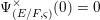 $\unicode[STIX]{x1D6F9}_{(E/F,\unicode[STIX]{x1D70D})}^{\times }(0)=0$
, giving the first assertion. For the second, we abbreviate the notation in the obvious way. From (1),
 $\unicode[STIX]{x1D70D}-c=\unicode[STIX]{x1D6F9}^{+}(\unicode[STIX]{x1D70D}-\unicode[STIX]{x1D6F9}^{\times }(c))=\unicode[STIX]{x1D6F9}^{+}(c)$
, as required. The graphs
 $y=\unicode[STIX]{x1D6F9}_{(E/F,\unicode[STIX]{x1D70D})}^{\times }(x)$
,
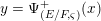 $y=\unicode[STIX]{x1D6F9}_{(E/F,\unicode[STIX]{x1D70D})}^{+}(x)$
are interchanged by the involution
 , whence (3) follows. ◻
We define the bi-Herbrand function
 $^{2\,\!}\unicode[STIX]{x1D6F9}_{(E/F,\unicode[STIX]{x1D70D})}$
by
 $$\begin{eqnarray}^{2\,\!}\unicode[STIX]{x1D6F9}_{(E/F,\unicode[STIX]{x1D70D})}(x)=\max \big\{\unicode[STIX]{x1D6F9}_{(E/F,\unicode[STIX]{x1D70D})}^{\times }(x),\unicode[STIX]{x1D6F9}_{(E/F,\unicode[STIX]{x1D70D})}^{+}(x)\big\},\quad 0\leqslant x\leqslant \unicode[STIX]{x1D70D}.\end{eqnarray}$$
When speaking of the jumps of
 $^{2\,\!}\unicode[STIX]{x1D6F9}_{(E/F,\unicode[STIX]{x1D70D})}$
, we mean the discontinuities of its derivative in the region
 $0<x<\unicode[STIX]{x1D70D}$
.
Proposition. Let
 $j_{\infty }=j_{\infty }(E|F)$
and write
 $c=c_{(E/F,\unicode[STIX]{x1D70D})}$
, as in the lemma.
(1) The function
$^{2\,\!}\unicode[STIX]{x1D6F9}_{(E/F,\unicode[STIX]{x1D70D})}$
is continuous, strictly increasing, piecewise linear and convex, with only finitely many jumps. The graph
$y=^{2\,\!}\unicode[STIX]{x1D6F9}_{(E/F,\unicode[STIX]{x1D70D})}(x)$
is symmetric with respect to the line
$x+y=\unicode[STIX]{x1D70D}$
.(2) Suppose
$j_{\infty }\geqslant c$
. The function
$^{2\,\!}\unicode[STIX]{x1D6F9}_{(E/F,\unicode[STIX]{x1D70D})}$
has an odd number of jumps, of which
$c$
is the middle one. The derivative
$^{2\,\!}\unicode[STIX]{x1D6F9}_{(E/F,\unicode[STIX]{x1D70D})}^{\prime }$
does not take the value
$1$
. Moreover, (3) Suppose
$j_{\infty }<c$
. Defining
$\bar{\jmath }_{\infty }$
as in (4.2.2), we have
$j_{\infty }<c<\bar{\jmath }_{\infty }$
.(a) If
$j_{\infty }<x<\bar{\jmath }_{\infty }$
, then (b) If
$0<x<j_{\infty }$
, then
$\unicode[STIX]{x1D6F9}_{(E/F,\unicode[STIX]{x1D70D})}^{+\prime }(x)=1>\unicode[STIX]{x1D6F9}_{(E/F,\unicode[STIX]{x1D70D})}^{\times \prime }(x)$
and $$\begin{eqnarray}^{2\,\!}\unicode[STIX]{x1D6F9}_{(E/F,\unicode[STIX]{x1D70D})}(x)=\unicode[STIX]{x1D6F9}_{(E/F,\unicode[STIX]{x1D70D})}^{\times }(x)>\unicode[STIX]{x1D6F9}_{(E/F,\unicode[STIX]{x1D70D})}^{+}(x).\end{eqnarray}$$
(c) If
$\bar{\jmath }_{\infty }<x<\unicode[STIX]{x1D70D}$
, then
$\unicode[STIX]{x1D6F9}_{(E/F,\unicode[STIX]{x1D70D})}^{\times \prime }(x)=1<\unicode[STIX]{x1D6F9}_{(E/F,\unicode[STIX]{x1D70D})}^{+\prime }(x)$
and $$\begin{eqnarray}^{2\,\!}\unicode[STIX]{x1D6F9}_{(E/F,\unicode[STIX]{x1D70D})}(x)=\unicode[STIX]{x1D6F9}_{(E/F,\unicode[STIX]{x1D70D})}^{+}(x)>\unicode[STIX]{x1D6F9}_{(E/F,\unicode[STIX]{x1D70D})}^{\times }(x).\end{eqnarray}$$
In particular,
$^{2\,\!}\unicode[STIX]{x1D6F9}_{(E/F,\unicode[STIX]{x1D70D})}$
has an even number of jumps.










Proof. In (1), only convexity requires comment, and that is obvious from parts (2) and (3).
The index
 $(E/F,\unicode[STIX]{x1D70D})$
will be constant throughout, so we omit it for the rest of this argument. We have
 $\unicode[STIX]{x1D6F9}^{\times }(c)=\unicode[STIX]{x1D6F9}^{+}(c)=^{2\,\!}\unicode[STIX]{x1D6F9}(c)$
. We examine the functions in a small neighbourhood of
 $x=c$
. The values of
 $\unicode[STIX]{x1D6F9}^{\times \prime }(x)$
are of the form
 $p^{-s}$
, and those of
 $\unicode[STIX]{x1D6F9}^{+\prime }(x)$
are
 $p^{s}$
, for various integers
 $s$
such that
 $0\leqslant s\leqslant r$
. In part (2), the left derivative of
 $\unicode[STIX]{x1D6F9}^{\times }$
at
 $c$
is, at most,
 $p^{-1}$
, while the right derivative of
 $\unicode[STIX]{x1D6F9}^{+}$
at
 $c$
is at least
 $p$
. So,
 $c$
is a jump of
 $^{2\,\!}\unicode[STIX]{x1D6F9}$
. The other assertions in (2) follow from the convexity of the functions
 $\unicode[STIX]{x1D6F9}^{\times }$
and
 $\unicode[STIX]{x1D6F9}^{+}$
.
In part (3), the functions
 $\unicode[STIX]{x1D6F9}^{\times }$
,
 $\unicode[STIX]{x1D6F9}^{+}$
agree, and have derivative
 $1$
, on the interval
 $j_{\infty }<x<\bar{\jmath }_{\infty }$
(which contains
 $c$
). The derivative relations are clear from the definitions, and readily imply the main points.◻
Remark.
By 1.6 Proposition, the condition
 $j_{\infty }\geqslant c$
amounts to
 $$\begin{eqnarray}j_{\infty }+\unicode[STIX]{x1D6F9}_{(E/F,\unicode[STIX]{x1D70D})}^{\times }(j_{\infty })=2j_{\infty }-p^{-r}w_{E/F}\geqslant \unicode[STIX]{x1D70D}.\end{eqnarray}$$
By 1.6 Corollary, this will hold if
 $w_{E/F}\geqslant m(p^{r}-1)/(p^{r}+1)$
.
4.3
We restate 2.6 Proposition in terms of the bi-Herbrand function.
Proposition. Let
 $\unicode[STIX]{x1D6E9}\in \mathbf{\mathscr{E}}^{\text{C}}(F)$
be of degree
 $p^{r}$
. Let
 $\unicode[STIX]{x1D703}\in \mathscr{C}(\mathfrak{a},\unicode[STIX]{x1D6FC})$
be a realization of
 $\unicode[STIX]{x1D6E9}$
on a simple stratum
 $[\mathfrak{a},m,0,\unicode[STIX]{x1D6FC}]$
in
 $\text{M}_{p^{r}}(F)$
. If
 $\unicode[STIX]{x1D70D}=\unicode[STIX]{x1D70D}_{\unicode[STIX]{x1D6E9}}=m/p^{r}$
and
 $E=F[\unicode[STIX]{x1D6FC}]$
then


4.4
We record the effect of tame lifting on these functions.
Proposition. Let
 $E/F$
be totally ramified of degree
 $p^{r}$
and let
 $\unicode[STIX]{x1D70D}=m/p^{r}$
, for a positive integer
 $m$
not divisible by
 $p$
. If
 $K/F$
is a finite tame extension and
 $e=e(K|F)$
, then
 $$\begin{eqnarray}\left.\begin{array}{@{}rcl@{}}\unicode[STIX]{x1D6F9}_{(E/F,\unicode[STIX]{x1D70D})}^{\times }(x)\ & =\ & \unicode[STIX]{x1D6F9}_{(EK/K,e\unicode[STIX]{x1D70D})}^{\times }(ex)/e,\\ \unicode[STIX]{x1D6F9}_{(E/F,\unicode[STIX]{x1D70D})}^{+}(x)\ & =\ & \unicode[STIX]{x1D6F9}_{(EK/K,e\unicode[STIX]{x1D70D})}^{+}(ex)/e,\\ ^{2\,\!}\unicode[STIX]{x1D6F9}_{(E/F,\unicode[STIX]{x1D70D})}(x)\ & =\ & ^{2\,\!}\unicode[STIX]{x1D6F9}_{(EK/K,e\unicode[STIX]{x1D70D})}(ex)/e,\end{array}\right\}\quad 0\leqslant x\leqslant \unicode[STIX]{x1D70D}.\end{eqnarray}$$
4.5
The second assertion of 4.3 Proposition determines
 $\unicode[STIX]{x1D6F9}_{\unicode[STIX]{x1D6E9}}$
where
 $\unicode[STIX]{x1D6F9}_{\unicode[STIX]{x1D6E9}}(x)>\unicode[STIX]{x1D70D}/2$
. That has already been done in 2.7 Proposition, but in a rather different way. Reconciliation of the two approaches reveals a fundamental property of
 $\unicode[STIX]{x1D6F9}_{(E/F,\unicode[STIX]{x1D70D})}^{+}$
. See 2.5 Definition for the notion of ‘twisting datum’.
Proposition. Let
 $[\mathfrak{a},m,0,\unicode[STIX]{x1D6FC}]$
be a simple stratum in
 $\text{M}_{p^{r}}(F)$
, in which
 $E=F[\unicode[STIX]{x1D6FC}]/F$
is totally ramified of degree
 $p^{r}$
and
 $m$
is not divisible by
 $p$
. Set
 $\unicode[STIX]{x1D70D}=m/p^{r}$
. If
 $(k,c,\unicode[STIX]{x1D712})$
is a twisting datum over
 $F$
such that
 $k<m/p^{r}$
is not a jump of
 $\unicode[STIX]{x1D6F9}_{(E/F,\unicode[STIX]{x1D70D})}^{+}$
then
 $$\begin{eqnarray}\unicode[STIX]{x1D6F9}_{(E/F,\unicode[STIX]{x1D70D})}^{+}(k)=t/p^{r},\end{eqnarray}$$
where
 $t$
is the least integer for which the congruence
 $$\begin{eqnarray}u^{-1}\unicode[STIX]{x1D6FC}u\equiv \unicode[STIX]{x1D6FC}+c\hspace{0.6em}({\rm mod}\hspace{0.2em}\mathfrak{p}^{-t})\end{eqnarray}$$
admits a solution
 $u\in U_{\mathfrak{a}}^{1}$
.
Proof. Assume initially that
 $2t>m$
. For comparison purposes, choose
 $\unicode[STIX]{x1D703}\in \mathscr{C}(\mathfrak{a},\unicode[STIX]{x1D6FC})$
and let
 $\unicode[STIX]{x1D6E9}$
be the endo-class of
 $\unicode[STIX]{x1D703}$
. Thus
 $\unicode[STIX]{x1D6E9}$
is totally wild and of Carayol type. By 4.3 Proposition,
 $k$
is not a jump of
 $\unicode[STIX]{x1D6F9}_{\unicode[STIX]{x1D6E9}}$
and so, by 2.7 Proposition,
 $t/p^{r}=\unicode[STIX]{x1D6F9}_{\unicode[STIX]{x1D6E9}}(k)=\unicode[STIX]{x1D6F9}_{(E/F,\unicode[STIX]{x1D70D})}^{+}(k)$
. Because of the jump condition,
 $t$
depends on
 $k$
but not on the element
 $c\in \mathfrak{p}_{F}^{-k}\smallsetminus \mathfrak{p}_{F}^{1-k}$
.
We now admit the possibility
 $2t\leqslant m$
. The integer
 $t$
depends on
 $\unicode[STIX]{x1D6FC}$
and
 $c$
, so we define a function
 $T(\unicode[STIX]{x1D6FC},c)=p^{-r}t$
where, as before,
 $t$
is the least integer for which (4.5.1) admits a solution. Let
 $n$
be a positive integer and take
 $\unicode[STIX]{x1D708}\in F$
with
 $\unicode[STIX]{x1D710}_{F}(\unicode[STIX]{x1D708})=-n$
. Thus
 $[\mathfrak{a},m+p^{r}n,0,\unicode[STIX]{x1D708}\unicode[STIX]{x1D6FC}]$
is a simple stratum in
 $\text{M}_{p^{r}}(F)$
. The congruences
 $$\begin{eqnarray}\displaystyle u^{-1}\unicode[STIX]{x1D6FC}u & \equiv & \displaystyle \unicode[STIX]{x1D6FC}+c\hspace{0.6em}({\rm mod}\hspace{0.2em}\mathfrak{p}^{-t}),\nonumber\\ \displaystyle u^{-1}\unicode[STIX]{x1D708}\unicode[STIX]{x1D6FC}u & \equiv & \displaystyle \unicode[STIX]{x1D708}(\unicode[STIX]{x1D6FC}+c)\hspace{0.6em}({\rm mod}\hspace{0.2em}\mathfrak{p}^{-(t+p^{r}n)})\nonumber\end{eqnarray}$$
have the same sets of solutions
 $u\in U_{\mathfrak{a}}^{1}$
. Consequently,
 $$\begin{eqnarray}T(\unicode[STIX]{x1D708}\unicode[STIX]{x1D6FC},\unicode[STIX]{x1D708}c)=T(\unicode[STIX]{x1D6FC},c)+n.\end{eqnarray}$$
Provided
 $2T(\unicode[STIX]{x1D708}\unicode[STIX]{x1D6FC},\unicode[STIX]{x1D708}c)>\unicode[STIX]{x1D70D}+n$
, we therefore have
 $$\begin{eqnarray}T(\unicode[STIX]{x1D708}\unicode[STIX]{x1D6FC},\unicode[STIX]{x1D708}c)=\unicode[STIX]{x1D6F9}_{(E/F,\unicode[STIX]{x1D70D}+n)}^{+}(k+n).\end{eqnarray}$$
The definition of the functions
 $\unicode[STIX]{x1D6F9}_{(E/F,\unicode[STIX]{x1D70D})}^{+}$
implies
 $$\begin{eqnarray}\unicode[STIX]{x1D6F9}_{(E/F,\unicode[STIX]{x1D70D}+n)}^{+}(x+n)=\unicode[STIX]{x1D6F9}_{(E/F,\unicode[STIX]{x1D70D})}^{+}(x)+n,\end{eqnarray}$$
so
 $k+n$
is not a jump of
 $\unicode[STIX]{x1D6F9}_{(E/F,\unicode[STIX]{x1D70D}+n)}^{+}(x+n)$
. The condition
 $2T(\unicode[STIX]{x1D708}\unicode[STIX]{x1D6FC},\unicode[STIX]{x1D708}c)>\unicode[STIX]{x1D70D}+n$
thus reduces to
 $2T(\unicode[STIX]{x1D6FC},c)>\unicode[STIX]{x1D70D}-n$
. So, for integers
 $k=-\unicode[STIX]{x1D710}_{F}(c)$
satisfying
 $2T(\unicode[STIX]{x1D708}\unicode[STIX]{x1D6FC},\unicode[STIX]{x1D708}c)>k>\unicode[STIX]{x1D70D}+n$
, we have
 $\unicode[STIX]{x1D6F9}_{(E/F,\unicode[STIX]{x1D70D})}^{+}(k)=T(\unicode[STIX]{x1D6FC},c)$
. Allowing
 $n$
to increase without bound, we see that
 $\unicode[STIX]{x1D6F9}_{(E/F,\unicode[STIX]{x1D70D})}^{+}(k)=T(\unicode[STIX]{x1D6FC},c)$
, for all integers
 $k$
that are not jumps of
 $\unicode[STIX]{x1D6F9}_{(E/F,\unicode[STIX]{x1D70D})}^{+}$
.◻
Remark.
The relation between the function
 $\unicode[STIX]{x1D6F9}_{(E/F,\unicode[STIX]{x1D70D})}^{+}$
and intertwining properties of simple strata was observed in more general work of Zink [Reference ZinkZin88, Reference ZinkZin92] on a corresponding problem in
 $F$
-division algebras.
4.6
To finish the section with an example, we calculate
 $\unicode[STIX]{x1D6F9}_{\unicode[STIX]{x1D6E9}}$
in a large family of cases.
Example. Let
 $\unicode[STIX]{x1D6E9}\in \mathbf{\mathscr{E}}^{\text{C}}(F)$
be of degree
 $p^{r}$
,
 $r\geqslant 1$
. Let
 $\unicode[STIX]{x1D703}\in \mathscr{C}(\mathfrak{a},\unicode[STIX]{x1D6FC})$
be a realization of
 $\unicode[STIX]{x1D6E9}$
on a simple stratum
 $[\mathfrak{a},m,0,\unicode[STIX]{x1D6FC}]$
in
 $\text{M}_{p^{r}}(F)$
. Write
 $\unicode[STIX]{x1D70D}=\unicode[STIX]{x1D70D}_{\unicode[STIX]{x1D6E9}}=m/p^{r}$
and
 $E=F[\unicode[STIX]{x1D6FC}]$
. If
 $j_{\infty }(E|F)<\unicode[STIX]{x1D70D}/2$
, then
 $$\begin{eqnarray}\unicode[STIX]{x1D6F9}_{\unicode[STIX]{x1D6E9}}(x)=^{2\,\!}\unicode[STIX]{x1D6F9}_{(E/F,\unicode[STIX]{x1D70D})}(x),\quad 0\leqslant x\leqslant \unicode[STIX]{x1D70D}.\end{eqnarray}$$
Proof. By 4.3 Proposition,
 $\unicode[STIX]{x1D6F9}_{\unicode[STIX]{x1D6E9}}(x)=^{2\,\!}\unicode[STIX]{x1D6F9}_{(E/F,\unicode[STIX]{x1D70D})}(x)$
for
 $0\leqslant x\leqslant \unicode[STIX]{x1D70D}/2$
. Likewise for
 $\unicode[STIX]{x1D70D}-\unicode[STIX]{x1D6F9}_{\unicode[STIX]{x1D6E9}}(\unicode[STIX]{x1D70D}/2)\leqslant x\leqslant \unicode[STIX]{x1D70D}$
by symmetry. In particular,
 $\unicode[STIX]{x1D6F9}_{\unicode[STIX]{x1D6E9}}^{\prime }(x)=^{2\,\!}\unicode[STIX]{x1D6F9}_{(E/F,\unicode[STIX]{x1D70D})}^{\prime }(x)=1$
for
 $j_{\infty }<x<\unicode[STIX]{x1D70D}/2$
. Thus 4.1 Proposition (2) applies. It shows that
 $\unicode[STIX]{x1D6F9}_{\unicode[STIX]{x1D6E9}}^{\prime }(x)=1$
on the set
 $j_{\infty }<x<\unicode[STIX]{x1D70D}-\unicode[STIX]{x1D6F9}_{\unicode[STIX]{x1D6E9}}(j_{\infty })$
. The same argument, using 4.2 Proposition, applies to
 $^{2\,\!}\unicode[STIX]{x1D6F9}_{(E/F,\unicode[STIX]{x1D70D})}$
, whence
 $\unicode[STIX]{x1D6F9}_{\unicode[STIX]{x1D6E9}}(x)=^{2\,\!}\unicode[STIX]{x1D6F9}_{(E/F,\unicode[STIX]{x1D70D})}(x)$
on this range. Overall,
 $\unicode[STIX]{x1D6F9}_{\unicode[STIX]{x1D6E9}}(x)=^{2\,\!}\unicode[STIX]{x1D6F9}_{(E/F,\unicode[STIX]{x1D70D})}(x)$
for
 $0\leqslant x\leqslant \unicode[STIX]{x1D70D}$
.◻
Gloss. The hypothesis
 $j_{\infty }<\unicode[STIX]{x1D70D}/2$
holds if
 $w_{E/F}<(p-1)m/2p$
.
Proof. By 1.6 Corollary,
 $j_{\infty }\leqslant p^{1-r}w_{E/F}/(p-1)$
.◻
5 Characters of restricted level
Let
 $[\mathfrak{a},m,0,\unicode[STIX]{x1D6FC}]$
be a simple stratum in
 $M=\text{M}_{p^{r}}(F)$
,
 $r\geqslant 1$
, satisfying the usual conditions:
(1)
$E=F[\unicode[STIX]{x1D6FC}]/F$
is totally ramified of degree
$p^{r}$
;(2)
$m$
is not divisible by
$p$
and
$\unicode[STIX]{x1D70D}=m/p^{r}$
.


Let
 $\Vert \mathscr{C}(\mathfrak{a},\unicode[STIX]{x1D6FC})\Vert$
be the set of endo-classes of simple characters
 $\unicode[STIX]{x1D703}\in \mathscr{C}(\mathfrak{a},\unicode[STIX]{x1D6FC})$
. Thus any
 $\unicode[STIX]{x1D6E9}\in \Vert \mathscr{C}(\mathfrak{a},\unicode[STIX]{x1D6FC})\Vert$
lies in
 $\mathbf{\mathscr{E}}^{\text{C}}(F)$
and has degree
 $p^{r}$
. In this section we fix
 $\unicode[STIX]{x1D6FC}$
and identify a set of
 $\unicode[STIX]{x1D6E9}\in \Vert \mathscr{C}(\mathfrak{a},\unicode[STIX]{x1D6FC})\Vert$
for which
 $\unicode[STIX]{x1D6F9}_{\unicode[STIX]{x1D6E9}}=^{2\,\!}\unicode[STIX]{x1D6F9}_{(F[\unicode[STIX]{x1D6FC}]/F,\unicode[STIX]{x1D70D})}$
. This will be the set called
 $\mathscr{L}_{\unicode[STIX]{x1D6FC}}$
in the introduction. In substance, the section is a sequence of increasingly delicate conjugacy calculations. These are progressively interpreted in terms of intertwining properties of simple characters, using the elementary properties of the graphs of the various functions ‘
 $\unicode[STIX]{x1D6F9}$
’ laid out in § 4.
5.1
We recall, in the special case to hand, some of the machinery of [Reference Bushnell and KutzkoBK93, ch. 1]. Let
 $\mathfrak{p}$
be the Jacobson radical of
 $\mathfrak{a}$
. Define
 $$\begin{eqnarray}\displaystyle \begin{array}{@{}rcl@{}}A_{\unicode[STIX]{x1D6FC}}:M\ & \longrightarrow \ & M,\\ x\ & \longmapsto \ & \unicode[STIX]{x1D6FC}x\unicode[STIX]{x1D6FC}^{-1}-x.\end{array} & & \displaystyle \nonumber\end{eqnarray}$$
Let
 $s_{E/F}:M\rightarrow E$
be a tame corestriction on
 $M$
, relative to
 $E/F$
. By definition,
 $s_{E/F}$
is an
 $(E,E)$
-bimodule homomorphism
 $M\rightarrow E$
such that
 $s_{E/F}(\mathfrak{a})=\mathfrak{o}_{E}$
. For integers
 $i<j$
, we have exact sequences

As in 2.1, let
 $\unicode[STIX]{x1D707}_{F}$
be a character of
 $F$
of level one and set
 $\unicode[STIX]{x1D707}_{M}=\unicode[STIX]{x1D707}_{F}\circ \text{tr}_{M}$
. Let
 $w_{E/F}$
denote the wild exponent of the field extension
 $E/F$
(1.6.1).
Lemma.
(1) There is a unique character
$\unicode[STIX]{x1D707}_{E}$
of
$E$
, of level one, such that (5.1.2)$$\begin{eqnarray}\unicode[STIX]{x1D707}_{M}(x)=\unicode[STIX]{x1D707}_{E}(s_{E/F}(x)),\quad x\in M.\end{eqnarray}$$
(2) There is a unique
$d\in E$
, of valuation
$w_{E/F}$
, such that
$s_{E/F}(y)=yd$
,
$y\in E$
.


Proof. Part (1) is [Reference Bushnell and KutzkoBK93, (1.3.7)]. Part (2) follows from [Reference Bushnell and KutzkoBK93, (1.3.8)]. ◻
5.2
We introduce a new parameter.
Definition. Let
 $\unicode[STIX]{x1D703}\in \mathscr{C}(\mathfrak{a},\unicode[STIX]{x1D6FC})$
. Define
 $l_{E}(\unicode[STIX]{x1D703})$
as the least integer
 $l\geqslant 0$
for which the character
 $\unicode[STIX]{x1D703}\,|\,U_{E}^{l+1}$
is trivial.
Proposition. Abbreviate
 $w=w_{E/F}$
and let
 $\unicode[STIX]{x1D703}\in \mathscr{C}(\mathfrak{a},\unicode[STIX]{x1D6FC})$
.
(1) If
$m>2w$
, then
$l_{E}(\unicode[STIX]{x1D703})=m-w$
.(2) If
$m\leqslant 2w$
, then
$0\leqslant l_{E}(\unicode[STIX]{x1D703})\leqslant m/2$
. If
$l$
is an integer,
$0\leqslant l\leqslant m/2$
, there exists
$\unicode[STIX]{x1D717}\in \mathscr{C}(\mathfrak{a},\unicode[STIX]{x1D6FC})$
such that
$l_{E}(\unicode[STIX]{x1D717})=l$
.





Proof. Let
 $y\in E$
,
 $\unicode[STIX]{x1D710}_{E}(y)\geqslant [m/2]+1$
. The description (2.3.1) of
 $\unicode[STIX]{x1D703}$
gives
 $$\begin{eqnarray}\unicode[STIX]{x1D703}(1+y)=\unicode[STIX]{x1D713}_{M}\ast \unicode[STIX]{x1D6FC}(1+y)=\unicode[STIX]{x1D707}_{E}(\unicode[STIX]{x1D6FC}s_{E/F}(y)),\end{eqnarray}$$
for a tame corestriction
 $s_{E/F}$
and a character
 $\unicode[STIX]{x1D707}_{E}$
of
 $E$
, as in 5.1 Lemma. Also,
 $\unicode[STIX]{x1D710}_{E}(s_{E/F}(y))=\unicode[STIX]{x1D710}_{E}(y)+w$
. Consequently, if
 $2w<m$
, the character
 $\unicode[STIX]{x1D703}$
is non-trivial on
 $U_{E}^{1+[m/2]}$
and
 $l_{E}(\unicode[STIX]{x1D703})=m-w$
. Otherwise,
 $\unicode[STIX]{x1D703}$
is trivial on
 $U_{E}^{1+[m/2]}$
and assertion (2) follows from the description in 2.3.◻
Warning.
The variation of
 $l_{E}(\unicode[STIX]{x1D703})$
with
 $E$
is unstable and quite subtle. We explore and exploit this in § 6.
5.3
We use the notation
 $j_{\infty }$
,
 $\bar{\jmath }_{\infty }$
of (4.2.2). We spend the rest of this section proving the following.
Theorem. Let
 $[\mathfrak{a},m,0,\unicode[STIX]{x1D6FC}]$
be a simple stratum in
 $M=\text{M}_{p^{r}}(F)$
,
 $r\geqslant 1$
, in which
 $E=F[\unicode[STIX]{x1D6FC}]/F$
is totally ramified of degree
 $p^{r}$
and
 $p$
does not divide
 $m$
. Set
 $\unicode[STIX]{x1D70D}=m/p^{r}$
and let
 $w=w_{E/F}$
. Let
 $\unicode[STIX]{x1D703}\in \mathscr{C}(\mathfrak{a},\unicode[STIX]{x1D6FC})$
have endo-class
 $\unicode[STIX]{x1D6E9}$
and suppose that
 $$\begin{eqnarray}l_{E}(\unicode[STIX]{x1D703})\leqslant \max \,\{0,m-w\}.\end{eqnarray}$$
(1) If
$^{2\,\!}\unicode[STIX]{x1D6F9}_{(E/F,\unicode[STIX]{x1D70D})}(x)$
has an odd number of jumps, then
$\unicode[STIX]{x1D6F9}_{\unicode[STIX]{x1D6E9}}(x)=^{2\,\!}\unicode[STIX]{x1D6F9}_{(E/F,\unicode[STIX]{x1D70D})}(x)$
,
$0\leqslant x\leqslant \unicode[STIX]{x1D70D}$
.(2) If
$m>2w$
, then
$l_{E}(\unicode[STIX]{x1D703})=m-w$
and
$\unicode[STIX]{x1D6F9}_{\unicode[STIX]{x1D6E9}}(x)=^{2\,\!}\unicode[STIX]{x1D6F9}_{(E/F,\unicode[STIX]{x1D70D})}(x)$
,
$0\leqslant x\leqslant \unicode[STIX]{x1D70D}$
.(3) If
$w$
is divisible by
$p$
, then
$\unicode[STIX]{x1D6F9}_{\unicode[STIX]{x1D6E9}}(x)=^{2\,\!}\unicode[STIX]{x1D6F9}_{(E/F,\unicode[STIX]{x1D70D})}(x)$
,
$0\leqslant x\leqslant \unicode[STIX]{x1D70D}$
.(4) Suppose that
$m>w\geqslant m/2$
, that
$w$
is not divisible by
$p$
, and that
$^{2\,\!}\unicode[STIX]{x1D6F9}_{(E/F,\unicode[STIX]{x1D70D})}$
has an even number of jumps. There is a unique character
$\unicode[STIX]{x1D719}$
of
$U_{E}^{m-w}$
, trivial on
$U_{E}^{1+m-w}$
, with the following property.(a) The relation
$\unicode[STIX]{x1D6F9}_{\unicode[STIX]{x1D6E9}}(x)=^{2\,\!}\unicode[STIX]{x1D6F9}_{(E/F,\unicode[STIX]{x1D70D})}(x)$
holds for all
$x$
,
$0\leqslant x\leqslant \unicode[STIX]{x1D70D}$
, if and only if
$\unicode[STIX]{x1D703}\,|\,U_{E}^{m-w}\neq \unicode[STIX]{x1D719}$
.(b) If
$\unicode[STIX]{x1D703}\,|\,U_{E}^{m-w}=\unicode[STIX]{x1D719}$
, then













Remarks.
(1) The hypothesis of part (1) holds if and only if
$^{2\,\!}\unicode[STIX]{x1D6F9}_{(E/F,\unicode[STIX]{x1D70D})}^{\prime }(x)\neq 1$
for
$0<x<\unicode[STIX]{x1D70D}$
(4.2 Proposition). It is valid if
$w\geqslant m(p^{r}-1)/(p^{r}+1)$
(4.2 Remark). In particular, if
$w\geqslant m$
then part (1) applies.(2) In part (2), hypothesis (5.3.1) holds for all
$\unicode[STIX]{x1D703}\in \mathscr{C}(\mathfrak{a},\unicode[STIX]{x1D6FC})$
(5.2 Proposition). This case therefore subsumes 4.6 Example (but we will use this example in the proof of the theorem).(3) Regarding (3), the case
$w\equiv 0\hspace{0.6em}({\rm mod}\hspace{0.2em}p)$
can only occur when
$F$
has characteristic
$0$
(1.8).(4) A form of the character
$\unicode[STIX]{x1D719}$
in part (4) is written down in (5.12.3) below. A different version is given in 7.3 Remark below, showing that it may or may not be trivial.
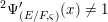


In the theorem, the division into cases (1)–(4) is not exclusive. Certainly (3) can overlap either (1) or (2). When
 $p=2$
, (1) and (2) can overlap (6.2 Example below). Case (4) overlaps no other.
After preparatory work, part (1) of the theorem is proved in 5.6. Following more preparation in 5.8 and 5.9, parts (2), (3) and (4) are proved in 5.10, 5.11 and 5.12, respectively.
5.4
Let
 $\mathfrak{p}$
be the Jacobson radical of
 $\mathfrak{a}$
. Let
 $c\in F$
, with
 $\unicode[STIX]{x1D710}_{F}(c)=-k$
and
 $k<\unicode[STIX]{x1D70D}=m/p^{r}$
. Let
 $t<p^{r}k$
be an integer. As a first step, we consider formal intertwining between the simple strata
 $[\mathfrak{a},m,t,\unicode[STIX]{x1D6FC}]$
and
 $[\mathfrak{a},m,t,\unicode[STIX]{x1D6FC}+c]$
. That is, we analyse the congruence
 $$\begin{eqnarray}u^{-1}\unicode[STIX]{x1D6FC}u\equiv \unicode[STIX]{x1D6FC}+c\hspace{0.6em}({\rm mod}\hspace{0.2em}\mathfrak{p}^{-t}),\quad u\in U_{\mathfrak{ a}}^{1}.\end{eqnarray}$$
Lemma. The set of solutions
 $u\in U_{\mathfrak{a}}^{1}$
of (5.4.1) is either empty or constitutes one coset
 $uU_{E}^{1}U_{\mathfrak{a}}^{m-t}\in U_{E}^{1}U_{\mathfrak{a}}^{m-p^{r}k}/U_{E}^{1}U_{\mathfrak{a}}^{m-t}$
.
Proof. Let
 $u\in U_{\mathfrak{a}}^{1}$
satisfy (5.4.1). Thus
 $u$
conjugates the equivalence class of the simple stratum
 $[\mathfrak{a},m,t,\unicode[STIX]{x1D6FC}]$
to that of
 $[\mathfrak{a},m,t,\unicode[STIX]{x1D6FC}+c]$
. If
 $v\in U_{\mathfrak{a}}^{1}$
and
 $uv$
satisfies (5.4.1), then
 $v$
conjugates the equivalence class of the stratum
 $[\mathfrak{a},m,t,\unicode[STIX]{x1D6FC}+c]$
to itself. Equivalently,
 $v\in U_{E}^{1}U_{\mathfrak{a}}^{m-t}$
[Reference Bushnell and KutzkoBK93, (1.5.8)], so the coset
 $uU_{E}^{1}U_{\mathfrak{a}}^{m-t}$
is uniquely determined by (5.4.1). On the other hand,
 $u$
conjugates the equivalence class of
 $[\mathfrak{a},m,p^{r}k,\unicode[STIX]{x1D6FC}]$
to itself, so
 $u\in U_{E}^{1}U_{\mathfrak{a}}^{m-p^{r}k}$
[Reference Bushnell and KutzkoBK93, (1.5.8)].◻
Remark.
Since
 $U_{E}^{1}$
commutes with
 $\unicode[STIX]{x1D6FC}$
, we need only ever consider solutions
 $u$
of (5.4.1) that satisfy
 $u\in U_{\mathfrak{a}}^{m-p^{r}k}$
.
5.5
We continue with the same notation. In (5.4.1), write
 $u=1+a$
,
 $a\in \mathfrak{p}^{m-p^{r}k}$
. In this form, (5.4.1) amounts to
 $$\begin{eqnarray}(1+a)^{-1}\unicode[STIX]{x1D6FC}(1+a)\equiv \unicode[STIX]{x1D6FC}+c\hspace{0.6em}({\rm mod}\hspace{0.2em}\mathfrak{p}^{-t})\end{eqnarray}$$
or, equivalently,
 $$\begin{eqnarray}\unicode[STIX]{x1D6FC}a-a\unicode[STIX]{x1D6FC}\equiv c(1+a)\hspace{0.6em}({\rm mod}\hspace{0.2em}\mathfrak{p}^{-t}).\end{eqnarray}$$
We use the standard notation
 $[x,y]=xy-yx$
, for
 $x,y\in M$
.
Proposition. Let
 $a\in \mathfrak{p}^{m-p^{r}k}$
satisfy (5.5.1). If
 $y\in E$
,
 $\unicode[STIX]{x1D710}_{E}(y)=b\geqslant 1$
, then
 $$\begin{eqnarray}(1+a)(1+y)(1+a)^{-1}\equiv 1+\bar{y}\hspace{0.6em}({\rm mod}\hspace{0.2em}\mathfrak{p}^{b+m-t}),\end{eqnarray}$$
for an element
 $\bar{y}\in E$
such that
 $\bar{y}\equiv y\hspace{0.6em}({\rm mod}\hspace{0.2em}\mathfrak{p}_{E}^{b+m-p^{r}k})$
.
Proof. We rearrange the conjugation as
 $$\begin{eqnarray}(1+a)(1+y)(1+a)^{-1}=1+y+[a,y](1+a)^{-1}.\end{eqnarray}$$
Applying the defining relations (5.5.1), (5.5.2), we get

The exact sequences (5.1.1) imply
 $[a,y](1+a)^{-1}=v+h$
, for
 $v\in \mathfrak{p}_{E}^{b+m-p^{r}k}$
and
 $h\in \mathfrak{p}^{b+m-t}$
, as required.◻
5.6
We continue with the same notation, especially
 $\unicode[STIX]{x1D70D}=m/p^{r}$
and
 $w=w_{E/F}$
.
Proposition 1. Let
 $I$
be an open sub-interval of
 $(0,\unicode[STIX]{x1D70D})$
on which
 $\unicode[STIX]{x1D6F9}_{(E/F,\unicode[STIX]{x1D70D})}^{\times }$
and
 $\unicode[STIX]{x1D6F9}_{(E/F,\unicode[STIX]{x1D70D})}^{+}$
are both smooth and satisfy
 $$\begin{eqnarray}\unicode[STIX]{x1D6F9}_{(E/F,\unicode[STIX]{x1D70D})}^{\times }(x)>\unicode[STIX]{x1D6F9}_{(E/F,\unicode[STIX]{x1D70D})}^{+}(x),\quad x\in I.\end{eqnarray}$$
Let
 $\unicode[STIX]{x1D703}\in \mathscr{C}(\mathfrak{a},\unicode[STIX]{x1D6FC})$
, and suppose
 $$\begin{eqnarray}l=l_{E}(\unicode[STIX]{x1D703})\leqslant \max \{0,m-w\}.\end{eqnarray}$$
If
 $\unicode[STIX]{x1D703}$
has endo-class
 $\unicode[STIX]{x1D6E9}$
, then
 $$\begin{eqnarray}\unicode[STIX]{x1D6F9}_{\unicode[STIX]{x1D6E9}}(x)=\unicode[STIX]{x1D6F9}_{(E/F,\unicode[STIX]{x1D70D})}^{\times }(x)=^{2\,\!}\unicode[STIX]{x1D6F9}_{(E/F,\unicode[STIX]{x1D70D})}(x),\quad x\in I.\end{eqnarray}$$
Proof. By (4.2.1), (4.2.3), we have
 $\unicode[STIX]{x1D6F9}_{(E/F,\unicode[STIX]{x1D70D})}^{\times \prime }(x)\leqslant 1\leqslant \unicode[STIX]{x1D6F9}_{(E/F,\unicode[STIX]{x1D70D})}^{+\prime }(x)$
,
 $0<x<\unicode[STIX]{x1D70D}$
. By 4.2 Proposition, hypothesis (5.6.1) implies that
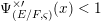 $\unicode[STIX]{x1D6F9}_{(E/F,\unicode[STIX]{x1D70D})}^{\times \prime }(x)<1$
,
 $x\in I$
. The convexity of
 $\unicode[STIX]{x1D713}_{E/F}=p^{r}\unicode[STIX]{x1D6F9}_{(E/F,\unicode[STIX]{x1D70D})}^{\times }$
and 1.6 Proposition now imply
 $\unicode[STIX]{x1D6F9}_{(E/F,\unicode[STIX]{x1D70D})}^{\times }(x)>x-p^{-r}w$
,
 $x\in I$
.
As in the proof of 2.6 Proposition, the tame lifting properties of 4.4 Proposition and 2.5 Proposition 2 show it is enough to prove the result when
 $x$
is an integer. So, let
 $k$
be an integer,
 $k\in I$
, that is not a jump of
 $\unicode[STIX]{x1D6F9}_{\unicode[STIX]{x1D6E9}}$
. Let
 $(k,c,\unicode[STIX]{x1D712})$
be a twisting datum (2.5). We apply 5.5 Proposition with
 $t=p^{r}\unicode[STIX]{x1D6F9}_{(E/F,\unicode[STIX]{x1D70D})}^{+}(k)$
. By 4.5 Proposition,
 $t$
is the least integer for which the congruence (5.5.1) admits a solution
 $a$
. By 5.4 Lemma, we may take
 $a\in \mathfrak{p}^{m-p^{r}k}$
. The definition of
 $I$
implies that
 $k$
is not a jump of
 $\unicode[STIX]{x1D713}_{E/F}$
, so
 $\unicode[STIX]{x1D713}_{E/F}(k)=\text{sw}(\unicode[STIX]{x1D712}\circ \text{N}_{E/F})$
is an integer (1.3 Proposition).
Write
 $v=\unicode[STIX]{x1D713}_{E/F}(k)$
and let
 $y\in E$
have valuation
 $1+v$
. In particular,
 $\unicode[STIX]{x1D712}\circ \det (1+y)=1$
(cf. 1.3 Proposition). Our hypothesis (5.6.1) amounts to
 $$\begin{eqnarray}\unicode[STIX]{x1D713}_{E/F}(k)=p^{r}\unicode[STIX]{x1D6F9}_{(E/F,\unicode[STIX]{x1D70D})}^{\times }(k)>p^{r}\unicode[STIX]{x1D6F9}_{(E/F,\unicode[STIX]{x1D70D})}^{+}(k)=t,\end{eqnarray}$$
so
 $v>t$
. Thus 5.5 Proposition gives
 $$\begin{eqnarray}(1+a)(1+y)(1+a)^{-1}\equiv 1+\bar{y}\hspace{0.6em}({\rm mod}\hspace{0.2em}\mathfrak{p}^{2+m}),\end{eqnarray}$$
whence
 $1+a$
normalizes the group
 $H^{1+v}(\unicode[STIX]{x1D6FC},\mathfrak{a})$
and
 $\unicode[STIX]{x1D703}^{1+a}(1+y)=\unicode[STIX]{x1D703}(1+\bar{y})$
. Taking first the case
 $l=0$
, we get
 $\unicode[STIX]{x1D703}^{1+a}(1+y)=\unicode[STIX]{x1D703}(1+\bar{y})=1=\unicode[STIX]{x1D712}\unicode[STIX]{x1D703}(1+y)$
. In the other case
 $0<l\leqslant m-w$
,
 $$\begin{eqnarray}\unicode[STIX]{x1D710}_{E}(\bar{y}-y)\geqslant 1+v+m-p^{r}k=1+\unicode[STIX]{x1D713}_{E/F}(k)+m-p^{r}k\geqslant 1+m-w,\end{eqnarray}$$
since
 $\unicode[STIX]{x1D713}_{E/F}(k)\geqslant p^{r}k-w$
. It follows that
 $\unicode[STIX]{x1D703}^{1+a}(1+y)=\unicode[STIX]{x1D703}(1+\bar{y})=\unicode[STIX]{x1D703}(1+y)=\unicode[STIX]{x1D712}\unicode[STIX]{x1D703}(1+y)$
. By hypothesis (5.6.1),
 $t<v$
so the definition of
 $a$
ensures that
 $1+a$
conjugates
 $\unicode[STIX]{x1D703}$
to
 $\unicode[STIX]{x1D712}\unicode[STIX]{x1D703}$
on
 $H^{1+v}(\unicode[STIX]{x1D6FC},\mathfrak{a})$
. Therefore
 $\unicode[STIX]{x1D6F9}_{\unicode[STIX]{x1D6E9}}(k)\leqslant v/p^{r}=^{2\,\!}\unicode[STIX]{x1D6F9}_{(E/F,\unicode[STIX]{x1D70D})}(k)$
.
We go through the same process with
 $\unicode[STIX]{x1D710}_{E}(y)=v=\unicode[STIX]{x1D713}_{E/F}(k)$
. We choose
 $y$
so that
 $\unicode[STIX]{x1D712}\circ \det (1+y)=\unicode[STIX]{x1D712}\circ \text{N}_{E/F}(1+y)\neq 1$
. If
 $m>w$
, then
 $$\begin{eqnarray}\unicode[STIX]{x1D710}_{E}(\bar{y}-y)\geqslant v+m-p^{r}k>m-w\geqslant l,\end{eqnarray}$$
whence
 $\unicode[STIX]{x1D703}^{1+a}(1+y)=\unicode[STIX]{x1D703}(1+y)\neq \unicode[STIX]{x1D712}\unicode[STIX]{x1D703}(1+y)$
. The element
 $1+a$
therefore normalizes
 $H^{v}(\unicode[STIX]{x1D6FC},\mathfrak{a})$
but does not conjugate
 $\unicode[STIX]{x1D703}$
to
 $\unicode[STIX]{x1D712}\unicode[STIX]{x1D703}$
on that group. If
 $m\leqslant w$
then
 $l=0$
and the same conclusion holds.
Suppose there exists
 $1+b\in U_{\mathfrak{a}}^{1}$
that intertwines
 $\unicode[STIX]{x1D703}$
with
 $\unicode[STIX]{x1D712}\unicode[STIX]{x1D703}$
on
 $H^{v}(\unicode[STIX]{x1D6FC},\mathfrak{a})$
: that is, it conjugates
 $\unicode[STIX]{x1D703}$
to
 $\unicode[STIX]{x1D712}\unicode[STIX]{x1D703}$
on that group. It therefore conjugates
 $\unicode[STIX]{x1D703}$
to
 $\unicode[STIX]{x1D712}\unicode[STIX]{x1D703}$
on
 $H^{1+v}(\unicode[STIX]{x1D6FC},\mathfrak{a})$
and so is of the form
 $1+b=u(1+a)$
, where
 $u\in U_{\mathfrak{a}}^{1}$
conjugates
 $\unicode[STIX]{x1D703}\,|\,H^{1+v}(\unicode[STIX]{x1D6FC},\mathfrak{a})$
to itself.
Lemma. We have
 $v\leqslant [m/2]$
.
Proof. Hypothesis (5.6.1) implies that
 $k$
is strictly less that the largest jump of
 $\unicode[STIX]{x1D713}_{E/F}$
. Therefore
 $v=\unicode[STIX]{x1D713}_{E/F}(k)\leqslant p^{r-1}k$
. On the other hand,
 $k<\unicode[STIX]{x1D70D}=m/p^{r}$
. Suppose that
 $v>[m/2]$
. Since
 $v$
is an integer, this implies
 $v>m/2$
and so
 $$\begin{eqnarray}m/2<v\leqslant p^{r-1}k<m/p,\end{eqnarray}$$
which is ridiculous. ◻
Following the lemma, the element
 $u$
conjugates
 $\unicode[STIX]{x1D703}$
to itself on
 $H^{1}(\unicode[STIX]{x1D6FC},\mathfrak{a})$
, as follows from [Reference Bushnell and KutzkoBK93, (3.3.2)]. Therefore,
 $$\begin{eqnarray}\unicode[STIX]{x1D703}^{1+a}\,|\,H^{v}(\unicode[STIX]{x1D6FC},\mathfrak{a})=\unicode[STIX]{x1D703}^{1+b}\,|\,H^{v}(\unicode[STIX]{x1D6FC},\mathfrak{a})=\unicode[STIX]{x1D712}\unicode[STIX]{x1D703}\,|\,H^{v}(\unicode[STIX]{x1D6FC},\mathfrak{a}),\end{eqnarray}$$
which is false. We conclude that
 $\unicode[STIX]{x1D703}$
does not intertwine with
 $\unicode[STIX]{x1D712}\unicode[STIX]{x1D703}$
on
 $H^{v}(\unicode[STIX]{x1D6FC},\mathfrak{a})$
, and so
 $\unicode[STIX]{x1D6F9}_{\unicode[STIX]{x1D6E9}}(k)=\mathbb{A}(\unicode[STIX]{x1D6E9},\unicode[STIX]{x1D712}\unicode[STIX]{x1D6E9})=v/p^{r}=^{2\,\!}\unicode[STIX]{x1D6F9}_{(E/F,\unicode[STIX]{x1D70D})}(k)$
, as required.◻
Proposition 1 has a ‘mirror image’ as follows.
Proposition 2. Let
 $I$
be an open sub-interval of
 $(0,\unicode[STIX]{x1D70D})$
on which
 $\unicode[STIX]{x1D6F9}_{(E/F,\unicode[STIX]{x1D70D})}^{\times }$
,
 $\unicode[STIX]{x1D6F9}_{(E/F,\unicode[STIX]{x1D70D})}^{+}$
are smooth and satisfy
 $$\begin{eqnarray}\unicode[STIX]{x1D6F9}_{(E/F,\unicode[STIX]{x1D70D})}^{\times }(x)<\unicode[STIX]{x1D6F9}_{(E/F,\unicode[STIX]{x1D70D})}^{+}(x),\quad x\in I.\end{eqnarray}$$
Let
 $\unicode[STIX]{x1D703}\in \mathscr{C}(\mathfrak{a},\unicode[STIX]{x1D6FC})$
, and suppose
 $$\begin{eqnarray}l=l_{E}(\unicode[STIX]{x1D703})\leqslant \max \{0,m-w\}.\end{eqnarray}$$
If
 $\unicode[STIX]{x1D703}$
has endo-class
 $\unicode[STIX]{x1D6E9}$
, then
 $$\begin{eqnarray}\unicode[STIX]{x1D6F9}_{\unicode[STIX]{x1D6E9}}(x)=\unicode[STIX]{x1D6F9}_{(E/F,\unicode[STIX]{x1D70D})}^{+}(x)=^{2\,\!}\unicode[STIX]{x1D6F9}_{(E/F,\unicode[STIX]{x1D70D})}(x),\quad x\in I.\end{eqnarray}$$
Proof. The symmetry property of
 $\unicode[STIX]{x1D6F9}_{\unicode[STIX]{x1D6E9}}$
(3.1.1) and the corresponding properties (4.2 Lemma) connecting
 $\unicode[STIX]{x1D6F9}^{\times }$
with
 $\unicode[STIX]{x1D6F9}^{+}$
together show that this proposition is equivalent to Proposition 1.◻
Proof of 5.3 Theorem (1).
Here,
 $^{2\,\!}\unicode[STIX]{x1D6F9}_{(E/F,\unicode[STIX]{x1D70D})}$
has an odd number of jumps. The interval
 $0<x<\unicode[STIX]{x1D70D}$
, with the jumps of
 $^{2\,\!}\unicode[STIX]{x1D6F9}_{(E/F,\unicode[STIX]{x1D70D})}$
removed, is covered by a finite union of open intervals
 $I_{j}$
on which either (5.6.1) or (5.6.3) holds. The propositions imply that
 $\unicode[STIX]{x1D6F9}_{\unicode[STIX]{x1D6E9}}(x)=^{2\,\!}\unicode[STIX]{x1D6F9}_{(E/F,\unicode[STIX]{x1D70D})}(x)$
for
 $x\in \bigcup _{j}I_{j}$
. By continuity, the functions are equal for
 $0\leqslant x\leqslant \unicode[STIX]{x1D70D}$
.◻
The argument used to prove part (1) of 5.3 Theorem has broader applicability. As before,
 $\unicode[STIX]{x1D6E9}$
is the endo-class of a simple character
 $\unicode[STIX]{x1D703}\in \mathscr{C}(\mathfrak{a},\unicode[STIX]{x1D6FC})$
satisfying (5.3.1).
Corollary 1. If
 $^{2\,\!}\unicode[STIX]{x1D6F9}_{(E/F,\unicode[STIX]{x1D70D})}$
has an even number of jumps, then
 $$\begin{eqnarray}\unicode[STIX]{x1D6F9}_{\unicode[STIX]{x1D6E9}}(x)=^{2\,\!}\unicode[STIX]{x1D6F9}_{(E/F,\unicode[STIX]{x1D70D})}(x)\end{eqnarray}$$
for all
 $x$
such that
 $0\leqslant x\leqslant j_{\infty }$
or
 $\bar{\jmath }_{\infty }\leqslant x\leqslant \unicode[STIX]{x1D70D}$
.
Proof. In the region
 $0<x<j_{\infty }$
, we have
 $\unicode[STIX]{x1D6F9}_{(E/F,\unicode[STIX]{x1D70D})}^{\times }(x)>\unicode[STIX]{x1D6F9}_{(E/F,\unicode[STIX]{x1D70D})}^{+}(x)$
by 4.2 Proposition. Proposition 1 then implies
 $\unicode[STIX]{x1D6F9}_{\unicode[STIX]{x1D6E9}}(x)=\unicode[STIX]{x1D6F9}_{(E/F,\unicode[STIX]{x1D70D})}^{\times }(x)=^{2\,\!}\unicode[STIX]{x1D6F9}_{(E/F,\unicode[STIX]{x1D70D})}(x)$
for
 $0\leqslant x\leqslant j_{\infty }$
. Proposition 2 implies
 $\unicode[STIX]{x1D6F9}_{\unicode[STIX]{x1D6E9}}(x)=\unicode[STIX]{x1D6F9}_{(E/F,\unicode[STIX]{x1D70D})}^{+}(x)=^{2\,\!}\unicode[STIX]{x1D6F9}_{(E/F,\unicode[STIX]{x1D70D})}(x)$
for
 $\bar{\jmath }_{\infty }\leqslant x\leqslant \unicode[STIX]{x1D70D}$
.◻
We can push this train of thought a little further.
Corollary 2. If
 $^{2\,\!}\unicode[STIX]{x1D6F9}_{(E/F,\unicode[STIX]{x1D70D})}$
has an even number of jumps, then
 $$\begin{eqnarray}\unicode[STIX]{x1D6F9}_{\unicode[STIX]{x1D6E9}}(x)\leqslant ^{2\,\!}\unicode[STIX]{x1D6F9}_{(E/F,\unicode[STIX]{x1D70D})}(x),\quad j_{\infty }<x<\bar{\jmath }_{\infty }.\end{eqnarray}$$
The following conditions are equivalent.
(1)
$\unicode[STIX]{x1D6F9}_{\unicode[STIX]{x1D6E9}}(x_{0})=^{2\,\!}\unicode[STIX]{x1D6F9}_{(E/F,\unicode[STIX]{x1D70D})}(x_{0})$
, for some
$x_{0}$
such that
$j_{\infty }<x_{0}<\bar{\jmath }_{\infty }$
.(2)
$\unicode[STIX]{x1D6F9}_{\unicode[STIX]{x1D6E9}}(x)=^{2\,\!}\unicode[STIX]{x1D6F9}_{(E/F,\unicode[STIX]{x1D70D})}(x)$
for all
$x$
such that
$j_{\infty }<x<\bar{\jmath }_{\infty }$
.






Proof. For
 $j_{\infty }\leqslant x\leqslant \bar{\jmath }_{\infty }$
, we have
 $^{2\,\!}\unicode[STIX]{x1D6F9}_{(E/F,\unicode[STIX]{x1D70D})}(x)=x-p^{-r}w$
. The functions
 $\unicode[STIX]{x1D6F9}_{\unicode[STIX]{x1D6E9}}$
,
 $^{2\,\!}\unicode[STIX]{x1D6F9}_{(E/F,\unicode[STIX]{x1D70D})}$
agree at the end-points
 $j_{\infty }$
,
 $\bar{\jmath }_{\infty }$
. As
 $\unicode[STIX]{x1D6F9}_{\unicode[STIX]{x1D6E9}}$
is convex in this region, (1) implies (2). The converse is trivial.◻
Corollary 2 provides the basis of a strategy for proving the remaining assertions of 5.3 Theorem.
5.7
Before we can develop this strategy, we need a minor result derived from elementary linear algebra.
Let
 $\boldsymbol{k}$
be a field and
 $V$
a
 $\boldsymbol{k}$
-vector space of finite dimension
 $n$
. Let
 $\mathfrak{n}$
be a regular nilpotent endomorphism of
 $V$
. The
 $\mathfrak{n}$
-stable subspaces of
 $V$
are then
 $V_{j}=\mathfrak{n}^{j}(V)$
,
 $0\leqslant j\leqslant n$
.
Lemma 1. Let
 $\mathfrak{n}^{\prime }$
be a nilpotent endomorphism of
 $V$
that commutes with
 $\mathfrak{n}$
. There exists
 $a=a(V,\mathfrak{n},\mathfrak{n}^{\prime })\in \boldsymbol{k}$
such that
 $$\begin{eqnarray}\mathfrak{n}^{\prime }(v)\equiv a\mathfrak{n}(v)\hspace{0.6em}({\rm mod}\hspace{0.2em}V_{j+2}),\quad v\in V_{j},\end{eqnarray}$$
for
 $0\leqslant j\leqslant n-2$
. The element
 $a$
is non-zero if and only if
 $\mathfrak{n}^{\prime }$
is regular.
Proof. Let
 $\mathfrak{m}\in \operatorname{End}_{\boldsymbol{k}}(V)$
commute with
 $\mathfrak{n}$
. There is a unique polynomial
 $\unicode[STIX]{x1D719}(X)\in \boldsymbol{k}[X]$
, of degree at most
 $n-1$
, such that
 $\mathfrak{m}=\unicode[STIX]{x1D719}(\mathfrak{n})$
. The endomorphism
 $\mathfrak{m}$
is nilpotent if and only if
 $\unicode[STIX]{x1D719}(0)=0$
. If this holds, the linear coefficient
 $a=\unicode[STIX]{x1D719}^{\prime }(0)$
satisfies
 $\mathfrak{m}(v)\equiv a\mathfrak{n}(v)\hspace{0.6em}({\rm mod}\hspace{0.2em}V_{j+2})$
,
 $v\in V_{j}$
, as required.◻
We apply Lemma 1 in the following context. Let
 $[\mathfrak{a},m,0,\unicode[STIX]{x1D6FC}]$
be a simple stratum in
 $M=\text{M}_{p^{r}}(F)$
,
 $E=F[\unicode[STIX]{x1D6FC}]$
, as in the theorem. Let
 $\Bbbk _{F}=\mathfrak{o}_{F}/\mathfrak{p}_{F}$
be the residue field of
 $F$
. If
 $\mathfrak{p}$
is the Jacobson radical of
 $\mathfrak{a}$
, the
 $\Bbbk _{F}$
-algebra
 $\mathfrak{a}/\mathfrak{p}$
is isomorphic to
 $\Bbbk _{F}^{p^{r}}$
and
 $\unicode[STIX]{x1D6FC}$
acts on it by conjugation.
Lemma 2. The endomorphism of
 $\mathfrak{a}/\mathfrak{p}$
, induced by
 $A_{\unicode[STIX]{x1D6FC}}$
, is regular nilpotent.
Proof. As an endomorphism of the
 $\Bbbk _{F}$
-space
 $\mathfrak{a}/\mathfrak{p}$
,
 $A_{\unicode[STIX]{x1D6FC}}=\operatorname{Ad}\unicode[STIX]{x1D6FC}-1$
satisfies
 $(A_{\unicode[STIX]{x1D6FC}})^{p}=A_{\unicode[STIX]{x1D6FC}^{p}}$
, and so
 $(A_{\unicode[STIX]{x1D6FC}})^{p^{r}}=A_{\unicode[STIX]{x1D6FC}^{p^{r}}}$
. However,
 $\unicode[STIX]{x1D6FC}^{p^{r}}\in F^{\times }U_{\mathfrak{a}}$
, whence
 $\operatorname{Ad}\unicode[STIX]{x1D6FC}^{p^{r}}$
induces the identity map on
 $\mathfrak{a}/\mathfrak{p}$
. That is,
 $(A_{\unicode[STIX]{x1D6FC}})^{p^{r}}=0$
and so
 $A_{\unicode[STIX]{x1D6FC}}$
is nilpotent. By (5.1.1),
 $\operatorname{Ker}A_{\unicode[STIX]{x1D6FC}}$
is the one-dimensional subspace
 $\mathfrak{o}_{E}/\mathfrak{p}_{E}$
of
 $\mathfrak{a}/\mathfrak{p}$
, so
 $A_{\unicode[STIX]{x1D6FC}}$
is regular.◻
Proposition. Let
 $V_{j}=A_{\unicode[STIX]{x1D6FC}}^{j}(\mathfrak{a}/\mathfrak{p})$
. Let
 $s$
be an integer and write
 $\unicode[STIX]{x1D701}=s/m\in \mathfrak{o}_{F}$
. If
 $\unicode[STIX]{x1D6FD}\in E$
has valuation
 $\unicode[STIX]{x1D710}_{E}(\unicode[STIX]{x1D6FD})=-s$
, then
 $$\begin{eqnarray}A_{\unicode[STIX]{x1D6FD}}(v)\equiv \unicode[STIX]{x1D701}A_{\unicode[STIX]{x1D6FC}}(v)\hspace{0.6em}({\rm mod}\hspace{0.2em}V_{j+2}),\end{eqnarray}$$
for
 $v\in V_{j}$
,
 $0\leqslant j\leqslant p^{r}-2$
.
Proof. The set of indecomposable idempotents of the
 $\Bbbk _{F}$
-algebra
 $\mathfrak{a}/\mathfrak{p}$
provides a
 $\Bbbk _{F}$
-basis that is permuted cyclically by
 $\operatorname{Ad}\unicode[STIX]{x1D6FC}$
, with period
 $p^{r}$
. We have
 $A_{\unicode[STIX]{x1D6FC}}=\operatorname{Ad}\unicode[STIX]{x1D6FC}-1$
. Similarly for
 $A_{\unicode[STIX]{x1D6FD}}$
, and
 $A_{\unicode[STIX]{x1D6FD}}+1=(A_{\unicode[STIX]{x1D6FC}}+1)^{t}$
, for an integer
 $t$
,
 $0\leqslant t\leqslant p^{s}-1$
, such that
 $s\equiv mt\hspace{0.6em}({\rm mod}\hspace{0.2em}p^{s})$
. The linear term in
 $(A_{\unicode[STIX]{x1D6FC}}+1)^{t}$
is
 $tA_{\unicode[STIX]{x1D6FC}}$
, whence the result follows.◻
5.8
We return to the proof of 5.3 Theorem, as it was left at the end of 5.6. We may now assume that
 $^{2\,\!}\unicode[STIX]{x1D6F9}_{(E/F,\unicode[STIX]{x1D70D})}$
has an even number of jumps. Let
 $I$
be the non-empty open interval
 $j_{\infty }<x<\bar{\jmath }_{\infty }$
. So, for
 $x\in I$
,
 $$\begin{eqnarray}^{2\,\!}\unicode[STIX]{x1D6F9}_{(E/F,\unicode[STIX]{x1D70D})}(x)=\unicode[STIX]{x1D6F9}_{(E/F,\unicode[STIX]{x1D70D})}^{\times }(x)=\unicode[STIX]{x1D6F9}_{(E/F,\unicode[STIX]{x1D70D})}^{+}(x)=x-p^{-r}w,\end{eqnarray}$$
where
 $w=w_{E/F}$
. Let
 $(k,c,\unicode[STIX]{x1D712})$
be a twisting datum with
 $k\in I$
; in particular,
 $w<p^{r}k$
. Our aim, in this subsection and the next, is to refine 5.5 Proposition in this more restricted context.
By 4.5 Proposition, the congruence
 $$\begin{eqnarray}(1+a)^{-1}\unicode[STIX]{x1D6FC}(1+a)\equiv \unicode[STIX]{x1D6FC}+c\hspace{0.6em}({\rm mod}\hspace{0.2em}\mathfrak{p}^{-t})\end{eqnarray}$$
admits a solution
 $a$
if and only if
 $t\geqslant p^{r}\unicode[STIX]{x1D6F9}_{(E/F,\unicode[STIX]{x1D70D})}^{+}(k)=p^{r}k-w$
. We examine these solutions
 $a$
more closely when
 $t=p^{r}k-w$
. As in 5.4 Remark, we need only consider elements
 $a\in \mathfrak{p}^{m-p^{r}k}$
.
Rewrite (5.8.1) in the form
 $$\begin{eqnarray}A_{\unicode[STIX]{x1D6FC}}(a)\equiv (1+a)c\unicode[STIX]{x1D6FC}^{-1}\hspace{0.6em}({\rm mod}\hspace{0.2em}\mathfrak{p}^{m-p^{r}k+w}),\end{eqnarray}$$
and set
 $$\begin{eqnarray}\unicode[STIX]{x1D716}=A_{\unicode[STIX]{x1D6FC}}(a)-(1+a)c\unicode[STIX]{x1D6FC}^{-1}\in \mathfrak{p}^{m-p^{r}k+w}.\end{eqnarray}$$
By 4.5 Proposition, the congruence
 $$\begin{eqnarray}A_{\unicode[STIX]{x1D6FC}}(a^{\prime })\equiv (1+a^{\prime })c\unicode[STIX]{x1D6FC}^{-1}\hspace{0.6em}({\rm mod}\hspace{0.2em}\mathfrak{p}^{1+m-p^{r}k+w})\end{eqnarray}$$
has no solution
 $a^{\prime }$
.
Lemma. The element
 $\unicode[STIX]{x1D716}$
of (5.8.3) satisfies
 $\unicode[STIX]{x1D710}_{E}(s_{E/F}(\unicode[STIX]{x1D716}))=m-p^{r}k+w$
and so
 $\unicode[STIX]{x1D710}_{E}(s_{E/F}(a))\geqslant w$
.
Proof. Write
 $t=p^{r}k-w$
. Suppose, for a contradiction, that
 $\unicode[STIX]{x1D710}_{E}(s_{E/F}(\unicode[STIX]{x1D716}))>m-t$
. Take
 $a\in \mathfrak{p}^{m-p^{r}k}$
satisfying (5.8.2): the element
 $a$
is then determined modulo
 $\mathfrak{p}_{E}^{m-p^{r}k}+\mathfrak{p}^{m-t}$
(5.4 Lemma). Let
 $y\in \mathfrak{p}^{m-t}$
and consider the congruence
 $$\begin{eqnarray}A_{\unicode[STIX]{x1D6FC}}(a+y)\equiv (1+a+y)c\unicode[STIX]{x1D6FC}^{-1}\hspace{0.6em}({\rm mod}\hspace{0.2em}\mathfrak{p}^{1+m-t}).\end{eqnarray}$$
Since
 $m>p^{r}k$
, we can neglect the term
 $yc\unicode[STIX]{x1D6FC}^{-1}$
, so this congruence amounts to
 $$\begin{eqnarray}A_{\unicode[STIX]{x1D6FC}}(a+y)\equiv (1+a)c\unicode[STIX]{x1D6FC}^{-1}\hspace{0.6em}({\rm mod}\hspace{0.2em}\mathfrak{p}^{1+m-t}),\end{eqnarray}$$
that is,
 $$\begin{eqnarray}A_{\unicode[STIX]{x1D6FC}}(y)\equiv -\unicode[STIX]{x1D716}\hspace{0.6em}({\rm mod}\hspace{0.2em}\mathfrak{p}^{1+m-t}).\end{eqnarray}$$
We have assumed that
 $\unicode[STIX]{x1D710}_{E}(s_{E/F}(\unicode[STIX]{x1D716}))>m-t$
so, by (5.1.1), this last congruence admits a solution
 $y\in \mathfrak{p}^{m-t}$
. The element
 $a^{\prime }=a+y$
then satisfies (5.8.4), which is impossible. This proves the first assertion. Now apply
 $s_{E/F}$
to the definition (5.8.3). Since
 $s_{E/F}(1)$
has valuation
 $w$
, the second assertion follows directly.◻
5.9
We continue in the situation of 5.8. In particular,
 $(k,c,\unicode[STIX]{x1D712})$
is a twisting datum such that
 $j_{\infty }<k<\bar{\jmath }_{\infty }$
; and
 $p^{r}k>w$
, by 4.2 Proposition (3)(a). Going forward, we impose the following simplification.
Assumption. We henceforward assume that
 $^{2\,\!}\unicode[STIX]{x1D6F9}_{(E/F,\unicode[STIX]{x1D70D})}(\bar{\jmath }_{\infty })\leqslant \unicode[STIX]{x1D70D}/2$
.
Justification.
If
 $^{2\,\!}\unicode[STIX]{x1D6F9}_{(E/F,\unicode[STIX]{x1D70D})}(\bar{\jmath }_{\infty })>\unicode[STIX]{x1D70D}/2$
, the functional equation implies
 $j_{\infty }<\unicode[STIX]{x1D70D}/2$
and we are in the situation of 4.6 Example. In that case, we know that
 $\unicode[STIX]{x1D6F9}_{\unicode[STIX]{x1D6E9}}(x)=^{2\,\!}\unicode[STIX]{x1D6F9}_{(E/F,\unicode[STIX]{x1D70D})}(x)$
for
 $0\leqslant x\leqslant \unicode[STIX]{x1D70D}$
, as demanded by part (2) of the theorem.◻
Proposition 1. Let
 $\unicode[STIX]{x1D703}\in \mathscr{C}(\mathfrak{a},\unicode[STIX]{x1D6FC})$
satisfy
 $l_{E}(\unicode[STIX]{x1D703})\leqslant m-w$
. Let
 $a\in \mathfrak{p}^{m-p^{r}k}$
be a solution of (5.8.2). Define
 $\unicode[STIX]{x1D716}$
by (5.8.3) and set
 $\unicode[STIX]{x1D701}=w/m\in \mathfrak{o}_{F}$
. If
 $y\in E$
and
 $\unicode[STIX]{x1D710}_{E}(y)\geqslant p^{r}k-w$
, then
 $$\begin{eqnarray}\unicode[STIX]{x1D703}^{1+a}(1+y)/\unicode[STIX]{x1D703}(1+y)=\unicode[STIX]{x1D703}(1-\unicode[STIX]{x1D701}c\unicode[STIX]{x1D6FC}^{-1}y)\,\unicode[STIX]{x1D707}_{M}(-\unicode[STIX]{x1D6FC}\unicode[STIX]{x1D701}\unicode[STIX]{x1D716}y).\end{eqnarray}$$
Proof. Suppose first that
 $\unicode[STIX]{x1D710}_{E}(y)>p^{r}k-w$
. This implies
 $\unicode[STIX]{x1D703}(1-\unicode[STIX]{x1D701}c\unicode[STIX]{x1D6FC}^{-1}y)=1$
, while
 $\unicode[STIX]{x1D707}_{M}(-\unicode[STIX]{x1D6FC}\unicode[STIX]{x1D701}\unicode[STIX]{x1D716}y)=1$
by 5.8 Lemma. The right-hand side of (5.9.1) thus equals
 $1$
. Application of 5.5 Proposition gives the same for the left-hand side. Assume now that
 $\unicode[STIX]{x1D710}_{E}(y)=p^{r}k-w$
.
Lemma 1. If
 $y\in E$
and
 $\unicode[STIX]{x1D710}_{E}(y)=p^{r}k-w$
, then
 $$\begin{eqnarray}(1+a)(1+y)(1+a)^{-1}=1+\bar{y}+h,\end{eqnarray}$$
for elements
 $\bar{y}$
of
 $E$
and
 $h$
of
 $\mathfrak{p}^{m}$
such that
 $$\begin{eqnarray}\displaystyle \bar{y} & \equiv & \displaystyle y\hspace{0.6em}({\rm mod}\hspace{0.2em}\mathfrak{p}_{E}^{m-w}),\nonumber\\ \displaystyle h & \equiv & \displaystyle -\unicode[STIX]{x1D701}\unicode[STIX]{x1D716}y\hspace{0.6em}({\rm mod}\hspace{0.2em}A_{\unicode[STIX]{x1D6FC}}(\mathfrak{p}^{m})+\mathfrak{p}^{m+1}).\nonumber\end{eqnarray}$$
Proof. We rewrite the defining relation (5.8.1), with
 $t=p^{r}k-w$
, as
 $$\begin{eqnarray}(1+a)^{-1}\unicode[STIX]{x1D6FC}(1+a)=\unicode[STIX]{x1D6FC}+c+\unicode[STIX]{x1D6FF}.\end{eqnarray}$$
Thus
 $\unicode[STIX]{x1D6FF}\in \mathfrak{p}^{w-p^{r}k}$
and
 $$\begin{eqnarray}\displaystyle [\unicode[STIX]{x1D6FC},a] & = & \displaystyle (1+a)(c+\unicode[STIX]{x1D6FF}),\nonumber\\ \displaystyle A_{\unicode[STIX]{x1D6FC}}(a) & = & \displaystyle (1+a)(c+\unicode[STIX]{x1D6FF})\unicode[STIX]{x1D6FC}^{-1}.\nonumber\end{eqnarray}$$
Therefore
 $\unicode[STIX]{x1D716}=(1+a)\unicode[STIX]{x1D6FF}\unicode[STIX]{x1D6FC}^{-1}$
. We start from the identity
 $$\begin{eqnarray}(1+a)(1+y)(1+a)^{-1}=1+y+[a,y](1+a)^{-1}\end{eqnarray}$$
and evaluate, using (5.9.2). We find
 $$\begin{eqnarray}\displaystyle [\unicode[STIX]{x1D6FC},[a,y](1+a)^{-1}] & = & \displaystyle \unicode[STIX]{x1D6FC}[a,y](1+a)^{-1}-[a,y](1+a)^{-1}\unicode[STIX]{x1D6FC}\nonumber\\ \displaystyle & = & \displaystyle \unicode[STIX]{x1D6FC}[a,y](1+a)^{-1}-[a,y](\unicode[STIX]{x1D6FC}+c+\unicode[STIX]{x1D6FF})(1+a)^{-1}\nonumber\\ \displaystyle & = & \displaystyle ([\unicode[STIX]{x1D6FC},a]y-y[\unicode[STIX]{x1D6FC},a]-[a,y](c+\unicode[STIX]{x1D6FF}))(1+a)^{-1}\nonumber\\ \displaystyle & = & \displaystyle ((1+a)(c+\unicode[STIX]{x1D6FF})y-y(1+a)(c+\unicode[STIX]{x1D6FF})-[a,y](c+\unicode[STIX]{x1D6FF}))(1+a)^{-1}\nonumber\\ \displaystyle & = & \displaystyle ((1+a)\unicode[STIX]{x1D6FF}y-y(1+a)\unicode[STIX]{x1D6FF}-[a,y]\unicode[STIX]{x1D6FF})(1+a)^{-1}\nonumber\\ \displaystyle & = & \displaystyle (1+a)[\unicode[STIX]{x1D6FF},y](1+a)^{-1}.\nonumber\end{eqnarray}$$
Substituting for
 $\unicode[STIX]{x1D6FF}$
, we get
 $$\begin{eqnarray}\displaystyle (1+a)[\unicode[STIX]{x1D6FF},y](1+a)^{-1} & = & \displaystyle (1+a)\big[(1+a)^{-1}\unicode[STIX]{x1D716}\unicode[STIX]{x1D6FC},y\big](1+a)^{-1}\nonumber\\ \displaystyle & = & \displaystyle (1+a)((1+a)^{-1}\unicode[STIX]{x1D716}\unicode[STIX]{x1D6FC}y-y(1+a)^{-1}\unicode[STIX]{x1D716}\unicode[STIX]{x1D6FC})(1+a)^{-1}\nonumber\\ \displaystyle & \equiv & \displaystyle [\unicode[STIX]{x1D716}\unicode[STIX]{x1D6FC},y]\hspace{0.6em}({\rm mod}\hspace{0.2em}\mathfrak{p}),\nonumber\end{eqnarray}$$
since
 $[\unicode[STIX]{x1D716}\unicode[STIX]{x1D6FC},y]\in \mathfrak{a}$
and
 $a\in \mathfrak{p}$
. Thus
 $$\begin{eqnarray}\displaystyle A_{\unicode[STIX]{x1D6FC}}((1+a)(1+y)(1+a)^{-1}) & = & \displaystyle A_{\unicode[STIX]{x1D6FC}}([a,y](1+a)^{-1})\nonumber\\ \displaystyle & \equiv & \displaystyle [\unicode[STIX]{x1D716}\unicode[STIX]{x1D6FC},y]\unicode[STIX]{x1D6FC}^{-1}\equiv [\unicode[STIX]{x1D716},y]\hspace{0.6em}({\rm mod}\hspace{0.2em}\mathfrak{p}^{m+1}).\nonumber\end{eqnarray}$$
We have
 $[a,y](1+a)^{-1}\in \mathfrak{p}^{m-w}$
and
 $[\unicode[STIX]{x1D716},y]\in \mathfrak{p}^{m}$
. It follows that
 $$\begin{eqnarray}(1+a)(1+y)(1+a)^{-1}=1+\bar{y}+h,\end{eqnarray}$$
where
 $\bar{y}\in \mathfrak{p}_{E}^{p^{r}k-w}$
satisfies
 $\bar{y}\equiv y\hspace{0.6em}({\rm mod}\hspace{0.2em}\mathfrak{p}_{E}^{m-w})$
and
 $h\in \mathfrak{p}^{m}$
satisfies
 $$\begin{eqnarray}A_{\unicode[STIX]{x1D6FC}}(h)\equiv [\unicode[STIX]{x1D716},y]\hspace{0.6em}({\rm mod}\hspace{0.2em}\mathfrak{p}^{1+m}).\end{eqnarray}$$
By 5.7 Proposition,
 $$\begin{eqnarray}[\unicode[STIX]{x1D716},y]=-A_{y}(\unicode[STIX]{x1D716})y\equiv -\unicode[STIX]{x1D701}A_{\unicode[STIX]{x1D6FC}}(\unicode[STIX]{x1D716})y\hspace{0.6em}({\rm mod}\hspace{0.2em}A_{\unicode[STIX]{x1D6FC}}^{2}(\mathfrak{p}^{m})+\mathfrak{p}^{m+1}).\end{eqnarray}$$
Adjusting
 $\bar{y}$
by an element of
 $\mathfrak{p}_{E}^{m}$
, which changes nothing, we may choose
 $h$
to satisfy
 $$\begin{eqnarray}h\equiv -\unicode[STIX]{x1D701}\unicode[STIX]{x1D716}y\hspace{0.6em}({\rm mod}\hspace{0.2em}A_{\unicode[STIX]{x1D6FC}}(\mathfrak{p}^{m})+\mathfrak{p}^{1+m}),\end{eqnarray}$$
as required. ◻
The elementary identity (5.9.3) implies
 $$\begin{eqnarray}(1+a)(1+y)(1+a)^{-1}\equiv 1+y+[a,y]\hspace{0.6em}({\rm mod}\hspace{0.2em}\mathfrak{p}^{1+m-w}).\end{eqnarray}$$
Lemma 2. Let
 $\unicode[STIX]{x1D710}_{E}(y)=p^{r}k-w$
. If
 $\unicode[STIX]{x1D701}=w/m\in \mathfrak{o}_{F}$
, then
 $[a,y]\equiv -\unicode[STIX]{x1D701}A_{\unicode[STIX]{x1D6FC}}(a)y\hspace{0.6em}({\rm mod}\hspace{0.2em}\mathfrak{p}^{1+m-w})$
.
Proof. The defining relation
 $A_{\unicode[STIX]{x1D6FC}}(a)\equiv (1+a)c\unicode[STIX]{x1D6FC}^{-1}\hspace{0.6em}({\rm mod}\hspace{0.2em}\mathfrak{p}^{m-p^{r}k+w})$
implies that
 $A_{\unicode[STIX]{x1D6FC}}^{2}(a)\in \mathfrak{p}^{1+m-p^{r}k}$
. That is,
 $$\begin{eqnarray}A_{\unicode[STIX]{x1D6FC}}(a)\in \mathfrak{p}_{E}^{m-p^{r}k}+\mathfrak{p}^{1+m-p^{r}k}=A_{\unicode[STIX]{x1D6FC}}^{p^{r}-1}(\mathfrak{p}^{m-p^{r}k})+\mathfrak{p}^{1+m-p^{r}k}.\end{eqnarray}$$
Therefore
 $a\in A_{\unicode[STIX]{x1D6FC}}^{p^{r}-2}(\mathfrak{p}^{m-p^{r}k})+\mathfrak{p}^{1+m-p^{r}k}$
. We apply 5.7 Proposition to get
 $$\begin{eqnarray}[a,y]=-A_{y}(a)y\equiv -\unicode[STIX]{x1D701}A_{\unicode[STIX]{x1D6FC}}(a)y\hspace{0.6em}({\rm mod}\hspace{0.2em}A_{\unicode[STIX]{x1D6FC}}^{p^{r}}(\mathfrak{p}^{m-w})+\mathfrak{p}^{1+m-w}).\end{eqnarray}$$
Since
 $A_{\unicode[STIX]{x1D6FC}}^{p^{r}}(\mathfrak{p}^{m-w})\subset \mathfrak{p}^{1+m-w}$
, we have the result.◻
Lemmas 1 and 2 imply
 $[a,y]\equiv -\unicode[STIX]{x1D701}A_{\unicode[STIX]{x1D6FC}}(a)y\equiv -\unicode[STIX]{x1D701}c\unicode[STIX]{x1D6FC}^{-1}y\hspace{0.6em}({\rm mod}\hspace{0.2em}\mathfrak{p}^{1+m-w})$
, and the proposition follows from (5.9.4).◻
Remark.
Consider the right-hand side of equation (5.9.1). The dependence on
 $a$
enters only via the element
 $\unicode[STIX]{x1D716}$
, and the expression depends only on
 $s_{E/F}(\unicode[STIX]{x1D716})$
modulo
 $\mathfrak{p}_{E}^{1+m-p^{r}k+w}$
. The element
 $a\in \mathfrak{p}^{m-p^{r}k}$
is only determined, as a solution of (5.8.2), modulo
 $\mathfrak{p}_{E}^{m-p^{r}k}+\mathfrak{p}^{m-p^{r}k+w}$
(5.4 Lemma). The definition (5.8.3) of
 $\unicode[STIX]{x1D716}$
implies that
 $s_{E/F}(\unicode[STIX]{x1D716})+\mathfrak{p}_{E}^{1+m-p^{r}k+w}$
, does not depend on the choice of the solution
 $a$
. It follows that (5.9.1) holds equally for all solutions
 $a$
of (5.8.2).
Corollary. In the notation of Proposition 1, the following conditions are equivalent.
(1)
$\unicode[STIX]{x1D6F9}_{\unicode[STIX]{x1D6E9}}(k)<k-p^{-r}w=^{2\,\!}\unicode[STIX]{x1D6F9}_{(E/F,\unicode[STIX]{x1D70D})}(k)$
.(2)
$\unicode[STIX]{x1D703}(1-\unicode[STIX]{x1D701}c\unicode[STIX]{x1D6FC}^{-1}y)\,\unicode[STIX]{x1D707}_{M}(-\unicode[STIX]{x1D6FC}\unicode[STIX]{x1D701}\unicode[STIX]{x1D716}y)=\unicode[STIX]{x1D707}_{M}(cy)$
, for all
$y\in \mathfrak{p}_{E}^{p^{r}k-w}$
.



Proof. If
 $y\in \mathfrak{p}_{E}^{1+p^{r}k-w}$
, the proposition gives
 $$\begin{eqnarray}\unicode[STIX]{x1D703}^{1+a}(1+y)/\unicode[STIX]{x1D703}(1+y)=1=\unicode[STIX]{x1D707}_{M}(cy).\end{eqnarray}$$
Our Assumption implies
 $\unicode[STIX]{x1D703}^{1+a}(1+x)=\unicode[STIX]{x1D712}\unicode[STIX]{x1D703}(1+x)$
, for
 $x\in \mathfrak{p}^{1+[m/2]}$
. Therefore
 $1+a$
conjugates
 $\unicode[STIX]{x1D703}$
to
 $\unicode[STIX]{x1D712}\unicode[STIX]{x1D703}$
on
 $H^{1+p^{r}k-w}(\unicode[STIX]{x1D6FC},\mathfrak{a})$
. For the same reason, if (2) holds, then
 $1+a$
conjugates
 $\unicode[STIX]{x1D703}$
to
 $\unicode[STIX]{x1D712}\unicode[STIX]{x1D703}$
on
 $H^{p^{r}k-w}(\unicode[STIX]{x1D6FC},\mathfrak{a})$
, which implies (1).
Conversely, suppose that (1) holds; there exists
 $1+b\in U_{\mathfrak{a}}^{1}$
that conjugates
 $\unicode[STIX]{x1D703}$
to
 $\unicode[STIX]{x1D712}\unicode[STIX]{x1D703}$
on
 $H^{p^{r}k-w}(\unicode[STIX]{x1D6FC},\mathfrak{a})$
. Thus
 $(1+b)=u(1+a)$
, for some
 $u\in U_{\mathfrak{a}}^{1}$
that conjugates
 $\unicode[STIX]{x1D703}\,|\,H^{1+p^{r}k-w}(\unicode[STIX]{x1D6FC},\mathfrak{a})$
to itself. By the Assumption again, any such
 $u$
conjugates
 $\unicode[STIX]{x1D703}$
to itself, whence
 $\unicode[STIX]{x1D703}^{1+a}\,|\,H^{p^{r}k-w}(\unicode[STIX]{x1D6FC},\mathfrak{a})=\unicode[STIX]{x1D712}\unicode[STIX]{x1D703}\,|\,H^{p^{r}k-w}(\unicode[STIX]{x1D6FC},\mathfrak{a})$
and this implies (2).◻
We shall apply Proposition 1 in combination with the following result.
Proposition 2. Let
 $k\in I$
be an integer and suppose that
 $\unicode[STIX]{x1D6F9}_{\unicode[STIX]{x1D6E9}}$
is smooth at
 $k$
. The following conditions are equivalent.
(1) There is a twisting datum
$(k,c,\unicode[STIX]{x1D712})$
relative to which for all$$\begin{eqnarray}\unicode[STIX]{x1D703}^{1+a_{c}}(1+y)/\unicode[STIX]{x1D703}(1+y)=\unicode[STIX]{x1D707}_{M}(cy),\end{eqnarray}$$
$y\in E$
such that
$\unicode[STIX]{x1D710}_{E}(y)\geqslant p^{r}k-w$
and all
$a_{c}\in \mathfrak{p}^{m-p^{r}k}$
such that $$\begin{eqnarray}(1+a_{c})^{-1}\unicode[STIX]{x1D6FC}(1+a_{c})\equiv \unicode[STIX]{x1D6FC}+c\hspace{0.6em}({\rm mod}\hspace{0.2em}\mathfrak{p}^{w-p^{r}k}).\end{eqnarray}$$
(2)
$\unicode[STIX]{x1D6F9}_{\unicode[STIX]{x1D6E9}}(k){<}^{2\,\!}\unicode[STIX]{x1D6F9}_{(E/F,\unicode[STIX]{x1D70D})}(k)$
.(3)
$\unicode[STIX]{x1D6F9}_{\unicode[STIX]{x1D6E9}}(x){<}^{2\,\!}\unicode[STIX]{x1D6F9}_{(E/F,\unicode[STIX]{x1D70D})}(x)$
for all
$x$
,
$j_{\infty }<x<\bar{\jmath }_{\infty }$
.(4) For any twisting datum
$(h,d,\unicode[STIX]{x1D719})$
, where
$h\in I$
is an integer at which
$\unicode[STIX]{x1D6F9}_{\unicode[STIX]{x1D6E9}}$
is smooth, we have for all$$\begin{eqnarray}\unicode[STIX]{x1D703}^{1+a_{d}}(1+y)/\unicode[STIX]{x1D703}(1+y)=\unicode[STIX]{x1D707}_{M}(dy),\end{eqnarray}$$
$y\in E$
such that
$\unicode[STIX]{x1D710}_{E}(y)\geqslant p^{r}h-w$
and all
$a_{d}\in \mathfrak{p}^{m-p^{r}h}$
such that $$\begin{eqnarray}(1+a_{d})^{-1}\unicode[STIX]{x1D6FC}(1+a_{d})\equiv \unicode[STIX]{x1D6FC}+d\hspace{0.6em}({\rm mod}\hspace{0.2em}\mathfrak{p}^{w-p^{r}h}).\end{eqnarray}$$













Proof. The equivalence of (1) and (2) is the preceding corollary. The equivalence of (2) and (3) is 5.6 Corollary 2.
Certainly (4) implies (1), so suppose that (4) fails: there is a twisting datum
 $(h,d,\unicode[STIX]{x1D719})$
such that
 $\unicode[STIX]{x1D703}^{1+a_{d}}(1+y)/\unicode[STIX]{x1D703}(1+y)\neq \unicode[STIX]{x1D707}_{M}(dy)$
, for some
 $y\in \mathfrak{p}_{E}^{p^{r}h-w}$
. Thus
 $\mathbb{A}(\unicode[STIX]{x1D719}\unicode[STIX]{x1D6E9},\unicode[STIX]{x1D6E9})=\unicode[STIX]{x1D6F9}_{\unicode[STIX]{x1D6E9}}(h)=h-p^{-r}w=^{2\,\!}\unicode[STIX]{x1D6F9}_{(E/F,\unicode[STIX]{x1D70D})}(h)$
. Corollary 2 of 5.6 now implies that (3) fails.◻
5.10
We start the proofs of the parts of 5.3 Theorem that allow
 $^{2\,\!}\unicode[STIX]{x1D6F9}_{(E/F,\unicode[STIX]{x1D70D})}$
to have an even number of jumps, the case of an odd number of jumps having been dispatched in 5.6. In this subsection, we prove part (2) of the theorem.
Proposition. Suppose
 $m>2w_{E/F}$
. If
 $\unicode[STIX]{x1D703}\in \mathscr{C}(\mathfrak{a},\unicode[STIX]{x1D6FC})$
has endo-class
 $\unicode[STIX]{x1D6E9}$
, then
 $\unicode[STIX]{x1D6F9}_{\unicode[STIX]{x1D6E9}}(x)=^{2\,\!}\unicode[STIX]{x1D6F9}_{(E/F,\unicode[STIX]{x1D70D})}(x)$
,
 $0\leqslant x\leqslant \unicode[STIX]{x1D70D}_{\unicode[STIX]{x1D6E9}}$
.
Proof. If
 $^{2\,\!}\unicode[STIX]{x1D6F9}_{(E/F,\unicode[STIX]{x1D70D})}$
has an odd number of jumps, the result follows from part (1) of the theorem, proved in 5.6. We therefore assume that
 $^{2\,\!}\unicode[STIX]{x1D6F9}_{(E/F,\unicode[STIX]{x1D70D})}$
has an even number of jumps and continue with the notation of 5.8, 5.9. As argued at the beginning of 5.9, we may assume that
 $\unicode[STIX]{x1D6F9}_{\unicode[STIX]{x1D6E9}}(\bar{\jmath }_{\infty })=^{2\,\!}\unicode[STIX]{x1D6F9}_{(E/F,\unicode[STIX]{x1D70D})}(\bar{\jmath }_{\infty })\leqslant \unicode[STIX]{x1D70D}/2$
.
The line segment
 $y=x-w/p^{r}=^{2\,\!}\unicode[STIX]{x1D6F9}_{(E/F,\unicode[STIX]{x1D70D})}(x)$
,
 $x\in I$
, crosses the axis of symmetry
 $x+y=\unicode[STIX]{x1D70D}$
where
 $p^{r}x=(m+w)/2$
. So, we choose an integer
 $k$
, at which
 $\unicode[STIX]{x1D6F9}_{\unicode[STIX]{x1D6E9}}$
is smooth, to satisfy
 $j_{\infty }<k<(m+w)/2p^{r}$
. That is,
 $$\begin{eqnarray}m-p^{r}k>(m-w)/2>w/2.\end{eqnarray}$$
Let
 $(k,c,\unicode[STIX]{x1D712})$
be a twisting datum over
 $F$
. Define
 $a_{c}$
as in 5.9 Proposition 2. We apply the definition (5.8.3), with
 $\unicode[STIX]{x1D710}_{E}(y)\geqslant p^{r}k-w$
, to get
 $$\begin{eqnarray}\displaystyle \unicode[STIX]{x1D703}(1-\unicode[STIX]{x1D701}c\unicode[STIX]{x1D6FC}^{-1}y)\,\unicode[STIX]{x1D707}_{M}(-\unicode[STIX]{x1D6FC}\unicode[STIX]{x1D701}\unicode[STIX]{x1D716}y) & = & \displaystyle \unicode[STIX]{x1D703}(1-\unicode[STIX]{x1D701}c\unicode[STIX]{x1D6FC}^{-1}y)\,\unicode[STIX]{x1D707}_{M}(\unicode[STIX]{x1D6FC}\unicode[STIX]{x1D701}c\unicode[STIX]{x1D6FC}^{-1}y)\,\unicode[STIX]{x1D707}_{M}(\unicode[STIX]{x1D6FC}\unicode[STIX]{x1D701}a_{c}c\unicode[STIX]{x1D6FC}^{-1}y)\nonumber\\ \displaystyle & = & \displaystyle \unicode[STIX]{x1D707}_{M}(-\unicode[STIX]{x1D6FC}\unicode[STIX]{x1D701}c\unicode[STIX]{x1D6FC}^{-1}y)\,\unicode[STIX]{x1D707}_{M}(\unicode[STIX]{x1D6FC}\unicode[STIX]{x1D701}c\unicode[STIX]{x1D6FC}^{-1}y)\,\unicode[STIX]{x1D707}_{M}(\unicode[STIX]{x1D6FC}\unicode[STIX]{x1D701}a_{c}c\unicode[STIX]{x1D6FC}^{-1}y)\nonumber\\ \displaystyle & = & \displaystyle \unicode[STIX]{x1D707}_{M}(a_{c}c\unicode[STIX]{x1D701}y).\nonumber\end{eqnarray}$$
 $$\begin{eqnarray}\unicode[STIX]{x1D703}^{1+a_{c}}(1+y)/\unicode[STIX]{x1D703}(1+y)=\unicode[STIX]{x1D707}_{M}(a_{c}c\unicode[STIX]{x1D701}y).\end{eqnarray}$$
We show that the character
 $$\begin{eqnarray}1+y\longmapsto \unicode[STIX]{x1D707}_{M}((1-\unicode[STIX]{x1D701}a_{c})cy),\quad y\in \mathfrak{p}_{E}^{p^{r}k-w},\end{eqnarray}$$
is not trivial, for some choice of
 $c\in \mathfrak{p}_{F}^{-k}/\mathfrak{p}_{F}^{1-k}\smallsetminus \{0\}$
. The proposition will then follow from 5.9 Proposition 2.
The defining relation
 $A_{\unicode[STIX]{x1D6FC}}(a_{c})\equiv (1+a_{c})c\unicode[STIX]{x1D6FC}^{-1}\hspace{0.6em}({\rm mod}\hspace{0.2em}\mathfrak{p}^{m-p^{r}k+w})$
(5.8.2) implies
 $\unicode[STIX]{x1D710}_{E}(s_{E/F}(a_{c}))\geqslant w$
. If
 $\unicode[STIX]{x1D710}_{E}(s_{E/F}(a_{c}))>w$
, (5.10.2) reduces to
 $1+y\mapsto \unicode[STIX]{x1D707}_{M}(cy)$
, which is surely not trivial. We therefore assume that
 $s_{E/F}(a_{c})$
has valuation
 $w$
for all
 $c\in \mathfrak{p}_{F}^{-k}/\mathfrak{p}_{F}^{1-k}$
,
 $c\neq 0$
. We show that this hypothesis is untenable.
We put
 $a_{0}=0$
and let
 $c,c^{\prime }\in \mathfrak{p}_{F}^{-k}/\mathfrak{p}_{F}^{1-k}$
. Conjugating the defining relation
 $$\begin{eqnarray}(1+a_{c})^{-1}\unicode[STIX]{x1D6FC}(1+a_{c})\equiv \unicode[STIX]{x1D6FC}+c\hspace{0.6em}({\rm mod}\hspace{0.2em}\mathfrak{p}^{w-p^{r}k})\end{eqnarray}$$
by
 $(1+a_{c^{\prime }})$
, condition (5.10.1) yields
 $$\begin{eqnarray}\left.\begin{array}{@{}rcl@{}}a_{c+c^{\prime }}\ & \equiv \ & a_{c}+a_{c^{\prime }}\hspace{0.6em}({\rm mod}\hspace{0.2em}\mathfrak{p}^{w+1}),\\ s_{E/F}(a_{c+c^{\prime }})\ & \equiv \ & s_{E/F}(a_{c}+a_{c^{\prime }})\hspace{0.6em}({\rm mod}\hspace{0.2em}\mathfrak{p}_{E}^{w+1}),\end{array}\right\}\quad c,c^{\prime }\in \mathfrak{p}_{F}^{-k}/\mathfrak{p}_{F}^{1-k}.\end{eqnarray}$$
Thus
 $c\mapsto s_{E/F}(a_{c})$
is a homomorphism
 $\mathfrak{p}_{F}^{-k}/\mathfrak{p}_{F}^{1-k}\rightarrow \mathfrak{p}_{E}^{w}/\mathfrak{p}_{E}^{1+w}$
. By 5.8 Lemma,
 $s_{E/F}(1+a_{c})\notin \mathfrak{p}_{E}^{1+w}$
. That is, the non-zero element
 $-s_{E/F}(1)$
of
 $\mathfrak{p}_{E}^{w}/\mathfrak{p}_{E}^{1+w}$
is not of the form
 $s_{E/F}(a_{c})$
. So the homomorphism
 $\mathfrak{p}_{F}^{-k}/\mathfrak{p}_{F}^{1-k}\rightarrow \mathfrak{p}_{E}^{w}/\mathfrak{p}_{E}^{1+w}$
,
 $c\mapsto s_{E/F}(a_{c})$
, cannot be surjective. It therefore has a non-trivial kernel, contradicting our hypothesis, and the proposition follows.◻
5.11
We prove part (3) of 5.3 Theorem.
Proposition. Suppose that
 $m/2<w<m$
and that
 $w\equiv 0\hspace{0.6em}({\rm mod}\hspace{0.2em}p)$
. Let
 $\unicode[STIX]{x1D703}\in \mathscr{C}(\mathfrak{a},\unicode[STIX]{x1D6FC})$
satisfy
 $l_{E}(\unicode[STIX]{x1D703})\leqslant m-w$
. If
 $\unicode[STIX]{x1D6E9}$
is the endo-class of
 $\unicode[STIX]{x1D703}$
, then
 $\unicode[STIX]{x1D6F9}_{\unicode[STIX]{x1D6E9}}(x)=^{2\,\!}\unicode[STIX]{x1D6F9}_{(E/F,\unicode[STIX]{x1D70D})}(x)$
,
 $0\leqslant x\leqslant \unicode[STIX]{x1D70D}$
.
Proof. We may again assume that
 $^{2\,\!}\unicode[STIX]{x1D6F9}_{(E/F,\unicode[STIX]{x1D70D})}$
has an even number of jumps and proceed as before. In formula (5.9.1),
 $$\begin{eqnarray}\unicode[STIX]{x1D703}^{1+a}(1+y)/\unicode[STIX]{x1D703}(1+y)=\unicode[STIX]{x1D703}(1-\unicode[STIX]{x1D701}c\unicode[STIX]{x1D6FC}^{-1}y)\,\unicode[STIX]{x1D707}_{M}(-\unicode[STIX]{x1D6FC}\unicode[STIX]{x1D701}\unicode[STIX]{x1D716}y),\end{eqnarray}$$
we have
 $\unicode[STIX]{x1D701}\equiv 0\hspace{0.6em}({\rm mod}\hspace{0.2em}\mathfrak{p}_{F})$
, so it reduces to
 $$\begin{eqnarray}\unicode[STIX]{x1D703}^{1+a}(1+y)/\unicode[STIX]{x1D703}(1+y)=1\neq \unicode[STIX]{x1D712}\circ \text{N}_{E/F}(1+y)=\unicode[STIX]{x1D707}_{M}(cy),\end{eqnarray}$$
for some choice of
 $y\in \mathfrak{p}_{E}^{p^{r}k-w}$
. The result now follows from 5.9 Proposition 2.◻
5.12
We prove part (4) of 5.3 Theorem. Thus
 $^{2\,\!}\unicode[STIX]{x1D6F9}_{(E/F,\unicode[STIX]{x1D70D})}$
has an even number of jumps, and we may continue with the notation of 5.8, 5.9. In particular,
 $I$
is the interval
 $j_{\infty }<x<\bar{\jmath }_{\infty }$
. Here, the element
 $\unicode[STIX]{x1D701}$
of 5.9 Proposition 1 is a unit in
 $F$
. We have to prove the following proposition.
Proposition. Suppose that
 $m>w\geqslant m/2$
and that
 $w\not \equiv 0\hspace{0.6em}({\rm mod}\hspace{0.2em}p)$
. Assume that
 $^{2\,\!}\unicode[STIX]{x1D6F9}_{(E/F,\unicode[STIX]{x1D70D})}$
has an even number of jumps. There is a unique character
 $\unicode[STIX]{x1D719}$
of
 $U_{E}^{m-w}/U_{E}^{1+m-w}$
with the following property: a character
 $\unicode[STIX]{x1D703}\in \mathscr{C}(\mathfrak{a},\unicode[STIX]{x1D6FC})$
, with
 $l_{E}(\unicode[STIX]{x1D703})\leqslant m-w$
and endo-class
 $\unicode[STIX]{x1D6E9}$
, satisfies
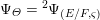 $\unicode[STIX]{x1D6F9}_{\unicode[STIX]{x1D6E9}}=^{2\,\!}\unicode[STIX]{x1D6F9}_{(E/F,\unicode[STIX]{x1D70D})}$
if and only if
 $\unicode[STIX]{x1D703}\,|\,U_{E}^{m-w}\neq \unicode[STIX]{x1D719}$
.
If
 $\unicode[STIX]{x1D703}\,|\,U_{E}^{m-w}=\unicode[STIX]{x1D719}$
, then
 $\unicode[STIX]{x1D6F9}_{\unicode[STIX]{x1D6E9}}(x){<}^{2\,\!}\unicode[STIX]{x1D6F9}_{(E/F,\unicode[STIX]{x1D70D})}(x)$
for all
 $x\in I$
.
Proof. We again write out formula (5.9.1),
 $$\begin{eqnarray}\unicode[STIX]{x1D703}^{1+a_{c}}(1+y)/\unicode[STIX]{x1D703}(1+y)=\unicode[STIX]{x1D703}(1-\unicode[STIX]{x1D701}c\unicode[STIX]{x1D6FC}^{-1}y)\,\unicode[STIX]{x1D707}_{M}(-\unicode[STIX]{x1D6FC}\unicode[STIX]{x1D701}\unicode[STIX]{x1D716}_{c}y),\end{eqnarray}$$
where
 $a_{c}\in \mathfrak{p}^{m-p^{r}k}$
is a solution of congruence (5.8.1),
 $$\begin{eqnarray}(1+a_{c})^{-1}\unicode[STIX]{x1D6FC}(1+a_{c})\equiv \unicode[STIX]{x1D6FC}+c\hspace{0.6em}({\rm mod}\hspace{0.2em}\mathfrak{p}^{w-p^{r}k})\end{eqnarray}$$
and
 $\unicode[STIX]{x1D716}_{c}$
is given by (5.8.3), relative to the element
 $a_{c}$
.
We use (5.8.3) to rewrite the last factor in (5.12.1) as
 $$\begin{eqnarray}\unicode[STIX]{x1D707}_{M}(-\unicode[STIX]{x1D6FC}\unicode[STIX]{x1D701}\unicode[STIX]{x1D716}_{c}y)=\unicode[STIX]{x1D707}_{M}(\unicode[STIX]{x1D701}cy)\,\unicode[STIX]{x1D707}_{M}(\unicode[STIX]{x1D701}a_{c}cy).\end{eqnarray}$$
For
 $1+y\in U_{E}^{p^{r}k-w}/U_{E}^{1+p^{r}k-w}$
, write
 $$\begin{eqnarray}\unicode[STIX]{x1D6EF}_{\unicode[STIX]{x1D703},c}(1+y)=\unicode[STIX]{x1D703}(1-\unicode[STIX]{x1D6FC}^{-1}\unicode[STIX]{x1D701}cy)\,\unicode[STIX]{x1D707}_{M}(\unicode[STIX]{x1D701}cy)\,\unicode[STIX]{x1D707}_{M}(\unicode[STIX]{x1D701}a_{c}cy)\,\unicode[STIX]{x1D707}_{M}(-cy).\end{eqnarray}$$
That is,
 $\unicode[STIX]{x1D6EF}_{\unicode[STIX]{x1D703},c}(1+y)$
is the product of the right-hand side of (5.12.1) and
 $\unicode[STIX]{x1D707}_{M}(-cy)$
. Therefore, invoking 5.9 Proposition 2, we have the following lemma.
Lemma. The character
 $\unicode[STIX]{x1D6EF}_{\unicode[STIX]{x1D703},c}$
is trivial if and only if
 $\unicode[STIX]{x1D6F9}_{\unicode[STIX]{x1D6E9}}(x){<}^{2\,\!}\unicode[STIX]{x1D6F9}_{(E/F,\unicode[STIX]{x1D70D})}(x)$
for all
 $x\in I$
. This condition holds for one element
 $c\in \mathfrak{p}_{F}^{-k}/\mathfrak{p}_{F}^{1-k}\smallsetminus \{0\}$
if and only if it holds for all.
Write
 $z=\unicode[STIX]{x1D701}\unicode[STIX]{x1D6FC}^{-1}cy$
. Thus
 $y\mapsto z$
induces an isomorphism of
 $U_{E}^{p^{r}k-w}/U_{E}^{1+p^{r}k-w}$
with
 $U_{E}^{m-w}/U_{E}^{1+m-w}$
and
 $$\begin{eqnarray}\displaystyle \unicode[STIX]{x1D6EF}_{\unicode[STIX]{x1D703},c}(1+y) & = & \displaystyle \unicode[STIX]{x1D703}(1-z)\,\unicode[STIX]{x1D707}_{M}(\unicode[STIX]{x1D6FC}z)\unicode[STIX]{x1D707}_{M}(\unicode[STIX]{x1D6FC}a_{c}z)\unicode[STIX]{x1D707}_{M}(-\unicode[STIX]{x1D701}^{-1}\unicode[STIX]{x1D6FC}z)\nonumber\\ \displaystyle & = & \displaystyle \unicode[STIX]{x1D703}(1+z)^{-1}\,\unicode[STIX]{x1D707}_{M}((1+a_{c}-\unicode[STIX]{x1D701}^{-1})\unicode[STIX]{x1D6FC}z).\nonumber\end{eqnarray}$$
Since
 $\unicode[STIX]{x1D710}_{E}(s_{E/F}(a_{c}))\geqslant w$
(5.8 Lemma), the formula
 $$\begin{eqnarray}\unicode[STIX]{x1D709}_{c}(1+z)=\unicode[STIX]{x1D707}_{M}((1+a_{c}-\unicode[STIX]{x1D701}^{-1})\unicode[STIX]{x1D6FC}z)\end{eqnarray}$$
defines a character of
 $U_{E}^{m-w}/U_{E}^{1+m-w}$
which is independent of the character
 $\unicode[STIX]{x1D703}\in \mathscr{C}(\mathfrak{a},\unicode[STIX]{x1D6FC})$
such that
 $l_{E}(\unicode[STIX]{x1D703})\leqslant m-w$
. For fixed
 $\unicode[STIX]{x1D703}$
, the character
 $\unicode[STIX]{x1D703}^{-1}\unicode[STIX]{x1D709}_{c}\,|\,U_{E}^{m-w}$
is either trivial for all
 $c\in \mathfrak{p}_{F}^{-k}/\mathfrak{p}_{F}^{1-k}\smallsetminus \{0\}$
, or else it is non-trivial for all such
 $c$
, by the lemma. Given any character
 $\unicode[STIX]{x1D719}$
of
 $U_{E}^{m-w}/U_{E}^{1+m-w}$
, there exists
 $\unicode[STIX]{x1D703}\in \mathscr{C}(\mathfrak{a},\unicode[STIX]{x1D6FC})$
agreeing with
 $\unicode[STIX]{x1D719}$
on
 $U_{E}^{m-w}$
. We conclude that if
 $c,c^{\prime }\in \mathfrak{p}_{F}^{-k}/\mathfrak{p}_{F}^{1-k}\smallsetminus \{0\}$
, then
 $\unicode[STIX]{x1D709}_{c}=\unicode[STIX]{x1D709}_{c^{\prime }}$
.
The proposition therefore holds for the character
 $$\begin{eqnarray}\unicode[STIX]{x1D719}(1+z)=\unicode[STIX]{x1D709}_{c}(1+z)=\unicode[STIX]{x1D707}_{M}((1+a_{c}-\unicode[STIX]{x1D701}^{-1})\unicode[STIX]{x1D6FC}z),\quad z\in \mathfrak{p}_{E}^{m-w},\end{eqnarray}$$
for any non-trivial element
 $c$
of
 $\mathfrak{p}_{F}^{-k}/\mathfrak{p}_{F}^{1-k}$
.◻
We have completed the proof of 5.3 Theorem. ◻
Remark.
We have noted that the character
 $\unicode[STIX]{x1D719}$
of (5.12.3) does not depend on the parameter
 $c\in \mathfrak{p}_{F}^{-k}/\mathfrak{p}_{F}^{1-k}\smallsetminus \{0\}$
. Indeed, any twisting datum
 $(h,b,\unicode[STIX]{x1D709})$
with
 $j_{\infty }<h<\bar{\jmath }_{\infty }$
will, by 5.9 Proposition 2, give rise to the same character.
6 Variation of parameters
In § 5 we fixed the stratum
 $[\mathfrak{a},m,0,\unicode[STIX]{x1D6FC}]$
and calculated
 $\unicode[STIX]{x1D6F9}_{\unicode[STIX]{x1D6E9}}$
, in many cases, under the restriction (5.3.1). Here, we investigate the scope for changing the stratum without changing the set
 $\mathscr{C}(\mathfrak{a},\unicode[STIX]{x1D6FC})$
, in order to avoid the condition (5.3.1) and to clarify the dichotomy in part (4) of the theorem.
6.1
Let
 $[\mathfrak{a},m,0,\unicode[STIX]{x1D6FC}]$
be a simple stratum in
 $M=\text{M}_{p^{r}}(F)$
,
 $r\geqslant 1$
, satisfying the usual conditions:
 $F[\unicode[STIX]{x1D6FC}]/F$
is totally ramified of degree
 $p^{r}$
and
 $m$
is not divisible by
 $p$
. Set
 $\unicode[STIX]{x1D70D}=m/p^{r}$
. Define
 $\text{P}(\mathfrak{a},\unicode[STIX]{x1D6FC})$
as the set of
 $\unicode[STIX]{x1D6FD}\in \operatorname{GL}_{p^{r}}(F)$
for which
 $[\mathfrak{a},m,0,\unicode[STIX]{x1D6FD}]$
is a simple stratum such that
 $\mathscr{C}(\mathfrak{a},\unicode[STIX]{x1D6FD})=\mathscr{C}(\mathfrak{a},\unicode[STIX]{x1D6FC})$
. We summarize the main properties of such elements
 $\unicode[STIX]{x1D6FD}$
. As usual,
 $\mathfrak{p}$
is the Jacobson radical of
 $\mathfrak{a}$
.
Proposition. Write
 $E=F[\unicode[STIX]{x1D6FC}]$
.
(1) If
$\unicode[STIX]{x1D6FD}\in \text{P}(\mathfrak{a},\unicode[STIX]{x1D6FC})$
, the field extension
$F[\unicode[STIX]{x1D6FD}]/F$
is totally ramified of degree
$p^{r}$
. Moreover, $$\begin{eqnarray}\unicode[STIX]{x1D6FD}\equiv \unicode[STIX]{x1D6FC}\hspace{0.6em}({\rm mod}\hspace{0.2em}\mathfrak{p}^{-[m/2]}).\end{eqnarray}$$
(2) Let
$k\leqslant [m/2]$
be an integer and let
$b\in \mathfrak{p}^{-k}$
. The element
$\unicode[STIX]{x1D6FD}=\unicode[STIX]{x1D6FC}+b$
then lies in
$\text{P}(\mathfrak{a},\unicode[STIX]{x1D6FC})$
.


Proof. In (1), the first assertion is an instance of [Reference Bushnell and KutzkoBK93, (3.5.1)], while the second follows from the definition in 2.3. In (2), the stratum
 $[\mathfrak{a},m,0,\unicode[STIX]{x1D6FD}]$
is simple with the required properties, as follows from [Reference Bushnell and KutzkoBK93, (2.2.3)].◻
Remarks.
(1) Any element of
$\text{P}(\mathfrak{a},\unicode[STIX]{x1D6FC})$
arises as in part (2) of the proposition [Reference Bushnell and KutzkoBK93, (2.4.1)].(2) If
$\unicode[STIX]{x1D6FD}\in \text{P}(\mathfrak{a},\unicode[STIX]{x1D6FC})$
, then
$\text{P}(\mathfrak{a},\unicode[STIX]{x1D6FD})=\text{P}(\mathfrak{a},\unicode[STIX]{x1D6FC})$
.(3) Let
$[\mathfrak{a},q,0,\unicode[STIX]{x1D6FE}]$
be a simple stratum in
$M$
. If the set
$\mathscr{C}(\mathfrak{a},\unicode[STIX]{x1D6FC})\cap \mathscr{C}(\mathfrak{a},\unicode[STIX]{x1D6FE})$
is non-empty, then
$q=m$
and
$\mathscr{C}(\mathfrak{a},\unicode[STIX]{x1D6FC})=\mathscr{C}(\mathfrak{a},\unicode[STIX]{x1D6FE})$
[Reference Bushnell and KutzkoBK93, (3.5.8), (3.5.11)], whence
$\Vert \mathscr{C}(\mathfrak{a},\unicode[STIX]{x1D6FC})\Vert =\Vert \mathscr{C}(\mathfrak{a},\unicode[STIX]{x1D6FE})\Vert$
.(4) Let
$\mathscr{K}_{\mathfrak{a}}$
be the group of
$x\in \operatorname{GL}_{p^{r}}(F)$
such that
$x\mathfrak{a}x^{-1}=\mathfrak{a}$
. For
$\unicode[STIX]{x1D6FD}_{1},\unicode[STIX]{x1D6FD}_{2}\in \text{P}(\mathfrak{a},\unicode[STIX]{x1D6FC})$
, say that
$\unicode[STIX]{x1D6FD}_{1}\sim \unicode[STIX]{x1D6FD}_{2}$
if
$\unicode[STIX]{x1D6FD}_{1}U_{\mathfrak{a}}^{m}$
is
$\mathscr{K}_{\mathfrak{a}}$
-conjugate to
$\unicode[STIX]{x1D6FD}_{2}U_{\mathfrak{a}}^{m}$
. It is shown in [Reference Bushnell and KutzkoBK94] that the sets
$\text{P}(\mathfrak{a},\unicode[STIX]{x1D6FC})/\!\sim \,$
and
$\Vert \mathscr{C}(\mathfrak{a},\unicode[STIX]{x1D6FC})\Vert$
are in (non-canonical) bijection.














6.2
We give a first application of this concept.
Proposition. Suppose that
 $m>2w_{F[\unicode[STIX]{x1D6FC}]/F}$
. If
 $\unicode[STIX]{x1D6FD}\in \text{P}(\mathfrak{a},\unicode[STIX]{x1D6FC})$
then
 $w_{F[\unicode[STIX]{x1D6FD}]/F}=w_{F[\unicode[STIX]{x1D6FC}]/F}$
.
Proof. Let
 $\mathfrak{p}=\operatorname{rad}\mathfrak{a}$
. Abbreviate
 $w_{\unicode[STIX]{x1D6FC}}=w_{F[\unicode[STIX]{x1D6FC}]/F}$
,
 $w_{\unicode[STIX]{x1D6FD}}=w_{F[\unicode[STIX]{x1D6FD}]/F}$
. By hypothesis,
 $m-w_{\unicode[STIX]{x1D6FC}}\geqslant [m/2]+1$
. A character
 $\unicode[STIX]{x1D703}\in \mathscr{C}(\mathfrak{a},\unicode[STIX]{x1D6FC})$
, by definition (2.3.1), agrees with
 $\unicode[STIX]{x1D707}_{M}\ast \unicode[STIX]{x1D6FC}$
on the group
 $H^{1+[m/2]}(\unicode[STIX]{x1D6FC},\mathfrak{a})=U_{\mathfrak{a}}^{1+[m/2]}$
. The integer
 $l_{E}(\unicode[STIX]{x1D703})$
is the least integer
 $k\geqslant 0$
such that
 $\unicode[STIX]{x1D703}$
is trivial on
 $U_{E}^{1+k}U_{\mathfrak{a}}^{1+m}=1+\mathfrak{p}_{E}^{1+k}+\mathfrak{p}^{1+m}$
. In this case,
 $l_{E}(\unicode[STIX]{x1D703})=m-w_{\unicode[STIX]{x1D6FC}}$
, as in 5.2 Proposition. However,
 $\mathfrak{p}_{E}^{1+k}+\mathfrak{p}^{1+m}$
is the kernel of the adjoint map
 $A_{\unicode[STIX]{x1D6FC}}$
on
 $\mathfrak{p}^{1+k}/\mathfrak{p}^{1+m}$
, so
 $l_{E}(\unicode[STIX]{x1D703})$
is the least integer
 $k\geqslant 0$
such that
 $\unicode[STIX]{x1D707}_{M}\ast \unicode[STIX]{x1D6FC}$
is trivial on
 $1+\operatorname{Ker}A_{\unicode[STIX]{x1D6FC}}\,|\,\mathfrak{p}^{1+k}/\mathfrak{p}^{1+m}$
. The same analysis applies relative to
 $\unicode[STIX]{x1D6FD}$
in place of
 $\unicode[STIX]{x1D6FC}$
.
By hypothesis,
 $\unicode[STIX]{x1D703}$
also agrees with
 $\unicode[STIX]{x1D707}_{M}\ast \unicode[STIX]{x1D6FD}$
on
 $U_{\mathfrak{a}}^{1+[m/2]}$
, so
 $\unicode[STIX]{x1D6FD}\equiv \unicode[STIX]{x1D6FC}\hspace{0.6em}({\rm mod}\hspace{0.2em}\mathfrak{p}^{-[m/2]})$
. The maps
 $A_{\unicode[STIX]{x1D6FC}}$
,
 $A_{\unicode[STIX]{x1D6FD}}$
therefore agree on the group
 $\mathfrak{p}^{1+[m/2]}/\mathfrak{p}^{1+m}$
, and the result follows.◻
The following corollary does not form part of the main development, but is included to illuminate the division into cases in 5.3 Theorem; see Example below.
Corollary. In the context of the proposition, we have

If
 $p\geqslant 3$
, the function
 $\unicode[STIX]{x1D6F9}_{\unicode[STIX]{x1D6E9}}$
has an even number of jumps.
Proof. Let
 $\unicode[STIX]{x1D6E9}\in \Vert \mathscr{C}(\mathfrak{a},\unicode[STIX]{x1D6FC})\Vert$
. Part (2) of 5.3 Theorem gives
 $$\begin{eqnarray}\unicode[STIX]{x1D6F9}_{\unicode[STIX]{x1D6E9}}(x)=^{2\,\!}\unicode[STIX]{x1D6F9}_{(F[\unicode[STIX]{x1D6FC}]/F,\unicode[STIX]{x1D70D})}(x)=^{2\,\!}\unicode[STIX]{x1D6F9}_{(F[\unicode[STIX]{x1D6FD}]/F,\unicode[STIX]{x1D70D})}(x),\quad 0\leqslant x\leqslant \unicode[STIX]{x1D70D},\end{eqnarray}$$
whence the first assertion follows.
If
 $\unicode[STIX]{x1D6F9}$
denotes any of the functions appearing in (6.2.1), define
 $c$
by
 $c+\unicode[STIX]{x1D6F9}(c)=\unicode[STIX]{x1D70D}$
, so that
 $\unicode[STIX]{x1D713}_{F[\unicode[STIX]{x1D6FC}]/F}(x)=\unicode[STIX]{x1D713}_{F[\unicode[STIX]{x1D6FD}]/F}(x)$
for
 $0\leqslant x\leqslant c$
. Let
 $j_{\infty }$
be the last jump of
 $\unicode[STIX]{x1D713}_{F[\unicode[STIX]{x1D6FC}]/F}$
.
Lemma. If
 $j_{\infty }<c$
, then
 $\unicode[STIX]{x1D713}_{F[\unicode[STIX]{x1D6FD}]/F}=\unicode[STIX]{x1D713}_{F[\unicode[STIX]{x1D6FC}]/F}$
and
 $\unicode[STIX]{x1D6F9}_{\unicode[STIX]{x1D6E9}}$
has an even number of jumps.
Proof. The second assertion follows from 4.2 Proposition and 5.3 Theorem (2). For
 $0<x<c$
, we have
 $p^{r}\unicode[STIX]{x1D6F9}_{\unicode[STIX]{x1D6E9}}(x)=\unicode[STIX]{x1D713}_{F[\unicode[STIX]{x1D6FC}]/F}(x)=\unicode[STIX]{x1D713}_{F[\unicode[STIX]{x1D6FD}]/F}(x)$
. Thus
 $\unicode[STIX]{x1D713}_{F[\unicode[STIX]{x1D6FD}]/F}$
has a jump at
 $j_{\infty }$
and
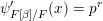 $\unicode[STIX]{x1D713}_{F[\unicode[STIX]{x1D6FD}]/F}^{\prime }(x)=p^{r}$
, for
 $j_{\infty }<x<c$
. Therefore
 $j_{\infty }$
is the last jump of
 $\unicode[STIX]{x1D713}_{F[\unicode[STIX]{x1D6FD}]/F}$
(cf. 1.6 Proposition) and the lemma follows.◻
We use 1.6 Corollary:
 $$\begin{eqnarray}j_{\infty }\leqslant \frac{w_{\unicode[STIX]{x1D6FC}}}{p^{r-1}(p-1)},\end{eqnarray}$$
where
 $w_{\unicode[STIX]{x1D6FC}}=w_{F[\unicode[STIX]{x1D6FC}]/F}$
. Invoking also 1.6 Proposition, we obtain

since
 $w_{\unicode[STIX]{x1D6FC}}<m/2$
. So, if
 $p\geqslant 3$
, the point
 $(j_{\infty },p^{-r}\unicode[STIX]{x1D713}_{F[\unicode[STIX]{x1D6FC}]/F}(j_{\infty }))$
lies strictly below the line
 $x+y=\unicode[STIX]{x1D70D}$
. That is,
 $j_{\infty }<c$
and, in this case, the corollary follows from the lemma.
Suppose therefore that
 $p=2$
. If
 $r=1$
, the graph of
 $\unicode[STIX]{x1D713}_{F[\unicode[STIX]{x1D6FC}]/F}$
consists of segments of the two lines
 $y=x$
and
 $y=2x-w_{F[\unicode[STIX]{x1D6FC}]/F}$
. Likewise for
 $\unicode[STIX]{x1D6FD}$
. The proposition gives
 $w_{\unicode[STIX]{x1D6FC}}=w_{\unicode[STIX]{x1D6FD}}$
, whence the result in this case.
Consider next the case where
 $r\geqslant 2$
and
 $j_{\infty }$
is the only jump of
 $\unicode[STIX]{x1D713}_{F[\unicode[STIX]{x1D6FC}]/F}$
. Here,
 $j_{\infty }=w_{\unicode[STIX]{x1D6FC}}/(2^{r}-1)$
(1.6 Corollary) and so
 $2^{-r}\unicode[STIX]{x1D713}_{F[\unicode[STIX]{x1D6FC}]/F}(j_{\infty })=2^{-r}j_{\infty }$
. Therefore
 $$\begin{eqnarray}j_{\infty }+2^{-r}\unicode[STIX]{x1D713}_{F[\unicode[STIX]{x1D6FC}]/F}(j_{\infty })=\frac{w_{\unicode[STIX]{x1D6FC}}}{2^{r}}\,\frac{2^{r}+1}{2^{r}-1}<\frac{\unicode[STIX]{x1D70D}}{2}\,\frac{2^{r}+1}{2^{r}-1}\leqslant \unicode[STIX]{x1D70D}.\end{eqnarray}$$
Thus
 $j_{\infty }+2^{-r}\unicode[STIX]{x1D713}_{F[\unicode[STIX]{x1D6FC}]/F}(j_{\infty })<\unicode[STIX]{x1D70D}$
, so
 $j_{\infty }<c$
, and the result in this case also follows from the lemma.
We are left with the case where
 $r\geqslant 2$
and
 $\unicode[STIX]{x1D713}_{F[\unicode[STIX]{x1D6FC}]/F}$
has at least two jumps. If
 $j_{\infty }<c$
, there is nothing more to do, so we assume
 $j_{\infty }\geqslant c$
. Let
 $j^{\prime }$
be the penultimate jump of
 $\unicode[STIX]{x1D713}_{F[\unicode[STIX]{x1D6FC}]/F}$
. In particular,
 $$\begin{eqnarray}2^{-r}\unicode[STIX]{x1D713}_{F[\unicode[STIX]{x1D6FC}]/F}(x)\leqslant x/4,\quad 0\leqslant x\leqslant j^{\prime }.\end{eqnarray}$$
We show that
 $j^{\prime }<c$
.
Abbreviate
 $a=w_{\unicode[STIX]{x1D6FC}}/2^{r}$
, so that
 $2^{-r}\unicode[STIX]{x1D713}_{F[\unicode[STIX]{x1D6FC}]/F}(x)=x-a$
for
 $x\geqslant j_{\infty }$
, while
 $2^{-r}\unicode[STIX]{x1D713}_{F[\unicode[STIX]{x1D6FC}]/F}(x)>x-a$
when
 $0\leqslant x<j_{\infty }$
. Thus
 $$\begin{eqnarray}x-a<2^{-r}\unicode[STIX]{x1D713}_{F[\unicode[STIX]{x1D6FC}]/F}(x)\leqslant x/4,\quad 0\leqslant x\leqslant j^{\prime }.\end{eqnarray}$$
The lines
 $y=x-a$
,
 $y=x/4$
meet at the point
 $(4a/3,a/3)$
, so
 $j^{\prime }<4a/3$
. Since
 $4a/3+a/3=5a/3<2a<\unicode[STIX]{x1D70D}$
, this point of intersection lies below the line
 $x+y=\unicode[STIX]{x1D70D}$
. Therefore
 $j^{\prime }<4a/3<c$
.
We have
 $\unicode[STIX]{x1D713}_{F[\unicode[STIX]{x1D6FC}]/F}(x)=\unicode[STIX]{x1D713}_{F[\unicode[STIX]{x1D6FD}]/F}(x)$
in the region
 $0\leqslant x<c$
. The same analysis applies with
 $\unicode[STIX]{x1D6FD}$
replacing
 $\unicode[STIX]{x1D6FC}$
, so
 $j^{\prime }$
is also the penultimate jump of
 $\unicode[STIX]{x1D713}_{F[\unicode[STIX]{x1D6FD}]/F}$
. Let
 $\tilde{\unicode[STIX]{x1D713}}(x)$
be the piecewise linear function agreeing with
 $\unicode[STIX]{x1D713}_{F[\unicode[STIX]{x1D6FC}]/F}(x)=\unicode[STIX]{x1D713}_{F[\unicode[STIX]{x1D6FD}]/F}(x)$
for
 $x<c$
and smooth for
 $x>j^{\prime }$
. In the region
 $x\geqslant 0$
, we then have

as required. ◻
Example. Suppose
 $p=2$
and let
 $\unicode[STIX]{x1D6E9}\in \mathbf{\mathscr{E}}^{\text{C}}(F)$
have degree
 $2$
. Thus
 $\unicode[STIX]{x1D6F9}_{\unicode[STIX]{x1D6E9}}$
has an odd number of jumps (in fact one jump) if and only if
 $j_{\infty }\geqslant c$
, using the notation of the Corollary. By 3.8 Proposition, this is equivalent to
 $m\leqslant 3w$
(cf. Kutzko [Reference KutzkoKut84]). So, for
 $p^{r}=2$
, there are examples of endo-classes
 $\unicode[STIX]{x1D6E9}$
for which
 $m>2w$
while
 $\unicode[STIX]{x1D6F9}_{\unicode[STIX]{x1D6E9}}$
has an odd number of jumps.
6.3
We use the notation from the start of 6.1, except that we write
 $E=F[\unicode[STIX]{x1D6FC}]$
and assume
 $m\leqslant 2w_{E/F}$
. This case is more complex and interesting. We first investigate the possibility of changing
 $\unicode[STIX]{x1D6FC}$
to raise the exponent
 $w_{E/F}$
.
Let
 $\mathfrak{p}$
be the Jacobson radical
 $\operatorname{rad}\mathfrak{a}$
of
 $\mathfrak{a}$
. Let
 $s_{E/F}:M\rightarrow E$
be a tame corestriction.
Proposition. Suppose that
 $m/2\leqslant w_{E/F}<m$
and that
 $w=w_{E/F}\not \equiv 0\hspace{0.6em}({\rm mod}\hspace{0.2em}p)$
. Let
 $\unicode[STIX]{x1D701}=(w-m)/m\in \mathfrak{o}_{F}$
. There exists
 $b\in \mathfrak{p}^{w-m}$
such that
 $$\begin{eqnarray}(\unicode[STIX]{x1D701}+1)s_{E/F}(b)\equiv s_{E/F}(\unicode[STIX]{x1D6FC})\hspace{0.6em}({\rm mod}\hspace{0.2em}\mathfrak{p}_{E}^{1+w-m}).\end{eqnarray}$$
For any such
 $b$
, the element
 $\unicode[STIX]{x1D6FD}=\unicode[STIX]{x1D6FC}-b$
lies in
 $\text{P}(\mathfrak{a},\unicode[STIX]{x1D6FC})$
and
 $w_{F[\unicode[STIX]{x1D6FD}]/F}>w$
.
Proof. The hypothesis
 $w\not \equiv 0\hspace{0.6em}({\rm mod}\hspace{0.2em}p)$
implies that
 $\unicode[STIX]{x1D701}\not \equiv -1\hspace{0.6em}({\rm mod}\hspace{0.2em}\mathfrak{p}_{F})$
. The exact sequences (5.1.1) then give an element
 $b$
with the necessary properties.
The hypothesis
 $m\leqslant 2w$
implies
 $\unicode[STIX]{x1D6FD}\equiv \unicode[STIX]{x1D6FC}\hspace{0.6em}({\rm mod}\hspace{0.2em}\mathfrak{p}^{-[m/2]})$
and, following 6.1 Proposition,
 $\unicode[STIX]{x1D6FD}\in \text{P}(\mathfrak{a},\unicode[STIX]{x1D6FC})$
. Write
 $E^{\prime }=F[\unicode[STIX]{x1D6FD}]$
.
Lemma.
(1) Let
$y\in \mathfrak{p}_{E}^{m-w}$
. There exist
$y^{\prime }\in \mathfrak{p}_{E^{\prime }}^{m-w}$
and
$h\in \mathfrak{p}^{m}$
such that (6.3.2)the map$$\begin{eqnarray}y=y^{\prime }+h,\end{eqnarray}$$
$y\mapsto y^{\prime }$
induces an isomorphism
$\mathfrak{p}_{E}^{m-w}/\mathfrak{p}_{E}^{m}\rightarrow \mathfrak{p}_{E^{\prime }}^{m-w}/\mathfrak{p}_{E^{\prime }}^{m}$
.(2) The decomposition (6.3.2) may be chosen so that, additionally,
(6.3.3)$$\begin{eqnarray}h\equiv \unicode[STIX]{x1D701}by\unicode[STIX]{x1D6FD}^{-1}\hspace{0.6em}({\rm mod}\hspace{0.2em}\mathfrak{p}^{m+1}+A_{\unicode[STIX]{x1D6FD}}(\mathfrak{p}^{m})).\end{eqnarray}$$




Proof. In (1), the relation
 $H^{1}(\unicode[STIX]{x1D6FD},\mathfrak{a})=H^{1}(\unicode[STIX]{x1D6FC},\mathfrak{a})$
implies that any
 $y\in \mathfrak{p}_{E}^{m-w}$
takes the form
 $y=y^{\prime }+h$
, with
 $y^{\prime }\in \mathfrak{p}_{E^{\prime }}^{m-w}$
and
 $h\in \mathfrak{p}^{1+[m/2]}$
. The element
 $[\unicode[STIX]{x1D6FD},y]=[\unicode[STIX]{x1D6FD},h]=-[b,y]$
lies in
 $\mathfrak{a}$
. By (5.1.1), we may choose the decomposition so that
 $h\in \mathfrak{p}^{m}$
. The second assertion is immediate.
In (2), 5.7 Proposition gives
 $$\begin{eqnarray}[\unicode[STIX]{x1D6FD},h]=-[b,y]=A_{y}(b)y\equiv \unicode[STIX]{x1D701}A_{\unicode[STIX]{x1D6FD}}(b)y\hspace{0.6em}({\rm mod}\hspace{0.2em}\mathfrak{p}+A_{\unicode[STIX]{x1D6FD}}^{2}(\mathfrak{a})).\end{eqnarray}$$
In multiplicative terms, the definition of
 $\unicode[STIX]{x1D6FD}$
gives
 $\unicode[STIX]{x1D6FD}\equiv \unicode[STIX]{x1D6FC}\hspace{0.6em}({\rm mod}\hspace{0.2em}U_{\mathfrak{a}}^{w})$
and therefore
 $\unicode[STIX]{x1D6FD}^{-1}\equiv \unicode[STIX]{x1D6FC}^{-1}\hspace{0.6em}({\rm mod}\hspace{0.2em}\mathfrak{p}^{m+w})$
. It follows that
 $$\begin{eqnarray}\begin{array}{@{}rcl@{}}\unicode[STIX]{x1D701}by\unicode[STIX]{x1D6FC}^{-1}\ & \equiv \ & \unicode[STIX]{x1D701}by\unicode[STIX]{x1D6FD}^{-1}\hspace{0.6em}({\rm mod}\hspace{0.2em}\mathfrak{p}^{m+1}),\quad \text{and}\\ A_{\unicode[STIX]{x1D6FC}}(\mathfrak{p}^{m})+\mathfrak{p}^{m+1}\ & =\ & A_{\unicode[STIX]{x1D6FD}}(\mathfrak{p}^{m})+\mathfrak{p}^{m+1}.\end{array}\end{eqnarray}$$
Relation (6.3.2) gives
 $\unicode[STIX]{x1D707}_{M}(\unicode[STIX]{x1D6FD}y)=\unicode[STIX]{x1D707}_{M}(\unicode[STIX]{x1D6FD}y^{\prime })\,\unicode[STIX]{x1D707}_{M}(\unicode[STIX]{x1D6FD}h)$
, while (6.3.3), (6.3.4) yield
 $\unicode[STIX]{x1D707}_{M}(\unicode[STIX]{x1D6FD}h)=\unicode[STIX]{x1D707}_{M}(\unicode[STIX]{x1D701}by)$
. On the other hand,
 $\unicode[STIX]{x1D707}_{M}(\unicode[STIX]{x1D6FD}y)=\unicode[STIX]{x1D707}_{M}((\unicode[STIX]{x1D6FC}-b)y)$
by definition, so
 $$\begin{eqnarray}\unicode[STIX]{x1D707}_{M}(\unicode[STIX]{x1D6FD}y^{\prime })=\unicode[STIX]{x1D707}_{M}((\unicode[STIX]{x1D6FC}-(\unicode[STIX]{x1D701}+1)b)y)=\unicode[STIX]{x1D707}_{E}(s_{E/F}(\unicode[STIX]{x1D6FC}-(\unicode[STIX]{x1D701}+1)b)y)=1,\end{eqnarray}$$
for all
 $y\in \mathfrak{p}_{E}^{m-w}$
, by (6.3.1). Part (1) of the lemma now shows that
 $\unicode[STIX]{x1D707}_{M}(\unicode[STIX]{x1D6FD}y^{\prime })=1$
for all
 $y^{\prime }\in \mathfrak{p}_{E^{\prime }}^{m-w}$
. Therefore
 $w_{E^{\prime }/F}>w$
, as required.◻
Corollary. Suppose that
 $m\leqslant 2w_{E/F}$
. There exists
 $\unicode[STIX]{x1D6FD}=\unicode[STIX]{x1D6FC}-b\in \text{P}(\mathfrak{a},\unicode[STIX]{x1D6FC})$
, where
 $b\in \mathfrak{p}^{w_{E/F}-m}$
satisfies (6.3.1), with the following property. If
 $E^{\prime }=F[\unicode[STIX]{x1D6FD}]$
, then either
(1)
$w_{E^{\prime }/F}\geqslant w_{E/F}$
and
$w_{E^{\prime }/F}\equiv 0\hspace{0.6em}({\rm mod}\hspace{0.2em}p)$
, or(2)
$w_{E^{\prime }/F}\geqslant m$
.



Proof. If
 $w_{E/F}$
is divisible by
 $p$
, there is nothing to do. Otherwise, we construct
 $E_{1}=F[\unicode[STIX]{x1D6FD}]$
following the proposition. If either
 $w_{E_{1}/F}\geqslant m$
or
 $w_{E_{1}/F}\equiv 0\hspace{0.6em}({\rm mod}\hspace{0.2em}p)$
, we are finished. So, assume that
 $w_{E_{1}/F}<m$
and
 $w_{E_{1}/F}\not \equiv 0\hspace{0.6em}({\rm mod}\hspace{0.2em}p)$
. Set
 $w_{1}=w_{E_{1}/F}$
. Following the procedure as before, we construct an element
 $\unicode[STIX]{x1D6FE}\equiv \unicode[STIX]{x1D6FD}\hspace{0.6em}({\rm mod}\hspace{0.2em}\mathfrak{p}^{w_{1}-m})$
such that
 $w_{F[\unicode[STIX]{x1D6FE}]/F}>w_{1}$
. The congruence condition on
 $\unicode[STIX]{x1D6FE}$
ensures that
 $b_{1}=\unicode[STIX]{x1D6FC}-\unicode[STIX]{x1D6FE}$
satisfies (6.3.1). We iterate this procedure as necessary until we achieve either (1) or (2).◻
6.4
We retain the notation of 6.3, in particular
 $E=F[\unicode[STIX]{x1D6FC}]$
and
 $w=w_{E/F}$
. The elements
 $\unicode[STIX]{x1D6FD}$
of 6.3 Proposition have useful properties relative to certain simple characters.
Proposition. Let
 $\unicode[STIX]{x1D6FD}=\unicode[STIX]{x1D6FC}-b\in \text{P}(\mathfrak{a},\unicode[STIX]{x1D6FC})$
, where
 $b\in \mathfrak{p}^{w-m}$
satisfies (6.3.1).
(1) If
$\unicode[STIX]{x1D709}\in \mathscr{C}(\mathfrak{a},\unicode[STIX]{x1D6FC})$
satisfies
$\unicode[STIX]{x1D709}(1+y)=\unicode[STIX]{x1D707}_{M}(\unicode[STIX]{x1D6FC}y)$
,
$y\in \mathfrak{p}_{E}^{m-w}$
, then $$\begin{eqnarray}l_{F[\unicode[STIX]{x1D6FD}]}(\unicode[STIX]{x1D709})=l_{E}(\unicode[STIX]{x1D709})=m-w.\end{eqnarray}$$
(2) If
$\unicode[STIX]{x1D709}\in \mathscr{C}(\mathfrak{a},\unicode[STIX]{x1D6FC})$
satisfies
$l_{E}(\unicode[STIX]{x1D709})>m-w$
, then $$\begin{eqnarray}l_{F[\unicode[STIX]{x1D6FD}]}(\unicode[STIX]{x1D709})=l_{E}(\unicode[STIX]{x1D709}).\end{eqnarray}$$


Proof. For part (1), we use (6.3.4) to evaluate
 $$\begin{eqnarray}\unicode[STIX]{x1D709}(1+y^{\prime })=\unicode[STIX]{x1D707}_{M}(\unicode[STIX]{x1D6FC}y)\unicode[STIX]{x1D707}_{M}(\unicode[STIX]{x1D6FC}h)=\unicode[STIX]{x1D707}_{M}((\unicode[STIX]{x1D6FC}-\unicode[STIX]{x1D701}b)y),\end{eqnarray}$$
where
 $y\in \mathfrak{p}_{E}^{m-w}$
,
 $y^{\prime }\in \mathfrak{p}_{E^{\prime }}^{m-w}$
and
 $h\in \mathfrak{p}^{m}$
are related as in 6.3 Lemma. As
 $1+\unicode[STIX]{x1D701}$
is a unit of
 $\mathfrak{o}_{F}$
, we have
 $\unicode[STIX]{x1D701}s_{E/F}(b)\equiv \unicode[STIX]{x1D701}s_{E/F}(\unicode[STIX]{x1D6FC})(\unicode[STIX]{x1D701}+1)^{-1}\hspace{0.6em}({\rm mod}\hspace{0.2em}\mathfrak{p}_{E}^{1+w-m})$
and so, by (6.3.1),
 $$\begin{eqnarray}\unicode[STIX]{x1D709}(1+y^{\prime })=\unicode[STIX]{x1D707}_{E}((\unicode[STIX]{x1D701}+1)^{-1}s_{E/F}(\unicode[STIX]{x1D6FC})y),\quad y^{\prime }\in \mathfrak{p}_{F[\unicode[STIX]{x1D6FD}]}^{m-w}.\end{eqnarray}$$
We may choose
 $y$
so that
 $\unicode[STIX]{x1D709}(1+y^{\prime })\neq 1$
and part (1) of the proposition follows.
In part (2), let
 $l=l_{E}(\unicode[STIX]{x1D709})$
. Let
 $y\in \mathfrak{p}_{E}^{l}$
. Since
 $l>m-w$
, we use 6.3 Lemma to write
 $y=y^{\prime }+h$
, where
 $y^{\prime }\in \mathfrak{p}_{F[\unicode[STIX]{x1D6FD}]}^{l}$
and
 $h\in \mathfrak{p}^{m+1}$
. Thus
 $\unicode[STIX]{x1D709}(1+y^{\prime })=\unicode[STIX]{x1D709}(1+y)$
and we may choose
 $y$
so that
 $\unicode[STIX]{x1D709}(1+y)\neq 1$
. If, however,
 $y\in \mathfrak{p}_{E}^{1+l}$
, then
 $\unicode[STIX]{x1D709}(1+y^{\prime })=\unicode[STIX]{x1D709}(1+y)=1$
, so
 $l_{F[\unicode[STIX]{x1D6FD}]}(\unicode[STIX]{x1D709})=l$
, as required.◻
Note the very restrictive hypothesis on
 $\unicode[STIX]{x1D709}$
in this corollary.
6.5
We turn to the question of lowering of the exponent
 $w_{E/F}$
. Following 6.2 Proposition, we are restricted to the case where
 $2w_{E/F}>m$
. The consequences for simple characters are complementary to those of 6.4, but we get much more detail.
Theorem. Let
 $[\mathfrak{a},m,0,\unicode[STIX]{x1D6FC}]$
be a simple stratum in
 $M=\text{M}_{p^{r}}(F)$
in which
 $E=F[\unicode[STIX]{x1D6FC}]/F$
is totally ramified of degree
 $p^{r}$
and
 $p$
does not divide
 $m$
. Suppose
 $m<2w_{E/F}$
. Let
 $d$
be an integer such that
 $$\begin{eqnarray}\begin{array}{@{}c@{}}1\leqslant d\leqslant m/2,\quad d>\max \{0,m-w_{E/F}\},\\ d\not \equiv m\hspace{0.6em}({\rm mod}\hspace{0.2em}p).\end{array}\end{eqnarray}$$
Let
 $b\in \mathfrak{p}^{-d}$
satisfy
 $\unicode[STIX]{x1D710}_{E}(s_{E/F}(b))=-d$
. The element
 $\unicode[STIX]{x1D6FD}=\unicode[STIX]{x1D6FC}+b$
lies in
 $\text{P}(\mathfrak{a},\unicode[STIX]{x1D6FC})$
and
 $$\begin{eqnarray}w_{E^{\prime }/F}=m-d<w_{E/F},\quad E^{\prime }=F[\unicode[STIX]{x1D6FD}].\end{eqnarray}$$
Let
 $\unicode[STIX]{x1D703}\in \mathscr{C}(\mathfrak{a},\unicode[STIX]{x1D6FC})$
and write
 $l=l_{E}(\unicode[STIX]{x1D703})$
. For any such
 $\unicode[STIX]{x1D6FD}$
, the following results hold.
(1) Suppose
$l<d$
.(a) If
$d\not \equiv 0\hspace{0.6em}({\rm mod}\hspace{0.2em}p)$
, then
$l_{E^{\prime }}(\unicode[STIX]{x1D703})=d$
.(b) If
$d\equiv 0\hspace{0.6em}({\rm mod}\hspace{0.2em}p)$
, then
$l_{E^{\prime }}(\unicode[STIX]{x1D703})<d$
.
(2) If
$l>d$
, then
$l_{E^{\prime }}(\unicode[STIX]{x1D703})=l$
.(3) Suppose
$l=d$
.(a) If
$d\not \equiv 0\hspace{0.6em}({\rm mod}\hspace{0.2em}p)$
, then
$l_{E^{\prime }}(\unicode[STIX]{x1D703})\leqslant d$
, with both equality and inequality occurring.(b) If
$d\equiv 0\hspace{0.6em}({\rm mod}\hspace{0.2em}p)$
, then
$l_{E^{\prime }}(\unicode[STIX]{x1D703})=d$
.


Proof. Writing
 $\mathfrak{p}=\operatorname{rad}\mathfrak{a}$
, let
 $b\in \mathfrak{p}^{-d}$
satisfy
 $\unicode[STIX]{x1D710}_{E}(s_{E/F}(b))=-d$
. As in 6.1 Proposition, the element
 $\unicode[STIX]{x1D6FD}=\unicode[STIX]{x1D6FC}+b$
lies in
 $\text{P}(\mathfrak{a},\unicode[STIX]{x1D6FC})$
. Put
 $E^{\prime }=F[\unicode[STIX]{x1D6FD}]$
.
Lemma.
(1) Let
$y\in \mathfrak{p}_{E}^{d}$
. There exist
$y^{\prime }\in \mathfrak{p}_{E^{\prime }}^{d}$
and
$h\in \mathfrak{p}^{m}$
such that
$y=y^{\prime }+h$
. The map
$y\mapsto y^{\prime }$
induces an isomorphism
$\mathfrak{p}_{E}^{d}/\mathfrak{p}_{E}^{m}\rightarrow \mathfrak{p}_{E^{\prime }}^{d}/\mathfrak{p}_{E^{\prime }}^{m}$
.(2) If
$y\in \mathfrak{p}_{E}^{d+1}$
, then
$y^{\prime }\in \mathfrak{p}_{E^{\prime }}^{d+1}$
and one may take
$h\in \mathfrak{p}^{m+1}$
.





Proof. This is identical to the proof of part (1) of 6.3 Lemma, so we omit the details. ◻
Set
 $w^{\prime }=w_{E^{\prime }/F}$
. We first show that
 $\unicode[STIX]{x1D707}_{M}(\unicode[STIX]{x1D6FD}z)=1$
, for
 $z\in \mathfrak{p}_{E^{\prime }}^{1+d}$
. By the lemma, there exist
 $y\in \mathfrak{p}_{E}^{1+d}$
and
 $h\in \mathfrak{p}^{m+1}$
such that
 $y=z+h$
. The condition
 $d>m-w_{E/F}$
implies
 $\unicode[STIX]{x1D707}_{M}(\unicode[STIX]{x1D6FC}y)=1$
. Since
 $by\in \mathfrak{p}$
, we have
 $\unicode[STIX]{x1D707}_{M}(by)=1$
. Altogether,
 $\unicode[STIX]{x1D707}_{M}(\unicode[STIX]{x1D6FD}y)=\unicode[STIX]{x1D707}_{M}(\unicode[STIX]{x1D6FC}y)\unicode[STIX]{x1D707}_{M}(by)=1$
. Therefore
 $1=\unicode[STIX]{x1D707}_{M}(\unicode[STIX]{x1D6FD}z)\unicode[STIX]{x1D707}_{M}(\unicode[STIX]{x1D6FD}h)=\unicode[STIX]{x1D707}_{M}(\unicode[STIX]{x1D6FD}z)$
, as asserted. It follows that
 $d\geqslant m-w^{\prime }$
.
Now take
 $z\in E^{\prime }$
with
 $\unicode[STIX]{x1D710}_{E^{\prime }}(z)=d$
. Thus
 $z=y-h$
, where
 $y\in E$
satisfies
 $\unicode[STIX]{x1D710}_{E}(y)=d$
and
 $h\in \mathfrak{p}^{m}$
. Consequently,
 $[\unicode[STIX]{x1D6FD},h]=[\unicode[STIX]{x1D6FD},y]=[b,y]$
. Setting
 $\unicode[STIX]{x1D701}=-d/m$
, 5.7 Proposition gives
 $$\begin{eqnarray}[b,y]=-A_{y}(b)y\equiv -\unicode[STIX]{x1D701}A_{\unicode[STIX]{x1D6FC}}(b)y\hspace{0.6em}({\rm mod}\hspace{0.2em}A_{\unicode[STIX]{x1D6FC}}^{2}(\mathfrak{a})+\mathfrak{p}).\end{eqnarray}$$
Since
 $\unicode[STIX]{x1D6FC}\equiv \unicode[STIX]{x1D6FD}\hspace{0.6em}({\rm mod}\hspace{0.2em}U_{\mathfrak{a}}^{m-d})$
, we have
 $$\begin{eqnarray}A_{\unicode[STIX]{x1D6FC}}(a)\equiv A_{\unicode[STIX]{x1D6FD}}(a)\hspace{0.6em}({\rm mod}\hspace{0.2em}\mathfrak{p}^{k+m-d}),\quad a\in \mathfrak{p}^{k},\end{eqnarray}$$
for any integer
 $k$
. So
 $$\begin{eqnarray}[\unicode[STIX]{x1D6FD},h]=[b,y]\equiv -\unicode[STIX]{x1D701}A_{\unicode[STIX]{x1D6FD}}(b)y\hspace{0.6em}({\rm mod}\hspace{0.2em}A_{\unicode[STIX]{x1D6FD}}^{2}(\mathfrak{a})+\mathfrak{p}).\end{eqnarray}$$
We may therefore choose the decomposition
 $y=z+h$
so that
 $$\begin{eqnarray}h\equiv -\unicode[STIX]{x1D701}by\unicode[STIX]{x1D6FD}^{-1}\equiv -\unicode[STIX]{x1D701}by\unicode[STIX]{x1D6FC}^{-1}\hspace{0.6em}({\rm mod}\hspace{0.2em}A_{\unicode[STIX]{x1D6FD}}(\mathfrak{p}^{m})+\mathfrak{p}^{m+1}).\end{eqnarray}$$
We apply the character
 $\unicode[STIX]{x1D707}_{M}\ast \unicode[STIX]{x1D6FD}$
to the relation
 $y=z+h$
. Since
 $\unicode[STIX]{x1D707}_{M}(\unicode[STIX]{x1D6FC}y)=1$
(because
 $d>m-w$
), we get

whence
 $\unicode[STIX]{x1D707}_{M}((1+\unicode[STIX]{x1D701})by)=\unicode[STIX]{x1D707}_{M}(\unicode[STIX]{x1D6FD}z)$
. Our hypothesis
 $d\not \equiv m\hspace{0.6em}({\rm mod}\hspace{0.2em}p)$
implies that
 $\unicode[STIX]{x1D701}\not \equiv -1\hspace{0.6em}({\rm mod}\hspace{0.2em}p)$
so, for some choice of
 $z$
, we get
 $\unicode[STIX]{x1D707}_{M}(\unicode[STIX]{x1D6FD}z)\neq 1$
. In combination with the previous argument, this proves that
 $w^{\prime }=m-d$
and the first assertion (6.5.2) of the theorem.
Let
 $\unicode[STIX]{x1D703}\in \mathscr{C}(\mathfrak{a},\unicode[STIX]{x1D6FC})=\mathscr{C}(\mathfrak{a},\unicode[STIX]{x1D6FD})$
and suppose
 $l=l_{E}(\unicode[STIX]{x1D703})<d=m-w^{\prime }$
. We calculate the
 $E^{\prime }$
-level
 $l_{E^{\prime }}(\unicode[STIX]{x1D703})$
. If
 $y\in E$
,
 $\unicode[STIX]{x1D710}_{E}(y)=1+d$
, we write
 $y=z+h$
as above, with
 $z\in E^{\prime }$
of valuation
 $1+d$
and
 $h\in A_{\unicode[STIX]{x1D6FC}}(\mathfrak{p}^{m})+\mathfrak{p}^{m+1}$
. This gives
 $1=\unicode[STIX]{x1D703}(1+y)=\unicode[STIX]{x1D703}(1+z)\unicode[STIX]{x1D703}(1+h)=\unicode[STIX]{x1D703}(1+z)$
. Thus
 $l_{E^{\prime }}(\unicode[STIX]{x1D703})\leqslant d$
. Now take
 $y\in E$
of valuation
 $d$
and write
 $y=z+h$
, where
 $\unicode[STIX]{x1D710}_{E^{\prime }}(z)=d$
and
 $h\in \mathfrak{p}^{m}$
. Indeed, we may take
 $h\equiv -\unicode[STIX]{x1D701}by\unicode[STIX]{x1D6FC}^{-1}\hspace{0.6em}({\rm mod}\hspace{0.2em}A_{\unicode[STIX]{x1D6FC}}(\mathfrak{p}^{m})+\mathfrak{p}^{m+1})$
as before. This gives
 $$\begin{eqnarray}1=\unicode[STIX]{x1D703}(1+y)=\unicode[STIX]{x1D703}(1+z)\unicode[STIX]{x1D707}_{M}(\unicode[STIX]{x1D6FC}h)\end{eqnarray}$$
and
 $$\begin{eqnarray}\unicode[STIX]{x1D707}_{M}(\unicode[STIX]{x1D6FC}h)=\unicode[STIX]{x1D707}_{M}(-\unicode[STIX]{x1D701}by)=\unicode[STIX]{x1D707}_{E}(-\unicode[STIX]{x1D701}ys_{\unicode[STIX]{x1D6FC}}(b)).\end{eqnarray}$$
Suppose
 $d\not \equiv 0\hspace{0.6em}({\rm mod}\hspace{0.2em}p)$
. Thus
 $\unicode[STIX]{x1D701}\not \equiv 0\hspace{0.6em}({\rm mod}\hspace{0.2em}\mathfrak{p}_{F})$
and we may choose
 $y\in \mathfrak{p}_{E}^{d}$
so that
 $\unicode[STIX]{x1D707}_{E}(-\unicode[STIX]{x1D701}ys_{\unicode[STIX]{x1D6FC}}(b))\neq 1$
. Thus
 $\unicode[STIX]{x1D703}(1+z)\neq 1$
, whence
 $l_{E^{\prime }}(\unicode[STIX]{x1D703})=d$
as required for (1)(a). If
 $d\equiv 0\hspace{0.6em}({\rm mod}\hspace{0.2em}p)$
, then
 $\unicode[STIX]{x1D701}\equiv 0\hspace{0.6em}({\rm mod}\hspace{0.2em}\mathfrak{p}_{F})$
and
 $\unicode[STIX]{x1D703}(1+z)=1$
. Thus
 $l_{E^{\prime }}(\unicode[STIX]{x1D703})<d$
, as required for (1)(b).
Part (2) follows from a similar, but easier, argument.
Part (3) is given by a counting argument as follows. Let
 $q$
be the cardinality of the residue field
 $\mathfrak{o}_{F}/\mathfrak{p}_{F}$
. For an integer
 $k\leqslant [m/2]$
, let
 $\mathscr{C}(\unicode[STIX]{x1D6FC};\,\leqslant k)$
be the set of
 $\unicode[STIX]{x1D703}\in \mathscr{C}(\mathfrak{a},\unicode[STIX]{x1D6FC})$
such that
 $l_{F[\unicode[STIX]{x1D6FC}]}(\unicode[STIX]{x1D703})\leqslant k$
. We use the obvious variations. Note that
 $\mathscr{C}(\unicode[STIX]{x1D6FC};\,\leqslant k)$
has exactly
 $q^{k}$
elements while
 $\mathscr{C}(\unicode[STIX]{x1D6FC};\,>k)$
has
 $q^{[m/2]-k}$
elements.
Part (2) gives
 $\mathscr{C}(\unicode[STIX]{x1D6FC};\,>d)\subset \mathscr{C}(\unicode[STIX]{x1D6FD};\,>d)$
, hence
 $\mathscr{C}(\unicode[STIX]{x1D6FC};\,>d)=\mathscr{C}(\unicode[STIX]{x1D6FD};\,>d)$
and also
 $\mathscr{C}(\unicode[STIX]{x1D6FC};\,\leqslant d)=\mathscr{C}(\unicode[STIX]{x1D6FD};\,\leqslant d)$
. Assertions (3)(a) and (3)(b) now follow from (1)(a) and (1)(b), respectively.◻
We refine the final step of the argument, retaining the notation of the theorem.
Corollary 1.
(1) There is a unique character
$\unicode[STIX]{x1D709}$
of
$U_{E^{\prime }}^{d}/U_{E^{\prime }}^{1+d}$
with the following property: if
$\unicode[STIX]{x1D703}\in \mathscr{C}(\mathfrak{a},\unicode[STIX]{x1D6FC})$
has
$l_{E^{\prime }}(\unicode[STIX]{x1D703})=d$
, then
$l_{E}(\unicode[STIX]{x1D703})<d$
if and only if
$\unicode[STIX]{x1D703}\,|\,U_{E^{\prime }}^{d}=\unicode[STIX]{x1D709}$
.(2) Let
$\unicode[STIX]{x1D703}_{0}$
be the unique element of
$\mathscr{C}(\mathfrak{a},\unicode[STIX]{x1D6FC})$
such that
$l_{E}(\unicode[STIX]{x1D703}_{0})=0$
. It satisfies
$l_{E^{\prime }}(\unicode[STIX]{x1D703}_{0})\leqslant d$
and the character
$\unicode[STIX]{x1D709}$
of (1) is given as
$\unicode[STIX]{x1D709}=\unicode[STIX]{x1D703}_{0}\,|\,U_{E^{\prime }}^{d}$
.(3) The character
$\unicode[STIX]{x1D709}$
is trivial if and only if
$d\equiv 0\hspace{0.6em}({\rm mod}\hspace{0.2em}p)$
.


Proof. Let
 $\unicode[STIX]{x1D703}_{0}\in \mathscr{C}(\mathfrak{a},\unicode[STIX]{x1D6FC})$
have
 $l_{E}(\unicode[STIX]{x1D703}_{0})=0$
and endo-class
 $\unicode[STIX]{x1D6E9}_{0}$
. Let
 $\unicode[STIX]{x1D709}$
be the restriction of
 $\unicode[STIX]{x1D703}_{0}$
to
 $U_{E^{\prime }}^{d}$
. By assertion (1) of the theorem, this character
 $\unicode[STIX]{x1D709}$
is trivial if and only if
 $d\equiv 0\hspace{0.6em}({\rm mod}\hspace{0.2em}p)$
. Let
 $\unicode[STIX]{x1D703}^{\prime }\in \mathscr{C}(\mathfrak{a},\unicode[STIX]{x1D6FC})$
have endo-class
 $\unicode[STIX]{x1D6E9}^{\prime }$
. If
 $\mathbb{A}$
is the canonical ultrametric on
 $\mathbf{\mathscr{E}}(F)$
, then
 $l_{E}(\unicode[STIX]{x1D703}^{\prime })<d$
if and only if
 $\mathbb{A}(\unicode[STIX]{x1D6E9}_{0},\unicode[STIX]{x1D6E9}^{\prime })<p^{-r}d$
. This condition is also equivalent to
 $\unicode[STIX]{x1D703}^{\prime }$
agreeing with
 $\unicode[STIX]{x1D703}_{0}$
on
 $U_{E^{\prime }}^{d}$
.◻
Corollary 2. Let
 $\unicode[STIX]{x1D703}\in \mathscr{C}(\mathfrak{a},\unicode[STIX]{x1D6FC})$
satisfy
 $l_{E}(\unicode[STIX]{x1D703})=d$
. In the theorem, one may choose
 $\unicode[STIX]{x1D6FD}$
so that
 $l_{E^{\prime }}(\unicode[STIX]{x1D703})=d$
.
Proof. If
 $d\equiv 0\hspace{0.6em}({\rm mod}\hspace{0.2em}p)$
, there is nothing more to do, so we assume the contrary. Let
 $y\in \mathfrak{p}_{E}^{d}$
, and write
 $y=z+h$
, for
 $z\in \mathfrak{p}_{E^{\prime }}^{d}$
and
 $h\in \mathfrak{p}^{m}$
, satisfying (6.5.3). Thus
 $\unicode[STIX]{x1D703}(1+y)=\unicode[STIX]{x1D703}(1+z)\,\unicode[STIX]{x1D707}_{M}(\unicode[STIX]{x1D6FC}h)=\unicode[STIX]{x1D703}(1+z)\,\unicode[STIX]{x1D707}_{M}(-\unicode[STIX]{x1D701}by)$
. The function
 $1+y\mapsto \unicode[STIX]{x1D707}_{M}(-\unicode[STIX]{x1D701}by)$
represents a non-trivial character of
 $U_{E}^{d}/U_{E}^{1+d}$
. We may choose
 $b$
at the beginning so that
 $\unicode[STIX]{x1D707}_{M}(-\unicode[STIX]{x1D701}by)\neq \unicode[STIX]{x1D703}(1+y)$
, for some
 $y\in \mathfrak{p}_{E}^{d}$
. This gives
 $\unicode[STIX]{x1D703}(1+z)\neq 1$
and
 $l_{E^{\prime }}(\unicode[STIX]{x1D703})=d$
, as required.◻
7 The Herbrand function
We continue with a simple stratum
 $[\mathfrak{a},m,0,\unicode[STIX]{x1D6FC}]$
as in the previous sections. We recall that
 $\Vert \mathscr{C}(\mathfrak{a},\unicode[STIX]{x1D6FC})\Vert$
is the set of endo-classes of simple characters
 $\unicode[STIX]{x1D703}\in \mathscr{C}(\mathfrak{a},\unicode[STIX]{x1D6FC})$
and that the canonical map
 $\mathscr{C}(\mathfrak{a},\unicode[STIX]{x1D6FC})\rightarrow \Vert \mathscr{C}(\mathfrak{a},\unicode[STIX]{x1D6FC})\Vert$
is a bijection (2.3 Remark (2)).
In this section we state and prove the main results concerning the Herbrand function
 $\unicode[STIX]{x1D6F9}_{\unicode[STIX]{x1D6E9}}$
,
 $\unicode[STIX]{x1D6E9}\in \Vert \mathscr{C}(\mathfrak{a},\unicode[STIX]{x1D6FC})\Vert$
. In 7.2 Theorem 1 and the supplementary 7.5 Proposition, we describe these functions in coherent families, rather along the lines of 5.3 Theorem but exploiting the flexibility gained in § 6. In 7.2 Theorem 2, we take a rather different approach. We fix
 $\unicode[STIX]{x1D6FC}$
and specify, via an explicit formula, a non-empty subset
 $\mathscr{C}^{\star }(\mathfrak{a},\unicode[STIX]{x1D6FC})$
of
 $\mathscr{C}(\mathfrak{a},\unicode[STIX]{x1D6FC})$
, the elements of which are the simple characters that conform to
 $\unicode[STIX]{x1D6FC}$
. If
 $\unicode[STIX]{x1D6E9}$
is the endo-class of
 $\unicode[STIX]{x1D703}\in \mathscr{C}^{\star }(\mathfrak{a},\unicode[STIX]{x1D6FC})$
, we show
 $\unicode[STIX]{x1D6F9}_{\unicode[STIX]{x1D6E9}}=^{2\,\!}\unicode[STIX]{x1D6F9}_{(F[\unicode[STIX]{x1D6FC}]/F,\unicode[STIX]{x1D70D})}$
. All Herbrand functions
 $\unicode[STIX]{x1D6F9}_{\unicode[STIX]{x1D6E9}}$
,
 $\unicode[STIX]{x1D6E9}\in \mathbf{\mathscr{E}}^{\text{C}}(F)$
, are captured this way. The description given by Theorem 2 has particularly good properties with respect to the Langlands correspondence (§ 10 below), but its proof relies on Theorem 1.
7.1
We introduce a new concept.
Definition. Let
 $\unicode[STIX]{x1D6E9}\in \mathbf{\mathscr{E}}^{\text{C}}(F)$
have degree
 $p^{r}$
. Let
 $\unicode[STIX]{x1D703}\in \mathscr{C}(\mathfrak{a},\unicode[STIX]{x1D6FC})$
be a realization of
 $\unicode[STIX]{x1D6E9}$
, on a simple stratum
 $[\mathfrak{a},m,0,\unicode[STIX]{x1D6FC}]$
in
 $M=\text{M}_{p^{r}}(F)$
. Let
 $E=F[\unicode[STIX]{x1D6FC}]$
and
 $l=l_{E}(\unicode[STIX]{x1D703})$
(5.2). Say that
 $\unicode[STIX]{x1D6FC}$
is
 $\unicode[STIX]{x1D703}$
-conformal if
 $$\begin{eqnarray}\unicode[STIX]{x1D703}(1+y)=\unicode[STIX]{x1D707}_{M}(\unicode[STIX]{x1D6FC}y),\quad y\in \mathfrak{p}_{E}^{1+[l/2]}.\end{eqnarray}$$
Say
 $\unicode[STIX]{x1D6FC}$
is weakly
 $\unicode[STIX]{x1D703}$
-conformal if
 $$\begin{eqnarray}\unicode[STIX]{x1D703}(1+y)=\unicode[STIX]{x1D707}_{M}(\unicode[STIX]{x1D6FC}y),\quad y\in \mathfrak{p}_{E}^{l}.\end{eqnarray}$$
In this situation, we might equally say that
 $\unicode[STIX]{x1D703}$
is
 $\unicode[STIX]{x1D6FC}$
-conformal. Let
 $\mathscr{C}^{\star }(\mathfrak{a},\unicode[STIX]{x1D6FC})$
be the set of
 $\unicode[STIX]{x1D6FC}$
-conformal
 $\unicode[STIX]{x1D703}\in \mathscr{C}(\mathfrak{a},\unicode[STIX]{x1D6FC})$
. Surely
 $\mathscr{C}^{\star }(\mathfrak{a},\unicode[STIX]{x1D6FC})$
is not empty.
Let
 $\Vert \mathscr{C}^{\star }(\mathfrak{a},\unicode[STIX]{x1D6FC})\Vert$
be the set of endo-classes of elements of
 $\mathscr{C}^{\star }(\mathfrak{a},\unicode[STIX]{x1D6FC})$
. The canonical map
 $\mathscr{C}^{\star }(\mathfrak{a},\unicode[STIX]{x1D6FC})\rightarrow \Vert \mathscr{C}^{\star }(\mathfrak{a},\unicode[STIX]{x1D6FC})\Vert$
is a bijection.
Proposition. Let
 $\unicode[STIX]{x1D6E9}\in \mathbf{\mathscr{E}}^{\text{C}}(F)$
be of degree
 $p^{r}$
. The endo-class
 $\unicode[STIX]{x1D6E9}$
has a realization
 $\unicode[STIX]{x1D703}\in \mathscr{C}(\mathfrak{a},\unicode[STIX]{x1D6FC})$
, on a simple stratum
 $[\mathfrak{a},m,0,\unicode[STIX]{x1D6FC}]$
in
 $M=\text{M}_{p^{r}}(F)$
, such that
 $\unicode[STIX]{x1D6FC}$
is
 $\unicode[STIX]{x1D703}$
-conformal. That is,
 $\unicode[STIX]{x1D6E9}\in \Vert \mathscr{C}^{\star }(\mathfrak{a},\unicode[STIX]{x1D6FC})\Vert$
.
Proof. Let
 $\unicode[STIX]{x1D703}\in \mathscr{C}(\mathfrak{a},\unicode[STIX]{x1D6FC})$
be a realization of
 $\unicode[STIX]{x1D6E9}$
and let
 $\mathfrak{p}=\operatorname{rad}\mathfrak{a}$
. Let
 $\unicode[STIX]{x1D708}_{\unicode[STIX]{x1D703}}(\unicode[STIX]{x1D6FC})$
be the least integer
 $\unicode[STIX]{x1D708}$
for
 $\unicode[STIX]{x1D703}(1+y)=\unicode[STIX]{x1D707}_{M}(\unicode[STIX]{x1D6FC}y)$
,
 $y\in \mathfrak{p}_{E}^{1+\unicode[STIX]{x1D708}}$
. Certainly
 $\unicode[STIX]{x1D708}\leqslant [m/2]$
(2.3.1). Write
 $E=F[\unicode[STIX]{x1D6FC}]$
and
 $d_{\unicode[STIX]{x1D6FC}}=m-w_{E/F}$
. We have
 $\unicode[STIX]{x1D708}\geqslant [d_{\unicode[STIX]{x1D6FC}}/2]$
since, otherwise, the function
 $\unicode[STIX]{x1D707}_{M}\ast \unicode[STIX]{x1D6FC}$
does not represent a character of
 $U_{E}^{1+\unicode[STIX]{x1D708}}$
. If
 $\unicode[STIX]{x1D708}=[d_{\unicode[STIX]{x1D6FC}}/2]$
, there is nothing more to do.
Lemma. Set
 $\unicode[STIX]{x1D708}=\unicode[STIX]{x1D708}_{\unicode[STIX]{x1D703}}(\unicode[STIX]{x1D6FC})$
, and assume that
 $\unicode[STIX]{x1D708}>[d_{\unicode[STIX]{x1D6FC}}/2]$
. There exists
 $\unicode[STIX]{x1D6FD}\in \text{P}(\mathfrak{a},\unicode[STIX]{x1D6FC})$
such that
 $\unicode[STIX]{x1D6FD}\equiv \unicode[STIX]{x1D6FC}\hspace{0.6em}({\rm mod}\hspace{0.2em}\mathfrak{p}^{-\unicode[STIX]{x1D708}})$
and
 $\unicode[STIX]{x1D708}_{\unicode[STIX]{x1D703}}(\unicode[STIX]{x1D6FD})\leqslant \unicode[STIX]{x1D708}-1$
. This condition determines the stratum
 $[\mathfrak{a},m,\unicode[STIX]{x1D708}-1,\unicode[STIX]{x1D6FD}]$
uniquely, up to formal intertwining.
Proof. Recall that
 $\unicode[STIX]{x1D708}\leqslant [m/2]$
. By hypothesis, the function
 $$\begin{eqnarray}\unicode[STIX]{x1D709}(1+x)=\unicode[STIX]{x1D703}(1+x)\,\unicode[STIX]{x1D707}_{M}(-\unicode[STIX]{x1D6FC}x),\quad x\in \mathfrak{p}_{E}^{\unicode[STIX]{x1D708}},\end{eqnarray}$$
represents a non-trivial character of
 $U_{E}^{\unicode[STIX]{x1D708}}$
, trivial on
 $U_{E}^{1+\unicode[STIX]{x1D708}}$
. Consequently, there exists
 $z\in \mathfrak{p}^{-\unicode[STIX]{x1D708}}$
such that
 $$\begin{eqnarray}\unicode[STIX]{x1D709}(1+x)=\unicode[STIX]{x1D707}_{M}(zx),\quad x\in \mathfrak{p}_{E}^{\unicode[STIX]{x1D708}}.\end{eqnarray}$$
Choose a tame corestriction
 $s_{E/F}:M\rightarrow E$
and let
 $\unicode[STIX]{x1D707}_{E}$
be the character of
 $E$
for which
 $\unicode[STIX]{x1D707}_{E}\circ s_{E/F}=\unicode[STIX]{x1D707}_{M}$
. Thus (7.1.1) reads
 $\unicode[STIX]{x1D709}(1+x)=\unicode[STIX]{x1D707}_{E}(s_{E/F}(z)x)$
, for all
 $x$
as before. As
 $\unicode[STIX]{x1D709}$
defines a non-trivial character of
 $U_{E}^{\unicode[STIX]{x1D708}}/U_{E}^{1+\unicode[STIX]{x1D708}}$
, we have that
 $\unicode[STIX]{x1D710}_{E}(s_{E/F}(z))=-\unicode[STIX]{x1D708}$
and
 $s_{E/F}(z)$
is uniquely determined, by
 $\unicode[STIX]{x1D703}$
, modulo
 $\mathfrak{p}_{E}^{1-\unicode[STIX]{x1D708}}$
. We invoke [Reference Bushnell and KutzkoBK93, (2.2.3)]: the stratum
 $[\mathfrak{a},m,\unicode[STIX]{x1D708}-1,\unicode[STIX]{x1D6FC}+z]$
is simple (whence
 $\unicode[STIX]{x1D6FD}\in \text{P}(\mathfrak{a},\unicode[STIX]{x1D6FC})$
) and uniquely determined up to formal intertwining [Reference Bushnell and KutzkoBK93, (2.2.1)].
Set
 $L=F[\unicode[STIX]{x1D6FD}]$
. We show that
 $$\begin{eqnarray}\unicode[STIX]{x1D703}(1+x)=\unicode[STIX]{x1D707}_{M}(\unicode[STIX]{x1D6FD}x),\quad x\in \mathfrak{p}_{L}^{\unicode[STIX]{x1D708}}.\end{eqnarray}$$
This will imply
 $\unicode[STIX]{x1D708}_{\unicode[STIX]{x1D6E9}}(\unicode[STIX]{x1D6FD})\leqslant \unicode[STIX]{x1D708}-1$
, as required to complete the proof of the lemma.
Since
 $x\in L=F[\unicode[STIX]{x1D6FD}]$
, there is a polynomial
 $f(T)\in F[T]$
, of degree at most
 $p^{r}-1$
, such that
 $x=f(\unicode[STIX]{x1D6FD})$
. Write
 $$\begin{eqnarray}f(T)=a_{0}+a_{1}T+\cdots +a_{p^{r}-1}T^{p^{r}-1}.\end{eqnarray}$$
The
 $L$
-valuations of the terms
 $a_{i}\unicode[STIX]{x1D6FD}^{i}$
,
 $0\leqslant i\leqslant p^{r}-1$
, are distinct. The condition
 $\unicode[STIX]{x1D710}_{L}(x)=\unicode[STIX]{x1D708}$
translates as
 $\unicode[STIX]{x1D708}\leqslant p^{r}\unicode[STIX]{x1D710}_{F}(a_{i})-mi$
for all
 $i$
, with equality for exactly one value of
 $i$
. So, if we put
 $y=f(\unicode[STIX]{x1D6FC})$
, we get
 $\unicode[STIX]{x1D710}_{E}(y)=\unicode[STIX]{x1D708}$
. Consider the element
 $$\begin{eqnarray}t=x-y=f(\unicode[STIX]{x1D6FD})-f(\unicode[STIX]{x1D6FC})=\mathop{\sum }_{1\leqslant i<p^{r}}a_{i}((\unicode[STIX]{x1D6FC}+z)^{i}-\unicode[STIX]{x1D6FC}^{i}).\end{eqnarray}$$
Expand
 $((\unicode[STIX]{x1D6FC}+z)^{i}-\unicode[STIX]{x1D6FC}^{i})$
. Any fractional
 $\mathfrak{a}$
-ideal
 $\mathfrak{p}^{k}$
,
 $k\in \mathbb{Z}$
, is stable under conjugation by
 $\unicode[STIX]{x1D6FC}$
, so every term in the expansion of
 $(\unicode[STIX]{x1D6FC}+z)^{i}-\unicode[STIX]{x1D6FC}^{i}$
lies in
 $\unicode[STIX]{x1D6FC}^{i-1}z\mathfrak{a}=\mathfrak{p}^{(1-i)m-\unicode[STIX]{x1D708}}$
. Since
 $p^{r}\unicode[STIX]{x1D710}_{F}(a_{i})\geqslant mi+\unicode[STIX]{x1D708}$
, the term
 $a_{i}((\unicode[STIX]{x1D6FC}+z)^{i}-\unicode[STIX]{x1D6FC}^{i})$
lies in
 $\mathfrak{p}^{m}$
, whence
 $t=f(\unicode[STIX]{x1D6FD})-f(\unicode[STIX]{x1D6FC})=x-y\in \mathfrak{p}^{m}$
.
With this element
 $t$
, and setting
 $$\begin{eqnarray}u=(1+t)^{-1}(1+y)^{-1}yt,\end{eqnarray}$$
we have
 $$\begin{eqnarray}1+x=(1+y)(1+t)(1-u).\end{eqnarray}$$
We use this expression to evaluate
 $\unicode[STIX]{x1D703}(1+x)$
. Our choice of
 $z$
gives
 $\unicode[STIX]{x1D703}(1+y)=\unicode[STIX]{x1D707}_{M}(\unicode[STIX]{x1D6FD}y)$
and, since
 $t\in \mathfrak{p}^{m}$
, we have
 $\unicode[STIX]{x1D703}(1+t)=\unicode[STIX]{x1D707}_{M}(\unicode[STIX]{x1D6FC}t)$
. As
 $yt\in \mathfrak{p}^{m+1}$
, so
 $\unicode[STIX]{x1D703}(1-u)=1$
. Therefore,
 $$\begin{eqnarray}\unicode[STIX]{x1D703}(1+x)=\unicode[STIX]{x1D703}(1+y)\unicode[STIX]{x1D703}(1+t)=\unicode[STIX]{x1D707}_{M}(\unicode[STIX]{x1D6FD}y)\unicode[STIX]{x1D707}_{M}(\unicode[STIX]{x1D6FC}t).\end{eqnarray}$$
On the other hand,
 $zt\in \mathfrak{p}^{m-\unicode[STIX]{x1D708}}$
and
 $m-\unicode[STIX]{x1D708}=(m-2\unicode[STIX]{x1D708})+\unicode[STIX]{x1D708}\geqslant 1$
, whence
 $\unicode[STIX]{x1D707}_{M}(zt)=1$
. Altogether,
 $$\begin{eqnarray}\unicode[STIX]{x1D707}_{M}(\unicode[STIX]{x1D6FD}x)=\unicode[STIX]{x1D707}_{M}(\unicode[STIX]{x1D6FD}y)\,\unicode[STIX]{x1D707}_{M}(\unicode[STIX]{x1D6FC}t)\,\unicode[STIX]{x1D707}_{M}(zt)=\unicode[STIX]{x1D703}(1+y)\,\unicode[STIX]{x1D703}(1+t)=\unicode[STIX]{x1D703}(1+x),\end{eqnarray}$$
as required for (7.1.2). This completes the proof of the lemma. ◻
The proposition now follows. ◻
Note that, while the proposition is an existence statement, the proof is constructive.
7.2
To state our first result, it is convenient to have a looser concept reflecting the structure of 5.3 Theorem. We consider a datum
 $(E/F,m)$
in which
 $E/F$
is a totally ramified field extension of degree
 $p^{r}$
,
 $r\geqslant 1$
, and
 $m$
is a positive integer not divisible by
 $p$
.
Definition. Say that
 $(E/F,m)$
is standard if at least one of the following conditions holds:
(a)
$m>2w_{E/F}$
;(b)
$m\leqslant w_{E/F}$
;(c)
$m\leqslant 2w_{E/F}$
and
$w_{E/F}\equiv 0\hspace{0.6em}({\rm mod}\hspace{0.2em}p)$
.


Case (c) can only arise when
 $F$
has characteristic
 $0$
(1.8). We remark that, in case (b), the function
 $^{2\,\!}\unicode[STIX]{x1D6F9}_{(E/F,m/p^{r})}$
has an odd number of jumps (4.2 Remark). In case (c), we actually have
 $m<2w_{E/F}$
, since
 $m$
is not divisible by
 $p$
. We can always reduce to one of these cases, as follows.
Lemma. Let
 $\unicode[STIX]{x1D6E9}\in \mathbf{\mathscr{E}}^{\text{C}}(F)$
have degree
 $p^{r}$
. There is a simple stratum
 $[\mathfrak{a},m,0,\unicode[STIX]{x1D6FC}]$
in
 $\text{M}_{p^{r}}(F)$
such that
(1)
$\mathscr{C}(\mathfrak{a},\unicode[STIX]{x1D6FC})$
contains a character
$\unicode[STIX]{x1D703}$
of endo-class
$\unicode[STIX]{x1D6E9}$
, and(2) the datum
$(F[\unicode[STIX]{x1D6FC}]/F,m)$
is standard.


Proof. Choose a simple stratum
 $[\mathfrak{a},m,0,\unicode[STIX]{x1D6FD}]$
in
 $\text{M}_{p^{r}}(F)$
such that
 $\unicode[STIX]{x1D6E9}\in \Vert \mathscr{C}(\mathfrak{a},\unicode[STIX]{x1D6FC})\Vert$
. If
 $m>2w_{F[\unicode[STIX]{x1D6FD}]/F}$
, then
 $(F[\unicode[STIX]{x1D6FD}]/F,m)$
is standard. Otherwise, the lemma follows from 6.3 Corollary.◻
We state our main results.
Theorem 1. Let
 $\unicode[STIX]{x1D6E9}\in \mathbf{\mathscr{E}}^{\text{C}}(F)$
have degree
 $p^{r}$
. Let
 $\unicode[STIX]{x1D703}\in \mathscr{C}(\mathfrak{a},\unicode[STIX]{x1D6FC})$
be a realization of
 $\unicode[STIX]{x1D6E9}$
on a simple stratum
 $[\mathfrak{a},m,0,\unicode[STIX]{x1D6FC}]$
in
 $\text{M}_{p^{r}}(F)$
for which the datum
 $(F[\unicode[STIX]{x1D6FC}]/F,m)$
is standard. Write
 $E=F[\unicode[STIX]{x1D6FC}]$
,
 $l=l_{E}(\unicode[STIX]{x1D703})$
and
 $\unicode[STIX]{x1D70D}=m/p^{r}=\unicode[STIX]{x1D70D}_{\unicode[STIX]{x1D6E9}}$
. For any such realization, the following statements hold.
(1) If
$l\leqslant \max \{0,m-w_{E/F}\}$
, then
$\unicode[STIX]{x1D6F9}_{\unicode[STIX]{x1D6E9}}(x)=^{2\,\!}\unicode[STIX]{x1D6F9}_{(E/F,\unicode[STIX]{x1D70D})}(x)$
,
$0\leqslant x\leqslant \unicode[STIX]{x1D70D}$
.(2) If
$l>\max \{0,m-w_{E/F}\}$
and
$l\not \equiv m\hspace{0.6em}({\rm mod}\hspace{0.2em}p)$
, then (7.2.1)$$\begin{eqnarray}\unicode[STIX]{x1D6F9}_{\unicode[STIX]{x1D6E9}}(x)=\max \,\big\{^{2\,\!}\unicode[STIX]{x1D6F9}_{(E/F,\unicode[STIX]{x1D70D})}(x),x-p^{-r}(m-l)\big\},\quad 0\leqslant x\leqslant \unicode[STIX]{x1D70D}.\end{eqnarray}$$
(3) In part (2), the class
$\unicode[STIX]{x1D6E9}$
admits a parameter field
$E^{\prime }/F$
as follows:(i)
$E^{\prime }=F[\unicode[STIX]{x1D6FD}]$
, where
$\unicode[STIX]{x1D6FD}\in \text{P}(\mathfrak{a},\unicode[STIX]{x1D6FC})$
and
$\unicode[STIX]{x1D6FD}\equiv \unicode[STIX]{x1D6FC}\hspace{0.6em}({\rm mod}\hspace{0.2em}\mathfrak{p}^{-l})$
;(ii)
$w_{E^{\prime }/F}=m-l$
and
$l_{E^{\prime }}(\unicode[STIX]{x1D703})=l$
.
For any such
$\unicode[STIX]{x1D6FD}$
,
$\unicode[STIX]{x1D6F9}_{\unicode[STIX]{x1D6E9}}(x)=^{2\,\!}\unicode[STIX]{x1D6F9}_{(E^{\prime }/F,\unicode[STIX]{x1D70D})}(x)$
,
$0\leqslant x\leqslant \unicode[STIX]{x1D70D}$
.











That
 $\unicode[STIX]{x1D6E9}$
has a realization of the required form is 7.2 Lemma. We shall see in the course of the proof that (7.2.1) also holds in the situation of part (1), but says nothing new there. We comment in 7.5 below on the restrictive hypothesis in part (2) of the theorem.
Theorem 2. Let
 $\unicode[STIX]{x1D6E9}\in \mathbf{\mathscr{E}}^{\text{C}}(F)$
have degree
 $p^{r}$
. Let
 $[\mathfrak{a},m,0,\unicode[STIX]{x1D6FC}]$
be a simple stratum in
 $M=\text{M}_{p^{r}}(F)$
such that
 $\unicode[STIX]{x1D6E9}$
has a realization
 $\unicode[STIX]{x1D703}\in \mathscr{C}^{\star }(\mathfrak{a},\unicode[STIX]{x1D6FC})$
. For any such realization,
 $l_{F[\unicode[STIX]{x1D6FC}]}(\unicode[STIX]{x1D703})=\max \{0,m-w_{F[\unicode[STIX]{x1D6FC}]/F}\}$
and
 $$\begin{eqnarray}\unicode[STIX]{x1D6F9}_{\unicode[STIX]{x1D6E9}}(x)=^{2\,\!}\unicode[STIX]{x1D6F9}_{(F[\unicode[STIX]{x1D6FC}]/F,\unicode[STIX]{x1D70D}_{\unicode[STIX]{x1D6E9}})}(x),\quad 0\leqslant x\leqslant \unicode[STIX]{x1D70D}_{\unicode[STIX]{x1D6E9}}.\end{eqnarray}$$
Remark.
The endo-class
 $\unicode[STIX]{x1D6E9}$
has a realization of the required form, by 7.1 Proposition. When proving Theorem 2, we show that (7.2.2) holds provided only that
 $\unicode[STIX]{x1D6E9}$
has a realization
 $\unicode[STIX]{x1D703}\in \mathscr{C}(\mathfrak{a},\unicode[STIX]{x1D6FC})$
such that
 $\unicode[STIX]{x1D6FC}$
is weakly
 $\unicode[STIX]{x1D703}$
-conformal (7.1 Definition). We will not use that version in the rest of the paper.
Before embarking on the proofs of the theorems, we give a consequence of Theorem 2.
Corollary. Let
 $E/F$
be a totally ramified field extension of degree
 $p^{r}$
, and let
 $m$
be a positive integer not divisible by
 $p$
. There exists
 $\unicode[STIX]{x1D6E9}\in \mathbf{\mathscr{E}}^{\text{C}}(F)$
, of degree
 $p^{r}$
, with parameter field
 $E/F$
and
 $\unicode[STIX]{x1D70D}_{\unicode[STIX]{x1D6E9}}=m/p^{r}$
, such that
 $\unicode[STIX]{x1D6F9}_{\unicode[STIX]{x1D6E9}}(x)=^{2\,\!}\unicode[STIX]{x1D6F9}_{(E/F,m/p^{r})}(x)$
,
 $0\leqslant x\leqslant m/p^{r}$
.
Proof. View
 $E$
as a subfield of
 $M=\text{M}_{p^{r}}(F)$
and take
 $\unicode[STIX]{x1D6FC}\in E$
such that
 $\unicode[STIX]{x1D710}_{E}(\unicode[STIX]{x1D6FC})=-m$
. There is a unique hereditary
 $\mathfrak{o}_{F}$
-order
 $\mathfrak{a}$
in
 $M$
such that
 $[\mathfrak{a},m,0,\unicode[STIX]{x1D6FC}]$
is a simple stratum in
 $M$
. By Theorem 2, any
 $\unicode[STIX]{x1D6E9}\in \Vert \mathscr{C}^{\star }(\mathfrak{a},\unicode[STIX]{x1D6FC})\Vert$
has the required property.◻
7.3
We prove 7.2 Theorem 1. In part (1) of the theorem, suppose that
 $(E/F,m)$
is standard of type (a) (respectively, (b); respectively, (c)). The assertion is then equivalent to part (2) (respectively, (1); respectively, (3)) of 5.3 Theorem.
The hypothesis in part (2) implies that
 $m<2w_{E/F}$
, so the standard datum
 $(E/F,m)$
is of type (b) or (c). To prove part (2), we first use 6.5 Corollary 2 to choose an element
 $\unicode[STIX]{x1D6FD}\in \text{P}(\mathfrak{a},\unicode[STIX]{x1D6FC})$
such that
 $$\begin{eqnarray}w_{F[\unicode[STIX]{x1D6FD}]/F}=m-l\quad \text{and}\quad l_{F[\unicode[STIX]{x1D6FD}]}(\unicode[STIX]{x1D703})=l.\end{eqnarray}$$
Consequently,
 $w_{F[\unicode[STIX]{x1D6FD}]/F}<w_{E/F}$
and
 $w_{F[\unicode[STIX]{x1D6FD}]/F}\not \equiv 0\hspace{0.6em}({\rm mod}\hspace{0.2em}p)$
.
Let
 $\unicode[STIX]{x1D703}_{0}$
be the unique element of
 $\mathscr{C}(\mathfrak{a},\unicode[STIX]{x1D6FC})$
with
 $l_{E}(\unicode[STIX]{x1D703}_{0})=0$
and let
 $\unicode[STIX]{x1D6E9}_{0}$
be the endo-class of
 $\unicode[STIX]{x1D703}_{0}$
. The hypotheses of part (1) of the theorem apply to
 $\unicode[STIX]{x1D703}_{0}$
as an element of
 $\mathscr{C}(\mathfrak{a},\unicode[STIX]{x1D6FC})$
, so

We compare
 $\unicode[STIX]{x1D703}$
and
 $\unicode[STIX]{x1D703}_{0}$
from the standpoint of the element
 $\unicode[STIX]{x1D6FD}$
. From 6.5 Theorem 1(1), we have
 $l_{F[\unicode[STIX]{x1D6FD}]}(\unicode[STIX]{x1D703}_{0})\leqslant l$
, with equality if and only if
 $l\not \equiv 0\hspace{0.6em}({\rm mod}\hspace{0.2em}p)$
.
If the function
 $^{2\,\!}\unicode[STIX]{x1D6F9}_{(F[\unicode[STIX]{x1D6FD}]/F,\unicode[STIX]{x1D70D})}$
has an odd number of jumps, then
 $$\begin{eqnarray}^{2\,\!}\unicode[STIX]{x1D6F9}_{(E/F,\unicode[STIX]{x1D70D})}=\unicode[STIX]{x1D6F9}_{\unicode[STIX]{x1D6E9}_{0}}=^{2\,\!}\unicode[STIX]{x1D6F9}_{(F[\unicode[STIX]{x1D6FD}]/F,\unicode[STIX]{x1D70D})}=\unicode[STIX]{x1D6F9}_{\unicode[STIX]{x1D6E9}},\end{eqnarray}$$
by (7.3.1) and 5.3 Theorem (1) applied to
 $\unicode[STIX]{x1D6E9}_{0}$
and to
 $\unicode[STIX]{x1D6E9}$
. Moreover,

so we are done in this case.
Assume therefore that
 $^{2\,\!}\unicode[STIX]{x1D6F9}_{(F[\unicode[STIX]{x1D6FD}]/F,\unicode[STIX]{x1D70D})}$
has an even number of jumps. Let
 $I$
be the set of points
 $x$
such that
 $^{2\,\!}\unicode[STIX]{x1D6F9}_{(F[\unicode[STIX]{x1D6FD}]/F,\unicode[STIX]{x1D70D})}^{\prime }(x)=1$
. Since
 $^{2\,\!}\unicode[STIX]{x1D6F9}_{(F[\unicode[STIX]{x1D6FD}]/F,\unicode[STIX]{x1D70D})}$
has an even number of jumps, the set
 $I$
is a non-empty open interval and (4.2 Proposition)

By 5.6 Corollary 1, the functions
 $\unicode[STIX]{x1D6F9}_{\unicode[STIX]{x1D6E9}_{0}}$
,
 $^{2\,\!}\unicode[STIX]{x1D6F9}_{(F[\unicode[STIX]{x1D6FD}]/F,\unicode[STIX]{x1D70D})}$
agree outside
 $I$
. By 5.6 Corollary 2, the only possibilities are that
 $\unicode[STIX]{x1D6F9}_{\unicode[STIX]{x1D6E9}_{0}}(x)=^{2\,\!}\unicode[STIX]{x1D6F9}_{(F[\unicode[STIX]{x1D6FD}]/F,\unicode[STIX]{x1D70D})}(x)$
for all
 $x\in I$
, or else
 $\unicode[STIX]{x1D6F9}_{\unicode[STIX]{x1D6E9}_{0}}(x){<}^{2\,\!}\unicode[STIX]{x1D6F9}_{(F[\unicode[STIX]{x1D6FD}]/F,\unicode[STIX]{x1D70D})}(x)$
for all
 $x\in I$
. The first alternative is untenable: if
 $\unicode[STIX]{x1D6F9}_{\unicode[STIX]{x1D6E9}_{0}}^{\prime }=1$
on an interval
 $I^{\prime }$
, then (by (7.3.1))
 $\unicode[STIX]{x1D6F9}_{\unicode[STIX]{x1D6E9}_{0}}(x)=x-p^{-r}w_{E/F}$
,
 $x\in I^{\prime }$
. But, if
 $\unicode[STIX]{x1D6F9}_{\unicode[STIX]{x1D6E9}_{0}}(x)$
equalled
 $^{2\,\!}\unicode[STIX]{x1D6F9}_{(F[\unicode[STIX]{x1D6FD}]/F,\unicode[STIX]{x1D70D})}(x)$
on
 $I$
, we would have
 $\unicode[STIX]{x1D6F9}_{\unicode[STIX]{x1D6E9}_{0}}(x)=x-p^{-r}w_{F[\unicode[STIX]{x1D6FD}]/F}$
there. Since
 $w_{E/F}>w_{F[\unicode[STIX]{x1D6FD}]/F}$
, this is impossible. Therefore,

and

In terms of the ultrametric
 $\mathbb{A}$
on
 $\mathbf{\mathscr{E}}(F)$
, we have
 $\mathbb{A}(\unicode[STIX]{x1D6E9},\unicode[STIX]{x1D6E9}_{0})=l/p^{r}>0$
. It follows that the characters
 $\unicode[STIX]{x1D703}$
,
 $\unicode[STIX]{x1D703}_{0}$
do not agree on
 $U_{F[\unicode[STIX]{x1D6FD}]}^{l}$
. Theorem 5.3(4) now implies
 $\unicode[STIX]{x1D6F9}_{\unicode[STIX]{x1D6E9}}=^{2\,\!}\unicode[STIX]{x1D6F9}_{(F[\unicode[STIX]{x1D6FD}]/F,\unicode[STIX]{x1D70D})}$
and Part (2) follows from (7.3.1) and (7.3.4).
Part (3) holds relative to the same choice of
 $\unicode[STIX]{x1D6FD}$
, so we have completed the proof of 7.2 Theorem 1.◻
Remark.
The argument following (7.3.4) shows that the character
 $\unicode[STIX]{x1D719}$
of 5.3 Theorem (4), relative to
 $l$
and
 $\unicode[STIX]{x1D6FD}$
, is
 $\unicode[STIX]{x1D703}_{0}\,|\,U_{F[\unicode[STIX]{x1D6FD}]}^{l}$
. It is trivial if and only if
 $l\equiv 0\hspace{0.6em}({\rm mod}\hspace{0.2em}p)$
.
7.4
We prove 7.2 Theorem 2. Let
 $\unicode[STIX]{x1D703}\in \mathscr{C}(\mathfrak{a},\unicode[STIX]{x1D6FC})$
be a realization of
 $\unicode[STIX]{x1D6E9}$
for which
 $\unicode[STIX]{x1D6FC}$
is weakly
 $\unicode[STIX]{x1D703}$
-conformal and set
 $E=F[\unicode[STIX]{x1D6FC}]$
. Thus
 $l=l_{E}(\unicode[STIX]{x1D703})=m-w_{E/F}$
or
 $0$
.
If either
 $m>2w_{E/F}$
or
 $w_{E/F}\equiv 0\hspace{0.6em}({\rm mod}\hspace{0.2em}p)$
, the desired relation
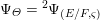 $\unicode[STIX]{x1D6F9}_{\unicode[STIX]{x1D6E9}}=^{2\,\!}\unicode[STIX]{x1D6F9}_{(E/F,\unicode[STIX]{x1D70D})}$
is given by 5.3 Theorem (2) or (3), respectively. We therefore assume that
 $m\leqslant 2w_{E/F}$
and that
 $w_{E/F}\not \equiv 0\hspace{0.6em}({\rm mod}\hspace{0.2em}p)$
. In particular,
 $l\not \equiv m\hspace{0.6em}({\rm mod}\hspace{0.2em}p)$
. If
 $^{2\,\!}\unicode[STIX]{x1D6F9}_{(E/F,m/p^{r})}$
has an odd number of jumps, then
 $\unicode[STIX]{x1D6F9}_{\unicode[STIX]{x1D6E9}}=^{2\,\!}\unicode[STIX]{x1D6F9}_{(E/F,\unicode[STIX]{x1D70D})}$
by 5.3 Theorem (1).
We therefore assume that
 $^{2\,\!}\unicode[STIX]{x1D6F9}_{(E/F,\unicode[STIX]{x1D70D})}$
has an even number of jumps (whence
 $(E/F,m)$
is not standard). Let
 $I$
be the open interval on which
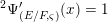 $^{2\,\!}\unicode[STIX]{x1D6F9}_{(E/F,\unicode[STIX]{x1D70D})}^{\prime }(x)=1$
,
 $0<x<\unicode[STIX]{x1D70D}$
. For
 $0\leqslant x\leqslant \unicode[STIX]{x1D70D}$
, we have (5.3 Theorem (4))

Consequently,
 $\unicode[STIX]{x1D6F9}_{\unicode[STIX]{x1D6E9}}(x)=^{2\,\!}\unicode[STIX]{x1D6F9}_{(E/F,\unicode[STIX]{x1D70D})}(x)$
at any point where these functions are smooth and have derivative other than
 $1$
.
We use 6.3 Corollary to construct from
 $\unicode[STIX]{x1D6FC}$
a standard datum
 $(F[\unicode[STIX]{x1D6FD}]/F,m)$
; this will be of type (b) or (c) in the scheme of 7.2 Definition. Since
 $(E/F,m)$
is not standard,
 $w_{F[\unicode[STIX]{x1D6FD}]/F}>w_{E/F}$
. By 6.4 Proposition,
 $l_{F[\unicode[STIX]{x1D6FD}]}(\unicode[STIX]{x1D703})=l$
. By 7.2 Theorem 1(2),
 $$\begin{eqnarray}\unicode[STIX]{x1D6F9}_{\unicode[STIX]{x1D6E9}}(x)=\max \big\{^{2\,\!}\unicode[STIX]{x1D6F9}_{(F[\unicode[STIX]{x1D6FD}]/F,\unicode[STIX]{x1D70D})}(x),x-p^{-r}(m-l)\big\},\quad 0\leqslant x\leqslant \unicode[STIX]{x1D70D}.\end{eqnarray}$$
So, if
 $\unicode[STIX]{x1D6F9}_{\unicode[STIX]{x1D6E9}}$
is smooth at
 $x$
and
 $\unicode[STIX]{x1D6F9}_{\unicode[STIX]{x1D6E9}}^{\prime }(x)\neq 1$
, then
 $\unicode[STIX]{x1D6F9}_{\unicode[STIX]{x1D6E9}}(x)=^{2\,\!}\unicode[STIX]{x1D6F9}_{(F[\unicode[STIX]{x1D6FD}]/F,\unicode[STIX]{x1D70D})}(x)=^{2\,\!}\unicode[STIX]{x1D6F9}_{(E/F,\unicode[STIX]{x1D70D})}(x)$
. Suppose, on the other hand, that
 $\unicode[STIX]{x1D6F9}_{\unicode[STIX]{x1D6E9}}^{\prime }(x)=1$
. If
 $^{2\,\!}\unicode[STIX]{x1D6F9}_{(F[\unicode[STIX]{x1D6FD}]/F,\unicode[STIX]{x1D70D})}^{\prime }(x)=1$
, then
 $$\begin{eqnarray}^{2\,\!}\unicode[STIX]{x1D6F9}_{(F[\unicode[STIX]{x1D6FD}]/F,\unicode[STIX]{x1D70D})}(x)=x-p^{-r}w_{F[\unicode[STIX]{x1D6FD}]/F}<x-p^{-r}(m-l).\end{eqnarray}$$
Therefore
 $\unicode[STIX]{x1D6F9}_{\unicode[STIX]{x1D6E9}}(x)=x-p^{-r}(m-l)=^{2\,\!}\unicode[STIX]{x1D6F9}_{(E/F,\unicode[STIX]{x1D70D})}(x)$
at such points. Altogether,
 $\unicode[STIX]{x1D6F9}_{\unicode[STIX]{x1D6E9}}(x)=^{2\,\!}\unicode[STIX]{x1D6F9}_{(E/F,\unicode[STIX]{x1D70D})}(x)$
for
 $0\leqslant x\leqslant \unicode[STIX]{x1D70D}$
. We have proved 7.2 Theorem 2.◻
7.5
Now that Theorem 2 has been proved, Theorem 1 has no further direct role in the paper. However, Theorem 2 gives no idea of how
 $\unicode[STIX]{x1D6F9}_{\unicode[STIX]{x1D6E9}}$
varies as
 $\unicode[STIX]{x1D6E9}$
ranges over
 $\Vert \mathscr{C}(\mathfrak{a},\unicode[STIX]{x1D6FC})\Vert$
while Theorem 1 does just that, modulo some limitations in part (2). For the sake of tidiness, we show that all Herbrand functions
 $\unicode[STIX]{x1D6F9}_{\unicode[STIX]{x1D6E9}}$
,
 $\unicode[STIX]{x1D6E9}\in \Vert \mathscr{C}(\mathfrak{a},\unicode[STIX]{x1D6FC})\Vert$
, are captured within the scheme of Theorem 1.
Proposition. Suppose that
 $m\leqslant 2w_{F[\unicode[STIX]{x1D6FC}]/F}$
. Let
 $\unicode[STIX]{x1D6E9}\in \Vert \mathscr{C}(\mathfrak{a},\unicode[STIX]{x1D6FC})\Vert$
. There exists
 $\unicode[STIX]{x1D6FD}\in \text{P}(\mathfrak{a},\unicode[STIX]{x1D6FC})$
, say
 $F[\unicode[STIX]{x1D6FD}]=E$
, with the following properties:
(1) the datum
$(E/F,m)$
is standard and(2) either
(a)
$l_{E}(\unicode[STIX]{x1D703})\leqslant \max \{0,m-w_{E/F}\}$
or(b)
$l_{E}(\unicode[STIX]{x1D703})\not \equiv m\hspace{0.6em}({\rm mod}\hspace{0.2em}p)$
.



Proof. We first choose
 $\unicode[STIX]{x1D6FD}$
so that
 $\unicode[STIX]{x1D6E9}$
is the endo-class of some
 $\unicode[STIX]{x1D703}\in \mathscr{C}^{\star }(\mathfrak{a},\unicode[STIX]{x1D6FD})$
, as we may by 7.1 Proposition. Writing
 $E=F[\unicode[STIX]{x1D6FD}]$
, suppose
 $w_{F[\unicode[STIX]{x1D6FD}]/F}\equiv 0\hspace{0.6em}({\rm mod}\hspace{0.2em}p)$
. Thus
 $(E/F,m)$
is standard and
 $l_{E}(\unicode[STIX]{x1D703})=\max \{0,m-w_{E/F}\}$
, so option (a) applies.
Suppose then that
 $w_{E/F}\not \equiv 0\hspace{0.6em}({\rm mod}\hspace{0.2em}p)$
. Thus
 $l_{E}(\unicode[STIX]{x1D703})=\max \{0,m-w_{E/F}\}$
, so
 $l_{E}(\unicode[STIX]{x1D703})\not \equiv m\hspace{0.6em}({\rm mod}\hspace{0.2em}p)$
. If
 $(E/F,m)$
is standard, there is nothing to do, so suppose otherwise. We use 6.2 Corollary to find
 $\unicode[STIX]{x1D6FE}\in \text{P}(\mathfrak{a},\unicode[STIX]{x1D6FD})$
such that, if
 $L=F[\unicode[STIX]{x1D6FE}]$
, then either
 $w_{L/F}\geqslant m$
or
 $w_{L/F}\equiv 0\hspace{0.6em}({\rm mod}\hspace{0.2em}p)$
and
 $w_{L/F}>w_{E/F}$
. In all cases,
 $(L/F,m)$
is standard. By 6.3 Proposition,
 $l_{L}(\unicode[STIX]{x1D703})=l_{E}(\unicode[STIX]{x1D703})\not \equiv m\hspace{0.6em}({\rm mod}\hspace{0.2em}p)$
, so option (b) applies.◻
Recall that, in the proposition, there is nothing to say when
 $m>2w_{E/F}$
(5.3 Theorem (2)). Otherwise,
 $\unicode[STIX]{x1D6F9}_{\unicode[STIX]{x1D6E9}}$
is given by 7.2 Theorem 1.
Remark.
The theorems of 7.2 and the proposition above leave open the following question. What are the functions
 $^{2\,\!}\unicode[STIX]{x1D6F9}_{(F[\unicode[STIX]{x1D6FD}]/F,\unicode[STIX]{x1D70D})}$
, where
 $\unicode[STIX]{x1D6FD}$
ranges over elements of
 $\text{P}(\mathfrak{a},\unicode[STIX]{x1D6FC})$
subject to the condition that the datum
 $(F[\unicode[STIX]{x1D6FD}]/F,m)$
is standard?
8 Representations with a single jump
We consider here representations
 $\unicode[STIX]{x1D70E}\in \widehat{\mathscr{W}}_{F}^{\text{wr}}$
for which the decomposition function
 $\unicode[STIX]{x1D6F4}_{\unicode[STIX]{x1D70E}}$
of (2.2.2) has a unique jump: these play a central role in what follows.
8.1
For the moment, let
 $G$
be a finite
 $p$
-group with centre
 $Z\neq G$
. Say that
 $G$
is H-cyclic if
 $Z$
is cyclic and
 $G/Z$
is elementary abelian. Equivalently,
 $G$
is an extra-special
 $p$
-group of class
 $2$
. We introduce this new terminology to avoid ambiguous usage that has accumulated here. In particular, we do not need to specify
 $G$
from among the various possibilities listed in, for instance, [Reference GorensteinGor00, p. 203]. The material of this subsection is generally familiar, but we choose to give a complete, albeit brief, account.
If
 $G$
is H-cyclic, the commutator group
 $[G,G]$
is the subgroup
 $Z_{p}$
of
 $Z$
of order
 $p$
. We may view the pairing
 $G/Z\times G/Z\rightarrow Z_{p}$
, induced by the commutator
 $(x,y)\mapsto [x,y]$
, as an alternating form on the
 $\mathbb{F}_{p}$
-vector space
 $G/Z$
. If
 $x,y\in G$
, then
 $[x,y]=1$
if and only if
 $x$
centralizes
 $y$
. The alternating form is therefore non-degenerate: if
 $[x,y]=1$
for all
 $y\in G$
, then
 $x\in Z$
.
We first give a technical result, needed in 8.4.
Lemma. Let
 $G$
be an
 $H$
-cyclic finite
 $p$
-group with centre
 $Z$
. Let
 $\unicode[STIX]{x1D6FC}$
be an automorphism of
 $G$
which is trivial on
 $Z$
and induces the trivial automorphism of
 $G/Z$
. The automorphism
 $\unicode[STIX]{x1D6FC}$
is then inner.
Proof. Consider the map
 $G\rightarrow Z_{p}$
given by
 $x\mapsto x^{\unicode[STIX]{x1D6FC}}x^{-1}$
. This induces a map
 $G/Z\rightarrow Z_{p}$
which is a homomorphism:
 $(xy)^{\unicode[STIX]{x1D6FC}}y^{-1}x^{-1}=x^{\unicode[STIX]{x1D6FC}}x^{-1}y^{\unicode[STIX]{x1D6FC}}y^{-1}$
. The non-degeneracy property of the commutator pairing gives a unique
 $y\in G/Z$
such that
 $x^{\unicode[STIX]{x1D6FC}}x^{-1}=[y,x]$
, for all
 $x$
. This relation says
 $x^{\unicode[STIX]{x1D6FC}}=yxy^{-1}$
, as required.◻
Proposition. Let
 $G$
be an H-cyclic finite
 $p$
-group with centre
 $Z$
, and let
 $\unicode[STIX]{x1D712}$
be a faithful character of
 $Z$
.
(1) There exists a unique irreducible representation
$\unicode[STIX]{x1D70E}$
of
$G$
such that
$\unicode[STIX]{x1D70E}\big|Z$
contains
$\unicode[STIX]{x1D712}$
. The representation
$\unicode[STIX]{x1D70E}$
is faithful of dimension
$(G\,:\,Z)^{1/2}$
and
$\unicode[STIX]{x1D70E}\,\big|\,Z$
is a multiple of
$\unicode[STIX]{x1D712}$
.(2) A character
$\unicode[STIX]{x1D709}$
of
$G$
satisfies
$\unicode[STIX]{x1D709}\otimes \unicode[STIX]{x1D70E}\cong \unicode[STIX]{x1D70E}$
if and only if
$\unicode[STIX]{x1D709}$
is trivial on
$Z$
. If
$D(\unicode[STIX]{x1D70E})$
denotes the group of such characters, then (8.1.1)$$\begin{eqnarray}\check{\unicode[STIX]{x1D70E}}\otimes \unicode[STIX]{x1D70E}=\mathop{\sum }_{\unicode[STIX]{x1D709}\in D(\unicode[STIX]{x1D70E})}\unicode[STIX]{x1D709}.\end{eqnarray}$$


Proof. Denote by
 $h$
the alternating form on
 $G/Z$
induced by the commutator pairing
 $(x,y)\mapsto \unicode[STIX]{x1D712}[x,y]$
,
 $x,y\in G$
. The non-degenerate alternating
 $\mathbb{F}_{p}$
-space
 $G/Z$
has even dimension
 $2r$
, say. Let
 $L$
be a Lagrangian subspace of
 $G/Z$
, that is, a subspace on which
 $h$
is null and is maximal for this property. Thus
 $L$
has dimension
 $r$
.
Let
 $\widetilde{L}$
be the inverse image of
 $L$
in
 $G$
. As
 $h$
is null on
 $L$
, the subgroup
 $\widetilde{L}$
of
 $G$
is abelian and maximal for this property. The character
 $\unicode[STIX]{x1D712}$
therefore admits extension to a character
 $\unicode[STIX]{x1D712}_{L}$
of
 $\widetilde{L}$
. Let
 $y\in G\smallsetminus L$
. There exists
 $x\in L$
such that
 $[x,y]\neq 1$
. This implies that
 $\unicode[STIX]{x1D712}_{L}^{y}(x)\neq \unicode[STIX]{x1D712}_{L}(x)$
, whence
 $\unicode[STIX]{x1D70C}_{\unicode[STIX]{x1D712}}=\operatorname{Ind}_{\widetilde{L}}^{G}\unicode[STIX]{x1D712}_{L}$
is irreducible. We form the usual inner product of characters,
 $$\begin{eqnarray}1=\langle \operatorname{tr}\unicode[STIX]{x1D70C}_{\unicode[STIX]{x1D712}},\operatorname{tr}\unicode[STIX]{x1D70C}_{\unicode[STIX]{x1D712}}\rangle =|G|^{-1}\mathop{\sum }_{g\in G}|\operatorname{tr}\unicode[STIX]{x1D70C}_{\unicode[STIX]{x1D712}}(g)|^{2}.\end{eqnarray}$$
As
 $\operatorname{tr}\unicode[STIX]{x1D70C}_{\unicode[STIX]{x1D712}}(z)=p^{r}\unicode[STIX]{x1D712}(z)$
, for
 $z\in Z$
, it follows that
 $\operatorname{tr}\unicode[STIX]{x1D70C}_{\unicode[STIX]{x1D712}}(g)=0$
, for all
 $g\in G\smallsetminus Z$
. Therefore
 $\unicode[STIX]{x1D70C}_{\unicode[STIX]{x1D712}}$
is independent of the choice of
 $\unicode[STIX]{x1D712}_{L}$
. The function
 $\operatorname{tr}\unicode[STIX]{x1D70C}_{\unicode[STIX]{x1D712}}$
takes the value
 $p^{r}=\dim \unicode[STIX]{x1D70C}_{\unicode[STIX]{x1D712}}$
only at the identity, so
 $\unicode[STIX]{x1D70C}_{\unicode[STIX]{x1D712}}$
is faithful.
Let
 $\unicode[STIX]{x1D70E}$
be an irreducible representation of
 $G$
that contains
 $\unicode[STIX]{x1D712}$
. With
 $L$
as before, the restriction
 $\unicode[STIX]{x1D70E}\,|\,\widetilde{L}$
is a sum of characters
 $\unicode[STIX]{x1D719}$
(since
 $\widetilde{L}$
is abelian), each of which satisfies
 $\unicode[STIX]{x1D719}\,|\,Z=\unicode[STIX]{x1D712}$
. However, any such character induces the representation
 $\unicode[STIX]{x1D70C}_{\unicode[STIX]{x1D712}}$
, so
 $\unicode[STIX]{x1D70E}\cong \unicode[STIX]{x1D70C}_{\unicode[STIX]{x1D712}}$
, as asserted. This deals with (1).
A character
 $\unicode[STIX]{x1D709}$
of
 $G$
such that
 $\unicode[STIX]{x1D709}\otimes \unicode[STIX]{x1D70E}\cong \unicode[STIX]{x1D70E}$
is surely trivial on
 $Z$
. That is,
 $\unicode[STIX]{x1D709}$
is the inflation of a character of
 $G/Z$
. The trace calculation ensures that any such character
 $\unicode[STIX]{x1D709}$
satisfies
 $\unicode[STIX]{x1D709}\otimes \unicode[STIX]{x1D70E}=\unicode[STIX]{x1D70E}$
. Thus
 $\unicode[STIX]{x1D709}$
occurs in the representation
 $\check{\unicode[STIX]{x1D70E}}\otimes \unicode[STIX]{x1D70E}$
. The number of such characters
 $\unicode[STIX]{x1D709}$
is
 $p^{2r}=\dim \check{\unicode[STIX]{x1D70E}}\otimes \unicode[STIX]{x1D70E}$
, whence (8.1.1) follows.◻
8.2
Let
 $\unicode[STIX]{x1D70E}\in \widehat{\mathscr{W}}_{F}^{\text{wr}}$
have dimension
 $p^{r}$
, and let
 $\bar{\unicode[STIX]{x1D70E}}:\mathscr{W}_{F}\rightarrow \text{PGL}_{p^{r}}(\mathbb{C})$
be the projective representation defined by
 $\unicode[STIX]{x1D70E}$
.
Definition 1. The centric field
 $Z=Z_{\unicode[STIX]{x1D70E}}/F$
of
 $\unicode[STIX]{x1D70E}$
is defined by
 $\mathscr{W}_{Z}=\operatorname{Ker}\bar{\unicode[STIX]{x1D70E}}$
. The tame centric field
 $T_{\unicode[STIX]{x1D70E}}/F$
of
 $\unicode[STIX]{x1D70E}$
is the maximal tame sub-extension of
 $Z_{\unicode[STIX]{x1D70E}}/F$
.
Thus
 $\unicode[STIX]{x1D70E}$
is absolutely wild if and only if
 $T_{\unicode[STIX]{x1D70E}}=F$
. Observe that if
 $K/F$
is a finite tame extension and
 $\unicode[STIX]{x1D70E}_{K}=\unicode[STIX]{x1D70E}\,|\,\mathscr{W}_{K}\in \widehat{\mathscr{W}}_{K}^{\text{wr}}$
, then
 $Z_{\unicode[STIX]{x1D70E}_{K}}=Z_{\unicode[STIX]{x1D70E}}K$
and
 $T_{\unicode[STIX]{x1D70E}_{K}}=T_{\unicode[STIX]{x1D70E}}K$
.
Define
 $D(\unicode[STIX]{x1D70E})$
to be the group of characters
 $\unicode[STIX]{x1D712}$
of
 $\mathscr{W}_{F}$
such that
 $\unicode[STIX]{x1D712}\otimes \unicode[STIX]{x1D70E}\cong \unicode[STIX]{x1D70E}$
.
Since
 $\unicode[STIX]{x1D70E}\in \widehat{\mathscr{W}}_{F}^{\text{wr}}$
, the restriction
 $\unicode[STIX]{x1D70E}_{0}^{+}=\unicode[STIX]{x1D70E}\,\big|\,\mathscr{P}_{F}$
is irreducible. Let
 $D^{+}(\unicode[STIX]{x1D70E})$
be the group of characters
 $\unicode[STIX]{x1D719}$
of
 $\mathscr{P}_{F}$
such that
 $\unicode[STIX]{x1D719}\otimes \unicode[STIX]{x1D70E}_{0}^{+}\cong \unicode[STIX]{x1D70E}_{0}^{+}$
. Since
 $\unicode[STIX]{x1D70E}_{0}^{+}$
factors through a representation of a finite
 $p$
-group, the group
 $D^{+}(\unicode[STIX]{x1D70E})$
is non-trivial. A character
 $\unicode[STIX]{x1D719}$
of
 $\mathscr{P}_{F}$
lies in
 $D^{+}(\unicode[STIX]{x1D70E})$
if and only if it is a component of
 $\check{\unicode[STIX]{x1D70E}}_{0}^{+}\otimes \unicode[STIX]{x1D70E}_{0}^{+}$
, whence
 $D^{+}(\unicode[STIX]{x1D70E})$
has order at most
 $p^{2r}$
. The group
 $\mathscr{W}_{F}$
acts on
 $D^{+}(\unicode[STIX]{x1D70E})$
in a natural way, with
 $\mathscr{P}_{F}$
acting trivially.
If
 $K/F$
is a finite tame extension, then
 $\mathscr{P}_{K}=\mathscr{P}_{F}$
. We may identify
 $(\unicode[STIX]{x1D70E}_{K})_{0}^{+}$
with
 $\unicode[STIX]{x1D70E}_{0}^{+}$
and
 $D^{+}(\unicode[STIX]{x1D70E}_{K})$
with
 $D^{+}(\unicode[STIX]{x1D70E})$
.
Lemma. Let
 $\unicode[STIX]{x1D70E}\in \widehat{\mathscr{W}}_{F}^{\text{wr}}$
.
(1) If
$K/F$
is a finite, tamely ramified field extension, the restriction map
$D(\unicode[STIX]{x1D70E}_{K})\rightarrow D^{+}(\unicode[STIX]{x1D70E})$
is an isomorphism of
$D(\unicode[STIX]{x1D70E}_{K})$
with the group of
$\mathscr{W}_{K}$
-fixed points in
$D^{+}(\unicode[STIX]{x1D70E})$
.(2) There is a unique minimal tame extension
$T_{I}(\unicode[STIX]{x1D70E})/F$
such that the map
$D(\unicode[STIX]{x1D70E}_{T_{I}(\unicode[STIX]{x1D70E})})\rightarrow D^{+}(\unicode[STIX]{x1D70E})$
is an isomorphism.(3) The field extension
$T_{I}(\unicode[STIX]{x1D70E})/F$
is Galois and contained in
$T_{\unicode[STIX]{x1D70E}}$
.







Proof. The lemma summarizes the discussion in [Reference Bushnell and HenniartBH17, 8.2]. ◻
We refer to
 $T_{I}(\unicode[STIX]{x1D70E})$
as the imprimitivity field of
 $\unicode[STIX]{x1D70E}$
.
Definition 2. Let
 $\unicode[STIX]{x1D70E}\in \widehat{\mathscr{W}}_{F}^{\text{wr}}$
. Say that
 $\unicode[STIX]{x1D70E}$
is H-cyclic if the finite
 $p$
-group
 $\unicode[STIX]{x1D70E}(\mathscr{P}_{F})$
is H-cyclic.
Proposition. If
 $\unicode[STIX]{x1D70E}\in \widehat{\mathscr{W}}_{F}^{\text{wr}}$
is H-cyclic then
 $T_{I}(\unicode[STIX]{x1D70E})=T_{\unicode[STIX]{x1D70E}}$
.
Proof. Let
 $Z_{\unicode[STIX]{x1D70E}}/F$
be the centric field of
 $\unicode[STIX]{x1D70E}$
. Since
 $T_{\unicode[STIX]{x1D70E}}$
contains
 $T_{I}(\unicode[STIX]{x1D70E})$
, nothing is changed if we extend the base field to
 $T_{I}(\unicode[STIX]{x1D70E})$
and assume
 $T_{I}(\unicode[STIX]{x1D70E})=F$
. According to the lemma, the group
 $D(\unicode[STIX]{x1D70E})$
is then isomorphic to
 $D^{+}(\unicode[STIX]{x1D70E})$
and so has order
 $p^{2r}$
, where
 $p^{r}=\dim \unicode[STIX]{x1D70E}$
. The non-trivial characters in
 $D(\unicode[STIX]{x1D70E})$
are wildly ramified of order
 $p$
. The sum
 $\sum _{\unicode[STIX]{x1D719}\in D(\unicode[STIX]{x1D70E})}\unicode[STIX]{x1D719}$
is a sub-representation of
 $\unicode[STIX]{x1D70E}\otimes \check{\unicode[STIX]{x1D70E}}$
, of the same dimension, so
 $\check{\unicode[STIX]{x1D70E}}\otimes \unicode[STIX]{x1D70E}=\sum _{\unicode[STIX]{x1D719}\in D(\unicode[STIX]{x1D70E})}\unicode[STIX]{x1D719}$
. We show that
 $\check{\unicode[STIX]{x1D70E}}\otimes \unicode[STIX]{x1D70E}$
provides a faithful representation of
 $\operatorname{Gal}(Z_{\unicode[STIX]{x1D70E}}/F)$
. Let
 $\unicode[STIX]{x1D70E}$
act on the vector space
 $V$
. So, if
 $x\in \operatorname{Ker}\check{\unicode[STIX]{x1D70E}}\otimes \unicode[STIX]{x1D70E}$
, the operator
 $1=\check{\unicode[STIX]{x1D70E}}(x)\otimes \unicode[STIX]{x1D70E}(x)\in \operatorname{End}_{\mathbb{C}}(\check{V}\otimes V)$
is, in particular, a non-zero scalar. Each of the operators
 $\unicode[STIX]{x1D70E}(x)\in \operatorname{End}_{\mathbb{C}}(V)$
,
 $\check{\unicode[STIX]{x1D70E}}(x)\in \operatorname{End}_{\mathbb{C}}(\check{V})$
, is therefore scalar. In particular,
 $x\in \operatorname{Ker}\bar{\unicode[STIX]{x1D70E}}=\mathscr{W}_{Z_{\unicode[STIX]{x1D70E}}}$
, as asserted.
Define
 $K/F$
by
 $\mathscr{W}_{K}=\bigcap _{\unicode[STIX]{x1D719}\in D(\unicode[STIX]{x1D70E})}\operatorname{Ker}\unicode[STIX]{x1D719}$
. The extension
 $K/F$
is totally wildly ramified, and elementary abelian of degree
 $p^{2r}$
. By definition, every
 $\unicode[STIX]{x1D719}\in D(\unicode[STIX]{x1D70E})$
is trivial on
 $\operatorname{Gal}(Z_{\unicode[STIX]{x1D70E}}/K)$
, whence
 $K=Z_{\unicode[STIX]{x1D70E}}$
and so
 $T_{\unicode[STIX]{x1D70E}}=F$
.◻
Remark.
Following the proposition, it is natural to ask whether there exists a representation
 $\unicode[STIX]{x1D70E}\in \widehat{\mathscr{W}}_{F}^{\text{wr}}$
for which the tame centric field and the imprimitivity field are distinct. We produce an example of such a representation
 $\unicode[STIX]{x1D70E}$
in 9.7 below.
The following device is not central to our current concerns, but we include it here for its utility in constructing examples (as in 8.4 below).
Example. Let
 $\unicode[STIX]{x1D70E},\unicode[STIX]{x1D70E}^{\prime }\in \widehat{\mathscr{W}}_{F}^{\text{wr}}$
be H-cyclic. The following are equivalent:
(1)
$D^{+}(\unicode[STIX]{x1D70E})\cap D^{+}(\unicode[STIX]{x1D70E}^{\prime })=\{1\}$
;(2)
$\unicode[STIX]{x1D70E}\otimes \unicode[STIX]{x1D70E}^{\prime }$
is irreducible and totally wild.


When these conditions hold, the representation
 $\unicode[STIX]{x1D70E}\otimes \unicode[STIX]{x1D70E}^{\prime }$
is H-cyclic.
Proof. If
 $\unicode[STIX]{x1D70F}$
is a smooth, finite-dimensional representation of
 $\mathscr{P}_{F}$
, then
 $\unicode[STIX]{x1D70F}$
is irreducible if and only if the space
 $\operatorname{Hom}_{\mathscr{P}_{F}}(1,\unicode[STIX]{x1D70F}\otimes \check{\unicode[STIX]{x1D70F}})$
has dimension
 $1$
. Here,
 $\unicode[STIX]{x1D70E}\otimes \check{\unicode[STIX]{x1D70E}}\,|\,\mathscr{P}_{F}=\sum _{\unicode[STIX]{x1D719}\in D^{+}(\unicode[STIX]{x1D70E})}\unicode[STIX]{x1D719}$
, and similarly for
 $\unicode[STIX]{x1D70E}^{\prime }$
. Therefore
 $$\begin{eqnarray}(\unicode[STIX]{x1D70E}\otimes \unicode[STIX]{x1D70E}^{\prime })\otimes (\check{\unicode[STIX]{x1D70E}}\otimes \check{\unicode[STIX]{x1D70E}}^{\prime })\,|\,\mathscr{P}_{F}=\mathop{\sum }_{\substack{ \unicode[STIX]{x1D719}\in D^{+}(\unicode[STIX]{x1D70E}), \\ \unicode[STIX]{x1D719}^{\prime }\in D^{+}(\unicode[STIX]{x1D70E}^{\prime })}}\unicode[STIX]{x1D719}\unicode[STIX]{x1D719}^{\prime }.\end{eqnarray}$$
The trivial character occurs exactly once in the sum if and only if
 $D^{+}(\unicode[STIX]{x1D70E})\cap D^{+}(\unicode[STIX]{x1D70E}^{\prime })=\{1\}$
, so (1) is equivalent to
 $\unicode[STIX]{x1D70E}\otimes \unicode[STIX]{x1D70E}^{\prime }$
being irreducible on
 $\mathscr{P}_{F}$
: this is the same as (2).
Abbreviate
 $\unicode[STIX]{x1D70F}=\unicode[STIX]{x1D70E}\otimes \unicode[STIX]{x1D70E}^{\prime }$
, and assume
 $\unicode[STIX]{x1D70F}$
to be irreducible. Let
 $C$
and
 $C^{\prime }$
be respectively the centres of
 $\unicode[STIX]{x1D70E}(\mathscr{P}_{F})$
and
 $\unicode[STIX]{x1D70E}^{\prime }(\mathscr{P}_{F})$
. For
 $x\in \mathscr{P}_{F}$
, the operator
 $\unicode[STIX]{x1D70F}(x)^{p}=\unicode[STIX]{x1D70E}(x)^{p}\otimes \unicode[STIX]{x1D70E}^{\prime }(x)^{p}$
is scalar and lies in
 $CC^{\prime }=\{z\otimes z^{\prime }:z\in C,z^{\prime }\in C^{\prime }\}$
. In particular,
 $CC^{\prime }$
consists of scalars and is central in
 $\unicode[STIX]{x1D70F}(\mathscr{P}_{F})$
. Thus
 $\unicode[STIX]{x1D70F}(\mathscr{P}_{F})$
is of exponent
 $p$
modulo its centre. Since
 $\unicode[STIX]{x1D70F}$
is irreducible on
 $\mathscr{P}_{F}$
, this centre is cyclic.◻
8.3
Let
 $\unicode[STIX]{x1D712}$
be a character of
 $\mathscr{P}_{F}$
. Define the
 $F$
-slope
 $\text{sl}_{F}(\unicode[STIX]{x1D712})$
of
 $\unicode[STIX]{x1D712}$
by
 $$\begin{eqnarray}\text{sl}_{F}(\unicode[STIX]{x1D712})=\operatorname{inf}\{x>0:\mathscr{R}_{F}(x)\subset \operatorname{Ker}\unicode[STIX]{x1D712}\}.\end{eqnarray}$$
If
 $\unicode[STIX]{x1D712}$
extends to a character
 $\tilde{\unicode[STIX]{x1D712}}$
of
 $\mathscr{W}_{F}$
, then
 $\text{sl}_{F}(\unicode[STIX]{x1D712})=\text{sw}(\tilde{\unicode[STIX]{x1D712}})=\unicode[STIX]{x1D70D}_{\tilde{\unicode[STIX]{x1D712}}}$
.
Let
 $\unicode[STIX]{x1D70E}\in \widehat{\mathscr{W}}_{F}^{\text{wr}}$
be H-cyclic, with
 $\dim \unicode[STIX]{x1D70E}>1$
. Say that
 $\unicode[STIX]{x1D70E}$
is H-singular if there exists
 $a>0$
such that
 $\text{sl}_{F}(\unicode[STIX]{x1D712})=a$
, for all non-trivial
 $\unicode[STIX]{x1D712}\in D^{+}(\unicode[STIX]{x1D70E})$
.
Proposition. Let
 $\unicode[STIX]{x1D70E}\in \widehat{\mathscr{W}}_{F}^{\text{wr}}$
be H-singular and let
 $a=\text{sl}_{F}(\unicode[STIX]{x1D712})$
, for
 $\unicode[STIX]{x1D712}\in D^{+}(\unicode[STIX]{x1D70E})$
,
 $\unicode[STIX]{x1D712}\neq 1$
. The function
 $\unicode[STIX]{x1D6F4}_{\unicode[STIX]{x1D70E}}$
has a unique jump, lying at the point
 $a$
.

8.4
The converse of 8.3 Proposition is more interesting.
Proposition. Let
 $\unicode[STIX]{x1D70E}\in \widehat{\mathscr{W}}_{F}^{\text{wr}}$
have dimension
 $p^{r}$
,
 $r\geqslant 1$
. Suppose that the decomposition function
 $\unicode[STIX]{x1D6F4}_{\unicode[STIX]{x1D70E}}$
has exactly one jump, at the point
 $a$
, say. The following properties then hold:
(1) the representation
$\unicode[STIX]{x1D70E}$
is H-singular and
$\text{sl}_{F}(\unicode[STIX]{x1D712})=a$
, for every
$\unicode[STIX]{x1D712}\in D^{+}(\unicode[STIX]{x1D70E})$
,
$\unicode[STIX]{x1D712}\neq 1$
;(2)
$\text{sw}(\check{\unicode[STIX]{x1D70E}}\otimes \unicode[STIX]{x1D70E})=p^{2r}\unicode[STIX]{x1D6F4}_{\unicode[STIX]{x1D70E}}(0)=(p^{2r}-1)a$
;(3) if
$\unicode[STIX]{x1D70E}$
is of Carayol type, then
$a=\text{sw}(\unicode[STIX]{x1D70E})/(1+p^{r})$
.





Proof. The definition (2.2.2) of
 $\unicode[STIX]{x1D6F4}_{\unicode[STIX]{x1D70E}}$
implies that
 $$\begin{eqnarray}\unicode[STIX]{x1D6F4}_{\unicode[STIX]{x1D70E}}^{\prime }(x)=\left\{\begin{array}{@{}ll@{}}p^{-2r},\quad & 0<x<a,\\ 1,\quad & x>a.\end{array}\right.\end{eqnarray}$$
Consequently, the restriction of
 $\unicode[STIX]{x1D70E}$
to
 $\mathscr{R}_{F}(a)$
is irreducible and its restriction to
 $\mathscr{R}_{F}^{+}(a)$
is a multiple of a character. The group
 $S^{+}=\unicode[STIX]{x1D70E}(\mathscr{R}_{F}^{+}(a))$
is therefore cyclic and central in
 $S=\unicode[STIX]{x1D70E}(\mathscr{R}_{F}(a))$
. The finite
 $p$
-group
 $S/S^{+}$
is a quotient of
 $\mathscr{R}_{F}(a)/\mathscr{R}_{F}^{+}(a)$
, so it is elementary. Since
 $\unicode[STIX]{x1D70E}$
is irreducible on
 $\mathscr{R}_{F}(a)$
, the centre of
 $S$
is cyclic. Consequently, the group
 $S=\unicode[STIX]{x1D70E}(\mathscr{R}_{F}(a))$
is H-cyclic with centre containing
 $S^{+}$
.
Let
 $C$
be the centralizer of
 $S$
in
 $P=\unicode[STIX]{x1D70E}(\mathscr{P}_{F})$
. Again,
 $C$
is finite cyclic. Let
 $y\in \mathscr{P}_{F}$
. The representations
 $\unicode[STIX]{x1D70E}$
,
 $\unicode[STIX]{x1D70E}^{y}$
are equivalent, particularly on
 $\mathscr{R}_{F}(a)$
. The element
 $y$
must therefore act trivially on the centre of
 $S$
. The commutator group
 $[y,\mathscr{R}_{F}(a)]$
is contained in
 $[\mathscr{P}_{F},\mathscr{R}_{F}(a)]\subset \mathscr{R}_{F}^{+}(a)$
, so
 $y$
acts trivially on
 $S$
modulo its centre. By 8.1 Lemma, there exists
 $x\in \mathscr{R}_{F}(a)$
such that
 $\unicode[STIX]{x1D70E}(xy)$
centralizes
 $S$
. Therefore
 $P=SC$
, implying that
 $\unicode[STIX]{x1D70E}$
is H-cyclic.
It follows from (8.1.1) that
 $\check{\unicode[STIX]{x1D70E}}\otimes \unicode[STIX]{x1D70E}\,|\,\mathscr{P}_{F}=\sum _{\unicode[STIX]{x1D712}\in D^{+}(\unicode[STIX]{x1D70E})}\unicode[STIX]{x1D712}$
. A non-trivial character
 $\unicode[STIX]{x1D712}\in D^{+}(\unicode[STIX]{x1D70E})$
is non-trivial on
 $\mathscr{P}_{F}$
but it is trivial on the centre
 $C$
of
 $\unicode[STIX]{x1D70E}(\mathscr{P}_{F})$
, so
 $\unicode[STIX]{x1D712}$
is determined by its restriction to
 $\mathscr{R}_{F}(a)$
. It is certainly trivial on
 $\mathscr{R}_{F}^{+}(a)$
, so it has
 $F$
-slope
 $a$
. Thus
 $\unicode[STIX]{x1D70E}$
is H-singular and (1) is proven. Part (2) now follows from (8.1.1). Part (3) is 3.8 Proposition.◻
We exhibit some implications of the preceding argument.
Corollary. Let
 $Z=Z_{\unicode[STIX]{x1D70E}}$
,
 $T=T_{\unicode[STIX]{x1D70E}}=T_{I}(\unicode[STIX]{x1D70E})$
and
 $\unicode[STIX]{x1D70E}_{T}=\unicode[STIX]{x1D70E}\,|\,\mathscr{W}_{T}$
.
(1) The field
$Z$
is given by $$\begin{eqnarray}\mathscr{W}_{Z}=\mathop{\bigcap }_{\unicode[STIX]{x1D712}\in D(\unicode[STIX]{x1D70E}_{T})}\operatorname{Ker}\unicode[STIX]{x1D712}.\end{eqnarray}$$
(2) The Herbrand function
$\unicode[STIX]{x1D713}_{Z/T}$
has a unique jump, lying at
$e(T|F)a$
. Moreover,(a)
$\mathscr{R}_{F}^{+}(a)\subset \mathscr{W}_{Z}$
and(b)
$\mathscr{W}_{T}=\mathscr{R}_{F}(a)\mathscr{W}_{Z}$
.
(3) The group
$\mathscr{W}_{T}$
is the
$\mathscr{W}_{F}$
-centralizer of
$\bar{\unicode[STIX]{x1D70E}}(\mathscr{R}_{F}(a))$
.





Proof. Define a field extension
 $Y/T$
by
 $\mathscr{W}_{Y}=\bigcap _{\unicode[STIX]{x1D712}}\operatorname{Ker}\unicode[STIX]{x1D712}$
, with
 $\unicode[STIX]{x1D712}$
ranging over
 $D(\unicode[STIX]{x1D70E}_{T})$
. It follows from 8.1 Proposition that
 $Y/T$
is the centric field for the representation
 $\unicode[STIX]{x1D70E}_{T}$
and hence that
 $Y\supset Z$
. We have to check that
 $\mathscr{W}_{F}$
acts trivially on
 $\unicode[STIX]{x1D70E}(\mathscr{W}_{Y})$
. However,
 $\unicode[STIX]{x1D70E}\,|\,\mathscr{W}_{Y}=\unicode[STIX]{x1D70E}_{T}\,|\,\mathscr{W}_{Y}$
is a multiple of a character, so that character is necessarily stable under
 $\mathscr{W}_{F}$
. Therefore,
 $Y=Z$
, as required for (1).
Every non-trivial element of
 $D(\unicode[STIX]{x1D70E}_{T})$
has Swan exponent
 $e(T|F)a$
, whence follows the first assertion of (2). The same observation proves (a), while (b) follows from the definition of
 $Z$
via the group
 $D(\unicode[STIX]{x1D70E}_{T})$
. In (3), the group
 $\bar{\unicode[STIX]{x1D70E}}(\mathscr{R}_{F}(a))$
is the quotient of the H-cyclic group by its centre. The dual of this quotient is the character group
 $D(\unicode[STIX]{x1D70E}_{T})$
. Under the natural action of
 $\mathscr{W}_{F}$
, the centralizer of this dual is
 $\mathscr{W}_{T}$
, by 8.2 Lemma, implying the result.◻
We finish with an example derived from [Reference Bushnell and HenniartBH14a] and 8.2 Example.
Example. Take
 $p=2$
, and suppose that
 $F$
contains a primitive cube root of unity. For
 $i=1,2$
, let
 $\unicode[STIX]{x1D70E}_{i}\in \widehat{\mathscr{W}}_{F}^{\text{wr}}$
have dimension
 $2$
and satisfy
 $\text{sw}(\unicode[STIX]{x1D70E}_{i})=1$
. [Reference Bushnell and HenniartBH14a, Theorem 5.1] gives the recipe for
 $T_{I}(\unicode[STIX]{x1D70E}_{i})$
and
 $D^{+}(\unicode[STIX]{x1D70E}_{i})$
. From that information and 8.2 Example, one sees it is possible to choose
 $\unicode[STIX]{x1D70E}_{1}$
,
 $\unicode[STIX]{x1D70E}_{2}$
so that
 $\unicode[STIX]{x1D70E}=\unicode[STIX]{x1D70E}_{1}\otimes \unicode[STIX]{x1D70E}_{2}$
is irreducible and H-singular. It is not of Carayol type, as
 $\text{sw}(\unicode[STIX]{x1D70E})=2$
. If
 $[\unicode[STIX]{x1D70E}]_{0}^{+}=^{\,\text{L}}\unicode[STIX]{x1D6E9}$
,
 $\unicode[STIX]{x1D6E9}\in \mathbf{\mathscr{E}}(F)$
, then
 $\unicode[STIX]{x1D6F9}_{\unicode[STIX]{x1D6E9}}$
has two jumps and is not convex; see 8.5 Example 1 of [Reference Bushnell and HenniartBH17] for the formula.
9 Ramification structure
Let
 $\unicode[STIX]{x1D70E}\in \widehat{\mathscr{W}}_{F}^{\text{wr}}$
be of Carayol type. We return to the methods of § 3 to work out the structure of
 $\unicode[STIX]{x1D70E}$
when restricted to an arbitrary ramification group of
 $\mathscr{W}_{F}$
. If
 $[\unicode[STIX]{x1D70E}]_{0}^{+}=^{\,\text{L}}\unicode[STIX]{x1D6E9}$
,
 $\unicode[STIX]{x1D6E9}\in \mathbf{\mathscr{E}}^{\text{C}}(F)$
, we get a formula for
 $\unicode[STIX]{x1D6F9}_{\unicode[STIX]{x1D6E9}}$
to set against those of § 7. Despite appearances to the contrary, everything in this section relies on the local Langlands correspondence and the conductor formula of [Reference Bushnell, Henniart and KutzkoBHK98], since we use the main results of § 3.
9.1
To avoid carrying an irrelevant variable, we make a minor adjustment to our notation. If
 $\unicode[STIX]{x1D70E}\in \widehat{\mathscr{W}}_{F}^{\text{wr}}$
and if
 $\unicode[STIX]{x1D6E9}\in \mathbf{\mathscr{E}}(F)$
satisfies
 $[\unicode[STIX]{x1D70E}]_{0}^{+}=^{\,\text{L}}\unicode[STIX]{x1D6E9}$
, we now write
 $\unicode[STIX]{x1D6F9}_{\unicode[STIX]{x1D70E}}=\unicode[STIX]{x1D6F9}_{\unicode[STIX]{x1D6E9}}$
.
Let
 $\unicode[STIX]{x1D70E}\in \widehat{\mathscr{W}}_{F}^{\text{wr}}$
be of Carayol type, and set
 $\unicode[STIX]{x1D70D}=\unicode[STIX]{x1D70D}_{\unicode[STIX]{x1D70E}}$
. If
 $0<x<\unicode[STIX]{x1D70D}$
, define

Thus
 $w_{\unicode[STIX]{x1D70E}}(x)$
is a non-negative power of
 $p$
, and
 $w_{\unicode[STIX]{x1D70E}}(x)>1$
if and only if
 $x$
is a jump of
 $\unicode[STIX]{x1D6F9}_{\unicode[STIX]{x1D70E}}$
. We then call
 $w_{\unicode[STIX]{x1D70E}}(x)$
the height of the jump
 $x$
.
Symmetry, as in 4.1 Proposition, gives an order-reversing involution
 $j\mapsto \bar{\jmath }$
on the set of jumps of
 $\unicode[STIX]{x1D6F9}_{\unicode[STIX]{x1D70E}}$
. If
 $\unicode[STIX]{x1D6F9}_{\unicode[STIX]{x1D70E}}$
has an even number of jumps, this involution has no fixed point. If the number of jumps is odd, it fixes the middle one. In the notation of (9.1.1), the symmetry property of
 $\unicode[STIX]{x1D6F9}_{\unicode[STIX]{x1D70E}}$
gives
 $$\begin{eqnarray}w_{\unicode[STIX]{x1D70E}}(\bar{\jmath })=w_{\unicode[STIX]{x1D70E}}(j).\end{eqnarray}$$
We will occasionally have to deal with the case of a one-dimensional representation
 $\unicode[STIX]{x1D70E}$
. There,
 $\unicode[STIX]{x1D6F4}_{\unicode[STIX]{x1D70E}}(x)=\unicode[STIX]{x1D6F9}_{\unicode[STIX]{x1D70E}}(x)=x$
and the functions
 $\unicode[STIX]{x1D6F4}_{\unicode[STIX]{x1D70E}}$
,
 $\unicode[STIX]{x1D6F9}_{\unicode[STIX]{x1D70E}}$
have no jumps. Indeed, the converse also holds [Reference Bushnell and HenniartBH17, 7.7].
9.2
Throughout the section, we use the following notation.
Notation.
Let
 $\unicode[STIX]{x1D70E}\in \widehat{\mathscr{W}}_{F}^{\text{wr}}$
be of Carayol type and dimension
 $p^{r}$
,
 $r\geqslant 1$
. Define
 $c_{\unicode[STIX]{x1D70E}}$
by
 $c_{\unicode[STIX]{x1D70E}}+\unicode[STIX]{x1D6F9}_{\unicode[STIX]{x1D70E}}(c_{\unicode[STIX]{x1D70E}})=\unicode[STIX]{x1D70D}_{\unicode[STIX]{x1D70E}}$
. Let

be the jumps of
 $\unicode[STIX]{x1D6F9}_{\unicode[STIX]{x1D70E}}$
with the understanding that
(a) the term
$c_{\unicode[STIX]{x1D70E}}$
is included only if
$\unicode[STIX]{x1D6F9}_{\unicode[STIX]{x1D70E}}$
has an odd number of jumps and(b)
$s=0$
when
$\unicode[STIX]{x1D6F9}_{\unicode[STIX]{x1D70E}}$
has only one jump.


For the first version of the main result, we assume that
 $\unicode[STIX]{x1D70E}$
is absolutely wild, written
 $\unicode[STIX]{x1D70E}\in \widehat{\mathscr{W}}_{F}^{\text{awr}}$
, in the sense of 3.2 Definition. We deduce the final version, for
 $\unicode[STIX]{x1D70E}\in \widehat{\mathscr{W}}_{F}^{\text{wr}}$
, in 9.5.
Theorem. Let
 $\unicode[STIX]{x1D70E}\in \widehat{\mathscr{W}}_{F}^{\text{wr}}$
be absolutely wild of Carayol type and dimension
 $p^{r}$
,
 $r\geqslant 1$
.
(1) The restriction
$\unicode[STIX]{x1D70E}\,|\,\mathscr{R}_{F}^{+}(c_{\unicode[STIX]{x1D70E}})$
is a direct sum of characters.(2) Let
$\unicode[STIX]{x1D709}$
be a character of
$\mathscr{R}_{F}^{+}(c_{\unicode[STIX]{x1D70E}})$
occurring in
$\unicode[STIX]{x1D70E}$
and let
$\mathscr{W}_{L_{\unicode[STIX]{x1D709}}}$
be the
$\mathscr{W}_{F}$
-stabilizer of
$\unicode[STIX]{x1D709}$
. Let
$\unicode[STIX]{x1D70E}_{\unicode[STIX]{x1D709}}$
be the natural representation of
$\mathscr{W}_{L_{\unicode[STIX]{x1D709}}}$
on the
$\unicode[STIX]{x1D709}$
-isotypic subspace of
$\unicode[STIX]{x1D70E}$
.(a) The field extension
$L_{\unicode[STIX]{x1D709}}/F$
is absolutely wildly ramified (cf. 1.2) of degree
$p^{r}w_{\unicode[STIX]{x1D70E}}(c_{\unicode[STIX]{x1D70E}})^{-1/2}$
and
$\mathscr{W}_{L_{\unicode[STIX]{x1D709}}}$
contains
$\mathscr{R}_{F}^{+}(c_{\unicode[STIX]{x1D70E}})$
.(b) The representation
$\unicode[STIX]{x1D70E}_{\unicode[STIX]{x1D709}}$
is irreducible, absolutely wild and $$\begin{eqnarray}\unicode[STIX]{x1D70E}=\operatorname{Ind}_{L_{\unicode[STIX]{x1D709}}/F}\,\unicode[STIX]{x1D70E}_{\unicode[STIX]{x1D709}}.\end{eqnarray}$$
(c) If
$c_{\unicode[STIX]{x1D70E}}$
is not a jump of
$\unicode[STIX]{x1D6F9}_{\unicode[STIX]{x1D70E}}$
, then
$\unicode[STIX]{x1D70E}_{\unicode[STIX]{x1D709}}$
is a character. Otherwise,
$\unicode[STIX]{x1D70E}_{\unicode[STIX]{x1D709}}$
is H-singular, of Carayol type and dimension
$w_{\unicode[STIX]{x1D70E}}(c_{\unicode[STIX]{x1D70E}})^{1/2}$
. The unique jump of
$\unicode[STIX]{x1D6F9}_{\unicode[STIX]{x1D70E}_{\unicode[STIX]{x1D709}}}$
lies at
$\unicode[STIX]{x1D713}_{L_{\unicode[STIX]{x1D709}}/F}(c_{\unicode[STIX]{x1D70E}})$
.


Remarks.
(1) The triple
$(\unicode[STIX]{x1D709},L_{\unicode[STIX]{x1D709}},\unicode[STIX]{x1D70E}_{\unicode[STIX]{x1D709}})$
is uniquely determined by
$\unicode[STIX]{x1D70E}$
, up to
$\mathscr{W}_{F}$
-conjugation.(2) The function
$\unicode[STIX]{x1D6F9}_{\unicode[STIX]{x1D70E}}$
has no jump lying strictly between
$c_{\unicode[STIX]{x1D70E}}$
and
$\bar{\jmath }_{s}$
. So, if
$\unicode[STIX]{x1D709}$
and
$\unicode[STIX]{x1D709}^{\prime }$
are components of
$\unicode[STIX]{x1D70E}\,|\,\mathscr{R}_{F}^{+}(c_{\unicode[STIX]{x1D70E}})$
, then
$\unicode[STIX]{x1D709}=\unicode[STIX]{x1D709}^{\prime }$
if and only if
$\unicode[STIX]{x1D709}\,|\,\mathscr{R}_{F}(\bar{\jmath }_{s})=\unicode[STIX]{x1D709}^{\prime }\,|\,\mathscr{R}_{F}(\bar{\jmath }_{s})$
. If
$c_{\unicode[STIX]{x1D70E}}$
is not a jump then, in the same way,
$\unicode[STIX]{x1D70E}\,|\,\mathscr{R}_{F}^{+}(j_{s})$
is a sum of characters, two of which are equal if and only if their restrictions to
$\mathscr{R}_{F}(\bar{\jmath }_{s})$
are equal.





As we prove the theorem, we uncover further features of interest that we now list.
Complement 1. Let
 $1\leqslant k\leqslant s$
.
(1) The restriction
$\unicode[STIX]{x1D70E}\,|\,\mathscr{R}_{F}^{+}(j_{k})$
is a multiplicity-free direct sum of irreducible representations.(2) The restriction
$\unicode[STIX]{x1D70E}\,|\,\mathscr{R}_{F}(\bar{\jmath }_{k})$
is a direct sum of characters. The isotypic components of
$\unicode[STIX]{x1D70E}\,|\,\mathscr{R}_{F}(\bar{\jmath }_{k})$
are the subspaces
$\unicode[STIX]{x1D70F}\,|\,\mathscr{R}_{F}(\bar{\jmath }_{k})$
, as
$\unicode[STIX]{x1D70F}$
ranges over the irreducible components of
$\unicode[STIX]{x1D70E}\,|\,\mathscr{R}_{F}^{+}(j_{k})$
.


In light of Remark (2) above, one can equally relate the decompositions of
 $\unicode[STIX]{x1D70E}\,|\,\mathscr{R}_{F}(j_{k})$
and
 $\unicode[STIX]{x1D70E}\,|\,\mathscr{R}_{F}^{+}(\bar{\jmath }_{k})$
. In the next result, we use the concept of elementary resolution from 1.9.
Complement 2. For
 $1\leqslant k\leqslant s$
, choose an irreducible component
 $\unicode[STIX]{x1D70F}_{k}$
of the restriction
 $\unicode[STIX]{x1D70E}\,|\,\mathscr{R}_{F}^{+}(j_{k})$
so that
 $\unicode[STIX]{x1D70F}_{k+1}$
is a component of
 $\unicode[STIX]{x1D70F}_{k}\,|\,\mathscr{R}_{F}^{+}(j_{k+1})$
,
 $1\leqslant k<s$
. Let
 $\mathscr{W}_{E_{k}}$
be the
 $\mathscr{W}_{F}$
-stabilizer of
 $\unicode[STIX]{x1D70F}_{k}$
.
(a) If
$\unicode[STIX]{x1D709}$
is a character of
$\mathscr{R}_{F}^{+}(c_{\unicode[STIX]{x1D70E}})$
occurring in
$\unicode[STIX]{x1D70F}_{s}\,|\,\mathscr{R}_{F}^{+}(c_{\unicode[STIX]{x1D70E}})$
, then
$E_{s}=L_{\unicode[STIX]{x1D709}}$
.(b) The Herbrand function satisfies
(9.2.2)$$\begin{eqnarray}\unicode[STIX]{x1D6F9}_{\unicode[STIX]{x1D70E}}(x)=p^{-r}\unicode[STIX]{x1D713}_{L_{\unicode[STIX]{x1D709}}/F}(x),\quad 0\leqslant x\leqslant c_{\unicode[STIX]{x1D70E}}.\end{eqnarray}$$
(c) The tower of fields
(9.2.3)is the elementary resolution of$$\begin{eqnarray}F\subset E_{1}\subset E_{2}\subset \ldots \subset E_{s}=L_{\unicode[STIX]{x1D709}}\end{eqnarray}$$
$L_{\unicode[STIX]{x1D709}}/F$
.


Following 4.1 Proposition, symmetry implies that the relation (9.2.2) determines
 $\unicode[STIX]{x1D6F9}_{\unicode[STIX]{x1D70E}}(x)$
for
 $0\leqslant x\leqslant \unicode[STIX]{x1D70D}_{\unicode[STIX]{x1D70E}}$
. The tower of fields (9.2.3) is uniquely determined by
 $\unicode[STIX]{x1D70E}$
, up to
 $\mathscr{W}_{F}$
-conjugacy.
9.3
The theorem of 9.2 is proved by induction on the number of jumps. If
 $\unicode[STIX]{x1D6F9}_{\unicode[STIX]{x1D70E}}$
has no jumps, then
 $\dim \unicode[STIX]{x1D70E}=1$
and this case has been excluded. If
 $\unicode[STIX]{x1D6F9}_{\unicode[STIX]{x1D70E}}$
has just one jump, the theorem and its complements follow from 8.4 Proposition with
 $L_{\unicode[STIX]{x1D709}}=F$
.
In this subsection, we assume that
 $\unicode[STIX]{x1D6F9}_{\unicode[STIX]{x1D70E}}$
has at least two jumps and give a reduction step concerned only with the outermost jumps. As in 8.2, let
 $D(\unicode[STIX]{x1D70E})$
be the group of characters
 $\unicode[STIX]{x1D712}$
of
 $\mathscr{W}_{F}$
such that
 $\unicode[STIX]{x1D712}\otimes \unicode[STIX]{x1D70E}\cong \unicode[STIX]{x1D70E}$
.
Proposition. Let
 $\unicode[STIX]{x1D70E}\in \widehat{\mathscr{W}}_{F}^{\text{awr}}$
be of Carayol type. Suppose that
 $\unicode[STIX]{x1D6F9}_{\unicode[STIX]{x1D70E}}$
has at least two jumps, of which
 $a$
is the first and
 $z$
the last. Let
 $D_{a}(\unicode[STIX]{x1D70E})$
be the group of
 $\unicode[STIX]{x1D712}\in D(\unicode[STIX]{x1D70E})$
for which
 $\text{sw}(\unicode[STIX]{x1D712})\leqslant a$
. Let
 $E_{1}/F$
be class field to
 $D_{a}(\unicode[STIX]{x1D70E})$
.
(1) The group
$D_{a}(\unicode[STIX]{x1D70E})$
is elementary abelian of order
$w_{\unicode[STIX]{x1D70E}}(a)$
.(2) The group
$\mathscr{R}_{F}^{+}(a)$
is contained in
$\mathscr{W}_{E_{1}}$
and
$\mathscr{W}_{F}=\mathscr{R}_{F}(a)\mathscr{W}_{E_{1}}$
.(3) There exists
$\unicode[STIX]{x1D70E}_{1}\in \widehat{\mathscr{W}}_{E_{1}}^{\text{awr}}$
such that
$\unicode[STIX]{x1D70E}=\operatorname{Ind}_{E_{1}/F}\,\unicode[STIX]{x1D70E}_{1}$
. Moreover, (9.3.1)The representations$$\begin{eqnarray}\unicode[STIX]{x1D70E}\,|\,\mathscr{R}_{F}^{+}(a)=\mathop{\sum }_{\unicode[STIX]{x1D6FE}\in \operatorname{Gal}(E_{1}/F)}\unicode[STIX]{x1D70E}_{1}^{\unicode[STIX]{x1D6FE}}\,|\,\mathscr{R}_{F}^{+}(a).\end{eqnarray}$$
$\unicode[STIX]{x1D70E}_{1}^{\unicode[STIX]{x1D6FE}}\,\big|\,\mathscr{R}_{F}^{+}(a)$
,
$\unicode[STIX]{x1D6FE}\in \operatorname{Gal}(E_{1}/F)$
, are distinct and irreducible. The
$\mathscr{W}_{F}$
-stabilizer of
$\unicode[STIX]{x1D70E}_{1}\,\big|\,\mathscr{R}_{F}^{+}(a)$
is
$\mathscr{W}_{E_{1}}$
.(4) The jumps of
$\unicode[STIX]{x1D6F9}_{\unicode[STIX]{x1D70E}_{1}}$
are
$\unicode[STIX]{x1D713}_{E_{1}/F}(j)$
, as
$j$
ranges over the jumps of
$\unicode[STIX]{x1D6F9}_{\unicode[STIX]{x1D70E}}$
,
$j\neq a,z$
. Indeed,
$w_{\unicode[STIX]{x1D70E}}(y)=w_{\unicode[STIX]{x1D70E}_{1}}(\unicode[STIX]{x1D713}_{E_{1}/F}(y))$
, for
$y\neq a,z$
.(5) The restriction
$\unicode[STIX]{x1D70E}\,|\,\mathscr{R}_{F}(z)$
is a direct sum of characters
$\unicode[STIX]{x1D709}$
. The
$\mathscr{W}_{F}$
-stabilizer of any such
$\unicode[STIX]{x1D709}$
is
$\mathscr{W}_{E_{1}}$
.








Proof. The group
 $D_{a}(\unicode[STIX]{x1D70E})$
is non-trivial (3.3 Lemma 1), so choose
 $\unicode[STIX]{x1D712}\in D_{a}(\unicode[STIX]{x1D70E})$
,
 $\unicode[STIX]{x1D712}\neq 1$
. Set
 $\mathscr{W}_{K}=\operatorname{Ker}\unicode[STIX]{x1D712}$
. The extension
 $K/F$
is cyclic of degree
 $p$
, and
 $\unicode[STIX]{x1D713}_{K/F}$
has a unique jump, lying at
 $a$
. As in 3.3 Lemma 2,
 $\mathscr{W}_{K}\cap \mathscr{R}_{F}(a)=\mathscr{R}_{K}(a)$
is of index
 $p$
in
 $\mathscr{R}_{F}(a)$
and
 $\mathscr{R}_{K}^{+}(a)=\mathscr{R}_{F}^{+}(a)$
. There exists
 $\unicode[STIX]{x1D70F}\in \widehat{\mathscr{W}}_{K}^{\text{wr}}$
with
 $\unicode[STIX]{x1D70E}=\operatorname{Ind}_{K/F}\,\unicode[STIX]{x1D70F}$
, the representation
 $\unicode[STIX]{x1D70F}$
being either absolutely wild of Carayol type (3.3 Lemma 1) or a character. By 3.4 Theorem (2) and 3.5 Theorem,
 $w_{\unicode[STIX]{x1D70E}}(y)=w_{\unicode[STIX]{x1D70F}}(\unicode[STIX]{x1D713}_{K/F}(y))$
, provided
 $y\neq a,z$
. On the other hand, the same results give
 $w_{\unicode[STIX]{x1D70E}}(a)=pw_{\unicode[STIX]{x1D70F}}(a)$
and
 $w_{\unicode[STIX]{x1D70E}}(z)=pw_{\unicode[STIX]{x1D70F}}(\unicode[STIX]{x1D713}_{K/F}(z))$
.
Note.
Since
 $\unicode[STIX]{x1D70E}$
has at least two jumps, 3.5 Corollary 1 shows that the case of 3.4 Theorem (3) need not be considered here.
Lemma.
(1) The restriction
$\unicode[STIX]{x1D70F}\,\big|\,\mathscr{R}_{K}(a)$
is irreducible and (9.3.2)$$\begin{eqnarray}\unicode[STIX]{x1D70E}\,\big|\,\mathscr{R}_{F}^{+}(a)=\mathop{\sum }_{\unicode[STIX]{x1D6FF}\in \operatorname{Gal}(K/F)}\unicode[STIX]{x1D70F}^{\unicode[STIX]{x1D6FF}}\,\big|\,\mathscr{R}_{F}^{+}(a).\end{eqnarray}$$
(2) The representations
$\unicode[STIX]{x1D70F}^{\unicode[STIX]{x1D6FF}}\,\big|\,\mathscr{R}_{F}^{+}(a)$
,
$\unicode[STIX]{x1D6FF}\in \operatorname{Gal}(K/F)$
, are disjoint.


Proof. Since
 $a$
is the first jump of
 $\unicode[STIX]{x1D6F4}_{\unicode[STIX]{x1D70E}}$
, the restriction
 $\unicode[STIX]{x1D70E}\,\big|\,\mathscr{R}_{F}(a)$
is irreducible. The Mackey formula implies that this restriction is
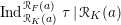 $\operatorname{Ind}_{\mathscr{R}_{K}(a)}^{\mathscr{R}_{F}(a)}\,\unicode[STIX]{x1D70F}\,|\,\mathscr{R}_{K}(a)$
, whence the first assertion follows. The relation (9.3.2) again follows from the Mackey formula.
Since
 $\unicode[STIX]{x1D70E}\,|\,\mathscr{R}_{F}(a)$
is irreducible, the irreducible components of
 $\unicode[STIX]{x1D70E}\,|\,\mathscr{R}_{F}^{+}(a)$
are all conjugate and occur with the same multiplicity. So, in (2), the representations
 $\unicode[STIX]{x1D70F}^{\unicode[STIX]{x1D6FF}}\,|\,\mathscr{R}_{F}^{+}(a)$
are either disjoint or identical. We show they are disjoint.
Let
 $\unicode[STIX]{x1D6E5}_{K}$
be the canonical ultrametric on
 $\mathscr{W}_{K}\backslash \widehat{\mathscr{P}}_{K}$
. Let
 $\unicode[STIX]{x1D6FF}\in \operatorname{Gal}(K/F)$
,
 $\unicode[STIX]{x1D6FF}\neq 1$
. By 3.5 Theorem (and recalling the definition (3.4.2)) we have
 $$\begin{eqnarray}\unicode[STIX]{x1D6E5}_{K}(\unicode[STIX]{x1D70F},\unicode[STIX]{x1D70F}^{\unicode[STIX]{x1D6FF}})=\unicode[STIX]{x1D713}_{K/F}(z)>\unicode[STIX]{x1D713}_{K/F}(a)=a.\end{eqnarray}$$
The representations
 $\unicode[STIX]{x1D70F}^{\unicode[STIX]{x1D6FF}}\,|\,\mathscr{R}_{F}^{+}(a)$
,
 $\unicode[STIX]{x1D70F}\,|\,\mathscr{R}_{F}^{+}(a)$
are therefore disjoint, as asserted.◻
Remark.
Relation (9.3.3) implies that
 $\unicode[STIX]{x1D70F}$
and
 $\unicode[STIX]{x1D70F}^{\unicode[STIX]{x1D6FF}}$
are disjoint on
 $\mathscr{R}_{F}(z)$
.
We proceed by induction on the integer
 $w_{\unicode[STIX]{x1D70E}}(a)$
. Suppose first that
 $w_{\unicode[STIX]{x1D70E}}(a)=p$
, whence
 $w_{\unicode[STIX]{x1D70F}}(a)=1$
. We prove the proposition with
 $E_{1}=K$
and
 $\unicode[STIX]{x1D70E}_{1}=\unicode[STIX]{x1D70F}$
. As
 $a$
is not a jump of
 $\unicode[STIX]{x1D6F4}_{\unicode[STIX]{x1D70F}}$
(giving point (4)), we have that
 $\unicode[STIX]{x1D70F}$
is irreducible on
 $\mathscr{R}_{F}^{+}(a)=\mathscr{R}_{K}^{+}(a)$
. It follows that
 $D(\unicode[STIX]{x1D70F})$
has no element of Swan exponent
 $a$
. The conjugates
 $\unicode[STIX]{x1D70F}^{\unicode[STIX]{x1D6FF}}$
,
 $\unicode[STIX]{x1D6FF}\in \operatorname{Gal}(K/F)$
, are disjoint on
 $\mathscr{R}_{K}^{+}(a)$
, by the lemma. Consequently,
 $D_{a}(\unicode[STIX]{x1D70E})$
has order
 $p=w_{\unicode[STIX]{x1D70E}}(a)$
. The point
 $\unicode[STIX]{x1D713}_{K/F}(z)$
is not a jump of
 $\unicode[STIX]{x1D6F4}_{\unicode[STIX]{x1D70F}}$
, by 3.4 Theorem again. It follows that
 $\unicode[STIX]{x1D70F}\,\big|\,\mathscr{R}_{F}(z)$
is a multiple of a character. Thus
 $$\begin{eqnarray}\unicode[STIX]{x1D70E}\,\big|\,\mathscr{R}_{F}(z)=\mathop{\sum }_{\unicode[STIX]{x1D6FF}\in \operatorname{Gal}(K/F)}\unicode[STIX]{x1D70F}^{\unicode[STIX]{x1D6FF}}\,\big|\,\mathscr{R}_{F}(z)\end{eqnarray}$$
is a sum of characters. Since
 $z$
is a jump of
 $\unicode[STIX]{x1D6F9}_{\unicode[STIX]{x1D70E}}$
, these characters cannot all be the same: they fall into
 $p$
distinct orbits under
 $\mathscr{W}_{F}$
. Assertion (5) follows, and the proof is complete in the case
 $w_{\unicode[STIX]{x1D70E}}(a)=p$
.
Suppose next that
 $w_{\unicode[STIX]{x1D70E}}(a)$
is divisible by
 $p^{2}$
. In particular,
 $\unicode[STIX]{x1D70F}$
is not a character. Inductively, we may assume that the result holds for the representation
 $\unicode[STIX]{x1D70F}\in \widehat{\mathscr{W}}_{K}^{\text{awr}}$
. For convenience, we expand this assumption and fix some notation.
Inductive hypothesis. Let
 $E/K$
be class field to the group
 $D_{a}(\unicode[STIX]{x1D70F})$
. Let
 $\unicode[STIX]{x1D701}\in \widehat{\mathscr{W}}_{E}^{\text{awr}}$
satisfy
 $\operatorname{Ind}_{E/K}\,\unicode[STIX]{x1D701}=\unicode[STIX]{x1D70F}$
.
(1) The group
$D_{a}(\unicode[STIX]{x1D70F})$
is elementary abelian of order
$w_{\unicode[STIX]{x1D70F}}(a)$
.(2) The group
$\mathscr{R}_{K}^{+}(a)$
is contained in
$\mathscr{W}_{E}$
and
$\mathscr{W}_{K}=\mathscr{R}_{K}(a)\mathscr{W}_{E}$
.(3) In the expansion
(9.3.4)the terms$$\begin{eqnarray}\unicode[STIX]{x1D70F}\,|\,\mathscr{R}_{K}^{+}(a)=\mathop{\sum }_{\unicode[STIX]{x1D6FE}\in \operatorname{Gal}(E/K)}\unicode[STIX]{x1D701}^{\unicode[STIX]{x1D6FE}}\,|\,\mathscr{R}_{K}^{+}(a),\end{eqnarray}$$
$\unicode[STIX]{x1D701}^{\unicode[STIX]{x1D6FE}}\,\big|\,\mathscr{R}_{F}^{+}(a)$
,
$\unicode[STIX]{x1D6FE}\in \operatorname{Gal}(E/K)$
, are distinct and irreducible. The
$\mathscr{W}_{K}$
-stabilizer of
$\unicode[STIX]{x1D701}\,\big|\,\mathscr{R}_{K}^{+}(z)$
is
$\mathscr{W}_{E}$
.(4) The jumps of
$\unicode[STIX]{x1D6F9}_{\unicode[STIX]{x1D701}}$
are
$\unicode[STIX]{x1D713}_{E/K}(k)$
, as
$k$
ranges over the jumps of
$\unicode[STIX]{x1D6F9}_{\unicode[STIX]{x1D70F}}$
,
$k\neq a,\unicode[STIX]{x1D713}_{K/F}(z)$
. Indeed,
$w_{\unicode[STIX]{x1D70F}}(y)=w_{\unicode[STIX]{x1D701}}(\unicode[STIX]{x1D713}_{E/K}(y))$
, for
$y\neq a,\unicode[STIX]{x1D713}_{K/F}(z)$
.(5) The restriction of
$\unicode[STIX]{x1D70F}$
to
$\mathscr{R}_{F}(z)=\mathscr{R}_{K}(\unicode[STIX]{x1D713}_{K/F}(z))$
is a direct sum of characters
$\unicode[STIX]{x1D709}$
. The
$\mathscr{W}_{K}$
-stabilizer of any such
$\unicode[STIX]{x1D709}$
is
$\mathscr{W}_{E}$
.











We prove that
 $E/F$
is class field to
 $D_{a}(\unicode[STIX]{x1D70E})$
. Each of the functions
 $\unicode[STIX]{x1D713}_{K/F}$
,
 $\unicode[STIX]{x1D713}_{E/K}$
has a unique jump, lying at
 $a$
. The same therefore applies to
 $\unicode[STIX]{x1D713}_{E/F}$
. The field
 $E$
appears as a subfield of the centric field of
 $\unicode[STIX]{x1D70E}$
, so
 $E/F$
is absolutely wild. As
 $\unicode[STIX]{x1D713}_{E/F}$
has a unique jump, lying at
 $a$
, the case
 $k=1$
of 1.9 Corollary 1 implies that
 $E/F$
is elementary abelian and so every element
 $\unicode[STIX]{x1D719}$
of
 $D_{(1)}(E|K)$
(in the notation of 1.9 Proposition) extends to a character
 $\tilde{\unicode[STIX]{x1D719}}$
of
 $\mathscr{W}_{F}$
lying in
 $D_{(1)}(E|F)$
. We have
 $\tilde{\unicode[STIX]{x1D719}}\otimes \unicode[STIX]{x1D70E}=\operatorname{Ind}_{K/F}\,\unicode[STIX]{x1D719}\otimes \unicode[STIX]{x1D70F}=\operatorname{Ind}_{K/F}\,\unicode[STIX]{x1D70F}=\unicode[STIX]{x1D70E}$
. That is,
 $\tilde{\unicode[STIX]{x1D719}}\in D_{a}(\unicode[STIX]{x1D70E})$
, whence
 $D_{a}(\unicode[STIX]{x1D70E})=D_{(1)}(E|F)$
and this group has order
 $pw_{\unicode[STIX]{x1D70F}}(a)=w_{\unicode[STIX]{x1D70E}}(a)$
.
We have proved part (1) of the proposition, with
 $E_{1}=E$
. Part (2) follows from the relation
 $\unicode[STIX]{x1D713}_{E/F}(a)=a$
. The lemma applies equally here, so the irreducible representations
 $$\begin{eqnarray}\unicode[STIX]{x1D701}^{\unicode[STIX]{x1D6FE}\unicode[STIX]{x1D6FF}}\,|\,\mathscr{R}_{F}^{+}(a),\quad \unicode[STIX]{x1D6FE}\in \operatorname{Gal}(E/K),~\unicode[STIX]{x1D6FF}\in \operatorname{Gal}(K/F),\end{eqnarray}$$
are disjoint. Part (3) of the proposition now follows by induction.
Part (4) of the proposition follows directly from part (4) of the inductive hypothesis. It remains to prove part (5). By part (5) of the inductive hypothesis,
 $\unicode[STIX]{x1D70E}\,\big|\,\mathscr{R}_{F}(z)$
is a sum of characters. The representations
 $\unicode[STIX]{x1D70F}^{\unicode[STIX]{x1D6FF}}$
,
 $\unicode[STIX]{x1D6FF}\in \operatorname{Gal}(K/F)$
, are disjoint on
 $\mathscr{R}_{F}(z)$
by the remark following (9.3.3). The result follows from the inductive hypothesis, with
 $E_{1}=E$
and
 $\unicode[STIX]{x1D70E}_{1}=\unicode[STIX]{x1D701}$
.◻
9.4
We prove 9.2 Theorem and its complements. We proceed by induction on the number of jumps of
 $\unicode[STIX]{x1D6F9}_{\unicode[STIX]{x1D70E}}$
.
Proof of Theorem.
When
 $\unicode[STIX]{x1D6F9}_{\unicode[STIX]{x1D70E}}$
has at most one jump, there is nothing more to say. We therefore assume, in the notation of (9.2.1), that
 $s\geqslant 1$
. We apply 9.3 Proposition to get a Galois extension
 $E_{1}/F$
and a representation
 $\unicode[STIX]{x1D70E}_{1}\in \widehat{\mathscr{W}}_{E_{1}}^{\text{awr}}$
such that
 $\unicode[STIX]{x1D70E}=\operatorname{Ind}_{E_{1}/F}\,\unicode[STIX]{x1D70E}_{1}$
. The extension
 $E_{1}/F$
has a unique jump, lying at
 $j_{1}$
, so
 $\mathscr{R}_{F}^{+}(x)\subset \mathscr{W}_{E_{1}}$
for
 $x\geqslant j_{1}$
. The function
 $\unicode[STIX]{x1D6F9}_{\unicode[STIX]{x1D70E}_{1}}$
has jumps at
 $\unicode[STIX]{x1D713}_{E_{1}/F}(j)$
, where
 $j$
ranges over all jumps of
 $\unicode[STIX]{x1D6F9}_{\unicode[STIX]{x1D70E}}$
, subject to
 $j\neq j_{1},\bar{\jmath }_{1}$
.
Suppose the number of jumps to be even. Assume to start with that this number is
 $2$
, that is,
 $s=1$
. In 9.3 Proposition, the representation
 $\unicode[STIX]{x1D70E}_{1}$
is a character. The conjugates
 $\unicode[STIX]{x1D70E}_{1}^{\unicode[STIX]{x1D6FE}}$
,
 $\unicode[STIX]{x1D6FE}\in \operatorname{Gal}(E_{1}/F)$
, agree on
 $\mathscr{R}_{F}^{+}(\bar{\jmath }_{1})$
but are distinct on
 $\mathscr{R}_{F}(\bar{\jmath }_{1})$
. All assertions of the theorem follow readily in this case. We therefore assume that
 $s\geqslant 2$
. By inductive hypothesis,
 $\unicode[STIX]{x1D70E}_{1}\,|\,\mathscr{R}_{F}^{+}(j_{s})$
is a sum of characters, so the same applies to
 $\unicode[STIX]{x1D70E}\,|\,\mathscr{R}_{F}^{+}(j_{s})$
. Part (1) is done in this case. The field
 $L=L_{\unicode[STIX]{x1D709}}$
appears as a subfield of the centric field of
 $\unicode[STIX]{x1D70E}$
, so
 $L/F$
is absolutely wild. The inductive hypothesis gives a character
 $\unicode[STIX]{x1D70C}_{1}$
of
 $\mathscr{W}_{L}$
which induces
 $\unicode[STIX]{x1D70E}_{1}$
. It follows that
 $\operatorname{Ind}_{L/F}\,\unicode[STIX]{x1D70C}_{1}=\unicode[STIX]{x1D70E}$
, and
 $\unicode[STIX]{x1D70C}_{1}$
has the necessary properties relative to
 $\unicode[STIX]{x1D70E}$
. This proves part (2) of the theorem when the number of jumps is even.
Suppose that the number of jumps is odd. Thus, by inductive hypothesis,
 $\unicode[STIX]{x1D70E}_{1}\,|\,\mathscr{R}_{E_{1}}(c_{\unicode[STIX]{x1D70E}_{1}})$
is not a sum of characters, while
 $\unicode[STIX]{x1D70E}_{1}\,|\,\mathscr{R}_{E_{1}}^{+}(c_{\unicode[STIX]{x1D70E}_{1}})$
is such. Since
 $\mathscr{R}_{E_{1}}(c_{\unicode[STIX]{x1D70E}_{1}})=\mathscr{R}_{F}(\unicode[STIX]{x1D711}_{E_{1}/F}(c_{\unicode[STIX]{x1D70E}_{1}}))$
, the point
 $\unicode[STIX]{x1D711}_{E_{1}/F}(c_{\unicode[STIX]{x1D70E}_{1}})$
is a jump of
 $\unicode[STIX]{x1D6F9}_{\unicode[STIX]{x1D70E}}$
. That is,
 $c_{\unicode[STIX]{x1D70E}}=\unicode[STIX]{x1D711}_{E_{1}/F}(c_{\unicode[STIX]{x1D70E}_{1}})$
and we have proved part (1) of the theorem. Assertions (2)(a)–(c) now follow by induction, exactly as in the first case, on noting that
 $\dim \unicode[STIX]{x1D70E}_{\unicode[STIX]{x1D709}}=w_{\unicode[STIX]{x1D70E}}(c_{\unicode[STIX]{x1D70E}})^{1/2}$
by 8.1 Proposition.◻
Proof of Complement 1.
We follow 9.3 Proposition to write
 $\unicode[STIX]{x1D70E}=\operatorname{Ind}_{E_{1}/F}\,\unicode[STIX]{x1D70E}_{1}$
. That result also shows that
 $\unicode[STIX]{x1D70E}\,|\,\mathscr{R}_{F}^{+}(j_{1})$
is multiplicity-free. For
 $2\leqslant k\leqslant s$
, the restriction
 $\unicode[STIX]{x1D70E}_{1}\,|\,\mathscr{R}_{F}^{+}(j_{k})$
is multiplicity-free by the inductive hypothesis. The relation
 $w_{\unicode[STIX]{x1D70E}_{1}}(\unicode[STIX]{x1D713}_{E_{1}/F}(j_{k}))=w_{\unicode[STIX]{x1D70E}}(j_{k})$
shows that
 $\unicode[STIX]{x1D70E}\,|\,\mathscr{R}_{F}^{+}(j_{k})$
is multiplicity-free, and we have proved part (1).
The first assertion of (2) follows from part (1) of the theorem. Since
 $\bar{\jmath }_{1}$
is the last jump of
 $\unicode[STIX]{x1D6F9}_{\unicode[STIX]{x1D70E}}$
, the restriction
 $\unicode[STIX]{x1D70E}_{1}\,|\,\mathscr{R}_{F}(\bar{\jmath }_{1})$
is a multiple of a character while
 $\unicode[STIX]{x1D70E}\,|\,\mathscr{R}_{F}(\bar{\jmath }_{1})$
is a direct sum of characters. The number of isotypic components in
 $\unicode[STIX]{x1D70E}\,|\,\mathscr{R}_{F}(\bar{\jmath }_{1})$
is
 $w_{\unicode[STIX]{x1D70E}}(\bar{\jmath }_{1})=w_{\unicode[STIX]{x1D70E}}(j_{1})=[E_{1}\,:\,F]$
, by 9.3 Proposition, whence the result follows.◻
Proof of Complement 2.
Recall that
 $E_{1}/F$
was defined in 9.3 as class field to the group
 $D_{j_{1}}(\unicode[STIX]{x1D70E})$
of characters
 $\unicode[STIX]{x1D712}$
of
 $\mathscr{W}_{F}$
such that
 $\unicode[STIX]{x1D712}\otimes \unicode[STIX]{x1D70E}\cong \unicode[STIX]{x1D70E}$
and
 $\text{sw}(\unicode[STIX]{x1D712})\leqslant j_{1}$
. Thus
 $E_{1}/F$
is Galois and, by 9.3 Proposition (3),
 $\mathscr{W}_{E_{1}}$
is the
 $\mathscr{W}_{F}$
-stabilizer of any irreducible component of
 $\unicode[STIX]{x1D70E}\,|\,\mathscr{R}_{F}^{+}(j_{1})$
. In the first instance, we may therefore choose the extension
 $L=L_{\unicode[STIX]{x1D709}}/F$
of the theorem, within its conjugacy class, so that
 $E_{1}\subset L_{\unicode[STIX]{x1D709}}$
. Since all choices of
 $\unicode[STIX]{x1D709}$
are
 $\mathscr{W}_{F}$
-conjugate and
 $E_{1}/F$
is Galois, we have
 $E_{1}\subset L_{\unicode[STIX]{x1D709}}$
for all
 $\unicode[STIX]{x1D709}$
. That is,
 $E_{1}\subset L$
.
Because of the relation
 $\unicode[STIX]{x1D70E}=\operatorname{Ind}_{L/F}\,\unicode[STIX]{x1D70C}_{\unicode[STIX]{x1D709}}$
, a character
 $\unicode[STIX]{x1D719}$
of
 $\mathscr{W}_{F}$
with
 $\unicode[STIX]{x1D719}\,|\,\mathscr{W}_{L}$
trivial must satisfy
 $\unicode[STIX]{x1D719}\otimes \unicode[STIX]{x1D70E}\cong \unicode[STIX]{x1D70E}$
. The definition of
 $E_{1}$
in 9.3 implies that
 $j_{1}$
is the least jump of
 $\unicode[STIX]{x1D713}_{L/F}$
. By 1.9 Proposition (3),
 $E_{1}/F$
is the first step in the elementary resolution of
 $L/F$
. Parts (a) and (c) of Complement 2 now follow by induction.
In the proof of the theorem, we showed that
 $c_{\unicode[STIX]{x1D70E}_{1}}=\unicode[STIX]{x1D713}_{E_{1}/F}(c_{\unicode[STIX]{x1D70E}})$
. From 3.4 Theorem we conclude that the jumps of
 $\unicode[STIX]{x1D6F9}_{\unicode[STIX]{x1D70E}_{1}}$
are

with the same convention regarding the central entry in the list. Moreover,
 $$\begin{eqnarray}w_{\unicode[STIX]{x1D70E}_{1}}(\unicode[STIX]{x1D713}_{E_{1}/F}(j_{k}))=w_{\unicode[STIX]{x1D70E}}(j_{k}),\quad 2\leqslant k\leqslant s,\end{eqnarray}$$
and similarly relative to the central jump. Let
 $w_{1}=w_{\unicode[STIX]{x1D70E}}(j_{1})$
, so that
 $w_{1}=[E_{1}\,:\,F]$
. The functions
 $\unicode[STIX]{x1D6F9}_{\unicode[STIX]{x1D70E}}(x)$
,
 $w_{1}^{-1}\unicode[STIX]{x1D6F9}_{\unicode[STIX]{x1D70E}_{1}}(\unicode[STIX]{x1D713}_{E_{1}/F}(x))$
have the same jumps in the region
 $0\leqslant x\leqslant c_{\unicode[STIX]{x1D70E}}$
. The heights (9.1) of these jumps are the same, and the functions agree on a region
 $0\leqslant x<\unicode[STIX]{x1D700}$
. We conclude by induction that

This proves part (b). ◻
9.5
We extend the results of 9.2 to representations of Carayol type that are totally, but not necessarily absolutely, wild. The notational conventions of 9.1, 9.2 remain in force.
Corollary. Let
 $\unicode[STIX]{x1D70E}\in \widehat{\mathscr{W}}_{F}^{\text{wr}}$
be of Carayol type and dimension
 $p^{r}$
,
 $r\geqslant 1$
. Define
 $c_{\unicode[STIX]{x1D70E}}$
by the equation
 $c_{\unicode[STIX]{x1D70E}}+\unicode[STIX]{x1D6F9}_{\unicode[STIX]{x1D70E}}(c_{\unicode[STIX]{x1D70E}})=\unicode[STIX]{x1D70D}_{\unicode[STIX]{x1D70E}}$
.
(1) The representation
$\unicode[STIX]{x1D70E}\,|\,\mathscr{R}_{F}^{+}(c_{\unicode[STIX]{x1D70E}})$
is a direct sum of characters.

Let
 $\unicode[STIX]{x1D709}$
be a character of
 $\mathscr{R}_{F}^{+}(c_{\unicode[STIX]{x1D70E}})$
occurring in
 $\unicode[STIX]{x1D70E}$
. Let
 $\mathscr{W}_{L_{\unicode[STIX]{x1D709}}}$
be the
 $\mathscr{W}_{F}$
-stabilizer of
 $\unicode[STIX]{x1D709}$
and let
 $\unicode[STIX]{x1D70E}_{\unicode[STIX]{x1D709}}$
be the natural representation of
 $\mathscr{W}_{L_{\unicode[STIX]{x1D709}}}$
on the
 $\unicode[STIX]{x1D709}$
-isotypic subspace of
 $\unicode[STIX]{x1D70E}\,|\,\mathscr{R}_{F}^{+}(c_{\unicode[STIX]{x1D70E}})$
.
(2) The representation
$\unicode[STIX]{x1D70E}_{\unicode[STIX]{x1D709}}$
is irreducible and
$\operatorname{Ind}_{L_{\unicode[STIX]{x1D709}}/F}\,\unicode[STIX]{x1D70E}_{\unicode[STIX]{x1D709}}=\unicode[STIX]{x1D70E}$
. Moreover,(a)
$\dim \unicode[STIX]{x1D70E}_{\unicode[STIX]{x1D709}}=w_{\unicode[STIX]{x1D70E}}(c_{\unicode[STIX]{x1D70E}})^{1/2}$
, and(b) if
$\dim \unicode[STIX]{x1D70E}_{\unicode[STIX]{x1D709}}>1$
, then
$\unicode[STIX]{x1D70E}_{\unicode[STIX]{x1D709}}$
is totally wild, H-singular and of Carayol type.
(3) The field extension
$L_{\unicode[STIX]{x1D709}}/F$
is totally ramified of degree
$p^{r}/\dim \unicode[STIX]{x1D70E}_{\unicode[STIX]{x1D709}}$
and (9.5.1)$$\begin{eqnarray}\unicode[STIX]{x1D6F9}_{\unicode[STIX]{x1D70E}}(x)=p^{-r}\unicode[STIX]{x1D713}_{L_{\unicode[STIX]{x1D709}}/F}(x),\quad 0\leqslant x\leqslant c_{\unicode[STIX]{x1D70E}}.\end{eqnarray}$$





Proof. Let
 $T=T_{\unicode[STIX]{x1D70E}}/F$
be the tame centric field of
 $\unicode[STIX]{x1D70E}$
. Thus
 $\unicode[STIX]{x1D70F}=\unicode[STIX]{x1D70E}\,|\,\mathscr{W}_{T}$
is absolutely wild of Carayol type. If
 $e=e(T|F)$
, then
 $\unicode[STIX]{x1D6F9}_{\unicode[STIX]{x1D70E}}(x)=\unicode[STIX]{x1D6F9}_{\unicode[STIX]{x1D70F}}(ex)/e$
and
 $\unicode[STIX]{x1D70D}_{\unicode[STIX]{x1D70F}}=e\unicode[STIX]{x1D70D}_{\unicode[STIX]{x1D70E}}$
, so
 $c_{\unicode[STIX]{x1D70F}}=ec_{\unicode[STIX]{x1D70E}}$
.
Consequently,
 $\mathscr{R}_{F}^{+}(c_{\unicode[STIX]{x1D70E}})=\mathscr{R}_{T}^{+}(c_{\unicode[STIX]{x1D70F}})$
and part (1) follows from part (1) of 9.2 Theorem. All choices of
 $\unicode[STIX]{x1D709}$
are
 $\mathscr{W}_{F}$
-conjugate so let us fix one and write
 $L_{\unicode[STIX]{x1D709}}=L$
. The
 $\mathscr{W}_{T}$
-stabilizer of
 $\unicode[STIX]{x1D709}$
is
 $\mathscr{W}_{T}\cap \mathscr{W}_{L}=\mathscr{W}_{LT}$
. The natural representation of
 $\mathscr{W}_{LT}$
on the
 $\unicode[STIX]{x1D709}$
-isotypic subspace of
 $\unicode[STIX]{x1D70F}\,|\,\mathscr{R}_{T}^{+}(c_{\unicode[STIX]{x1D70F}})$
is
 $\unicode[STIX]{x1D70E}_{\unicode[STIX]{x1D709}}\,|\,\mathscr{W}_{LT}$
, which is irreducible. It follows that
 $\unicode[STIX]{x1D70E}_{\unicode[STIX]{x1D709}}$
is irreducible and has properties (2)(a), (2)(b). Moreover,
 $\mathscr{R}_{F}(c_{\unicode[STIX]{x1D70E}})$
is contained in
 $\mathscr{W}_{L}$
and
 $\unicode[STIX]{x1D70E}_{\unicode[STIX]{x1D709}}\,|\,\mathscr{R}_{F}(c_{\unicode[STIX]{x1D70E}})$
is irreducible.
The degree
 $[L\,:\,F]$
is the number of distinct characters occurring in the representation
 $\unicode[STIX]{x1D70E}\,|\,\mathscr{R}_{F}^{+}(c_{\unicode[STIX]{x1D70E}})=\unicode[STIX]{x1D70F}\,|\,\mathscr{R}_{F}^{+}(c_{\unicode[STIX]{x1D70E}})$
, so
 $[L\,:\,F]=[LT\,:\,T]$
and
 $L/F$
is totally wildly ramified. Further,
 $$\begin{eqnarray}\operatorname{Ind}_{L/F}\,\unicode[STIX]{x1D70E}_{\unicode[STIX]{x1D709}}\,|\,\mathscr{W}_{T}=\operatorname{Ind}_{LT/T}\,(\unicode[STIX]{x1D70E}_{\unicode[STIX]{x1D709}}\,|\,\mathscr{W}_{LT}).\end{eqnarray}$$
This restriction is irreducible, whence
 $\operatorname{Ind}_{L/F}\,\unicode[STIX]{x1D70E}_{\unicode[STIX]{x1D709}}$
is irreducible and equivalent to
 $\unicode[STIX]{x1D70E}$
. Finally, for
 $0\leqslant x\leqslant c_{\unicode[STIX]{x1D70E}}$
,
 $$\begin{eqnarray}\unicode[STIX]{x1D6F9}_{\unicode[STIX]{x1D70E}}(x)=\unicode[STIX]{x1D6F9}_{\unicode[STIX]{x1D70F}}(ex)/e=p^{-r}\unicode[STIX]{x1D713}_{LT/T}(ex)/e=p^{-r}\unicode[STIX]{x1D713}_{L/F}(x),\end{eqnarray}$$
Complement. If
 $\unicode[STIX]{x1D70E}\in \widehat{\mathscr{W}}_{F}^{\text{wr}}$
, the assertions of 9.2 Complement 1 apply unchanged.
Proof. Take
 $T/F$
,
 $e=e(T|F)$
and
 $\unicode[STIX]{x1D70F}=\unicode[STIX]{x1D70E}\,|\,\mathscr{W}_{T}$
as in the proof of the corollary. Thus
 $\mathscr{R}_{F}(x)=\mathscr{R}_{T}(ex)$
,
 $\mathscr{R}_{F}^{+}(x)=\mathscr{R}_{T}^{+}(ex)$
, for all
 $x>0$
. So, for
 $x>0$
, the decomposition structures of
 $\unicode[STIX]{x1D70E}\,|\,\mathscr{R}_{F}(x)$
and
 $\unicode[STIX]{x1D70E}\,|\,\mathscr{R}_{F}^{+}(x)$
are identical to those of
 $\mathscr{R}_{T}(ex)$
and
 $\unicode[STIX]{x1D70F}\,|\,\mathscr{R}_{T}^{+}(ex)$
.◻
Remark.
Let
 $K/F$
be a finite tame extension and set
 $e=e(K|F)$
. We may view
 $\unicode[STIX]{x1D709}$
as a character of
 $\mathscr{R}_{K}^{+}(ec_{\unicode[STIX]{x1D70E}})=\mathscr{R}_{K}^{+}(c_{\unicode[STIX]{x1D70E}_{K}})$
, where
 $\unicode[STIX]{x1D70E}_{K}=\unicode[STIX]{x1D70E}\,|\,\mathscr{W}_{K}$
. The arguments in the proof of 9.5 Corollary show that
 $L_{\unicode[STIX]{x1D70E}_{K},\unicode[STIX]{x1D709}}=KL_{\unicode[STIX]{x1D70E},\unicode[STIX]{x1D709}}$
, in the obvious notation.
9.6
We continue with the notation of 9.5 Corollary, and look into the structure of the inducing representation
 $\unicode[STIX]{x1D70E}_{\unicode[STIX]{x1D709}}$
. This is in preparation for a more detailed discussion in the next section.
Definition. Let
 $\widetilde{L}_{\unicode[STIX]{x1D70E},\unicode[STIX]{x1D709}}/L_{\unicode[STIX]{x1D709}}$
be the centric field of the representation
 $\unicode[STIX]{x1D70E}_{\unicode[STIX]{x1D709}}\in \widehat{\mathscr{W}}_{L_{\unicode[STIX]{x1D709}}}^{\text{wr}}$
.
The extension
 $\widetilde{L}_{\unicode[STIX]{x1D70E},\unicode[STIX]{x1D709}}/L_{\unicode[STIX]{x1D709}}$
is Galois and
 $\widetilde{L}_{\unicode[STIX]{x1D70E},\unicode[STIX]{x1D709}}/F$
is uniquely determined by
 $\unicode[STIX]{x1D70E}$
, up to conjugation in
 $\mathscr{W}_{F}$
.
Proposition. Suppose
 $\unicode[STIX]{x1D70E}$
is absolutely wildly ramified. The extension
 $\widetilde{L}_{\unicode[STIX]{x1D70E},\unicode[STIX]{x1D709}}/L_{\unicode[STIX]{x1D709}}$
is totally ramified and elementary abelian of degree
 $(\dim \unicode[STIX]{x1D70E}_{\unicode[STIX]{x1D709}})^{2}$
. If
 $\widetilde{L}_{\unicode[STIX]{x1D70E},\unicode[STIX]{x1D709}}\neq L_{\unicode[STIX]{x1D709}}$
, the extension
 $\widetilde{L}_{\unicode[STIX]{x1D70E},\unicode[STIX]{x1D709}}/L_{\unicode[STIX]{x1D709}}$
has a unique ramification jump, lying at
 $\unicode[STIX]{x1D713}_{L_{\unicode[STIX]{x1D709}}/F}(c_{\unicode[STIX]{x1D70E}})$
. In particular,
 $\mathscr{R}_{F}^{+}(c_{\unicode[STIX]{x1D70E}})\subset \mathscr{W}_{\widetilde{L}_{\unicode[STIX]{x1D70E},\unicode[STIX]{x1D709}}}$
.
Proof. All assertions are trivial if
 $\unicode[STIX]{x1D70E}_{\unicode[STIX]{x1D709}}$
is a character, so assume otherwise. By 9.2 Theorem, the representation
 $\unicode[STIX]{x1D70E}_{\unicode[STIX]{x1D709}}$
of
 $\mathscr{W}_{L_{\unicode[STIX]{x1D709}}}$
is absolutely wild and H-singular. Thus
 $\widetilde{L}_{\unicode[STIX]{x1D70E},\unicode[STIX]{x1D709}}/L_{\unicode[STIX]{x1D709}}$
is totally ramified and elementary abelian of degree
 $(\dim \unicode[STIX]{x1D70E}_{\unicode[STIX]{x1D709}})^{2}$
. By 8.1 Proposition, it is class field to the character group
 $D(\unicode[STIX]{x1D70E}_{\unicode[STIX]{x1D709}})$
. The unique ramification jump of
 $\unicode[STIX]{x1D70E}_{\unicode[STIX]{x1D709}}$
lies at
 $\unicode[STIX]{x1D713}_{L_{\unicode[STIX]{x1D709}}/F}(c_{\unicode[STIX]{x1D70E}})$
(9.2 Theorem again), so every non-trivial element of
 $D(\unicode[STIX]{x1D70E}_{\unicode[STIX]{x1D709}})$
has Swan exponent
 $\unicode[STIX]{x1D713}_{L_{\unicode[STIX]{x1D709}}/F}(c_{\unicode[STIX]{x1D70E}})$
(8.3 Proposition). Therefore
 $\mathscr{W}_{\widetilde{L}_{\unicode[STIX]{x1D70E},\unicode[STIX]{x1D709}}}\supset \mathscr{R}_{L_{\unicode[STIX]{x1D709}}}^{+}(\unicode[STIX]{x1D713}_{L_{\unicode[STIX]{x1D709}}/F}(c_{\unicode[STIX]{x1D70E}}))=\mathscr{R}_{F}^{+}(c_{\unicode[STIX]{x1D70E}})$
.◻
In the general case
 $\unicode[STIX]{x1D70E}\in \widehat{\mathscr{W}}_{F}^{\text{wr}}$
, the extension
 $\widetilde{L}_{\unicode[STIX]{x1D70E},\unicode[STIX]{x1D709}}/L_{\unicode[STIX]{x1D709}}$
is not totally wildly ramified. We recall the standard example.
Example. For this example, we adhere to the classical framework of the exposition in [Reference Bushnell and HenniartBH06, §41]. Take
 $p=2$
, and let
 $\unicode[STIX]{x1D70E}\in \widehat{\mathscr{W}}_{F}$
be primitive of dimension
 $2$
. The representation
 $\unicode[STIX]{x1D70E}$
is then totally ramified and H-singular. After twisting with a character, if necessary, we may assume that
 $\unicode[STIX]{x1D70E}$
is of Carayol type. In terms of the preceding discussion,
 $\unicode[STIX]{x1D6F9}_{\unicode[STIX]{x1D70E}}$
has one jump and
 $L_{\unicode[STIX]{x1D709}}=F$
. Using standard notation for permutation groups,
 $\bar{\unicode[STIX]{x1D70E}}(\mathscr{W}_{F})$
is either
 $A_{4}$
(if
 $F$
has a primitive cube root of unity) or
 $S_{4}$
(otherwise). The tame centric field
 $T_{\unicode[STIX]{x1D70E}}/F$
is cyclic of degree
 $3$
in the first case and, in the second,
 $\operatorname{Gal}(T_{\unicode[STIX]{x1D70E}}/F)\cong S_{3}$
.
9.7
As an application of the methods of this section, we return to the question posed in 8.2 Remark. If
 $\unicode[STIX]{x1D70E}\in \widehat{\mathscr{W}}_{F}^{\text{wr}}$
, we use the notation
 $D(\unicode[STIX]{x1D70E})$
,
 $D^{+}(\unicode[STIX]{x1D70E})$
,
 $T_{I}(\unicode[STIX]{x1D70E})$
introduced in § 8. In addition,
 $T(\unicode[STIX]{x1D70E})$
shall be the tame centric field of
 $\unicode[STIX]{x1D70E}$
.
Application. There exist a field
 $F$
, of residual characteristic
 $2$
, and a representation
 $\unicode[STIX]{x1D70E}\in \widehat{\mathscr{W}}_{F}^{\text{wr}}$
such that
 $T_{I}(\unicode[STIX]{x1D70E})\neq T(\unicode[STIX]{x1D70E})$
. One may take
 $\unicode[STIX]{x1D70E}$
to be of Carayol type and dimension
 $4$
.
Proof. Let
 $F$
have residual characteristic
 $2$
. Let
 $K/F$
be totally ramified of degree
 $4$
, such that
 $\unicode[STIX]{x1D713}_{K/F}$
has two jumps
 $a<b$
, of which
 $a$
is an odd integer. Replacing
 $F$
by
 $E$
and
 $K/F$
by
 $EK/E$
, where
 $E/F$
is finite and tamely ramified, we may assume
 $b-a$
to be as large as necessary without affecting the parity of
 $a$
.
Let
 $m$
be a positive integer and define
 $c=c_{m}$
by the equation
 $4c+\unicode[STIX]{x1D713}_{K/F}(c)=m$
.
Lemma. If
 $b-a$
is sufficiently large, one may choose
 $m$
so that
(1)
$a<c_{m}<b$
,(2)
$m\not \equiv 2a\hspace{0.6em}({\rm mod}\hspace{0.2em}3)$
,(3)
$m\equiv a+2\hspace{0.6em}({\rm mod}\hspace{0.2em}4)$
.



This is clear. Assume it has been done, and note that
 $m$
is odd. We obtain
 $$\begin{eqnarray}c=c_{m}=(m-2a)/6.\end{eqnarray}$$
The bi-Herbrand function
 $\unicode[STIX]{x1D6F9}=^{2\,\!}\unicode[STIX]{x1D6F9}_{(K/F,m/4)}$
has three jumps, namely
 $a$
,
 $c$
and
 $z$
, satisfying
 $a<c<z$
. By 7.2 Corollary, there exists
 $\unicode[STIX]{x1D6E9}\in \mathbf{\mathscr{E}}^{\text{C}}(F)$
such that
 $\unicode[STIX]{x1D6F9}(x)=\unicode[STIX]{x1D6F9}_{\unicode[STIX]{x1D6E9}}(x)$
,
 $0\leqslant x\leqslant m/4$
. Choose
 $\unicode[STIX]{x1D70E}\in \widehat{\mathscr{W}}_{F}^{\text{wr}}$
such that
 $[\unicode[STIX]{x1D70E}]_{0}^{+}=^{\,\text{L}}\unicode[STIX]{x1D6E9}$
. We show that
 $\unicode[STIX]{x1D70E}$
has the desired properties.
Let
 $\unicode[STIX]{x1D719}\in D^{+}(\unicode[STIX]{x1D70E})$
,
 $\unicode[STIX]{x1D719}\neq 1$
. The
 $F$
-slope
 $\text{sl}_{F}(\unicode[STIX]{x1D719})$
of
 $\unicode[STIX]{x1D719}$
, as in (8.3.1), can only take a value
 $a,c,z$
(cf. [Reference Bushnell and HenniartBH17, 8.1 Proposition]). Suppose
 $\text{sl}_{F}(\unicode[STIX]{x1D719})=a$
. The jump
 $a$
has height
 $2$
, so there is only one possibility for
 $\unicode[STIX]{x1D719}$
. Since
 $a$
is an integer, the
 $\mathscr{W}_{F}$
-stabilizer of
 $\unicode[STIX]{x1D719}\,|\,\mathscr{R}_{F}(a)$
is of the form
 $\mathscr{W}_{E}$
, where
 $E/F$
is unramified. The character
 $\unicode[STIX]{x1D719}\in D^{+}(\unicode[STIX]{x1D70E})$
is completely determined by its restriction to
 $\mathscr{R}_{F}(a)$
, so
 $\mathscr{W}_{E}$
is the
 $\mathscr{W}_{F}$
-stabilizer of
 $\unicode[STIX]{x1D719}$
. So, writing
 $\unicode[STIX]{x1D70E}_{E}=\unicode[STIX]{x1D70E}\,|\,\mathscr{W}_{E}$
, there exists a unique character
 $\tilde{\unicode[STIX]{x1D719}}\in D(\unicode[STIX]{x1D70E}_{E})$
such that
 $\tilde{\unicode[STIX]{x1D719}}\,|\,\mathscr{P}_{F}=\unicode[STIX]{x1D719}$
(8.2 Lemma). Thus
 $D_{a}(\unicode[STIX]{x1D70E}_{E})$
has order
 $2$
.
Suppose next that
 $\text{sl}_{F}(\unicode[STIX]{x1D719})=c=(m-2a)/6$
. The conditions imposed on
 $m$
imply
 $3c\in \frac{1}{2}\mathbb{Z}\smallsetminus \mathbb{Z}$
. We conclude that there is no finite tame extension
 $E/F$
for which
 $\unicode[STIX]{x1D719}$
extends to a character of
 $\mathscr{W}_{E}$
. Finally, consider the case where
 $\text{sl}_{F}(\unicode[STIX]{x1D719})=z$
. By 3.5 Theorem,
 $z=(m-a)/4\in \frac{1}{2}\mathbb{Z}\smallsetminus \mathbb{Z}$
and the same conclusion holds. We have shown the following proposition.
Proposition. The group
 $D^{+}(\unicode[STIX]{x1D70E})$
has order
 $2$
and there is a finite unramified extension
 $E/F$
such that every character
 $\unicode[STIX]{x1D719}\in D^{+}(\unicode[STIX]{x1D70E})$
is fixed by
 $\mathscr{W}_{E}$
. Further,
(1)
$D(\unicode[STIX]{x1D70E}_{E})=D_{a}(\unicode[STIX]{x1D70E}_{E})$
, where
$\unicode[STIX]{x1D70E}_{E}=\unicode[STIX]{x1D70E}\,|\,\mathscr{W}_{E}$
and(2)
$T_{I}(\unicode[STIX]{x1D70E})/F$
is unramified.



We now follow the procedure of 9.5 to choose a character
 $\unicode[STIX]{x1D709}$
of
 $\mathscr{R}_{F}^{+}(c)$
occurring in
 $\unicode[STIX]{x1D70E}\,|\,\mathscr{R}_{F}^{+}(c)$
. We set
 $L=L_{\unicode[STIX]{x1D709}}$
and
 $\unicode[STIX]{x1D70F}=\unicode[STIX]{x1D70E}_{\unicode[STIX]{x1D709}}$
. We have
 $\unicode[STIX]{x1D70E}=\operatorname{Ind}_{L/F}\unicode[STIX]{x1D70F}$
. Since
 $\text{sw}(\unicode[STIX]{x1D70E})=m$
and
 $w_{L/F}=a$
, we get
 $\text{sw}(\unicode[STIX]{x1D70F})=m-2a\not \equiv 0\hspace{0.6em}({\rm mod}\hspace{0.2em}3)$
. The Herbrand function
 $\unicode[STIX]{x1D6F9}_{\unicode[STIX]{x1D70F}}$
has a unique jump, which lies at
 $(m-2a)/3$
(8.4 Proposition). It follows that
 $e(T_{I}(\unicode[STIX]{x1D70F})|L)$
is divisible by
 $3$
. This implies that
 $e(T(\unicode[STIX]{x1D70E})|F)$
is divisible by
 $3$
, whence
 $T(\unicode[STIX]{x1D70E})\neq T_{I}(\unicode[STIX]{x1D70E})$
.◻
Remark.
The choice of
 $p=2$
in the example is for simplicity only. There is nothing special about the case
 $p=2$
in this context.
10 Parameter fields
Let
 $[\mathfrak{a},m,0,\unicode[STIX]{x1D6FC}]$
be a simple stratum in
 $\text{M}_{p^{r}}(F)$
,
 $r\geqslant 1$
, with the usual properties:
 $F[\unicode[STIX]{x1D6FC}]/F$
is totally ramified of degree
 $p^{r}$
and
 $m=-\unicode[STIX]{x1D710}_{F[\unicode[STIX]{x1D6FC}]}(\unicode[STIX]{x1D6FC})$
is not divisible by
 $p$
. Let
 $$\begin{eqnarray}\mathscr{G}^{\star }(\unicode[STIX]{x1D6FC})=\{\unicode[STIX]{x1D70E}\in \widehat{\mathscr{W}}_{F}^{\text{wr}}:[\unicode[STIX]{x1D70E}]_{0}^{+}\in ^{\,\text{L}}\Vert \mathscr{C}^{\star }(\mathfrak{a},\unicode[STIX]{x1D6FC})\Vert \}.\end{eqnarray}$$
Observe that every
 $\unicode[STIX]{x1D70E}\in \mathscr{G}^{\star }(\unicode[STIX]{x1D6FC})$
has dimension
 $p^{r}$
.
If
 $\unicode[STIX]{x1D70E}\in \mathscr{G}^{\star }(\unicode[STIX]{x1D6FC})$
and
 $[\unicode[STIX]{x1D70E}]_{0}^{+}=^{\,\text{L}}\unicode[STIX]{x1D6E9}$
, we have two determinations of
 $\unicode[STIX]{x1D6F9}_{\unicode[STIX]{x1D6E9}}$
, from 7.2 Theorem 2 and 9.5 Corollary, respectively. In 9.5 and 9.6 we attached to
 $\unicode[STIX]{x1D70E}$
a tower of fields
 $F\subset L_{\unicode[STIX]{x1D709}}\subset \widetilde{L}_{\unicode[STIX]{x1D70E},\unicode[STIX]{x1D709}}$
, given by a character
 $\unicode[STIX]{x1D709}$
of
 $\mathscr{R}_{F}^{+}(c_{\unicode[STIX]{x1D6FC}})$
occurring in
 $\unicode[STIX]{x1D70E}$
. This configuration is determined by
 $\unicode[STIX]{x1D70E}$
up to
 $\mathscr{W}_{F}$
-conjugation. We now examine how it varies when
 $\unicode[STIX]{x1D6E9}$
ranges over
 $\Vert \mathscr{C}^{\star }(\mathfrak{a},\unicode[STIX]{x1D6FC})\Vert$
.
10.1
We fix notation for the rest of the section. With
 $[\mathfrak{a},m,0,\unicode[STIX]{x1D6FC}]$
as above, we abbreviate
 $$\begin{eqnarray}\begin{array}{@{}ll@{}}\unicode[STIX]{x1D70D}_{\unicode[STIX]{x1D6FC}}=m/p^{r},\quad & w_{\unicode[STIX]{x1D6FC}}=w_{F[\unicode[STIX]{x1D6FC}]/F},\\ l_{\unicode[STIX]{x1D6FC}}=\max (0,m-w_{\unicode[STIX]{x1D6FC}}),\quad & \unicode[STIX]{x1D706}_{\unicode[STIX]{x1D6FC}}=[l_{\unicode[STIX]{x1D6FC}}/2].\end{array}\end{eqnarray}$$
By 7.2 Theorem 2,
 $\unicode[STIX]{x1D6F9}_{\unicode[STIX]{x1D6E9}}(x)=^{2\,\!}\unicode[STIX]{x1D6F9}_{(F[\unicode[STIX]{x1D6FC}]/F,\unicode[STIX]{x1D70D}_{\unicode[STIX]{x1D6FC}})}(x)$
, for all
 $\unicode[STIX]{x1D6E9}\in \Vert \mathscr{C}^{\star }(\mathfrak{a},\unicode[STIX]{x1D6FC})\Vert$
and
 $0\leqslant x\leqslant \unicode[STIX]{x1D70D}_{\unicode[STIX]{x1D6FC}}$
. We use the notation
 $$\begin{eqnarray}\begin{array}{@{}rcl@{}}^{2\,\!}\unicode[STIX]{x1D6F9}_{(F[\unicode[STIX]{x1D6FC}]/F,\unicode[STIX]{x1D70D}_{\unicode[STIX]{x1D6FC}})}\ & =\ & \unicode[STIX]{x1D6F9}_{\unicode[STIX]{x1D6FC}},\\ c_{\unicode[STIX]{x1D6FC}}+\unicode[STIX]{x1D6F9}_{\unicode[STIX]{x1D6FC}}(c_{\unicode[STIX]{x1D6FC}})\ & =\ & \unicode[STIX]{x1D70D}_{\unicode[STIX]{x1D6FC}},\\ \unicode[STIX]{x1D6F9}_{\unicode[STIX]{x1D6FC}}(\unicode[STIX]{x1D716}_{\unicode[STIX]{x1D6FC}})\ & =\ & \unicode[STIX]{x1D706}_{\unicode[STIX]{x1D6FC}}/p^{r}.\end{array}\end{eqnarray}$$
Let
 $\mathscr{G}_{0}^{\star }(\unicode[STIX]{x1D6FC})$
be the subset
 $^{\,\text{L}}\Vert \mathscr{C}^{\star }(\mathfrak{a},\unicode[STIX]{x1D6FC})\Vert$
of
 $\mathscr{W}_{F}\backslash \widehat{\mathscr{P}}_{F}$
. Every element of
 $\mathscr{G}_{0}^{\star }(\unicode[STIX]{x1D6FC})$
is a singleton orbit, so we may treat such orbits as individual representations of
 $\mathscr{P}_{F}$
. Restriction to
 $\mathscr{P}_{F}$
gives a surjective map
 $\mathscr{G}^{\star }(\unicode[STIX]{x1D6FC})\rightarrow \mathscr{G}_{0}^{\star }(\unicode[STIX]{x1D6FC})$
. Each fibre of this map is a principal homogeneous space over the group of tamely ramified characters of
 $\mathscr{W}_{F}$
, as in [Reference Bushnell and HenniartBH14b, 1.3 Proposition].
10.2
We give a relative characterization of the elements of
 $\mathscr{G}^{\star }(\unicode[STIX]{x1D6FC})$
in terms of the ultrametric pairing
 $\unicode[STIX]{x1D6E5}$
on
 $\widehat{\mathscr{W}}_{F}$
.
Proposition. Let
 $\unicode[STIX]{x1D70E}\in \mathscr{G}^{\star }(\unicode[STIX]{x1D6FC})$
and
 $\unicode[STIX]{x1D70F}\in \widehat{\mathscr{W}}_{F}^{\text{wr}}$
. The following conditions are equivalent:
(1)
$\unicode[STIX]{x1D70F}\in \mathscr{G}^{\star }(\unicode[STIX]{x1D6FC})$
;(2)
$\dim \unicode[STIX]{x1D70F}\leqslant p^{r}$
and
$\unicode[STIX]{x1D6E5}(\unicode[STIX]{x1D70E},\unicode[STIX]{x1D70F})\leqslant \unicode[STIX]{x1D716}_{\unicode[STIX]{x1D6FC}}$
;(3)
$\dim \unicode[STIX]{x1D70F}\leqslant p^{r}$
and
$\operatorname{Hom}_{\mathscr{R}_{F}^{+}(\unicode[STIX]{x1D716}_{\unicode[STIX]{x1D6FC}})}(\unicode[STIX]{x1D70E},\unicode[STIX]{x1D70F})\neq 0$
.



Proof. We first work on the GL side.
Lemma. Let
 $\unicode[STIX]{x1D6E9}\in \Vert \mathscr{C}^{\star }(\mathfrak{a},\unicode[STIX]{x1D6FC})\Vert$
and
 $\unicode[STIX]{x1D6F7}\in \mathbf{\mathscr{E}}(F)$
. The following are equivalent:
(1)
$\unicode[STIX]{x1D6F7}\in \Vert \mathscr{C}^{\star }(\mathfrak{a},\unicode[STIX]{x1D6FC})\Vert$
;(2)
$\deg \unicode[STIX]{x1D6F7}\leqslant p^{r}$
and
$\mathbb{A}(\unicode[STIX]{x1D6F7},\unicode[STIX]{x1D6E9})\leqslant \unicode[STIX]{x1D706}_{\unicode[STIX]{x1D6FC}}/p^{r}$
.



Proof. Let
 $\unicode[STIX]{x1D703}\in \mathscr{C}^{\star }(\mathfrak{a},\unicode[STIX]{x1D6FC})$
have endo-class
 $\unicode[STIX]{x1D6E9}$
. If
 $\unicode[STIX]{x1D6F7}\in \Vert \mathscr{C}^{\star }(\mathfrak{a},\unicode[STIX]{x1D6FC})\Vert$
, then
 $\deg \unicode[STIX]{x1D6F7}=p^{r}$
and
 $\unicode[STIX]{x1D6F7}$
is the endo-class of some
 $\unicode[STIX]{x1D719}\in \mathscr{C}^{\star }(\mathfrak{a},\unicode[STIX]{x1D6FC})$
. By definition,
 $\unicode[STIX]{x1D719}$
agrees with
 $\unicode[STIX]{x1D703}$
on
 $H^{1+\unicode[STIX]{x1D706}_{\unicode[STIX]{x1D6FC}}}(\unicode[STIX]{x1D6FC},\mathfrak{a})$
, whence
 $\mathbb{A}(\unicode[STIX]{x1D6F7},\unicode[STIX]{x1D6E9})\leqslant \unicode[STIX]{x1D706}_{\unicode[STIX]{x1D6FC}}/p^{r}$
. Thus (1) implies (2).
Assume (2) holds. Since
 $\mathbb{A}(\unicode[STIX]{x1D6F7},\unicode[STIX]{x1D6E9})\leqslant l_{\unicode[STIX]{x1D6FC}}/2p^{r}<m/p^{r}$
, we conclude that
 $\unicode[STIX]{x1D70D}_{\unicode[STIX]{x1D6F7}}=m/p^{r}$
; this follows from the definition of
 $\mathbb{A}$
. As
 $\deg \unicode[STIX]{x1D6F7}\leqslant p^{r}$
and
 $p$
does not divide
 $m$
, so
 $\deg \unicode[STIX]{x1D6F7}=p^{r}$
and
 $\unicode[STIX]{x1D6F7}$
has a realization
 $\unicode[STIX]{x1D719}\in \mathscr{C}(\mathfrak{a},\unicode[STIX]{x1D6FD})$
, for a simple stratum
 $[\mathfrak{a},m,0,\unicode[STIX]{x1D6FD}]$
in which
 $F[\unicode[STIX]{x1D6FD}]/F$
is totally ramified of degree
 $p^{r}$
. The characters
 $\unicode[STIX]{x1D719}\,|\,H^{1+\unicode[STIX]{x1D706}_{\unicode[STIX]{x1D6FC}}}(\unicode[STIX]{x1D6FD},\mathfrak{a})$
,
 $\unicode[STIX]{x1D703}\,|\,H^{1+\unicode[STIX]{x1D706}_{\unicode[STIX]{x1D6FC}}}(\unicode[STIX]{x1D6FC},\mathfrak{a})$
intertwine in
 $\operatorname{GL}_{p^{r}}(F)$
by hypothesis. Since
 $\unicode[STIX]{x1D706}_{\unicode[STIX]{x1D6FC}}<m/2$
, [Reference Bushnell and KutzkoBK93, (3.5.11) Theorem] allows us to replace
 $\unicode[STIX]{x1D719}$
by a conjugate to achieve
 $H^{1}(\unicode[STIX]{x1D6FD},\mathfrak{a})=H^{1}(\unicode[STIX]{x1D6FC},\mathfrak{a})$
and
 $\unicode[STIX]{x1D719}\in \mathscr{C}(\mathfrak{a},\unicode[STIX]{x1D6FC})$
. The characters
 $\unicode[STIX]{x1D719}\,|\,H^{1+\unicode[STIX]{x1D706}_{\unicode[STIX]{x1D6FC}}}(\unicode[STIX]{x1D6FC},\mathfrak{a})$
,
 $\unicode[STIX]{x1D703}\,|\,H^{1+\unicode[STIX]{x1D706}_{\unicode[STIX]{x1D6FC}}}(\unicode[STIX]{x1D6FC},\mathfrak{a})$
intertwine and so are equal [Reference Bushnell and KutzkoBK93, (3.3.2)]. That is,
 $\unicode[STIX]{x1D719}\in \mathscr{C}^{\star }(\mathfrak{a},\unicode[STIX]{x1D6FC})$
, as required.◻
In the proposition, the equivalence of (2) and (3) is the definition of
 $\unicode[STIX]{x1D6E5}$
. Write
 $[\unicode[STIX]{x1D70E}]_{0}^{+}=^{\,\text{L}}\unicode[STIX]{x1D6E9}$
,
 $[\unicode[STIX]{x1D70F}]_{0}^{+}=^{\,\text{L}}\unicode[STIX]{x1D6F7}$
. In particular,
 $\unicode[STIX]{x1D6E9}\in \mathbf{\mathscr{E}}^{\text{C}}(F)$
while
 $\unicode[STIX]{x1D6F7}\in \mathbf{\mathscr{E}}(F)$
is totally wild of degree at most
 $p^{r}$
. We have
 $\unicode[STIX]{x1D6F9}_{\unicode[STIX]{x1D6E9}}(\unicode[STIX]{x1D6E5}(\unicode[STIX]{x1D70E},\unicode[STIX]{x1D70F}))=\mathbb{A}(\unicode[STIX]{x1D6E9},\unicode[STIX]{x1D6F7})$
. The definition (10.1.2) shows that
 $\mathbb{A}(\unicode[STIX]{x1D6E9},\unicode[STIX]{x1D6F7})\leqslant \unicode[STIX]{x1D706}_{\unicode[STIX]{x1D6FC}}/p^{r}$
if and only if
 $\unicode[STIX]{x1D6E5}(\unicode[STIX]{x1D70E},\unicode[STIX]{x1D70F})\leqslant \unicode[STIX]{x1D716}_{\unicode[STIX]{x1D6FC}}$
. The proposition thus follows from the lemma.◻
Remark.
In the lemma, the hypothesis
 $\deg \unicode[STIX]{x1D6F7}\leqslant p^{r}$
is essential. For, the Density Lemma of [Reference Bushnell and HenniartBH17, 5.3] shows that the set of values
 $\mathbb{A}(\unicode[STIX]{x1D6E9},\unicode[STIX]{x1D6F7})$
,
 $\unicode[STIX]{x1D6F7}\in \mathbf{\mathscr{E}}(F)$
, is dense on the positive real axis. Indeed, the same proof shows that the set of
 $\mathbb{A}(\unicode[STIX]{x1D6E9},\unicode[STIX]{x1D6F7})$
is dense when
 $\unicode[STIX]{x1D6F7}$
is confined to the set of totally wild endo-classes. In the proposition, the hypothesis
 $\dim \unicode[STIX]{x1D70F}\leqslant p^{r}$
is likewise essential. Interpretation of the general case, with
 $\dim \unicode[STIX]{x1D70F}$
unbounded, is the subject of [Reference Bushnell and HenniartBH17, 6.5 Corollary].
10.3
Let
 $j_{\infty }(\unicode[STIX]{x1D6FC})=j_{\infty }(F[\unicode[STIX]{x1D6FC}]|F)$
be the greatest jump of the function
 $\unicode[STIX]{x1D713}_{F[\unicode[STIX]{x1D6FC}]/F}$
.
Definition. Say that
 $[\mathfrak{a},m,0,\unicode[STIX]{x1D6FC}]$
(or the element
 $\unicode[STIX]{x1D6FC}$
) is
 $\star$
-exceptional if
 $j_{\infty }(\unicode[STIX]{x1D6FC})=c_{\unicode[STIX]{x1D6FC}}$
,
 $l_{\unicode[STIX]{x1D6FC}}>0$
and
 $l_{\unicode[STIX]{x1D6FC}}\equiv 0\hspace{0.6em}({\rm mod}\hspace{0.2em}2)$
. Otherwise, say that
 $\unicode[STIX]{x1D6FC}$
is
 $\star$
-ordinary.
Both exceptional and ordinary cases arise. If
 $\unicode[STIX]{x1D6FC}$
is
 $\star$
-exceptional, then
 $\unicode[STIX]{x1D6F9}_{\unicode[STIX]{x1D6FC}}$
has an odd number of jumps. Otherwise, both odd and even cases occur. We prove the following theorem.
Theorem.
(1) There is a character
$\unicode[STIX]{x1D709}$
of
$\mathscr{R}_{F}^{+}(c_{\unicode[STIX]{x1D6FC}})$
occurring in every representation
$\unicode[STIX]{x1D70E}\in \mathscr{G}^{\star }(\unicode[STIX]{x1D6FC})$
. This condition determines
$\unicode[STIX]{x1D709}$
uniquely, up to
$\mathscr{W}_{F}$
-conjugation. In particular, each
$\unicode[STIX]{x1D70E}\in \mathscr{G}^{\star }(\unicode[STIX]{x1D6FC})$
determines the same conjugacy class of field extensions
$L_{\unicode[STIX]{x1D709}}/F$
.(2) Suppose that
$\unicode[STIX]{x1D6FC}$
is
$\star$
-ordinary but that
$\unicode[STIX]{x1D6F9}_{\unicode[STIX]{x1D6FC}}$
has an odd number of jumps. There is an irreducible representation
$\unicode[STIX]{x1D70C}_{\unicode[STIX]{x1D709}}$
of
$\mathscr{R}_{F}(c_{\unicode[STIX]{x1D6FC}})$
that contains
$\unicode[STIX]{x1D709}$
and occurs in every
$\unicode[STIX]{x1D70E}\in \mathscr{G}^{\star }(\unicode[STIX]{x1D6FC})$
. This condition determines
$\unicode[STIX]{x1D70C}_{\unicode[STIX]{x1D709}}$
uniquely, up to
$\mathscr{W}_{F}$
-conjugation.(3) If
$\unicode[STIX]{x1D6FC}$
is
$\star$
-ordinary, then
$\widetilde{L}_{\unicode[STIX]{x1D70E},\unicode[STIX]{x1D709}}=\widetilde{L}_{\unicode[STIX]{x1D70F},\unicode[STIX]{x1D709}}$
, for all
$\unicode[STIX]{x1D70E},\unicode[STIX]{x1D70F}\in \mathscr{G}^{\star }(\unicode[STIX]{x1D6FC})$
.


Proof. We estimate the number
 $c_{\unicode[STIX]{x1D6FC}}$
to get a more effective bound for the distance
 $\unicode[STIX]{x1D6E5}(\unicode[STIX]{x1D70E}_{1},\unicode[STIX]{x1D70E}_{2})$
,
 $\unicode[STIX]{x1D70E}_{i}\in \mathscr{G}^{\star }(\unicode[STIX]{x1D6FC})$
.
Lemma 1. Write
 $j_{\infty }(\unicode[STIX]{x1D6FC})=j_{\infty }(F[\unicode[STIX]{x1D6FC}]|F)$
.
(1) If
$j_{\infty }(\unicode[STIX]{x1D6FC})\leqslant c_{\unicode[STIX]{x1D6FC}}$
, then
$c_{\unicode[STIX]{x1D6FC}}=(m+w_{\unicode[STIX]{x1D6FC}})/2p^{r}$
and
$\unicode[STIX]{x1D6F9}_{\unicode[STIX]{x1D6FC}}(c_{\unicode[STIX]{x1D6FC}})=l_{\unicode[STIX]{x1D6FC}}/2p^{r}$
.(2) If
$j_{\infty }(\unicode[STIX]{x1D6FC})>c_{\unicode[STIX]{x1D6FC}}$
, then
$c_{\unicode[STIX]{x1D6FC}}<(m+w_{\unicode[STIX]{x1D6FC}})/2p^{r}$
and
$\unicode[STIX]{x1D6F9}_{\unicode[STIX]{x1D6FC}}(c_{\unicode[STIX]{x1D6FC}})>l_{\unicode[STIX]{x1D6FC}}/2p^{r}\geqslant \unicode[STIX]{x1D706}_{\unicode[STIX]{x1D6FC}}/p^{r}$
.






Proof. Suppose
 $j_{\infty }(\unicode[STIX]{x1D6FC})<c_{\unicode[STIX]{x1D6FC}}$
. The function
 $\unicode[STIX]{x1D6F9}_{\unicode[STIX]{x1D6FC}}$
then has an even number of jumps, its graph contains a non-empty open segment of the line
 $y=x-p^{-r}w_{\unicode[STIX]{x1D6FC}}$
, and
 $x=c_{\unicode[STIX]{x1D6FC}}$
is the intersection of this line segment with
 $x+y=\unicode[STIX]{x1D70D}_{\unicode[STIX]{x1D6FC}}$
(4.2 Proposition). That is,
 $c_{\unicode[STIX]{x1D6FC}}=(m+w_{\unicode[STIX]{x1D6FC}})/2p^{r}$
and so
 $\unicode[STIX]{x1D6F9}_{\unicode[STIX]{x1D6FC}}(c_{\unicode[STIX]{x1D6FC}})=c_{\unicode[STIX]{x1D6FC}}-p^{-r}w_{\unicode[STIX]{x1D6FC}}=l_{\unicode[STIX]{x1D6FC}}/2p^{r}$
.
Suppose next that
 $j_{\infty }(\unicode[STIX]{x1D6FC})=c_{\unicode[STIX]{x1D6FC}}$
. Therefore
 $\unicode[STIX]{x1D6F9}_{\unicode[STIX]{x1D6FC}}(c_{\unicode[STIX]{x1D6FC}})=p^{-r}\unicode[STIX]{x1D713}_{F[\unicode[STIX]{x1D6FC}]/F}(c_{\unicode[STIX]{x1D6FC}})=c_{\unicode[STIX]{x1D6FC}}-p^{-r}w_{\unicode[STIX]{x1D6FC}}$
. Thus
 $2c_{\unicode[STIX]{x1D6FC}}-p^{-r}w_{\unicode[STIX]{x1D6FC}}=\unicode[STIX]{x1D70D}_{\unicode[STIX]{x1D6FC}}$
whence
 $c_{\unicode[STIX]{x1D6FC}}=(m+w_{\unicode[STIX]{x1D6FC}})/2p^{r}$
and
 $\unicode[STIX]{x1D6F9}_{\unicode[STIX]{x1D6FC}}(c_{\unicode[STIX]{x1D6FC}})=l_{\unicode[STIX]{x1D6FC}}/2p^{r}$
as desired.
In (2), the line
 $y=x-p^{-r}w_{\unicode[STIX]{x1D6FC}}$
lies strictly below the graph
 $y=\unicode[STIX]{x1D6F9}_{\unicode[STIX]{x1D6FC}}(x)$
, (cf. 1.6 Proposition, 4.2 Proposition), giving
 $$\begin{eqnarray}\unicode[STIX]{x1D70D}_{\unicode[STIX]{x1D6FC}}-c_{\unicode[STIX]{x1D6FC}}=\unicode[STIX]{x1D6F9}_{\unicode[STIX]{x1D6FC}}(c_{\unicode[STIX]{x1D6FC}})>c_{\unicode[STIX]{x1D6FC}}-p^{-r}w_{\unicode[STIX]{x1D6FC}},\end{eqnarray}$$
and hence the first assertion. The three lines
 $y=l_{\unicode[STIX]{x1D6FC}}/2p^{r}$
,
 $y=x-p^{-r}w_{\unicode[STIX]{x1D6FC}}$
and
 $x+y=\unicode[STIX]{x1D70D}_{\unicode[STIX]{x1D6FC}}$
all meet at
 $x=(m+w_{\unicode[STIX]{x1D6FC}})/2p^{r}$
. As
 $(m+w_{\unicode[STIX]{x1D6FC}})/2p^{r}>c_{\unicode[STIX]{x1D6FC}}$
, we have
 $\unicode[STIX]{x1D6F9}_{\unicode[STIX]{x1D6FC}}(c_{\unicode[STIX]{x1D6FC}})>l_{\unicode[STIX]{x1D6FC}}/2p^{r}$
.◻
Lemma 2.
(1) If
$\unicode[STIX]{x1D70E}_{1},\unicode[STIX]{x1D70E}_{2}\in \mathscr{G}^{\star }(\unicode[STIX]{x1D6FC})$
then
$\unicode[STIX]{x1D6E5}(\unicode[STIX]{x1D70E}_{1},\unicode[STIX]{x1D70E}_{2})\leqslant c_{\unicode[STIX]{x1D6FC}}$
.(2) There exist
$\unicode[STIX]{x1D70E}_{1},\unicode[STIX]{x1D70E}_{2}\in \mathscr{G}^{\star }(\unicode[STIX]{x1D6FC})$
such that
$\unicode[STIX]{x1D6E5}(\unicode[STIX]{x1D70E}_{1},\unicode[STIX]{x1D70E}_{2})=c_{\unicode[STIX]{x1D6FC}}$
if and only if either(a)
$j_{\infty }(\unicode[STIX]{x1D6FC})<c_{\unicode[STIX]{x1D6FC}}$
and
$l_{\unicode[STIX]{x1D6FC}}$
is even, or(b)
$\unicode[STIX]{x1D6FC}$
is
$\star$
-exceptional.


Proof. By 10.2 Proposition,

By Lemma 1 above,
 $\unicode[STIX]{x1D6F9}_{\unicode[STIX]{x1D6FC}}(c_{\unicode[STIX]{x1D6FC}})\geqslant \unicode[STIX]{x1D706}_{\unicode[STIX]{x1D6FC}}/p^{r}$
, whence
 $c_{\unicode[STIX]{x1D6FC}}\geqslant \unicode[STIX]{x1D706}_{\unicode[STIX]{x1D6FC}}/p^{r}$
. This proves (1). If
 $j_{\infty }(\unicode[STIX]{x1D6FC})>c_{\unicode[STIX]{x1D6FC}}$
, Lemma 1 gives
 $\unicode[STIX]{x1D716}_{\unicode[STIX]{x1D6FC}}>c_{\unicode[STIX]{x1D6FC}}$
, so
 $\unicode[STIX]{x1D6E5}(\unicode[STIX]{x1D70E}_{1},\unicode[STIX]{x1D70E}_{2})<c_{\unicode[STIX]{x1D6FC}}$
in this case. If
 $j_{\infty }(\unicode[STIX]{x1D6FC})<c_{\unicode[STIX]{x1D6FC}}$
, Lemma 1 gives
 $c_{\unicode[STIX]{x1D6FC}}=\unicode[STIX]{x1D6F9}_{\unicode[STIX]{x1D6FC}}^{-1}(l_{\unicode[STIX]{x1D6FC}}/2p^{r})\geqslant \unicode[STIX]{x1D6F9}_{\unicode[STIX]{x1D6FC}}^{-1}(\unicode[STIX]{x1D706}_{\unicode[STIX]{x1D6FC}}/p^{r})$
, with equality if and only if
 $l_{\unicode[STIX]{x1D6FC}}$
is even. This accounts for option (a) in case (2).
This leaves the case
 $j_{\infty }(\unicode[STIX]{x1D6FC})=c_{\unicode[STIX]{x1D6FC}}$
. If
 $l_{\unicode[STIX]{x1D6FC}}\neq 0$
, the same argument applies and gives option (b). It remains only to show that the conditions
 $j_{\infty }(\unicode[STIX]{x1D6FC})\leqslant c_{\unicode[STIX]{x1D6FC}}$
and
 $l_{\unicode[STIX]{x1D6FC}}=0$
are incompatible.
Suppose these two conditions hold. We have
 $m\leqslant w_{\unicode[STIX]{x1D6FC}}$
while, by Lemma 1,
 $c_{\unicode[STIX]{x1D6FC}}=(m+w_{\unicode[STIX]{x1D6FC}})/2p^{r}$
. Now 1.6 Corollary implies

contrary to the hypothesis
 $j_{\infty }(\unicode[STIX]{x1D6FC})\leqslant c_{\unicode[STIX]{x1D6FC}}$
.◻
We prove the theorem. In part (1), choose
 $\unicode[STIX]{x1D70E}\in \mathscr{G}^{\star }(\unicode[STIX]{x1D6FC})$
and apply 9.5 Corollary. In the notation of that result,
 $\unicode[STIX]{x1D70E}\,|\,\mathscr{R}_{F}^{+}(c_{\unicode[STIX]{x1D6FC}})$
is a direct sum of
 $\mathscr{W}_{F}$
-conjugate characters
 $\unicode[STIX]{x1D709}$
. If
 $\unicode[STIX]{x1D70F}\in \mathscr{G}^{\star }(\unicode[STIX]{x1D6FC})$
, Lemma 2 gives
 $\unicode[STIX]{x1D6E5}(\unicode[STIX]{x1D70E},\unicode[STIX]{x1D70F})\leqslant c_{\unicode[STIX]{x1D6FC}}$
whence any such
 $\unicode[STIX]{x1D709}$
occurs in
 $\unicode[STIX]{x1D70F}$
. The uniqueness property follows by symmetry.
In part (2), take
 $\unicode[STIX]{x1D709}$
as in part (1) and set
 $L=L_{\unicode[STIX]{x1D709}}$
. By definition,
 $\mathscr{W}_{L}$
is the
 $\mathscr{W}_{F}$
-stabilizer of
 $\unicode[STIX]{x1D709}$
and we have
 $\mathscr{R}_{F}^{+}(c_{\unicode[STIX]{x1D6FC}})\subset \mathscr{W}_{L}$
. Let
 $\unicode[STIX]{x1D70E}_{\unicode[STIX]{x1D709}}$
be the natural representation of
 $\mathscr{W}_{L}$
on the
 $\unicode[STIX]{x1D709}$
-isotypic subspace of
 $\unicode[STIX]{x1D70E}$
. The
 $\mathscr{R}_{F}(c_{\unicode[STIX]{x1D6FC}})$
-normalizer of the character
 $\unicode[STIX]{x1D709}$
is
 $\mathscr{W}_{L}\cap \mathscr{R}_{F}(c_{\unicode[STIX]{x1D6FC}})$
, by the definition of
 $L$
. So, the representation
 $\unicode[STIX]{x1D70C}_{\unicode[STIX]{x1D709}}$
of
 $\mathscr{R}_{F}(c_{\unicode[STIX]{x1D6FC}})$
, induced by
 $\unicode[STIX]{x1D70E}_{\unicode[STIX]{x1D709}}\,|\,\mathscr{W}_{L}\cap \mathscr{R}_{F}(c_{\unicode[STIX]{x1D6FC}})$
, is irreducible. If
 $\unicode[STIX]{x1D70F}\in \mathscr{G}^{\star }(\unicode[STIX]{x1D6FC})$
, Lemma 2 asserts that
 $\unicode[STIX]{x1D6E5}(\unicode[STIX]{x1D70E},\unicode[STIX]{x1D70F})<c_{\unicode[STIX]{x1D6FC}}$
, so
 $\unicode[STIX]{x1D70C}_{\unicode[STIX]{x1D709}}$
also occurs in
 $\unicode[STIX]{x1D70F}$
. The representation
 $\unicode[STIX]{x1D70C}_{\unicode[STIX]{x1D709}}$
therefore has the required properties.
Part (3) is trivial if
 $\unicode[STIX]{x1D6F9}_{\unicode[STIX]{x1D6FC}}$
has an even number of jumps, as then
 $\widetilde{L}_{\unicode[STIX]{x1D70E},\unicode[STIX]{x1D709}}=L_{\unicode[STIX]{x1D709}}$
. Assume otherwise. In the same notation as in the proof of part (2),
 $\unicode[STIX]{x1D70E}_{\unicode[STIX]{x1D709}}\,|\,\mathscr{W}_{L}\cap \mathscr{R}_{F}(c_{\unicode[STIX]{x1D6FC}})$
is the natural representation on the
 $\unicode[STIX]{x1D709}$
-isotypic subspace of
 $\unicode[STIX]{x1D70C}_{\unicode[STIX]{x1D709}}$
. Consequently, if
 $\unicode[STIX]{x1D70F}\in \mathscr{G}^{\star }(\unicode[STIX]{x1D6FC})$
, the representations
 $\unicode[STIX]{x1D70E}_{\unicode[STIX]{x1D709}}$
,
 $\unicode[STIX]{x1D70F}_{\unicode[STIX]{x1D709}}$
agree and are irreducible on
 $\mathscr{W}_{L}\cap \mathscr{R}_{F}(c_{\unicode[STIX]{x1D6FC}})$
. Therefore
 $\unicode[STIX]{x1D70F}_{\unicode[STIX]{x1D709}}\cong \unicode[STIX]{x1D712}\otimes \unicode[STIX]{x1D70E}_{\unicode[STIX]{x1D709}}$
, for a character
 $\unicode[STIX]{x1D712}$
of
 $\mathscr{W}_{L}$
trivial on
 $\mathscr{R}_{F}^{+}(c_{\unicode[STIX]{x1D6FC}})$
, and so
 $\unicode[STIX]{x1D70E}_{\unicode[STIX]{x1D709}}$
,
 $\unicode[STIX]{x1D70F}_{\unicode[STIX]{x1D709}}$
define the same projective representation of
 $\mathscr{W}_{L}$
. Their centric fields are therefore the same. This proves (3) and completes the proof of the theorem.◻
10.4
We fix a character
 $\unicode[STIX]{x1D709}$
of
 $\mathscr{R}_{F}^{+}(c_{\unicode[STIX]{x1D6FC}})$
, occurring in some, hence any,
 $\unicode[STIX]{x1D70E}\in \mathscr{G}^{\star }(\unicode[STIX]{x1D6FC})$
. Let
 $\mathscr{W}_{L}$
be the
 $\mathscr{W}_{F}$
-stabilizer of
 $\unicode[STIX]{x1D709}$
. For
 $\unicode[STIX]{x1D70E}\in \mathscr{G}^{\star }(\unicode[STIX]{x1D6FC})$
, let
 $\unicode[STIX]{x1D70E}_{\unicode[STIX]{x1D709}}$
denote the natural representation of
 $\mathscr{W}_{L}$
on the
 $\unicode[STIX]{x1D709}$
-isotypic subspace of
 $\unicode[STIX]{x1D70E}$
.
Lemma 1. If
 $\unicode[STIX]{x1D6E5}_{L}$
denotes the canonical ultrametric pairing on
 $\widehat{\mathscr{W}}_{L}$
, then
 $$\begin{eqnarray}\max \big\{\unicode[STIX]{x1D6E5}_{L}(\unicode[STIX]{x1D70E}_{\unicode[STIX]{x1D709}},\unicode[STIX]{x1D70F}_{\unicode[STIX]{x1D709}}):\unicode[STIX]{x1D70E},\unicode[STIX]{x1D70F}\in \mathscr{G}^{\star }(\unicode[STIX]{x1D6FC})\big\}=\unicode[STIX]{x1D706}_{\unicode[STIX]{x1D6FC}}.\end{eqnarray}$$
Proof. By 10.2 Lemma,
 $\max \{\mathbb{A}(\unicode[STIX]{x1D6E9},\unicode[STIX]{x1D6F7}):\unicode[STIX]{x1D6E9},\unicode[STIX]{x1D6F7}\in \Vert \mathscr{C}^{\star }(\mathfrak{a},\unicode[STIX]{x1D6FC})\Vert \}=\unicode[STIX]{x1D706}_{\unicode[STIX]{x1D6FC}}/p^{r}$
. So
 $$\begin{eqnarray}\max \{\unicode[STIX]{x1D6E5}(\unicode[STIX]{x1D70E},\unicode[STIX]{x1D70F}):\unicode[STIX]{x1D70E},\unicode[STIX]{x1D70F}\in \mathscr{G}^{\star }(\unicode[STIX]{x1D6FC})\}=\unicode[STIX]{x1D6F9}_{\unicode[STIX]{x1D6FC}}^{-1}(\unicode[STIX]{x1D706}_{\unicode[STIX]{x1D6FC}}/p^{r})=\unicode[STIX]{x1D711}_{L/F}(\unicode[STIX]{x1D706}_{\unicode[STIX]{x1D6FC}}),\end{eqnarray}$$
by (9.5.1). Relation (10.4.1) now follows from 1.4 Proposition. ◻
Let
 $k\geqslant 0$
be an integer and
 $K/F$
a finite field extension. Let
 $\unicode[STIX]{x1D6E4}_{k}(K)$
be the group of characters of
 $K^{\times }/U_{K}^{1+k}$
, sometimes viewed as characters of
 $\mathscr{W}_{K}$
. Let
 $\unicode[STIX]{x1D6E4}_{k}^{0}(K)$
be the group of characters of
 $U_{K}^{1}/U_{K}^{1+k}$
.
Let
 $\mathscr{H}(L,\unicode[STIX]{x1D709})$
be the set of representations
 $\unicode[STIX]{x1D70E}_{\unicode[STIX]{x1D709}}\in \widehat{\mathscr{W}}_{L}^{\text{wr}}$
, for
 $\unicode[STIX]{x1D70E}\in \mathscr{G}^{\star }(\unicode[STIX]{x1D6FC})$
. The induction functor
 $\operatorname{Ind}_{L/F}$
then gives a bijection
 $\mathscr{H}(L,\unicode[STIX]{x1D709})\rightarrow \mathscr{G}^{\star }(\unicode[STIX]{x1D6FC})$
.
Proposition.
(1) If
$\unicode[STIX]{x1D712}\in \unicode[STIX]{x1D6E4}_{\unicode[STIX]{x1D706}_{\unicode[STIX]{x1D6FC}}}(L)$
and
$\unicode[STIX]{x1D705}\in \mathscr{H}(L,\unicode[STIX]{x1D709})$
, then
$\unicode[STIX]{x1D712}\otimes \unicode[STIX]{x1D705}\in \mathscr{H}(L,\unicode[STIX]{x1D709})$
.(2) If
$\unicode[STIX]{x1D6FC}$
is
$\star$
-ordinary, then the set
$\mathscr{H}(L,\unicode[STIX]{x1D709})$
is a principal homogeneous space over
$\unicode[STIX]{x1D6E4}_{\unicode[STIX]{x1D706}_{\unicode[STIX]{x1D6FC}}}(L)$
.





Proof. By definition, the character
 $\unicode[STIX]{x1D712}$
is trivial on
 $\mathscr{R}_{L}^{+}(\unicode[STIX]{x1D706}_{\unicode[STIX]{x1D6FC}})$
, so
 $\unicode[STIX]{x1D6E5}_{L}(\unicode[STIX]{x1D705},\unicode[STIX]{x1D712}\otimes \unicode[STIX]{x1D705})\leqslant \unicode[STIX]{x1D706}_{\unicode[STIX]{x1D6FC}}$
. The representation
 $\unicode[STIX]{x1D705}^{F}=\operatorname{Ind}_{L/F}\,\unicode[STIX]{x1D705}$
is irreducible and lies in
 $\mathscr{G}^{\star }(\unicode[STIX]{x1D6FC})$
. If
 $\unicode[STIX]{x1D70C}$
is an irreducible component of
 $\operatorname{Ind}_{L/F}\,\unicode[STIX]{x1D712}\otimes \unicode[STIX]{x1D705}$
, it follows that
 $\unicode[STIX]{x1D6E5}(\unicode[STIX]{x1D705}^{F},\unicode[STIX]{x1D70C})\leqslant \unicode[STIX]{x1D719}_{L/F}(\unicode[STIX]{x1D706}_{\unicode[STIX]{x1D6FC}})=\unicode[STIX]{x1D716}_{\unicode[STIX]{x1D6FC}}$
and
 $\dim \unicode[STIX]{x1D70C}\leqslant p^{r}$
. From 10.2 Proposition we deduce that
 $\unicode[STIX]{x1D70C}\in \mathscr{G}^{\star }(\unicode[STIX]{x1D6FC})$
and
 $\dim \unicode[STIX]{x1D70C}=p^{r}$
. That is,
 $\operatorname{Ind}_{L/F}\,\unicode[STIX]{x1D712}\otimes \unicode[STIX]{x1D705}=\unicode[STIX]{x1D70C}$
is irreducible and lies in
 $\mathscr{G}^{\star }(\unicode[STIX]{x1D6FC})$
. Therefore,
 $\unicode[STIX]{x1D712}\otimes \unicode[STIX]{x1D705}\in \mathscr{H}(L,\unicode[STIX]{x1D709})$
.
Let
 $\mathscr{H}_{0}(L,\unicode[STIX]{x1D709})$
be the set of equivalence classes of representations
 $\unicode[STIX]{x1D70E}_{\unicode[STIX]{x1D709}}\,|\,\mathscr{P}_{L}$
,
 $\unicode[STIX]{x1D70E}\in \mathscr{G}^{\star }(\unicode[STIX]{x1D6FC})$
. Induction, from
 $\mathscr{P}_{L}$
to
 $\mathscr{P}_{F}$
, gives a bijection
 $\mathscr{H}_{0}(L,\unicode[STIX]{x1D709})\rightarrow \mathscr{G}_{0}^{\star }(\unicode[STIX]{x1D6FC})$
. In the second part of the proposition, it is enough to show that
 $\mathscr{H}_{0}(L,\unicode[STIX]{x1D709})$
is a principal homogeneous space over
 $\unicode[STIX]{x1D6E4}_{\unicode[STIX]{x1D706}_{\unicode[STIX]{x1D6FC}}}^{0}(L)$
. The sets
 $\mathscr{H}_{0}(L,\unicode[STIX]{x1D709})$
,
 $\Vert \mathscr{C}^{\star }(\mathfrak{a},\unicode[STIX]{x1D6FC})\Vert$
and
 $\mathscr{C}^{\star }(\mathfrak{a},\unicode[STIX]{x1D6FC})$
are in canonical bijection, and
 $\mathscr{C}^{\star }(\mathfrak{a},\unicode[STIX]{x1D6FC})$
visibly has exactly
 $q^{\unicode[STIX]{x1D706}_{\unicode[STIX]{x1D6FC}}}$
elements, where
 $q$
is the cardinality of the residue field of
 $F$
. This reduces us to showing that, if
 $\unicode[STIX]{x1D705}\in \mathscr{H}_{0}(L,\unicode[STIX]{x1D709})$
and
 $\unicode[STIX]{x1D712}\in \unicode[STIX]{x1D6E4}_{\unicode[STIX]{x1D706}_{\unicode[STIX]{x1D6FC}}}^{0}(L)$
,
 $\unicode[STIX]{x1D712}\neq 1$
, then
 $\unicode[STIX]{x1D712}\otimes \unicode[STIX]{x1D705}\not \cong \unicode[STIX]{x1D705}$
.
If
 $j_{\infty }(\unicode[STIX]{x1D6FC})<c_{\unicode[STIX]{x1D6FC}}$
, the representation
 $\unicode[STIX]{x1D705}$
is a character, and the result is obvious. To deal with the other cases, we need the following general fact. Recall that
 $j_{\infty }(L|F)$
denotes the largest jump of
 $\unicode[STIX]{x1D713}_{L/F}$
.
Lemma 2. If
 $\unicode[STIX]{x1D6F9}_{\unicode[STIX]{x1D6FC}}$
has an odd number of jumps, that is, if
 $j_{\infty }(\unicode[STIX]{x1D6FC})\geqslant c_{\unicode[STIX]{x1D6FC}}$
, then
 $j_{\infty }(L|F)<c_{\unicode[STIX]{x1D6FC}}$
.
Proof. Let
 $d^{-}$
(respectively,
 $d^{+}$
) be the left (respectively, right) derivative of
 $\unicode[STIX]{x1D6F9}_{\unicode[STIX]{x1D6FC}}$
at
 $c_{\unicode[STIX]{x1D6FC}}$
. Let
 $\dim \unicode[STIX]{x1D70E}_{\unicode[STIX]{x1D709}}=p^{s}=p^{r}/[L\,:\,F]$
. The H-singular representation
 $\unicode[STIX]{x1D70E}_{\unicode[STIX]{x1D709}}$
of
 $\mathscr{W}_{L}$
is irreducible on
 $\mathscr{R}_{F}(c_{\unicode[STIX]{x1D6FC}})\cap \mathscr{W}_{L}$
, but is a sum of
 $p^{s}$
copies of
 $\unicode[STIX]{x1D709}$
on
 $\mathscr{R}_{F}^{+}(c_{\unicode[STIX]{x1D6FC}})$
(which is contained in
 $\mathscr{W}_{L}$
). Therefore
 $d^{+}/d^{-}=p^{2s}$
. Symmetry (as in 3.1) implies that
 $d^{+}=(d^{-})^{-1}$
, whence
 $d^{-}=p^{-s}=p^{-r}[L\,:\,F]$
. So, if
 $\unicode[STIX]{x1D6FF}$
is small and positive,
 $\unicode[STIX]{x1D713}_{L/F}^{\prime }(x)=[L\,:\,F]$
for
 $c_{\unicode[STIX]{x1D6FC}}-\unicode[STIX]{x1D6FF}<x<c_{\unicode[STIX]{x1D6FC}}$
. It follows (cf. 1.6 Proposition) that
 $j_{\infty }(L|F)\leqslant c_{\unicode[STIX]{x1D6FC}}-\unicode[STIX]{x1D6FF}<c_{\unicode[STIX]{x1D6FC}}$
, as required.◻
Suppose that
 $j_{\infty }(\unicode[STIX]{x1D6FC})=c_{\unicode[STIX]{x1D6FC}}$
and
 $l_{\unicode[STIX]{x1D6FC}}$
is odd, or that
 $j_{\infty }(\unicode[STIX]{x1D6FC})>c_{\unicode[STIX]{x1D6FC}}$
. In either case, the function
 $\unicode[STIX]{x1D6F9}_{\unicode[STIX]{x1D6FC}}$
has an odd number of jumps. It follows from Lemma 2 that
 $j_{\infty }(L|F)<c_{\unicode[STIX]{x1D6FC}}$
, so
 $\mathscr{R}_{F}(c_{\unicode[STIX]{x1D6FC}})\subset \mathscr{W}_{L}$
by 1.9 Corollary 2. The restriction
 $\unicode[STIX]{x1D705}\,|\,\mathscr{R}_{F}(c_{\unicode[STIX]{x1D6FC}})$
is irreducible, since
 $\unicode[STIX]{x1D713}_{L/F}(c_{\unicode[STIX]{x1D6FC}})$
is the only jump of
 $\unicode[STIX]{x1D705}$
. If
 $\unicode[STIX]{x1D70C}$
is a representation of
 $\mathscr{P}_{L}$
such that
 $\unicode[STIX]{x1D70C}\,|\,\mathscr{R}_{F}(c_{\unicode[STIX]{x1D6FC}})=\unicode[STIX]{x1D705}\,|\,\mathscr{R}_{F}(c_{\unicode[STIX]{x1D6FC}})$
, there is a unique character
 $\unicode[STIX]{x1D719}$
of
 $\mathscr{P}_{L}$
, trivial on
 $\mathscr{R}_{F}(c_{\unicode[STIX]{x1D6FC}})$
, such that
 $\unicode[STIX]{x1D70C}=\unicode[STIX]{x1D719}\otimes \unicode[STIX]{x1D705}$
. By 10.3 Lemma 1, any
 $\unicode[STIX]{x1D712}\in \unicode[STIX]{x1D6E4}_{\unicode[STIX]{x1D706}_{\unicode[STIX]{x1D6FC}}}^{0}(L)$
is trivial on
 $\mathscr{R}_{F}(c_{\unicode[STIX]{x1D6FC}})$
. The representations
 $\unicode[STIX]{x1D712}\otimes \unicode[STIX]{x1D705}$
are therefore distinct, as
 $\unicode[STIX]{x1D712}$
ranges over
 $(U_{L}^{1}/U_{L}^{1+\unicode[STIX]{x1D706}_{\unicode[STIX]{x1D6FC}}})^{\displaystyle \widehat{~}}$
, and the proposition follows.◻
Remarks.
(1) Suppose that
$\unicode[STIX]{x1D6FC}$
is
$\star$
-ordinary. The set
$\mathscr{G}^{\star }(\unicode[STIX]{x1D6FC})$
then inherits the structure of principal homogeneous space over
$\unicode[STIX]{x1D6E4}_{\unicode[STIX]{x1D706}_{\unicode[STIX]{x1D6FC}}}(L)$
, via the bijection
$\operatorname{Ind}_{L/F}:\mathscr{H}(L,\unicode[STIX]{x1D709})\rightarrow \mathscr{G}^{\star }(\unicode[STIX]{x1D6FC})$
.(2) If
$\unicode[STIX]{x1D6FC}$
is
$\star$
-exceptional, there will, in many cases, exist non-trivial characters
$\unicode[STIX]{x1D712}\in \unicode[STIX]{x1D6E4}_{\unicode[STIX]{x1D706}_{\unicode[STIX]{x1D6FC}}}(L)$
such that
$\unicode[STIX]{x1D712}\otimes \unicode[STIX]{x1D70E}_{\unicode[STIX]{x1D709}}\cong \unicode[STIX]{x1D70E}_{\unicode[STIX]{x1D709}}$
. This is incompatible with a principal homogeneous space structure.





10.5
We assume, in this subsection, that
 $\unicode[STIX]{x1D6FC}$
is
 $\star$
-exceptional. We fix a character
 $\unicode[STIX]{x1D709}$
of
 $\mathscr{R}_{F}^{+}(c_{\unicode[STIX]{x1D6FC}})$
as in 10.3 Theorem and abbreviate
 $L=L_{\unicode[STIX]{x1D709}}$
,
 $\widetilde{L}_{\unicode[STIX]{x1D70E}}=\widetilde{L}_{\unicode[STIX]{x1D70E},\unicode[STIX]{x1D709}}$
. Let
 $T_{\unicode[STIX]{x1D70E}}/L$
be the maximal tame sub-extension of
 $\widetilde{L}_{\unicode[STIX]{x1D70E}}/L$
, and define the character group
 $D(\unicode[STIX]{x1D70E}_{\unicode[STIX]{x1D709}})$
as in 8.2.
Theorem. Suppose that
 $\unicode[STIX]{x1D6FC}$
is
 $\star$
-exceptional.
(1) If
$\unicode[STIX]{x1D70E},\unicode[STIX]{x1D70F}\in \mathscr{G}^{\star }(\unicode[STIX]{x1D6FC})$
, then
$T_{\unicode[STIX]{x1D70E}}=T_{\unicode[STIX]{x1D70F}}$
.(2) The integer
$d=|D(\unicode[STIX]{x1D70E}_{\unicode[STIX]{x1D709}})|$
is independent of the choice of
$\unicode[STIX]{x1D70E}\in \mathscr{G}^{\star }(\unicode[STIX]{x1D6FC})$
. It satisfies
$d^{1/2}\leqslant \dim \unicode[STIX]{x1D70E}_{\unicode[STIX]{x1D709}}=p^{r}/[L\,:\,F]$
.(3) There are, at most,
$d$
distinct Galois extensions of the form
$\widetilde{L}_{\unicode[STIX]{x1D70E}}/L$
, as
$\unicode[STIX]{x1D70E}$
ranges over
$\mathscr{G}^{\star }(\unicode[STIX]{x1D6FC})$
. If
$p$
does not divide
$[T_{\unicode[STIX]{x1D70E}}\,:\,L]$
, there are exactly
$d$
such extensions.





Proof. We gather some identities. First,
 $\unicode[STIX]{x1D6F9}_{\unicode[STIX]{x1D6FC}}(x)=p^{-r}\unicode[STIX]{x1D713}_{L/F}(x)$
,
 $0\leqslant x\leqslant c_{\unicode[STIX]{x1D6FC}}$
, by 9.5 Corollary. Since
 $j_{\infty }(\unicode[STIX]{x1D6FC})=c_{\unicode[STIX]{x1D6FC}}$
, 10.3 Lemma 1 gives
 $\unicode[STIX]{x1D6F9}_{\unicode[STIX]{x1D6FC}}(c_{\unicode[STIX]{x1D6FC}})=l_{\unicode[STIX]{x1D6FC}}/2p^{r}$
. Consequently,
 $$\begin{eqnarray}\unicode[STIX]{x1D713}_{L/F}(c_{\unicode[STIX]{x1D6FC}})=l_{\unicode[STIX]{x1D6FC}}/2.\end{eqnarray}$$
In this situation,
 $j_{\infty }(\unicode[STIX]{x1D6FC})=c_{\unicode[STIX]{x1D6FC}}>j_{\infty }(L|F)$
by 10.4 Lemma 2, so
 $$\begin{eqnarray}\mathscr{R}_{F}(c_{\unicode[STIX]{x1D6FC}})=\mathscr{R}_{L}(\unicode[STIX]{x1D713}_{L/F}(c_{\unicode[STIX]{x1D6FC}}))=\mathscr{R}_{L}(l_{\unicode[STIX]{x1D6FC}}/2)\end{eqnarray}$$
by 1.9 Corollary 2. Write
 $e_{\unicode[STIX]{x1D70E}}=e(T_{\unicode[STIX]{x1D70E}}|L)$
, so that
 $\mathscr{R}_{L}(l_{\unicode[STIX]{x1D6FC}}/2)=\mathscr{R}_{T_{\unicode[STIX]{x1D70E}}}(e_{\unicode[STIX]{x1D70E}}l_{\unicode[STIX]{x1D6FC}}/2)$
. The point
 $e_{\unicode[STIX]{x1D70E}}l_{\unicode[STIX]{x1D6FC}}/2$
is the unique jump of
 $\widetilde{L}_{\unicode[STIX]{x1D70E}}/T_{\unicode[STIX]{x1D70E}}$
, so

and

We prove part (1) of the theorem.
Lemma 1. If
 $\unicode[STIX]{x1D70E},\unicode[STIX]{x1D70F}\in \mathscr{G}^{\star }(\unicode[STIX]{x1D6FC})$
, then
 $T_{\unicode[STIX]{x1D70F}}=T_{\unicode[STIX]{x1D70E}}$
.
Proof. By 8.2 Lemma and Proposition, the group
 $\mathscr{W}_{T_{\unicode[STIX]{x1D70E}}}$
is the common
 $\mathscr{W}_{L}$
-stabilizer of the elements of the character group
 $D^{+}(\unicode[STIX]{x1D70E}_{\unicode[STIX]{x1D709}})$
. Dualizing (via 8.1 Proposition), the group
 $\mathscr{W}_{T_{\unicode[STIX]{x1D70E}}}$
is the
 $\mathscr{W}_{L}$
-centralizer of
 $\unicode[STIX]{x1D70E}_{\unicode[STIX]{x1D709}}(\mathscr{R}_{L}(\unicode[STIX]{x1D713}_{L/F}(c_{\unicode[STIX]{x1D6FC}}))$
modulo its centre (cf. 8.4 Corollary). This centre, we assert, is independent of
 $\unicode[STIX]{x1D70E}$
. The pairing
 $(x,y)\mapsto \unicode[STIX]{x1D709}([x,y])$
defines an alternating form on the
 $\mathbb{F}_{p}$
-vector space
 $\mathscr{R}_{L}(l_{\unicode[STIX]{x1D6FC}}/2)/\mathscr{R}_{L}^{+}(l_{\unicode[STIX]{x1D6FC}}/2)$
. Let
 $R$
be the inverse image, in
 $\mathscr{R}_{L}(l_{\unicode[STIX]{x1D6FC}}/2)$
, of the radical of this pairing. Since
 $\mathscr{W}_{L}$
fixes
 $\unicode[STIX]{x1D709}$
, it normalizes
 $R$
. The image
 $\unicode[STIX]{x1D70E}_{\unicode[STIX]{x1D709}}(R)$
is the centre of
 $\unicode[STIX]{x1D70E}_{\unicode[STIX]{x1D709}}(\mathscr{R}_{L}(l_{\unicode[STIX]{x1D6FC}}/2))$
. Thus
 $\mathscr{W}_{T_{\unicode[STIX]{x1D70E}}}$
is the
 $\mathscr{W}_{L}$
-centralizer of the finite group
 $\mathscr{R}_{L}(l_{\unicode[STIX]{x1D6FC}}/2)/R$
and so is independent of
 $\unicode[STIX]{x1D70E}$
.◻
In part (2) of the theorem, the integer
 $\dim \unicode[STIX]{x1D70E}_{\unicode[STIX]{x1D709}}=p^{r}/[L\,:\,F]$
is certainly independent of
 $\unicode[STIX]{x1D70E}\in \mathscr{G}^{\star }(\unicode[STIX]{x1D6FC})$
. By 8.2 Lemma (1), the order of the group
 $D(\unicode[STIX]{x1D70E}_{\unicode[STIX]{x1D709}})$
is the number of fixed points for the natural action of
 $\mathscr{W}_{L}$
on
 $\mathscr{R}_{L}(l_{\unicode[STIX]{x1D6FC}}/2)/R$
, in the notation of the proof of Lemma 1. It is therefore independent of
 $\unicode[STIX]{x1D70E}$
and we have proved part (2) of the theorem.
In light of part (1), we abbreviate
 $T=T_{\unicode[STIX]{x1D70E}}$
.
Lemma 2. Suppose that
 $T=L$
. For
 $\unicode[STIX]{x1D70F}\in \mathscr{G}^{\star }(\unicode[STIX]{x1D6FC})$
, the following are equivalent:
(1)
$\widetilde{L}_{\unicode[STIX]{x1D70F}}=\widetilde{L}_{\unicode[STIX]{x1D70E}}$
;(2) there is a character
$\unicode[STIX]{x1D712}$
of
$\mathscr{W}_{L}$
, trivial on
$\mathscr{R}_{L}^{+}(l_{\unicode[STIX]{x1D6FC}}/2)$
, such that
$\unicode[STIX]{x1D70F}_{\unicode[STIX]{x1D709}}\cong \unicode[STIX]{x1D712}\otimes \unicode[STIX]{x1D70E}_{\unicode[STIX]{x1D709}}$
.


Proof. Surely (2) implies (1), so suppose that (1) holds. The restrictions
 $\unicode[STIX]{x1D70E}_{\unicode[STIX]{x1D709}}^{\prime }=\unicode[STIX]{x1D70E}_{\unicode[STIX]{x1D709}}\,|\,\mathscr{R}_{L}(l_{\unicode[STIX]{x1D6FC}}/2)$
,
 $\unicode[STIX]{x1D70F}_{\unicode[STIX]{x1D709}}^{\prime }=\unicode[STIX]{x1D70F}_{\unicode[STIX]{x1D709}}\,|\,\mathscr{R}_{L}(l_{\unicode[STIX]{x1D6FC}}/2)$
are irreducible, and each is a multiple of
 $\unicode[STIX]{x1D709}$
on
 $\mathscr{R}_{L}^{+}(l_{\unicode[STIX]{x1D6FC}}/2)$
. On the group
 $R$
(as in the proof of Lemma 1), each is a multiple of a character of
 $R$
extending
 $\unicode[STIX]{x1D709}$
. Consequently, there is a character
 $\unicode[STIX]{x1D719}_{R}$
of
 $R$
, trivial on
 $\mathscr{R}_{L}^{+}(l_{\unicode[STIX]{x1D6FC}}/2)$
, such that
 $\unicode[STIX]{x1D70F}_{\unicode[STIX]{x1D709}}\,|\,R=\unicode[STIX]{x1D719}_{R}\otimes \unicode[STIX]{x1D70E}_{\unicode[STIX]{x1D709}}\,|\,R$
. The character
 $\unicode[STIX]{x1D719}_{R}$
extends to a character
 $\unicode[STIX]{x1D719}$
of
 $\mathscr{R}_{L}(l_{\unicode[STIX]{x1D6FC}}/2)$
. For any such
 $\unicode[STIX]{x1D719}$
, we have
 $\unicode[STIX]{x1D70F}_{\unicode[STIX]{x1D709}}^{\prime }=\unicode[STIX]{x1D719}\otimes \unicode[STIX]{x1D70E}_{\unicode[STIX]{x1D709}}^{\prime }$
. The projective representations
 $\bar{\unicode[STIX]{x1D70E}}_{\unicode[STIX]{x1D709}}$
,
 $\bar{\unicode[STIX]{x1D70F}}_{\unicode[STIX]{x1D709}}$
defined by
 $\unicode[STIX]{x1D70E}_{\unicode[STIX]{x1D709}}$
,
 $\unicode[STIX]{x1D70F}_{\unicode[STIX]{x1D709}}$
are therefore identical on
 $\mathscr{R}_{L}(l_{\unicode[STIX]{x1D6FC}}/2)$
. Each of these projective representations has
 $\mathscr{W}_{\widetilde{L}_{\unicode[STIX]{x1D70E}}}=\mathscr{W}_{\widetilde{L}_{\unicode[STIX]{x1D70F}}}$
in its kernel, so
 $\bar{\unicode[STIX]{x1D70E}}_{\unicode[STIX]{x1D709}}$
,
 $\bar{\unicode[STIX]{x1D70F}}_{\unicode[STIX]{x1D709}}$
are the same on the group
 $\mathscr{W}_{L}=\mathscr{W}_{T}=\mathscr{W}_{\widetilde{L}_{\unicode[STIX]{x1D70E}}}\mathscr{R}_{L}(l_{\unicode[STIX]{x1D6FC}}/2)$
. That is,
 $\unicode[STIX]{x1D70E}_{\unicode[STIX]{x1D709}}$
,
 $\unicode[STIX]{x1D70F}_{\unicode[STIX]{x1D709}}$
are liftings to
 $\mathscr{W}_{L}$
of the same projective representation
 $\bar{\unicode[STIX]{x1D70E}}_{\unicode[STIX]{x1D709}}$
. It follows that
 $\unicode[STIX]{x1D70F}_{\unicode[STIX]{x1D709}}\cong \unicode[STIX]{x1D712}\otimes \unicode[STIX]{x1D70E}_{\unicode[STIX]{x1D709}}$
, for some character
 $\unicode[STIX]{x1D712}$
of
 $\mathscr{W}_{L}$
trivial on
 $\mathscr{R}_{L}^{+}(l_{\unicode[STIX]{x1D6FC}}/2)$
.◻
In the case
 $T=L$
, we have
 $D(\unicode[STIX]{x1D70E}_{\unicode[STIX]{x1D709}})\subset \unicode[STIX]{x1D6E4}_{l_{\unicode[STIX]{x1D6FC}}/2}(L)$
, so Lemma 2 implies that the number of distinct fields
 $\widetilde{L}_{\unicode[STIX]{x1D70E}}/L$
,
 $\unicode[STIX]{x1D70E}\in \mathscr{G}^{\star }(\unicode[STIX]{x1D6FC})$
, is
 $$\begin{eqnarray}|\unicode[STIX]{x1D6E4}_{l_{\unicode[STIX]{x1D6FC}}/2}(L)\backslash \mathscr{G}^{\star }(\unicode[STIX]{x1D6FC})|=|\unicode[STIX]{x1D6E4}_{l_{\unicode[STIX]{x1D6FC}}/2}^{0}(L)\backslash \mathscr{G}_{0}^{\star }(\unicode[STIX]{x1D6FC})|.\end{eqnarray}$$
The set
 $\mathscr{G}_{0}^{\star }(\unicode[STIX]{x1D6FC})$
is in bijection with
 $\Vert \mathscr{C}^{\star }(\mathfrak{a},\unicode[STIX]{x1D6FC})\Vert$
, and so has
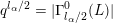 $q^{l_{\unicode[STIX]{x1D6FC}}/2}=|\unicode[STIX]{x1D6E4}_{l_{\unicode[STIX]{x1D6FC}}/2}^{0}(L)|$
elements, while each element of
 $\mathscr{G}_{0}^{\star }(\unicode[STIX]{x1D6FC})$
is fixed under twisting by exactly
 $d$
elements of
 $\unicode[STIX]{x1D6E4}_{l_{\unicode[STIX]{x1D6FC}}/2}^{0}(L)$
. Therefore
 $\big|\unicode[STIX]{x1D6E4}_{l_{\unicode[STIX]{x1D6FC}}/2}^{0}(L)\backslash \mathscr{G}_{0}^{\star }(\unicode[STIX]{x1D6FC})\big|=d$
, as required for part (3) of the theorem in this case.
Return to the general case and write
 $e=e(T|L)$
. For
 $\unicode[STIX]{x1D70E}\in \mathscr{G}^{\star }(\unicode[STIX]{x1D6FC})$
, write
 $\unicode[STIX]{x1D70E}_{\unicode[STIX]{x1D709}}^{T}=\unicode[STIX]{x1D70E}_{\unicode[STIX]{x1D709}}\,|\,\mathscr{W}_{T}$
. Thus
 $\unicode[STIX]{x1D70E}_{\unicode[STIX]{x1D709}}^{T}$
has centric field
 $\widetilde{L}_{\unicode[STIX]{x1D70E}}/T$
. For
 $\unicode[STIX]{x1D70E},\unicode[STIX]{x1D70F}\in \mathscr{G}^{\star }(\unicode[STIX]{x1D6FC})$
, Lemma 2 shows that
 $\widetilde{L}_{\unicode[STIX]{x1D70E}}=\widetilde{L}_{\unicode[STIX]{x1D70F}}$
if and only if there exists
 $\unicode[STIX]{x1D712}\in \unicode[STIX]{x1D6E4}_{el_{\unicode[STIX]{x1D6FC}}/2}(T)$
such that
 $\unicode[STIX]{x1D70F}_{\unicode[STIX]{x1D709}}^{T}=\unicode[STIX]{x1D712}\otimes \unicode[STIX]{x1D70E}_{\unicode[STIX]{x1D709}}^{T}$
. So, if there exists
 $\unicode[STIX]{x1D719}\in \unicode[STIX]{x1D6E4}_{l_{\unicode[STIX]{x1D6FC}}/2}(L)$
such that
 $\unicode[STIX]{x1D70F}_{\unicode[STIX]{x1D709}}=\unicode[STIX]{x1D719}\otimes \unicode[STIX]{x1D70E}_{\unicode[STIX]{x1D709}}$
, then
 $\widetilde{L}_{\unicode[STIX]{x1D70F}}=\widetilde{L}_{\unicode[STIX]{x1D70E}}$
. Counting as before, there are at most
 $d=|D(\unicode[STIX]{x1D70E}_{\unicode[STIX]{x1D709}})|$
distinct fields
 $\widetilde{L}_{\unicode[STIX]{x1D70E}}$
, as
 $\unicode[STIX]{x1D70E}$
ranges over
 $\mathscr{G}_{0}^{\star }(\unicode[STIX]{x1D6FC})$
. We have proved the first assertion of part (3) of the theorem.
In general, the relation
 $\unicode[STIX]{x1D70F}_{\unicode[STIX]{x1D709}}^{T}=\unicode[STIX]{x1D712}\otimes \unicode[STIX]{x1D70E}_{\unicode[STIX]{x1D709}}^{T}$
implies
 $\unicode[STIX]{x1D712}/\unicode[STIX]{x1D712}^{\unicode[STIX]{x1D6FE}}\in D(\unicode[STIX]{x1D70E}_{\unicode[STIX]{x1D709}}^{T})$
, for all
 $\unicode[STIX]{x1D6FE}\in \operatorname{Gal}(T/L)$
. That is,
 $\unicode[STIX]{x1D712}$
defines a
 $\operatorname{Gal}(T/L)$
-fixed point in
 $\unicode[STIX]{x1D6E4}_{el_{\unicode[STIX]{x1D6FC}}/2}(T)/D(\unicode[STIX]{x1D70E}_{\unicode[STIX]{x1D709}}^{T})$
. If
 $p$
does not divide
 $[T\,:\,L]$
, this is equivalent to
 $\unicode[STIX]{x1D712}\in \unicode[STIX]{x1D6E4}_{l_{\unicode[STIX]{x1D6FC}}/2}(L)/D(\unicode[STIX]{x1D70E}_{\unicode[STIX]{x1D709}})$
, since
 $D(\unicode[STIX]{x1D70E}_{\unicode[STIX]{x1D709}})$
is the group of
 $\mathscr{W}_{L}$
-fixed points in
 $D(\unicode[STIX]{x1D70E}_{\unicode[STIX]{x1D709}}^{T})$
(8.2 Lemma). The final assertion follows.◻
Remark.
There are indeed cases of
 $p$
dividing
 $[T_{\unicode[STIX]{x1D70E}}\,:\,L]$
in the context of the theorem; we have already seen this in the example of 9.6.
10.6
For this subsection only, we assume that
 $p\neq 2$
. We outline a mild variant to our approach, following Mœglin [Reference MœglinMœ90]. It gives a simpler expression of the results, at the cost of a loss of generality.
Otherwise, we use the notation from the beginning of the section. Suppose that
 $l_{\unicode[STIX]{x1D6FC}}>0$
. Define
 $\mathscr{C}^{\dagger }(\mathfrak{a},\unicode[STIX]{x1D6FC})$
to be the set of
 $\unicode[STIX]{x1D703}\in \mathscr{C}^{\star }(\mathfrak{a},\unicode[STIX]{x1D6FC})$
satisfying

This expression does indeed define a character of
 $U_{E}^{[(1+l_{\unicode[STIX]{x1D6FC}})/2 )]}$
. Surely
 $\mathscr{C}^{\dagger }(\mathfrak{a},\unicode[STIX]{x1D6FC})$
is not empty. It is equal to
 $\mathscr{C}^{\star }(\mathfrak{a},\unicode[STIX]{x1D6FC})$
when
 $l_{\unicode[STIX]{x1D6FC}}$
is odd. Let
 $\Vert \mathscr{C}^{\dagger }(\mathfrak{a},\unicode[STIX]{x1D6FC})\Vert$
be the set of endo-classes of characters
 $\unicode[STIX]{x1D703}\in \mathscr{C}^{\dagger }(\mathfrak{a},\unicode[STIX]{x1D6FC})$
. In the case
 $l_{\unicode[STIX]{x1D6FC}}=0$
, we may put
 $\mathscr{C}^{\dagger }(\mathfrak{a},\unicode[STIX]{x1D6FC})=\mathscr{C}^{\star }(\mathfrak{a},\unicode[STIX]{x1D6FC})$
; remember that this set has only one element.
Lemma 1. Let
 $\unicode[STIX]{x1D703}\in \mathscr{C}(\mathfrak{a},\unicode[STIX]{x1D6FC})$
. There exists
 $\unicode[STIX]{x1D6FD}\in \text{P}(\mathfrak{a},\unicode[STIX]{x1D6FC})$
such that
 $\unicode[STIX]{x1D703}\in \mathscr{C}^{\dagger }(\mathfrak{a},\unicode[STIX]{x1D6FD})$
.
Proof. This follows readily from 7.1 Proposition. ◻
Let
 $\mathscr{G}^{\dagger }(\unicode[STIX]{x1D6FC})$
be the set of
 $\unicode[STIX]{x1D70E}\in \widehat{\mathscr{W}}_{F}^{\text{wr}}$
such that
 $[\unicode[STIX]{x1D70E}]_{0}^{+}\in ^{\,\text{L}}\Vert \mathscr{C}^{\dagger }(\mathfrak{a},\unicode[STIX]{x1D6FC})\Vert$
. The advantage of this approach is encapsulated in the following lemma.
Lemma 2. For
 $\unicode[STIX]{x1D70E},\unicode[STIX]{x1D70F}\in \mathscr{G}^{\dagger }(\unicode[STIX]{x1D6FC})$
, one has
 $\unicode[STIX]{x1D6E5}(\unicode[STIX]{x1D70E},\unicode[STIX]{x1D70F})<c_{\unicode[STIX]{x1D6FC}}$
.
This follows from 10.3 Lemma 2. Imitating the discussion in 10.4 and 10.5, using the same notation, we find the following result.
Proposition.
(1) If
$\unicode[STIX]{x1D70E},\unicode[STIX]{x1D70F}\in \mathscr{G}^{\dagger }(\unicode[STIX]{x1D6FC})$
, then
$\widetilde{L}_{\unicode[STIX]{x1D70F}}=\widetilde{L}_{\unicode[STIX]{x1D70E}}$
.(2) Let
$\unicode[STIX]{x1D706}_{\unicode[STIX]{x1D6FC}}^{\prime }=\max \{[(1+l_{\unicode[STIX]{x1D6FC}})/2]-1,0\}$
. The set
$\mathscr{G}^{\dagger }(\unicode[STIX]{x1D6FC})$
is a principal homogeneous space over
$\unicode[STIX]{x1D6E4}_{\unicode[STIX]{x1D706}_{\unicode[STIX]{x1D6FC}}^{\prime }}(L)$
.





10.7
Explicit results concerning the local Langlands correspondence fall into three areas. For essentially tame representations (which have trivial Herbrand functions), complete results are given in [Reference Bushnell and HenniartBH05a, Reference Bushnell and HenniartBH05b, Reference Bushnell and HenniartBH10]. A method for reducing to the totally wild case is worked out in [Reference Bushnell and HenniartBH14b]. For totally wildly ramified representations, results are confined to a small number of old, but distinguished, papers. We briefly examine the relation between this paper and that historical context.
Leaving aside the peripheral case of [Reference Bushnell and HenniartBH14a], the significant work concerns dimension
 $p$
, in the context of proving the existence of the Langlands correspondence. The case
 $p=2$
is in Kutzko [Reference KutzkoKut80, Reference KutzkoKut84] (as recounted in [Reference Bushnell and HenniartBH06]),
 $p=3$
is Henniart [Reference HenniartHen84] while
 $p\geqslant 5$
is Mœglin [Reference MœglinMœ90].
The keystone of Kutkzo’s work is the management of the case where, in the notation of the rest of the section,
 $\unicode[STIX]{x1D6F9}_{\unicode[STIX]{x1D6FC}}$
has a single jump. He proves that this is equivalent to
 $m\leqslant 3w_{\unicode[STIX]{x1D6FC}}$
(as we noted in 6.2 Example). He identifies the field we called
 $T_{\unicode[STIX]{x1D70E}}$
in 10.5: it is the splitting field of the polynomial
 $X^{3}-\text{tr}(\unicode[STIX]{x1D6FC})X^{2}+\det (\unicode[STIX]{x1D6FC})$
[Reference Bushnell and HenniartBH06, 45.2 Theorem]. This approach is extended to odd
 $p$
in [Reference MœglinMœ90, V.4 Proposition]. A similar ‘universal polynomial’ appears in [Reference Bushnell and HenniartBH14a, 5.1 Theorem] for epipelagic representations, that is, those with Swan exponent
 $1$
in arbitrary dimension
 $p^{r}$
. These results anticipate the more general 10.5 Theorem (1).
Kutzko’s construction of the Langlands correspondence has little to say about relating parameter fields
 $F[\unicode[STIX]{x1D6FC}]$
,
 $L_{\unicode[STIX]{x1D709}}$
on the two sides. To define the correspondence, he relies on the Weil representation. That construction has remained resistant to further elucidation.
Mœglin’s paper [Reference MœglinMœ90], for
 $p\geqslant 5$
, goes significantly further in that respect. It builds on Kutzko and Moy [Reference Kutzko and MoyKM85] and Kutzko [Reference KutzkoKut79] along with Carayol [Reference CarayolCar84]. It also relies on a number of working hypotheses that have since been verified, notably:
(1) characterization of the Langlands correspondence via local constants of pairs (see [Reference HenniartHen93]);
(2) compatibility of Kazhdan’s lift [Reference KazhdanKaz84] and the Kutzko–Moy tame lift [Reference Kutzko and MoyKM85] with Arthur–Clozel base change [Reference Arthur and ClozelAC89] (see [Reference Henniart and HerbHH95, Reference Bushnell and HenniartBH99], respectively).
All of those cited papers assume
 $F$
to be of characteristic zero. That restriction is removed in [Reference Henniart and LemaireHL10, Reference Henniart and LemaireHL11].
A feature of [Reference MœglinMœ90] is the treatment of the relation between parameter fields. To rearrange matters in accordance with the scheme here, we start with a simple stratum
 $[\mathfrak{a},m,0,\unicode[STIX]{x1D6FC}]$
in
 $\text{M}_{p}(F)$
(as throughout) such that
 $m>w_{\unicode[STIX]{x1D6FC}}$
. Write
 $E=F[\unicode[STIX]{x1D6FC}]$
and let
 $\unicode[STIX]{x1D703}\in \mathscr{C}^{\dagger }(\mathfrak{a},\unicode[STIX]{x1D6FC})$
. Let
 $\unicode[STIX]{x1D712}_{\unicode[STIX]{x1D703}}$
be a character of
 $E^{\times }$
agreeing with
 $\unicode[STIX]{x1D703}$
on
 $U_{E}^{1}$
. The representation
 $\unicode[STIX]{x1D70E}(\unicode[STIX]{x1D712}_{\unicode[STIX]{x1D703}})=\operatorname{Ind}_{E/F}\,\unicode[STIX]{x1D712}_{\unicode[STIX]{x1D703}}$
is then irreducible, totally wild and of Carayol type. If
 $E/F$
is cyclic, then
 $\unicode[STIX]{x1D70E}(\unicode[STIX]{x1D712}_{\unicode[STIX]{x1D703}})$
is absolutely wild. In this case, Mœglin shows that the set of representations
 $\unicode[STIX]{x1D70E}(\unicode[STIX]{x1D712}_{\unicode[STIX]{x1D703}})$
, for
 $\unicode[STIX]{x1D703}\in \mathscr{C}^{\dagger }(\mathfrak{a},\unicode[STIX]{x1D6FC})$
, is what we have called
 $\mathscr{G}^{\dagger }(\unicode[STIX]{x1D6FC})$
. That is, the Langlands correspondence matches parameter fields.
In general, the problem of describing parameter fields for H-singular representations seems to be of a different order. In the case of epipelagic representations [Reference Bushnell and HenniartBH14a] (where
 $m=1$
), the field
 $F[\unicode[STIX]{x1D6FC}]$
is so ill-determined as to make the question meaningless without some qualification.
Acknowledgements
Both the transparency and accuracy of the exposition were greatly improved by detailed criticism from referees. We are extremely grateful for their efforts.


