Introduction
Today, the discourse on quality and related educational policies is dominated by industrial and commercial notions of quality such as ‘knowledge production’ (Peters & Olssen, Reference PETERS, OLSSEN and Barnett2005), ‘learning economy’ (ibid.), ‘accountability to stakeholders’ (Elton, Reference ELTON and Barnett2005) and ‘cultures of performativity’ (Troman et al., Reference TROMAN, JEFFREY and RAGGL2007) and is imposed on higher education through quality agencies such as The Quality Assurance Agency for Higher Education in Great Britain and various forms of evaluations of the practice of teaching.
Research on the implementation of such quality assurance procedures (Johnes & De Saram, Reference JOHNES and DE SARAM2005; Anderson, Reference ANDERSON2006) has revealed that academic staff in institutions for higher education do not perceive them as relevant for what they hold to be the real substantive issues of quality particularly in relation to the quality of teaching and learning.
If this is the case, then it is important to establish what staff members and their students perceive to be the substantive issues of teaching and learning quality. This is the focus of the study.
We investigated internal evaluation quality issues from the standpoint of professors and trainees teaching and learning within higher music education and specifically in relation to musikdidaktik. The main research question was: ‘How do professors and trainees perceive the quality of teaching and learning within musikdidaktik as an educational subject?’ Musikdidaktik is a core subject within music teacher education in several European and Scandinavian countries, comprising the theory of music teaching and suggesting structures and principles for its planning and analysis including planning-execution-evaluation models and concepts such as objectives, content, methods and assessment (see e.g. Kertz Welzel, Reference KERTZ WELZEL2004). As such, musikdidaktik aims to develop trainees’ abilities in both general music class and instrumental and vocal teaching.
The aim of the study was to map and explore professors' and trainees' perceptions of what constitutes quality of teaching and learning and furthermore to contribute to bottom-up constructed insights on the quality of teaching and learning in higher music education by reflecting those perceptions through a theoretical framework. Hence, the study was positioned within the field of research on music teacher education (Hennessy, Reference HENNESSY2007; Webster, Reference WEBSTER2007) and how that education can be strengthened (Wilcox & Upitis, Reference WILCOX, UPITIS, Colwell and Richardson2002). It is also positioned within the field of research studies relating to the exploration students' and teachers' perceptions of effective instrumental and vocal teaching (Mills, Reference MILLS2002; Mills & Smith, Reference MILLS and SMITH2003). We hold that within the field of music teacher training such knowledge remains to be further developed and also related to the debate on educational quality.
Theoretically, the study was founded on the research and literature of educational quality in higher education (Biggs, Reference BIGGS2004; Steensaker & Maasen, Reference STEENSAKER and MAASEN2005) and didaktik. Drawing on the literature on educational quality the trainees’ learning can be studied by focusing on their learning orientations, which can be broken down into learning styles, strategies and approaches. ‘Learning styles’ denotes the preferred ways in which an individual processes information, like analytic or imaginative (McCarthy, Reference MCCARTHY2000) and are hardly open to modification, while ‘learning strategies’, including the ways in which trainees carry out their learning (e.g. going from the parts to the whole or vice versa), can be inspected by the individual and are accessible to deliberate change. ‘Learning approaches’ concerns primarily trainees’ intentions and motivations to learn and appear as largely context sensitive. Within this interplay, the quality of trainees’ learning can be described as deep or surface oriented (see Biggs, Reference BIGGS2004; Pettersen, Reference PETTERSEN2004, – as applied to musikdidaktik see Johansen, Reference JOHANSEN2007a). ‘Surface learning’ denotes minimalist strategies for memorising and reproducing along with an intentional focus on passing assessments and is possibly connected to negative attitudes to learning. As opposed to this, deep learning is characterised by strategies for achieving meaningful learning, an intention to develop wider understanding and a positive attitude to learning. By meaningful learning we mean understanding the potential of what is learned for its utilisation within practices of music teaching, communication with peers and professors and strengthening of theoretical insights. It is characterised by ‘the negotiation of new meanings – not just the acquisition of new skills or information’ (Wenger, Reference WENGER2006: 12)
As educational theory, didaktik is indebted to the 17th century works of Ratke and Comenius and was further developed by scholars like Pestalozzi, Herbart, Diesterweg, Weniger and Klafki (Jank & Meyer, Reference JANK and MEYER2003). Etymologically, it is rooted in Greek concepts like didaskein (to teach and to be taught) and didachtike techne (the art of teaching). Today didaktik in the context of education is concerned with the relationship between teaching and learning in formal settings and constitutes a core discipline within the wider concept of ‘pedagogy’.
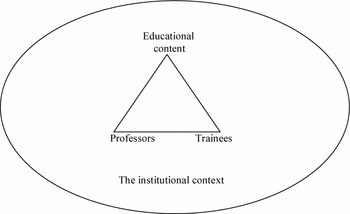
A distinction between knowing the subject content of an academic discipline and teaching it to students is central in didaktik theory. Firstly, it is necessary to select what discipline content is to become the educational content for the teaching (Johansen Reference JOHANSEN2007b). Secondly, the selected educational content then needs to be presented to a third part – the students. Thus, when professors teach ‘their’ subject, their discipline knowledge takes on a new function and is transformed as a basis for teaching (Nielsen, Reference NIELSEN and Fiske2002; Johansen, Reference JOHANSEN2007b). What emerges from this is musikdidaktik as an educational subject, characterised by the three-part relationship between the educational content, the professor and the trainee. The three-part relationship of an educational subject can be illustrated by ‘the didaktik triangle’ (Nielsen, Reference NIELSEN and Jørgensen1997, see Fig. 1).
The didaktik triangle and its context as adapted to the study

The triangle relations between professors, trainees and the educational content are understood as having a significant impact on trainees’ learning in general. Within this present article however we concentrate on significant preconditions for deep learning to take place. By preconditions we mean frames, circumstances and conditions that influence learning processes (Hanken & Johansen, Reference HANKEN and JOHANSEN1998).
Method
As the research focused on professors’ and trainees’ perceptions of quality factors and not on their observed actions in teaching and learning situations, semi-structured in-depth interviews 60–90 minutes in length were chosen as the instrument for collecting information. The interviewees were not known beforehand by the interviewers, and the interviews took place at the interviewees’ institutions.
As musikdidaktik is taught in various forms and at various kinds of institutions, a structured sample of teachers and students was selected according to a maximum variation sampling strategy (Lindlof, Reference LINDLOF1995) and a cross-selection of type of institution, type of musikdidaktik subject, types of students’ main instrument and music culture, and gender. To provide rich trainee experience, the trainees selected were in their second and third year of their undergraduate degree studies.
The sample for the present part of the study consisted of two musikdidaktik teachers and two trainee focus groups comprising a total of ten trainees. The teachers were of different sexes, one teaching musikdidaktik theory and the other musikdidaktik for classroom music teaching, one at a conservatory which educated both musicians and music teachers and the other at a teacher-training college which educated generalists, one in Norway and the other in Finland. The trainees were of both sexes and represented a variety of instrumental and music-cultural backgrounds.
The interview guide was constructed around three main questions, directing attention to personal musical identity, learning processes and the selection of teaching & learning content, with optional sub-questions aiming at exemplifying aspects of each theme. In this article, we report and discuss the findings related to the parts of the interviews that concerned learning processes. Having asked the interviewees about their understanding of the terms deep and surface student learning we then asked how they would describe the differences between the two and what characterised each. We then asked for their perceptions and opinions about what they understood to be the most significant preconditions for deep learning, including how deep versus surface learning might be influenced by the professor.
The interviews took place in the second half of the spring period to ensure that the trainees’ statements included experiences from that year as well as earlier years. All the interviews took place within the localities of the two institutions during day-time and were recorded on minidisk. One of the researchers took responsiblity for the questioning whilst the other operated the mini-disk recorder, posing supplementary questions when needed. The interviews were then transcribed for analysis.
Analysis of the transcribed interview material
In addition to interviewees’ answers about the preconditions for deep learning, we anticipated that our perceptions about various issues would be enriched by their stories of learning in general as well as other interview themes. Consequently, analysis began by reading through each interview as a whole and coding statements about preconditions for deep learning regardless of the different interview questions. Through this process the inductive categories of preconditions located to the institution, trainees and professors emerged. Thereafter, the statements in each category were cross analysed according to the relations of the didaktik triangle and the institutional context, and further to the concepts of learning orientations and deep and surface learning.
Findings
What then were the frames, circumstances and conditions which were perceived by the interviewees as significant preconditions for deep learning, drawing on the theoretical concept of the didaktik triangle as an analytic tool, and what preconditions for deep learning were identified? These preconditions were linked to the relation between the trainee and the content, the trainee and the professor, and finally the relation of second degree between the trainee and the side of the didaktik triangle that represents the professors’ relations to the content (see Fig. 1). Further, the relations of the didaktik triangle appeared as linked to the surrounding institutional context in various ways. As a result, three categories emerged from the material: institutional preconditions, trainee preconditions and professor preconditions.
Institutional preconditions for deep trainee learning
Institutional preconditions refer to frames, circumstances and conditions that can be located to the institutional context surrounding the musikdidaktik subject. Through interacting with and impacting upon the didaktik triangle relations (see Fig. 1) institutional preconditions affect the quality of trainee's learning. The interviewees particularly emphasised the institution's disposition towards time allocation, and its organisation as being significant for the trainees’ deep learning. Thus their statements provided empirical support for Jørgensen's (Reference JØRGENSEN2000) emphasis on the importance of institutional influence on student learning.
The institution's disposition of time
The statements about time mainly concerned the amount of time that was given to musikdidaktik subject teaching during the course. Shortage of time sometimes caused professors to choose lecturing over activity-based teaching which would have almost certainly enhanced deep learning. Consequently increasing the amount of time was felt likely to result in more deep learning by allowing teaching forms more activity-based:
One year ago we had 20 hours, or 20 lessons and now we have 30, so now we have more resources for the teaching. I think now we have a better chance for deep learning. [. . .] Now it is possible to play in a band and to guide the students in that situation. 85% of the 70 students in the first year are now playing in a band. This is the first time that it is possible (teacher).
Another time aspect related to the point at which, the teaching of musikdidaktik should start. Interviewees considered that the important issues here were trainees’ maturity and the other subjects that the students were supposed to study. Deep learning in musikdidaktik required a level of experience with trainees’ musical instrument, which was usually developed during the first year at the institution. We will come back to this trainee precondition below. Questions were raised as to whether first-year trainees were prepared for a subject that included theoretical and practical issues of teaching and learning in music, if significant aspects of their practical and theoretical understanding of music itself were underdeveloped. This raises the issue as to the way in which the teaching of music and didaktik understandig and skills might be integrated (blended) and related to each other.
One interviewee connected the question of time to trainees’ readiness to teach or supervise their pupils:
So, you could say that it is a problem for the musikdidaktik subject, the way it is organised here. Some of us think that students in their first year, being juvenile singers, have too little experience for doing a good job in practical vocal teacher training. [. . .] They are too insecure to supervise others successfully [. . .]. I experience some students as so insecure that they do not dare to supervise at all or to ‘let themselves go’ in teaching situations. And they do not feel their knowledge of their instrument to be sufficient, either. Which is their own body. They have not experienced how bodily things work when those things work well. And consequently they have problems entering the kind of subject that vocal didaktik is. So, idealistically speaking, perhaps their vocal didaktik studies should wait until their second year (professor).
The order of musikdidaktik and the trainees’ main instrument studies was also discussed in relation to a third subject area; the trainees’ practical teacher training. There were various opinions among the students about the order of the three. While some would prefer the first year to be solely concentrated on musical performance, others held that anyone who wants to become a music teacher should engage in practical teacher training and musikdidaktik at the very start of year one. The view trainees took on this issue seemed to be connected to trainees’ self-identity, when beginning their studies. (We will come back to questions of identity under ‘trainee preconditions’ below).
Summing up, three time-related issues emerged as significant for the trainees’ deep learning.
• The amount of time that was allocated musikdidaktik impacted upon the professors’ opportunities to choose activity-based teaching forms over lecturing.
• When in the course of the music teacher's education the teaching of musikdidaktik began and brought to the maturity and experience which the trainees learning tasks within musikdidaktik.
• Deep learning was enhanced by the sequencing and integration of musikdidaktik, principal instrument and practical teacher training.
The institutions' educational organisation
The interviewees' views about how the institution's organising of musikdidaktik impacts on surface and deep learning focused on three themes: the total amount of subjects which trainees had to study, the position of musikdidaktik within music teacher education as a whole, and the institutional culture and its impact on trainees' and professors' attitudes.
The number of subjects, mandatory and optional, which were programmed by the institution as part of music teacher education caused many trainees as well as professors to experience subject overload. This made it impossible for trainees to achieve deep learning in all subjects. Consequently they prioritised some subjects at the expense of others sometimes to the deteriment of musikdidaktik.
The position of the musikdidaktik subject within music teacher education as a whole was also perceived to influence the possibility of deep learning. Musikdidaktik ought to be the central subject of music teacher education, it was held, because it has a potential to bind subjects together and give trainees a holistic understanding of themselves as music teachers consequently.
It was also regarded as important that the musikdidaktik subject was organised with clear connections to what the trainees were expected to do in other subjects, rather than as an isolated, theoretical subject. In this respect, making links to practical teacher training were considered to be particularly important as it was reported that deep learning in musikdidaktik increased as soon as the trainees started their practical teacher training. Further, deep learning in musikdidaktik was experienced as directly related to how well the practical teacher training is planned and carried out.
The institutional culture and its impact on professors’ and trainees’ attitudes were perceived as a significant factor governing the underpinning pedagogy of musikdidaktik as an educational subject. As such, it was regarded as a significant precondition for the trainees’ learning. One such impact concerned the way professors’ and trainees’ prioritised musikdidaktik's internal blend of musik and didaktik (Nielsen, Reference NIELSEN and Fiske2002). This was manifested through professors’ demands and expectations of trainee achievement. While some emphasised musical skills and knowledge over and above educational aspects and others did the opposite, there was a clear tendency to favour the musical part of the subjects over the pedagogical aspect. However, both professors and trainees regarded musik and didaktik as ideally being interwoven in a field of relations (Nielsen, Reference NIELSEN and Fiske2002), meaning that the educational content of musikdidaktik should result from musik and didaktik being reflected in each other as opposed to one being dominant.
Another issue concerned the status of the musikdidaktik subject which was perceived by the interviewees to be lower than that of other subjects. The musikdidaktik professors knew that the trainees might regard the subject as less important than others, and occasionally some professors reinforced this perception by adjusting their demands on trainees’ achievements and by tolerating their late arrivals and absences. This was reported by the trainees as having direct impact on their motivation, leading to surface learning.
An institutional precondition that had a more indirect impact on the trainees’ learning in musikdidaktik was how the trainees were treated by their professors in other subjects, such as their instrumental lessons, music history and solfège. It made a difference if the trainees were regarded as being a definite group of music education students within the rest of the institution or if they were treated like the other students, in for example main instrument lectures. Being regarded as a separate and distance group might contribute to a feeling of being second rank, which fed back to the trainees’ perception of the subject's status, and the value of working hard in musikdidaktik.
Summing up, five issues that concerned the institutions’ educational organisation emerged as significant for the trainees’ deep learning.
• Subject overload caused the trainees to prioritise to the detriment or benefit of musikdidaktik.
• Clarifying the central role of musikdidaktik in music teacher education as well as making connections to what the trainees were doing in other subjects appeared to enhance learning.
• The impact on professors' and trainees’ attitudes of the institutional culture resulted in a tendency to favour the musical aspects of the musikdidaktik subject where the ideal was for musik and didaktik to be reflected in each other.
• The status of the musikdidaktik subject was perceived to be lower than that of other subjects and sometimes professors' actions reinforced this perception.
• The ways in which the trainees were treated by teachers of subjects other than musikdidaktik affected whether or not the trainees were being accepted on equal terms with students of other musical disciplines.
Trainees’ preconditions
The preconditions for deep learning that were identified as located to the trainees included the areas of trainee identity, learning orientations and musical experience.
Trainee identity
The professors expressed clear opinions that various identities were observable among the music teacher trainees. While some trainees expected to become music teachers, others saw themselves as heading for future occupations as performers, composers or conductors. The interviews showed how music teacher trainees’ self-identities impacted on their understanding of musikdidaktik:
I have changed from thinking of myself as a music teacher trainee to a musician trainee who specialises in teaching (trainee).
On the question of the quality of learning, the trainees reported that seeing themselves as music teacher trainees would enhance deep learning in musikdidaktik. This perception was fully supported by the professors.
Three perspectives in particular showed how aspects of identity could be connected to deep learning. The first concerned trainees’ ability to change the way they looked at themselves from one subject to another. The second perspective concerned the possibility of engaging in dialogue. As one of the professors said:
You can have different kind of dialogue with trainees who imagine themselves as music teachers.
Thirdly, possibilities for deep learning were connected to the formation of identity and how early in their course trainees saw themselves as music teachers. One of the professors expressed it this way:
Trainees, who develop a music teacher identity in the early stages of the course, learn more effectively than trainees who think of themselves in other professional roles (professor).
A clear distinction between trainees who defined themselves as music education trainees in one way or another, and those who did not, showed in their capacity for deep learning in musikdidaktik. One professor held that trainees must be encouraged to develop their musical identity in parallel with their musikdidaktik learning processes. Others stressed how the trainees' envisaged professional identity, whether explicit or implicit, influenced their capacity for deep learning.
Trainees' learning orientations
Professors and trainees were both aware of the importance of trainees' learning orientations, including learning styles, strategies and approaches. The professors felt that trainees had various learning styles and that it was necessary to adjust their teaching to accommodate. The trainees, on their side, felt that the way in which they managed to internalise the subject content was related to the extent to which their own ways of learning were taken into account.
The trainees' knowledge about and ability to monitor their own learning strategies (Graabræk-Nielsen, Reference GRAABRÆK-NIELSEN, Hanken, Graabrækdr Nielsen and Nerland2002) were also related to deep learning. For example working with tasks and assignments did not only consist of doing the task or assignment itself, but also engaging with the challenges and expectations of learning:
To understand that learning is a task in itself is a prerequisite for deep learning (professor).
To become aware of this ‘double obligation’: that is to pose the question ‘what am I expected to learn from this work’ in addition to ‘just finishing the task’ required a meta-perspective on a music teacher trainee's own work. In addition, it required an ability to select relevant strategies (or metacognitive control; Graabræk-Nielsen, Reference GRAABRÆK-NIELSEN, Hanken, Graabrækdr Nielsen and Nerland2002) for its fulfilment. So, the level of awareness seemed to be important also when it came to learning strategies.
What then constituted the connection between learning orientations and trainee intention? Trainees' intentions and motivations appeared to be central to the perceptions and opinions of the interviewees in this respect. As regards intentions, professors emphasised the importance of approach to deep learning in musikdidaktik which was governed by its perceived usefulness in the labour market for music teachers and also its transfer value to other subjects within music teacher education.
Other factors that were perceived as significant for the trainees' learning orientations concerned to what extent the teaching and learning tasks gave pleasure and genuine interest, in comparison to, say, playing a musical instrument or making music together.
Trainees' musical experience
Musical experience, which refers to trainees' experiences of listening to, making, teaching and learning music, is a third way of viewing the trainee-content relation of the didaktik triangle. This experience was perceived as a precondition for deep learning in the sense that knowledge of what is taught deepens the learning of how to teach it:
If the students manage to get into and reflect on [. . .] the music, are they then in a deep learning process?
Yes, I think so. If they understand what is happening in the music: [. . .] ‘I know this song very well, I have listened to it many, many times and I like it very much’. Then it is much easier to teach the children [. . .] (professor).
Musical experience was regarded as significant for classroom music teaching, and even more crucial for instrumental teaching. It was held that trainee preconditions for deep learning in musikdidaktik were strongly related to trainees’ musical maturity. A central opinion was that a lack of musical experience blocks deep learning in musikdidaktik. This encompassed all kinds of musical competence from musical performance to theoretical, intuitive as well as logic-analytical knowledge (Swanwick, Reference SWANWICK1994). However, the importance of music experience was most clearly connected to trainees’ musical performance. For example, the professors reported that trainees who studied music education after having finished their education as a musician, tried much harder to learn musikdidaktik than those who were in earlier phases of their instrumental development. A challenge for musikdidaktik professors is to make links connecting musical experience to trainees’ musikdidaktik competence as a whole.
Summing up, three issues that concerned the trainees’ preconditions emerged as significant for achieving deep learning.
• The trainees believed that seeing themselves as music teacher trainees as early as possible in the course of education enhanced the dialogue between professors and trainees and thereby promoted deep learning in musikdidaktik.
• The possibility of achieving deep learning was related to the extent to which the trainees’ various learning styles were taken into consideration along with guidance on adopting appropriate learning strategies and approaches.
• Experience of listening to, making, teaching and learning music was perceived to deepen the learning of musikdidaktik. Connecting musical experience with educational thinking constituted a challenge for the musikdidaktik professors.
Professor preconditions for deep student learning
We now take the professor point of the didaktik triangle as a starting point. The preconditions that were perceived as significant for deep learning included professors’ attitudes to the trainees’ preconditions and professors’ approaches to the subject. Rather than being fixed, these preconditions continually changed, centring on concepts like openness, engagement, identity and competence.
Professors' attitudes to trainees' preconditions
Professors' attitudes to trainees' preconditions were regarded as a triangle relation of second degree, highlighting how professors related to the student-content relation. As such those attitudes were perceived as being significant for deep learning because they influenced whether educational ‘meetings’ (von Wright, Reference VON WRIGHT2000, see below) would take place or not. Here, the interviewees emphasised the importance of professors being receptive and open to changing and varying their teaching approaches in order to meet the needs of individuals in terms of preferred learning styles and providing opportunities for everyone to take part. Trainee's knowledge, their situations and interests were perceived as important focuses for professors’ awareness. One professor stressed the importance of being careful in the process of planning, to be focused towards the knowledge of the trainees, and to use the interest of the trainees as a starting-point for teaching the intended content. Another of the participating professors underlined that the trainees had to trust her. She considered that her task was to give the trainees confidence in their own abilities and to encourage trainee involvement and enjoyment.
Professors' approach to the subject
The professor-content relation of the didaktik triangle was perceived to include preconditions for the trainees' deep learning in several significant ways. One factor that was considered to be crucial concerned the professors’ awareness of what constitutes musikdidaktik as an educational subject. This included having a clear understanding of her or his version of musikdidaktik. For example: what characterises guitar-didaktik, what constitutes classroom-didaktik or general musikdidaktik? It was held that the professors had to be willing to develop their knowledge of music and awareness of how various components of musical knowledge enrich their knowledge base of musikdidaktik. Furthermore, they should be conscious about how that knowledge base influences and develops their educational subject. Commitment to the subject was also thought to be important when it came to the professor-subject relation:
If the teacher is enthusiastic about the thing he is teaching, then I think it helps deep learning. [. . .] If the teacher is good, he says: Hey, listen to this! Aha! (trainee).
Another aspect that the interviewees connected to professor competence in musikdidaktik was their musical credibility. This seemed to be an important dimension of the student–teacher/content relation. However, this was related to an experienced asymmetry regarding the balance between musik and didaktik:
A balance between music- and didaktik-competence is the optimal prerequisite for a musikdidaktik teacher. But the students have greater respect for a teacher who knows music. In that way, musical competence is a significant teacher precondition influencing that balance (trainee).
Maintaining this balance and also having experience of teaching music as well as of musikdidaktik were key factors impacting on professors' credibility and legitimacy as were professors’ ability to communicate their knowledge and experience: in other words, knowing how to teach. Deep learning seemed to require professors to use their experience to enhance trainees’ reflections on both practical and theoretical aspects of musikdidaktik drawing on a broad repertoire of teaching methods, theoretical models and experiences relevant to different settings. It was also seen to be important that the professor could organise and systematise the content of their lectures (Johansen, Reference JOHANSEN2007b). Even if it is rooted in the teacher-content relation, this organising cannot be isolated from the third corner of the triangle: the one of the trainee.
For the trainees, good teaching of musikdidaktik meant clarifying basic ideas by combining knowledge, experience and practical skills and being aware of trainees' developing understanding of musikdidaktik. In other words, to be competent to teach meant being engaged in the trainees' learning as well as the subject.
The trainees emphasised the importance of open teaching methods such as encouraging the students to investigate an area of their own interest or to organise an educational project involving children. By this they indirectly pointed to the selection of teaching methods as a significant factor of the teacher–student/content relation.
Professors' perceptions of what constitutes competence and their views on the subject were also connected to their awareness of why they wanted trainees to do things, and how they valued the trainees' efforts. This revealed relations between professor attitudes and the institutional culture, with consequences for the subjects' status.
Summing up, three issues that could be connected to the professors emerged as significant for trainees to achieve deep learning.
• Professors’ attitudes to trainees’ need to signal trust, encourage independent thinking and promote involvement and enjoyment thus increasing the probability of educational ‘meetings’ taking place.
• Professors’ approaches to the subject should be based on awareness of the balance of musik and didaktik and a willingness to develop their musical knowledge.
• While the professors emphasised the importance of selection of content, trainees emphasised the significance of professors' choice of teaching strategies.
In summary, the trainees and professors largely agreed on what preconditions were the most significant for deep learning: the institutional dispositions, the trainees' identities, learning and orientations and musical experiences and the professors' attitudes to the trainees and approach to musikdidaktik as a subject. Opinions differed as only one single, significant issue: the importance of the educational content versus the teaching strategies forms used. While the advantages of a carefully selected content were stressed by the professors, the trainees underlined the importance of selecting good teaching strategies.
Findings also indicated how professors’ and trainees’ insights in their own subjects can be taken as a starting point for enhancing and improving educational quality in higher music education ‘bottom up’.
Discussion and some conclusions
In considering the question: what did the interviewees regard as significant preconditions for the trainees’ deep learning? we need to consider what conclusions, if any, can be drawn from the study and what issues deserve closer attention.
Basically, deep learning in musikdidaktik was reported as dependent upon the teaching forms, such as forms connected to practice, forms that construct practice, ‘free’ forms, individual forms, social forms and examination forms, as well as the selection of educational content, such as didaktik tools and concepts, teaching materials, human relations and the professional setting (Ferm & Johansen Reference FERM and JOHANSEN2007). What was at stake was how those factors might give space for trainees' individual learning styles. The challenge for the professors seems to be to vary the teaching forms and be open to take interest in how to help and encourage the individual trainees to reflect upon their learning tasks and select relevant learning strategies. Being aware of their impact on the trainees' learning approaches were also considered important.
It also became obvious that teaching and learning does not take place in a vacuum, but is strongly influenced by the institutional context (D'Andrea & Gosling, Reference D'ANDREA and GOSLING2005).
For example, the time allotted by the institution for the musikdidaktik subject affected the trainee-content relation by hindering or giving room for activity-based teaching forms. Similarly the student–teacher/content relation could be affected by the musikdidaktik subject's low status as part of the institutions' hidden curriculum: a low status that was sometimes affirmed by the musikdidaktik teachers themselves through teaching which lacked challenge.
As status was perceived as a significant precondition for deep learning, which affected the students’ learning approaches in particular, this is an area worthy of further consideration. While the musikdidaktik subject was perceived to be at the core of music teacher education as regards its content, function and formal position in the institution, the subject's status appeared to be low. The cultural powers promoting this view were strong enough to influence the attitudes of some musikdidaktik teachers as well. Hence, the possibilities for enhancing deep learning in musikdidaktik also seemed embedded outside the subject, yet within the institutional culture itself.
Another, institutional precondition that seemed to influence trainees’ deep learning rather strongly were the relations between the musikdidaktik subject and practical teacher training. How the institution values practical teaching training and how they organise and encourage the connections between the two activities seemed to be crucial.
Awareness among the professors of how music and didaktik was combined in the musikdidaktik subject content constituted a further, significant precondition for deep learning. This blend was formally decided by the institution but affected the didaktik triangle relations through informal mechanisms within the institutional culture. It concerned the professor-content relation through the ways in which professors choose the subject content for teaching from the institution's written curricula and embedded in the various knowledge cultures of their own backgrounds. The trainee–teacher/content relation was affected through the ways that the trainees related learning to the resulting blend of music and didaktik as by the professors’ attitudes to that blend. Both blends and attitudes were approached by the trainees from their various student identities (Bouij, Reference BOUIJ1998; Dolloff, Reference DOLLOFF and Stålhammar2006) and the identities that they envisaged in their future careers. Therefore, it was held that deep learning might be enhanced by professors’ encouraging the trainees to develop their musical identity in parallel with their music teacher identity within the musikdidaktik learning processes. Related to earlier studies which also underline the blend of competences within music teacher training (Bouij, Reference BOUIJ1998), this study illuminates the possibility for the subject of musikdidaktik to become an arena where those competences could have the opportunity to grow in different blends (e.g. Ferm, Reference FERM2008).
The reported findings point to several opportunities for further studies. Firstly, the findings, including their inner contradictions and dilemmas, need to be augmented by further interviews. Secondly, other sides of student learning need to be studied to give a more complete picture, along with the fields of identity, and the selection of educational content and their interrelations. Finally, studies are needed to test the general value of the findings. In these ways, it will be possible to contribute to the foundations of a more grounded development of teaching and learning quality within music teacher education and beyond.