

1. Introduction
In the United States, the share of bilingual individuals has more than doubled over the last 40 years. Using data from the US Census, Figure A.1 in the Appendix shows that their share increased from around 6–9% in 1980 to 12–18% in 2019.Footnote 1 According to Eurostat, in 2016 around 25% of individuals in Europe reported to be proficient in at least one foreign language, ranging from 11% in Italy to 66% in Luxembourg. More individuals knowing various languages implies better communication skills which have been shown to foster trade (Melitz Toubal, Reference Melitz and Toubal2014) and migration (see e.g. Adserà Pytliková, Reference Adserà, Pytliková, Ginsburgh and Weber2016; Aparicio Fenoll Kuehn, Reference Aparicio Fenoll, Kuehn, Wickstroem and Gazzola2016). Furthermore, if bilingualism improved individuals’ cognitive skills, this could help to explain the positive effects of migrants’ home country language proficiency on labor market outcomes or social integration (Bleakley Chin, Reference Bleakley and Chin2004; Bleakley Chin, Reference Bleakley and Chin2010). Bilingualism could then also have an impact on economic growth through improved cognitive skills (Hanushek Woessmann, Reference Hanushek and Woessmann2008). However, the individual effects of bilingualism are unclear. In particular, the question regarding the existence of the so-called bilingual advantage, the idea that knowing more than one language improves individuals’ other cognitive skills is unresolved.Footnote 2
We use data on children of Latino immigrants in the Unites States who have been randomly assigned calculation tests in English or Spanish to check whether bilingual children perform better on these tests which are designed to be unaffected by language proficiency (see Aparicio Fenoll, Reference Aparicio Fenoll2018). After controlling for different characteristics of children and their parents, as well as children's time in the US, we find that bilingual readers or writers perform one-fourth to one-third of a standard deviation better than monolingual children, equal to learning gains of one additional school year.Footnote 3 However, this finding does not extend to those who report to merely speak or understand both languages. Given that our estimated bilingual advantage for readers and writers could be due to unobservable characteristics such as school or neighborhood quality, we apply the Oster (Reference Oster2019) test, and we show that this is highly unlikely. Selection on unobservables would have to be between 3 and 4 times stronger than selection on observables to explain away our results. Using scores on other cognitive exams which were also randomly assigned in English or Spanish to children in our sample, we do not find any evidence that the bilingual advantage extents to tests which are not language-free. As Bialystok et al. (Reference Bialystok, Luk, Peets and Yang2010) explain, bilingual children tend to know fewer words in each language compared to monolinguals because “some words occur in a context in which they only use one of their languages” (p. 3).
In the fields of psychology, neuroscience, and education, the idea that bilingualism can shape individuals’ brains beyond language use has been debated for decades. Initially the view that additional languages cause confusion dominated, see e.g. Darcy (Reference Darcy1953). As the first to challenge this notion, Peal Lambert (Reference Peal and Lambert1962) reported that bilingual individuals outperformed monolinguals on various cognitive tests. A large and growing number of studies have since provided additional evidence in favor of the bilingual advantage; see for instance Bialystok (Reference Bialystok1988) or Bialystok et al. (Reference Bialystok, Craik, Klein and Viswanathan2004).Footnote 4 However, others such as Paap Greenberg (Reference Paap and Greenberg2013) or Hilchey Klein (Reference Hilchey and Klein2011) claim that the positive association between bilingualism and cognitive skills is oftentimes the result of flaws in the design of tests, the failure to control for demographic characteristics, differences across age groups considered, or very small samples. Furthermore, no clear consensus exists as to how to measure bilingualism and language proficiency, see e.g. Surrain Luk (Reference Surrain and Luk2019) , De Bruin (Reference De Bruin2019), or Hulstijn (Reference Hulstijn2012) for inconclusive reviews on this topic.Footnote 5 Our findings provide two novel explanations for the presence of a bilingual advantage in some and its absence in other contexts: First, we show that it only arises when classifying individuals according to their reading and writing skills, while bilingual speaking and understanding abilities imply no advantage. Second, we find the bilingual advantage to only show up in cognitive tests which are language-free.
Among the few works that like the current paper consider larger samples and control for demographic characteristics are Mouw Xie (Reference Mouw and Xie1999) who find “no evidence that bilingualism has a positive effect on academic achievement.” Looking at 832 first and second generation Asian Americans from the 1988 National Educational Longitudinal Study, the authors find that speaking a native language with parents has a temporary positive effect on academic achievement which vanishes once immigrant parents achieve a moderate level of English proficiency. Focusing on academic paths, Han (Reference Han2012) looks at the Early Childhood Longitudinal Study and shows that children who speak both English and their native language well, start out with lower math scores in kindergarten, but that by fifth grade the math gap between bilingual and monolingual children is fully closed. While similar to both papers we also find no significant differences between bilingual and monolingual speakers, we do estimate a bilingual advantage for readers and writers. Hence the current paper is closely related to Golash-Boza (Reference Golash-Boza2005) who measures bilingualism as speaking, understanding, reading, and writing well in English and in a native language. The author uses data on more than 3000 individuals from the 1992/93 and 1995/96 Children of Immigrants Longitudinal Study and finds that bilingualism improves performance on the Stanford Math and Reading tests, but only for individuals in communities with low levels of English proficiency and high levels of resources and networks. This is in line with our heterogeneity results which find the bilingual advantage to be stronger among children at the upper end of the ability distribution and those coming from Mexico, the Latino origin-group with the lowest share of migrants reporting to speak English very well (see PEW Hispanic Center, 2007).
Different from these three papers we are able to isolate the role of bilingualism from the influence of English proficiency per se, because (i) the random assignment of tests in English and Spanish allows us to estimate an effect of being bilingual that is not tied to one particular language, and (ii) we differentiate between monolingual individuals in English and Spanish in our estimations. We standardize test scores by age and our estimations include age dummies. As migrant children move to the US and start attending the US school system it becomes more likely that they turn bilingual and improve their cognitive skills at the same time. To address this issue of assimilation which has been shown to have important effects for the performance on cognitive tests (see Akresh Akresh, Reference Akresh and Akresh2011), we also control for children's time in the US.
Our findings contribute to the literature in two ways. First, the fact that only bilingual writers and reader seem to have a cognitive advantage but not speakers or those who only understand English and Spanish suggests that merely picking up a second language will not result in better cognitive skills. This speaks to a potential mechanism behind the bilingual advantage which could lie with the additional effort by children, parents, schools, or teachers required to read and write well in two languages. Second, we show that independently of the language of the test, bilingual readers and writers perform better on language-free calculation tests, and that this difference is hardly explained by unobserved characteristics. The remainder of this paper is organized as follows: The next section presents our data. In Section 3, we describe the methodology used, and Section 4 presents our results. Section 5 concludes.
2. Data
For our analysis we use data from the New Immigrant Survey (NIS). The NIS was conducted among US immigrants who were granted permanent residence between May and November of 2003, including both new arrival immigrants as well as so-called adjustee immigrants who were already living in the US on temporary non-migrant visas (or, in some cases, undocumented). Surveyed individuals were selected based on administrative records from the US Immigration and Naturalization Service such as for the data to be nationally representative of new arrival and adjustee immigrants. The survey asked questions about migrants’ education, language skills, and employment history, as well as family composition and characteristics. The language of the interview (English or the migrant's native language) was chosen by the respondent.
Two aspects of the NIS are key for our analysis. First, the survey administered four cognitive, so-called Woodcock-Johnson (WJ), tests to children of respondents (ages 6–12).Footnote 6 Second, for some children of Spanish-speaking immigrants the language of these tests was randomized (English or Spanish). This is important because our estimated effect of being bilingual will thus not be tied to one particular language. For our main analysis, we use children's performance on the numerical reasoning test, with tasks ranging from simple summations to solving equations with unknowns, see Nancy Jaffe (Reference Nancy and Jaffe2002). We also consider children's performance on the other three WJ tests: Passage Comprehension, Letter-Word Identification, and Applied Problems. Apart from these tests, children were also asked to repeat digits forward and backward. Digits were read to children in the language of their choice. We calculate the sum of correct repetitions of digits. Note that digit span tests were originally designed as part of the so-called Wechsler Intelligence Test within the category “Verbal IQ” to test individuals’ working memory.Footnote 7 We normalize all tests scores by age to have zero mean and standard deviation equal to one.
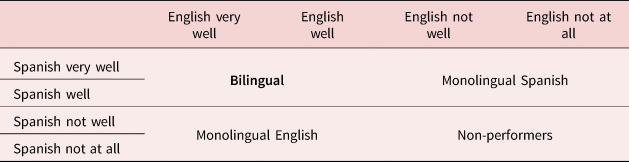
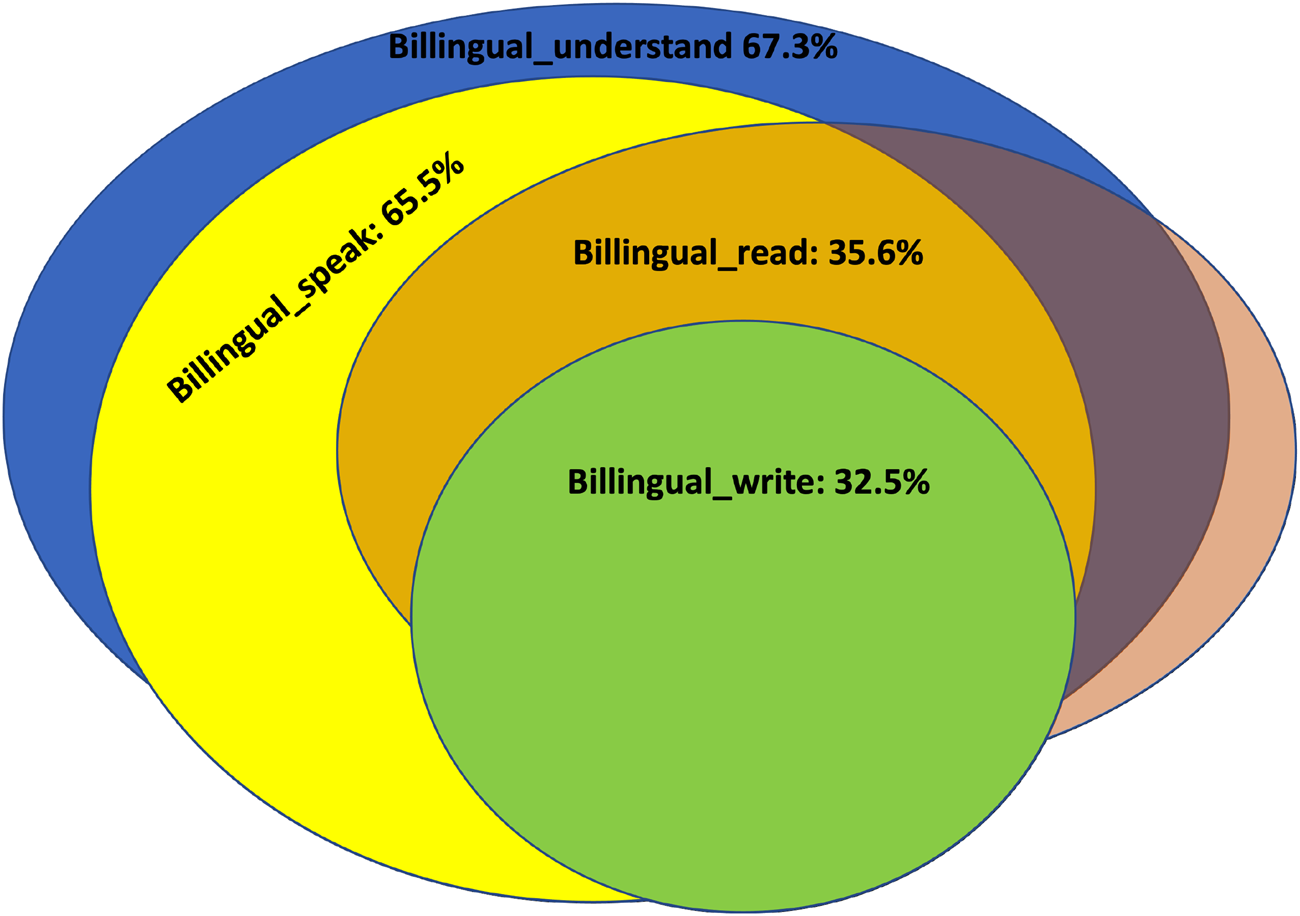
Children were also asked to assess their Spanish and English proficiency along four dimensions (understanding, speaking, reading, and writing) on the following scale: very well, well, not well, or not at all. Table 1 displays all possible combinations of language skills. We define bilingual children as those who report to perform in both English and Spanish either well or very well. We define as monolingual Spanish (English) individuals who report to only perform well or very well in Spanish (English). Non-performers are those who neither know English nor Spanish well. They make up less than 1% (12%) of the sample in case of understanding and speaking (reading and writing). While in general there are fewer individuals who read and write both languages compared to understanding and speaking, Figure 1 shows that the four different definitions of bilingualism are not perfect subsets of one another. For certain robustness checks we also use data by US state for 2003 on median household income by state (in current US$) and per student expenditure on public education from the US Census and the US Department of Education, National Center for Education Statistics respectively. We assign these data to parents’ current state of residence.Footnote 8
Combinations of language skills and bilingualism

Four different definitions of bilingualism.
Source: NIS data; sample used in this paper N = 652.

Our sample is composed of all children of Spanish-speaking immigrants aged 6–12 who provide information on how well they understand, speak, read, and write English or Spanish, whose language of the test was randomly assigned, and for whom we know their WJ test scores, their correct digits, and for whom we have information on parental characteristics.Footnote 9 This leaves us with 652 children.
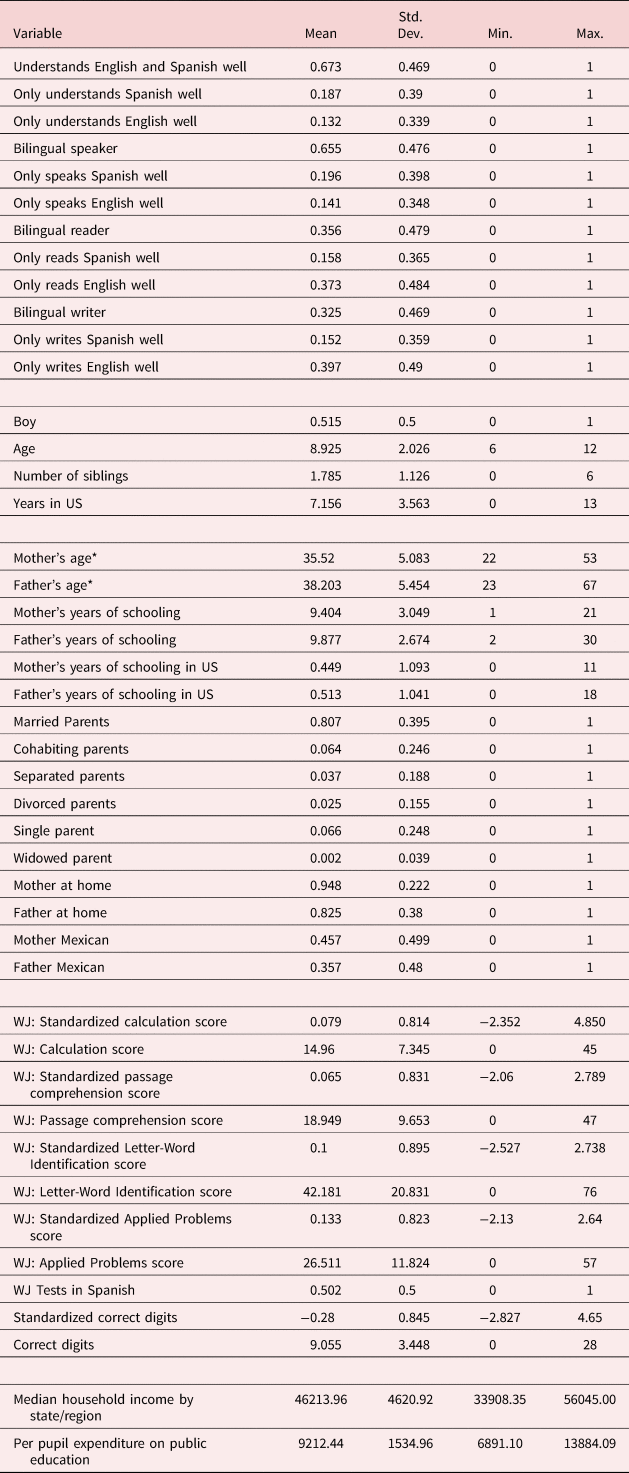
Table 2 displays the characteristics of children and their parents in our sample. Between 33% and 67% of children in our sample are bilingual and between 15% and 18% are monolingual in Spanish, depending on the language dimension used. Around half of them are boys, and they are on average nine years old. Most have been living for approximately seven years in the US. Regarding parental variables, on average mothers and fathers are around 36 and 38 years old, respectively. Mothers and fathers in our sample have received less than 10 years of education on average, and most have acquired their education outside of the US. In total, 86% of parents are married or cohabiting, while around 6–7% are single parents or separated or divorced. In total, 95% of children live with their mother and around 83% with their father.Footnote 10 Parents of children in our sample are migrants from 10 different countries, but the majority has arrived from Mexico: 46% in the case of mothers and 36% in the case of fathers.Footnote 11 Regarding test scores, children perform best on letter-word identification which is tailored to younger children, applied problems, passage comprehension, and last calculation tests. However, the ranking changes when we standardize test scores by age. Half of the children in our sample were randomly assigned tests in Spanish.Footnote 12
Descriptive statistics

Notes: NIS data: This table presents averages and standard deviations for the sample used in the estimation. The number of observations is 652. *Data for mothers’ and fathers’ age (year of birth) are missing for 6.4% and 18.9% of our observations. We replace missing values with mean values by children's ages and include dummy variables indicating missings in our regressions. Data for Median Household income and per public expenditure on education from the US Census and the US Department of Education respectively; for regional data, state data have been weighted by population size of 2003 also from the US Census.
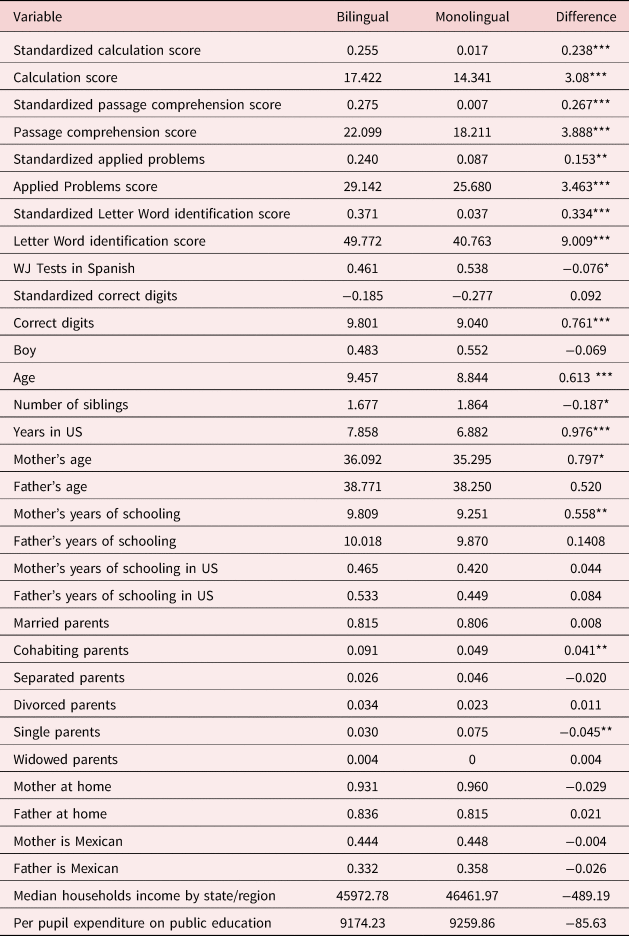
Table 3 presents differences between bilingual and monolingual readers in terms of observable characteristics. In line with our main findings, bilingual readers perform significantly better on calculation tests as well as on repeating digits back- and forward; the latter only when not standardized by age. On average, they also perform better on the other three Woodcock–Johnson tests, although this does not hold in our controlled regression analysis. Regarding individual characteristics, bilingual readers are a little older and have lived in the US for longer and have fewer siblings. Their mothers are somewhat older and more educated. Parents of bilingual readers are more likely to be cohabiting and less likely to be single parents. On the other hand, monolingual children are slightly more likely to have taken the test in Spanish compared to bilingual children. We do not observe any differences regarding median household income or public expenditure on education by state of residence.Footnote 13
Differences between bilingual and monolingual readers

Notes: This table presents the average observable characteristics of monolingual and bilingual readers who are part of the sample used in the estimation, separately. Here we have excluded non-performers from the sample (11.4%). The last column includes the differences between the two values. ***p < 0.01, **p < 0.05, *p < 0.1.
3. Methodology
We estimate the difference in test scores between bilingual and monolingual children controlling for English and Spanish language proficiency and demographic characteristics of children and their parents as follows:

where C i is the test score standardized by age of child i, and B i is a dummy variable that takes on value one if the child is bilingual. D(L)i are indicator variables for language proficiency other than bilingualism; i.e. Spanish monolinguals and non-performers. Our reference group are English monolingual children. T i controls for the language of the test, taking on value one if the test was administered in Spanish. We also control for the interaction of language proficiency (or being bilingual) and the language of the test. Note that the calculation test is understood to be language-free, and hence for our main specification we do not expect coefficients on the test language to be significant. Our controls allow us to separately identify the effect of being more proficient in any language and of speaking two languages. This way we can be sure that our effect of bilingualism is not driven by the fact that those who speak two languages just happen to be more fluent in English or Spanish. In some of our specifications we also control for children's innate ability, including D i, the standardized correctly repeated digits. Finally, X i is a vector of children's characteristics (boy, age dummies, number of siblings, time in the US dummies, and the interaction of age and time in the US dummies), parental characteristics (age, years of schooling, years of schooling in the US, marital status, and country of birth dummies). The vector also includes dummies for US state/region of residence.
Note that our coefficient of interest β 1 may be affected by the presence of certain unobservable characteristics which could lead to different cognitive abilities of bilingual individuals but which should not be attributed to bilingualism per se. For instance, bilingual individuals may be those living in neighborhoods or attending schools which are less segregated and also richer allowing them to acquire better English skills and to receive a better education overall. To address this issue, we employ the methodology proposed by Oster (Reference Oster2019). In particular, we estimate Equation (1) in two different ways. Once, as proposed above and a second time only retaining the controls necessary for the coefficient β 1 to be meaningful. We refer to this last specification as uncontrolled (u) while our main specification is the controlled specification (c). In our uncontrolled specification, we only include test language and language proficiency controls and their interactions. Retaining the estimated coefficients of interest β 1u and β 1c as well as the R 2 from both estimations ($R_{u}^{2}$ and $R_{c}^{2}$
 ) allows us to compute the following statistic:

The value of δ indicates how many times larger selection on unobservables would have to be compared to selection on observables in order to fully explain away the estimated coefficient.Footnote 14
4. Results
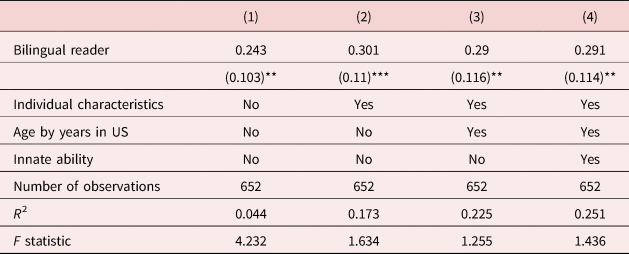
Table 4 shows the results from estimating equation (1). Column (1) displays our benchmark uncontrolled specification which regresses the standardized calculation test score on a bilingual dummy, dummies for language proficiency and a dummy variable for test language as well as its interactions with all language proficiency controls. In column 2, we add children's and parental characteristics including child's years in the US and age, as well as state/region of residence fixed effects. Column 3 includes dummies for each combination of child's years in the US and age and finally, column 4 presents results from our preferred specification that also controls for innate ability using children's standardized correctly repeated digits. Results indicate that bilingual readers perform significantly better on calculation tests than monolinguals. The magnitude of these differences lies between one-fourth and one-third of a standard deviation. According to Woessmann (Reference Woessmann2016), this is equal to average learning gains over one school year.
Difference in standardized calculation test scores between bilingual and monolingual children

Notes: Data are from the NIS 2003 and refer to children of Spanish-speaking immigrants ages 6–12. Coefficients are the result of estimating equation (1) by OLS. All columns control for language proficiency, test language, and the last two variables interacted. The dependent variable is the standardized calculation test score. Individual characteristics refer to age, years in US, gender, number of siblings, parental age, education, marital status, country of origin, and US state/region of residence. Innate ability refers to the age-standardized sum of correctly repeated digits. ***p < 0.01, ** p < 0.05, *p < 0.1.
Using results from columns (1) and (4) we calculate parameter δ to be equal to 3.5. This indicates that for the coefficient 0.29 to be explained entirely by selection on unobservables, such selection would need to be more than 3 times larger than the selection on the observables that were added between columns (1) and (4). According to Oster (Reference Oster2019), values above one for δ indicate that unobservable characteristics do not explain the estimated differences.
Table A.4 in the Appendix displays the full estimation results. Apart from being bilingual, mother's years of education, parents being divorced, and higher ability measured by correctly repeated digits also display a significant and positive coefficient. The first result is in line with a large body of literature finding mother's education to matter more for children's academic achievements, see e.g. Rosenzweig Wolpin (Reference Rosenzweig and Wolpin1994); Carneiro et al. (Reference Carneiro, Meghir and Parey2013). On the other hand, the result on divorce seems to stand in contrast to existing evidence on a negative effect on educational attainment for children of parental separations or in non-traditional families (see e.g. Garasky, Reference Garasky1995; Astone McLanahan, Reference Astone and McLanahan1991; Haveman Wolfe, Reference Haveman and Wolfe1995 for a review of the literature). Finally regarding innate ability as measured by individuals’ sum of correctly repeated digits, there might be some concern that it could be a bad control. The fact that the estimated coefficients hardly differ across columns (4) and (3) which does not include the ability control is reassuring. When we re-calculate Oster's δ using column (3) as our main specification instead, we obtain a similar but somewhat smaller value for δ of 2.7.
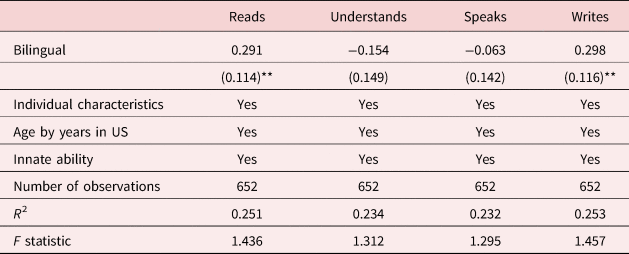
We repeat our estimation of column (4) using the three remaining definitions of bilingualism (understanding, speaking, and writing in both languages), see Table 5. We find a similar cognitive advantage among bilingual writers but no significant difference in cognitive test scores for bilinguals defined in terms of understanding or speaking both languages.Footnote 15
Different dimensions of bilingualism and cognitive advantage

Notes: Data are from the NIS 2003 and refer to children of Spanish-speaking immigrants ages 6–12. Coefficients are the result of estimating equation (1) by OLS. All columns control for years in US, age of the child, language proficiency, test language, and the last two variables interacted. The dependent variable is the standardized calculation test score. Individual characteristics refer to age, years in US, gender, number of siblings, parental age, education, marital status, country of origin, and US state/region of residence. Innate ability refers to the age-standardized sum of correctly repeated digits. *** p < 0.01, **p < 0.05, *p < 0.1.
4.1. Robustness
One important unobservable in our estimation is neighborhood and school quality. While we would ideally control for it, we only know about parental state of residence (and in some cases only US division of residence). Nevertheless, we consider data on median household income and per pupil spending on public education by these geographical areas (measured in 2003, the year the survey was conducted), and we re-run Table 4 using these controls instead of state/region dummies. Results in Table A.8 in the Appendix show that our main coefficients for bilingual reader remain fairly robust.
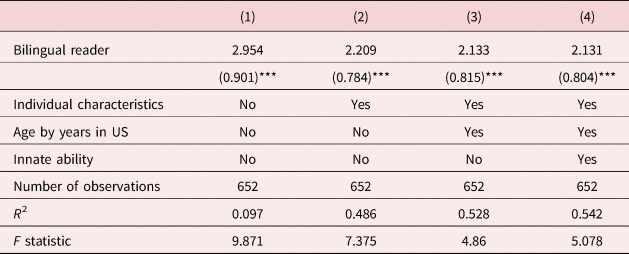
Note that for ease of interpretation in our benchmark estimation we used the standardized calculation test score as our outcome variable. However, one caveat of this measure is that it has been constructed by age using sample instead of unknown population averages and standard deviations. Hence we test the robustness of our results by using raw test scores. Results in Table 6 are very much in line with those from our main specification. Considering that the standard deviation of the raw calculation test score is 7.3 implies that the estimated coefficients are equal to 0.29 a standard deviation and thus identical to our benchmark results. The same holds true when using our alternative definitions of bilingualism, see Table A.9 in the Appendix.
Difference in raw calculation test scores between bilinguals and monolinguals

Notes: Data are from the NIS 2003 and refer to children of Spanish-speaking immigrants ages 6–12. Coefficients are the result of estimating equation (1) by OLS. All columns control for language proficiency, test language, and the last two interacted. The dependent variable is the raw calculation test score. Individual characteristics refer to age, years in US, gender, number of siblings, parental age, education, marital status, country of origin. Innate ability refers to the raw sum of correctly repeated digits. ***p < 0.01, **p < 0.05, *p < 0.1.
To check that our results do not hinge on the particular functional form imposed by our linear regression we also run a logit model with the outcome variable defined as scoring above the mean of one's age group. Table A.10 in the Appendix displays the results. The bilingual advantage among those who understand and speak both languages remains non-existent, among bilingual writers it remains positive and significant while for bilingual readers the sign of the coefficient remains positive but we loose significance, probably due to the reduced sample size caused by perfectly predicted observations being dropped.
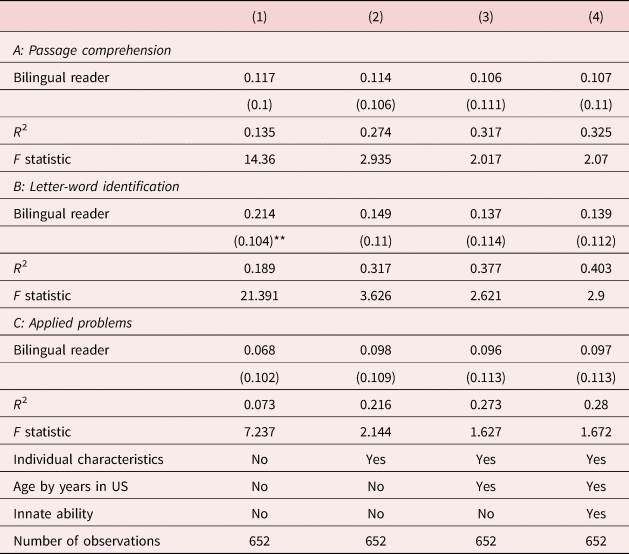
Finally, as a type of falsification test, we also check how bilingual children perform on the other three Woodcock–Johnson tests which were administered in this survey and which are not language-free: passage comprehension, applied problems, and letter-word identification. Here, we do not expect bilingual children to perform better, because controlling for language of the test, if anything, their language skills are more likely to be lower. Table 7 shows that there are no statistically significant differences between bilingual and monolingual children regarding performance on neither one of those tests; independently of which language dimension is used to define bilingualism (see Table A.11 in the Appendix).
Falsification: difference in scores on language-dependent tests between bilingual and monolingual readers

Notes: Data are from the NIS 2003 and refer to children of Spanish-speaking immigrants ages 6–12. Coefficients are the result of estimating equation (1) by OLS. All columns control for language proficiency, test language, and the last two interacted. The dependent variable in panel A is the standardized passage comprehension test score, in panel B the standardized score on the letter-word identification test, and in panel C the standardized score on applied problems. Innate ability refers to the standardized sum of correctly repeated digits. ***p < 0.01, **p < 0.05, *p < 0.1.
4.2. Heterogeneity
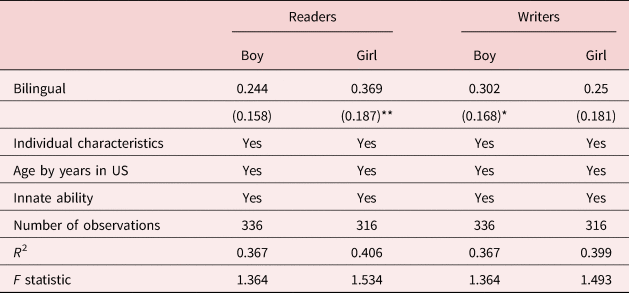
Literature has highlighted important gender differences in the performance on math or calculation test scores (e.g. OECD, 2019, Guiso et al., Reference Guiso, Monte, Sapienza and Zingales2010; Brindusa et al., Reference Brindusa, Rodrìguez-Planas and Sanz-de-Galdeano2010), as well as regarding the influence of external factors on cognitive development (Rosselli et al., Reference Rosselli, Ardila, Matute and Inozemtseva2009). We hence further explore our results by performing separate regressions for boys and girls. While results in Table 8 show certain gender differences, they are inconclusive. The bilingual advantage among readers is particularly strong and only significant among girls, while among writers the bilingual advantage is only significant and slightly larger for boys. In our sample, similar to most studies, girls are more likely to be bilingual. However, this difference is only significant for the dimensions of speaking and writing. In particular, girls are 9 percentage points more likely to be bilingual writers. Hence, boys who are bilingual writers could simply be more positively selected.
Heterogeneity: bilingualism and cognitive advantage by gender

Notes: Data are from the NIS 2003 and refer to children of Spanish-speaking immigrants ages 6–12. Coefficients are the result of estimating equation (1) by OLS separately for boys and girls. All columns control for years in US, age of the child, language proficiency, test language, and the last two interacted. The dependent variable is the standardized calculation test score. Innate ability refers to the age-standardized sum of correctly repeated digits. ***p < 0.01, **p < 0.05, * p < 0.1.
We also test for differences in the bilingual advantage by parental education, which has been shown to be closely linked to children's educational outcomes (see e.g. Hertz et al., Reference Hertz, Jayasundera, Piraino, Selcuk, Smith and Verashchagina2011).Footnote 16 In our sample, parental education is relatively low, and hence we split the sample into children who have or not at least one parent with more than 10 years of education. Table A.13 in the Appendix displays the results. When bilingualism is defined in terms of reading, we only estimate a significant bilingual advantage for children of low educated parents. However, this result is not robust to defining bilingualism along individuals’ writing abilities in English and Spanish. In this case, we find significant effects for both, children with high and low educated parents, although the estimated coefficient is slightly larger for the former. Looking at descriptive statistics we observe that children of high educated parents perform significantly better on all tests (when scores are standardized by age), and while they are as likely as children of low educated parents to be bilingual in terms of understanding or speaking, they are 10 percentage points more likely to be bilingual readers and writers. Hence, this suggests that bilingual writers and readers of lower educated parents might be more selected.
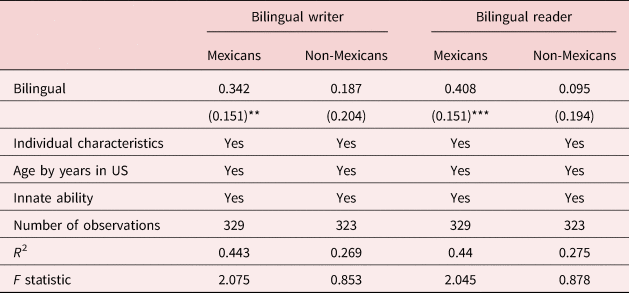
Given that 50% of children in our sample have at least one Mexican parent, we explore whether there are differences in the bilingual advantage between these children and those with parents from other Latin-American countries. In our sample, children with parents from Mexico are more likely to be bilingual speakers compared to those whose parents are not Mexicans. However, there are no statistical differences along the other three language dimensions, see Table A.12 in the Appendix. Results in Table 9 show that the bilingual advantage seems to be particularly strong for children with parents from Mexico.
Bilingualism and cognitive advantage by parental country of origin

Notes: Data are from the NIS 2003 and refer to children of Spanish-speaking immigrants ages 6–12. Coefficients are the result of estimating equation (1) by OLS separately for children with at least one Mexican parent. All columns control for years in US, age of the child, language proficiency, test language, and the last two interacted. The dependent variable is the standardized calculation test score. Innate ability refers to the age-standardized sum of correctly repeated digits. ***p < 0.01, **p < 0.05, *p < 0.1.
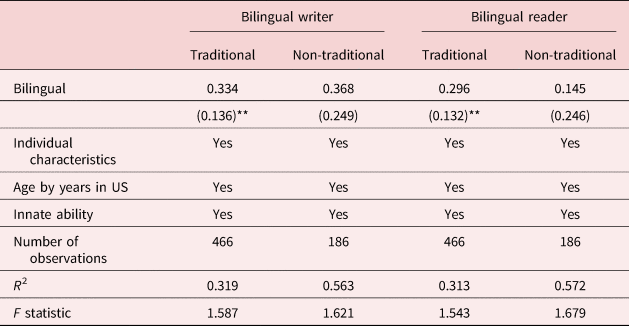
Children with Mexican parents have more siblings, they have younger and less educated parents who are more likely to be married and to be living at home and who are less likely to be single. More traditional household structures by Mexican parents could have a positive effect on children's cognitive skills, but also more household members could imply more communication on average. The former notion is in line with findings in literature on the before-mentioned negative effect on educational attainment for children in non-traditional families. To test for this idea we split our sample into children with parents who are married, living together, and have at least two children. Table 10 displays the results. The bilingual advantage is particularly strong and significant for children in traditional families.Footnote 17
Bilingualism and cognitive advantage by family type

Notes: Data are from the NIS 2003 and refer to children of Spanish-speaking immigrants ages 6–12. Coefficients are the result of estimating equation (1) by OLS separately for children in traditional and non-traditional families, where traditional families are defined as households with married parents, living together, and at least two children. All columns control for years in US, age of the child, language proficiency, test language, and the last two interacted. The dependent variable is the standardized calculation test score. Innate ability refers to the age-standardized sum of correctly repeated digits. ***p < 0.01, **p < 0.05, *p < 0.1.
Another possible explanation for our result of a particularly strong bilingual advantage for children of Mexican parents could be linked to the fact that around the time of the NIS survey individuals from Mexico were least likely to report to be proficient in English among Hispanics in the US (PEW Hispanic Center, 2007). Hence, similar to Golash-Boza (Reference Golash-Boza2005), our findings would indicate a stronger bilingual advantage in communities with low levels of English proficiency.
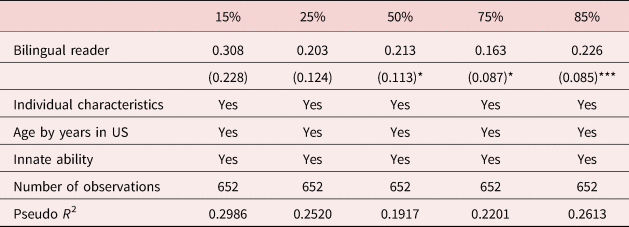
Finally, we run quantile regressions to see if the bilingual advantage changes along children's ability distribution. Results in Table 11 show that the bilingual advantage is larger and only significant for children at the upper end of the ability distribution. In particular, while the coefficient for being bilingual at the lower end of the ability distribution is largest, we only estimate significant coefficients for those at the 50th, 75th, and 85th percentile. When defining bilingualism in terms of writing, we already estimate significant coefficient for those at the 25th percentile, see Table A.15 in the Appendix. Null results for a bilingual advantage among those who report to only understand or speak both languages also hold along the entire ability distribution.
The bilingual advantage: heterogeneity by ability

Notes: Data are from the NIS 2003 and refer to children of Spanish-speaking immigrants ages 6–12. Coefficients are the result of estimating equation (1) by quantile regressions. The dependent variable is the standardized reading test score. All columns control for years in US, language proficiency, test language, and age of the child. Innate ability refers to the age-standardized sum of correctly repeated digits. *** p < 0.01, **p < 0.05, *p < 0.1.
5. Conclusion
Our findings provide support for the existence of a cognitive advantage among Latino migrant children in the US who are bilingual readers or writers but not among those who only speak or understand both languages. We show that the better performance by bilingual readers or writers on cognitive tests, independently of any particular language, is not explained by observables and highly unlikely to be driven by unobserved factors. In particular, for children with parents from Mexico, for those in two-parent households with siblings, and for those at the upper end of the ability distribution, being a bilingual writer or reader is associated with improved cognitive skills.
For potential mechanisms behind the bilingual advantage one typically turns to findings from other disciplines. Neuroscience argues that bilingualism alters the functional involvement of certain brain areas in the performance of tasks (see e.g. Garbin et al., Reference Garbin, Sanjuan, Forn, Bustamante, Rodríguez-Pujadas, Belloch, Hernández, Costa and César2010; Rodríguez-Pujadas et al., Reference Rodríguez-Pujadas, Sanjuán, Ventura-Campos, Román, Martin, Barceló, Costa and César2013). Some studies in sociology sustain that bilingual children have access to positive “cultural capital” in their families and ethnic communities (see e.g. Rumberger Larson, Reference Rumberger and Larson1998), potentially improving academic performance. Others highlight the importance of speaking the same language as one's family, and how this may enhance the parent–child relationship, which in turn, could have positive implications for children's motivation to succeed academically (e.g. Fuligni, Reference Fuligni1997 or Tseng Fuligni, Reference Tseng and Fuligni2000). Our findings provide some suggestive evidence regarding potential mechanisms. The fact that the bilingual advantage is only present among those who read or write both languages but nonexistent among bilingual speakers or those who report to understand English and Spanish, suggests that merely picking up a second language is not enough. In particular, a cognitive advantage might only arise from the additional effort by children, parents, schools, or teachers required to read and write well or very well in two languages.Footnote 18
Unfortunately, our data are not rich enough to further investigate this idea. However, our results suggest that additional efforts to teach migrant children to read and write in their native languages are advisable, and that in particular children in two-parent households with siblings and those at the upper end of the ability distribution could benefit the most from it.Footnote 19
Supplementary material
The supplementary material for this article can be found at https://doi.org/10.1017/dem.2025.3
Acknowledgements
The authors are grateful for suggestions made by Daniela del Boca, Vicente Cuñat, Chris Flinn, Libertad González, Giovanni Mastrobuoni, Mario Pagliero, Barbara Petrongolo, Aleksey Tetenov, and two anonymous referees. We thank seminar participants at the WOLFE workshop at York, the CHILD internal seminar, the SAEe Bilbao, and the Alp Pop conference at La Thuile. Zoë Kuehn acknowledges financial support from Ministerio de Ciencia e Innovación (PID2020-112739GA-I00, PID2023-149412NB-I00).
Competing interests
None.