More than half (57%) of nursing home residents are colonized with multidrug-resistant organisms (MDROs).Reference Mody, Foxman and Bradley 1 Methicillin-resistant Staphylococcus aureus (MRSA), vancomycin-resistant enterococci (VRE), and multidrug-resistant Gram-negative bacteria (RGNB) are among the most common MDROs in nursing facilities.Reference Mody, Foxman and Bradley 1 , Reference Cassone and Mody 2 Between 11% and 59% of nursing home residents are colonized with RGNB.Reference Mody, Foxman and Bradley 1 , Reference Aliyu, Smaldone and Larson 3 Furthermore, these bacteria have been shown to spread from patient-to-patient by healthcare personnel (HCP).Reference Harris, Perencevich and Johnson 4 – Reference Harris, Kotetishvili and Shurland 6
Contact precautions are used for MDRO-colonized patients in acute-care hospitals, while in nursing homes only standard precautions are used.Reference Smith, Bennett and Bradley 7 – Reference Roghmann, Johnson and Sorkin 9 Few evidence-based guidelines describe best practices for the prevention of the transmission of MDROs in nursing homes.
Our group recently reported that transmission of RGNB from colonized residents to HCP gloves and gowns occurs during specific high-risk care activities in Veterans Affairs (VA) nursing homes.Reference Blanco, Pineles and Lydecker 10 However, most nursing homes in the United States are not part of the VA system and are known as community nursing facilities. In contrast to VA nursing homes, residents living here are older and more likely to be women. They are less likely to be affiliated with acute-care hospitals responsible for the nursing homes’ infection prevention program.Reference Mody, Greene and Saint 11 Therefore, it is important to determine whether the same risk factors are also observed in this related but different population.
In this study, we examined care-specific transmission of RGNB to HCP gowns and gloves in community nursing homes. In addition, we aimed to identify resident characteristics associated with transmission of RGNB.
Methods
Study design and study population
We present data collected as part of a multicenter, prospective, observational study reporting the frequency of, and risk factors for, the contamination of HCP gloves and gowns when providing care to residents of community nursing homes. We previously reported data describing MRSA transmission in this population.Reference Roghmann, Johnson and Sorkin 9 This report describes transmission of RGNB in the same cohort. The institutional review boards of the University of Maryland and the University of Michigan approved this protocol.Reference Roghmann, Johnson and Sorkin 9
Residents from 13 non-VA community-based nursing facilities in Maryland (n=10) and Michigan (n=3) were approached for enrollment.Reference Roghmann, Johnson and Sorkin 9 Eligible residents were enrolled with written informed consent from them (84%) or their legally authorized representative (16%). HCP were enrolled with verbal consent.Reference Roghmann, Johnson and Sorkin 9
Data collection
A research coordinator recorded demographic and clinical characteristics from enrolled residents, including the activities of daily living (ADL) score. The ADL score includes bed mobility, transfer, toilet use and eating. A total ADL score ranges between 0 and 16. A score of 0 represents an independent resident, in contrast to a score of 16, which represents a totally dependent resident. 12 A perianal swab was collected only once from each participating resident at enrollment. As part of the study, we asked HCP to wear gowns and gloves during usual care activities. The research coordinator observed and recorded the types of care delivered during each interaction (which may have included 1 or >1 type of care). When each HCP was finished with care activities, the coordinator swabbed the gloves and gown in a standardized manner before they were removed completely, and the HCP interacted with a different resident. A single set of gloves and gown was worn during each interaction.Reference Roghmann, Johnson and Sorkin 9
Laboratory analysis
Residents’ perianal swabs and HCP gown and gloves swabs were enriched by inoculating 100 µL E-swab liquid into 5 mL BHI broth and incubated 24 hours at 35–37°C in ambient air. This solution was later cultured on each of the following plates: MacConkey agar supplemented with 1 µg/mL ciprofloxacin; MacConkey agar supplemented with 1 µg/mL ceftazidime; and MacConkey agar supplemented with 1 µg/mL imipenem. Plates were streaked for isolation and incubated aerobically at 37°C for 24 hours. Identification was confirmed using VITEK II system (BioMérieux, Hazelwood, MO). The Kirby-Bauer test was used to confirm each organism’s susceptibility to antibiotics. Organisms were categorized as susceptible, intermediate, or resistant based on the Clinical Laboratory Standards Institute’s (CLSI) breakpoints. 13
Study definitions
The RGNB were defined as any pathogenic gram-negative bacteria categorized as intermediate or resistant based on the Kirby-Bauer test for at least 1 of the following antibiotics: ciprofloxacin, ceftazidime, or imipenem. 13 Residents were considered colonized with RGNB if their perianal culture was positive for at least 1 RGNB. Transmission to gowns and/or gloves with RGNB occurred when at least 1 strain isolated from the HCP gown or gloves matched the genus, species, and antibiotic resistance pattern of the strain isolated from the respective RGNB-colonized resident.Reference Blanco, Pineles and Lydecker 10
Statistical analysis
Resident characteristics were described using proportions for categorical variables and median and range (minimum–maximum) for continuous variables. The overall crude transmission rate was estimated as the number of HCP interactions that led to RGNB transmission over the total number of HCP interactions. Overall transmission rate to HCP (1) gown or gloves, (2) gloves only, and (3) gown only were estimated. Additionally, the crude rate of transmission by type of care was estimated as the total number of HCP interactions that led to transmission during a particular type of care over the total number of HCP interactions of this particular type of care. Logistic regression, using generalized estimating equations (GEEs)Reference Liang and Zeger 14 to account for the correlation of repeated measures within resident, was used to estimate the odds ratio (OR) associated with each type of care and resident characteristics. The OR, for example, gives the odds of RGNB transmission to the HCP gloves or gown when a resident receives a particular type of care divided by the odds of RGNB transmission when the resident receives care other than the particular type of care being examined. Types of care or resident characteristics with an OR >1.0 and P<.05 for a specific type of care were considered high risk. Additionally, types of care or resident characteristics with strong ORs above 2.5, even if not statistically significant, were considered high risk.
Results
Resident characteristics
A perianal swab was collected from 399 of the 403 enrolled residents (99%). Among the 399 residents, 221 residents were enrolled in Maryland and 178 in Michigan. No significant difference in median age or gender was observed between both states.
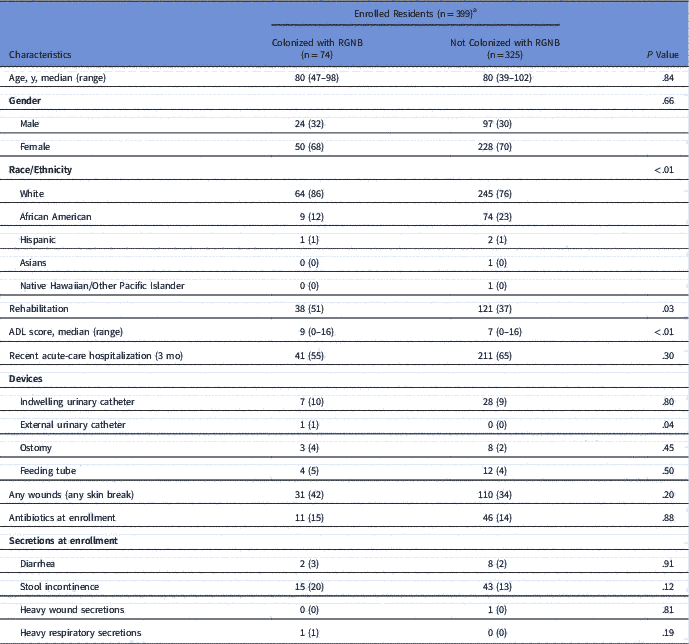
Among 399 residents, 74 (19%) were colonized with at least 1 RGNB on their perianal skin at enrollment (Table 1). Colonized residents were more likely to be receiving rehabilitation care than noncolonized residents (51% vs 37%; P=.03). Colonized residents also had a higher median ADL score than noncolonized residents (9 vs 7; P<.01).
Demographic and Clinical Characteristics of Enrolled Residents of Community Nursing Facilities by Colonization Status as Detected on a Perianal Swab

Note. RGNB, resistant Gram-negative bacteria, No. (%)/median (minimum–maximum).
a Enrolled residents with a perianal swab collected.
Microbiological characteristics
In total, 110 RGNB were isolated from the residents’ perianal swabs. Of these, 92 (84%) belonged to the Enterobacteriaceae family, 13 (12%) were Pseudomonas aeruginosa, and 5 (4%) were Acinetobacter baumannii. Among the 92 isolates from Enterobacteriaceae family, 80 (87%) were resistant to ciprofloxacin, 21 (23%) were resistant to ceftazidime, and 28 (30%) were resistant to imipenem. Among the 13 P. aeruginosa isolates, all were resistant to ciprofloxacin, 3 (23%) were resistant to ceftazidime, and 7 (55%) were resistant to imipenem.
Among the A. baumannii isolates (n=5), all were resistant to ciprofloxacin, 4 (80%) were resistant to ceftazidime, and 3 (60%) were resistant to imipenem. Similarly, among these 110 resistant isolates, 67 isolates (61%) were resistant to only 1 of the analyzed antibiotics, while 39% were resistant to 2 or more antibiotics.
Gown and glove transmission with RGNB by type of care
We observed a median of 7 interactions (interquartile range, 6–9) per RGNB colonized resident. Overall, either gowns or gloves were contaminated with RGNB during 11% of 584 interactions with RGNB colonized residents. Gloves were contaminated during 9% of 581 interactions (3 interactions were missing a glove specimen), and gowns were contaminated during 3% of 584 interactions. In addition, 73% of the interactions had only 1 type of care during the interaction; 11% had 2 types of care; 6% had 3 types of care, and 10% had 4 or more types of care. The risk of RGNB transmission to gloves or gowns by type of care did not differ significantly when the type of care occurred alone or in conjunction with other types of care (data not shown).
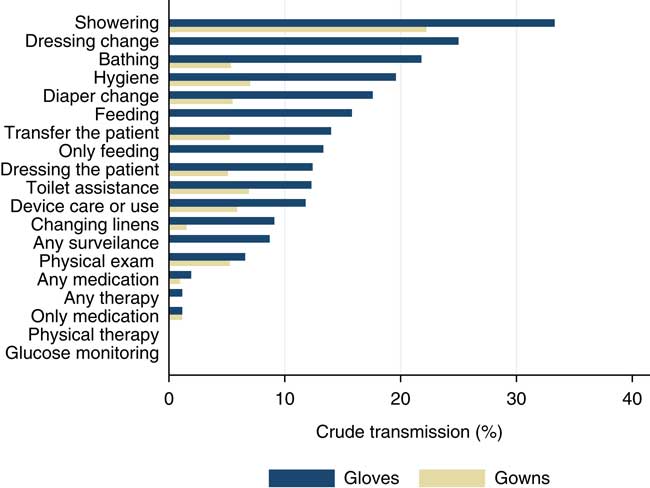
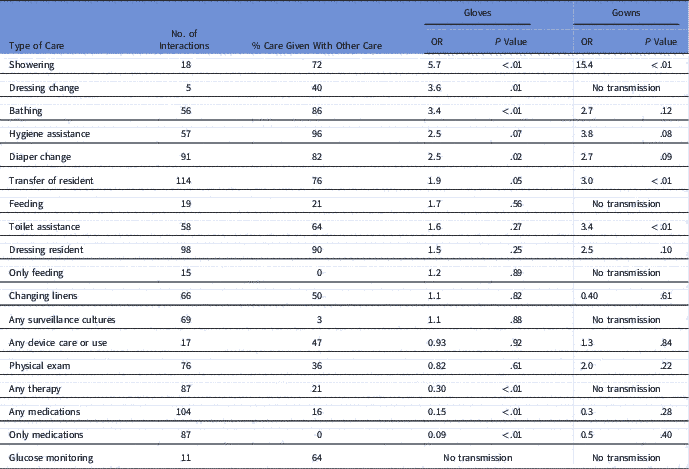
RGNB transmission from colonized residents to HCP varied by type of care activity from 0% to 22% for gowns and from 0% to 33% for gloves (Fig. 1). We identified showering, wound dressing change, diaper change, hygiene assistance (brushing teeth, combing hair), bathing, dressing, and transferring the resident as high-risk activities for glove contamination (Table 2). Providing physical or occupational therapy, only giving medications, and glucose monitoring were considered low-risk activities for glove contamination (OR<1.0; P<.05; or no transmission observed). Showering, diaper change, toilet and hygiene assistance, bathing, dressing, and transferring the resident were identified as high-risk activities for gown contamination. Glucose monitoring, giving medications, and feeding were also identified as low-risk activities for gown contamination because no transmissions occurred during these interactions (Table 2).
Crude transmission risk of antibiotic-resistant Gram-negative bacteria to healthcare personnel (HCP) gloves and gowns during care interactions with resistant Gram-negative bacteria colonized residents of community nursing homes. The Y-axis details the different types of care that were identified and analyzed. The X-axis represents the percent of crude transmission detected. The blue bars represent transmission to gloves and the beige bars represent transmission to gowns.

Odds Ratio a of Transmission of RGNB to Healthcare Personnel’s Gowns or Gloves by Type of Care Given to R-GNB–Colonized Residents in Community Nursing Homes

Note. RGNB, resistant Gram-negative bacteria.
a Odds of transmission divided by odds of transmission if that type of care was not given, calculated using generalized estimating equations to account for the correlation of repeated measurements obtained from a given resident.
Additionally, a random sample of 26 residents who were not colonized by RGNB in the perianal culture (183 interactions) were also analyzed. Of the 183 HCP interactions, 23 glove swabs (13%) and 16 gown swabs (9%) were RGNB positive. Of the 26 noncolonized residents, 15 (58%) had HCP interactions positive for RGNB.
Resident characteristics that increase gown and glove transmission with RGNB
We also examined whether certain resident characteristics changed the risk of RGNB transmission. Having diarrhea was uncommon (3%) in this population, so we focused on stool incontinence (15%). No strong association between stool incontinence and transmission of RGNB was observed. Although heavy wound secretions were rare (<1%), 23% of the enrolled population had a pressure ulcer. Among colonized residents, those with a pressure ulcer were 3 times more likely to transmit RGNB to HCP gowns than those residents without a pressure ulcer (OR, 3.3; 95% CI, 1.0–11.1). A weaker association was observed for transmission to gloves (OR, 1.6; 95% CI, 0.7–3.8). High-risk types of care were also identified among residents with an unhealed pressure ulcer. Among this subpopulation, showering (OR, 14.0; P=.01), hygiene assistance (OR, 8.4; P=.03), transferring the resident (OR, 2.5; P=.01), diaper change (OR, 2.9; P=.08), and dressing (OR, 2.6; P=.09) were associated with higher RGNB transmission to HCP gowns.
Having an ostomy bag also had a strong association with transmission to HCP gowns (OR, 5.4; 95% CI, 1.8–16.1); however, this finding was driven by HCP interactions with a single nursing home resident with other risk factors (ie, hemiplegia, currently on antibiotics, feeding tube).
Due to the selective pressure of antibiotics on MDRO colonization,Reference Donskey 15 we analyzed the association between the resident’s antibiotic use and RGNB transmission risk. Overall, 15% of our colonized population was receiving systemic antibiotics at the time of enrollment. The residents received fluoroquinolones, cephalosporins, tetracyclines, sulfamethoxazole trimethoprim, amoxicillin, or glycopeptides. Residents using systemic antibiotics at enrollment did not have a significantly higher odds of gown or glove contamination than residents not on antibiotics at enrollment (OR, 1.5; P=.57 vs OR, 1.3; P=.66, respectively).
Discussion
Overall, 11% of the HCP interactions with an RGNB-colonized resident resulted in the transmission of RGNB to HCP glove or gowns in community nursing homes. Showering, bathing, and dressing the resident, as well as diaper change, providing hygiene, and transferring the resident were identified as high-risk types of care for HCP gown and glove contamination. Glucose monitoring and assistance with medications were also identified as low-risk activities. Having an unhealed pressure ulcer increased the risk of RGNB transmission from the resident to the HCP.
The observed high-risk and low-risk types of care were consistent with previously published results by our group about RGNB transmission to HCP’s gowns and gloves from RGNB colonized residents in VA nursing homes.Reference Blanco, Pineles and Lydecker 10 These findings were also consistent with the high-risk and low-risk types of care associated with MRSA transmission in this same population.Reference Roghmann, Johnson and Sorkin 9
Pressure ulcers have been shown to be reservoirs of multidrug-resistant gram-negative bacteria.Reference Braga, Brito, Filho, Filho and Ribas 16 , Reference Flattau, Schiffman, Lowy and Brem 17 Braga et alReference Braga, Brito, Filho, Filho and Ribas 16 isolated 72 gram-negative isolates from infected or colonized pressure ulcers of 60 different patients. Also, 7% of the isolates were resistant to fluoroquinolones, 76% were resistant to cephalosporins, 14% were resistant to carbapenems, and 40% were multidrug resistant.Reference Braga, Brito, Filho, Filho and Ribas 16 Furthermore, the presence of pressure ulcers has been described as a risk factor associated with RGNB colonization.Reference Tseng, Chen and Yang 18 Given this finding and the high dependency of those with pressure ulcers on HCP for care, it is not surprising that interacting with a resident with a pressure ulcer was associated with a higher risk of RGNB transmission. This finding is consistent with previously published results by our group about MRSA transmission to HCP gowns and gloves from MRSA-colonized residents in this population.Reference Roghmann, Johnson and Sorkin 9 Additionally, we observed similar high-risk activities associated with transmission of RGNB and MRSA among this subpopulation.Reference Roghmann, Johnson and Sorkin 9
Although we observed a similar risk of transmission of RGNB to gloves associated with systemic antibiotic use, we were unable to replicate the positive association between systemic antibiotic use and transmission to gowns previously described in VA community living centers.Reference Blanco, Pineles and Lydecker 10 Although both colonized populations had similar antibiotic use at enrollment, the current population received mostly broad-spectrum antibiotics, which could have impacted both gram-negative and gram-positive bacteria colonization and, as a result, their transmission to HCP gowns and gloves. Topical antibiotic use was not recorded for the current study, which could help explain this difference.
As observed in our prior studies, we detected transmission of RGNB to HCP gloves or gown from residents not detected to be colonized by RGNB in the perianal culture.Reference Roghmann, Johnson and Sorkin 9 , Reference Blanco, Pineles and Lydecker 10 , Reference Pineles, Morgan and Lydecker 19 Other potential sources of RGNB exist that could explain these findings, such as other body sites of RGNB colonization (eg, skin or wounds) or the environment.Reference Lemmen, Hafner, Zolldann, Stanzel and Lutticken 20 – Reference Thurlow, Prabaker and Lin 24 Importantly, the definition of transmission of RGNB in residents not colonized at the study baseline is less strict than among colonized residents because there is no baseline isolate to match the HCP gown and glove isolate by antibiotic resistance and specific bacteria. All nursing homes should recognize the high prevalence of RGNB in their population and environment. Colonization of RGNB in nursing home residents has been described as high as 59%,Reference Mody, Foxman and Bradley 1 , Reference Aliyu, Smaldone and Larson 3 highlighting the need for appropriate and effective guidelines for gown and glove use that protect their HCP and their other residents.
This study is limited by the fact that our outcome, transmission to HCP gowns and gloves, acts as a surrogate for RGNB transmission to other nursing home residents. We were unable to estimate how often contamination of gowns and gloves resulted in transmission to other HCP or residents.Reference Blanco, Pineles and Lydecker 10 , Reference Pineles, Morgan and Lydecker 19 We did not perform molecular typing to compare the residents’ strains with the strains isolated from gowns and gloves. In earlier studies, we observed a high concordance (up to 89%) between antibiotic resistant strains from residents and those detected on gowns and gloves.Reference Roghmann, Johnson and Sorkin 9 , Reference Morgan, Rogawski and Thom 21 Our study is strengthened by its design, a multisite prospective study, which is representative of community nursing facilities across the United States.
In contrast to other healthcare settings, nursing homes call for a balance between infection prevention and a home-like atmosphere. Nursing homes are also more limited in resources than acute-care hospitals. Therefore, evidence-based guidelines tailored to this setting are important. This study provides evidence supporting the potential benefit of a care-based or resident-specific approach to reduce the transmission of MDROs in community nursing homes.
Acknowledgments
Financial support
This project was supported by the National Institutes of Health (NIH grant no. R03AI122223). Dr Sorkin and Dr Roghmann are supported by the Baltimore Veterans Affairs (VA) Medical Center Geriatrics Research, Education, and Clinical Center, the National Institute on Aging (grant no. 5 P30 AG028747), and the National Institute of Diabetes and Digestive and Kidney Diseases (grant no. 5 P30 DK072488). Dr Mody is supported by the Ann Arbor VA Geriatrics Research, Education, and Clinical Center, National Institute on Aging (grant nos. R01 AG032298, R01 AG41780, R18 HS019979) and by the University of Michigan Claude D. Pepper Older Americans Independence Center (grant no. P30 AG024824).
Conflicts of interest
L.M. reports receiving grants from the NIH and the AHRQ during the conduct of the study. All other authors report no conflicts of interest relevant to this article.