Introduction
The nationalization of party systems entered the research agenda in the last 10 years. Books by Caramani (Reference Caramani2004) and Chhibber and Kollman (Reference Chhibber and Kollman2004) provided systematic examinations of the historic processes by which western countries (plus India in the latter case) moved towards nationalization during the last century and a half. This research has stimulated comparative analysis of the nationalization of party systems in more recent elections.Footnote 1 There appears to be agreement on the topic's relevance: as summarized by Alemán and Kellam (Reference Alemán and Kellam2008: 193), ‘comparative nationalization interests scholars because it helps to distinguish party systems from one another in ways that have implications for governability and political representation’. Party nationalization is also of paramount importance for analysing party competition from both the supply and demand sides (Kasuya and Moenius, Reference Kasuya and Moenius2008: 126). As Jones and Mainwaring (Reference Jones and Mainwaring2003: 140) have written, ‘in case of high nationalization, electoral competition follows a roughly similar pattern across the country's sub-national units. In a case of low nationalization, the parties that fare well in some sub-national units are minor electoral competitors elsewhere’.
Accordingly, parties should develop distinctive political and, in particular, electoral strategies depending on the extent to which they are nationalized – that is receiving similar vote shares across all or most districts – or not. And there are other facets of comparative research that should be considered when countries exhibit different levels of party nationalization. For instance, the validity of certain indicators, such as the effective number of parties at the national level, could be affected with low nationalization of party systems. Many comparative dimensions of politics, such as the outcomes of decentralization processes, the range of public policies, the legislative careers of representatives, the politics of coalition-making in parliamentary regimes, and even the consolidation of new democracies might have different results in high or low party-nationalized countries (Jones and Mainwaring, Reference Jones and Mainwaring2003: 143–144).
Recent literature on the nationalization of party systems has focused upon the measurement of the phenomenon; with some exceptions (see Cox and Knoll, Reference Cox and Knoll2003; Caramani, Reference Caramani2004; Chhibber and Kollman, Reference Chhibber and Kollman2004; Hicken and Stoll, Reference Hicken and Stoll2007; Brancati, Reference Brancati2008; Hicken, Reference Hicken2009; Lago-Peñas and Lago-Peñas, Reference Lago-Peñas and Lago-Peñas2009; Morgenstern et al., Reference Morgenstern, Swindle and Castagnola2009; Harbers, Reference Harbers2010; Kollman et al., Reference Kollman, Hicken and Simmons2010; Simón, Reference Simón2013) the causes or consequences of its variation remain largely unexplored. While description must obviously come before explanation, existing measures of the nationalization of party systems are not linked with a theory or at least a clear and parsimonious concept. Therefore, it is not clear what it is that has to be measured. As a consequence, measures of party system nationalization capture many different attributes at the same time.
In this paper, we present the most relevant measures that have been used recently, discuss their advantages and problems, and propose a new measure of party system nationalization. It is based on a minimalist definition of the phenomenon. In our view, the processes of nationalization imply replacement of local and regional parties with national parties. A perfectly nationalized party system is a party system with only national parties or, in other words, without sub-national parties. On the contrary, a perfectly de-nationalized party system is a party system with only local or regional parties, or without national parties. We define a party as national when it runs candidates in every district of an electoral system. The higher the number of districts where a party fields candidates, the more national this party is. In sum, while for existing measures the nationalization of party systems is an aggregate indicator of territorial homogeneity of electoral results, our local entrant measure takes into account a different and complementary aspect of nationalization: the aspirations of parties to be national, measured as the proportion of districts (weighted by seats) in which a party runs candidates.
The territorial coverage of parties is the core of electoral coordination models. When explaining variations in the size of local party systems, the analytical task is identifying the equilibrium number of candidates or parties for a particular electoral system (Cox, Reference Cox1997: 3). Within this framework of strategic coordination, entry and exit of viable parties (primarily a function of elite decision making) should be the focus of measures of party system nationalization instead of vote shifts between established parties (primarily a function of vote decision making). In other words, our definition and measure of the concept hinges on the existence of equilibria in national party systems. At equilibrium, the nationalization of party systems should be stable across elections. This is precisely what our measure captures: whether party systems are in equilibrium or not. As our measure captures whether parties enter local races or not, this behaviour rarely changes once the party system has reached equilibrium. Consequently, the values of our measure should be very stable when a party system is institutionalized.Footnote 2
The paper proceeds as follows. In the next section, we critically review the indicators of party system nationalization found in the literature. Second, we present the logic and interpretation of our measure of party system nationalization. Third, our measure is compared with existing indicators through a longitudinal analysis of 256 elections in 18 Western European countries from 1945 to 1998.
The nationalization of party systems: concepts and measures
The concept of party system nationalization is afflicted by its polysemic and multidimensional nature. The label has ‘suffered from a conflation of terms and imprecise, if not ambiguous, definitions’ (Morgenstern and Potthoff, Reference Morgenstern and Potthoff2005: 18). The list of other terms taken more or less as synonymous is rather long. In chronological order, a short selection would include ‘a national arena’ (Chambers, Reference Chambers1966: 82–83); the ‘permeation’ of the party system which may lead to a far-reaching ‘homogenization between parties at the center and in regional areas’ (Daalder, Reference Daalder1966: 64); the ‘politicization’ process by which national organized parties broke the traditional rules of local elites through their entry into municipal elections (Rokkan, Reference Rokkan1970: 227); the ‘party linkages’, the process by which politicians contesting elections in different districts get to run under a common party label (Cox, Reference Cox1997: Ch. 10), or similarly, ‘party aggregation’, the process by which politicians coordinate candidates and/or voters in order to aggregate votes across districts and to create national parties (Chhibber and Kollman, Reference Chhibber and Kollman1998: 330, 2004: Ch. 3).
Some concepts
The nationalization of party systems can be both understood as a process or as an outcome.Footnote 3 As a process, in Caramani's (Reference Caramani2004: 1, 196) words:
the highly localized and territorialized politics (…) is replaced by national electoral alignments and oppositions. Peripheral and regional specificities disappear, and sectional cleavages progressively transform into nationwide functional alignments. (..) Processes of center-building and massification of politics through the inclusion of newly enfranchised working classes (mobilized through the Industrial Revolution) have brought about the supremacy of the left-right cleavage – a homogenizing cleavage. Processes of industrialization and mobilization led in all countries to predominant functional left-right cleavages, that is, non-territorial nationwide alignments that are expressed in nationalized party families.
As an outcome, according to the path-breaking contributions by Cox (Reference Cox1997, Reference Cox1999a) and Chhibber and Kollman (Reference Chhibber and Kollman1998, Reference Chhibber and Kollman2004), it involves the replacement of local parties with national parties. For the former:
The next step in the process of creating a national party system is linking the members of the various local party systems into national parties. At one extreme, each party in a country might field candidates in just one district, so that every local party system was sui generis. (…) At the opposite extreme, every party might run candidates in every district, so that every local party system is a microcosm of the national party system (Cox, Reference Cox1999a: 155).
And for the latter:
National party systems are best understood as aggregations of local party systems (…). If candidates in other districts do not adhere to the same party label, then district-level votes will not aggregate into sizable or competitive national-level vote totals. In other words, for a two-party system to emerge at the national level, candidates and voters across electoral districts must coordinate on party labels (Chhibber and Kollman, Reference Chhibber and Kollman1998: 329–330). [Therefore,] we define a national party system as one in which the same parties compete at different levels of vote aggregation. In practice, this means that party systems at the constituency level, or at the state or provincial levels, look similar to national party systems (Chhibber and Kollman, Reference Chhibber and Kollman2004: 4).
The most popular measurements of party system nationalization are based on the outcome side of the phenomenon. Their assumption is that the homogeneous demand for parties across geographic units within countries created by nationalization should give rise to homogenous electoral results of parties across sub-national units. According to Kasuya and Moenius (Reference Kasuya and Moenius2008: 136):
nationalization of party systems’ (…) refers to the extent to which parties compete with equal strength across various geographic units within a nation. Strongly nationalized party systems are systems where the vote share of each party is similar across geographic units (e.g., districts, provinces, and regions), while weakly nationalized party systems exhibit large variation in the vote shares of parties across sub-national units.Footnote 4
Several measures of nationalization as the homogeneity of parties’ electoral support have been proposed. Let us critically examine the most relevant of them.
Some measures
Beginning with Schattschneider's (Reference Schattschneider1960) pioneering analysis, the measures put later into circulation include the absolute deviation, the mean squared deviation, the variance, the standard deviation, the variability coefficient, the index adjusted for party size and number of regions, the cumulative regional inequality index, or Lee's (Reference Lee1988) regional voting index. These are applied most frequently to two distinct dimensions of party nationalization: dispersion – the extent to which parties receive similar levels of electoral support throughout the country (Jones and Mainwaring, Reference Jones and Mainwaring2003: 140); and inflation – the extent to which the number of parties at some level of aggregation may be higher than the number of parties at another level of aggregation (Nikolenyi, Reference Nikolenyi2009: 99). While inflation measures only capture the nationalization of party systems, dispersion indicators measure both the nationalization of parties and party systems.
The most prominent measure to gauge the degree of party nationalization in terms of dispersion is the Party Nationalization Score (PNS) created by Jones and Mainwaring (Reference Jones and Mainwaring2003: 142). Its formula is the following:
 $$PNS\, = \,1{\rm{ - }}Gini\,coefficient$$
The Gini coefficient ranges from 0 in cases of perfect equality across all units to 1 in cases of perfect inequality. A Gini coefficient of 0 signifies that a party received the same share of the vote in every sub-national unit; a Gini coefficient of 1 means that it received 100% of its vote in one sub-national unit and 0% in all the rest. The Gini coefficient is inverted and subtracted from 1, so that high scores indicate high levels of nationalization.
In addition, Bochsler (Reference Bochsler2010) proposed a standardized PNS that weights for the sizes of territorial units within a country, and considers the different numbers of territorial units in different countries. The following formula establishes the PNS with weighted units (PNSw ) for a country with d weighted units [1, …, I, …, d], ordered according to the increasing vote share of party P. Each territorial unit i has vi voters, and pi of them vote for political party P:
 $$PN{{S}_w} = 2\,\times \,\frac{{\mathop{\sum}\limits_{1}^{d} \left( {{{v}_i} \times \left( {{\mathop{\sum}\limits _{1}^{i}} \displaystyle{{p}_j}{\rm{ - }}\frac{{{{p}_i}}}{2}} \right)} \right)}}{{\mathop{\sum}\limits _{1}^{d} {{v}_i} \times {\mathop{\sum}\limits _{1}^{d} {{p}_i}}}$$
There are also different ways to measure party system inflation. As devised by Cox (Reference Cox1999a: 155–156), there is no inflation when countries have as large a national party system as one would expect if each local party system were a microcosm of the whole. At the other end of the scale, there is inflation of the national party system over the local baseline when countries have substantially larger national party systems than one would expect were their local party systems largely the same throughout the nation. This conceptualization is developed through four relatively distinct measures. First, Chhibber and Kollman (Reference Chhibber and Kollman1998, Reference Chhibber and Kollman2004) measure the nationalization of party systems by using the difference between the effective number of electoral parties in the national party system and the average effective number of parties in the local party systems. As this measure of deviation (D) becomes larger, the nationalization is poorer. Its formal expression is as follows:
 $$D\, = \,EN{{P}_{not}}\:{\rm{ - }}\:EN{{P}_{avg}}$$
where ENP, or the effective number of parties, measures how many ‘serious’ parties are in the race;Footnote 5 ENPnat , the effective number of electoral parties at the national level, and ENPavg , the average effective number of electoral parties at the district level.
Second, Cox's (Reference Cox1999a) measure builds upon D and provides an estimation of party system inflation on a percentage basis. As inflation (I) gets larger, party linkage is poorer. If for instance I is 10, then about 10% of the overall size of the national party system can be attributed to different parties obtaining votes in different sub-units of the country, and 90% to the average size of the local party systems (Cox, Reference Cox1999a: 155–156). Its formal expression is the following:
 $$I = \left( {\frac{{EN{{P}_{nat}}\:{\rm{ - }}\:EN{{P}_{avg}}}}{{EN{{P}_{nat}}}}} \right)\,\times \,100$$
Third, Moenius and Kasuya (Reference Moenius and Kasuya2004: 504) (see also Kasuya and Moenius, Reference Kasuya and Moenius2008: 129) define the inflation (I) rate of party system linkage as follows:
 $$I\, = \,\left( {\frac{{EN{{P}_{nat}}\:{\rm{ - }}\:EN{{P}_{avg}}}}{{EN{{P}_{avg}}}}} \right)\,\times \,100$$
In their own words:
Our measure I relates the size of the national-level party system to the average size of the district-level party systems. If the size of the national-level party system is larger than the average size of party systems across districts, our measure indicates that there is inflation of the party system from the district level to the national level. If the average size of the party system across districts is larger than the size of the party system at the national level, we observe party system deflation. In short, the higher the inflation or the lower the deflation rate, the poorer the linkage across district-level party systems (Moenius and Kasuya, Reference Moenius and Kasuya2004: 549).
But, given that district size is not a constant in most countries, Moenius and Kasuya (Reference Moenius and Kasuya2004: 550) (see also Kasuya and Moenius, Reference Kasuya and Moenius2008: 130) introduce a weighted measure:
 $${{I}_w} = \left( {\frac{{vo{{t}_{nat}}\,\times \,EN{{P}_{nat}}}}{{\mathop{\sum}\limits_{i = 1}^n {EN{{P}_i}\,\times \,vo{{t}_i}} }}{\rm{ - }}1} \right)\,\times \,100$$
where votnat is the total number of votes cast at the national level; voti is the number of votes cast in district i, and ENPi is the effective number of electoral parties in district i.
Finally, Kasuya and Moenius (Reference Kasuya and Moenius2008: 131) provide still an additional measure of party system nationalization (N) combining the dimensions of inflation (I) and dispersion (D). Its formal expression is the following:
 $$N\, = \,I_{w}^{\alpha } {{D}^{1{\rm{ - }}\alpha }} $$
where
 $$)(--><$>I_{w}^{\alpha } <$><!--$$
is the weighted inflation measure mentioned above; and
 $$)(--><$>D\, = \,CV{{({{I}_i})}^\gamma } k{{({{I}_i})}^{1{\rm{ - }}\gamma }} <$><!--$$
, where Ii
measures how much the party system size in district i differs from the national-level party system size, CV is the coefficient of variation (CV), and k is the kurtosis. In the absence of any theoretical reason, the parameters α and γ are arbitrary numbers. Therefore, Kasuya and Moenius give equal weight to the inflation and dispersion parameters, implying α = 0.5 and γ = 0.5. N is always larger than zero and has no upper bound. A lower N indicates a more strongly nationalized party system.
Some criticisms
The territorial heterogeneity of electoral support for parties across geographical units within countries is the natural candidate for measuring the nationalization of parties and party systems. At one extreme, when parties obtain virtually the same vote shares in all districts, it is hardly arguable that the party system is highly nationalized. At the opposite extreme, if each party in a country runs candidates in just one district, so that every local party system is sui generis, then the party system is clearly poorly nationalized.
Although valuable, measures of nationalization based on outcomes are problematic. As a consequence of not having a conceptualization of nationalization intimately linked with theory, concept and measurement are confounded. For instance, according to some seminal contributions, nationalized party systems are those in which ‘every party runs candidates in every district’ (Cox, Reference Cox1999a: 155) or in which ‘the same parties compete at different levels of vote aggregation’ (Chhibber and Kollman, Reference Chhibber and Kollman2004: 4). But when they both come to operationalize their definitions, they end up with measures, which look at a relatively differentiated phenomenon – the homogeneity of parties’ electoral support throughout countries and not the homogeneity of parties. In empirical terms, the main problem is that intermediate situations of nationalizaton between the previous two scenarios are difficult to interpret. Apart from the existence of different parties across geographical units within countries, electoral support for parties can substantially differ across districts because of variations in the socioeconomic structure such as urbanization or institutional factors such as district magnitude.
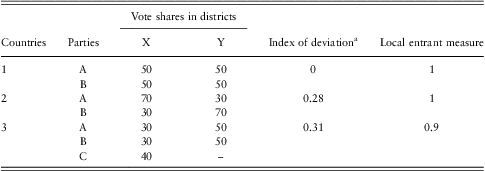
Let us take a simple example. Imagine three countries – 1, 2, and 3 (Table 1). In each country there are two districts, X and Y, for the purpose of electing the national legislature, and two or three parties entering the race, A, B, and/or C. In countries 1 and 2, only parties A and B compete for votes nationally. There is a relevant variation, though: while in the former the vote share of each party is exactly the same in the two districts, in the latter each district has parties with opposite results. In country 3, parties A and B compete for votes nationally and C by contrast compete only in one district. According to the Chhibber and Kollman (Reference Chhibber and Kollman1998, Reference Chhibber and Kollman2004) measure of deviation, country 1 has a more nationalized party system than country 2; but both have the same number of parties. And countries 2 and 3 have a pretty similar index of nationalization; but the latter counts with a relevant local party, whereas the former has none. That is, two countries, 1 and 2, with only national parties, are much more different in terms of nationalization than two countries, 2 and 3, with and without local parties. In short, nationalization scores are not particularly informative about the party system format, the structure of party competition, or the role of regionalism. The local entrant measure (in the last column of the table) will be explained in detail below.Footnote 6
Three hypothetical cases of party system nationalization in three countries

aAccording with Chhibber and Kollman's (Reference Chhibber and Kollman1998, Reference Chhibber and Kollman2004) index of deviation (D).
There are at least four aspects captured by measures based on the homogeneity of parties’ vote shares across the nation which are stricto sensu different from nationalization (at least understood as the predominance of national parties in accord with the contributions by Cox (Reference Cox1999a) and Chhibber and Kollman (Reference Chhibber and Kollman1998, Reference Chhibber and Kollman2004):
-
(a) Social and occupational factors: if components of the social fabric such as urbanization, demographic trends, employment levels, or average wages in different occupational sectors are not uniformly distributed across districts, parties’ vote shares will differ even though all parties are national.
-
(b) Party offer: The offer of a given party, its distinctive organizational features, and the variety of appeals presented to its potential votes are not exactly the same in every district within a country. Take, for instance, the case of party candidates: they obviously change from one district to the other, and their influence in the party vote should accordingly also vary across districts. The likely heterogeneity of electoral results even for national parties does not necessarily correlate with an electoral competition pitting national vs. sub-national parties.
-
(c) Strategic campaigning: parties behave strategically in election campaigns. As is well known, closeness or electoral competitiveness boosts mobilization efforts and hence correlates positively with turnout (Cox, Reference Cox1999b). Since closeness varies across districts within a given country, parties will not distribute their (scarce) resources homogeneously; as a consequence, their electoral results will diverge across districts. The outcome of strategic resource allocation increases the dispersion of party support across districts and then reduces the nationalization of party systems.
-
(d) Electoral systems: when institutional factors affecting voting behaviour differ within countries, parties’ vote shares also differ. For instance, according to the variance effect (i.e., the partisan political consequences of districts of varying magnitude; Monroe and Rose, Reference Monroe and Rose2002: 71–72), heterogeneity of parties’ vote shares is higher in countries with variation in district magnitude due to strategic behaviours. Especially in low magnitude districts, there may be (i) strategic non-entry (i.e., parties expecting defeat may join forces with other parties, or stay out of a district race altogether) by potential parties; (ii) strategic resource allocation by political parties; (iii) strategic voting, by which voters have incentives to choose among only likely winning lists; and (iv) (strategic) turnout, by which voters simply do not bother to show up for non-competitive elections at the district level.
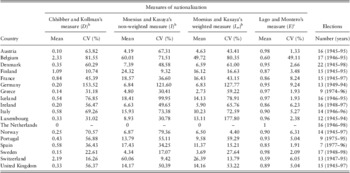
In sum, the measures that are commonly used in the literature run the risk of becoming catch-all indicators. They include the outcomes of too many social and political processes, and this contaminates their aim of capturing the phenomenon of party nationalization, particularly when the absence of a clear link to a concept or theory hampers knowledge of what has to be measured (see, for instance, Table 2). According to our own calculations based on the Moenius and Kasuya's (Reference Moenius and Kasuya2004) weighted and non-weighted measures, party system nationalization in Iceland is weaker than in Spain. This is an odd result. While Iceland is a very homogeneous country by any account, where it is not possible to speak of proper regionalist parties, social diversity is much higher and sub-national parties are particularly strong in Spain (Caramani, Reference Caramani2004: Ch. 4). In comparative terms, Spanish levels of both regional voting and voting for nationalist–regionalist parties in national elections are among the highest in Europe (Hearl et al., Reference Hearl, Budge and Peterson1996: 172–173; Linz and Montero, Reference Linz and Montero2001: 181); but no Icelandic party was included in any of the most recent books on regionalist parties in Europe for the rather convincing argument that none were regionalist (De Winter et al., Reference De Winter, Gómez-Reino and Lynch2006).
The nationalization of party systems in Europe, 1945–98a

CV = coefficient of variation.
aThe CV is the standard deviation divided by the mean, and multiplied by 100%.
bThe larger the figures, the poorer the nationalization.
cThe larger the figures, the higher the nationalization.
Moreover, measures of nationalization based on the homogeneity of parties’ vote shares suffer a notable inconsistency over time. A slightly different total vote for a given party across districts and elections will always result from non-systematic features of election campaigns – that is aspects of politics that do not persist from one district or election to the next, even if the campaigns begin on an identical footing. Even when national party systems show a tendency towards equilibrium, the problem when using these measures of nationalization is that the pattern seems to be one of instability in repeated measurements: some countries with highly nationalized party systems in one election, for example, do not tend to be among those with the highest nationalization in the next election. As can be seen in Table 2, the nationalization of party systems, when using Moenius and Kasuya's (Reference Moenius and Kasuya2004) weighted and non-weighted measures, is an extremely volatile feature: the dispersion of the variable in all countries is huge.
Proposing a definition and a measure of party system nationalization
The nationalization of party systems does not necessarily imply homogeneity of parties’ vote shares across the nation. Although they are strongly correlated, we propose an indicator that underlines the existence of national parties and the disappearance of sub-national parties; or, in Caramani's (Reference Caramani2004: 5) words, ‘the transformation of local electorates and segmented party systems into national electoral constellations’. Namely, the proposed measure captures the aspirations of parties to be national or the role of regionalism in party systems.
Similar to what happens at the district level (Cox, Reference Cox1997, Reference Cox1999a), our measure of party system nationalization reflects the number of parties that can appear in equilibrium under alternative institutions. We know much less about cross-district coordination than about district-level coordination. However, increasingly coordination should also push national party systems towards an equilibrium in which only serious parties enter the race.Footnote 7 As explained in detail above, an equilibrium across elections is compatible with vote shifts between (established) parties, while upsetting an equilibrium necessarily demands significant vote shifts among parties. Accordingly, one basic property of measures of the nationalization of party systems in the long term should be their relative stability.Footnote 8
In our view, a perfectly nationalized party system is a party system with only national parties. According to Urwin (Reference Urwin1982: 220), a minimalist definition of a national party should consider the extent to which a given party is able to enter the race in ‘all, or all but a handful, of constituencies in every region of a country’. Consequently, for us nationalization should depend upon the extent to which parties enter the electoral fray in every district. If every party runs candidates in every district, there are only national parties; the degree of nationalization is then perfect. At the opposite extreme, if each party fields candidates in just one district, there are only local parties; the degree of nationalization is thus zero. The territorial coverage of parties, or parties’ entry decisions, rather than parties receiving votes uniformly across districts, is the key variable to measure the nationalization of party systems.
A similar measure has been proposed also by Caramani (Reference Caramani2004: 61, 64, 76). Nonetheless, it has two shortcomings. First, it is only appropriate when district magnitude does not vary substantially within electoral systems. This is the case, for instance, of countries using single-member districts, such as the United Kingdom. But when variations in district magnitude are a significant feature, such as in Portugal, Spain, or Switzerland, Caramani's measure over-represents the contribution of small districts to the degree of nationalization. For instance, the weight of Lisbon, a 48-seat district, in the 2009 Portugal general election, is the same as that of Portalegre, a two-seat district. Similarly, Caramani's measure does not weight parties by their levels of electoral support. In Spain also, for example, the contribution to the degree of nationalization of the socialdemocrat Partido Socialista Obrero Español (PSOE) and the tiny regionalist and conservative Unió Valenciana (UV) was the same, given that they are weighted one-to-one. But the former had a mean vote share of 37.34% from 1977 to 1996, while the latter's was 0.18 (Caramani, Reference Caramani2004: 114). That is, the means of territorial coverage are clearly biased in favour of small parties.
The measure we propose is clearly inspired by Caramani's, but with some important differences. Given that parties do not have the same (electoral) size and that districts do not necessarily allocate the same number of seats, parties and districts should not receive equal weight in their contribution to the nationalization of the party system. Accordingly, our measure incorporates a weighted average of party system nationalization by which parties’ entry decisions are the primary variable and the national vote share of each party and the proportion of seats of the national total allocated in each district are two secondary variables. Therefore, the index is adjusted so that it controls for the different sizes of the territorial units and the vote share of parties, as Bochsler (Reference Bochsler2010) suggests. Our measure of nationalization is thus defined as:
 $$E\, = \,\mathop{\sum}\limits_{i\, = \,1}^n {{{v}_i}} \,\times \,{{s}_i}$$
where vi is the proportion of votes obtained by party i at the national level, si is the proportion of seats of the national total to be allocated in those districts where party i entered the race and n refers to the number of parties.
We call this the local entrant measure (E). If every party runs candidates in every district, E equals 1, and the party system is perfectly nationalized, independent of the distribution of national vote shares and the number of seats across districts. At the opposite extreme, if each party fields candidates in just one district, the party system is poorly nationalized, and E approaches 0. As E increases, the nationalization of a party system does as well. If E is 0.95, for example, about 95% of the size (votes) of the national party system can be attributed to the same parties entering the race and obtaining votes in all districts, with the other 5% due to different parties entering local races and obtaining votes in different parts of the country.Footnote 9 The two weights, party electoral size and district magnitude, do not apply when parties enter the race in every district and in countries whose national legislatures are elected using districts that do not vary in magnitude; that is, in countries that have single-member districts (e.g., plurality systems as in the United Kingdom, runoff systems as in France, or alternative vote systems as in Australia) or that have a single national district (e.g., Israel or the Netherlands). Similar to dispersion indicators, our measure captures both the nationalization of individual parties and party systems.
Congruent with our previous point about the problems of interpreting differences in party support across geographical units in terms of nationalization, our measure is not sensitive to how electoral support for parties is distributed within the country. Whether the support of a given party is perfectly balanced or heavily unbalanced across districts does not matter at all. The only relevant aspect is the number of districts contested by the party.
Table 1 illustrates the calculation of the measure using the data we already know. As a matter of simplicity, suppose that the number of seats to be filled in the two districts, X and Y, are the same and that the votes cast in the two districts are identical. In country 1 the nationalization score is 1, that is nationalization is perfect: the proportion of votes obtained by parties A and B at the national level is 0.5 in both cases, and the proportion of seats of the national total to be allocated in the districts where party A and B entered the race is 1 in both cases: (0.5 × 1) + (0.5 × 1) = 1. In country 2 the nationalization score is 1 again: (0.5 × 1) × (0.5 × 1) = 1. Finally, country 3 has the least nationalized party system: (0.4 × 1) + (0.4 × 1) + (0.2 × 0.5) = 0.9. That is, 10% of the size of the national party differs across districts due to the existence of sub-national parties. In contrast with most of the existing measures of nationalization, our index is easy to calculate and interpret.
Empirical applications of party system nationalization measures
In this section our measure of party system nationalization is compared with the indictors based on the homogeneity of parties’ vote shares. Although they capture different dimensions of nationalization, this comparison is helpful to understand how the different measures work. For that aim we have performed a longitudinal analysis of 256 elections in 18 western European countries over the period 1945–98. The countries are Austria, Belgium, Denmark, Finland, France, Germany, Greece, Iceland, Ireland, Italy, Luxembourg, the Netherlands, Norway, Portugal, Spain, Sweden, Switzerland, and the United Kingdom.Footnote 10 We have calculated four indices of nationalization for each country and election: our local entrant measure, E, the Chhibber and Kollman's deviation measure (D), and the Moenius and Kasuya's (Reference Moenius and Kasuya2004) weighted (in terms of district size) (Iw ) and non-weighted inflation measures (I), probably the most widely used in the otherwise sparse literature (see, for instance, Nikolenyi, Reference Nikolenyi2009). As far as we know, this is the most comprehensive analysis of party system nationalization existing in the literature, at least in a longitudinal perspective.Footnote 11
Table 2 includes the mean rates of party system nationalization for the 18 countries. Leaving aside the Netherlands, a perfectly nationalized party system by definition, Austria, Sweden, and Greece have the highest nationalized party systems in our sample according to the four measures. According to our own measure, virtually all parties in Austria, Sweden, and Greece enter all the local races; the territorial coverage of parties is 98%. At the other extreme, Switzerland and Belgium have substantially larger national parties than one would expect if their local party systems were largely the same throughout the country (2.19–2.33 more effective electoral parties at the national level than at the local level, or a 60% inflation according to the Moenius and Kasuya's non-weighted measure, and 26–50% according to the weighted one). According to our own measure, Switzerland and Belgium have the lowest nationalized party systems: in both countries, there is considerable variation in the number and identity of parties entering local races. As can been seen in the table, our measure correctly captures the role of regionalism, while other measures fail to do so: for instance, when using the E measure, party system nationalization is clearly weaker in Spain than in Iceland.
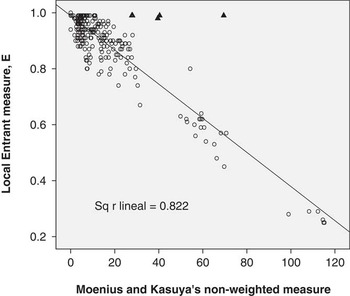
The correlations between our measure and Chhibber and Kollman's index (−0.91), the non-weighted version of Moenius and Kasuya's measure (−0.91) and their weighted measure (−0.83) are very high. The three correlations are statistically significant at the 0.01 level. This means that the homogeneity of party support across geographical units increases when all parties are national and reduces when there are local or regional parties. Given that all the figures are very similar, Figure 1 only displays the relationship between our measure of party system nationalization and the non-weighted index proposed by Moenius and Kasuya (Reference Moenius and Kasuya2004).
Correlations between Author's measure and Moenius and Kasuya's non-weighted measure in western European countries, 1945−98. The black triangles (4) indicate (some) elections in Iceland.

As we think that our measure of nationalization is more linked with theory, particularly with the role of regionalism, than indicators based on homogeneity of party support, we hypothesize that the former should be correlated more highly with the determinants of nationalization than the latter. To test this hypothesis, we have calculated the correlation between the measures of nationalization and the level of decentralization in our sample of countries and elections. According to Chhibber and Kollman (Reference Chhibber and Kollman1998, Reference Chhibber and Kollman2004), Brancati (Reference Brancati2008), Morgenstern et al. (Reference Morgenstern, Swindle and Castagnola2009), or Harbers (Reference Harbers2010), decentralization reduces nationalization more than any other institutional variable. Increasing the level of fiscal and political centralization in a state increases the incentive to win national office(s) and thus also increases the nationalization of party systems. The contrary applies also: increasing fiscal and political decentralization increases the incentive to win regional office(s) and thus depresses the nationalization of party systems.
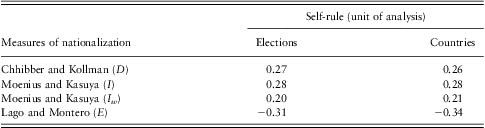
The correlations are displayed in Table 3. To measure the different facets of decentralization, we take into account political, fiscal, and institutional dimensions using the database compiled by Hooghe et al. (Reference Hooghe, Marks and Schakel2008). In particular, we use a variable, self-rule, that captures the authority exercised by a regional government over those who live in the region. It is a scale composed of four items: policy scope,Footnote 12 fiscal autonomy,Footnote 13 institutional depth,Footnote 14 and representation.Footnote 15 As can be seen, all the correlations have the expected signs: party system nationalization tends to be lower as decentralization tends to be higher. However, Lago and Montero's measure has the strongest correlation with self-rule when both elections and countries (national means) are the unit of analysis.Footnote 16
Correlations between nationalization and decentralization in 18 countries and 256 elections, 1945–98

Similarly, given that our concept and measure of nationalization hinges on the existence of equilibria in national party systems, we hypothesize that Lago and Montero's indicator will be more stable over time than Moenius and Kasuya's (Reference Moenius and Kasuya2004) indices. We test the hypothesis comparing now the CV of the different measures over elections, also included in Table 2. The standard deviations of both Lago and Montero's and the Moenius and Kasuya (Reference Moenius and Kasuya2004) measures cannot be compared in a meaningful way to determine which variable has greater dispersion: they vary hugely in their units and the means around which they occur. Instead, when using the CV the standard deviation and mean of each variable are expressed in the same units, so taking the ratio of these two allows the units to cancel. As the CV expresses the variation as a percentage of the mean, the series of data for which the CV is large indicates that the group is more variable and less stable or less uniform. If a CV is small it indicates that the group is less variable and more stable or more uniform. Lower values mean that a party system has probably reached an equilibrium. The evidence presented in Table 2 strongly supports the argument. Lago and Montero's measure has a much smaller CV (i.e., less dispersion) than Moenius and Kasuyas’ in all countries. The differences are particularly strong in Luxembourg (2.38 vs. 177.8 or 30.78), Germany (9.24 vs. 127.77 or 121.6), Iceland (1.93 vs. 78.91 or 9.95), and Austria (1.33 vs. 2.01 or 67.31). The differences across countries between the two sets of estimations are remarkable: while the CV goes from 49.11 in Belgium to 1.38 in Austria for Lago and Montero's measure, it moves from 177.8 in Luxembourg to 2.01 in Austria for the Moenius and Kasuya indices.
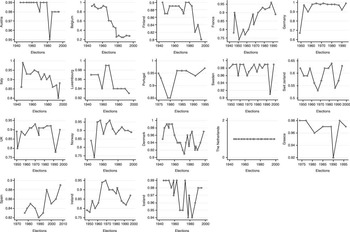
Finally, Figure 2 shows the values yielded by E in each country – from the first election held after World War II to the most recent included in the Caramani (Reference Caramani2000) data set. As a consequence of using a measure based on the territorial coverage of parties, the nationalization of party systems is not as volatile as previous measures had indicated. But neither is the picture dominated by general stability, as emphasized by Caramani (Reference Caramani2004: 88ff). The sensitivity of our index is able to distinguish patterns and trends among the different European countries and over time. Although the analysis of their origins and consequences should be the thrust of another paper, it is interesting at least to note the stable patterns shown by Germany and Austria (in spite of certain recent changes) and the basically unstable patterns manifested in the cases of Iceland, Ireland, Norway, Sweden, and Switzerland. On another note, while France and the United Kingdom show a tendency towards higher nationalization, Belgium, Finland, Italy, and Luxembourg follow exactly the inverse pattern. Finally, the new democracies of Greece, Portugal, and Spain share common trends of party system nationalization once they moved past a stage of initial but relevant variations.
The nationalization of party systems in Europe.

Conclusions
As little as drop <10 years ago, Jones and Mainwaring (Reference Jones and Mainwaring2003: 139) stated the necessity to address ‘an under-analyzed issue in the comparative study of parties and party systems: their degree of nationalization’. In this article we have proposed a concept of party system nationalization based on the aspirations of parties to be national and consequently a new measure of it mainly based on the territorial coverage of parties. While existing indicators measure the homogeneity of parties’ vote shares, the distribution of votes earned across geographical units, our approach captures a different dimension of nationalization: the homogeneity of competitors entering local races. Our local entrant measure, E, analyzes the extent to which parties enter the electoral fray in every district within a country. If every party runs candidates in every district, the party system is perfectly nationalized, and E equals 1, no matter how the national vote shares and seats among districts are distributed among parties. At the opposite extreme, if each party fields candidates in just one district, the party system is poorly nationalized and E approaches 0. As E increases, the nationalization of a party system does too. In sum, our definition of the concept hinges on the existence of equilibria in national party systems and therefore our measure captures their existence across elections.
We have illustrated how our measure works in comparison to some existing indicators through a longitudinal analysis of 256 elections in 18 western European countries from 1945 to 1998. Given that our local entrant measure is linked to electoral coordination models and hinges on the existence of equilibria in national party systems, it is no surprise that it is more correlated with decentralization than existing indicators based on the homogeneity of party support, and produces more stable scores over time. Finally, our measure is very simple to calculate and interpret, captures both the nationalization of individual parties and party systems, and could provide indications of nationalization when vote-share data are not available at the district level. However, our local entrant measure is not sensitive to how electoral support for parties is distributed within the country.
Acknowledgements
The authors would like to thank André Blais, Santiago Lago-Peñas, Csaba Nikolenyi, Pedro Riera, Kelly Rowe, the editors of this journal, and three anonymous referees for their helpful comments, and Pablo Simón for his superb research assistance. The authors also acknowledge the financial support provided by the Spanish Ministry of Science and Innovation (CSO2010-16319) and the Universidad Autónoma de Madrid-Comunidad de Madrid (CCG08-UAM/HUM-4446), as well as the excellent research facilities made available by the Center for Advanced Studies in the Social Sciences, Instituto Juan March, Madrid. Preliminary versions of this paper were presented at the Canadian Political Science Association Annual Meeting, Montreal, June 2010, and at the 18th International Conference of Europeanists, Council for European Studies, Barcelona, June 2011.