Introduction
‘Structure’ in the discipline of International Relations (IR), for all the criticism of Kenneth Waltz’ work, still typically means the Waltzian triad of ordering principles, functional differentiation, and distribution of capabilities. Either that or one uses the term in the ordinary-language sense of ‘organization’ or ‘arrangement’, without reference to a general account of the elements of political structures. Even many critics, who typically focus on what this framework excludes (e.g., ideas, identities, norms, institutions, dynamic density, interaction capacity, process variables), implicitly accept Waltz’ triad as the core of an adequate conception of structure. Those less concerned with parsimony, it would appear, may simply ‘add on’ to this secure and fruitful foundation.
I argue, however, that ordering principles, functional differentiation, and distribution of capabilities not only do not in Waltz’ particular presentation but cannot provide an adequate account of political structures. Anarchy and hierarchy are not actually ordering principles. Polarity is not a plausible conception of the distribution of capabilities. The anarchy-plus-polarity model excludes vital elements that are unquestionably structural. And all this can be shown while staying within Waltz’ conceptions of system and structure and employing only elements that he explicitly acknowledges are structural.
My principal purpose, however, is positive, not critical. Most of this essay (see pages 58–78) sketches a five-part alternative framework of the elements of political structures.
The key move is to begin afresh with differentiation, a concept widely employed in Sociology and Anthropology but strangely absent from IR. Differentiation establishes the positions into which the units of a system are arranged. ‘Vertical differentiation’ defines ranked positions; ‘hierarchy’. ‘Horizontal differentiation’, including functional differentiation, creates behaviorally distinct but equivalently ranked positions; ‘segmentation’. ‘Unit differentiation’ assigns certain types of actors a privileged status. I also identify two dimensions of what I call structural elaboration: fundamental norms and institutions and geography and technology.
Of perhaps greatest immediate interest is my analysis of vertical differentiation (see pages 55–71). I argue that we need three classes of ‘ordering principles’ to model fruitfully the actual range of international political structures. International orders may be unranked (‘autarchy’), singly-ranked (‘single-hierarchy’), or multiply ranked (‘heterarchy’). For example, ‘globalization’ and contemporary American ‘empire’, I argue, can only be comprehended adequately as multiply-ranked ‘heterarchic’ orders. More generally, as opposed to the ‘anarchic orders’ story of mainstream structural IR, this typology emphasizes the regular and central fact of ranking in international systems.
My alternative framework also permits, even encourages, us to consider structural variety and change. For example, it underlines rather than erases important differences between Westphalian international relations and both its medieval predecessor and its possible globalized successor. In addition, in sharp contrast to the anarchy-plus-polarity conception, which has been useful to and thus used primarily by realists, it opens systematic, comparative structural analysis to the concerns and contributions of constructivism. The greater coherence, accuracy, depth, range, and theoretical openness of this differentiation-plus-elaboration model, I contend, promise to enhance substantially the explanatory power and reach of structural analysis in the study of international relations.
Critique: Waltz’ double dichotomy of ordering principles
‘Two, and only two, types of structures are needed to cover societies of all sorts’ (Waltz, Reference Waltz1979: 116). Waltz sometimes contrasts anarchic and hierarchic orders (1979: 114–116, 93); other times, international and national (or domestic) orders (1979: 81–93). He treats these distinctions, though, as equivalent (1979: 81, 88, 104, 113, 115–116), producing what I call the double dichotomy of anarchic/international vs. hierarchic/domestic orders.
Rather than stress the fact that these dichotomies overlap imperfectly – that is, that many international orders have important hierarchic dimensions and many domestic orders are anarchic – I focus on more serious problems within each dichotomy. Waltz, I argue, mistakenly identifies anarchy and hierarchy as ordering principles and misconceives their relationship as dichotomous. In addition, he misrepresents the character of both domestic and international politics and inappropriately denies fundamental variety to international political systems.
Anarchy and hierarchy
The central yet almost universally ignored problem with Waltz’ account is that anarchy and hierarchy are not actually ordering principles. An ordering principle specifies system-level relations of coordination and superordination. Neither anarchy nor hierarchy does that.
Anarchy, according to both the dictionary definition and standard disciplinary practice, means absence of government or central authority. This specifies neither coordination nor superordination. In fact, it tells us nothing about how units are ordered. ‘Anarchy’ at best indicates what the ordering principle is not – and not even really that. Government is an institution of governance. Its absence or presence marks, in Waltz’ terms, functional differentiation not ordering principle.
Hierarchy is not an ordering principle either. ‘Superordinated’ (hierarchic) indicates merely that there is ranking. It tells us almost nothing about how the units are arranged.
Waltz’ account of the relationship between anarchy and hierarchy is also inadequate. Taking anarchy as the absence of government, hierarchy (as the other side of a dichotomy) would mean ‘government’ or some comparable ‘power able to overawe them all’ (Hobbes, Leviathan, Ch. 13). In fact, though, it does not.
Hierarchy indicates ranking, superordination: ‘a body of persons or things ranked in grades, orders, or classes, one above another’ (Oxford English Dictionary (OED)). In hierarchies units ‘stand vis-à-vis each other in relations of super- and subordination’ (Waltz, Reference Waltz1979: 81). Anarchy as the other side of a dichotomy defined by hierarchy would mean the absence of superordination – which is in fact how Waltz presents the international side of the anarchic–international couplet. ‘The parts of international-political systems stand in relations of coordination. Formally, each is the equal of all the others’ (1979: 88).
Thus defined, though, ‘anarchy’ and ‘hierarchy’ are not separate ordering principles but a little and a lot of superordination. A continuum of hierarchy replaces a dichotomy of ordering principles. Defining anarchy stipulatively as the absence of hierarchy also is inconsistent with the definition of the absence of government. Government is only one source of hierarchy. For example, big man societies and chiefdoms have hierarchy – big men and chiefs – without government.
Hierarchy is not the opposite of the absence of government (which is both Waltz’ definition and the standard ordinary-language sense of anarchy). Anarchy is not the opposite of superordination (which is Waltz’ as well as the standard ordinary-language definition of hierarchy). Anarchy and hierarchy thus do not define a dichotomy, or even a continuum. They are analytically distinct phenomena that stand in various relations to one another. And all of this is a matter of simple conceptual logic, not complicating empirical features of the world from which we can fruitfully abstract.
National and international politics
Waltz got himself (and us) into this mess largely because – quite astonishingly – he never presents a general discussion of political structures or ordering principles. Chapter 5 of Theory of International Politics, although titled ‘Political Structures’, actually examines (purported) differences between domestic and international politics.
‘In defining structures, the first question to answer is this: What is the principle by which the parts are arranged?’ (Waltz, Reference Waltz1979: 81). But instead of addressing this question, the next sentence begins ‘Domestic politics is hierarchically ordered’ (1979: 81), shifting the discussion from ordering principles to ideal-type models of national and international polities. The sub-section titled ‘ordering principles’ (1979: 88–93) actually devotes less than a page to that topic, focusing instead on a misleading analogy with microeconomic market theoryFootnote 1 and an extended defense of the irrelevant assumption that states seek survival.Footnote 2 And Waltz’ depictions of national and international politics are defensible neither in their own terms nor as explications of hierarchy and anarchy.
‘National politics is the realm of authority, of administration, and of law. International politics is the realm of power, of struggle, and of accommodation’ (Waltz, Reference Waltz1979: 113). In fact, though, many international systems have significant elements of law and even limited formal authority. Simpler non-state domestic polities lack administration; some lack offices of any sort. And power, struggle, and accommodation are regular features of many national polities. In some, they are at least as characteristic as authority, administration, and law.
National politics is not (ideal-typically) ‘vertical, centralized, heterogeneous, directed, and contrived’, nor is ‘the international realm … horizontal, decentralized, homogeneous, undirected, and mutually adaptive’ (Waltz, Reference Waltz1979: 113). Simple hunter–gatherer band societies are anarchic, horizontal, homogenous, and undirected and practice a decentralized, mutually adaptive politics of accommodation. Most tribal societies would also, by this account, have to be considered ‘international’ not ‘national’. Waltz further confuses matters by describing international orders as segmentary (1979: 95 n. *), a standard description of tribal ‘domestic’ polities. If the dichotomy Waltz has delineated depicts anything, it is a distinction between ‘simple’ and ‘complex’ societies.
These are not modest ‘to-be-expected’ deviations from ideal types. Numerous referenced systems do not approximate the specified types. Many have the opposite characteristics.
The just-quoted descriptions, however, become accurate and insightful if we replace ‘national’ with ‘modern sovereign state’ and ‘international’ with ‘Hobbesian state of nature’. Waltz presents a particular subset as an ideal-typification of the entire class, analogous to describing mammals as slow-moving quadrupedal herbivores that moo. The underlying problem, though, is not choosing the wrong exemplar or description.
National and international politics are not the kinds of things for which there are fruitful ideal types. We may divide all political orders into national and international but we will be able to say little, if anything, of substance about either set. For example, as we will see below, international orders have at least three different types of ordering principles. Certainly the equation of anarchic and international cannot be sustained.
Rather than trim our account of ordering principles to fit preconceived – and misconceived – models of national and international politics, we need to start over, fresh. The resulting framework will prove a bit more complex than Waltz’, a point to which we will return in the final section. It will, however, be much better able to explain more features of more types of international systems.
Starting over: system, structure, and differentiation
Waltz’ approach to structure does rest on two important insights: ‘a structure is defined by the arrangement of its parts’ (1979: 80) and ranking is central to that arrangement. I will argue, however, that differentiation, a concept used extensively in Sociology and Anthropology, allows us to deploy these insights much more effectively. This section lays the conceptual groundwork by defining ‘system’, ‘structure’, and ‘differentiation’ in terms that aim to be as analytically neutral as possible. I am in effect suggesting that we return to the relatively uncontroversial understandings of system and structure with which Waltz begins and then properly trace their implications.
A structure orders the parts of a system, understood as ‘a set or assemblage of things connected, associated, or interdependent, so as to form a complex unity’ (OED); a unitas multiplex (Luhmann, Reference Luhmann1995 [1984]: 18). ‘We are dealing with a system when (a) a set of units or elements is interconnected so that changes in some elements or their relations produce changes in other parts of the system, and (b) the entire system exhibits properties and behaviors that are different from those of the parts’ (Jervis, Reference Jervis1997: 6; cf. Waltz, Reference Waltz1979: 18–19, 39–40, 53; Wendt, Reference Wendt1999: 10–15; Bull, Reference Bull1977: 9).Footnote 3
Structure indicates how the parts ‘stand in relation to one another (how they are arranged or positioned)’ (Waltz, Reference Waltz1979: 80; cf. Nadel, Reference Nadel1957: 4–8). It is ‘the systems-level component that makes it possible to think of the units as forming a set [system] as distinct from a mere collection [agglomeration]’ (Waltz, Reference Waltz1979: 40). Structure specifies ‘the relations between components that define a composite unity [system] as a composite unity of a particular kind’ (Maturana and Varela, Reference Maturana and Varela1980: xix). Taking politics in the familiar sense of the authoritative allocation of values (Easton, Reference Easton1953), political structures establish/represent the fundamental relations of force and authority in a system.
Differentiation is the ‘social process of distinguishing among people [and groups] according to the social statuses they occupy’ (Johnson, Reference Johnson2000: 88–89). ‘Differentiation refers to the unequal arrangement of goods and services within and among social groups’ (Yoffee, Reference Yoffee1979: 28).
A social structure is ‘a multidimensional space of different social positions among which a population is distributed’ (Blau, Reference Blau1977: 4). It acts as a ‘field of forces’ (Waltz, Reference Waltz1979: 73) that shapes and (re)directs the behavior of actors. Structural theoryFootnote 4 ‘seeks to explain the relations among various parts of entire societies in terms of the differentiation of these parts’ (Blau, Reference Blau1977: 2); that is, ‘how the organization of a realm acts as a constraining and disposing force on the interacting units within it’ (Waltz, Reference Waltz1988: 618).
I focus initially, and for reasons of space primarily, on vertical differentiation (see pages 55–71); that is, relations of coordination and superordination; inequality/hierarchy (or its absence). Pages 71–73 add horizontal differentiation and pages 73–75 introduce unit differentiation. Pages 75–78 introduce what I call structural elaboration, incorporating fundamental norms and institutions and geography and technology.
Vertical differentiation
Vertical differentiation establishes positions that are super- and subordinate or coordinate. Vertical differentiation is a matter of rank, of ‘relative position or status’ (OED).
Rank in international political systems
Political rank is principally a function of authority and (material) coercive capabilities. For some purposes it may be useful to distinguish formal authority-based ranking from informal capabilities-based ranking (see sub-section titled ‘Control hierarchies and command hierarchies’). Informal ranking based on unequal capabilities, however, is no less truly hierarchical, and often no less politically important, than official legal ranking.
Waltz, though, treats superordination as solely a matter of authority, independently – even to the exclusion – of capabilities. Taking anarchy as ‘the absence of agents with system-wide authority’ (1979: 88), he restricts international ordering principles to the formal equality of states. ‘The parts of international-political systems stand in relations of coordination. Formally, each is equal to all the others. None is entitled to command; none is required to obey’ (1979: 88).
This might be unproblematic if ‘distribution of capabilities’ captured informal inequality and hierarchy. But defining the international distribution of capabilities by polarity, the number of great powers in a system, excludes the informal subordination of the weak from the account of structure.
It simply is not true that ‘system-level characteristics [are] defined …by the situation of the great powers’ (Waltz, Reference Waltz1979: 145; cf. 93, 98–99). The class structure of a society is not defined by its ruling class. An army’s structure is not a matter of the number of generals and their relations to one another. We cannot discern the structure of a slave system by attending solely to the large slave-owners. In addition to the privileged we must also consider the deprived (and those in between).
Ranking, being relative, cannot be understood by looking only at those at the top of a hierarchy. Societies with ten rich people but a hundred, ten thousand, and a million poor people are structured differently. That some, many, or most have relatively few capabilities is essential to any adequate understanding of the distribution of capabilities. Ignoring the weak is a radically inappropriate way to understand relations of coordination and superordination, and thus the structure (arrangement of the parts) of international systems.
All of this is particularly puzzling and unfortunate because Waltz notes that ‘the great powers of the era have always been marked off from others by practitioners and theorists alike’ (1979: 97). He refuses, however, to mark them off structurally as superior. Waltz also insists that ‘international politics is mostly about inequalities’ (1979: 94; cf. 130–132) – but excludes material inequality and informal subordination from his account of structure. He notes that international political orders are characterized by ‘varying degrees of independence for some, and of dependence for others’ (1979: 143) – but excludes dependence from his account of structure.Footnote 5
Authority, capabilities, and rank
Part of the problem would seem to arise from failing to distinguish structure (the nature and arrangement of positions) from the causal impact of (occupants of) particular structural positions. It may be true that ‘the theory, like the story, of international politics is written in terms of the great powers of the era’ (Waltz, Reference Waltz1979: 72; cf. Mearsheimer, Reference Mearsheimer2001: 5, 17). Ignoring the limited influence of the weak thus may be fruitful when explaining some international outcomes. But the fact that certain actors, positions, or sub-systems are the principal cause of phenomena in which one has a special interest does not justify representing the structure of the system (the arrangement of its parts) solely in terms of those elements – any more than the fact that an engine propels a car suggests leaving out the wheels and the chassis in depicting a car’s structure.Footnote 6
Whether ‘clubs are trumps’ in anarchic orders, and to what extent, when, and how, are empirical questions. They cannot be resolved by theoretical argument.Footnote 7 Conceptually, any relationship between force and legitimacy is possible. And history reveals many and varied mixes of authority and capabilities, in both domestic and international politics.
Authority often is more readily, regularly, and successfully challenged in anarchic orders than in systems with strong and effective governments. In few international orders, however, are clubs always trump, or even used very frequently. The percentage of the deck that trump cards comprise, when and how they may be played, the costs of doing so, and even the nature and legitimacy of the ‘rule’ about clubs vary considerably. Thus there are many different games in which clubs are trumps. In most, play typically proceeds largely based on other rules and resources. And in all of these political games, the trumping power of clubs is only one part of the story, the significance of which varies with time, place, and circumstance.
If all actors happen to be both formally and informally (more or less) equal, we must be able to capture that. Where one group stands above another in capabilities or authority (or both), we should be able to comprehend that as well. Where other types of ranking exist, we need to be able to represent these too.
Unfortunately, ordering principle understood as anarchy/equality and distribution of capabilities understood as polarity obscure, even occlude, the nature and significance of ranking in international relations. Therefore, I will abandon both concepts,Footnote 8 treating the material they address as parts of vertical differentiation (ranking).
In the following sections I identify three broad types of vertical differentiation, distinguished by the number of dimensions of hierarchical ranking within the system. International political systems, I argue, can be depicted fruitfully as unranked, singly-ranked, or multiply-ranked.
Unranked orders
In unranked orders actors have (roughly) equal authority and (roughly) equal control over politically relevant resources. ‘Simple’ or ‘immediate-return’ hunter–gatherer bands, for example, have almost no formal or informal subordination. Two types of unranked international orders are of obvious interest.
‘States of nature’, following Hobbes, are systems in which units are equal in authority because none has any. Hobbes’ ‘right of every man to every thing’ (Leviathan, Ch. 14) is exactly equivalent to a right of no one to anything; no obligation or authority exists; ‘the notions of right and wrong, justice and injustice, have there no place’ (Leviathan, Ch. 13). All actors also have effectively equal resources, a feature that Hobbes enumerates before, and no less importantly than, the absence of a power to overawe them all.
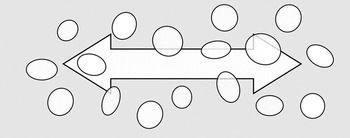
Orders are also unranked, however, when each unit has some but the same authority. The ‘no rule’ of the state of nature is replaced by ‘self-rule’ or autarchy.Footnote 9Figure 1 represents this simplest form of vertical differentiation.
Vertical differentiation in autarchy.

Unranked orders are exactly that, unranked – both formally and informally. Systems become ranked when either formal or informal inequalities establish positions associated with politically significant unequal access to goods, services, opportunities, or protections. Thus Hobbes draws a purely genetic distinction between commonwealth by acquisition (in which the ‘sovereign power’ is obtained ‘by natural force’) and commonwealth by institution (where ‘men agree amongst themselves to submit’) (Leviathan, Ch. 17, last para). Substantial material inequality creates an informal hierarchy that removes men from a state of nature. Force and authority, which create identically sovereign commonwealths, are separate but substitutable sources of hierarchy (although Hobbes goes too far in denying any difference between coercion and consent).
Are many international systems well described as unranked? The standard IR answer is that international systems are ‘anarchic’; meaning not hierarchic; meaning, roughly, unranked. In fact, however, few historical international systems, even as an ideal-type approximation, have lacked both political authority and substantial material political inequality. In the ‘Westphalian’ system, for example, the formal equality of sovereign states has been combined with substantial, politically vital, material inequality (and often some modest elements of formal inequality as well) (cf. Hobson and Sharman, Reference Hobson and Sharman2005). That the special rights, powers, privileges, and opportunities of great powers often have been principally informal does not make them unreal or unimportant – a point one would have thought realists in particular would want to highlight rather than hide.
Singly-ranked orders
Singly-ranked orders or single-hierarchies – ‘stratified societies’ – have one axis of superordination that runs through the entire system. Hierarchical layers are arranged more or less neatly on top of one another. For example, complex chiefdoms have multiple layers of sub-chiefs arrayed along a ladder leading up to the paramount chief.
Imperial states systems
The tributary states system of the Chinese Empire illustrates what I will call imperial states systems. An ‘empire’ can be understood as a ‘domestic’ political form that largely extinguishes both the autonomy and the separate political identity of formerly independent units (Eisenstadt, Reference Eisenstadt1968: 41; Doyle, Reference Doyle1986: 12; Motyl, Reference Motyl2001: 4). In imperial states systems, a core power, typically an empire, rather than ruling directly over fully incorporated provinces, exercises suzerainty or dominion over still somewhat separate units. Such systems are more centralized than hegemonies (see page 66) but more decentralized than empires (cf. Watson, Reference Watson1992: 15–16). Figure 2 provides an illustration.
An imperial states system.

Imperial states systems, which have been the norm in large parts of the world across many centuries, even millennia, can only be (mis)represented within the Waltzian triad as unipolar orders made up of (sovereign) equals. Huge swaths of international history thus are misapprehended. Not surprisingly, theories based on this (mis)conception of structure usually misunderstand and mispredict behavior in such systems. Kaufman, Little, and Wohlforth’s recent edited volume The Balance of Power in World History (Reference Kaufman, Little and Wohlforth2007) decisively demonstrates this for the realist anti-hegemonic balancing hypothesis.
Great power systems
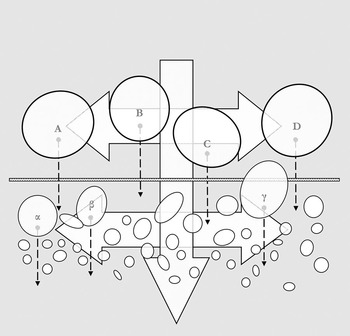
Great power systems rest on a hierarchical division between great and non-great powers, creating three major sub-systems, involving relations of great with great, non-great with non-great, and great with non-great. Figure 3 illustrates this configuration.
A great power system: vertical differentiation.

Because great powers (A, B, C, D in Fig. 3) are materially roughly equal – each is able to undertake a protracted war against any other unit in the system – their relations are likely to be coordinate, especially in a system of formal (e.g., sovereign) equality. Relations between non-great powers are also likely to be coordinate, although superordination may arise from major inequalities in, for example, regional subsystems (α, β, γ). Relations between great powers and non-great powers, however, are hierarchical, stratifying the system as a whole along a single axis of superordination.
Great powers often, perhaps typically, lack authority or legitimate power, possessing ‘only’ greater capabilities. Nonetheless, there is an important sense in which the strong, as a result of occupying a different structural position, can and do ‘do what they can’, while the weak are compelled to suffer what they must. Vertical differentiation allows us to capture these critical political differences, easily and elegantly. Anarchy-plus-polarity hides it.
Confusing ‘anarchic’ with ‘unranked’ has important substantive consequences. Waltz insists that ‘balance-of-power politics prevails wherever two, and only two, requirements are met: that the order be anarchic and that it be populated by units wishing to survive’ (1979: 121). In fact, however, structure induces non-great powers in their relations with great powers to bandwagon, seek neutrality, or hide. They cannot balance, lacking the capabilities to do so.Footnote 10 My simple model of great power systems not only makes space for but draws attention to this significant structural dynamic. Anarchy-plus-polarity ignores it and thus wrongly predicts much of the behavior of most units in great power systems.
Again, we must keep cause and structure analytically distinct. The contingent empirical fact (if it is a fact) that hierarchy explains little in which we happen to be interested, is no reason to (mis)represent the structure of the system as unranked. In any case, great powers have regularly enjoyed opportunities and legitimacy not available to other states. Thus Waltz – whose good sense often breaks free of the constraints of his conception of structure – devotes an entire chapter (1979: Ch. 9) to the opportunities and informal rights and responsibilities of great powers to manage the system.
Control hierarchies and command hierarchies
Although both authority and capabilities can establish ranking/hierarchy, we should expect patterned differences in unit behavior depending on the mix of legitimacy and coercion. We might therefore distinguish command hierarchies (based on legitimate authority), illustrated above by imperial states systems, from control hierarchies (based on coercive capabilities), illustrated by great power systems. Given the fungibility and interactions of force and authority, we probably should also identify, in addition to the pure types, what we might call ‘legitimated control’ and ‘coercive command’.
Limited forms of dynamic analysis might even be possible. I suspect, for example, that there are characteristic processes by which authority tends to acquire capabilities and by which control comes to be legitimated.
We may also be able to model fundamental change over time. For example, technological innovation, natural disaster, devastating disease, or debilitating warfare might transform a great power system into a largely or completely unranked order. Moving in the other direction, a single great power might successfully imperialize a system. Uncovering structural patterns that shape such transformations could be quite valuable.
Systems that are more complicated may also emerge. For example, one or more great powers might obtain at least semi-formal authority over some part of the system, creating a hegemonic order. This, however, introduces multiple ranking, the subject of the next section.
Multiply-ranked orders: heterarchies
Power (capabilities and authority) may be distributed differently in different spatial, functional, or relational domains, producing multiply-ranked (‘heterarchic’) orders.
Heterarchy
‘Heterarchy’ combines the root archē (rule) or archon (ruler) with the prefix hetero-, indicating difference, variety, or the other. Heterarchy involves ‘differential rule’ or ‘multiple rule’ – in contrast to the ‘higher’ rule of hierarchy, the ‘self-rule’ of autarchy, and the ‘no ruler’ of anarchy.
The concept has been widely employed in cybernetics. In heterarchic systems, ‘phenomena at one level influence phenomena at putatively higher … lower … or the same level of description’ (Findlay and Lumsden, Reference Findlay and Lumsden1988: Figure 4). It has also found fruitful application in business studies, to describe firms that although layered have no single hierarchy and thus allow authority relations to vary with time, place, unit, or issue area.Footnote 11
A hegemonic system: vertical differentiation.

Archaeology, the one social science where the concept has become semi-standard, has adopted Carole Crumley’s definition: heterarchic systems are either unranked or ranked in multiple ways.Footnote 12 This, however, is unfortunately dichotomous. Unranked actors stand in very different structural relations than actors linked by contextually variable relations of super- and subordination.
I therefore use heterarchy to refer to systems with multiple, and thus often ‘tangled’ (Hofstadter, Reference Hofstadter1979), hierarchies. Heterarchy, as I use the term, involves multiple ranking associated with differentially divided capabilities or authority.
‘In the case of hierarchy, there is only one top; heterarchy, on the other hand, has several tops’ (Tokoro and Mogi, Reference Tokoro and Mogi2007: 135) – and, continuing the series, autarchy has no top (or bottom). Units are autonomous in autarchy, embedded in single-hierarchy, and variously related in heterarchies. Single-hierarchic orders are centralized. Autarchic orders are decentralized. Heterarchic orders are ‘neither and both centralized and decentralized’ (Michael, Reference Michael1983: 260).
Intimations of heterarchy
Although I believe that this is the first sustained published use in IR of heterarchy considered as a structural ‘ordering principle’ (vertical differentiation),Footnote 13 heterarchy has affinities with a variety of insights and concerns expressed across the discipline.
John Ruggie describes medieval Europe’s ‘lattice-like network of authority relations’ (Reference Ruggie1983: 274 n. 30) as ‘heteronomous’. Although authority relations suggests an ordering principle, Ruggie presents heteronomy as a matter of functional differentiation (Reference Ruggie1983: 274, 279, 1993: 151, 161). Moreover, neither he nor Rodney Bruce Hall (Reference Hall1997: 604) ties heteronomy to the broader issue of conceptualizing structure.Footnote 14 Much the same is true of Hedley Bull’s speculative consideration of a ‘neo-medieval’ future (1977: 264–276), which draws attention to the co-existence of multiple types of actors (rather than multiple ranking) and focuses on states, sovereignty and the contrast between international and world society (rather than forms of vertical differentiation). Fred Riggs’ notion of a ‘prismatic system’ (Reference Riggs1961) also has certain similarities, although developed from a very different perspective.
Nicholas Onuf and Frank Klink, drawing on Kant, use ‘heteronomy’ as the opposite of autonomy. They deploy it, however, in a tripartite conception of rule, contrasted to hierarchy and hegemony (Reference Onuf and Klink1989: 150, 159, 161ff., 168–169). Again, there are resemblances but a rather different focus and result.
Hints of heterarchy can be found in Robert Keohane and Joseph Nye’s (Reference Keohane and Nye1977: 24–25ff.) well-known model of complex interdependence. Their account, however, provides a partial description of one type of structure. Much the same is true of Anne-Marie Slaughter’s notions of the ‘disaggregated state’ and a ‘disaggregated world order’ (Reference Slaughter2004: 12–14, Ch. 4), which focus on states and ‘government networks’ rather than on systems and structures. Other valuable models of particular heterarchic orders include John Ikenberry’s (Reference Ikenberry2001: 29–37; Reference Ikenberry2006: Ch. 6) ‘constitutional orders’, such as the post-1945 San Francisco-Bretton Woods system (cf. Nexon and Wright, Reference Nexon and Wright2007: 257–258), and Daniel Deudney’s ‘negarchy’, in which security is provided centrally in an otherwise autarchic order (Reference Deudney1995; cf. 2007: Ch. 1).
The literature on multi-level governance, following the lead of Bob Jessop (Reference Jessop1998; cf. Lipschutz, Reference Lipschutz1998), does use the term heterarchy, but to indicate a particular type of new actor or governance mechanism. For example, Jürgen Neyer (Reference Neyer2003: 242) uses heterarchy to conceptualize the fact that the EU is less than a state but more than a regime. The language of sharing, pooling, or re-scaling sovereignty or jurisdiction (e.g. Neyer, Reference Neyer2003: 243, 255; Jessop, 2005: 54, 63; Curry, Reference Curry2006: 79, 81, 85) underscores the focus on Westphalian states and contemporary alternatives, rather than a systematic examination of differentially divided power or a principle of vertical differentiation – and a rather protean principle at that.
The literature on hierarchy ‘under’ (Wendt and Friedheim, Reference Wendt and Friedheim1995), ‘amidst’ (Weber, Reference Weber2000), or ‘in’ (Donnelly, Reference Donnelly2006) anarchy grapples most directly with the phenomena to which heterarchy turns our attention. Such conceptualizations, however, suggest an awkward combination of opposites, a hybrid form of fundamentally unranked order, or a space on a continuum between ‘anarchy’ and ‘hierarchy’ (cf. Milner, Reference Milner1998: 774; Lowenheim, Reference Lowenheim2007: 22), rather than a distinctive type of vertical differentiation. They also fail to draw attention to the essential feature of multiple dimensions of ranking.
Heterarchy captures something ‘in the air’ in contemporary IR and incorporates these scattered insights and discontents into a general account of vertical differentiation that dramatically expands the reach and penetration of structural analysis.
Hegemony
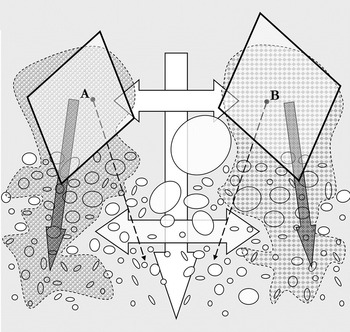
Hegemony is perhaps the best-known heterarchic international form. A hegemon, in one standard definition (e.g., Doyle, Reference Doyle1986: 12, 40, 55–60; Watson, Reference Watson1992: 15–16, 27–28, 122–128; Nexon and Wright, Reference Nexon and Wright2007: 256–258), directs the foreign policy of lesser powers that remain formally independent and substantially in control of their domestic policy.Footnote 15 Power is thus differentially divided by subject matter (external and internal relations) and type of actor (hegemon and hegemonized), creating multiple dimensions of superordination. The Greek world in the century prior to the rise of Macedon, for example, was structured around competing Spartan, Athenian, and Theban hegemonies.
Figure 4 illustrates both the qualitative distinction of the hegemons from other units (depicted by the different-shaped figures) and the distinctive type of subordination operating within each league (represented by the dark arrows). In effect, a great power system is overlaid by (in this case two) hegemonic leagues.
Discussions of hegemony, however, are often confused by an inability to comprehend differentially divided power. For example, Jonathan DiCicco and Jack Levy note that ‘[Waltz] concedes that international politics is characterized by some semblance of order, and power transition and other hegemonic theorists concede that order exists within a nominally anarchic system’ (Reference DiCicco and Levy1999: 685). ‘Order’ here means roughly ‘higher authority’ which hegemons do indeed possess. ‘Nominally anarchic’ however, is a problematic notion, which I think explains their claim, later on the same page, that hegemonic international systems are ‘hierarchically ordered’. By this, though, they mean that there are ‘rules similar to rules of domestic political systems’ (1999: 685). ‘Hierarchy’ thus understood is not a structural ordering principle – which probably explains their initial reference to anarchy. Understanding hegemony heterarchically, rather than forcing us to struggle clumsily with the fact that hegemony is neither ‘anarchic’ nor ‘hierarchic’, permits a simple, clear, and insightful analysis of this type of differentially divided power.
Or consider Robert Gilpin’s argument that for the past two centuries hegemony has been ‘the fundamental ordering principle of international relations’ (Reference Gilpin1981: 144). Gilpin also, however, presents international relations as ‘a recurring struggle for wealth and power among independent actors in a state of anarchy’ (1981: 7) and draws explicitly on Waltz’ structural account of ‘an anarchic order of sovereign states’ (1981: 85). This makes sense only if, contrary to the standard disciplinary understanding, hegemony, but not anarchy, is an ordering principle – which is exactly the case in my account of vertical differentiation.
Heterarchy in the late nineteenth-century international system
Multiple ranking was the hallmark of the Westphalian system though most of its history. Consider the late nineteenth century.
Overseas empires created sub-systems with strong command hierarchies. The standard of civilization and unequal treaties, by contrast, established a legitimated control hierarchy that restricted but did not extinguish the sovereignty of China, Japan, the Ottoman Empire, and Siam. Treaties of protection and guarantee represented different forms of legitimated control, ranging ‘from the relationship which imposes only slight limitations on the protected state to the so-called protectorate which has no international capacity at all’ (Dickinson, Reference Dickinson1920: 240–241). Formal differences of rights were also established by servitudes (legal obligations to permit or prohibit certain activities on the servient state’s territory) and institutions such as extended leases of territory (e.g. Hong Kong), free cities (e.g. Lubeck), and permanently neutralized states (Belgium and Luxemburg). Such practices produced ‘semi-sovereign’ (Wheaton, Reference Wheaton1866: Sections 34–38), ‘imperfectly independent’ (Hall, Reference Hall1895: Section 4), or ‘half-sovereign’ (McNair, Reference McNair1927: 138; Oppenheim, Reference Oppenheim1955: Section 126) states. In addition, individual powers exercised unlegitimated local and regional control (as ordinary ‘great powers’).
‘Abstracting from’ these rankings in the name of ‘parsimony’ would seriously misrepresent the system’s structure and its resulting political dynamics. Late-nineteenth-century states were arranged (structured) in a greater variety of more complex positions than their late-twentieth-century post-decolonization successors, giving international relations a very different texture. Many political practices and outcomes that were standard then are now anomalous, rare, or non-existent.
Additional types of international heterarchy
Concert systems, the most famous of which operated following the Congress of Vienna, involve great powers collectively exercising rights of central management over a limited range of issues (Jervis, Reference Jervis1985; Cronin, Reference Cronin1999: Ch. 3; Penttila, Reference Penttila2003). The control hierarchy of a great power system is heterarchically overlaid by a legitimated control hierarchy operating on a different principle over a different range. The concert is a distinct social actor, occupying a different structural position with different rights and responsibilities. It should not be confused with the great powers acting individually or cooperatively.
In what international lawyers once called ‘imperfect unions’ the constituent parts retain an element of international legal personality (Dickinson, Reference Dickinson1920: 230–236; Ermacora, Reference Ermacora1987). The Holy Roman Empire and the European Union (EU) are important historical examples. The EU today frequently acts collectively, drawing on the resources of five of the world’s 10 largest economies and two nuclear-armed powers – who also, however, at other times act individually.
Heterarchy is also a powerful tool for thinking about ‘globalization’. It is a matter of speculation whether the post-Westphalian era, whenever it may come, will be a full-fledged multiply-ranked order. Thinking clearly about this prospect, however, is impossible if our conceptual repertoire includes only unranked (‘anarchic’) and singly-ranked (‘hierarchic’) systems. Heterarchy not only permits but requires us to ask whether (and how) capabilities and authority are divided differently in different domains. It also permits multiple ranking to be the norm not just an exception in a ‘world of states’. Whatever the near-term empirical probability, our framework needs to encompass this theoretical possibility.
Introducing heterarchy (and clarifying the nature of singly-ranked orders) also facilitates thinking cogently about the character and consequences of contemporary American power. Although the United States is not an empire or a hegemon in any strong standard sense of those terms, the anarchy-plus-polarity framework, by expunging all other types of ‘hierarchical’ order, has encouraged such misleading characterizations. Heterarchy provides the multi-dimensional perspective needed to capture the complex variety of power and ranking today.
Vertical differentiation: concluding observations
Having introduced the notion of vertical differentiation and identified and illustrated some of its principal forms, I want to make six clarifying conceptual points before moving on.
• I have identified a wide range of structural variety – three broad types of ‘anarchic orders’ with different models of each – without appealing to unit attributes (or anything else beyond ‘ordering principles’).
• Heterarchy is a distinct type of vertical differentiation. Norman Yoffee’s complaint that heterarchy ‘simply refers to the existence of many hierarchies in the same society’ (Reference Yoffee2005: 179), much like Waltz, focuses on the (less important) fact that there is hierarchy while ignoring the structurally essential issue of how units are ranked. Politics has characteristic patterns in a system with but one axis of superordination. Multiple ranking, by dividing or sharing power, produces different political patterns. For example, the ‘hierarchy’ within hegemonic leagues is very different from the ‘hierarchy’ outside the leagues. We need an analytical framework that identifies rather than ignores such important structural differences. One reason why I prefer the language of ranking to hierarchy is that it more readily provokes the question ‘How are they ranked/ordered?’
• Heterarchy is not what lies ‘between’ single-hierarchy and autarchy. Orders that divide authority and capabilities in different ways in different contexts are qualitatively different from, rather than approximations of, deviations from, or combinations of, either those that concentrate authority in a single type of unit or those that have no ranking. Again, the form rather than the fact of ranking is crucial. The political space of heterarchies is multidimensional, in contrast to the ‘planar’ space of unranked orders and the ‘cubic’ space of singly-ranked orders.
• As this spatial metaphor suggests, unranked and singly-ranked orders are also qualitatively distinct types. Seeing ‘anarchy’ and ‘hierarchy’ as endpoints of a continuum of superordination in effect plots a percentage of ‘empire’ or ‘statehood’ that both unhelpfully draws attention away from other (heterarchic) possibilities and obscures the distinctive individual characters of these two types of orders – especially when only one is defined and the other is reduced to a residual absence. Autarchic systems of unit self-rule, for example, are misrepresented as ordered by lack of government or hierarchy.
• Heterarchy is an ideal type best reserved for systems that cannot plausibly be presented as approximately unranked or approximately singly-ranked. Most actual autarchic orders include limited elements of superordination. Few single-hierarchies are completely one-dimensional. This should not, however, be taken to suggest representing most international orders as heterarchic.
• The class of multiply ranked orders is so large and diverse that it almost certainly needs to be sub-divided. Unfortunately, the best I can offer is the rather obvious suggestion to distinguish between orders with a few and many dimensions of ranking.
Vertical differentiation, however, is only the first step towards adequately specifying the network of positions into which actors are placed.Footnote 16 The next three sections begin to sketch the principal additional elements required to specify how units are positioned and the resulting structural field of forces.
Horizontal differentiation
Horizontal differentiation creates segmentation that ‘cut[s] across … rank distinctions’ to produce ‘equivalently ranked, though behaviorally differentiated units’ (Pertulla, Reference Pertulla1992: 81; Sinopoli, Reference Sinopoli1991: 126). Examples include race, ethnicity, and the division of labor. Although horizontal differentiation includes segmentation on bases other than function – for example, modern international relations has variously assigned populations to political units based on dynasty, nationality, and territory – for simplicity here I will consider only functional differentiation.
Functional differentiation in international orders
International societies lack government, perhaps the most striking form of functional political differentiation.Footnote 17 Sectoral/functional differentiation, however, is common. International economic and political sectors, for example, have often involved different actors set in different relations operating over different geographical ranges. In IR today we typically distinguish international economic and security relations and speak of the global economy but territorial nation states.
It simply is not true that that ‘the units of an anarchic system are functionally undifferentiated’ (Waltz, Reference Waltz1979: 97); that anarchy ‘precludes functional differentiation among units’ (Weber, Reference Weber1990: 62). We have already seen that great powers and hegemons perform different functions than other units. Moreover, even if all units in a system are largely ‘alike’ this does not make the system functionally undifferentiated (except perhaps in states of nature).
Thinking structurally requires that we distinguish ‘differentiated in the same way’ from ‘undifferentiated’. Units perform only some of the possible functions. Which they do and which they don’t is an important feature of the structure of the system. For example, sixteenth-century European states discharged major religious functions, both nationally and internationally. The Westphalian settlement largely removed religion from international (but not domestic) politics. The religious functions of most twentieth-century states were few, if any, and generally peripheral. Or consider the differences between twentieth-century welfare states and their ‘laissez faire’ predecessors.
Specific allocations of functions define structural positions. If the functions performed by all units happen to be the same, that is a secondary consequence of a particular differentiation of functions. That A and B in system r are ‘the same’ and C and D in system t are ‘the same’ does not mean that r and t are in any way alike. Even if every unit in each international system performed identical functions, that would tell us nothing of substance about how any international system was functionally differentiated. We need to know which functions; ‘alike’ with respect to what.
Interactions between vertical and horizontal differentiation
Vertical and horizontal differentiation, however, usually are interconnected. Unranked orders typically lack horizontal differentiation. (This would seem to be the source of Waltz’ mistaken denial of international functional differentiation.) Rank tends to be associated with functional differentiation, as cause, effect, or (characteristically) through mutually reinforcing interactions.
Because of this interpenetration, in an earlier draft I considered distinguishing vertically-generated from horizontally-generated hierarchies. Although this distinction may be forced and too focused on causation, I suspect that it points towards something important. For example, it would seem to make a difference, both analytically and in the world, whether one begins with or emphasizes horizontal differentiation (as in sociological discussions of organic and mechanical solidarity) or vertical differentiation (as in my discussion here).
When vertical and functional differentiations interact intensely it may not be easy or even profitable to identify each separately. This is not particularly problematic, though, because these are two dimensions of a broader process of differentiation. In fact, we should expect ranking and non-hierarchical segmentation not merely to intermingle but sometimes to fuse. Waltz, however, rather than model a constructive interaction between two types of differentiation, effectively reduces functional differentiation to a feature of hierarchy (and ignores other forms of horizontal differentiation). My framework – with greater insight and analytical utility, I would contend – treats each as conceptually distinct and allows for contingent and variable interactions between them.
Unit differentiation
What I call unit differentiation Footnote 18 determines the entities that are ranked and to which functions are allocated. These privileged actors are the ‘units’ of the system. Those that do not attain this status – and it is a structural status – are more marginalized than subordinated. In contemporary international relations, for example, NGOs, religious communities, businesses, and individuals are more outside than at the bottom of the ranking scheme. Georg Schwarzenberger (Reference Schwarzenberger1951: Chs. 6 and 7) thus describes sovereign states as the international aristocracy and the great powers as the oligarchs among those aristocrats.
The paramountcy of Westphalian states is a contingent feature of this particular order, not a universal consequence of anarchy. Empires, city states, tribes, bands, and households have been ‘terminal polities’ (the most extensive standard political units in a system) in many international systems. Aristocratic families, chartered companies, mercenary armies, and churches have all held structural status as units in modern European international relations.
In a certain sense, unit differentiation merely marks a particular conjunction of horizontal and vertical differentiation. Robert Gilpin, however, rightly notes that ‘the character of the international system is largely determined by the type of state-actor’ (1981: 26). ‘Who counts’ (unit differentiation) is appropriately treated as analytically distinct and qualitatively different from how or how much ‘those who count’ count (vertical differentiation) and what ‘those who count’ do (functional differentiation).
The structure of a system is not independent of the character of its parts. Replace the organs of a human body with billiard balls and you destroy the system. Gears, jewels, hands, and a pendulum can be arranged into a clock but not a toaster. The suppression of pirates and privateers and the political subordination of the Church and ecclesiastical principalities were significant structural changes during early modern international relations.
Such differences can be of considerable substantive significance. A truckload of bears and a truckload of beans do not interact similarly. Dynastic states fight wars over disputed kinship and rules of inheritance and succession – recall the War of the Spanish Succession and the War of the Austrian Succession – but territorial states do not.
Unit differentiation is a structural, system-level feature that should not be confused with unit-level variation among different parts of a particular type. That As are parts of system r (bears [in a truck]) is a very different matter from the fact that γ and δ are standard types of A in r (Arctic polar bears and Malayan sun bears [in a truck]). We must also be careful not to confuse features of an external classificatory typology – for example, that territorial states are a type of state and states are a type of polity – with features of systems or structures that include such typologized entities. That states are the principal parts of states systems, for example, is a matter of the structure of states systems not unit-level variation in political systems.Footnote 19
Even Waltz, in another little-noted passage where good sense breaks free of the anarchy-plus-polarity straightjacket, claims that ‘international political structures are defined in terms of the primary political units of an era, be they city states, empires, or nations’ (1979: 91).Footnote 20 The end of the Classical Greek system was marked not just by the ascent of Macedon but also by the replacement of poleis by empires. The emergence of modern international relations was inseparable from the rise of a system of states.
Unit differentiation, I would argue, is of special interest in IR because a particular type defines international relations. (Remember, anarchy does not.) Barry Buzan (Reference Buzan2004: xvii, xviii) usefully distinguishes ‘first-order’ societies, which are composed of individuals and groups that operate primarily within or as parts of that society, from ‘second-order’ or international societies, whose members are first-order societies. As Justin Rosenberg (Reference Rosenberg2006: 308) puts it, ‘by “the international”, I mean that dimension of social reality which arises specifically from the coexistence within it of more than one society’.
That the units of second-order (international) societies are states or societies has important consequences. For example, Hobbes in Chapter 13 of Leviathan argues that although ‘kings and persons of sovereign authority’ stand in a state of war, ‘because they uphold … the industry of their subjects, there does not follow from it that misery which accompanies the liberty of particular men’. Because neither states nor their subjects face a life that is solitary, poor, nasty, brutish, and short, states interact differently than individuals in an otherwise identical ‘anarchic order’.
Structure is whatever structures (arranges the parts)
Structures, as Waltz nicely puts it, ‘shape and shove’ (Reference Waltz1986: 343; Reference Waltz1997: 915). All such system-level forces are, in principle, structural. At least two additional elements need to be included in any adequate framework of international political structures: norms and institutions and what Deudney (Reference Deudney2007: 39) usefully calls geo-technics.
Norms and institutions
Basic system-wide norms and institutions, such as sovereignty in modern international relations, are essential to any adequate ‘purely positional picture of society’ (Waltz, Reference Waltz1979: 80). Ranked higher or lower often is a profoundly unilluminating depiction of structural positions. We need to know not only that A has authority over B (vertical differentiation) with respect to p but also what kind(s) of authority, exercised through which mechanisms.
Differentiation, of course, involves norms and institutions that constitute actors and the positions that they occupy. The structural dimension of norms and institutions to which I draw attention here, however, extends much further. They establish systemic patterns of prescribed, proscribed, and permitted relations and interactions and particular mechanisms by which interactions may, must, or must not occur. These are essential to defining the positions, statuses, and segmentations of political systems.
Constructivists (and many rationalists) have done much productive work in this area. Following my general approach, however, I want to draw attention to still another little-noted passage from Waltz. ‘Structures may … be changed by imposing requirements where previously people had to decide for themselves’ (1979: 108).Footnote 21 Norms and institutions do exactly this. When they are system-wide and fundamental, they belong in our account of structure.
Thus Glenn Snyder, unusually for a realist, allows that norms and institutions are ‘structural modifiers’, that is, ‘system-wide influences that are structural in their inherent nature but not potent enough internationally to warrant that description’ (1996: 169). But this is not enough. They are inherently structural and thus belong in our general account of structure. Should they prove to be not particularly potent, that is merely an interesting fact about that structure or type(s) of structure. And norms can in fact be quite potent.
Consider the transformations brought about by just two normative changes after World War II. The Charter regime’s restriction of the use of force to self-defense abolished the ‘right of war’, which through most of the Westphalian era had been one of the principal rights of sovereignty. This, along with the principle of self-determination (as institutionalized in the decolonization norm), has made survival largely unproblematic for most states – producing, as realist theories imply, fundamental change in international relations.
For example, the long historical trend of reducing the number of units in the system – in Europe, from about five hundred in 1500 to about two dozen in 1900 – was dramatically reversed. The number of states more than tripled in the 40 years following the creation of the United Nations. Dividing the globe among nearly 200 units rather than barely 50 – and the changes in political practices required to produce and maintain this division – has dramatically reshaped international relations.Footnote 22
It may be true that most international societies, in comparison to most domestic polities, have relatively thin and narrow systems of fundamental norms and institutions. That, however, does not imply that those that do exist are unimportant. It certainly is no reason to pretend that they do not exist. That a six-storey building has slight height compared to the Petronas, Sears, Jin Mao, and Eiffel Towers is no reason to model it as if it were flat as a pancake.
Even the absence of norms may be structural. That a type or domain of activity is not regulated is a feature of the structural distribution of authority in a system. The lack of authoritative international norms, for example, is an essential element of the structure of states of nature. More generally, which functional or relational domains are and are not regulated by authoritative norms, and how, defines political structures (the arrangement of social positions and the distribution of actors among them). We need to be able to examine (and account for the impact of) when, where, and how fundamental international norms and institutions both do and do not shape international systems.
Geo-technics
Polarity provides as inadequate an account of the material dimensions of international structuresFootnote 23 as anarchy does of the normative/authority dimensions. Technology and geography help to specify how actors are arranged in real political space. Thus many authors (e.g., Snyder, Reference Snyder1996: 170–171; Mearsheimer, Reference Mearsheimer2001: 20; George and Bennett, Reference George and Bennett2004: 7) have noted that military technology is structural. Waltz even attributes to nuclear weapons a weight equal to polarity in explaining the Cold War peace between the superpowers (1993: 44; cf. 1988: 624–625; 2000: 6). We need to incorporate such elementsFootnote 24 into our framework so that, for example, ‘the stopping power of water’ (Mearsheimer, Reference Mearsheimer2001: 114–128) refers to the structure of the system – which, perversely, it does not in the anarchy-plus-polarity conception.
Structural differentiation and structural elaboration
The intuition behind this ‘3+2’ structure is that norms, institutions, geography, and technology shape positions, roles, statuses, and segmentations rather differently than vertical, horizontal, and unit differentiation. Although I am not certain that this 3+2 model properly incorporates these vital normative and material forces with satisfactory clarity and precision,Footnote 25 incorporating them is essential to any adequate account of political structures. The rights, powers, liberties, privileges, prerogatives, duties, responsibilities, and liabilities associated with particular structural positions, and the principal means by which authority is exercised, are essential elements of international political structures.
Moving beyond anarchy-plus-polarity
This differentiation-plus-elaboration framework clearly requires refinement, perhaps even modification. Nonetheless, I would contend that it is a reasonable first approximation of the field of forces that shape and shove actors in international political systems. In this final section I address one feature that many readers will find problematic, namely, its relative complexity. I also draw attention to two inter-related virtues that have not been adequately emphasized above: its openness to constructivist approaches and its comprehension of variety and change.
Parsimony: virtue or vice?
Waltz’ framework is parsimonious, with a vengeance. Mine is not. If this is presented as criticism I would reply ‘So?’ – and then embrace the alleged vice as a virtue.
Parsimony, everything else being equal, is indeed a virtue. Purchased at the price of insight, though, parsimony is at best a lesser evil. It becomes a vice when the pursuit of simplicity leads to simple-mindedness.
Only for peculiar purposes would it be helpful to represent all animals as either big or small. Conceptualizing color as either red or blue is not ‘more parsimonious’ than the standard red-orange-yellow-green-blue-violet spectrum but a gross distortion. ‘The world’ and our analytical purposes set the limits of useful parsimony.
My account of structure, I want to suggest, provides close to the maximum analytically useful parsimony. Some readers have treated this claim with incredulity; one described it as ludicrous. In my defense I can perhaps do no better than appeal to Waltz, who both prizes and is praised for his parsimony. As we saw above, he acknowledges the structural character of each of my additions.
Anarchy and polarity alone, even making generous allowance for the necessities of analytical simplification, can provide an insightful analysis of almost nothing of political interest. Not surprisingly, then, most realists follow Waltz’ practice and rely heavily on unit differentiation (e.g., sovereign states with a monopoly on the legitimate use of force), geo-technics (e.g., the offense–defense balance), functional differentiation (e.g., separating international political economy from international security relations) and even norms and institutions (e.g., explaining outcomes by reference to the absence of strong international norms other than sovereignty).Footnote 26
The distinction between description and explanation will not rescue the Waltzian triad. Descriptive inaccuracy may be relatively unproblematic in certain causal theories. Structural analysis, however, specifies order and explains outcomes by the arrangement of the parts of the system. Failure to represent that arrangement accurately – appropriately simplified, of course – is simply bad structural analysis.Footnote 27 The anarchy-plus-polarity framework regularly gets the arrangement of the parts just plain wrong: for example, denying both superordination and functional differentiation.
Once we stop trying to force ourselves to look through the distorting lenses of pre-determined ideal types, we see that ranking is a regular feature of international systems, which typically involve functional differentiation among not characterless ‘units’ but particular types of privileged actors. We also find that norms, institutions, geography, and technology significantly shape international systems. These suppressed elements of structure matter greatly in most international orders. Abstracting from them in the name of the largely aesthetic value of parsimony – and an illusory parsimony at that – is misguided theoretical self-mutilation.
Constructivism and structural theory
Waltz’ parsimony is also problematic because it is not analytically neutral. It pushes us towards political realism by arbitrarily excluding the variables needed for any other kind of theory.Footnote 28 My framework, by contrast, is neither tied to nor biased in favor of any particular theory or approach. With it, as Wendt (Reference Wendt1999: 91) put it in a different context, ‘everyone gets to do what they do’. I want to focus here, though, on constructivists, who usually have pursued very different approaches to structure from what I have suggested above.
Constructivists have primarily sought to establish the structural character (and demonstrate the analytical utility) of features that are excluded from the Waltzian triad, such as ideas and identities, and to grapple with the central social-theoretical issue of the relations between agents and structures. Wendt’s Social Theory of International Politics (1999) is the locus classicus of both projects. Most, however, pay no attention to an account of the elements of international political structures. This, I believe, reflects not only preoccupying concern with other issues but also, often, skepticism of the heuristic or analytical value of a general framework.
The differentiation-plus-elaboration account, I hope, will draw constructivists to more systematic and comparative investigations of structure. (For example, horizontal and unit differentiation and normative elaboration provide a structural footing for exploring the central constructivist concern with identity.) The result, I believe, would substantially enrich both our understanding of structure and the power and reach of structural analysis. A constructivist emphasis on the fact that differentiation produces social positions is likely to be particularly productive. Understanding technology as human social artifacts, for example, promises new insights into geo-technics.
To take just one new area of research that might be facilitated by a constructivist use of the differentiation-plus-elaboration framework, consider roles, ‘the behavior of status-occupants that is oriented toward the patterned expectations of others’ (Merton, Reference Merton1968: 41). Comparative historical and theoretical analysis of the major roles in different international systems, and how similar roles vary with time and place, would be of immense value. For example, different international societies have had different norms concerning the prerogatives and obligations of great powers. The meaning of ‘ally’ has varied from expectations of long-standing general support to a relation of convenience for fighting a particular war. Neutrality and non-belligerency, their associated rights and obligations, and even the recognition of such statuses, have also varied greatly. Such comparative knowledge is especially valuable in helping us to uncover hidden assumptions in practices that we today often take as (almost) ‘natural’ or (nearly) ‘universal’ but which in fact are contingently constructed.
Making conceptual space for diversity and change
The reference in the preceding paragraph to variety and change brings me to my final point. The differentiation-plus-elaboration framework provides the conceptual resources for exploring systematically and comparatively the diversity of international orders.
Well-formulated structural models identify types of international systems. If most have certain features in common, that is an interesting and probably important fact about the world. But differences between types of systems are analytically no less important than similarities.
Waltz reflects, and has helped to foster, the discipline’s (excessive) fascination with law-like regularities. Such knowledge, when available, can be valuable. Structure in IR, however, as in Sociology and Anthropology, is likely to be more useful for comparison than prediction. Comparative knowledge, in turn, is likely to be as much about differences as similarities. Moreover, patterns discerned usually will hold only within a more or less limited range of types of systems. (Constructivists and rational choice modelers, interestingly, agree on this.)
Generalization certainly is desirable. Constructivists criticize structural realism not principally because of its nomothetic-deductive vision of social science, but because its models are poorly formulated, its results are not empirically sound, and its reach is, at best, severely limited. A primary motive of my effort to develop an adequate framework of elements of international political structures is to encourage and facilitate generalization – at an appropriate level of generality. This means, though, that we will almost never be able to say something about all international systems that is both significant and structural.
The realist emphasis on ‘the essential continuity of international politics’, ‘the striking sameness in the quality of international life through the millennia’ (Waltz, Reference Waltz2000: 39; Reference Waltz1979: 66), is misplaced, even misleading.Footnote 29 Consider the assertion that in the post-Cold War world ‘the basic structure of international politics continues to be anarchic’ (Waltz, Reference Waltz1993: 59; cf. Jervis, Reference Jervis1991-1992: 46; Mearsheimer, Reference Mearsheimer2001: 372). That there (still) is no world government is hardly a penetrating or even pertinent observation: no serious student of international relations mistook the demise of the Cold War for the arrival of world government. Like the claim that humans continue to have the same basic structure as chimpanzees – and, for that matter, mice and manatees; they are all mammals – it reveals little but veils much. Allowing just two possibilities, an unchanging anarchy or world government, undermines our capacity even to recognize the important structural variety that practically jumps out at us once we open our eyes to it.
Although structure involves features that typically persist over extended periods, they can change with surprising rapidity. Moreover, as we have seen, there are many different types of structures. The differentiation-plus-elaboration framework, by being equally open to continuity and change, and to similarity and difference, allows us to begin to appreciate systematically and comparatively the character and the range – and thereby also the true shaping and shoving power – of international political structures.
Acknowledgments
I thank Bill Wohlforth, Alex Wendt, Cameron Thies, Hidemi Suganami, Jason Sharman, Martin Rhodes, M.J. Peterson, Jonathan Moyer, Arturo Lopez-Levy, Haider Khan, Raslan Ibrahim, Ian Hurd, John Hobson, David Goldfischer, Rachel Epstein, John Barkdull, and Sarah Bania-Dobyns for comments on earlier drafts. I owe special debts to the PIPES Workshop at the University of Chicago (especially Charles Lipson, Duncan Snidal, and Ahsan Butt) and the editors of and three anonymous reviewers for International Theory. Their incisive constructive criticisms – two hours of intense grilling at PIPES and 22 pages of written comments over two rounds from IT! – were essential in helping me to bring out and focus on the core of my argument and its implications. Earlier drafts were also presented at annual conferences of the British International Studies Association and the Southwest Political Science Association and in a seminar at the University of Denver.