Juana Tapia did not know how to sign her own name. Yet, on September 12, 1900, Tapia successfully initiated a suit in federal district court for her son's release from military service. Her son, Miguel Álvarez, had been imprisoned by a local prefect during the recent municipal elections in the city of Hermosillo, Sonora, for alleged criminal activities. Instead of consigning Álvarez to a criminal judge to be prosecuted for these alleged crimes, the local prefect had ordered Tapia's son to nearby Torim to serve in the Mexican army's twelfth battalion.Footnote 1
Tapia's petition for judicial protection or amparo was presented in her son's name and appears to have been drafted by a lawyer, one Cuauhtémoc Dávalos. In addition to protesting the arbitrary imprisonment ordered by the prefect, Tapia's petition also mentioned the army's forced retention of Álvarez in the twelfth battalion. Her petition alleged that the arbitrary imprisonment was a violation of article 16 of Mexico's 1857 constitution: Álvarez had been deprived of his liberty without “just cause.” His retention in the army was a violation of constitutional article 5, which prohibited forced or coerced labor without consent or just compensation. The amparo petition requested Álvarez's immediate release.
The prefect of Hermosillo denied any misconduct. In his report presented to federal district judge Esteban M. Castellanos, he explained that Álvarez was a vagrant and a criminal and declared that the local government had not violated any constitutional provisions but rather had applied the letter of the local law. However, neither the prefect nor the plaintiff provided any supporting documentation to buttress their conflicting claims in the case. On November 13, 1900, the district judge ruled in Álvarez's favor, citing constitutional violations of article 5, a decision the Supreme Court unanimously confirmed on January 18, 1901.Footnote 2
Not all soldiers who filed amparo against their forced recruitment won their suits and obtained their release. But the vast majority did—a finding of some significance given the traditional characterization of legal and constitutional restraints on executive and military power during the late nineteenth century as largely ineffectual. The exact number of soldiers who obtained their release against forced recruitment in this way is still unclear, for reasons explored below. What is clear, however, is that regular soldiers used the federal courts in far greater numbers than historians have previously realized. Although state and local officials, and unquestionably the federal army itself, continued to make use of illegal recruiting practices to man the army, the federal judiciary protected the constitutional rights of those who decried these violations, despite executive-branch pressure at both the state and federal level to do otherwise.
This article argues that federal judges and the Supreme Court in particular were dependable allies of the forced recruit, not only during the Restored Republic (1867–76) and the early years of the Porfiriato (1876–82), but in the period after 1882 as well. The Supreme Court granted an average of approximately 700 cases annually to soldier-plaintiffs against their forced recruitment during the 1880s, and tens of thousands of soldiers earned their freedom from compulsory military service using the federal judicial system during the Porfirian period taken as a whole (1876–1910).Footnote 3
Support for this argument is drawn from judicial case files, the published case record (El Semanario Judicial de la Federación), and executive-branch archives (Guerra y Marina, Secretaría de la Defensa Nacional, and Secretaría de Justicia). It runs counter to the many contemporary published sources and recent histories of the leva that support the view that the exercise of constitutional rights by soldiers who were forcibly conscripted was rendered less and less efficacious during the middle years of the Porfiriato. Indeed, the opposition press announced more than once that the executive and legislative branches of government had put an end to amparo, or severely reduced its effectiveness against the leva with this or that legal reform. Following the passage of a new procedural law for amparo in 1882, for example, the Mexico City daily El Monitor Republicano concluded, “They have legalized with this [law] the system of leva … the primary means of recruitment for covering the losses in the army.”Footnote 4
Executive and judicial branch archives tell a different story. In the years that followed the promulgation of the 1882 procedural law, the Supreme Court continued to grant amparo to soldiers in similar numbers and with similar rates of success as before. Moreover, the legal grounds for successful suits against the leva remained the same throughout this period. Other legislative attempts, including a constitutional reform to article 5 of the 1857 constitution, similarly failed to stop the use of amparo by soldiers against their forced recruitment and retention.Footnote 5 Between 1898, when this constitutional reform to article 5 was enacted, and 1914, at least 8,734 amparos were filed by soldiers against the leva—an annual average of 546 cases. As the historian Mario Ramírez concludes, “To claim that during the Porfiriato, the conscripts who joined the ranks of the Federal Army as regular soldiers (soldados rasos) could refuse, file amparo, and even win seems a joke. However, this was absolutely true.”Footnote 6
Nonetheless, Ramírez, who has consulted these judicial case files in some detail, notes a significant decline in the number of successful amparos filed during the preceding period. “From 1883 to 1896,” he writes, “the number of amparos was markedly reduced. For the most part, they did not even reach the 50 mark. The annual average was 37 amparos.”Footnote 7 His findings, as well as the findings set out in chapter 5 of Victoria Unzueta's doctoral dissertation, “La justicia militar: un estudio comparativo: México (1855–1901) – Italia (1859–1896),” which notes a similar albeit less drastic decline, therefore support a very different interpretation of this period.Footnote 8
Ramírez's hypothesis is that the fall in the number of amparos during the middle years of the Porfiriato indicates a fall in the number of soldiers illegally consigned. “Thus it would appear that there was not too much government pressure to recruit new candidates for the army.”Footnote 9 Unzueta for her part hypothesizes that the legal reforms to the procedural law of 1882 led to a striking decline in the ability of soldier-plaintiffs to win their freedom using the federal courts.Footnote 10 To explain these diverging opinions, this article argues that the complete counts provided by Ramírez and Unzueta are too low for the 1880s, and probably for later years as well. These quantitative differences in their estimates for the total number of successful cases are ultimately responsible for the qualitative differences in their respective interpretations of the period.
The Law and Practice of Army Recruitment
For most of the colonial period, non-elite groups in the territories that would later become independent Mexico were simply not part of the recruiting pool for the permanent army. This was to change only in the final decades of Bourbon rule. Despite the misgivings expressed by various viceroys and peninsular commanders about the “military potential” of the populace of colonial Mexico—and therefore the advisability of arming and training them—financial exigencies and the ongoing international conflict meant that regular army units were increasingly forced to depend on Mexican recruits in the years after the French Revolution.Footnote 11 Initially, Bourbon officials strove to entice non-elite groups to enlist voluntarily for service in the regular units. However, the recruiting teams assembled for this purpose were not well received by the general populace and recruiters repeatedly failed to enlist the numbers required.Footnote 12 Because of these failures, and popular resistance to military recruitment more generally, levas of vagabonds and criminals became the standard practice. These levas produced significant numbers of recruits but “abused the general populace and hardened anti-military attitudes.”Footnote 13
The leva on the colonial model continued to be used after independence by the provinces and states to cover the losses in the permanent army.Footnote 14 Although it remained the predominant system, it coexisted with a second method, a system of sorteo, or lottery. Lotteries had been used during the late Bourbon period to man the provincial militias.Footnote 15 They were implemented a handful of times in the state of Guanajuato and in Mexico City between 1827 and 1835, and perhaps in other parts of Mexico as well.Footnote 16 However, most states showed a clear preference for the leva, a preference that was codified in the numerous state-level regulations supporting the federal Replacement Decree of August 25, 1824.Footnote 17
Later, following the transition from federalism to centralism, lotteries became mandatory in all parts of Mexico with a new recruitment decree promulgated in 1839. The only other method of recruitment permitted by the General Lottery Decree of 1839 was to elicit volunteers. In other words, the leva, which was the predominant method of recruitment during the first federal republic, was now illegal. In addition, article 15 of the decree mandated that those found guilty of an ignominious crime or felony were ineligible for the lottery.Footnote 18 Thus, one of the principal groups that the leva had drawn from to man the army was now barred from military service altogether. The army hoped that this new system of military recruitment would improve the quality of new recruits and cut down on high desertion rates. The army also argued that a lottery system was far more equitable and more in line with Mexico's republican institutions than the colonial leva.Footnote 19
However, the new law failed to achieve the desired results. As José Antonio Serrano Ortega writes in his excellent book on military recruitment, “The authorities of the departments refused, for diverse reasons, to cover their contingent with sorteados.”Footnote 20 Instead, governors and other local officials continued to resort to the leva (even when they called what they were doing a lottery) to cover their replacement quotas. And since there were never enough vagabonds and delinquents, departments systematically failed to provide the number of recruits required by the law. “Again and again,” writes the historian Peter Guardino, “it is clear from the documents that the men who were actually recruited through the draft lottery were those the authorities saw as thieves, gamblers, drunks, lazy bums, troublemakers, wife-beaters, men who did not support their families, and men who were sexually promiscuous.”Footnote 21
The new law also failed to cut down on the high desertion rates that plagued the permanent army.Footnote 22 Moreover, the new department governments, like the state governments before them, frequently sent men who did not meet the minimum legal requirements to be a soldier. In February of 1842, for example, the department of Jalisco drafted 1,177 men to serve as replacements in the permanent army. Not one was admitted into service by the commanding general who received them. As this general explained to the minister of war, José María Tornel, “The principal objective of the local authorities [of Jalisco] was to expel from their department the worst of the population.”Footnote 23 The question of how best to cover the losses in the army was, as Tornel himself told Congress in 1844, “one of the problems that [we] have not been able to resolve in practice.” He estimated that since the passage of the General Lottery Decree of 1839, “the departments will have covered one-fourth of the contingent,” of men required by the army to cover its losses.Footnote 24
Ongoing military conflict, combined with popular animosity and fear toward service in the permanent army, meant that levas remained the primary means of recruitment throughout the middle decades of the nineteenth century as well. As Guy Thompson has shown for the 1850s and 60s, liberal groups in some regions were successful at recruiting volunteers for the national guard but not the permanent army. As he writes, “The leva continued being a common practice, as much among the liberals as among the conservatives and invaders.”Footnote 25
Following the war of the French Intervention, Congress abolished the leva as part of a new military recruitment law of May 28, 1869. Similar in nature to previous reforms, the new law required the governors of the states to send fresh recruits each year to cover the vacancies that inevitably arose in the ranks of the federal army. The new legislation required a lottery, to be regulated by the states, or to be substituted for by a system of voluntary enlistment; either way, the total number of volunteers would have to be sufficient to meet the quotas set by the federal government. The exact timing and destination for new recruits for the federal army were to be established by the head of the federal executive branch (the “president of the Republic”) and the total number was to correspond to one person for every thousand residing in each state, district, or territory. New recruits were required to serve five-year terms but could not be required to serve consecutive terms.Footnote 26
Although the law of May 28, 1869, was to endure as the provision in force regulating federal recruitment in the permanent army for more than 40 years, it did not succeed in putting an end to the leva.Footnote 27 Because the lottery system was extremely unpopular, state laws implementing a lottery were often ignored in practice. Instead of being chosen by chance, draftees were chosen by local government officials who exercised considerable discretion in the matter.Footnote 28 The first to be drafted were “bums and malefactors” but inevitably others were required to serve as well.Footnote 29 Other states passed legislation that actually prohibited the lottery and mandated voluntary recruitment as the only legal means to man the army.Footnote 30
However, this legislation also failed. A popular aversion to military service, combined with the army's low wages (a few reales a day) and the oppressive conditions of military life, meant that states had trouble attracting sufficient recruits. To meet the quotas of new recruits set by the federal government all states continued to resort to methods of forced recruitment. According to the historian Robert Martin Alexius, the most common tactic used by state governors unable to meet their legally assigned quotas was to consign criminals, so that many soldiers were in fact prisoners forcibly inducted into the army directly from the jails.Footnote 31 State governments also forcibly inducted into military service “the poorest and most unpopular men,” “social deviants,” members of the “political opposition,” or “any element considered undesirable.”Footnote 32 As one contemporary complained in 1883, “No one will doubt that for reasons more or less specious, and always without legal justification, it has become the custom of certain civil or military authorities to consign to military service … those who have bad reputations but cannot be brought to trial for lack of evidence.”Footnote 33
In 1891, the army's own official publication, the Revista Militar Mexicana, admitted that more than 81 percent of new conscripts were forced into military service.Footnote 34 Alexius, who cites this figure, argues that the percentage of conscripts who were forced recruits was most likely even higher. But even if we take these figures at face value, they underscore the enduring legacy of forced recruitment as the principal method of manning the army. According to the historian Brígida von Mentz, labor unrest and agitation, a growing phenomenon in the last two decades of the nineteenth century and the first decade of the twentieth, was also routinely punished by government officials who could and would consign the protesting worker to a five-year tour of duty in the army. These officials publicly claimed that they were implementing the draft lottery as required by the federal law of May 28, 1869, but as Von Mentz shows, this was pure pretense. In actuality, they were applying the leva as a tool of social control.Footnote 35
Yet, because forced recruiting practices operated outside the formal institutional mechanism established by federal and state laws, new recruits sufficiently cognizant of their constitutional rights frequently filed amparo—or had an amparo filed on their behalf by a family member. Given what has been said in the literature about the class divisions within the army and the subservience of the judiciary to the executive branch, the success of amparo against forced recruitment is more than a little surprising. This is especially true for the period after Porfirio Díaz's first reelection, when according to historians of the Porfiriato, the regime's increasing authoritarianism led to a de facto suspension of constitutional guarantees, at least with regard to Mexico's middle and lower classes.Footnote 36
The Leva and Constitutional Procedural Law
Amparo was a mechanism of constitutional enforcement set out in articles 101 and 102 of the Constitution of 1857. According to the first part of article 101, anyone—including women, minors, and foreigners—could file a petition of amparo if aggrieved in some way in their constitutional rights by a public authority. The rights that amparo protected were those enumerated in articles 1 through 29 of the constitution, and the two most important articles for victims of the leva were 5 and 16, the prohibitions against forced labor and arbitrary imprisonment. As in the Álvarez case with which this article began, these two articles were often cited together by plaintiffs in cases against the leva. It is worth noting that the judicial interpretation of these two constitutional articles when cited by plaintiffs against the leva remained largely unchanged during the period considered here.
To file an amparo against the leva was admittedly a complicated affair, but it must not have been too complicated. Some individuals successfully filed amparo without the help of trained lawyers.Footnote 37 In the vast majority of cases, however, plaintiffs most likely benefited from the assistance of a third party familiar with the judicial system, generally a lawyer or someone who functioned like a lawyer (notaries, tinterillos, or huizacheros) and received some form of payment for their services.Footnote 38 In any case, the inability to write was not a barrier to a successful suit. Indeed, many successful plaintiffs were unable to sign their own names.
Another complication, although not an insurmountable one, was access to a judge. Victims of the leva were routinely denied such access, at least initially. As in the Álvarez case, however, an amparo suit could be initiated by someone else on behalf of the recruit or other disenfranchised person, so long as the suit was later ratified by the plaintiff, a rule incorporated into the procedural legislation in 1882. Thus, leva cases were usually initiated by someone other than the forced recruit, most often a wife, mother, or other family member. According to army records, it was even possible, prior to 1882, for a third party to win an amparo on behalf of a conscript without the conscript's knowledge that a suit in federal court had been initiated on his behalf.Footnote 39
In addition to amparo, soldier-plaintiffs, or those who filed on their behalf, could also be successful in requesting an auxiliary action or a provisional suspension proceeding (referred to in the documentation of the period as “suspension of the act”). Historians have often confused amparo with this type of proceeding, but the differences between them—amparo permanently “suspends” an unconstitutional act, returning things to their prior situation, whereas “suspension” does so only provisionally (that is, for the duration of the suit)—are important for understanding the various debates over the impact of amparo on military recruitment as well as the changes made to procedural law.
Suspension proceedings in leva cases were usually initiated in the same petition as the amparo itself. By law, the judge had to rule on suspension before he decided the amparo, and initially at least judges had considerable discretionary powers to decide suspension as they saw fit. In personal liberty cases, of which leva cases are a subset, suspensions were rarely denied. On those occasions when they were, however, the initial ruling could be appealed to the Supreme Court, which could either confirm or revoke or otherwise modify the judge's decision on provisional suspension. In leva cases, the effect of a suspension decree prior to 1882 was to put the soldier-plaintiff at the disposition of a federal judge, removing him from the jurisdiction of the authorities against whom he was filing suit.
During the Restored Republic, the procedural law regulating amparo was reformed once, in 1869. During the Porfiriato, the procedural law was reformed on three different occasions, in 1882, 1897, and 1908. The constitutional articles establishing amparo were reformed once, in 1908. Each of these reforms brought important changes to the system. However, none of these legal changes had much of an impact on either the quantity or success rates of amparos against forced recruitment, much to the dismay of the military command.
Under the 1869 legislation, federal district judges, once they received a written petition for amparo, were to request a written explanation from the offending authorities—those allegedly responsible for the constitutional violations. The named authority in the petition had three days to respond unless the plaintiff, in addition to requesting amparo, also requested the immediate suspension of the act, in which case, the authority had to respond within 24 hours. In special circumstances, the district judge could immediately suspend the act prior to hearing from the authority. In either case, the judge was then required to forward both the authority's written report and the original amparo petition to the public attorney (promotor fiscal), who was also given three days to render his recommendation in the case.
If necessary, the judge was also allowed to open the motion to a period of proof (prueba) in order to clarify the facts of the case (hechos) for a period not to exceed eight days, unless travel outside of the district seat was required. In these cases, the period of eight days could be extended one additional day for every ten leagues. Following the period of proof, the judge was then required to place the case files in the court office for six days so that both the plaintiff and public attorney could consult them. At the close of this six-day period, the judge received the briefs and had five days to render his judgment and submit the entire file to the Supreme Court for mandatory review. The Supreme Court had 15 days to render its verdict, which could confirm, revoke, or modify the judgment of the district judge.Footnote 40
Much of this basic procedure was retained in the new amparo law of 1882. However, one important reform related to the rules regulating the immediate suspension of the act. The 1869 law stipulated little with regard to suspension proceedings. Indeed, under the 1869 legislation, the district judge, in any amparo proceeding, could decide to immediately suspend the act, or deny a suspension. The new 1882 procedural legislation regulated this aspect of amparo procedure in much more detail, and it attempted to limit judicial discretion, especially in personal liberty cases where suspension resolutions had become a source of considerable conflict and criticism.
The 1882 legislation devoted an entire chapter and nine separate articles to the question of suspension proceedings. The law enumerated the kinds of cases in which suspension could proceed, as opposed to the previous legislation that had held open the possibility of an immediate suspension decree in all cases. According to article 12, the suspension of the act could proceed in cases related to the death penalty or other acts expressly prohibited by the constitution. According to the second section of article 12, suspensions could also be granted in cases when the act in question might be “difficult to right,” causing harm to the plaintiff “physically, morally or legally,” with the caveat that the suspension decree not harm “society, the state, or a third party.” With respect to petitions related to tax cases, article 15 of the 1882 legislation stated: “When suspension is requested against the payment of taxes, fines, and other levies, the judge will grant it, but mandate a deposit in the collectors’ office, of the amount in question, which will be at the disposition of said judge so that it can be returned to the plaintiff or the collecting authority depending on whether the final resolution of the Supreme Court concedes or denies amparo.”
By far the most controversial new rule, however, was the second part of article 14, which related to cases of personal liberty filed against military authorities. The first part of article 14 specified a general rule: that “the prisoner, detained or arrested, will not be set free by the simple fact of suspending the act in question; but will be at the disposition of the respective judge, who will take all necessary precautions to secure the plaintiff so that the plaintiff does not become an obstacle to the execution of the final sentence.” This rule had already evolved as the practice of many, although not all, district judges in the period prior to 1882 in cases against the leva. The idea, according to those who defended this reform, was to prevent a situation in which a plaintiff, simply by alleging a violation of individual guarantees, could obtain absolute freedom and that in this way a “true criminal … goes unpunished.”Footnote 41
The second part of article 14 went further still, specifying a separate procedure for those individuals “belonging to the national army,” one that broke with the general rule. In these cases, the law ordered that “the suspension resolution will be sent to the chief or official in charge of executing the act and by the most direct route and via the Ministry of Justice, the suspension resolution will also be communicated to the Ministry of War, so that this Ministry can deliver the order that the plaintiff remain in the place where he filed amparo until pronouncement of the final sentence.” Instead of being placed at the disposition of a federal judge, the victim of the leva would now remain under the control of the very authority against which he was filing suit.
As the jurist Fernando Vega explained in 1883, a common suspect could at least expect that the inviolability of his person would be protected through an immediate suspension proceeding, but this was not so for the soldier illegally consigned to serve in the federal army. Even in cases in which the authorities immediately admitted to an unconstitutional procedure or refused to provide any justification whatsoever, under the new legislation, the “soldier remains exposed to the excesses of military jurisdiction [fuero militar], with no power capable of removing him,” until the final sentencing of the Supreme Court.Footnote 42 The sentencing, however, could sometimes take months, despite the 1882 law's requirement (included in subsequent legislation as well) that the Supreme Court decide such cases within 15 days of receiving the case file. For Vega, as for many others jurists, article 14 was the most egregious example of the new law's failure to adequately reconcile the Constitution's guarantees favoring personal liberty with the common welfare.
It is true that the new law favored the military's position on the question of suspension. However, it also required that the plaintiff not be moved or transferred. Such transfers had been a tactic of officers resisting the enforcement of amparo resolutions prior to 1882. The new law also favored the military's position on how sentences in cases against the leva should be carried out. Article 48 required that definitive resolutions be communicated immediately to the Ministry of War, through the channel of the Ministry of Justice, and that the order to comply with a sentence come down the chain of command. The justification for this reform was that military discipline was thereby preserved. In cases not involving military personnel, district judges were to notify the reclaimed authority of the Supreme Court's final resolution directly, and noncompliance with a sentence could result in criminal charges against this authority.
Already in 1878, the Ministry of War had insisted on a method of enforcement identical to the one later contained in article 48, when it mandated via an executive circular that division chiefs not free soldiers under their command without a direct order to this effect from the ministry. Thus, prior to 1882, officers often refused to comply with judicial sentences granted to soldiers in the Mexican army, despite the fact that this was a violation of federal and constitutional law.Footnote 43 This controversial practice was later legitimated with the passage of the 1882 organic law. However, contrary to the dire warnings of Mexico City's liberal press, the Supreme Court continued to grant judicial protection to soldiers in the military after 1882—in literally thousands of cases—and the speed and willingness of the military to comply with these resolutions appears to have increased overtime. This claim, to be substantiated in what follows, has not been sufficiently appreciated by historians.
The Enforcement of Federal Judicial Decisions
In its executive circular, dated October 15, 1878, the Ministry of War prohibited army officers from discharging soldiers without a direct order from the ministry. Following publication of this circular, army officers refused to comply with district-level judicial orders setting soldiers free from military service. The circular was of dubious constitutionality because it directly contradicted the constitutional procedural law of 1869, a point underscored by the district judge of Veracruz in one of the first judicial complaints related to executive branch noncompliance. As this judge wrote, “One cannot and one should not consent when one of the ministries of the executive passes circulars that … reform de facto a law passed by a legitimate Congress, regulating constitutional provisions.” Moreover, “the retention of a citizen in the ranks of a battalion against his will is one of the gravest abuses of power.”Footnote 44 The Supreme Court's public attorney (fiscal) concurred, as did the Supreme Court.Footnote 45 Nonetheless, the finer points of constitutional jurisprudence were often lost on battalion commanders, who even prior to this date had sought ways to obstruct the possibility of successful amparos by forced recruits.Footnote 46 Now with direct orders from the Ministry of War to this effect, army officers were more brazen in openly defying judicial orders.
In his private correspondence, Manuel González, acting Minister of War and Navy in 1879, counseled his generals to frustrate the implementation of amparo suits in other ways as well, and this just prior to his election to the presidency. For example, González proposed to General Francisco Tolentino that, “in view of the frequent amparos that the judges of the district of Guanajuato concede to the individuals which the government consigns to the service of arms,” the plaintiffs be immediately transferred to Lagos, a point outside of the jurisdiction of those functionaries.Footnote 47 It is not clear how widespread this practice was, nor how successful.Footnote 48 But the document itself, coming as it did from the soon-to-be president, underscored the extent to which the conflict between the judiciary and the army had become a significant political issue between the two branches of government.Footnote 49 Indeed, this particular conflict or rather the multiple conflicts over the implementation of judicial sentences contributed to the resignation of the Minister of Justice, Ezequiel Montes, on March 31, 1881, as well as the resignation of the Chief Justice of the Supreme Court, Ignacio L. Vallarta in 1882.Footnote 50
In one communication between the Supreme Court and the Ministry of War on this issue, when Vallarta was still chief justice, the Court expressed the hope that a new military recruitment law (one that would replace the law of May 28, 1869) would soon be forthcoming. “The actual system of leva,” wrote the Court, “condemned as unconstitutional, is not only occupying the attention of the federal courts with the many amparos that for this reason are being filed but it demoralizes in turn military discipline because it has been established in various decisions of this Court that one cannot consider soldiers those individuals who have been taken by leva.”Footnote 51
Congress failed to pass a new military recruitment law. However, the conflict was largely diffused in the eyes of the army by new regulatory legislation for amparo passed by the Congress in 1882 that, as mentioned above, essentially incorporated the October 15, 1878, circular into the regulatory legislation itself. Article 48 of the 1882 law required that definitive resolutions be communicated immediately to the Ministry of War, through the channel of the Ministry of Justice, so that the order to comply with a sentence would come down the chain of command. District judges could order officers to comply, but officers would not comply until the Ministry of War provided the order of discharge.
The Supreme Court could have declared this part of the regulatory legislation unconstitutional. Indeed, the concessions to the army in the new law were widely condemned by some of Mexico's leading jurists and several federal district judges as a threat to personal liberties guaranteed by the constitution.Footnote 52 However, the Court chose instead to order district judges to comply with the new procedures in leva cases, which greatly improved judicial-military relations. With the removal of Secretary of War Francisco Naranjo and the arrival of Pedro Hinojoso in 1884, judicial-military relations improved even more. Better judicial-military relations led to a significant decline in judicial complaints of noncompliance against the army, although these do not disappear from the archival record completely.Footnote 53
Prior to 1882, the army successfully resisted the implementation of countless judicial orders in leva cases, presumably with the explicit permission of the president. However, for the period after 1882, it is clear that most judicial grants of amparo to soldier plaintiffs were complied with. We know this because from 1882 onward, the Ministry of Justice retained the communications between the judicial authorities and the Ministry of War related to these cases, as required by the 1882 organic law for amparo. Among these records were orders of discharge and provisional suspension proceedings.
An alternative reading of the impressive decline in the number of judicial complaints related to army noncompliance during the 1880s and 1890s might relate the decline to the increasing subordination of the judicial branch to the executive. Such a reading would be in keeping with many histories of the Porfiriato that point to the decade of the 1880s as the period when the executive branch (following Montes's resignation as Minister of Justice and Vallarta's resignation from the Court) successfully subdued the independent spirit of the federal judicial branch. However, if the large numbers of discharge orders found in the Ministry of Justice papers are to be taken as indicating actual discharges, then a very different conclusion must follow: namely, that federal district judges and the Supreme Court did not waver in their opposition to the leva despite the problems this often caused the executive branch in its efforts to recruit and retain soldiers.Footnote 54
Although he does not cite the documentation in the Ministry of Justice archive, this is indeed the conclusion of Robert Alexius. As he writes, Porfirio Díaz did not hesitate to communicate his displeasure to district judges upon receiving complaints about successful amparos from state and military authorities charged with military recruitment. Yet according to Alexius, these “district judges reveal[ed] an independence one does not expect to find, nor does one usually find, in Díaz's Mexico.” In 1903, for example, the governor of Aguascalientes complained to President Díaz that the federal judge with jurisdiction in his state “continues issuing amparos with insistence concerning the last shipment of replacements that I made,” and this despite his “recommendation” to decide these cases differently. Díaz responded that he had repeatedly warned the district judge in question about granting too many amparos. Nonetheless, the amparos continued to be granted. Indeed, complaints from executive branch authorities about the high success rate of amparos against military recruitment, “continue[d] with an almost monotonous regularity throughout the Porfiriato.” But “the act of conscription was indeed, suspended thousands of times … the governors complained about the independence of the judges,” and the whole “business of amparo was never settled to the satisfaction of the military command.”Footnote 55
Judicial Decision-Making in Leva Cases
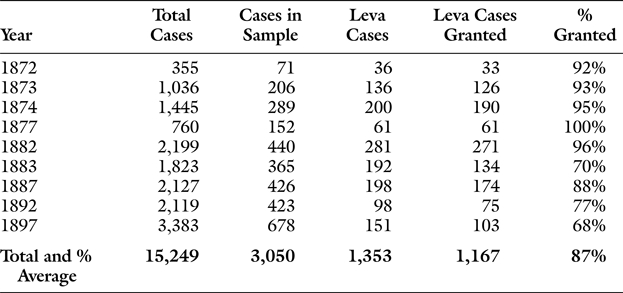
Along with the discharge orders to be found in the Ministry of Justice papers, the striking continuity of judicial opposition to the leva after 1882 is evident in the way these judicial cases were decided. Table 1, a random sample of 3,050 federal amparo cases for select years, provides a summary of the amparo cases initially consulted for the purposes of this article.Footnote 56
Leva Cases Granted from a Random Sample of Amparos for Select Years

Source: Based on a 20 percent random sample compiled by author from the Archivo Central de la Suprema Corte de Justicia de la Nación, Mexico City.
As Table 1 shows, most soldier-plaintiffs who filed amparo against the leva won their cases, but some did not. Who did not get amparo and why? There are three types of cases in which the federal judiciary consistently denied constitutional protection to individuals who filed amparo against their retention in the permanent army. Significantly, the reasons for denying amparo remained the same during this period. However, the number of cases denied could fluctuate considerably from year to year. In 1882, for example, only 4 percent of the leva cases decided by the Court were denied. In 1897, however, the percentage of denials in these cases was much higher—approximately 32 percent. Table 1 clearly shows that rates of success diminished in later years, but such differences cannot be attributed to changes in procedural legislation or judicial interpretation. Moreover, the total number of soldiers who successfully filed amparo remained much higher throughout this period than scholars have realized, a point we will return to in the next section.
The first type of case involved those who although illegally inducted into military service later consented to military service, either by renewing a volunteer contract or by accepting a promotion. In one such case, Jesús Martínez filed amparo in the district of Chihuahua against a three-year prison sentence for the military crime of desertion. Because he had been pressed into military service illegally, Martínez argued that he could not be tried and sentenced as a soldier for a military crime. Indeed, in many similar cases, the Supreme Court had interpreted constitutional article 16 to mean exactly this: namely, that soldiers who had not entered the service voluntarily (or by lottery) could not be tried for the crime of desertion. However, as both the public attorney and the district judge of Chihuahua pointed out, Martínez probably had been a victim of the leva, but his later acceptance of a promotion to the rank of sergeant demonstrated that he had consented to military service in the terms laid out in his contract. The judge denied him amparo against both the prison sentence and the act of retention on October 6, 1890. The Supreme Court confirmed this judgment nine days later in a unanimous decision.Footnote 57
A second type of case included those men who entered military service as a consequence of a lottery conducted in compliance with a state law. As already mentioned, few states actually regulated a lottery and those that did had their laws carefully scrutinized by the federal judiciary for their constitutionality. Thus, in the case of Puebla's lottery law of August 12, 1885, the Supreme Court usually granted amparo to those consigned by the state, even when it could be shown that the authorities had fully complied with the state law, because the Court considered the state law unconstitutional.Footnote 58 However, in other cases, such as those involving the application of Veracruz's lottery law of June 20, 1900, it was enough for the authorities to show that they had complied with all the requirements of the state legislation for a soldier to be denied amparo.Footnote 59
A third type of case included men who entered the army voluntarily. One María Josefa Gutiérrez, for example, filed an amparo for violations of articles 5 and 16 on behalf of her husband, soldier Pedro Nolasco. Nolasco claimed he had been a victim of the leva. He also claimed (and later proved) that he was insolvent and therefore unable to pay for the stamps that by law were to be included in the case file. However, the military authorities contested Nolasco's claim that he had been a victim of leva with a certified copy of Nolasco's contract. The army claimed that these documents proved that Nolasco had entered the army voluntarily in the city of Orizaba on May 28, 1885. Nolasco protested that the documents were fabricated but failed to provide any proof in support. The judge ruled against Nolasco, a decision the Supreme Court confirmed on April 27, 1886.Footnote 60 On November 11, 1889, one Manuel Hernández was also denied amparo on the basis of a contract. In the ruling against Hernández, the district judge of Tamaulipas in Tampico, cited five Supreme Court decisions from previous years to argue that this interpretation of the rules of proof was the established jurisprudence of the Court.Footnote 61
However, plaintiffs could always contest a contract with the testimony of two witnesses, and at least some soldiers did. In a case decided on January 12, 1881, for example, the Supreme Court granted amparo to one Ignacio Flores against the leva for constitutional violations of articles 5, 13, and 16. As in the Hernández case cited above, the military authorities contested Flores's claim, as set out in his amparo petition, that he had been illegally consigned to military service by submitting an official copy of a contract proving that he had entered the army as a volunteer. In this case, however, two witnesses testified that Flores had entered the army quarters one day as a carrier for a food vendor and had been pressed into service against his will by the battalion officer.
As the Supreme Court explained in its decision, the testimony of two witnesses invalidated the official documents (contrato y filiación) that appeared to support the army's justification of its retention of Flores. Moreover, because Flores had entered the army by leva and not as a volunteer, he could not be tried for the crime of desertion. Flores, who had been condemned to death by a military tribunal for desertion, received amparo against both the leva and the death sentence.Footnote 62 He may have been aided in his successful bid for amparo by a defense attorney appointed by the military in the desertion case, although the file makes no mention of a “defensor,” a figure that appears by name in other cases.
In another typical example, the second district judge of Veracruz granted amparo to one Higinio Vázquez against his forced retention in the eighteenth battalion. Although the authorities alleged that Vázquez had enlisted voluntarily, the judge cited the testimony of two witnesses to the effect that Vázquez had been forced to serve. The Supreme Court unanimously confirmed the first-instance decision, explaining that the authorities in question were notoriously guilty of an article 16 violation.Footnote 63
It seems likely, in light of the examples given here and others that are similar, that at least some of the soldiers who were denied amparo as “volunteers” were not really volunteers at all but were in fact victims of the leva. In most cases, however, amparo suits against the leva were won against the army without requiring any sort of proof or elaborate defense on the part of the plaintiff.Footnote 64 More often than not, military authorities corroborated the claims of soldier-plaintiffs who had been illegally pressed into service.
Military authorities did this in one of three ways. First, military authorities sometimes failed to submit a report of justification, in which case the district judge automatically granted the amparo in accordance with the established jurisprudence of the Court. Second, military authorities sometimes did submit a report of justification but then provided no supporting documentation, or faulty documentation. Thus, when military authorities did not provide a copy of a contract, or provided a copy of a contract that was not properly certified or did not meet the other requirements established by military law, federal judges decided in favor of the soldier-plaintiff.
In one such case, Alejandra Mora, alleging violations of constitutional article 5 against the leva, filed an amparo suit on behalf of her son Francisco before the district judge in Tabasco. However, because Mora provided no supporting documentation that he had been recruited against his will, the judge denied amparo. The Supreme Court, however, reversed the first-instance decision, granting amparo to Mora—first because the certified copy of the contract provided by the head of federal forces in San Juan Bautista had several errors of form, and second because the Supreme Court had established that the burden of proof in all such cases must rest with the authorities, not the soldier-plaintiff. In its decision, the Court cited the Roman law dictum, “What is customarily done can be presumed to be done.”Footnote 65
A third scenario was for the army to submit a certified contract to the judge that simply documented that a soldier had been illegally pressed, either by the army directly or by this or that state official. Upon receiving a report of justification from the chief of replacements (jefe de reemplazos) that one Pablo García had been forcibly consigned by the jefe político of Tecolotlán, the district judge in Jalisco concluded that “it is fully proven with the contract and reports already referenced that the plaintiff did not enter the army by means established by the law but was consigned against his will, violating in his person the rights contained in articles 5 and 16 of the Constitution,” a decision that was unanimously confirmed by the Supreme Court on December 11, 1885.Footnote 66 In another case, the second district judge of the Federal District granted amparo to Martiniano Arrieta for constitutional violations of articles 5 and 16 because, as the judge noted in his decision, Arrieta's contract demonstrated that he had been illegally consigned by the political authority of Texcoco.Footnote 67 The Supreme Court unanimously confirmed the first-instance decision within days of receipt and the Minister of War gave the order of discharge without protest or delay.Footnote 68 In a case from the state of Oaxaca, the commander of the sixth military zone cooperated fully with the federal judge. He supplied a copy of the soldier-plaintiff's contract and confirmed that the soldier-plaintiff, one Francisco Aguilar, had—despite the protestations of the jefe político who denied the allegations set out in the petition—indeed been illegally consigned by the political authorities of the state of Oaxaca. Citing the military zone commander's report, the district judge granted amparo for violations of constitutional articles 5 and 16, a decision unanimously confirmed by the Supreme Court.Footnote 69
Multiple additional examples could be cited, but the main point is that whenever the army failed to demonstrate with supporting documentation “that an individual … entered the army by means of lottery or voluntary enlistment, the federal judiciary … protected him.”Footnote 70 This quotation is taken from a judicial treatise written by Silvestre Moreno Cora, a highly esteemed jurist and justice of the Supreme Court, reflecting in 1902 on three decades of federal judicial cases against the leva. The case files analyzed here support his main conclusion.
How Many Soldiers Filed Amparo?
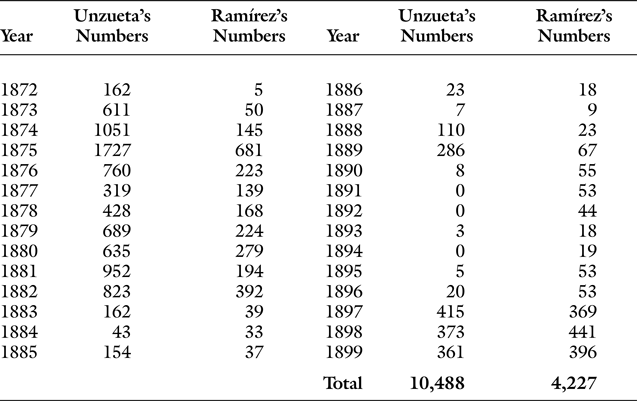
The exact number of soldiers who obtained their release against forced recruitment following an amparo decision is still unclear. Several historians have provided complete counts of the total number of cases filed.Footnote 71 However, as Table 2 shows, the complete counts provided by Mario Ramírez and Victoria Unzueta for the period from 1872 to 1900 diverge significantly for individual years. The difference in aggregate between their respective counts is more than 6,000 cases. My own estimate, based on a sample of cases for select years, comes close to the numbers provided by Unzueta for the period prior to 1882 but then diverges significantly in later years. How can these differences be accounted for?
Total Number of Amparos against the Leva from 1872 to 1899

Source: Ramírez Rancaño, Los amparos entre el Ejército Federal: 1898–1914; Unzueta, “La justicia militar.”
One possibility is that Unzueta came up with her case numbers by counting the carátulas, or jackets, of the individual case files. Many case files specify the type of case on the jacket, for example, “leva” or “CSA” (an abbreviation for forced conscription, literally, consignación al servicio de las armas) or “civil,” or “criminal,” and so on. Although all cases labeled as leva or CSA on the jacket appear to be leva cases, it becomes clear on closer inspection that not all leva cases are labeled as such. For example, I found only three jackets labeled as leva cases on the jackets for the year 1893. This is identical to the number provided by Unzueta (see Table 2).
In other words, one needs to read the file contents, not just the cover, to arrive at an accurate complete count. This is easier said than done, given that there are over a hundred thousand registered cases in the Supreme Court's central archive for this period. The discrepancy between actual leva cases and those that make reference to leva on the case jackets is especially true for the period after 1882, which would help explain why my estimates diverge from Unzueta's after this date.
But why are the complete counts provided by Ramírez so much lower than Unzueta's? Ramírez did not use the jackets of the individual case files; none of the numbers he provides approximate the number of cases listed as leva on the jackets. But he might have used the finding aids provided by the staff of the Supreme Court archive. Unfortunately, the finding aids in the Supreme Court archive regarding case type are woefully inadequate. The following comparison of my findings with the complete counts provided by Unzueta and Ramírez is intended to substantiate the claim that Ramírez's numbers are far too low for the entire period and that Unzueta's numbers are too low for the period after 1882.
For the three-year period starting January 1, 1872, and ending December 31, 1874, I counted 2,838 amparos sent to the Supreme Court from the various district courts for revision and sentencing. A random sample of 566 cases taken from this total yields 372 cases filed against forced recruitment in the army, approximately 66 percent of the whole. Out of these 372 cases, exactly 349 were granted, a success rate for soldier-plaintiffs of approximately 94 percent. Thus, extrapolating from those numbers, it seems likely that 1750 leva cases were granted by the Supreme Court out of a total of 1865 cases brought during this period.
These numbers are quite close to those presented by Unzueta of 1824 leva cases for the same period. However, Unzueta's numbers are quite a bit higher than the ones presented by Ramírez, who suggests in his study that only 200 cases were filed against forced recruitment into the army during this period. Footnote 72 The same also applies for the next three-year period, 1875 through 1877. By Unzueta's calculations, there were approximately 2,806 cases against forced recruitment; of those, 319 were from the second half of 1877. For Ramírez, there were 1,053 cases for those three years, 139 of which were from the second half of 1877. My own estimate for the second half of 1877 (the Supreme Court did not function during the first half) is that approximately 305 cases out of a total of 760 cases against forced recruitment were received by the Supreme Court. Again, my estimate is quite close to Unzueta's (319 cases) for the second half of 1877.
The counts of both authors diverge for later periods as well, but both show a rather dramatic decline in this type of case after 1882, with an increase in the years from 1897 to 1899. However, statistics published by the Supreme Court, as well as my own estimates based on random samples for select years, show a much more significant and consistent pattern of leva cases during the 1880s, with hundreds of cases each year being granted against the army.
In 1883, for example, my estimate is that 1,823 amparos were sent to the Supreme Court from the various district courts for revision and sentencing. A random sample of 365 cases taken from this total yields 192 cases filed against forced consignment in the national army, approximately 53 percent of the whole. Of these 192 cases, 13 were denied, 134 were granted, and 45 were stayed (sobreseimiento).Footnote 73 Far from a decline, it seems likely that the Supreme Court received upward of 959 cases against forced recruitment rather than the 39 instances cited by Ramírez or the 162 cases cited by Unzueta.
For later years as well, the number of amparos brought against forced recruitment into the military remained high. For 1887, for example, my estimate is that 2,127 amparos arrived at the Supreme Court. A sample of 426 cases taken from this total yields 198 cases filed against forced consignment in the national army, approximately 46 percent of the whole. Of these 198 cases, 174 were granted, a rate of approximately 88 percent. It seems likely, then, that the Supreme Court granted around 870 amparos out of a total number of 989 cases filed against forced recruitment into the military in 1887. Unzueta, however, reports only 7 cases filed against the leva in 1887.
The Supreme Court also published lists of granted leva cases for select months during the 1880s. The lists support the claim that the number of forced recruitment cases remained quite high, even after the passage of new procedural legislation in 1882. In January of 1885, for example, the Supreme Court reported that 49 cases had been granted against forced recruitment and retention in the armed services.Footnote 74 The same periodical reported 113 granted cases in February, 69 granted cases in March, 70 granted cases in April, and 159 granted cases in July. Although no cases were reported for the months of June or December, the numbers of cases reported for the other months add up to at least 763 cases granted against forced recruitment and retention in the armed services for the year 1885.Footnote 75 Since it is highly unlikely that there were no CSA cases for the months that went unreported, it is certainly possible that more than 800 cases were granted against forced recruitment in 1885. (Ramírez, however, suggests that there were fewer than 37 for the entire year.) In 1888, the Supreme Court reported more than 600 cases granted against forced recruitment into the military.Footnote 76 In 1889, it reported another 600.Footnote 77
The Supreme Court did not publish complete lists for any of the months in 1890 or 1891.Footnote 78 But I estimate that in 1892 the Supreme Court granted 375 amparos out of a total 490 forced recruitment cases—a significant number but still a noteworthy decline from the number of cases granted in 1888 and 1889. Nor is there reliable data for the years 1893, 1894, 1895, or 1896. Did the number of amparos against the military slow to a trickle during this period, as suggested by Ramírez and Unzueta? This seems unlikely, although more research is needed.Footnote 79 Indeed, I estimate that 753 forced recruitment cases were received by the Supreme Court in 1897, and of those 514 were granted. This is more than twice the estimate provided by Ramírez (369 cases) and a little less than twice the number provided by Unzueta (415 cases).
The Ministry of War also published statistics on amparos filed by soldiers against military service. Unfortunately, as with the Supreme Court statistics just mentioned, these statistics were published sporadically and help us for only a handful of years. In its Memoria of 1881, the Ministry of War observed that from December 1877 to May 1881 there had been 1,720 amparos granted to soldiers against their recruitment and retention in the armed forces, an average of 480 amparos granted per year. In its report to congress of 1883, the Ministry of War noted that 402 amparos had been granted for the subsequent period, running from June 1, 1881 to May 31, 1882. In its report of 1884, however, the Ministry of War noted a significant jump, so that from June 1, 1882 to May 31, 1883, the number of amparos granted was 911.
Although Ramírez cites these numbers, he notes that they refer to the number of cases received at the first instance or district level and not to the amparo decisions of the Supreme Court. He therefore concludes that the discrepancy between these published numbers and his own estimates for forced recruitment cases in the Supreme Court probably indicates that “for the period 1872–1900, less than half of all amparos made it to the sphere of the Supreme Court for their revision and confirmation.”Footnote 80 However, this cannot be correct: the three amparo laws in force during this period required that all amparos be reviewed and decided by the Supreme Court.Footnote 81
Unfortunately, the statistics published by the Ministry of War do not give us a complete picture for the period under study. Nor is the published case record, reissued by the Mexican Supreme Court in 2005 as a DVD titled Jurisprudencia histórica y otros documentos de la época, 1870–1910, a reliable source for getting a sense of the quantity of judicial cases being decided. This too has been a source of confusion in the literature. Even though we do not have an accurate total count, this article has argued that more soldiers won their freedom using federal courts than historians have previously realized. During the last two decades of the nineteenth century, hundreds of soldiers a year petitioned the federal judiciary for their freedom from forced recruitment. In contrast to what has been suggested by the recent literature, there does not appear to have been a drastic decline after 1882 in the total number of amparo petitions.
Conclusion
Counting judicial case files is tedious but important work. Two conclusions mentioned above bear repeating. The first is that the published record is unreliable if one is interested in the question of how many cases of a certain type were decided by the federal judicial power. The second is that both the finding aids provided by the Supreme Court for the Supreme Court archive and the jacket covers of individual case files are unreliable. The way forward, at least for the time being, is to disregard the finding aids and read the cases.
There are larger interpretative questions at stake as well. Critical histories of the nineteenth century have long emphasized the Porfirian regime's “serial abuse of constitutional norms and its increasing authoritarianism.”Footnote 82 A rather extreme formulation of this view that continues to be shared by many historians today goes back to Daniel Cosío Villegas's 1957 classic La Constitución de 1857 y sus críticos, in which he wrote:
The real truth is that the Constitution of 1857 did not really function except for the years from 1867 to 1876 or, a little more generously, until 1880; that is, in the first case it worked only 10 years, and 13 in the second. It could not work earlier because the Three Years’ War, the French Intervention, and the Empire prevented it; and it could not function after 1876, or 1880, because once Porfirio Díaz felt secure in power, he put [the constitution] to one side, turning it into empty words … devoid of meaning.Footnote 83
Yet historians of the Porfiriato have rarely mentioned, let alone studied, federal judicial cases.Footnote 84 There is a paradox to be resolved. The regime consolidated in the wake of the Tuxtepec Revolution is said to have turned its back on the civil liberties enshrined in the Constitution of 1857. Unconstitutional practices of military recruitment have often been cited in support. However, during this very same period, the federal judiciary was deciding thousands of constitutional cases related to the protection of personal liberty—cases that only a few historians have studied.
Despite my disagreements with Ramírez and Unzueta, we all agree that victims of the leva were drawn overwhelmingly from the lower ranks of society, and so it is possible to extend the main conclusions of this article one step further. When the federal judiciary decided an amparo in favor of a regular soldier, it was enforcing the civil liberties of a non-elite member of Mexican society. If decisions like the Álvarez case with which this article began were not unique—and this article has argued that they were not—then what other rights were being protected by the federal judiciary during this period, and for whom? Answers to these and similar questions are certainly relevant to larger interpretive questions of the period. But they will ultimately depend on an accurate quantitative estimate of the universe of data in these (and other) types of amparo cases.