I
The history of central banks is rich in modifications to their role and functions (Goodhart Reference Goodhart1988; Lastra Reference Lastra1996). In the last 30 years – before the 2008 financial crisis – the mandate of central banks has been progressively narrowed. In a large number of countries, central bank mandates have focused on the area of monetary policy and zoomed in on the goal of price stability. At the same time, this narrowing of the mandate has been accompanied by changes in their governance arrangements. The pillar of central bank governance has been identified with an increasing degree of independence.
By the early 2000s a significant number of countries had adopted a well-defined central bank governance: the independent agency had become increasingly specialised in achieving monetary policy goals, and, consequently, its traditional responsibilities in pursuing financial stability became progressively less important. By now, the 2008 financial crisis (hereafter, ‘the crisis’) is posing new challenges to modern central banking models, in which monetary policy is conducted by an independent central bank which follows an interest rate rule-based approach to stabilise inflation and output gaps (Goodhart et al. Reference Goodhart, Osorio and Tsomocos2009; Aydin and Volkan Reference Aydin and Volkan2011; Curdia and Woodford Reference Curdia and Woodford2011; Giavazzi and Giovannini Reference Giavazzi, Giovannini, Eijffinger and Masciandaro2011; Gertler and Karadi Reference Gertler and Karadi2011; Goodhart Reference Goodhart2011a; Hefeker and Zimmer Reference Hefeker and Zimmer2011; Issing Reference Issing2012; Woodford Reference Woodford2012; Cohen-Cole and Morse Reference Cohen-Cole and Morse2013; Cukierman Reference Cukierman2013; Ueda and Valencia Reference Ueda and Valencia2014).
Following this crisis, a significant number of reforms are taking place, which concern in particular the central bank's role in the structure of supervision. For example, the US legislature passed the Dodd–Frank Act in 2010 which rethinks the role of the Fed as part of the reshaping of financial supervision. Even if during the discussion of the bill US lawmakers debated the possibility of restricting some of the Fed's regulatory powers, as well as increasing political control over the central bank, the Dodd–Frank Act actually ended up increasing the responsibilities of the Fed as prudential supervisor (Komai and Richardson Reference Komai and Richardson2011; Gorton and Metrick Reference Gorton and Metrick2013). In Malaysia, the 2009 Central Bank Law provided for greater involvement of the central bank in supervision (Siregar Reference Siregar2011). Worldwide, in the current evolution of the Basel Capital Accord (Basel III), the activation of countercyclical macro-prudential measures has been put in the hands of central banks (Goodhart Reference Goodhart2011b).
In Europe, policymakers are moving to finalise reforms concerning the involvement of central banks in supervision both at the regional and national levels. In 2010, the European Systemic Risk Board (ESRC) was established to provide macro-prudential supervision, and this new institution is dominated by the European Central Bank (ECB).Footnote 1 Furthermore, in 2012 the heads of states and governments of the eurozone started the process of establishing the European Single Supervisory Mechanism (SSM), which entered into operation in November 2014, and assigns banking supervision to the ECB together with the national supervisory authorities of the participating member states.
Concerning individual EU members, in 2011, with the new Banking Act, the German government dismantled its unified financial supervisor (BaFiN) in favour of the Bundesbank, which is now the main banking supervisor. In 2013, the UK government put the key prudential functions of the Financial Services Authority (FSA) within the purview of the Bank of England. In 2010, the Irish Financial Services Regulatory Authority was legally merged with the central bank. Furthermore, an analysis of the reforms undertaken in Bulgaria, the Czech Republic, Estonia, Hungary, Latvia, Poland and Slovakia reveals that the trend towards supervisory consolidation has not resulted in smaller central bank involvement (Filipova et al. Reference Filipova, Csongraádi, Apinis, Foit, Kotkas, Bodzioch, Porzycki and Vetraák2010; Masciandaro and Romelli Reference Masciandaro and Romelli2015). In this respect, it is interesting to note that before the crisis the national central banks were the main banking supervisor in less than half the EU countries (13 out of 27). After the crisis, with the establishment of new supervisory regimes in Belgium, France, Germany and United Kingdom, the main prudential supervisor is now the central bank in more than half of them (17 out of 27).
These episodes are likely to provide signals of a sort of back to the future in central banking governance, given that before the crisis the direction of changes in the supervisory structure had been characterised by a greater separation of central banking from supervision (Masciandaro and Quintyn Reference Masciandaro and Quintyn2009; Orphanides Reference Orphanides, Eijffinger and Masciandaro2011; Eichengreen and Dincer Reference Eichengreen and Dincer2011; Masciandaro Reference Masciandaro2012a,Reference Masciandarob; Blancheton Reference Blancheton2015).
Yet what could be the effects of this evolution on central bank independence (CBI)? The crisis is posing new challenges to modern central banking models, where monetary policy is conducted by an independent central bank that follows an interest rate rule-based approach to stabilise inflation and output gaps. In other words: how should the ongoing central banking reforms be interpreted with respect to the never-ending debate on independence?
In this article, we analyse these issues from three perspectives. First, we provide a critical review of the economics of the key feature of modern central bank governance, i.e. independence, focusing on what could be the determinants of a given institutional setting. Second, we build a political economy model that highlights the drivers that can explain the optimal design of central bank governance when citizens delegate to policymakers the design of central bank independence. This framework is then used to evaluate the evolution of central bank governance before and after the crisis in the light of the recent reforms. We argue that changes in the preferences of both politicians and citizens can explain the ups (before the crisis) and downs (after the crisis) in the level of central bank independence.
We support our interpretation with empirical evidence of the evolution of central bank independence in a sample of 45 countries over the period 1972–2014. Employing recently developed indices of dynamic central bank independence, we show that the evolution in the design of central banks appears to be in line with our theoretical conjectures. We first document a trend towards decreasing the level of central bank independence measured by the Grilli et al. (Reference Grilli, Masciandaro and Tabellini1991) index in the post-crisis period. We then show that this decrease in independence is associated with countries that are more likely to experience deflationary, fiscal and unemployment shocks. This empirical evidence provides strong support for our theoretical arguments that macroeconomic shocks can alter the political costs of choosing the level of independence of central banks.
The remainder of this article is organised as follows. In Section ii we review the design of central bank governance over the past decades. In Section iii we present the set-up of our theoretical model, while in Section iv we use this model explain the evolution of central bank governance before and after the crisis. Section v presents the empirical evidence, while Section vi concludes.
II
Up to 30 years ago, economic theory did not attribute importance to the concept of central bank governance. These institutional arrangements became important when economic theory started stressing their role in determining macroeconomic performance, i.e. during the New Classical Revolution, with the role of central bank design being confirmed in the New Keynesian analysis of monetary policy.Footnote 2
The theoretical bottom line can be summarised as follows: policymakers tend to use monetary tools with a shortsighted perspective, using the inflation tax to smooth different kinds of macroeconomic shocks and trying to exploit the tradeoff between real gains and nominal (inflationary) costs.Footnote 3 This inflation tax finances the stabilisation policies. However, the more efficient markets are, the greater the risk that the shortsighted monetary policies produce just inflation. In fact, rational private agents fully anticipate the political incentives to use the inflation tax, fully adjusting the nominal variables. In this framework, the Friedman–Lucas proposition on monetary policy neutrality holds (Friedman Reference Friedman1968; Lucas Reference Lucas1973). Furthermore, the political inflation bias can dynamically generate greater uncertainty and negative externalities (such as moral hazard risk). As a result, the inflation tax is inefficiently used in a systematic way, becoming potentially high and volatile and producing only macroeconomic distortions.
Inefficient use of the inflation tax has been empirically confirmed since optimal taxation theory does not find any support in the data.Footnote 4 Optimal taxation theory claims that the benevolent policymaker chooses the rate of any taxation – including the inflation tax – to minimise the present value of the social cost; consequently inflation and tax rates have a positive relationship. If the optimal taxation theory fails empirically, it is natural to conclude that the government is not benevolent, being affected by inflation biases.Footnote 5
Therefore banning the use of the monetary policy for inflation tax purposes became the social goal. This institutional setting gained momentum and the relationship (governance) between the policymaker – who designs the overall economic policy – and the central bank – who is responsible for the monetary policy – became crucial in avoiding the inflation bias. Furthermore, the more markets were rational, the more the rules of the game between policymakers and central bankers gained momentum.Footnote 6 Thus, the optimal central bank governance has to be essentially a medal with two sides.
On the one hand, the central banker has to be independent, i.e. the central bank enjoys the ability to implement the non-inflationary monetary policy without any external (political) short-sighted interference. The central banker becomes a veto player against inflationary monetary policies. On the other hand, the central banker has to be conservative, where conservativeness refers to the importance that he/she assigns to price stability in its relation to other macroeconomic objectives. The conservativeness is the necessary step to avoid the central banker himself/herself becoming a source of inflation bias. Independence and conservativeness become the conditions for implementing credible non-inflationary monetary policies.Footnote 7 Independence can be considered a devise for implementing conservative monetary policies.Footnote 8 However, private agents trust the central banker only if effective rules on accountability and transparency hold. In other words, a conservative central bank is credible if it works in an institutional setting that guarantees independence and accountability, acting in a transparent way and implementing an effective communication policy.Footnote 9
The relationship between independence and accountability represents the core of the so-called central bank governance (Briault et al. Reference Briault, Haldane and King1996; Morris and Lybek Reference Morris and Lybek2004; Frisell et al. Reference Frisell, Roszbach and Spagnolo2008; Crowe and Meade Reference Crowe and Meade2008; Hasan and Mester Reference Hasan, Mester, Siklos, Bohl and Wohar2010). Central bank governance became the institutional setting for implementing the day-by-day monetary policy: given the long-run goal of avoiding the risk of inflation, the modern central banker can also smooth the real business cycles using monetary policy rules (Bernanke and Gertler Reference Bernanke and Gertler1995; Gertler et al. Reference Gertler, Gali and Clarida1999; Woodford Reference Woodford2003; Gali and Monacelli Reference Gali and Monacelli2005; Taylor Reference Taylor1993; Henderson and McKibbin Reference Henderson and McKibbin1993; Persson and Tabellini Reference Persson and Tabellini1993; Walsh Reference Walsh1995; Svensson Reference Svensson1997).Footnote 10 Monetary policy becomes the final outcome of a complex interaction between three main components: monetary institutions, central banker preferences and policy rules.
In this article, our variable of interest is the optimal degree of central bank independence (CBI), other things being equal, including the rules on accountability and transparency.
For our purposes, the huge CBI literature can be described as a two-stage process.Footnote 11 Initially the scholars involved in the field went on to verify the theoretical conjectures with comparative, institutional and empirical analysis. After constructing indices of independence of the central bank, and having historical alternative models of independent and dependent monetary authorities, the literature has attempted to determine whether the degree of independence could be considered a driver in explaining the most important macroeconomic phenomena: inflation, public debt and interest rates, income and growth.Footnote 12
The assumption was to verify if the existence of the monetary veto player reduces the intended and unintended effects of the misuse of the inflation tax and produces positive spillovers on other macro variables. In the first wave of studies, central bank independence was essentially considered an exogenous (independent) variable that can be useful to explain macro trends.
The step forward in the research was to consider the degree of CBI as an endogenous (dependent) variable that has to be explained.Footnote 13 Which are the drivers that can motivate the decision of one or more countries to maintain or reform their monetary regimes, i.e. the degree of independence of their central banks? Why and how are policymakers forced to implement monetary reforms that reduce their powers in using the inflation tax, increasing the degree of independence of the central bank?
Various interpretative hypotheses have been advanced to explain the genesis of the political process that leads a monetary regime to assume given characteristics. Development in endogenising central bank independence – i.e. its effectiveness – has been the subject of analysis in both economics and political science.Footnote 14
Some scholars sustain the possibility that the degree of CBI depends on the level to which constituencies strongly averse to the use of the inflation tax are present, which drives policymakers to bolster the status of the central bank (the constituency view).Footnote 15 Others have stressed that aversion to the use of the inflation tax is structurally written into the features of the overall legislative and/or political system, which influences the policymakers’ decision on whether to have a setting of monetary powers with an independent central bank (the institutional view).Footnote 16 Others have stressed the role of culture and tradition of monetary stability in a country in influencing the policymaker's choices (the culture view) (Berger Reference Berger1997; Berger et al. Reference Berger, De Haan and Eijffinger2001).Footnote 17 These three views share the role of the preferences of the citizens in determining the degree of CBI. In the constituency view, the present preferences against the use of the inflation tax are relevant; in the institutional and culture views, the past anti-inflationary preferences influence the present policymaker's decisions.
Furthermore, it is worth noting that the three views can be intertwined in studying the economic, institutional and cultural conditions under which reforms of CBI do or do not take place. It is also evident that these studies acquire greater importance in periods – such as the present one – when there is a tendency to reform, or at least to question, the design of the central bank governance.
All in all, the review of the literature shows that, whatever the view adopted in explaining the evolution of CBI, we have to focus our research attention on two crucial elements: on the one hand, the social preferences; on the other hand, the incentives and constraints that shape the behaviour of the agent responsible for the monetary setting design, i.e. the incumbent policymaker.
III
In this section, we study the design of the central bank governance using a delegation framework, which we consider an efficient way to take into account the abundant, consolidated and still growing literature on the topic reviewed in the previous section.
In doing so we adopt a political economy approach, arguing that the policymaker's actual choices relating to the central bank governance are conditional on the economic and institutional environment existing at a given time, which in turn determines the political weights put on the pros and cons of CBI.
Our framework is based on two hypotheses.Footnote 18 First of all, gains and losses of a given central bank setting are variables computed by the incumbent policymaker, who maintains or reforms the central bank regime following his/her own preferences. Secondly, policymakers are politicians, and as such, they are held accountable at elections for how they have managed to please voters. All politicians are career-oriented agents, motivated by the goal of pleasing voters in order to win elections. The main difference among various types of politicians concerns which kinds of voters they wish to please in the first place. Therefore, CBI is likely to change over time following political preferences, which are not automatically coincident with the social ones.
Consider an economy with rational expectations and uncertainty. We suppose that the citizens dislike monetary settings where the incumbent governments can manage the monetary policy directly and discretionally. The citizens know that the politicians may have an incentive to inflate the economy to address different kinds of macroeconomic shocks. In other words, politicians have an incentive to use the inflation tax systematically.
As a result, rational citizens fully anticipate this political inflation bias and the monetary policy's risk in producing an inflation cost without any real gains. All the citizens or at least the majority of the voters dislike the use of the inflation tax and like monetary stability, which means that the government cannot systematically use inflation to change the income and wealth distribution. Hence, we are studying a democracy where citizens dislike the political inflationary biases.
The political biases can be explained in several alternative and, at the same time, complementary ways:
(a) First of all, there may be advantages – both for electoral and ideological reasons – brought about by an inflationary policy (partisan bias);
(b) Secondly, governments may try to increase the employment level (employment bias);
(c) Thirdly, a fiscal temptation may arise: the government may have the incentive to use the monetary policy to make the costs of fiscal policies less onerous in economic or political terms (fiscal bias);
(d) Fourthly, the government may have the temptation to bail out banks through monetization (banking bias);
(e) Finally, the government may have the incentive to use accommodative monetary policy to face balance of payment imbalances (foreign exchanges bias).
In all these cases, the government gives a higher expected value to the short-run benefits relative to the long-run costs of the inflation tax. However, citizens understand the political bias and rationally adjust their expectations: in equilibrium, there is inflation above the socially optimal level and no real effects. Therefore, if the government is the monetary policy authority, monetary policy is likely to be time inconsistent: no pre-announced monetary path is credible.
Here is where central bank independence comes in. CBI becomes a possible institutional device for facing political bias: the monetary policy is delegated to an unelected bureaucracy – the central bank – which is committed to pursuing the goal of monetary stability (conservativeness) – i.e. to avoid any inflationary bias – and it is both independent of the government and accountable to the parliament. The citizens acknowledge that the definition of the optimal level of CBI means exploiting the tradeoff between avoiding the inflationary bias in normal times and having a stabilization device in extraordinary times.
Citizens care about the effectiveness of the central bank regime according to a classic well-behaved concave function u = U(y): social welfare increases with the optimal level of CBI. Linear preferences are used:
 $$U\left( y \right)\; = \; y$$
In a democracy, citizens assign to the elected policymaker the task of designing the optimal level of CBI, i.e. the setting that guarantees the monetary policy effectiveness. For the sake of simplicity, we suppose that the elected policymaker represents both the legislative and the executive powers, i.e. the interests of the majority of the parliament and of the government in charge are perfectly aligned.
The incumbent policymaker is delegated by society to define and implement the optimal level of CBI. The policymaker reward is based on how he/she (hereafter she) carries out her job, i.e. defining and implementing the level of CBI.
Our policymaker is a politician. We assume that the policymaker wishes to please the citizens; alternatively, we could also assume that the policymaker's aim is to please specific constituencies, i.e. the lobbies. Nonetheless, in this article, we adopt the helping hand view of the policymaker's type: she wishes to please citizens rather than a particular constituency or lobby (grabbing hand view). It will be interesting to demonstrate that, notwithstanding the fact that the policymaker wishes to please the citizens, the final outcome – the actual CBI – can be different from the socially optimal one.
The level y of CBI is determined by the policymaker's ability Ω and by her effort a:
 $$y\; = \; a\; + \; \Omega $$
Let us describe the delegation framework. The sequence of events is as follows:
(1) Society chooses to delegate to the policymaker the task of designing the optimal level of CBI;
(2) Next, the policymaker chooses effort a, before knowing her ability Ω in implementing this particular task (building up CBI is not a usual nor a day-by-day operation);
(3) The policymaker implements the CBI regime, revealing her ability Ω;
(4) Citizens observe the CBI level, but not the relationship between effort and ability, since they cannot distinguish innate talent from contingent effort, and reward the policymaker for this task.
Coming back to the policymaker, her utility function, denote by Z HH, is defined as:
 $${Z_{HH}} = R\left( U \right) - C\left( a \right)$$
where R(U) is the reward function and C(a) is the cost function. The political reward is a function of the social utility, while the political costs are a function of the effort involved in implementing the task. The policymaker evaluates every task assignment while taking into account the political rewards and costs in doing so. Let us describe the three crucial features of the policymaker:
(A) Ability: the ability of the policymaker is a random variable with the usual normal distribution (where we denote by ΩAV the mean);
(B) Political reward: The incumbent policymaker wishes to be re-elected. The government needs to provide enough utility to the majority of voters; then her utility function is the social welfare function U.
In general, the policymaker wishes to please voters and her goal is the alignment of interest between her and the citizens. Then each delegated task – i.e. each specific alignment – can be more or less convenient from the policymaker's point of view in terms of political gains. We denote the political value she assigns to fulfil the specific task on CBI by β – with 0 ≤ β ≤ 1. Therefore:
 $$R\left( U \right) = \beta U$$
The alignment of incentives between the policymaker and citizens is a necessary and sufficient condition for finding the optimal behaviour of the policymaker. One more step is necessary to find out the effective political reward. The reward will be useful if the citizens' utility exceeds the minimum threshold of utility W that they expect from an incumbent government (political competition condition). Citizens compare government performance with the expected performance of outside politicians. The political competition condition can be defined as follows:
 $${R_{HH}} = \beta {\rm Pr}\left( {U \ge W} \right)$$
Therefore, the usefulness of the political reward will depend on condition (4).
(C) Political costs: The policymaker knows that if monetary policy is delegated to an independent bureaucracy committed to a monetary stability goal, rigidities in implementing accommodative policies (conservative veto player event) may arise: the inflation tax cannot be used to finance stabilization policies.
In other words, we assume that from the policymaker's point of view the political costs of implementing a CBI regime will depend on her expectations of facing at least one of five different situations calling for a lax monetary policy during her term of office, which cannot be implemented given the existence of a non-accommodative central banker:
(1) Political shocks (PS);
(2) Unemployment shocks (ES);
(3) Fiscal shocks (FS);
(4) Financial shocks (FINS);
(5) Foreign exchange shocks (FES).
From the citizens' point of view, the government can be a natural scapegoat in each crisis, but it is not able to control monetary policy tools to implement the right short-sighted policy. In each case, the government is likely to be blamed; political costs will arise.
Therefore, the policymaker's cost function can assume the following simple specification:
 $$C\left( a \right) = c{a^2}$$
where, c = c 0 + c 1(probPS + probES + probFS + probFIN + probFE) and prob represents a probability between zero and one that each shock occurs.
Thus, the political cost of the effort involved in establishing CBI depends on how the incumbent government is blamed when the shocks occurred, i.e. on the size of reputation losses.
When a shock occurs, citizens can be more or less sensitive to the use of accommodative policies. From the government's point of view, the crisis likelihood per se is not relevant, but its political cost affects its reputation. The reputation factor is represented by the parameter c 1. For the sake of simplicity, we assume: (a) that the negative effect on the government's reputation is the same irrespective of the type of shock; and (b) the shocks are independently distributed.
We will see in what follows that the size of the reputational costs can determine the difference between the optimal CBI and the actual one. As a result, for the incumbent policymaker the political cost in building up a CBI regime is represented by the likelihood of facing a macroeconomic crisis without the possibility of implementing the desired ad hoc short-sighted monetary policy.
IV
We can now use this theoretical skeleton to mimic the evolution of central bank governance in advanced countries before and after the crisis.
Establishing a level of CBI is a two-step process: (i) defining the policymaker effort and (ii) evaluating the level of CBI. In defining her optimal effort a 1, the policymaker maximises her objective function. Then her ability ΩHH becomes evident, the level of CBI can be evaluated using the CBI equation (2) and her final political reward can be calculated using the political competition equation (4). It follows that the policymaker maximises social welfare net of costs of executing the task:
 $$Max\; {Z_{HH}} = R\left( U \right) - c({a_1})\comma$$
where,
 $$R\left( U \right) - c({a_1}) = \; \beta U - c({a_1})$$
Given that the level of social utility is equal to the level of CBI, which is a function of the policymaker effort, it is evident that both the rewards and the costs depend on the effort:
 $$\; \beta \left( {{a_1} + {\rm \Omega}} \right) - ca_1^2 $$
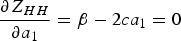
From the first order condition the optimal effort will be:
 $$\displaystyle{{\partial {Z_{HH}}} \over {\partial {a_1}}} = \beta - 2c{a_1} = 0$$
implying that:
 $${a_1} = \displaystyle{\beta \over {2{c_1}}}$$
Given a 1, the effective political reward of the policymaker will depend on the condition of political competition (4):
 $${R_{HH}} = \beta {\rm Pr}\left( {U \ge W} \right)$$
Voters are rational. They realise that the alternative to re-electing the incumbent policymaker is to get another politician with average ability. Given their expectations a e on effort, it follows that:
 $$W = {a^e} + {{\rm \Omega} _{AV}}$$
Then:
 $${R_{HH}} = \beta \Pr \left( {{\rm \Omega} + {\rm \;} {a_1} \ge {{\rm \Omega} _{AV}} + {a^e}} \right)\; $$
 $${R_{HH}} = \beta \Pr \left( {{\rm \Omega} - {\rm \;} {{\rm \Omega} _{AV}} \ge {a^e} - {a_1}} \right)$$
Nature chooses the ability of the incumbent policymaker, ΩHH. It follows that:
 $${R_{HH}} = \beta \Pr \left( {{{\rm \Omega} _{HH}} - {\rm \;} {{\rm \Omega} _{AV}} \ge {a^e} - {a_1}} \right)\; $$
When expectations are perfectly matched (a e = a 1), the effective political reward will be positive if the ability of the incumbent policymaker is greater than average:
 $${{\rm \Omega} _{HH}} \gt {\rm \;} {{\rm \Omega} _{AV}}$$
The equilibrium level y of the CBI will be determined by the policymaker's ability ΩHH and by her effort a 1:
 $${y_{HH}} = {a_1} + {{\rm \Omega} _{HH}} = \displaystyle{\beta \over {2{c_1}}} + {{\rm \Omega} _{HH}}$$
Given the exogenous ability of the policymaker, on one hand the level of CBI depends on how politically relevant it is for the government to build up a central bank regime pleasing the majority of voters, who dislike the inflation tax as a tool of economic policy. In other words, the level of CBI depends on the policymaker's perception of the relevance of the central bank setting matters. On the other hand, the government takes into account the expected costs of facing a conservative veto player in monetary affairs when macroeconomic shocks have to be addressed.
The parameter c 1 can be easily used to show the conditions under which the actual level of CBI is different from the socially optimal one. In fact, we can suppose that the citizens acknowledge the need in extraordinary times to address shocks using the inflation tax, which is perfectly consistent with the aim of avoiding the inflationary bias in normal times. The socially optimal value of the reaction parameter  ${c_1}^{soc} $ is different from zero: for the sake of simplicity, we can assume that:
 $${c_1}^{soc} = 1.$$
Now, if the reputational costs for the government in facing macroeconomic shocks is particularly high, it is likely that  ${c_1} \gt {c_1}^{soc} $. Consequently, the actual level of CBI designed by the policymaker will be lower than the socially optimally one.
What was the situation before the crisis? In the three decades before the 2008 financial meltdown safeguarding monetary stability became a primary goal in many advanced, emerging and less developed countries alike, and CBI was the chosen institutional device for raising the commitment to avoid the use of the inflation tax. The expected high political gains pushed several governments all around the world to enhance the degree of CBI in their countries, accepting the restriction on their future freedom to use the inflation tax through the presence of a veto player.Footnote 19 The monetary policy action was associated with less variance in both inflation and output (Bernanke Reference Bernanke2004; Taylor Reference Taylor2013).
Then the crisis came. Is it possible to identify the potential drivers of CBI reform after the 2008 financial meltdown? In general, we assume that the gains and losses of a CBI regime are variables computed by the incumbent policymaker, who maintains or reforms the central bank regime, following her preferences. Therefore, any situation that influences the policymaker's gains and costs in changing the monetary regime can produce incentives to modify the CBI level.
First, consider the case in which society's aversion to inflation is decreasing. In our model, this would correspond to a decrease in the parameter β, which would, in turn, decrease the gains from maintaining/adopting a high level of CBI. Nowadays in advanced economies both inflation and inflation expectations seem to be stable at low but positive levels and the same is true for inflation volatility.Footnote 20 Thus, pressure from voters to increase the level of CBI is unlikely. Furthermore, if deflation becomes a concrete macroeconomic problem, political pressures can arise to reduce the central bank's conservativeness and/or the CBI.Footnote 21
Second, any situation that changes the policymaker's political costs c 1in reforming the monetary regime can produce incentives to modify the degree of CBI. The policymaker's incentives to decrease the level of CBI in order to be able to implement monetary accommodation are likely to increase if the incumbent governments are facing macroeconomic shocks. Our theoretical model discusses five types of macroeconomic shocks likely to influence the policymaker's costs. In the post-crisis period, two of these have had a greater weight: (1) public deficit financing and (2) unemployment shocks. The large public deficits and unemployment rates, which characterised many advanced and emerging economies alike in the post-crisis period, are likely to have exerted a great influence on the political costs associated with a high level of central bank independence, thus creating incentives to decrease the level of CBI.
In conclusion, our simple theoretical framework highlights how changes in either political and/or citizen preferences can explain the ups – before the crisis – and downs – after the crisis – in the level of independence. In the next section, we investigate empirically whether the evolution of CBI prior to and post the global financial crisis is in line with our theoretical arguments.
V
This section provides empirical evidence that sheds light on the evolution of the level of CBI prior to and post the global financial crisis.
The literature on CBI generally uses two different strategies to capture the degree of independence of a central bank: (a) indices based on central bank legislation (de jure), or (b) on the turnover rate of the central bank governor (de facto). In this article, we only consider de jure indices that capture the degree of CBI for several reasons. First, turnover rates relate the independence of central banks to the autonomy of their governors. While extensively used, this approach has been shown to be less robust in empirical estimations than the GMT index of legal independence (Maslowska Reference Maslowska2011). Second, our aim in this article is to capture the decrease, if any, in the level of CBI post 2007. Given that many post-crisis reforms have been related to the involvement of the central bank in supervision, we restrict our attention to de jure indices that can capture such changes.Footnote 22
We consider the two main dimensions along which de jure independence is usually measured: political and economic independence (Grilli et al. Reference Grilli, Masciandaro and Tabellini1991; Debelle and Fischer Reference Debelle and Fischer1994; Fisher Reference Fisher1995). Political independence refers to the discretion given to the central bank in the design and implementation of policies consistent with the monetary stability goal. Economic independence is related to the freedom of the central bank in choosing the set of instruments consistent with monetary policy. Therefore, more central bank involvement in supervision weakens the priority of monetary stability and, as a result, lowers the degree of independence of the central bank.
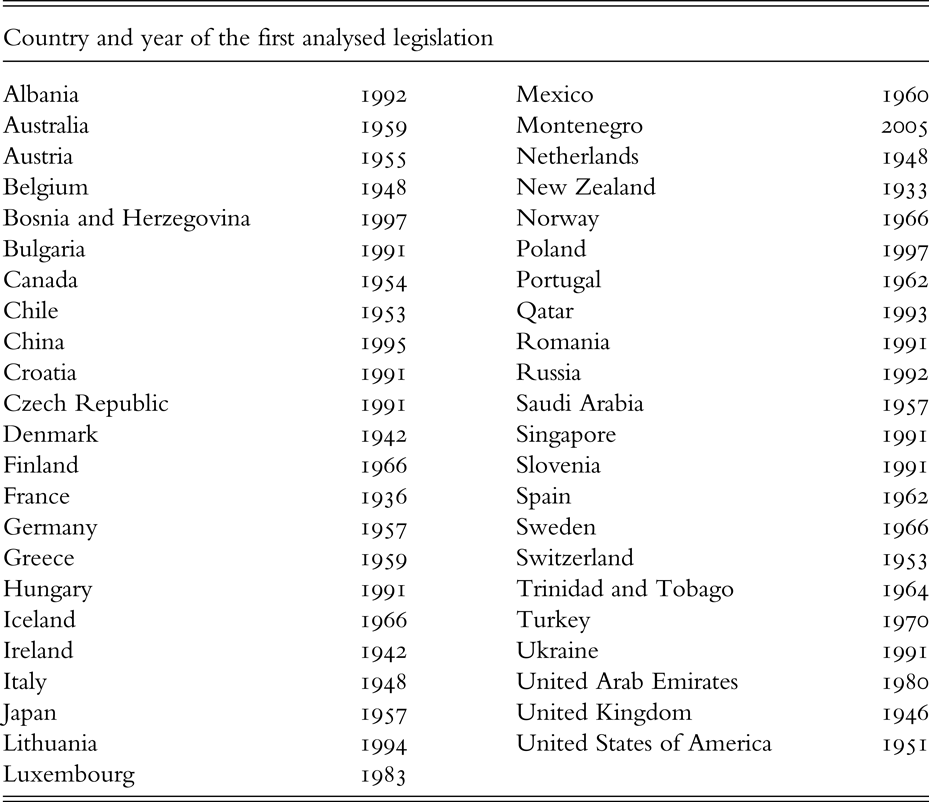
Despite the wealth of research on central bank independence indices, the only measure of de jure CBI that differentiates between political and economic CBI, as well as providing information on the involvement of the central bank in banking supervision, is the Grilli et al. (Reference Grilli, Masciandaro and Tabellini1991) index (GMT). Moreover, the inclusion in the GMT index of non-statutory factors that influence the degree of de facto independence has been shown to strengthen the explanatory power of this index as compared to other indices of de jure CBI (Maslowska Reference Maslowska2011).Footnote 23 We thus use this index to evaluate the evolution of CBI over the past decades. To that end, we need to compute the evolution of the level of central bank independence over time. Most research that tackles building CBI indices simply updates the information of the most commonly used indices at a particular point in time (Acemoglu et al. Reference Acemoglu, Johnson, Querubin and Robinson2008). For example, the GMT index, first computed to capture the degree of CBI at the end of the 1980s, has been updated by Arnone et al. (Reference Arnone, Laurens, Segalotto and Sommer2009) with the level of independence as of 2003. However, measuring the degree of CBI only at specific points in time can overlook the true evolution of central bank independence. Since our interest rests in capturing these particular dynamics, we follow recent approaches in Arnone and Romelli (Reference Arnone and Romelli2013) and Romelli (Reference Romelli2015) to compute the evolution of the political and economic indices of GMT. Arnone and Romelli (Reference Arnone and Romelli2013) compute the economic and political GMT for a sample of ten OECD countries over a span of 40 years. Their methodology implies the re-computation of the index in each year in which a reform in the legislation of the central bank took place. We follow their approach and present the evolution of the GMT index in a sample of 45 countries over the period 1972 and 2014.Footnote 24Figure 1 presents the evolution of the average degree of political and economic independence for our sample of countries.
The evolution of political and economic independence indices

Figure 1 highlights several important trends. First, prior to the 2008 financial crisis a clear trend towards an increase in the level of both the political and economic CBI is observed. The most striking feature is present in the early 1990s where, together with a spike in the average inflation rate, we see a significant rise in the level of CBI. This coincides with the break-up of the USSR, which resulted in the inclusion in the sample of several economies experiencing high inflation and which implemented significant reforms in their monetary policy institutions throughout this period. This period also coincides with the European Union integration process and the creation of the ECB, which required members to implement legislative reforms aimed at assigning their central banks a level of independence similar to that of the Bundesbank, the highest at the time. Further, in this period the establishment of an independent central bank became an external prerequisite for maintaining or gaining access to the financial markets, i.e. the political gains in changing the CBI level increased.
From this point on, transition to a period of more stable and low inflation followed. This, as clearly depicted in Figure 1, corresponded to a levelling in the degree of CBI. This provides clear support for the theoretical arguments presented in Section iv, where we have argued that periods with low inflation aversion will correspond to a lower level of CBI.
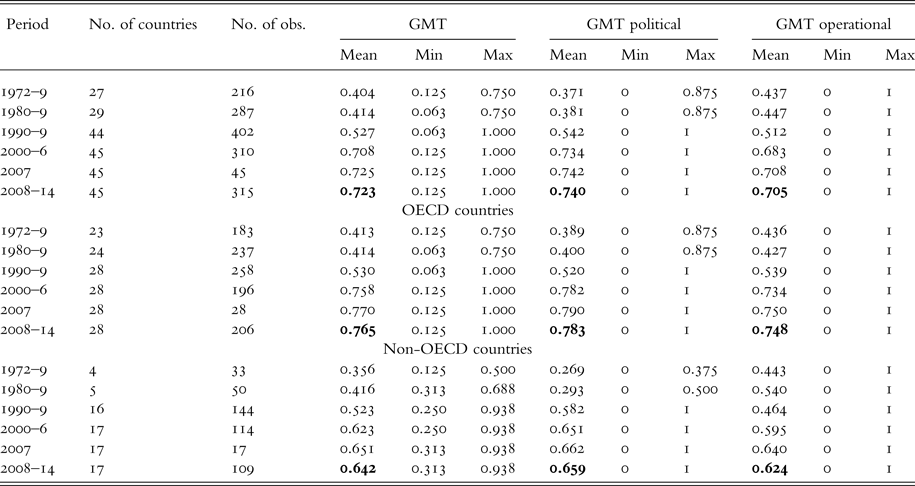
Furthermore, a clear reversal in the level of independence is noticeable following the 2008 financial crisis. This trend is, in fact, captured by the degree of economic independence (GMT Operational in Figure 1), since this index is the one capturing the evolution of central bank involvement in banking supervision. Thus, in line with the theoretical assumptions in the previous section, the post-crisis period, which corresponds to a very low inflation aversion and, at the same time, a high probability of experiencing macroeconomic shocks, is associated with a trend towards decreasing the level of independence of central banks.
Table 1 adds further relevant details on the evolution of these indices of CBI. We present the average level of the GMT across the last four decades up to the start of the global financial crisis. Looking at the mean of the GMT (column 4), we clearly observe a systematic increase in the average level of the index in every decade analysed. This pattern is consistent whether we look separately at the political or operational GMT or whether we split the sample of countries into OECD or non-OECD members. Yet this increasing trend is reversed after 2007. The average level of CBI drops and this decrease is more pronounced in non-OECD countries and, in particular, for the level of operational independence which also includes information on the involvement of the central bank in banking supervision.
Summary statistics on the evolution of the GMT independence index

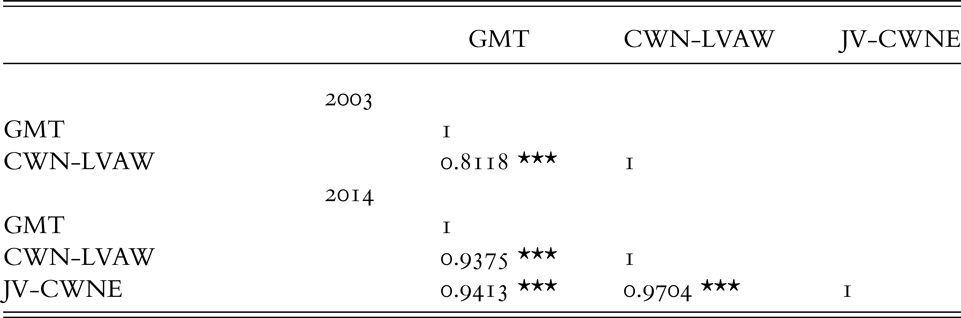
This evolution is in line with our model, as well as with the theoretical discussion in Blancheton (Reference Blancheton2015), who argues that since the crisis, a ‘tacit low-independence’ regime might be in place, which is reflected by the operational CBI since governments might be willing to trade off central bank independence in order to cope with rising public debt levels. As a final robustness check, we verify the reliability of our GMT index by examining the correlation between our index and the Cukierman et al. (Reference Cukierman, Webb and Neyapti1992) (LVAW) and the Jacome and Vazquez (Reference Jacome and Vazquez2008) de jure indices. As expected, our computed GMT index is highly correlated (significant at the 1 per cent level) with the other indices of CBI. We show these correlations in Table A2.
Having established this systemic decrease in the level of central bank independence after the crisis, we proceed to analyse whether this change in CBI can be associated with the probability of incurring macroeconomic shocks. This empirical evidence simply aims to relate the change in CBI with countries more likely to experience macroeconomic shocks.
The theoretical model presented in the previous section discusses five types of shocks which might influence the policymaker's cost function and hence the level of CBI. Due to limited data availability and identification issues, we present evidence for only three types of shock: inflation, fiscal and unemployment. Our empirical strategy consists in analysing the change in CBI around the crisis as explained by proxies for each of these types of shocks. More specifically, we estimate the following cross-sectional model:
 $$\Delta CB{I_i} = \alpha + \; {\beta _1}I{S_i} + {\beta _2}F{S_i} + {\beta _3}E{S_i} + \; {\varepsilon _i}\comma$$
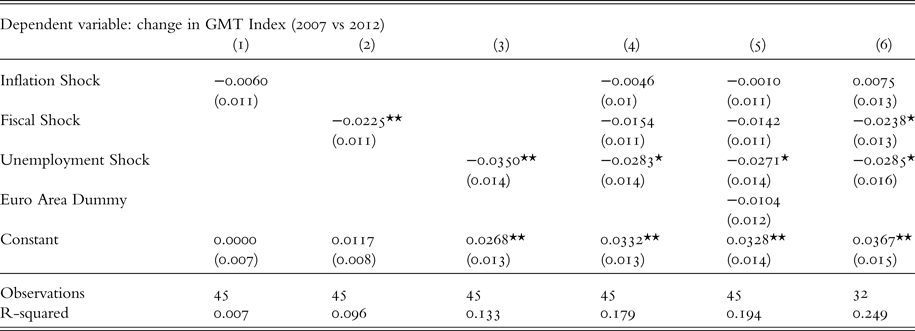
where  $\Delta CB{I_i}$ is the change in the level of CBI between 2012 and 2007, while IS, FS and ES represent dummy variables which proxy the probability that deflationary, fiscal and unemployment shocks, respectively, occur in each country i in our sample.
Note that we are interested in the likelihood that these shocks may occur and not just in cases where they have actually occurred. Thus, we need to take a stand on how to gauge this likelihood. We adopt a very conservative approach and use a simple rule of thumb: we consider a country as having a higher risk of incurring macroeconomic shocks if the indices we look at deviate considerably from their pre-crisis averages. More specifically, we build a dummy variable equal to one if the level of the variable of interest is, in at least one of the post-crisis years, two standard deviations above/below the pre-crisis average computed over the period 2002–7. Thus, the Inflation Shock dummy takes the value of one in countries that had, in any of the years after 2007, an inflation rate two standard deviations below the 2002–7 average. Voters in countries experiencing such low levels of inflation are likely to have a very low level of inflation aversion (low β in our theoretical model), which we expect to be associated with a lower level of CBI post-crisis. Fiscal Shock is computed in a similar manner by looking at the level of fiscal balance to GDP after 2007 and comparing it to the average before the crisis. If the fiscal balance is two standard deviations lower than the pre-crisis average then we consider the country as having a higher likelihood of incurring a fiscal shock and assign the dummy variable a value of one. Finally, for the Employment Shock we look, in fact, at the levels of unemployment and consider the cases where unemployment is higher than the pre-crisis average.Footnote 25
Following this strategy for identifying proxies for macroeconomic shocks, a dummy equal to one will represent a country, which, in our sample, has a higher probability of experiencing a shock. Thus, we expect all three coefficients β 1, β 2, β 3 to have a negative sign, i.e. the change in the level of CBI is negative in countries that have a higher likelihood of incurring macroeconomic shocks.
We present the results pertaining to this empirical strategy in Table 2. We first show the association between each shock and the change in CBI separately to mitigate concerns regarding possible high correlations between the three types of shocks. Results in columns (1), (2) and (3) show that countries with a risk of deflationary, fiscal or unemployment shocks are all associated with a negative change in the level of CBI. We also include all the three dummies in the same specification in column (4). Here the coefficients are still correctly signed but less precisely estimated and only the unemployment shock remains statistically significant. Finally, we check the robustness of these results when including a euro area dummy variable in column (5) or excluding euro area countries in column (6) to control for the fact that these countries are characterised by a similar degree of CBI. Our results remain unchanged under this alternative specification.
Empirical estimations
Standard errors in parentheses. *** p < 0.01, ** p < 0.05, * p < 0.10.
(6) Excludes euro area countries.
All in all our empirical test provides further support for our theoretical arguments that macroeconomic shocks can alter the political costs of choosing the level of independence of central banks. We have shown that the decrease in CBI in the post-crisis period is associated with countries that are more likely to experience deflationary, fiscal and unemployment shocks.
VI
Before the crisis of 2008, changes in the central bank landscape were characterised by two intertwined features: independent monetary specialisation and supervisory neglect. The above characteristics are two sides of the same coin: the modern central banker was essentially an independent monetary policy agent, focused on monetary goals, which can be pursued by manoeuvring interest rates.
These trends become evident upon observing the route that the major central banks have followed. The central banks with full responsibility for monetary stability – the Federal Reserve System (Fed), the European Central Bank (ECB), the Bank of England, the Bank of Japan, the Swiss National Bank – did not have full responsibility for banking supervision. This does not mean that these central banks were not concerned with banking stability, but they generally dealt with it from a macro-economic perspective and only as a function of their primary mission, i.e. pursuing monetary action.
But now, after the crisis, the scenario is changing. Policymakers in all countries have wondered and are still wondering whether to reshape their central bank settings.
On these questions, the overall suggestion of this article for the analysis of the impact on CBI of concrete reforms of the central bank involvement in supervision is straightforward: it is necessary to evaluate rule by rule what the consequences are – if any – on the capacity at least to maintain the effectiveness of the central bank as monetary veto player.
In this respect, let us comment in conclusion on a significant example, the concrete case of the European Central Bank (ECB), which can be considered the benchmark of the modern specialised central bank, which now will be more involved in supervision. It has been claimed that today the ECB enjoys a sufficient level of independence as bank supervisor seemingly to ‘piggy back’ on the arrangements ensuring monetary policy independence (Masciandaro and Nieto Reference Masciandaro and Nieto2013). However, such independence would be further enhanced by: (i) the exercise of self-restraint by the European Parliament in its responsibilities for the appointment and dismissal of the Chair and Vice Chair of the Supervisory Board so that political considerations derived of their supervisory decisions do not interfere with their European mandate; (ii) the necessary addition of supervisors' legal immunity when exercising their job in good faith. In other words, the effects on the independence of the ECB in hosting the Single European Supervisor are so far to be definitively settled.
Appendix I: The Grilli, Masciandaro and Tabellini (GMT) index of CBI
The GMT index allows the identification of a political and an economic independence index.
The political index is based on a binary code assigned to eight different characteristics that sum up the ability of monetary authorities to independently achieve the final goals of their policy. This index captures three main aspects of monetary regimes: the procedure for appointing the members of the central bank governing bodies; the relationship between these bodies and the government; and the formal responsibilities of the central bank. Starting from these three aspects, one point is assigned for each of the following criteria, if satisfied:
I. Governor and central bank board appointment
(1) the governor is appointed without government involvement
(2) the governor is appointed for more than five years
(3) the other members of the board of directors are appointed without government involvement
(4) the other board members are appointed for more than five years
II. Relationships with government
(5) there is no mandatory participation of government representative(s) in the board
(6) no government approval is required for formulation of monetary policy
III. Objectives and responsibilities of the central bank
(7) the central bank is legally obliged to pursue monetary stability as one of its primary objectives
(8) there are legal provisions that strengthen the central bank's position in the event of a conflict with the government.
The economic index summarises the degree of independence of central banks in choosing their monetary policy instruments. Its three main aspects concern: the influence of the government in determining how much to borrow from the central bank; the nature of the monetary instruments under the control of the central bank; and the degree of central bank involvement in banking supervision. Again, one point is assigned for each of the following satisfied criteria:
I. Monetary financing of public deficits
(1) there is no automatic procedure for the government to obtain direct credit from the central bank
(2) when available, direct credit facilities are extended to the government at market interest rates
(3) direct credit facilities are temporary
(4) direct credit facilities are for a limited amount
(5) the central bank does not participate in the primary market for public debt
II. Monetary instruments
(6) the central bank is responsible for setting the policy rate
III. Central bank involvement in banking supervision
(7) the central bank has no responsibility for overseeing the banking sector (two points) or shares its responsibility with another institution (one point).
Countries analysed
Correlation between CBI indices
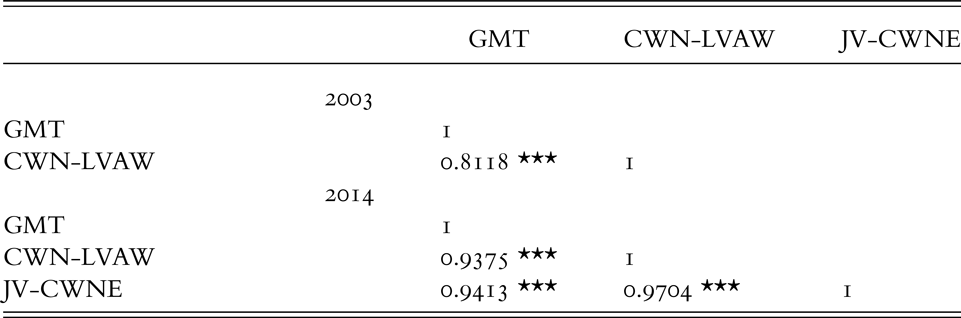
Due to data availability, we estimate the correlation of the GMT index and the Cukierman weighted index of CBI (LVAW) for the year 2003 using the data provided in Crowe and Meade (Reference Crowe and Meade2008). We also re-compute the Cukierman et al. (Reference Cukierman, Webb and Neyapti1992) as well as the extended index of CBI proposed by Jacome and Vazquez (Reference Jacome and Vazquez2008) as of 2014. Both indices are highly correlated (significant at 1 per cent) with our recomputed GMT index of CBI.