Introduction
Antarctic terrestrial algae are extremophilic organisms capable of surviving in harsh environmental conditions (Hájek et al. Reference Hájek, Vaczi, Bartak and Jahnova2012, Reference Hájek, Barták, Hadrová and Forbelská2016, Gray et al. Reference Gray, Krolikowski, Fretwell, Convey, Peck and Mendelowa2021). One way to withstand extremely low temperatures is via deep dehydration of the algal thallus; however, the molecular mechanisms of cold and drought resistance are not yet fully understood. Low temperature stresses biological systems as it reduces molecular motions and consequently affects the chemical and physical processes that take place in living organism. The effects of low-temperature stresses relate to reduced membrane fluidity, changes in intracellular pH and loss of macromolecular integrity (Clarke et al. Reference Clarke, Morris, Fonesca, Murray and Acton2013). The formation of ice crystals during the freezing of bound water in biological systems causes several additional types of cell damage (Bojic et al. Reference Bojic, Murray, Bentley, Spindler, Pawlik and Cordeiro2021), and the rate of cooling affects the form of ice crystals created. Low cooling rates result in extracellular ice crystals whereas rapid cooling rates result in intracellular crystallites (Chang & Zhao Reference Chang and Zhao2021). During ice nucleation, solutes are excluded from the growing ice crystal and the concentration of solutes in the remaining liquid increases.
The analysis of water adsorption in porous materials improves our understanding of the physical and chemical properties of molecules inside the porous polymers of such novel materials as metal-organic frameworks (MOFs) or covalent organic frameworks (COFs; Zhou et al. Reference Zhou, Liu, Zhou, Ren and Zhong2018, Gao et al. Reference Gao, Zhang, Yang, Zang and Gu2019, Wang et al. Reference Wang, Xue, Zhou, Yao and Hansen2019, Zhang et al. Reference Zhang, Liu, Liu, Zhang, Cheng, Wang and Ding2019). Water adsorbed on the surface of porous materials may reveal different properties than it does in its bulk form. This may be due to the interactions of molecules with the solid material as well as the increased surface-to-volume ratio of materials with smaller pores (Valiullin & Furo Reference Valiullin and Furo2002).
The aim of our research was to observe the behaviour of water present in the foliose green alga Prasiola crispa (Lightfoot) Menegh. upon cooling of the thallus to -63°C. Prasiola crispa provides a unique opportunity for study, as it is widespread in its free-living as well as lichenized form in the same Antarctic microenvironments. The lichenized form of P. crispa, Turgidosculum complicatulum (= Mastodia tesselata), is created by association with Guingardia prasiolae (Huiskes et al. Reference Huiskes, Gremmen, Francke, Battaglia, Valencia and Walton1997, Kovačik & Pereira Reference Kovačik and Pereira2001, Kovačik et al. Reference Kovačik, Jancusova, Pereira and Olech2003); however, some authors consider Prasiola borealis to be a photobiont of T. complicatulum (Pérez-Ortega et al. Reference Pérez-Ortega, De Los Ríos, Crespo and Sancho2010).
Prasiola crispa is found in abundance in ice-free areas of Antarctica, especially in the supralittoral zone. This macroscopic terrestrial green alga has been the subject of much research (Santarius Reference Santarius1992, Jackson & Seppelt Reference Jackson and Seppelt1995, Reference Jackson, Seppelt, Battaglia, Valencia and Walton1997, Tatur et al. Reference Tatur, Myrcha and Niegodzisz1997, Kovačik & Pereira Reference Kovačik and Pereira2001, Lud et al. Reference Lud, Buma, Van de Poll, Moerdijk and Huiskes2001b, Kovačik et al. Reference Kovačik, Jancusova, Pereira and Olech2003, Graham et al. Reference Graham, Graham and Wilcox2009, Kosugi et al. Reference Kosugi, Katashima, Aikawa, Tanabe, Kudoh and Kashino2010, Richter et al. Reference Richter, Matuła, Urbaniak, Waleron and Czerwik-Marcinowska2017, Fernández-Marín et al. Reference Fernández-Marín, López-Pozo, Perera-Castro, Arzac, Saenz-Cenceros and Colesie2019). Prasiola crispa is often found in wetter habitats than T. complicatulum, especially near meltwater streams (Lud et al. Reference Lud, Huiskes and Ott2001a). Under natural conditions, P. crispa occurs in different growth forms, including unicellularly as well as with much more developed filaments. It may also form a sheet-like thallus. In its lichenization, tetrads of algal cells form packages interwoven with fungal hyphae that attach them to the substrate (Lud et al. Reference Lud, Huiskes and Ott2001a). Prasiola crispa can be found on wet soils near bird colonies (especially penguin rookeries) rich in guano in the Maritime Antarctic and Continental Antarctica, where it forms wide, green ‘carpets’ (Jackson & Seppelt Reference Jackson and Seppelt1995, Kovačik & Pereira Reference Kovačik and Pereira2001, Graham et al. Reference Graham, Graham and Wilcox2009). During the summer, in favourable habitats rich in nutrients, the dry mass of this algal colony may double every 2 weeks (Kovačik & Pereira Reference Kovačik and Pereira2001). Its main type of reproduction is fragmentation of the thallus, which may adapt to terrestrial environments (Kovačik et al. Reference Kovačik, Jancusova, Pereira and Olech2003). Prasiola crispa plays an important role in the succession of vegetation on abandoned penguin rookeries in the Maritime Antarctic (Tatur et al. Reference Tatur, Myrcha and Niegodzisz1997). Prasiola crispa experiences high levels of solar radiation, especially during summer, which may inhibit photosynthetic photon flux densities; it also endures repeated freeze/thaw cycles during spring and autumn as well as extremely low temperatures in winter, which cause the thallus to freeze (Jackson & Seppelt Reference Jackson and Seppelt1995, Reference Jackson, Seppelt, Battaglia, Valencia and Walton1997, Lud et al. Reference Lud, Buma, Van de Poll, Moerdijk and Huiskes2001b, Kosugi et al. Reference Kosugi, Katashima, Aikawa, Tanabe, Kudoh and Kashino2010, Hájek et al. Reference Hájek, Vaczi, Bartak and Jahnova2012). Photosynthetic activity of the P. crispa thallus was detected at temperatures as low as -15°C, although most of the intracellular water was frozen (Becker Reference Becker1982). Prasiola crispa investigations create a unique opportunity for photobiont investigations, bypassing the need to prepare lichen thalli (Determeyer-Wiedmann et al. Reference Determeyer-Wiedmann, Sadowsky, Convey and Ott2019).
This paper concerns the water-freezing mechanisms in P. crispa thalli. These mechanisms are not fully understood in the context of the sample hydration level. For that reason, the behaviour of bound water freezing was investigated at different sample hydration levels. The study was conducted with proton nuclear magnetic resonance (1H-NMR) spectroscopy, relaxometry and differential scanning calorimetry (DSC). NMR is a powerful technique for investigating porous matter on the length scale from molecules to cells (Valiullin & Furo Reference Valiullin and Furo2002), whereas DSC yields the temperature of water freezing and monitors the diffusion of supercooled water molecules to crystallization centres during the freezing of the sample. Our study shows two types of water immobilization: non-cooperative, for sample hydration levels below Δm/m 0 = 0.39 (where Δm is the mass of water taken up from the gaseous phase - this is taken as the difference between the mass of the sample taken during the experiment and the dry mass of the sample, m 0), and cooperative (with the formation of ice crystallites) for higher sample hydration levels. The two types of immobilization of water molecules at a low temperature are discussed in relation to the diffusion process.
Materials and methods
Field site
Free-living P. crispa thalli were collected near the Arctowski Polish Antarctic Station (centred at 62°09'41''S, 58°28'10''W), King George Island, Southern Shetlands, Maritime Antarctic, in January 2002, during the 26th Polish Antarctic Expedition of the Polish Academy of Sciences, close to sites populated by T. complicatulum. The samples were collected in the crevices of coastal rocks. They were situated on a thin layer of soil. The alga is a free-living organism that has a sheet-like, flattened thallus. It was identified using morphological and anatomical characteristics. Prasiola crispa thalli revealed morphological diversity. Mature plants had irregular, crisped, monostromatic blades creating green carpets. Cells were quadrate or rectangular and were clustered in groups with one layer of thick cells. Pyrenoids were at the centre of the chloroplasts. The thallus was medium to dark brownish-green and 2–20 mm in diameter. It was locally vesicular or cupulate, partially expanding to flat sheets with rhizoids. The thallus was filamentous (consisting of one or many series of cells) or foliaceous. At the time of the sample collection, during the summer, the air temperature was > 0°C.
After collection, the samples were stored under herbarium conditions at 22°C. The experimental work was carried out under laboratory conditions at the home institution. The hydration level of the air-dry sample was equal to Δm/m 0 = 0.066 ± 0.012. The dry mass of the samples was measured after 72 h of heating at 70°C. This procedure was performed after all temperature measurements to achieve the sample hydration levels used in the experimental design. In order to obtain the different sample hydration levels, they were kept in desiccators over the surface of different salt solutions (Bacior et al. Reference Bacior, Nowak, Harańczyk, Patryas, Kijak and Ligęzowaska2017). The hydration of each sample was designated as Δm/m 0 (Δm = m - m 0, where m is the mass obtained in a given desiccator).
1H-NMR experimental parameters
The 1H-NMR free induction decay (FID) measurements were carried out using a high-power WNS HB-65 NMR relaxometer constructed by Waterloo NMR Spectrometers (Waterloo, ON, Canada). The resonance frequency was 30 MHz (at the main static magnetic field, B 0 = 0.7 T), the transmitter power was 400 W and the length of the π/2 pulse was 1.5 μs. The obtained data were averaged over 1000 accumulations with a repetition time of 2 s, and they were analysed using the CracSpin program (Węglarz & Harańczyk Reference Węglarz and Harańczyk2000). The temperature was varied from 24.7°C to -62.3°C and was stabilized in a gaseous nitrogen stream. A wide range of temperatures were used to determine the freezing mechanisms of water in the algae as well as their adaptation strategy to harsh the Antarctic conditions.
The 1H-NMR spectra were recorded on a Bruker Avance III spectrometer (Bruker Biospin, Billerica, MA, USA) operating at a resonance frequency of 300 MHz (at B 0 = 7.0 T) with the transmitter power used equal to 400 W. The length of the π/2 pulse was 2.2 μs.
1H-NMR FID measurements
1H-NMR measures the signal from hydrogen nuclei, and the intensity of the signal is proportional to the number of hydrogen nuclei. Measurement of the 1H-NMR FIDs is a commonly used way to observe the 1H-NMR signal. The FIDs can be parameterized by  $T_2^\ast $. Free water has a
 $T_2^\ast $ of approximately several seconds and ice has a
 $T_2^\ast $ of < 5 μs. When water turns to ice, its 1H-NMR signal is not measurable by the spectrometers used in this study; therefore, water freezing in bulk water can be followed precisely using these 1H-NMR measurements as a complete loss of signal from the ice protons.
Alternatively, the Fourier transform of the 1H-NMR FIDs represents the 1H-NMR spectrum characterized by spectral widths that are related to  $T_2^\ast $. Bulk water has a narrow linewidth of a few hertz, ice has a very broad linewidth that cannot be measured with the equipment used in this work and bound water has an intermediate linewidth of a few kilohertz. In many biological systems, including lichen, non-aqueous protons in lichen have a
 $T_2^\ast $ of 10–20 μs and linewidths of a few tens of kilohertz. Water interacting with non-aqueous molecules has a much shorter
 $T_2^\ast $ and a broader linewidth than bulk water - this is a consequence of time-dependent bonding to hydrophilic sites in the biological system's microstructure. The 1H-NMR FID and 1H-NMR spectrum measurements acquired here are equivalent: either approach could have provided all of the results from these experiments.
Temperature dependence of the 1H-NMR FIDs
1H-NMR FIDs for P. crispa thalli hydrated to Δm/m 0 = 0.078, 0.259 and 1.71 (Fig. S1), recorded from 24.7°C down to -62.3°C, were fitted well by the superposition of Gaussian component S and exponentially relaxing component L (Eq. (1)):
 $$FID( t ) = S\cdot \exp \left({-{\left({\displaystyle{t \over {T_{2S}^\ast }}} \right)}^2} \right) + L_1\cdot exp\left({-\displaystyle{t \over {T_{2L}^\ast }}} \right), \;$$
where  $T_{2S}^\ast $ is the proton spin-spin relaxation time for the solid component S, taken as the time required for the Gaussian function to decay to 1/e of its initial amplitude, whereas
 $T_{2L}^\ast $ is the proton relaxation time of mobile protons of liquid component L (Harańczyk et al. Reference Harańczyk, Leja and Strzałka2006, Reference Harańczyk, Nowak, Bacior, Lisowska, Marzec, Florek and Olech2012). The spin-spin relaxation times were shortened by B 0 inhomogeneities and their effective values were measured (Chavhan et al. Reference Chavhan, Babyn, Thomas, Shroff and Haacke2009). The liquid signal expressed in the units of the solid signal (L/S) allowed for comparison of the data detected for dry and hydrated samples.
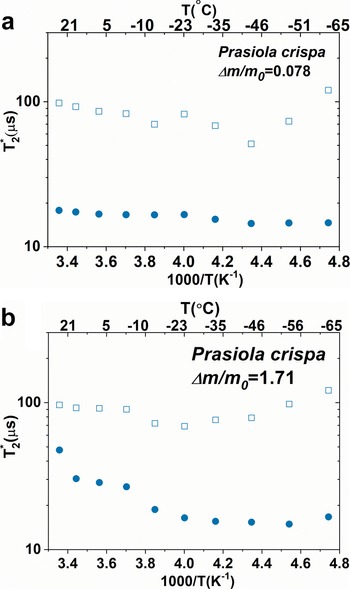
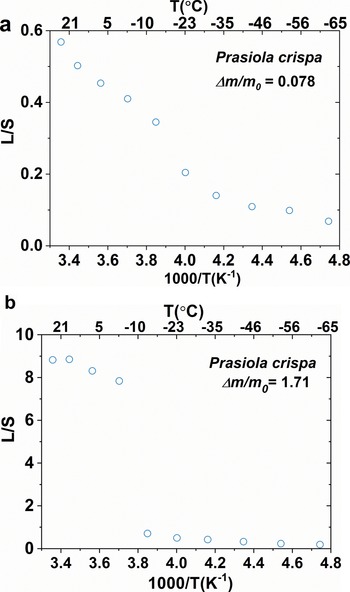
The data shown in Figs 1 & 2 were obtained from FID measurements carried out for selected samples with hydration levels of 0.078 and 1.71, respectively. For each sample hydration, FID signals were collected at 10 different temperatures: 24.7°C, 17.2°C, 7.5°C, -3.1°C, -13.1°C, -23.3°C, -32.8°C, -43.1°C, -52.9°C and -62.3°C.
a. Proton nuclear magnetic resonance (1H-NMR) free induction decay (FID) times taken as a function of temperature for Prasiola crispa thalli hydrated to Δm/m 0 = 0.078. Solid Gaussian component (S) = closed circles, bound water fraction (L) = open squares. b. 1H-NMR FID times taken as a function of temperature for P. crispa thalli hydrated to Δm/m 0 = 1.71. Solid Gaussian component (S) = closed circles, bound water fraction (L) = open squares.

Temperature dependence of the liquid signal amplitude, L/S, expressed in units of solid signal, recorded for Prasiola crispa thalli hydrated to a. Δm/m 0 = 0.078 and to b. Δm/m 0 = 1.71.

In micro-heterogenous biological systems, separated spin subsystems have different relaxation times. Separated groups of spins form a solid matrix of the system, while other mobile molecular groups form tightly and loosely bound water pools. The total 1H-NMR amplitude signal was normalized to 1 as a superposition of the signal S from the solid-state protons and of the signal L coming from the mobile protons of bound water fraction. The S or L signals do not give any useful information separately, but the liquid signal expressed in the units of the solid signal allows us to compare the data for dry and hydrated samples. The mobile component of the algal samples arises not only from bound water, but also from non-aqueous liquid components, as neutral lipids.
Temperature dependence of the 1H-NMR spectra
The 1H-NMR spectrum (Eq. (2)) may be successfully fitted by the superposition of the Gaussian line component with the area under the line equal to AG, coming from significantly immobilized protons bound to the solid matrix, and one narrow Lorentzian line component with the area under the line equal to AL, coming from mobile protons of the sample (from water bound in the algal thallus):
 $$A( \nu ) = y_0 + \displaystyle{{A_G} \over {\sqrt {\pi \ln 2} \Delta \nu _G}}\exp \left[{-2\cdot {\left({\displaystyle{{\nu -\nu_G} \over {\sqrt {2\ln 2} \Delta \nu_G}}} \right)}^2} \right] + \displaystyle{{2A_L} \over \pi }\left[{\displaystyle{{\Delta \nu_L} \over {4{( {\nu -\nu_L} ) }^2 + {( {\Delta \nu_L} ) }^2}}} \right], \;$$
where νG and νL are Gaussian and Lorentzian peak positions, respectively, while ΔνG and ΔνL are the line half-widths for the Gaussian and Lorentzian components of the 1H-NMR line and y 0 is the constant signal component. The amplitude A is a dependent variable as a function of the magnetic field frequency (independent variable). For the P. crispa thalli hydrated to Δm/m 0 = 0.08, 0.311 and 0.486, the 1H-NMR spectra were recorded at temperatures ranging from 23.8°C down to -61.3°C.
Differential scanning calorimetry
DSC measurements were taken using a PerkinElmer (Waltham, MA, USA) DSC 8000 calorimeter with 30 μL aluminium pans. The calibration of the calorimeter was performed using the melting points of indium and of water. The sample mass was ~8 mg. The temperature measurements were recorded from room temperature down to -60°C, then the samples were heated back to room temperature. These steps were conducted to detect the freezing/melting temperature of the water present in the sample. The rate of heating or cooling was equal to 2°C min-1.
DSC incubation experiment
During the incubation experiment, the sample was cooled down to -60°C, then heated up to -20°C, and after 2 h of incubation at this temperature it was warmed up to room temperature. A 2 h incubation of the sample at -20°C increases the mobility of water molecules in the sample; it is thus possible to observe the growth of ice crystallites, as water molecules migrate to the centres of crystallization. Pyris software (PerkinElmer, Waltham, MA, USA) was used to calculate the onset and peak temperatures as well as the transition enthalpies. A relatively long incubation time allowed water molecules to diffuse and to attach to presumably already-existing ice microcrystallites beyond the resolution of the calorimeter.
Statistical analysis
The one-dimensional procedure of the CracSpin program (Węglarz & Harańczyk Reference Węglarz and Harańczyk2000) was used to fit the 1H-NMR FID signal (in time domain), where the solid component S is a Gaussian function and the liquid component L is an exponential function. The accuracy of the function was confirmed by the residual function, calculated as the difference between the fitted and the recorded values of the FID signal, which did not exceed a few percentage points for any recorded point (Fig. S1b).
The 1H-NMR data were elaborated using OriginPro version 9.1 (OriginLab Corp., Northampton, MA, USA). This program allows for the arbitrary adjustment of the results as set by the user functions using the iterative Lavenberg-Marquardt algorithm. The R 2 value obtained for the entire dataset was ~0.99.
Results
Temperature dependence of the 1H-NMR FIDs
Figures 1a & b show the temperature dependences of the proton spin-spin relaxation times  $T_2^\ast $ for the 1H-NMR FID signal components recorded for P. crispa samples hydrated to Δm/m 0 = 0.078 and 1.71, respectively. The average values of the spin-spin relaxation times were equal to
 $\;T_{2L\;}^\ast $≈ 82 μs, 63 μs and 89 μs for the hydration levels of the sample equal to Δm/m 0 = 0.078, 0.259 and 1.71.
The temperature dependences of the total liquid signal expressed in units of the solid signal L/S are shown in Figs 2a & b & S3. The values shown in Fig. 2 were calculated from the FID measurements (Fig. S1) performed for the samples with different hydration levels (Δm/m 0 = 0.078, 0.259 and 2.429) and recorded from room temperature down to -63°C.
The typical FID signal is shown in Fig. S1. As temperatures decreased, the water molecules gradually became immobilized. In thalli of Antarctic lichen, where the fractions of tightly and loosely bound water were observed, a transition of the loosely bound (freezing) water pool to the tightly bound (non-freezing) water pool was observed, representing an adaptive mechanism to Antarctic conditions.
The amplitude of the liquid signal decreased continuously with decreasing temperature for the samples of P. crispa thalli hydrated to Δm/m 0 = 0.078 and 0.259, which suggests non-cooperative bound water immobilization (Figs 2a & S3). Water freezing was detected for the sample hydrated to Δm/m 0 = 1.71 (Fig. 2b). The amplitude of the liquid-to-solid signal continuously decreased from room temperature down to -3.1°C, then a non-continuous gap was observed down to -13.1°C, suggesting water freezing in the sample.
Temperature dependence of the 1H-NMR spectra
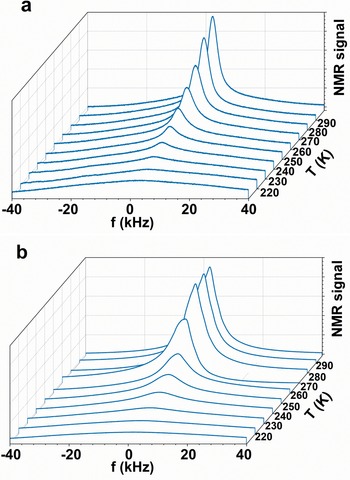
The 1H-NMR spectrum (Fig. 3) was successfully fitted by the superposition of Gaussian component AS coming from significantly immobilized protons of the sample and one narrow Lorentzian line component AL coming from the mobile protons of the sample (Eq. S2).
a. Stacked plots of the proton nuclear magnetic resonance (1H-NMR) spectra recorded as a function of temperature for Prasiola crispa thalli hydrated to Δm/m 0 = 0.08. b. Stacked plots of the 1H-NMR spectra recorded as a function of temperature for P. crispa thalli hydrated to Δm/m 0 = 0.486.

When the temperature decreased down to -61.3°C, the half-widths of a broad line component increased, reaching the average values ΔνG ≈ 48.77, 45.75 and 52.63 kHz for the samples hydrated to Δm/m 0 = 0.08, 0.311 and 0.486, respectively. This continuous increase suggests the gradual immobilization of protons during the cooling of the sample (Fig. 3). The more pronounced increase in half-widths of the Lorentzian function ΔνL during the cooling of the sample suggests a reduced mobility of the supercooled water molecules.
Table I presents the parameters of the 1H-NMR spectra recorded for P. crispa thalli at t = 25°C and ‐3°C at different hydration levels of the samples. At room temperature, the half-width of the solid Gaussian line component had ΔνG values of 37.6–39.6 kHz (i.e. the Gaussian component width changes little with moisture content). The half-width of the mobile Lorentzian line component ΔνL varied from 2.85 to 7.65 kHz for the hydration levels of Δm/m 0 = 0.08–0.486.
Proton nuclear magnetic resonance spectral parameters evaluated for Prasiola crispa thalli for the temperatures of 25°C down to -3°C at different sample hydration levels.

At different levels of thallus hydration for Δm/m 0 = 0.08–0.486 at ‐3°C, the half-width of the solid Gaussian line component decreased from ΔνG = 46.1 to 29.3 kHz (i.e. at ‐3°C, the solid component changed mobility as the moisture content increased). For the liquid component, the half-widths of the line for the mobile component ΔνL were in the range of 3.25–7.88 kHz. The spin-spin relaxation time for the Gaussian line component was calculated from Eq. (3):
 $$T_{2S}^\ast = \displaystyle{{\sqrt 2 } \over {{\rm \pi \Delta }\nu G}}$$
whereas for the mobile protons  $T_{2L}^\ast $ the spin-spin relaxation time was taken from Eq. (4):
 $$T_{2L}^\ast = \displaystyle{{\sqrt 2 } \over {{\rm \pi \Delta }\nu L}}.$$
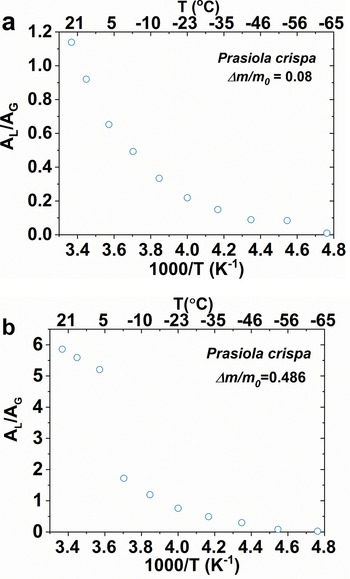
The temperature dependence of the total mobile proton signal (area under the line) expressed in units of the solid signal AL/AG is presented in Fig. 4. As observed in the time domain 1H-NMR experiments, P. crispa thalli hydrated in the range of Δm/m 0 = 0.08–0.311 showed a continuous decrease in the liquid signal, coming from mobile protons with decreasing temperature (Figs 4a & S5). For the sample hydrated to Δm/m 0 = 0.486, cooperative immobilization of water was observed (Fig. 4b).
a. The AL/AG temperature dependence for Prasiola crispa thalli hydrated to Δm/m 0 = 0.08. b. The AL/AG temperature dependence for P. crispa thalli hydrated to Δm/m 0 = 0.486.

DSC temperature measurements
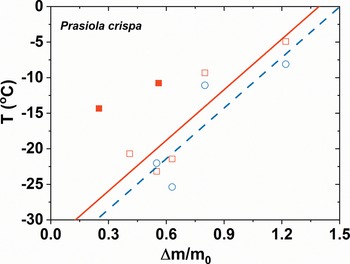
DSC was used to monitor the bound water freezing (melting) in the samples. These measurements involved cooling and heating scans at the same cooling/heating rate of 2°C min-1. Measurements performed for the driest sample (Δm/m 0 = 0.08) did not reveal any peaks coming from water freezing or ice melting in the P. crispa thalli (Figs S5–S8). At a higher hydration level (Δm/m 0 = 0.25), only an ice-melting peak was recorded during the heating of the sample and there was no water-freezing peak detected during cooling of the sample. For yet higher hydration levels of the sample (from Δm/m 0 = 0.55), the presence of a phase transition was detected either for water freezing or for ice melting. A linear increase of the onset temperatures for water freezing, tf (and for ice melting, tm), as a function of sample hydration level was detected for P. crispa thalli (Fig. 5) according to Eq. (5) and Eq. (6):
 $$t_f = 23.8\Delta m/m_0 \, {\hbox -}\, ( {35.6 \pm 2.2} ) ^\circ {\rm C}$$
 $$t_m = ( {23.7 \pm 6.7} ) \Delta m/m_0 \, {\hbox -}\, ( {33.0 \pm 5.2} ) ^\circ {\rm C}$$
The onset temperatures of ice melting (open squares) and water freezing (open circles) and of ice melting preceded by a 2 h incubation of the sample (closed squares) expressed as a function of the hydration level of Prasiola crispa thalli.

The linear form suggests that the freezing onset temperature is correlated with the size of the water compartment in a porous material that characterizes the heterogenous ice-nucleation process.
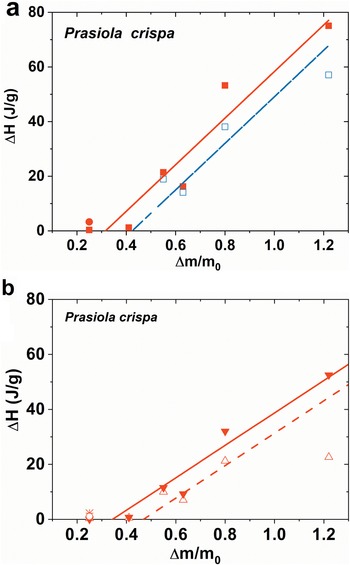
The transition enthalpies for melting ΔHm and for freezing ΔHf linearly increased with increasing hydration levels (Fig. 6a) according to Eq. (7) and Eq. (8):
 $$\Delta H_{m.} = ( {85 \pm 13} ) \Delta m/m_0 \, {\hbox -}\, ( {26.9 \pm 8.7} ) $$
 $$\Delta H_{\,f.} = 85\Delta m/m_0 \, {\hbox -}\, ( {36.1 \pm 4.4} ) $$
a. Transition enthalpy ΔH expressed as a function of relative mass increase Δm/m 0 for bound water freezing (open squares) and ice melting (closed squares) and for ice melting after a 2 h incubation of the sample at -20°C (closed circles) observed for Prasiola crispa thalli. b. Transition enthalpy for ice melting after decomposition of differential scanning calorimetry peaks into two components: a mean melting peak (closed triangles) and a low-temperature ‘shoulder’ (open triangles), showing a main melting peak after a 2 h incubation of the sample at -20°C (star) and a low-temperature ‘shoulder’ after a 2 h incubation of the sample at -20°C (circle).

This dependence allows one to determine the threshold hydration level at which the cooperative bound water freezing (ice formation) appears. For P. crispa thalli, no melting was detected (melting enthalpy was equal to 0) for the hydration levels of the thalli a Δm/m 0 ≤ 0.32 ± 0.15, whereas no freezing was detected (freezing enthalpy was 0) for the hydration levels Δm/m 0 ≤ 0.42 ± 0.12 (Fig. 6a). The average value of the threshold hydration level was equal to Δm/m 0 = 0.37. Quantitative decomposition of the recorded peaks into a symmetric part coming from the main ice-melting peak and a low-temperature shoulder (surplus in the enthalpy) was performed. The proportions of the low-temperature shoulder in the DSC peaks (Fig. 6b) for the different sample hydration levels were calculated and used to separately fit the hydration dependence of the area under the main peak ΔHmMP and the low-temperature ‘shoulder’ ΔHmSh according to Eq. (9) and Eq. (10):
 $$\Delta H_{mMP} = ( {59 \pm 7.4} ) \Delta m/m_0 \, {\hbox -}\, ( {20.3 \pm 5.3} ) $$
 $$\Delta H_{mSh} = 59\Delta m/m_0 \; ( {27.7 \pm 4.8} ) $$
The melting enthalpy increased for the main peak as well as for the low-temperature shoulder with a similar slope when the hydration level was increased up to Δm/m 0 = 0.8, suggesting that the mass of water in both subsystems increased similarly and did not saturate within the range of hydration levels investigated. For the P. crispa thalli hydrated to the highest level (Δm/m 0 = 1.22), the melting enthalpy related to the low-temperature shoulder (Fig. 6b) differed from that of the thalli of the lichen T. complicatulum.
DSC incubation experiment
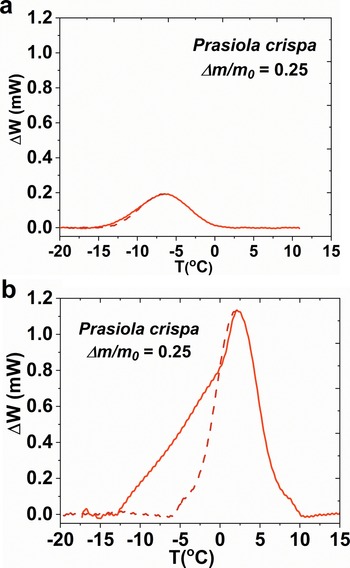
The DSC incubation experiment was performed for P. crispa thalli hydrated to Δm/m 0 = 0.25 (no or only residual freezing/melting peak was expected). At the end of the incubation process, the sample was warmed up to room temperature. A pronounced melting peak was detected. The warming thermogram without the 2 h incubation is shown in Fig. 7a, while the warming thermogram after 2 h of incubation at -20°C is presented in Fig. 7b. The melting enthalpy determined without the incubation process was equal to ΔH = 0.34 J g-1, whereas after the incubation process this value was equal to ΔH = 3.30 J g-1.
a. Differential scanning calorimetry (DSC) heating termogram for Prasiola crispa thalli hydrated to Δm/m 0 = 0.25 and b. DSC heating termogram of the same sample but recorded after a 2 h incubation at -20°C. Each peak was decomposed into two components: a main peak (dashed line) and a low-temperature ‘shoulder’. The heating rate was equal to 2°C min-1.

Discussion
The relaxation of the spin subsystems with different values for the relaxation time was observed. A solid matrix of the organism was marked by significantly immobilized protons, while the mobile proton group constituted the tightly bound water pool. Single-component water relaxation was observed in P. crispa thalli, meaning that there was only one fraction of bound water in the sample (Fig. S1). The transverse spin-spin relaxation time  $T_2^\ast $ recorded by the 1H-NMR was inversely proportional to the correlation time τc characterizing the rotational mobility of protons. When protons rotate quickly (as in the case of protons of the loosely bound water pool), the rotational correlation time τc is shorter and thus the relaxation time is longer. By contrast, water molecules situated in the proximity of the pore walls of the sample have longer correlation times (shorter
 $T_2^\ast $) as their rotation is hindered. This is particularly evident in Antarctic lichens, as well as in lyophilized photosynthetic membranes, where tightly and loosely bound water fractions differing in their
 $T_{2\;}^\ast $ relaxation times were found (Harańczyk et al. Reference Harańczyk, Nowak, Bacior, Lisowska, Marzec, Florek and Olech2012, Reference Harańczyk, Nowak, Lisowska, Florek-Wojciechowska, Lahuta and Olech2016, Reference Harańczyk, Strzałka, Kubat, Andrzejowska, Olech and Jakubiec2021, Nowak et al. Reference Nowak, Harańczyk, Kijak, Fitas, Lisowska, Baran and Olech2018). The decrease in temperature causes the gradual immobilization of water molecules, which form ice crystallites. The correlation time increases with decreasing relaxation time. The residual fraction of unfrozen water remains between the ice crystallites and the algal surface.
The 1H-NMR FIDs were registered at different temperatures (from 25°C down to -63°C) and were fitted by a superposition of the solid component coming from immobilized protons of the algal thallus and one exponentially relaxing component coming from the tightly bound water fraction. In contrast, in the lichenized form of P. crispa, both tightly and loosely bound water fractions were detected (Bacior et al. Reference Bacior, Harańczyk, Nowak, Kijak, Marzec, Fitas and Olech2019). The loosely bound water fraction was not detected even at high levels of sample hydration (i.e. there was no free water). These differences can be explained by the different structures between the alga and its lichenized form. Lichens are symbiotic organisms formed most often of a fungus and an alga; lichen thalli are formed differently from the thalli of P. crispa. Additionally, P. crispa as a photobiont of T. complicatulum appears in the lichen thalli in a coccal state (Lud et al. Reference Lud, Huiskes and Ott2001a). The alga Klebsormidium, from King George Island, Antarctica, has a similar structure to P. crispa. It is made up of filaments with 500–1000 cells and grows in very compact tufts (Elster et al. Reference Elster, Degma, Kováčik, Valentová, Šramowá and Pereira2008). The average value of the spin-spin relaxation time recorded for the solid signal component of P. crispa at different sample hydration levels (Figs 1 & S2) was equal to  $T_{2S}^\ast $ ≈ 19 μs (corresponds to the second moment M 2 ≈ 3 × 10⁹ s-2), which is a value close to that obtained for lichens (e.g. for T. complicatulum thalli
 $T_{2S}^\ast $ ≈ 18 μs, for Umbilicaria aprina
 $T_{2S}^\ast $ ≈ 19 μs) and for other biological systems such as photosynthetic membranes or DNA and didecyldimethylammonium chloride (C19H42CIN) complexes (DNA-DDCA) (Harańczyk Reference Harańczyk2003, Harańczyk et al. Reference Harańczyk, Leja, Jemioła-Rzemińska and Strzałka2009, Reference Harańczyk, Nowak, Bacior, Lisowska, Marzec, Florek and Olech2012). The Gaussian component of the 1H-NMR line gradually broadened as the temperature decreased (Fig. 3), which suggests increased immobilization of the protons building the algal thallus. The half-width of the Lorentzian line component also increased with decreasing temperature due to the gradual immobilization of water molecules.
Many experiments show that the temperature of heterogenous ice nucleation depends on the sizes of the water compartments in the biological systems (Angell Reference Angell and Franks1982, Wilson et al. Reference Wilson, Arthur and Haymet1999, Reference Wilson, Heneghan and Haymet2003, Inada et al. Reference Inada, Zhang, Yabe and Kozawa2001, Heneghan & Haymet Reference Heneghan and Haymet2002, Heneghan et al. Reference Heneghan, Wilson and Haymet2002). For larger volumes of water, it is more difficult to attain low-temperature nucleation because there is a greater probability of encountering ice nuclei, thus the initiation of the freezing process takes place at a higher temperature (Wilson et al. Reference Wilson, Heneghan and Haymet2003). The experiment performed on 5 μL of bulk water revealed that it freezes in the temperature range from approximately -21°C to -25°C (Wilson et al. Reference Wilson, Arthur and Haymet1999), whereas large volumes of water equal to 200 μL freeze at -14°C (Harańczyk Reference Harańczyk2003).
The DSC measurements of P. crispa thalli revealed that the onset temperatures of water freezing and ice melting linearly increase with increased hydration level of the thalli. This process, promoted by ice-nucleation activators, is also characteristic of other biological systems, such as bacteria, fungi, insects, plants and lichens (Kawahara Reference Kawahara and Ferreira2013). At lower thalli hydration, the freezing point of the water connected to the sample was lower and reached -25°C for the hydration level Δm/m 0 = 0.6 compared to the more hydrated samples (Δm/m 0 = 1.2) for which the freezing point equalled -8°C. A similar dependence on the onset temperatures was detected for T. complicatulum thalli as well as for other lichen genera (Harańczyk Reference Harańczyk2003, Harańczyk et al. Reference Harańczyk, Nowak, Bacior, Lisowska, Marzec, Florek and Olech2012). The analysis of the onset temperatures for the ice melting and water freezing of P. crispa thalli (Fig. 5) demonstrated a higher value of the slope for the line fitted to the experimental data (aP.f ≈ 24, where aP.f means the slope for the line registered for the freezing of P. crispa samples) compared to the value determined for T. complicatulum thalli (aT.f ≈ 19, where aT.f means the slope for the line registered for the freezing of T. complicatulum samples; Bacior et al. Reference Bacior, Harańczyk, Nowak, Kijak, Marzec, Fitas and Olech2019). It is already known that sugar, alcohol and other substances may lower the freezing point in lichens. For this reason, the thalli of P. crispa hydrated to higher levels may freeze at higher temperatures than those of T. complicatulum collected from the same habitat. These data are consistent with data obtained for the same samples at different hydration levels by Bacior et al. (Reference Bacior, Nowak, Harańczyk, Patryas, Kijak and Ligęzowaska2017, 2019), where the significant presence of water-soluble substances was observed in the thalli of T. complicatulum, as well as with results obtained by Fernández-Marin et al. (Reference Fernández-Marín, López-Pozo, Perera-Castro, Arzac, Saenz-Cenceros and Colesie2019), where a higher freezing tolerance of P. crispa in its lichenized form was suggested. The DSC peaks recorded for P. crispa thalli were asymmetric in form and were decomposed into the main transition peak and the low-temperature ‘shoulder’. This asymmetry significantly increased after 2 h of incubation at -20°C; however, there are some differences seen in the quantitative analyses performed for the free-living P. crispa and for its lichenized form (Bacior et al. Reference Bacior, Harańczyk, Nowak, Kijak, Marzec, Fitas and Olech2019). In lichenized thalli of P. crispa, the proportion of the main peak compared to the low-temperature shoulder was ΔHmp/ΔHs = 0.55, whereas for P. crispa it was ΔHmp/ΔHs = 2.1. This difference may be related to the structural differences in these two forms of P. crispa thalli and suggests that in the lichenized form the frozen water molecules may be gradually thawing, leading to a greater contribution to the ‘shoulder’ part of the peak. The incubation experiment showed the diffusion of supercooled, separated water molecules to the ice nuclei. The DSC courses recorded after the 2 h incubation of P. crispa thalli at -20°C gave the threshold hydration level at which ice melting was detected as equal to Δm/m0 = 0.21. This value was significantly higher than that for T. complicatulum thallus where the lowest hydration level for melting detection was equal to Δm/m 0 = 0.084 (Bacior et al. Reference Bacior, Harańczyk, Nowak, Kijak, Marzec, Fitas and Olech2019). This difference may be related to other factors in addition to the higher number of crystallization centres in the thalli of the lichenized form of P. crispa. Comparing the low-temperature water immobilization observed in the DSC calorimetry courses in free-living P. crispa thalli and in its lichenized form (T. complicatulum) hydrated to Δm/m 0 = 0.25 and collected from the same habitat in Antarctica, a significant difference could be observed, in that the melting enthalpy measured for free-living P. crispa was lower than that of its lichenized form (Bacior et al. Reference Bacior, Harańczyk, Nowak, Kijak, Marzec, Fitas and Olech2019) before (ΔH = 0.34 J g-1 for P. crispa and ΔH = 1.5 J g-1 for T. complicatulum) as well as after the 2 h incubation of the sample (ΔH = 3.3 J g-1 for P. crispa and ΔH = 6.1 J g-1 for T. complicatulum), which may indicate that a smaller amount of water forms ice crystallites (whereas a larger amount remains in the supercooled phase) in the pores of the lichenized form of P. crispa than in its free-living form. The DSC measurements indicate that greater energy is needed to create an ice crystallite in the lichenized form of P. crispa than in its free-living form, which also suggests that the free-living P. crispa has less freezing resistance. This may, in turn, indicate that lichenized cells are more resistant to freezing.
In its natural habitat, P. crispa is adapted to wide temperature fluctuations. On the other hand, the increased amount of cryoprotectant in the algal thallus may protect it against frost damage during the growth of ice crystallites connected with the migration of water molecules to the centres of crystallization. A large increase in proline, which probably plays a role as a cryoprotectant in the P. crispa thallus, has been observed in early winter (up to 28.4 ± 2.9 μmol g-1 of dry mass in mid-April from 1.2 ± 0.1 μmol g-1 of dry mass in January), and this was connected with photosynthetic activity after melting (Jackson & Seppelt Reference Jackson and Seppelt1995). Amino acids and other solutes protect this photosynthetic activity during freezing (Santarius Reference Santarius1992). One of cryoprotective mechanisms often used by terrestrial organisms is extracellular ice formation. In this process, a water vapour pressure gradient is created between the inside and the outside parts of the cells, which leads to a further outflow of water from the interior parts of the cells. As a consequence, intracellular dehydration continues. This dehydration process may preserve the interior parts of the algal cells against freezing and protect against the growth of ice crystallites inside the cells. At the same time, it causes an increased concentration of solutes, which protects the thallus against frost (Benson et al. Reference Benson, Harding, Day and Seckbach2007). At freezing temperatures, in the presence of ice the existence of unfrozen water may be caused by the freezing-point depression due to the presence of small solutes, macromolecules, membranes and other hydrophilic ultrastructures or by the effect of viscosity (Wolfe et al. Reference Wolfe, Bryant and Koster2002). Many freeze-tolerant organisms accumulate multiple cryoprotectants, including antifreeze proteins, glycoproteins or glycolipids, which inhibit ice formation or ice-crystal growth (Storey & Storey Reference Storey and Storey1996, Duman Reference Duman2001).
It seems that in biological systems (such as lichens or algae) there is a sample hydration level above which the cooperative water freezing is observed (with a strong discontinuity in the temperature dependence of the liquid amplitude of the signal, L/S) and below which the non-cooperative immobilization of water is preferred (as in the case of dry samples). In free-living P. crispa thalli, a similar mechanism was observed. A few scenarios for this could be proposed based on our results: 1H-NMR measurements showed the non-cooperative immobilization of water bound in P. crispa thalli for the hydration level of Δm/m 0 ≤ 0.40. In this hydration range, the temperature dependence of the liquid-to-solid amplitude (L/S) has a gentler slope. For the samples with hydration levels of Δm/m 0 ≥ 0.40, the temperature dependence of the liquid-to-solid amplitude (L/S) revealed a step decrease in the liquid signal, which is characteristic of water freezing. The transfer of the loosely to tightly bound water fraction characteristic of lichens (Harańczyk et al. Reference Harańczyk, Nowak, Bacior, Lisowska, Marzec, Florek and Olech2012, Nowak et al. Reference Nowak, Harańczyk, Kijak, Fitas, Lisowska, Baran and Olech2018) was absent here, suggesting another structure of the free-living form of the alga, with smaller pore sizes in which the water molecules could still rotate but with longer rotational correlation times and thus with shorter spin-spin relaxation times. Data analysis suggests that down to -63°C the co-existence of ice crystallites as well as a supercooled interfacial water fraction within the pores of P. crispa thalli is probable. The co-existence of a non-freezing water fraction was supported by the temperature dependencies of proton spin-spin relaxation times  $T_2^\ast $, which did not change during the temperature drop (
 $T_2^\ast $ ≈ 100 μs), suggesting that the correlation times of the residual interfacial water remained unchanged during the water freezing in the pores. The DSC analysis yielded the water-freezing threshold value of the hydration level at which cooperative bound water freezing was detected at Δm/m 0 = 0.37, which was a similar value to that obtained by 1H-NMR.
These investigations provide a new perspective on water adsorption in porous materials and its freezing, which may have some applications not only in biological systems but also in water recycling, catalysts and fossil fuel studies (Zhou et al. Reference Zhou, Liu, Zhou, Ren and Zhong2018, Gao et al. Reference Gao, Zhang, Yang, Zang and Gu2019, Wang et al. Reference Wang, Xue, Zhou, Yao and Hansen2019, Zhang et al. Reference Zhang, Liu, Liu, Zhang, Cheng, Wang and Ding2019). By using 1H-NMR relaxometry and spectrometry as well as DSC, it is possible to monitor water molecule motions in the interfacial layer during the cooling of samples.
Conclusions
This study sheds light on the molecular dynamics of water bound in the Antarctic alga P. crispa. We found that algae samples with different levels of hydration revealed different mechanisms of water freezing. Namely, for dry samples below the hydration level of 0.39, non-cooperative immobilization of water molecules prevails, while cooperative water freezing was observed above this value. As the temperature decreased, the gradual immobilization of water molecules was observed, leading to the formation of ice crystals.
The DSC measurements showed that the freezing point of the sample water decreased with increasing dehydration, indicating the presence of heterogenous nucleation. The enthalpy of melting determined for the free-living form of P. crispa was lower than that for the lichenized form of this alga, which may indicate that the free-living form is less resistant to freezing.
Only one fraction of bound water was found in P. crispa, in contrast to Antarctic lichens, in which two fractions of bound water are present. Analysis of the data suggests that up to -63°C a fraction of supercooled water was found in the sample in addition to ice crystallites.
There are still many unanswered questions regarding how Antarctic organisms, especially the alga P. crispa, cope with harsh Antarctic conditions such as low temperatures and deep dehydration. Combined DSC and 1H-NMR techniques are powerful tools that can be used to improve our understanding of the molecular mechanisms of cold and drought resistance.
Acknowledgements
We would like to thank the reviewers for their comments and suggested improvements.
Financial support
The research was carried out with equipment purchased thanks to the financial support of the European Regional Development Fund in the framework of the Polish Innovation Economy Operational Program (contract no. POIG.02.01.00-12-023/08) and financed by the Polish Ministry of Science and Higher Education (MNiSW, contract no. 7150/E-338/M/2015 and 7150/E-338/M/2016).
Author contributions
MO conducted the sampling. MB performed the laboratory work and data analyses and wrote the manuscript with support and assistance from HH. PN, PK, MM and JF performed the laboratory work.
Supplementary material
Eight supplemental figures will be found at https://doi.org/10.1017/S0954102022000335.