When Hans Rosenberg wrote an assessment of the first three published volumes—by Friedrich Lütge, Heinz Haushofer, and Wilhelm Abel—of what would become the six-volume Deutsche Agrargeschichte (1962–1984), he thought he detected a new analytical direction in German agrarian history, one that pointed toward how the economic and social experiences of rural populations could be understood as mutually intertwined and active in the broader course of events.Footnote 1 In contrast to the legal formalism of Lütge and the technicist agronomism of Haushofer, Rosenberg held up Wilhelm Abel's work as particularly noteworthy for seeing rural populations simultaneously engaged in several kinds of markets, with movements in European grain prices over three centuries playing, for Abel, the role of comparable indicators for regionally differentiated market swings with diverse effects on rural life.
There were significant contributions during the 1970s and 1980s toward understanding interactive trends among German peasant economies, politics, and social relationships. Works by Rudolf Braun, Eckart Schremmer, David Sabean, and others advanced our conceptual and methodological grasp on rural history and its place in the larger frameworks of German central European political and social development. By the 1990s, and lasting into the present, these beginnings were, however, swamped by a revival of culturalist preoccupations in which economic and social motivations and experiences were submerged under arguments about the “communal man,” “emotions,” “thick description,” and various types of allegedly motivating symbolic representation. Rural economies did not disappear altogether in this cultural turn but were recast as rural populations that exercised “material interests” in more or less self-contained local-cultural terms while simultaneously and collectively implicated in a widely accepted macroeconomic development story about more or less growth, modernization, and urbanization. Statistics and indicators of performance appeared as evidence for what was seen as a master-narrative about eighteenth- and nineteenth-century absolutism that laid the groundwork for an alternative path to economic and social modernity, one in which the lowest levels of rural populations, specifically in the Austrian case, substituted “industrious hands” (fleissige Hände) for absent industrial development.Footnote 2 To challenge these largely functionalist conceptions and to recover some of the economic and social experiences of the people lost inside them, we need to achieve a sharper sense of what economic necessities and calculations and what social arrangements commanded people's attention. It is this essay's intent to look into a specific Austrian rural location and its changing political-economic environments to understand better what it was like where culturally motivated “industrious hands” had to perform.
This investigation concerns three aspects of central European agrarian history. The first involves the market structures in which economic activity took place. The seventeenth- and eighteenth-century central European economies were no longer feudal nor yet capitalist but “corporatist” (ständisch), which is to say that to have access to recognized markets, one had to have legal standing as a member of or attached to a political or other formally recognized corporation with defined market privileges. Such market rationalities as could be exercised always had to cost-in corporate obligations and limitations and were subject to, in Abel's words, “rents rooted in might, right, and custom.”Footnote 3 Rural householders were effectively bound into market-governing political formations that extracted fees and tributes in various guises to provide members of aristocratic corporations a flow of securitizable collateral for their own engagements in more distant commodity and financial markets, and all of it contained by an Imperial system that, in practice, extended past the peasants' formal emancipations and other restructurings during the nineteenth century.Footnote 4
A second focus is on the units of rural economic organization, which, in the area under discussion here, appear as leasehold farms, mills, inns, workshops, and cottages that owed combinations of crops, cash, and various “services” to proprietors who exercised legal lordship over subject tenants. To help us gain a conceptual grasp on these peasant household economies, it is again Abel, trained in business management (Betriebswirtschaft), who pointed a way, with simple spreadsheets, toward understanding, for example, how price movements in grain markets confronted large, middling, and small hold farms with distinctly different options and chances for returns during periods of good, average, and bad harvests.Footnote 5 His was, in effect, a treatment of peasant enterprises as firms producing a market yield. My personal sense of the interaction of various economic and social dimensions of such firms was further strongly influenced by the classic work of anthropologists such as George Foster, Eric Wolf, Sidney Mintz, Teodor Shanin, and others, whose research reveals what it takes to make peasant economies work in different times and places. Particularly the pioneering synthesis by Eric Wolf outlines the several “funds” that peasant firms have to juggle to survive by meeting not only their nutritional needs but also their labor and replacement costs, as well as their ceremonial, landlord, social, and other obligations.Footnote 6 The present essay is, in this spirit, an effort to examine parish register data, organized by individual houses, to gain access to and a comparative appreciation of the specific labor-force calculations peasant firms had to make in eighteenth- and nineteenth-century Austria.
Understanding actual peasant household economies as economies in this latter sense has found almost no place in historical studies. Economists' language about “firms” (and, below, about “labor hoarding”) is more than jargon; it designates conceptual formulations that can move us beyond thinking merely about peasant farming as such and away from prevalent views that remain content to leave what goes on in any economic enterprises in a “black box.”Footnote 7 This latter is the perspective that assumes that whatever goes on inside “successful” firms must somehow be sufficiently competitive and that firms' “survival” or “growth,” and not how they actually achieve these outcomes, are the historically significant categories and measures. A black-box perspective is the implicit approach by micro-histories that describe in detail peasant farms' complements of livestock, crops, implements, labor inputs and techniques, and the varieties and combinations of agricultural outputs associated with various types of enterprise without presenting, at the same time, any sense of how economic outputs (i.e., market yields) could be actually realized, or of how specific firms' internal markets cleared, or of how benefits were distributed both within and between firms.Footnote 8
It is a third, and the central, concern of this essay to outline the qualities, organization, and costs of the labor force at work in specific firms. This is not only one place where issues of yield and social formation come together, but it is also where an understanding of how enterprises covered their labor needs and wage funds—and how they produced labor for other sectors of the economy—appears as foundational for understanding broader economic history.Footnote 9 The specific case in question examines labor arrangements understood as “labor hoarding” (to be explored below) as a special problem for recognizing labor deployments and assessing their implications for rural social life in German central Europe. This paper aggregates data that reveals the changing composition of Austrian rural house communities as these appear in a sampling of four annual census records (“soul books”) of Oftering parish near Linz in Upper Austria. My primary intent is to reveal aspects of the structures and experiential dimensions of the rural labor forces and markets of this region of Austria. I begin by examining some contextual historical processes that can then in turn be illuminated by the analysis.
* * *
Austria's peasantries had had regionally diverse successes in the political and religious struggles of the sixteenth and early seventeenth centuries. In Upper Austria they subsequently lost the gains from that period when their economies and social arrangements were defeated and refigured by absolutist police and military practices that applied early forms of social engineering discourses (Cameralism) to absorb, after about 1650, peasant resistance and to crush any incipient democratic-corporate communalism.Footnote 10 The Upper Austrian peasants had sought to develop their household economies up to this point by pursuing flexible partible inheritance strategies; by gaining a relative freedom to trade, including trade over long distances with “foreign” agents; and by deploying market-responsive industrial-agricultural divisions of household and other kinds of labor. Their efforts, however, were systematically countermanded and repressed by the allied corporations of cities, political Estates, churches, and the royal-Imperial treasury apparatus.
One way to put it would be to say that instead of responding to markets as the independent variable (as they had been attempting to do), Austria's peasants increasingly saw themselves forced to adjust their economies to a new independent variable (i.e., to the Imperial-corporate tribute state with its various agents and layers of authorities pursuing a Polizey regime that veered from one new directive to the next). Avoidance of and sheltering against both royal-bureaucratic and aristocratic-corporate surplus extractions became one of the rural householders' primary preoccupations. It is possible to observe the eighteenth-century slide of this rural economy into stagnant or absent markets, functioning in exclusionary systems of limited, impartible (which is to say economically frozen), and regulated peasant firms that produced cash and labor tributes as well as material goods for aristocratic, ecclesiastical, and state corporations.
Oftering parish is in the region known as the Hausruckviertel, which extends south of the Danube and runs westward from the provincial capital Linz, following the river Traun through the major market and industrial town Wels, then on through Ried toward Braunau and Schärding on the Austrian-Bavarian border. Oftering itself is in a partly wooded farming area just beyond a suburban-industrial fringe to the southwest of Linz. Tradition has it that the Hausruck was, overall, a region with wealthy peasants; however, compared to the often cited minority of wealthier peasants of the Kremsmünster area of the Traunviertel farther to the south, the majority of the peasant householders in the Hausruck lived on a modest scale. Most important perhaps is that, contrary to claims of enduring peasant prosperity, based on ostensibly favorable natural conditions and on a “native” spirit of hard work, the actual historical trend is that the region's economy peaked in the early eighteenth century (the period to which stories of peasant wealth in the region invariably point) and entered a period of long-term decline that was far from over by the mid-nineteenth century, even as the Austrian economy ostensibly grew. Before we begin to understand how Austrian peasant householders actually managed their labor options, we have to get a better sense of this changing market environment.
The Hausruck- and the adjoining Bavarian Innviertel together had been an active cross-border trading region from the sixteenth century until, by the treaty of Teschen in 1779 (in an interesting corporate property swap among dynastic heirs), the Innviertel was brought into Upper Austria, and, cut off from economic lifelines to Germany and Italy, both the Inn- and the Hausruckviertel went into decline together.Footnote 11 The chief sources of capital for the region since the Renaissance had been the south German textile putting-out merchants in Nuremberg, Augsburg, eventually Bolzano/Bozen, and even from as far away as Hamburg, connecting with Upper Austrian peasant producers through the then-Bavarian towns of Braunau, Schärding, and Ried. The small rural parish Oftering appears in the early sixteenth century as a peripheral trading location in this system alongside more significant Upper Austrian places nearby such as Wels, Vöcklabruck, Aistershaim, and Haag, among others.Footnote 12
There were continuous attempts by royal and Imperial town authorities to limit and capture these markets, beginning with Maximilian I's “general prohibition” of 1510 against foreign (i.e., German, Bohemian, Hungarian) wholesale buyers of manufactures trading in Upper Austria. The period of the Upper Austrian peasant wars between the 1590s and 1640s strengthened Vienna's hold on the economy of the region, but the cross-border trade remained relatively “free” well into the seventeenth century as dealers, bankers, and peasants learned to develop firms and networks that could circumnavigate the royal/urban restrictions.Footnote 13
The ruling corporations of the Upper Austrian urban Estates complained continually to sympathetic royal officials and to the other Estates about the way “foreign” merchants had been interfering with their trade by negotiating and contracting with ad hoc rural guilds (a practice known as Zunftkauf) acting under the authority of individual members of the ecclesiastical and aristocratic Estates.Footnote 14 These latter were divided among themselves on the Zunftkauf issue depending on where particular members stood at any given moment in terms of who controlled and profited from the creation and dissolution of specific rural guilds in their own and in others' jurisdictions. The Estates parties came together, however, after the peasant war of 1626 had seen the presence of rural dealers and guildsmen among the leadership of the peasant armies, and they accepted universal restrictions on new guild formations as part of the constitutional “restitution” of 1629. Taking the economic and communal means for political expression away from the “common rabble” (gemeine Gesinde) became a hegemonic meeting ground between court and country for the remainder of the Habsburgs' reign.Footnote 15
A new business alliance that involved the royal court, the cities and several of the larger trading towns, the Estates, and even some of the industrial peasant producers emerged during the second half of the seventeenth century and put an end to independent rural producers' guilds. A model for this “new deal” to exclude foreign capital, to suppress “free trading” guildsmen,Footnote 16 and yet still be involved in personally profitable textile, woolens, and other kinds of rural-industrial production was spelled out by the Cameralist economist Philip Wilhelm von Hörnigk to the Upper Austrian Estates in 1677.Footnote 17 His purportedly “modernist” program is now recognizable as a state- and stockholder-funded domestic cartel formation, protected by import barriers, and centered on royal and provincial-aristocratic houses (i.e., “courts”) as deal-negotiating venues. Those eligible to participate acquired exclusive rights to buy at wholesale, in domestic markets depressed by both import and export restrictions, goods of local manufacture selected exclusively for export at below foreign market prices. Crucial to the profitability of such undertakings was that the investors could hope to make up any direct losses through foreign exchange arbitrage.
As Alfred Hoffmann pointed out, Hörnigk's project was criticized by some in its own time for its monopolistic aspects and, indeed, it specifically disappeared.Footnote 18 When we look, however, at how aristocratic and urban corporations operated under the umbrella of the Austrian state, beginning in the late seventeenth and throughout the eighteenth and first half of the nineteenth centuries, it is obvious that Hörnigk's concept had, by around 1700, achieved hegemonic force at the political centers at exactly the time when, unfortunately for Austrian dealers, many arbitrage windows were closing. Moreover, with the Innviertel deal in 1779—following more than seventy years of Austro-Bavarian warfare—the Bavarian commercial opening was closed from the Bavarian side, where the unfolding of a better capitalized and market-connected cottage industry with a more “progressive” involvement of state authorities stood in contrast to Austria's subsequently regressive development.Footnote 19
Such still highly touted “industrializing” enterprises as the Linz Woolens Factory—founded in 1672 as a monopolistic collation, finishing, and marketing installation for select rural producers organized in the “factory's” putting-out system—had to be bailed out as early as 1717, when it was placed under the administration of the Viennese poor house as only the first of a succession of failing corporate-dynastic state enterprises. It was going broke even as it employed about 50,000 putting-out primary producers and finishing workers throughout Upper and Lower Austria, Bohemia, and Styria in 1748. It ended up by 1754 in the royal family's possession until it was abandoned in 1854.Footnote 20 The privileged Innerberg iron and steel manufacturers' and distributors' corporation of the Traunviertel, centered on the city Steyr, was similarly taken into the royal family treasury in 1807. Another well-researched case is the stocking “factory” Poneggen near Schwertberg just to the east of Linz; founded in 1764 as a state-supported, monopolistic putting-out, finishing, and export enterprise under an aristocratic consortium, it failed in 1807, with the assets disappearing into the hands of Viennese entrepreneurs.Footnote 21
That these kinds of exclusionary cartel arrangements depressed and narrowed the rural peasant-producers' options and blighted the region's economy until well into the nineteenth century was evident to contemporary Upper Austrian observers such as Benedikt Pillwein (1779–1847), a civil servant and the region's first modern geographical, historical, and ethnographic analyst. He observed that where there were once growing enterprises, especially in the linen industries along the Traun, there was now the exclusive agreement between the state and Count Lamberg, with the result that resources were underutilized (Pillwein's word was brach) and that the once-progressive organization of industries in free guilds, including the rural merchant guilds (which had included a women's guild from Gallspach), died with the closure of the cross-border trade into the German empire and beyond.Footnote 22 For Oftering parish itself, Pillwein noted that it no longer had its own priest after 1823, that neither it nor its main parish of Hörsching supported any kind of benevolent foundations, and that the closest medical assistance was at castle Hartheim, more than five kilometers away.Footnote 23
One of the best indicators of this region's active disconnection from the larger world economy is the development of rail transport to and through the region. One continues to find textbook references to the allegedly pioneering Linz-Budweis horse trains of 1832–36, but this 160-km stretch of rail was merely a link inside the state-controlled salt economy of the region and did not see steam engines until the 1870s. Even at mid-century it was still far quicker to get from Vienna to Munich by detouring through the German/Prussian rail system than to go directly by way of Linz.Footnote 25 The latter was reached by rail from Vienna in 1858; by 1861 Wels was on that line which was then extended to Schärding on the Bavarian border.Footnote 26 Standing in sharp contrast to the depressed Upper Austrian transport economy in this period—and revealing where the empire's future was envisioned to be—was the forward-looking execution of a serious steam-rail link connecting Vienna to Brünn, Olmütz, Troppau, and Wielizka near Cracow between 1836 and 1843.Footnote 27
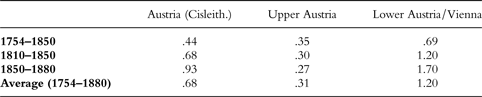
The following compilations from published statistical sources demonstrate the region's negative trends very clearly. In Kurt Klein's summary of Austrian population development between the sixteenth century and the twentieth, Upper Austria's population growth lagged far behind the rest of the Cisleithanian provinces (see Table 1).
Population, Percent per Annum GrowthFootnote 24
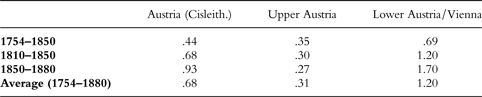
The distribution of population changes shows a shift in growth toward the capital region offset by relative stagnation and decline in other German portions of the empire, particularly so in Upper Austria.Footnote 28
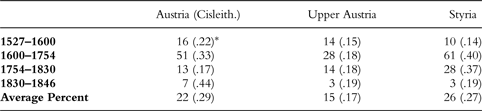
There were cyclical aspects to regional growth, and we note, for example, that for Cisleithania there was a peak in the annual growth rate of housing in the period 1600 to 1754 that was not achieved again until the early nineteenth century (see Table 2). Moreover, it is worth noting, in reference to the previous table, that the rates of increase in housing did not keep up with rates of population growth.
Styria's housing growth rates provide a good contrast for the Austrian and Upper Austrian figures since they reveal how that province became an attractor for investment and population at a time when Austria's “world system” direction was moving away from Germany and turning toward Italy and the Yugoslavian fringe. The sharp downturn at the end reflects the growing problems with connections to a northern Italy that was on its way toward the upheavals of 1848 and beyond. Upper Austria's almost unchanging rates of housing growth can be read in terms of the strong upward trend in Vienna's population growth. Arguably, this latter trend does not indicate a modernizing urbanization but rather an outmigration from the immiseration of stagnant rural economies.
The figures for growth in arable lands reveal trends that also call into question some of the accepted wisdom about where “development” was to be found in the Austrian empire (see Table 3).
Percent Growth in Arable LandsFootnote 30

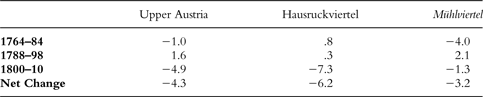
Again, Upper Austria was lagging behind other predominantly agrarian zones in the empire even as those areas that were industrializing after 1850 were in effect diminishing their investments in agriculture, a contraction that is shared by Upper Austria, where it was not, however, offset by a growing industrial sector during the crucial period of transition into the nineteenth century as the following set of tables concerning Upper Austrian textile manufactures suggests (see Tables 4 and 5).
Percent per Annum Growth of Linen Production for ExportFootnote 31
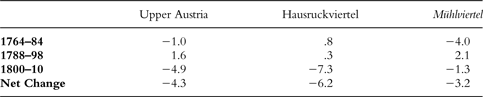
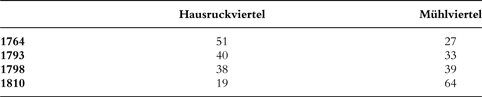
Percent Market Share in Linen Export ProductionFootnote 33
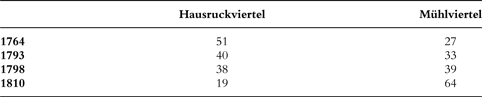
This, we must recall, is the linen that found its way into export by means of the new eighteenth-century “producer-cartel” economy controlled by courtier-investors, and it represents the output of fewer than half the Upper Austrian producers.Footnote 32 That the producer cartels that worked the Hausruck were in trouble is made even clearer when we compare the market share of the latter (Table 5) with developments in the Mühlviertel, the Upper Austrian quarter north of the Danube, where a more cottager-based putting out system became the favored form and investment venue for Austrian traders.
Tables 4 and 5 throw into sharper focus the relative and differentiated-by-region (as well as overall) decline in the Upper Austrian rural-industrial sectors that appeared as one significant condition governing the organization of peasant firms in Oftering parish. They reflect as well one of the little-recognized features of the Austrian Cameralist state, which is that it played neighboring regions against each other in what has been misperceived as an eighteenth- and nineteenth-century domestic “free-trade” empire surrounded and contained by a tariff wall. More particularly, these figures define more sharply the market structure and business climate in which the peasants' firms that we are about to look at had to operate.
Alleged Imperial “free trade” was in fact bound increasingly tightly by monopsonic and exemption privileges, inspection- and stamp-tax stations, etc., all of whose deployments and variable enforcements were subject to political as well as business negotiations and deals. One of the results was that even the subsidized Austrian industries were increasingly not only uncompetitive on the world market but were also reduced to regional competitions inside the closed empire, where previous military provision, salt trade, and other “dedicated” forms of production (Widmungen) were being opened to “free trade” in the last decades of the eighteenth century and beyond.Footnote 34 Courtier-entrepreneurs and rural producers alike still only operated in a closed, zero-sum Imperial world of economic winners and losers (often couched in ethnic-regional antagonisms) that depressed the economies of the losers while its pseudo-liberal restructurings offered the winners insufficient and uncompetitive connections to the larger world.Footnote 35 All of this points toward a contextual history not of growth but of stagnation and underutilization, of cut-throat competition for narrowed opportunities and diminishing returns.
* * *
Turning to the peasant householders of Oftering parish, we can now approach their labor constraints and opportunities with greater respect for their increasing economic marginalization in ambiguous and unpredictable processes of imperial-political restructuring and benefit-shifting in rural markets. Among the best sources for apprehending how peasant firms arranged themselves in actual houses and farms are the annual parish Communion records, the so-called “soul book” census lists, of which a considerable number from Upper and Lower Austria have survived. Lutz Berkner's seminal essay on the peasants of the Lower Austrian estate Heidenreichstein drew on one such Seelenbeschreibung (“description of souls”) from 1763.Footnote 36 Michael Mitterauer's early work on the Berndorf and Dorfbeuern Communion censuses was my first engagement with this source. He names forty-five Austrian parishes for which the Institute of Economic and Social History (ISWG) at the University of Vienna has such holdings.Footnote 37 For someone trying to see beyond the debate between Berkner and Laslett about stem families, Mitterauer's early approaches to this source offered an effective antidote of “real types.” The question about what historical “realities” animated the dynamic variances revealed in these sources remains open, however. My intent here is to supplement the mainly “ecological” framework on the Löfgren model put forward by Mitterauer and his associates by analyzing this source with economic- and specifically labor-historical questions in mind.
It was Michael Mitterauer who, during his tenure as head of the ISWG, offered to me, in the early 1980s, access to the institute's holdings of Oftering Communion censuses.Footnote 38 I was able to transcribe the records for the years 1703, 1793, 1815, 1825, 1846, 1862, 1880, 1895, and 1910. No Oftering records survived between 1703 and 1793. I present in their entirety the aggregated data from the Oftering soulbooks for the years 1703, 1793, 1825, and 1846 in a summary table in the Appendix. In the text that follows I seek to clarify salient points by selecting and reassembling figures from that summary table into smaller tables.
To begin, Table 6 shows the changing numbers of houses and people. Most immediately evident is that there was an increasing number of empty “houses,” houses for which no lease contract had been taken on. Moreover, by population numbers alone, we can see that this not-insignificant parish was in the long-term decline that one might expect given the region's economic trends as set out so far. We can see loss of population not only in the period of revolution and war but also a broader decline that continued into the period of relative recovery in the 1820s, leading one to conclude that possibly emigration was a significant aspect of this region's experience. The sharp drop in the actual number of houses between 1703 and 1793—and the very slow recovery, returning to only 161 houses by 1910, still ten below the number in 1703—speaks to a significant period of house-decay sometime after 1703.Footnote 39 Without necessarily ascribing decisive significance to the fact, it is yet worthwhile to note that the renewal of the Habsburg-Wittelsbach conflict over this region (ending in 1779 as indicated) and the region's accompanying “modern” decline began, oddly enough, precisely in 1704. It remains reasonable to assume that the 1703 figures speak to a time when the “old” active cross-border trade and more or less freely negotiated peasant-dealer relations were still operative. To confirm the regional decline sketched above, one can also note that the 1703 census not only reveals the highest number of houses but also a 100-percent occupancy rate. The sharp drop and slow recovery in the number of houses was duplicated and compounded by the behavior of the occupancy rates. What modifies a perception that a decline in population signified a decline in the local economy is the counterintuitive finding that during periods of relatively “better” markets for rural householders (1703, 1825), the occupancy density of the houses (average number of persons per house) was relatively low, a possible paradox to be unpacked below.
Oftering Parish Population/HousingFootnote 40

*Average number of persons per house
**Percentage occupancy rate
This last does not mean to suggest that these figures are mainly explicable by secular swings in the economy. As the difference in the number and occupancy rates of houses between 1703 and the later three years indicates, there had obviously been some fundamental structural changes between the early eighteenth century and the period of centralizing “revolutions” in the Austrian empire beginning after mid-century. This difference appears as well when we look at the terms under which the Oftering houses were occupied. In the following Tables 7 and 8, “housed” refers to heads of houses with life-term, heritable lease-contracts.
Housed Occupants/Percent of Occupied Houses in Oftering

*Percent of all occupied houses for the year (see Table 6 or Appendix)
Percent Housed Occupants/All Houses in Oftering

Families of the Housed in Oftering
*Percent of housed
**Occupied houses (percent of occupied houses)
If we consider that for the year 1703 the housed percentage rate for occupied houses was necessarily the same as for all available houses, then the drop-off and subsequent fluctuations of that latter rate for 1793 and after stands in even sharper contrast to the mitigated appearance of fluctuations above, as is evident in Table 7a.
Table 7a reveals what interests me more. The figures in both tables behave in roughly the same way but the sharp and permanent drop-off between the early eighteenth century and the later years visible in the second table of the traditional tenure contracts that created a formally “housed” (behaust) status for incumbents is particularly remarkable and leaps to the eye. The latter offers a truer measure of any actual or prospective incumbents' capacity or, perhaps more pointedly, desire to manage any of the available peasant farms on a traditional lease basis. It suggests that the margins for economic success were very narrow, especially so by 1846. It is also evident that the number of farms in the hands of single incumbents was increasing and that incumbent “housed” families with heritable life-term leases were in relatively steady decline. This is not, however, to say that power at the parish level held by housed incumbents declined nor that the cultural-hegemonic and political drumbeats for the desirability of such incumbency were diminishing. If anything, the opposite was the case.
Lastly, in connection with the trends in incumbency visible in Tables 7 and 7a, there is also an apparent fluctuation, corresponding to the increased number of persons per house in years of relative dearth already noted above (Table 6), by which the number of houses in the hands of both housed couples and singles increased as the number of persons per house decreased, pointing to another counterintuitive conclusion that we will also take up again below; namely, that in good years when these farms were more desirable investments (reflected in the rise in incumbents), they were also releasing labor. It is also worth noting here that the 1846 figures reflect without a doubt this tenure system's last gasps and suggest a reluctance by prospective incumbents to place themselves in a position to bear the debt-burdens appearing on the horizon in the form of the legal and fiscal restructuring (dressed up as a “peasant emancipation”) that was about to take place between 1848 and 1869.
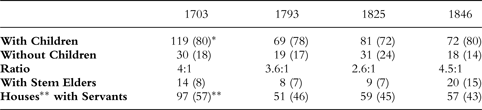
In the classic writings on the Austrian peasant family, the importance of family members laboring for the family enterprise has long been taken for granted. More recently, Michael Mitterauer and his ISWG colleagues have shown, on the basis of careful work in family reconstitution over time, that the relationship of “family labor” to other kinds of labor, particularly to “servant” (Gesinde) labor, is not the straightforward inverse kind of mutual and “life cycle” replacement once envisaged by Lutz Berkner's pioneering work, but can in fact take a number of different directions of development.Footnote 41 We can confirm this by showing that where Berkner saw children and servants reciprocally interchangeable, the Oftering families clearly were not behaving in this way (see Table 8).
The fluctuating ratios between housed families with and without children clearly had no bearing on the steadily declining presence of servants in the Oftering house economies, and that solidifies the perception that the presence of children in the family labor force did not necessarily stand in an inverse relationship to the number of servants. The trend concerning the presence of incumbents' children will take on a sharper focus when we repeat the servant figures in the context of other sources of labor in Table 9.
Labor Groups in Occupied Houses in Oftering
*Percent of occupied houses
Table 8 also shows a somewhat surprising upturn in houses with stem elders in 1846. Elsewhere I have developed a perspective on this group that is different from the persistent perception that theirs was a predominantly welfare-driven institution. Stem families clearly had tribute sheltering, accounting avoidance, private credit, and other functions as well.Footnote 42 The sudden resurgence of stem families in the 1840s alerts us further that by 1846, the peasantry appeared to be anticipating, adjusting, and relocating firms' assets in advance of the restructuring implicit in a possible “emancipation” that was already in the public debate.
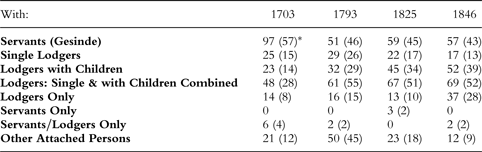
When we repeat in the first line of Table 9 the servants' numbers from Table 8 and put them in juxtaposition to the presence of other laboring groups that operated under different social-familial and compensation contracts in the Oftering houses, then a clearer picture begins to emerge of both the specific and general labor strategies of the Austrian peasant householders.
Table 9 suggests that although traditionally waged farm servants (called Gesinde, Dienstboten, Knechte, Mägde, etc.) on annually renewable contracts remained the backbone of the rural workforce, by the mid-nineteenth century the number of houses where they found employment had dropped by fourteen percent since the early eighteenth century. We note the growth in numbers (almost by inverse proportion to the servant population) of the “lodgers” (called Inwohner, Inleute) who took up residence in houses alongside the incumbents' families or in cottages rented from incumbents and paid for with labor services.Footnote 43 We will consider in a moment what kinds of services lodgers offered and what labor markets they served. In terms of the numbers, we note that there is an absolute and significant increase in the lodger numbers from the early eighteenth century to the three later years. Most notable is that lodgers with children made up the only group whose presence in peasant houses grew steadily through all four periods under investigation.Footnote 44 This is a surprising finding and opens a window on the experience of living under and working for peasant enterprise.
While lodgers of all types had already been part of the “classic” peasant labor force in 1703, what is of particular interest for us is the cyclical nature of the lodgers' appearance in the later period. As Tables 7, 7a, and 8 already suggested, there appeared to have been a rough correlation in the data, especially for the latter three years, between the broader economic cycle and the occupancy rates and the numbers of resident children. The same applies to all the lodgers as a group, most certainly in terms of houses occupied by lodgers only and, in the latter three years, for houses occupied by combinations of lodgers and servants only. An explanation for the difference between the 1703 data and those of the latter three years may be that in 1703 these rates were high because the local economy was still strong enough for a full occupancy rate and for full employment of all resident labor. From household inventory data we know that in the early seventeenth century, lodgers had been a relatively well-off group, some even employing their own servants.Footnote 45 During the later periods' recessions (1793, 1846) when fewer incumbents wanted (or could afford) a commitment to a lease contract on a house, those that had such a contract tended to retain both their children and increased numbers of lodgers, an increase that was reflected in the pattern of placing lodgers as well as combinations of lodgers and servants in houses that had no other takers—even as they were lowering the numbers of otherwise (i.e., non-contractually) attached persons, unknowable numbers of whom were more or less distant relatives of the incumbent householders. This last group's fluctuating and finally diminishing presence over time suggests a tightening of the immediate family links accompanied by a loosening of ties with more distant relatives, role kin, and significant others, which in turn suggests that the latter's implicit options to call on “family” for employment and welfare assistance were eroding.
How can we account for peasant householders' paradoxical tendency to hold more labor during recessions than during good years? One clue may be that, with the exception of the spike in numbers in 1793, the preference for single lodgers was in decline while that for lodgers with children was clearly on a substantially steady rise, making it the only group to increase its share of house communities' populations through all four periods. This is to say that this group's growth in significance was not in relation to the secular fluctuations of the market but rather in relation to the unfolding structural conditions of the peasant firms' economies and the broader markets. In terms of the current questions about an overall modernization of the Austrian economy in the period, we might reflect on whether this structural trend represents simply a modernization of market forces or, as I mean to argue, a structural regression coming to rest, in part, on familial involution and self-exploitation among the lodgers.
* * *
The Inleute were an important laboring population but do not appear as such in the parish censuses, as do the servants, the Gesinde, defined as persons by their labor. With a different compensation contract and different prospects, the lodgers were in fact the other significant provincial-rural workforce. They were the region's (and, indeed, the empire's) per diem laborers (Taglöhner), risking cycles of employment and unemployment to be in a waged labor market that the servants (i.e., the resident and multifunctional agricultural and household “hands”) had opted out of in return for the certainties of, however poor, food and lodging and an annual (and annually accounted-for and paid) “traditional” wage.Footnote 46
Although to the parish census taker the lodgers were renters of space and shelter in the village houses, to the peasant landlords they were opportunistic sellers of short-term contract labor to employers in the surrounding larger communities, in this case as far away as Linz and beyond. Day laborers occasionally contracted to do periodic unwaged work for their landlords but mostly worked either as itinerants going from farm to farm to perform specific, specialized in-house services (Störarbeit) such as shoe repair, tailoring, roofing, stove-tiling, masonry work, lumbering, etc.; they also worked as seasonal “guest workers” or as short-term help for craft and industrial producers who took advantage of specific contract opportunities arising from the ebb and flow of the mostly short-term production and delivery arrangements required by the rural-industrial deals conducted among the courtier cartels of the empire.
This is to say that their appearance in the Oftering house communities does not mean that they were, perforce, employed by their own landlords or, indeed, by any of the local tenant incumbents. It actually suggests the opposite: the householders' evident preference for married lodgers paradoxically reflects rather a deepening of the householders' dependence on unwaged labor. The married lodgers in effect paid for their rent with the labor of their wives and children. By enlisting the lodgers' families in that function, landlords could add theirs alongside the servants' “traditionally” (i.e., non-market) waged labor. The lodgers/day laborers in effect “sold” the unwaged labor of their families to their landlords to achieve for themselves the risky freedom of seeking work in waged labor markets beyond Oftering.
From an economist's perspective one can say that the Oftering householders were increasingly hoarding unwaged and traditionally waged labor, especially during downswing years, to avoid paying market-rate wages.Footnote 47 In a depressed economy, as this one certainly was, wages tend also to be generally depressed and yet even within this context there was a clear difference in pay scales between the two most prevalent kinds of waged labor as they were accounted either daily (lodgers) or annually (servants). Around 1800, a male day laborer in the region earned between fifteen and twenty kreuzer a day while a male servant's “traditional” wage was between ten and fifteen gulden a year.Footnote 48 In other words, given the rate of sixty kreuzer per one gulden, a year's wage for a servant laborer would only purchase forty-five days of a day laborer's time. Or, put another way, a lodger could earn in one to one-and-a-half months what a servant laborer earned in a year. Combining servant labor with the unwaged labor of the day laborers' families was a way to retain, to hoard, labor that was unspecified and available seven days a week. It was on command (in market terms, liquid) in the sense that its employers could direct it at any task for any length of time without previously negotiated and specified terms and limits. Hoarded labor can be seen as a result of a “liquidity preference” in labor. The lodgers' day labor, on the other hand, was negotiated from occasion to occasion and available only for specific jobs and specified periods of time at a specified wage rate. Moreover, the latter expected to be paid at the end of the day whereas the servants were paid after a year of service and their employers, acting in the additional function of “police” supervisor to everyone in their house, could withhold and garnishee such wages for various infractions, medical assistances, “loans,” etc.
Roman Sandgruber has compiled statistics that reveal a suggestive conjuncture by detailing the trends of Austrian prices and of related changes in real and nominal wages for the period 1750–1850.Footnote 49 In some accord with the differential regional stagnation and relative growth trends outlined above, beginning about 1770, nominal wages for day labor rose more sharply in Vienna than they did in Upper Austria and continued to climb in the former throughout the nineteenth century. In Upper Austria generally they peaked by 1820, then fell again and fluctuated at a level far below Viennese wages for the rest of the century. Underscoring this difference between more and less attractive locations for waged labor, Viennese day laborers' real wages began to rise between 1790 and 1800, peaked between the 1820s and 1840s, declined moderately by mid-century, and rose again toward peak levels by 1880. By contrast, Upper Austrian real wages remained depressed from the 1780s to 1820, then also rose sharply until the later 1830s only to fall again to their 1790s' lows by the mid- and late nineteenth century. In other words, the growing sector of day laborers that we find in the Oftering houses in the form of lodgers who serviced the needs of the “industrializing” suburbs of Linz operated in a low-end wage market that advantaged in particular married lodgers with children who could in effect sell the unwaged labor of their families to their landlords to be themselves sufficiently flexible to compete in a stagnant labor market. This latter could in turn pay a lower wage for day laborers whose residency costs were covered by the unwaged labor of their families.
The key benefit for the heads of houses was that they had unwaged labor available on command even as day-labor wages elsewhere were draining labor out of the local economy, a drain that could include the labor of the landlords' own children.Footnote 50 During periods when real wages for day laborers were relatively high, the Oftering houses showed fewer incumbents' children present to work for the house, and the inverse is true in periods when real wages went down (see Table 8). One way to account for this is to think of the children remaining in the home as one group of a three-part cohort of hoarded labor: 1. children of the heads of houses working usually for low-end servant wages or no wages, alongside 2. the growing numbers of lodgers' unwaged spouses and children, and 3. the steadily present servants on a traditional annual salary. Michael Mitterauer's family reconstitutions clearly showed that what made the incumbents' children's working conditions privileged in contrast to those of the servant laborers and the lodgers' families was that they could in specific cases be exempt from what appear to be most servants' one- to two-year nonrenewable service contracts.Footnote 51 Conversely, they were not burdened by the time commitment of the servants and of the lodgers' families but could leave to seek day labor work elsewhere when an opportunity arose.
It is the presence and the ambivalent status of this last group of laborers present in the peasant firms that has prompted Michael Mitterauer to move beyond what appeared to him overlapping dualistic typologies of either “servant labor” or “day labor” working in what could be seen as “family” or “servant” firms.Footnote 52 It is the practice of having peasant family offspring working as day laborers outside while also still living as part of and contributing some of their income to the family but doing so without participating in the latter as part of an integral “family enterprise” (Familienbetrieb) that caused Mitterauer to deny that such latter enterprises even existed.Footnote 53 Although he is no doubt right to distinguish as a separate group incumbents' children who operated as day laborers from their familial home base without at the same time being considered part of a “family firm,” what argues against Mitterauer's denial of a “family” enterprise dimension is that the mostly married incumbents had to include their families' internal obligations (inheritance portions, dowries, stem-elder obligations, etc.) as part of their firms' calculus. The Oftering evidence shows that all the forms, including family economies, existed at the same time, albeit in variable proportions and conjunctures, within adjacent houses in the same village society. They did so, moreover, in different proportions and in relation not to a given “ecosystem” but to the presence (or effectual absence) of labor markets and of negotiable, differential, and marginally adjustable wages.
Mitterauer, Ehmer, and others have rightly emphasized that the quality of life for those who labored in Austrian peasant houses was not one of membership in the enterprise but rather one of exclusion.Footnote 54 They and their colleagues at the ISWG have been instrumental in gathering personal histories (with remembrances from the late nineteenth through the early twentieth century) left by those who were cottagers, day laborers, “in service,” or were simply unpaid hands working for the most miserable sorts of room and board.Footnote 55 The evidence available here is altogether unequivocal and, indeed, heart-rending. It was a life of brutal choices, abjection, severed from claims on humane treatment, powerless against bullying and violence, perpetually obedient to commands.
On one hand, these memoirs—page after page of abysmal living conditions in tiny, often unheated, rooms; monotonous or no food; neglect; verbal and physical abuse; bodies and minds breaking under the tensions of poverty, hard labor, and domination—appear as yet more instances of what is possible under any sort of immiseration. On the other hand, there are inherent in these narratives several recurring experiences that speak not simply to eternal poverty but also to historically specific qualities of a working life whose conditions persisted in the Austrian empire from the eighteenth century into the early twentieth. Almost all of the memoirs turn on accounts that detailed the interactions among the three kinds of labor we have discerned from the Oftering soul books. For servants, the only escape from low-wage service was, other than outright emigration, to marry and then for the male partner to pursue day labor work while wives and children worked unwaged for landlords to secure minimal shelter and a domicile with a proper address, itself an essential legal attribute for any itinerant worker.
The economic and social experiences of the married lodgers' wives and children were not without economic and other significance. The memoirs reveal that child labor was everywhere, beginning often before the age of ten. Parents negotiated with employers on their children's behalf, but the “light” work contracted for, such as child care, kitchen and household service, would often and in a very short time become adult labor in the fields and stables.Footnote 56 The day laborers' wives bore a particularly heavy burden at the base of this pyramid, having to put their many labor obligations to the landlord above their own infants' care. Without doctors available (or affordable), many of them fell ill, were unable to work, and often died young. Their husbands, unless they could find a new wife or a relative to do the deceased's work, were forced to dissolve their lodger households, give up their children to employers or to more or less distant kin for “care,” and return to servant labor.Footnote 57 The children of the day laborers were purposefully undereducated, harnessed during childhood into the work routines of peasant enterprises and, early accustomed to no or very low wages, became the most frequent source of traditionally waged servant labor.
The peasant landlords were of two minds about the married day laborers in their midst. The son of cottagers recalled that when his father obtained day labor making deliveries for a local bakery, the peasant leadership, backed by the parish priest, forced his dismissal. Their argument was that a baker was not entitled to hire agricultural workers.Footnote 58 Married day laborers were the preferred lodgers for the unwaged labor of their families but they could not be allowed to become an entry wedge locally for day-labor wages paid for specified work. When they found work too close to home there was, in effect, political intervention to return them to the hoard of multitasked and commanded labor available at a standard minimal or no wage.
* * *
How might we read, in the light of such regional and microeconomic evidence, the Austrian empire's ostensible modernization in the period from the late seventeenth through the mid-nineteenth centuries? How is it analytically useful to say that trends of labor formation in Austrian peasant firms represented a broadly evolving, differentiated, and progressively modern labor market?Footnote 59 The answer to these questions requires some observations on the analytical value of the “labor hoarding” concept.
The ongoing post-1989 discussion about the former East Bloc economies has seen the appearance in the economic-analytical literature of “labor hoarding” as a concept to grasp one of the dimensions of those economies. Uwe Vollmer's enlightening analysis of firm management under conditions of idle or underemployed hoarded labor in the state-planned and directed economies in the former GDR stands out in particular as a clarification of the concept.Footnote 60 His critical discussion of the socialist-revolutionary tradition of commanding and threatening labor for shirking and desertion revealed a “modernized” instance of what were in effect eighteenth-century absolutist languages and practices.Footnote 61 His several main arguments' focus on the paradoxical underutilization of labor in the East German planned economy's actual practices also opened for examination, among other things, the ways that this form of labor deployment can render specific utilities to incumbent managers of firms while simultaneously incurring several micro- and macroeconomic inefficiencies and disutilities throughout a system as whole.Footnote 62
The East German plant managers' strategies obviously differed in many ways from those of farm incumbents in the eighteenth- and nineteenth-century Austrian empire, but the labor hoarding concept's strength is that the agents, forms, and dynamics of specific instances may differ greatly without impairing its overall analytical power for revealing how such hoarding can work in specific historical instances to affect firms' as well as a larger economy's returns and competitive qualities. Vollmer's plant and shop managers functioned in a technically advanced and planned “socialist” economy in which they were required to adjust their labor and production quotas to centrally prescribed and allocated wage funds whose disbursement they controlled. They exploited areas of “play” in the system that allowed them opportunistic deployments of—often necessarily concealed—hoarded labor to engage in production with two distinct kinds of labor force. On the one hand were the quota-fulfilling ordinary workers who were paid standard low wages and, on the other, those who earned substantially higher wages by producing for the managers a surplus of goods for barter and other off-the-books transactions when such opportunities presented themselves. These strategic behaviors can guide us toward refiguring variously active and idle, waged and unwaged laborers being hoarded elsewhere, as for instance in the configurations of early modern and later Austrian peasant firms, as we have observed.Footnote 63
We have to note that, unlike the GDR's firm managers, the Austrian peasant householders were not required to circumvent a system of mandatory reporting of surplus labor to the authorities for possible centrally directed redeployment. They, too, however, had only a limited wage fund to allow them to function in a bounded, centrally directed market in which two kinds of peasant enterprise could operate. On the one hand, domestic prices were depressed to advantage a sizable minority of peasant firms that were organized to produce for state-subsidized and corporatively managed commercial and export cartels. The majority of rural enterprises, on the other hand, was left to individual competition in a low-return, essentially closed-off-from-the-world “free” market to produce—with labor inputs that were traditionally compensated or unwaged—relatively low “rent” quotas of commodity and cash tributes, and reserving (i.e., hoarding), such labor for the daily variety of self-reproducing, seasonal, and opportunistic “windfall” deployments.
A labor-hoarding perspective raises doubts against the argument for an allegedly modernizing trend occurring since the eighteenth century in the German provinces of the Austrian empire. The economics of hoarding drew the attention of J. M. Keynes as an obstacle to be overcome in achieving any economic-structural modernization that could strike a livable balance between freedoms and controls in the market. Keynes perceived what he called a “liquidity preference” in the common tendency during stagnant markets to hoard cash as a store of value that, when withheld from markets to be perpetually ready for opportunistic deployment in unforeseeable windfall or other future investment, perpetuates a downward spiral of stagnant markets with ever fewer such opportunities.Footnote 64 Unwaged or traditionally low-waged command labor can similarly store value and be rationally hoarded and even idled in expectation of future, seasonably profitable or windfall deployment. Such low- or unwaged labor effectively subsidizing a low day-labor wage cannot, however, be construed as a foundation for progressively growing effective demand in a modernizing economy.
Austrian peasant firms' actual labor acquisitions and deployments, as they appeared in the Oftering sources and in work by Mitterauer, Ehmer, and others, as well as in the collected autobiographies, seem to be a clear instance of a liquidity preference for labor. Householders preferred hoarding labor in their firms to be available at all times for variable and commanded functions rather than having to contract with day laborers in the market at times when opportunity demand for labor was seasonally and/or conjuncturally high. When, in a context of limited or shrinking opportunities in a “protected” market, as was the case in rural Austria between 1750 and 1850, labor cannot (nor needs to) return a generally high yield, then it may as well be hoarded at low cost for the few occasions when it can (or might) render such yields to the incumbents. This observable historical trend, however, does not indicate “modern” economic development but points rather at peasant firms releasing and exporting waged labor to the broader economy only to the extent that this increased their own hoard of unwaged and traditionally waged labor. The day laborers in effect bargained for a wage in a broader labor market governed by state-corporate and lesser enterprises that did not need to offer wages sufficient to cover the cost of sheltering workers' families. These markets were in effect directly subsidized by unwaged, or minimally waged, labor working in rural firms that were themselves stuck in a labor liquidity trap and operating at levels of productivity and income well below capacity. This was an economy that required, on a broad scale and, arguably, into the early years of the twentieth century, recognizable forms of slave labor that went generally unrecognized as such, given their containment in the lodging and family arrangements of both housed peasants and day laborers.Footnote 65
Appendix
Oftering: House Occupancy and Constellations