When heavy-metal toxins and organic pollutants are present in the human body in concentrations that exceed prescribed thresholds, they pose serious threats to human health (Sigmund et al., Reference Sigmund, Gharasoo, Hüffer and Hofmann2020; Daikh et al., Reference Daikh, Ouis, Benyoucef and Mouffok2022). Over the past several decades, the adverse impacts of heavy metals and organic pollutants on animals and plants have been studied and discussed extensively, and it has become clear that the treatment of water containing heavy metals requires urgent attention (Wang et al., Reference Wang and Gong2006). Clay materials play a significant role in the adsorption of heavy metals in water due to their large surface areas and charged surfaces (Gomes et al., Reference Gomes, Rautureau, Poustis and Gomes2021; Orucoglu et al., Reference Orucoglu, Grangeon, Gloter, Robinet, Madé and Tournassat2022; Xu et al., Reference Xu, Dai, Skuza, Xu, Shi and Wang2022). Previous studies have shown that a given heavy metal can be adsorbed by several clay minerals (Liu, Reference Liu, Wu, Tang and Zeng2005; Erdoğan et al., Reference Erdoğan, Ergürhan and Anter2021; Ma et al., Reference Ma, Wang, Ge, Xia and Song2021; Sarabadan et al., Reference Sarabadan, Bashiri and Mousavi2021; Silva et al., Reference Silva, Gois, Ramme, Dantas, Barillas and Santanna2021; Barrientos-Velazquez et al., Reference Barrientos-Velazquez, Kakani, Fowler, Haq, Bailey and Deng2022; Werling et al., Reference Werling, Kaltenbach, Weidler, Schuhmann, Dehn and Emmerich2022). For example, Pb2+ can be adsorbed by montmorillonite, kaolinite, sepiolite, attapulgite, illite, rectorite and bentonite (Zhang, Reference Zhang2012; Lai, Reference Lai2013) and Cu2+ can be adsorbed by sepiolite, kaolinite, illite, bentonite and montmorillonite (Koppelman & Dillard, Reference Koppelman and Dillard1977; He et al., Reference He, Guo, Xie and Peng2000; Cheng, Reference Cheng2017). In addition, numerous synthetic adsorbents have been developed to remove heavy-metal toxins and organic pollutants from wastewater (Dai et al., Reference Dai, Guo, He, Song and Wang2021; Wang et al., Reference Wang, Zhuang, Wang, Liu, Kong, Li and Chen2022). Examples of these include the hybrid polyaniline matrix reinforced by kieselguhr (PANI@KG) adsorbent for water treatment (Ouis et al., Reference Ouis, El Kebir, Moulefera, Lilia and Benyoucef2022) and activated carbon based on prickly pear seeds and a conductive polymer matrix based on polyaniline for the removal of anionic Congo red dye from aqueous solutions (Lahreche et al., Reference Lahreche, Moulefera, El Kebir, Lilia, M'hamed and Abdelghani2022). However, different minerals exhibit varying adsorption rates for the same heavy metal (Adebowale et al., Reference Adebowale, Unuabonah and Olu-Owolabi2006). The removal rate of Pb2+ from wastewater has been reported to be greater than average when rectorite is used as the adsorbent (Yu et al., Reference Yu, Lv, Zhou, Cai and Yu2019). As pH increases within a certain range, the Pb2+-adsorption capacities of kaolinite and montmorillonite exceed the average value (Lai, Reference Lai2013). The Pb2+-adsorption capacity of illite is greater than those of montmorillonite and kaolinite (SenGupta & Bhattacharyya, Reference SenGupta and Bhattacharyya2012). Modified kaolinite might remove Pb2+ from aqueous solutions more effectively than kaolinite (David et al., Reference David, Okoro, Akpomie, Okey and Oluwasola2020). The Pb2+ adsorption rate on sepiolite exceeded the average rate under the same experimental conditions (e.g. pH, Eh and temperature; Liu et al., Reference Liu, Chen, Li, Chen, Chen, Gao and Li2018). Thus, the factors that influence the adsorption rates of heavy metals in water need to be elucidated.
Deep learning is a type of machine learning based on artificial neural networks; it employs the method of characterization from learning research (Hinton et al., Reference Hinton, Osindero and Teh2006). By reducing the use of numerous space relationship parameters it improves training performance. Additionally, deep learning employs efficient unsupervised or semi-supervised learning and layered feature extraction algorithms, which can replace manual feature acquisition. Furthermore, the artificial neural networks simulate the learning procedure of the human brain through analysis (e.g. Castro et al., Reference Castro, Hickson, Bettadapura, Thomaz, Abowd, Christensen and Essa2015; Chaudhary et al., Reference Chaudhary, Poirion, Lu and Garmire2017; Hu et al., Reference Hu, Zhang, Yang, Chen and Zuo2017; Liu et al., Reference Liu, Li, Wang and Yan2020). A neural network system based on deep learning can be used to accurately predict adsorption rates, which have a wide range of input parameters, through simulation fitting training with large amounts of useful data (Huang et al., Reference Huang, Wu and Cheng2020). In addition, Pearson sensitivity analysis can be used to determine the contribution of individual input parameters to the adsorption rates predicted by the neural network. For example, Glänzel et al. (Reference Glänzel, Teles and Schubert1984) corrected a characterization of the matrix by truncated moments and applied this to Pearson-type distributions, and Xie et al. (Reference Xie, Wu and Zheng2020) performed feature selection using a two-dimensional adaptive feature selection algorithm based on information gain and the proposed Pearson correlation coefficient. Therefore, deep learning and Pearson analysis can be used to predict the factors that influence certain outcomes and identify the factors with the maximum and minimum levels of influence.
In this work, papers published over the past 20 years were collected describing studies in which a given heavy metal was adsorbed by various minerals with different adsorption rates. The collected papers were selected as targets for deep learning prediction after screening and classification (78% of the 128 papers collected). Based on training, validation and testing, the deep learning neural network predicted accurately the adsorption rates of heavy metals by clay minerals. Pearson sensitivity analysis was used to determine the factors having the maximum and minimum levels of influence on the adsorption rates of heavy metals by clay minerals. The results of this work indicate that deep learning neural networks could have a wide range of practical applications in the prediction of heavy-metal adsorption rates on clay minerals.
Methods
Data mining from the literature
Three key terms, namely ‘clay minerals’, ‘adsorption’ and ‘heavy metals in water’, were used to retrieve the relevant literature from 1978 to 2019. Irrelevant papers were excluded from the database, leaving a list of 128 papers. Of these, only papers that dealt with the parameters of heavy metals (hydration heat, electronegativity, electron charge/mass ratio, ionic radius), clay minerals (concentration, expansion volume, slice gap, specific surface area), ambient temperature and pH were analysed further, and the result was a core database consisting of valid data collected from literature. Finally, the effectiveness of the method used to identify target literature was tested by applying it to a larger dataset that was more accurate. As the prediction error decreased and the working prediction range increased, the number of training items available increased.
Setup of the deep learning neural network
Deep learning is based on artificial neural networks, which establish and simulate the neural network of the human brain for analysis and learning and mimic the mechanism of the human brain to interpret data. To improve the model, outliers were excluded from the training data. Overfitting is a common problem during neural network training. In an overfitted neural network, although the error of the training data is minimized, processing new data can result in large errors because the trained network has only memorized the training examples and has not learned to generalize for new situations. In this study, the number of parameters was smaller than the total amount of data in the training set, such that the probability of overfitting was minimized. In addition, for the same kind of data, the effective number of iterations of the neural network fitting simulation was trained using MATLAB (Mathworks, MA, USA). In this study, based on the various types of input factors, each group of effective fitting training was divided into six groups for a certain number of training iterations, testing, error analysis and Pearson correlation analysis in MATLAB. As various conditions led to different solutions, the final estimates were obtained by averaging the outputs obtained from all 50, 80 or 100 trained networks. As a result, in the majority of cases, the mean squared error for the average output was lower than that for the individual sessions. As the computational costs of multiple training can be high, a parallel computation scheme was used in this study to reduce training time substantially. The computational time for a complete multi-training session using an Intel Core (TM)i5-8250K CPU with 64 GB RAM was <1 min using all eight CPU cores.
Deep learning was used to select the deep structure related to the adsorption of heavy metals by clay minerals and >100 papers were further screened. The effects of clay mineral parameters (e.g. hydration heat, electronegativity, charge/mass ratio, ionic radius, temperature, concentration, swelling capacity, slice gap, pH and specific surface area) on the process of heavy-metal adsorption were analysed. The deep learning neural network was used to analyse the adsorption of a given heavy metal in water using various kinds of clay minerals. Differences in the parameters of the clay minerals caused variations in the adsorption rates of the same heavy metal. The adsorption of heavy metals by clay minerals under specific conditions was simulated using MATLAB. In this study, the adsorption rate (M) is defined as follows:

where C 1 is the initial concentration of heavy metals and C 2 is the final concentration of heavy metals adsorbed by the clay minerals. Because the values of all of the input parameters fell within a certain range, the validity of the method was verified using the data from the literature obtained using the deep learning artificial neural network. As the number of effective fitting training items increased, the range of the relevant parameters increased and the error decreased.
Parameter selection
The classical form of the equation used to calculate the adsorption rate is based on Equation 1. Parameters that are related to the adsorption of heavy metals by clay minerals are shown in this section and are defined as the target parameters for prediction. Parameters related to the adsorption properties of clay minerals, as reported in the literature and previously linked to sorption behaviour, were selected. This study used MATLAB simulations and Pearson correlation to analyse performance with respect to goals.
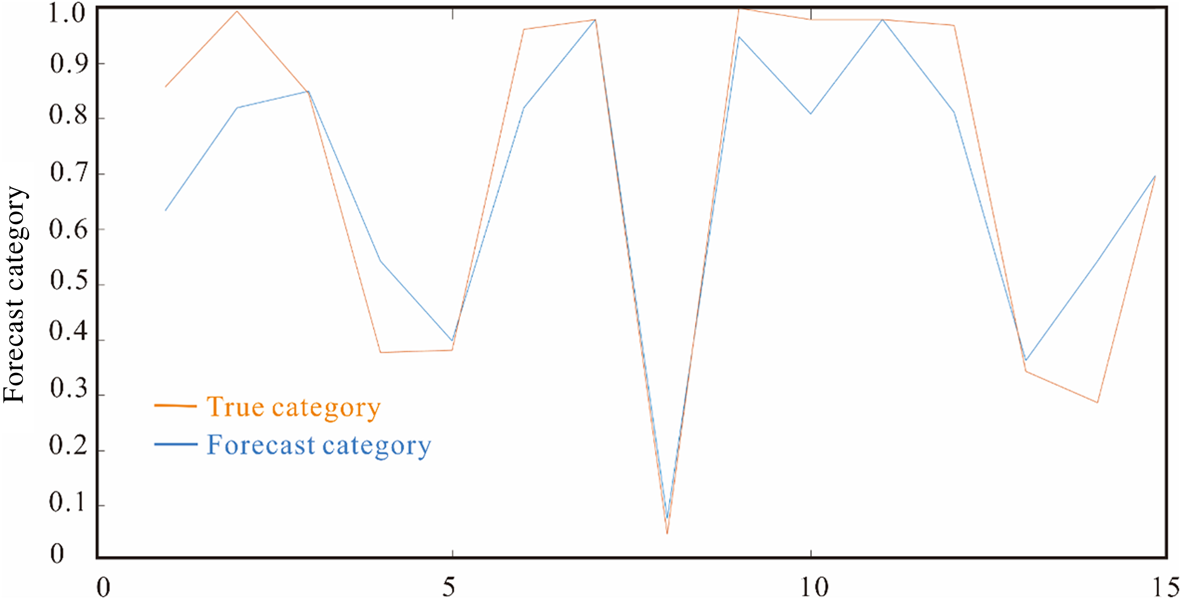
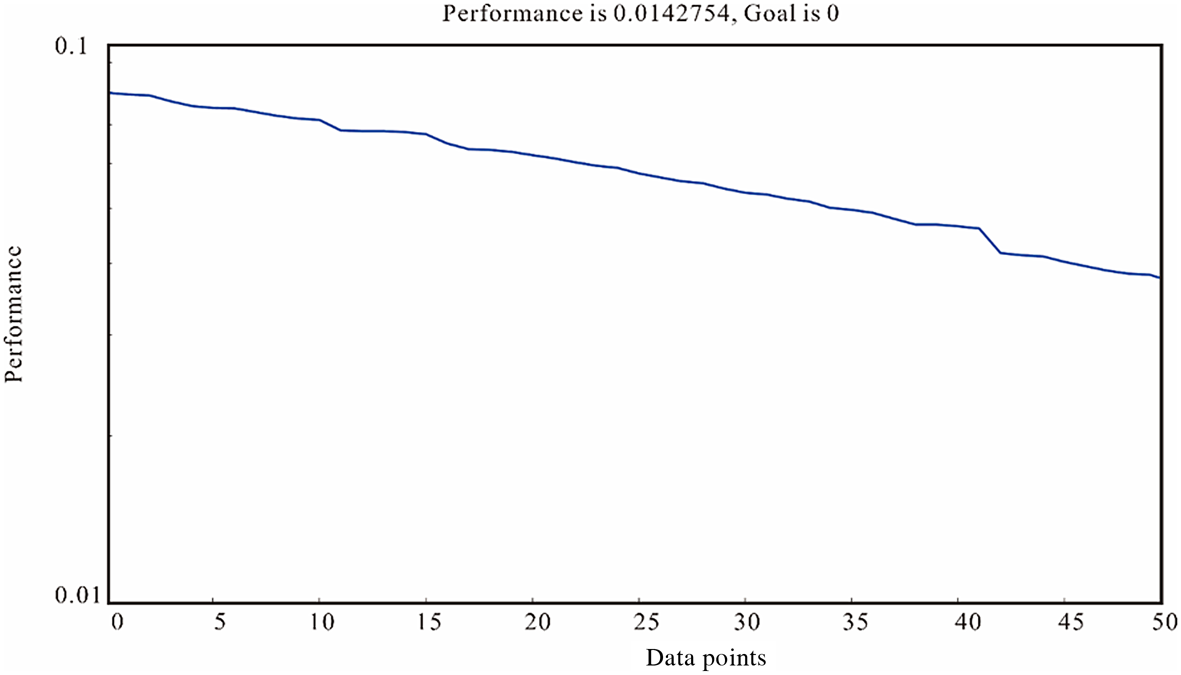
Accounting for the effective fitting of training times, the first set of relevant input parameters included temperature, ionic radius, charge/mass ratio, electronegativity and heat of hydration; the training times were divided into training (78%) and validation (12%). A total of 100 iterations were adopted as the number of iterations for effective fitting training for the first set of parameters (Fig. 1). On this basis, this study adopted a target of 15 iterations for effective fitting validation (Fig. 2) and error analysis (Fig. 3). The second set of relevant input parameters included temperature, ionic radius, charge/mass ratio, electronegativity, hydration heat and concentration; the training times were divided into training (62%) and validation (14%). A total of 80 iterations were adopted as the number of iterations for effective fitting training for the second set of parameters (Fig. S1). On this basis, this study adopted a target of 18 iterations for effective fitting validation (Fig. S2) and error analysis (Fig. S3). The third set of relevant input parameters included temperature, ionic radius, charge/mass ratio, electronegativity, hydration heat and swelling capacity; the training times were divided into training (62%) and validation (14%). A total of 80 iterations were adopted as the number of iterations for effective fitting training for the third set of parameters (Fig. S4). On this basis, this study adopted a target of 18 iterations for effective fitting validation (Fig. S5) and error analysis (Fig. S6). The fourth set of relevant input parameters included temperature, ionic radius, charge/mass ratio, electronegativity, hydration heat and slice gap; the training times were divided into training (62%) and validation (14%). A total of 80 iterations were adopted as the number of iterations for effective fitting training for the fourth set of parameters (Fig. S7). On this basis, this study adopted a target of 18 iterations for effective fitting validation (Fig. S8) and error analysis (Fig. S9). The fifth set of relevant input parameters included temperature, ionic radius, charge/mass ratio, electronegativity, hydration heat and pH; the training times were divided into training (62%) and validation (12%). A total of 80 iterations were adopted as the number of iterations for effective fitting training for the fifth set of parameters (Fig. S10). On this basis, this study adopted a target of 16 iterations for effective fitting validation (Fig. S11) and error analysis (Fig. S12). The sixth set of relevant input parameters included temperature, ionic radius, charge/mass ratio, electronegativity, hydration heat and specific surface area; the training times were divided into training (39%) and validation (11%). A total of 50 iterations were adopted as the number of iterations for effective fitting training for the sixth set of parameters (Fig. S13). On this basis, this study adopted a target of 15 iterations for effective fitting validation (Fig. S14) and error analysis (Fig. S15). With the help of deep learning and MATLAB, the effective number iterations of training, testing, error analysis and Pearson correlation analysis for each set of input variables could be obtained relatively quickly and accurate simulations and predictions of relevant results could be achieved. The aforementioned calculation setup was completed in ~2.5 min.
Effective fitting training of hydration heat, electronegativity, electron charge/mass ratio, ionic radius and temperature using MATLAB.

Effective fitting validation of hydration heat, electronegativity, electron charge/mass ratio, ionic radius and temperature using MATLAB.

Performance and goal of hydration heat, electronegativity, electron charge/mass ratio, ionic radius and temperature.

The spatial variability of each input parameter was assumed to follow a normal distribution, which was defined by the standard deviation and mean value of that parameter alone; no correlation was assumed between the spatial variabilities of the various input parameters. Pearson analysis was carried out on the effective data selected from the target literature obtained through deep learning. The parameter simulation of the sample data from the target literature was simulated using MATLAB to obtain the predicted and actual categories of clay minerals. In addition, the deep learning neural network yielded enhanced accuracy through simulation fitting training of the effective number of iterations.
Based on the foregoing discussion, 10 factors (hydration heat, electronegativity, electron charge/mass ratio, ionic radius, concentration, swelling capacity, slice gap, specific surface area, temperature and pH) affecting the adsorption of heavy metals by clay minerals were selected, and the factors with the maximum and minimum levels of influence on the adsorption rates were identified using MATLAB simulations and Pearson correlation analysis. We obtained the relevant parameters of clay minerals and heavy metals from a self-organizing database. The model was based on a feedforward deep learning neural network (also known as a multi-layer neural network) with two hidden layers between the input and output layers. These hidden layers dealt with the complex non-linear relationships between 10 input parameters (i.e. the 10 aforementioned factors) and one output parameter (the heavy-metal adsorption rate by clay minerals). A very accurate training set of predicted data covering a wide range of input parameters was obtained using the neural network predictions for M in Equation 1. All input parameters yielded the same results within a certain range of values for M in Equation 1.
Sensitivity and data analysis
A global sensitivity analysis considers variabilities in the full range of values for all input parameters simultaneously. Pearson correlation analysis was used to determine the contributions of individual input parameters to the adsorption rates predicted by the neural network. In this study, the individual input parameters with the maximum and minimum levels of influence on the adsorption rates of heavy metals by clay minerals were identified through Pearson correlation analysis within a certain range using MATLAB.
Results and discussion
Analysis of the factors affecting the adsorption rates of heavy metals by clay minerals in water
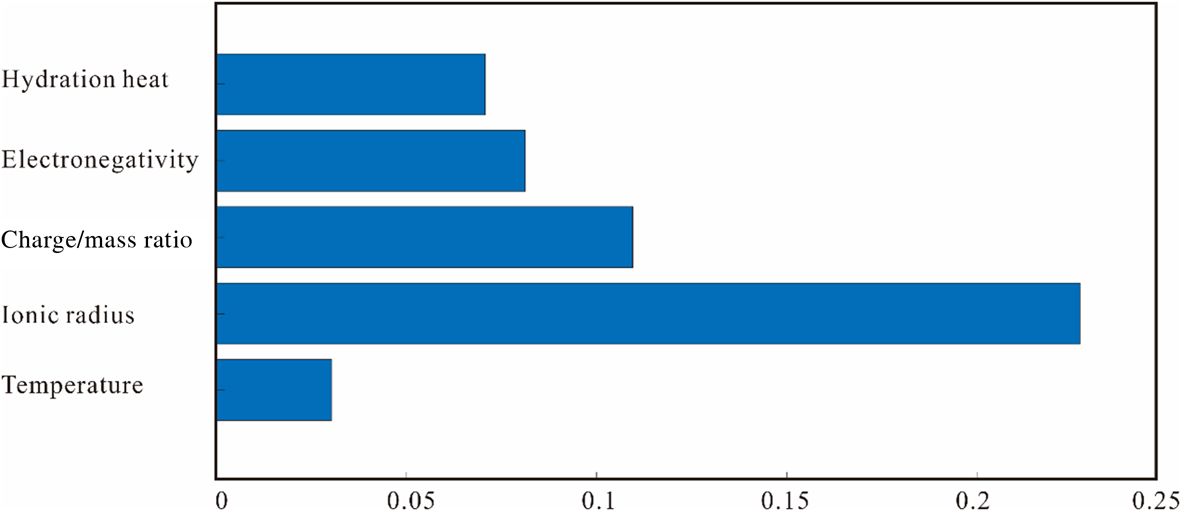
The model was constructed based on a feedforward deep learning neural network (also known as multi-layered network of neurons). The deep learning neural network and Pearson correlation analysis yielded very accurate predictions of the data from the training set and were able to cover a wide range of input parameters. The Pearson correlation coefficients were as follows: hydration heat: 0.067, electronegativity: 0.08, charge/mass ratio: 0.14, ionic radius: 0.23, and temperature: 0.03; the overall performance was 0.0142754 and the goal was 0. The Pearson correlation coefficient was greatest for heavy-metal ionic radius in this group (Fig. 4). Therefore, in this group of influencing factors, the heavy-metal ionic radius had a dominant effect on the adsorption rates of heavy metals by clay minerals.
Influence of the first group of parameters (hydration heat, electronegativity, electron charge/mass ratio, ionic radius and temperature) on the heavy-metal adsorption rate by clay minerals.

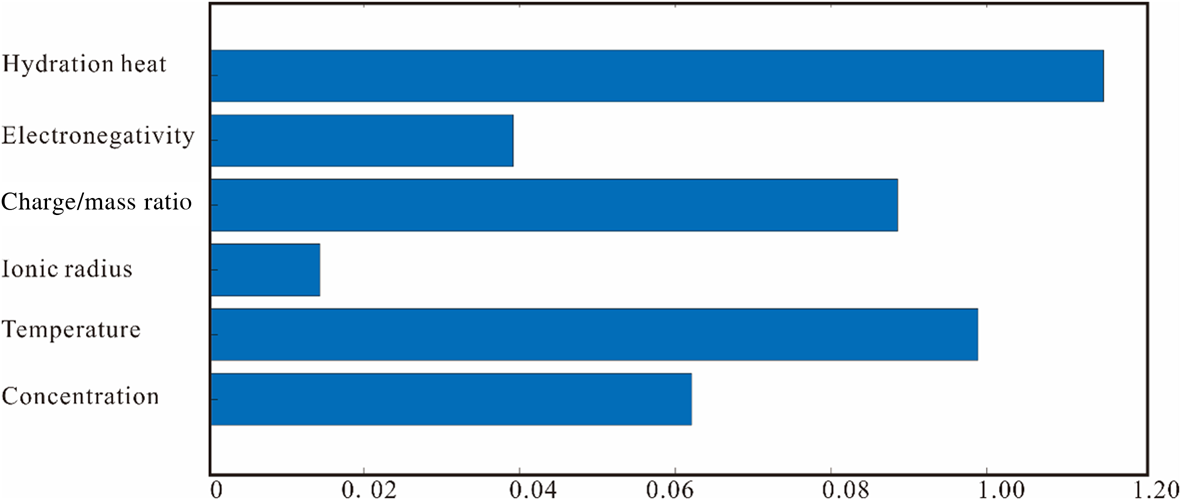
For the inherent influencing factors of heavy metals in water, Pearson correlation coefficients for hydration heat, electronegativity, charge/mass ratio, ionic radius, ambient temperature and concentration of clay minerals were as follows: hydration heat: 0.118, electronegativity: 0.039, charge/mass ratio: 0.09, ionic radius: 0.017, temperature: 0.099, and concentration: 0.062; the overall performance was 0.037 and the goal was 0. The Pearson correlation coefficient was greatest for heavy-metal hydration heat in this group (Fig. 5). Therefore, in this group of influencing factors, heavy-metal hydration heat had a dominant effect on the adsorption rates of heavy metals by clay minerals.
Influence of the second group of parameters (hydration heat, electronegativity, electron charge/mass ratio, ionic radius, temperature and concentration) on the heavy-metal adsorption rate by clay minerals.

The Pearson correlation coefficients for the third set of parameters of hydration heat, electronegativity, charge/mass ratio, ionic radius, ambient temperature and swelling capacity were as follows: hydration heat: 0.01, electronegativity: 0.11, charge/mass ratio: 0.057, ionic radius: 0.28, temperature: 0.025, and swelling capacity: 0.0153; the overall performance was 0.0409 and the goal was 0. The Pearson correlation coefficient was greatest for heavy-metal ionic radius in this group (Fig. 6). Therefore, in this group of influencing factors, the heavy-metal ionic radius had a dominant effect on the adsorption rates of heavy metals by clay minerals.
Influence of the third group of parameters (hydration heat, electronegativity, electron charge/mass ratio, ionic radius, temperature and swelling capacity) on the heavy-metal adsorption rate by clay minerals.

The Pearson correlation coefficients for the fourth set of parameters of hydration heat, electronegativity, charge/mass ratio, ionic radius, ambient temperature and spacing of clay mineral layers were as follows: hydration heat: 0.11, electronegativity: 0.059, charge/mass ratio: 0.057, ionic radius: 0.11, temperature: 0.147, and slice gap: 0.12; the overall performance was 0.038 and the goal was 0. The Pearson correlation coefficient was greatest for temperature in this group (Fig. 7). Therefore, in this group of influencing factors, temperature had a dominant effect on the adsorption rates of heavy metals by clay minerals.
Influence of the fourth group of parameters (hydration heat, electronegativity, electron charge/mass ratio, ionic radius, temperature and slice gap) on the heavy-metal adsorption rate by clay minerals.

Pearson correlation coefficients for the fifth set of parameters of hydration heat, electronegativity, charge/mass ratio, ionic radius, ambient temperature and pH of heavy metals in water were as follows: hydration heat: 0.09, electronegativity: 0.023, charge/mass ratio: 0.135, ionic radius: 0.025, temperature: 0.092, and pH: 0.117; the overall performance was 0.0452 and the goal was 0. The Pearson correlation coefficient was greatest for heavy-metal electron charge/mass ratio in this group (Fig. 8). Therefore, in this group of influencing factors, the heavy-metal electron charge/mass ratio had a dominant effect on the adsorption rates of heavy metals by clay minerals.
Influence of the fifth group of parameters (hydration heat, electronegativity, electron charge/mass ratio, ionic radius, temperature and pH) on the heavy-metal adsorption rate by clay minerals.

The Pearson correlation coefficients for the sixth set of parameters of hydration heat, electronegativity, charge/mass ratio, ionic radius, ambient temperature and specific surface area of clay minerals were as follows: hydration heat: 0.057, electronegativity: 0.14, charge/mass ratio: 0.05, ionic radius: 0.15, temperature: 0.08, and specific surface area: 0.44; the overall performance was 0.042 and the goal was 0. The Pearson correlation coefficient was greatest for the specific surface area of clay minerals in this group (Fig. 9). Therefore, in this group of influencing factors, the specific surface area of clay minerals had a dominant effect on the adsorption rates of heavy minerals by clay minerals.
Influence of the sixth group of parameters (hydration heat, electronegativity, electron charge/mass ratio, ionic radius, temperature and specific surface area) on the heavy-metal adsorption rate by clay minerals.

Development and application
The collected literature was analysed using deep learning. MATLAB programming was used to conduct effective training, testing, error analysis and Pearson correlation analysis on the 10 input parameters based on the relevant parameters for a given heavy metal. The method presented in this work can be used to identify the factors with the maximum and minimum levels of influence on the adsorption rates of heavy metals by clay minerals and to predict the relevant parameters of the target clay minerals. The method applied in this study could also be used for data simulation error analysis and Pearson correlation analysis in similar situations in other fields of study in the future.
Conclusions
Based on generally available datasets of heavy-metal parameters, a widely applicable deep learning neural network approach was developed that provided accurate predictions of the influence of the sorption ratio on the adsorption of heavy metals by clay minerals. In addition, this system yielded accurate predictions of adsorption rates. According to the Pearson sensitivity analysis, the contributions of individual parameters to the adsorption rates could be determined using this method. This method has the potential to be used for data simulation error and correlation analysis in other fields of study.
Associated content
All data used in this study, including the training datasets, can be found in the online supplementary supporting information files. The MATLAB source code for these models can be provided by the authors upon reasonable request.
Acknowledgements
The authors thank the anonymous reviewers for their helpful reviews of the manuscript and the Principal Editor, Prof. Chun-Hui Zhou, for constructive suggestions and comments on this work.
Financial support
This work was supported jointly by the National Natural Science Foundation of China (grant no. 4210020411) and project ZR202102190109 supported by the Shandong Provincial Natural Science Foundation.
Supplementary material
To view supplementary material for this article, please visit https://doi.org/10.1180/clm.2022.20.