Dexmedetomidine is a novel sedative agent that has a minimal amount of respiratory depression, making it a potentially ideal agent for use in transitioning to tracheal extubation in patients who are difficult to sedate.Reference Reiter, Pietras and Dobyns 1 – Reference Bejian, Valasek, Nigro, Cleveland and Willis 7 Data regarding the use of dexmedetomidine in critically ill children are ample, but do not suggest that dexmedetomidine decreases ventilator time or hospital length of stay.Reference Hosokawa, Shime and Kato 2 – Reference Bejian, Valasek, Nigro, Cleveland and Willis 7 Currently, there are few data describing the use of dexmedetomidine in children with trisomy 21 who have undergone surgery for CHD. One of the proposed benefits of dexmedetomidine use in this population is the ability to extubate patients from mechanical ventilation while maintaining adequate sedation. This should theoretically result in decreased ventilatory time and decreased length of stay. We propose that dexmedetomidine may be most beneficial in patients with trisomy 21 after a cardiac surgical procedure, as this is a group of patients who are at a high risk of prolonged mechanical ventilation.Reference Butler, Hayes, Hathaway and Begleiter 8 – Reference Pandit and Fitzgerald 10
The primary objective of the study was to determine whether the use of dexmedetomidine after surgery for CHD in children with trisomy 21 was associated with decreased ventilatory time, ICU length of stay, or hospital length of stay when compared with children with trisomy 21 who did not receive dexmedetomidine.
We used a large administrative database to accomplish these objectives. The use of large administrative databases is not uncommon when evaluating paediatric cardiac surgical outcomes.Reference Pasquali, Gaies, Jacobs, William and Jacobs 11 , Reference Ungerleider, Pasquali and Welke 12 The total population of patients undergoing congenital heart surgery with trisomy 21 at an individual institution is likely not large enough to provide the power necessary to determine differences in clinically significant endpoints. In addition, institutional biases or protocols can limit the generalisability of single-centre observations. A large administrative database may overcome these problems and represent “real-world” utilisation without the cost and resource utilisation associated with prospective trials.
Materials and methods
A retrospective case-matched cohort study was designed and approval from the Institutional Review Board was obtained. This study was approved by the appropriate ethics committee and has therefore been conducted in accordance with the ethical standards laid down in the 1964 Declaration of Helsinki and its later amendments. The primary outcome variable was days of mechanical ventilation charged. The secondary outcomes of interest included days of intensive care and hospital stay, and mortality before discharge from hospital.
Data for this study were obtained from the Pediatric Health Information System (PHIS), an administrative database that contains inpatient, emergency department, ambulatory surgery, and observation data from 45 not-for-profit, tertiary care paediatric hospitals in the United States. These hospitals are affiliated with the Child Health Corporation of America (Shawnee Mission, Kansas, United States of America), a business alliance of children’s hospitals. Data quality and reliability are assured through a joint effort between the Child Health Corporation of America and participating hospitals. The data warehouse function for the PHIS database is managed by Thomson Reuters (Ann Arbor, Minnesota, United States of America). For the purposes of external benchmarking, participating hospitals provide discharge/encounter data including demographics, diagnoses, and procedures. A total of 44 of these hospitals also submit resource utilisation data, for example, pharmaceuticals, imaging, and laboratory, into the PHIS database. Data are de-identified at the time of data submission, and data are subjected to a number of reliability and validity checks before being included in the database.
The PHIS database was queried from 2008 to 2010 for patients meeting the study criteria. Inclusion criteria consisted of patients, 18 years of age or less at admission, who had an International Classification of Diseases, 9th revision diagnosis code for trisomy 21 (758.0) and underwent a cardiac surgical procedure during that admission as evidenced by a calculated risk adjustment for congenital heart surgery (RACHS-1) category.Reference Jenkins, Gauvreau, Newburger, Spray, Moller and Iezzoni 13 Dexmedetomidine patients were excluded if a propensity-matched control patient was unable to be identified, the patients were receiving extracorporeal membrane oxygenation or a ventricular assist device in the ICU, had an open sternum in the ICU, or had missing data. Patient ventilator days charged were identified through a query for clinical transaction codes and procedure codes.
Propensity score matching was used to minimise selection bias in the initiation of dexmedetomidine. A propensity score was generated for each patient in the data set based on patient age, gender, and RACHS-1 category. Patients who received dexmedetomidine after cardiac surgery were then matched by the propensity score to control patients who did not receive dexmedetomidine. A sample of ∼500 patients per group was estimated to detect a 20% difference (α=0.05 and Type II error (β) of 80%) in the primary outcome of ventilator days billed.
Data collection included patient demographics, International Classification of Diseases, 9th revision codes for cardiac surgical diagnosis and procedure, RACHS-1 category, ventilator time (days), ICU length of stay (days), hospital length of stay (days), and mortality. Patients’ use of vasopressor and inotropic medications, opiates, benzodiazepines, and other analgesic or sedative medications billed during the admission were also queried.
Descriptive statistics – mean, standard deviation, median, and interquartile range – were used to characterise the patient population. χ2 analysis was used for categorical data. Student’s t-test was used for continuous normally distributed data, and Wilcoxon Rank-Sum test for non-parametric data. Mixed-effects linear regression analysis was performed on all variables, which included medications that were not included in the original propensity score analysis to determine the effect of dexmedetomidine on ventilator days, ICU length of stay, and hospital length of stay. The models were built in a stepwise manner, beginning with a full model and eliminating all variables with a p-value >0.2 until final models were developed. The variable for dexmedetomidine was added back into the final models if it had been removed in the stepwise portion of the model build. The model building process was performed for each of the outcomes. All data that were skewed were log transformed to normal distributions for multivariable analyses. All statistical analyses were performed with Stata v.12 (StataCorp, College Station, Texas, United States of America), and a p-value of <0.05 was determined as significant a priori.
Results
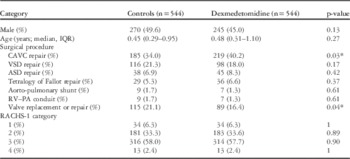
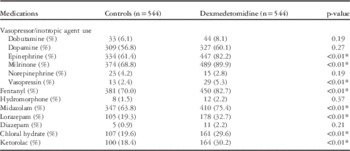
A total of 2346 patients were identified with trisomy 21 who underwent a cardiac surgical procedure. After propensity score matching, patients from 30 hospitals met study criteria and 544 matched pairs (1088 patients) were included. In univariable analyses, baseline surgical characteristics for the two groups were similar with the exception that more patients in the dexmedetomidine group underwent repair of complete atrioventricular canal defect and fewer underwent a valve repair or replacement (Table 1). There were no patients with a RACHS-1 category of 5 or 6. Patients in the dexmedetomidine group received dexmedetomidine for a median of 8 days ranging from 3 to 212 days. Patients in the dexmedetomidine group significantly received more inotropic and sedative agents (Table 2). More patients in the dexmedetomidine group received a neuromuscular blocker than in the non-dexmedetomidine group (22.4 versus 39.9%, p<0.01).
Baseline characteristics.

*Statistical significance at p<0.05
ASD=atrial septal defect; CAVC=complete atrioventricular canal; IQR=interquartile range; RACHS-1=risk-adjusted congenital heart surgery-1; RV–PA=right ventricular–pulmonary artery; VSD=ventricular septal defect
Unadjusted medication use in patients with and without dexmedetomidine.

*Statistical significance at p<0.05
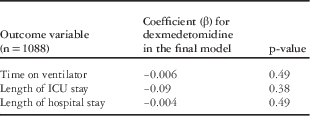
By univariable analyses, ICU length of stay, duration of postoperative hospitalisation, and mortality were not significantly different between treatment groups (Table 3). The mixed-effects linear regression models, which incorporated hospital, vasopressor and inotrope use, analgesic use, neuromuscular blocker use, and dexmedetomidine use, did not elucidate a significant relationship between dexmedetomidine use and ventilator days, ICU length of stay, or hospital length of stay (Table 4).
Unadjusted outcomes for dexmedetomidine as compared with non-dexmedetomidine patients.

IQR=interquartile range
Mixed-effects multivariable linear regression analyses for dexmedetomidine and primary and secondary outcomes.

Discussion
This is the first report using a large, national, multi-hospital database to evaluate the utilisation of dexmedetomidine in paediatric cardiac surgical patients with trisomy 21. It is well known that the trisomy 21 patient population can present challenges in sedation and extubation after cardiac surgery.Reference Butler, Hayes, Hathaway and Begleiter 8 , Reference Pandit and Fitzgerald 10 The selection of this high-risk patient group for this study was important to evaluate the efficacy of an agent that could potentially minimise morbidity. Despite the potential for improved outcomes in this patient population, multivariable analyses did not demonstrate that the use of dexmedetomidine was associated with a decreased duration of mechanical ventilation or differences in length of ICU stay or hospitalisation.
Previous institution-specific data have demonstrated that dexmedetomidine does not impact larger-scale outcomes, that is, ventilator days or ICU length of stay, for children admitted to an ICU after cardiac surgery.Reference Tokuhira, Atagi, Shimaoka, Ujiro, Otsuka and Ramsay 14 – Reference Lazol, Lichtenstein and Jooste 16 Our data would confirm those findings, as patients receiving dexmedetomidine in this evaluation did not have a decrease in the length of ventilatory time, ICU, or hospital length of stay when evaluated using univariable and multivariable analysis. Even though propensity score matching and multivariable analyses were used to adjust for comorbidities and other medication administration, our results may reflect that dexmedetomidine was used in a more critically ill patient population. Anecdotally, these findings reflect practice at our own institution, in that dexmedetomidine seems to be used more often in patients who are sicker and are perceived to have a greater risk of reintubation. Alternatively, our findings could be explained by a greater incidence of side effects, such as hypotension or bradycardia, in those patients who received dexmedetomidine. A randomised controlled trial of dexmedetomidine use in postoperative paediatric cardiac surgical patients with trisomy 21 would be useful to determine the efficacy of dexmedetomidine.
Patients in the dexmedetomidine group received opioids (morphine and fentanyl), benzodiazepines (midazolam, lorazepam), and adjunct medications (chloral hydrate and ketorolac) more frequently than the control group. This is a paradoxical finding, as decreased opioid or benzodiazepine use would be expected with dexmedetomidine use. These findings are similar to previous reports of the use of dexmedetomidine in the postoperative period in children. As previously mentioned, the increased use of medications may be owing to patients being more critically ill. Overall, it appears that the use of dexmedetomidine does not necessarily result in the decreased use of other sedative agents. Institutional strategies for management of analgesia and sedation should take this finding into account. The aetiology of this finding is unclear and unable to be answered by our investigation, but may include lack of efficacy of dexmedetomidine or adverse events associated with dexmedetomidine therapy.
The limitations of this study are those common with large administrative databases, such as the assumption that patients were administered all medications for which they were charged. In addition, indications and doses for sedative and analgesic medications were not evaluated. Clinical variables such as the need for concomitant cardiac operations and duration of cardiopulmonary bypass are not available in the PHIS database. Patients with missing data, which were to be used in the propensity score matching or other analyses, were not reported in the initial query of the database and this may result in bias towards particular institutions. Whereas the database we chose to answer this question has limitations, the large sample size and multiple institutions evaluated provide benefits that could not be obtained from a single-centre analysis and avoid biases that can be present in single-centre evalutions.
The dosing of dexmedetomidine is clearly affected by age and may have affected the effectiveness of the drug, but the dosages of medications were not evaluated in this study. Pain and sedation scores are unavailable as well as any documentation of the finer details of the postoperative or intraoperative course, which can affect dexmedetomidine use.Reference Chrysostomou, Komarlu and Lichtenstein 22 The criteria used for readiness to extubation or ICU discharge are dependent on several variables other than patient status, including personnel availability and institutional protocols and may minimise the impact of dexmedetomidine in this population. Adverse events that commonly occur with dexmedetomidine include bradycardia and hypotension, but these were unable to be reliably evaluated in using an administrative database.Reference Zhang, Schmidt, Wain and Bigatello 17 – Reference Chrysostomou, Komarlu and Lichtenstein 22 Future investigations into the utility of dexmedetomidine in critically ill postoperative cardiac surgical patients should account for the severity of illness beyond age and surgical complexity.
Conclusions
The use of dexmedetomidine in this large administrative data set was not associated with decreased ventilator time or hospital length of stay in patients with trisomy 21 undergoing congenital heart surgery.
Acknowledgements
This work was supported partly by the Cardiovascular Clinical Research Core at Baylor College of Medicine, Texas Children’s Hospital, Houston, Texas.
Financial Support
This research received no specific grant from any funding agency, commercial, or not-for-profit sectors.
Conflicts of Interest
None.
Ethical Standards
The authors assert that all procedures contributing to this work comply with the ethical standards of the relevant national guidelines on human experimentation (please name) and with the Helsinki Declaration of 1975, as revised in 2008, and has been approved by the Baylor College of Medicine Institutional Review Board.