Resistance to fluoroquinolone (FQ) antibiotics has increased sharply in the long-term care setting, and FQ-resistant Escherichia coli are now among the most common antibiotic-resistant organisms in nursing homes.Reference Vromen, van der Ven, Knols and Stobberingh 1 , Reference Viray, Linkin and Maslow 2 A recent study demonstrated that among nursing home residents colonized with FQ-susceptible E. coli, nearly 50% acquired FQ-resistant E. coli within 1 year.Reference Han, Maslow and Han 3 Given that infection due to FQ-resistant E. coli is likely preceded by gastrointestinal colonization, the potential morbidity and mortality due to FQ-resistant E. coli infections in this population is high. Therefore, we performed this case-control study to identify risk factors for the development of clinical E. coli infections in nursing home residents with FQ-resistant E. coli colonization.
METHODS
A case-control study was performed in which the primary outcome was clinical infection with E. coli. The initial source population included all residents from 3 major nursing homes in the Academic Long-Term Care Network of the University of Pennsylvania: (1) facility #1, a 124-bed facility; (2) facility #2, a 240-bed facility; and (3) facility #3, a 200-bed facility.
As described previously, nursing home residents, or their legally authorized representatives, were approached for informed consent during the study period from March 8, 2006, to October 2, 2008.Reference Han, Maslow and Han 3 Rectal swabs (with stool visually present on the swab) were obtained and submitted to the study laboratory at the Philadelphia Veterans Affairs Medical Center for processing. Identification of E. coli from rectal swabs was performed as previously described, with FQ resistance defined as a levofloxacin minimum inhibitory concentration (MIC) ≥8 μg/mL.Reference Han, Maslow and Han 3 Therefore, the source population for the present study consisted of all patients who were colonized with FQ-resistant E. coli.
Data on baseline demographic information, comorbidities, and receipt of antibiotics or corticosteroids during the study period or within 30 days prior to enrollment were collected from medical records using standardized forms. History of a urinary catheter, tracheostomy, enteral feeding tube, diarrhea, fecal incontinence, and confinement to a bed or wheelchair within 30 days of fecal sampling were documented. The study was approved by the institutional review board of the University of Pennsylvania.
Cases were defined as residents who developed a clinical E. coli infection within 1 year of the rectal swab, or until discharge or death. Control patients were residents who did not develop an infection with E. coli within the same period. Infection was determined via medical record review by an infectious disease–trained physician (JHH) using the modified McGeer Criteria.Reference Stone, Ashraf and Calder 4
Descriptive statistics were conducted to characterize the overall study population. Bivariate analyses of potential risk factors were then performed. Categorical variables were compared using Fisher’s exact test and continuous variables were compared using the Wilcoxon rank-sum test. An odds ratio (OR) and 95% confidence interval (CI) were calculated to evaluate the strength of each association. A two-tailed P value of <0.05 was considered significant. All statistical calculations were performed using commercially available software (STATA v13.0; StataCorp LP, College Station, Texas).
RESULTS
A total of 94 patients were colonized with FQ-resistant E. coli during the study period. The median age of the study population was 77 years (interquartile range [IQR], 64–85 years), 62 (66%) were male, and 66 (70%) self-identified as non-white. The distribution of patients among sites was 40 (42%), 46 (49%), and 8 (9%) residents for sites 1, 2, and 3, respectively. The median length of stay in the nursing home prior to the rectal swab was 137 days (IQR, 28–738 days).
A total of 11 residents (12%) developed subsequent clinical infections with E. coli within 1 year of the rectal swab. Of these, 10 (91%) had positive urine cultures, while 1 (9%) had a positive blood culture. The majority of infections (n=10; 91%) were due to FQ-resistant E. coli; however, 1 patient had a urinary tract infection due to fluoroquinolone-susceptible E. coli. The median time to development of a clinical infection was 131 days (IQR, 57–299 days).
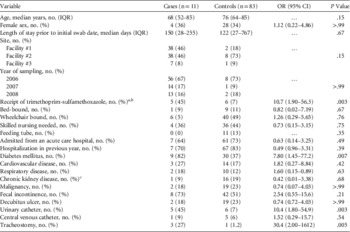
Results of bivariate analyses are shown in Table 1. The presence of a urinary catheter (OR, 10.4; 95% CI, 1.85–54.9; P=.003) or tracheostomy (OR, 30.4; 95% CI, 2.00–1612; P=.005) significantly increased the risk of developing a clinical E. coli infection. Trimethoprim-sulfamethoxazole (TMP-SMX) exposure within 30 days prior to enrollment, or at any time during the study period, was associated with development of an E. coli infection (OR, 10.7; 95% CI, 1.90–56.3; P=.003), as was the presence of diabetes mellitus (OR, 7.80; 95% CI, 1.45–77.2; P=.007).
Bivariate Analyses of Risk Factors for Clinical Infection with E. coli in Patients with Baseline Colonization with Fluoroquinolone-Resistant E. coli

NOTE. OR, odds ratio; CI, confidence interval; IQR, interquartile range.
a <30 d prior to enrollment up to study follow-up.
b All other antibiotic exposures had P values >.05.
c Serum creatinine >2 mg/dL or requirement of hemodialysis.
DISCUSSION
In this multisite, case-control study, 12% of nursing home residents who were colonized with FQ-resistant E. coli developed clinical infections with E. coli during the study period. The majority of these were urinary tract infections, and all cases except 1 were due to FQ-resistant E. coli. Significant risk factors for a clinical infection with E. coli included exposure to TMP-SMX during the study period or within 30 days prior to enrollment, the presence of a urinary catheter or tracheostomy, and comorbid diabetes mellitus.
A novel finding of our study was that treatment with TMP-SMX was a risk factor for subsequent infection with E. coli. Although a mechanism for such activity is unclear, given that the susceptibility rate of FQ-resistant E. coli to TMP-SMX in our population was low (~40%), selective pressure exerted by treatment with TMP-SMX may have predisposed patients to infection with FQ-resistant E. coli. This finding underscores the results of a recent study showing high rates of inappropriate antibiotic use in nursing homes.Reference Nicolle, Bentley, Garibaldi, Neuhaus and Smith 5 While further exploration is needed to elucidate the association between TMP-SMX and E. coli infections, it is clear that standardized antibiotic stewardship measures are urgently needed in the nursing home setting.
Our study underscores the need for more judicious use of indwelling urinary catheters in nursing home residents. Up to 10% of nursing home residents have indwelling urinary catheters, and numerous studies have shown that the associated burden of colonization and infection, particularly with antibiotic-resistant organisms, is high.Reference Das, Perrelli, Towle, Van Ness and Juthani-Mehta 6 – Reference Wang, Lansing and Symons 8
In addition, our study revealed an increased risk in clinical E. coli infections in patients with diabetes mellitus. The infection risk burden due to diabetes may be increased in the nursing home setting due to high rates of underlying conditions that predispose patients with diabetes toward infections (eg, hyperglycemia-related impairment of immune response, vascular insufficiency, neurogenic bladder), as well as multimorbidity.Reference Geerlings and Hoepelman 9
This study has several potential limitations. The relatively small number of infections may have precluded our ability to detect certain significant associations. Misclassification bias is a concern in case-control studies. However, medical record review for clinical infection was performed prior to data collection, and cases and controls were drawn from the same nursing home population and were classified solely based on development of infection. Pulsed-field gel electrophoresis of colonizing and clinical isolates was not performed for the present study; therefore, we cannot definitively conclude that the observed E. coli infections arose from strains colonizing the gastrointestinal tract. Finally, because the study was conducted in a single healthcare system, these results may not be generalizable to other institutions.
In conclusion, our study demonstrated a modest rate of development of clinical E. coli infections among nursing home residents colonized with FQ-resistant E. coli. Future studies should focus on the development and implementation of guidelines for urinary catheter removal and on determining optimal antibiotic management of infections in nursing home populations.
Acknowledgments
Financial support. This work was supported by the National Institutes of Health (grant nos. R01-AG023792 and K24-AI080942 to EL and grant no. K01-AI103028 to JHH). This study was also supported, in part, by the Centers for Disease Control and Prevention Epicenters Program (grant no. U54-CK000163 to EL).
Potential conflicts of interest: All authors report no conflicts of interest relevant to this article.