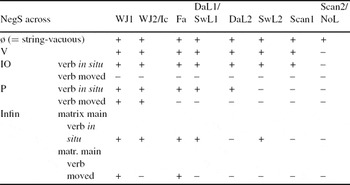
1. INTRODUCTION
As in English, illustrated in (1), there are two ways of formulating a negative sentence in the Scandinavian languages, either with a negation marker and an indefinite quantifier, shown in (2a), or with a negative object, shown in (2b). The example in (2) illustrates this for Danish; the same alternation is found in the other Scandinavian languages. (Where necessary, in numbered examples in this paper, underline is used to highlight negative elements such as negation marker plus indefinite object or negative object, and bold is used to highlight constituents crossed by Negative Shift.)
(1)

(2)

The paper focuses on the latter construction and investigates the variation across the Scandinavian languages as to the distribution of negative objects.
In the canonical object position, an object occurs in its VP-internal base position to the right of a non-finite main verb, as illustrated in (3a). Negative objects are peculiar as they cannot occur in this position under a sentential negation reading in Scandinavian. As shown in (3b), a negative object cannot follow a non-finite main verb.Footnote 1
(3)
Given that the negative object is merged inside VP, where thematic structure is encoded, the above data suggest that it undergoes leftward movement to the IP domain, the locus of grammatical information such as e.g. subject–predicate relation, tense and negative polarity. This movement operation is referred to as Negative Shift (NegS); see also K. K. Christensen (Reference Christensen, Dahl and Holmberg1986, Reference Christensen1987), Rögnvaldsson (Reference Rögnvaldsson1987), Jónsson (Reference Jónsson1996), Svenonius (Reference Svenonius and Svenonius2000, Reference Svenonius2002), and K. R. Christensen (Reference Christensen2005). NegS is driven by the need for feature checking: The uninterpretable feature [+neg] carried by the negative object must be licensed in Spec–head relation with the interpretable negative feature in Neg° (see neg-criterion, Haegeman & Zanuttini Reference Haegeman and Zanuttini1991; Haegeman Reference Haegeman1995). This is illustrated in (4). (The ikke . . . nogen variant does not necessitate object movement; the negation marker ikke merged in SpecNegP licenses [+neg].)
(4)
While string-vacuous NegS as in (2b)/(4b) is possible in all Scandinavian varieties, there is a considerable amount of cross-linguistic variation as to non-string-vacuous NegS. Specifically, the varieties contrast in (i) which constituents may be crossed by NegS, and (ii) whether crossing of a certain constituent requires the presence of a main verb in situ. This will be illustrated by data from different sources such as corpora, web searches, relevant linguistic literature and acceptability judgments. In particular, the data given in the examples and summarized in the tables below originate from the literature for Icelandic and for different styles of Mainland Scandinavian, referred to as Scandinavian 1 (formal styles) and Scandinavian 2 (colloquial styles), from field work for West Jutlandic and Faroese and from data collections among fellow linguists for Norwegian, Danish and Swedish, referred to as NoL, DaL and SwL, respectively – unless indicated otherwise.Footnote 2, Footnote 3
Section 2 presents cross-linguistic variation in non-string-vacuous NegS in Scandinavian in detail. NegS across a verb, indirect object, preposition, and infinitive are discussed in Sections 2.1–2.4, respectively, showing that neither the intervening elements (main verb/indirect object/preposition/infinitive) nor the base position of the negative phrase (as complement of transitive verb/ditransitive verb/preposition/infinitival verb) nor its target position (to the left/right of the matrix main verb) may capture the distributional patterns of negative objects by themselves.
Section 3 sketches an analysis of NegS within Fox & Pesetsky's (Reference Fox and Pesetsky2003, Reference Fox and Pesetsky2005a, Reference Fox and Pesetskyb) cyclic linearization model, in which non-string-vacuous movement is forced to proceed through intermediate positions. It will be argued that the cross-linguistic variation observed with non-string-vacuous NegS can be accounted for by differences in the availability of these intermediate positions, which is assumed to depend on a mechanism of feature transmission. The analysis is set out in detail in Engels (to appear). Section 4 summarizes the results.
Expanding the empirical basis of language varieties where NegS does not take place, the present paper provides a reader-friendly account which gives access to the intricacy of the data; thus, the paper should be of interest also to those readers who are not concerned with the theoretical details of the analysis.
2. NON-STRING-VACUOUS NEGATIVE SHIFT
2.1 NegS across a verb in situ
If the verb has undergone V°-to-I°-to-C° movement, NegS of a direct object is permitted in all Scandinavian varieties (Ic = Icelandic, Fa = Faroese, Da = Danish, Sw = Swedish, No = Norwegian); see (5).
(5)
However, NegS across a verb in situ is subject to cross-linguistic variation. In the Insular Scandinavian languages, a negative object may occur to the left of a non-finite verb in situ; see (6).
(6)
For the Mainland Scandinavian languages, in contrast, NegS across a verb is usually claimed in the literature to be stylistically marked (see K. K. Christensen Reference Christensen, Dahl and Holmberg1986, Faarlund, Lie & Vannebo Reference Faarlund, Lie and Vannebo1997 and Svenonius Reference Svenonius2002 on Norwegian; Holmes & Hinchliffe Reference Holmes and Hinchliffe2003 on Swedish; K. R. Christensen Reference Christensen2005 on Danish). It is found in literary or formal styles, referred to as Scandinavian 1 (Scan1) by K. R. Christensen (Reference Christensen2005), illustrated in (7a), but is ungrammatical in colloquial speech, referred to as Scandinavian 2 (Scan2), illustrated in (7b). Since failure to undergo NegS results in ungrammaticality, (3b), the variant ikke . . . nogen ‘not . . . any’, which is always acceptable, must be used in case NegS is blocked, as is shown in (8).Footnote 4
(7)
(8)
However, data from various sources point to the conclusion that NegS across a verb in situ is not only a matter of style but also subject to dialectal and inter-speaker variation in Mainland Scandinavian. Thelander (Reference Thelander1980) observes differences between Northern (Västerbotten, Umeå) and Southern Swedish (Eskilstuna, Örebro) in the distribution of negative objects. Moreover, in a dialect study on West Jutlandic (WJ), 15 out of my 16 informants judged NegS across a verb in situ as unmarked. In contrast, the vast majority of my Norwegian informants – 11 out of 12 linguists and linguistics students at the University of Oslo from different regions of Norway, referred to as Norwegian linguists (NoL) below – did not accept NegS across a verb in situ at all, not even as formal style.
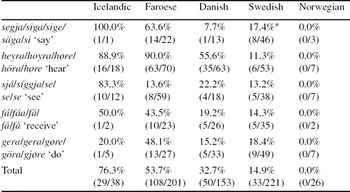
In addition, in the BySoc Corpus of spoken Danish (http://bysoc.dyndns.org/index.cgi?EeNnGg), 7% (or 8 out of 114) of the matches on the lexical items ingenting/intet ‘nothing’ are clause-medial objects preceding a verb in situ, indicating that the construction in (7a) is in fact used in spoken language. Furthermore, a Google blog search (Google web for Faroese) on clauses that include one of the frequent verbs segja/siga/sige/säga/si ‘say’, heyra/hoyra/høre/höra/høre ‘hear’, sjá/síggja/se/se/se ‘see’, fá/fáa/få/få/få ‘receive’, gera/gera/gøre/göra/gjøre ‘do’ and are negated by ingenting/intet to the left of a VP-internal main verb or by ikke . . . nogen ‘not . . . any’ produced the results summarized in Table 1: While clause-medial negative objects preceding a main verb in situ were quite frequent in Insular Scandinavian and possible in Danish and Swedish, there was no hit for this construction in Norwegian (Bokmål).
Percentages of negative object < main verb orders. Sentence formats included: (i) (auxiliary) – subject1SG – (auxiliary) – negative object – verbpresent/past/participle, and (ii) (auxiliary) – subject1SG – (auxiliary) – negation marker – verbpresent/past/participle – object.

*Instances of the Swedish saying Jag säger ingenting/inget så har jag ingenting/inget sagt ‘I could say a lot about this but I won't’ are excluded.
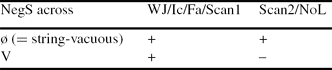
Hence, while string-vacuous NegS is possible in all Scandinavian varieties under discussion, NegS across a verb in situ is subject to cross-linguistic variation, as illustrated in Table 2.Footnote 5 Though NegS across a verb in situ was shown to be acceptable for my West Jutlandic informants and ungrammatical for my Norwegian informants (at least for the majority of speakers), irrespective of style, I keep the Scandinavian1/Scandinavian2 labeling for those Mainland Scandinavian varieties discussed in the literature that make a distinction between formal and colloquial styles.
NegS with moved verb and verb in situ.
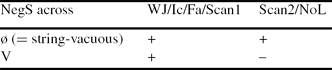
Note finally that in other languages, NegS need not take place overtly.Footnote 6 For instance, a negative object may appear in VP-internal position to the right of the main verb in English; see the example in (1b). Similarly, in situ occurrence of a negative object was apparently possible in Finland Swedish (FS) around 1900 (see Bergroth Reference Bergroth1917), but the sentences in (9) seem to be ungrammatical in present-day Finland Swedish (Caroline Sandström, p.c.). Instead, like in Standard Swedish, licensing of sentential negation must be carried out by overt NegS or use of the variant ikke . . . nogen; see (10).
(9)
(10)
However, as pointed out to me by Caroline Sandström (p.c.), an ingen-object may appear in situ in the presence of a VP-external negation marker in the Sibbo dialect of Finland Swedish (Eastern Nyland). The sentence in (11) gives rise to a negative concord reading ‘I haven't had anything to do with this affair’.Footnote 7
(11)
Likewise, VP-internal occurrence of an ingen-object is possible in Övdalian (Öv) if the negation marker it ‘not’ is present, as is shown in (12). In addition, the object may undergo NegS. In this case, co-occurrence of it is optional, as shown by the example in (13); see Garbacz (Reference Garbacz, Bukowski, Pietrzak-Porwisz and Kowal2008).
(12)
(13)
Given that sentential negation is expressed by it in NegP, which licenses in situ occurrence of the ingen-object in (12b), the question arises why the object may optionally undergo NegS in the presence of it at all, as in (13b). In other words, the acceptability of in situ occurrence and the negative concord reading seem to indicate that the ingen-object itself does not have any negative impact in the presence of a VP-external negation marker. This, in turn, gives rise to doubts regarding the trigger for optional NegS. These issues are connected to the question of how negative concord is to be analyzed, which cannot be discussed here due to space limitations (but see Haegeman & Zanuttini Reference Haegeman and Zanuttini1991, Reference Engels, Svenonius, Bentzen, Heycock, Jacobsen, Johannessen, Parrott, Strahan and Vangsnes1996; Haegeman Reference Haegeman1995; Zeijlstra Reference Zeijlstra2004; Giannakidou Reference Giannakidou, Everaert, van Riemsdijk, Goedemans and Hollebrandse2005).
Summing up, this section has shown that there is cross-linguistic and diachronic variation in the distribution of negative objects. While a negative object stays in situ in English and former stages of Finland Swedish, sentential negation must be overtly licensed in the IP-domain in present-day Scandinavian: The negative object must undergo movement to NegP, where its neg-feature is checked. While an intervening verb blocks NegS for the Norwegian linguists (NoL) and colloquial styles of Scandinavian (Scan 2), NegS across a verb in situ is possible in the other Scandinavian varieties under consideration. As discussed in the following section, NegS across an indirect object even requires the presence of a main verb in situ.
2.2 NegS across an indirect object
In a double object construction, an indirect object (IO) precedes a direct object (DO), as illustrated in (14).
(14)
NegS of the DO across the IO is possible in those and only those varieties which permit NegS across a verb in situ. In Scandinavian 2 and for my Norwegian informants, who do not accept NegS across a verb in situ, NegS across an IO is not grammatical either; see (15). In Icelandic, Faroese, West Jutlandic, and Scandinavian 1, in contrast, it is possible; see (16).
(15)
(16)
However, NegS of the DO across the IO gives rise to a so-called Inverse Holmberg Effect (Fox & Pesetsky Reference Fox and Pesetsky2005a): It is acceptable if the main verb stays in situ, as in (16), but it is ungrammatical if the main verb undergoes leftward movement as well, as in (17).Footnote 8, Footnote 9
(17)
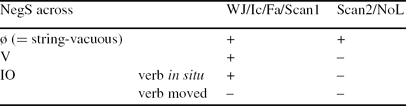
Given that NegS across an IO presupposes the presence of a verb in situ, it is not surprising that it is only possible in varieties which permit NegS across a verb in the first place. The observed patterns are summarized in Table 3.
NegS across verb and/or indirect object.
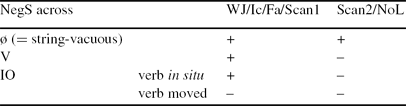
The Inverse Holmberg Effect observed with NegS across an IO points to the conclusion that it is not the intervening constituent itself which blocks NegS, contrary to what e.g. K. R. Christensen (Reference Christensen2005) suggests. A verb in situ may cancel out the blocking effect: The negative object may move across the IO if it also crosses the main verb. By the same reasoning, the base position of the object cannot be crucial for the availability of NegS either.
(18) Inverse Holmberg Effect
At first glance, the fact that an intervening main verb cancels out the blocking effect would seem to indicate that the Inverse Holmberg Effect has to do with the target position of NegS to the left/right of the main verb (see Svenonius Reference Svenonius and Svenonius2000 for an analysis along these lines). Apart from cross-linguistic variation, however, there is also variation across constructions as to the dependence of NegS on verb position, discussed in the following sections. This suggests that the target position to the left/right of the main verb itself cannot be decisive for the acceptability of NegS either.
2.3 NegS across a preposition
According to K. R. Christensen (Reference Christensen2005), NegS of the complement of a preposition is not permitted in Mainland Scandinavian at all, neither in formal (Scandinavian 1) nor in colloquial style (Scandinavian 2).
(19)
However, my Danish informants, six linguists at the University of Aarhus from different regions of Denmark, referred to as Danish linguists (DaL) below, showed an Inverse Holmberg Effect with NegS of a prepositional complement: They marginally accepted NegS across a preposition if the main verb occurred in situ, as in (20a), but rejected NegS just across the preposition, as in (20b). The same pattern was displayed by two of my six Swedish informants (SwL1) – linguists at the University of Gothenburg from different regions of Sweden. In contrast, the other four informants (SwL2) rejected NegS across a preposition altogether, in line with (19), although they accepted NegS across a verb (see (7a) above), reflecting the Scandinavian 1 pattern.
(20)
(21)
Likewise in Faroese, NegS across a preposition was judged acceptable in the presence of a verb in situ, see (22a), whereas it was rejected by the majority of my informants (25 out of 34) if the main verb had undergone finite verb movement, as in (22b); see also Engels (Reference Engels, Svenonius, Bentzen, Heycock, Jacobsen, Johannessen, Parrott, Strahan and Vangsnes2009).
(22)
Moreover, Svenonius (Reference Svenonius and Svenonius2000) claims that NegS of the complement of a preposition in Icelandic improves if the movement also crosses the verb, though this contrast is not that strong, (23b) is degraded but not ungrammatical.Footnote 10
(23)
Finally, in West Jutlandic, NegS just across the preposition is not even marked. NegS of the complement of the preposition is possible, independent of verb position.
(24)
Summing up, there is not only cross-linguistic variation as to which constituent can be crossed by NegS (verb, IO, preposition) but also variation as to whether crossing of a certain constituent requires the presence of a main verb in situ (see Table 4). While NegS across an IO presupposes the presence of a main verb in situ, NegS across a preposition may be grammatical or ungrammatical independent of verb position.
NegS across verb, indirect object or preposition.
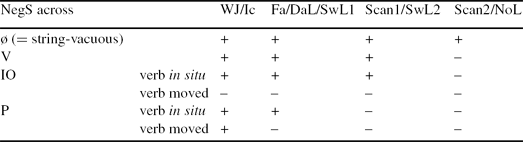
2.4 NegS out of an infinitival clause
NegS out of a control infinitive is only acceptable in Icelandic if it also crosses the matrix main verb (see Svenonius Reference Svenonius and Svenonius2000).Footnote 11
(25)
An Inverse Holmberg Effect was also displayed by the Swedish linguists (SwL) as well as by some of the Danish linguists (DaL1) and West Jutlandic speakers (WJ2):Footnote 12
(26)
(27)
The other Danish linguists (DaL2) do not permit long NegS at all, as shown in (28). Similarly, NegS out of a control infinitive seems to be ruled out altogether in Scandinavian 1 and Scandinavian 2; see Christensen & Taraldsen (Reference Christensen, Taraldsen and Benincà1989:72).
(28)
(29)
The other West Jutlandic speakers (WJ1), on the other hand, permit NegS out of the infinitival clause, irrespective of the position of the matrix main verb; see (30). Likewise, NegS out of an infinitival clause is possible in Faroese, independent of verb position, as shown in (31).
(30)
(31)
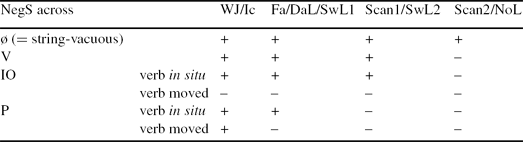
Hence, as with NegS across a preposition, there is cross-linguistic variation as to whether or not NegS out of a control infinitive is possible at all and, if so, whether it depends on the position of the matrix main verb. In addition, Table 5 shows that there is variation across constructions with regard to these parameters. For instance, both Faroese and the Danish linguists display an Inverse Holmberg Effect with NegS across a preposition. In contrast, NegS out of an infinitival clause gives rise to an Inverse Holmberg Effect for the Danish linguists 1 whereas it is permitted in Faroese and prohibited for the Danish linguists 2, irrespective of verb position. These facts point to the conclusion that the target position to the left/right of the matrix main verb cannot be decisive for the availability of NegS as such.
NegS across verb, indirect object, preposition or infinitive.

3. CYCLIC LINEARIZATION OF NEGATIVE OBJECTS
It was stated in Section 1 above that NegS takes place to license a sentential negation reading, which is unavailable in situ: The uninterpretable neg-feature carried by the negative object needs to be checked in Spec–head relation with Neg°. Hence, NegS would seem to be semantically motivated. However, it is subject to certain syntactic constraints, which apply to a varying extent in the Scandinavian varieties: NegS may be blocked if it were to cross intervening constituents. While string-vacuous NegS is possible in all varieties, non-string-vacuous NegS displays a considerable amount of variation (see Section 2 above). In particular, the language varieties differ as to which constituents can be crossed (verb, IO, preposition, infinitive) and whether or not NegS across a certain constituent depends on the presence of a verb in situ.Footnote 13
As discussed in Section 2, the Inverse Holmberg Effect observed with NegS across an IO, NegS across a preposition, and NegS out of an infinitival clause in certain varieties points to the conclusion that it cannot be the intervening element itself (i.e. IO, preposition, or infinitive) that blocks movement of the negative object: An additional intervening verb makes NegS possible (see (18) above). Moreover, asymmetries as to the emergence of an Inverse Holmberg Effect with NegS across a preposition and NegS out of an infinitival clause in a given variety indicate that the target position to the left/right of the main verb cannot account for the availability of NegS, either.
In Engels (Reference Engels2011), I put forward an approach to NegS in Scandinavian within Fox & Pesetsky's (Reference Fox and Pesetsky2003, Reference Fox and Pesetsky2005a, Reference Fox and Pesetskyb) cyclic linearization model. Assuming that derivations proceed bottom–up, Fox & Pesetsky suggest that the mapping between syntax and phonology (i.e., Spell-out) takes place at various points in the course of derivation (on multiple Spell-out see also Chomsky Reference Chomsky, Martin, Michaels and Uriagereka2000, Reference Chomsky and Kenstowicz2001). The material in the Spell-out domain D is thereby linearized. The crucial property of Spell-out is that it may only add information about the linearization of a newly constructed Spell-out domain to the information cumulatively produced by previous applications of Spell-out; previously established linearization statements cannot be deleted.
The diagram in (32) illustrates the derivation of string-vacuous NegS under the cyclic linearization approach. At Spell-out of VP, both the verb and its object occur in their base positions and the linearization statement V<O (i.e. ‘verb precedes object’) is established. When the derivation proceeds, the subject is merged, the negative object moves to SpecNegP, where it licenses [+neg], and the main verb undergoes finite verb movement. At Spell-out of CP, the new ordering statements added (boldfaced) are consistent with the ones established at VP Spell-out. Though movement takes place, the relative ordering between verb and object is retained and the derivation succeeds.
(32) String-vacuous NegS (see ex. (5))
Non-string-vacuous movement has to proceed successive cyclically through the left edge of Spell-out domains to avoid ordering contradictions, which would impose conflicting requirements on the phonology and thus cause the derivation to fail. This is illustrated for NegS across a verb in situ in (33): The object moves to the edge of VP prior to Spell-out. Consequently, the ordering statement O<V is established at VP Spell-out. From this edge position, the object may then move to SpecNegP without giving rise to an ordering contradiction at Spell-out of CP.
(33) NegS across a verb in situ (see exx. (6) and (7a))
Since non-string-vacuous movement needs to proceed through the edge of Spell-out domains under the cyclic linearization approach, variation as to the applicability of NegS can be accounted for by contrasts in the availability of the left-edge positions, which is considered to depend on feature transmission in Engels (Reference Engels2011). More concretely, Neg° may transmit an uninterpretable copy of its neg-feature to the head of the relevant Spell-out domain in certain varieties while it is not able to do so in other varieties. Consequently, movement through the Spell-out domain's edge, which is necessary in order to cross intervening material, is permitted or prohibited, respectively. Given that movement is driven by the need for feature checking, movement to the edge position must apply if feature transmission takes place, but cannot apply if feature transmission does not take place.Footnote 14 Under the assumption that PPs constitute a Spell-out domain and that control infinitives are CPs and thus also constitute a Spell-out domain, cross-linguistic differences in which constituents may be crossed by NegS (verb/preposition/infinitive) are captured by differences in which Spell-out domain heads (V°/P°/C°) can receive a feature copy from Neg°.
An Inverse Holmberg Effect, whereby movement across a certain constituent is only possible in the presence of a verb in situ, emerges if movement must proceed via the edge of VP. This is due to the fact that movement through the edge of VP is only possible in the present analysis if the verb stays in situ as it would otherwise result in an ordering contradiction. NegS across an IO must necessarily proceed through the edge of VP because there is no additional Spell-out domain involved: To be linearized to the left of the IO, the negative DO, which follows the IO in base order, must move to the edge of VP. This predicts that NegS across an IO is possible in those and only those varieties where the edge of VP is available, i.e. where NegS across a verb in situ is possible, as borne out by the data in Section 2.2. In case of NegS across a preposition and NegS out of an infinitival clause, an Inverse Holmberg Effect arises if feature transmission from Neg° to P° or from Neg° to C° requires that V° possesses a feature copy, too: Neg° transmits an uninterpretable copy of its feature to V°, which in turn transmits a copy to P° or C°. Thus P° or C° may only carry a feature copy if V° does so, too. As a result, NegS via the edge of PP or CP must continue to the edge of VP, predicting that it is only possible if the verb stays in situ. In case NegS across a preposition or NegS out of an infinitival clause is independent of verb position, feature transmission from Neg° to P° or C° may proceed with or without V° holding a copy: If V° carries a feature copy, NegS must go through the edge of VP and consequently the verb must stay in situ to avoid ordering contradictions; if V° does not carry a feature copy, NegS cannot go through the edge of VP and consequently the verb must move itself. The dependence of NegS on verb position is thus a matter of whether or not it is possible for P° or C° to receive a feature copy without V° possessing one.
In addition, note that NegS across a preposition and NegS out of an infinitival clause may contrast as to their acceptability and their dependence on verb position (see Table 5 above). This indicates that feature transmission to P° and feature transmission to C° are independent of one another. A certain variety may permit feature transmission to P° while prohibiting feature transmission to C°, or vice versa. Likewise, the necessity for V° to carry a feature copy in these cases may vary. Moreover, P° and C° seem to be able to receive a feature copy from Neg° only if V° in principle is, too. First, NegS across a preposition and NegS out of an infinitival clause are only possible in varieties that also permit NegS across a verb in situ. Second, they are only possible in the absence of a verb in situ if they are also permitted in the presence of a verb in situ (i.e. there are no reversed Inverse Holmberg Effects). These facts indicate that all feature transmission to P° and C° is mediated by V°: Only if Neg° can transmit a feature copy to V° can P° or C° receive one from V°. In certain varieties this is only possible if V° keeps a copy for itself, giving rise to an Inverse Holmberg Effect, while in other varieties V° may pass on the feature copy without holding one itself. Under these assumptions, the ten distributional patterns in (34) are predicted, eight of which are identified here. As this investigation of NegS in Scandinavian is far from being exhaustive, the missing two patterns should not be ruled out on principled grounds.
(34) Feature transmission from Neg°
For further details of the analysis the reader is referred to Engels (Reference Engels2011).
4. CONCLUSION
The preceding sections showed that while all Scandinavian varieties have string-vacuous NegS, they vary massively as to non-string-vacuous NegS, concerning in particular which constituent can be crossed by NegS and whether or not crossing depends on the presence of a main verb in situ.
(35)
Contrary to the widely held belief, non-string-vacuous NegS in Mainland Scandinavian is not only a matter of style but it is also subject to dialectal and inter-speaker variation, as exhibited by the data presented in Section 2. While colloquial styles of Mainland Scandinavian reported in the literature (Scan 2) and my Norwegian informants (NoL) only permit string-vacuous NegS (i.e. NegS cannot cross any intervening constituent, neither verb nor IO nor preposition nor infinitive), the presence of a main verb in situ does not block NegS in formal styles of Mainland Scandinavian reported in the literature (Scan 1), Icelandic, Faroese, West Jutlandic and for the Danish linguists (DaL) and is even required during NegS across an IO (Inverse Holmberg Effect). In contrast, NegS across a preposition and NegS out of an infinitive are not necessarily dependent on the presence of a verb in situ; they may be permitted or prohibited, irrespective of the position of the matrix main verb; see Table 5 above.
It was argued that neither the intervening elements (main verb/indirect object/preposition/infinitive) nor the base position of the negative phrase (as complement of transitive/ditransitive verb/preposition/infinitival verb) nor its target position (to the left/right of the matrix main verb) can capture the observed variation by themselves. Under the cyclic linearization approach (Fox & Pesetsky Reference Fox and Pesetsky2003, Reference Fox and Pesetsky2005a, Reference Fox and Pesetskyb), non-string-vacuous movement must proceed through the edge of Spell-out domains, whose availability is considered to depend on a mechanism of feature transmission in the present analysis. Only if the head of the relevant Spell-out domain (VP, PP, CP) may receive an uninterpretable feature copy from Neg° is movement via its left-edge position possible. Thus cross-linguistic variation as to which constituents can be crossed by NegS and whether crossing presupposes the presence of a verb in situ can be captured by differences in which Spell-out domain heads may receive a feature copy from Neg° and whether feature transmission from Neg° to P° or C° requires V° to possess the feature itself (see Section 3).
ACKNOWLEDGEMENTS
Earlier versions of this paper were presented at Grammatik i Fokus (University of Lund, February 2008), the NORMS seminar on Typology and Nordic Dialect Variation (University of Helsinki, June 2008) the ScanDiaSyn Grand Meeting (Sandbjerg Estate, Sønderborg, August 2008) and The Glory of Babel (University of Reykjavik, December 2008). I would like to thank the audiences at these occasions and three anonymous reviewers for helpful discussion and comments. I am also very indebted to my native speaker informants in West Jutland and the Faroe Islands as well as to those at the University of Aarhus, the University of Gothenburg and the University of Oslo.