1. Introduction
High Arctic deposition of the relatively fossiliferous Upper Jurassic – lowermost Cretaceous strata is followed by deposition of the rather unfossiliferous Lower Cretaceous successions. Macrofossils occur scattered both geographically and stratigraphically (Ershova, Reference Ershova1972, Reference Ershova1983; Pchelina, Reference Pchelina1983). Sections often have thick intervals yielding no fossils, for example, in the Deer Bay and Christopher formations interval in Arctic Canada (Jeletzky & Kemper, Reference Jeletzky and Kemper1988; Schröder-Adams et al. Reference Schröder-Adams, Herrle, Embry, Haggart, Galloway, Pugh and Harwood2014) and in the Rurikfjellet and Carolinefjellet formations interval in Svalbard (Dypvik et al. Reference Dypvik, Nagy, Eikeland, Backer-Owe and Johansen1991b), meaning that the biostratigraphic subdivision of the succession is rather incomplete (Harland & Kelly, Reference Harland, Kelly and Harland1997).
The Lower Cretaceous succession in Svalbard is generally very poor in macrofossils (Dypvik et al. Reference Dypvik, Nagy, Eikeland, Backer-Owe and Johansen1991b). Belemnites have rarely been recorded except locally in Kong Karls Land (Blüthgen, Reference Blüthgen1936; Doyle & Kelly, Reference Doyle and Kelly1988). Nalnyaeva et al. (Reference Nalnyaeva, Basov and Meledina2011) recorded belemnites from the Jurassic and Lower Cretaceous strata, but their account only includes a very few taxa from the Rurikfjellet Formation. Recent field investigations of the Lower Cretaceous mudstone-dominated Rurikfjellet Formation at a number of localities on Spitsbergen (Fig. 1) yielded only a few scattered finds of ammonites, buchiid bivalves and belemnite fragments. Macrofossils commonly weather out from poorly consolidated mudstones and subsequently lie loose on the surface of scree-covered mountain slopes. However, the locality of Bohemanflya in the Isfjorden area (Fig. 2) provided favourable sampling conditions, allowing a well-preserved, relatively specimen-rich assemblage of complete belemnite rostra to be retrieved. One species, Arctoteuthis bluethgeni (Doyle in Doyle & Kelly, Reference Doyle and Kelly1988), dominates the assemblage. The purpose of this paper is to report the occurrence of this well-preserved earliest Cretaceous belemnite assemblage. The material was collected in conjunction with a palynostratigraphic study of the Lower Cretaceous of Svalbard (Śliwińska et al. Reference Śliwińska, Jelby, Grundvåg, Nøhr-Hansen, Alsen and Olaussenin press) that provides important means of determining the age of the investigated belemnites. Arctoteuthis bluethgeni is considered a useful new stratigraphic guide fossil in the High Arctic Lower Cretaceous succession otherwise characterized by a paucity of guide fossils.
(a) Palaeogeographic map of Arctic Boreal basins adjacent to Svalbard (based on Steel & Worsley, Reference Steel, Worsley and Spencer1984; Dypvik et al. Reference Dypvik, Håkansson and Heinberg2002; Torsvik et al. Reference Torsvik, Carlos, Mosar, Cocks, Malme and Eide2002; modified from Grundvåg et al. Reference Grundvåg, Marin, Kairanov, Śliwińska, Nøhr-Hansen, Jelby, Escalona and Olaussen2017). (b) Map of Svalbard showing distribution of Lower Cretaceous strata, major structural elements and locations of Bohemanflya, Myklegardfjellet and Kong Karls Land (KKL) (modified from Dallmann, Reference Dallmann1999; Grundvåg et al. Reference Grundvåg, Marin, Kairanov, Śliwińska, Nøhr-Hansen, Jelby, Escalona and Olaussen2017). (c) Middle Jurassic – Lower Cretaceous lithostratigraphy of Svalbard (based on Parker, Reference Parker1967; Nagy, Reference Nagy1970; Steel & Worsley, Reference Steel, Worsley and Spencer1984; Dypvik et al. Reference Dypvik, Nagy, Eikeland, Backer-Owe, Andersen, Haremo, Bjærke, Johansen and Elverhøi1991a; Gjelberg & Steel, Reference Gjelberg, Steel and Steel1995; Grundvåg et al. Reference Grundvåg, Marin, Kairanov, Śliwińska, Nøhr-Hansen, Jelby, Escalona and Olaussen2017 and unpublished data of ME Jelby). BFZ – Billefjorden Fault Zone; CTB – Central Tertiary Basin; LFZ – Lomfjorden Fault Zone.

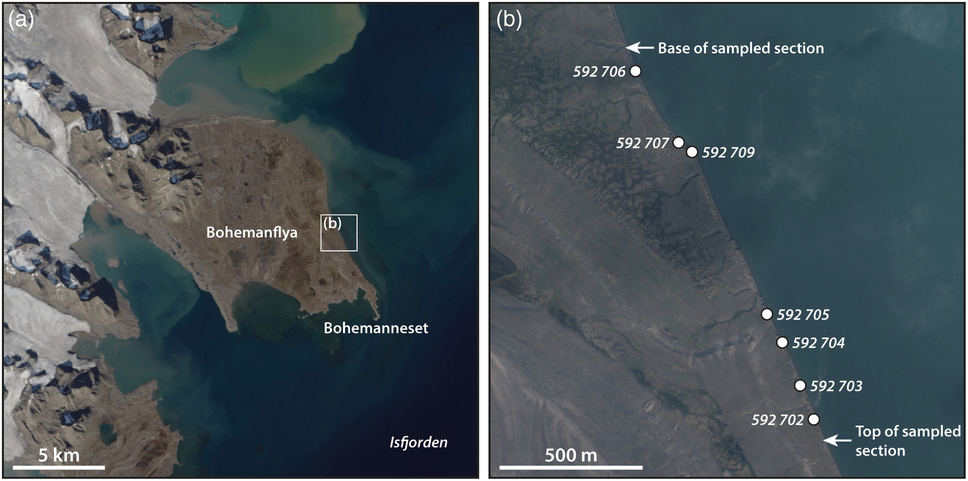
Satellite views of (a) the Bohemanflya peninsula in the northern part of Isfjorden; and (b) the eastern coast of Bohemanflya, showing selected positions of belemnite samples (from https://toposvalbard.npolar.no).

2. Regional setting
The Lower Cretaceous succession of Svalbard is divided into the Rurikfjellet, Helvetiafjellet and Carolinefjellet formations (Fig. 1). The succession is more than 1000 m thick and forms a large-scale regressive–transgressive stacking pattern representing an overall shoreline progradation and back-stepping in response to a full relative sea-level cycle (Gjelberg & Steel, Reference Gjelberg, Steel and Steel1995; Midtkandal et al. Reference Midtkandal, Nystuen and Nagy2007; Midtkandal & Nystuen, Reference Midtkandal and Nystuen2009). The stacking pattern was controlled by the High Arctic Large Igneous Province (HALIP), in relation to the opening of the Canada Basin at the northern margin of the Barents Sea Shelf (Fig. 1a), and the associated regional thermo-tectonic uplift and subsequent cooling and subsidence.
The focus of this paper is the shale-dominated Wimanfjellet Member in the lower part of the Rurikfjellet Formation. The base of the formation is typically marked by a relatively thin (< 10 m) glauconitic, plastic clay unit known as the Myklegardfjellet Bed (Fig. 1c; Dypvik et al. Reference Dypvik, Nagy and Krinsley1992; Dallmann, Reference Dallmann1999). The Myklegardfjellet Bed is overlain by dark grey mudstones of the Wimanfjellet Member deposited in open marine shelf environments. The shales constitute numerous scattered or stratabound reddish siderite concretions. The Wimanfjellet Member transitionally shoals into coarsening-upwards units of bioturbated shales, siltstones and sandstones with abundant hummocky cross-stratification reflecting a change from deep shelf environments to prodeltaic inner shelf and shoreface environments. The upper sand-rich part of the Rurikfjellet Formation is included in the Kikutodden Member (Dypvik et al. Reference Dypvik, Nagy, Eikeland, Backer-Owe, Andersen, Haremo, Bjærke, Johansen and Elverhøi1991a; Midtkandal et al. Reference Midtkandal, Nystuen, Nagy and Mørk2008). A marked regional subaerial unconformity separates the Rurikfjellet Formation from the overlying Barremian–Aptian Helvetiafjellet Formation, which includes the lower, prominent cliff-forming Festningen Member representing coarse-grained, fluvial braidplain deposits (e.g. Steel, Reference Steel1977; Midtkandal et al. Reference Midtkandal, Nystuen, Nagy and Mørk2008; Midtkandal & Nystuen, Reference Midtkandal and Nystuen2009; Grundvåg & Olaussen, Reference Grundvåg and Olaussen2017; Grundvåg et al. Reference Grundvåg, Marin, Kairanov, Śliwińska, Nøhr-Hansen, Jelby, Escalona and Olaussen2017).
3. Material and localities
Belemnites were collected at Bohemanflya, central Spitsbergen, and Myklegardfjellet, eastern Spitsbergen (Fig. 1b). Palynostratigraphic shale samples have been analysed from both localities, providing important information on the age and range of Arctoteuthis bluethgeni (Śliwińska et al. Reference Śliwińska, Jelby, Grundvåg, Nøhr-Hansen, Alsen and Olaussenin press).
3.a. Bohemanflya
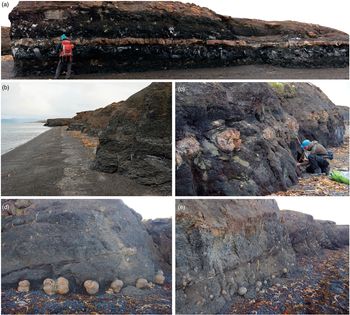
The cliffs on the eastern coast of the Bohemanflya peninsula (Fig. 1b) display well-exposed sections of the Rurikfjellet and Helvetiafjellet formations (Fig. 2). The coastal physiography of the peninsula and its topography are largely defined by the sandstones of the Kikutodden Member (Rurikfjellet Formation) and Festningen Member (Helvetiafjellet Formation). Both units are resistant to weathering compared with the under- and overlying mudstones of the Wimanfjellet Member (Valanginian–Hauterivian) and Carolinefjellet Formation (Aptian–Albian), respectively. The succession dips gently (< 3°) towards the SE, dipping beneath the sea surface at the southeastern tip of the peninsula (Bohemanneset; Fig. 2b). Sandstone units in the vicinity of Bohemanneset form steep cliffs up to c. 25 m high. Further to the NW, shales of the Wimanfjellet Member are exposed in lower, typically c. 3–4 m high, cliffs along the shore (Fig. 3). Locally, the shales are thrusted, possibly exhibiting repetitive stratigraphy. The foot of the cliffs are subject to alternating wave ravinement and subaerial exposure within the tidal zone and, in combination with scouring from winter-associated pack ice, the shale sections are fresh, clean and easily accessible. The conditions at Bohemanflya allow unique in situ sampling of macrofossils and the low inclination of the strata, along with several easily recognizable siderite marker beds, makes it possible to walk out and constrain stratigraphic sample levels in the succession (Fig. 3).
The low coastal cliff section along the eastern coast of Bohemanflya exhibiting fresh exposures of the Wimanfjellet Member, Rurikfjellet Formation. (a) Siderite concretion-bearing dark grey to black mudstones with a laterally continuing siderite layer; (b) view of the nature of exposure along the coast towards the ESE during low tide; (c) extracting an in situ belemnite from mudstones below a distinctive level with large, oval siderite concretions; (d) black mudstones with irregularly shaped siderite concretions; and (e) black mudstones with cannon-ball- and irregularly shaped concretions (level c. 10–12 m).

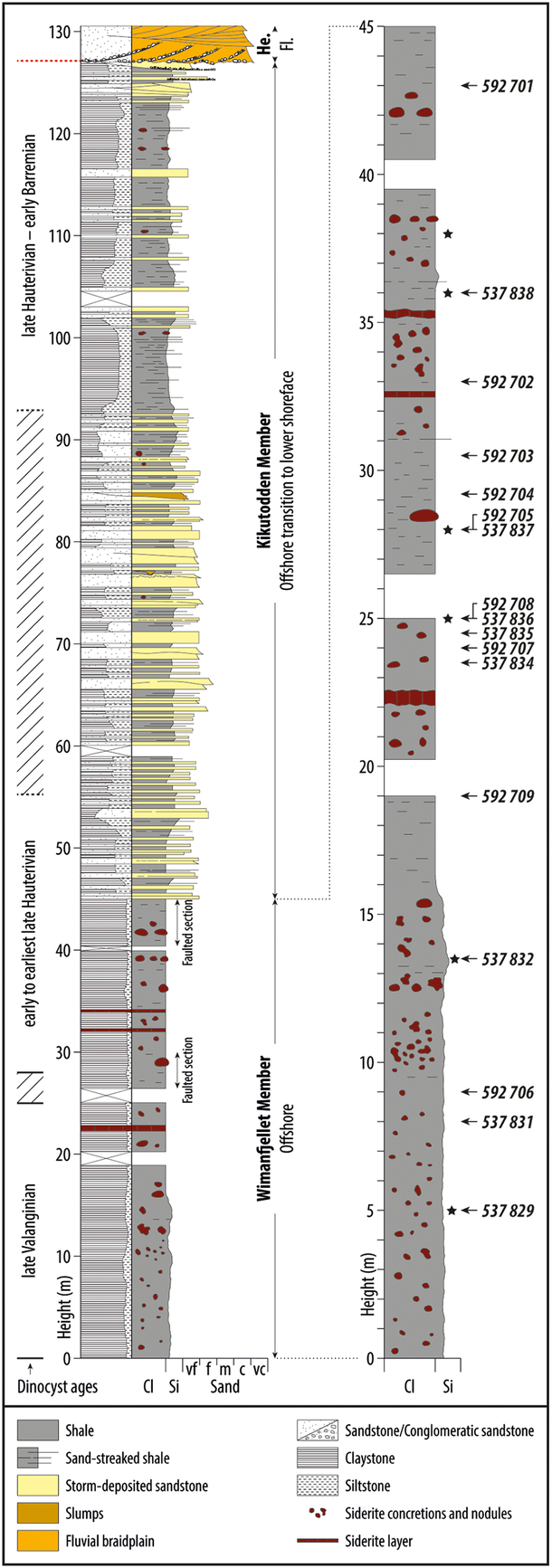
Macrofossils are generally rare in the Rurikfjellet Formation, and only a few have been reported previously from Bohemanflya. Hvoslef et al. (Reference Hvoslef, Dypvik and Solli1986) conducted a sedimentological and geochemical study of the Agardhfjellet and Rurikfjellet formations at Bohemanflya. They indicated the presence of ‘an ammonite and bivalves’ in the lowermost part of the Rurikfjellet Formation, as well as belemnite-bearing levels some 40 m higher. However, the fossils were not sampled (H. Dypvik, personal communication, 2017). This study confirms the scarcity of macrofossils, but scattered belemnites occur in the Wimanfjellet Member shales. Fieldwork along the 1.6-km stretch of costal exposure of the Wimanfjellet Member resulted in the collection of 23 belemnites found in situ and with their stratigraphic levels carefully recorded in a measured section (Figs 4, 5). The belemnites are generally well preserved, often having completely preserved rostra. The assemblage is dominated by A. bluethgeni (19 specimens), which is described in detail in Section 4 on systematic palaeontology (Figs 6–12). Only three specimens of other belemnite taxa were also recorded (Fig. 13).
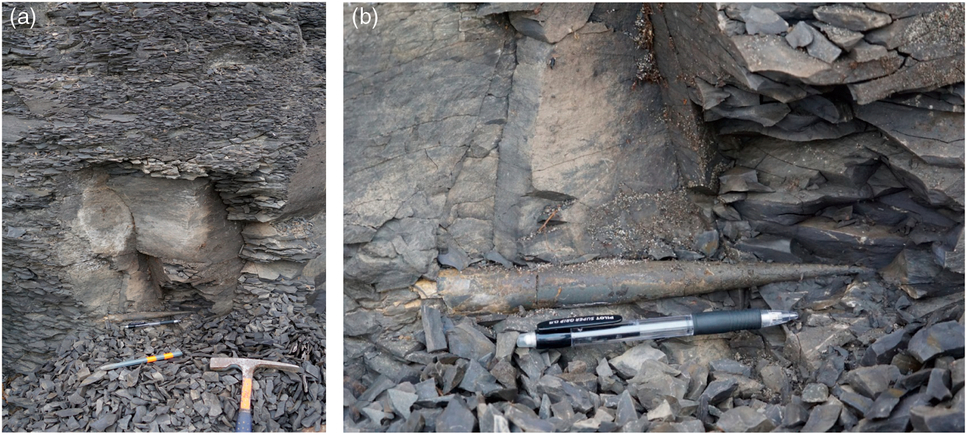
Large complete in situ belemnite in the mudstones of the Wimanfjellet Member at Bohemanflya, MGUH 33341 [ex. GEUS 592707], Arctoteuthis bluethgeni Doyle, level 24 m. (a) Extraction of the fossil from the fresh exposure of mudstones and (b) detailed photo of the in situ belemnite with 14.7-cm-long pencil for scale.

Sedimentological log of the Rurikfjellet Formation in the Bohemanflya section, including detailed inset log of the exposed Wimanfjellet Member sampled, constituting the belemnites described in this study. Macrofossil levels are indicated with their six-digit sample numbers. Asterisks indicate bulk rock samples analysed for palynostratigraphy.

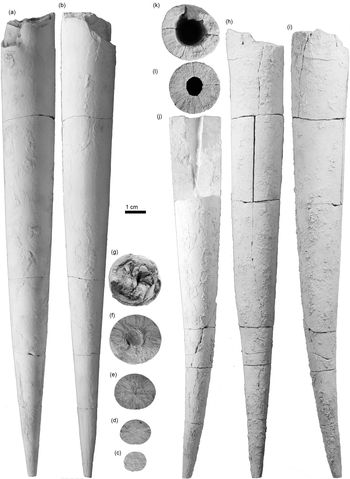
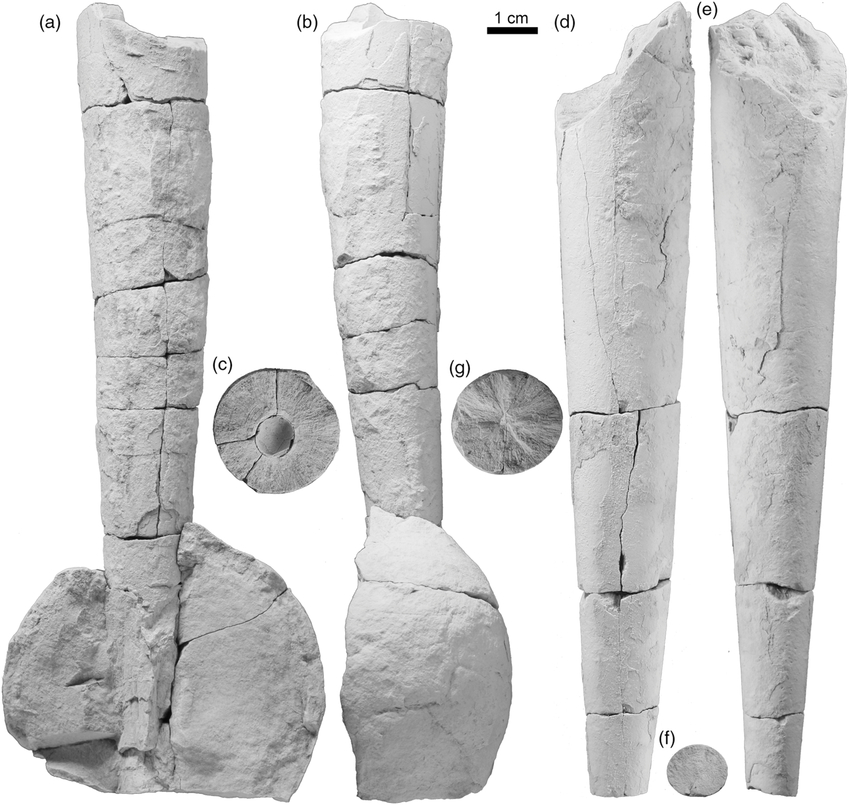
Large and complete specimens of Arctoteuthis bluethgeni Doyle from Bohemanflya section. (a–g) MGUH 33341 [ex. GEUS 592707], level 24 m: (a) ventral view; (b) lateral view, venter to the right; (c–e) cross-sections in stem region at 35, 62 and 95 mm from apex, respectively; (f) cross-section in alveolar region at 172 mm from apex; and (g) view towards alveolar rim. (h–l) MGUH 33342 [ex. GEUS 537835], level 24.75 m; (h) ventral view; (i) lateral view with venter to the right; strong ventral deflection of apex; (j) lateral view, venter to the left; part of the alveolar region removed and showing depth of alveolus; (k–l) cross-sections in alveolar region and near alveolar rim.

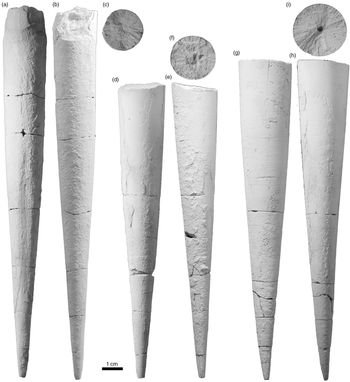
Arctoteuthis bluethgeni Doyle from the Bohemanflya section. (a–c) Complete specimen, MGUH 33343 [ex. 529706_1], level 9 m: (a) ventral view; (b) lateral view, dorsal to the right; and (c) cross-section 135 mm from apex. (d–f) MGUH 33344 [ex. 537831a], level 8 m: (d) dorsal view; (e) lateral view, venter to the left; and (f) cross-section. (g–i) MGUH 33345 [ex. 537836], level 25 m: (g) dorsal view; (h) lateral view, venter to the right; and (i) cross-section.

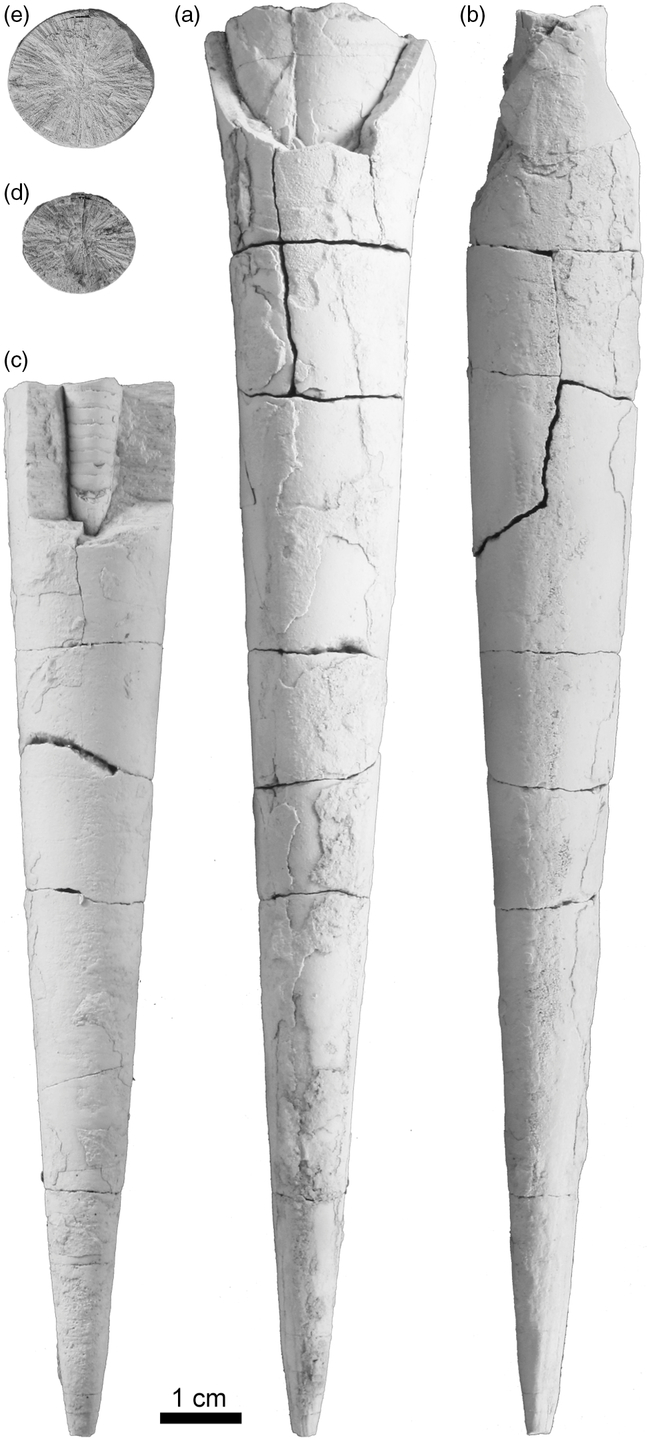
Complete specimen of Arctoteuthis bluethgeni Doyle, MGUH 33346 [ex. 592709_1], level 19 m, Bohemanflya section: (a) ventral or dorsal view; (b) lateral view; (c) ventral or dorsal view with part of the alveolar region removed showing lower part of the phragmocone; and (d–e) cross-sections at 68 and 96 mm from apex, respectively.

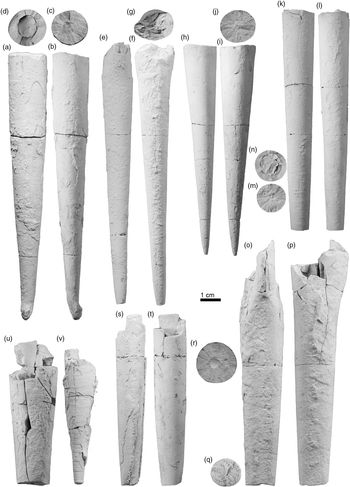
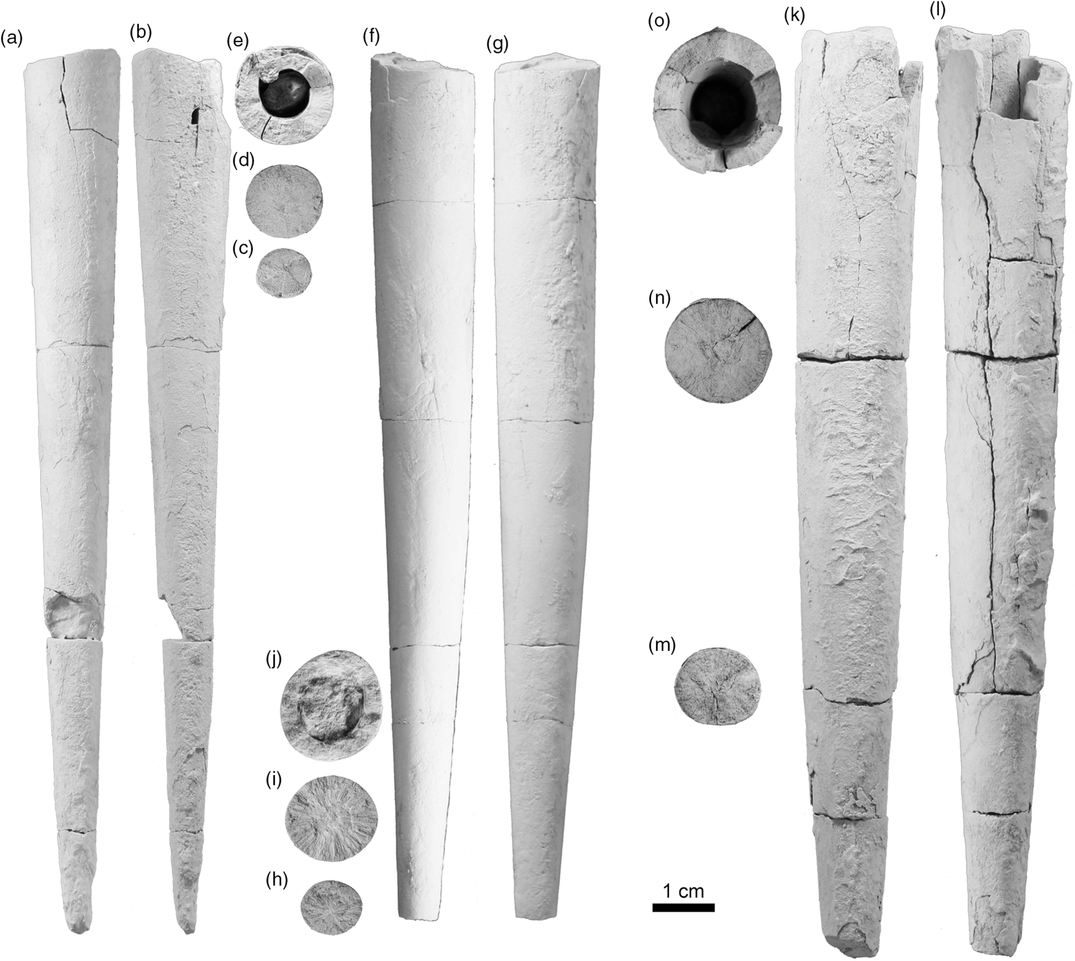
Arctoteuthis bluethgeni Doyle from the Bohemanflya section. (a–d) MGUH 33347 [ex. 537837], level 28 m: (a) dorsal or ventral view; (b) lateral view; (c) cross-section of stem region; and (d) cross-section of alveolar region. (e–g) MGUH 33348 [ex. 537829], level 5 m: (e) dorsal or ventral view; (f) lateral view; and (g) alveolar view of crushed alveolus. (h–j) MGUH 33349 [537831b], level 8 m: (h) lateral view, venter to the left; (i) dorsal view; and (j) cross-section of stem. (k–n) MGUH 33350 [ex. 537830], level 6 m: (k) ventral view; (l) lateral view, venter to the left; and (m–n) cross-sections of stem and alveolus. (o–r) MGUH 33351 [ex. 592709_3], level 19 m: (o) dorsal view; (p) lateral view, venter to the right; and (q–r) cross-sections of stem and lower alveolar regions. (s–t) Lateral view (venter to the right) and dorsal view of MGUH 33352 [ex. 529706_2], level 9 m. (u–v) MGUH 33353 [ex. 537838_2], level 36 m: (u) ventral view of alveolar region and (v) phragmocone.

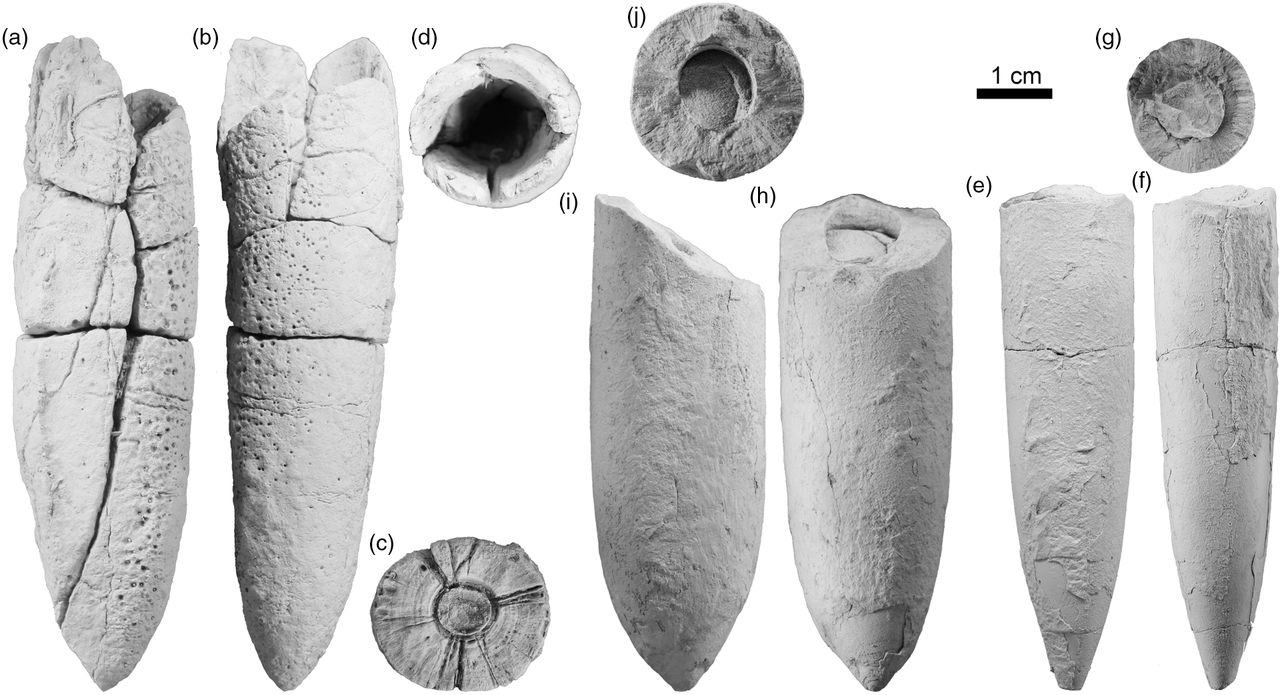
Arctoteuthis bluethgeni Doyle from the Bohemanflya section. (a–c) Specimen partly embedded in a cannon-ball-shaped siderite concretion, MGUH 33354 [ex. 537832], level 13.5 m: (a) dorsal view; (b) lateral view (venter to the right); and (c) cross-section in lower alveolar region. (d–f) MGUH 33355 [ex. 592708], level 25 m: (d) ventral view; (e) lateral view (venter to the right); and (f, g) cross sections.

Arctoteuthis bluethgeni Doyle from the Bohemanflya section. (a–e) MGUH 33356 [ex. 592703_1], level 30.3 m: (a) ventral view; (b) lateral view, venter to the left; and (c–e) cross-sections at 48 and 98 mm from apex and mid-alveolar region. (f–j) MGUH 33357 [ex. 592709_2], level 19 m: (f) dorsal or ventral view; (g) lateral view; and (h–j) cross-sections. (k–o) MGUH 33358 [ex. 592704],level 29.25 m: (k) dorsal view; (l) lateral view, venter to the right; and (m–o) cross-sections.

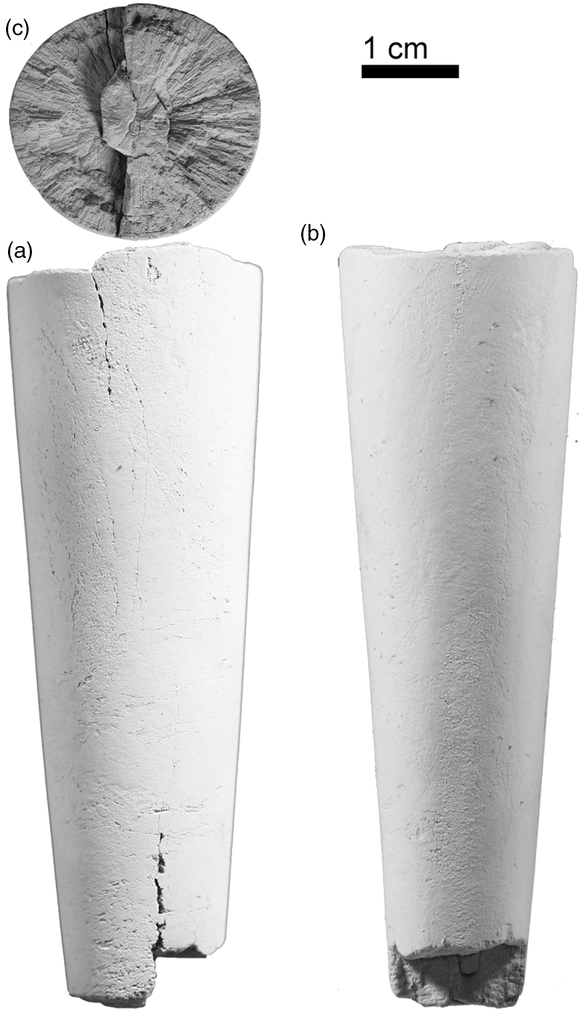
Fragment of stem from Arctoteuthis bluethgeni Doyle from 60 m level in the Myklegardfjellet section, MGUH 33359 [ex. 546551]: (a) dorsal view; (b) lateral view (venter to the right) and (c) cross-section, respectively.

(a–d) Worn specimen of Liobelus sp. MGUH 33360 [ex. 537838_1]: (a) ventral view; (b) lateral view, venter to the left; (c) cross-section of lower alveolar region; and (d) alveolar view. (e–g) Acroteuthis acmonoides Swinnerton, MGUH 33361 [ex. 592703_2], level 30.3 m in the Bohemanflya section: (e) ventral view; (f) lateral view; and (g) cross-section. (h–j) Simobelus sp., MGUH 33362 [592705], level 28 m in Bohemanflya section: (h) ventral view; (i) lateral view; and (j) cross-section.

3.b. Myklegardfjellet
The section of Myklegardfjellet (Fig. 1b) comprises a well-exposed Wimanfjellet Member succession. It is 166 m thick from the base of the member (including the Myklegardfjellet Bed) to the base of the overlying sandstones of the Festningen Member (Helvetiafjellet Formation). One specimen of A. bluethgeni was collected at this locality at sample level 60 m.
3.c. Repository and labels
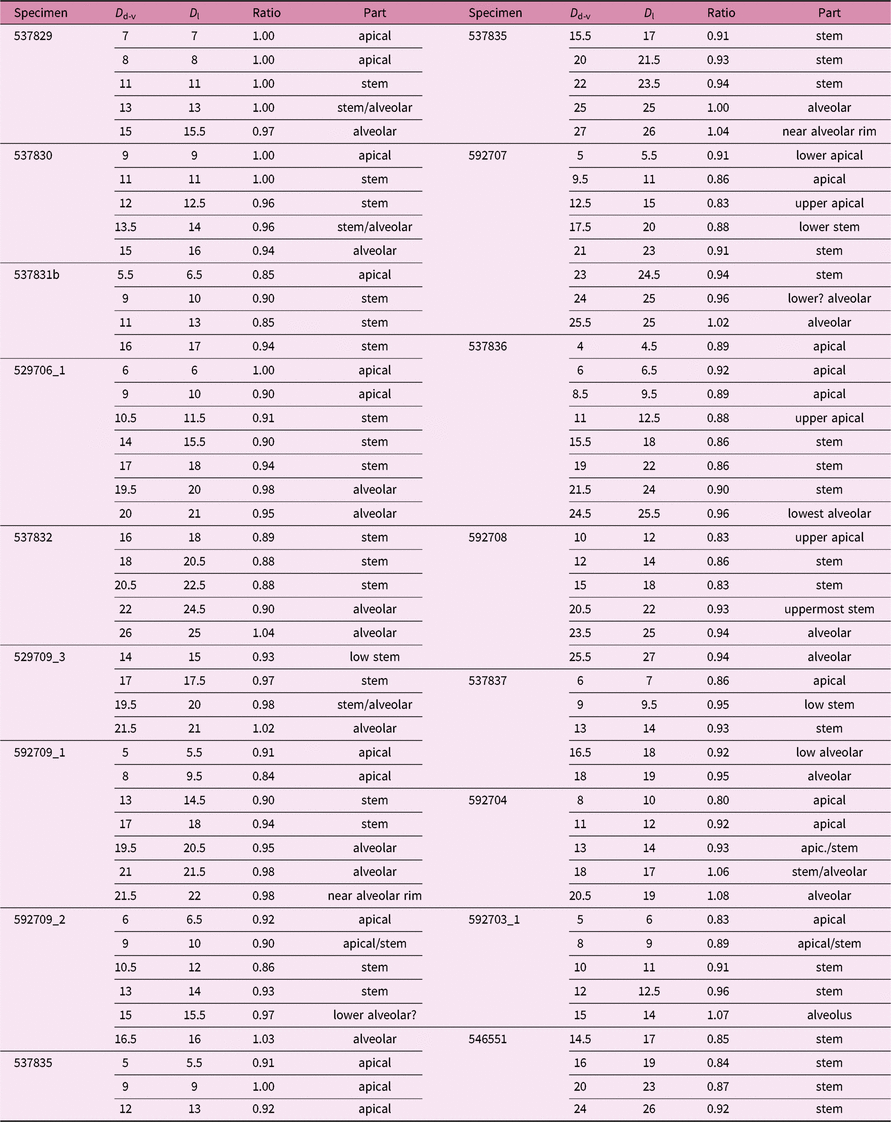
The material was assigned six-digit sample numbers (in correspondence with the Geological Survey of Denmark and Greenland; GEUS) in the field, as referred to in Figures 2b and 5 and Table 1. Figured material, 22 specimens, are housed in the Palaeontology Type Collection at the Natural History Museum of Denmark and have subsequently been assigned Museum Geologica Universitas Hafniensis or Geological Museum numbers MGUH 33341–62.
Measured dimensions in different parts of rostra of 16 selected specimens of Arctoteuthis bluethgeni Doyle. Dorso-ventral diameter D d-v, lateral diameter D l and their ratio D d-v/D l. Measurements were carried out manually using a caliper with ±0.5 mm uncertainty in the readings. The uncertainty becomes relative large close to the apex (at small diameters)

4. Systematic palaeontology
Order: Belemnitida Zittel, Reference Zittel1895
Suborder: Belemnitina Zittel, 1895
Family: Cylindroteuthididae Stolley, Reference Stolley1919
Subfamily: Cylindroteuthidinae Stolley, 1919
Genus: Arctoteuthis Saks & Nalnyaeva, Reference Saks and Nalnyaeva1964
Diagnosis: Slender, elongate to very elongate cylindrical to cylindroconical rostra, shallow alveolus (0.2 of the length of the rostrum). Apical line goniolineate. Short apical groove. Subcircular transverse section.
Stratigraphic range: Kimmeridgian–Hauterivian.
Arctoteuthis bluethgeni Doyle, Reference Doyle and Kelly1988
Figures 6a–l, 7a–i, 8a–e, 9a–v, 10a–g, 11a–o, 12a–c.
1936 Oxyteuthis(?) sp. indet., Blüthgen, p. 37 pl. VII, figs 6, 7.
1964 Acroteuthis? (nov. gen.?) n. sp. A, Jeletzky, pl. 10, fig. 1a, b.
1972 Cylindroteuthis (Arctoteuthis) n.sp. (ex. gr. subporrecta Bodylevsky), Saks & Nalnyaeva, p. 225.
1973 Cylindroteuthis (Cylindroteuthis) sp.nov. ex. gr. subporrecta, Saks & Nalnyaeva, p. 396.
1988 Cylindroteuthis (Arctoteuthis) bluethgeni Doyle sp. nov., in Doyle & Kelly, pl. 5, figs 1–14.
Types. The type material includes a holotype and five paratypes derived from the Tordenskjoldbjerget Member of the Klippfisk Formation, Kong Karls Land (Fig. 1). The holotype and three of the paratypes were figured by Doyle & Kelly (Reference Doyle and Kelly1988; pl. 5, figs 1–12) and consist of fragments only. The holotype and three of the paratypes are from the east side of Passet on SW Kongsøya (CSE location 831, Doyle & Kelly, Reference Doyle and Kelly1988). One paratype (Doyle & Kelly, Reference Doyle and Kelly1988; pl. 5, figs 4–5, refigured) is from the collection described by Blüthgen (Reference Blüthgen1936; pl. VII, figs 6–7) from Johnsenbjerget, NE Kongsøya. The types are fragments of stem and alveolar region, and apices are missing.
Material. 20 specimens. 19 specimens from the Wimanfjellet Member at Bohemanflya, central Spitsbergen, from 5 to 36 m in the measured section (Figs 1, 2, 5). One fragment from level 60 m, Wimanfjellet Member, Myklegardfjellet, Agardhbukta, eastern Spitsbergen (Fig. 1b).
Diagnosis. Slender, elongate rostrum. Outline and profile symmetrical and conical. Transverse section depressed in stem and apex, slightly compressed in alveolar region. Apex deflected in large specimens.
Description. Very large form. The largest specimen is 22.4 cm long and only lacks the apex (Fig. 6a, b). Another large specimen, which lacks the apex and the upper part of the alveolus, would probably be more than 25 cm long if the rostrum was complete (Fig. 6h, i). The rostrum is long, slender and conical, in both outline and profile. The dorsum and venter are straight and converge with an acute angle from the alveolar region to the apex. There is a variation in the angle of converging sides and dorsum and venter from c. 6 to 9°. In cross-section, the ventral side is slightly depressed in the apical and stem regions and in the lower part of the alveolar region. The ratio between the ventral-dorsal diameter and the lateral diameter is less than 1.00, close to equal or equal, but sometimes becomes slightly laterally depressed in the alveolar region in large specimens (Table 1). The depth of the alveolus is c. 1/3 of the total length. Lateral grooves are not observed. Large individuals may display a weak ventral apical groove, which extends into the stem region (Fig. 7a). Large individuals show a ventral deflection of the apex, which is particularly strongly developed in the largest specimen, suggesting that this peculiar feature is related to mature ontogenetic growth stages (Fig. 6h, j).
Remarks. The rostrum of this species is very characteristic and peculiar. Included in this species is the complete specimen figured by Jeletzky (Reference Jeletzky1964; see list of synonymy), who noted that no other belemnites from the Upper Jurassic – Lower Cretaceous strata have a similar attenuated, dagger-like outline and profile.
Comparisons. The morphologically closest species to A. bluethgeni is Arctoteuthis subporrecta (Bodylevsky, Reference Bodylevsky1960). A. subporrecta differs with relatively more curved sides of dorsum and venter. A ventral groove is observed in specimens of A. subporrecta from NE Greenland, which also have a shallow alveolus. A. subporrecta was reported from upper Valanginian – lower Hauterivian strata at the famous section at Kap Festningen in Spitsbergen (Nalnyaeva et al. Reference Nalnyaeva, Basov and Meledina2011), that is, from a stratigraphically equivalent interval to A. bluethgeni studied here. The large size of A. bluethgeni is only matched by Arctoteuthis harabylensis (Saks & Nalnyaeva, 1964), which has a deep ventral groove, is cylindrical to cylindroconical in outline and has a shallower alveolus than A. bluethgeni. A. cf. harabylensis has been reported from lower Valanginian strata in the Van Keulenfjord area, Spitsbergen (Nalnyaeva et al. Reference Nalnyaeva, Basov and Meledina2011).
Stratigraphy and range. The A. bluethgeni material recorded by Blüthgen (Reference Blüthgen1936) was collected from reddish marls at Johnsenbjerget, Kongsøya, and is associated with a fauna including species of Acroteuthis, Pachyteuthis and Hibolithes of probable Valanginian–Hauterivian age (Doyle & Kelly, Reference Doyle and Kelly1988). Alsen & Mutterlose (Reference Alsen and Mutterlose2009) demonstrated a close correlation between the faunas described from Kong Karls Land and those of NE Greenland, where similar taxa occur in red calcareous mudstones of Hauterivian age but without A. bluethgeni. Hibolithes caroli and Hibolithes nathorsti are typical for the Hauterivian strata of NE Greenland (Alsen & Mutterlose, Reference Alsen and Mutterlose2009). Their presence on Kong Karls Land suggests a Hauterivian age for the Johnsenbjerget fauna.
The specimen from the Sverdrup Basin was collected by M. Heywood in 1952. It was found in association with Acroteuthis ex. gr. subquadratus (GSC location 21897) and is ‘definitely of an early Lower Cretaceous age’ (Jeletzky, Reference Jeletzky1954; p. 4), somewhere within the Ryazanian–Hauterivian. Subsequently, Jeletzky (Reference Jeletzky1964) presented it in a figure among fossils from the Polyptychites stubbendorfi ammonite zone, indicating a middle-early Valanginian age (Jeletzky & Kemper, Reference Jeletzky and Kemper1988).
During collection of belemnites at Bohemanflya, the succession was also sampled for palynology within a larger Early Cretaceous palynostratigraphic study in Svalbard and the Barents Sea (Śliwińska et al. Reference Śliwińska, Jelby, Grundvåg, Nøhr-Hansen, Alsen and Olaussenin press). Palynostratigraphic dating of the Bohemanflya outcrop section indicates a late Valanginian – early Hauterivian age for the A. bluethgeni-bearing interval. The lower part of the interval is broadly dated as Valanginian based on the presence of Nelchinopsis kostromiensis and lack of Endoscrinium hauterivianum dinoflagellate species. The first occurence of E. hauterivianum at 28.0 m marks the base of the Hauterivian (Duxbury, Reference Duxbury2001). Sediments below that depth are therefore tentatively referred to as upper Valanginian. A. bluethgeni is found from near the base of the succession (at 5 m) and may range further down into the deeper part of the Wimanfjellet Member, subcropping the section measured in this study. A. bluethgeni ranges upwards to the 36 m level, 8 m above the Valanginian–Hauterivian boundary at 28 m. This is well below the lower–upper Hauterivian boundary situated around 55 m (Śliwińska et al. Reference Śliwińska, Jelby, Grundvåg, Nøhr-Hansen, Alsen and Olaussenin press). Acroteuthis acmonoides Swinnerton at 30.3 m (Fig. 13e–g) has a late Valanginian – Hauterivian age in NW Europe (Swinnerton, Reference Swinnerton1936–1955; Pinckney & Rawson, Reference Pinckney and Rawson1974; Mutterlose, Reference Mutterlose1990). Liobelus sp. was found at 36 m (Fig. 13a–d), which is the same level as the highest occurrence of A. bluethgeni. The genus Liobelus stratigraphically range from the Tithonian (Volgian) to the Hauterivian (Dzyuba, Reference Dzyuba2005).
The stratigraphic level of the one specimen from Myklegardfjellet is palynostratigraphically dated to the early–late Valanginian boundary. Based on the last occurrence of the stratigraphically persistent dinoflagellate species, T. apatela is considered a marker for the top of the early Valanginian (Śliwińska et al. Reference Śliwińska, Jelby, Grundvåg, Nøhr-Hansen, Alsen and Olaussenin press). The presence of A. bluethgeni and the presence of the middle early Valanginian ammonite Tollia (Neocraspedites) aff. subtilis some 13 m below may indicate a potential range of A. bluethgeni into the early Valanginian. However, the belemnite specimen was found loose on the surface and may have slid down from a stratigraphically higher, upper Valanginian, level.
In summary, the age range of A. bluethgeni appears to be late Valanginian – early Hauterivian.
Distribution. A. bluethgeni is recorded from Kong Karls Land (Doyle & Kelly, Reference Doyle and Kelly1988), Ellef Ringnes Island in the Sverdrup Basin, Arctic Canada (Jeletzky, Reference Jeletzky1964) and Svalbard (this study). It is not recorded from the rich and diverse Valanginian–Hauterivian faunas of NE Greenland, which include other rare Arctoteuthis species (A. cf. baculus, A. subporrecta) (Mutterlose et al. Reference Mutterlose, Alsen, Iba and Sin press).
5. Conclusions
The majority of belemnite specimens collected at Bohemanflya, central Spitsbergen, belong to the species Arctoteuthis bluethgeni. The assemblage adds significantly to the taxonomic understanding of this species, which has previously only been established from fragments from Kong Karls Land. The improved understanding of the taxon now allows an enigmatic specimen found in 1952 from Ellef Ringnes Island in the Sverdrup Basin, Arctic Canada, to be included in this taxon.
The species is characterized by its large size, elongate rostra, and symmetrical outline and profile, as well as straight sides, dorsum and venter converging from the alveolar rim to the apex in a conical shape with rounded to slightly oval cross-sections. These characteristics make the species easy to recognize, even from fragmentary fossil material, and the taxon is considered to be a useful late Valanginian – early Hauterivian guide fossil for biostratigraphic correlations across High Arctic Boreal basins, otherwise characterized by a paucity of guide fossils.
Acknowledgements
This study is part of the consortium LoCrA (Lower Cretaceous Basin Studies in The Arctic; https://wp.ux.uis.no/locra), supported by 22 industry partners. Annette Ryge, Charlotte Olsen and Dorthe Samuelsen (GEUS) prepared palynological microscope slides. James W. Haggart is thanked for providing details on the Arctic Canadian locality and access to a GSC fossil report (Jeletzky, 1954). PA appreciates the generous support by the San Cataldo Foundation. We are grateful for field-related logistics and transport provided by the University Centre in Svalbard (UNIS) and Lufttransport. We greatly appreciate the useful reviews from two anonymous referees.