Introduction
The golden jackal (Canis aureus Linnaeus 1758) is a canid of medium size with one of the widest distribution ranges in the world, a range that is still expanding (Demeter & Spassov, Reference Demeter, Spassov, Niethammer and Krapp1993; Kryštufek et al., Reference Kryštufek, Murariu and Kurtonour1997; Mitchell-Jones et al., Reference Mitchell-Jones, Amori, Bogdanowicz, Kryštufek, Reijnders, Spitzenberger, Sttube, Thissen, Vohralík and Zima1999). In the past few decades, it has undergone several changes, especially in Europe, where the stretch of the Danube through ex-Yugoslavia and Romania has traditionally been described as the northern border of residential populations (Kryštufek et al., Reference Kryštufek, Murariu and Kurtonour1997). However, the present distribution of the jackal additionally comprises parts of central Europe (Mitchell-Jones et al., Reference Mitchell-Jones, Amori, Bogdanowicz, Kryštufek, Reijnders, Spitzenberger, Sttube, Thissen, Vohralík and Zima1999; Arnold et al., Reference Arnold, Humer, Heltai, Murariu, Spassov and Hackländer2012). Apart from Greece, where the jackal population has decreased (Giannatos, Reference Giannatos2004; Giannatos et al., Reference Giannatos, Marionos, Maragou and Catsadorakis2005), European populations are both rapidly increasing and widening their ranges (Kryštufek et al., Reference Kryštufek, Murariu and Kurtonour1997; Arnold et al., Reference Arnold, Humer, Heltai, Murariu, Spassov and Hackländer2012). In Serbia, jackals neared extinction due to extensive poisonings organized after World War II, initially aimed at controlling the size of the wolf population and lessening the damage they caused to domestic animals. Only two relic populations survived in Srem and in eastern Serbia (Milenković, Reference Milenković1983, Reference Milenković1987). At the beginning of the 1980s, the species started to spread quickly and to increase in number (Savić et al., Reference Savić, Paunović, Milenković, Stamenković, Stevanović and Vasić1995), which resulted in the fusion of the two relic populations and the widening of their range. This range now covers more than half of the territory of modern Serbia (Ćirović et al., Reference Ćirović, Milenković, Paunović and Penezić2008; Zachos et al., Reference Zachos, Ćirović, Kirschning, Otto, Hartl, Petersen and Honnen2009).
The increasing jackal range in Europe was not automatically followed by detailed parasitological research. Only two studies in Europe, namely in Bulgaria and Greece, have been undertaken on the intestinal helminths of the golden jackal, and these are based on small numbers of hosts (Bulgaria n= 13, Greece n= 5) examined (Trifonov et al., Reference Trifonov, Meskov and Stoimenov1970; Papadopoulos et al., Reference Papadopoulos, Himonas, Papazahariadou and Antoniadou-Sotiriadou1997). More work has been done in Asia, where comprehensive studies, particularly in Iran, showed high prevalences in jackals, ranging from 66.7 to 100% (Sadighian, Reference Sadighian1969; Dalimi & Mobedi, Reference Dalimi and Mobedi1992; Dalimi et al., Reference Dalimi, Sattari and Motamedi2006; Meshgi et al., Reference Meshgi, Eslami, Bahonar, Kharrazian-Moghadam and Gerami-Sadeghian2009). In central Asia, 13 species of intestinal helminths were identified in Tajikistan and 8 species in Uzbekistan, but, again, data were limited (Heptner & Naumov, Reference Heptner and Naumov1967). In Israel, two helminth species, Ancylostoma caninum and Dipylidium caninum, were identified using faecal flotation techniques (Shamir et al., Reference Shamir, Yakobson, Baneth, King, Dar-Verker, Markovics and Aroch2001). High prevalences of Toxocara leonina, A. caninum and Mesocestoides lineatus were found in Iran (Sadighian, Reference Sadighian1969; Dalimi & Mobedi, Reference Dalimi and Mobedi1992; Dalimi et al., Reference Dalimi, Sattari and Motamedi2006; Meshgi et al., Reference Meshgi, Eslami, Bahonar, Kharrazian-Moghadam and Gerami-Sadeghian2009) and also Uncinaria stenocephala and Taenia hydatigena have been found in Europe (Trifonov et al., Reference Trifonov, Meskov and Stoimenov1970; Papadopoulos et al., Reference Papadopoulos, Himonas, Papazahariadou and Antoniadou-Sotiriadou1997).
However, these studies were limited by the small number of jackals examined. The aim of the present investigation, therefore, was to identify species of gastrointestinal helminths in a large sample of hosts and to evaluate the potential role of the golden jackal in enhancing transmission of these helminths in Serbia and Europe.
Material and methods
Collection and examination of jackals
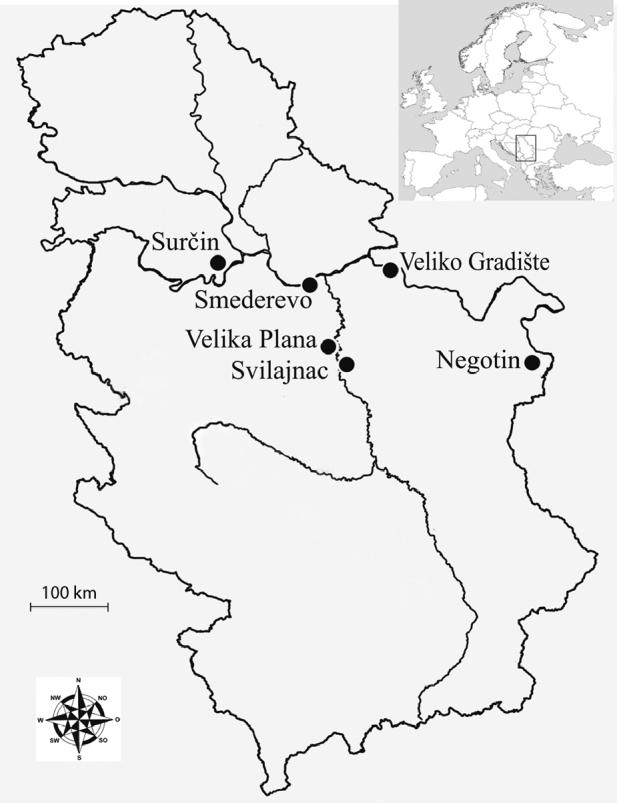
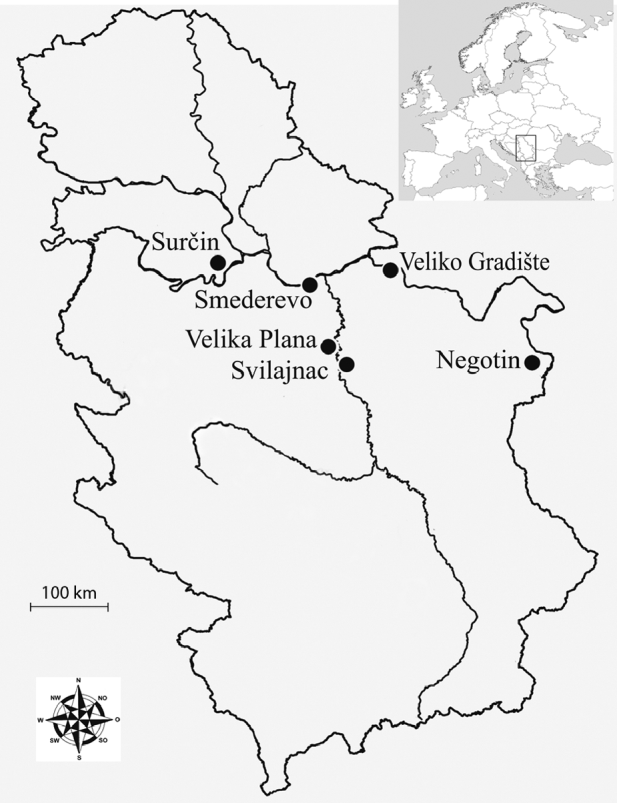
In cooperation with local hunting associations, the carcasses of all available, legally hunted jackals were collected in six locations in Serbia between 2005 and 2010. This collection was conducted throughout the main hunting season, the winter period from December until February, when jackals are sexually mature and therefore presumed to be adults. In total, 447 animals (239 males and 208 females) were collected: 40 from Negotin (MGRS 34T FP29), 162 from Veliko Gradište (MGRS 34T EQ45), 49 from Velika Plana (MGRS 34T EQ00), 119 from Smederevo (MGRS 34T DQ75), 39 from Svilajnac (MGRS 34T EP19) and 38 from Surčin (MGRS 34T DQ46) (fig. 1). The date of collection, location and sex of each jackal were noted. After morphometric analysis of each individual, the stomach and intestine were removed in the field and immediately frozen at − 20°C. For safety reasons, the material was additionally frozen at − 80°C for 3 days and then thawed at room temperature prior to parasitological investigation in the laboratory of the Scientific Institute of Veterinary Medicine of Serbia.
The collection sites of golden jackals examined from Serbia between 2005 and 2010.
The analysis of the gastrointestinal helminths was part of wider research on the jackal's diet (Ćirović et al., Reference Ćirović, Milenković, Paunović and Penezić2009). For this reason, the stomach was first scrutinized for food contents. Parasites found in the stomach were removed and stored in 70% ethanol until eventual determination. The intestines were opened with a longitudinal cut and the entire intestinal contents were collected and washed with a water jet over a 200 μm sieve. All visible parasites were transferred to Petri dishes. Furthermore, to detect the presence of small parasites embedded in the mucosa, intestinal walls were scraped with a wooden spatula or a glass microscope slide. All helminths found were first washed in warm water and then fixed. Nematodes were fixed in 70% ethanol, while cestodes and trematodes were fixed in a mixture composed of 5% formalin, 85% ethanol and 10% glacial acetic acid. Nematodes were studied in depression slides using lactophenol wet mounts. Cestodes and trematodes were stained with acetic carmine, and after dehydration were mounted with Canada balsam. Scolices of taeniids were severed and mounted in lactophenol; sufficient pressure was applied to the coverglass to cause the rostellar hooks to lie flat. Identification was based on the number, size, shape and arrangement of rostellar hooks.
All helminths were identified using the relevant keys (Kozlov, Reference Kozlov1977; Soulsby, Reference Soulsby1982), counted and deposited in the collections of the Scientific Institute of Veterinary Medicine of Serbia and the Faculty of Biology of the University of Belgrade.
Data analysis
Prevalence (P) and mean intensity (MI) were calculated according to Bush et al. (Reference Bush, Lafferty, Lotz and Shostak1997). For each intestinal helminth, prevalences were noted for each locality and for the entire sample of jackals. In addition, prevalence was calculated according to annual cycles (2005–2010) and host sex. The G-test was used for statistical evaluation of differences between the six localities (Sokal & Rohlf, Reference Sokal and Rohlf1995) in addition to the number of infected/uninfected hosts for each year. The chi-square test was used to compare the prevalence of intestinal helminths in male and female hosts. The mean intensity was calculated for the entire host sample and at each locality. Data were analysed using Statistica 5.1 (Statsoft, Tulsa, Oklahoma, USA) with the level of significance being P< 0.05.
Results
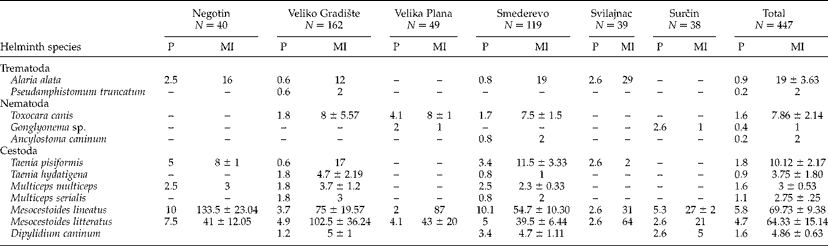
Up to 46 of 447 jackals (10.3%) were infected with at least one helminth species and a total of 12 species were identified, namely two trematodes, Alaria alata and Pseudamphistomum truncatum, three nematodes, Toxocara canis, Ancylostoma caninum and Gongylonema sp. and seven cestodes, Taenia pisiformis, Taenia hydatigena, Multiceps multiceps, Multiceps serialis, Mesocestoides lineatus, Mesocestoides litteratus and Dipylidium caninum (table 1).
The prevalence (P%) and mean intensity (MI ± SE) of gastrointestinal helminths in the golden jackal Canis aureus from six collection sites in Serbia; N=number of hosts examined.
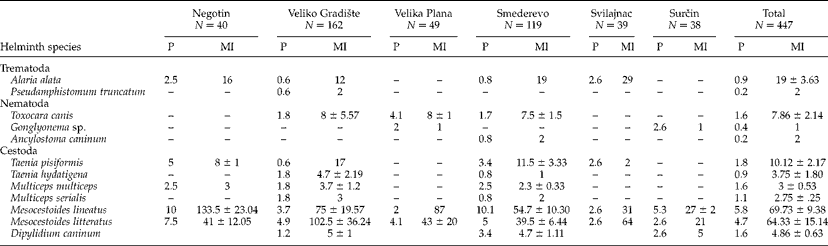
The highest prevalence value was recorded at Smederevo (15.1%), followed by Veliko Gradište (10%), Negotin (10%), Velika Plana (6.1%), Surčin (7.9%) and Svilajnac (5.1%). These differences, which varied from 5.3% in 2007 to 15% in 2008, were not significant (P>0.9999), relative to locality. Similarly, no significant differences in prevalence were found between years (P>0.502) nor relative to host sex (P>0.817). The smallest number of infected jackals (4 from 75 examined) was recorded in 2007, while the highest number (11 from 102 examined) was recorded in the last year – 2010. The most frequent parasites found in this study were the cestodes M. lineatus (found in 26 individuals) and M. litteratus (found in 21 individuals), with the respective prevalences of 5.8 and 4.7% and mean intensities 69.73 ± 9.38 and 64.33 ± 15.14. These two species also had the widest distribution range, having been recorded at all six locations.
Generally, all cestodes had a relatively higher prevalence in comparison to nematodes and trematodes. Toxocara canis was the nematode with the highest prevalence (1.6%) and a mean intensity of 7.86 ± 2.14, while among trematodes A. alata had the highest prevalence (0.9%) with a mean intensity of 19 ± 3. Pseudamphistomum truncatum and A. caninum were the only two parasites recorded in one animal only. With the exception of Gongylonema sp., which were found in the stomach, all parasites were found in the intestine.
Regarding the diversity of parasites, the highest number of species (10) was recorded at Veliko Gradište and Smederevo, while the smallest number of parasite species (4) was recorded at Velika Plana, Svilajnac and Surčin. While 34.8% (16) of the infections were monospecific, the majority (65.2%, 30) of individuals had multiple infections. Within the group with multiple infections: 37% (17) of jackals had two species of helminths, 21% (10) had three, while 4% (2) hosted four species. Only one animal had five species of parasites in its intestine, the highest number of recorded parasites per jackal in Europe. Most of the analysed animals were hosts to cestodes only (76%, 35), while 10% (5) were hosts to nematodes only. Four animals were hosts to both cestodes and trematodes, two animals were hosts to both cestodes and nematodes, and one animal was infected with both nematodes and trematodes. No single animal was infected with trematodes only. The findings of P. truncatum and M. serialis represent the first record of these parasites in jackals.
Discussion
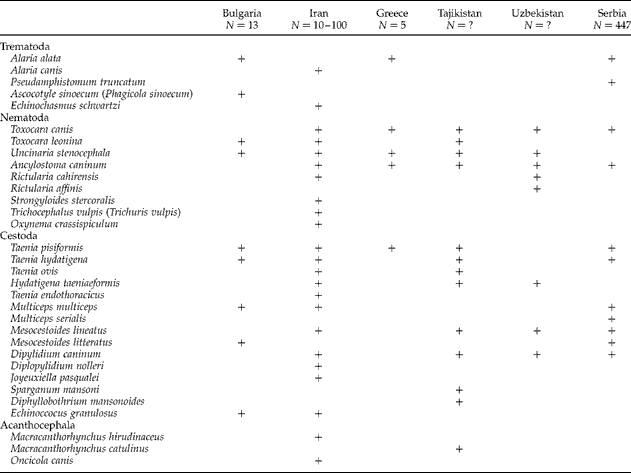
The present analysis has shown that jackals in Serbia are hosts to 12 species of intestinal helminths. According to the available literature, 32 species of intestinal helminths have been recorded across the entire distribution range (table 2). Of the 12 species found in this research, P. truncatum and M. serialis have never been found infecting jackals before, and M. lineatus and D. caninum are recorded for the first time in jackal populations in Europe. Acanthocephalan species were not found in this study nor in other studies in Europe (Trifonov et al., Reference Trifonov, Meskov and Stoimenov1970; Papadopoulos et al., Reference Papadopoulos, Himonas, Papazahariadou and Antoniadou-Sotiriadou1997) (table 2), although they have been found in Iran and Tajikistan (Heptner & Naumov, 1967; Sadighan, Reference Sadighian1969; Dalimi et al., Reference Dalimi, Sattari and Motamedi2006; Meshgi et al., Reference Meshgi, Eslami, Bahonar, Kharrazian-Moghadam and Gerami-Sadeghian2009).
The occurrence (+) of intestinal helminths in the golden jackal from parts of Europe including Bulgaria (Trifonov et al., Reference Trifonov, Meskov and Stoimenov1970), Iran (Sadighian, Reference Sadighian1969; Dalimi & Mobedi, Reference Dalimi and Mobedi1992; Dalimi et al., Reference Dalimi, Sattari and Motamedi2006; Meshgi et al., Reference Meshgi, Eslami, Bahonar, Kharrazian-Moghadam and Gerami-Sadeghian2009), Greece (Papadopoulos et al., Reference Papadopoulos, Himonas, Papazahariadou and Antoniadou-Sotiriadou1997), Tajikistan (Heptner & Naumov, Reference Heptner and Naumov1967), Uzbekistan (Heptner & Naumov, Reference Heptner and Naumov1967) and Serbia. N=number of hosts examined.
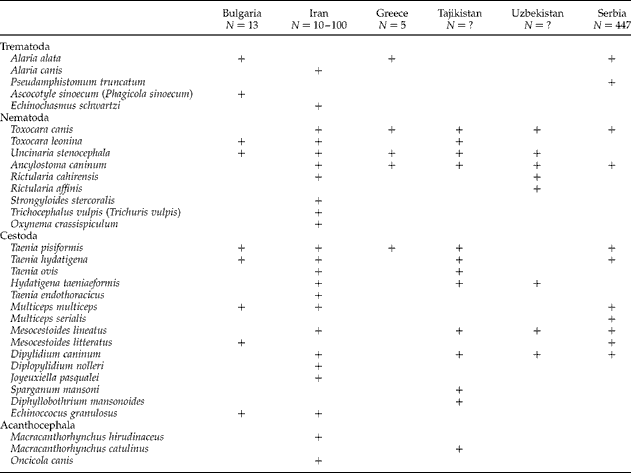
The total prevalence of gastrointestinal parasites in Serbia was significantly low (table 1) at only 10.3%. All previous studies have indicated a much higher helminth infection of jackals (Sadighian, Reference Sadighian1969; Trifonov et al., Reference Trifonov, Meskov and Stoimenov1970; Dalimi & Mobedi, Reference Dalimi and Mobedi1992; Papadopoulos et al., Reference Papadopoulos, Himonas, Papazahariadou and Antoniadou-Sotiriadou1997; Dalimi et al., Reference Dalimi, Sattari and Motamedi2006; Meshgi et al., Reference Meshgi, Eslami, Bahonar, Kharrazian-Moghadam and Gerami-Sadeghian2009). Similarly, the prevalence of each helminth species was considerably lower than in previous studies.
These differences could be partly explained by seasonal variations in prevalence, which is well known in canids (see Rajković-Janje et al., Reference Rajković-Janje, Marinculić, Bosnić, Benić, Vinković and Mihaljević2002; Saeed et al., Reference Saeed, Maddox-Hytell, Monrad and Kapel2006). The low infection rate we found in Serbia could be explained by differences in sampling seasons between this study and other studies, since our study included specimens only from the winter, while studies from Greece, Bulgaria and Iran included the entire year. Detecting whether the diversity of intestinal helminths also shows seasonal variation is left for future research. The other possible reason for the differences in prevalence and diversity between other studies and ours is that the jackal population in Serbia has developed only recently. It is known that species introduced to a new area are usually less heavily parasitized, with a lower prevalence than the original population from which they have descended (Torchin et al., Reference Torchin, Lafferty, Dobson, McKenzie and Kuris2003).
When the diversity of intestinal helminths between Serbian and Iranian populations is compared, only seven species are mutual, and all of them are common parasites of canid species. The difference in diversity of intestinal parasites in the two countries could be explained by the rule that, in some host species, similarities in parasite communities decay exponentially with increasing distance (Poulin, Reference Poulin2003). The data in table 2 show that the diversity of intestinal parasites in Serbia differs from both Bulgaria and Greece despite their close proximity. Note that these studies considered only a small number of hosts and more data are therefore required in order to come to a proper conclusion.
In Serbia, as in most other countries of south-eastern Europe, the jackal is the second most numerous wild canid after the red fox. Almost all intestinal helminths recorded in the jackal are also found in the red fox, with only a nematode from the genus Gongylonema not yet found in the red fox (Pavlović, Reference Pavlović1994). Like the jackal, the red fox is an autochthonous canid of medium size, and the niches of the two animals overlap to a great extent (Lanszki et al., Reference Lanszki, Heltai and Szabo2006; Lanszki & Heltai, Reference Lanszki and Heltai2010). From an ecological point of view, this could explain the high number of common intestinal parasites of these two species.
Considering the constant spreading of the jackal's range and the permanent increase of its populations both in Serbia and throughout south-eastern Europe (Arnold et al., Reference Arnold, Humer, Heltai, Murariu, Spassov and Hackländer2012), it seems that this animal is likely to have a great parasitological significance, both for animal and human health, as a reservoir of specific parasites. For example, T. canis, M. lineatus and D. caninum are transmittable to humans and other canids. Of these, T. canis could be the most important as it is reported to be a common parasite in domestic and wild canids worldwide. In light of this, the next (necessary) step should be better monitoring of jackal population dynamics, as well as the prevalence of their parasites, throughout Serbia and the whole of its European range.
Acknowledgements
The authors wish to express their gratitude to all collaborators in the field who helped in collecting the material for this study: Goran Blagojević (Surčin); Zoran Gubin, Ljubiša Branković and Milan Stefanović (Smederevo); Nenad Mirković, Sladan Marković, Goran Cvetković and Mladen Bogdanović (Veliko Gradište); Živorad Pavlović and Predrag Živanović (Velika Plana); Borko Dimitrijević, Boriša Dimitrijević and Bata Dimitrijević (Svilajnac); Zoran Tufarević-Moce and Slobodan Kastratović (Negotin). The authors give their thanks to three anonymous reviewers for their useful advice and suggestions that significantly improved the paper. They are also very thankful to Maria del Mar Mancha Cisneros (Arizona State University in Tempe, USA), Enrico Sandro Colizzi (Utrecht University, The Netherlands) and Linda McPhee for final editing of the English text.
Financial support
This study was supported by the Ministry of Education and Science of the Republic of Serbia (Contract TR 31009).
Conflict of interest
None.
Ethical standards
The authors assert that all procedures contributing to this work comply with the ethical standards of the relevant national and institutional guides on the care and use of laboratory animals.