INTRODUCTION
On-line sentence processing by children is still an emerging field despite the fact that Tyler and Marslen-Wilson's (Reference Tyler and Marslen-Wilson1981) pioneer experiments on English clearly underlined the theoretical merits of developmental studies. The growing importance of on-line methods in child-language research is well attested in Sekerina, Fernandez and Clahsen (Reference Sekerina, Fernandez and Clahsen2008), a volume providing overviews on innovative methods ranging from behavioural (word monitoring, probe recognition, real-time grammaticality judgement) to paradigms involving eye tracking (free-viewing and looking while listening) and event-related potentials. These on-line methods can be used with children from about 5 years of age onwards to study relatively complex syntactic and morphosyntactic phenomena.
The purpose of this study was to provide more developmental data on the on-line integration of two basic grammatical constraints, word order configuration and morphological agreement in Swedish, and to compare these processes with previous data obtained in French (Kail, Reference Kail2004), a typologically contrasted language. Swedish is a Germanic language belonging to the Scandinavian branch of Indo-European languages such as Danish, Norwegian and Icelandic. French is a Romance language like Italian, Spanish and Portuguese. In our previous cross-linguistic studies using comparisons within Romance languages, we showed that typological closeness was not always predictive of all processing specificities, whether in off-line paradigms (Kail & Charvillat, Reference Kail and Charvillat1988; Kail, Reference Kail, MacWhinney and Bates1989) or on-line ones (Kail, Costa & Hub Faria, Reference Kail, Costa, Hub Faria, Kail, Fayol and Hickmann2008).
Cross-linguistic studies of monolinguals have been used extensively to study the syntactic development of children and adults of different native languages, with a view to determining how theoretically relevant linguistic differences affect performance and how regularities are useful in the search for universal mechanisms (Slobin, Reference Slobin1985).
Real-time language processing requires the listener or reader to integrate linguistic cues into the ongoing sentence representation. Language is a complex system that involves different types of information (i.e. phonological, syntactic, semantic, morphosyntactic) that must be retrieved and used to achieve comprehension. Different psycholinguistic theories agree that all these information types must be retrieved and used in normal on-line comprehension, but there is still some debate about the timing of information use and the nature of the interplay between syntactic and lexical-semantic information.
In the serial approach, the strongest claims, such as the garden path theory of Frazier (Reference Frazier and Coltheart1987), propose that structural syntactic principles – minimal attachment and late closure – are sufficient to explain the initial pass analysis and the local phrase structure building. For example, according to late closure, the parser prefers to attach locally, low in the tree. Information from other components may play a role only after the parser has made an initial attachment. However, in the serial approach, Altmann (Reference Altmann1989) provided evidence to suggest that referential information can influence the parser's decisions and prevent garden path effects. Likewise, Tanenhaus, Carlson and Trueswell (Reference Tanenhaus, Carlsson and Trueswell1989) have shown that thematic role information associated with the verb is rapidly accessed and used in the interpretation of the sentence. On the whole, as underlined by Mitchell (Reference Mitchell and Gernsbacher1994), much of the work on parsing is based on the notion that human parsing involves building something like ‘linguists’ tree diagrams'.
The interactive models challenge the idea that syntax occupies a privileged position in the initial parsing of sentences (McClelland, St John & Taraban, Reference McClelland, St John and Taraban1989; MacWhinney, Reference MacWhinney and MacWhinney1987; MacWhinney & Bates, Reference MacWhinney and Bates1989). According to these models, the parser is immediately able to integrate all available linguistic information. In this single system all cues or constraints guide the construction of a unique representation as a function of their relative weights.
Our framework is the Competition Model (CM: MacWhinney, Reference MacWhinney and MacWhinney1987; MacWhinney & Bates, Reference MacWhinney and Bates1989), an integrative-activation model of language comprehension and language use that emphasizes qualitative and quantitative linguistic variations across languages. In this model, the informational value of linguistic forms in a given language plays a probabilistic role in mapping surface forms to their underlying functions as directly as possible. The CM assumes parallel processing, and the language processor can use compound input cues that work across linguistic boundaries, e.g. prosody, morphology, lexicon and syntax. In contrast to modular theories in which different pieces of linguistic information are computed sequentially by separate processors, the CM processes information from various sources via a common set of perceptual, representational and retrieval mechanisms. Different cues cooperate and compete with each other in language comprehension, where coalitions and competitions represent the mediation process between forms and functions. When parallel activation of the formal and functional levels leads to competition, the co-evaluation of different linguistic sources becomes necessary and is directly determined by the validity of these cues in the particular language.
The major predictive construct of the CM is ‘cue validity’, evaluated as the product of ‘cue availability’ (how often a cue is there when needed) and ‘cue reliability’ (how often an available cue leads to the right interpretation). Cue validity, availability and reliability are properties of the linguistic input. Validity can be measured directly in samples of spoken or written language and used to derive predictions concerning language processing by adults or language acquisition by children. According to McDonald (Reference McDonald1986), availability can be expressed numerically as the ratio of the cases in which the cue is available over the total number of cases in a linguistic task. The probabilistic character of the CM suggests that, although two languages may both employ a set of rules that are obligatory in terms of grammar, the strengths of the mappings implied by those rules may differ between languages. To illustrate, in English and Spanish, both subject--verb agreement and word order cues are available but the validities of these two cues are different. Spanish has a rich set of marking for subject--verb agreement (cantó, cantás, cantá, cantámos, cantáis, cantán vs. I sing, you sing, he sings, we sing, you sing, they sing) and thus subject--verb agreement is a stronger cue for assigning agent--patient relations. However, Spanish allows the omission of a known subject and also permits more word order variations. As a result, word order is a relatively weak and unreliable cue for agency. English presents very few contrasts in verb morphology to mark the subject role. In addition, subjects are not omitted in declarative sentences and word order is rigidly preserved in most sentence types. Hence, in English, subject--verb agreement is a weak cue while word order is a very strong cue to the agent role of a sentence.
According to the processing hypotheses proposed in this model, another construct is ‘cue strength’. In a given language, cue strength is the probability assigned by the speaker to a specific linguistic device in order to assign a specific function. In the CM, cue strength is determined by cue validity.
To study cue strength in a given language, most CM experiments use a sentence-comprehension task in which native speakers are presented with sequences of words consisting of two nouns and a transitive action verb in one of three possible orders, NNV, NVN or VNN (e.g. The cat is kissing the duck), and are asked to say which of the two nouns is the performer (agent) of the action described in the sentence. A substantial body of studies (for reviews see MacWhinney & Bates, Reference MacWhinney and Bates1989; Kail, Reference Kail, Fuchs and Robert1999; Bates, Devescovi & Wulfeck, Reference Bates, Devescovi and Wulfeck2001) conducted over a wide range of languages revealed a strong correlation between cue validity and cue strength in sentence processing. The results also showed that when there is competition between cues, the levels of choice in a group of adult subjects will closely reflect the relative strengths of the competing cues.
The assumption that children acquire sentence comprehension strategies in a sequence that is predictable from the cue validity of the grammatical devices in the adult language has been supported by a large set of developmental studies conducted in various languages (MacWhinney & Bates, Reference MacWhinney and Bates1989). Children begin learning to comprehend sentences by first focusing on the strongest cue in their language. As children get older, the strength of all cues changes to match the adult pattern, with the most valid cues growing most in strength. Young children are relatively more influenced by cue availability, while in older children (8--10 years) and adults, cue strength is determined by cue reliability.
The second basic notion in the CM, ‘cue cost’, refers to the amount and type of processing required for the activation of a given form when cue validity is held constant. We suggested (Kail & Charvillat, Reference Kail and Charvillat1988) that cues are distributed along a processing-type continuum that ranges from local (an interpretation can be computed as soon as the cue is encountered) to topological (the interpretation is delayed until all information is stored and compared). In some languages like French (Kail & Charvillat, Reference Kail and Charvillat1988), Italian (Devescovi, D'Amico & Gentile, Reference Devescovi, D'Amico and Gentile1999) and German (Lindner, Reference Lindner2003), cue validity and cue cost interact during development. Some predictions based on the idea that children acquire sentence-interpretation strategies in an order that can be predicted from cue validity in the adult language have been updated to take into account the greater short-term memory demands of topological processing (Kail, Reference Kail, Fuchs and Robert1999).
Assuming that cue validity and cue cost interact to determine cross-linguistic variations in the use and development of sentence-interpretation strategies, the investigation of cue cost requires more information about how listeners allocate their attention and make predictions in the course of sentence processing (Kail, Reference Kail, Fuchs and Robert1999; Kempe & MacWhinney, Reference Kempe and MacWhinney1999; Devescovi & D'Amico, Reference Devescovi, D'Amico, Tomasello and Slobin2005; Staron, Bokus & Kail, Reference Staron, Bokus, Kail and Bokus2005).
In previous experiments, (Blackwell, Bates & Fisher, Reference Blackwell, Bates and Fisher1996) on-line grammaticality judgements where participants have to judge the grammaticality or ungrammaticality of sentences as quickly as possible were used. We proposed a variant of this task, the violation detection paradigm, where children as young as 6 and adults have to detect a linguistic violation in a sentence as quickly as possible. We used this paradigm to study verbal agreement processing by French adults (Kail & Bassano, Reference Kail and Bassano1997) and to examine the on-line integration of case cues by Greek children and adults (Kail & Diakogiorgi, Reference Kail, Diakogiorgi, Dittmar and Penner1998). In a study examining on-line grammaticality judgements in French children (from 6 to 11) and adults, Kail (Reference Kail2004) found that, at each age level, morphological agreement violations were more quickly detected than word order ones. This result followed the predictions based on cue validity in French. Second, each age group was faster at judging sentences with later occurring violations and this position effect was especially strong in the youngest group. This effect has been interpreted as an indication that listeners are using their grammatical knowledge to build expectations over the course of the sentence. Finally, intraphrasal violations were more rapidly detected than interphrasal ones, this effect being observed only in the oldest groups and in adults. This result is both compatible with the CM and with serial models. The amount of memory required for on-line integration is low when attachments between units can be made locally (Frazier, Reference Frazier and Coltheart1987). In the CM, cues to sentence processing can be ranked along a dimension called ‘assignability’, referring to the amount of material that must be held in memory before a meaning assignment can be made.
The present article is devoted to increasing our knowledge of how these different factors affect on-line sentence processing from a double perspective: first, we examine how the factors develop over time and, second, we chose an uncommonly studied Germanic language, Swedish, which presents some interesting contrasts with French. On the one hand, Swedish is similar to English in that grammatical roles are indicated by word order, but in a different way, especially concerning the subject. On the other hand, as opposed to French, morphology is unevenly distributed on nouns (rich marking) and verbs (poor marking). The article is organized as follows: after a presentation of selected characteristics of word order and morphology in Swedish and French, we present an experiment using on-line grammaticality judgements conducted on Swedish children and adults, which is very close to the previous study conducted in French (Kail, Reference Kail2004). In a cross-linguistic section, we then compare the developmental results obtained in both languages and, finally, we discuss the results in the light of the interaction between cue cost factors and cue validity during on-line sentence processing.
SELECTED CHARACTERISTICS OF SWEDISH AND FRENCH
Swedish and French differ in morphology and word order. The major differences can be summarized as follows: verb morphology is rich in French but poor in Swedish. Word order in Swedish is constrained by the V2 rule, whereas word order in French allows some exceptions to the SVO rule due to cliticization and dislocations.
Swedish
Word order
Swedish has a canonical word order, SVO, for declarative sentences. But Swedish exhibits more variation than French in this respect. Like all Germanic languages except English, Swedish is a V2 (verb-second) language. Whenever an adverbial, (1), a subordinate clause (2) or an object (3) is topicalized and occurs in sentence-initial position, subject--verb inversion is obligatory because the second position of the sentence is targeted for the verb as in the following examples (X=adverbial, object or subordinate clause):
(1) Nu kommer han. (XVS)
Now come-PRES he
‘Now he comes.’
(2) När jag kom hem, träffade jag Lisa. (XVS)
When I come-PAST home, meet-PAST I Lisa
‘When I came home, I met Lisa.’
(3) Glass gillar han. (OVS)
Ice cream like-PRES he
‘He likes ice-cream.’
The VS option is used extensively in Swedish. In a corpus of spoken Swedish (Jörgensen, Reference Jörgensen1976), a nearly even distribution between the two options was observed: no subject--verb inversion occurred in 60% of all declarative clauses, whereas 40% exhibited the XVS pattern, where X could be an object, an adverbial or a subordinate clause.
Thus, the XVS pattern is mandatory in some frequent and clearly identifiable syntactic contexts in Swedish, which means that the following sentence used in the experiment constitutes a violation of word order:
(4) *På lördagar den turkiska grannfrun fyller kylskåpet (XSV instead of XVS)
On Saturdays the Turkish-DEF neighbour-DEF fill-PRES fridge-DEF
‘On Saturdays, the Turkish neighbour fills the fridge.’
Another word order feature included in the experiment was the position of the adjective in noun phrases. In Swedish, adjectives are placed before the noun, with no exceptions. Thus, postposing the adjective is unambiguously a violation of word order, as in the following sentence from the experiment:
(5) *På lördagar fyller den grannfrun turkiska kylskåpet. (Noun+Adj instead of Adj+Noun)
On Saturdays fill-PRES the neighbour-DEF Turkish-DEF fridge-DEF
‘On Saturdays, the Turkish neighbour fills the fridge.’
Verbal and nominal agreement
The paradigm of Swedish verbs is considerably less complex than in other Germanic languages. There is no subject--verb agreement. Neither number nor person is marked morphologically. Verbs are marked only for tense. For regular verbs, there are two main groups, the -ar group and the -er group. Table 1 presents the verb morphemes of Swedish.
Swedish verb morphemes (regular verbs)

As shown in Table 1, the imperative form is a very informative form, for it indicates whether an -ar verb or an -er verb is at stake. The infinitive form is not conclusive because of its invariable -a suffix. The present tense morpheme is either -r, as in öppna r (=-ar verb) ‘open(s)’ or -er, as in ring er (=-er verb) ‘phone(s)’. The preterite morpheme is always -de. For the -ar verbs, with a final ‘a’ in the verb stem, this gives öppna de ‘opened’. For the -er verbs with a final consonant in the stem, this gives ring de ‘phoned’, with a phonematic allomorphe, -te, after unvoiced consonants. The past participle, called the supin, is always marked with -t, as in öppna t ‘opened’ and ring t ‘phoned’.
Evaluating the impact of verbal agreement on sentence processing in a language that only marks tense poses some difficulties. Tense is deictic and involves speech time, which is not relevant or discriminatory in the linguistic material used in our experiment. The only available choice for creating an audible, clear-cut distinction between correct and incorrect verb forms was the contrast between the infinitive and the present form of -er verbs, ringa vs. ringer (‘to phone’ vs. ‘phone(s)’).Footnote 1
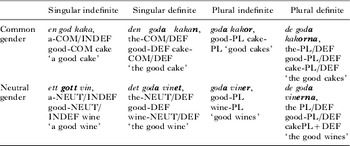
Although there is not much inflection in the verbal system, Swedish noun morphology is relatively rich and complex. There are two genders: common (also called uter), en, and neuter, ett. The common gender is three times as frequent (Allen, Reference Allen1971) and includes practically all animate nouns. The indefinite article is a preposed free morpheme, as in many languages: en kaka ‘a cake’. The definite article is a suffix on the noun, kaka- n ‘cake-the=the cake’, gender-sensitive in the singular: kaka- n ‘the cake’ versus vin- et ‘the wine’, but neutralized to the -na morpheme in the plural: kakor- na ‘cakes-the=the cakes’, viner -na ‘wines-the=the wines’ (cf. Table 2).
Agreement of adjectival attributive NPs in Swedish

note: DEF=definite, PL=plural, COM=common gender, NEUT=neuter gender.
Nouns and adjectives are inflected for gender, number and definiteness. Determiners and adjectives agree in gender, number and definiteness with the head noun. Definiteness is the most complex part. Morphological marking for definiteness on both the article and the noun is obligatory in adjectival attributive NPs. This is called ‘double definiteness’ and is characteristic of Swedish. The postposed definite article is then doubled with a free preposed definite article: den/det in the singular and de in the plural. The double definiteness also has consequences for the adjective, which takes on a strong and a weak form.
The strong form is used in indefinite contexts. It is unmarked for the common gender, e.g. en godkaka ‘a good cake’, but marked with -t in the neuter, as in ett gott vin ‘a good wine’. In the plural, adjectives are marked with -a, irrespective of gender: godakakor ‘good boys’, godaviner ‘good wines’.
The weak form of the adjective, expressed by the suffix -a, occurs in definite NPs, whether singular or plural: den/de godakakan/kakorna ‘the good cake/cakes’. A consequence of this is that the adjectival suffix -a denotes several functions: indefinite plural and definite singular+plural.
Swedish exhibits some particularities that we have taken into account in our experiment. There is regular and systematic morphology in the noun phrase but not in the verbal system. Neither number nor person is marked on the verb, only tense. As far as word order is concerned, some structures follow strict word order rules, e.g. the position of the adjective, but others exhibit more variability: e.g. both SVX and XVS order are possible in main declarative sentences. These linguistic specificities are reflected in the acquisition of Swedish: word order (the V2 rule) is acquired in an error-free manner at the same time or even before verb morphology, around 2 years (e.g. Håkansson, Reference Håkansson and Pienemann2005).
French
Word order
The canonical word order in French is SVO. The first NP in a sentence is most frequently the agent, but canonical SVX is also preserved in sentences involving intransitive verbs (e.g. mourir ‘to die’) or elliptical transitives (e.g. manger ‘to eat’). Unlike Italian and Spanish, which are also SVX Romance languages, French does not permit subject ellipsis. Despite its pre-eminence, the canonical SVX order occurs along with other orders imposed by syntactic, pragmatic or contextual constraints.
A major exception to SVX order is the use of SOV order. SOV order in French is primarily due to the existence of a double series of clitic pronouns: preverbal direct object (le, la, les) and preverbal indirect object (lui, leur) pronouns. From the sentence:
(6a) Le soldat montre la flèche à l'indien.
‘The soldier shows the arrow to the Indian.’
all the following sentences may be derived:
(6b) Le soldat la montre à l'indien.
The soldier it-DIR.OBJ shows to the Indian
‘The soldier shows it to the Indian.’
(6c) Le soldat lui montre la flèche.
The soldier to him-INDIR.OBJ shows the arrow
‘The soldier shows the arrow to him.’
(6d) Le soldat la lui montre.
The soldier it-DIR.OBJ to him-INDIR.OBJ shows
‘The soldier shows it to him.’
Although direct object clitics are marked both for gender and number, these forms are identical to the definite articles (le, la, les). This potential ambiguity between clitics and articles present problems for left-to-right parsing in French as we have shown for children (Weissenborn, Kail & Friederici, Reference Weissenborn, Kail and Friederici1990; Charvillat & Kail, Reference Charvillat and Kail1991) and aphasic participants (Friederici, Weissenborn & Kail, Reference Friederici, Weissenborn and Kail1991).
Nonetheless, this variability clearly operates within definite limits. French does not allow subject ellipsis, and tends to conserve canonical SVX in many constructions. Whenever non-canonical order appears in simple sentences it occurs with specific phenomena such as cliticization. Taken together these facts mean that SVX constructions are both frequent and informative in French.
Verbal and nominal agreement
Verbal agreement in French is determined by the number of the subject and, in some constructions, by its gender. Gender is expressed only in complex verbal forms composed of the auxiliary être ‘be’ and the past participle with a masculine, feminine and/or plural marking:
(7a) Les cerises sont ramassées au printemps.
The cherries-FEM.PL be-3rd PL gathered-FEM.PL in springtime
‘The cherries are gathered in springtime.’
(7b) Le cerisier est chargé de fruits.
The cherry tree-MASC.SG be-3rd SG laden-MASC.SG with fruits
‘The cherry tree is laden with fruits.’
In verbal forms composed of the auxiliary avoir ‘have’ and the past participle, there is usually no agreement for gender or number. In the oral code, French has a large degree of ambiguity in its inflectional system, particularly with the verbs of the 1st conjugation in the present tense (ending in -er in the infinitive form, like chanter), which are the most frequent.
(8a) je chante I sing-1st SG, ‘I sing’
(8b) tu chantes you sing-2nd SG, ‘You sing’
(8c) il chante he sing-3rd SG, ‘He sings’
(8d) ils chantent they sing-3rd PL, ‘They sing’
The various written inflections (s and nt) are inaudible because for all these items the pronunciation is the same. In the absence of strong information, il chante can be confounded with ils chantent. In our experiment, we used 2nd and 3rd conjugations in which the plural inflection is audible (e.g. Il remplit vs. ils remplissent ‘he fill-3rd.SG=he fills’ vs. ‘they fill-3rd.PL=they fill’).
As a general rule, nominal agreement concerns gender and number agreement of various units such as articles, adjectives, possessive and demonstrative pronouns. In the French lexicon, 60% of the nouns have exclusive gender, masculine or feminine, e.g. le garçon ‘the boy’ (MASC), and la table ‘the table’ (FEM). The remaining 40% of nouns can take both genders, e.g. le tour ‘the turn’ (MASC) and la tour ‘the tower’ (FEM). The masculine is more frequent than the feminine (Tucker, Lambert & Rigault, Reference Tucker, Lambert and Rigault1977), and the phonological information of the last syllable of the noun often has a high predictive value for gender assignment. Gender agreement is frequently realized through the addition of -e to the masculine form (fort (MASC) vs. forte (FEM) ‘strong’, or grand (MASC) vs. grande (FEM) ‘big’). Such gender inflections are audible, contrary to number inflections such as -s or -x for plurals, which are inaudible (homme ‘man’ (SING) vs. hommes ‘men’ (PLUR)). In a very small set of nouns which constitute an exception, number is expressed by an audible contrastive flexion (le journal ‘the newspaper’ (SING) vs. les journaux ‘the newspapers’ (PLUR)).
MAIN FACTORS IN ON-LINE SENTENCE PROCESSING
As we previously mentioned, the notion of cue cost has to be specified in terms of processing constraints. We suggest that three main constraints are at work in on-line sentence processing: (i) the amount of linguistic information available to the listener at a given moment, which contrasts early versus late integration (violation position); (ii) the phrase structure building, which contrasts intra- versus interphrasal violations (violation span); and (iii) the third constraint is language-specific. It concerns the relationship between morphology and word order in a given language (violation type). Our predictions on the main factors are the following.
Violation position: early vs. late
Some cross-linguistic research using the error detection paradigm (Wulfeck, Reference Wulfeck1993; Kail & Diakogiorgi, Reference Kail, Diakogiorgi, Dittmar and Penner1998) has shown that late violations are more rapidly detected than early ones, in children, normal adults and aphasics. This set of results suggests that the facilitation effect of late position is highly systematic. This effect has been interpreted as an indication that listeners are using their grammatical knowledge to build up expectations over the course of the sentence. Thus, our prediction is that, in their grammatical judgements, participants will be sensitive to the available amount of linguistic information at a given moment. For example, we expect that the verbal agreement violation fylla ‘to fill’ in (9a) will be more easily and more rapidly detected than in (9b) (Hypothesis 1):
(9a) *På lördagar efter att ha handlat på marknaden, fylladen turkiska grannfrun kylskåpet (the infinitive instead of the present form in late position)
On Saturdays, after to have shopped at market-DEF, fill-INF the Turkish-DEF neighbour-DEF fridge-DEF'
‘On Saturdays, after going shopping at the market, the Turkish neighbour fills the fridge,’
(9b) *På lördagar fylladen turkiska grannfrun kylskåpet, efter att ha handlat på marknaden. (the infinitive instead of the present form in early position)
On Saturdays fill-INF the Turkish-DEF neighbour-DEF fridge-DEF', after to have shopped at market-DEF
‘On Saturdays, the Turkish neighbour fills the fridge, after going shopping at the market.’
Given that Kail (Reference Kail2004) showed that, in French, this effect tends to decrease with age, another aim is to examine the course of the position effect during development in Swedish.
Violation span: intraphrasal vs interphrasal
One assumption is that the processing system tries to assign cues to meaning as soon as possible, integrating each piece of linguistic information into larger structures compatible with the information obtained up to that point. Consequently, violations of elements belonging to the same constituent (10a) (word order violation in the nominal phrase) should be detected more rapidly than violations of elements belonging to different main constituents (10b) (word order violation across a constituent). Therefore, we predict (Hypothesis 2) that in Swedish, this factor constrains on-line sentence processing and its weight during development will be evaluated.
(10a) *På lördagar fyller den grannfrun turkiskakylskåpet, efter att ha handlat på marknaden.
On Saturdays fill-PRES the neighbour-DEF Turkish-DEF fridge-DEF, after to have shopped at market-DEF
‘On Saturdays the Turkish neighbour fills the fridge, after going shopping at the market.’
(10b) *På lördagar den turkiska grannfrun fyllerkylskåpet, efter att ha handlat på marknaden.
On Saturdays the Turkish-DEF neighbour-DEF fill-PRES fridge-DEF, after to have shopped at market-DEF
‘On Saturdays the Turkish neighbour fills the fridge, after going shopping at the market.’
Violation type: agreement vs. word order
The main issue is to know how morphological and word order cues are integrated during real-time sentence processing in children and adults. Previous research on languages with rich morphology (Kail & Diakogiorgi, Reference Kail, Diakogiorgi, Dittmar and Penner1998; Kail, Reference Kail2004) has shown that agreement violations are detected more rapidly than word order violations. There are very few experimental studies on sentence comprehension and cue validity in Swedish. In an off-line study on word order and animacy contrasts, Gullberg (Reference Gullberg1994) showed that agent identification by adults relied more on animacy than on word order cues. This result indicates that word order is not a dominant cue in Swedish.
The purpose of the experiment is to examine how morphological cues are integrated in on-line sentence processing as compared to word order cues. For example, will the violation in (11a) (early interphrasal morphological violation) be detected more rapidly than the word order violation in (11b) (early interphrasal word order violation), which was the case in French?
(11a) *På lördagar fylladen turkiska grannfrun kylskåpet, efter att ha handlat på marknaden.
On Saturdays fill-INF the Turkish-DEF neighbour-DEF fridge-DEF, after to have shopped at market-DEF
‘On Saturdays, the Turkish neighbour fills the fridge, after going shopping at the market.’
(11b) *På lördagar den turkiska grannfrun fyllerkylskåpet, efter att ha handlat på marknaden.
On Saturdays the Turkish-DEF neighbour-DEF fill-PRES fridge-DEF, after to have shopped at market-DEF
‘On Saturdays, the Turkish neighbour fills the fridge, after going shopping at the market.’
The linguistic properties of Swedish – no verbal agreement but rich NP morphology on the one hand, and variability of word order at the interphrasal level but strict word order within the NP on the other hand – and the lack of studies on cue validity in Swedish make it difficult to predict whether morphological violations will be more rapidly detected than word order ones or not. Consequently, Hypothesis 3 is exploratory, and therefore the experiment is likely to shed new light on this particular processing factor.
METHOD
Participants
Forty-four Swedish children participated in this study. They were divided into three age groups: 12 six- to seven-year-olds (mean age 6;8); 11 eight- to nine-year-olds (mean age 8;6); and 21 ten- to eleven-year-olds (mean age 10;10). In addition, 25 Swedish university students were tested as adult controls. All participants were native speakers of Swedish, living and attending schools/universities in Stockholm and Visby.
Linguistic material
Stimuli were declarative sentences with an animate subject, a verb, a direct object and an adverbial transitive complement which can easily be shifted (e.g. placed before or after the subject noun). The main verb consisted of a verb which marks the present with the -er morpheme, making it clearly distinguishable from the infinitive form. The overall length of each sentence was controlled (21--25 syllables).
Some minor modifications in the Swedish sentences were made to create sentences testing the same phenomena as in French. For example, the minimal NP, article+noun, was taken as a basis for violation at the intraphrasal level. The gender agreement violation in the previous study of French consisted in replacing legarçon (masculine gender) by *lagarcon (feminine gender) ‘the boy’. In the present study of Swedish, gender agreement violations were realized in the same way, by switching from one gender to the other: from pojke n (common gender) to *pojke t (neuter gender) ‘the boy’.
The intraphrasal word order violation in French was realized by placing the article after the noun in the minimal NP: *garçon le ‘boy the’. The same violation is impossible in Swedish, where the definite article is always postposed and fused with the noun as a suffix: pojken ‘the boy’ (cf. Table 2). This impossibility led to the introduction of an attributive adjective in the Swedish NPs. The adjective is always prenominal in Swedish, as is the article in French. Thus, moving the adjective to the postnominal position, as in *den grannfrun turkiska, corresponding to ‘the neighbour Turkish’, provides an unambiguous intraphrasal word order violation similar to the French *garcon le (‘boy the’) or *voisine la (‘neighbour the’). This meant a bit longer NPs in Swedish, but it seemed more important to have an intraphrasal violation of word order comparable to the one in French. Also, the potential influence of the adjective, which is likely to be more perceptible than the article, will be accounted for in the discussion section below.
A total of 360 sentences were constructed consisting of 40 grammatical sentences and 320 ungrammatical sentences with the same contents as the grammatical ones. There were five different sentences at each level of a 2×2×2 design, representing orthogonal combinations of 2 positions (early vs. late), 2 structural spans (intraphrasal vs. interphrasal) and 2 violation types (word order vs. agreement). Eight lists of 40 grammatical and 40 ungrammatical sentences were generated. For a given semantic content, each list contained a different violation and the corresponding grammatical sentence. Each participant was assigned to one list and processed 80 sentences. An example is given in the Appendix.
Experimental apparatus
Participants' grammaticality judgements and error detections times were recorded using PsyScope (Cohen, MacWhinney, Flatt & Provost, Reference Cohen, MacWhinney, Flatt and Provost1993). The stimuli were read by a native speaker with the most appropriate intonational contour, tape-recorded and digitally stored in a microcomputer. The speech signals corresponding to each sentence were equalized for duration using Sound Edit Pro. The mean duration was 5740 ms for grammatical sentences and 5830 ms for ungrammatical sentences and, in French (Kail, Reference Kail2004), they were respectively 5620 ms for grammatical sentences and 5710 ms for ungrammatical ones. In the ungrammatical sentences, a timer was started by a pulse on a second channel, placed at the offset of the word that made the sentence ungrammatical. In other words, a violation detection time was taken from that place in the sentence after which no legal completion could render the sentence grammatical, marked with exclamation mark, !, as in the following example:
(12) *På lördagar fylla !(instead of fyller) den turkiska grannfrun kylskåpet efter att ha handlat på marknaden
On Saturdays fill-INF ! the Turkish-DEF neighbour-DEF fridge-DEF after to have shopped at market-DEF
‘On Saturdays the neighbour fills the fridge after going shopping at the market.’
Participants were tested individually during a session of approximately 20 minutes. They listened to 8 training items and afterwards the 80 test sentences were presented in a random order at fixed intervals of 2 seconds. No sentence was followed immediately by its grammatical or ungrammatical counterpart. Participants were asked to decide whether each sentence was grammatical and indicate their choice via a button box, pressing a red button for ungrammatical sentences and a green one for grammatical sentences. Children were instructed to listen carefully because they would hear each sentence only once, and to respond as quickly as possible in particular for ungrammatical sentences as soon as they could detect the violation. By pressing the button, the participant stopped the timer started at the offset of the violation and the time needed to detect the violation was computed.
RESULTS
Two analyses of variance were conducted, one on accuracy and the other one on detection times.
Accuracy of on-line judgements
The children's and adults' undetected violations consisted of overacceptance (incorrectly accepting an ungrammatical sentence). A very small number of the grammatical sentences were considered as being ungrammatical (<2%). What can be called errors have to be analyzed before examining the main dependent variable, detection times. The data were absolute frequencies that were first transformed into relative frequencies. Then Fisher's angular transformation was applied to avoid variance dependency on the mean. The resulting variable had a nearly normal distribution. The transformation was an arc sine transformation computed using the following formula: y=2arcsin where y is the new variable and p the relative frequency (proportion). To analyze these undetected violations, a mixed design ANOVA on transformed mean error rates was carried out with an age group (4)×violation position (2)×violation type (2)×violation span (2) design in which age group was the only between participants factor. ANOVAS were run with participants (F1) or sentences (F2) as a random factor.
The violation position did not reach significance (F1(1,65)=1·10, p=0·298, η2=0·0001). Swedish children and adults did not show greater sensitivity to violations occurring late in the sentence. These results are in accordance with previous ones on English and French (Wulfeck, Reference Wulfeck1993; Kail, Reference Kail2004). As far as violation span is concerned, there was no significant effect (F1(1,65)=1·67, p=0·201, η2=0·003). There was no main effect of violation type either: children and adults detected agreement violations and word order violations to the same extent (F1(1,65)=1·37, p=0·246, η2=0·002). Moreover, there were no significant four-way, three-way or two-way interactions.
As shown in Table 3, there was an overall developmental effect. Starting at the age of six or seven, children exhibited good sensitivity to grammatical violations -- more than half of the ungrammatical sentences were judged correctly (55·7%). The undetected violation rates in each group indicated a main effect of age (F1(3,65)=12·11, p<0·001, η2=0·117 and F2(3,156)=27·57, p<0·001, η2=0·057).
Undetected violations rates (%) by age group

There were also specific age-group effects. No significant developmental differences were found between the two younger groups (6- to 7-year-olds (44·3%) and 8- to 9-year-olds (37%) (F1(1,21)=2·09, p=0·163, η2=0·006). A significant difference was observed between the 6- to 7-year-olds and the 10- to 11-year-olds (F1(1,31)=7·33, p=0·011, η2=0·023 and F2(1,78)=24·07, p<0·001, η2=0·019). Finally, there was a significant difference between the 10- to 11-year-old children and the adults (F1(1,44)=10·44, p=0·002, η2=0·036 and F2(1,78)=25·63, p<0·001, η2=0·010). So, two developmental changes occurred, one between the youngest and the oldest children and one between the oldest children and the adults.
Sentence structure comparisons
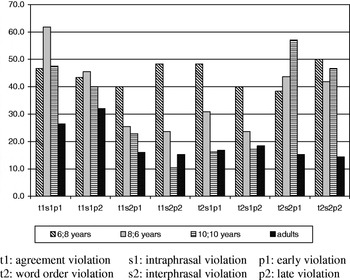
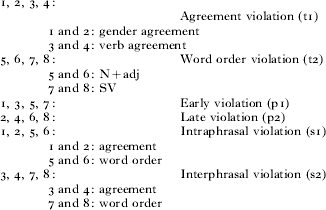
A qualitative analysis (see Figure 1) as a function of violation structure -- eight structures corresponding to all combinations of the two violation types (t), the two spans (s) and the two positions (p) -- indicated a consistent pattern across ages. Figure 1 shows that four structures elicited more undetected violations than others: t1s1p1, t1s1p2, t2s2p1, and t2s2p2. Structures including gender agreement violations (t1s1) or subject--verb word order violations (t2s2) generated the highest figures of undetected violations.
Undetected violations rates as a function of age and violation structure.

As shown in Table 4, regarding intraphrasal violations (s1), gender agreement violations between the noun and the article (s1t1) were more difficult to detect than incorrect word order violation (s1t2), i.e. postposed adjectives. On the one hand, this gender effect could be due to the weak auditory perceptibility of the phonemic contrast between the articles den [dεn:] and det [de:t]. On the other hand, the prenominal adjective introduced sequential discontinuity between the gender mark in the article and the gender mark on the noun. This resulted in discontinuous gender morphology within the NP, which is more difficult to process because of higher demands on working memory.
Undetected violations rates: interaction between violation type (t) and violation span (s), by age group

Regarding interphrasal violations (s2), word order violations (incorrect subject--verb inversion: t2s2) were less often detected than verbal agreement violations (the infinitive instead of the present: t1s2). The latter were apparently easier, especially for the 8- to 9-year-olds (46·2% vs. 24·1%) and 10- to 11-year-olds (51·9% vs. 16·7%). It should be noted that this difference disappeared in the adult group (15·5% vs. 14·8%).
Detection times
To determine whether cue cost changes with age, an ANOVA on mean detection times for correctly rejected ungrammatical sentences was carried out with an age group (4)×violation position (2)×violation type (2)×violation span (2) mixed design in which age group was the only between participants factor. ANOVAS were run with participants (F1) or sentences (F2) as a random factor.
First, as regards main effects, they were all significant except violation type. Among the two-way, three-way and four-way interactions, only two were significant (age by violation position and age by violation span by violation position). Neither the violation position by violation span by violation type interaction (F1(1,65)=1·38, p=0·244, η2=0·0007) nor the four way interaction (F1(3,65)=1·30, p=0·282, η2=0·0021) were significant. The significant results are presented in what follows.
Age effect
Not surprisingly, children were slower than adults at detecting grammatical violations. The overall analysis yielded a significant main effect of age on detection time (F1(3,65)=10·53, p<0·001, η2=0·147 and F2(3,156)=59·80, p<0·001, η2=0·145).
Table 5 shows that detection times decrease through age groups. There is neither significant difference between 6- to 7-year-olds and 8- to 9-year-olds (F1(1,21)=0·640, p=0·433, η2=0·003), nor between 8- to 9-year-olds and 10- to 11-year-olds (F1(1,30)=1·925, p=0·176, η2=0·008). However, 10- to 11-year-olds and adults differed significantly (F1(1,44)=10·11, p=0·003, η2=0·047 and F2(1,78)=87·29, p<0·001, η2=0·048). Recall that the ability to detect grammatical violations also changed significantly from age 10 to 11 onwards. A linear-trend test across the four age ranges yielded significant results (F1(1,65)=26·50, p<0·001, η2=0·124 and F2(1,156)=160·17, p<0·001, η2=0·130). The sum of squares for the linear trend accounted for 84% of the sum of squares between the age groups in the participant analysis, and for 89% in the item analysis.
Detection times (ms), by age group

Violation position: early vs. late violation
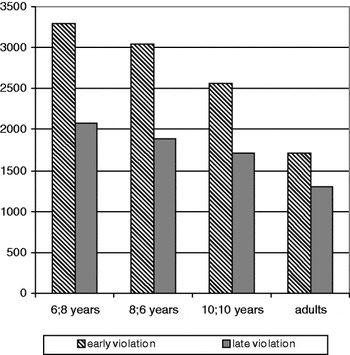
As predicted (Hypothesis 1), late violations were detected more rapidly than early ones (F1(1,65)=150·59, p<0·001, η2=0·116 and F2(1,156)=180·35, p<0·001, η2=0·091).
Figure 2 shows that every age group was faster at judging sentences when the violation occurred later in the sentence, whether at age 6 to 7 (F1(1,11)=78·89, p<0·001, η2=0·046 and F2(1,39)=80·20, p<0·001, η2=0·034), at age 8 to 9 (F1(1,10)=37·52, p<0·001, η2=0·038 and F2(1,39)=66·77, p<0·001, η2=0·032), at age 10 to 11 (F1(1,20)=52·10, p<0·001, η2=0·039 and F2(1,39)=42·87, p<0·001, η2=0·025) or among adults (F1(1,24)=14·70, p=0·001, η2=0·011 and F2(1,39)=12·46, p=0·001, η2=0·007). These differences were decreasing with age. So the interaction between age and violation position was significant (F1(3,65)=8·04, p<0·001, η2=0·019 and F2(3,156)=4·55, p=0·004, η2=0·007).
Mean detection times (ms) as a function of violation position and age.

Violation span: intra- vs. interphrasal violations
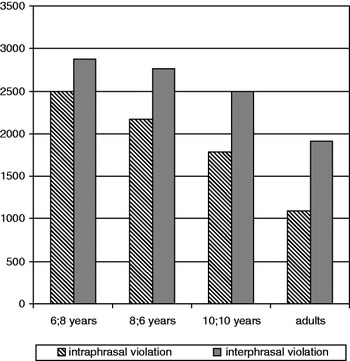
On the basis of Wulfeck's data (Reference Wulfeck1993) for English and Kail's (Reference Kail2004) for French, we predicted that intraphrasal violations would be more rapidly detected than interphrasal ones in Swedish. The overall analysis supported this prediction (Hypothesis 2) (F1(1,65)=90·96, p<0·001, η2=0·081 and F2(1,156)=114·86, p<0·001, η2=0·053). The prediction was also confirmed at each individual age (see Figure 3), and there was no interaction with age (F1(3,65)=1·57, p=0·205, η2=0·0042). Intraphrasal violations were always easier to detect, whether at age 6 to 7 (F1(1,11)=4·91, p=0·049, η2=0·005 and F2(1,39)=3·57, p=0·066), at age 8 to 9 (F1(1,10)=9·15, p=0·013, η2=0·010 and F2(1,39)=18·32, p<0·001, η2=0·012), at age 10 to 11 (F1(1,20)=27·05, p<0·001, η2=0·028 and F2(1,39)=47·37, p<0·001, η2=0·030) or in adulthood (F1(1,24)=63·34, p<0·001, η2=0·043 and F2(1,39)=77·49, p<0·001, η2=0·022).
Mean detection times (ms) as a function of violation span and age.

Neither the overall interaction between age, violation position and violation type (F1(3,65)=2·09, p=0·110, η2=0·0042), nor the interaction between age, violation span and violation type (F1(3,65)=0·99, p=0·403, η2=0·0023), was significant. The age-by-position-by-span interaction was significant (F1(3,65)=3·62, p=0·018, η2=0·006 and F2 (3,156)=2·08, p=0·105, η2=0·006) and the span by position interaction was also significant (F1(1,65)=6·15, p=0·016, η2=0·003 and (F2(1,156)=114·86, p<0·001, η2=0·053). For early violations, there was no effect of violation span, while for late violations, intraphrasal violations were detected more rapidly than interphrasal ones. This interaction was significant in the two younger groups (age 6 to 7: 2080 ms vs. 3300 ms, F1(1,11)=8·18, p=0·016, η2=0·006 and F2(1,39)=20·96, p<0·001, η2=0·009; age 8 to 9: 1882 ms vs. 3114 ms, F1(1,10)=6·29, p=0·031, η2=0·003 and F2(1,39)=14·68, p<0·001, η2=0·007), but disappeared in the two older groups.
When the violation occurred early in the sentence, the younger participants detected interphrasal violations as rapidly as intraphrasal ones. This unexpected result could stem from the existence of a single constituent before the verb (an adverbial), which represents the prototypical use of subject--verb inversion in Swedish (XVS). In later violations, two constituents precede the verb; this pattern may have confused the younger children (who have a smaller working-memory capacity) and may therefore have delayed the detection of interphrasal XVS violations.
Violation type: agreement vs. word order violations
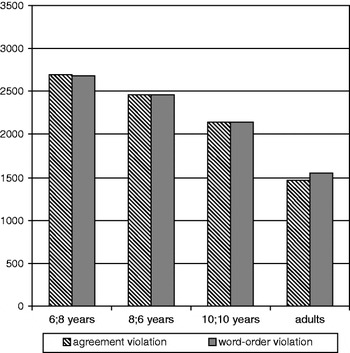
As shown in Figure 4, for children and adults, agreement violations were not more rapidly detected than word order violations at any age (Hypothesis 3) (F1(1,65)=0·29, p=0·592, η2=0·0002 and F2(1,156)=1·06, p=0·305, η2=0·008). Furthermore, the results indicated no interaction between violation type and violation span (F1(1,65)=3·50, p=0·066, η2=0·0028) and between violation type and violation position (F1(1,65)=0·08, p=0·778, η2=0·0001). There was no interaction with age (F1(3,65)=0·23, p=0·875, η2=0·0004).
Mean detection times (ms) as a function of violation type and age.

Sentence structure comparisons
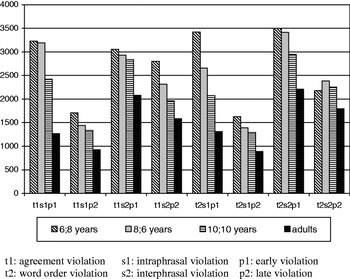
A comparative age analysis of the eight structures involving violations yielded very robust results (see Figure 5). Two structures were most quickly detected at every age: intraphrasal violations occurring late in the sentence gave rise to the fastest detection times regardless of the violation type (t1s1p2: 1352 ms; t2s1p2: 1301 ms).
Mean detection times (ms) as a function of age and violation structure.

On the other hand, two structures elicited longer detection times than the others. At every age, an interphrasal word order violation occurring early in the sentence took the longest amount of time to detect (t2s2p1: 3017 ms); it was followed by an interphrasal agreement violation occurring early (t1s2p1: 2724 ms).
Weight of the different factors
The detection times indicated some developmental changes pertaining to the respective weights of the various factors used by children and adults during on-line sentence processing.
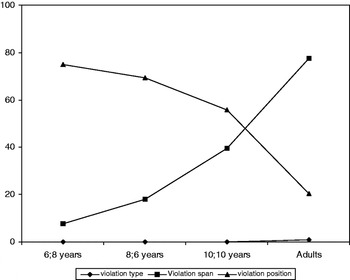
Figure 6 shows the developmental courses illustrated by the size effect from the ANOVA results. For each age group, variance percentages were measured by Sseffect/Sstotal, the latter including all interactions. There was a clear developmental change between age 10 to 11 and adulthood. At the age of 6 to 7, the most important factor (75% of variance) was the position of the violation in the sentence, which elicited a large difference: early violations took 3300 ms to be detected, whereas late ones took 2080 ms. The second-most important factor was the violation span, which explained 7·5% of variance: intraphrasal violations were detected more quickly (2497 ms) than interphrasal ones (2884 ms). Finally, the type of violation had no effect in this age group.
Percentage of detection times variance resulting from main effects in each age group.

For the 8- to 9-year-olds, the same factor ranking was obtained. The dominant factor was the violation position, explaining 69% of variance (early: 3046 ms; late: 1882 ms), which was followed by the violation span (interphrasal: 2760 ms; intraphrasal: 2168 ms), explaining 18% of variance. As in the youngest group, violation type had no effect.
For the 10- to 11-year-olds, even though position remained the dominant factor explaining 59% of variance (early: 2567 ms; late: 1711 ms), the violation-span effect increased (interphrasal: 2499 ms; intraphrasal: 1780 ms) explaining 39·5% of variance, and the violation type still had no effect. Among the adults, the factor hierarchy changed. Violation span became by far the most important factor, explaining 77·5% of variance (intraphrasal: 1097 ms; interphrasal: 1916 ms), whereas position lost its importance (early: 1716 ms; late 1297 ms), explaining 20% of variance.
DISCUSSION
The purpose of this study was to examine on-line sentence processing in children and adults in Swedish from a cross-linguistic perspective. Experiments were conducted in order to evaluate how three factors determine ongoing language processing by children and adults: the amount of linguistic information at a given point, the phrase structure building and a language-specific factor related to morphology and word order patterns. The grammatical judgement task allowed for analyzing accuracy as well as detection times, both of which are discussed below.
Concerning the first factor, the accuracy analysis showed that neither the children nor the adults exhibited greater sensitivity to violations appearing late in the sentence as compared to those occurring early. These results are in line with previous studies on English (Wulfeck, Reference Wulfeck1993) and French (Kail, Reference Kail2004). By contrast, sentences with violations occurring late were consistently detected more quickly than early violations at every age range. So regarding detection times, our results confirm that by the age of 6 or 7, Swedish participants were able to take advantage of previous linguistic information to formulate accurate expectations about subsequent information in the sentence. It could be also possible that as the sentence proceeded, children became more certain of the structure. This position effect tended to decrease with age. This decrease was closely linked to the increasing role of the structural sentence constraints (violation span).
As to phrase structure building, the participants did not detect intraphrasal violations more easily than interphrasal ones. A plausible explanation lies in the discontinuous morphology within the NP, because of the adjective. In the incorrect noun phrase detturkiska grannfru n, the subject has to retain the gender marking of the article in working memory in order to make predictions about the gender of the noun. The adjective was introduced in order to find a parallel to the French intraphrasal word order violation *voisine la (cf. ‘Linguistic material’ above). As regards undetected violations, it is plausible that adjectives are differently processed as compared to articles.
However, the detection times indicated another pattern. The adjective did not seem to be a source of delayed detection times. On the contrary, all participants detected intraphrasal violations more rapidly than interphrasal ones. These results validate the prediction that violations within the same constituent are detected more rapidly than violations that cross the constituent boundary. Furthermore, the gap between intra- and interphrasal detection times increased with age and became dominant with development. An in-depth analysis of the cue hierarchy concerning the detection times showed that this factor became the most important one for Swedish adults.
One possible explanation for the difference between intra- and interphrasal violations is linked to some language-specific features of the interphrasal violations. As mentioned above (cf. ‘Linguistic material’), subject--verb agreement for person or number does not exist in Swedish. The difference between the infinitive and the present tense forms is of another kind. Whereas subject--verb agreement is a pure morphological assignment of the subject, the infinitive is a default form that never takes a subject. The difference between fylla ‘fill’ and fyller ‘fills’, which is, on the surface, a verbal agreement contrast, involves a change of grammatical category from an expected inflected verb form to an uninflected verb form where subject assignment is never at stake. The interphrasal violation of word order, the VS and the SV patterns in Swedish, is governed by strict rules, but the fact that the two patterns co-exist in fairly similar proportions in the language somewhat weakens their relative availability.
There is a clear link between verb inflection (finiteness) and word order in Swedish in that the V2 rule applies only to inflected verbs To hear the infinitive fylla at the position in the sentence reserved for the inflected verb might have caused an additional difficulty that delayed the detection times. Thus, the specificities of Swedish enhanced the effect of the phrase building factor in the adults' on-line sentence processing.
Finally, as far as violation type is concerned, we previously mentioned that it is difficult to make a strong prediction on this factor in Swedish. This view was confirmed by the data. Our results indicate that on-line sentence processing does not exhibit differences between morphological and word order constraints. This finding is compatible with the main linguistic features of this language: contrary to Romance languages, Swedish does not present systematic verbal and nominal agreement. Verbs are inflected only for tense, whereas noun phrase markers indicate number, gender and definiteness in a relatively complex way. Grammatical roles are to a large extent assigned by word order but, contrary to English, constraints on the SVO order are more variable and subject--verb inversion is frequent.
It is worth mentioning that in the L1 acquisition of Swedish, word order and morphology are intertwined in development from the start. For example, Swedish L1 children start with variable word order and use the V2 rule as soon as they produce inflected verbs. Subject--verb inversion is usually acquired by L1 children around the age of two years. This close relationship between verb inflections and verb placement in L1 development has been observed also in German and Dutch (Clahsen & Muysken, Reference Clahsen and Muysken1989). For Swedish, it has further been empirically documented that there is an increase in the use of XVS structures around age 2;0--2;6, about the same time as there is an ‘explosion of tense morphology’, according to Christensen (Reference Christensen, Josefsson, Platzack and Håkansson2004).
Further studies are needed to confirm the finding that Swedish on-line sentence processing depends equally on word order and on morphological constraints.
Cross-linguistic comparisons between Swedish and French
Data show that for detection times, French participants were always faster than Swedish ones. Even though we were not directly interested in this global comparison, because it is always problematic to make comparisons across experiments, the differences are pretty striking:
French: 2573 ms at 6;8: 2017 ms at 8;6: 1123 ms at 10;10: 790 ms in adults
Swedish: 2690 ms at 6;8: 2464 ms at 8;6: 2139 ms at 10;10: 1507 ms in adults.
These global differences could be linked to the relative perceptibility of violations in each language. From previous studies on case marking violations in Modern Greek (Kail & Diakogiorgi, Reference Kail, Diakogiorgi, Dittmar and Penner1998), we know that the perceptibility of the violations could result in more errors and longer detection times within a language, but we have not done such a study either in Swedish or in French. It could also be due to the fact that the Swedish nominal paradigm (double definiteness, adjective inflections) is more complex and more ambiguous than the French one. The informational value of an inflection as a function of the size of the morphological paradigm (differences of relative entropy; Moscoso del Prado Martin, Kostic & Baayen, Reference Moscoso del Prado, Kostic and Baayen2004) has to be taken into account. A related issue is discussed by Kempe and MacWhinney (Reference Kempe and MacWhinney1999), in a study on the acquisition of case marking by native speakers of English who learn Russian and German as a second language. The results showed that the more complex language, Russian, was acquired faster than German, a language with more frequent neutralizations of case, introducing ambiguity and consequently lower reliability of case marking resulting in a slower acquisition rate.
As regards early vs. late integration, in both languages late violations were more rapidly detected than those occurring early in the sentence. The analysis of cue hierarchy showed that early/late integration is the most important factor for young Swedish (6 to 10 years) and French (6 to 8 years) children, explaining about 80% of variance. For these children, the prevalence of position effect indicated that during this stage (6 to 10 years), on-line processing is characterized by its dependence on previous linguistic information in the sentence. The position effect decreased with age in both languages. The impact of this factor and its systematic decrease with age, argue in favour of considering the amount of previous linguistic information as a common on-line processing factor.
Concerning phrase structure building, detection times indicated that Swedish participants detected intraphrasal violations more rapidly than interphrasal ones at every age. Our analyses revealed that this factor became the dominant one in Swedish adults, explaining 78% of variance. In French, this factor was only confirmed for the oldest children and the adults, explaining between 38% and 16% of variance. It was never a dominant factor for the French participants.
Finally, contrary to Swedish participants, who did not rely more on agreement cues than on word order cues, French participants relied on agreement cues rather than on word order cues at each age level. The violation type became the most important factor in French adults, explaining 60% of variance. These results for French confirmed previous studies showing the greater impact of agreement cues as compared to word order cues in on-line sentence processing on various tasks (word monitoring: Charvillat & Kail, Reference Charvillat and Kail1991; grammaticality judgements: Kail & Bassano, Reference Kail and Bassano1997).
Cue cost, cue validity and the development of processing abilities
Young children approach on-line sentence processing with limited processing resources. An important issue is whether, during on-line sentence processing, children use the same kind of linguistic information as adults do. We have shown that younger Swedish and French children use quite exclusively the sentential context to integrate linguistic information as sentences are processed. This phenomenon was found in various languages, not only in Swedish and French but also in Modern Greek (Kail & Diakogiorgi, Reference Kail, Diakogiorgi, Dittmar and Penner1998) and in Portuguese (Kail et al., Reference Kail, Costa, Hub Faria, Kail, Fayol and Hickmann2008). The integration process in the CM is referred to as ‘cue assignability’, i.e the capacity of a linguistic cue (e.g. morphological marking) to provide immediate integration. For example, local cues have high assignability and topological or discontinuous cues have low assignability. Cue assignability implies working-memory processes and in our future research it might be worthwhile to include a test of working memory so that high- and low-span children can be compared. Indeed, several recent studies on on-line sentence processing in children have underlined the relevance of working memory. For example, Fabrizio, Guasti and Adani (Reference Fabrizio, Guasti and Adani2006), using a self-paced listening task, showed that Italian-speaking 9-years-olds were unable to repair an initial subject relative analysis. They also found that children with higher memory spans were more likely than children with lower memory spans to use agreement information (number agreement on the auxiliary verb) to revise their initial structural hypothesis. The effects of working memory capacity have been confirmed in studies showing that children with low memory span do not show the reactivation of antecedents at gaps demonstrated by children with higher memory spans (Roberts, Marinis, Felser & Clahsen, Reference Roberts, Marinis, Felser and Clahsen2007).
It is interesting to note that the developmental changes we found in children around 9 years of age is also the age identified by Trueswell (Reference Trueswell, Sekerina, Fernandez and Clahsen2008) when children are able to revise their initial parsing taking into account the subcategorical requirements of the verb. Trueswell argues that increased revision ability is attributable to the development of cognitive control and executive function.
The development of processing mechanisms can be described as a type of ‘linguistic tuning’ (Cuetos & Mitchell, Reference Cuetos and Mitchell1988), in that the statistical properties of the language may tune the processing system to use the available cognitive resources in the most efficient way. In our view, grammaticality judgements do not require evaluations of complete syntactic representations but instead can be based on how well the incoming sentence conforms to the statistical regularities of the language acquired in the course of learning. Our previous comparative work on Spanish and French on-line processing (Kail, Reference Kail, MacWhinney and Bates1989) has shown that strong cues, i.e. morphological or case marking ones, tend to saturate the on-line processing system. In fact, confirming cues does not necessarily speed the processing of a sentence. For example, Kail (Reference Kail, MacWhinney and Bates1989) has found that the presence of a clitic pronoun can actually slow processing in both French and Spanish even though it eventually aids in the interpretation of the sentence. In the same way, examining the on-line processing of morphological and semantic cues in Russian and German, Kempe and MacWhinney (Reference Kempe and MacWhinney1999) have provided evidence for the non-cumulative effects of redundant cues for on-line processing. The degree to which the assignment of grammatical roles relies on strong cues will determine the way cue cost and cue validity (mainly reliability) interact in a given language. For example, in Spanish, the reliability of the accusative marking was a very good predictor of cue cost.
French nominal and verbal agreement availabilities are also on-line efficient cues (Kail, Reference Kail2004). In contrast, the lack of a higher reliable cue in a language like Swedish gives way for other components of cue cost, like cue assignability expressed through the intraphrasal/interphrasal constraints.
In the present study focusing on Swedish, we move to deepen our knowledge of cue cost factors. The study of the interdependency of cue validity and cue cost requires more systematic cross-linguistic comparisons since the relationship between cue validity and cue cost proves to be more complex than previously stated in the CM. The major findings we have obtained so far point towards the need for a more fine-grained model in order to get a more precise picture of how the on-line language processing system develops and how cue cost factors limit the application of cue validity.
APPENDIX
EXAMPLE OF A GRAMMATICAL SENTENCE AND THE EIGHT CORRESPONDING UNGRAMMATICAL SENTENCES
Grammatical sentence
På lördagar fyller den turkiska grannfrun kylskåpet efter att ha handlat på marknaden
On Saturdays fill-PRES the Turkish-DEF neighbour-DEF fridge-DEF, after to have shopped at market-DEF
‘On Saturdays, the Turkish neighbour fills the fridge after going shopping at the market.’
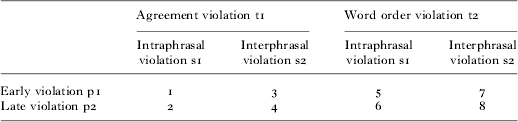
The eight corresponding ungrammatical sentences
1. t1s1p1 På lördagar fyller det turkiska grannfru nkylskåpet efter att ha handlat på marknaden.
2. t1s1p2 På lördagar efter att ha handlat på marknaden fyller det turkiska grannfru nkylskåpet.
3. t1s2p1 På lördagar fyll aden turkiska grannfrun kylskåpet efter att ha handlat på marknaden.
4. t1s2p2 På lördagar efter att ha handlat på marknaden fyll aden turkiska grannfrun kylskåpet.
5. t2s1p1 På lördagar fyller den grannfrun turkiskakylskåpet efter att ha handlat påmarknaden.
6. t2s1p2 På lördagar efter att ha handlat på marknaden fyller den grannfrun turkiskakylskåpet.
7. t2s2p1 På lördagar den turkiska grannfrun fyllerkylskåpet efter att ha handlat på marknaden.
8. t2s2p2 På lördagar efter att ha handlat på marknaden denturkiska grannfrun fyllerkylskåpet.
Sentence No.:
The corresponding linguistic material in French (Kail, Reference Kail2004)
Chaque semaine, la voisine remplit le frigo après avoir fait les courses au marché.
‘Every week, the neighbour fills the fridge after going shopping at the market.’
1. t1s1p1 Chaque semaine, le voisin eremplit le frigo après avoir fait les courses au marché.
2. t1s1p2 Chaque semaine, après avoir fait les courses au marché le voisin eremplit le frigo.
3. t1s2p1 Chaque semaine, la voisine rempl issentle frigo après avoir fait les courses au marché.
4. t1s2p2 Chaque semaine, après avoir fait les courses au marché, la voisine rempl issentle frigo.
5. t2s1p1 Chaque semaine, voisine laremplit le frigo après avoir fait les courses au marché.
6. t2s1p2 Chaque semaine, après avoir fait les courses au marché voisine laremplit le frigo.
7. t2s2p1 Chaque semaine, remplit la voisinele frigo après avoir fait les courses au marché.
8. t2s2p2 Chaque semaine, après avoir fait les courses au marché remplit la voisinele frigo.