A growing population of students in US classrooms comprises children from homes where English is not the primary language (Fry & Lopez, Reference Fry and Lopez2012; National Clearinghouse for English Language Acquisition, 2011). The largest and fastest growing group of school-age learners is US-born children of immigrants, who are educated in the United States (Capps et al., Reference Capps, Fix, Murray, Ost, Passel and Herwantoro2005) and who are faced with simultaneously learning English and the academic curriculum. Research focused on this population suggests that even after many years of schooling in English, language minority (LM) learners tend to demonstrate, on average, underdeveloped literacy-related skills in comparison to their English-only (EO) peers (August & Shanahan, Reference August and Shanahan2006; Jean & Geva, Reference Jean and Geva2009; Lesaux & Kieffer, Reference Lesaux and Kieffer2010; Mancilla-Martinez & Lesaux, Reference Mancilla-Martinez and Lesaux2010). In particular, for those LM learners from Spanish-speaking homes, which is the largest group of LM learners in the United States, much research suggests that their discrete English language skills, for example, vocabulary skills, lag behind their native English-speaking peers (for relevant reviews, see August & Shanahan, Reference August and Shanahan2006; Genesee, Lindholm-Leery, Saunders, & Christian, 2006) and do not necessarily “catch up” with time (Kieffer, Reference Kieffer2008; Mancilla-Martinez & Lesaux, Reference Mancilla-Martinez and Lesaux2011).
It is important to recognize, however, that the great majority of existing research to describe LM learners’ (low) language skills employs standardized assessments, most often using a forced-choice format and generating a proxy for one specific aspect of language, such as vocabulary. Although certainly important for gauging general performance, this assessment strategy limits our understanding of the specific skills that underlie students’ results. To better support and promote this growing population's academic development, we need to understand more deeply their language development: how they are using language and what aspects of language are challenging, moving past accounts of “low” language, globally. In sum, drawing on Garcia-Coll et al.’s (1996) model of studying minority children's development, researchers must attend to sources of strength, in addition to weaknesses, and in turn uncover unique aspects of development, including those in the domain of language.
Given the multifaceted nature of language, a study of LM learners’ oral narratives has the particular advantage of providing insight into multiple levels of language skill. That is, the oral narrative not only affords the opportunity for assessment of LM learners’ skill in organizing a story (often referred to as macrostructural components) but also provides insight into their discrete language skills (often referred to as microstructure components) as well as the speech planning and production processes involved in telling a story aloud. Moreover, because oral narratives involve the type of language valued in the US school system, for instance, decontextualized talk (Dickinson & Tabors, Reference Dickinson and Tabors1991) that is lexically and grammatically complex (Davidson, Kline, & Snow, Reference Davidson, Kline and Snow1986), narrative competence may be indicative of academic competency (Dickinson & McCabe, Reference Dickinson and McCabe2001). Yet, while there is an extensive literature focused on narrative skills in monolingual children (Berman & Slobin Reference Berman and Slobin1994; Peterson & McCabe, Reference Peterson and McCabe1983), less is known about narrative skills in LM learners, and much less during adolescence, because there have been too few studies focused on this population (Fiestas & Peña, Reference Fiestas and Peña2004; Gutiérrez-Clellen, Reference Gutiérrez-Clellen2002; Pearson, Reference Pearson, Oller and Eilers2002; Uccelli & Páez, 2007). Thus, the present study was designed to advance the theoretical and empirical literature focused on Spanish-speaking LM learners’ narratives, in this case with a sample of early adolescents.
STRUCTURAL ORGANIZATION OF ORAL NARRATIVES
There is an extensive literature base on the structural characteristics of stories (e.g., Berman & Slobin, Reference Berman and Slobin1994; Labov & Waletzky, Reference Labov, Waletzky and Helm1967; McCabe & Peterson, Reference McCabe, Peterson, McCabe and Peterson1991; Strömqvist & Verhoeven, Reference Strömqvist and Verhoeven2004). There is also widespread agreement on the minimum characteristics of a well-formed story, including reference to a protagonist and his/her desires or goals, goal-directed (and/or nongoal-directed) actions, and outcomes related to those goals (Mandler & Johnson, Reference Mandler and Johnson1977; Stein & Glenn, Reference Stein, Glenn and Freedle1979; Stein & Policastro, Reference Stein, Policastro, Mandl, Stein and Trabasso1984). In other words, a “good” fictional story has been understood in the developmental literature as a goal–action–outcome framework, one in which there is a problem-initiating event for which the protagonist forms a goal and carries out actions to achieve that goal. According to Labov and Waletzky (Reference Labov, Waletzky and Helm1967), in addition to accomplishing a referential function (i.e., explaining who or what the story is about), a narrative also accomplishes an evaluative function (i.e., why the story is told) in that the narrator makes statements about attitudes concerning the people, settings, things, or events in the story.
Developmental analyses of oral narratives, primarily focused on monolingual children of varying ages, have shown a developmental progression in story structure (for a review, see Hudson & Shapiro, Reference Hudson, Shapiro, McCabe and Peterson1991). Specifically, while monolingual preschool children tend to construct narratives that lack many of the basic elements of a story (e.g., Applebee, Reference Applebee1978), the elementary school years represent a critical time for the development of story structure (Stein, Reference Stein, Franklin and Barten1988; Stein & Glenn, Reference Stein, Glenn and Friedman1982). For example, it has been shown that by fifth grade, monolingual children construct coherent and goal-based fictional narratives (Hudson & Shapiro, Reference Hudson, Shapiro, McCabe and Peterson1991).
The few but growing number of narrative studies conducted with LM learners suggests that narrative development in LM learners follows a trajectory similar to EO children's. For example, a longitudinal study of Spanish-speaking LM learners’ story structure development (Melzi, Schick, & Bostwick, Reference Melzi, Schick and Bostwick2013) showed that by 5 years of age, children gained skills aimed at increasing narrative complexity by, for example, consistently including initiating events, actions, and plans. At the same time, the children relied heavily on pronouns or descriptors and demonstrated emerging skills in domains such as mentioning specific settings. In a cross-sectional study of second- and fifth-grade Spanish-speaking LM learners’ narratives, Pearson (Reference Pearson, Oller and Eilers2002) also found that there was a general increase in inclusion of story structure components with age. By fifth grade, there were no differences between LM learners and their monolingual English peers with respect to the complexity of narrative structure. In sum, as LM children mature, there are minimal differences in the structural characteristics of their stories in comparison to monolinguals’.
Research on narrative production in LM learners has also revealed cross-linguistic influences of story structure. In Pearson's (2002) study, there was a high correlation between story structure scores in Spanish and English, indicating a positive contribution of the native language. Fiestas and Peña (Reference Fiestas and Peña2004) also found evidence that narrative skills are interrelated as early as 4 years of age. It is worth noting that although they found differences in Spanish-speaking LM learners’ reliance on particular narrative structure components depending on the language used to tell the stories (e.g., more initiating events in Spanish and consequences in English), the complexity of the narrative structure was no different between the languages. In addition, Uccelli and Paez (Reference Uccelli and Paez2007) and Squires et al. (Reference Squires, Lugo-Neris, Peña, Bedore, Bohman and Gillam2014) showed that Spanish narrative skills in kindergarten predicted first-grade English narrative skills. These findings suggest that story structure might transcend language; that is, LM learners may be able to transfer their knowledge about story elements from one language to the other (Pearson, Reference Pearson, Oller and Eilers2002).
THE DISCRETE LANGUAGE FEATURE OF ORAL NARRATIVES
As noted, producing a well-formed story involves paying attention not only to narrative structure but also to multiple aspects of linguistic structure, such as lexical and grammatical encoding of information relating to characters and events (Berman & Slobin, Reference Berman and Slobin1994). Berman and Slobin (Reference Berman and Slobin1994) argue for the interrelatedness and interactive development of linguistic structures and storytelling. They emphasize that to produce complex narratives, one must move beyond basic syntax and produce complex sentences, for example, by incorporating subordinate clauses. Using growth-modeling techniques, a recent longitudinal study on young Spanish-speaking LM learners’ narratives (Rojas & Iglesias, Reference Rojas and Iglesias2013) revealed that their grammatical complexity continued to increase during the early school years, as has been established for monolingual speakers (Chomsky, Reference Chomsky1969; Karmiloff-Smith, Reference Karmiloff-Smith, Fletcher and Garman1979; Loban, Reference Loban1976). In particular, LM learners with weaker initial English proficiency experienced faster growth rates in English than their LM counterparts with more advanced initial English proficiency; the differences in complexity between the two groups was less pronounced over time. Moreover, in Pearson's (2002) study, differences in grammatical complexity (e.g., use of subordination) between LM learners and their monolingual peers dissipated by fifth grade.
While the narratives of older EO and LM learners may not differ in terms of grammatical complexity, LM learners’ grammatical skills in English may differ from their EO counterparts’, in particular, on structures that are inherently different between English and Spanish (Gathercole, Reference Gathercole, Oller and Eilers2002a, Reference Gathercole, Oller and Eilers2002b, Reference Gathercole, Oller and Eilers2002c). As a case in point, preposition use in English can pose particular challenges for Spanish speakers given the lack of one-to-one correspondence of prepositions between the two languages (see Becker & Carroll, Reference Becker and Carroll1997; Coventry, Guijarro-Fuentes, & Valdes, 2012). For example, the spatial relationships represented by the prepositions in, on, and at in English are all encompassed by the Spanish preposition en. That is, while the English language distinguishes between spatial relationships, such as containment and support, with the use of different prepositions (in vs. on, respectively), Spanish collapses these relationships within a single term en.
There is also some evidence that in comparison to their English monolingual peers, children who are exposed to more than one language show lower performance on standardized assessments of English vocabulary, which is another critical component skill of constructing a narrative (Bialystok, Luk, Peets, & Yang, Reference Bialystok, Luk, Peets and Yang2010; Hoff et al., Reference Hoff, Core, Place, Rumiche, Senor and Parra2012; Place & Hoff, Reference Place and Hoff2011). It is worth noting, however, that English vocabulary performance is linked to the amount of exposure to and use of English (De Houwer, Reference De Houwer2007; Pearson, Reference Pearson, Oller and Eilers2002; Pearson, Fernández, Lewedeg, & Oller, 1997). Moreover, socioeconomic status (SES) strongly predicts oral language skills, including vocabulary size (Hart & Risley, Reference Hart and Risley1995; Hoff, Reference Hoff2003) and grammatical complexity (Huttenlocher, Waterfall, Vasilyeva, Vevea, & Hedges, Reference Huttenlocher, Waterfall, Vasilyeva, Vevea and Hedges2010; Vasilyeva, Waterfall, & Huttenlocher, Reference Vasilyeva, Waterfall and Huttenlocher2008).
It is critical that the population of school-age LM learners in the United States represents a confounding of these two predictive factors (amount of English exposure and low SES) because approximately 25% is Latino (Fry & Lopez, Reference Fry and Lopez2012), with 70% speaking Spanish at home (Ryan, 2013) and 39% living in poverty (Lopez & Velasco, Reference Lopez and Velasco2011). As one example, a longitudinal study (prekindergarten through age 12) conducted with a sample of 183 Spanish-speaking LM children, from low-income backgrounds, revealed that children's English oral language skills started out well below the national average, as determined by standardized, norm-referenced assessments. However, despite being educated in English, and their rates of growth were faster than those of the English monolinguals, they were not fast enough to allow them to catch up by age 12. That is, at age 12, their English vocabulary skills were a full standard deviation below national norms, whereas their English word reading skills were on par with national norms (Mancilla-Martinez & Lesaux, Reference Mancilla-Martinez and Lesaux2011). Kieffer (Reference Kieffer2008) confirmed such trends using a nationally representative sample of learners who entered US schools with limited English proficiency, after controlling for school poverty and demographic risk factors, including SES. Given the dearth of studies focused on the older LM learner, it is unclear whether this is a process that may be characterized as a deficit or a developmental lag. Studies with LM learners well past the primary grades will begin to shed light on these outstanding questions about language development.
THE SPEECH PLANNING AND PRODUCTION PROCESSES INVOLVED IN TELLING ORAL NARRATIVES
Beyond a focus on the macro- and microstructures (story structure and linguistic forms, respectively) that cut across common narrative genres (e.g., scripts, personal narratives, and stories; see Hudson & Shapiro, Reference Hudson, Shapiro, McCabe and Peterson1991), a critical component of oral storytelling is the planning and production of speech. In one of the most influential theoretical models of oral production, Levelt (Reference Levelt1989; for the adapted bilingual version, see de Bot, Reference de Bot2004) emphasizes that in preparation for articulating speech, a speaker conceptualizes an idea, and then translates these conceptual representations into linguistic forms, for example, by selecting the individual words the narrator wants to say (lexical/vocabulary planning) and combining them to form sentences (grammatical planning). Levelt, Roelofs, and Meyer (Reference Levelt, Roelofs and Meyer1999) further theorize that self-monitoring is evident at every stage in the process. Thus, it is at any point during the planning and execution of the speech plan that a speaker may become uncertain or encounter difficulty, for instance, in retrieving a word or constructing the syntax of an utterance. If a mistake occurs and/or the speaker decides to modify the message, the fluidity of language production is compromised. The resulting speech disruptions are what Loban (Reference Loban1976) referred to as “mazes,” which he defined as being unnecessary for the intended message; material outside of mazes represents a meaningful communication unit (Bedore, Fiestas, Peña, & Nagy, 2006). Mazes include filled pauses like “uh” and “um,” and repetitions, and revisions made to any part of a word or utterance (MacLachlan & Chapman, Reference MacLachlan and Chapman1988; Wiese, Reference Wiese, Dechert, Mohle and Raupach1984).
There is conflicting evidence regarding developmental change, with some early studies finding stability in maze use across age (Loban, Reference Loban1976) and others finding a greater frequency of mazes with increased age (Evans, Reference Evans1985). More recent research has provided further insight and suggests that maze frequency increases with age and the complexity of the context; for example, there is evidence of increased use of mazes during narration in comparison to conversation (Leadholm & Miller, Reference Leadholm and Miller1992). In general, then, it appears that revisions require advanced linguistic knowledge and having low language skill makes it difficult to recognize when revisions are needed (Kormos, Reference Kormos1999). Thus, in the context of a complex narrative, it is expected that adolescents will engage in revisions, but it remains unknown how LM learners, who have been shown to have low language skills on more global measures of language, compare to their EO peers. A recent study with young LM learners (Bedore et al., Reference Bedore, Fiestas, Pena and Nagy2006) shows that maze use was positively associated with measures of productivity, for example, mean length of utterance (MLU), which is often used as a proxy for grammatical complexity. However, in that study, there was no difference in the number of mazes exhibited compared to young monolinguals, whereas previous research has shown differences between adult monolinguals and speakers of two languages, with the latter group producing more mazes (Lennon, Reference Lennon1990; Wiese, Reference Wiese, Dechert, Mohle and Raupach1984).
PRESENT STUDY
In light of existing research and outstanding questions, the purpose of the present study was to investigate the narrative production skills of early adolescent LM learners and their EO peers. We take a comprehensive approach to studying narratives in an attempt to uncover the unique strengths of, not only weaknesses in, adolescent LM learners’ language skills. Guided by the existing literature on young children's narrative development, we examined the narrative production skills of older EO and LM learners with a focus on the structural organization of their stories (macrostructural characteristics) and their linguistic form and content (microstructural characteristics), as well as the planning and production processes involved in producing speech (mazes). To elicit the spontaneous narrative, we used a wordless picture book; this is a particularly useful strategy with older learners because the pictures limit the scope of the plot and general content of the narratives children produce (Berman & Slobin, Reference Berman and Slobin1994; Petersen, Gillam, & Gillam, 2008), but still allow for a range of variability in story and language elements (Heilmann et al., Reference Heilmann, Miller, Iglesias, Fabiano-Smith, Nockerts and Andriacchi2008). Although the great majority of research on narratives has used the Frog, Where Are You? book series (Mayer, Reference Mayer1969) to elicit narratives from young students, it has a rather juvenile format and plot. Given our early adolescent sample and our goal of ensuring high interest in producing high-quality narratives, we used the graphic, wordless novel Robot Dreams (Varon, Reference Varon2007).
In previous studies including LM learners and their EO counterparts, particularly those conducted in the United States, there has been a tendency for the EO group to be of higher SES than the LM group (Lesaux, Koda, Siegel, & Shanahan, Reference Lesaux, Koda, Siegel, Shanahan, August and Shanahan2006). These unbalanced designs limit insights into the developmental process of learning two languages. To generate a nuanced understanding of LM learners’ language development and to inform the design of effective practices to support this development, in-depth empirical investigation is needed, particularly with attention to linguistic strengths and weaknesses in a sample of LM and EO speakers from both low- and high-SES backgrounds. Therefore, using a comparative framework, the present study investigates the oral narratives of 12-year-old (sixth grade) Spanish-speaking US-born children of immigrants (n = 43) and their native English-speaking classmates (n = 38) from low- and high-SES backgrounds. The study was guided by three research questions:
-
1. How does the structural organization of oral narratives (i.e., story structure) compare between early-adolescent LM learners and their EO peers?
-
2. How do the narratives of early-adolescent LM learners and EO speakers compare on discrete language features, in particular, lexicogrammatical diversity and accuracy?
-
3. What is the frequency and pattern of maze use in early-adolescent LM learners, and how does it compare to their EO counterparts’ when telling a story?
METHOD
Participants
Ninety sixth-grade students from a large urban school district in the southwest United States were selected (from returned parental consent forms distributed in 25 classrooms) to participate in the present study. Participant selection was based on language status as determined by a demographic questionnaire and SES, as measured by qualification for free or reduced-price lunch (FRL) with the restriction that there were an equal number of LM and EO students. Data from 9 children were not analyzed due to low-quality audio recordings (n = 3) or experimenter error (n = 2). In addition, 4 children were excluded from the final analyses because their cultural background did not match the selection criteria for this study, which was that LM learners self-identified as Latino and spoke both English and Spanish at home, whereas EO speakers self-identified as Caucasian and spoke exclusively English at home. Thus, the final sample included 81 sixth-grade students (M = 12 years, 2 months, SD = 0.47 years) from 21 different classrooms. Consistent with national trends (Gándara et al., Reference Gándara, Losen, August, Uriarte, Gómez, Hopkins, Gándara and Hopkins2010), all instruction was provided in English.
When asked about their home language use, on a 5-point scale ranging from English only to another language only, the LM group (n = 43, 24 females) reported speaking English and Spanish equally at home (M = 3.18, SE = 0.08). Twenty-four LM learners (15 females) qualified for FRL, while 19 (9 females) did not. The majority of LM learners (n = 34; 79%) attended kindergarten in the same city in which the study took place, 7 (16%) in another US city, and 2 (04%) in Mexico. Further, for a subset of the LM group (n = 24; 16 who qualified for FRL), scores were available on a state-level test of English proficiency in the areas of listening, speaking, reading, and writing skills: the English Language Development Test (ELDT). The test yields individual skill scores and a composite score representing five performance levels: beginning (248–441), early intermediate (442–491), intermediate (492–551), early advanced (552-601), and advanced (602–741). Per state regulations, the ELDT is administered annually to all students whose primary home language is not English and who have not attained “advanced” performance levels in previous years. While the LM group was homogenous in that they used English and Spanish with equal frequency, this was a heterogeneous group in terms of their English proficiency as measured by the district-administered ELDT. The overall English language proficiency level of this subgroup at sixth grade was early advanced (M = 556.58, SD = 40.10; min = 461, max = 622).
Eighteen EO speakers qualified for FRL, but 20 (10 females) did not. The majority of EO speakers attended kindergarten in the same city in which the study took place (n = 25; 65%), and 13 (35%) attended kindergarten in another city in the United States.
Measures
Wordless picture book stimulus
To elicit oral narratives, we used the graphic, wordless novel Robot Dreams (Varon, Reference Varon2007). This age-appropriate story, presented in color comic book like panes, details the friendship of a dog and his mail-order robot that he builds to keep him company: they spend the day at the library, at home watching a movie, and at the beach swimming and lying in the sand. The pair part ways when the robot malfunctions after swimming in the water. A dream about the day's events prompts the dog to return to his friend only to find the beach closed and the robot lying inside. To tell the story, the narrator must rely entirely on the book's illustrations, though there was a limited amount of written text featured in the stimulus presented, for example, words printed on buildings (“Municipal Library”), labels of containers (“100% Corn Oil”), and sound effects (“CREEEAAK”).
Procedure
Each student was tested individually by one of two trained research assistants, both native English speakers. The students were told they would need to tell a story from the pictures in the book to a classmate who did not know the story, and could not see the pictures. Each student was then shown the first 32 pages, which contain all of the elements commonly scored in narrative production tasks (e.g., characters, setting, conflict, and action). After reviewing the book together, the student was instructed to independently turn the pages and use the pictures to tell the story. Students were reminded to use enough detail in their story so that the classmate listening to it would be able to understand the story. The protocol for prompting during the storytelling was consistent with previous methodology (Berman & Slobin, Reference Berman and Slobin1994) in that minimal prompting was provided (e.g., mmhmm; is that it?). All students produced narratives in English without being prompted to do so. All narratives were digitally recorded.
Narrative transcription
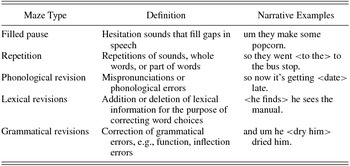
The narratives were transcribed using the CHAT conventions of the Child Language Data Exchange System (MacWhinney, Reference MacWhinney2010). Following Berman and Slobin (Reference Berman and Slobin1994), the entire narration was segmented into clauses, which are defined as linguistic units containing a subject and predicate (verb phrase and other accompanying elements). This transcription method was chosen in lieu of other available options (e.g., c-units as cited in Loban, Reference Loban1976) because it orients the analyses to the lexical and syntactic levels of language as it visibly highlights, for example, parallel constructions and grammatical shifts (i.e., use of different subordinator types). In general, clauses contained only one verb (e.g., “then Roberto fell asleep on the couch”), except in the case of serial verbs constructions (e.g., “and they go get the popcorn”), modals (e.g., “he should go home”), and semimodals (e.g., “Dog was going to mail a letter”), which were not treated as forming separate clauses. We also did not consider side comments to be separate clauses (e.g., “. . ., I think”). In addition, during transcription, clauses were marked for mazes. Mazes included filled pauses (e.g., um or uh), false starts/repetitions (e.g., “so then <the> the robot's just lying there”), and revisions, either recasts (e.g., “and <he was pulling the robot> the dog was pulling the robot”) or complete reformulations (e.g., “<he's putting> maybe he ordered a robot or something”). To ensure transcription reliability, 10% of the transcripts were transcribed by two independent transcribers; percentage agreement for two independent coders was 89%. In addition, all transcripts were checked by a second research assistant trained in CHAT.
Narrative coding
As noted, we took a comprehensive approach to analyzing the narratives told by LM learners and their EO peers. We assessed not only the story structure (macrostructural components) but also the discrete language features (microstructural elements) present or absent in the stories, assessing their lexical and grammatical accuracy (i.e., errors) and diversity. We also examined the speech disruptions that occurred while telling the story aloud (i.e., mazes). To measure interrater reliability of the coding schemes detailed below, 15% of the transcripts were coded twice on each of these dimensions. There was strong agreement for grammatical diversity: κ = 0.851 (95% confidence interval [CI] = 0.808, 0.894), mazes, κ = 0.834 (95% CI = 0.725, 0.881), and errors, κ = 0.803 (95% CI = 0.793, 0.875).
Story structure
Narratives were coded using the Index of Narrative Complexity (INC; Petersen et al., 2008), a criterion-referenced coding scheme for assessing narrative complexity. The INC is composed of 13 elements related to the assessment of macrostructural and microstructural characteristics of narratives, taking into account the story grammar analysis of Stein and Glenn (Reference Stein, Glenn and Freedle1979) and Peterson and McCabe (Reference Peterson and McCabe1983), in addition to the high-point analysis of Labov (Reference Labov1972; e.g., evaluations). Following modified procedures laid out in Petersen, Gillam, Spencer, and Gillam (Reference Petersen, Gillam, Spencer and Gillam2010), we judged story structure using the macrostructural components of the INC (character, setting, initiating event, internal response, plan, action/attempt, complication, and consequence), each yielding scores ranging from 0 to 2 or 0 to 3 (maximum total score = 20).
Given that the INC has historically been used with younger children, we accommodated for the early adolescent population by also adjusting the scoring scales, but not the design and content, to increase variability within each of the categories. To do so, we removed the ceiling on the scale. For example, whereas 2 was the highest possible score for the internal response category on the original scale, the modified scoring system awarded one point for each internal response. In addition, the modified scoring system penalized participants for being unclear about the actions of characters in the action/attempt category (i.e., negative scores were possible). Twenty percent of the transcripts were coded twice for reliability purposes. Reliability for the total INC score was high (intraclass correlations [ICC] = 0.977). ICC values for the 13 individual categories were also moderate to high, ranging from 0.804 to 1.00 (M ICC = 0.940).
Discrete language features
Narrative length was measured in both tokens (number of words) and clauses (number of clauses). Vocabulary diversity was determined using the vocd-d program in CLAN (MacWhinney, Reference MacWhinney2010), which computes the lexical diversity of the narratives through random sampling of the transcripts (Duran, Malvern, Richards, & Chipere, Reference Duran, Malvern, Richards and Chipere2004). Thus, vocd-d avoids the narrative length issues inherent in most commonly used measures of lexical diversity, such as the type–token ratio. Values of vocd-d generally range from 10 to 100 (McKee, Malvern, & Richards, Reference McKee, Malvern and Richards2000), where low values of D reflect a lower lexical diversity and high values reflect greater lexical diversity. To provide the most accurate description of students’ own linguistic skill, words in the text were excluded from these analyses.
Grammatical diversity was coded manually in the transcripts and measured the range and variety of subordinator types used to construct dependent clauses. Dependent clauses, also commonly referred to as subordinate clauses, are defined as clauses that require a main clause. Subordinate clauses are typically introduced by subordinating conjunctions (e.g., “he started wagging his tail when he finally saw the mailman”) or relative pronouns (e.g., “the story is about a dog who buys a robot”). For ease of presentation, we refer to these markers as subordinators. We calculated the total number of clauses, dependent clauses, and the number of different subordinators employed or implied (e.g., “he got all of the supplies [that] he needed”). The number of different subordinator types over the total number of dependent clauses indicates the variety in children's inventory of subordinators. That is, a child with a low ratio of subordinator types indicates a story constructed by combining clauses using the same subordinator (e.g., “when the mailman knocked on his door, he gave him a box . . . when he made his robot, he went to the library . . . when he goes to the library, he gets a book”) and a high ratio indicates the child used a variety of subordinator types (e.g., “the story's about a dog who buys a robot . . . while he's watching the movie, the robot falls asleep . . . [they] pick out a travel book which is Cameron's Guide to Dog Beaches”).
Of note, the literature on narratives includes various measures of grammatical complexity, including MLU (Rojas & Iglesias, Reference Rojas and Iglesias2013). However, researchers generally agree that past early childhood, MLU is not a reliable measure of complexity (Klee & Fitzgerald, Reference Klee and Fitzgerald1985; Scarborough, Rescorla, Tager-Flusberg, Fowler, & Sudhalter, Reference Scarborough, Rescorla, Tager-Flusberg, Fowler and Sudhalter1991), partly because of the variability within age groups, and agree that length alone is not a good indicator of grammatical complexity. The use of subordinate clauses continues to develop through the school-age years (Nippold, Reference Nippold2007). As such, an alternative measure is the subordination index, which is calculated by dividing the number of subordinate clauses over the number of total clauses in the story. Guided by previous research, in particular Pearson's (2002) study showing virtually no difference in subordination between EO speakers and LM learners by fifth grade, we focused on the diversity with which children used subordinators, not just whether their stories contained subordination.
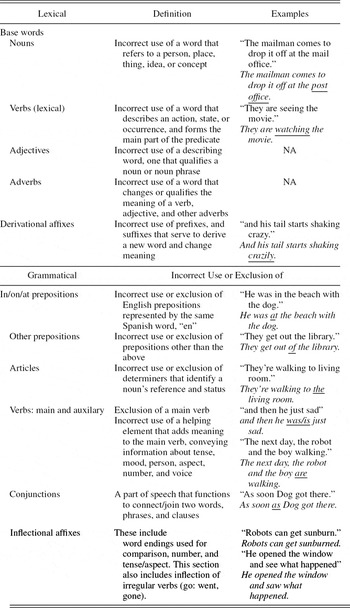
In addition, each clause was coded for grammatical and lexical errors (see Table 1). An error was coded as grammatical when it involved omission or incorrect use of morphemes that contributed grammatical information to the clause, that is, errors in word order or incorrect use/exclusion of function words (articles, auxiliary verbs, and conjunctions, including subordinating conjunctions and relative pronouns), prepositions, or inflections (comparison, number, case, gender, tense, or aspect). Errors were coded as lexical when they contributed meaning beyond grammatical information. Thus, lexical errors involved incorrect usage of base words (i.e., nouns, verbs, adjectives, and adverbs) or derivational affixes (i.e., prefix and suffix). Of note, when a clause excluded a (required) main verb, we counted this as a grammatical error.
Lexical and grammatical error type definitions and examples

Given that errors could be corrected in more than one way, we took the approach to make the minimum number of changes required to make clauses lexically/grammatically correct in the discourse context [e.g., “Then he woked up in the middle of the night” = Then he woke up in the middle of the night (grammatical, inflection error, past tense, 1 change) ≠ Then he awoke Ø in the middle of the night (two changes)]. We took into account the context of the statements being made and the message in preceding and proceeding clauses, while excluding any material in mazes. To further minimize this issue of double-coding, errors also potentially due to mispronunciations were noted as phonological errors, but placed within the existing grammatical and lexical categories [e.g., “They sleeped on a blanket” = They slept on a blanket (grammatical, inflection, past tense error)]. It should be noted that while an exploration of the varieties of English (see Craig & Washington, Reference Craig and Washington2002; Fought, Reference Fought2003) was outside the main focus of this study, we did exclude instances of multiple negation (n = 7 instances; n = 4 students; all double negatives) from our error counts because this feature is widely used in several varieties of English and is “standard” in many other languages (Labov, Reference Labov1972; Kortmann & Szmrecsanyi, Reference Kortmann and Szmrecsanyi2004; Adger, Wolfram, & Christian, Reference Adger, Wolfram and Christian2007). Similarly, we excluded from our error counts the use of “hisself” (n = 7 instances; n = 6 students). For each participant, we calculated the total number of errors and the number of each error type divided by the total number of errors.
Mazes
Following a modified version of the conventions laid out by Bedore et al. (Reference Bedore, Fiestas, Pena and Nagy2006), we coded for lexical and grammatical revisions, filled pauses, repetitions, and phonological revisions (see Table 2). It is worth noting that in coding for phonological revisions, we followed the strategy noted earlier: if material within a maze was potentially due to mispronunciations, these were noted as phonological errors, but only when they could not be placed within the grammatical and lexical revision categories. We tallied the total number of mazes used. For each participant, we also divided the number of maze types used by the total number of total clauses to get a percentage of maze type.
Maze type definition and examples

Data analysis plan
It was prudent to account for transcript size in the analyses of narratives given the differences in the length of stories produced. While calculating a proportion score to control for transcript size and comparing group differences using an analysis of variance (ANOVA) is a widely used approach, recent investigations have shown that the use of proportions can produce spurious results when using an ANOVA even after an arcsine–square root transformation has been performed to meet the normality assumption (see Jaeger, Reference Jaeger2008). Thus, an ANOVA was used only for outcome variables that inherently take into account differences in length (e.g., story structure: original and modified INC scores; vocabulary diversity: voc-d); these outcome variables for ANOVAs were continuous and normally distributed. Two-way ANOVAs were performed with language status (language minority vs. EO) and SES (low vs. high) as between-subject factors.
For all other analyses (e.g., grammatical diversity: subordinator types; accuracy: errors; maze use), we relied on mixed-effects logistic modeling, which allowed us to model our outcome variables as categorical (hits or misses) instead of proportions. Mixed-effects logistic models are a generalization of logit regression. Unlike ordinary logit models, the mixed part of logistic model refers to modeling of both random (e.g., subject effects) and fixed effects. In these analyses, each subject can contribute a different amount of data; each clause represents a data point. The models included a dichotomous outcome variable representing the occurrence of a particular linguistic feature (1 = yes, 0 = no) at each clause and, as such, can be interpreted as the likelihood of a narrative including a particular linguistic feature or not. The models also included the between-subject variables language status (EO = 0, LM learner = 1) and SES Status (low = 0, high = 1) as dichotomous and fixed factors; participant was included as a random factor. An interaction term (Language Status × SES) was included to test whether the relation between language status and the occurrence of a particular linguistic feature differs for low- and high-SES groups. Where there were differences between EO and LM learners, follow-up analyses on the LM learners’ narratives were carried out as a function of ELDT performance levels; this assessment served as an additional measure of language skill. Specifically, comparisons were made between the narratives of LM learners with ELDT scores below “advanced” levels and those of LM learners with “advanced” performance on the ELDT (ELDT status: advanced = 0, not advanced = 1).
RESULTS
Story structure
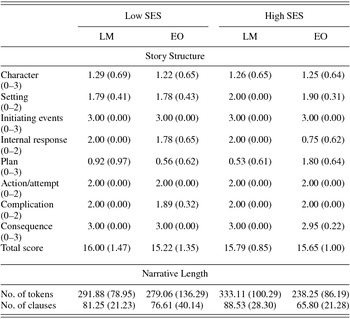
There was limited variability in this sample's original INC scores (see descriptives in Table 3), and the story structure scores (combined macrostructure components) were comparable between SES groups, and EO speakers and LM learners. Separate two-way ANOVAs (language status: LM vs. EO; SES: low vs. high) on story structure revealed no significant differences between EO and LM learners, F (1, 77) = 2.728, p = .103, η2 p = 0.034, or SES groups, F (1, 77) = 0.153, p = .697, η2 p = 0.002, and no significant interaction effects, F (1, 77) = 1.321, p = .254, η2 p = 0.017. A similar pattern of nonsignificant results (ps > .05) was found when using the modified scoring system despite more variability within the full sample (M = 48.99, SD = 13.44). Thus, we report only the original INC scores in Table 3.
Descriptive statistics by language status and SES group

Note: SES, Socioeconomic status as measured by free/reduced lunch; LM, language minority learner; EO, English-only speaker.
Guided by prior studies revealing differences between EO and LM learners on separate story elements (e.g., Fiestas & Peña, Reference Fiestas and Peña2004), a two-way multivariate ANOVA (language status and SES) was performed on the macrostructural elements only, excluding categories with no variability (in an attempt to reduce the number of comparisons). The results of the omnibus ANOVA revealed no significant differences by language status, the Roy largest root = 0.136, F (6, 72) = 1.628, p = .153, η2 p = 0.119, or SES, the Roy largest root = 0.108, F (6, 72) = 1.292, p = .272, η2 p = 0.097, and no significant interaction, the Roy largest root = 0.105, F (6, 72) = 1.261, p = .286, η2 p = 0.095. The lack of a statistical difference is in spite of the consistently higher scores for LM learners in the internal responses category (M = 2.00, SD = 0.00) than EO speakers (M = 1.79, SD = 0.43).
Lexical and grammatical diversity and accuracy
As noted, we expected to find variability on a measure of narrative length (see Table 3), and we were particularly interested in whether length varied as a function of language status and SES. Separate two-way ANOVAs revealed that LM learners’ narratives contained more total tokens (M = 310.09, SD = 90.29) than EO speakers’ narratives (M = 257.58, SD = 113.03), F (1, 77) = 5.717, p = .019, η2 p = 0.069. LM learners’ narratives also contained more total clauses (M = 84.47, SD = 24.56) than EO speakers’ (M = 70.92, SD = 31.66), F (1, 77) = 4.748, p = .032, η2 p = 0.058. SES was not a significant factor for either tokens, F (1, 77) = 0.000, p = .992, η2 p = 0.000, or clauses, F (1, 77) = 0.079, p = .779, η2 p = 0.001, nor was there an interaction effect for tokens, F (1, 77) = 3.319, p = .072, η2 p = 0.041, or clauses, F (1, 77) = 2.074, p = .154, η2 p = 0.026. Follow-up ANOVAs showed that LM learners’ story length, determined by either tokens or clauses, did not vary as a function of ELDT performance levels (ps > .05).
Lexical and grammatical diversity
A two-way ANOVA revealed a significant interaction between language status and SES, F (1, 77) = 5.07, p = .027, η2 p = 0.062, but no significant main effect of language status, F (1, 77) = 0.763, p = .385, η2 p = 0.010, or SES, F (1, 77) = 0.928, p = .338, η2 p = 0.012, on voc-d, our measure of lexical diversity. These results indicate that the two language groups did not differ from each other, but that the impact of SES was different for LM and EO students. Follow-up comparisons showed no difference in vocabulary diversity between EO students from low- (M = 54.74; SD = 13.27) and high-income backgrounds (M = 51.17; SD = 8.0), F (1, 36) = 0.862, p = .359, η2 p = 0.023. Yet LM learners from high-income backgrounds used more diverse vocabulary in their narratives (M = 54.50, SD = 13.27) than did LM learners from low-income backgrounds (M = 46.41, SD = 13.27), F (1, 41) = 5.073, p = .030, η2 p = 0.110.
In contrast to the finding of no difference between the two language groups on our measure of lexical diversity, descriptive results showed that EO speakers showed greater grammatical diversity than did LM learners. For example, EO speakers used a greater proportion of subordinator types (M = 0.54, SD = 0.24) than did LM learners (M = 0.46, SD = 0.16). To assess these potential differences in grammatical diversity, we built a logistic model to predict the use of different subordinator types: each clause was coded as whether or not it introduced a new subordinator. Language status was found to be a significant factor (coefficient = –0.28, SE = 0.12, z-value = –2.38, p < .05, CI = –0.51, –0.5, χ2 = 6.23, df = 2, p < .05), while SES status was not (coefficient = 0.08, SE = 0.12, z = 7.0, p > .05, CI = –0.15, 0.31), and neither was the interaction term (coefficient = –0.37, SE = 0.23, z = –1.58, p > .05, CI = –0.83, 0.09). Follow-up logistic regression analyses including only the LM group showed that their use of subordinators did not vary as a function of ELDT performance levels (coefficient = –0.206, SE = 0.18, z = –1.13, p > .05, CI = –0.56, 0.15). Together, these results indicate that there is a greater probability that the EO speakers would use a more diverse set of subordinators to construct their stories than the LM learners, regardless of SES or their ELDT performance levels. Moreover, the proportion of dependent clauses (i.e., number of dependent clauses over the total number of clauses; M EO = 0.17, SE = 0.06; M LM = 0.16, SE = 0.06) did not vary as a function of our key predictors (e.g., language status: coefficient = –0.12, SE = 0.10, z = –1.28, p > .05, CI = –0.32, 0.07).
Accuracy
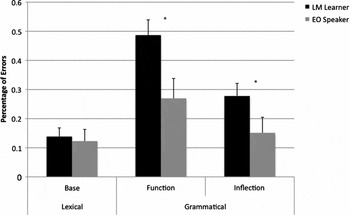
Errors were committed at the grammatical (i.e., function or inflection) and lexical (i.e., base or affix) levels. LM learners committed a greater number of errors (M = 5.12, SD = 3.90) than did their EO counterparts (M = 1.00, SD = 1.12), and the number of errors was significantly correlated with narrative length in clauses (r = .293, p < .05, n = 81). Figure 1 also shows that LM learners’ narratives contained a higher percentage of errors that were grammatical than did EO speakers’ narratives, but there was no difference between the groups in the percentage of errors that were lexical errors. The difference in errors between EOs and LM learners was most marked for function word errors. Whereas less than a quarter of EO speakers’ errors were function word errors, about half of LM learners’ total errors were classified as such, in particular, in/on/at preposition errors. It is worth noting that their preposition errors were classified as commissions, not errors of omission. In particular, over 95% of errors coded as preposition errors were due to the use of an incorrect preposition.
Lexical and grammatical errors by language status. The percentages of errors are the number of errors of a particular type over the total number of errors in each student's narrative. LM Learner, language minority learner; EO Speaker, English-only speaker.

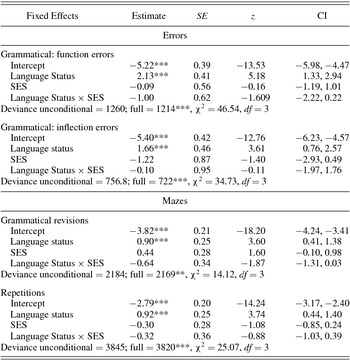
A series of logistic regression models predicting each error type (see Table 4) revealed a greater likelihood that the LM group would produce more function word and inflection errors than the EO group. The lack of a significant interaction suggests that for the participating children, being from a low-SES background did not affect LM learners’ risk for making errors, as compared to their EO peers. Follow-up analyses with the LM group further revealed that students with lower than “advanced” performance levels on the ELDT were more likely to commit function (ELDT status: coefficient = 0.518, SE = 0.25, z = 2.048, p < .05, CI = 0.02, 1.01) and inflection errors (ELDT status: coefficient = 0.939, SE = 0.36, z = 2.611, p < .05, CI = 0.23, 1.64) in comparison to LM students with “advanced” performance levels. LM learners’ vocd-d was related to their total errors in a negative direction (r = –.377, p = .013, n = 43), indicating that students with lower vocabulary diversity committed the most errors. Vocabulary diversity was not significantly correlated with EO speakers’ total errors (r = .124, p = .458, n = 38), which may be due to the relatively low number of errors committed by EO speakers overall.
Mixed-effects logistic regression model results for maze use and errors

Note: CI, Confidence interval; SES, socioeconomic status as measured by free/reduced lunch; LM, language minority learner; EO, English-only speaker.
**p < 0.01. ***p < .001.
Maze use
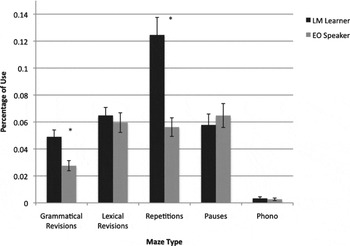
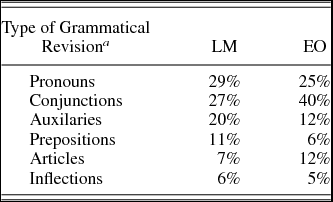
LM learners exhibited a greater number of mazes (M = 26.14, SD = 14.17) than did their EO counterparts (M = 14.76, SD = 11.37), and the number of mazes used was significantly correlated with narrative length in clauses (r = .624, p < .001, n = 81). Figure 2 also shows that LM learners exhibited a higher percentage of repetitions and grammatical revisions than did EO speakers, though filled pauses and phonological and lexical revisions did not differ across the groups. A series of logistic models predicting each maze type revealed a greater probability of repetitions and grammatical revisions by LM learners than by EO speakers (see Table 4). The models predicting filled pauses and lexical errors revealed no significant predictors or interactions (ps > .05). Moreover, the consistent lack of a significant interaction effect suggests that, for the sample studied, being from a low-SES background did not affect LM learners differently than EO speakers with respect to risk for mazes. Table 5 shows the percentage of grammatical revisions by subcategory for EO and LM learners. As shown, LM learners’ tendency was to revise their use of pronouns (choosing a different pronoun or including one after failing to do so initially), followed by choosing a different conjunction, whereas the great majority of grammatical revisions exhibited by EO speakers resulted in a change of their choice of conjunction.
Maze use by language status. The maze type percentage of use is based on the number of the maze tyoe over the total number of claues in each student's narrative. LM Learner, language minority learner; EO Speaker, English-only speaker.

Percentage of grammatical revisions by subcategory and language group

Note: LM, Language minority learner; EO, English-only speaker.
a Exclusion or change.
Follow-up analyses indicated that speakers’ tendency to use mazes was related to measures of advanced linguistic knowledge. In particular, logistic regression analyses showed that LM learners with “advanced” performance levels on the ELDT were more likely to exhibit grammatical revisions than were LM learners with lower than advanced performance levels (ELDT status: coefficient = –0.653, SE = 0.24, z = –2.70, p < .05, CI = –1.13, –0.18). The use of repetitions by the LM group did not differ by ELDT performance (ELDT status: coefficient = 0.264, SE = 0.31, z = 0.840, p < .05, CI = –0.35, 0.88). In addition, while no association was found for LM learners (r = –.075, p = .631, n = 43), EO speakers’ total number of mazes was found to be significantly correlated with vocd-d (r = .477, p = .002, n = 38), suggesting that attempts at increasing the diversity of the vocabulary used to construct narratives increases the tendency to exhibit mazes.
DISCUSSION
For the growing population of LM learners in today's schools, large-scale, standardized measures of achievement (National Center for Education Statistics [NCES], 2013; Planty et al., Reference Planty, Hussar, Snyder, Kena, KewalRamani and Kemp2009) demonstrate that, on average, this population's achievement and language proficiency is low. While obtaining such information is important for reasons of educational equity and accountability, in-depth empirical investigation is needed to generate nuanced and sufficiently informative models of their language development and targeted instructional supports. To that end, in the present study, we went beyond the format of the standardized language or literacy measure and compared the oral narratives of 12-year-old Spanish-speaking LM learners (US-born and educated children of immigrants) to those of their EO peers. Our fine-grained analysis of early adolescents’ oral narratives revealed sources of strength for LM learners and unique aspects of their language development. Discussed in turn below, our findings showed that the narratives of early-adolescent EO speakers and LM learners did not differ on their structural characteristics; instead, the discrete language features of the stories told and the use of mazes differed between the groups.
Areas of strength for LM learners
More specifically, and perhaps most importantly, LM learners’ performance on a measure of story structure was not different from that of their EO peers. The lack of difference in story structure is consistent with research documenting young Spanish-speaking LM learners’ growth in narrative skill (Melzi et al., Reference Melzi, Schick and Bostwick2013; Pearson, Reference Pearson, Oller and Eilers2002). This pattern of results indicates that, by middle school, LM learners have well-developed skills in producing stories within a goal–action–outcome framework (Stein & Glenn, Reference Stein, Glenn and Freedle1979). The lack of difference in the structural organization of LM learners’ narratives from EO speakers is significant when considering that narrative skill is linked to academic and reading outcomes (Miller et al., Reference Miller, Iglesias, Heilmann, Fabiano, Nockerts and Frances2006), yet this is a group that demonstrates low academic achievement on average and has significant challenges in the domain of reading comprehension (Lesaux et al., 2010; Mancilla-Martinez & Lesaux, Reference Mancilla-Martinez and Lesaux2010; Proctor, Carlo, August, & Snow, Reference Proctor, Carlo, August and Snow2005; NCES, 2013; Swanson, Rosston, Gerber, & Solari, Reference Swanson, Rosston, Gerber and Solari2008). Of note, the identification of reading difficulties typically comes from developmental studies that confound language status with SES. In contrast, a major strength of this study was the inclusion of participants from low- and high-SES backgrounds (as measured by qualification for FRL). We found few interaction effects of language status and SES, indicating that, by far, the low-SES group exhibited lower performance on the narrative measures than did the high-SES group, regardless of language status.
Although we controlled for differences in SES, our LM and EO groups differed by cultural/ethnic background, in addition to language status. Yet, while other studies, albeit mostly focused on young children's personal and not fictional narratives, show cultural variations in emphasis on specific story elements (Melzi, Reference Melzi2000), there was no difference in the reliance on one story element over another by this sample of Caucasian EOs and Latino LM learners. In contrast, at least one cross-cultural study of children's narratives, elicited from wordless pictures books, suggests that the cultural experiences Latino children bring to the narrative task impacts the stylistic features of their stories. In that study, Spanish-speaking Latino children tended to include character names more often than Caucasian EO children who made more references to the nature of character relationships. The authors explained that this practice mirrors the tendency of Latino parents to recite family members’ names during their personal stories (Cristofaro & Tamis-LeMonda, Reference Cristofaro, Tamis-LeMonda, McCabe, Bailey and Melzi2008). With prior cross-cultural and cross-language findings in mind (Fiestas & Peña, Reference Fiestas and Peña2004), our finding that the LM group scored slightly higher on internal responses than did the EO group, a difference that failed to reach statistical significance, may be indicative of a cultural influence with respect to how the story structure elements are incorporated, and not necessarily whether they are included or not. This finding and hypothesis is worthy of further research.
Although the findings of no difference in language outcomes between EO and LM learners shed light on comparable strengths between the groups, we argue that findings of between-group differences can also explain sources of strength for LM learners. For example, it has been suggested that the use of mazes implies a certain degree of linguistic knowledge because it signals that the narrator has recognized linguistic breakdowns and attempts to revise them (Bedore et al., Reference Bedore, Fiestas, Pena and Nagy2006; Kormos, Reference Kormos1999). Our results showed LM learners, as a group, exhibited more mazes than their EO counterparts, which may suggest they have more metalinguistic knowledge, perhaps from speaking their two languages on a regular basis (Bialystok, Craik, Green, & Gollam, 2009). LM learners with advanced levels of English proficiency were more likely to exhibit grammatical revisions than were LM learners with lower than advanced performance. Consistent with this idea, we found that EOs with greater vocabulary diversity exhibited more mazes than did EOs whose narratives demonstrated lower vocabulary diversity. As Leadholm and Miller (Reference Leadholm and Miller1992) suggest, EO speakers’ attempts at increasing the complexity of the language used to construct narratives may have resulted in more monitoring, thus revising of their speech (Levelt, Reference Levelt1989). Support for the relation between linguistic knowledge and mazes comes from the type of grammatical revisions consistently made. The most common type of grammatical revision by EOs resulted in a change in conjunction type (40% of all errors), including subordinators, which indexed grammatical diversity; for LM learners, grammatical revisions more likely resulted in a change in pronouns (29%) or conjunctions (27%).
Unique aspects of linguistic development for LM learners
As noted, differences between LM learners and EO speakers in the present study were found at the linguistic level, primarily in grammar. In particular, LM learners produced longer narratives in comparison to their EO peers, and yet, their stories were constructed using a smaller repertoire of subordinators, our indicator of grammatical diversity. That is, consistent with the previous literature (Pearson, Reference Pearson, Oller and Eilers2002), LM and EO learners did not differ in their amount of subordination. Instead, we found that EO speakers used a more diverse set of subordinators than did LM learners (54% vs. 46% of the total number of dependent clauses included different subordinators). Thus, LM learners’ stories included more repetition and were less grammatically diverse (e.g., “when the mailman knocked on his door, he gave him a box . . . when he made his robot, he went to the library”). This finding is also in line with the findings from a narrative production study with early-adolescent Spanish–Hebrew speakers that showed they used a smaller range of relative clauses in comparison to their monolingual (Spanish) counterparts, which we included in our subordinator counts (Kupersmitt, Reference Kupersmitt, Stromqvist and Verhoeven2004). Together, these two studies (one focused on Spanish and ours focused on English) may signal a general tendency for the use of less diverse grammatical forms by speakers of two languages, worthy of further investigation. These findings of less diverse language use support the position that the frequency of and quality of exposure to language is an important factor to consider in language development, especially for LM learners who, as others by virtue of speaking two languages, may have less time in each language (see Hoff, Reference Hoff2013).
Our analyses further revealed that, as a group, LM learners’ narratives included more grammatical errors than their EO peers’, the majority of which were errors in the use of prepositions. Of note, it is possible that grammatical and lexical errors reflected phonological errors more so than our descriptive results would suggest, an alternative that we cannot entirely rule out because a thorough investigation of phonological errors was beyond the scope of the present study. At the same time, incorrect use of prepositions cannot easily be attributed to a phonological error, such as a mispronunciation. Instead, and consistent with cross-linguistic narrative studies that reveal differences between languages in the use of specific grammatical features and vocabulary (Berman & Slobin, Reference Berman and Slobin1994; Strömqvist & Verhoeven, Reference Strömqvist and Verhoeven2004; Verhoeven & Strömqvist, Reference Verhoeven and Strömqvist2001), these errors are more likely explained as a transfer effect from Spanish to English. For example, errors in using the prepositions in/on/at were the most common for LM learners, presumably because in Spanish, these three prepositions are encompassed by a single preposition en (Coventry et al., 2012). Our analyses with respect to errors in the case of prepositions also showed that LM learners committed more errors of commission than omission; that is, they tended to use an incorrect preposition instead of omitting one altogether. In particular, we found that LM learners with lower than advanced proficiency in English were more likely to commit grammatical errors in comparison to their LM peers who had reached advanced proficiency in English. The negative relation between LM learners’ vocabulary diversity and their use of errors also indicates that learners with lower vocabulary diversity committed more errors. These results highlight the heterogeneity within the LM group; that is, while having been educated in English and using their two languages with equal frequency, differences emerged as a function of their eventual language skill.
In addition, while we did not find an overall difference in the diversity of vocabulary used by EO and LM learners, we found a difference in vocabulary diversity as a function of SES. That is, EO speakers from high- and low-income backgrounds did not differ on the diversity of vocabulary used in their narratives, whereas LM learners from lower income backgrounds demonstrated lower vocabulary diversity than their LM peers from higher income backgrounds. Thus, although poverty poses risks for all children, LM learners from low-income households may be particularly vulnerable in the domain of vocabulary. This is particularly concerning given that Spanish-speaking LM learners disproportionately live in poverty (Lopez & Velasco, Reference Lopez and Velasco2011) and drop out of school at rates twice as high as their monolingual EO peers (Fry, Reference Fry2010). These circumstances increase their own chances of generational poverty, while reinforcing the need to consider the role of the instructional environments in bolstering language development for schools in high-poverty neighborhoods serving large numbers of LM learners.
Limitations and future research
Despite the promise of this study and its methods for generating important insights about the learner's language use, several limitations to be addressed in subsequent research should be noted. Much of the research on narrative production skills has been conducted with young children; for this reason, finding an appropriate stimulus and prompt for this population was a challenge, particularly with regard to eliciting academic language. The prompt we used did not necessarily elicit formal or more academic uses of language, which may explain why we did not get an overall difference in the diversity of vocabulary used by EO and LM learners. With a different prompt we may have detected differences in the use of academic vocabulary words between the groups. Related to the prompt, a small amount of written text was available to participants in the graphic novel. The inclusion of written text may have influenced the production of narratives, for example, by highlighting particular events in the story that students may have not otherwise attended to, or may have attended to differently in the absence of text. Future research would do well to further compare the effects of different prompts (see Fiestas & Peña, Reference Fiestas and Peña2004), for example, those devoid of any writing to those with written text on students’ narrative production.
In addition, while this comparative study provides important insight into how LM learners are productive with language in relation to their EO classmates, answering questions about whether their production in specific domains of language reflects a deficit versus a developmental lag requires comprehensive, longitudinal study. For example, while we identified key differences between LM learners and EO students on some specific measures of their linguistic skills, particularly those in the domain of grammar, and substantiated these with an additional measure of language proficiency, it remains of question whether with additional years of exposure to English, the LM learners will produce language in an academic setting that is devoid of cross-linguistic influences.
This study was conducted with one particular sample of LM learners: Spanish-speaking households. Thus, the findings should not only be replicated with larger samples of Spanish speakers but should also be investigated with other groups of LM learners from different language backgrounds. Although Spanish constitutes the language spoken by the great majority of LM learners in the United States, there are more than 400 other languages spoken by LM learners (Ryan, 2013). In this study, we identified the clear influence of Spanish in the LM students’ English production; other languages are likely to influence English acquisition and production differently.
Conclusions
For the sample of early adolescents studied, it is clear that the LM learners had acquired enough knowledge about story elements, as well as lexical and grammatical knowledge, to create complex narratives. To substantiate these claims, we found a lack of difference between EO and LM learners’ use of complex story structure, vocabulary, and use of subordination (i.e., complex syntax). Adding to this list of strengths, this study provided evidence that linguistic background is a source of strength for LM learners: their use of mazes may be indicative of metalinguistic knowledge. Because they were educated entirely in US schools by early adolescence, the participating LM learners showed command of the different elements that makes for an effective narrative (e.g., inclusion of an action/attempt, outcome, and goals of story characters). However, their lack of subordinator diversity indicates that while LM learners clearly have command of the grammar, they did not use the grammar in more diverse ways. Moreover, the finding of an increase in grammatical errors suggests that the typical academic experience provided to these US-born children of Spanish-speaking immigrants may not have been sufficient to develop their command of the English language to nativelike levels in the academic setting. This is particularly the case with regard to preposition use. Consistent with and extending the narrative literature focused on younger LM learners (Uccelli & Páez, 2007), the findings from this study with older LM learners reinforce the need to delve more deeply into understanding this population's development, including the strengths that underlie their academic performance, in order to better target instructional supports to further develop their English language skills.
ACKNOWLEDGMENTS
This research was supported by US Department of Education Grant R305A080631 from the Institute of Education Sciences and William T. Grant Foundation Scholars Award 8054 (both to N.K.L.). We thank Julie Russ Harris for her instrumental role during the early stages of this study and the anonymous reviewers for their feedback on earlier drafts of this manuscript. We are also grateful to the participating students and their families.