Introduction
Emperor penguins Aptenodytes forsteri, have a circumpolar distribution. Currently just over 30 colonies are known to exist, with nearly half of these located in the Australian Antarctic Territory (AAT). Thus, the Australian Federal Government has a particular responsibility in managing this species. Emperor penguins are highly dependent on the fast ice (sea ice adjacent to the continent) as this is where most of their colonies are located. The effects of climate change may lead to regional changes in sea ice conditions (Anisimov and others Reference Anisimov, Vaughan, Callaghan, Furgal, Marchant, Prowse, Vilhjálmsson, Walsh, Parry, Canziani, Palutikof, van der Linden and Hanson2007). Hence, emperor penguins are likely to encounter a significantly different environment in the future. If the extent of the fast ice increases, breeding adults will need to traverse greater distances over the ice to reach open water and their foraging grounds. Alternatively, if the sea ice breaks out or becomes unstable before the young penguins are ready to go to sea their likelihood of survival will decline. Thus, the penguins' reproductive output is likely to be directly influenced by changes in sea-ice conditions. Therefore, a thorough understanding of the natural variation of emperor penguin populations is necessary in order to assess how changes in the environment might influence their future survival. To achieve this, a long-term monitoring programme is required because, like all seabirds, emperor penguins are long lived and mature late. To determine the extent of natural fluctuations of seabird populations, monitoring studies need to encompass at least one or two generations (see Nisbet Reference Nisbet1989).
Before engaging in a monitoring study, the purpose of the research needs to be defined. Many emperor penguin colonies are inaccessible in winter so that a determination of the size of the breeding population is difficult. However, visits towards the end of the breeding season may help to answer related questions, such as determining the ratio of adults to chicks, and comparing these between colonies (for example Kooyman and Mullins Reference Kooyman, Mullins, Kerry and Hempel1990). Monitoring of chick numbers is also a useful tool to compare trends among colonies provided that the census work is carried out at a comparable time of year (Barber-Meyer and others Reference Barber-Meyer, Kooyman and Ponganis2007) and relate changes to climate variation (Barber-Meyer and others Reference Barber-Meyer, Kooyman and Ponganis2008).
The few colonies that are accessible in winter provide the opportunity of gaining insights into the variability of adults attending a colony each year. To obtain reliable estimates of the number of emperor penguins attempting to breed, the ideal time is in the middle of winter when the males are incubating. At this time, the females are away foraging and the vast majority of birds in the colony comprise bona fide breeders (for example Budd Reference Budd1962). Thus, a count in the second half of June/early July gives the most reliable estimate of the breeding population because the number of incubating birds is maximal and the number of non- or failed breeders (adults that lost their egg earlier in the season) in the colony is minimal.
Because of the remoteness and inaccessibility of most emperor penguin colonies in winter, systematically gathered population data collected during incubation are available for only two colonies in the AAT. One is the emperor penguin colony at Taylor Glacier (67.4°S, 60.8°E) some 90 km west of Mawson station where continuous, annual census work has been carried out since 1988. Counts have also been conducted at the colony at Auster (67.4°S, 63.9°E), about 50 km east of Mawson station, in 1988, 1993 and in 1994.
Taylor Glacier is one of only two emperor penguin colonies in the whole of Antarctica for which long term, continuous population data collected in winter are available. The other colony is near the French research station Dumont d'Urville (67.6°S, 140.0°E). Taylor Glacier is also an Antarctic Specially Protected Area (ASPA No. 001) under the Antarctic Treaty System. Annex V of the Protocol on Environmental Protection to the Antarctic Treaty provides for the establishment of protected areas ‘to protect outstanding environmental, scientific, historic, aesthetic or wilderness values, a combination of these values, or ongoing or planned scientific research’ (ATCM 1991).
Until recently, only three other emperor penguin colonies had received ASPA status: 1. Emperor Island, Dion Islands (67.9°S, 68.7°W) in Marguerite Bay, Antarctic Peninsula, was the northern most known colony when it was declared a protected area which became effective on 1 November 1982 (ASPA 107); 2. Cape Crozier (77.4°S, 169.3°E) is the southern most emperor penguin colony (ASPA 124); 3. Haswell Island (66.5°S, 93.0°E, ASPA 127) which was the second protected area including an emperor penguin colony in the AAT. The ASPAs at Taylor Glacier and Dion Islands were the only two established exclusively to protect the emperor penguin colonies there. Incidentally, in July 1997, an emperor penguin colony was discovered near Snow Hill Island (64°32'S, 57°26'W) making it the northern most colony of this species (Coria and Montalti Reference Coria and Monalti2000)
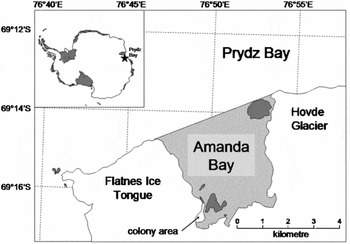
In 2008, a third emperor penguin colony in the AAT received ASPA status during the 31st Antarctic Treaty Consultative Meeting in Kyiv, Ukraine (ATCM 2008). This newly created ASPA (No. 169) at Amanda Bay (69.3°S, 76.8°E) is situated at the eastern side of Prydz Bay some 80 km west of Davis Station and nearly 800 km to the east of Taylor Glacier. This colony is of interest because Amanda Bay is situated in the southeast part of Prydz Bay, the only major embayment along the East Antarctic coast (Fig. 1). Several surveys showed that surface waters in Prydz Bay can be warmer than might be expected for such high latitudes and a high biomass of Antarctic krill Euphausia superba has been reported here as well (Smith and others Reference Smith, Zhaoqian, Kerry and Wright1984 and references therein). This makes the local environment of the emperor penguins from Amanda Bay potentially quite different from that of the colonies along the Mawson Coast. Moreover, Amanda Bay offers the opportunity of expanding the existing monitoring program in the AAT enabling comparisons of numbers of attending breeders and breeding success in future years.
Location of Amanda Bay, Ingrid Christensen Coast. The grey area indicates the nominated Antarctic Specially Protected Area (ASPA) No 169. The white area in the southwestern part of the bay indicates where the penguins were seen most frequently in winter. In late spring/summer, the chicks spread out over a vaster, less predictable area.

The Amanda Bay colony was discovered in 1956 and since then it has received regular visits by personnel from Davis station, and there have been a number of scientific studies. On various occasions, population estimates, utilising a variety of techniques, were obtained. Here we examine the quality of these population estimates and assess whether they can be used to estimate natural fluctuations in the size of this colony since its discovery. We also report on the first winter visit to the colony with the specific purpose of conducting a systematic count of emperor penguins at Amanda Bay based on digital photography and imaging processing software.
Methods
Collation of historical population information (1956–2000)
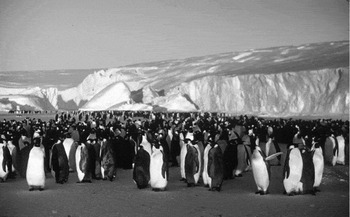
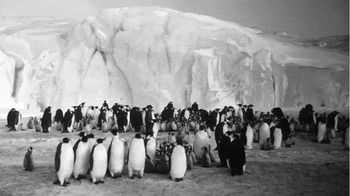
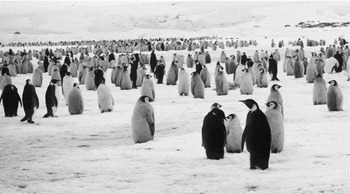
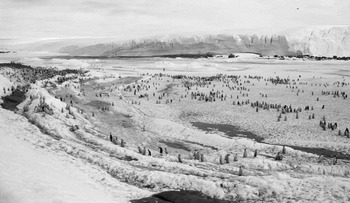
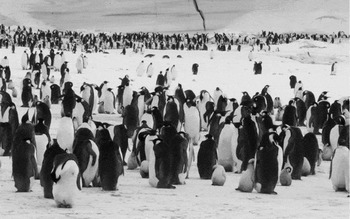
Publications describing activities carried out at Amanda Bay since the emperor penguin colony was discovered were examined for data relating to the number of breeding birds contained within the colony (for example Korotkevich Reference Korotkevich1964; Cracknell Reference Cracknell1986; Gales and others Reference Gales, Klages, Williams and Woehler1990; Giese and Riddle Reference Giese and Riddle1999). We used only primary sources of information, that is to say demographic information was collated from the original publication, rather than relying on references in later publications. Where information remained unpublished, a search was conducted through field note books, station logs, flight registers and, whenever possible, we interviewed personnel of the Australian National Antarctic Research Expeditions (ANARE) who visited the colony and/or performed the count. Only very few photographs of the colony were found in the search. These were usually taken from the air and the penguins are hardly visible. None of the very early images could be found. All available information was examined in terms of the timing of the visit, whether the population size was estimated and whether information on the count method was available. Based on these variables each count was rated as either reliable or unreliable in terms of providing an accurate estimate on the size of the breeding population. In the few historical photographs of the colony that were found, only part of it is shown. Some examples are presented as Figs. 2–6.
May 1960, a ground count was attempted (photo: G. Newton).

September 1960, recreational visit by Mawson personnel (photo: K. Felton).

3 December 1981, an attempt to count chicks was probably made but data could not be found (photo: G. Johnstone).

November 1990, recreational visit. The chicks are spread out over a vast area and the sea ice had already started to deteriorate (photo: M. Hesse).

September 2006, visit to colony to reconnoitre possible winter route (photo: R. Urmonas).

Winter census at Amanda Bay in 2008
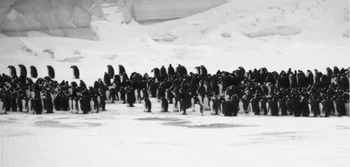
The emperor penguin colony at Amanda Bay was photographed by personnel from Davis station on 2 July 2008. The vehicles were parked out of sight of the penguins and the colony was approached on foot. Personnel positioned themselves at two different locations a safe distance from the colony (>60 m). At both locations, a series of overlapping, high resolution images were taken with digital cameras. Photographer 1 stood on a small island (elevation ~30 m) approximately 200 m from the nearest penguin from where he could see the entire colony. The photographer's position was approximately at the midpoint of the penguin group, that is to say roughly equal parts of the colony were to his left and his right. In a series of 15 images the whole colony was captured (for example see Fig. 7).
2 July 2008, one of the images taken for the winter census (photo: M. Milnes).

The second photographer also stood on a small island closer to the penguins (~50 m) but at the northern end of the line of birds. From here, a small part of the colony was obscured by an overhanging ice cliff. Since the second photographer stood at the northern end of the colony, the images taken of the far end were at too low an angle to identify individual birds. This rendered these images unusable for an accurate census. However, since photographer 2 took the images from the opposite side of the colony from that of photographer 1, we can confidently say that no penguin was lying down and out of sight of photographer 1. Thus, for the census, we used the images of photographer 1 because the whole colony was visible and the more central position meant that the birds in the images were of similar size and parallax was not a problem. The images were taken with a Nikon D80 with a 200 mm lens in the RAW format.
Upon return to the station, the two series of images were sent to the headquarters of the Australian Antarctic Division. To count the birds, we used the same method as Robertson and others (Reference Robertson, Moreno, Lawton, Kirkwood and Valencia2008) applied to count albatrosses. That is, the images were imported into Adobe Photoshop CS2 (Adobe Systems Incorporated, San Jose, California) in which a collage of all 15 images was created. The contrast was enhanced to make individual penguins more distinct. Two copies of the image were saved. Each collage was then counted separately and individual penguins were marked with a coloured dot and with a clicker counter by the first author.
The Antarctic personnel who participated in the photography of the colony carefully surveyed the bay around the colony and noted whether any subgroups of penguins were present but not part of the main group. This was not the case and no penguin traffic was observed in or out of the colony; only one penguin was seen on the seaice north of the bay. Hence, there is no evidence that the females had started to return and, thus, we are confident that the images were taken at the right time of year and that all birds were photographed.
Results
Historical population information
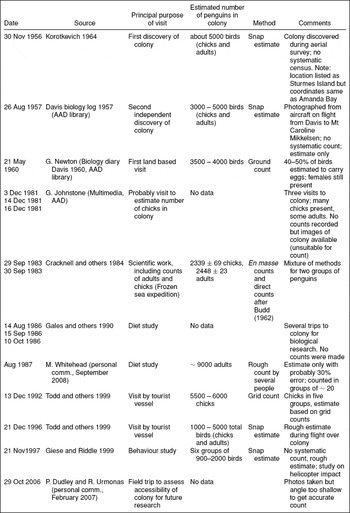
From 1956 to 2000, Amanda Bay was visited by ANARE personnel during 10 different years in which estimates of the population were made or scientific studies were carried out (Table 1). A number of recreational visits that were verified were also made in September 1960, October 1987, November 1990, and in the summer of 1995 (month unknown). On a number of occasions, snap estimates of the number of birds in the colony were made from a passing aeroplane; however, most visits to the colony were ground visits. Although scientific studies were carried out, especially in the 1980s, population studies were not part of the programme. The first systematic count was made in September 1983 (Cracknell Reference Cracknell1986), nearly 30 years after the colony was discovered. In 1986 and 1987, the diet of the emperor penguins was studied and samples were collected each month from August until December. In August 1987, an attempt was made to estimate broadly the number of birds present.
Summary of all available census information of the emperor penguin colony at Amanda Bay. Visits were made from Davis station, 1956–2006, for scientific and other purposes. Note: two non-Australian visits were included (1992, 1996) because published information was available. Purely recreational visits by station personnel are not listed.

From the 1990s to 2000, several visits were made to Amanda Bay during late spring and in the summer. Thus, these visits occurred after the incubation peak, with attempts to estimate the number of birds being made when males and females were present in the colony (May, August), or when the chick development was quite advanced (September – December) and they outnumbered the adults in the colony. In 2006, personnel from Davis were requested to explore a possible route to Amanda Bay that could be travelled safely in winter. The group travelled to the bay in October and photographed the colony area to provide information about the physical environment and the layout of the colony.
In summary, from 1956 to 2006 there were 11 years during which Amanda Bay was visited, sometimes multiple times. Population estimates were made in eight of these years. Of these eight estimates/counts, one was made in the months of May (1960) and September (1983), two in August (1957, 1987), as well as in November (1956, 1997) and December (1992, 1996). With the exception of the count in September 1983, none of the historical information on the size of the emperor penguin colony at Amanda Bay was collected in a scientifically rigorous and systematic manner. The problem is that is difficult to interpret the information even for the months for which two estimates are available because the surveys were either several decades apart (for example 41 years between November counts) or the count units were incomparable (for example number of chicks in December 1992 but total number of birds in December 1996). Thus, despite a long history of visits, the available population estimates cannot be used in a qualitative analysis to determine potential changes of this population since its discovery (Table 1).
Winter count 2008
The emperor penguins at Amanda Bay had positioned themselves very close to the ice cliffs on the western side of the bay in the southwestern area of the ASPA. They stood on a slope of compressed snow and were spread out in a long and rather narrow band approximately 15–20 penguins deep. The penguins at the far side were slightly higher than those closest to the photographer. Although slightly blurred, the images were sufficiently good to count individuals. The two separate counts gave 6534 and 6351 individuals with an average of 6443. The counts are within 3% of each other and given the quality of the images this was deemed a satisfactory result.
Discussion
Population information of emperor penguins at Amanda Bay
The emperor penguin colony at Amanda Bay was ‘discovered’ twice by independent parties. The first sighting was from the air by the Russian crew of the first Soviet Antarctic Expedition who performed extensive aerial surveys of the Antarctic coastline in November 1956 as part of their programme during the International Geophysical Year. The first report on the discovery of the emperor penguin colony was published in English only in 1964 (Korotkevich Reference Korotkevich1964); hence, the Australian team assumed that their sighting of this colony in August 1957 was the first (see Willing Reference Willing1958). Again the colony was only seen from the air. During both flights, photographs were taken of the colony; however, the images were for mapping the coastline rather than for counting penguins and the quality and resolution of the pictures were insufficient for census work. Moreover, both early sightings occurred outside of the ideal time to conduct a population census (June; see Table 1). Korotkevich (Reference Korotkevich1964) made a snap estimate and guessed 5000 birds to be present. The report did not mention whether this included both chicks and adults. But in November the chicks are well developed and tend to outnumber the adults in the colony. The Australian team, not aware of the existence of this colony until they saw it, also roughly estimated how many birds were present. In August, hatching is well underway but the chicks are still small and being brooded, and hence, invisible to people on a plane. However, the females have started to return and the number of adults present in the colony exceeds that of the number of breeding pairs. Regardless of this, there was no systematic count and the number of birds in the bay was simply guessed.
In 1958, R.L. Willing mentioned that on a flight from Davis to the Vestfold Hills in September 1957 ‘between one thousand and two thousand birds’ were seen at Amanda Bay (Willing Reference Willing1958). It is unclear where this information came from and it could not be verified. The log of the Royal Australian Air Force (RAAF) pilots, who were responsible for all Antarctic air travel of ANARE, notes the ‘discovery’ of the colony in August 1957. While two flights were made to Davis station (one from Mirny station and one from Mawson station) in mid-September but there is no mention of Amanda Bay. The usual flight route between the stations was well to the north of the colony area.
The first ground visit to the colony took place in May 1960. An attempt was made to count the birds under the guidance of the medical officer from Mawson station. Estimates were made for both the number of birds in the colony, as well as the percentage of birds with eggs. Ground counts are inherently inaccurate particularly when birds occur at high density. The 1960 Biology log from Davis station states that the penguins had gathered in two distinct groups but there is no information on how many men counted or how the percentage of incubating birds was estimated. The other problem with this count was that females were still present in the colony as laying had not yet ceased. Johnstone and others (Reference Johnstone, Lugg and Brown1973) interpreted the 1960s estimates of 3500–4000 birds and calculated that 2150 to 3300 pairs to have been in the colony, hence confirming an earlier report by Budd (Reference Budd1961) of approximately 3000 pairs. These reports appear to be the basis for the assumed size of the emperor penguin colony at Amanda Bay. However, the figures in neither publication were the results of systematic counts. Johnstone and others (Reference Johnstone, Lugg and Brown1973) simply cited the crude estimates made in 1960 and made some flawed calculations, and Budd (Reference Budd1961) did not provide any information about the origin of his information.
In September 1960, a recreational visit was made to Amanda Bay. This visit appears to have been the last for more than two decades. A number of publications (for example Horne Reference Horne1983; Woehler Reference Woehler1993) state that 1500 birds or adults were present in the colony in 1961 but no further details are provided. According to the station leader's logbook, however, no field trips to Amanda Bay were made in the 1961 season. In case the date was a misprint we also checked the logbooks of 1960 and 1962 but could not verify this visit.
From 1961–1964, the number of long distance field trips conducted by Davis personnel greatly diminished. Then, in late 1964, Davis station was closed and it was only reopened in early 1969. From 1973 onwards there is anecdotal information available from station logs that emperor penguins were sighted near the station or on field trips to nearby islands; however, Amanda Bay was never mentioned. Biological research was carried out in the Davis region in the 1970s but much of it focused on Adelie penguins Pygoscelis adeliae, abundant in the wider Davis area.
It was not until the 1980s that scientific studies, mainly on the diet composition of emperor penguins, were conducted at Amanda Bay but population census work was not part of the study plan (Table 1). In September 1983, a party visited Amanda Bay and carried out the first attempt at a systematic count of adult penguins and chicks (Cracknell and others Reference Cracknell, Schou, Lewis, George, Lewis and George1984). While an effort was made to obtain as accurate a count as possible, there are two major problems with the data. Firstly the visit took place in September; thus, the timing was too late to obtain a good estimate of the number of birds attending the colony in winter, and secondly different methods were employed to count the two groups of penguins present, with insufficient detail provided to evaluate whether these methods were comparable. It is also uncertain how many of the chicks counted in September would survive to fledging. Moreover, it is very difficult to achieve accurate census results from ground counts conducted in September as chicks are often obscured by adults. Because of this, we caution Cracknell's (Reference Cracknell1986) comparison with calculations made by Johnstone (Reference Johnstone, Lugg and Brown1973) based on the broad estimates made in May 1960, and her conclusion that the emperor penguin population at Amanda Bay had not changed. Not only would both survey methods have been subject to high levels of uncertainty, but because the two counts were collected at different times of the year >20 years apart, and hence, should not be compared.
In August 1987, M. Whitehead went to Amanda Bay to continue a diet study on the emperor penguins. When approaching the colony, he was surprised by its size and carried out a rough count because the population appeared to exceed the generally accepted figure of 3000 breeding pairs. However, because of time constraints the count was a crude estimate only (M. Whitehead, personal communication, September 2008). All subsequent visits during which attempts were made to estimate the population size of the emperor penguin colony at Amanda Bay occurred too late in the breeding season to be a useful indicator for the number of adults attending the colony in winter (see Table 1).
Winter count and future work
July 2008 was the first time that the emperor penguins at Amanda Bay were counted systematically during incubation with the specific purpose of obtaining an estimate of the number of birds in the colony at a time when the majority are incubating males. Budd (Reference Budd1962), and Prévost and Sapin-Jaloustre (Reference Prévost and Sapin-Jaloustre1965) both noted that generally >90% of penguins present in winter carry eggs. Those that do not, comprise individuals that have either not bred at all or have lost their egg early in the season; it is not possible to distinguish these two groups. Because any winter count of emperor penguins will always include these birds, our estimate of 6443 birds will be a slight overestimate of the number of breeding pairs. However, since the percentage of non-egg carrying birds in an undisturbed emperor penguin colony appears relatively constant and is usually low, inter-annual comparisons of numbers of birds in the colony are still the most useful way to monitor population fluctuations in this species.
To understand the extent of natural variability in populations of long lived species it is necessary to obtain good quality, standardised, long term data, preferably annually. The use of photographic techniques is favoured over ground counts because images have the advantage that they are archival and counts can be verified if necessary. What made the photography in July 2008 somewhat difficult was the fact that it was a relatively warm day (~−5°) and the penguins were quite active. A small number of birds were slowly walking along the outside of the group and many inside the group were preening. Those whose heads were bowed far down were difficult to identify because only the shoulders were visible and they blended in with their neighbours. An accurate ground count would have been very difficult to achieve under these circumstances. Ideally the images should have been taken on a cold day when the penguins are less likely to be active. However, time constraints prevented the party from staying on.
Currently, quality population information is available only for few colonies of emperor penguins. The remoteness of most of their breeding locations makes access in winter impossible. Thus, those colonies that can be visited in winter are of particular value for population studies. Based on the success in July 2008, we endeavour to improve the photography and to incorporate the colony at Amanda Bay into the existing monitoring programme and to include annual counts of chicks in late spring/early summer in order to provide a measure of the annual breeding success. From such data it is aimed to determine the variability in the size of populations at colonies that are located in areas of different bathymetry and oceanography in the Southern Ocean. This will also allow comparisons of population fluctuations and breeding success between emperor penguins at Amanda Bay and those at Taylor Glacier. We also aim to determine whether apparently easier access to open water during chick rearing and the differences in the extent of the continental shelf influences the birds' breeding success at these colonies. The challenge now is to make the emperor penguin colony at Amanda Bay part of a long term monitoring study to gain insights into the health and wellbeing of this colony in particular, and the species in general.
Acknowledgments
This project was undertaken as part of ASAC Project 484. It would not have been possible without the enthusiastic support of Davis station members Scott Adam, Noel Cottrell, Jason Cull, Mark Milnes, Dwayne Rooke, Murray Rogers and Paul Jager. Special thanks are due to Jason Cull and Mark Milnes for their expert photography. We also like to thank Drs Graham Robertson and Mike Double for their constructive comments on earlier versions of the manuscript and two anonymous referees for their helpful suggestions that improved the paper.