INTRODUCTION
The Japanese eel, Anguilla japonica Temminck & Schlegel is widely distributed in east Asia, from Taiwan in the south, through eastern China, Korea, and up to the Sanriku coast of northern Honshu Island, Japan (Tesch, Reference Tesch1977). The life cycle of A. japonica has five principal stages which are the leptocephalus, glass eel, elver, yellow eel and silver eel stages (Bertin, Reference Bertin1956). Anguilla japonica spawns in waters to the west of the Mariana Islands and their leptocephali drift within the North Equatorial and Kuroshio Currents to the continental shelves (Tsukamoto, Reference Tsukamoto1992). They leave these currents after metamorphosing into glass eels and have traditionally been considered to migrate up to freshwater streams where they grow to the pre-adult silver eel stage. During the silver eel stage, their gonads begin maturing and they start their downstream migration into the ocean and back out to the spawning area where they spawn and die.
However, Tsukamoto et al. (Reference Tsukamoto, Nakai and Tesch1998) using otolith strontium (Sr) and calcium (Ca) analysis, found yellow and silver eels of A. japonica in marine areas adjacent to their typical freshwater habitats that had never migrated into freshwater and had spent their entire life histories in the ocean. Furthermore, Tsukamoto & Arai (Reference Tsukamoto and Arai2001) also used Sr:Ca ratios and found an intermediate type of A. japonica between those that are marine and freshwater residents. Eels of this type appear to frequently move between different environments during their growth phase. This discovery of A. japonica types that are marine (‘sea eels’) and estuarine (‘estuarine eels’) residents suggests that anguillid eels do not all have to be catadromous and calls into question the generalized classification of diadromous fish. Thus, the migratory patterns in the life cycle of freshwater eels are variable and sometimes complicated as has been found in recent otolith microchemistry studies in the Atlantic (Jessop et al., Reference Jessop, Shiao, Iizuka and Tzeng2002; Arai et al., Reference Arai, Kotake and McCarthy2006; Daverat & Tomás, Reference Daverat and Tomás2006) and New Zealand (Arai et al., Reference Arai, Kotake, Lokman, Miller and Tsukamoto2004) eels. Such information on individual migratory histories provides basic knowledge for both fish migration studies and fisheries management and helps promote effective sustainable use of Japanese eel resources.
The absolute concentration of Sr ranges from 9 × 10⁻⁷ M in freshwater to 8.7 × 10⁻⁵ M in seawater, and thus there is an almost 100-fold difference between the two environments. The molar ratio of Sr:Ca in seawater (8.6 × 10⁻³) is about 5 times higher than that in freshwater (1.8 × 10⁻³) (Campana, Reference Campana1999). The Sr:Ca ratios in the otoliths of Anguilla japonica are positively correlated to ambient salinity (Tzeng, Reference Tzeng1996) as they appear to be the same in a variety of teleost fish (Campana, Reference Campana1999; Arai, Reference Arai2002). Accordingly, the Sr:Ca ratios in the otoliths of eels are useful for reconstructing their migratory environmental history.
The previous otolith studies showed that some eels skipped the freshwater phase after being recruited to coastal waters and remained in the sea or brackish water for their entire lives. These studies have emphasized that there is considerable variation in the habitat use of temperate anguillid eels. However, little information is available regarding what factors affect the decision of glass eels to enter freshwater or to remain in estuarine or coastal waters, or regarding what causes eels to switch from one habitat to another during their life histories.
In this study we measured Sr:Ca ratios in the otoliths of Anguilla japonica collected from a brackish water habitat at the northernmost edge of their species range, the Sanriku coast of Japan. Little information is available regarding the migration and habitat use by the species in this habitat. Thus, the objective of this study was to reconstruct the environmental history of A. japonica eels caught in a brackish water lake, Lake Ogawara, in north-eastern Japan where there are apparently low densities of eels and to compare the findings to the patterns of migratory history of eels sampled further south in Japan where their densities may be higher.
MATERIALS AND METHODS
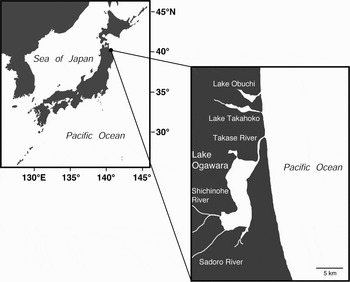
Specimens of Anguilla japonica were collected by fishing or using eel pots or set nets in November 2003 and in June and August 2004 in Lake Ogawara, Aomori Prefecture, Japan (Figure 1). Lake Ogawara is a brackish water lake located on the Pacific side of northernmost Honshu Island and it covers an area of 63 km2. The northern section of the lake is connected to the Pacific Ocean by the 6-km long intermittent Takase River through which seawater enters the lake by tidal flow. The deep layer is always anaerobic, and the surface waters are always less saline (0.9–1.0 in salinity) throughout the year.
Sampling sites for the Japanese eel, Anguilla japonica, in Lake Ogawara and adjacent rivers along the Sanriku coast of Japan in the northernmost part of its distribution.

A total of 55 specimens were used in the present study, and the total length, body weight and gonad-somatic index (GSI) were measured for each fish. All eels were categorized as yellow eels based on the GSI of each eel (less than 1.0). Species identification of each eel was carried out using polymerase chain reaction–restriction fragment length polymorphism (PCR-RFLP) analysis of the mitochondrial 16s rRNA gene as described by Aoyama et al. (Reference Aoyama, Watanabe, Nishida and Tsukamoto2000), and all eels were confirmed to be A. japonica.
Sagittal otoliths were extracted from each fish, embedded in epoxy resin (Struers, Epofix) and mounted on glass slides. The otoliths were then ground to expose the core, using a grinding machine equipped with a diamond cup-wheel (Struers, Discoplan-TS), and polished further with OP-S suspension on an automated polishing wheel (Struers, RotoPol-35). Finally, they were rinsed with deionized water prior to analysis.
For the electron microprobe analyses, all otoliths were Pt-Pd coated by a high vacuum evaporator. The life-history transect analysis of the Sr and Ca concentrations was performed along a line down the longest axis of each otolith from the core to the edge using a wavelength dispersive X-ray electron microprobe (JEOL JXA-8900R), as described in Arai et al. (Reference Arai, Kotake, Ohji, Miller, Tsukamoto and Miyazaki2003a, Reference Arai, Kotake, Ohji, Miyazaki and Tsukamotob). Wollastonite (CaSiO3) and tausonite (SrTiO3) were used as standards, and the accelerating voltage and beam current were 15 kV and 1.2 × 10⁻⁸ A, respectively. The electron beam was focused on a point 10 µm in diameter, with measurements spaced at 10 µm intervals.
Following the electron microprobe analysis, the otoliths were repolished to remove the coating, etched with 1% HCl and thereafter stained with 1% toluidine blue. The age of the specimens was determined by counting the number of blue-stained transparent zones following the method of Arai et al. (Reference Arai, Kotake, Ohji, Miller, Tsukamoto and Miyazaki2003a, Reference Arai, Kotake, Ohji, Miyazaki and Tsukamotob). The positions of the transparent zones were then correlated to elemental analysis points. The relative ages at particular elemental analysis points could then be assigned. The otolith radii for each age of the specimens were also measured. The total lengths of each age of the specimens were estimated from the growth rate and age of each fish. The growth rate was calculated as follows. Growth rate = (TL-6.0)/age, where 6.0 is the mean length (cm) of glass eels when they are recruited to a coastal area (Arai et al. Reference Arai, Otake and Tsukamoto1997).
We calculated the average Sr:Ca ratios for the values outside the elver mark, and we categorized the specimens into ‘sea eels’ (Sr:Ca ratios, ≥ 6.0 × 10⁻³), ‘estuarine eels’ (Sr:Ca ratios, 2.5–6.0 × 10⁻³) or river eels (Sr:Ca ratios, <2.5 × 10⁻³), according to the criteria of Tsukamoto & Arai (Reference Tsukamoto and Arai2001).
Differences between data were tested using the Mann–Whitney U-test. The significance of the correlation coefficient and regression slope were tested by Fisher's Z-transformation and an analysis of covariance (ANCOVA) (Sokal & Rohlf, Reference Sokal and Rohlf1995).
RESULTS
Biological characteristics
The eels collected in Lake Ogawara were predominantly females (93%, N = 51), with no male in this area. The other 7% (N = 4) had no discernible gonads and their sex could not be determined visually.
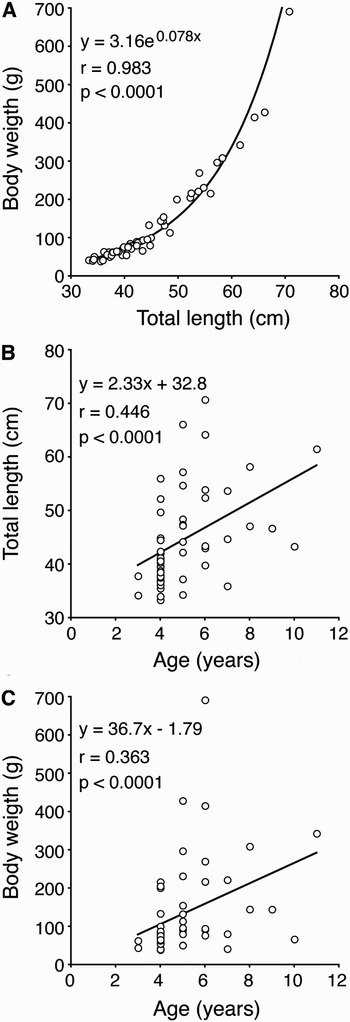
The total length (TL) of the females ranged from 34.2 to 70.7 cm, with a mean±SD of 44.6±8.7 cm, and the body weight (BW) of the females ranged from 38.9 to 692 g with a mean of 133±122 g. Age ranged from 3 to 11 years, with a mean±SD of 5±1.7 cm years. Close relationships were found between TL and BW, between age and TL and between age and BW (Figures 2A–C; ANCOVA P < 0.01–0.0001).
The relationship between body weight (BW) and total length (TL) (A), TL and age (B), and BW and age (C).

Migratory history
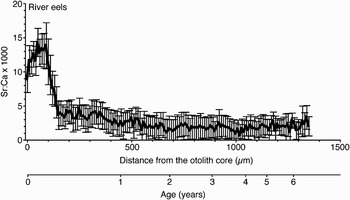
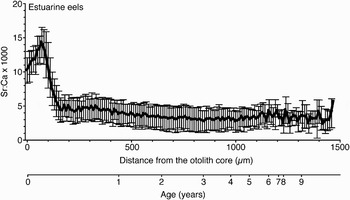
The Sr:Ca ratios in the transect along the radius of each otolith showed the same common features in all specimens around the centre, but there were generally two different patterns outside the otolith centre. All otoliths had a common peak of the value of the Sr:Ca ratio at the centre of the otolith inside the elver mark, which roughly corresponded to the leptocephalus and early glass eel stages of the eels' oceanic life (Arai et al., Reference Arai, Otake and Tsukamoto1997). The radius of the elver mark ranged from 128 to 169 µm with a mean±SD of 146±7.8 µm. Outside of the high Sr core, there was great variation in the Sr:Ca ratios in the otoliths of eels from the different habitats. The change in Sr:Ca values outside the elver mark were generally divided into two types (Figures 3 & 4). Eight fish showed constantly low values with a mean of 2.34±0.87 × 10⁻³(mean±SD) (Figure 3), and others (47 fish) showed relatively high values with a mean of 3.56±0.64 × 10⁻³(mean±SD) (Figure 4). There was a significant difference in the mean Sr:Ca rations between the former and the latter fish (Mann–Whitney U-test, P < 0.0001).
Typical changes in otolith Sr:Ca ratios along line transects from the core (0 µm) to the edge in the frontal plane of sagittal otoliths in Japanese river eels. The solid line indicates the mean ratios for all eels at 10 µm intervals with error bars (standard deviations).

Typical changes in otolith Sr:Ca ratios along line transects from the core (0 µm) to the edge in the frontal plane of sagittal otoliths in Japanese estuarine eels. The solid line indicates the mean ratios for all eels at 10 µm intervals with error bars (standard deviations).

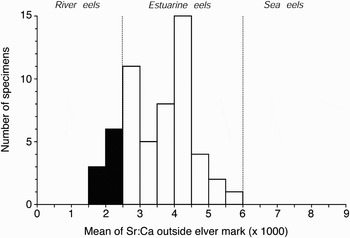
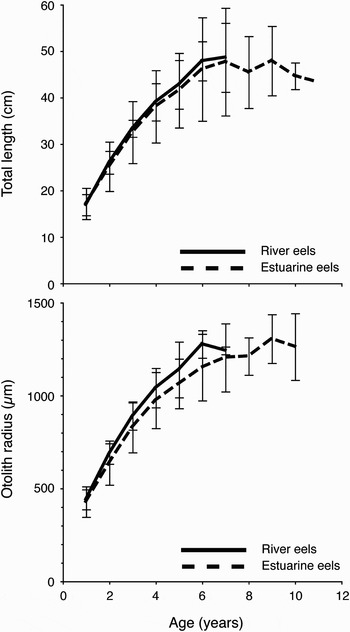
The mean Sr:Ca ratio value outside of 150 µm from the core of all otoliths ranged from 1.6 to 5.6 × 10⁻³, and based on those mean values of each specimen was categorized as either estuarine or river eels (Figure 5). Of the specimens examined, 15% were river eels (Sr/Ca < 2.5 × 10⁻³) (N = 8) while the vast majority (85%, N = 47) were estuarine eels (2.5 × 10⁻³ ≤ Sr/Ca < 6.0 × 10⁻³) (Figure 5). We compared the total length and otolith radius between river and estuarine eels at each age (Figure 6), and no significant differences were found in each biological parameter between them (Mann–Whitney U-test, P > 0.5).
Frequency distribution of the mean values of Sr:Ca ratios outside the elver mark (150 µm in radius) in each otolith of the specimens.

The relationship between the total length and age (upper), and the otolith radius and age (lower). The solid and dotted lines indicate the mean values for river eels and estuarine eels, respectively at each age with error bars (standard deviations).

DISCUSSION
The most significant finding of this study was confirmation of the existence of resident estuarine eels that had never migrated into a freshwater habitat and had lived only in a brackish water environment in Japanese coastal waters near the northern edge of the distribution range of this species (Figure 5). Further, estuarine eels constituted 85% of all specimens while ordinary diadromous eels that had entered a freshwater habitat was only comprised 15%. These findings strongly suggested that A. japonica has a flexible migration strategy with a high degree of behavioural plasticity and an ability to utilize the full range of salinity. A similar phenomenon was indicated in the otoliths of yellow and silver eels of A. japonica at other localities in the southern part of the Japanese coastal waters (Tsukamoto & Arai, Reference Tsukamoto and Arai2001; Arai et al., Reference Arai, Kotake, Ohji, Miller, Tsukamoto and Miyazaki2003a, Reference Arai, Kotake, Ohji, Miyazaki and Tsukamotob; Kotake et al., Reference Kotake, Arai, Ozawa, Nojima, Miller and Tsukamoto2003, Reference Kotake, Okamura, Yamada, Utoh, Arai, Miller, Oka and Tsukamoto2005). Otolith analyses of European, American and Australasian yellow and silver eels have also shown evidence of marine and estuarine residencies (Jessop et al., Reference Jessop, Shiao, Iizuka and Tzeng2002; Arai et al., Reference Arai, Kotake, Lokman, Miller and Tsukamoto2004; Reference Arai, Kotake and McCarthy2006; Daverat & Tomás, Reference Daverat and Tomás2006). Therefore, migration into freshwater in A. japonica is not an obligate pathway but a facultative catadromy as an ecophenotype.
It is noteworthy that all eels were identified as females in the present study. Krueger & Oliveira (Reference Krueger and Oliveira1999) concluded that increases in population density, and the resulting slower growth, retarded the production of males in A. rostrata. Wiberg (Reference Wiberg1983) concluded that warm temperatures induce maleness in A. anguilla, but long-term experiments in Sweden produced a small but significant increase in the number of females with increasing temperature (Holmgren & Mosegaard, Reference Holmgren and Mosegaard1996). In A. japonica, Kotake et al. (Reference Kotake, Arai, Okamura, Yamada, Utoh, Oka, Miller and Tsuakamoto2007) reported that the most female-predominant area was in the coastal waters at Sanriku in the north (100%), the second most was Mikawa Bay in central Japan (95%), and the least was in the Amakusa Islands in the south (70%). The present study was consistent with these results, finding that the rate of females near the northern edge of the distribution was 100%. Tzeng et al. (Reference Tzeng, Cheng and Lin1995) also reported that A. japonica collected near the estuary and at down-, mid- and up-stream sites of rivers in northern Taiwan were mainly made up of smaller individuals with undetermined sex, whereas the eels whose sex could be determined were mainly female. In anguillid eels it is thought that overcrowding and poor feeding appear to give rise to males and that low population densities with rich feeding favour females (Tzeng et al., Reference Tzeng, Cheng and Lin1995; Krueger & Oliveira, Reference Krueger and Oliveira1999; Davey & Jellyman, Reference Davey and Jellyman2005). Thus, the potentially food-rich and low-population-density environment in the coastal waters of Lake Ogawara might favour the production of females, while river habitats with poor food resources and higher population density might favour males, although population density could not be examined in the present study.
The evolutionary pathway of the diverse migration of anguillid eels is still unclear. However, it may be attributed to genetics or environmental adaptation as in other diadromous fish (Nordeng Reference Nordeng1983; Gross, Reference Gross1985). A recent mitochondrial DNA (mtDNA) analysis could not find any genetic difference in the Japanese eel, and thus, it is considered to be a panmictic population (Sang et al., Reference Sang, Chang, Chen and Hui1994). There is a widely held view that life histories in animals are selected for and adapted to maximizing the production of progeny (Schaffer & Elson, Reference Schaffer and Elson1975; Stearns, Reference Stearns1977; Dingle, Reference Dingle1980; Gross, Reference Gross1985). The persistence of migration needs to be seen in relation to the balance of the advantages obtained from migration and the costs incurred by the population and/or species. These advantages include such aspects as increased food supply, avoidance of potentially harmful environmental conditions and/or movement to more favourable ones, the occupation of habitats that have specific or specialized habitat requirements, and the availability of more living space. In the present study, there was no significant difference in growth between river and estuarine eels (Figure 6), although food abundance for the eel is generally superior in the estuaries than in the upper regions of rivers in an island country such as Japan. Further, a recent ecotoxicological study found that estuarine eels as well as sea eels had a higher ecological risk from organotin compounds than river eels during their life history (Ohji et al., Reference Ohji, Harino and Arai2006). Those results suggested that estuarine-dependent eels could not take advantage of living in the estuarine environment in the lake, although estuarine-dependent eels were predominant in other species and areas such as the European eel Anguilla anguilla (Arai et al., Reference Arai, Kotake and McCarthy2006; Daverat & Tomás, Reference Daverat and Tomás2006), Japanese eel A. japonica (Tsukamoto & Arai, Reference Tsukamoto and Arai2001; Arai et al., Reference Arai, Kotake, Ohji, Miller, Tsukamoto and Miyazaki2003a, Reference Arai, Kotake, Ohji, Miyazaki and Tsukamotob; Kotake et al., Reference Kotake, Arai, Ozawa, Nojima, Miller and Tsukamoto2003, Reference Kotake, Okamura, Yamada, Utoh, Arai, Miller, Oka and Tsukamoto2005), American eel A. rostrata (Jessop et al., Reference Jessop, Shiao, Iizuka and Tzeng2002) and New Zealand eels, A. australis and A. dieffenbachii (Arai et al., Reference Arai, Kotake, Lokman, Miller and Tsukamoto2004). In Japan, there is a relatively narrow and mountainous landmass, with extensive urban agricultural development adjacent to most lowland rivers and streams, so the number and quality of freshwater habitats may be somewhat limited. Thus, most eels might be compelled to live in coastal areas. Further studies are needed to examine the factors affecting the apparently flexible pattern of habitat use by the Japanese eel. Such studies will assist with the management of the species for prevention of its further decline.
ACKNOWLEDGEMENT
This work was supported in part by Grant-in-Aid Nos. 18780141 and 20688008 from the Ministry of Education, Culture, Sports, Science, and Technology of Japan.