Low-level chronic inflammation is implicated in the pathogenesis of anxiety and depression. Indeed, an elevation in various peripheral inflammatory markers has been associated with both major depressive disorder and generalised anxiety disorder (Dowlati et al., Reference Dowlati, Herrmann, Swardfager, Liu, Sham, Reim and Lanctot2010; Costello et al., Reference Costello, Gould, Abrol and Howard2019). This inflammation hypothesis has been proposed as an explanation for the increased risk of anxiety and depression in various chronic inflammatory conditions, but its relevance to atopic dermatitis (AD) is not yet known. This gap in the literature is surprising given both the increased risk of anxiety and depression in AD, and evidence suggesting that AD is associated with altered circulating inflammatory markers (Thijs et al., Reference Thijs, Strickland, Bruijnzeel-Koomen, Nierkens, Giovannone, Knol, Csomor, Sellman, Mustelin, Sleeman, de Bruin-Weller, Herath, Drylewicz, May and Hijnen2018). We therefore performed a case-control study to investigate associations between plasma cytokines and symptoms of anxiety and depression in adults with and without AD. Our hypothesis was that associations would be significantly different between groups, consistent with the theory that AD-specific systemic inflammation contributes to the pathogenesis of comorbid anxiety and depression.
Sequential adults presenting to the dermatology clinic at Groote Schuur Hospital, Cape Town, were screened for eligibility during pre-defined study periods. Inclusion criteria were current AD (diagnosis confirmed using UK Working Party Criteria) and age 18–60 years. Exclusion criteria were (1) comorbid chronic inflammatory conditions (except other atopic conditions), (2) acute illness, or (3) any systemic medication for AD. Age and sex-matched controls were recruited from waiting rooms. In addition to the exclusion criteria above, controls had to be free of any history of atopic illness. All participants provided informed consent. The study was approved by the University of Cape Town Human Research Ethics Committee (HREC473/2017).
Disease severity was measured using the SCORing Atopic Dermatitis (SCORAD) index. Participants completed the Hospital Anxiety and Depression Scale (HADS). Collection and processing of blood samples were conducted according to standardised operational procedures. For cytokine analysis, blood samples were handled on ice between collection and centrifugation (2,600g for 10 min at 4 °C within 2 h of blood draw) and stored at −80 °C. Multiplex analysis was performed using a Human Custom ProcartaPlex Immunoassay (Thermo Fisher Scientific, Waltham, MA, USA) according to the manufacturer’s protocol. Due to more than 25% of values below the detectable limit for all measured cytokines except BDNF, CCL-2, and CCL-22, repeat analysis was performed using a Milliplex® MAP Magnetic Bead assay (MerckMillipore, Billerica, MA, USA) according to the manufacturer’s protocol.
Statistical analysis was performed using R version 3.6.0. Power calculations were based on a medium effect size. Sample size was limited by financial constraints and the study power was low (<60%). However, the study was still deemed worthwhile given significant findings in previous studies with smaller sample sizes. Differences between AD and control groups were analysed using Mann–Whitney U tests. Spearman’s correlation coefficient (rho) was used to measure the association between plasma cytokines and HADS depression and anxiety scores. Analyses were repeated replacing any cytokine outliers with values capped at the 95th percentile to ensure consistency of results. The cocor package was used to compare correlations between inflammatory markers and anxiety and depression scores between the two groups (Diedenhofen and Musch, Reference Diedenhofen and Musch2015). All tests were two-sided. Statistical significance was defined as p < 0.05. Given the limited power, adjustment for multiple comparisons was not included in the study design.
The final sample consisted of 20 participants with AD and 20 controls. Median age was 28.5 years and 25% were male. Median body mass index was 25.93 kg/m2 and did not differ between cases and controls (p = 0.66). Median scores for both HADS anxiety and depression were higher in cases than controls, but this was not significant (p = 0.26 and p = 0.20 respectively). Eighty-five percent of cases had moderate or severe AD. Median total serum IgE was 2976.5 kU/L for cases and 77.3 kU/L for controls (p < 0.001), consistent with sampling of cases with predominantly extrinsic AD.
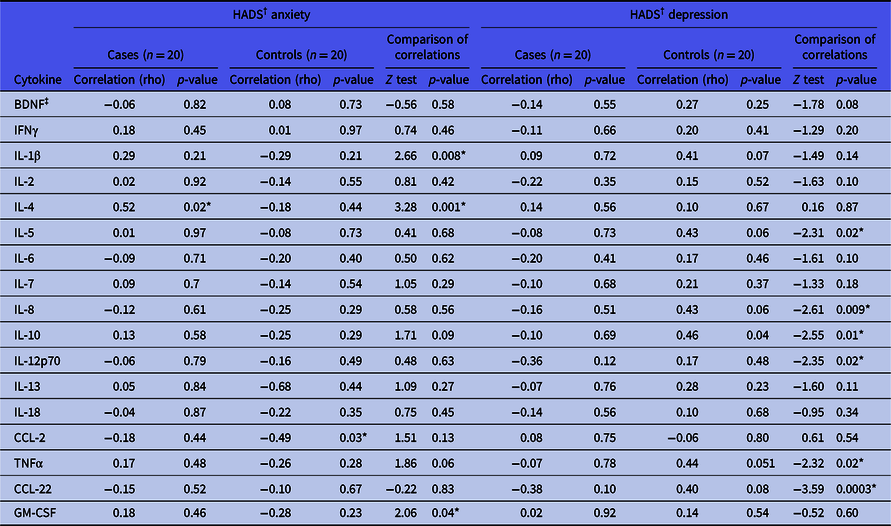
Correlation between inflammatory markers and HADS anxiety and depression scores are shown in Table 1. IL-4 was significantly correlated with anxiety in cases (rho = 0.52, p = 0.02) but not in controls (rho = −0.18, p = 0.44). Comparison of these correlations showed that they are significantly different (p = 0.001). None of the other inflammatory markers tested were significantly associated with HADS anxiety or depression scores in participants with AD.
Table 1.Comparison of inflammatory markers per anxiety and depression symptoms
We also compared median plasma cytokine concentrations in adults with and without AD. Four cytokines, IL-1β (p = 0.05), IL-18 (p < 0.0007), CCL-2 (p = 0.001), and CCL-22 (p = 0.03) had significantly higher median concentrations in AD versus controls. Notably, median IL-4 was not significantly higher in cases than in controls (95.33 pg/ml versus 76.25 pg/ml, p = 0.44). There was also no significant correlation between IL-4 and AD severity (p = 0.96).
The main finding of this study was that IL-4 was correlated with anxiety symptoms in participants with AD, but not in healthy controls, and the difference in correlations was significant. These results raise the possibility that IL-4 contributes to the immunopathogenesis of anxiety in adults with AD, consistent with the theory that AD-specific systemic inflammation contributes to comorbid anxiety. Although further investigation is required, the findings presented in this paper are exciting given the emergence of targeted immune modulators for the treatment of AD. For example, in addition to improvement in AD severity, phase III trials suggested that dupilumab, an anti-interleukin-4 receptor-α (IL-4Rα) monoclonal antibody, is associated with significant improvement in Hospital Anxiety and Depression Scores (HADS) (p < 0.0001 at week 16) (Cork et al., Reference Cork, Eckert, Simpson, Armstrong, Barbarot, Puig, Girolomoni, de Bruin-Weller, Wollenberg, Kataoka, Remitz, Beissert, Mastey, Ardeleanu, Chen, Gadkari and Chao2019). However, it is not known whether this improvement in psychiatric symptoms is due to altered inflammatory pathways or simply a by-product of improvement in AD symptomatology. It remains to be seen whether future biologic therapies for AD show similar improvements in HADS scores given comparable improvement in AD severity.
Given the study limitations, our findings should be interpreted with caution. Larger, multi-centre studies able to adjust for multiple confounding factors are required. Complementary investigations, for example into associated genetic risk factors, would also be helpful. Indeed, a better understanding of the shared etiopathogenesis of AD and psychiatric symptoms could help in the development and selection of immune modulators for patients with dual pathology.





 You have
Access
Low-level chronic inflammation is implicated in the pathogenesis of anxiety and depression. Indeed, an elevation in various peripheral inflammatory markers has been associated with both major depressive disorder and generalised anxiety disorder (Dowlati et al., Reference Dowlati, Herrmann, Swardfager, Liu, Sham, Reim and Lanctot2010; Costello et al., Reference Costello, Gould, Abrol and Howard2019). This inflammation hypothesis has been proposed as an explanation for the increased risk of anxiety and depression in various chronic inflammatory conditions, but its relevance to atopic dermatitis (AD) is not yet known. This gap in the literature is surprising given both the increased risk of anxiety and depression in AD, and evidence suggesting that AD is associated with altered circulating inflammatory markers (Thijs et al., Reference Thijs, Strickland, Bruijnzeel-Koomen, Nierkens, Giovannone, Knol, Csomor, Sellman, Mustelin, Sleeman, de Bruin-Weller, Herath, Drylewicz, May and Hijnen2018). We therefore performed a case-control study to investigate associations between plasma cytokines and symptoms of anxiety and depression in adults with and without AD. Our hypothesis was that associations would be significantly different between groups, consistent with the theory that AD-specific systemic inflammation contributes to the pathogenesis of comorbid anxiety and depression.
Sequential adults presenting to the dermatology clinic at Groote Schuur Hospital, Cape Town, were screened for eligibility during pre-defined study periods. Inclusion criteria were current AD (diagnosis confirmed using UK Working Party Criteria) and age 18–60 years. Exclusion criteria were (1) comorbid chronic inflammatory conditions (except other atopic conditions), (2) acute illness, or (3) any systemic medication for AD. Age and sex-matched controls were recruited from waiting rooms. In addition to the exclusion criteria above, controls had to be free of any history of atopic illness. All participants provided informed consent. The study was approved by the University of Cape Town Human Research Ethics Committee (HREC473/2017).
Disease severity was measured using the SCORing Atopic Dermatitis (SCORAD) index. Participants completed the Hospital Anxiety and Depression Scale (HADS). Collection and processing of blood samples were conducted according to standardised operational procedures. For cytokine analysis, blood samples were handled on ice between collection and centrifugation (2,600g for 10 min at 4 °C within 2 h of blood draw) and stored at −80 °C. Multiplex analysis was performed using a Human Custom ProcartaPlex Immunoassay (Thermo Fisher Scientific, Waltham, MA, USA) according to the manufacturer’s protocol. Due to more than 25% of values below the detectable limit for all measured cytokines except BDNF, CCL-2, and CCL-22, repeat analysis was performed using a Milliplex® MAP Magnetic Bead assay (MerckMillipore, Billerica, MA, USA) according to the manufacturer’s protocol.
Statistical analysis was performed using R version 3.6.0. Power calculations were based on a medium effect size. Sample size was limited by financial constraints and the study power was low (<60%). However, the study was still deemed worthwhile given significant findings in previous studies with smaller sample sizes. Differences between AD and control groups were analysed using Mann–Whitney U tests. Spearman’s correlation coefficient (rho) was used to measure the association between plasma cytokines and HADS depression and anxiety scores. Analyses were repeated replacing any cytokine outliers with values capped at the 95th percentile to ensure consistency of results. The cocor package was used to compare correlations between inflammatory markers and anxiety and depression scores between the two groups (Diedenhofen and Musch, Reference Diedenhofen and Musch2015). All tests were two-sided. Statistical significance was defined as p < 0.05. Given the limited power, adjustment for multiple comparisons was not included in the study design.
The final sample consisted of 20 participants with AD and 20 controls. Median age was 28.5 years and 25% were male. Median body mass index was 25.93 kg/m2 and did not differ between cases and controls (p = 0.66). Median scores for both HADS anxiety and depression were higher in cases than controls, but this was not significant (p = 0.26 and p = 0.20 respectively). Eighty-five percent of cases had moderate or severe AD. Median total serum IgE was 2976.5 kU/L for cases and 77.3 kU/L for controls (p < 0.001), consistent with sampling of cases with predominantly extrinsic AD.
Correlation between inflammatory markers and HADS anxiety and depression scores are shown in Table 1. IL-4 was significantly correlated with anxiety in cases (rho = 0.52, p = 0.02) but not in controls (rho = −0.18, p = 0.44). Comparison of these correlations showed that they are significantly different (p = 0.001). None of the other inflammatory markers tested were significantly associated with HADS anxiety or depression scores in participants with AD.
Comparison of inflammatory markers per anxiety and depression symptoms
† Hospital Anxiety and Depression Scale.
‡ Levels lower than detectable limit omitted n = 38.
* Null hypothesis rejected based on statistically significant p value (p < 0.05).
We also compared median plasma cytokine concentrations in adults with and without AD. Four cytokines, IL-1β (p = 0.05), IL-18 (p < 0.0007), CCL-2 (p = 0.001), and CCL-22 (p = 0.03) had significantly higher median concentrations in AD versus controls. Notably, median IL-4 was not significantly higher in cases than in controls (95.33 pg/ml versus 76.25 pg/ml, p = 0.44). There was also no significant correlation between IL-4 and AD severity (p = 0.96).
The main finding of this study was that IL-4 was correlated with anxiety symptoms in participants with AD, but not in healthy controls, and the difference in correlations was significant. These results raise the possibility that IL-4 contributes to the immunopathogenesis of anxiety in adults with AD, consistent with the theory that AD-specific systemic inflammation contributes to comorbid anxiety. Although further investigation is required, the findings presented in this paper are exciting given the emergence of targeted immune modulators for the treatment of AD. For example, in addition to improvement in AD severity, phase III trials suggested that dupilumab, an anti-interleukin-4 receptor-α (IL-4Rα) monoclonal antibody, is associated with significant improvement in Hospital Anxiety and Depression Scores (HADS) (p < 0.0001 at week 16) (Cork et al., Reference Cork, Eckert, Simpson, Armstrong, Barbarot, Puig, Girolomoni, de Bruin-Weller, Wollenberg, Kataoka, Remitz, Beissert, Mastey, Ardeleanu, Chen, Gadkari and Chao2019). However, it is not known whether this improvement in psychiatric symptoms is due to altered inflammatory pathways or simply a by-product of improvement in AD symptomatology. It remains to be seen whether future biologic therapies for AD show similar improvements in HADS scores given comparable improvement in AD severity.
Given the study limitations, our findings should be interpreted with caution. Larger, multi-centre studies able to adjust for multiple confounding factors are required. Complementary investigations, for example into associated genetic risk factors, would also be helpful. Indeed, a better understanding of the shared etiopathogenesis of AD and psychiatric symptoms could help in the development and selection of immune modulators for patients with dual pathology.
Financial support
Dr N.A. Gray is funded by a Discovery Foundation Academic Fellowship Award; Prof NP Khumalo is funded by the NRF and the SA MRC; Prof D.J. Stein is funded by the SA MRC.
Conflict of interest
None.