

On 8 December 2019, Olga Neuwirth’s opera Orlando premiered at the Wiener Staatsoper, the first opera by a woman to be commissioned in the institution’s 150-year history. Based on Virginia Woolf’s renowned novel of the same name, the production was made possible not by one woman but by women across various disciplines, responsible for the music, libretto, costumes, and stage design.Footnote 1 Woolf’s novel itself is a radical feminist classic: the eponymous protagonist undergoes a sex change and lives across four hundred years to the period when the novel was written (1928). In Neuwirth’s operatic adaptation of roughly three hours, the story’s timeline is extended to the twenty-first century — to include the premiere — thus spanning almost five hundred years. The story comprises nineteen scenes, termed Bilder (literally ‘pictures’) by Neuwirth. To expand the added timeline, new plots, locations, and characters are introduced around Orlando (a mezzo-soprano role performed by Kate Lindsey in the premiere), including a child, a girlfriend, a husband, and a guardian angel, which further complicate Orlando’s shifting gender identities.
This unorthodox character impressed music critic Alex Ross, who, in his review ‘Opera against the Patriarchy’, remarked that Orlando ‘stands in contrast to a Viennese season that features women dying of consumption, flinging themselves off buildings, and riding horses into funeral pyres’.Footnote 2 Far from merely echoing Woolf’s critique of male-dominated British historiography, Orlando, as Ross observes, mounts its own resistance against the persistent figuration of women as victims in the operatic canon and the patriarchal structures that continue to shape artistic articulation and music history. How, then, is this critique of gender stereotypes and phallocentric, sexist historiography not merely represented but enacted — materially, vocally, and spatially — within the operatic medium itself?
At the heart of this provocative adaptation lies the concept of ‘in-betweenness’, calling for a diversity of experiences, identities, and gender expressions. As Neuwirth herself acutely reflects on the idea,
Orlando is a being that challenges all imposed, human-made norms. Through this interaction, norms are changed and reconsidered. Orlando cannot be confined to any clear binary system or stereotypes; instead, he/she emerges as a being, a free spirit with bubbling, overflowing freedom, who independently questions norms. It is about freedom of expression and fluid identity.Footnote 3
This ‘in-between’ gender identity of Orlando opens onto a fluid and liberated terrain, where it also finds resonance with the marginalized experiences long theorized by feminist thinkers. Gloria Anzaldúa, for instance, envisions ‘Borderlands’ as metaphorical spaces crossing geopolitical borders, sexual boundaries, and cultural becoming.Footnote 4
Ontologically, the idea of the in-between also destabilizes fixed conceptions of existence, aligning more closely with Gilles Deleuze and Félix Guattari’s philosophical call for a shift from being to becoming. To illustrate how becoming operates, they draw on Woolf’s conception of Orlando:
‘This will be childhood, but it must not be my childhood’, writes Virginia Woolf. (Orlando already does not operate by memories, but by blocks, blocks of ages, blocks of epochs, blocks of the kingdoms of nature, blocks of sexes, forming so many becomings between things, or so many lines of deterritorialization.) Wherever we used the word ‘memories’ in the preceding pages, we were wrong to do so; we meant to say ‘becoming’, we were saying becoming.Footnote 5
Unlike the linear temporality of ‘memories’, becoming, the movement across the borders of different ‘blocks’, signals a fluid and transcendent mode of identity. As a work attuned to our contemporary condition, Neuwirth’s Orlando invites renewed scrutiny into how Woolf’s vision of fluid subjectivity and Deleuze–Guattarian becoming converge within the operatic medium. Deleuzian thought inspires us to imagine: more than a mere artistic statement, the idea of the in-between, crystallized in Orlando, becomes a potent political weapon, overturning the patriarchal structures and binary gender ideologies of the past and combating their lingering spectres in the present. More strikingly still, it becomes a force that unsettles how gender and operatic voice have been understood, voiced, and historicized.
Traversing the thread from Deleuze–Guattari, through Woolf, and ultimately to Neuwirth, I seek to probe deeper into Orlando, arguing that opera today functions not merely as a reflective medium of feminist consciousness and postmodern discourse, but as a generative space: an in-between terrain, an ever-becoming Borderland, where marginalized voices are empowered and alternative forms of knowledge are produced.Footnote 6 By specifically foregrounding the operatic voice, I explore how the in-between becomes audible, how voice not only articulates liminality, but inhabits it, forming a site of becoming. I begin with an overview of the opera, then trace how the singing voice animates Deleuze–Guattarian ideas of becoming, setting the stage for my analyses of Neuwirth’s in-between reconfigurations of Orlando’s voice and the surrounding vocal worlds across four key duets.
The In-Between
The in-between, long a preoccupation for Neuwirth, resonates through the opera’s very structure, its sonic textures, and its compositional logic. Labelled ‘Musiktheater’ on the composer’s website, and identified by Irene Lehmann in the programme notes as an example of Neuwirth’s aufgebrochenes Musiktheater (‘deconstructed music theatre’), Orlando is nevertheless staged within an opera-house setting, suggesting yet another kind of in-between threshold space: a music-theatrical form that deliberately oscillates between opera and its deconstruction.Footnote 7
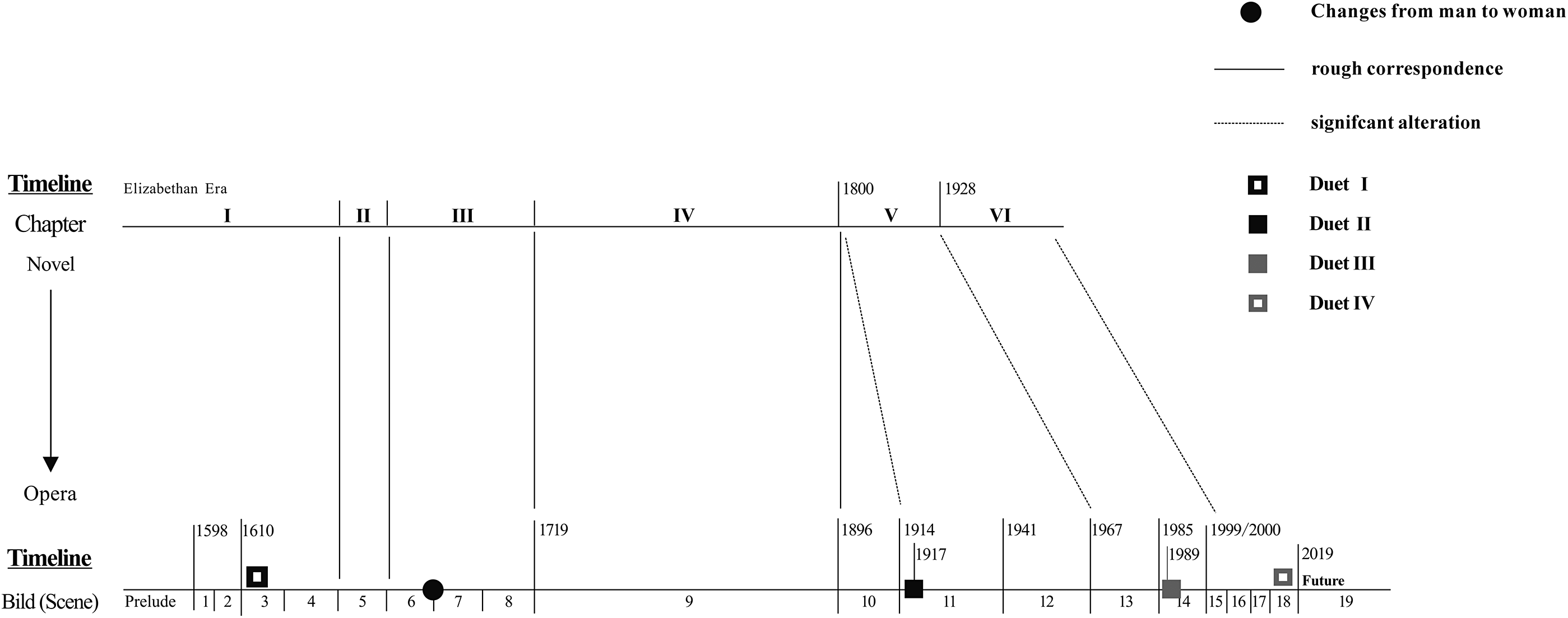
By calling Orlando ‘a biography’, Woolf challenged the genre: not the story of a great man but of a gender-shifting figure modelled on her lover, Vita Sackville-West. In granting her protagonist an ageless life, Woolf also created a hybrid form that blurs the boundary between fact and fiction. Echoing this gesture, Neuwirth’s opera adopts a similarly ironic subtitle, ‘eine fictive musikalische Biografie’ [‘a fictional musical biography’], yet extends the narrative further, reimagining the storyline for a contemporary context. As shown in Figure 1, a synoptic comparison of the novel and the opera, a significant portion of the opera aligns with the novel’s storyline. Scenes 1–9 roughly align with the first four chapters of the novel, depicting Orlando’s youth as a teenage boy favoured by the queen, his initial love for the Russian princess Sasha, and his sexual transformation into a woman when serving as an ambassador in Constantinople. The novel ends in 1928, with the final two chapters focusing on Orlando’s married and immortal life. The ensuing four scenes (10–13) broadly complete the remainder of Woolf’s original narrative, exploring Orlando’s experiences as a woman and culminating in her marriage to Shelmerdine.
Comparison of the structures of the novel and opera Orlando.

Figure 1. Long description
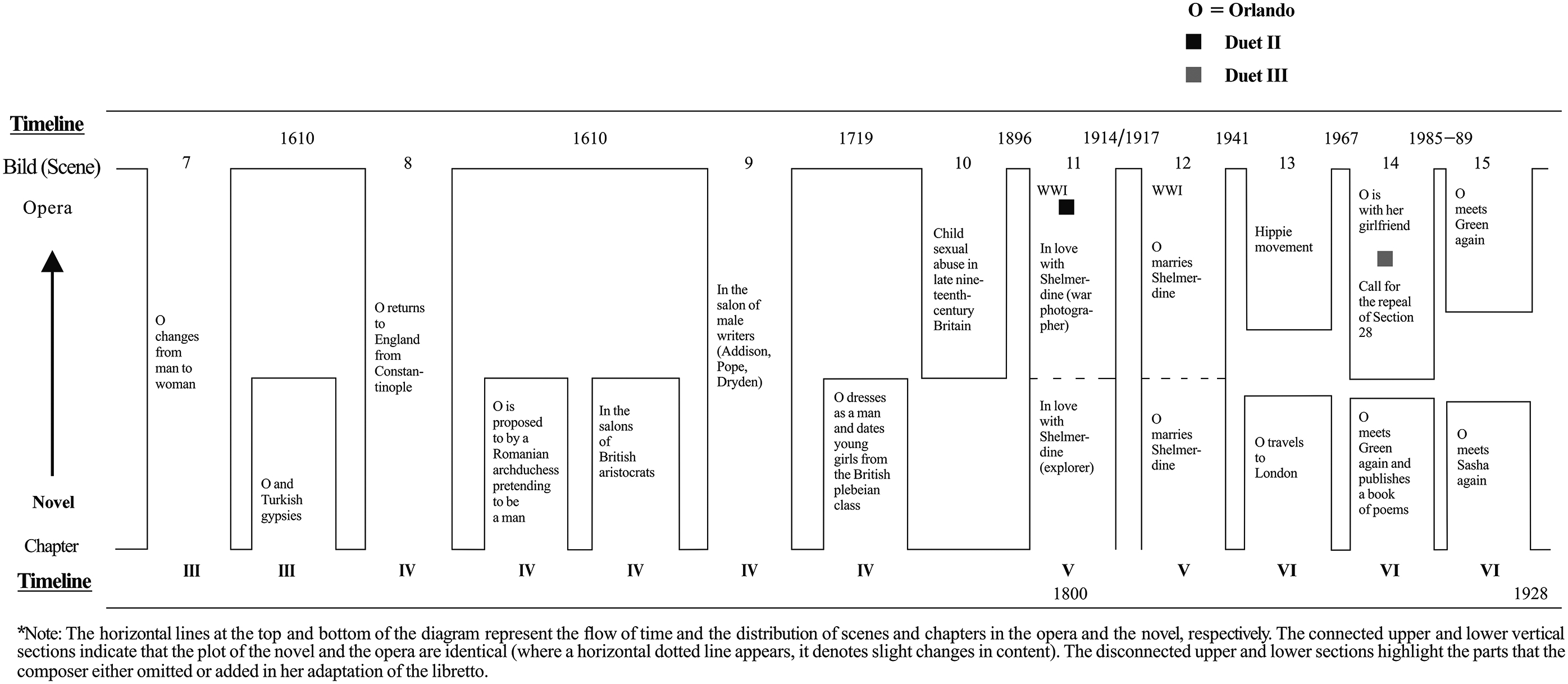
The flowchart spans from 1610 to 1928, with a horizontal timeline at the top and bottom. Vertical columns represent scenes (opera, labeled as Bild) and chapters (novel, labeled as Chapter), aligned by date. The opera is mapped above, the novel below. Each column is labeled with a number and contains text summarizing key events, such as ‘O changes from man to woman’ in scene 7/chapter III, ‘O returns to England from Constantinople’ in scene 8/chapter IV, and ‘O dresses as a man and dates young girls from the British plebeian class’ in scene 10/chapter IV. Overlapping sections are connected by vertical lines, indicating identical or similar content, while disconnected sections highlight additions or omissions in the opera adaptation. Specific events such as ‘In love with Shelmerdine (war photographer)’ and ‘O marries Shelmerdine (explorer)’ are shown in both works but with slight shifts in content, marked by dotted lines. Later events include ‘Hippie movement’ (scene 13/chapter VI), ‘O travels to London’ (scene 14/chapter VI), and ‘O meets Sasha again’ (scene 15/chapter VI). A legend at the top right identifies symbols: open circle for Orlando, filled black square for Duet II, and filled grey square for Duet III. The diagram visually tracks narrative structure, content overlap, and divergence between the novel and opera.
After Scene 10, as indicated by the dotted line in Figure 1, the opera diverges from Woolf’s novel, introducing new elements mostly drawn from contemporary sociopolitical realities to enrich the narrative. This extension enables Orlando’s gender transition to occur relatively early in the opera, thereby shifting the dramatic focus from the transition itself to the experiences that follow. Figure 2 illustrates, in part, how these extensions and transformations unfold: at the end of the nineteenth century (Scene 10), Orlando becomes a Victorian-era activist campaigning against child sexual abuse. Scenes 11–12 shift the novel’s original early nineteenth-century setting to the battlegrounds of World Wars I and II, with Orlando’s husband, Shelmerdine, reimagined as a war photographer rather than an explorer. Scene 13 enters the 1960s, with Orlando dressed as a hippie amid the 1967 ‘Summer of Love’. Scene 14 spans from 1985 to 1989, set against the backdrop of the enactment of Section 28 — Margaret Thatcher’s 1988 ban on ‘promoting homosexuality’ — and the founding of the UK’s first LGBTQ+ rights group, Stonewall. Orlando appears in a Boy George-inspired look, while her girlfriend channels post-punk icon Siouxsie Sioux. Scene 15 reworks the novel’s ending, replacing Orlando’s reunion with the writer Green with a video call, and transitions into the twenty-first century through Shelmerdine’s death in an Iraq War explosion. The final four scenes (16–19), however, diverge entirely from the original novel, unfolding from the year 2000 to the composer’s envisioned ‘2019’ and even a projected ‘future’. Here, the protagonist is placed amid a range of sociopolitical concerns of the new millennium, including technology, gender minorities, children, economic precarity, war, and the rise of right-wing populism. Scene 16 introduces a new character, Orlando’s child, a transgender role performed by Justin Vivian Bond, who sings through a microphone.
Orlando, Scenes 7–15, comparison with the plot of the novel.

Figure 2. Long description
The diagram presents a horizontal timeline anchored at the top by novel chapters labeled I through VI, spanning from the Elizabethan Era to the future. Directly below, a second timeline marks years from 1598 to 2019, with opera scenes labeled Prelude, 1 to 19, and ‘Future.’ Vertical lines connect novel chapters to corresponding opera scenes, indicating rough correspondences with solid lines and significant alterations with dotted lines. Large black circles at chapter III and scene 7 mark the change from man to woman. Four duet types are shown: Duet I as an open black square at scene 3, Duet II as a filled black square at scenes 7, 11, and 16, Duet III as a filled gray square at scene 17, and Duet IV as a open gray square at scene 19. The timeline visually aligns the opera’s structure with the novel’s plot, highlighting key transitions and thematic parallels.
At the premiere, the stage media displayed the corresponding years as each scene unfolded, marking thirteen time points along the horizontal timeline (see Figure 1). To reflect Orlando’s historical journey and gender transformations, the protagonist undergoes nine costume changes and striking shifts in vocal style. These changes delineate four distinct stages: the young man (Scenes 1–6, 1598–1610), transition and marriage (Scenes 7–12, 1610–1941), romance with a girlfriend (Scenes 13–15, 1967–2000), and pregnancy and having a child (Scenes 16–19, 2000–19). In each stage, Orlando interacts with characters across a range of vocal types — fiancée (high soprano), husband (baritone), girlfriend (mezzo-soprano with microphone), and guardian angel (countertenor). These interactions illustrate remarkable vocal fluidity across ranges and registers. Four duets (Duets I–IV; see Figures 1 and 2), placed at key structural junctions, mark pivotal moments where vocal interaction most vividly enacts gender fluidity and sonic in-betweenness, and form the central focus of my analyses below.
Sounding In-Betweenness: On Becoming and Androgynous Sound
How can the in-between be made audible? This is by no means a new question for Neuwirth. As Nicholas Till observes, her earlier compositions already engaged with this idea, as she ‘constantly blurs categories and boundaries’ between sound and noise, acoustic and electronic, vocal and instrumental, animate and inanimate.Footnote 8 Till goes further, describing his experience of Neuwirth’s music as ‘weird, eerie, uncanny’, and explicitly linking it to Deleuze and Guattari’s notion of ‘becoming-animal’ through its evocation of posthuman animality.Footnote 9 But how, then, does the in-between sound again, this time through operatic voices and in closer relation to gender identifications, not only as a mode of representation, but as a performative and material force? This once again links Neuwirth’s vocal writing in Orlando to the framework of becoming, wherein the voice is drawn into Deleuze and Guattari’s rethinking of sexuality and identity, particularly in the concept of becoming-woman. Footnote 10
As opposed to classical ontologies, committed to a static and immutable notion of being, becoming encapsulates the multifaceted conditions of existence structured by binaries, describing movement across categories, not from one point to another, but through the in-between — a transversal process that resists binary logic (see Figure 3).Footnote 11 The line of becoming takes many forms in Deleuze and Guattari’s thought, with becoming-woman as its primary axis: ‘all becomings begin with and pass through becoming-woman’.Footnote 12 Far from a literal transition from man to woman, it denotes a mode of in-betweenness, a line of flight from fixed categories, opening up a field of fluid, indeterminate, and unstable subjectivities. In this framework, ‘woman’ is no longer defined in relation to man but becomes one of the lines of flight from the dualisms of sex and the logics of binary sexuality, what Deleuze and Guattari call ‘n sexes, an entire war machine through which love passes’.Footnote 13 Admittedly, advocating for gender diversity over sex essentialism is hardly a novel proposition, particularly in the wake of post-Deleuzian queer theory and gender studies. Yet neither Deleuze nor Guattari can be strictly considered feminists, and the concept of becoming-woman has itself become a contested terrain within feminist thought, eliciting considerable polemics.Footnote 14 Nonetheless, I would suggest that it remains productive in the context of Orlando, particularly considering how music, and specifically the singing voice, not only enters but animates the process of becoming.Footnote 15
The line of becoming; Gilles Deleuze and Félix Guattari, A Thousand Plateaus: Capitalism and Schizophrenia, trans. by Brian Massumi (University of Minnesota Press, 1987), p. 545.

Music, in Deleuzian terms, becomes a fibre that traverses multiple lines of flight — multiple becomings. Among these, becoming-woman initiates what they describe as the ‘machining of the voice’.Footnote 16 This idea draws on Dominique Fernandez’s La Rose des Tudors (1976), in which he celebrates the countertenor’s head voice in the English choral tradition, the alternative tenor voice in castrato roles, and the contralto voice in trouser roles for heroic figures in the operas of Bellini and Rossini.Footnote 17 In contrast, he critiques Verdi and Wagner for their rigidly gendered vocal assignments — voices strictly aligned with male or female characters — while advocating instead for the divine androgyny of the voice, epitomized in the myth of Orpheus, whom he identifies as the forgotten patron of music and prince of androgyny.Footnote 18
But is this divine androgyny of voice the only (or even a true) form of becoming-woman? Deleuze and Guattari seem unconvinced. Rather than idealizing vocal androgyny in the mythic image of Orpheus, they emphasize the voice’s inherent capacity to remain always fluid, always becoming. For them, the key to vocal becoming-woman lies not in Fernandez’s metaphor, but in what they term a ‘real becoming’.Footnote 19 Even in the works of Verdi and Wagner, vocal becoming remains possible: ‘Voices may be reterritorialized on the distribution of the two sexes, but the continuous sound flow still passes between them as in a difference of potential.’Footnote 20 This assertion directly challenges Fernandez’s premise that vocal becoming in opera ceased after Bellini and Rossini.Footnote 21
If becoming-woman invites us to think about gender beyond fixed categories of man or woman, privileging fluidity and transformation, then the androgyny at the heart of Woolf’s Orlando already anticipates such a spectrum-based view of identity. Drawing on this, Neuwirth developed her concept of ‘androgyne Klänge’ [‘androgynous sounds’], which allows her to render androgyny acoustically, beyond the visual domain, through operatic voices. As Neuwirth herself proposes,
For Virginia Woolf, androgyny is the impetus for freedom. From the beginning of my composing, it was clear to me that I wanted to create androgynous sounds — a theme that was not understood during my composition studies. Analogous to Gertrude Stein’s ‘A rose is a rose is a rose’, I wanted to say: ‘A horn is not a horn is not a horn.’ To this ‘horn’, something else always comes along that questions this ‘horn’. Every object, including every sound object that I establish, is immediately questioned. Androgyny, or the ultimate refusal of the androgynous, means that nothing is as it is.Footnote 22
Building on Woolf’s notion of androgyny, Neuwirth radicalizes its sonic dimension by making sound itself a site in which identity becomes unstable. Her reinterpretation resonates more closely with Deleuzian becoming, an open process that resists containment, singularity, or fixed (gendered) identity.
This sonic becoming takes shape in Neuwirth’s concrete vocal choices, most notably her deliberate use of the countertenor voice. During a lecture on her early stage work Bählamms Fest, Neuwirth referred to the countertenor as an ‘androgynous vocal range’ [‘androgyne Stimmlage’] for its evocation of gender ambiguity.Footnote 23 This concept is further illuminated by Stefan Drees’s study of her early works, which traces her longstanding fascination with the voice of pop countertenor Klaus Nomi. This interest led Neuwirth to regard the countertenor’s vocal quality as the point of departure to represent the ‘Other’, a state of indeterminacy beyond precisely traceable classifications.Footnote 24 By conceptualizing androgyny not merely in terms of voice–gender relation but as a process of sound production that fuses seemingly contradictory sources — historically marked as ‘the others’, such as women, children, and animals — Neuwirth’s approach once again echoes becoming. Ultimately, she defines androgynous sound through a hybridization that transcends boundaries and borders. As she puts it, ‘in the generation of androgynous sounds, where material-imposed limits are dissolved, one no longer knows what is what… The ultimate goal of my entire engagement with this issue is fusion.’Footnote 25
Cultural associations between androgyny and high male voices have long been shaped by the legacy of the castrato. Yet this tradition gave way to a binary model of gendered representation on the operatic stage, marked by the rise of the tenor and the prima donna as distinctly male and female leads.Footnote 26 In modern contexts, countertenors, whether substituting for castratos in Baroque revivals or cast in new operas, continue to unsettle staged gender norms through their vocal ambiguity.
Admittedly, the gender ambiguity inscribed in the countertenor voice, especially in contemporary opera, through its historical sedimentation from the castrato tradition, has become a focal point in recent musicological discourse. By reevaluating castrato voices as one type of male higher voice, these studies challenge rigid attributions of sexes to vocal types. Philip Brett’s seminal reading of the countertenor role of Oberon in Britten’s A Midsummer Night’s Dream shaped the trajectory of this discourse, positioning the countertenor as a figure of falsetto vocality inscribed with emasculation, misogyny, and boy-desire, invoking the legacy of the eighteenth-century primo uomo and whose very sonority typifies the voice of the closet.Footnote 27 Joke Dame reconsiders the voice of the castrato, acknowledging its associations with so-called ‘aural homosexuality’ in opera as a productive site for denaturalizing both sexual and vocal difference.Footnote 28 Building on Dame’s critique of essentialist voice–gender alignment, Jelena Novak examines the character of Dante in Louis Andriessen’s opera La Commedia , performed by a high female voice; she highlights the homoerotic implications of this casting and further destabilizes the conventional mapping between vocal timbre, performer identity, and gendered roles.Footnote 29 Amid a similarly entangled voice–gender–body matrix, Susan McClary complicates the assumption that men singing in falsetto or treble, such as contemporary countertenors and pop singers, necessarily undermine their masculinity. Rather, she contends that such voices invoke the historical figure of the castrato, who embodied Baroque heroism: ‘Men in opera acquired the phallus only if they agreed to retire the penis.’Footnote 30
Also drawing on Brett’s insights, W. Anthony Sheppard extends the discussion to more recent operas, arguing that the countertenor’s associations with the distant operatic past repeatedly inspire archaic and exotic musical styles. At the same time, archaic settings also prompt contemporary composers to cast countertenors.Footnote 31 In Orlando, this casting choice is not only shaped by an archaizing tendency, but also by a conscious engagement with gender. Indeed, like becoming-woman as the beginning of all becomings, the countertenor’s voice also serves as the foundation for Neuwirth’s exploration of androgynous sounds in Orlando.
Apart from a narrator (portrayed by a female actor), the only character who consistently accompanies Orlando is the Guardian Angel, a countertenor role not found in the original novel and written without any gender specification. Their voice deliberately eschews assignment to a character with a specific sex. The Angel sings with Orlando throughout the opera yet remains in the background, with no costume changes and a wordless vocal line. This character can also be interpreted as Orlando’s soul, always accompanying and remaining in their shadow, with vocal registers that trace Orlando’s shifts across different gender states. The timbre and register of mezzo-soprano Orlando and countertenor Angel are closely aligned, though they emanate from the distinctly male and female bodies of the performers, blurring the auditory and visual cues onstage.
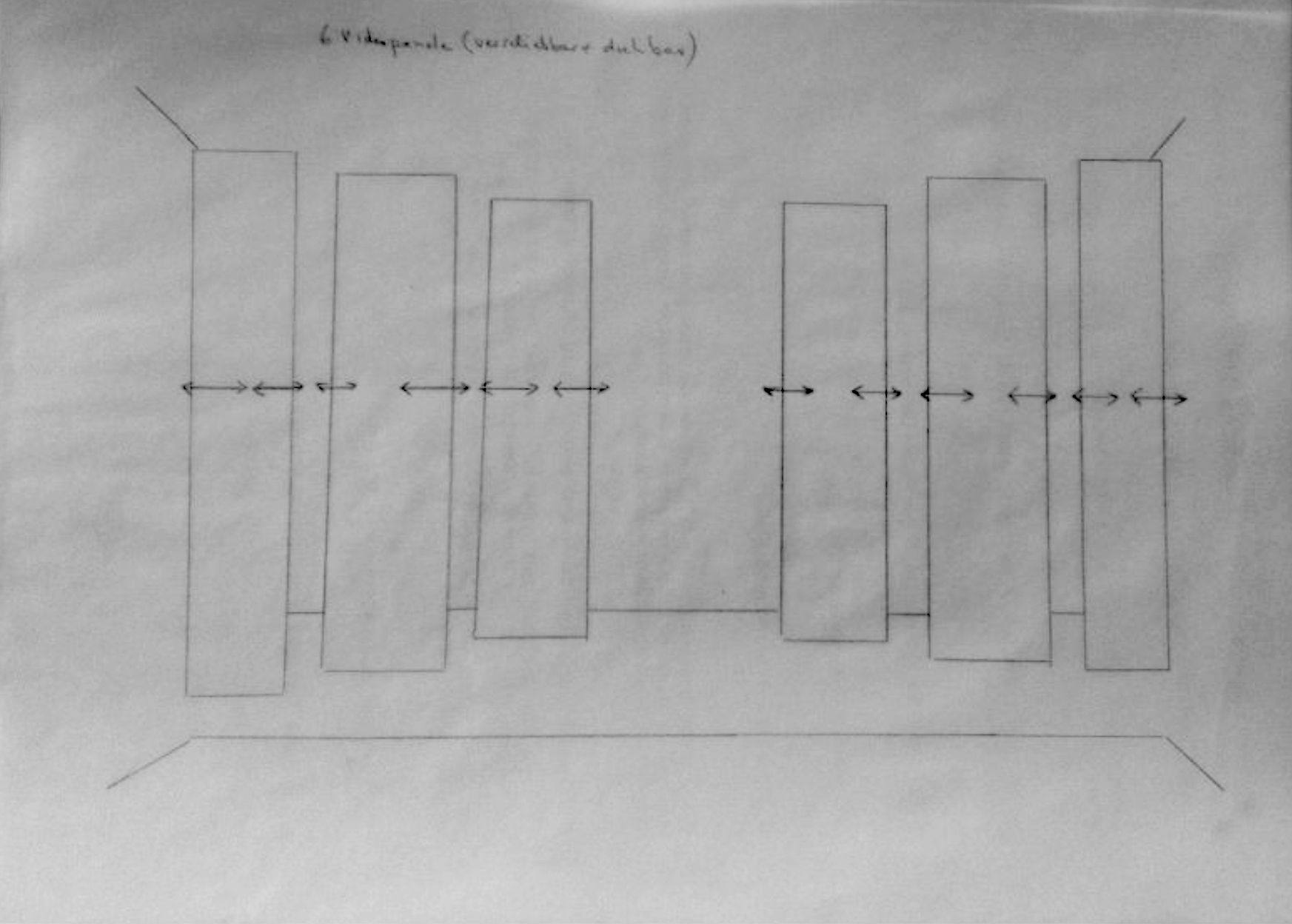
While Sheppard has noted the countertenor voice’s inexorable tendency towards archaism, in Orlando this vocal type is further mobilized to evoke its historical association with the castrato hero. The casting of the Angel, sung by a countertenor, may be read as a parodic gesture towards the operatic tradition that privileged masculine heroism onstage and male authority in biographical narrative. This not only adds a layer of androgynous ambiguity but also evokes Baroque aesthetics in sound and staging, a connection Neuwirth herself has drawn when describing the design as echoing Baroque opera traditions (see Figure 4).Footnote 32 According to the composer, the six movable video panels onstage are ‘analogous to the idea of the baroque theatre, where the impression or illusion of infinite depth and perspectives was created by backdrops and soffits’.Footnote 33 Through its ironic entanglement of archaism and gender play, Orlando crafts a temporal and vocal setting charged with parody, preparing the ground for a more radical sonic becoming.
Orlando’s stage design, with six high, movable video panels, as shown in the score.

Becoming in Orlando-Voices
It is helpful to revisit how Deleuze and Guattari conceptualize gendered vocal roles within their becoming. As previously noted, they draw on Fernandez’s critique of Verdi and Wagner, coining the terms ‘Verdi-voices’ and ‘Wagner-voices’. Yet rather than reinforcing a critique of binary-gendered vocal roles, they affirm the voice’s inherent capacity to render fluidity — even (or especially) in terms of gender. To adopt similar wording here, the term ‘Orlando-voices’ seeks to trace how voice once again animates a state of in-betweenness and the becoming of identity in an already non-gendered, ambiguous figure. My investigation begins with Neuwirth’s configuration of Orlando’s vocal lines and extends to how these lines become entangled with those of other characters, including the lover Sasha, the husband Shelmerdine, the girlfriend, and the Guardian Angel, through four duets.
A mezzo-soprano is assigned to the title role across its gender transitions from male to female. As the character resists clear categorization into male or female operatic types, Neuwirth notes ‘with a versatile voice’ next to the role in the score’s cast list, thereby accommodating the complexity of gender representations beyond the binary. Precisely by not conforming to traditional gendered vocal practices, these choices gesture back towards operatic history, layering it with subtle anachronisms. Orlando introduces an intriguing dilemma regarding cross-dressed performance: their male period can be viewed either as an allusion to or a parody of the travesti tradition, or as a gendered misalignment — a portrayal of masculinity that is rendered unstable by its mezzo embodiment. In the late eighteenth and early nineteenth centuries, concurrent with the decline of castrato, women’s lower voices (the mezzo-sopranos and contraltos) began to perform male operatic roles, either en travesti as a substitute for castrati or in designated trouser roles.Footnote 34 The former becomes the voice of the hero, whereas the latter — the pageboy type, as Heather Hadlock observes — delineates a liminal presence within opera’s increasingly gendered spheres of action. Neither fully resolves the inherent contradictions in the perception of gendered voices. Hadlock states:
Although the musico is dressed as a man, and although the libretto rarely if ever alludes to the presence of a female singer beneath the hero’s male costume, the music creates a parallel reality of pure sonority in which we cannot help perceiving her as a feminine presence. Operas with musico heroes thus work on two levels, as the spectacle and the ‘theater of voices’ are mismatched.Footnote 35
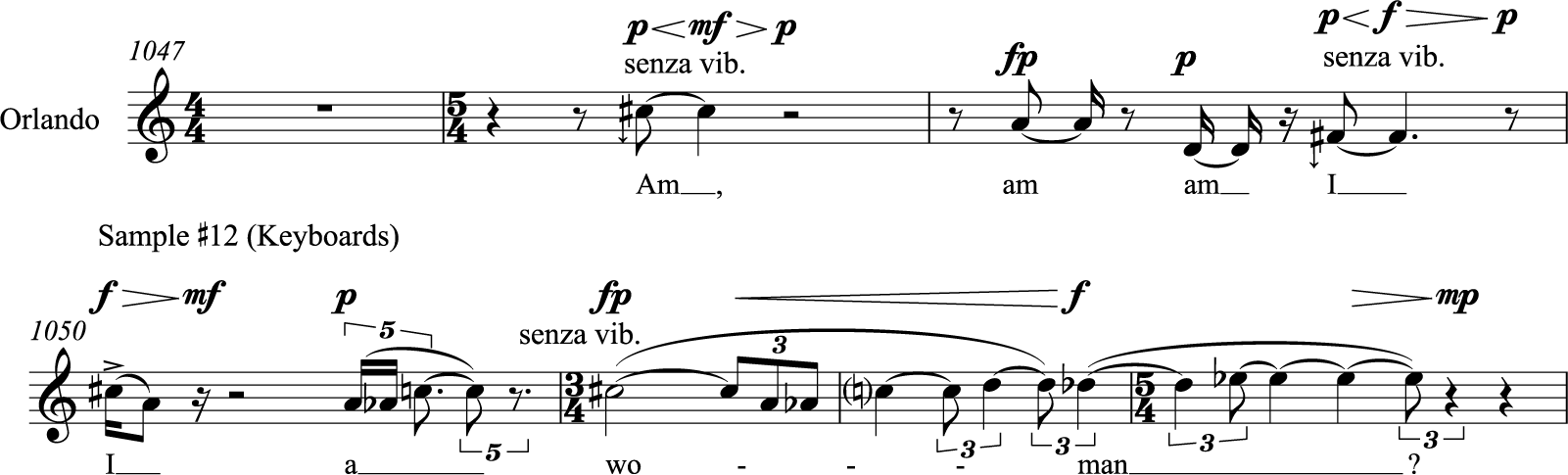
Beyond the choice of voice type, the vocal register becomes a crucial tool for Neuwirth, first grounding Orlando’s identity in a masculine register, then marking his gender transformation as the opera unfolds. Male Orlando first appears in Scene 1, for instance, with the first line, ‘I am alone’, which remains in a relatively low register for the mezzo-soprano, from G3 to C4 (Example 1a). This register continues throughout Orlando’s male period. However, Orlando shifts to the higher register immediately when they transform into a woman in the seventh scene, with the first phrase circling around C♯5 and lasting through the next few scenes (Example 1b).
Orlando, Scene 1, male Orlando, ‘I am alone’ (bars 108–14).

Example 1a. Long description
From left to right, the staff is labelled Orlando. The excerpt begins with piano (p) and senza vib. above the first note, followed by poco vib. and a crescendo to forte (f). Tuplets marked as 5 appear above groups of notes. Dynamics shift to mezzo-forte (mf), fortissimo (ff), pianissimo (pp), and alternate between mf and pp, each with corresponding tuplet brackets. Below the staff, phonetic cues are present: (a), (i), a, lone, and arrows pointing to ‘→m (stimmhaft/voiced)’ and ‘(Mund öffnen) (open mouth)’. Slurs connect note groups, and articulation marks are present. The excerpt contains both German and English performance instructions.
Orlando, Scene 7, female Orlando, ‘Am I a woman?’ (bars 1047–53).

Example 1b. Long description
At the top, the first staff labelled Orlando in treble clef, 4/4 time, begins at bar 1047. Dynamics progress from piano to mezzo-forte to piano, with crescendo and diminuendo hairpins and senza vib. above the staff. The melody includes rests, a five-note chord, and text cues A-m and a-m under notes. The second staff, labelled Sample number 12 Keyboards, starts at bar 1050, also in treble clef. Dynamics move from forte to mezzo-forte, then piano, forte-piano, and mezzo-piano, with senza vib. and slurs connecting notes. Tuplets are marked with brackets and numbers 5 and 3. The text ‘I a wo -man’ appears under the notes, ending with a question mark. All articulations, dynamics, and text are precisely placed above or below the corresponding notes.
Nevertheless, viewed through the Deleuzian lens, the transformation into a woman does not equate to the idea of becoming-woman, which thus is unable to construct Orlando’s in-between identities. The division of gender through higher and lower registers instead reaffirms a binary opposition, akin to the Verdi- and Wagner-voices critiqued by Fernandez. The illusion of a binary-gendered voice is swiftly and playfully dismantled, especially as the voice enters into dynamic relations with others. My ensuing analysis primarily focuses on the duets across the various stages of Orlando’s gender identities, with particular attention to how the opera constructs the voice as a medium for expressing and performing gender.
Duet I, Scene 3: Orlando–Sasha
The scene unfolds in the novel’s first chapter, which narrates the love triangle involving young Orlando, his fiancée, and his lover, the Russian princess Sasha. Orlando falls in love with Sasha after becoming engaged but is subsequently abandoned by her; she then elopes with a Russian sailor. In the opera, the fiancée is played by a dancer without any words or music, bringing the duet between Orlando and Sasha — the first duet in the opera — to the fore.
Set during the Great Frost of 1600, the scene, echoing the novel, opens with the year ‘1600’ projected across the video panels onstage. The duet’s text is notably abbreviated and fragmented, preventing any substantial interactions from forming. It opens with Orlando addressing Sasha as his ‘pet’, a gesture that seemingly frames Sasha’s vocal portrayal in more animalistic terms:
Orlando: Sasha! My pet.
Sasha: Your fiancée dropping everything, including herself?
(They laugh and kiss, as he takes off his ring and tosses it aside.)
O: Convention means nothing to me.
S: Take me away. I detest your English mob.
(They stop ice skating. They leave the scene, to find an intimate place.)
S: In Russia we have rivers, we gallop horses all day long without meeting a soul.
(He begins to undress her in a secluded spot, and the Narrator enters again.)
O: Your breasts, soft as snow.
S: I want to see the real parts of London.
O: Snow melt it?
S: Why don’t we ever melt it?
O: You melt me.
S: It’s still blue. No, but you will love Russia.
O: Russia you [repeat]
S: you [repeat]
O: -u melt me. Jour de ma vie. You are my first love.
S: Russia [repeat]
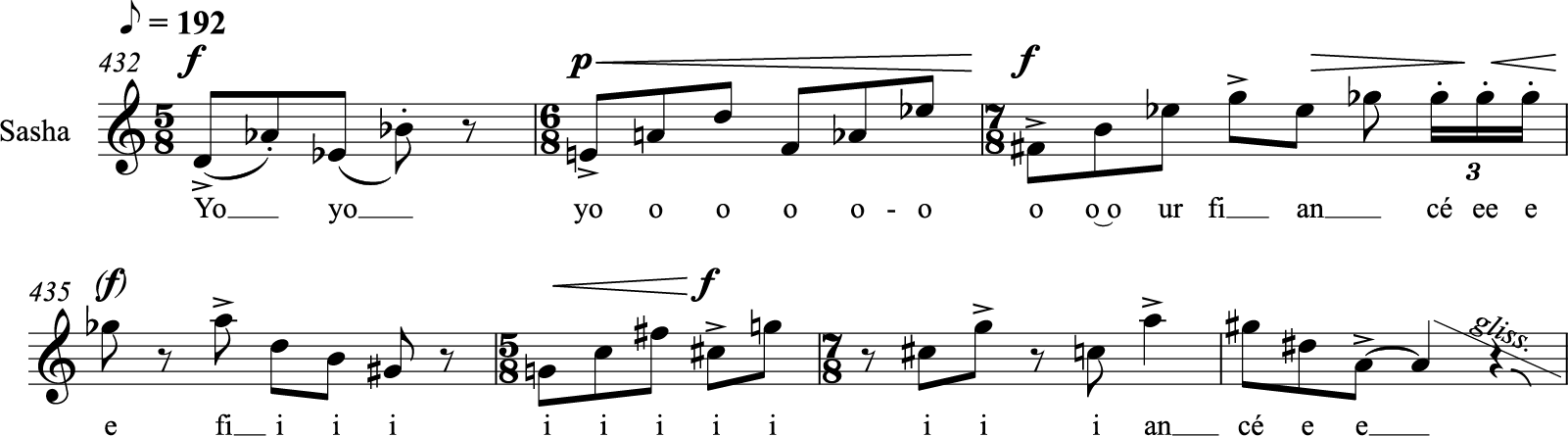
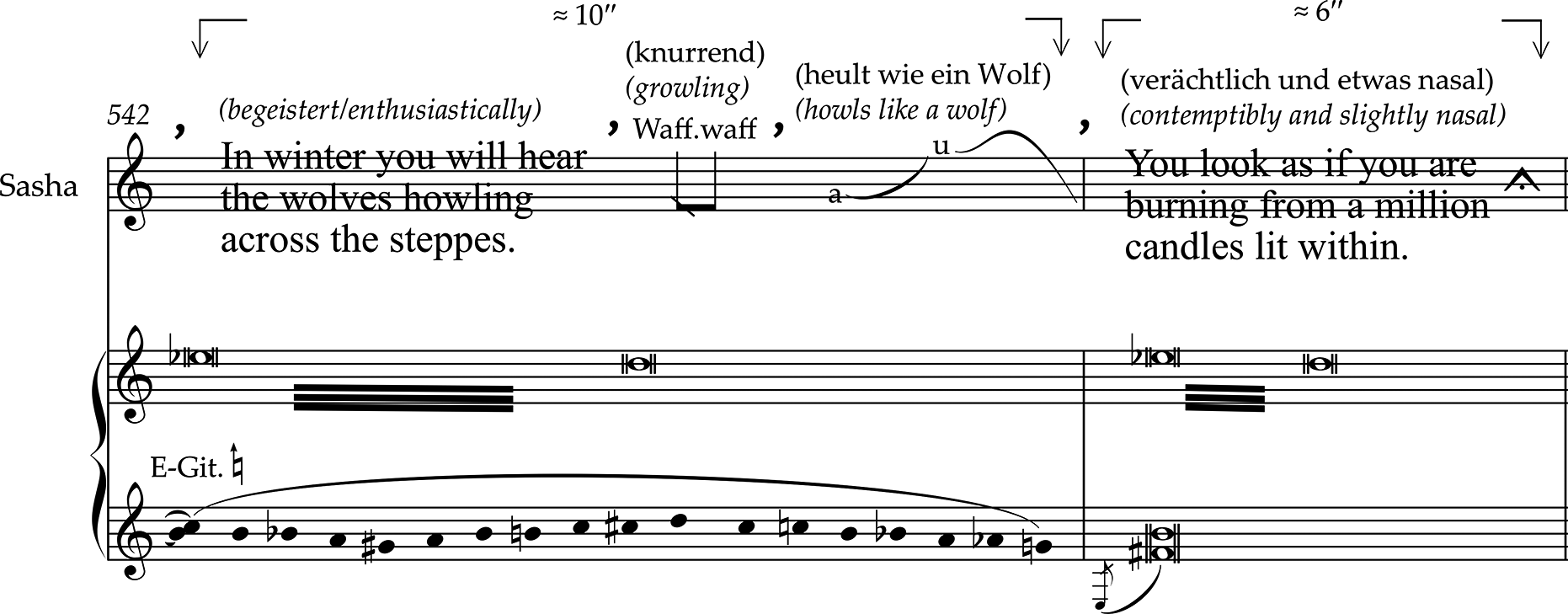
Sasha is assigned a high soprano voice: which contrasts with Orlando’s mezzo-soprano register. Her first line — ‘Your fiancée dropping everything, including herself?’ — precedes her exchange with Orlando, and is marked by continuous upward skips of perfect fourths and staccato repetitions of vowel sounds on a single high pitch (Example 2). These features produce an indistinct, fragmented, and uncanny effect, culminating in a direct imitation of a wolf’s howl (Example 3), which underscores her animalistic vocal character. Echoing Orlando’s ironic use of the term ‘pet’, these vocal features inhabit a liminal space between human and animal, and, more pointedly, between normative femininity and its disruption.
Orlando, Scene 3, Sasha ‘Your fiancée’, melodic form and vowel position (bars 432–38).

Example 2. Long description
From the left, the staff begins at bar 432 with a tempo marking of crotchet equals 192. The vocal part labelled Sasha is notated in treble clef and 5/8 time. Dynamics start forte, with accents and staccato on several notes. The melody uses flats and naturals, with slurs connecting some notes. The text underlays the notes with a series of vowels and syllables. At bar 435, the dynamic is forte with accents and a glissando at the end. Articulation includes staccato, accents, and slurs. The score contains expressive markings such as crescendo and diminuendo hairpins above the staff.
Orlando, Scene 3, Sasha ‘In winter you will hear the wolves howling across the steppes’ (bars 542–43).

Example 3. Long description
At the top, the vocal staff labelled Sasha begins at bar 542. The English text ‘In winter you will hear the wolves howling across the steppes’ is sung with the marking ‘begeistert/enthusiastically’ above. A ten-second pause is indicated, followed by ‘(knurrend) (growling) (heult wie ein Wolf) (howls like a wolf)’ and ‘Waff. waff’ above the staff, with a curved line connecting the syllables ‘a’ and ‘u’. The next phrase, ‘You look as if you are burning from a million candles lit within’ is marked ‘(verächtlich und etwas nasal) (contemptibly and slightly nasal)’ with a six-second pause indicated. Below, the electric guitar staff shows a sequence of notes and a sustained chord, mirroring the vocal line’s timing. All expressive and timing annotations are placed above the corresponding text and notes.
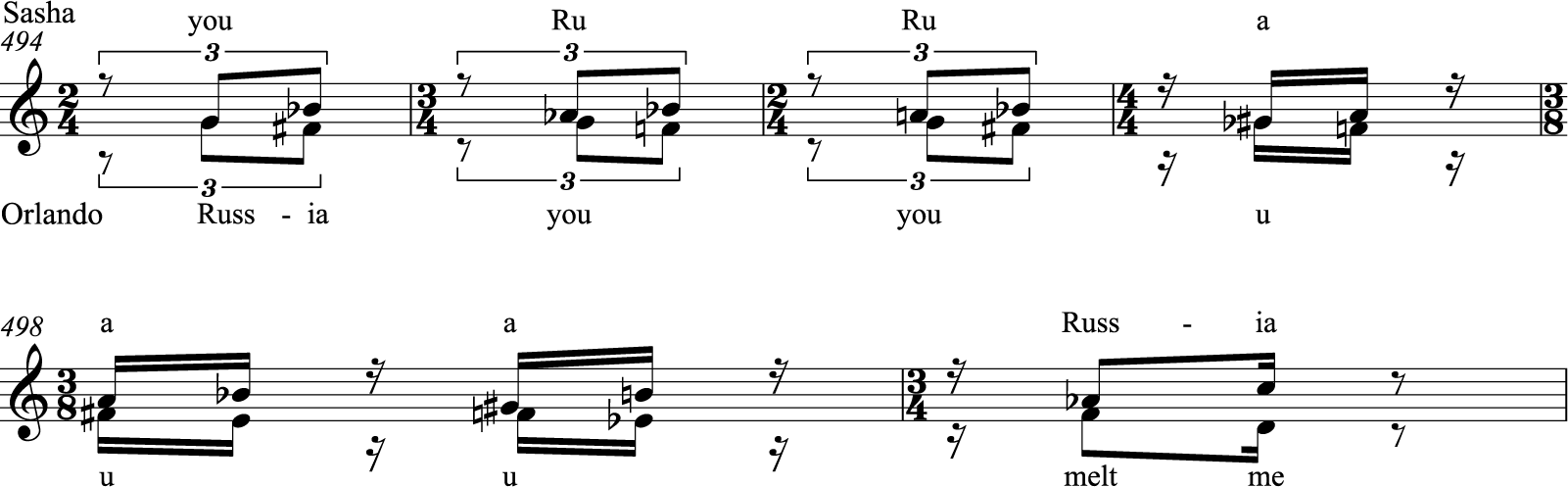
Occurring soon after Orlando’s declaration of ‘I am alone’, which asserts their male identity, as discussed earlier, the duet retains the mezzo’s lower vocal range as a sonic trace of youthful masculinity. Meanwhile, Sasha shifts from the previous higher register to the lower-middle range when she joins Orlando, singing ‘take me away’. As the duet moves from the call and response to its climax, the two melodic lines intertwine in a chromatically descending sequence, repeating the same pattern with different intervals (Example 4), with a staccato rhythm — a typical musical rhetoric of sexual arousal and pleasure. As the chromatic descent darkens the vocal texture, Orlando and Sasha repeatedly utter the phrases ‘Russia’ and ‘you melt me’ in unison, so that emotional intimacy and sexual excitement are expressed through the increasing entanglement of their voices. Compared to her earlier solo, Sasha’s high soprano voice is notably lowered, encroaching into Orlando’s register and acquiring a darker and more conventionally masculine colouring. She concludes with a prolonged shout (the score indicating she ‘laughs disparagingly’), which pushes her voice toward mockery and animalistic excess. These elements unsettle the distinction between Orlando’s mezzo and Sasha’s soprano, making gender harder to hear as a stable vocal difference.
Orlando, Scene 3, Orlando–Sasha duet (repetition omitted) (bars 494–99).

Example 4. Long description
At the top is Sasha’s staff labelled 494, with the text ‘you Ru Ru a’ above the notes. Directly below is Orlando’s staff, labelled 494, with the text ‘Russia you you u.’ Both staves use 2/4 time and contain triplet brackets over the first three bars. The next system begins at bar 498 in 3/8 time, with Sasha’s line ‘a a Russia’ and Orlando’s line ‘u u melt.’ The text is aligned vertically to indicate simultaneous singing. The notation includes accidentals such as B flat and F sharp, and rests are interspersed throughout both staves.
This instability recalls Hadlock’s account of women performing en travesti in earlier opera, in which the perception of two female voices singing together can still linger in tension with the visual and dramatic presentation of one character as male. Neuwirth draws on this historical memory, yet her use of it is ironic. The irony lies precisely in the way that operatic masculinity is constituted through the unstable alignment of gender, body, voice, and role. This is where the duet begins to sound ‘the same, but different’. The phrase, drawn from Judith Peraino, encapsulates the paradox of queer desire.Footnote 36 Here, Neuwirth stages this paradox of sameness but difference sonically: two female voices, entangled in erotic and rhythmic unison, sound strikingly alike, yet carry different gender meanings within the opera. Their duet becomes a site where sameness and difference are folded into one another rather than being opposed. Deleuze’s understanding of difference as a generative force, actualized through creative repetition, sharpens this point.Footnote 37 The repetition of phrases, intervals, and rhythms in this duet produces difference through sonic becoming.
Duet II, Scene 11: Orlando–Shelmerdine
The eleventh scene marks the start of the opera’s second half, signalled by the video timeline shifting from 1914 to 1917. The music features a distorted march rhythm, evoking the ambiance of wartime. Reminiscing about (male) Orlando’s first line in his first appearance in the first scene, female Orlando here sings ‘I am alone’ again, yet with a higher register and a melismatic style. This ornate opening embodies a stereotypical portrayal of vocal femininity. Yet as the duet unfolds, this femininity is again revealed as an untenable construction.
As in the first duet, the text provides minimal and ambiguous information; without further ado, Orlando and Shelmerdine fall in love and all dialogue ceases:
(While the war photographer, SHELMERDINE, appears with his camera, the NARRATOR watches from the side. On screen, during this scene, we see in fast succession and in overlapping colour footage and black-and-white footage of World War II warfare [sic].)
Shelmerdine: Madam, you are hurt!
Orlando: Am I dead, Sir?
O: Was that your heart ticking below the earth?
S: a——i—— earth
O: a——o——
S: a——o——
O: My name is Orlando; I’m a writer
S: My name is Shelmerdine; I take pictures
S: The Oak Tree.
O: You know all of Shelley’s works by heart
O: u——
S: You cook all your omelettes with four eggs
O: You go to Germany next
S: Germany
S: You will have my child.
O: You are a woman, Shel!
S: You are a man, Orlando!
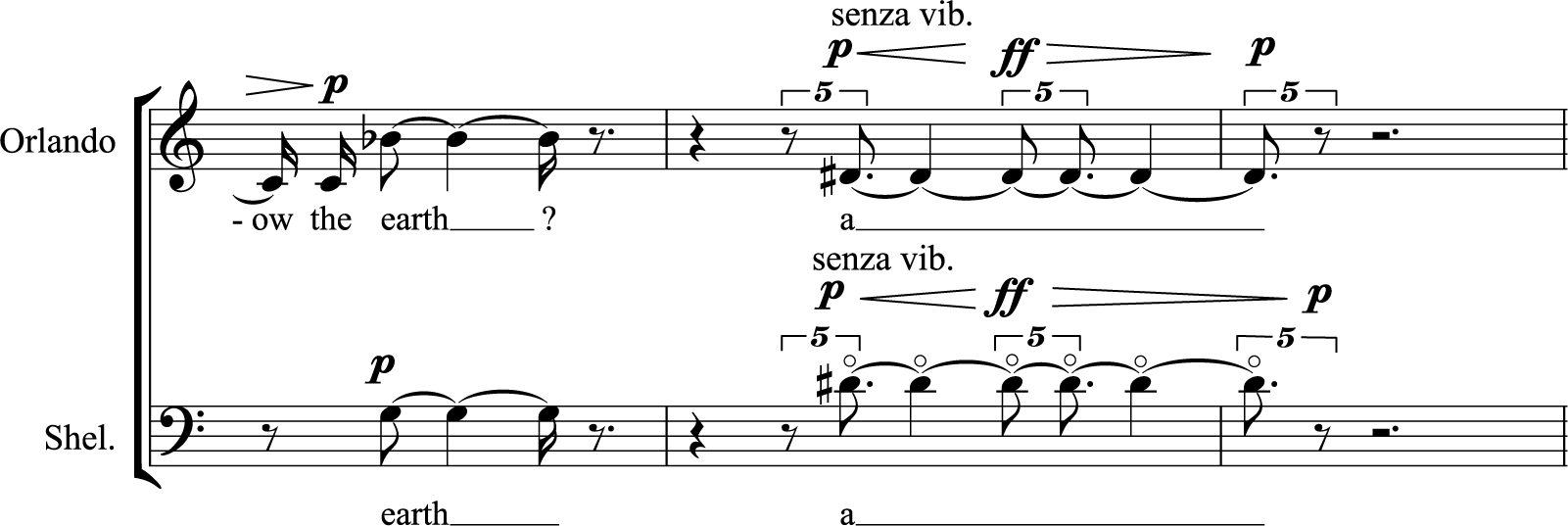
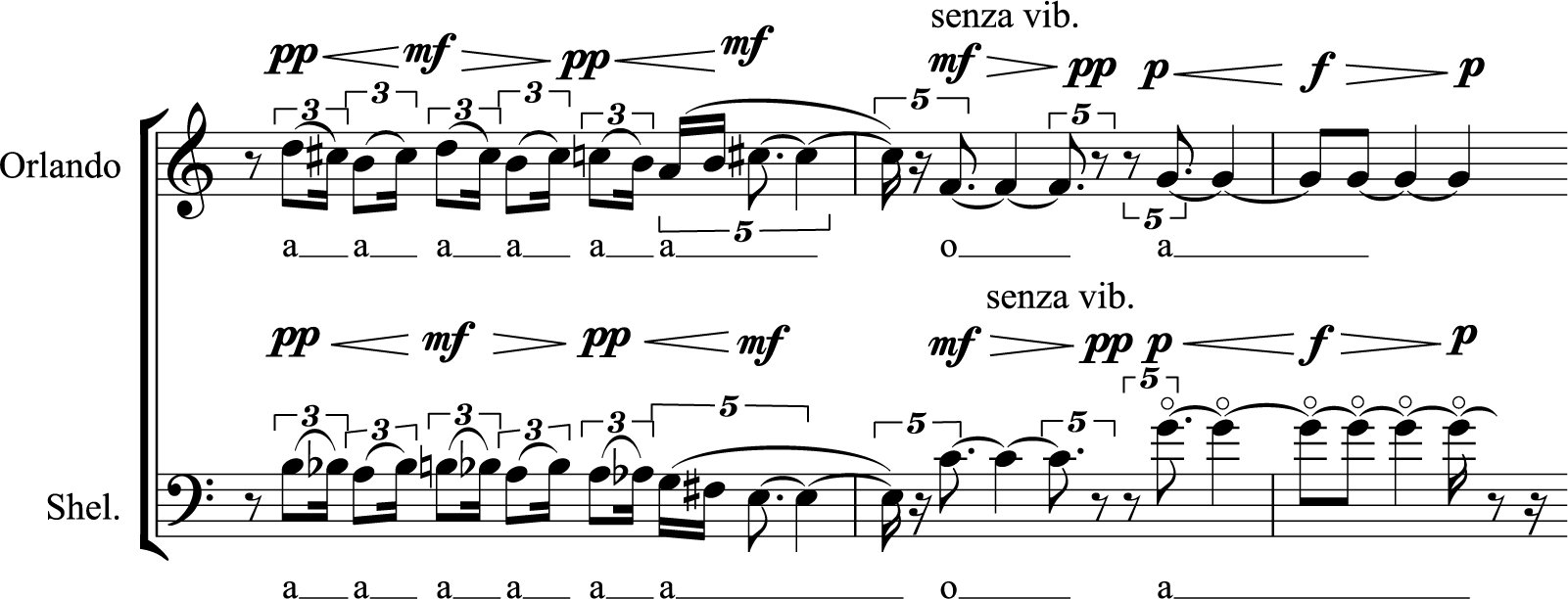
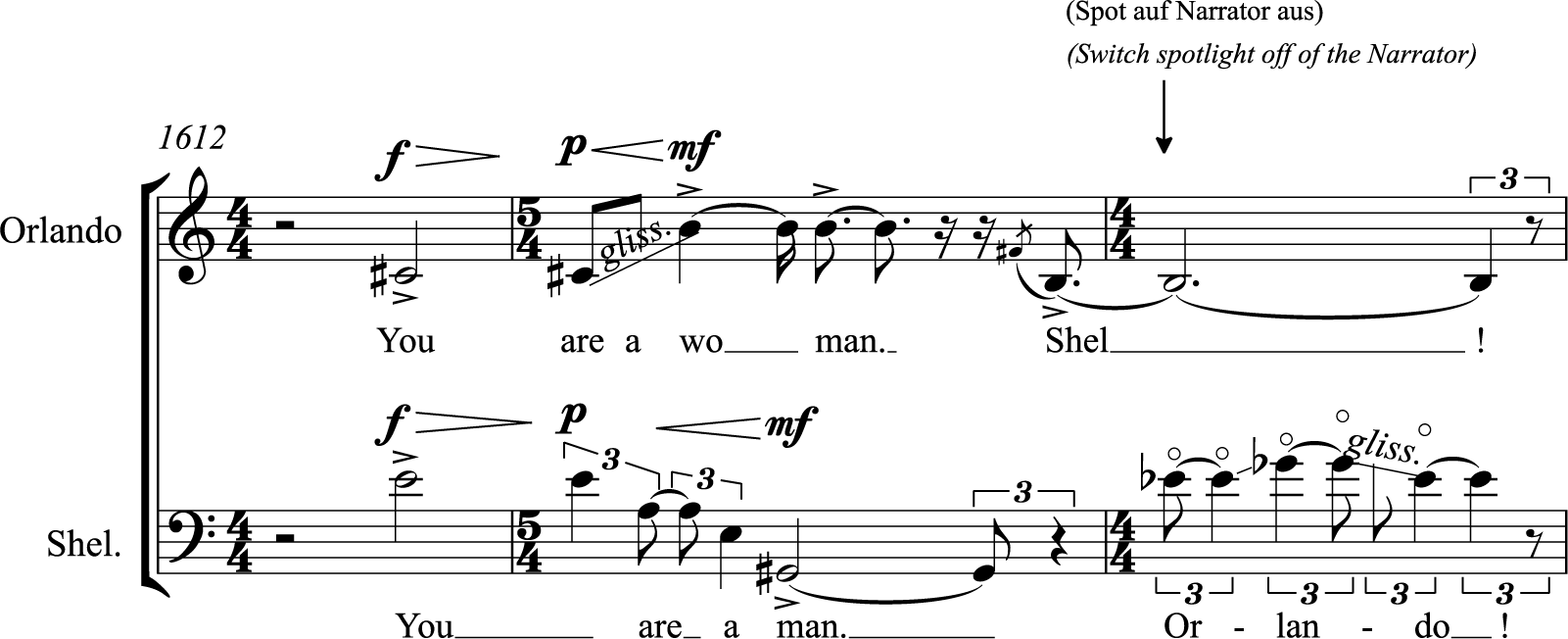
At this point, the two voices switch to unison, and they both sing without words, sustaining instead the vowels ‘a’, ‘o’, and ‘u’. As Orlando’s melodic line makes a big leap from B♭4 to D♯4 — back to the lower register of their male period — Shelmerdine simultaneously jumps to the higher register of the baritone, sustaining D♯4 in falsetto, the same note as Orlando (Example 5a, bar 1589). A bar later, their sustained note is broken by chromatic, coloratura-like material, while Orlando’s melodic line jumps back a major sixth into the ‘female register’ (Example 5b, bar 1592) and, just one bar after, back down to F4 in the low range (Example 5b, bar 1593). Shelmerdine, on the other hand, continues to ascend to the higher register, all the way to the stunning high G4 sustained in falsetto, entwined with Orlando’s range. The two then introduce themselves to each other, ending emphatically with ‘You are a woman, Shel!’ and ‘You are a man, Orlando!’ (Example 5c). At this point, the free glissando traverses both the ‘male’ and ‘female’ registers, and Shelmerdine’s ending note (E♭4) is, strikingly, a diminished fourth higher than Orlando’s B (see Example 5c, bar 1614), thereby disrupting the supposed interdependence between vocal register and gender.
Orlando, Scene 11, Orlando–Shelmerdine duet (bars 1587–89).

Example 5a. Long description
At the top, the Orlando staff is in treble clef, beginning with a piano dynamic and a crescendo hairpin. The vocal line sets the text ‘ow the earth?’ with ‘earth’ extended under a slur. Above, ‘senza vib.’ is marked, followed by a sequence of quintuplet eighth notes with dynamics p, fortissimo, and p, each under a hairpin. The Shelmerdine staff below is in bass clef, also marked piano and ‘senza vib.’ The line features a sustained note on ‘earth’ under a slur, then a quintuplet passage with the same dynamic sequence and hairpins as Orlando. Both staves show the word ‘a’ under the quintuplets. The excerpt ends with a rest in both parts.
Orlando, Scene 11, Orlando–Shelmerdine duet (bars 1592–94).

Example 5b. Long description
The top staff labelled Orlando and the bottom staff labelled Shel. Each begins with a rest. Both lines feature sequences of triplets and quintuplets, marked by brackets and numbers above the notes. Dynamics progress from pp to mf, then back to pp, with crescendos and decrescendos indicated by hairpins. The instruction senza vib. appears above both staves. In the second half, dynamics shift from mf to pp, then p, f, and p, with corresponding hairpins. The text alternates between ‘a’ and ‘o’ under the notes, aligned with the tuplets. The Shel staff mirrors Orlando’s rhythm and dynamics but includes accidentals such as B flat and F sharp. The final measures contain repeated notes and slurs, with open noteheads in Shel indicating harmonics.
Orlando, Scene 11, Orlando–Shelmerdine duet (bars 1612–14).

Example 5c. Long description
At the top, the treble staff labelled Orlando begins with the bar 1612, 4/4 time signature, and dynamic f. The vocal line reads ‘You are a wo__man’ with a glissando on ‘wo__’. Dynamics shift to p then mf. The next measure contains ‘Shel__!’ with a triplet and a slur. Above, a stage direction reads ‘(Spot auf Narrator aus)’ and ‘(Switch spotlight off of the Narrator)’. Below, the bass staff labelled Shel starts with the same time signature and dynamic f. The vocal line reads ‘You are a man’ with triplets and a glissando on ‘Or - lan - do!’, including flat accidentals and slurs. All musical and textual elements are mapped in left-to-right order.
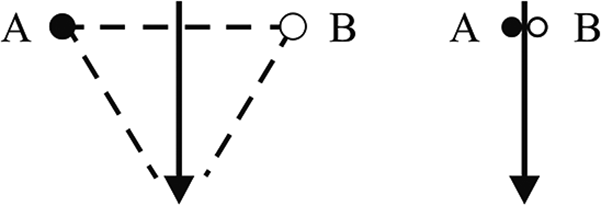
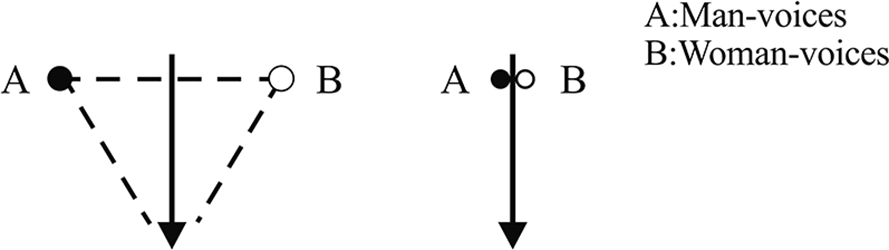
What Neuwirth seems to stage here is no longer, as in the first duet, an archly nostalgic play with cross-gendered performance conventions, but rather a genuine dismantling of the ‘correct’ man–woman love duet, performed by characters onstage who are cast appropriately to their gender. Yet, as Deleuze and Guattari remind us through their reflections on man-/woman-voices, ‘Verdi-voices’, and ‘Wagner-voices’ (voices bound to the laws of masculinity and femininity), even these conventional pairings harbour seeds of becoming. In this duet, Neuwirth exposes the voice as a restless force, tethered to the gender binary yet always poised to fracture, slip, and slip again into new forms, Thus, even as the overt textual provocations, with each character naming the other’s opposite sex, capture immediate attention, it is the voice itself, with its restless leaps and falsetto bursts, that inscribes a Deleuzian line of becoming (see Figure 5), cutting across gender’s binary codes and crystallizing into Neuwirth’s androgynous sound.
The ‘line of becoming’ between man-voices and woman-voices.

Figure 5. Long description
On the left, a dashed triangle connects a filled circle labelled A on the left, an open circle labelled B on the right, and a central vertical arrow pointing downwards. On the right, a filled circle labelled A and an open circle labelled B are joined at the top of a single vertical arrow pointing downwards. In the upper right, a legend states A is man-voices and B is woman-voices.
Duet III, Scene 14: Orlando–Girlfriend
Duet III introduces Orlando’s girlfriend, a character not found in Woolf’s novel, and transports the narrative into 1985, inaugurating a new storyline. To situate the scene firmly within 1980s queer and subcultural aesthetics, Neuwirth specifies that Orlando should appear styled after Boy George — an icon of androgyny and gender nonconformity — while the girlfriend embodies the post-punk or goth look of Siouxsie Sioux. By evoking these figures, Neuwirth not only places the opera within the queer cultural landscape of the 1980s but also aligns the visual and sonic dimensions of the duet with the broader theme of in-betweenness. Moreover, with the video referring to Derek Jarman’s The Last of England and using footage of protesters demanding the abolition of Section 28 and equal rights for gays and lesbians, Neuwirth brings the immediacy of political reality directly into the operatic space. Through the direct insertion of political video footage, she collapses this imagined distance and confronts the audience with the urgency of lived realities. At this moment, Orlando becomes not merely a figure of temporal fluidity through time travel but an emblem of queerness itself, embodying the entanglement of personal identity and political activism.
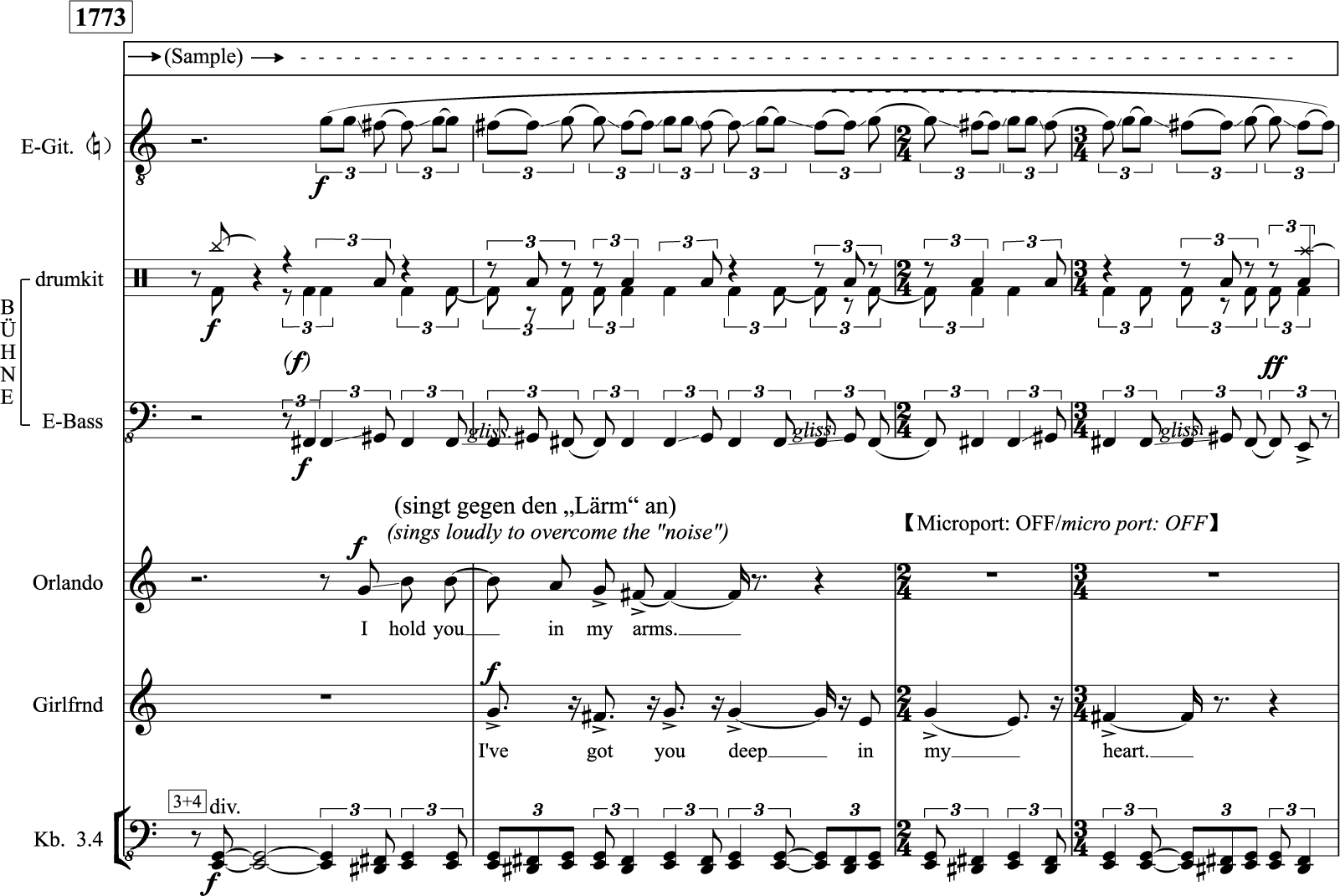
The music is also aggressive: a drum kit pounds onstage, while the orchestra shifts into a funk-inflected texture. This stylistic fusion dissolves the boundaries between the highbrow realm of opera and the idioms of funk, pop, and punk. In this scene, Neuwirth orchestrates a sonic rebellion, transforming Orlando into both a creature of time travel and a fierce emblem of queer visibility and defiance. The duet is notably short, built almost entirely on the refrain of ‘love’ and a tender, minimal exchange: ‘I hold you in my arms’ and ‘I’ve got you deep in my heart’ (Example 6). Orlando and her girlfriend sing in a pop style with microphones, in unison, accompanied by a jazz band divided between on- and offstage. Their vocal style is intentionally raw and punky, projecting loudly to assert itself against the surrounding sonic chaos. The drum kit (with only two types of timbres, bass drum and snare drum) and electric bass are placed onstage, sustaining a triplet pattern throughout without any accented beats. Offstage are the electric guitar and double bass, both played in sync with the onstage instruments. A layer of pre-recorded sample is added, integrating the jazz band into a cacophony of background sound.
Orlando, Scene 14, Orlando–Girlfriend duet (bars 1773–76).

Example 6. Long description
Fallback
By blending pop vocals and instrumentation, electronic sounds, and traditional acoustic timbres, this hybrid musical style mounts a challenge to opera’s status as a high-art genre. It calls for renewed reflection on fluid in-betweenness and androgyny in a broader cultural sense. It is also a way in which Neuwirth enacts her concept of androgynous sound:
I’ve been trying to create an androgynous sound for thirty years, ever since I started composing. By never knowing which source is coming from where: Is it traditional instruments? Is it electronics? The sounds are mixed, the instruments are not tuned to each other.Footnote 38
Such sonic hybridity creates a site of vocal becoming, where amplified, punk-inflected timbres break away from the polished vocal production heard earlier, shifting between melody and noise, and refusing to settle into fixed sonic or gendered identities — a fluidity that mirrors the characters’ visual transformations onstage. In this context, Orlando’s amplified, hybrid voice resists the disciplinary aesthetics of classical opera, challenging the audience to listen beyond both gender and genre expectations and turning Neuwirth’s androgynous sound into a musical and theatrical practice of queer fluidity and resistance.
Duet IV, Scene 18: Orlando–Guardian Angel
The penultimate scene, which hosts the final duet, does not appear in the novel (as illustrated in Figure 1). Before the duet, the scene features only three characters: Orlando, the Angel, and the narrator. In this scene, Orlando dons their final, entirely black costume. Moreover, the scene is essentially static, with no movement from the characters: Orlando sits at the centre of the stage, while the others are positioned on opposite sides. The overarching duet becomes the focal point of the scene; Orlando, the Angel, and a chorus begin by singing together polyphonically. This is followed by aria-like melismatic solo parts from Orlando and the Angel, and the duet culminates with both repeating the same phrase: ‘my brain obscured, time obscured’:
Orlando: Have more wars started today? Scream!
Angel: The wind blows. Storms scream. Scream. o_u_o_u_
Narrator: As long as woman thinks of a man, nobody objects to a woman thinking. —
Love, it is agreed by poets, is woman’s whole existence. But if we look for a moment at Orlando writing, we must admit that never was there a woman more fitted for that calling.
O: a___i can’t i___keep quiet, but i___love trees, sheep, dogs and night. But people?
Narrator: The cold breeze of the present brushes Orlando’s face. All the scenes I’ve described here […] [She clears her throat ironically:] They may lie in the future or the past. I cannot be sure. Either I am remembering or am still imagining. But Orlando is somewhere in the grid of time, a coordinate, as I am.
A: You_u_haven’t changed. Only your mind became like a forest. Openness is the soul of your nature and you have a great variety.
O: in my brain. The visible world is obscured for time.
A: variety of selves you can call upon.
O: my brain obscured. Time obscured.
A: my brain obscured. Time obscured.
O: my brain obscured. Time obscured for time […]
A: time obscured for time. Time obscured […]
At this point, Orlando and the Angel engage in a call and response, interweaving their voices and fusing mezzo and countertenor into one seamless sonic thread. As discussed earlier, the countertenor voice exemplifies Neuwirth’s idea of androgynous sound, recalling the archaic castrato voice. Similarly, the mezzo-soprano shares its register and serves as an alternative to the revival of castrato roles. Whereas the classic castrato–soprano pairing and its latent gender ambiguity quietly shadow the first Orlando–Sasha duet, where the onstage man–woman dynamic masks the reality of two female voices, hinting at a hidden same-sex desire, the final duet features mezzo and countertenor voices freed from gender assignments, embodying a far more radical fluidity and openness.
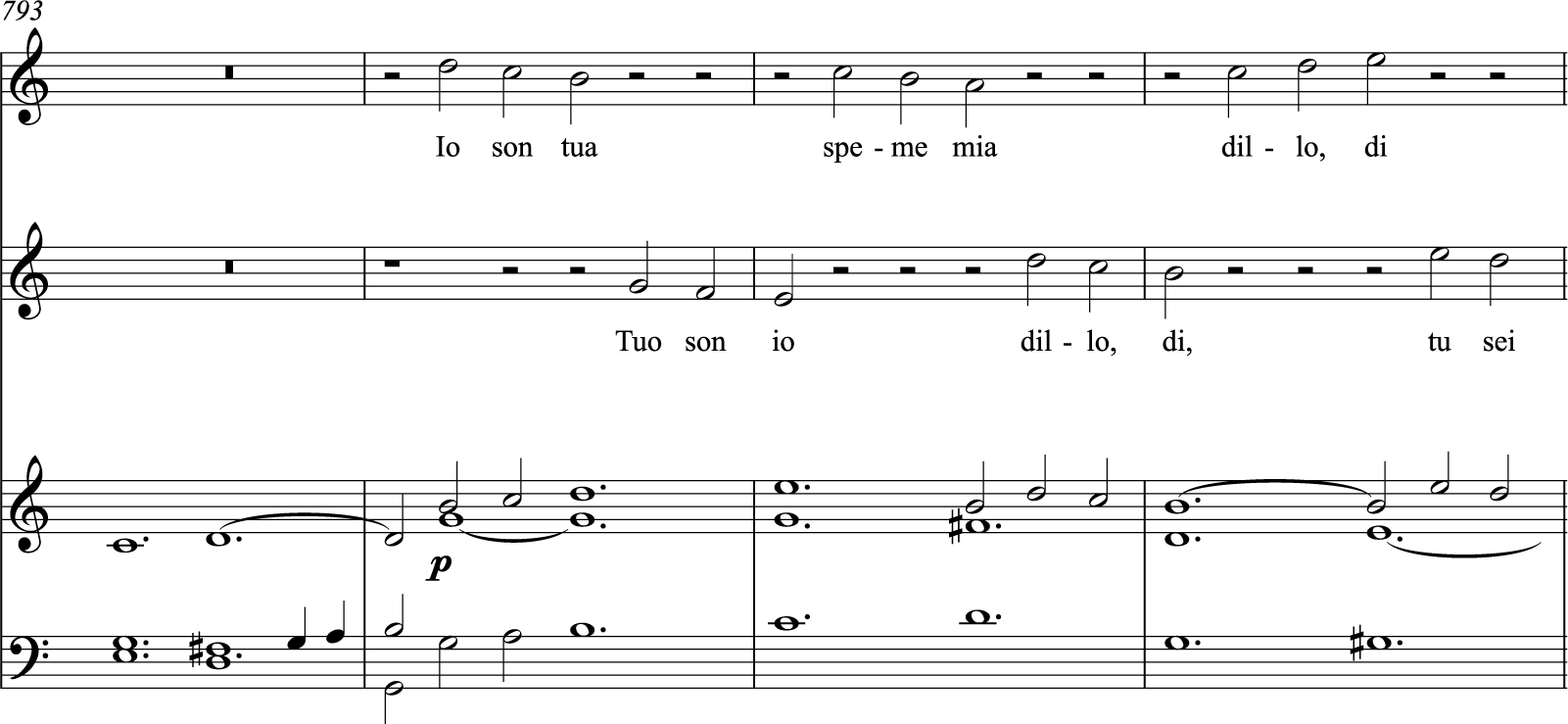
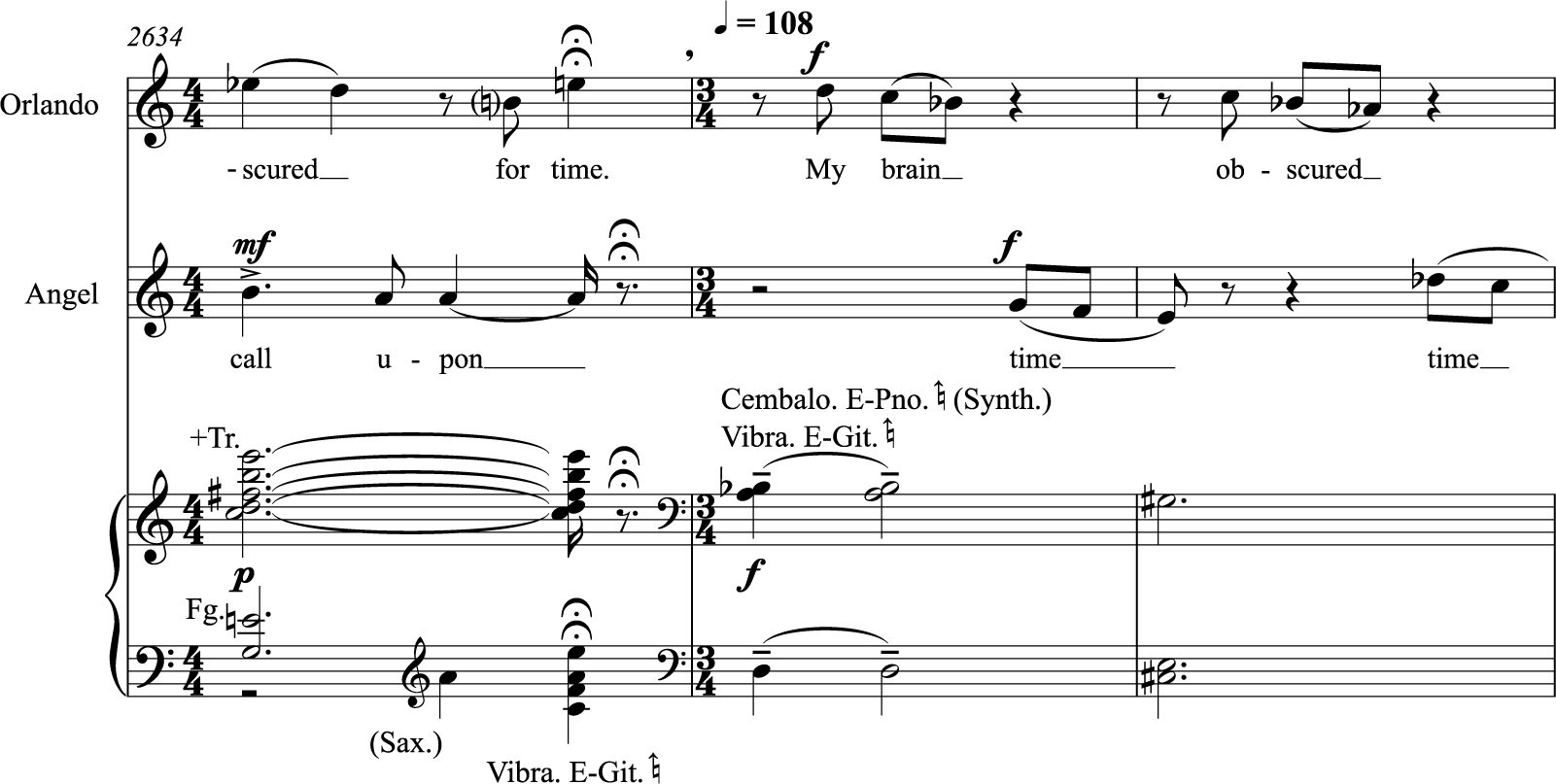
Neuwirth deliberately makes previously implicit historical tropes explicit here for the first time, through a direct allusion to Nerone and Poppea’s love duet in the finale of Claudio Monteverdi’s L’incoronazione di Poppea (1642) (Example 7a). ‘Pur ti miro’, at the conclusion of this opera, signifies the ultimate triumph of love over fortune and virtue, achieving emotional intensity and climax through its musical rhetoric. The original melody remains discernible in Neuwirth’s score, yet an eerie effect is created by the lowering of some notes. For instance, at the beginning of this section the descending triadic scale is lowered by a semitone, producing the unsettling sonority of a tritone (Example 7b). The new texts include only a few repeated phrases: ‘my brain obscured’, ‘time obscured’, and ‘humanity’. Rachel A. Lewis, in her analysis of L’incoronazione , further illustrates that gender confusion is central to the Nerone–Poppea relationship, evident in Nerone’s effeminate behaviour and Poppea’s ‘manly’ articulations — a blend of masculine ‘force’ and feminine ‘guile’.Footnote 39
L’incoronazione di Poppea , Act III, Scene 8, Nerone and Poppea duet (bars 793–96).

Example 7a. Long description
At the top, the first staff in treble clef is labeled with measure number 793 and contains the vocal line ‘Io son tua spe-me mia dil-lo, di’ with quarter and half notes. Below, the second staff in treble clef presents the second vocal line ‘Tuo son io dil-lo, di, tu sei’ with a similar rhythmic pattern. The third and fourth staves, also in treble and bass clefs, provide the instrumental accompaniment, featuring chords and harmonic support. Dynamics marking ‘p’ for piano appears in the accompaniment. The notation is in 2/4 time signature throughout, and accidentals such as F sharp are present in the bass line.
Orlando, Scene 18, Orlando–Guardian Angel duet (bars 2634–36).

Example 7b. Long description
At the top, the tempo marking equals 108 is centered above all staves. The first staff is labeled Orlando, in treble clef, with the lyrics ‘-scured for time. My brain ob-scured’ under the notes. The second staff, labeled Angel, also in treble clef, has the lyrics ‘call u-pon time time.’ Both vocal lines include dynamic markings: f for Orlando, m f and f for Angel. Below, the keyboard staff is in treble and bass clefs, with a trill (+Tr.) and chord cluster, labeled Cembalo, E-Pno., Synth., Vibra., E-Git. The lowest staff, in bass clef, is labeled Fg., with a p dynamic and a saxophone cue (Sax.). All staves are aligned vertically to indicate simultaneous performance. Bar number 2634 is at the upper left.
What is invoked here, however, extends beyond the Baroque conception of gender ambiguity, since the presence of distinctly male and female characters in Nerone and Poppea already anticipates the binary division that would become entrenched over centuries. As the first duet reminds us, although two female voices were employed there to undermine staged ‘masculinity’ and ‘femininity’, the final duet instead employs two closely matched voices that mask the fact that they actually emanate from different male and female bodies. Orlando’s and the Angel’s voices (mezzo and countertenor) are remarkably similar in timbre and range, with only subtle differences, such as the male singer employing slightly more chest voice in live performance. These nearly indistinguishable vocal timbres nonetheless emerge from performers of different sexes, corresponding respectively to Orlando’s physical body and their spiritual self. This sonic fusion signals a deeper transgression of sexual oppositions, enacted both visually and aurally. The allusion explicitly gestures towards an archaic operatic past, while the distorted melodic contour turns that past into a site in which the relations of voice, sexed body, and gendered roles can be reimagined.
Beyond merely playing with the gender–voice relationship, the blending of musical styles in this allusion further suggests a fluidity that traverses linear time and history, embodying the concept espoused by Deleuze in his analysis of Woolf’s writing techniques. Recalling Deleuze’s reference to Woolf’s Orlando quoted at the beginning of this article is instructive: for Deleuze, the novel operates not on ‘memories’ but on becoming. Similarly, Neuwirth’s evocation of Nerone and Poppea’s love duet manifests this becoming as a form of fluid continuity across temporal and stylistic boundaries. Moreover, the Narrator’s lines, blurring memory and imagination, give dramatic shape to Deleuze’s notion of becoming as an endless process that dissolves the boundaries of past, present, and identity. Thus narration itself becomes a performative act that embodies fluid subjectivity.
As the duet progresses, the Narrator joins in, stating: ‘Different as the sexes are, they are fluid./I don’t expect everyone to be able to grasp this./but we are all different.’ The term ‘different’ in the text appears paradoxical, as it follows the vocal unification of two gendered bodies, symbolic of the perceived ‘similarities’ between man and woman. But it further underscores the essence of becoming, which extends beyond merely replacing biological differences with similarities; instead, true becoming in terms of gender and identity remains in a perpetual state of in-betweenness, resisting capture by any static notion of being. In short, through the unification of the gendered body, the meaning of ‘androgynous sound’ is achieved, escaping from the ‘man-/woman-voices’ binary through the becoming. In stark contrast to the initial scenes where Orlando’s ‘man-/woman-voices’ are distinctly delineated to portray their male and female periods, the final scene presents a radical deconstruction of these binary-gendered voices. Here, the voices, liberated from any gendered assignations, embody a profound rejection of traditional gender norms, reimagining identity, voice, and history as processes of perpetual becoming..
***
While traditional vocal registers initially demarcate Orlando’s male and female periods, Neuwirth swiftly reveals the illusoriness and constructedness of this binary through her theoretical practices of ‘androgynous sound’. The ever-present countertenor voice, haunted by historically ambivalent spectres of gender, serves as an eternal companion to Orlando’s soul and catalyses a radical deconstruction of this gender dichotomy. This dissolution reaches its zenith in the four duets, each progressively dismantling the binary through the concept of the ‘line of becoming’. In Duet I, Neuwirth stages a paradox of sameness and difference as two female voices entwine in erotic unison, transforming operatic masculinity into a site of queer becoming. Duet II fractures vocal gender codes through virtuosic leaps, glissandos, and falsetto surges that refuse to settle into binary positions. Duet III shatters the operatic frame altogether, merging pop idioms, punk aggression, and political urgency to assert queer presence as both aesthetic and activist force. Finally, Duet IV dissolves boundaries entirely as mezzo and countertenor blur into a nearly indistinguishable sonority; its allusion to Monteverdi places the relations between voice, body, and gender back within operatic history, allowing them to be heard anew as historically unstable and continually becoming.
The idea of Neuwirth’s androgynous sound is further explored through these duets, enacting a sonic mode of in-betweenness and becoming. Reflections on gender ambiguity and voice converge across the writings of Woolf, Deleuze–Guattari, Fernandez, contemporary opera scholars, and, ultimately, Neuwirth’s own compositional strategies employed in Orlando, such as the countertenor’s voice and the play of vocal registers. These operatic voices transcend mere auditory experience; they metamorphose into a dynamic line of becoming. Rooted in the Deleuze–Guattarian notion of becoming-woman, this transformation symbolizes a fluid, in-between state that powerfully disrupts the established gender frameworks. Orlando’s journey, spanning four centuries, thus becomes more than a narrative: it evolves into a fierce critique of the rigid, fixed nature of the gender binary, advocating for a fluid, ever-evolving conception of gender. These duets together reimagine the interplay between gender and voice in twenty-first-century opera, revealing opera’s profound capacity not merely to reflect postmodern philosophical discourse but to invent new ways of sounding identity. Above all, operatic voices in Orlando carve out a sonic Borderland, a space where gender and identity are perpetually reborn in the act of becoming, affirming opera’s unique power to challenge, rethink, and reimagine human subjectivity in our time.