Introduction
Difficulties in performing goal-directed activities of daily living (ADL) after acquired brain injury have been interpreted as an impairment in activating action knowledge units of experienced events from semantic memory, referred to as scripts (Allain et al., Reference Allain, Gaura, Fasotti, Chauvire, Prundean, Sherer-Gagou and Remy2011; Reference Allain, Fasotti, Roy, Chauvire, Etcharry-Bouyx and De Le Gall2012; Boelen, Allain, Spikman, & Fasotti, Reference Boelen, Allain, Spikman and Fasotti2011). According to Wood and Grafman (Reference Wood and Grafman2003), scripts are managerial knowledge units stored as structured event complexes in the frontal lobes. Scripts contain a semantic dimension, including (1) central and/or distinctive actions which are essential in a script, (i.e., ‘Ask for the menu’ which can only be found in the script ‘Going to a restaurant’) and (2) trivial actions, that can be part of the script, but are not necessary and specific to the script (i.e., ‘Take off coat’ which can be found in several scripts: ‘Going to a restaurant’ or ‘Going to the movies’ scripts). Within a script, actions are structured following a sequential order, with a clear beginning and an end (Allain et al., Reference Allain, Gaura, Fasotti, Chauvire, Prundean, Sherer-Gagou and Remy2011; Reference Allain, Fasotti, Roy, Chauvire, Etcharry-Bouyx and De Le Gall2012; Boelen et al., Reference Boelen, Allain, Spikman and Fasotti2011). Wood and Grafman (Reference Wood and Grafman2003) also suggest that both the semantic and the sequential dimensions of a script are stored and activated within the prefrontal regions. Thus, damage in these areas may negatively affect script generation and, as a consequence, everyday action planning.
In order to verify Grafman's predictions, several studies (Allain et al., Reference Allain, Gaura, Fasotti, Chauvire, Prundean, Sherer-Gagou and Remy2011; Reference Allain, Fasotti, Roy, Chauvire, Etcharry-Bouyx and De Le Gall2012; Chevignard et al., Reference Chevignard, Pillon, Pradat-Diehl, Taillefer, Rousseau, Le Bras and Dubois2000; Fortin, Godbout, & Braun, Reference Fortin, Godbout and Braun2003; Godbout, Cloutier, Bouchard, Braun, & Gagnon, Reference Godbout, Cloutier, Bouchard, Braun and Gagnon2004; Zanini, Reference Zanini2008) have compared patients with frontal lobe damage to patients with posterior lesions and/or healthy controls in verbal script generation and script sequencing tasks.
Studies investigating the relation between the production of correct actions and frontal pathology have yielded mixed results. Godbout et al. (Reference Godbout, Cloutier, Bouchard, Braun and Gagnon2004) and Chevignard et al. (Reference Chevignard, Pillon, Pradat-Diehl, Taillefer, Rousseau, Le Bras and Dubois2000) found that patients with frontal lesions produced significantly less correct actions in comparison with patients with posterior lesions and healthy controls. However, other investigations have shown that patients with frontal lesions produced similar numbers of correct actions compared to healthy controls (Allain et al., Reference Allain, Gaura, Fasotti, Chauvire, Prundean, Sherer-Gagou and Remy2011; Reference Allain, Fasotti, Roy, Chauvire, Etcharry-Bouyx and De Le Gall2012; Cazalis et al., Reference Cazalis, Azouvi, Sirigu, Agar and Burnod2001; Fortin et al., Reference Fortin, Godbout and Braun2003; Godbout, Grenier, Braun, & Gagnon, Reference Godbout, Grenier, Braun and Gagnon2005; Zanini, Rumiati, & Shallice, Reference Zanini, Rumiati and Shallice2002). On the other hand, patients with frontal damage have consistently been found to produce more sequencing errors (SE) (i.e., errors in organising actions in the correct temporal order) and perseverative errors (i.e., actions repetition) in both script generation (Fortin et al., Reference Fortin, Godbout and Braun2003; Godbout et al., Reference Godbout, Cloutier, Bouchard, Braun and Gagnon2004; Zanini, Reference Zanini2008) and script sequencing tasks (Allain, Etcharry-Bouyx, & Le Gall, Reference Allain, Etcharry-Bouyx and Le Gall2001; Zalla et al., Reference Zalla, Sirigu, Pillon, Dubois, Grafman and Agid1998; Zanini et al., Reference Zanini, Rumiati and Shallice2002). In summary, the above mentioned studies showed a consistent relation of anterior pathology with deficits in script sequencing, but not with the total number of correct actions produced in verbal script generation.
These conflicting results can be attributed to several factors, among which the use of different types of multistep activities, the number of actions included in the scripts, the presence or absence of headers, the degree of the familiarity of the required actions and the low power of the majority of the studies. In the Cazalis et al. (Reference Cazalis, Azouvi, Sirigu, Agar and Burnod2001) study, for example, there were differences between patients with TBI and healthy controls in the number of actions produced in novel and non-routine tasks, but these differences did not reach significance because the study was underpowered, with only 12 patients and 12 controls. On the contrary, Chevignard et al. (Reference Chevignard, Pillon, Pradat-Diehl, Taillefer, Rousseau, Le Bras and Dubois2000), Fortin et al. (Reference Fortin, Godbout and Braun2003) and Godbout et al. (Reference Godbout, Cloutier, Bouchard, Braun and Gagnon2004) used a larger number of script tasks, each including numerous actions. These studies showed a significantly poorer action generation in TBI patients compared to posteriorly lesioned patients and healthy controls.
Furthermore, in some of these studies, patient groups with other lesions were used (Allain et al., Reference Allain, Fasotti, Roy, Chauvire, Etcharry-Bouyx and De Le Gall2012; Cazalis et al., Reference Cazalis, Azouvi, Sirigu, Agar and Burnod2001) and only a few included patients with well-selected anterior lesions (e.g., Zanini et al., Reference Zanini, Rumiati and Shallice2002). The patients included in the study of Cazalis et al. (Reference Cazalis, Azouvi, Sirigu, Agar and Burnod2001), for instance, suffered diffuse axonal injury without any focal cortical damage. On the contrary, patients in the studies of Chevignard et al. (Reference Chevignard, Pillon, Pradat-Diehl, Taillefer, Rousseau, Le Bras and Dubois2000), Fortin et al. (Reference Fortin, Godbout and Braun2003) and Godbout et al. (Reference Godbout, Cloutier, Bouchard, Braun and Gagnon2004) had focal cortical lesions, which may explain their more extensive deficits. However, even with well-selected patients, the latter studies were also underpowered due to small study samples. For example, Fortin et al. (Reference Fortin, Godbout and Braun2003) used only nine frontal and one dubious (only ‘suspected’ frontal damaged) patient. Similarly, only a few patients with well-selected anterior lesions were included in the Godbout et al. (Reference Godbout, Grenier, Braun and Gagnon2005) study. In the Zanini (Reference Zanini2008) study in which the highest number of anteriorly damaged patients (nine) was compared to nine healthy controls, a mean difference of about 12 generated actions between the two groups (p > .09) in favour of healthy controls was found in novel and non-routine scripts. Here also, no significant differences were found, seemingly due to the small samples investigated.
Thus, former studies were generally underpowered, including either small number of well-selected patients with focal frontal damage or mixed groups with diffuse injuries or groups with more extensive damage, e.g., patients with Huntington disease in the Allain et al. (Reference Allain, Fasotti, Roy, Chauvire, Etcharry-Bouyx and De Le Gall2012) study. Therefore, we have tried to select a substantial number of patients with verified anterior lesions (30 patients). The main goal of the present study was to examine whether there is a relation between script generation and anterior damage. For this purpose, we studied (verbal) script generation in 30 patients with focal anterior lesions, 22 patients with lesions in the posterior regions and 29 healthy controls. We also verified that patients included in our study had executive difficulties in everyday life. The verbal script tasks that we used were all derived from the Everyday Description Task (EDT; Dritschel, Kogan, Burton, Burton, & Goddard, Reference Dritschel, Kogan, Burton, Burton and Goddard1998). The EDT includes eight open, free-response script tasks in which the participants have to describe how they would perform ADL. Each of these activities represents a set of familiar actions-steps and the sequential ordering of these actions is asked. We expected our patients with focal brain damage to show more difficulties in generating verbal scripts compared to healthy controls and that patients with anterior lesions would produce significantly less correct actions than patients with posterior lesions. Deficits in verbal script generation may indicate difficulties in action planning and therefore contribute to an accurate detection and management of such impairments in patients with brain damage. Additionally, the script tasks used in the present study were assessed with a well-investigated scoring method (Allain et al., Reference Allain, Gaura, Fasotti, Chauvire, Prundean, Sherer-Gagou and Remy2011; Boelen et al., Reference Boelen, Allain, Spikman and Fasotti2011) aimed at identifying different kinds of relevant and irrelevant actions (and errors).
Moreover, only a limited number of studies have explored the relation between scores on executive tests and script generation performance (Allain et al., Reference Allain, Gaura, Fasotti, Chauvire, Prundean, Sherer-Gagou and Remy2011; Boelen et al., Reference Boelen, Allain, Spikman and Fasotti2011; Godbout et al., Reference Godbout, Grenier, Braun and Gagnon2005; McWilliams & Schmitter-Edgecombe, Reference McWilliams and Schmitter-Edgecombe2008). These studies have revealed significant correlations between: (1) errors on the Trail Making Test, the Modified Card Sorting Test, the Stroop Test and SE (Allain et al., Reference Allain, Gaura, Fasotti, Chauvire, Prundean, Sherer-Gagou and Remy2011), (2) poor performances on the category fluency task (representing semantic memory deficits) and SE (Allain et al., Reference Allain, Gaura, Fasotti, Chauvire, Prundean, Sherer-Gagou and Remy2011; McWilliams & Schmitter-Edgecombe, Reference McWilliams and Schmitter-Edgecombe2008), (3) global executive test performance and script execution (e.g., preparing a meal) (Godbout et al., Reference Godbout, Grenier, Braun and Gagnon2005) and (4) global executive test performance and total error score (sequencing and perseverative errors, and irrelevant intrusions (IRI)) in verbal script generation tasks (the EDT; Boelen et al., Reference Boelen, Allain, Spikman and Fasotti2011; Dritschel et al., Reference Dritschel, Kogan, Burton, Burton and Goddard1998). Thus, our second goal was more explorative, that is, to determine the specific executive processes that predict performance in script tasks. Our hypothesis was that successful performance in script generation tasks would demand the integration of multiple aspects of executive functioning.
Methods
Participants
Fifty-two patients took part in this study. Forty-one were in treatment at the ‘Anagennisi’ Rehabilitation Centre in Nea Redestos, Thessaloniki, Greece and 11 were recruited from the neurosurgery department of the Saint Lukas Clinic in Panorama, Thessaloniki, Greece. All these patients and the 29 healthy control subjects included in this study had already participated in one of our previous studies (Emmanouel, Kessels, Mouza, & Fasotti, Reference Emmanouel, Kessels, Mouza and Fasotti2014).
Patient Selection Criteria
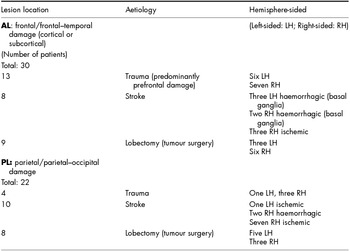
All patients (30 male/22 female) had documented brain injuries verified by CT and/or MRI-scans. Thirty patients with anterior lesions were included in our study, of whom the majority (13) had suffered traumatic brain injury with identified cerebral contusions and subdural haemorrhage. These patients had primary frontal dysfunctions, also including a disconnection of the prefrontal regions from other anterior cortical or subcortical areas or combined damage to these anterior brain areas (fronto-temporal cortical or anterior subcortical damage). The rest of the patients included in this group were eight patients with stroke and nine patients with a history of surgically resected anterior tumours. Twenty-two patients with focal posterior lesions (parietal/occipital cortical damage mainly due to stroke and focal tumours after lobectomy) were also selected to participate in this study. All patients were at least 6 months post-onset when assessment took place (time since injury ranged from 6–46 months, M = 11.5 months, SD = 8.508). Table 1 shows the distribution of the patient groups according to lesion location and aetiology.
Lesion Location and Aetiology

Note: AL=Anterior Lesion; PL= Posterior Lesion.
Beside the lesion location criterion, all patients with anterior and posterior lesions had executive difficulties in everyday life and during therapy sessions, as ascertained by their therapists (physiotherapists and speech-therapists), using a Greek translation of Spikman's Checklist of Executive Disorders (Spikman, Reference Spikman2002). This Checklist is a structured interview, screening several cognitive, awareness and psychosocial executive problems in real-life situations.
Exclusion Criteria
Patients with neurodegenerative disorders, severe psychiatric problems, severe verbal, sexual or aggressive disinhibition, severe abulia and anosognosia (lack of awareness of deficit), severe aphasia, severe hemi-inattention and a history of substance abuse were excluded from the study. Patients were also excluded if they had severe learning difficulties and long-term memory problems.
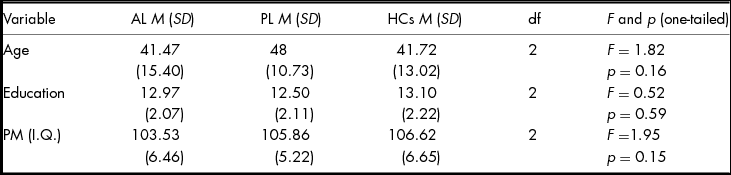
Mean Scores and SDs, as well as statistical tests for demographic data and IQ are presented in Table 2. No significant group differences were found between patients with anterior lesions, patients with posterior lesions and healthy controls with respect to age (ranging from 18–61 years), educational level (ranging from 9–17 years) or general intellectual ability, based on the participants’ performances on Raven's Standard Progressive Matrices. Also, the same groups’ performances did not differ in a set of memory and language tests (for details of these measures, see Emmanouel et al., Reference Emmanouel, Kessels, Mouza and Fasotti2014).
Mean Scores (+SD), Results of Parametric One-Way ANOVAs (One-Tailed) for Variables of Group Differences in Demographic Data and Estimated I.Q. for Patients with Anterior Lesions (n = 30), Patients with Posterior Lesions (n = 22) and Healthy Controls (n = 29)

AL: patients with AL lesions, PL: patients with posterior lesions, HCs: Healthy Controls.
Assessment of Executive Function
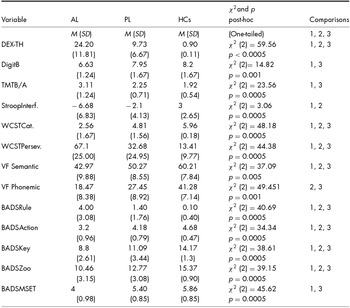
Executive functions were assessed using 12 executive test variables, previously found to be sensitive to anterior brain damage (Alvarez & Emory, Reference Alvarez and Emory2006; Emmanouel et al., Reference Emmanouel, Kessels, Mouza and Fasotti2014; Stuss & Alexander, Reference Stuss and Alexander2000; Stuss & Levine, Reference Stuss and Levine2002; Stuss, Floden, Alexander, Levine, & Katz, Reference Stuss, Floden, Alexander, Levine and Katz2001; Stuss et al., Reference Stuss, Alexander, Hamer, Palumbo, Dempster, Binns and Izukawa1998; Reference Stuss, Levine, Alexander, Hong, Palumbo, Hamer and Izukawa2000; Wilson, Alderman, Burgess, Emslie, & Evans, Reference Wilson, Alderman, Burgess, Emslie and Evans1996). A therapist's version of the DEX-Questionnaire (DEX-TH; Wilson et al., Reference Wilson, Alderman, Burgess, Emslie and Evans1996) was also administered. Among these executive measures (see Table 3 for details), the Stroop interference score was calculated as the ratio of the total number of coloured stimuli named in Condition III (colour hues printed as competing colour words, within 45 seconds) to the colours named in Condition II (colour hues printed as XXX, also within 45 seconds), in a fixed order for all the three Stroop conditions, according to Golden's (Reference Golden, Espe-Pfeifer and Wachsler-Felder2000) scoring method. With respect to the Verbal Fluency Test, a Greek version was used (Kosmidis, Vlachou, Panagiotaki, & Kiosseoglou, Reference Kosmidis, Vlachou, Panagiotaki and Kiosseoglou2004). Table 3 also shows the means and SDs of the executive variables, along with the results of post-hoc multiple (pair-wise) comparisons (following one-way ANOVAs and Kruskal–Wallis tests).
Mean raw Scores (+SD) Results of Mann–Whitney U Tests (Two-Tailed) Post-Hoc Multiple Comparisons between the HCs and the Patients with AL, Between HCs and the Patients with PL and between the Two Patient Groups After Statistically Significant Kruskal–Wallis Differences in the Executive Variables, Bonferroni Adjustment α = .017

AL: anterior lesions; PL: posterior lesions; HCs: Healthy Controls; DEX-TH: DEX-reporting scales of patients’ therapists; DigitB: the Digit Span Backward; TMT B/A: ratio of time to complete part B compared to the time to complete part A of the TMT; StroopInterf: the Stroop interference score; WCSTCat: the WCST total number of categories completed; WCSTPersev: the WCST total number of perseveration errors; VFSemantic: the total number of words produced in the Semantic part (Categories) and VF Phonemic: the total number of words produced in the Phonemic part (Letters); BADSRule: the total number of errors on the Rule Shifting subtest; BADSAction: the BADS Action Program raw score; BADSKey: The BADS Key Search raw score; BADSMSET: the BADS Modified Six Elements Test raw score.
1 : HCs significantly better than AL (all z > −3.13, all p < .002, effect sizes r = .34–.71).
2 : HCs significantly better than PL (all z > −2.43, all p < .011, r = .28–.43).
3 : AL significantly worse than PL (all z > −2.43, all p < .015, r = .25–.49).
Procedure
All the executive tests were administered by the clinical neuropsychologist-examiner of this study, in three or more 4-hour assessment sessions and in a fixed order of administration, that is, first Spikman's Executive Checklist and then the executive tests and the DEX-TH followed by the Greek translation of the EDT (Dritschel et al., Reference Dritschel, Kogan, Burton, Burton and Goddard1998).
Measures
Everyday Description Task (EDT)
The EDT is a free-response verbal script generation task that consists of eight questions, requiring participants to tell how they would perform ADL (see Table 4). Participants were asked to verbally express the sequence of actions corresponding to each activity in the correct order. The eight activities were presented in the same order to all subjects. The participants were not prompted to continue when they stopped. Subjects’ responses were audiotaped, then written out and scored.
The Eight Scripts of the Everyday Description Task

EDT Scoring
All the responses of the 29 healthy controls on the eight scripts were scored based on the criteria established by Boelen et al. (Reference Boelen, Allain, Spikman and Fasotti2011) and Allain et al. (Reference Allain, Gaura, Fasotti, Chauvire, Prundean, Sherer-Gagou and Remy2011). The first step in scoring the actions generated by the healthy control group was to establish a script corpus (i.e., a standard list of sequential actions for each script, expressing agreement about the actions named by healthy subjects). The inclusion of an action in the script corpus was based on a pre-set criterion percentage of minimally 18% of healthy controls mentioning the action. Next, actions were classified as major steps if they were mentioned by at least 60% of the healthy controls, minor steps if they were mentioned by 40–59% of the healthy controls, or trivial steps if they were mentioned by 18–39% of the healthy controls. Thus, major actions were considered to be the most central features to the theme or goal of each of the scripts (e.g., ‘booking/making a reservation’ in the ‘take a trip with friends’ script). Minor actions were considered to be less critical than major actions, but still representative script features of the target activity (e.g., ‘booking rooms/tickets through internet’ or ‘call/go to a travel agency to arrange everything’ in the ‘take a trip with friends’ script). Major and minor actions together constituted the relevant central actions (RCA) of a script. Trivial actions were relevant script features estimated to be peripheral to (but still a part of) the target activity (e.g., ‘Take into consideration the weather conditions in order to organise the trip’ in the ‘take a trip with friends’ script). Evoked actions that did not reach the minimal frequency of 18% were characterised as intrusions. Relevant intrusions (RI) were part of a script (e.g., ‘Use a ladder to reach the wall and paint it’ in the ‘paint a room’ script). IRI did not belong to the script (e.g., ‘choose a colour that matches with the colours of other rooms’ in the ‘paint a room’ script) and were scored as errors. Moreover, perseverations (PE) (i.e., actions repeated within the same script) and SE (i.e., errors in the logical sequence of the script, e.g., booking hotel rooms without firstly selecting the exact place/time/date in the ‘take a trip with friends’ script) were also scored as errors.
Composite Executive Function Variables
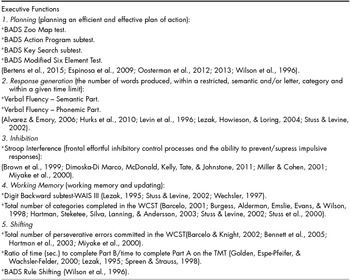
Five z-composite executive function variables were created based on the z-values of individual executive test measures. Lesion and factor-analytic studies have shown that these composite variables represent five basic executive (sub) domains (Alvarez & Emory, Reference Alvarez and Emory2006; Bennett, Ong, & Ponsford, Reference Bennett, Ong and Ponsford2005; Espinosa et al., Reference Espinosa, Alegret, Boada, Vinyes, Valero, Martinez-Lage and Tarraga2009; Miyake, Friedman, Emerson, Witzki, & Howeter, Reference Miyake, Friedman, Emerson, Witzki and Howeter2000; Oosterman, Osterveld, Rikkert, Claassen, & Kessels, Reference Oosterman, Oosterveld, Rikkert, Claassen and Kessels2012; Oosterman, Wijers, & Kessels, Reference Oosterman, Wijers and Kessels2013; Stuss & Levine, Reference Stuss and Levine2002; Stuss et al., Reference Stuss, Floden, Alexander, Levine and Katz2001). Before grouping, z-scores with negative valence were reversed, so that higher z-composite scores all represented better performance. Table 5 illustrates the five composite executive domains investigated in this study and their component test variables.
The Five Composite Executive Function Variables Explored in this Study and Their Individual Components

Note: The number of categories obtained in the Normal WSCT 128 administration of the task, has been significantly related to intact frontal lobe function as patients with frontal lesions have been found to attain significantly lower categories than non-frontal patients (Stuss et al., Reference Stuss, Levine, Alexander, Hong, Palumbo, Hamer and Izukawa2000).This lower number of categories obtained by patients with frontal lesions can be attributed to their limited working memory capacities in terms of their impairment in conceptualising and retaining for a period of time a string of sorts/categories in order to complete the tasks (Stuss et al., Reference Stuss, Levine, Alexander, Hong, Palumbo, Hamer and Izukawa2000). The retention of this string and the avoidance of perseverations related to criterion/category (differentiated from perseverations of preceding responses) imply good working memory capacities.
Statistical Analyses
First, all the data derived from the six EDT variables, i.e., the RCA of a script, the relevant trivial actions (RTA), the RI and IRI as well as the PE and SE were tested for normality with Shapiro–Wilk's tests. All the EDT variables were found to be skewed, except for the RCA. All the skewed variables were transformed using square transformation (x a), whereas for positively skewed variables, a square root transformation was used (Clark-Carter, Reference Clark-Carter1997). Even after transformation, all these variables remained skewed.
Due to the relatively high number of TBI patients (n = 13) in the group with anterior lesions in comparison with the posterior lesion group (n = 4), we performed subgroup analyses on the six EDT variables. For this purpose, parametric t-tests (for the normally distributed RCA) and non-parametric Mann–Whitney U-tests were computed to compare the TBI subgroup with the other patients (n = 13 vs. n = 17) within the group with anterior brain damage.
Afterwards, with respect to our first goal, parametric one-way ANOVAs (for the normally distributed RCA variable) and non-parametric Kruskal–Wallis tests (for the rest of the EDT variables) were used, to examine whether there were significant differences in EDT scores among the three participant groups. To investigate which of the six EDT measures discriminated between group differences (i.e., patients with anterior lesions vs. healthy controls, patients with posterior lesions vs. healthy controls and patients with anterior lesions vs. patients with posterior lesions), further multiple post-hoc comparisons were conducted using parametric two-tailed Dunnett's t-test (after significant one-way ANOVAs, p < .01) and two-tailed Mann–Whitney U tests (after significant Kruskal–Walllis differences, p < .01). Bonferroni correction (set at .017) was used to control for Type 1 errors across pair-wise comparisons. Effect sizes were computed for parametric Dunnett's t-test using η2 ρ and non-parametric post-hoc Mann–Whitney comparisons using an approximate value of r. This r value was calculated by dividing the value of z in the Mann–Whitney test by the square root of n (Field, Reference Field2005). The effect sizes were estimated according to Cohen's (Reference Cohen1988) criteria (.1 = small, .3 = medium, .5 = large). Our aim was to investigate which EDT variables were sensitive to brain damage and successively which EDT variables were indicative for anterior pathology. Therefore, stepwise regression analyses with the two patient groups were carried out. To explore which of the EDT measures would predict group membership (anterior vs. posterior damage), we used the Forward Selection: LR method with entry testing-based on the significance of the score statistic.
With regard to our second goal, six non-parametric Spearman ρ correlations (level of significance p = .01) were calculated for each of the six EDT variables expressed in z-values and the five z-composite executive test variables representing ‘Planning’, ‘Response generation’, ‘Working Memory’, ‘Inhibition’ and ‘Shifting’). The z-values of the EDT variables with negative valence (i.e., the RI and IRI, PE and SE), were reversed for the correlation analyses, so that all scores were in the same direction (with higher scores representing better performance). p-value (set at .00167) and effect sizes (ρ2 ) were also adjusted.
Finally, multiple linear regression analyses were conducted in order to investigate the impact of the five executive domains on each of the six EDT measures. In these analyses, the z-composite executive variables were entered as potential predictors (independent variables) of each EDT variable. In this case, the significance value (p = .05) was adjusted and set at .008 (.05/6 = .008).
Results
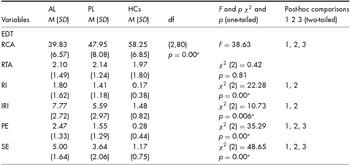
The subgroup comparisons between patients with TBI and patients with other aetiologies within the anterior group revealed no differences in performance on the six EDT variables [for the RCA, t (28) = .78, p = .43; for the other five EDT variables, all z scores < 1.96, all p scores > .05]. Table 6 shows the results of the One-Way ANOVA and Kruskal–Wallis tests used to investigate differences among the three participant groups (i.e., patients with anterior lesions vs. patients with posterior lesions vs. healthy controls) in each of the six EDT variables, i.e., the RCA of a script, the RTA, the RI and IRI as well as the PE and SE. The results revealed significant differences among the three groups on all the EDT variables, except for the RTA (see Table 6). Further parametric post-hoc multiple comparisons, using Dunnett's two-sided t-tests, were conducted, to compare healthy controls and patients with anterior lesions, healthy controls and patients with posterior lesions and the two patient groups for total number of RCA produced. These analyses showed that the total number of RCA generated in the healthy control group was significantly higher than in the group with anterior lesions (n = 59, mean difference = 18.41, p < .001, η2 ρ = .8) and in the group with posterior lesions (n = 51, mean difference = −10.29, p < .001, η2 ρ = −.56). Patients with posterior lesions were also found to produce a significantly higher number of RCA compared to the group of patients with anterior lesions (n = 52, mean difference = 8.12, p < .001, η2 ρ = .48).
Mean Raw Scores (+SD), Results of Parametric Dunnett's t-tests and Non-Parametric Mann–Whitney U tests (Two-Tailed) Post-hoc Multiple Comparisons between the HCs and the Patients with AL, between HCs and the Patients with PL and between the Two Patient Groups after Statistically Significant One-Way ANOVA and Kruskal–Wallis Differences in the EDT Variables. Bonferroni Adjustment α = 0 .017

RCA: the total number of the Relevant Central (major + minor) Actions produced in the EDT script generation task; RTA: the total number of the EDT Relevant Trivial actions; RI: the total number of the EDT Relevant Intrusions; IRI: the total number of the EDT Irrelevant Intrusions; PE: the total number of the Perseverative errors committed in the EDT script descriptions; SE: the total number of the Sequencing errors committed in the EDT script descriptions.
*Statistical significance.
1 : HCs significantly better than AL (all z > −2.96, all p < .013, effect sizes r = .48–.73).
2 : HCs significantly better than PL (all z > −3.23, all p < .001, r = .44–.53).
3 : AL significantly worse than PL (all z > −2.36, all p < .017, r = .27, .28, respectively).
Additional non-parametric post-hoc multiple comparisons using two-tailed Mann–Whitney U tests showed that, as anticipated, healthy controls generated significantly less total RI and IRI and committed significantly less PE and SE than both patients with anterior lesions and patients with posterior lesions (see bottom of Table 6). Multiple Mann–Whitney pair-wise comparisons between the two patient groups also revealed that patients with anterior lesions committed significantly more PE and SE than patients with posterior lesions (also bottom of Table 6), whereas no significant differences were found between the two patient groups in the total production of RI (z = −.82, p = .41) and the total production of IRI (z = −.50, p = .61).
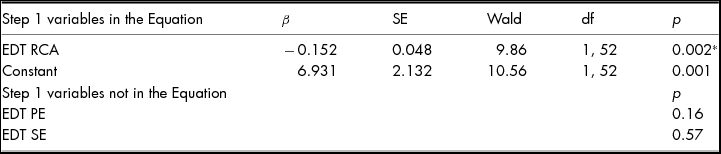
To further investigate which of the three EDT measures (RCA, PE and SE) could predict group membership (anterior or posterior damage), a stepwise logistic regression analysis (forward: LR method) was conducted. The results of this regression analysis are presented in Table 7. The model was statistically significant at step 1 [χ2 (1, 52) = 13.86, p < .001]. Only RCA had a significant impact on the dependent variable ‘lesion location’. The probability of the Wald statistic for RCA was significant (see Table 7) and this variable discriminated patients with anterior lesions and those with posterior lesions with an accuracy of 67.3%.
Results of Logistic Regression Analysis Using the EDT RCA, EDT PE and EDT SE as Predictor Variables of Group Membership (AL/PL)

*Statistical significance.
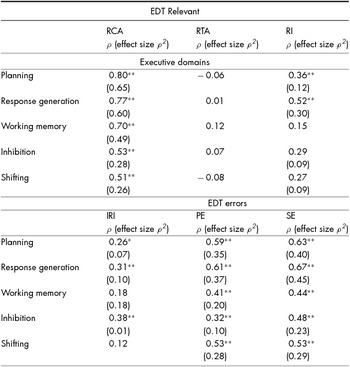
With respect to the second goal of our study, the results of six separate non-parametric Spearman ρ correlation analyses (adjusted α = .00167, and ρ2 effect sizes) are presented in Table 8.
Six Spearman ρ Correlations between the Six EDT Script Generation Performances and the z-Composite Scores of the Five Basic Executive Domains

**Correlation significant at α adjusted level (.01/6) = .00167(two-tailed).
Significant positive correlations were found between the z-total number of RCA and all the z-composite executive domains (all ρ > .51, all p < .00167, effect sizes ρ2 = .26–.65). These correlations indicate that the better the performances in the executive domains of ‘Planning’, ‘Response generation’, Working Memory’, ‘Inhibition’ and ‘Shifting’, the higher the total number of RCA generated in EDT scripts. However, no significant correlations were found between the total number of RTA and these five executive domains (all p > .27). On the other hand, significant positive correlations were found between RI and scores in the domains of ‘Planning’ (p = .001), ‘and Productivity (p = .00) (all significant s > .27, effect sizes ρ2 = .08–.3).
Significant positive correlations were also found between the score of the IRI and the composite measures of ‘Inhibition’, ‘Response generation’ and ‘Planning’ (all significant ρ > .27, all p < .00, effect sizes ρ2 = .07–.15). Similarly, significant positive correlations were seen between the scores of PE and all executive domains (all significant ρ scores > .32, all p scores = .00, effect sizes ρ2 = .10–.37) and the SE (all significant ρ scores > .44, all p scores < .00, effect sizes ρ2 = .2–.45) committed in the EDT scripts.
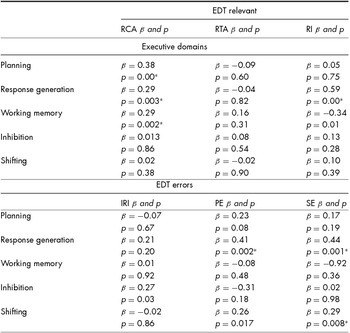
Finally, six separate multiple regression analyses were performed, including each of the six EDT scores as dependent variables and the five executive domains as predictors. The results of these analyses (p-values set at .008) are summarised in Table 9.
Results of the Multiple Regression Analyses Using the Five Basic Executive Domains as Predictors of Each of the EDT Measures (Expressed in z Values)

*Statistical significance at α adjusted level (.05/6) = .008 (two-tailed).
The first model, including RCA as a dependent variable, was statistically significant, as the five-composite executive variables were found to explain 70.7% of the variability of RCA [Adjusted R2 = .68, F = (5, 75) = 36.22, p < .001, effect size Cohen's f2 = 2.20]. Additional analysis (with an adjusted p-value = .008) revealed that ‘Working Memory’ (β = .29, p = .002), ‘Planning’ (β = .38, p = .00) and ‘Response generation’ (β = .29, p = .003) contributed significantly to the prediction of the total number of RCA in the EDT scripts. The second model with RTA as dependent variable was not statistically significant [Adjusted R2 = −.041, F = (5, 75) = .37, p = .86], indicating that none of the five executive domains can significantly predict RTA. The next analysis including RI as a dependent measure, was statistically significant [Adjusted R2 = 0.29, F = (5, 75) = 7.61, p < .001, effect size Cohen's f2 = .41], indicating ‘Response generation’ (β = .59, p < .001) as the major predictor of RI, that accounted for 33.7% of the variance of RI. The fourth model, using IRI as dependent variable, was not significant [Adjusted R2 = .073, F = (5, 75) = .13, p = .057, effect size Cohen's f2 = .08]. The next analysis, with PE as dependent variable, was statistically significant [Adjusted R2 = .45, F = (5, 75) = 14.40, p < .001, effect size Cohen's f2 = .82], revealing ‘Response generation’ as the predictor of PE accounting for 48.65% of PE variance. Finally, the sixth model, with SE as a dependent variable, was statistically significant, predicting 50.95 % of SE variance [Adjusted R2 = .47, F = (5, 75) = 15.52, p < .001, effect size Cohen's f2 = .90] and disclosing ‘Response generation’ (β = .44, p < .001) and ‘Shifting’ (β = .29, p = .008) as significant predictors of SE.
Discussion
The first goal of this study was to investigate whether there were differences in verbal script action generation according to location of brain pathology (anterior vs. posterior damage). Therefore, we compared the performance of three groups (healthy controls, patients with posterior lesions and patients with anterior lesions) on six relevant script action variables.
Before proceeding with these comparisons, we conducted subgroup analyses comparing patients with TBI and patients with other aetiologies within the anterior group on these six script variables. This was done due to the higher proportion of people with TBI (n = 13) in the anterior group as compared to the posterior group (n = 4). No significant differences were found between patients with TBI and patients with other aetiologies within the anterior group. This finding indicated that the performances were affected by ‘anterior’ brain damage, regardless of its aetiology. However, the higher proportion of patients with TBI in the anterior group as compared with those included in the posterior group is a limitation of our study (and other relevant studies) and an issue that should be taken into consideration in future studies.
The comparisons among the three participant groups showed that patients with anterior lesions generated significantly less RCA than both the group of patients with posterior lesions and the healthy control group. This finding suggests that the generation of RCAs is likely to be impaired after anterior brain damage. This conclusion was also drawn from our regression analyses, which indicated that RCAs were the only significant predictor of anterior dysfunction. So, a deficiency or a loss of ‘centrality’ in the core of actions needed for the accurate organisation and generation of a script can be interpreted as a dysfunction primarily related to anterior pathology. The higher number of omissions made by patients with anterior lesions in the production of correct script actions can be explained as a form of ‘goal neglect’, due to dissociation between the main activity and the list of actions that needs to be generated to achieve this activity (Duncan, Emslie, Williams, Johnson, & Freer, Reference Duncan, Emslie, Williams, Johnson and Freer1996).
On the other hand, no significant differences were found among patients with anterior lesions, patients with posterior lesions and healthy controls in the generation of RTA, which are actions of low frequency (mentioned by 18–39 % of the healthy controls). This means that, on the one hand, the production of high-frequency actions central to a script (i.e., RCA) is significantly affected by brain damage and especially by anterior pathology, but on the other hand, the production of RTA (i.e., low-frequency actions) remains relatively intact after brain damage. This strengthens the conclusion of former studies (Boelen et al., Reference Boelen, Allain, Spikman and Fasotti2011; Sirigu et al., Reference Sirigu, Zalla, Pillon, Grafman, Agid and Dubois1995), those patients with frontal damage and executive deficits have prominent difficulties in generating the central actions of a script.
Our findings also show that the two patient groups did not differ in their total production of RI and IRI in script generation, whereas both patient groups generated significantly more intrusions than the healthy control group. These results imply that difficulties in inhibiting relevant and irrelevant intrusions (RI & IRI) in script generation pertain to brain damage but cannot be exclusively attributed to anterior pathology. They can be better interpreted as a dysfunction within a broader neural network involving both the frontal lobes and other, more posterior, regions. These findings are in agreement with several other studies (Boelen et al., Reference Boelen, Allain, Spikman and Fasotti2011; Godbout & Doyon, Reference Godbout and Doyon2000; Zalla et al., Reference Zalla, Sirigu, Pillon, Dubois, Grafman and Agid1998).
Our study also revealed differences between the three participant groups in the total number of PE and SE. Healthy controls produced significantly less PE and SE than both patients with posterior and anterior lesions, whereas patients with anterior lesions generated significantly more PE and SE than those with posterior lesions. This indicates that patients with anterior lesions have more difficulties in sequencing steps in logical order during action production. The production of PE and SE by these patients may also be indicative for working memory problems, like retaining the correct string of actions while generating a script. On the other hand, the number of RI and IRI that interfered with the correct description of the scripts were not found sensitive to anterior brain damage. The finding that patients with anterior lesions committed significantly more PE and SE within the EDT scripts is in accordance with previous studies, revealing a strong relationship between the production of SE and PE within script generation tasks and frontal executive dysfunction (Allain et al., Reference Allain, Gaura, Fasotti, Chauvire, Prundean, Sherer-Gagou and Remy2011; Fortin et al., Reference Fortin, Godbout and Braun2003; Godbout et al., Reference Godbout, Cloutier, Bouchard, Braun and Gagnon2004; Zanini, Reference Zanini2008).
Taken together, and in line with Chevignard et al. (Reference Chevignard, Pillon, Pradat-Diehl, Taillefer, Rousseau, Le Bras and Dubois2000), our results show that difficulties in RCA, PE and SE are sensitive indicators of anterior brain damage. Patients with posterior lesions may also be impaired in these script parameters, but to a significantly lesser degree than patients with anterior damage. Thus, these indices can be useful for the assessment of the executive problems that patients with anterior brain damage (e.g., patients with TBI) face in action planning and in performing multistep ADL. Consequently, prominent difficulties in action centrality, action sequencing and working memory may constitute the main treatment targets for improving the planning ability and actual performance of patients with anterior lesions in complex everyday action sequences. Our findings also support the predictions made by Grafman (Reference Grafman and Perecman1989; Reference Grafman and Zaidel1994) and Wood and Grafman (Reference Wood and Grafman2003), that anterior lesions are related to insufficient production of RCA and deficient planning of complex script structures.
Our second goal was to explore the relation between several executive processes and the EDT script generation variables. Due to limitations in our sample size and the number of items included in each variable, the composition of our variables was based on findings from previous lesion and factor analytic studies with larger sample sizes and more items per factor (Bennett et al., Reference Bennett, Ong and Ponsford2005; Bertens, Frankenmolen, Boelen, Kessels, & Fasotti, Reference Bertens, Frankenmolen, Boelen, Kessels and Fasotti2015; Espinosa et al., Reference Espinosa, Alegret, Boada, Vinyes, Valero, Martinez-Lage and Tarraga2009; Lezak et al., Reference Lezak1995; Miyake et al., Reference Miyake, Friedman, Emerson, Witzki and Howeter2000; Oosterman et al., Reference Oosterman, Oosterveld, Rikkert, Claassen and Kessels2012; Stuss & Levine, Reference Stuss and Levine2002; Stuss et al., Reference Stuss, Floden, Alexander, Levine and Katz2001; Wilson et al., Reference Wilson, Alderman, Burgess, Emslie and Evans1996; also see the review of Alvarez and Emory, Reference Alvarez and Emory2006 for standard executive measures).
Significant correlations were found between all the executive domains (‘Planning’, ‘Working Memory’, ‘Response generation’, ‘Inhibition’ and ‘Planning’) and RCA, PE and SE, indicating that RCA, PE and SE tap several executive functions. Furthermore, correlations between the five executive domains and RTA were not significant, suggesting that the inclusion of peripheral actions in an action-sequence does not depend on general executive functioning, in contrast with RI, which was significantly correlated with ‘Planning’ and ‘Productivity’. We also found that a higher ability to suppress IRI is significantly correlated with better performances on ‘inhibition’, ‘response generation’ and ‘planning’. This implies that the ability to withhold the generation of intrusions irrelevant to a script scenario is not only dependent on inhibition but also presupposes adequate planning and response generation.
Additional multiple regression analyses, with EDT variables as dependent variables and executive domains as predictors, showed that RCA was significantly predicted by ‘Planning’, ‘Response generation’ and ‘Working Memory’. RI was significantly predicted by ‘Response generation’. PE was significantly predicted by ‘Response generation’ and ‘Shifting’. Finally, SE was significantly predicted by ‘Response generation’ and ‘Shifting’. RTA was not predicted by any executive domain. Taken together, these findings indicate, as expected, that verbal script generation taps several executive processes. However, the relative contribution of each of these processes to script generation varies for every EDT generation variable, supporting the multiple, but interrelated, components view of executive function in adults (Miyake et al., Reference Miyake, Friedman, Emerson, Witzki and Howeter2000).
These results suggest that the generation of RCA in correct sequence without sequencing and perseverative errors demands various executive abilities such as the capacity to retrieve central actions in correct order (planning), hold these actions on-line (working memory) while producing them in correct sequence (action plan), ‘shift’ (shifting/switching) from one essential action to the next in sequence and ‘inhibit’ (inhibition) intrusions from ‘breaking in’ throughout the on-going verbal script generation (Allain et al., Reference Allain, Gaura, Fasotti, Chauvire, Prundean, Sherer-Gagou and Remy2011; Cooper & Shallice, Reference Cooper and Shallice2000).
More specifically, our data with respect to the crucial role of working memory in preventing intrusions, provide evidence for the predictions made previously by Zalla et al. (Reference Zalla, Sirigu, Pillon, Dubois, Grafman and Agid1998), Godbout and Doyon (Reference Godbout and Doyon2000) and Godbout et al. (Reference Godbout, Cloutier, Bouchard, Braun and Gagnon2004). These authors proposed that the generation of RI and IRI reflects a difficultly in ‘on-line’ comparison of action sequences retrieved from semantic memory with those to be actively maintained in working memory and produced in the actual task.
Our findings with respect to the contribution of shifting and response generation (consisting of semantic and phonemic fluency measures also dependent on set shifting) to the prevention of SE might also indicate that SE in verbal script generation tasks can be attributed to deficiencies in the semantic representation of action steps, as already suggested by Cosentino, Chute, Libon, Moore and Grossman (Reference Cosentino, Chute, Libon, Moore and Grossman2006). Given the high verbal nature of the EDT, language expression (verbal fluency) should have been controlled for when examining group differences in script generation performance. This omission is a limitation of our study (and of other script generation studies) and an issue that should be addressed in future studies.
Finally, from a more practical perspective, our results reveal deficits in different aspects of EDT scripts after anterior brain damage. This can provide clinicians with useful qualitative information about the set of executive functions that is impaired when planning multistep real-life activities and thus needs to be assessed and treated when an improvement of goal-directed behaviour of patients with frontal lobe damage (e.g., TBI) in these situations is striven for.
In conclusion, verbal script generation tasks may be a useful tool for the assessment and treatment of executive dysfunctions visible in the planning of complex real-life tasks after anterior brain damage. However, this study has the limitation of examining only script generation without additionally comparing this to script execution. Consequently, future research should investigate both script generation and task execution in parallel, to explain difficulties in planning, execution and monitoring after brain damage in a more comprehensive way.
Acknowledgements
The authors thank all the participants and their therapists as well as the healthcare institutions that participated in this study: Rehabilitation Center ‘Anagennisi’ (Nea Redestos, Thessaloniki, Greece), Saint Lukas Clinic (Panorama, Thessaloniki, Greece).
Financial Support
This research received no specific grant from any funding agency, commercial or not-for-profit sectors.
Conflict of Interest
None.
Ethical Standards
The authors assert that all procedures contributing to this work comply with the ethical standards of the relevant national and institutional committees on human experimentation and with the Helsinki Declaration of 1975, as revised in 2008.