
Introduction
Wide band gap metal oxide semiconductor (i.e., TiO2, ZnO, and SnO2) nanostructures are of considerable interest to scientists and engineers because of their technological applications spanning from sensor, display, and catalyst to energy conversion and storage devices [Reference Fierro1]. In particular, SnO2 has been emerged as one of the appealing candidate material for aforementioned applications owing to its large band gap (3.6 eV), high electron mobility (100–200 cm2 V−1 S−1) and superior chemical tolerance [Reference Das and Jayaraman2–Reference Li, Zhao, Wang and Guan4]. Several studies have shown that the distinctive properties of SnO2 are largely influenced by its size, morphology, crystallinity, and phase [Reference Kumar, Parmar, Rao, Rajanna and Phani5, Reference Park, Kang, Wang, Dou and Liu6]. Hence, the development of synthesis techniques with good control over the size, shape, and phase of the SnO2 has become the subject of intense research over the past decade [Reference Batzill and Diebold7–Reference Mei, Chen and Ma9]. Various metal oxide nanostructures, including SnO2 are usually prepared by wet chemical approaches such as co-precipitation, sol–gel and solvothermal methods [Reference Guo, Yao, Lin and Nan10]. Although these ‘bottom-up’ batch processes can produce metal oxides with desired microstructural features, multiple post-synthesis washing steps and low-yield undermine their scaling up potential and economic viability for large-scale manufacturing.
Flame synthesis technique is one of the most potential routes for the high-throughput volume production of metal oxide nanostructures in an industrially viable atmosphere [Reference Kammler, Mädler and Pratsinis11, Reference Roth12]. Tin oxide nanostructures with different morphology and crystalline features have been previously produced from the pyrolysis of a volatile tin precursor (SnCl4 or C16H30O4Sn) in a high-temperature flame, the process generally described as flame spray pyrolysis [Reference Zhu and Pratsinis13–Reference Hu, Xu, Kong, Jiang, Zhang and Li15]. Nevertheless, the full potential of flame synthesis could be realized when the cost-effective metals are employed as starting material instead of expensive and complex liquid or gas phase precursors. For instance, Rao et al. prepared Fe2O3, CuO, and WO3 nanostructures by solid thermal oxidation of their respective bulk metal (in the form of wire or foil) in a flat flame environment [Reference Rao and Zheng16, Reference Rao and Zheng17]. However, the direct synthesis of technologically important SnO2 nanostructure from Sn remains unexplored. In this communication, for the first time, we report a rapid and scalable synthesis of phase-pure SnO2 nanoparticles from inexpensive metallic Sn feedstock powder using flame oxidation approach. The beneficial application of flame-synthesized SnO2 nanoparticles is successfully demonstrated as photoanode material in dye-sensitized solar cells (DSSCs) and a maximum power conversion-efficiency of 2.72% is achieved.
Experimental
Synthesis of tin oxide nanoparticles
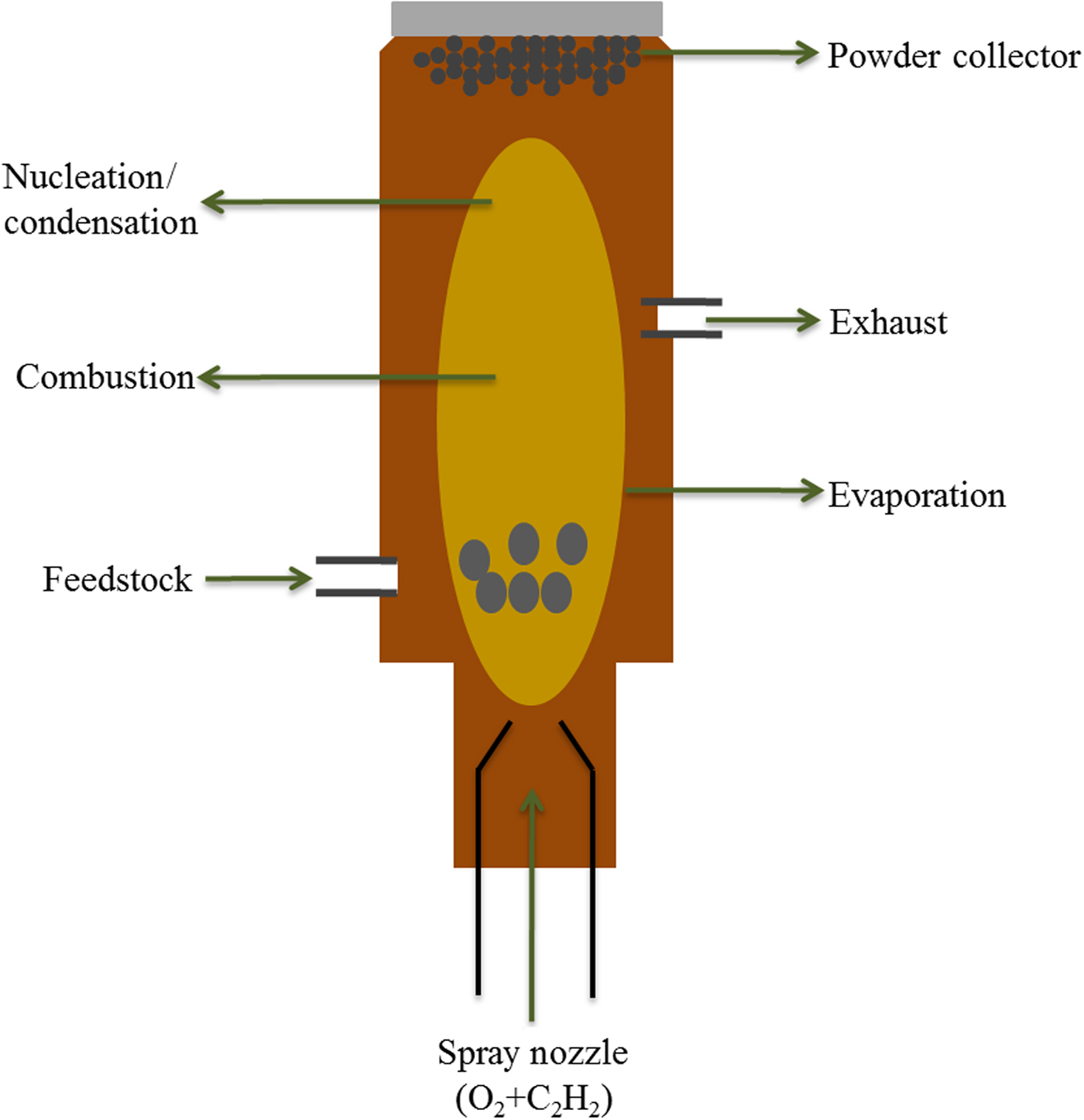
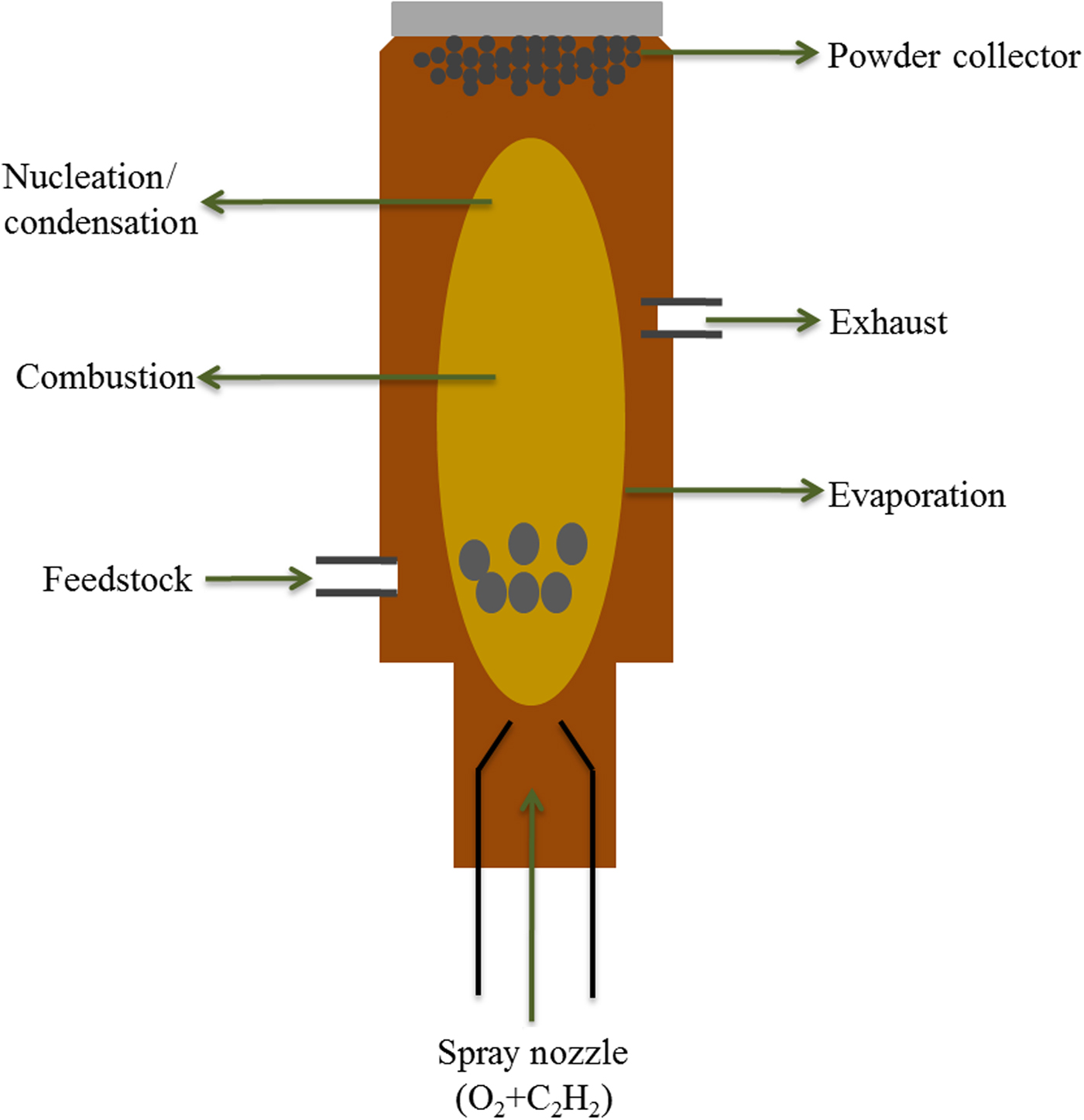
Metallic Sn powder (SRL, India) having an optimum particle size <30 µm with mean size of 6.7 µm and standard deviation (SD) of 4.7 µm was selected and used as feedstock. Figure 1 schematically describes the flame oxidation process. The Sn powder was fed into a neutral oxy-acetylene flame (50 O2:50 C2H2) by gravitational feed to facilitate the oxidation [Reference Kathirvel, Chandrasekaran, Manoharan and Kumar18]. The Sn powder melts in oxy-acetylene flame and reacts with oxygen; subsequently resulting in the formation of SnO2 nanoparticles. The resultant product was collected from the dome for characterization and electrode preparation.
Schematic representation of the flame oxidation process.
Fabrication of dye-sensitized solar cells
Photoanode was prepared by screen printing a paste of flame-SnO2 nanoparticles in ethyl cellulose dissolved α-terpineol. After annealing at 500 °C for 30 min in air, flame-SnO2 photoanode was sensitized with N719 dye and then assembled with a Pt counter electrode. The inter-electrode space was filled with an iodide/tri-iodide (I−/I3 −) redox couple electrolyte. A detailed paste preparation, photoanode screen printing, and DSSC fabrication procedure are published elsewhere [Reference Parmar, Ramasamy, Lee and Lee19]. For comparison, control devices (defined as control-SnO2) also prepared using commercially available SnO2 nanopowders (Alfa Aesar, particle size: 22–43 nm) in a similar experimental condition. Figure S3 shows the digital photograph of sealed DSSCs with an active area of 0.36 cm2. The photovoltaic performances of DSSCs were measured using a 1000 W Xe arc lamp (Sol3A, Oriel Instruments, USA).
Characterization
X-ray diffraction (XRD) measurements were performed using Bruker-D8 powder diffractometer with a step size of 0.02° and dwell time of 2 s for better resolution. Nanostructure of the SnO2 powder was studied using transmission electron microscopy (TEM, Model no. TECNAI200). Electron transparent TEM sample was prepared by dispersing flame-SnO2 powder in methanol and placing a small drop of solution on carbon grid followed by drying in vacuum desiccator for 12 h. Size distribution of the SnO2 nanoparticles was estimated by image analysis of 20 TEM images and extracted size of the 700 particles.
Results and discussion
Selecting appropriate size of the feedstock is critical for the direct synthesis of metal oxide nanopowder from metal. In this perspective, for effective conversion of metal feedstock into metal oxide, the effect of feedstock size on the oxidation of the same was estimated in detail by using basic fluid dynamics and combustion equations. The residence time (t res) of metallic Sn particle in the oxidative flame can be estimated from the thermo-physical properties of the flame and feedstock using the following equation [Reference Kumar and Selvarajan20]:
 $$t_{{\rm res}} = \left( {\displaystyle{{2S} \over {kV_{\rm g}}}} \right)^{1/2},$
where the constant “k” is derived from the dynamic viscosity of the flame (η), size (d p) and density (ρ p) of the feedstock, and the gas velocity “V g” is derived from the mass flow (m) and density (ρ g) of the flame forming gases. The dynamic viscosity (η) of the oxygen-acetylene combustion flame was estimated from the following relation, which can be referred elsewhere [Reference Ozturk and Cetegen21]
 $$\eta = a + bT + cT^2 + dT^3.$$
Oxidation time (t oxi) of the metal powder inside the flame can be estimated from the following relationship [Reference Kanury22]:
 $$t_{{\rm oxi}} = \displaystyle{{\rho _{\,pd_{\rm p}^2}} \over {8\rho _{\rm g}Z{\rm \; ln}2.12}}$$
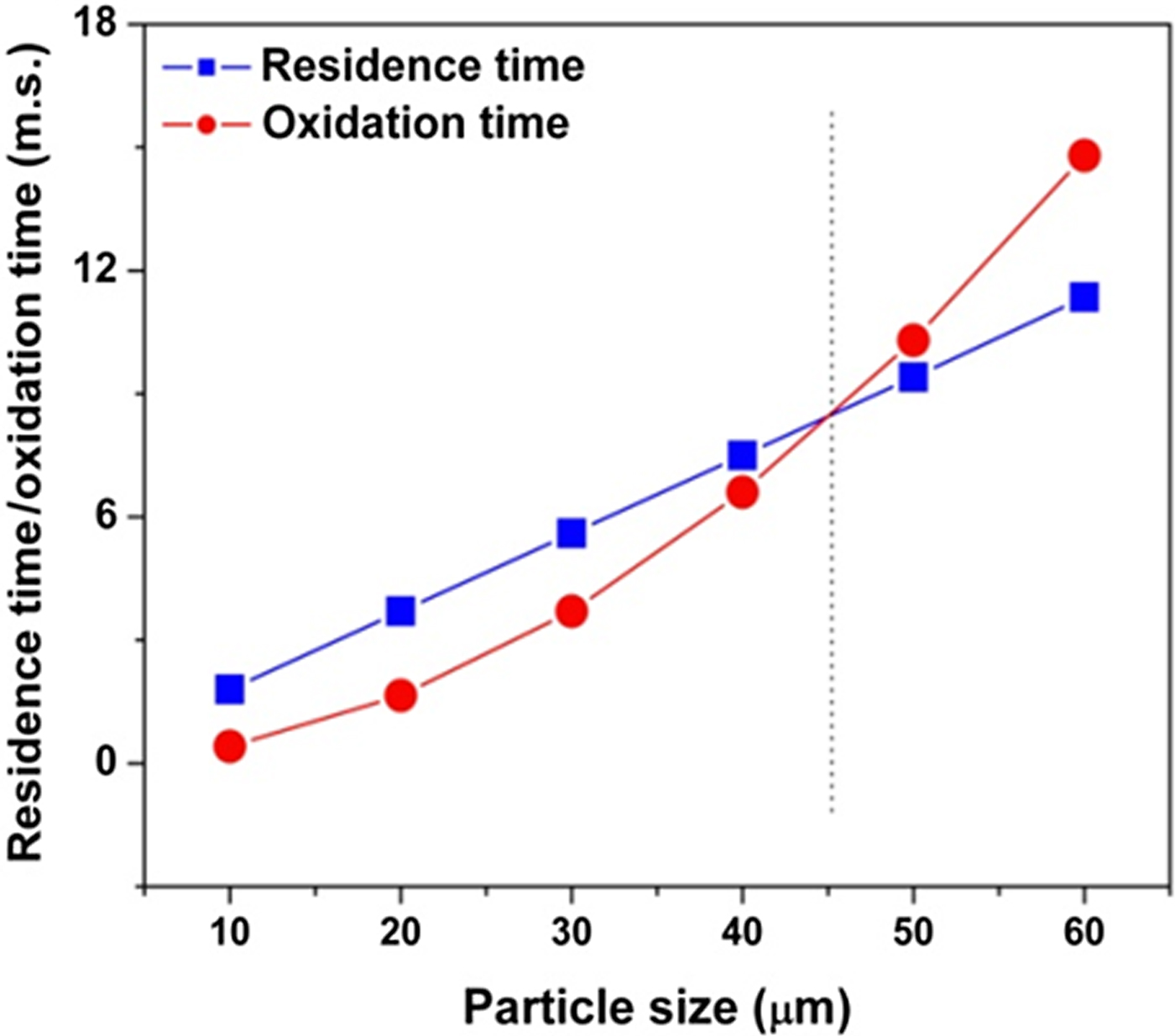
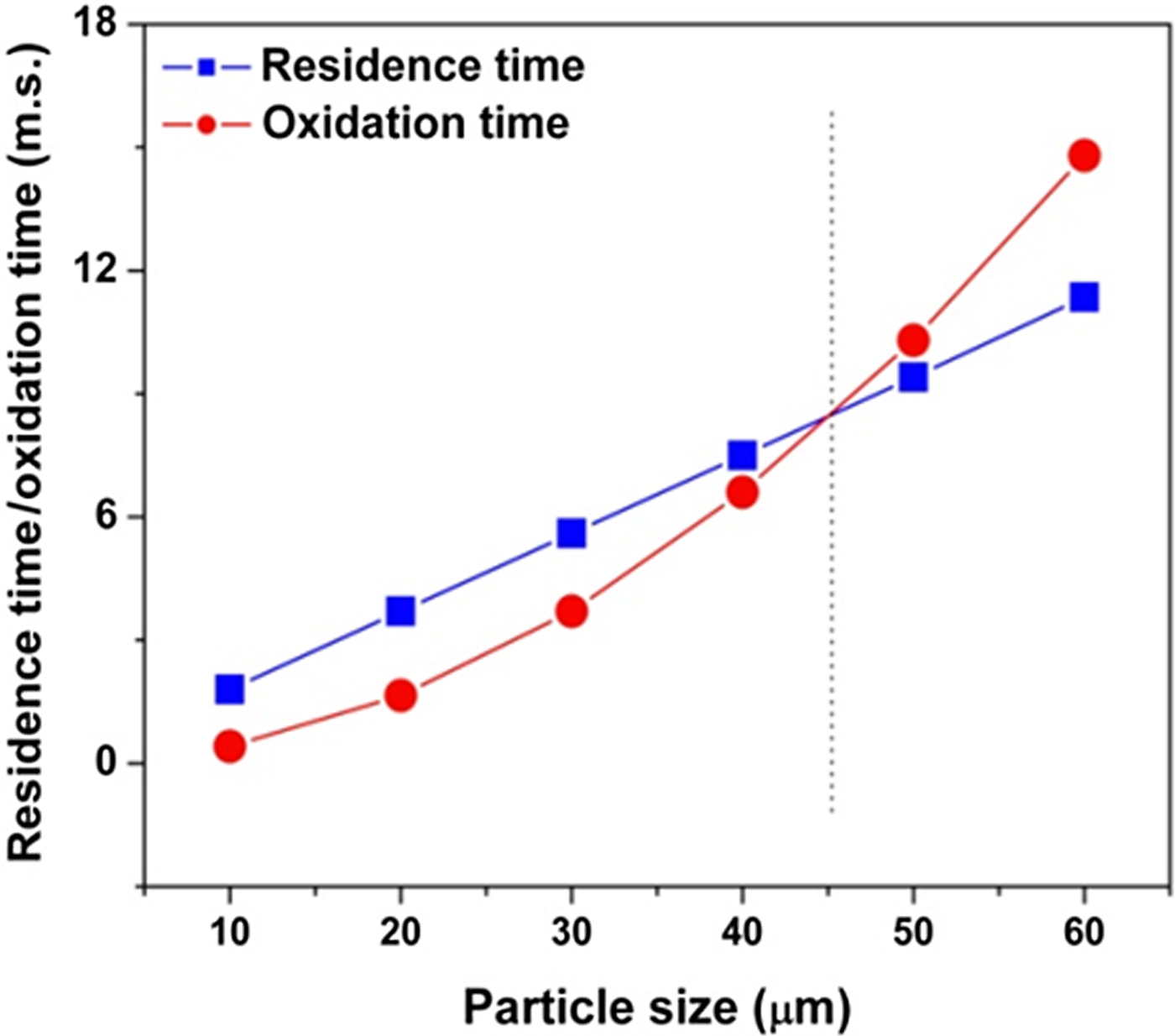
where Z is the diffusion coefficient of oxygen into a flame. The diffusion coefficients of almost all plasma forming and combustion gases hardly have any difference in the lower temperature region (<3000 K) than typical plasma temperatures (10,000 to 30,000 K). The diffusion coefficient of oxygen into argon plasma at 3000 K (combustion flame temperature) was taken into account for this work [Reference Rosner23]. It was reported that the oxidation time of 10 and 100 µm aluminum powders inside an argon thermal plasma jet (T plasma: ~ 6200 K) was estimated to be 10 µs and 1 ms, respectively [Reference Kumar, Kang, Bae, Selvarajan and Lee24]. It is worth noting that the melting point of aluminum (923 K) is higher than that of tin (453 K). Figure 2 shows the residence and oxidation times of tin particles inside the oxy-acetylene flame. As a function of powder size, almost a liner increase in residence time was observed, whereas oxidation time varies exponentially and intercepts with the former one for 45 µm tin particles. Further increase in powder size leads to incomplete melting and/or oxidation, which may lead to the presence of metallic debris in the resultant oxide powder.
Oxidation time of different size Sn powders in oxy-acetylene flame.
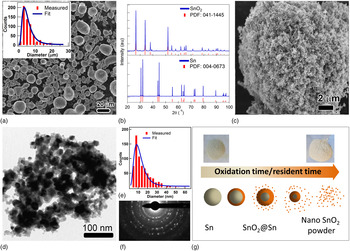
Based on the above calculations, metallic Sn powder (SRL, India) having particle size <30 µm with mean size of 6.7 µm and SD of 4.7 µm was used as feedstock. Detailed morphology and particle size distribution of Sn feedstock were shown in Fig. 3(a). The Sn powder was fed into a neutral oxy-acetylene flame (50 O2:50 C2H2) by gravitational feed to facilitate the oxidation. The Sn powder melts in oxy-acetylene flame and reacts with oxygen; subsequently resulting in the formation of tin oxide (hereafter denoted as flame-SnO2) nanoparticles. Figure 3(b) shows XRD profiles of the Sn feedstock powder and flame-SnO2 nanoparticles. Both metallic Sn feedstock and flame-SnO2 nanoparticles exhibit their respective single phase, and there is no trace of any secondary phases. This result indicates the complete conversion of metallic Sn into SnO2. Broadening of diffracted peaks indicates nanocrystalline nature of flame-SnO2 powder. Scanning electron microscopy (SEM) image of as-synthesized flame-SnO2 is shown in Fig. 3(c). The obtained product can be characterized as micron size agglomerates consist of loosely bounded SnO2 nanoparticles (Fig. S2). A representative TEM bright-filed (TEM-BF) image of dispersed product shown in Fig. 3(d) indicates the presence of SnO2 nanoparticles. Histogram of the particle size distribution [Fig. 3(e)] follows log-normal distribution with a mean size of 15.3 nm and a SD of 15.1 nm. The selected area diffraction pattern [Fig. 3(f)] obtained from a region of Fig. 3(d) exhibits ring pattern, which attributes random orientation of nanoparticles. From the radius of the rings, inter-planner distance was estimated and found to be d-spacing's of SnO2 particles with symmetry of P42/mnm (136). A plausible mechanism for the formation of crystalline SnO2 nanoparticles from metallic Sn feedstock is described in Fig. 3(g) [Reference Zolotko, Poletaev and Vovchuk25].
(a) SEM secondary electron image of metallic Sn feedstock powder and the inset to figure shows size distribution; (b) XRD patterns of metallic Sn feedstock and flame-synthesized SnO2 nanoparticles; (c) SEM secondary electron image of agglomerated SnO2 nanoparticles; (d) Representative TEM-BF image of flame-synthesized SnO2 nanoparticles; (e) Size distribution of SnO2 nanoparticles obtained from TEM-BF images; (f) Selected area electron diffraction (SAED) pattern from region shown in (d); and (g) Illustration for the formation mechanism of crystalline SnO2 nanoparticles from metallic Sn feedstock.

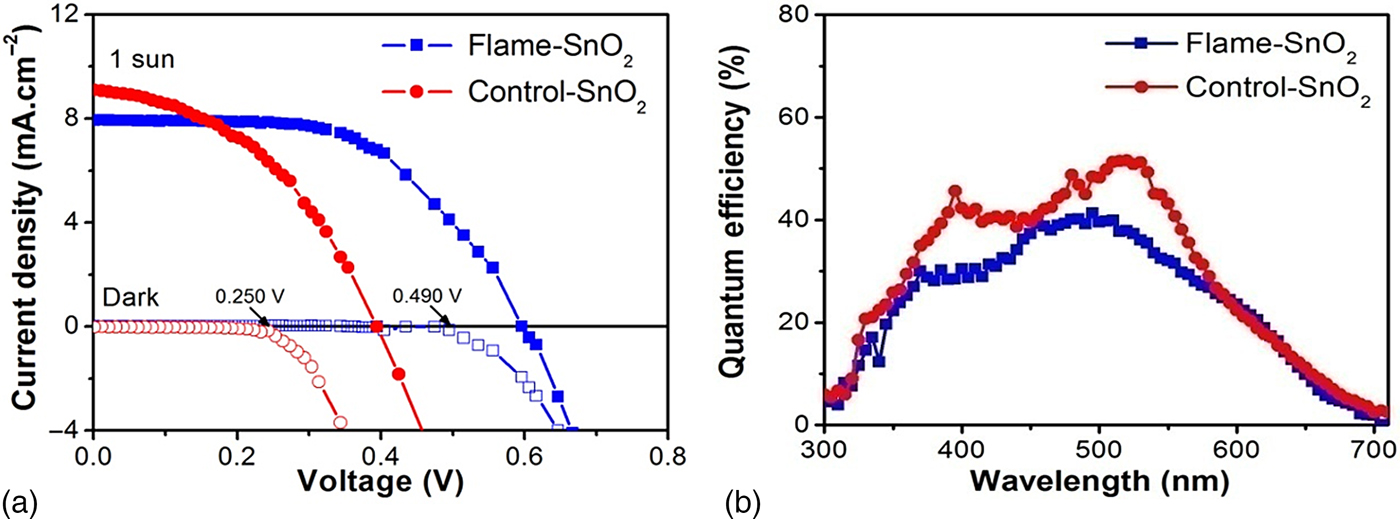
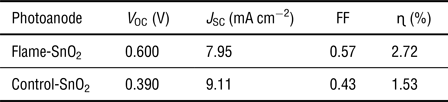
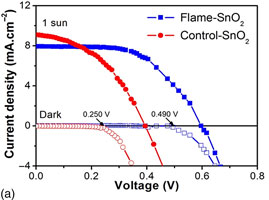
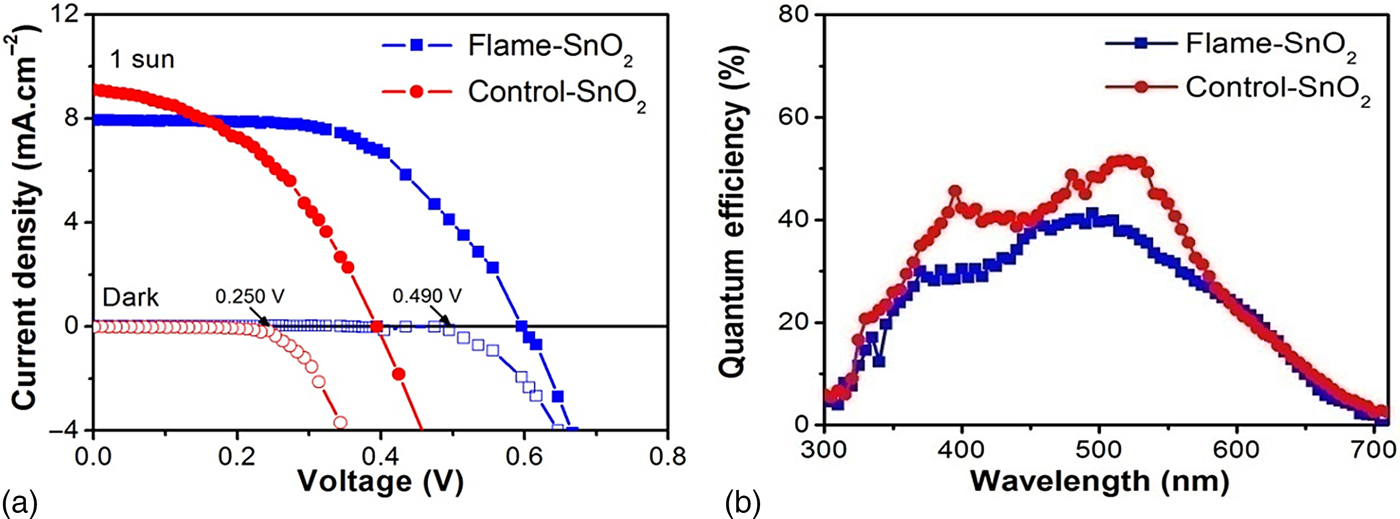
The potential application of flame-SnO2 was demonstrated in DSSCs [Reference O'Regan and Gratzel26]. Figure 4(a) shows the current–voltage characteristics of DSSCs. Under 1 sun illumination (100 mW.cm−2, AM 1.5 G), the device shows an open-circuit voltage (V OC) of 600 mV, a short-circuit current density (J SC) of 7.95 mA.cm−2, and a fill factor (FF) of 0.57, yielding a power conversion efficiency (ɳ) of 2.72%. It is worthwhile mentioning here that the V OC of flame-SnO2 DSSC is notably higher than that of control device (Table I) and other published SnO2 photoanode DSSCs [Reference Ramasamy and Lee3, Reference Ramasamy and Lee8, Reference Wang, Fei, Zhang, Guo, Shen, Tian and Cao27, Reference Basu, Benetti, Zhao, Jin, Vetrone, Vomiero and Rosei28]. The V OC of DSSC is determined by the difference between conduction band edge of metal oxide photoanode and redox potential of electrolyte. The decrease in V OC from theoretical value is primarily attributed to recombination of photoinjected electrons with I3 − ions, mostly caused by the sub-band-edge surface states in a metal oxide photoanode [Reference Prasittichai and Hupp29]. Such surface states might have eliminated in flame-SnO2 due to high-temperature and optimum oxidative environment. The high dark-current onset potential of 490 mV observed for flame-SnO2 DSSC also supports aforementioned hypothesis [Reference Ito, Liska, Comte, Charvet, Pechy, Bach, Schmidt-Mende, Zakeeruddin, Kay, Nazeeruddin and Gratzel30]. The slight decrease in J SC of flame-SnO2 DSSC is in concurrence with quantum efficiency analysis [Fig. 4(b)]. Although both devices fabricated using similar thickness photoanode (~4 µm), variation in film porosity and dye uptake would have adversely influenced the J SC. Flame oxidation parameters such as composition of flame, particle size of feed stock, and residence time mainly affect the quality of the final product. Optimizations of such parameters for the production of high-quality metal oxides with desired surface area and morphology is currently underway and may lead to high-efficiency DSSCs.
(a) Current–voltage characteristics and (b) Quantum efficiency of flame-SnO2 and control-SnO2 photoanode DSSCs.

Conclusion
In summary, we report gram-scale synthesis of SnO2 nanoparticles from inexpensive metallic Sn feedstock by the flame oxidation method. The selection of optimal feedstock powder size based on computational fluid dynamics ensures complete oxidation and thereby production of crystalline and phase-pure SnO2 nanoparticles. Dye-sensitized solar cell fabricated using flame-synthesized SnO2 as a photoanode shows 2.72% power conversion efficiency, much higher than those of control devices prepared with commercial SnO2 nanoparticles (1.53%). The superior photovoltaic performance was attributed to passivation of sub-band-edge surface states, which in turn inhibit electron recombination and improves the V OC. Flame-synthesized SnO2 nanoparticles can also find a large array of novel applications in gas sensors, batteries, and optoelectronic devices.
Supplementary material
The supplementary material for this article can be found at https://doi.org/10.1557/mrc.2017.97.