

I. Introduction
Numerous studies such as Cyr, Kwong, and Sun (Reference Cyr, Kwong and Sun2017b), Noparumpa, Kazaz, and Webster (Reference Noparumpa, Kazaz and Webster2015), Ali, Lecocq, and Visser (Reference Ali, Lecocq and Visser2010), Ashenfelter (Reference Ashenfelter2010), and Jones and Storchmann (Reference Jones and Storchmann2001) have shown that Bordeaux en primeur prices are heavily dependent on critics’ barrel ratings despite the many uncertainties from the continued aging, blending, and bottling process. In particular, it has long been known that barrel scores from the prestigious wine critic Robert Parker Jr. have had a significant influence on the initial en primeur price offerings by chateaux. Indeed, Parker has been largely viewed as the authority on Bordeaux en primeur wines with his scores and palate having a dominating influence for nearly a 40-year period. His ratings, in particular, have been noted to have a significant impact on the release price of the wine (Mendick, Finnigan, and Chazan, Reference Mendick, Finnigan and Chazan2016; Ali, Lecocq, and Visser, Reference Ali, Lecocq and Visser2010).
His reign as the world's leading wine critic on Bordeaux wines, however, has not been without some controversy, having been criticized with advocating style over substance and creating a homogenous world of highly-oaked and over-extracted wines. Conversely, he has also been credited with having pushed the Bordeaux wine industry into investments in newer technology and equipment, resulting in greater consistency over the years (Millar, Reference Millar2015).
In February 2015, Parker announced that he would no longer review Bordeaux wine futures; turning the responsibility over to his successor Neal Martin, a British wine critic. Martin's rise to prominence as a wine critic had been relatively quick, having his beginnings as a wine buyer and taster, and wine blogger commencing in 2003 with the website Wine Journal (Mendick, Finnigan, and Chazan, Reference Mendick, Finnigan and Chazan2016). He gained a substantial following in a short period of time, and, consequently, was asked by Parker to join the publication, The Wine Advocate, as a wine writer and critic in 2006 (Lyons, Reference Lyons2015). In April 2016, Martin assumed responsibility for the review of all Bordeaux wines, both in barrel and bottle, for The Wine Advocate (Demmond, Reference Demmond2016; Pickford, Reference Pickford2016). However, in 2018 Martin left The Wine Advocate to become senior editor for the wine magazine Vinous, and, consequently, Parker announced that the wine critic Lisa Perrotti-Brown would assume responsibility for all Bordeaux wines for The Wine Advocate (Parker, Reference Parker2017).
Given the long-standing influence of Parker on the Bordeaux wine industry, the informal appointment of Martin as his successor, and, subsequently, Perrotti-Brown, creates some uncertainty for many chateaux, both with respect to the future influence of Martin's ratings and their consistency, or lack thereof, with that of Parker's. Indeed, the question remains that despite the “passing of the mantle” on the part of Parker, what will be the potential future impact of other long-time wine critics on Bordeaux wine. The question has arose among some wine industry writers as to the future influence of The Wine Advocate and who will truly succeed Parker (Livsey, Reference Livsey2016; Staveley, Reference Staveley2018).
Although the past influence of Parker's palate and preferences may diminish with time, it has had a significant impact on many producers in terms of their choices with respect to wine production, and on the preferences of consumers as evidenced by his impact on prices. Hence, reasonable questions arise as to the similarities of the ratings of various wine critics, including Martin, with that of Parker's. Cyr, Kwong, and Sun (Reference Cyr, Kwong and Sun2017a) used copula function modelling to examine the bivariate distributional relationship between Parker and Martin's wine ratings over the period of 2010–2012 when both experts independently rated en primeur wines. The findings indicate significant upper tail dependence in terms of Parker's and Martin's ratings of left bank wines, particularly in the years 2011 and 2012. However, in terms of right bank wines, they note a changing pattern in the bivariate relationship of Parker and Martin ratings over the three-year period, with a lack of upper tail dependence in 2011 and 2012 and lower correlation overall. It is hence speculated that Martin may have begun to develop his own idiosyncratic preferences over that time period. This is a critical issue given the known preference of Parker and his influence in terms of right bank wines.
The extent of nonlinear relationship between the ratings of a wine rater and that of Parker's is important as the relationship between Parker's past ratings and en primeur prices have been shown to be nonlinear in nature. Noparumapa, Kazaz, and Webster (Reference Noparumpa, Kazaz and Webster2015), for example, provides a visual indication of the nonlinearity in the relationship between Parker barrel ratings and en primeur prices while Cyr, Kwong, and Sun (Reference Cyr, Kwong and Sun2017b) explores the nature of this relationship through copula function modelling. Significant upper tail dependence is noted in terms of Parker's ratings and prices, implying that the impact of Parker's ratings on en primeur prices have been greater at the upper echelon of scores.
The current study expands the results regarding Parker and Martin by analyzing the ratings of a number of other en primeur wine critics. The objective of the study is to identify which prominent en primeur wine critic has shown the greatest consistency in terms of ratings with those of Parker, both in terms of overall correlation, and also in terms of the nonlinear relationship expressed through copula function modelling. Section II describes the data employed and the wine critics examined, while Section III provides an overview of the methodology and the results. Section IV concludes.
II. Wine Critics Rating Data
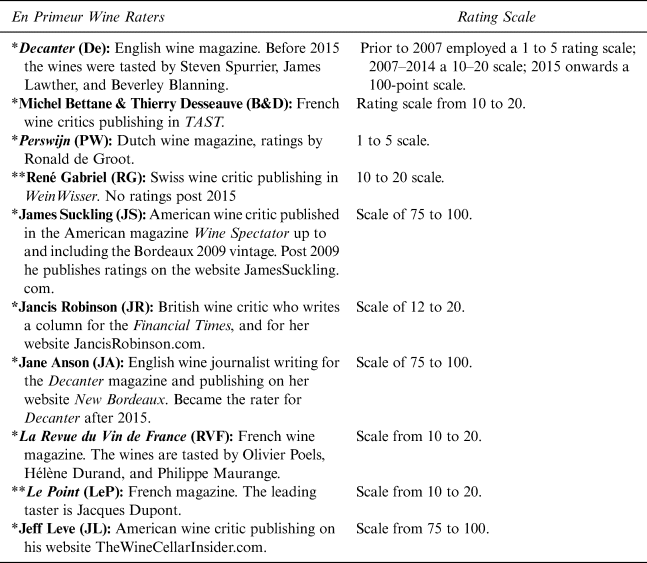
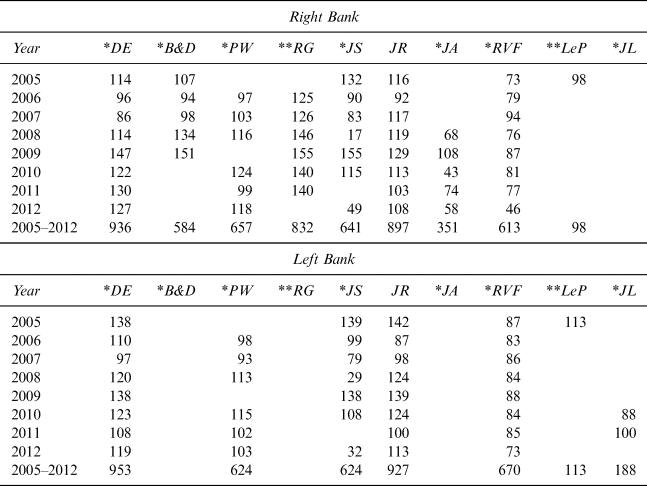
A rich database of en primeur wine data, including the ratings of various wine critics, is available from the Amsterdam wine sellers Bolomey Wijnimport (www.bordoverview.com). The data covers the period from 2004 onward, with Parker's ratings available up to and including 2012. Not all wine critics rated en primeur wines every year throughout that period and, in some cases, not always wines from both the right and left banks. However, the data allows for a fairly robust analysis of the ratings of a number of key Bordeaux wine critics including Jancis Robinson, James Sucking, and Rene Gabriel along with wine critics from the Decanter wine magazine, La Revue du Vin de France, and the Dutch wine magazine Perswijn. The ratings of the English wine critic Jane Anson are also available for comparison with that of Parker, but only from the period of 2006 onward. Table 1 provides a brief summary of the prominent en primeur wine critics and their ratings scales, while Table 2 provides the number of en primeur wines jointly rated by both Parker and specific wine critics in the case of both the right and left bank.
Prominent En Primeur Wine Raters Other Than Robert Parker and Neal Martin

*Continues to rate en primeur wines.
** Does not appear to continue to rate en primeur wines.
Number of En Primeur Wines Jointly Rated by Various Wine Raters and Robert Parker

*Continues to rate en primeur wines.
**Does not appear to continue to rate en primeur wines.
III. Methodology and Results
To explore the relationship between the ratings of various critics and that of Parker, we employ copula function modelling. Copula function modelling provides a practical way of characterizing a multivariate distribution. Its strength lies in that it can capture basic nonlinear relationships, commonly referred to as tail dependence, which are frequently overlooked by methods that implicitly assume linearity over the range of the multivariate distribution, and can be employed even in the case of small data sets. It also has the added advantage of being able to deal implicitly with the issue of different wine rating scales. Although Martin and Parker employed the same rating scale, many other raters (as noted in Table 1) have not and, in some cases (Decanter), have changed rating scales over time.
A. Copula Function Methodology
Copula functions originate from the work of Sklar (Reference Sklar1959) where Sklar's Theorem essentially shows that any multivariate distribution can be expressed in terms of its univariate marginal distribution functions along with a copula function which describes the dependence structure between the variables. The copula is a multivariate probability distribution for which the marginal probability distribution of each variable is uniform. A key element of Sklar's Theorem is that in modelling a multivariate distribution, it allows for the separation of the modelling of the individual univariate marginal distributions and that of the dependence structure captured by the copula function. This is an important element when comparing the relationship between the ratings of two wine raters which employ different rating scales, or vary over time, as the wine ratings are first converted to uniform variates before identifying the best fitting copula functions. Cyr, Kwong, and Sun (Reference Cyr, Kwong and Sun2017b) provides a succinct summary of the copula function methodology employed to capture the relationship between Parker ratings and en primeur prices.
Although the number of copula functions is theoretically infinite, there are parametric copulas which can capture typical dependence structures between two covariates, with known parameters that can be estimated. These parametric forms then allow the classification of copula functions into families; two of particular importance are the elliptical and the Archimedean families. Typical copulas of the elliptical family frequently employed are the Gaussian or normal copula and the Student T copula. However, they are limited to radial symmetry restricting their ability to fully capture nonlinear, and particularly asymmetric, tail dependence between covariates.
Fortunately, the Archimedean family of copulas includes some relatively simple closed forms with dependence parameters that capture asymmetric tail dependence in a tractable way. Common forms of the Archimedean family employed are the Gumbel, Clayton, and Frank copulas. The Clayton copula, for example, enables the modelling of greater correlation or tail dependence in the lower values of the covariates, while the Gumbel copula captures tail dependence in the higher values. It is also possible, through inversion of either, or both of the two uniform covariates to capture other forms of asymmetric tail dependence. Through inversion of both uniform covariates, for example, the Clayton copula can also be employed to capture upper tail dependence. The Frank copula captures greater correlation in the middle of the bivariate distribution as opposed to the tails.
Upper (λ U) and lower (λ L) tail dependence measures can frequently be derived from the copula parameters as well as, in limited cases, the relationship to standard dependence measures such as Kendall's tau and Spearman's rho (Cherubini, Luciano, and Vecchiato, Reference Cherubini, Luciano and Vecchiato2004). Table 3 provides a summary of the relationship between the copula dependence parameter θ (a scalar in the case of bivariate analysis) for the standard copula functions discussed. Note that with an inversion of the uniform covariates, the lower tail parameter associated with the Clayton copula will effectively measure upper tail dependence in the untransformed uniform covariates.
Archimedean Copulas and Dependence Parameters

In the case of the Frank copula, Kendall's tau, and Spearman's rho requires the calculation of the Debye function where:  $D_k\lpar \alpha \rpar = \displaystyle{k \over {\alpha ^k}}\mathop \int \nolimits_0^\alpha \displaystyle{{t^k} \over {\exp \lpar t \rpar -1}}dt,\; \; \; k = 1,2$.
Goodness-of-fit testing for copula functions remains a complex and relatively unresolved area. Issues arise primarily due to the high dimensionality of the problem particularly for copulae modelling where the number of covariates m ≥ 3. Summaries of the problems and approaches attempted in terms of copula goodness-of-fit testing are provided by Fermanian (Reference Fermanian, Jaworski, Durante and Härdle2013), Okhrin (Reference Okhrin, Duan, Härdle and Gentle2012), Genest, Remillard, and Beaudoin (Reference Genest, Remillard and Beaudoin2009), and Berg (Reference Berg2009), among others. In general, the power of the tests proposed to date appears to differ with sample size, dimensionality, and copula function being tested (Berg, Reference Berg2009).
Although there is no universally agreed upon methodology, a frequently employed practical approach to bivariate copula selection is to use maximum likelihood goodness-of-fit tests such as the Akaike Information Criterion (AIC) to choose between copulae (Hasebe, Reference Hasebe2013).
Additional likelihood tests such as the Schwartz-Bayesian (SIC) and Hannan-Quinn (HQIC) information criteria were also applied. Both SIC and HQIC consider the number of parameters estimated, and penalize for overfitting; a model that has a good fit using fewer parameters is preferred over one that requires more parameters. In the current study, the results of the SIC and HQIC tests to identify best fitting copulas were consistent with that of the AIC test in all cases.
B. Results
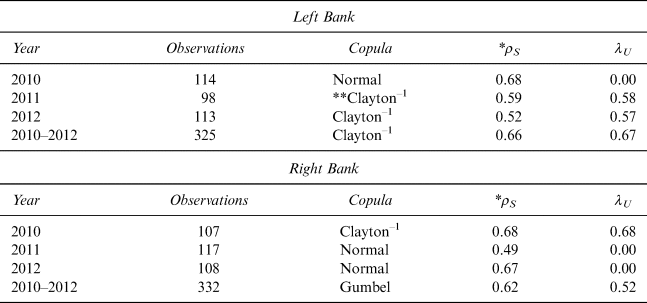
The results begin with an analysis of correlation and tail dependence between the ratings of Robert Parker and Neal Martin as provided in Cyr, Kwong, and Sun (Reference Cyr, Kwong and Sun2017a). In particular, both wine critics rated left and right bank en primeur wines over the period of 2010 through 2012. Table 4 indicates the best fitting copula function identified for each of the three years as well as for the total period, in the case of both left and right bank wines.
Best Fitting Copula Function, Robert Parker and Neal Martin Ratings: 2010–2012

*Spearman rank correlation.
**The notation –1 indicates the fitting of a copula function to the inverted uniform distribution data. In the case of the Clayton copula, which captures lower tail dependence, when fitted to the transformed (inverted) data, indicates upper tail dependence in the untransformed data.
The results in Table 4 are interesting in terms of the right bank in that although the aggregated data for 2010–2012 indicates a Spearman rank correlation (ρ s) of 0.62 with significant upper tail dependence (λ U = 0.52) between the ratings of Martin and Parker, it would appear to be driven largely by the 2010 period where λ U = 0.68. The analyses of the years 2011 and 2012, on the other hand, indicate a normal copula function as best fitting, without significant upper tail dependence. The results imply that perhaps, subsequent to 2010, Martin began to develop his own preferences with respect to highly rated wines, relative to Parker. If Martin was identified as the heir to Parker in terms of en primeur wines, this results in some uncertainty for right bank wine producers. This is of particular importance given that both Martin and Parker have been noted to prefer the Merlot dominated right bank wines.
The question then arises as to whether one of the other noted en primeur wine critics has exhibited a greater correlation and upper tail dependence with respect to Parker's ratings, as opposed to Martin, particularly in terms of right bank wines. Of particular interest are those wine critics who appear to continue to rank en primeur wines. Table 2 indicates those wine critics who are known to continue to rate en primeur wines despite not having done so in every year. Also, a greater number of wine critics have consistently rated right bank wines, and exhibit the largest number of jointly rated wines along with Parker, over the total period of 2005–2012. Given the influence of Parker and the prominence of other wine critics, we focus our attention on the right bank wines and in particular the wine critics of DE, B&D, PW, JS, JR, JA, and RVF. From the data, two periods of study are of particular interest: (1) that of 2010–2012 where a comparison to Parker and Martin is possible and (2) the period of 2005–2009 in which the greatest number of comparisons can be made between the ratings of long standing en primeur wine raters and those of Parker's.
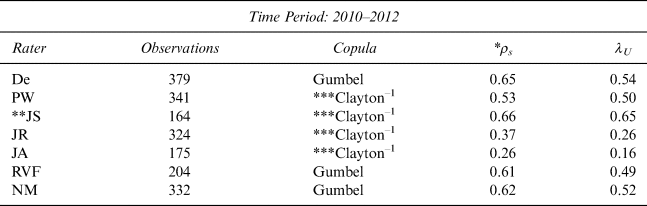
Table 5 first provides the results of the previously-mentioned wine critics for the period of 2010–2012 for right bank wines. The best fitting copula identified in each case for the total period along with the Spearman rank correlation coefficient and, where relevant, the upper tail dependence parameter are provided. The results for Martin (NM) from Table 4 for the 2010–2012 period are also provided for comparison. In all cases the best fitting copula identified with respect to the Parker paired ratings was either the Gumbel or the inverted Clayton copula, indicating significant upper tail dependence. However, the wine critic whose ratings exhibited the highest correlation with that of Parker’s, and also the strongest evidence of upper tail dependence, is that of James Suckling (ρ s = 0.66, λ U = 0.65). A high correlation and tail dependence is also exhibited by the raters for Decanter, however, not as great (ρ s = 0.65, λ U = 0.54) as that of Suckling.
Best Fitting Copula Function and Dependence Measures for Jointly Rated En Primeur Wines by Various Wine Raters and Robert Parker for the Period of 2010–2012

*Spearman rank correlation.
**Note that no data was available in terms of jointly ranked en primeur wines by JS and Parker for the year 2011, accounting somewhat for the lower number of observations over the 2010–2012 period.
***The notation –1 indicates the fitting of a copula function to the inverted uniform distribution data. In the case of the Clayton copula, which captures lower tail dependence, when fitted to the transformed (inverted) data, indicates upper tail dependence in the untransformed data.
It is important to note that the results with respect to the Decanter magazine prior to 2015 are based on the ratings of Steven Spurrier, James Lawther, and Beverley Blanning. Ratings for Decanter from 2015 onwards have been carried out by Jan Anson (JA). Unfortunately, the results in Table 5 indicate that the ratings of JA, over the 2010–2012 period exhibit a low correlation (ρ s = 0.26) with that of Parker's. Although some upper tail dependence is indicated, it is again relatively weak (λ U = 0.16).
As in the case of Martin, we can also examine the pattern of correlation between the ratings of James Suckling and that of Parker over each year of the three-year period. As previously shown in Table 4, Martin's ratings exhibited less tail dependence in the latter years of 2011 and 2012. In the case of Suckling, although no data in terms of wines jointly rated with Parker were available for the year of 2011, Table 6 shows the individual results for the years of 2010 and 2012. In both cases the best fitting copula function remained that of the inverted Clayton, with very to somewhat high correlation and upper tail dependence, although decreasing from 2010 to 2012.
Best Fitting Copula and Resulting Dependence Measures for James Suckling and Robert Parker Jointly Rated Right Bank En Primeur Wines: 2010 and 2012

*Spearman rank correlation.
**The notation –1 indicates the fitting of a copula function to the inverted uniform distribution data. In the case of the Clayton copula, which captures lower tail dependence, when fitted to the transformed (inverted) data, indicates upper tail dependence in the untransformed data.
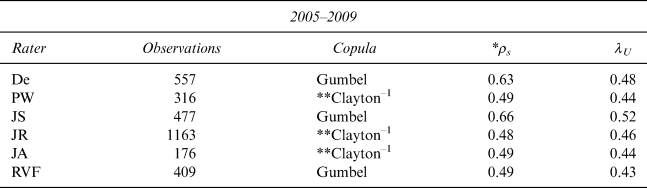
Finally, the data provides the additional opportunity to compare the nonlinear association between the ratings of various continuing en primeur wine critics with that of Parker's for the period of 2005–2009, prior to the ratings of Martin. Table 7 provides the results.
Best Fitting Copula Function, and Dependence Measures for Jointly Rated Right Bank En Primeur Wines by Various Wine Raters and Robert Parker for the Period of 2005–2009

*Spearman rank correlation.
**The notation –1 indicates the fitting of a copula function to the inverted uniform distribution data. In the case of the Clayton copula, which captures lower tail dependence, when fitted to the transformed (inverted) data, indicates upper tail dependence in the untransformed data.
As in the 2010–2012 period, the ratings of Suckling exhibit the highest rank correlation (ρ s = 0.66) with that of Parker's and also the highest upper tail dependence (λ U = 0.52). Although the Decanter wine ratings also appear to have a relatively high correlation (ρ s = 0.63) and upper tail dependence (λ U = 0.48) with that of Parker's, the Decanter ratings, as noted, are now carried out by JA, whose ratings again exhibit a much lower correlation (ρ s = 0.49) and upper tail dependence (λ U = 0.44) on average.
IV. Conclusion
The impact of the wine critic Robert Parker on the Bordeaux wine industry over a 40-year period is without question and his influence has been credited with having shaped the industry to some extent. Consequently, his withdrawal from the rating of Bordeaux en primeur wine futures in 2015 creates some uncertainty for producers. The wine critic Neal Martin could be construed as having been deemed to be the successor to Parker as the en primeur wine rater for Parker's prestigious periodical The Wine Advocate. However, in 2017 it was announced that Martin would be leaving The Wine Advocate to join the publication Vinous in February 2018 (Shaw, Reference Shaw2017a) with the subsequent appointment of The Wine Advocate’s editor-in-chief Lisa Perotti-Brown having the responsibility for all Bordeaux wines (Shaw, Reference Shaw2017b).
We employ copula function modelling to examine the nonlinear correlation and upper tail dependence between the ratings of Parker and various prominent en primeur wine critics over the period of 2010–2012 when Neal Martin and Parker both rated right bank en primeur wines and also for the period of 2005–2009 when several wine critics and Parker rated many of the same right bank en primeur wines. Our results would indicate that of the prominent en primeur wine critics, the ratings of James Suckling had the highest association, both in terms of rank correlation as well as upper tail dependence with that of Parker. This would suggest that a natural replacement in the en primeur right bank market, for those dedicated to the palate and ratings of Parker, would be James Suckling. Having taken over the responsibility for Bordeaux wines for The Wine Advocate in 2018, Lisa Perotti-Brown sampled the 2017 en primeur wines. Early results would suggest, however, some consistency with her ratings and those of Martin (Millar, Reference Millar2018).