Implications
Although there is no obvious compromise shown by free access (FA) journals in the explicit policies on reporting studies involving animals, this study demonstrates that there are no obvious improvements either. Since anyone (both professionals and the general public) can read published FA studies online, FA journals that do not have an explicit policy about publishing animal research are urged to consider adopting one.
Introduction
Scientific articles are intended to form the definitive description of novel findings, and as such, their authors are required to conform to ethical standards regarding factors such as conflicts of interest, plagiarism, data falsification, and other aspects of scientific misconduct (Benos et al., Reference Benos, Fabres, Farmer, Gutierrez, Hennessy, Kosek, Lee, Olteanu, Russell, Shaikh and Wang2005). In reporting experimental work involving animals, other ethical concerns also need to be considered, such as whether the animals used have been treated in a suitable manner, both in terms of their husbandry and the amount of suffering that is incurred before, during and after the reported procedure. Careful consideration of the use of animals in experiments is important from a ‘3Rs’ perspective (following the call for reduction, refinement and replacement articulated by Russell and Burch (Reference Russell and Burch1959)), and also in persuading funding bodies, the general public and other interested stakeholders of both the ethical validity of the research conducted and the accountability of the researchers conducting the work. The use of a benchmark set of guidelines laid out in a journal’s instructions to authors is therefore an important tool for the journal; not only does it allow a straightforward method of vetting submitted manuscripts for their scientific and ethical value, but it also demonstrates that published studies are sound (they have already conformed to these guidelines), and that both the journal and its published authors are subscribing to an appropriate, discipline-specific ethical stance on animal experimentation.
The range of discipline-specific journals publishing the results of experiments involving animals is vast, and the exact ethical policy of a journal may well be related to the discipline a journal is attached to (e.g. see the discussion in Marsh and Kenchington (Reference Marsh and Kenchington2004), on the ethics of publication in marine ecology journals), and some areas of research may call for new approaches to animal welfare (Minteer and Collins (Reference Minteer and Collins2005) look at the wider question of ethics in large-scale ecological studies). Because there is such a wide range of discipline-specific requirements, journal ethical policies will vary. In some cases, bodies have been set up to give specific guidelines. For example, institutional review committee and national standards should be mandated in journals following the recommendations of the International Committee of Medical Journal Editors (2007), the Council of Science Editors (Scott-Lichter and the Editorial Policy Committee, Reference Scott-Lichter2006), and other working groups (Working Committee for the Biological Characterization of Laboratory Animals/GV-SOLAS, 1985; Festing and van Zuthphen, Reference Festing and van Zuthphen1997; Smaje et al., Reference Smaje, Smith, Combes, Ewbank, Gregory, Jennings, Moore and Morton1998). The Committee on Publication Ethics (2008) recommends that research should fulfil internationally-recognised ethical standards. Learned societies and editorial panels may publish their current stance on experiments involving animals within the journal (e.g. Higgins, Reference Higgins2001; Scientific Affairs Board of the British Psychological Society’s Standing Advisory Committee on the Welfare of Animals in Psychology, 2001; American Physiological Society, 2002; Association for the Study of Animal Behaviour/Animal Behavior Society, 2006; Gannon et al., Reference Gannon and Sikes2007; Portaluppi et al., Reference Portaluppi, Touitou and Smolensky2008), or offer detailed guidelines online (a detailed treatment of current international, national and society guidelines for animal use is presented in the guidelines produced by the Association for the Study of Animal Behaviour and the Animal Behavior Society, 2006). There have been calls for including details of animal treatment within methodology sections, such as by including an additional ethical section following the ‘3Rs’ principle (Würbel, Reference Würbel2007; Olsson et al., Reference Olsson, Hansen and Sandøe2008; and the reticence of researchers to do this has also been noted – Buck, Reference Buck2007; Jimenez, Reference Jimenez2007; Sherwin, Reference Sherwin2007). Furthermore, surveys have shown that there is a marked difference in the level of detail required by journals in reporting ethical and other details of the treatment of animals within experimental reports (Boisvert, Reference Boisvert1997; Alfaro, Reference Alfaro2005).
The recent advent of Open Access (OA) publishing and other forms of free access (FA) publishing has arguably changed the landscape of how scientific research is reported. For inclusiveness, I am focussing on a FA model of publication, where research papers are freely accessible online. OA is taken to be a subset of FA, as journals following an OA framework also subscribe to specific requirements about copyright allocation and archiving, laid out by agreements such as the Berlin, Bethesda and Budapest statements – Canessa and Zennaro (Reference Canessa and Zennaro2008) collect together some of the key publications and discussion of the OA movement. ‘Free access’ is taken here to also include those journals where papers are automatically available to download or read online without payment of a subscription or fee immediately upon publication of the electronic version, but do not follow (or at least say they subscribe to) strict OA policy on archiving or copyright. FA to published research findings raises a number of novel concerns about the potential treatment of animals in published studies. Many FA journals levy a front-end charge (per page or per article) to the authors as a means of mitigating the loss of income from making an article freely available on the internet to all readers (instead of following a more traditional income route, where the costs of publishing are moved to the end-user, with libraries and other individuals paying for a print or online version of a publication). It has been acknowledged that researchers have concerns that the commercial interests involved with ‘author-pays’ publication models could lead to a reduction in the quality of both peer review and the articles published (Wellcome Trust, 2004; Hubbard et al., Reference Hubbard, Tamber, Lin, Furler and Duckett2005; Liesegang et al., Reference Liesegang, Schachat and Albert2005; Schroter et al., Reference Schroter, Tite and Smith2005; Hernández-Borges et al., Reference Hernández-Borges, Cabrera-Rodríguez, Montesdeoca-Melián, Martínez-Pineda, Torres-Álvarez de Arcaya and Jiménez-Sosa2006; Liyanage and MacIntyre, Reference Liyanage and MacIntyre2006), and where a worst-case scenario sees the publication of articles as being akin to ‘vanity publishing’. It is conceivable that one of the reductions in quality that could occur is in the editorial criteria for what is permissible in animal experimentation: authors could pay for the publication of studies that would not be considered by ‘traditional’ journals (ones not using a FA framework for publication). Essentially, author charges could be seen in this case as being similar to the journal offering a bribe for ignoring or toning down the peer and editorial review process. This could lead to both a potential reduction in the ethical treatment of animals in research, and the presentation of a greater number of ethically unsound experiments to a sceptical public able to freely access them online.
In this study, I address this concern about a link between FA publishing and a reduction in animal welfare, by conducting a survey of the editorial policies of a large, random selection of biomedical journals. Although the argument presented above might initially be raised about the ethical policies of FA journals, the underlying question is really about the link between payment for publication and ethical standards. Since many of the ‘traditional’, non-FA journals levy a mandatory charge for publication, I also assess the effects of author charges on ethical policy. There may also be historical reasons behind whether a journal has an ethical policy or not: it is conceivable that older, established journals are more likely to have considered imposing an ethical policy on their authors, but it is also conceivable that newer journals with more recently composed author instructions are more likely to have considered more ‘modern’ concerns about animal welfare. I, therefore, also included a measure of the age of a journal in the analyses, to assess whether there is an historical effect upon editorial policy.
Methods
A master journal list was assembled on 7 September 2008 from the Directory of Open Access Journals (DOAJ; http://www.doaj.org) and the 2007 edition of the Journal Citation Report® (JCR). The master list contained all the journals within the following categories on each database:
JCR: ‘Agriculture, Dairy & Animal Science’, ‘Anatomy & Morphology’, ‘Behavioral Sciences’, ‘Biodiversity Conservation’, ‘Biology’, ‘Ecology’, ‘Entomology’, ‘Evolutionary Biology’, ‘Fisheries’, ‘Genetics & Heredity’, ‘Marine & Freshwater Biology’, ‘Multidisciplinary Sciences’, ‘Ornithology’, ‘Parasitology’, ‘Physiology’, ‘Veterinary Sciences’ and ‘Zoology’.
DOAJ: ‘Anatomy’, ‘Animal Sciences’, ‘Aquaculture and Fisheries’, ‘Biology’, ‘Ecology’, ‘Genetics’, ‘Physiology’, ‘Science (General)’ and ‘Zoology’.
Note that the databases did not have identical categories; the above categories were therefore chosen to include all possible journals containing biomedical papers, excluding those journals that explicitly dealt with research on humans.
Non-repeated journals (500) were randomly selected from the master list. Using information collected from both the websites of the journals’ publishers and from abstract databases (accessed between 7 and 23 September 2008 – note that although most of the journals assessed were in English, the non-English journals retrieved were also considered within the analysis), the journals were assessed for the following criteria:
1. At least one complete volume of the journal containing issues dated within 2006 had been published, and at least one 2007- or 2008-dated issue from a later volume had appeared by the date the site was accessed.
2. The complete, finished volume of the journal containing the earliest issue from 2006 (excluding special issues) contained at least one paper where at least one individual (taken to include embryos) of a non-human multicellular species from Kingdom Animalia had been experimentally manipulated in some manner (where ‘manipulation’ is taken to mean any experimental observation, either invasive or non-invasive, that could potentially affect the animal’s physiology or behaviour), or where the paper described details of a previously unpublished dataset where manipulation occurred. If the journal was online and published papers on an ‘available when ready’ basis rather than in the ‘compendium’ form of an issue containing multiple papers, the entire catalogue of papers published in 2006 was considered.
3. Instructions for authors were available online.
4. The year in which the journal started being published was identifiable.
Of the 500 journals randomly selected from the database searches, 332 satisfied all four of these criteria. Note that journals (or issues) consisting solely of review articles were excluded from the analysis. Similarly, because of the sampling technique used, some journals that would normally publish experimental studies on animals (or include vertebrate experiments) were excluded from the analysis because the individual issue assessed did not fit the criteria laid out above.
For the journals fitting the above criteria, I used both abstract databases and the online instructions for authors and journal information available from the publishers’ websites to code the following:
Free access: whether the journal was free access on the date of examination (taken to mean that all its papers were automatically available to download or read online without payment of a subscription or fee immediately upon publication of the electronic version, which was assumed to happen before, at the same time, or instead of print publication). Journals were classified as ‘free access’ or ‘not free access’. Of the 332 journals considered, 103 were free access.
Publication fee: whether authors are expected or required to contribute towards basic publication costs, either through page charges or through a flat rate publication fee. Journals were classified as ‘charge’ or ‘do not charge’. The ‘do not charge’ category included those journals that charged for extra pages on top of a set number of ‘free’ pages, as well as journals that only charged an author when a paper included colour illustrations. If a journal only levied publication fees from non-subscribers or from authors who were not members of an appropriate society or organisation, I considered them to ‘charge’. Of the 332 journals considered, 101 charged for publication.
Ethical stance: whether the authors were required to demonstrate adherence to any ethical guidelines for the treatment of non-human animals. Journals were classified as ‘having an explicit ethical policy’ or ‘not having an explicit ethical policy’.
Vertebrate studies: whether any of the papers published during the journal’s target period contained at least one paper where a non-human vertebrate had been experimentally manipulated (or where the paper described details of a previously unpublished dataset where manipulation occurred). Of the 332 journals considered, 274 reported work on vertebrates.
The year of initial publication was also recorded (the date at which the journal began publication, taking into consideration historic name changes).
The data were modelled using logistic regression, using Design 2.1-1 in R 2.7.2 (Harrell, Reference Harrell2003; R Development Core Team, 2008) with the model ethics ∼ year + access + author charge. This model was applied to both the full dataset and to the subset containing all the journals that presented studies on vertebrates during the target period. Because there was a degree of correlation between year, charge and FA, the model’s predictions could potentially have been subject to unwanted effects of colinearity (Bagley et al., Reference Bagley, White and Golomb2001). However, systematic removal of these explanatory terms from the model had no effect upon the results presented.
Results
Of the 500 randomly selected journals surveyed, 332 published articles during the period studied contained some degree of animal manipulation. Of these journals, only 135 (40.7%) demanded that the papers submitted comply with a pre-defined ethical stance. Of the 274 journals presenting work involving vertebrates, only 127 (46.4%) had an ethical stance.
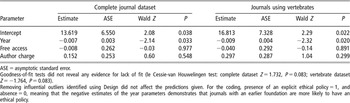
Whether a journal was FA or not had no effect upon whether it had an explicit policy on animal experimentation (Table 1). Similarly, whether a journal charged fees for publication or not also had no effect (Table 1). However, the age of the journal had a significant effect upon whether a journal had an ethical policy on animal experimentation (see Table 1, for both journals presenting non-human vertebrate studies, and journals presenting studies on any non-human animal), where older journals were more likely to have an ethical policy than ones that had been founded more recently.
Summary statistics for logistic regressions modelling ethical policies of journals publishing animal and vertebrate studies

ASE = asymptotic standard error.
Goodness-of-fit tests did not reveal any evidence for lack of fit (le Cessie-van Houwelingen test: complete dataset Z = 1.732, P = 0.083; vertebrate dataset Z = −1.764, P = 0.083).
Removing influential outliers identified using Design did not affect the predictions given. For the coding, presence of an explicit ethical policy = 1, and absence = 0, meaning that the negative estimates of the year parameters demonstrates that journals with an earlier foundation are more likely to have an ethical policy.
Discussion
The results presented here demonstrate that the stance of a FA journal with regard to animal treatment is generally no different to that of a ‘traditional’ non-FA journal, nor is there is any relationship between paying to publish and a lack of ethical guidelines. However, there is a link between journal age and policy, which may well reflect historic editorial responses to an increasing interest and call for action in the treatment of animals in the well-established journals that were surveyed here. The suggestion that younger journals (including all the recently-founded, online-only FA journals) have not automatically considered an explicit editorial policy on publishing studies involving animal experimentation (coupled with the lack of a positive trend towards FA journals having any kind of policy) is moderately disappointing, and I would urge any FA journals that consider themselves to be publishing high-quality articles that are freely accessible, to be mindful of the image they are projecting of their discipline.
In the current study, I only considered whether or not a journal had any form of ethical policy on the treatment of animals, and did not attempt to quantify the actual degree of detail required by the journal (see Alfaro (Reference Alfaro2005), for a detailed discussion of the history and current state of this question). Similarly, I did not attempt to quantify the severity of animal treatment within a journal. These two factors may well be linked (as suggested by Gomez and Conlee (Reference Gomez and Conlee2008)), and a further in-depth analysis may tell us more about how policy can affect the ethical quality of published experimental work. Other factors may also be important – for example, the country of publication could have an influence on the standards of reporting ethical treatment (as has been shown in a comparative study of UK and Italian journals – Matarese (Reference Matarese2008)). Regardless of detail, I demonstrate that the editorial policy of FA journals (as well as those of any journal that requires a publication fee) are as likely as those of non-FA journals to consider detail about the welfare of animals as an important part of whether a study is acceptable for publication. In addition to urging potential authors to consider a journal’s ethical stance when deciding where they send their work, I would urge editorial boards to adopt appropriate guidelines on publishing and presenting studies involving animal experimentation and make these explicit in their instructions to authors.
Acknowledgements
Thanks to John Bradshaw, Bill Browne, Mike Mendl, Christine Nicol, Chris Sherwin and Heather Whitney for useful discussion.