In the field of decision-making in risk situations, one normative theory has dominated the analyses performed for many years: the Expected Utility Theory (von Neumann & Morgenstern, Reference von Neumann and Morgenstern1944). According to this rational theory, the decision rule for risky choices involves maximizing the expected utility of wealth; that is, decision makers evaluate outcomes based on the utility of the final asset positions. Kahneman and Tversky (Reference Kahneman and Tversky1979), convinced of the error of this approach, developed an alternative model, which they called the Prospect Theory, to describe the way human beings make choices and act in risk situations. The prospect theory, in contrast to the expected utility theory, proposes that the value function depends on changes in total wealth, defined as deviations from the reference point (Kahneman, Reference Kahneman2003; Tversky & Kahneman, Reference Tversky and Kahneman1981). The only outcomes taken into account, according to the prospect theory, are those that affect this point of reference, that is, gains, losses or neutral results (Kahneman & Tversky, Reference Kahneman and Tversky1984). Since then, the idea of rational choice, a process that emphasizes the utility of the final states in selecting the best option, has been widely questioned (Kahneman, Reference Kahneman2012; Kahneman & Tversky, Reference Kahneman and Tversky2000).
To test their model, the authors designed a series of well-known experiments in which the participants had to choose between two options (problem 1):
-
a) Winning $300 for sure.
-
b) 80% chance to win $400 and 20% chance to win nothing.
The majority of people (80%) chose option “a”, showing an aversion to risk. This effect was referred to by Kahneman and Tversky (Reference Kahneman and Tversky1979) as the “certainty effect”, which points out that people give too much weight to outcomes that are considered certain, compared to outcomes that are merely probable.
Nonetheless, this occurs not only in gain situations. Reversing the previous alternatives, the following choices appear (problem 2):
-
a) Losing $300 for sure.
-
b) 80% chance to lose $400 and 20% chance to lose nothing.
In this case, 92% of participants chose option “b”, again showing that the certainty outcome is over-weighted. In other words, now participants seek risk to avoid a sure loss. This phenomenon was called the “reflection effect” by the authors, as the preferences described involved a mirror image of the gain situation.
The expected utility theory assumes that people have consistent risk preferences. In contrast, prospect theory clearly shows that this is not true (Frank, Reference Frank2009). According to the expected utility theory, the individuals who avoid risk in problem 1 should again choose the sure option in problem 2; however, the opposite occurs, showing a risk preference reversal pattern. These and other results have led different authors to argue that it is time to recognize that expected utility is an ex-hypothesis (Rabin, Reference Rabin2000).
Later, other studies have pointed out the effect of the emotions in the decision-making process. Thus, motivational needs and emotionally attractive stimuli produce specific effects that cannot be explained by the aforementioned theories. These relationships between emotion and decision have been addressed from different disciplines, such as economics or psychology. The disposition effect observed in stock market investors is explained based on the emotions evoked by different situations related to the decision to buy or sell (Summers & Duxbury, Reference Summers and Duxbury2012). Hsee and Kunreuther (Reference Hsee and Kunreuther2000) demonstrated that affect influences decisions about whether to purchase insurance. Tyszka and Przybyszewski (Reference Tyszka and Przybyszewski2006) concluded that emotional attachment to a currency can cause an increase in the price evaluation of a good by adding an emotion-based value to the purchasing value of the currency. Clinical psychology, on the other hand, has managed to establish new study models for decision-making in patients with altered emotional states like depression or anxiety (Paulus & Yu, Reference Paulus and Yu2012). Tabernero and Wood (Reference Tabernero and Wood2009) showed that subjects in the condition where positive affect was associated with possible errors showed more interest in the task they were doing and better scores, both individually and in groups. Likewise, Regueiro and León (Reference Regueiro and León2003) found that the more a decision was perceived as stressful in the first evaluation process, the greater the negative emotional potential associated with it. Along with these examples, it is also worth mentioning the identification of the neurophysiological structures that evaluate and react to the emotional significance of the stimuli and the effect these structures have on the decision-making process (Gupta, Koscik, Bechara, & Tranel, Reference Gupta, Koscik, Bechara and Tranel2011; Ohira, Reference Ohira2011; Simón, Reference Simón1997).
Over time, different methods have been used to study the majority of the prospect theory hypotheses based on their interactions with the emotions. It has been demonstrated that neither the measurement of the different cognitive systems (intuitive and reasoned), nor the value and weight functions described by Kahneman and Tversky (Reference Kahneman and Tversky1979), fit the response patterns produced in individuals when a certain emotional state is induced (Angie, Connelly, Waples, & Kligyte, Reference Angie, Connelly, Waples and Kligyte2011), or when their affective thinking style varies (Mukherjee, Reference Mukherjee2011).
In addition, Rottenstreich and Hsee (Reference Rottenstreich and Hsee2001) pointed out that weighting the probability of the possible alternatives can alter the normal course of risk decision-making situations, but in this case when stimuli with different affective values are presented. Dividing a sample of 40 participants into two groups of 20, they offered the first group a choice between kissing their favorite movie star or receiving 50 dollars, while the second group had to choose between the same options, but with only a 1% chance of winning. Their results were quite surprising, to the extent that the number of people who chose the money was much greater in the condition of sure gain, and the opposite was true in the low probability condition. According to the authors, these results suggest that in situations of sure gains, affect-poor stimuli are preferred, while in the case of probabilities near zero, affect-rich stimuli are preferred. In the second experiment, one group of participants had to put a price on a coupon for a trip through Europe that could be exchanged for 500 dollars, whereas another group had to put a price on a coupon that could only be exchanged for partial payment of university fees. For each prize, two different conditions were used, a 1% or 99% chance of winning. Again, the results obtained corroborate their predictions, reformulating the weighting function originally proposed by Kahneman and Tversky (Reference Kahneman and Tversky1979).
The main conclusion reached by Rottenstreich and Hsee (Reference Rottenstreich and Hsee2001) helped them to confirm their initial proposal, an idea that has been applied to other contexts (Tyszka & Zaleskiewicz, Reference Tyszka and Zaleskiewicz2012). Based on their data, the independence between the outcomes and the probabilities presented by the classical decision theories or by the prospect theory was not upheld. The probability of the alternatives has a weight (weighting function) determined by the type or nature of the outcomes (value function). That is, the probability and the outcomes cannot be separated when analyzing stimuli with different affective values.
Thus, the emotional load of the stimuli changes the alternative chosen in decision making. However, in the experiments by Rottenstreich and Hsee (Reference Rottenstreich and Hsee2001), the equality of the probabilities was assumed when establishing the different experimental conditions, thus leaving out one of the main characteristics of the experiences designed by Kahneman and Tversky (Reference Kahneman and Tversky1979): the risk we have to face when making decisions. By always using high or low probabilities in both alternatives, the distinct evaluations people can make of the certain or probable options are left out.
Moreover, Dhar and Wertenbroch (Reference Dhar and Wertenbroch2000) introduce a parallel distinction to the contributions of Rottenstreich and Hsee (Reference Rottenstreich and Hsee2001) by differentiating between hedonic goods and utilitarian goods. On the one hand, they define hedonic goods as those whose consumption is primarily characterized by an affective and sensory experience of aesthetic or sensual pleasure, fantasy and fun. On the other, utilitarian goods are those whose consumption is more cognitively driven, instrumental and goal oriented, fulfilling a functional or practical role. In other words, hedonic goods provide consumption that is more experiential, exciting, enjoyable and appealing to the senses, while utilitarian goods are primarily useful, functional and help to achieve a goal. Rottenstreich and Hsee (Reference Rottenstreich and Hsee2001) note that hedonic goods may be thought of as affect-rich, and utilitarian goods as affect-poor. Dhar and Wertenbroch (Reference Dhar and Wertenbroch2000) demonstrate a preference asymmetry in the way people alternate between the hedonic and utilitarian dimensions in acquisition and forfeiture choices. They also show that this asymmetry in preferences can also be expressed in terms of differential loss aversion for hedonic and utilitarian attributes. However, unfortunately, the experiments carried out by these authors focus on riskless choices.
Taking this into account, the main objective of the present article is to complement the prospect theory by Kahneman and Tversky (Reference Kahneman and Tversky1979). More specifically, we intend to find out whether the certainty and reflection effects are fulfilled as predicted in this theory when stimuli with an emotional load are introduced. Based on the contributions made by Rottenstreich and Hsee (Reference Rottenstreich and Hsee2001) and Dhar and Wertenbroch (Reference Dhar and Wertenbroch2000), we will incorporate the importance of the emotive decisions into Kahneman and Tversky’s theory, but this time in risk conditions.
For this purpose, we have used two of the problems described by Kahneman and Tversky (Reference Kahneman and Tversky1979) as a model, in order to ensure that the alternatives meet the criteria for certainty-uncertainty, one in the domain of gains and the other in the domain of losses. Furthermore, we have added the corresponding affect-rich and affect-poor stimuli to the description of these problems. In the end, two situations were obtained, gain and loss, combined with two other conditions, rich and poor affect, resulting in four different experimental conditions.
The following hypotheses are proposed:
H1: In situations of gain, the affect-rich alternative will be chosen more (regardless of whether this alternative is sure or probable).
H2: In situations of loss, the affect-rich alternative will be chosen more (regardless of whether this alternative is sure or probable).
Therefore, we expect that, unlike what is predicted in the prospect theory, a greater proportion of affect-rich alternatives will be chosen, regardless of the assigned probability (sure or probable option) or whether the situation is one of gain or loss. We believe this precisely because of the effect of the emotive decisions on the decision-making process. In a situation of gain, the affect-rich alternatives (or hedonic goods) provide a differential value that makes them more experiential and produces more excitement, fantasy and fun, causing them to be preferred by many people, even though there is risk involved in getting them (even rejecting sure options based on the poor emotions they produce). In contrast, in loss situations this process becomes completely inverted. The affect-rich alternative is chosen because the affect-poor option (or utilitarian goods) is more valued. Faced with the mindset of having to lose, it is better to lose something rich in affect (merely influenced by emotional desires in search of pleasure) than something poor in affect but more functional, instrumental, and practical. For this reason, the participants will continue to take risks to avoid losing something useful, but they will be more reluctant to risk (in contrast to what is proposed by the prospect theory) when this risk involves the danger of losing something functional and practical.
Method
Participants
The participants in this experiment were a total of 160 psychology degree students in the third course at a Spanish university. Each of the experimental conditions was composed of 40 students.
Design and instruments
On the one hand, the experimental design used in this study, consisting of a situation of gain and another situation of loss, is the same one used by Kahneman and Tversky (Reference Kahneman and Tversky1979), described at the beginning of this article. The quantities and percentages used have also been extracted from these same situations.
On the other hand, drawing on the methodology of Rottenstreich and Hsee (Reference Rottenstreich and Hsee2001), an emotional value was introduced in the alternatives that made up these situations. Thus, two stimuli were chosen, the “affect-rich” stimulus gave the participants the possibility of spending the money in the city or town festivities of their choice, while the “affect-poor” stimulus also offered the possibility of spending the same amount of money, but this time on material for photocopies.
To make up the final experimental conditions in the gain situation, the affect-rich and affect-poor stimuli were added to the alternatives of certain (a) and uncertain (b) gain, so that there were two conditions for this situation:
Condition 1:
(The same statement was used in all of the conditions). Please, imagine that you have to choose between the two options offered below. Mark which one you would choose:
a – A sure win of 300€ that could be used to have fun at the festivities in the Spanish city or town of your choice.
b – An 80% chance of winning 400€ that could be used to pay for photocopy material for a few months, and a 20% chance of not winning anything.
Condition 2:
a – A sure win of 300€ that could be used to pay for photocopy material for a few months.
b – An 80% chance of winning 400€ that could be used to have fun at the festivities in the Spanish city or town of your choice, and a 20% chance of not winning anything.
In condition 1, the affect-rich stimulus is associated with the sure alternative (a), and the affect-poor stimulus with the risk alternative (b). The opposite is true in condition 2. According to the prospect theory by Kahneman and Tversky (Reference Kahneman and Tversky1979), in both conditions the sure alternative (a) should be chosen more. However, hypothesis 1 proposes that this will only occur in condition 1, while in condition 2 the affect-rich risk alternative will be chosen more (b).
The same procedure was followed to construct the experimental conditions in the situation of loss:
Condition 3:
a – A sure loss of 300€ that could be used to have fun at the festivities in the Spanish city or town of your choice.
b – An 80% chance of losing 400€ that could be used to pay for photocopy material for a few months, and a 20% chance of not losing anything.
Condition 4:
a – A sure loss of 300€ that could be used to pay for photocopy material for a few months.
b – An 80% chance of losing 400€ that could be used to have fun at the festivities in the Spanish city or town of your choice, and a 20% chance of not losing anything.
According to the prospect theory by Kahneman and Tversky (Reference Kahneman and Tversky1979), in both conditions the risk alternative (b) should be chosen more. However, hypothesis 2 proposes that this will only occur in condition 4, while in condition 3 the affect-rich sure alternative will be chosen more (b).
Procedure
Students’ collaboration was requested to participate in this experiment. They were told that the task would consist of choosing one of the alternatives presented, and that these were hypothetical situations and not real ones. The students who agreed to participate were informed that there were no correct or incorrect answers. The anonymity and confidentiality of their responses were guaranteed. The students were randomly assigned to the four experimental conditions, with 40 students participating in each condition.
Data analysis
Once the frequency of the alternatives chosen by the participants had been calculated, the next step was to determine whether there were significant differences between conditions 1 and 2 (gain situation) and between conditions 3 and 4 (loss situation). A contrast of proportions was carried out using the Z test, comparing the percentages for each experimental condition. Meanwhile, to find out whether the differences between the proportions within each group were statistically significant, a binomial test was applied using a proportion of 0.5. SPSS 17.0 for Windows was used for all the analyses.
Results
Gain situation
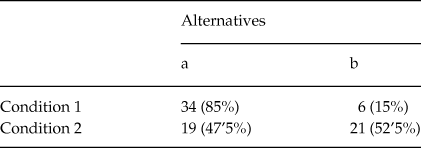
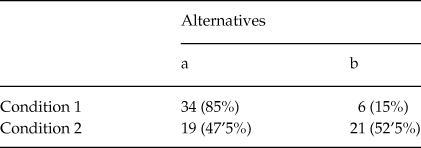
On the one hand, according to the data shown in Table 1, the affect-rich risk alternative (b) was chosen more in condition 2. In contrast, in condition 1, the greater percentage is observed in the affect-rich sure alternative (a). The first hypothesis predicts a greater tendency to choose the affect-rich alternatives in the gain situation. Therefore, we compared the data for the alternatives (a) in each condition (condition 1 and condition 2), by means of a Z test to contrast hypotheses about two independent proportions. The results suggest that there are statistically significant differences between the two alternatives (z = 3’53; p ≤ .01).
On the other hand, the binomial test was used to establish whether there were statistically significant differences between alternatives (a) and (b) in each condition. In condition 1, this was the case (p ≤ .05); while in condition 2 significant differences could not be determined (p > .05).
Frequency and percentage in gain situation
Loss situation
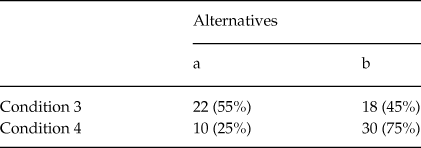
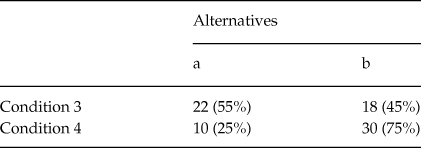
Table 2 reflects the responses chosen and their proportions in the loss situation. In condition 4, a greater percentage chose alternative (b), the one that implies a risky loss and an affect-rich stimulus. This same type of stimulus is found in alternative (a) in condition 3, which is the alternative chosen more, even though it is a sure option. The second hypothesis was tested by applying a Z test between the (a) alternatives in conditions 3 and 4. The results of this test yielded statistically significant differences between the percentages compared (z = 2’74; p < .05).
The binomial test behaved in a similar way to the previous gain situation. In condition 4, a statistically significant difference was obtained when comparing the percentages of the two alternatives (p ≤ .05), but this did not occur in condition 3 (p > .05).
Frequency and percentage in loss situation
Discussion and Conclusions
The results of this experiment provide support for the two hypotheses proposed: in gain and loss situations, the affect-rich alternatives were chosen to a greater extent than the affect-poor alternatives. Thus, again the impact of the emotions is confirmed in the decision-making process, causing the certainty and reflection effects to disappear, even though they are probably among the most strongly supported and corroborated effects in the research on decision-making and choice (Kahneman, Reference Kahneman2012).
The introduction mentions various studies that examined the emotional influence in the decision-making process from different methodological perspectives (Angie et al., Reference Angie, Connelly, Waples and Kligyte2011; Mukherjee, Reference Mukherjee2011; Regueiro & León, Reference Regueiro and León2003; Tabernero & Wood, Reference Tabernero and Wood2009). However, in the present article, the basic methods for testing the prospect theory have been respected, that is, simple alternatives with monetary outcomes and given probabilities (Kahneman & Tversky, Reference Kahneman and Tversky1979, Reference Kahneman and Tversky1984). Nevertheless, in this case, affective-loaded stimuli were added to the monetary amounts (Dhar & Wertenbroch, Reference Dhar and Wertenbroch2000; Rottenstreich & Hsee, Reference Rottenstreich and Hsee2001), integrating the two theoretical approaches.
The first hypothesis, referring to the gain situation, is confirmed by the results. The certainty effect predicted by the prospect theory was not proven in condition 2. The influence of the affect-rich stimulus had a strong impact on the decision-making process, slanting the choice toward the emotionally-rich alternatives, regardless of whether they were sure or probable. Consequently, the risk aversion predicted in this type of situations did not occur in the second condition. The mechanism for assigning values to the different stimuli is altered, granting more importance to those with an affect-rich load, as occurs in other studies (Hsee & Kunreuther, Reference Hsee and Kunreuther2000) showing that people are willing to pay more for something they love than for things about which they have no special feelings, even when they have exactly the same economic value. Although these quite different results between the two conditions manage to annul risk aversion, we cannot state that, in the opposite sense, there is risk seeking in condition 2, as the binomial test does not support this result.
Regarding the loss situation, we observed that the same phenomenon occurs, corroborating the non-fulfillment of the reflection effect foreseen in condition 3. While in condition 4 the percentages are within what has often been described by the prospect theory (the sure alternative is more valued, so that the risk alternative is chosen more), the most valued option in condition 3 is not the sure loss because both options are chosen almost equally. In condition 4, people prefer to take risks rather than losing something sure but affect-poor (although more useful), but in condition 3 this effect is annulled due to the affective value of the stimuli. Thus, when choosing between losing an affect-rich sure outcome and another probable affect-poor option, many more people than what the prospect theory would predict choose to lose the former rather than the latter. In other words, if they have to lose, it is better to lose something sure that is emotionally positive (although less functional, instrumental, and practical) than risk losing something that is considered more useful. In any case, and as occurred in the gain situation, the results of the binomial test do not allow us to state that there is risk aversion in condition 3, which is what would be expected if the effect were completely inverted.
It is important to point out that monetary values were used at all times, in order to compare these results with the original ones from the Kahneman and Tversky studies. From a rational point of view, adding a use for this money should not affect the choice people make, given that a characteristic of money is its fungibility. The fact that someone loses 300 Euros that he/she intended to use for photocopies, for instance, does not keep him/her from transferring money destined for a leisure trip (budgeted at 400 Euros). In that case, one is simply 300 Euros poorer from a strictly rational perspective, given that our total wealth, and not the amount we have separately, is what determines how rich or poor we are (Frank, Reference Frank2009). However, this is not what occurs in this experiment. The participants change their preferences, but not according to what the prospect theory proposes. It is clear that they assign a different value to each option, so that their value functions change based on the emotional quality of the stimuli presented.
On the other hand, this experiment complements the one carried out by Rottenstreich and Hsee (Reference Rottenstreich and Hsee2001), as it compares risky and sure alternatives in decision-making, providing new support for the main conclusion reached by these authors. The probability of the alternatives has a weight determined by the type or nature of the outcomes, so that there is no independence between the outcomes and the probabilities, as defended by both classical decision theories and the prospect theory. Otherwise, the certainty and reflection effects would have appeared in all the experimental conditions in this study, but this was not the case from the moment the emotive decisions appeared. Affect-rich and affect-poor alternatives are valued depending on whether the situation is one of gain or loss. That is, in situations of gain, affect-rich alternatives are valued more, while the opposite occurs in situations of loss, where the affect-poor alternatives are more highly valued, an effect that is not considered in the original study by Rottenstreich and Hsee (Reference Rottenstreich and Hsee2001).
However, one limitation of this study is that we did not use low probabilities in any experimental condition. Rottenstreich and Hsee (Reference Rottenstreich and Hsee2001) showed that in situations of sure gain, affect-poor stimuli were preferred, while in the case of probabilities near zero, affect-rich stimuli were preferred. The present study does not make it possible to explore the effects of the emotional value of stimuli associated with low probabilities in situations involving gain or loss. Future studies will have to examine this question.
The results from the present study could have implications for other basic assumptions of the prospect theory. One of them is the different structure that would be adopted by the weight and value functions derived from the effect of the emotionally-loaded stimuli. Future developments, such as the accumulative prospect theory (Tversky & Kahneman, Reference Tversky and Kahneman1992), could be revised and broadened to test whether what has been shown here is fulfilled in other forms and extensions of the original theory.
The combination of probabilities, monetary amounts and affect-rich and poor stimuli can lead to decisions that do not fit the rational model or the prospect theory. In conclusion, as this study shows, it is necessary to reconsider the way emotive decisions are dealt with, establishing different criteria and models from those used until now in the field of risky decision-making.
I would like to thank Luis Vidal and Javier Gay for their collaboration in carrying out this study.