Learning words in a second language (L2) is a gradual and incremental process that involves the linking of new lexical forms to conceptual representations already connected to word forms in the first language (L1). This process of word learning has been shown to be easier in the case of cognate words (i.e., translation equivalents with full or partial form overlap, as in Dutch-English schip-ship or Spanish-English dialecto-dialect) than in the case of noncognate words (e.g., De Groot & Keijzer, Reference De Groot and Keijzer2000; Tonzar, Lotto, & Job, Reference Tonzar, Lotto and Job2009). For instance, in De Groot and Keijzer (Reference De Groot and Keijzer2000), native speakers of Dutch learned artificial language words using a paired association technique in which L1 words were paired with pseudo-words. Recall scores on immediate tests and on retests one week later showed that cognates were easier to learn and were remembered better than noncognates.
The cognate status of words also has an effect during later stages of L2 acquisition in which bilinguals are already proficient in a L2 (e.g., Dijkstra, Grainger, & Van Heuven, Reference Dijkstra, Grainger and Van Heuven1999; Duyck, Van Assche, Drieghe, & Hartsuiker, Reference Duyck, Van Assche, Drieghe and Hartsuiker2007). Typically, cognates are recognized or produced faster than monolingual control words—an effect referred to as the cognate facilitation effect (e.g., Costa, Caramazza, & Sebastian-Galles, Reference Costa, Caramazza and Sebastian-Galles2000; Dijkstra et al., Reference Dijkstra, Grainger and Van Heuven1999). This result has provided evidence for the viewpoint that lexical access is language nonselective in that L1 lexical representations are accessed when people are reading in their L2 (e.g., Brysbaert, Van Dyck, & Van de Poel, Reference Brysbaert, Van Dyck and Van de Poel1999; Caramazza & Brones, Reference Caramazza and Brones1979; Dijkstra et al.,Reference Dijkstra, Grainger and Van Heuven1999; Dijkstra, Timmermans, & Schriefers, Reference Dijkstra, Timmermans and Schriefers2000; Jared & Kroll, Reference Jared and Kroll2001; Lemhöfer & Dijkstra, Reference Lemhöfer and Dijkstra2004; Lemhöfer, Dijkstra, & Michel, Reference Lemhöfer, Dijkstra and Michel2004) and vice versa (Duyck, Reference Duyck2005; Van Assche, Duyck, Hartsuiker, & Diependaele, Reference Van Assche, Duyck, Hartsuiker and Diependaele2009; Van Hell & Dijkstra, Reference Van Hell and Dijkstra2002). However, almost all evidence for the cognate facilitation effect has been obtained with noun stimuli, and, as a consequence, theoretical accounts of bilingual language processing (in general) and cognate representation (in particular) are almost exclusively based on noun processing. The main goal of the present study, therefore, is to extend these findings on noun processing to the processing of verbs. Because verbs are more language specific than nouns in terms of both form and meaning, it remains to be tested whether or not the theoretical assumptions for cognate representations deduced from noun studies can be generalized to verbs. Additionally, we investigate whether these effects for verbs are modulated by verb tense (i.e., Experiment 1), and more specifically, whether or not the fact that past tense verbs generally have lower degrees of crosslingual orthographic overlap affects word processing. We also examine whether verb cognate facilitation effects are modulated by presentation in natural sentence contexts, which arguably provide a language cue for lexical selection and possibly lead to smaller crosslingual activation effects.
We first review the literature on noun cognate processing for words presented out of context and for words presented in a sentence context. We then present the most influential theoretical accounts on the cognate facilitation effect. This is followed by a discussion of verb processing and the presentation of the current experiments.
THE COGNATE FACILITATION EFFECT
Many bilingual studies have shown that noun cognates presented out of context are processed faster than noncognates. This cognate facilitation effect has been observed using tasks such as visual lexical decision (e.g., Dijkstra et al., Reference Dijkstra, Grainger and Van Heuven1999; Lemhöfer & Dijkstra, Reference Lemhöfer and Dijkstra2004), picture naming (e.g., Costa et al., Reference Costa, Caramazza and Sebastian-Galles2000), and word naming (e.g., Schwartz, Kroll, & Diaz, Reference Schwartz, Kroll and Diaz2007). Cognate facilitation even occurs when bilinguals perform a lexical decision task in their native language (Van Assche et al., Reference Van Assche, Duyck, Hartsuiker and Diependaele2009; Van Hell & Dijkstra, Reference Van Hell and Dijkstra2002). This cognate facilitation effect has typically been explained by assuming language-nonselective activation of lexical representations in the two languages. The presentation of a word in one language activates orthographic, phonological, and semantic representations in all known languages (e.g., Dijkstra & Van Heuven, Reference Dijkstra and Van Heuven2002). The crosslingual activation that spreads from these three codes speeds up the activation of cognates—compared to noncognates—and results in faster word-recognition times. This view is supported by studies that show that the size of the cognate facilitation effect increases with greater crosslingual form overlap between the cognate’s two readings (e.g., Dijkstra, Miwa, Brummelhuis, Sappelli, & Baayen, Reference Dijkstra, Miwa, Brummelhuis, Sappelli and Baayen2010; Duyck et al., Reference Duyck, Van Assche, Drieghe and Hartsuiker2007; Van Assche et al., Reference Van Assche, Duyck, Hartsuiker and Diependaele2009; Van Assche, Drieghe, Duyck, Welvaert, & Hartsuiker, Reference Van Assche, Drieghe, Duyck, Welvaert and Hartsuiker2011).
Most studies on bilingual word processing and the cognate facilitation effect have investigated the recognition of isolated words; yet, word recognition in natural language processing rarely occurs out of context. The ecological validity of the studies on word processing out of context can be tested by examining word recognition in sentences. Only recently have a few studies started to investigate this issue for L2 sentence processing (e.g., Duyck et al., Reference Duyck, Van Assche, Drieghe and Hartsuiker2007; Libben & Titone, Reference Libben and Titone2009; Schwartz & Kroll, Reference Schwartz and Kroll2006; Van Assche et al., Reference Van Assche, Drieghe, Duyck, Welvaert and Hartsuiker2011; Van Hell & De Groot, Reference Van Hell and De Groot2008) and L1 sentence processing (e.g., Titone, Libben, Mercier, Whitford, & Pivneva, Reference Titone, Libben, Mercier, Whitford and Pivneva2011; Van Assche et al., Reference Van Assche, Duyck, Hartsuiker and Diependaele2009). Second language processing studies converge on the conclusion that a low-constraint sentence—and the language cue it provides—does not modulate the language selectivity of the bilingual word recognition process. However, mixed results have been obtained for cognate processing in semantically constraining sentences (for a review on bilingual word processing in sentences, see Van Assche, Duyck, & Hartsuiker, Reference Van Assche, Duyck and Hartsuiker2012). Low-constraint sentences have linguistic contexts that do not predict the target word (e.g., Anna has seen a popular ___), whereas high-constraint sentences strongly predict the target word (e.g., That train always arrives on time at the ___). Studies that use lexical decision or naming indicate that a strong semantic context reduces or eliminates crosslingual activation effects (e.g., Schwartz & Kroll, Reference Schwartz and Kroll2006; Van Hell & De Groot, Reference Van Hell and De Groot2008), whereas recent studies, which use time-sensitive eye-tracking (e.g., Van Assche et al., Reference Van Assche, Drieghe, Duyck, Welvaert and Hartsuiker2011), suggest that crosslingual activation effects may remain in the semantically constraining context. In the study by Schwartz and Kroll (Reference Schwartz and Kroll2006) with Spanish-English bilinguals, L2 low- and high-constraint sentences were presented word by word using rapid serial visual presentation. The target words were all singular nouns (e.g., Spanish-English piano-piano) and had to be named out loud. Cognate facilitation was observed in low-constraint sentences but not in high-constraint sentences. Van Hell and De Groot (Reference Van Hell and De Groot2008) obtained similar results with Dutch-English bilinguals performing lexical decision and translation tasks.
Evidence for the fact that the mere presentation of a word in a L2 sentence does not restrict the spread of activation to target language representations in the bilingual lexicon has also been obtained in studies that use the more time-sensitive eye-tracking technique (e.g., Duyck et al., Reference Duyck, Van Assche, Drieghe and Hartsuiker2007; Libben & Titone, Reference Libben and Titone2009; Titone et al., Reference Titone, Libben, Mercier, Whitford and Pivneva2011; Van Assche et al. Reference Van Assche, Duyck, Hartsuiker and Diependaele2009, Reference Van Assche, Drieghe, Duyck, Welvaert and Hartsuiker2011). This method allows participants to read on a computer screen, as in everyday life, and does not require any overt response such as in lexical decision or naming. Duyck et al. (Reference Duyck, Van Assche, Drieghe and Hartsuiker2007) tested Dutch-English bilinguals while they read L2 English low-constraint sentences, which contained a noun cognate or a control word (e.g., Hilda bought a new RING-COAT and showed it to everyone, in which ring is the cognate and coat the control word). Cognate facilitation was observed on early reading time measures (e.g., lower first fixation and gaze durations for cognates than for noncognates, which signal easier lexical access) but only for identical cognates (i.e., cognates with identical spellings across languages, like the Dutch-English ring-ring). Thus, it seems that the sentence context was strong enough to weaken the cognate facilitation effect when crosslingual orthographic overlap was not perfect (nonidentical cognates, e.g., Dutch-English schip-ship). However, when crosslingual orthographic overlap was complete (i.e., identical cognates), coactivation of representations occurred during sentence reading, as was the case for words presented out of context.
In a follow-up study, Van Assche et al. (Reference Van Assche, Drieghe, Duyck, Welvaert and Hartsuiker2011) fine-tuned this distinction between identical and nonidentical cognates by calculating the degree of orthographic overlap on Van Orden’s (Reference Van Orden1987) word similarity measure Footnote 1 for each noun cognate and noncognate on a scale from 0 to 1 (e.g., Dutch-English cognate boek-book: 0.72; noncognate gezicht-face: 0.06). In L2 low-constraint sentences, reading times for cognates were faster than for noncognates. This was a gradual and continuous effect: The higher the degree of crosslingual overlap, the faster the reading time. Furthermore, cognate facilitation effects in high-constraint sentences were also observed, which conflicted with the findings of earlier studies (e.g., Schwartz & Kroll, Reference Schwartz and Kroll2006; Van Hell & De Groot, Reference Van Hell and De Groot2008). It seems that for these noun cognate studies, eye-tracking technology was more sensitive to early crosslingual activation effects in the bilingual language system (e.g., the cognate facilitation effect on first fixation duration) than were lexical decision or naming tasks, which may also reflect processes occurring after lexical access had taken place (see Van Assche et al., Reference Van Assche, Duyck and Hartsuiker2012).
Cognate facilitation for nouns in native language reading was recently reported by Van Assche et al. (Reference Van Assche, Duyck, Hartsuiker and Diependaele2009) and Titone et al. (Reference Titone, Libben, Mercier, Whitford and Pivneva2011). Van Assche et al. presented Dutch-English bilinguals with low-constraint sentences that could include both the noun cognate and its control (e.g., Ben heeft een oude OVEN-LADE gevonden tussen de rommel op zolder “Ben found an old OVEN-DRAWER among the rubbish in the attic,” in which oven is a Dutch-English cognate and lade is a control word). They observed shorter reading times on early (e.g., gaze duration) and later (e.g., go-past time) reading time measures for cognates than for noncognates. This implies that the mere knowledge of a L2 affects a highly automated skill such as sentence reading in the mother tongue. These findings provide strong evidence for language-nonselective access in the bilingual lexicon.
Titone et al. (Reference Titone, Libben, Mercier, Whitford and Pivneva2011) observed greater cross-language activation on early reading time measures when the L2 was acquired early in life. They measured the eye movements of English-French bilinguals reading identical cognates (e.g., English-French piano-piano) in low- and high-constraint L1 sentences. Cognate facilitation was present on early reading time measures. This effect was independent of contextual constraint, but it was modulated by age of L2 acquisition: Only bilinguals who acquired their L2 early in life showed cognate facilitation for these early reading measures. The age of L2 acquisition, however, did not affect the degree of cognate facilitation on late reading time measures, whereas semantic constraint did (i.e., cognate facilitation effects were smaller in high- than in low-constraint sentences).
These studies on L1 and L2 sentence processing show that the mere presentation of words in a sentence context does not modulate language-nonselective activation in the bilingual language system. Mixed results have been obtained for semantically constraining sentences, but studies using time-sensitive eye-movement recordings suggest that even a restrictive context does not necessarily yield language-selective lexical activation, at least not in early reading stages.
An even more natural reading situation than word reading in sentences was recently tested by Balling (Reference Balling2012). She investigated noun cognate processing in natural text or paragraph reading. Danish-English bilinguals read news articles in their L2 while eye movements were monitored. The results revealed cognate facilitation effects that were modulated by morphological complexity. Simple cognates (e.g., Danish-English rolle-role) showed cognate facilitation, whereas morphologically complex cognates (i.e., words that are not fully cognate but contain at least one morpheme—that is, as in Danish-English onsdag-Wednesday, in which dag-day is the cognate morpheme) showed inhibition compared to noncognates. Balling suggested that this inhibition effect may arise because of the problematic integration of cognate and noncognate morphemes. It thus seems that the morphological structure of words plays a role in bilingual word recognition. Because verbs have many more possible inflections than nouns in both English and Dutch, it is therefore important to investigate the generalizability of cognate facilitation effects from nouns to verbs.
THEORETICAL ACCOUNTS OF THE COGNATE FACILITATION EFFECT
The cognate facilitation effect has often been taken as evidence for either (a) a bilingual language system in which words are represented in an integrated lexicon or (b) the parallel activation of words from both languages. Although it is often assumed that identical cognates have largely overlapping orthographic and semantic representations across languages, the exact nature of (nonidentical) cognates remains debated (see, for example, Dijkstra et al., Reference Dijkstra, Miwa, Brummelhuis, Sappelli and Baayen2010, or De Groot, Reference De Groot2011, for an overview as well as figures that illustrate the different theoretical accounts). Many studies have attributed the cognate facilitation effect to the coactivation of orthographic, phonological, and semantic representations in the bilingual language system (e.g., Dijkstra & Van Heuven, Reference Dijkstra and Van Heuven2002; Dijkstra et al., Reference Dijkstra, Miwa, Brummelhuis, Sappelli and Baayen2010). A formal implementation of this is the bilingual interactive activation + (BIA+) model, which assumes that words from both languages are represented in an integrated lexicon and are activated in parallel. On the presentation of a word, orthographic, phonological, and semantic representations become activated in both languages depending on the amount of overlap with the input word. Because cognates have similar crosslingual orthographic, phonological, and semantic representations, activation levels are higher for cognates as compared to noncognates, which leads to faster recognition times.
However, other theoretical accounts of the cognate facilitation effect assume qualitative differences in the representation of cognates and noncognates at a conceptual (e.g., De Groot & Nas, Reference De Groot and Nas1991; Van Hell & De Groot, Reference Van Hell and De Groot1998) or a morphological level (e.g., Kirsner, Lalor, & Hird, Reference Kirsner, Lalor, Hird, Schreuder and Weltens1993; Lalor & Kirsner, Reference Lalor and Kirsner2000; Sánchez-Casas & García-Albea, Reference Sánchez-Casas, García-Albea, Kroll and De Groot2005). The distributed features account (Van Hell & De Groot, 1998) assumes that word meanings are represented over a network of interconnected meaning units, each of which represents one aspect of the word’s meaning. De Groot (Reference De Groot, Frost and Katz1992) suggested that the representations of cognates may share more meaning units than those of noncognates, which results in faster word processing. This more similar conceptual representation for cognates may arise from the tendency to think that words that look alike across languages mean the same thing, which is also related to the way new words are learned. Van Hell and De Groot (Reference Van Hell and De Groot1998) suggested that learners may map the meaning of a new L2 cognate onto the existing conceptual representation of its translation in the L1, whereas this may be less the case for a noncognate.
Another account attributes the differences between cognates and noncognates to a morphological level (e.g., Kirsner et al., Reference Kirsner, Lalor, Hird, Schreuder and Weltens1993; Lalor & Kirsner, Reference Lalor and Kirsner2000; Sánchez-Casas & García-Albea, Reference Sánchez-Casas, García-Albea, Kroll and De Groot2005). For instance, in the Kirsner et al. (Reference Kirsner, Lalor, Hird, Schreuder and Weltens1993) model of word recognition, cognate translations were considered a special type of morphologically related items; therefore, words that share form and meaning will be learned interdependently. By implication, when a word becomes more frequently used, this effect transfers to other related words. Sánchez-Casas and García-Albea (Reference Sánchez-Casas, García-Albea, Kroll and De Groot2005) proposed a morphological level of representation within the bilingual lexicon in which cognate translations share a morphological representation, and noncognate translations do not. On the basis of their common root, they suggested that cognate translations and morphologically related words are similarly represented. Sánchez-Casas and García-Albea also described several possibilities for how to implement a morphological level in the distributed features account (Van Hell & De Groot, Reference Van Hell and De Groot1998) and the BIA+ model (Dijkstra & Van Heuven, Reference Dijkstra and Van Heuven2002). This morphological level could link all the words that share a common root.
Dijkstra et al. (Reference Dijkstra, Miwa, Brummelhuis, Sappelli and Baayen2010) tested whether these accounts could explain the results of experiments on the crosslinguistic similarity of translation equivalent effects (e.g., Dutch-English ring-ring vs. schip-ship vs. lied-song) and task effects (e.g., lexical decision vs. language decision) with Dutch-English bilinguals. A localist connectionist model such as BIA+ (Dijkstra & Van Heuven, Reference Dijkstra and Van Heuven2002) provided the best framework to interpret these results and the graded effects of cognate status found in other studies (e.g., Van Assche et al., Reference Van Assche, Duyck, Hartsuiker and Diependaele2009, Reference Van Assche, Drieghe, Duyck, Welvaert and Hartsuiker2011). We therefore use this theoretical framework to interpret the results of the present study. Still, Lehtonen and colleagues (Lehtonen & Laine, Reference Lehtonen and Laine2003; Lehtonen, Niska, Wande, Niemi, & Laine, Reference Lehtonen, Niska, Wande, Niemi and Laine2006) and Balling (Reference Balling2012) suggest that the morphology of words also affects bilingual word recognition. The BIA+ model (Dijkstra & Van Heuven, Reference Dijkstra and Van Heuven2002) and the distributed features model (Van Hell & De Groot, 1998) do not include morphological representations possibly because morphologically simple, monomorphemic nouns have mostly been used to study and model bilingual word recognition.
VERB PROCESSING
Lexical activation and representation in bilingual memory may depend not only on cognate status but also on grammatical word class. In English monolingual studies, verb processing has been shown to be more demanding than noun processing. English nouns were recognized faster than English verbs in lexical decision (e.g., Sereno, Reference Sereno1999; Tyler, Russell, Fadili, & Moss, Reference Tyler, Russel, Fadili and Moss2001), semantic categorization (e.g., Tyler et al., Reference Tyler, Russel, Fadili and Moss2001), and noun-or-verb categorization tasks (e.g., Sereno, Reference Sereno1999). This processing advantage for nouns over verbs can be related to their semantic, syntactic, and morphological characteristics (see Vigliocco, Vinson, Druks, Barber, & Cappa, Reference Vigliocco, Vinson, Druks, Barber and Cappa2011, for an integrative review of noun and verb studies). More specifically, the meaning of nouns typically refers to objects and discrete entities, whereas verb meanings refer to actions or events and are thus more dependent on the surrounding linguistic context and the relating nouns. Additionally, verbs have a greater breadth of meaning (e.g., Gentner, Reference Gentner1981) and are more often polysemous than are nouns (e.g., Miller & Fellbaum, Reference Miller and Fellbaum1991). As such, verbs can be considered the most complex and “arguably the most important lexical category of a language” (Miller & Fellbaum, Reference Miller and Fellbaum1991, p. 214). Furthermore, verbs are syntactically more complex than nouns because their argument structure dictates that the sentence must contain certain constituents (e.g., the agent, theme, and goal), whereas nouns do not assign thematic roles (Baker, Reference Baker2003).
Verbs also have a more complex morphological structure than nouns. English verbs are associated with several possible regular inflections related to tense, aspect, and number, and although nouns can take various derivational morphemes (i.e., noun markers), they only have the plural inflectional morpheme (i.e., -s or zero morpheme). Several studies have investigated whether morphologically complex words are recognized by a direct, whole-word process or whether a decomposition process takes place in which the root morpheme has a special role. For instance, Randall and Marslen-Wilson (Reference Randall, Marslen-Wilson, Gernbacher and Derry1998) studied English regular and irregular past tense verbs and suggested that inflected verbs are recognized through the whole-word form, whereas other studies that investigated Dutch irregular past tense verbs found evidence for a morphological decomposition of verbs (e.g., Baayen, Dijkstra, & Schreuder, Reference Baayen, Dijkstra and Schreuder1997). However, an eye-tracking study by Niswander, Pollatsek, and Rayner (Reference Niswander, Pollatsek and Rayner2000), which investigated English regularly inflected verbs, suggested that both the whole-word form and the root morpheme influence word processing. Studies by Lehtonen and colleagues (e.g., Lehtonen & Laine, Reference Lehtonen and Laine2003; Lehtonen et al., Reference Lehtonen, Niska, Wande, Niemi and Laine2006) with noun materials have also shown that language background (i.e., monolinguals vs. bilinguals), word frequency, and the morphological richness of a language influence the use of these processing modes for morphologically complex words.
It has been shown that verb meanings vary more between languages than do noun meanings (e.g., Gentner, Reference Gentner1981), which is likely to affect verb processing by bilinguals. Gentner (Reference Gentner1981) instructed a bilingual to translate an English text into another language and then had another bilingual translate the text back to English. When both versions were compared, it was found that more of the original nouns than verbs appeared in the final version. Similar results were obtained by Van Hell and De Groot (Reference Van Hell and De Groot1998), who investigated the meaning representation of words that varied on grammatical class, cognate status, and concreteness. Dutch-English bilinguals performed a within-language and a between-language word-association task on either Dutch or English words. Results showed that responses to nouns, cognates, and concrete words were faster and more similar than those to verbs, noncognates, and abstract words. An interpretation of the results in the distributed features account (Van Hell & De Groot, Reference Van Hell and De Groot1998) suggests that cognate and noun translations share larger parts of a conceptual representation than noncognate and verb translations.
In addition to the greater crosslinguistic differences for verbs than for nouns, verbs also vary more between Dutch and English with respect to orthography. For example, Dutch infinitival verb forms mostly end in -en, whereas this is not the case for English (e.g., Dutch-English helpen-help). Furthermore, crosslingual overlap for verbs varies according to tense. English regular verbs have minimal and predictable inflection in the present and past tense, whereas in Dutch verb conjugation is richer and more complex. The infinitival form with the suffix -en is the same as for the first-, second-, and third-person present plural forms (e.g., wij wandelen “we walk,” jullie wandelen “you walk,” zij wandelen “they walk”). The first-person present singular form is the root (e.g., ik wandel “I walk”), whereas the suffix -t is added for the second- and third-person singular forms (e.g., jij wandelt “you walk,” hij wandelt “he walks”). The past tense of Dutch verbs is different for weak, strong, and irregular verbs: Weak verbs form their past tenses by adding -d or -t (e.g., we werkten “we worked”); strong verbs are formed by vowel gradation (e.g., we vonden “we found”).
The previous paragraphs demonstrate that verbs are more language specific than nouns in terms of both meaning and form. Little is known about whether or not the theoretical assumptions for cognate representations deduced from noun studies generalize to verbs. However, in a recent study by Bultena, Dijkstra, and Van Hell (in press), cognate status and word class ambiguity (i.e., ambiguous vs. unambiguous words—for example, the English word dress can occur both as a noun and a verb, whereas the word cliff occurs only as a noun, and the word learn only as a verb) were manipulated in nouns and verbs. A cognate ambiguous word is one for which both the noun reading (e.g., sprint-sprint) and the verb reading (e.g., sprinten-sprint) are Dutch-English cognates. Dutch-English bilinguals performed L2 lexical decision tasks in which nouns and present tense verb forms (e.g., you bake, we bake, they bake) were presented in separate blocks. Although there was a cognate facilitation effect for nouns, there was no effect of word class ambiguity, which suggests that the additional verb reading for ambiguous nouns does not facilitate (or inhibit) processing. For verbs, there was both a cognate facilitation effect and an ambiguity effect that were indicative of the fact that verb processing is facilitated by the additional noun reading in word class ambiguous verbs. There was also a cognate facilitation effect for verbs, which is more relevant for the present study. An interpretation of these results in the BIA+ model (Dijkstra & Van Heuven, Reference Dijkstra and Van Heuven2002) suggests that both the English and Dutch representations of an unambiguous cognate verb are activated strongly enough to facilitate processing. Yet, it is not clear whether cognate facilitation effects are modulated by presentation in a more naturalistic sentence context, which provides a clear language cue for these verbs that are more language specific than nouns. Furthermore, it is still unclear as to how verb conjugation modulates crosslingual activation for verbs.
THE PRESENT STUDY
In Experiment 1, we examined whether verb cognates generate similar cognate facilitation effects as previously found for noun cognates in a L2 lexical decision task (e.g., Dijkstra et al., Reference Dijkstra, Grainger and Van Heuven1999, Reference Dijkstra, Miwa, Brummelhuis, Sappelli and Baayen2010; Lemhöfer & Dijkstra, Reference Lemhöfer and Dijkstra2004; Van Assche et al., Reference Van Assche, Drieghe, Duyck, Welvaert and Hartsuiker2011). We also investigated whether verb tense modulates cognate facilitation effects for verb targets. Simple present plural tense forms (e.g., wij haten–we hate) and inflected past tense forms (e.g., wij haatten–we hated) were tested. We predicted to find cognate facilitation effects for present tense verbs in accordance with Bultena et al.’s (in press) results, although effects may be smaller than those generally found for nouns (e.g., Dijkstra et al., Reference Dijkstra, Grainger and Van Heuven1999; Lemhöfer & Dijkstra, Reference Lemhöfer and Dijkstra2004; Van Hell & Dijkstra, Reference Van Hell and Dijkstra2002) because lower degrees of crosslingual orthographic and semantic overlap for verbs can restrict dual-language activation for cognate verbs (e.g., Dijkstra et al., Reference Dijkstra, Miwa, Brummelhuis, Sappelli and Baayen2010; Duyck et al., Reference Duyck, Van Assche, Drieghe and Hartsuiker2007; Van Assche et al., Reference Van Assche, Duyck, Hartsuiker and Diependaele2009; Van Hell & De Groot, Reference Van Hell and De Groot1998). Cognate facilitation effects may also be smaller for past tense verbs because the Dutch-English past tense verb pairs (e.g., scoorde-scored) have somewhat lower degrees of crosslingual orthographic overlap than present tense verb pairs (e.g., scoren-score). For instance, mean orthographic overlap—calculated on the basis of Van Orden’s (Reference Van Orden1987) orthographic word similarity measure—was 0.64 for present tense cognate verb pairs and 0.55 for past tense cognate verb pairs in Experiment 1. This difference was statistically significant, t(21) = 4.08, p < .001. However, if we apply Sánchez-Casas and García-Albea’s (Reference Sánchez-Casas, García-Albea, Kroll and De Groot2005) suggestion that cognate translations involve a special kind of morphological relation, the base morpheme may constitute the crucial link between the L1 and L2 representations. It may be inferred that if the base morpheme is strongly activated for past tense verbs, the different suffixes in Dutch (e.g., -ten and -te) and English (e.g., -ed) that are added to the verb root or base morpheme for regular verbs do not generate interference (e.g., test: we testten–we tested; hij testte–he tested); thus similar effects for past tense verbs are also possible under this account.
In Experiment 2, we investigated the time course of activation and whether or not the language of the sentence can restrict lexical access to a specific language. Cognate and noncognate verbs were presented in a low-constraint sentence context, which provided more ecologically valid presentation circumstances than in Experiment 1, while eye movements were monitored. Bilingual sentence studies on noun processing have shown that the mere presentation of words in a sentence does not restrict lexical access to words of only one language (e.g., Duyck et al., Reference Duyck, Van Assche, Drieghe and Hartsuiker2007; Libben & Titone, Reference Libben and Titone2009; Schwartz & Kroll, Reference Schwartz and Kroll2006; Van Assche et al., Reference Van Assche, Duyck, Hartsuiker and Diependaele2009, Reference Van Assche, Drieghe, Duyck, Welvaert and Hartsuiker2011; Van Hell & De Groot, Reference Van Hell and De Groot2008). We therefore predicted the same cognate facilitation effects to occur in sentences as in isolation. However, Duyck et al. (Reference Duyck, Van Assche, Drieghe and Hartsuiker2007) showed that sentence context may nullify cognate facilitation effects obtained in isolation for target words for which crosslingual orthographic overlap is not complete. As the target words in this study are nonidentical cognates that have lower crosslingual overlap than nouns, the unilingual sentence context may tune down crosslingual activation effects for verbs.
EXPERIMENT 1: LEXICAL DECISION
Method
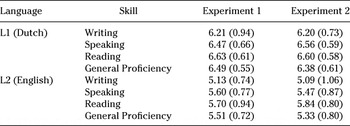
Participants.Forty-six students from Ghent University participated in the experiment in exchange for course credit or monetary compensation. Most of them were psychology students, although students from other departments also participated. They were all late Dutch-English bilinguals who started to learn English around age 14 at secondary school for approximately 3–4 hr a week. In addition to this classroom exposure, students in Belgium are regularly exposed to English through popular media and English university textbooks. After the experiment was finished, participants were asked to rate several dimensions of their L1 and L2 proficiency (i.e., reading, writing, speaking, and general proficiency) on a 7-point Likert scale that ranged from very bad to very good. Mean self-reported general L1 (M = 6.50) and L2 proficiency (M = 5.50) differed significantly, t(45) = 8.92, p < .001. Means are reported in Table 1.
Self-assessed ratings (as measured by a 7-point Likert scale) of L1 and L2 proficiency in Experiments 1 and 2

Note.
Standard deviations are displayed in parentheses.
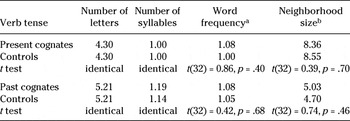
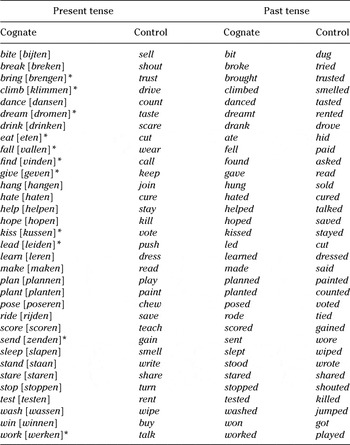
Stimulus materials.Because the present study investigated processing in the participants’ L2, the cognate verb stimuli consisted of 33 English present tense verbs and their past tense counterparts. Each was three to seven letters in length and varied in the degree of Dutch-English orthographic similarity. Using the WordGen stimulus-generation program (Duyck, Desmet, Verbeke, & Brysbaert, Reference Duyck, Desmet, Verbeke and Brysbaert2004) and the CELEX lexical database (Baayen, Piepenbrock, & Van Rijn, Reference Baayen, Piepenbrock and Van Rijn1993), 66 English noncognate control verbs matched—item by item—to the cognates with respect to word class (i.e., all words were verbs), word length, number of syllables, word form frequency, and neighborhood size (Coltheart, Davelaar, Jonasson, & Besner, Reference Coltheart, Davelaar, Jonasson, Besner and Dornic1977) were selected (see Table 2). To ensure that participants saw each cognate verb in only one of the two verb tense conditions, the total set of cognates and controls was divided into two presentation lists, and each participant saw only one list. Thus, if a participant saw the cognate verb bite and the control sell in the present tense, he or she saw neither the past tense verb bit nor the control dug. Matching between cognates and noncognates on the matching variables was ensured in each presentation list.
Mean lexical characteristics of the cognates and controls

Note.
T tests are dependent-samples t tests between cognates and controls.
a Mean log word form frequency per million words, according to the CELEX database (Baayen et al., Reference Baayen, Piepenbrock and Van Rijn1993).
b Neighborhood size (Coltheart et al., Reference Coltheart, Davelaar, Jonasson, Besner and Dornic1977) calculated using the WordGen program (Duyck et al., Reference Duyck, Desmet, Verbeke and Brysbaert2004) on the basis of the CELEX database (Baayen et al., Reference Baayen, Piepenbrock and Van Rijn1993).
In addition to these verb targets, 104 filler nouns in their singular or plural form and 22 filler verbs were presented to ensure a variety of word types in the presentation list. Using the WordGen program (Duyck et al., Reference Duyck, Desmet, Verbeke and Brysbaert2004), 192 orthographically regular and pronounceable nonwords were selected that were matched on word length (independent-samples t test: t[478] = 0.63, p > .53), neighborhood size (t[478] = 0.32, p > .75), and bigram frequency (t[478] = 1.52, p > .13). On the basis of Van Orden’s (Reference Van Orden1987) word similarity measure, we defined cognates as words with an orthographic overlap of 0.50 or more in the present tense verb condition. This resulted in the removal of 11 verb word pairs because these targets’ orthographic overlap in both languages was too low to be considered a cognate (e.g., klimmen-climb: 0.24; zenden-send: 0.33). The selected cognates and control words are included in the appendix.
Procedure.Participants were tested in small groups of four persons. They received oral and written instructions to decide on each trial whether or not the presented letter string was a real English word by pressing one of two response buttons. Verb targets, filler nouns, and filler verbs were presented in a minimal context to indicate whether they were a noun or a verb. Each verb was preceded by we (e.g., we bite) and each noun by the (e.g., the book). Participants were instructed to press the right button for a word response and the left button for a nonword, and they were to make this decision as quickly and accurately as possible. All participants completed the 384 trials in a random order. Each word was presented only once, and 10 practice trials preceded the experiment.
Each trial started with the presentation of a centered fixation point for 800 ms. After a 300-ms stimulus interval, the context word we or the was presented in the middle of the screen for 500 ms. Next, a blank screen was presented for 100 ms, followed by the presentation of the letter string for lexical decision. It remained there either until the participant responded or until the maximum response time of 2,500 ms was exceeded. The intertrial interval was 700 ms. After the experiment, participants completed a questionnaire and assessed their self-reported L1 and L2 reading, speaking, writing, and general skills on a 7-point Likert scale.
Results
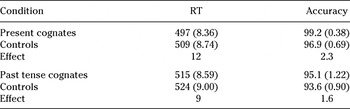
Due to the exclusions made on the basis of orthographic overlap described in the previous section, analyses were run on 22 present tense and 22 past tense cognate-control pairs. This did not affect the matching between cognates and controls on word length (identical), number of syllables (identical), word frequency (present tense condition: t(21) = 0.40, p > .70; past tense condition: t(21) = 0.99, p > .34), or neighborhood size (present tense: t(21) = 0.30, p > .77; past tense: t(21) = 0.30, p > .77). Mean reaction times (RTs) and percentage of errors are presented in Table 3. Incorrect responses (i.e., 3.77 % of the data for word targets) and RTs that were more than 2.5 standard deviations below or above the participants’ mean RT for word targets were excluded from analyses (i.e., 2.13% of the total data). Analyses of variance by participants (F 1) and items (F 2) were performed with verb tense (i.e., present vs. past) and word type (i.e., cognate vs. control) as independent variables. The dependent variables were the mean RTs and percentage of errors.
Mean RTs (in ms) and accuracy (percentage correct) across participants as a function of verb tense and word type

Note.
Standard errors are indicated in parentheses.
Latencies.An ANOVA on mean RTs revealed that cognates (M = 507 ms) were recognized more quickly than control words (M = 516 ms) and that this effect was significant in the analysis by participants, F 1(1, 45) = 5.96, p < .05, and marginally significant in the analysis by items, F 2(1, 42) = 3.47, p = .07. There was a significant effect of verb tense—F 1(1, 45) = 12.89, p < .001; F 2(1, 42) = 4.03, p = .05—which indicates that present tense verbs (M = 503 ms) were recognized more quickly than past tense verbs (M = 520 ms). There was no interaction of word type and verb tense, F 1(1, 45) = 0.22, p = .64; F 2(1, 42) = 0.07, p = .79. It is important to note that the processing advantage for present tense verbs over past tense verbs may be due to present tense verbs having shorter word lengths (M = 4.53 characters) than past tense verbs (M = 5.48 characters) as indicated by an independent-samples t test, t(21) = 4.11, p < .001. Indeed, several studies have shown such length effects in lexical decision (e.g., O’Regan & Jacobs, Reference O’Regan and Jacobs1992, but see also New, Ferrand, Pallier, & Brysbaert, Reference New, Ferrand, Pallier and Brysbaert2006, for more information on how length effects in lexical decision vary depending on the length range).
Accuracy.Participants made fewer errors on cognate trials (M = 3.61%) than on control trials (M = 5.93%), and this effect was significant in the analysis by participants, F 1(1, 45) = 5.26, p < .05; F 2(1, 42) = 1.67, p = .20. Error scores were lower for present tense verbs (M = 1.93%) than for past tense verbs (M = 5.61%), F 1(1, 45) = 22.56, p < .001; F 2(1, 42) = 4.37, p < .05. There was no interaction of word type and verb tense, F 1(1, 45) = 0.22, p = .64; F 2(1, 42) = 0.07, p = .79.
Discussion
The results showed that cognate facilitation effects can be obtained for verbs (see Bultena et al., in press), which is similar to the findings of previous studies on noun cognate facilitation (e.g., Dijkstra et al., Reference Dijkstra, Grainger and Van Heuven1999; Lemhöfer & Dijkstra, Reference Lemhöfer and Dijkstra2004; Van Assche et al., Reference Van Assche, Drieghe, Duyck, Welvaert and Hartsuiker2011; Van Hell & Dijkstra, Reference Van Hell and Dijkstra2002). As for the accuracy data, participants made fewer errors on cognate trials than on controls, although this effect was only significant in the analysis by participants. The cognate facilitation effect was not modulated by verb tense. The present data set provides further evidence that lexical access in bilinguals is not language specific, and it extends this conclusion to verb processing. Additionally, this experiment on word targets presented out of context provides a validation of the materials for use in a sentence context in the next experiment.
EXPERIMENT 2: EYE-TRACKING
Method
Participants.Forty-five additional Ghent University students participated in the experiment. Although students from any department could participate, most of the participants were psychology students. All subjects were paid for participation or received course credit. Mean self-reported general L1 (M = 6.38) and L2 (M = 5.33) proficiency, as measured by the same 7-point Likert scale used in Experiment 1, differed significantly, t(45) = 8.50, p < .001 (see also Table 1). There were no differences in mean general L1 and L2 proficiency between the participants of Experiments 1 and 2: L1 proficiency, t(45) = 1.00, p = .32; L2 proficiency, t(45) = 1.04, p = .30.
Stimulus materials.A low-constraint sentence context was constructed for each target word of the original set of present tense (e.g., The girls LEARN a lot at their new school; The man wants to TEST this hypothesis) and past tense verbs (e.g., The girls LEARNED a lot at their old school; The man TESTED this hypothesis) and for each filler noun and filler verb, which resulted in 288 sentences. A sentence-completion task with 27 participants, who did not take part in Experiments 1 or 2, verified the low predictability of the targets in the sentence contexts. The L2 sentences for cognates and noncognate controls were matched in terms of number of words, syntactic structure, and the length of the word preceding the target. Critical words never occurred in the final position of the sentence. A minimum of two words preceded the target word, and a minimum of two words followed the target. As in Experiment 1, the sentences were divided across two presentation lists, and participants saw only one of these lists to ensure that each participant saw each cognate in only one of the verb tense conditions. In each list, cognates and controls were matched on word length, word form frequency, and neighborhood size. Additionally, 30 filler sentences and 10 practice sentences, all of a syntactic complexity comparable to the target sentences, were added to each list. A complete list of the cognate and control verb sentences can be provided upon request to the corresponding author.
Procedure.The participants’ eye movements while reading were recorded using a SR Research Eyelink 1000 eye-tracking device. Before the start of the experiment, participants were informed that the experiment was about the comprehension of sentences presented on a screen. We emphasized that it was important to read the sentences as naturally as possible for comprehension (as if one were reading a book or a newspaper). Sentences were presented on a single line on the screen. Participants had to press a button to indicate that they had finished reading the sentence, after which a new sentence or a comprehension question followed. Comprehension questions were presented in 40 trials and required the participants to provide a yes/no response by pressing one of two response buttons. Participants read the sentences attentively, which was indicated by the overall accuracy rate of 91.6%. One subject apparently transposed the yes/no responses, and his answers were corrected accordingly. Each participant was given 10 practice trials before the 66 experimental and 108 filler sentences were presented in a random order to each participant. The experimental session, combined with the setup and calibration of the eye-tracking system, lasted about 30 min.
Results
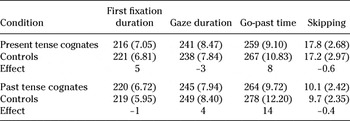
We examined four eye-movement measures: (a) first fixation duration, (b) gaze duration, (c) go-past times, and (d) percentage of skipped targets. The first fixation duration is the duration of the first fixation during the first passage through the target region (e.g., in this case, the verb). The gaze duration is the sum of fixations from the moment the eyes land on the target (for the first time) until the moment they move off again. The go-past time is the sum of all fixations from the first fixation on the target until a word to the right of the target is fixated. Regressions launched from the target are added to the go-past time for that target, but they are not added to the gaze duration. If the reader skipped the word, this was coded as a missing value for first fixation duration, gaze duration, and go-past time measures. Means are presented in Table 4.
First fixation duration (in ms), gaze duration (in ms), go-past time (in ms), and skipping percentages on the target word

Note.
Standard errors are indicated in parentheses.
Prior to analyses, fixations shorter than 100 ms (see Morrison, Reference Morrison1984; Rayner, Sereno, Morris, Schmauder, & Clifton, Reference Rayner, Sereno, Morris, Schmauder and Clifton1989, for justification) or longer than 2.5 standard deviations above the participant’s mean first fixation duration (i.e., 2.42% of the data), gaze duration (i.e., 3.53% of the data), and go-past time (i.e., 4.29% of the data) were removed. For each dependent measure, ANOVAs across participants and across items were performed with verb tense (i.e., present vs. past) and word type (i.e., cognate vs. control) as independent variables.
Results only showed significantly faster go-past times for cognates than for controls. This effect was marginally significant in the analysis by participants, F 1(1, 44) = 3.28, p = .077, and was significant in the analysis by items, F 2(1, 42) = 5.26, p < .05. No significant cognate facilitation was observed for first fixation duration, gaze duration, or skipping rates: first fixation duration, F 1(1, 44) = 0.28, p = .60; F 2(1, 42) = 0.41, p = .53; gaze duration, F 1(1, 44) = 0.10, p = .76; F 2(1, 42) = 0.11, p = .74; and skipping rates, F 1(1, 44) = 0.15, p = .70; F 2(1, 42) = 0.15, p = .70. The effect of verb tense was marginally significant in the analysis by participants for gaze duration, F 1(1, 44) = 3.38, p = .07; F 2(1, 42) = 1.51, p = .23, and was significant for skipping rates, F 1(1, 44) = 20.18, p < .001; F 2(1, 42) = 9.33, p < .01, which indicated that present tense verbs were read more quickly than past tense verbs. Footnote 2 No such effect arose for first fixation duration, F 1(1, 44) = 0.13, p = .72; F 2(1, 42) = 0.15, p = .70, or go-past time, F 1(1, 44) = 1.33, p = .26; F 2(1, 42) = 1.78, p = .19, although clear numerical differences were present for these reading time measures. Word type and verb tense did not interact for first fixation duration, F 1(1, 44) = 0.77, p = .38; F 2(1, 42) = 1.09, p = .30; gaze duration, F 1(1, 44) = 0.75, p = .39; F 2(1, 42) = 0.32, p = .57; go-past time, F 1(1, 44) = 0.29, p = .59; F 2(1, 42) = 0.09, p = .77; or skipping rates, F 1(1, 44) = 0.005, p = .94; F 2(1, 42) = 0.002, p = .97.
Discussion
The results of the eye-movement experiment showed no clear cognate facilitation effect on early reading time measures (first fixation duration, gaze duration, and skipping rates). A small cognate facilitation effect was present on a later measure (i.e., go-past time). As in the lexical decision task of Experiment 1, present tense verbs were read more quickly than past tense verbs, and this effect was present on skipping rates and, to some extent, gaze duration. The cognate facilitation effect was not modulated by verb tense.
GENERAL DISCUSSION
Earlier research has shown that lexical access in bilingual word recognition is not language specific (e.g., Brysbaert et al., Reference Brysbaert, Van Dyck and Van de Poel1999; Dijkstra et al., Reference Dijkstra, Grainger and Van Heuven1999, Reference Dijkstra, Timmermans and Schriefers2000; Duyck, Reference Duyck2005; Jared & Kroll, Reference Jared and Kroll2001; Lemhöfer & Dijkstra, Reference Lemhöfer and Dijkstra2004; Lemhöfer et al., Reference Lemhöfer, Dijkstra and Michel2004; Van Hell & Dijkstra, Reference Van Hell and Dijkstra2002). Virtually all of this evidence has been obtained with noun stimuli (for two rare exceptions, see Bultena et al., in press; Van Hell & De Groot, Reference Van Hell and De Groot1998), and, as a result, theoretical accounts on bilingual language processing and cognate representation are almost exclusively based on noun processing. The present study examined lexical access in the bilingual lexicon for L2 verbs and further tested whether or not effects differ for present and past tense verbs and for verbs presented in a sentence context. Experiment 1 showed cognate facilitation for cognate verbs presented in isolation. This L2 cognate facilitation effect was not modulated by verb conjugation. In Experiment 2, the verbs were presented in a L2 low-constraint sentence context while eye movements were monitored. The results only showed cognate facilitation on a later reading time measure (i.e., go-past time), with no effect on the earliest reading time measures. As in Experiment 1, cognate facilitation effects did not interact with verb tense.
The results for verbs out of context in Experiment 1 are in accordance with previous studies on visual word recognition that have found crosslingual activation effects for nouns (e.g., Dijkstra et al., Reference Dijkstra, Grainger and Van Heuven1999; Duyck, Reference Duyck2005; Jared & Kroll, Reference Jared and Kroll2001; Lemhöfer & Dijkstra, Reference Lemhöfer and Dijkstra2004; Van Hell & Dijkstra, Reference Van Hell and Dijkstra2002). A few studies have already shown these effects for present tense forms (Bultena et al., in press; Van Hell & De Groot, Reference Van Hell and De Groot1998). The current study confirms that even though verbs have smaller degrees of formal and semantic overlap between languages than nouns (Gentner, Reference Gentner1981; Van Hell & De Groot, Reference Van Hell and De Groot1998), crosslingual activation is strong enough for cognate facilitation to arise. It should be mentioned, however, that the lower degrees of crosslingual orthographic overlap for verbs result in numerically smaller cognate facilitation effects than those generally found for nouns in L2 lexical decision tasks (e.g., Dijkstra et al., Reference Dijkstra, Grainger and Van Heuven1999; Duyck et al., Reference Duyck, Van Assche, Drieghe and Hartsuiker2007; Lemhöfer & Dijkstra, Reference Lemhöfer and Dijkstra2004; Van Assche et al., Reference Van Assche, Drieghe, Duyck, Welvaert and Hartsuiker2011). Finally, verb cognate facilitation was shown not to interact with verb tense.
The cognate facilitation effect for verbs out of context suggests that, just as for noun targets, lexical representations are closely linked in the bilingual mental lexicon and activation is not language selective. As such, the results can be integrated within the BIA+ model (Dijkstra & Van Heuven, Reference Dijkstra and Van Heuven2002), which assumes an integrated lexicon and language-nonselective activation. Lexical representations are activated in both languages depending on the overlap with the input stimulus. The crosslingual activation spreading from the orthographic, phonological, and semantic codes speeds up the activation of cognates compared to noncognates. This activation spreading—as a function of word similarity—may directly explain why cognate verb facilitation effects were smaller than the effects found for nouns in other studies with the same type of Dutch-English bilinguals (Duyck et al., Reference Duyck, Van Assche, Drieghe and Hartsuiker2007; Van Assche et al., Reference Van Assche, Drieghe, Duyck, Welvaert and Hartsuiker2011). Furthermore, although the inflectional form of a cognate verb has smaller crosslinguistic orthographic overlap in the current study, cognate facilitation effects were not modulated by verb tense. This may be suggestive of a morphological link between cognate translations (Lalor & Kirsner, Reference Lalor and Kirsner2000; but see also Sánchez-Casas & García-Albea, Reference Sánchez-Casas, García-Albea, Kroll and De Groot2005, for suggestions on the inclusion of a morphological level in bilingual models). The inflectional form of a cognate verb may activate the verb root or may have a strong connection to the infinitival form, which results in dual-language activation effects. It remains for future studies to investigate this issue further for verb processing in bilinguals.
The presentation of verbs in a sentence context in Experiment 2 showed that cognate verbs yielded faster reading times on a later reading measure (i.e., go-past time). There was no effect on early reading measures (i.e., first fixation and gaze durations), and this contrasts with the results of previous studies with noun materials in which cognate facilitation was shown on first fixation durations, gaze durations, and skipping rates (e.g., Libben & Titone, Reference Libben and Titone2009; Titone et al., Reference Titone, Libben, Mercier, Whitford and Pivneva2011; Van Assche et al., Reference Van Assche, Duyck, Hartsuiker and Diependaele2009, Reference Van Assche, Drieghe, Duyck, Welvaert and Hartsuiker2011). A possible explanation may be related to the fact that verb translations have less crosslingual orthographic overlap than nouns and that verb meanings vary more between languages than noun meanings (e.g., Gentner, Reference Gentner1981). The presentation of verbs in a sentence context, which provides a clear language cue to direct lexical access of words that appear later in the sentence, may influence dual-language activation for these verbs with lower degrees of crosslingual orthographic overlap (see also Duyck et al., Reference Duyck, Van Assche, Drieghe and Hartsuiker2007) and results in slower or weaker lexical activation transfer between languages. This may consequently lead to cognate facilitation effects only being present on go-past times.
Another explanation, however, may be more related to a cognate’s semantic processing load. The presence of cognate facilitation effects on go-past times as opposed to gaze durations indicates that cognate verbs elicited fewer or shorter regressions during sentence reading than noncognate verbs. Because go-past time is thought to be a marker of higher order reading processes—such as semantic integration (Rayner, Reference Rayner1998)—this may indicate that cognates are easier to process semantically. De Groot and Nas (Reference De Groot and Nas1991) indeed proposed that cognate translations share a conceptual representation, whereas noncognates do not. In other words, from a distributed viewpoint, cognate translations may share more meaning elements than noncognate translation equivalents (Van Hell & De Groot, Reference Van Hell and De Groot1998). Because of these semantic features, the integration of a cognate into the sentence representation may be easier and may lead to fewer regressions to earlier parts of the sentence.
In conclusion, the present study is one of very few to investigate bilingual visual word recognition and sentence processing of word categories other than nouns. Verbs have generally smaller degrees of crosslingual overlap in terms of form and semantics than nouns. The cognate facilitation effect we obtained for verb cognates presented out of context extends the previous evidence on noun processing to verbs, although the cognate facilitation effect for verbs is generally smaller than for nouns. Similarly, when presenting verbs in sentence contexts, cognate facilitation effects were only present on a later reading time measure, which possibly reflects weaker crosslingual activation transfer or easier semantic integration processes for cognate verbs than for noncognates. We believe that testing a variety of word categories may provide interesting new opportunities to extend and test theoretical accounts on bilingual language processing, and we hope that this study contributes to this new avenue of research.
APPENDIX DUTCH-ENGLISH TARGET WORDS OF EXPERIMENTS 1 AND 2