1 Introduction
The passage of health care reform legislation in the United States (i.e., the Patient Protection and Affordable Care Act of 2010) has released a flood of consolidations between health care providers positioning themselves for success in the new regulatory environment.Footnote 1 This merger wave has coincided with a renewed emphasis on hospital antitrust enforcement at both U.S. antitrust agencies: The Federal Trade Commission (FTC) and the Antitrust Division of the Department of Justice (DOJ). In 2011 alone, the FTC attempted to block three hospital mergers in federal courtFootnote 2 and the DOJ successfully challenged the exclusive dealing practices of a hospital system in Texas.Footnote 3 Recent activity in hospital antitrust enforcement is not confined to the United States. The U.K.'s Office of Fair Trading (OFT) recently recommended that the Competition Commission investigate private British hospitals for potential antitrust violations.Footnote 4
Many legal analysts point to the FTC's challenge of Evanston Northwestern Healthcare's (ENH) purchase of Highland Park Hospital (HPH) in 2004 as the genesis of this renewed emphasis on hospital antitrust enforcement. (Bernstein, Reference Bernstein2009; Rice, Reference Rice2010) Between 1994 and 2001, the U.S. antitrust agencies lost eight straight hospital merger challenges in federal court. In 2002, the FTC began the Hospital Merger Retrospectives Project and established its Merger Litigation Task Force to reinvigorate hospital antitrust enforcement by carefully studying consummated hospital mergers and retrospectively challenging any found to be anticompetitive (Haas-Wilson and Vita, Reference Haas-Wilson and Vita2011). Out of this effort came the FTC's challenge of ENH's acquisition of HPH and the Commission's ultimate ruling in 2007, after administrative litigation and appeal, that the acquisition was anticompetitive.Footnote 5 After the Evanston decision, the FTC successfully blocked Inova Health System's proposed purchase of Prince William Hospital in 2008, ProMedica Health System's acquisition of St. Luke's Hospital in 2011 and the merger of OSF Healthcare and Rockford Health in 2012.
In addition to its legal significance, the Evanston hospital merger challenge was unique in its approach. Unlike most merger challenges that rely on structural indicia of market power (e.g., market shares of the merging firms), the Evanston challenge, which occurred four years after the merger was consummated, emphasized the actual post-merger price increases at the merged hospitals. As described in Haas-Wilson and Garmon (Reference Haas-Wilson and Garmon2011) and Romano and Balan (Reference Romano and Balan2011), ENH and HPH's prices increased 10–17% more than similar non-merging hospitals with little evidence of improved quality. Citing this and other documentary evidence that the excess price increases were caused by the increased market power conferred on ENH/HPH with the merger, the Administrative Law Judge and the full Commission found the merger anticompetitive.
However, one aspect of the ENH/HPH merger has puzzled legal analysts and health economists. Despite the evidence of large post-merger price increases and other evidence linking these price increases with the merger, the two hospitals were not each other's closest competitor prior to the merger (Campbell, Reference Campbell2007; Adams and Noether, Reference Adams and Noether2011). At the time of the merger, ENH's flagship hospital, Evanston Hospital, was a large teaching hospital offering many advanced (tertiary) services (e.g., neonatal intensive care and open heart surgery), while HPH was a smaller community hospital offering only basic (primary and secondary) services. HPH was 15 miles away from Evanston (and also 15 miles away from ENH's Glenbrook Hospital), but only 6 miles away from the nearest community hospital. Likewise, a number of large teaching hospitals were closer to Evanston than HPH. Furthermore, the ENH/HPH estimated price increases were larger than those estimated for most of the mergers studied in the Hospital Merger Retrospectives Project, many of which involved hospitals that were each other's closest competition.
What might explain the seemingly counterintuitive finding of large price increases after a merger of dissimilar hospitals? One clue to this mystery is provided by the trial testimony and memoranda of ENH and HPH executives. As paraphrased by FTC staff attorneys, a former HPH executive testified that:
…the merged entity would have greater price ‘leverage’ because of the ‘geographical placement’ of the three ENH facilities. Within the geographic triangle live many executives who ‘make decisions about health benefits for their employers, employees,’ and have ‘immense influence and power with the health plans’.Footnote 6
The Administrative Law Judge, in finding that the merger was anticompetitive, cited this testimony and a memo written by an ENH executive that made the same argument:
The inclusion of local hospitals in this particular geographic market is critical to hospital networks because, as ENH officials proclaimed, this is an area populated by ‘senior executives and decision-makers’ and it would be ‘real tough’ for any managed care organization and employer ‘whose CEOs either use [Evanston or Highland Park] to walk from [ENH] and 1700 of their doctors’.Footnote 7
This evidence suggests that one factor contributing to the combined firm's post-merger market power was the location of important health care decision-makers, the executives who decide which health plans will be offered to their employees. The area within the triangle formed by Evanston, Glenbrook and Highland Park is the most affluent in the Chicago region and where many executives of Chicago-based companies reside. The executives’ proximity to HPH and the ENH hospitals likely made these hospitals their first and second choice for most hospital services. While ENH and HPH may not have been the closest of substitutes for most consumers, they were closest substitutes for the executives who make health insurance decisions for their employees.
In most countries, private health insurance is provided primarily as an employment benefit. In the United States, 97% of those with private health insurance receive it through their employerFootnote 8 (Carroll and Miller, Reference Carroll and Miller2011). In the United Kingdom, 69% of those with private health insurance receive it through their employer (Office of Fair Trading, 2011). For employer-provided health insurance, the employer decides which health benefit plans will be offered to employees and each employee enrolls in one of the plans or opts out of health insurance. For most large employers, third-party health insurance is not used. These employers design and ‘self-fund’ the health benefits of their employees and bear most of the risk, while contracting with managed care companies to administer their benefits and provider payments. Some employers even negotiate directly with health care providers for inclusion in their health plan.
This paper develops a model to explore the impact of employer-provided health insurance on hospital competition and hospital merger effects. The CEO of a company negotiates with hospitals for inclusion in the network that serves all of the company's employees, including the CEO. In the context of the model, the CEO can be thought of as a representative agent: an amalgamation of the company's senior managers who determine the health insurance benefits to offer their employees. The employees then each use the most preferred hospital in the network if hospitalization is required. In this later stage, the employees base their decisions on non-price characteristics (e.g., location, quality) as they pay the same co-pay amount regardless of the network hospital they select. In this way, the model closely matches the many situations in which employers are actively involved in designing, funding and bearing the risk for their employees’ health insurance.
A number of important insights result from the model. First, even if the CEO has the same opportunity cost of travel as her employees, a merger of hospitals surrounding the CEO will result in a larger price increase than would result from a hospital merger occurring elsewhere. With the merger of any adjacent hospitals, the hospitals’ price will increase because, in the post-merger negotiations between the hospitals and the CEO, the CEO's threat point will worsen with the higher wages demanded by employees if the merged hospitals are not part of the health plan's network. For a merger of hospitals surrounding the CEO, not only does the merger worsen her threat point because of potential lost profits from increased wages, but it also directly worsens the CEO's personal outside option in the event she needs hospitalization. Thus, even if the CEO has the same opportunity cost of travel as her employees, a merger of hospitals surrounding the CEO will worsen her outside option more than any other merger of adjacent hospitals, leading to a larger price increase. This illustrates that the employer effect highlighted in the ENH/HPH litigation is not simply a function of the affluence – and possible higher opportunity costs of travel – of the community between the hospitals.
Second, the difference between the price increase from a merger of hospitals surrounding the CEO and a price increase from another merger is inversely proportional to the share of profits received by the CEO. As the CEO's profit share declines, the worsening of her own outside option of expected hospitalization becomes more prominent compared with the worsening of her compensation if an agreement cannot be reached with the merging hospitals. In the extreme case in which the CEO receives only a fixed salary unrelated to the firm's profits, she will only care about the hospitals near her, as these are the only hospitals that can worsen her outside option by merging.
Third, even if the CEO receives all of the firm's profits, the price increase from a merger of hospitals near the CEO will still be greater than a price increase from another merger. This is because the CEO is harmed personally (through an increase in her expected travel costs if hospitalization is necessary) in addition to the reduction in her compensation (the full employee wage increase) that is necessary if an agreement cannot be reached.
The implications of the model are consistent with hospital financial and discharge data from Florida and Texas and CEO location data from the Bureau of Labor Statistics (BLS). In relatively concentrated hospital markets in Florida and Texas, hospital prices are positively correlated with the number of CEOs per employee in the area, as the model predicts. This relationship exists even after controlling for the median income of the area, again confirming that the employer-provided health insurance effect is more than an income effect.
It is natural to ask why shareholders would allow this distortion, which emanates from the CEO's influence in constructing the provider network. While it may be possible for shareholders to offer the CEO a separate health insurance plan (e.g., a very generous indemnity plan which includes all hospitals) in addition to profit-sharing to better align the CEO's incentives with that of the shareholders, it may not be likely given the relatively small benefit to the shareholders from doing so.Footnote 9 The distortion described in this paper only affects the post-merger prices of the hospitals surrounding the CEO. It does not affect the prices that result when other hospitals merge. Whether the CEO has her own health insurance or shares the employees’ health insurance, she will have the correct incentives to negotiate with merging hospitals not located near her if she shares some of the company's profit. Unless most of the employees live near the CEO, this distortion will have only a small effect on the firm's health care costs. Giving the CEO her own health insurance would only reduce health care costs associated with employee admissions to hospitals near the CEO, which, in the inclusive health plan networks currently favored by employers, would be a very small percentage of the plan's overall costs. In any event, some empirical research suggests that CEOs are often not compensated in a manner that would solve all agency problems (Bertrand and Mullainathan, Reference Bertrand and Mullainathan2001; O'Reilly and Main, Reference O'Reilly and Main2010).
The results described in this paper have important implications for hospital merger enforcement. Clearly, patient and hospital characteristics, along with other factors (e.g., quality and cost efficiencies, conditions in complementary markets, etc.), are important for assessing the likely effects of hospital mergers.Footnote 10 However, when estimating the likely effect of a hospital merger, antitrust investigators should also consider the locations of executives who choose their company's health benefit options and the form of the executives’ compensation. The merger of ENH and HPH illustrates that these factors can have a non-trivial effect on post-merger hospital prices.
The following section describes the model and characterizes the pre-merger equilibrium. Section 3 describes the equilibrium that results when two hospitals merge if the hospitals do not surround the health care decision-maker of the firm. Section 4 characterizes the equilibrium that results when the two hospitals surrounding the health care decision-maker merge and juxtaposes this price with the price found in Section 3. Section 5 describes the data and methods used to test some of the implications of this model and the results of the data analysis. Section 6 concludes.
2 Model
Quality and proximity are important factors in a patient's decision to be treated at a hospital. However, unlike other differentiated markets, insured patients largely ignore price when making decisions about the hospital to use, at least for hospitals within their health plan's network. This is because most health plans (whether self-funded by the employer or insured elsewhere) specify a fixed co-pay regardless of the hospital, as long as the hospital is within the plan's network. Co-pays are usually an order of magnitude larger for hospitals outside of the plan's network, making the choice of an out-of-network hospital implausible for most.Footnote 11
However, price is still an important factor for hospital competition. The employer's and health plan's choice of which providers to include in the health plan's network is a function of price, as well as the quality of the hospital and its proximity to the employee beneficiaries. The price is determined in the negotiation between the health plan and the hospital wishing to gain or retain access to the health plan's insured members. The following model of hospital competition reflects the negotiations that determine price as well as the choices of insured patients that are largely based on non-price factors, such as location. The model resembles that of Gal-Or (Reference Gal-Or1999) in that hospital differentiation is represented with a circular city. However, unlike Gal-Or, the model incorporates the employer and its influence in health plan design.
Consider a circular city with a circumference of one. Evenly distributed around this circle are N hospitals and M + 1 employees. Following Salop (Reference Salop1979) and Gal-Or (Reference Gal-Or1999), these locations represent generalized differentiation in product space. In other words, the locations of the hospitals and employees reflect not only geographic differentiation, but differences in quality and amenities (and the different preferences of employees for the geographic proximity, quality and amenities of hospitals). The hospitals’ locations are fixed and no hospital entry is permitted, reflecting the hospital markets of many states that are constrained by certificate of need regulations that severely restrict hospital movement, entry or expansion. The M + 1 employees consist of M insured employees and a CEO who represents the employees in the negotiations with the hospitals that result in the company's health plan. Note that the role of the managed care company is deliberately minimized to focus attention on the employer and its decision-makers.
Each employee has a travel (or ‘mismatch’) cost of ci(t) = kt β where t is the distance traveled to hospital i, k > 0, and β ⩾ 1. As the employee pays the same co-pay for any hospital in the network and pays a significantly larger co-pay for any hospital outside of the network, the employee will seek treatment, if needed, from the nearest network hospital. Let q be the probability that an employee (including the CEO) will need hospitalization. For simplicity, the employee's in-network co-pay is normalized to zero.
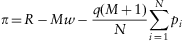
If all N hospitals are included in the firm's health care network, the firm's expected variable profit (i.e., above the CEO's fixed salary) is
 $$\pi \,{\rm{ = }}\,R\,{\rm{ - }}\,Mw\,{\rm{ - }}\,\frac{{q{\rm{(}}M\,{\rm{ + }}\,{\rm{1)}}}}{N}\mathop{\sum}\limits_{i\, = \,1}^N {{{p}_i}} $$
where R is the firm's revenue, w is the average wage for each employee and pi is the price of an admission at hospital i. The firm's only costs are labor costs and direct health care costs. The firm does not employ outside insurance, but instead pays the hospital costs directly and bears all of the risk. It is assumed that the firm's demand for labor is perfectly inelastic at M.
Each employee is risk neutral with a reservation wage normalized to zero.Footnote 12 Each employee is paid the wage that compensates him for his expected travel cost to the nearest hospital. If the firm offers a restrictive hospital network (e.g., one without the employee's most preferred hospital), the firm must pay a higher wage to the employees to compensate. If all N hospitals are in the health plan's network, the average wage is
 $$w\, = \,{\rm{2}}Nqk{\int}_{\!\!\!\!0}^{{{\rm{1}}\over{\rm{2}}N}} {{{t}^\beta } \,dt\, = \,\frac{{qk}}{{(\beta \, + \,1){{{({\rm{2}}N)}}^\beta } }}} $$
The CEO, who is risk neutral, receives a fixed salary s and also receives a share α ∈ (0,1] of the firm's variable profits. The CEO's travel cost to a hospital is kct β. The CEO is assumed to live halfway between hospitals μ and μ + 1 where μ ∈ {1, 2, …, N}. The point halfway between μ and μ + 1 is chosen for the CEO's location to isolate the effect of the merger of hospitals surrounding the CEO from other mergers. If, for instance, the CEO lived closer to μ than μ + 1, the pre-merger price of μ would be higher than the price of other hospitals, reflecting the CEO's preference for μ. If μ and μ − 1 merged, the price of the combined entity would be higher than the price of any other merged hospitals, but only because of the CEO's preference for μ, not because there is anything special about the merger. From (1) and (2), the CEO's payoff, when all N hospitals are in the network, is
 $$V\, = \,\alpha \left[ {R{\rm{ - }}\frac{{Mqk}}{{(\beta \, + \,{\rm{1}}){{{({\rm{2}}N)}}^\beta } }}{\rm{ - }}\frac{{q{\rm{(}}M\,{\rm{ + }}\,{\rm{1)}}}}{N}\mathop{\sum}\limits_{i\, = \,1}^N {{{p}_i}} } \right]\, + \,s{\rm{ - }}\frac{{q{{k}_c}}}{{{{{({\rm{2}}N)}}^\beta } }}$$
Each hospital can expect to treat q(M + 1)/N patients, if all of the hospitals are in the network. The marginal cost of treating patients is assumed to be constant and identical across hospitals. Without loss of generality, assume that the marginal cost is equal to zero. Thus, if hospital i is in the health plan's network, hospital i's profit from treating the health plan's patients is qpi(M + 1)/N.
If hospital i is not included in the health plan's network, then the employees who live closest to hospital i will require compensation for the higher expected travel cost of traveling to hospital i − 1 or i + 1. In this case, the additional amount of total wages necessary to compensate these employees near hospital i is
 $${\rm{2}}Mqk{\int}_{\!\!\!\!0}^{{{\rm{1}}\over{\rm{2}}N}} {[{{{({{N}^{{\rm{ - 1}}}} {\rm{ - }}t)}}^\beta } {\rm{ - }}{{t}^\beta } ]\,dt\, = \,\frac{{{\rm{4}}Mqk({{{\rm{2}}}^\beta } {\rm{ - 1}})}}{{(\beta \, + \,{\rm{1}}){{{({\rm{2}}N)}}^{\beta \, + \,{\rm{1}}}} }}} $$
Therefore, from (3) and (4), the net gain to the CEO from including hospital i in the network is
 $$V{\rm{ - }}{{V}_{{\rm{ - }}i}}\, = \,\alpha q\left[ {\frac{{{\rm{4}}Mk({{{\rm{2}}}^\beta } {\rm{ - 1}})}}{{(\beta \, + \,{\rm{1}}){{{({\rm{2}}N)}}^{\beta \, + \,{\rm{1}}}} }} + \frac{{M\, + \,{\rm{1}}}}{N}\, + \,\left( {\frac{{{{p}_{i{\rm{ - 1}}}}\, + \,{{p}_i}_{{ + \,{\rm{1}}}} }}{{\rm{2}}}{\rm{ - }}{{p}_i}} \right)} \right]$$
The CEO and the hospitals engage in N simultaneous negotiations to determine the price at which the hospital will be in the plan's network. Each negotiation results in the Nash bargaining solution (i.e., an equal division of the net gains from reaching an agreement).Footnote 13 The model is similar to the labor market bargaining model in Stole and Zwiebel (Reference Stole and Zwiebel1996), except that Stole and Zwiebel (Reference Stole and Zwiebel1996) assume the negotiations are sequential. It is inappropriate to assume sequential negotiations in the hospital market for three reasons. First, each health plan or employer often negotiates simultaneously with multiple hospitals. This is particularly true in areas where the convention is to negotiate annual contracts. However, even in areas where ‘evergreen’ contracts are common, multiple negotiations often occur at the same time. Second, even when negotiations are sequential in time, they are effectively simultaneous because the terms of most health plan–hospital contracts are confidential. Finally, in Stole and Zwiebel (Reference Stole and Zwiebel1996), in which a firm pair-wise negotiates with multiple workers, the workers are identical so that the equilibrium is independent of the ordering of negotiations. In the context of pair-wise CEO/hospital negotiations, when two hospitals merge, hospitals are no longer identical; even non-merging hospitals are differentiated by their distance from the merging hospitals. In this case, the ordering of negotiations could affect the equilibrium and it is not clear what ordering would result post-merger. Any model with sequential negotiations would need to endogenize the ordering of negotiations and, given that many health plan/hospital negotiations occur simultaneously, this seems unnecessarily complex.
Each negotiation between the CEO and hospital i (for i = 1, …, N) will result in the price, which maximizes the following Nash product:
 $$Ma{{x}_{{{p}_i}}}\left[ {\frac{{\alpha {{p}_i}{{q}^{\rm{2}}} (M + {\rm{1}})}}{N}} \right]\left[ {\frac{{{\rm{4}}Mk({{{\rm{2}}}^\beta } {\rm{ - 1}})}}{{(\beta + {\rm{1}}){{{({\rm{2}}N)}}^{\beta + {\rm{1}}}} }} + \frac{{M + {\rm{1}}}}{N}\left( {\frac{{{{p}_{i\,{\rm{ - }}\,{\rm{1}}}} + {{p}_{i + {\rm{1}}}}}}{{\rm{2}}}{\rm{ - }}\,{{p}_i}} \right)} \right]$$
The solution to (6) is
 $${{p}_i}\, = \,\gamma Mk({{{\rm{2}}}^\beta } {\rm{ - 1}}) + \frac{{({{p}_{i\,{\rm{ - }}\,{\rm{1}}}} + {{p}_{i\,{\rm{ + }}\,{\rm{1}}}})}}{{\rm{4}}}$$
where  $$)(--><$>\gamma \, = \,{{[(M\,{\rm{ + }}\,{\rm{1}})(\beta \,{\rm{ + }}\,{\rm{1}}){{({\rm{2}}N)}^\beta } ]}^{{\rm{ - 1}}}} <$><!--$$. By symmetry, the equilibrium in which all of the simultaneous CEO/hospital negotiations conform to the Nash bargaining solution is
 $${{p}_i}\, = \,{\rm{2}}\gamma Mk({{{\rm{2}}}^\beta } {\rm{ - 1}})$$
This equilibrium possesses the expected traits of a market in which spatially differentiated firms compete. The equilibrium price falls as the number of hospitals increases and the equilibrium price increases as travel costs (or, equivalently, the patient's loyalty to her favorite hospital) increases.
3 Post-merger equilibrium
Consider a merger of two competing hospitals i and i + 1, where the merging hospitals do not surround the CEO (i.e., i ≠ μ). In this case, if the CEO and the merged hospitals fail to reach an agreement, the increase in the firm's total wage costs will be
 $${\rm{2}}Mqk\left[ {{\int}_{{\rm{\!\!\!\!0}}}^{{{{1\over 2N}}}} {[{{{({{N}^{{\rm{ - 1}}}} {\rm{ - }}t)}}^\beta } {\rm{ - }}{{t}^\beta } ]\,dt + {\int}_{{\rm{\!\!\!\!0}}}^{{{{1\over 2N}}}} {[{{{({{N}^{{\rm{ - 1}}}} + t)}}^\beta } {\rm{ - }}{{t}^\beta } ]\,dt} } } \right]\, = \,\frac{{{\rm{6}}Mqk({{{\rm{3}}}^\beta } {\rm{ - 1}})}}{{(\beta \,{\rm{ + }}\,{\rm{1}}){{{({\rm{2}}N)}}^{\beta + {\rm{1}}}} }}$$
because the employees located near i and i + 1 will require compensation for the expected costs of traveling to hospital i − 1 or i + 2.Footnote 14 For the merged hospitals, pi = pi + 1 as the two hospitals are symmetric within the hospital system created by the merger. Therefore, the Nash product in this case is
 $$Ma{{x}_{{{p}_i}}}\left[ {\frac{{{\rm{2}}\alpha {{p}_i}{{q}^{\rm{2}}} (M{\rm{ + }}{\rm{1}})}}{N}} \right]\left[ {\frac{{{\rm{6}}Mk({{{\rm{3}}}^\beta } {\rm{ - 1}})}}{{{\rm{(}}\beta \,{\rm{ + }}\,{\rm{1)(2}}N{{{\rm{)}}}^{\beta \,{\rm{ + }}\,{\rm{1}}}} }} + \frac{{M\,{\rm{ + }}\,{\rm{1}}}}{N}\left( {{{p}_{i{\rm{ - 1}}}} + {{p}_{i\,{\rm{ + }}\,{\rm{2}}}}{\rm{ - 2}}{{p}_i}} \right)} \right]$$
The price that splits the net surplus between the CEO and the merged hospital system is
 $${{p}_i}\, = \,\frac{{{\rm{3}}\gamma Mk({{{\rm{3}}}^\beta } {\rm{ - 1}}) + {{p}_{i{\rm{ - 1}}}} + {{p}_{i\,{\rm{ + }}\,{\rm{2}}}}}}{{\rm{4}}}$$
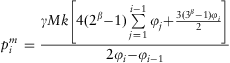
The non-merging firms’ prices are characterized by (7), as before. The N − 1 conditions in (7) and (11) result in the following equilibrium price for the merged hospitals:
 $$p_{i}^{m} \, = \,\frac{{\gamma Mk\left[ {{\rm{4(}}{{{\rm{2}}}^\beta } {\rm{ - 1)}}\mathop{\sum}\limits_{j\, = \,{\rm{1}}}^{i{\rm{ - 1}}} {{{\varphi }_j} + } \frac{{{\rm{3}}({{{\rm{3}}}^\beta } {\rm{ - 1}}){{\varphi }_i}}}{{\rm{2}}}} \right]}}{{{\rm{2}}{{\varphi }_i}{\rm{ - }}{{\varphi }_{i{\rm{ - 1}}}}}}$$
where ϕi is a second-order linear recurrence with initial values, ϕ 1 = 1, ϕ 2 = 3 and φj = 4ϕj −1−ϕj −2 for j > 2. As shown in Appendix A, the post-merger price of the merged hospitals given in (12) is strictly greater than the pre-merger price described in (8) for all β ⩾ 1. In other words, the merger of two adjacent, competing hospitals leads to a price increase. This is because the CEO's outside option has worsened after the merger. The employees living between the merging hospitals will require a disproportionately larger wage increase if the merged hospitals are dropped from the network than if two non-competing hospitals were dropped from the network. If two non-competing hospitals were dropped from the network, the farthest an employee would have to travel to an alternate hospital is 1/N, but if two competing hospitals are dropped from the network, the M/N employees between these hospitals would need to travel farther than 1/N to an alternate hospital if they need care. The disproportionately larger wage increase required to compensate these employees in the latter case will worsen the CEO's bargaining position with the merged hospitals, leading to a price increase.
4 Merger of hospitals surrounding the CEO
Now suppose that the hospitals surrounding the CEO merge (i.e., i = μ). In this case, not only will the firm pay higher wages to its employees if an agreement with the merged hospitals cannot be reached, but the CEO will be harmed personally with an increased expected travel cost of her own as she too lives directly between the merging hospitals. If an agreement is not reached with the merged hospitals, the CEO's expected travel cost will increase by 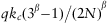 $$)(--><$>q{{k}_c}{{{{({{{\rm{3}}}^\beta } {\rm{ - 1}})} \mathord{\left/ {\vphantom {{({{{\rm{3}}}^\beta } {\rm{ - 1}})} {({\rm{2}}N)}}} \right. \kern-\nulldelimiterspace} {({\rm{2}}N)}}}^\beta } <$><!--$$ because she would have to travel to i − 1 or i + 2 if she needs hospital care. In this case, the negotiation between the CEO and the merged hospital solves
 $$Ma{{x}_{{{p}_i}}}\left[ {\frac{{{\rm{2}}\alpha {{p}_i}{{q}^{\rm{2}}} (M\,{\rm{ + }}\,{\rm{1}})}}{N}} \right]\left[ {\frac{{{\rm{6}}Mk({{{\rm{3}}}^\beta } {\rm{ - 1}})}}{{{\rm{(}}\beta \,{\rm{ + }}\,{\rm{1)(2}}N{{{\rm{)}}}^{\beta \,{\rm{ + }}\,{\rm{1}}}} }} + \frac{{M\,{\rm{ + }}\,{\rm{1}}}}{N}\left( {{{p}_{i{\rm{ - 1}}}} + {{p}_{i\,{\rm{ + }}\,{\rm{2}}}}{\rm{ - 2}}{{p}_i}} \right) + \frac{{q{{k}_c}({{{\rm{3}}}^\beta } {\rm{ - 1}})}}{{\alpha {{{{\rm{(2}}N{\rm{)}}}}^\beta } }}} \right]$$
The price that solves (13) is
 $${{p}_i}\, = \,\frac{{\gamma ({\rm{3}}\alpha Mk + N{{k}_c}(\beta + {\rm{1}}))({{{\rm{3}}}^\beta } {\rm{ - 1}})}}{{{\rm{4}}\alpha }} + \frac{{{{p}_{i{\rm{ - 1}}}} + {{p}_{i + {\rm{2}}}}}}{{\rm{4}}}$$
As before, the non-merging firms’ prices are characterized by (7). The N − 1 conditions in (7) and (14) result in the following equilibrium price for the merged hospitals:
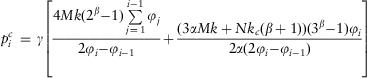 $$p_{i}^{c} \, = \,\gamma \left[ {\frac{{{\rm{4}}Mk({{{\rm{2}}}^\beta } {\rm{ - 1}})\mathop{\sum}\limits_{j\, = \,{\rm{1}}}^{i{\rm{ - 1}}} {{{\varphi }_j}} }}{{{\rm{2}}{{\varphi }_i}{\rm{ - }}{{\varphi }_{i{\rm{ - 1}}}}}} + \frac{{({\rm{3}}\alpha Mk + N{{k}_c}(\beta + {\rm{1}}))({{{\rm{3}}}^\beta } {\rm{ - 1}}){{\varphi }_i}}}{{{\rm{2}}\alpha ({\rm{2}}{{\varphi }_i}{\rm{ - }}{{\varphi }_{i{\rm{ - 1}}}})}}} \right]$$
The difference between the merged system's price when the merged hospitals surround the CEO [given by (15)] and the price resulting from a merger elsewhere [given by (12)] is
 $$p_{i}^{c} {\rm{ - }}p_{i}^{m} \, = \,\frac{{\gamma N(\beta \,{\rm{ + }}\,{\rm{1}})({{{\rm{3}}}^\beta } {\rm{ - 1}}){{\varphi }_i}}}{{{\rm{4}}{{\varphi }_i}{\rm{ - 2}}{{\varphi }_{i{\rm{ - 1}}}}}}\left[ {\frac{{{{k}_c}}}{\alpha }} \right] \gt 0$$
Condition (16) reveals a great deal about the effect of the CEO's location on the price increase associated with the merger of adjacent hospitals. First,  $$)(--><$>p_{i}^{c} {\rm{ - }}p_{i}^{m} \, \gt \,0<$><!--$$ even if kc = k. In other words, even if the CEO has the same travel cost as her employees, a merger of hospitals near the CEO will lead to a larger price increase than a merger of adjacent hospitals elsewhere. While a merger of hospitals in an affluent area may lead to a larger price increase than a merger of hospitals in a less prosperous area because of the higher opportunity cost of travel of the patient population, there is an additional price effect if the executives who choose health benefit plans for their employees also live in this area.
Second,  $$)(--><$>p_{i}^{c} {\rm{ - }}p_{i}^{m} <$><!--$$ is inversely proportional to α. In other words, as the CEO's share of the firm's profit declines, the difference between the post-merger price increase for hospitals near the CEO and the post-merger price increase for other merging hospitals widens. This is because a merger of the hospitals near the CEO directly affects the CEO by increasing her expected travel cost if an agreement is not reached with the merged hospitals. A merger of hospitals elsewhere only affects the CEO's threat point by reducing her compensation from profits. If she gets a relatively small share of the firm's profit, this reduction in compensation will be relatively small. Thus, when the CEO receives a relatively small share of the firm's profit, not reaching an agreement with hospitals near the CEO reduces her expected payoff much more than not reaching an agreement with hospitals elsewhere. In the extreme, in which the CEO receives only a fixed salary unrelated to profit (i.e., as α approaches zero), a merger of hospitals far from the CEO will not affect her bargaining position at all. Only the merger of hospitals near the CEO will lead to a worsening of her bargaining position and thus a price increase.
Third,  $$)(--><$>p_{i}^{c} {\rm{ - }}p_{i}^{m} <$><!--$$ is positive even when α = 1. In other words, even if the CEO is the sole owner of the firm, receiving all profits, a merger of hospitals near the CEO will lead to a larger price increase than a merger of competing hospitals elsewhere. This is because failure to reach an agreement with the hospitals near the CEO leads to a reduction in profits because the employees must be paid more with the smaller hospital network and an increase in the CEO's expected travel costs. Failure to reach an agreement with merged hospitals elsewhere only leads to a reduction in profits. A merger of competing hospitals far from the CEO does not directly affect the CEO's expected travel costs. Therefore, the hospitals surrounding the CEO will gain more bargaining leverage with the CEO through a merger than competing hospitals elsewhere, even if the CEO receives all of her firm's profit.
5 Empirical analysis
Empirically testing the implications and predictions of the previous model is difficult because it requires knowledge of the CEO's location. Owing to security and privacy concerns, a CEO's residential address is usually not public information. However, aggregate data exist that allows one to test some of the implications of the previous model. The Bureau of Labor Statistics’ (BLS's) Occupational Employment Statistics provide estimates of the number of employees working in various occupations in each of the Metropolitan Statistical Areas (MSA) in the United States. One of the employee classifications for which BLS provides estimates is chief executive. Thus, using BLS data, it is possible to calculate the number of CEOs per employee in each MSA in the United States. One testable implication of the previous model is that, in relatively concentrated hospital markets (e.g., those that have experienced mergers leading to relatively high levels of concentration), hospital prices should be higher when there are more CEOs per worker. Furthermore, this relationship should hold even after controlling for differences in income levels across areas.
Hospital financial and inpatient discharge data from Florida and Texas are used to test this hypothesis.Footnote 15 Florida and Texas both collect detailed financial information from each hospital in the state, including the net revenue (i.e., after contractual discounts) received from managed care patients, most of whom receive their health insurance from their employer. The dependent variable in the analysis below – used as a proxy for the price paid by employers – is the net revenue per discharge for managed care patients at each hospital in 2002.
The hypothesis from the model is that this price is positively correlated with the number of CEOs per worker in relatively concentrated markets. In order to test this hypothesis, it is necessary to group hospitals by the level of competition they face. One measure of competition commonly used in the literature is the patient-weighted Herfindahl–Hirschman Index (HHI). The patient-weighted HHI is calculated by dividing patients into geographically and diagnostically based groups and calculating the HHI for each group. For each hospital system, the patient-weighted HHI is then the weighted average of these HHIs, where the weights are based on the importance of each group to that hospital system. Unlike the traditional HHI – which is the same for all hospitals in a market – the patient-weighted HHI differs across hospital systems, reflecting the fact that hospital systems face different levels of competition depending on the competition they face for each of the groups of patients they serve. Capps and Dranove (Reference Capps and Dranove2004) employ the patient-weighted HHI to show that mergers of competing hospitals often lead to higher managed care prices. Melnick and Keeler (Reference Melnick and Keeler2007) and Dranove et al. (Reference Dranove, Lindrooth, White and Zwanziger2008) also use the patient-weighted HHI to study the effects of competition on hospital managed care prices. A detailed description of the patient-weighted HHI is attached in Appendix B.
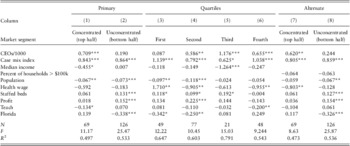
In the primary set of results, hospitals are divided into two groups: those facing relatively little competition (i.e., those with an HHI greater than the median HHI) and those in relatively competitive environments (i.e., those with an HHI less than the median HHI).Footnote 16 Within each group, the managed care price of the hospital is modeled as a function of the number of CEOs per 1000 employees (CW) in the hospital's MSA, as well as other covariates that track shifts in cost and demand.
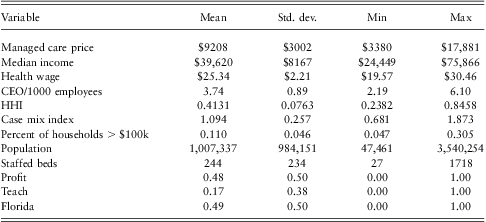
The primary determinant of a hospital's cost is the mix of diagnoses seen and procedures performed by the hospital. The case mix index for the hospital's managed care patients is included as a proxy for the cost associated with each hospital's managed care patient mix. The case mix index for a group of patients is the mean Diagnosis Related Group (DRG) weight. These weights are published and revised annually by the Center for Medicare and Medicaid Services and reflect the average relative resource use associated with each diagnosis or procedure. For example, in 2002, the DRG weight for a liver transplant was 8.04 while the DRG weight for a cesarean section without complications was 0.68. Thus, the case mix index for a hospital's managed care patients represents the average expected resource use for that group of patients.
To capture the possibility of economies or diseconomies of scale, the hospital's number of staffed beds is included. The mean hourly wage for health care practitioners and technical occupations (e.g., nurses, lab technicians, etc.) in the hospital's MSA from the BLS's Occupational Employment Statistics is used as a proxy for common hospital costs that may vary across geographic areas. A teaching indicator is also included to capture the higher costs of teaching hospitals.
County population and the median household income of the county in which the hospital resides from the 2002 Census American Community Survey are used to capture shifts in hospital demand. It is particularly important to control for differences in income as one might expect that areas with a higher proportion of CEOs would also have higher median incomes. (The correlation coefficient between the two is 0.31.)
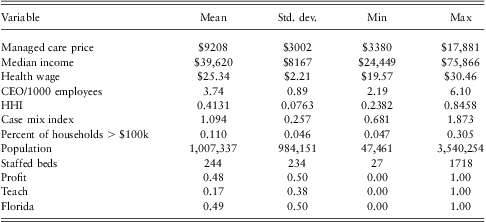
Finally, a dummy for investor ownership (‘Profit’) is included because past research has shown that for-profit hospitals charge higher prices than non-profit hospitals, all else equal. To capture state-specific differences in pricing, a state dummy is also included (‘Florida’). Only private, urban, short-term, general acute-care hospitals that reported managed care inpatient net revenues and discharges are included in the analysis.Footnote 17 There are 195 such hospitals in Florida and Texas. Table 1 lists the summary statistics of the variables. All non-dummy variables, including the dependent variable, were log transformed and the coefficients were estimated using ordinary least squares.
Descriptive statisticsFootnote 1
HHI = Herfindahl–Hirschman Index.
1 The unit of observation is a hospital. There are 195 observations in the data. Managed Care Price, Herfindahl–Hirschman Index (HHI), Case Mix Index, Staffed Beds, Profit and Teach are derived from financial and discharge data from the Florida Agency for Health Care Administration, the Texas Department of Health and the Texas Health Care Information Council. CEO/1000 Employees and Health Wage are taken from Bureau of Labor Statistics' (BLS's) Occupational Employment Statistics. Population is taken from the 2002 Census American Community Survey. The percentage of households with an income greater than $100,000 is derived from the Department of Health and Human Services' (HHS's) Area Resource File.
Table 2 lists the coefficient estimates of the model. The first two columns list the coefficient estimates for the primary model and market segmentation, where hospitals are classified as ‘concentrated’ (i.e., above the median HHI) or ‘unconcentrated’ (i.e., below the median HHI). As seen in Table 2, for hospitals facing relatively little competition, there is a positive and statistically significant relationship between the number of CEOs per worker in the hospital's area and the hospital's managed care price.Footnote 18 A 10% increase in the number of CEOs per 1000 workers roughly corresponds to a 7% increase in price for these hospitals. Of particular note, this relationship exists even after controlling for the effects of income (which are not significant). However, a statistically significant relationship between CEOs/1000 and price does not exist for hospitals in competitive areas.
Coefficient estimates (DV = managed care price)

*p < 0.1; **p < 0.05; ***p < 0.01.
The relationship between CEOs per worker and price is also evident when the hospitals are segmented into HHI quartiles (as seen in columns 3 to 6 of Table 2). In the top three quartiles, the relationship between price and CEOs per 1000 workers is positive and statistically significant. The hospitals in the top three quartiles are those with a patient-weighted HHI > 3900. While the hospitals in the second quartile are in unconcentrated markets relative to other hospitals in the sample, these markets could be characterized as generally concentrated. For instance, the FTC/DOJ Horizontal Merger Guidelines classify as ‘highly concentrated’ any market with an HHI above 2500. These hospitals operate in markets with concentration levels much higher than this threshold.Footnote 19
It is possible that median income is an insufficient control for income differences across markets as the distribution of large incomes could differ between areas with similar median incomes. As an additional check that the CEOs per worker variable is not picking up residual income effects, the model is estimated with median income replaced by the percentage of households with an income greater than $100,000 in 2000, taken from the Department of Health and Human Services’ Area Resource File. As seen in columns 7 and 8 of Table 2, the relationship between CEOs per 1000 workers and price is positive and statistically significant in concentrated markets when median income is replaced by the percentage of households with incomes greater than $100,000, providing additional confirmation that the relationship between CEOs per worker and price in concentrated markets is not simply a by-product of income differences. Overall, the data are consistent with one prediction of the theoretical model: in concentrated hospital markets, hospitals located near large numbers of CEOs can negotiate higher managed care prices.
6 Conclusion
One unusual aspect of competition in hospital markets is that managed care companies negotiate prices with hospitals, while their clients, the employers, are choosing the health plans to offer their employees, who in turn choose hospitals largely ignoring the hospital's price. As this paper illustrates, the location of the decision-maker who is choosing the health plan (to which she and her employees have access) affects the negotiations between the employer/managed care company and the hospitals. As in the case of ENH's purchase of HPH, a merger of hospitals close to this employer-based health care decision-maker will lead to a larger price increase than a merger of competing hospitals elsewhere. This is confirmed with data from Florida and Texas showing that hospitals facing little competition in areas with a relatively large proportion of CEOs can charge higher prices than hospitals that simply face little competition.
This has important implications for hospital antitrust enforcement. One factor antitrust regulators and the courts should consider when assessing the likely effects of a hospital merger is the location and compensation arrangements of the executives who are choosing the health plans to offer their employees. All else equal, a merger of hospitals in the area where most executives live is more likely to lead to market power than mergers elsewhere.
Acknowledgments
The views expressed in this paper are the author's, not necessarily those of the Federal Trade Commission or any individual Commissioner. I would like to thank Marissa Crawford and Michelle Kambara for their research assistance. I would also like to thank David Balan, David Schmidt, anonymous reviewers, and participants at the Midwest Economic Theory Conference, the International Industrial Organization Conference and the American Society of Health Economists Conference for their helpful comments and suggestions. I would also like to thank the Bureau of Economics for its support of the project through the purchase of the data and the grants of time to work on the project.
Appendix A The post-merger price (12) is greater than the pre-merger price (8)
When β = 1, the coefficient of γMk in (12) is
 $$\frac{{{\rm{4}}\mathop{\sum}\limits_{j\, = \,{\rm{1}}}^{i{\rm{ - 1}}} {{{\varphi }_j}} + {\rm{3}}{{\varphi }_i}}}{{{\rm{2}}{{\varphi }_i}{\rm{ - }}{{\varphi }_{i{\rm{ - 1}}}}}}\, = \,\frac{{{\rm{4}}\mathop{\sum}\limits_{j\, = \,{\rm{1}}}^{i{\rm{ - 1}}} {{{\varphi }_j}} + {{\varphi }_i} + {\rm{2}}{{\varphi }_i}{\rm{ - }}{{\varphi }_{i{\rm{ - 1}}}} - {{\varphi }_{i - {\rm{1}}}}}}{{{\rm{2}}{{\varphi }_i}{\rm{ - }}{{\varphi }_{i{\rm{ - 1}}}}}}\, = \,\frac{{{\rm{4}}\mathop{\sum}\limits_{j\, = \,{\rm{1}}}^{i{\rm{ - 1}}} {{{\varphi }_j}} + {{\varphi }_i} + {{\varphi }_{i{\rm{ - 1}}}}}}{{{\rm{2}}{{\varphi }_i}{\rm{ - }}{{\varphi }_{i{\rm{ - 1}}}}}} + {\rm{1}}$$
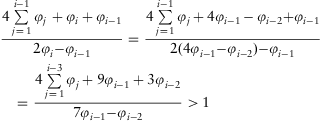
The first part of the expression in (A17) is
 $$no{\quad\quad\quad\frac{{{\rm{4}}\mathop{\sum}\limits_{j\, = \,{\rm{1}}}^{i{\rm{ - 1}}} {{{\varphi }_j}} \, + {{\varphi }_i} + {{\varphi }_{i{\rm{ - 1}}}}}}{{{\rm{2}}{{\varphi }_i}{\rm{ - }}{{\varphi }_{i{\rm{ - 1}}}}}}\, = \,\frac{{{\rm{4}}\mathop{\sum}\limits_{j\, = \,{\rm{1}}}^{i{\rm{ - 1}}} {{{\varphi }_j}} + {\rm{4}}{{\varphi }_{i{\rm{ - 1}}}}\,{\rm{ - }}\,{{\varphi }_{i{\rm{ - 2}}}}{\rm{ + }}{{\varphi }_{i{\rm{ - 1}}}} {{}{{\rm{ }}}}}}{{{\rm{2(4}}{{\varphi }_{i{\rm{ - 1}}}}{\rm{ - }}{{\varphi }_{i{\rm{ - 2}}}}{\rm{) - }}{{\varphi }_{i{\rm{ - 1}}}}}} \cr\quad\quad\quad\quad= \,\frac{{{\rm{4}}\mathop{\sum}\limits_{j\, = \,{\rm{1}}}^{i{\rm{ - 3}}} {{{\varphi }_j}} + {\rm{9}}{{\varphi }_{i{\rm{ - 1}}}} + {\rm{3}}{{\varphi }_{i{\rm{ - 2}}}}}}{{{\rm{7}}{{\varphi }_{i{\rm{ - 1}}}}{\rm{ - }}{{\varphi }_{i{\rm{ - 2}}}}}}\, \gt \,{\rm{1}}$$
Therefore, for β = 1, the post-merger price given in (12) is strictly greater than 2γMk [i.e., the pre-merger price given in (8)]. It follows from (8) and (12) that the post-merger price is greater than the pre-merger price for all β ⩾ 1.
Appendix B Calculation of the patient-weighted HHI
Competition is measured using the patient-weighted Herfindahl–Hirschman Index (HHI). This measure is calculated by first dividing the patient population into groups and then calculating a competition index for each patient group. The level of competition faced by each hospital system is then the weighted average of the group competition indices where the weights reflect the importance of each group to that system.
Patient groups are based on zip codes and the classifications of Diagnosis Related Groups (DRGs) used in Town and Vistnes (Reference Town and Vistnes2001), which reflect general categories of resource use.Footnote 20 Zip code and diagnosis-based patient groups are used to reflect the importance of distance in a patient's choice of hospital and the fact that patients are generally willing to travel farther for more complex diagnoses. The four Town and Vistnes (Reference Town and Vistnes2001) DRG groups are used instead of the roughly 500 DRGs to insure a sufficient sample size in each patient group.
Suppose there are M zip codes and N hospital systems. Define patient group zk as the managed care patients from zip code z with diagnosis in DRG group k. Each hospital system h serves a share  $$)(--><$>s_{h}^{{zk}} <$><!--$$ of the managed care patient's in this group, equal to the patients in zk who go to system h divided by the total number of managed care patients in zk. Of each hospital system's managed care patients, the share
 $$)(--><$>\rho _{h}^{{zk}} <$><!--$$ come from group zk. The patient-weighted HHI for system h is
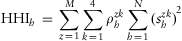 $${\rm HH}{{\rm I}_h}\, = \,\mathop{\sum}\limits_{z\, = \,{\rm{1}}}^M {\mathop{\sum}\limits_{k\,{\rm{ = }}\,{\rm{1}}}^{\rm{4}} {\rho _{h}^{{zk}} } \mathop{\sum}\limits_{h\, = \,{\rm{1}}}^N {{{{(s_{h}^{{zk}} )}}^{\rm{2}}} } } $$