Introduction
Football (or soccer) is by far Europe’s most popular sport, drawing large crowds to football stadiums every week. Football matches fit the definition of a mass gathering (MG) perfectly, with the World Health Organization (WHO; Geneva, Switzerland) defining a MG as “a gathering of persons at a specific location for a specific purpose for a defined period of time,” 1 and Arbon adding “the number of people attending to be sufficient to strain the planning and response resources of the community, state, or nation hosting the event.” Reference Arbon2
Despite its popularity and potential for mass-casualty incidents, literature concerning football matches as MGs is scarce. A recent systematic review by Karami highlighted alcohol and drug-related disorders among football fans as a public health concern. Reference Karami, Doosti-Irani and Ardalan3 Although life-threatening medical situations are rare, Reference Bhangu, Agar, Pickard and Leary4 an increase in acute cardiovascular events, Reference Wilbert-Lampen, Leistner and Greven5 or even mortality, Reference Kirkup6 has been shown. Accurate data on patient presentations in modern football stadiums, however, are still lacking. Reference Bhangu, Agar, Pickard and Leary4
With limited predictive models for patient presentations during MGs, and certainly for football matches, the need for a comprehensive risk assessment tool to predict patient presentations (and patient presentation rates [PPRs]) is obvious. Predictive models primarily cited in the literature are those of Arbon Reference Arbon, Bridgewater and Smith7 and Hartman. Reference Hartman, Williamson and Sojka8
A Belgian predictive medical resource model, Plan Risk Manifestation (PRIMA), was developed to predict patient presentations at various types of MGs. Reference Spaepen, Haenen and Hubloue9 With the first steps of validating this model having been taken, Reference Spaepen, Haenen, Kaufman, Beens, Vandekerckhove and Hubloue10 more data on patient presentations are lacking, upholding further validation of the PRIMA model across other types of MGs. This study aims to compare the actual number of patient presentations at Belgium’s largest football stadium during domestic and international football matches to predictions provided by the models above and the PRIMA model.
Methods
Study Design
This research is a retrospective observational study comparing the predicted patient presentations and the actual medical workload during football matches from 2010-2019 in the King Baudouin Stadium, Brussels, Belgium.
All attendees (home or away supporters) who sought medical help at one of the first aid stations in the stadium or called 1-1-2 (European emergency call number) within the closed perimeter around the stadium were included. Patients who referred themselves to local emergency departments without consulting on-site medical personnel were excluded. The Belgian Red Cross, Brussels provided first responders and the University Hospital Brussels (Jette, Belgium) provided emergency nurses and emergency physicians and were present during the MG.
Data from the actual responses were collected by in-event health services (IEHS; Belgian Red Cross Brussels or University Hospital Brussels). Belgian Red Cross Brussels uses their patient registration software, documenting patient demographics, triage code, treatment, and patient disposition. Data for this study were anonymized and provided to the primary author by the University Hospital Brussels.
Collected data from patient encounters of 65 football matches formed the basis for the conducted study. These matches were held from January 2010 through December 2019 in the King Baudouin Stadium, Brussels, Belgium. The only football matches played at the King Baudouin Stadium are the Belgian National Football Team’s home matches and the Royal Belgian Football Association’s (RBFA; Brussels, Belgium) cup final.
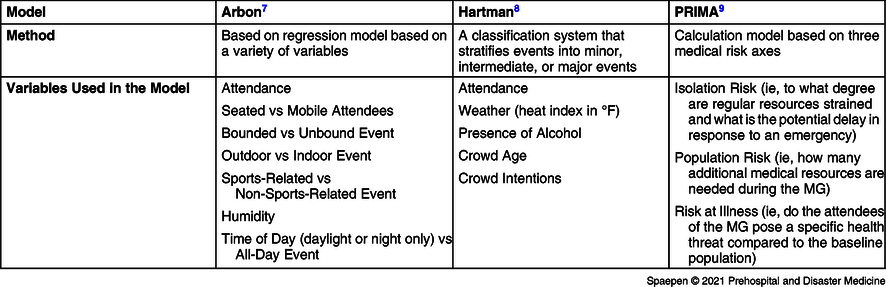
After the matches, the actual numbers of patient encounters were used as control data compared to the predicted numbers by the Arbon, the Hartman, and the PRIMA prediction models. These models were used because they were created to predict patient presentations at MGs and apply to various MG types. Another model by Smith was not chosen because the model predicts the amount of personnel that should be deployed but doesn’t give an estimation of patient presentations. Reference Smith, Wessels, Naicker, Leuenberger, Fuhri and Wallis11 Variables and parameters used to indicate the number of patient encounters is found in Table 1 and extensive detail in the specific publications. Reference Arbon, Bridgewater and Smith7–Reference Spaepen, Haenen and Hubloue9
Event Characteristics Used in the Arbon, Hartman, and PRIMA Models

Abbreviations: MG, mass gathering; PRIMA, Plan Risk Manifestation.
Complete data were acquired for 41 matches. No missing data were encountered as only events for which complete data from IEHS could be obtained were included in this study. Information obtained only included an initial diagnosis, three categories determined by the presenting complaint or an IEHS physician’s diagnosis (life-threatening, urgent, or minor), and whether or not patients were transported to one of the two designated hospitals. A specific data dictionary (definitions) regarding the collected codes was not used because of a lack of detailed information given by the IEHS. Information such as patient demographics, clinical information (eg, diagnosis/treatment), and patient disposition was also not obtained due to privacy restrictions. The Royal Meteorological Institute of Belgium (Uccle, Belgium) provided weather information, and data on the attendees were obtained through the Brussels police department and RBFA. Patient presentation rates were calculated as described by Lund. Reference Lund, Turris and Bowles12
Patient and Public Involvement
Patients were not involved in this research.
Sample Event Model
The King Baudouin Stadium in the northwest of Brussels, Belgium is the home stadium of the Belgian National Football Team. Initially opened in 1930, it was rebuilt several times and is best known for being the Heysel Stadium disaster location in 1985. It is currently Belgium’s biggest football stadium, with an all-seating capacity of 50,093 spectators.
During football matches, a fenced perimeter around the stadium is closed off to prevent opposing fans from clashing. The stadium has three first-aid posts located in three of the stands. During the football matches, all first aid posts had sufficient basic first aid supplies or Advanced Life Support supplies. Patient encounters were defined as all assessments by trained health care personnel (eg, from minimal interventions by first responders to full patient assessment by physicians).
There are two third-level hospitals within one kilometer around the stadium (the Dutch-speaking University Hospital Brussels and the French-speaking Brugmann University Hospital). When patients from the stadium needed to be hospitalized, home supporters were transported to the University Hospital Brussels and away supporters were taken to the Brugmann University Hospital.
Statistical Analysis
Data were entered in a Microsoft Excel 2016 spreadsheet (Microsoft Corp.; Redmond, Washington USA). Statistical analysis included means and medians, interquartile ranges (IQRs), one-way ANOVA, and Pearson’s correlation test. Nonparametric related samples test (Wilcoxon signed-rank test) for comparing the median in deviations in predictions of patient presentations was performed using SPSS version 23 (IBM Corp.; Armonk, New York USA). Confidence interval levels were set at 95%, and results were deemed statistically significant if P <.05.
Ethical Approval
Approval was granted by the medical ethics committee of Vrije Universiteit Brussel (Brussels, Belgium; B1432020000137).
Results
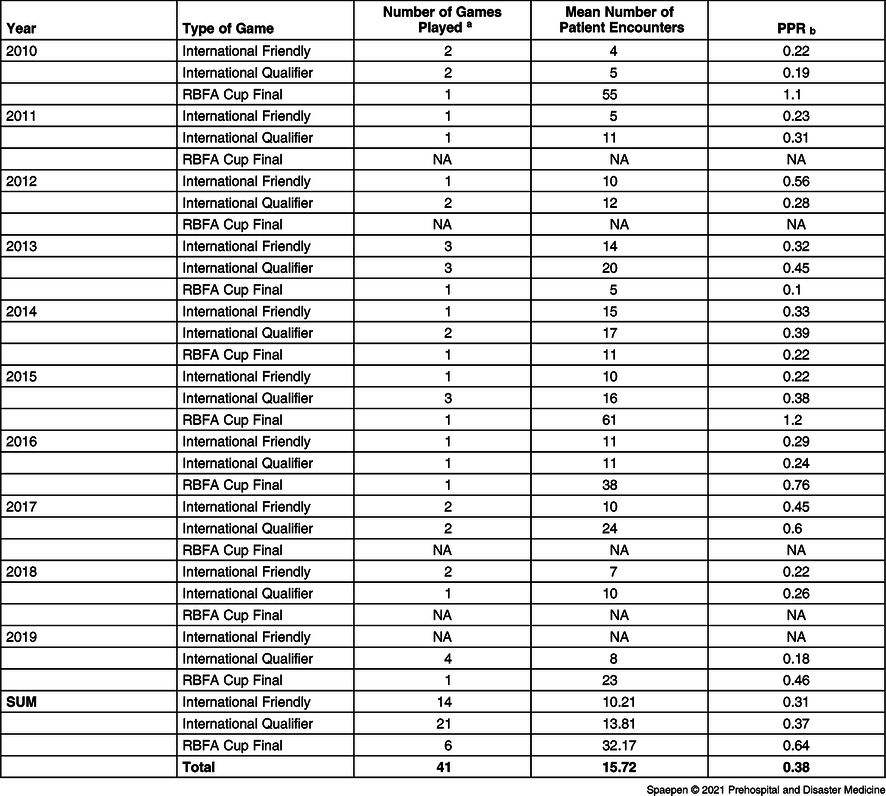
Of a possible 65 games, 24 events had insufficient patient records, resulting in 41 games for analysis (63.07%; Table 2). With a total of 1,630,549 attendees, the average number of attendees per game was 39,769 (median = 42,881; range = 11,000 to 50,093; 95% CI, 36,849-42,690). Of all matches included in this study, six were RBFA cup finals (14.63%; mean attendance = 50,000); 14 matches were international friendlies (34.15%; mean attendance = 33,048; range = 11,000 to 45,000); and 21 matches were international qualifying games (51.22%; mean attendance = 41,327; range = 24,231 to 50,093).
An Overview of the Number of Games Played, Mean Number of Patient Encounters, and PPR per Year Over the Study Period

Abbreviations: PPR, patient presentation rate; RBFA, Royal Belgian Football Association.
a Number of games played and for which complete data were available.
b Mean number of patient presentations per 1,000 attendees.
The average temperature was 11.8°C (0.0°C to 21.0°C; 95% CI, 10.18°C − 13.58°C). The average humidity was 80.05% (61.0% to 98.0%; 95% CI, 76.95% - 83.15%).
Patient Presentations
The total number of patients seen was 626 with a mean of 15.72 patient encounters per match (median = 11.00; range = 1 to 61; 95% CI, 11.37-19.17). Of the total number of patients treated at the games, 129 patients with a mean of 3.15 patients per match (median = 2.00; range = 0 to 11; 95% CI, 2.20-4.09) were seen by a medical team (emergency physician and emergency nurse). The mean PPR was 0.38/1,000 attendees (95% CI, 0.29-0.45). The total number of patients transported to the hospital by ambulance was 68, resulting in a transport-to-hospital rate (TTHR) of 0.04/1,000 attendees.
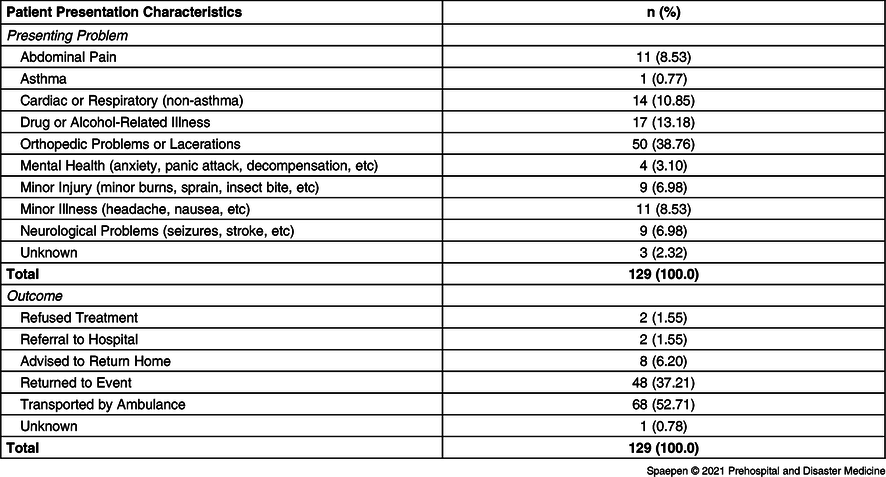
Medical emergencies were rare. Eight patients (1.28%; 95% CI, 0.88-1.68) were initially triaged as life-threatening. Twenty-nine patients (4.63%; 95% CI, 2.95-6.34) were initially triaged as urgent, and 589 (94.09%; 95% CI, 92.21-95.97) were initially triaged as minor. Of the 626 attendees presented to IEHS, 558 (89.14%; 95% CI, 79.42-98.86) returned to the match after receiving on-site care. Sixty-eight patients (10.86%; 95% CI, 1.14-20.58) needed further treatment and were transported to nearby hospitals by ambulance. Orthopedic problems and lacerations were the most common presenting problems, accounting for 38.76% (95% CI, 23.54-53.98; n = 50) of all presentations. Table 3 presents a summary of the patients’ characteristics across all 41 matches of which data were obtained.
Summary of Patient Presentations at 41 Football Matches

No correlation was found between the actual number of patient presentations and temperature (Pearson’s r (41) = .026; P = .873) nor between actual number of patient presentations and humidity (Pearson’s r (41) = −.22; P = .164).
Patient Presentations Considering Different Types of Games
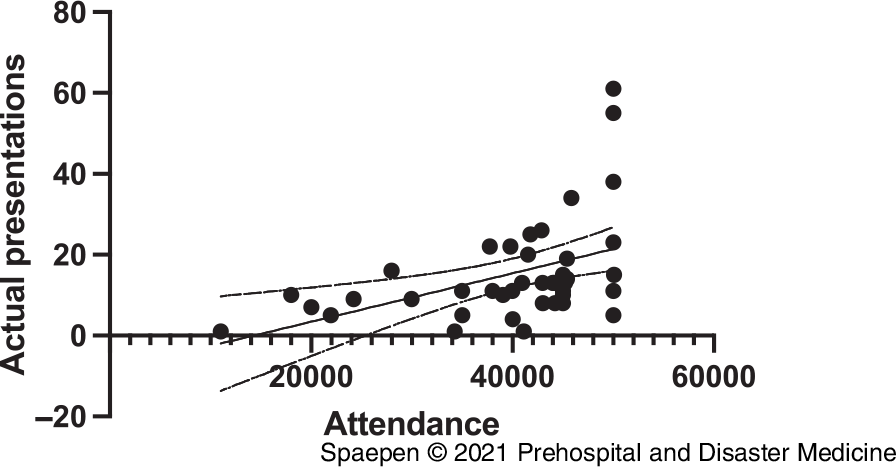
A Pearson’s correlation test showed a significant positive relationship between the number of attendees and the number of patient presentations (r = .45; n = 41; P = .003; Figure 1).
Correlation between Attendees and Actual Patient Presentations.

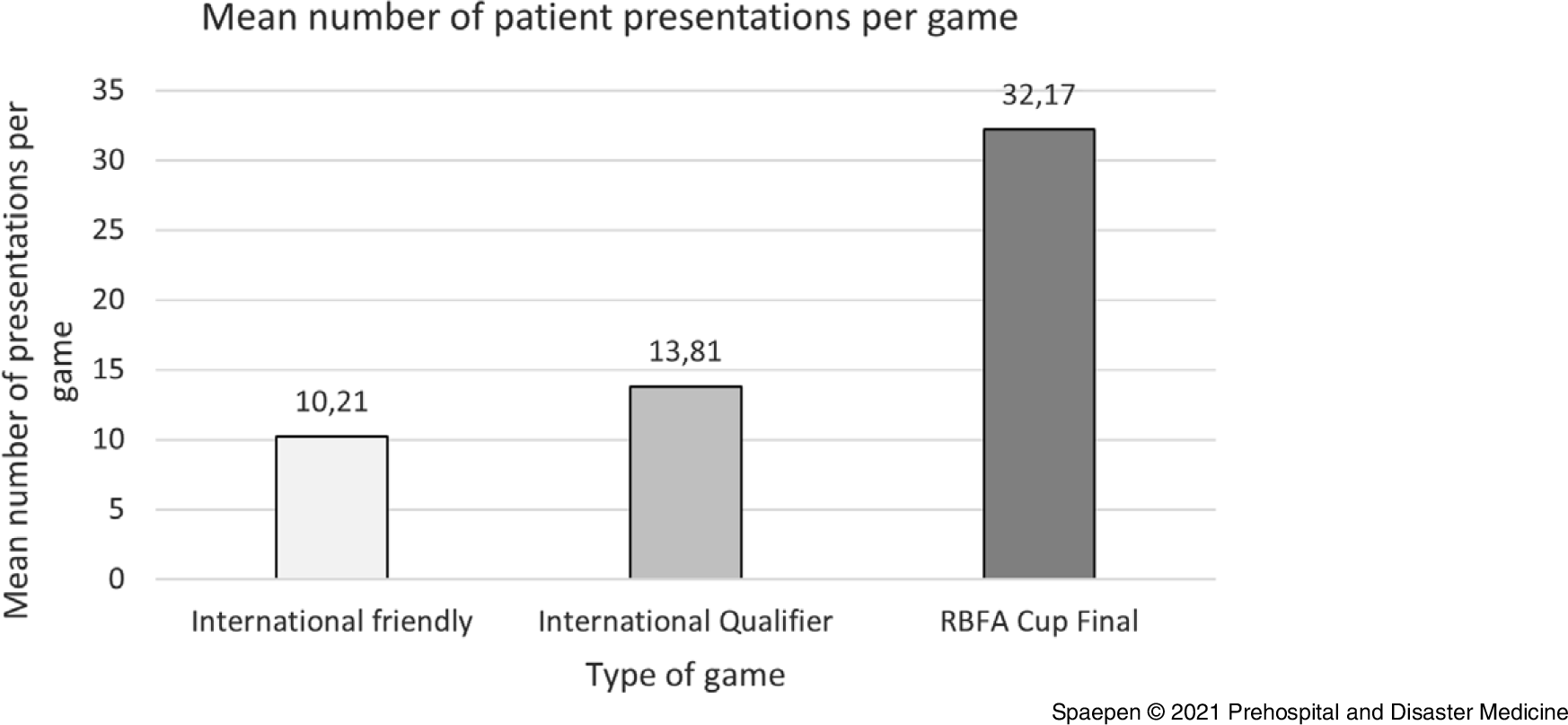
The mean number of patient presentations differed between the type of games (Figure 2). A Pearson’s correlation test showed a statistically positive relationship between the type of game (domestic RBFA cup final or international game) and patient presentations (r = .56; n = 41; P <.001).
Mean Number of Patient Presentations per Game.
Abbreviation: RBFA, Royal Belgian Football Association.

One-way ANOVA was used to determine if there was any statistical difference between the means of the types of matches. One-way ANOVA showed a statistically significant difference between types of matches (F2, 38 = 9.176; P = .001). A Tukey post hoc test revealed that the mean number of presentations was statistically significantly higher during RBFA cup finals (32.16; SD = 23.05; P = .002) compared to qualifying or friendly games of the Belgian National Football Team (10.21; SD = 5.84; P <.001). There was no statistically significant difference between friendly or qualifying matches of the Belgian National Football Team (P = .600).
Over- or Under-Prediction of the Models
The Arbon model under-predicted the number of patient encounters for four events (9.75%; 95% CI, 0.49-19.01) with a mean number of under-predictions of 2.12 (95% CI, 0.21-4.45). On 37 occasions (90.25%), the Arbon model over-predicted patient encounters with a mean number of over-predictions of 7.27 (95% CI, 4.45-10.10). It had a median in deviations in predictions of patient presentations of 7.39 (IQR: 51.5 to 14.72).
The Hartman model over-predicted the number of patient encounters for all events with a mean number of over-predictions of 55.73 (95% CI, 51.83-59.63). It had a median in deviations in predictions of patient presentations of 60.0 (IQR: 51.5 to 63.0).
The PRIMA model over-predicted the number of patient encounters for all events with a mean number of over-predictions of 42.61 (95% CI, 37.81-47.41). It had a median in deviations in predictions of patient presentations of 41.0 (IQR: 29.0 to 55.0).
A Wilcoxon signed-rank test showed there was a significantly higher difference in deviations of the PRIMA model (median = 41; IQR: 29 to 55) than the Arbon model (median = 7.39; IQR: 0.56 to 14.72; Z = −5.566; P <.001; r = −.61). However, another Wilcoxon signed-rank test showed there was a significantly lower difference in deviations of the PRIMA model (median = 41; IQR: 29 to 55) and the Hartman model (median = 60.00; IQR: 51.5 to 63.00; Z = −4.245; P <.001; r = .47).
Discussion
This study aimed to compare the actual number of patient presentations at Belgium’s largest football stadium during domestic and international football matches with predicted patient presentations provided by the Arbon, the Hartman, and the PRIMA models. When comparing the models’ mentioned above predictions, there were significant differences between the predicted number of patient encounters and actual patient encounters—both the PRIMA and the Hartman model over-estimated patient encounters for each occasion. The Arbon model over-estimated the number of patient presentations for 90.25% of the events but under-estimated the number of patient encounters for 9.75% of the events.
Although low, the under-prediction by the Arbon model merits further attention. When models under-estimate the number of potential patient encounters, this could have severe or even fatal consequences. Reference Arnold13 However, continuous over-prediction like the Hartman and the PRIMA models is not good either. Yet, the PRIMA model’s continuous over-prediction is contrary to a previous study where the PRIMA model had the highest rate of under-predicting patient encounters. Reference Spaepen, Haenen, Kaufman, Beens, Vandekerckhove and Hubloue10 On the one hand, over-predicting the number of patient presentations leads to excessive staffing levels, which could lead to disgruntled IEHS personnel. Subsequently, excessive levels and amounts of IEHS staffing bring additional costs for event organizers. On the other hand, over-estimating the level and amount of IEHS staffing allows it to be perceived as an additional service at the event site. The attendees have used the IEHS as a replacement for General Practitioner services before. Reference Leary, Greenwood, Hedley, Agnew, Thompson and Punshon14
When comparing the PPR of the events in this study, a mean PPR of 0.38 patients/1,000 attendees was found. This result is consistent with previous studies. Reference Bhangu, Agar, Pickard and Leary4,Reference Allgaier, Shaafi-Kabiri and Romney15,Reference Morimura, Katsumi and Koido16 Analyzing the reasons for PPR brought no clear answers, however. Crowd size used to be cited as an essential factor for patient presentations. Reference De Lorenzo17 Although Leary drew contradictory conclusions, Reference Leary, Kemp and Greenwood18 results from this study did show a positive relationship between patient presentations and the number of attendees.
Other well-established contributing factors to patient presentations are temperature Reference Milsten, Seaman, Liu, Bissell and Maguire19 and alcohol and drug usage among attendees. Reference Smith, Wessels, Naicker, Leuenberger, Fuhri and Wallis11,Reference Milsten, Seaman, Liu, Bissell and Maguire19 However, no correlation was found between temperature and the number of patient presentations. Despite only selling alcohol-free beer within the stadium’s perimeter, alcohol and drug usage could explain patient presentations since alcohol consumption (mostly beer) is commonplace in Belgium. It can be assumed that attendees consume alcohol before entering the stadium’s perimeter.
Striking from this study results is the positive relationship between the number of patient presentations and the type of game visitors attended (international versus domestic game). A statistically significantly higher number of patients consulted IEHS during RBFA cup finals than international games of Belgium’s National Football Team. In agreement with Milsten, Reference Milsten, Seaman, Liu, Bissell and Maguire19 it is assumed that alcohol usage and (local) team rivalry are the main reasons for the higher number of patient presentations during RBFA cup finals.
Most of the patients seen by IEHS are of low acuity and even present with pre-existing medical problems, which is congruent to previous studies. Reference Bhangu, Agar, Pickard and Leary4,Reference Leary, Greenwood, Hedley, Agnew, Thompson and Punshon14 When attendees did present to IEHS with acute medical issues, they did so mostly with critical cardiovascular issues, which also replicates the previous studies. Reference Wilbert-Lampen, Leistner and Greven5,Reference Kirkup6
Limitations
The current study comes with several limitations. A first limitation is missing out on attendees who self-refer to local emergency departments other than the designated ones. Missing out on these patients leads to a possible under-estimation of the actual number of patient presentations. A further limitation is the lack of data concerning football matches, making it difficult to compare results. Previous studies focus on preparations or in-event medical services during World Cup Finals or are limited to one football season. Reference Bhangu, Agar, Pickard and Leary4,Reference Allgaier, Shaafi-Kabiri and Romney15,Reference Morimura, Katsumi and Koido16,Reference Leary, Kemp and Greenwood18 Another limitation is the general applicability of the PRIMA model. None of the two other models used in this study have been validated in other countries. Reference Arbon2,Reference Ranse, Hutton, Turris and Lund20 The PRIMA model was developed because European studies and literature are scarce. Both the Arbon and the Hartman models are non-European. However, because of the specific Belgian setup, the PRIMA model’s general applicability for other countries could be limited. Adding to these limitations is the small sample studied, justifying further studies on patient presentations during football matches. A final limitation was the lack of detailed patient data, making it impossible to examine the accuracy of amount and levels of IEHS staffing.
Despite the evolution in mass-gathering medicine, the prediction of the number of patient presentations remains complex as each event is unique with its characteristics that influence the usage of IEHS. With the PRIMA model developed for a broad set of MGs, Reference Spaepen, Haenen and Hubloue9 this study focused on validating the PRIMA model for (domestic and international) football matches played at Belgium’s largest football stadium.
Conclusion
Comparing the predicted patient presentations, only one out of three models under-predicted on a small number of occasions, while the PRIMA model over-estimated for all studies events. When comparing mean deviations, the PRIMA model had significantly different mean deviations of all predicted patient presentations than the Arbon and the Hartman models.
Nonetheless, based on the results of this and previous studies, municipalities and government officials may use the PRIMA model with confidence to predict patient presentations and estimate the level and amount of staffing needed for IEHS during domestic and international football matches played at the King Baudouin Stadium.
Conflicts of interest/funding
To the best of their knowledge, the named authors have no conflict of interest, financial or otherwise.