Introduction
Rosa L. (Rosaceae) contains approximately 200 species, with the genus considered one of the world's most famous ornamental plants. Rosa species are primarily distributed throughout the Northern Hemisphere (Scariot et al., Reference Scariot, Akkak and Botta2006). China is an important region of distribution for Rosa species and holds abundant resources for this genus. At the end of the 18th century, many Chinese roses with continual flowering, rich fragrance and charismatic flowers were introduced into Europe, which played a key role in the formation of modern roses.
The genus Rosa contains two subgenera. Subgenus Rosa is divided into 10 sections (Wissemann, Reference Wissemann2017) and the species in sect. Chinenses are important materials for omics studies. According to Ku and Robertson (Reference Ku, Robertson, Wu and Raven2003), sect. Chinenses includes three species, namely, R. x odorata (Andr.) Sweet, R. chinensis Jacq. and R. lucidissima Lévl. Among these species, R. x odorata, characterized by its large plant size, graceful branches and leaves, half-bent flowers, sweet fragrant petals and strong adaptability, is an important species in sect. Chinenses. R. x odorata has been described from courtyards in the Chinese Song Dynasty (Wang, Reference Wang2015), indicating its long history of cultivation. Currently, R. x odorata is an important species for courtyard greening, and it is a precious material for breeding roses with fragrant flowers. R. x odorata resources are distributed naturally only in Yunnan Province, China (Wang, Reference Wang2015). It is also a national rare third-class protected species for its scarcity and value (Fu, Reference Fu1992). Because of its long history of cultivation and old natural interspecific cross, R. x odorata has an extremely rich array of variation among wild resources and a large number of varieties. However, comprehensive studies on the natural resources of R. x odorata have rarely been reported.
The relationships among Rosa spp. are complex and hard to unravel owing to the numerous species, various ploidy levels, wide distribution and extreme intrageneric variation (Liorzou et al., Reference Li, Zhong, Dong, Jiang, Xu, Sun, Cheng, Li, Tang, Wang, Dai and Hu2016). Some research examined the relationships of Rosa species and hypothesized that parts of the R. x odorata varieties are hybrids between R. x odorata var. gigantea and R. chinensis (Meng et al., Reference Meng, Fougère-Danezan, Zhang, Li and Yi2011). Previous studies have focused on the discovery of key genes in the flowering transition of R. x odorata var. gigantea (Guo et al., Reference Guo, Yu, Luo, Wan, Li, Wang, Cheng, Pan and Zhang2017, Reference Guo, Zhang, Tian, Chen and Zhao2018). A recent research milestone is the report of the whole genome sequence of R. chinensis ‘Old Blush,’ which will allow further in depth studies of Rosa spp. (Raymond et al., Reference Raymond, Gouzy, Just, Badouin, Verdenaud, Lemainque, Vergne, Moja, Choisne, Pont, Carrère, Caissard, Couloux, Cottret, Aury, Szécsi, Latrasse, Madoui, François, Fu, Yang, Dubois, Piola, Larrieu, Perez, Labadie, Perrier, Govetto, Labrousse, Villand, Bardoux, Boltz, Lopez-Roques, Heitzler, Vernoux, Vandenbussche, Quesneville, Boualem, Bendahmane, Liu, Bris, Salse, Baudino, Benhamed, Wincker and Bendahmane2018). Other research on R. x odorata has investigated cytogenetics (Jian et al., Reference Jia2010a, Reference Khadivi-Khub and Etemadi-Khahb; Tian et al., Reference Tian, Jian, Zhang, Mo, Gui, Zhang and Tang2013), genetic evolution (Tang et al., Reference Tang, Qiu, Zhang, Li, Wang, Jian, Yan and Huang2008; Xu et al., Reference Xu, Li, Qiu, Tang, Jiang, Li, Wang and Zhang2009), flower fragrance (Li et al., Reference Liorzou, Pernet, Li, Chastellier, Thouroude, Michel, Malécot, Gaillard, Briée, Foucher, Oghina-Pavie, Clotault and Grapin2018a, Reference Li, Yan, Yang, Jian, Zhang, Chen and Tangb), cold resistance (Deng et al., Reference Deng, Jian, Li, Wang, Guo and Zhang2013) and propagation (Guo et al., Reference Guo, Yu, Luo, Wan, Li, Wang, Cheng, Pan and Zhang2008).
The analysis and description of morphological traits is the most direct and effective approach to study germplasm resources (Hesami and Rahmati-Joneidabad, Reference Hessayon2018). This study analysed the morphological traits of R. x odorata germplasm resources. The results are expected to lay a theoretical basis for the development of R. x odorata resources and offer references for the breeding of additional modern roses.
Materials and methods
Tested materials
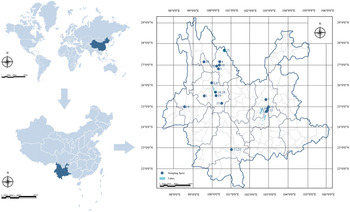
The 22 Rosa germplasm resources used in this study were collected from 18 regions in Yunnan Province, China from 2012 to 2017 (Fig. 1). Through a detailed comparison of the species in Flora of China (Ku and Robertson, Reference Ku, Robertson, Wu and Raven2003), we identified these materials as R. x odorata. The R. x odorata materials are numbered samples #1–#22. In addition, two R. chinensis var. spontanea resources (#23, #24), one double-flowered R. chinensis germplasm (#25), R. chinensis ‘Old Blush’ (#26) and R. lucidissima (#27) were used in this study for a comparative analysis with the 22 R. x odorata germplasm resources. To protect these wild resources, we collected scion materials of the plants from the original areas described above and preserved them in our garden in Kunming under the same environment for years to stabilize phenotypic characters. Information on the morphology, habitats and growing conditions of the collected plants in their original environment were recorded. All the scions were then grafted onto R. x odorata var. gigantea and cultivated in a common garden plot under the same conditions of sunlight with a minimum distance of 3 meters between each plant. The plants were irrigated and fertilized regularly.
Geological distribution of the sampling sites of the studied materials.

Trait Survey and determination
After years of observation, the characters were stable and we started to collect the phenotypic data. The data were collected during the blooming period (between March and April) in 2018–2019. Sixteen morphological traits were selected in the full-bloom stage for data measurement and analysis. All the leaf traits (leaflet length, leaflet width, leaflet length/width, number of leaflets), sepal traits (sepal length, sepal width, sepal length/width), style length, stamen length, number of petals and flower diameter were collected in 2018. Peduncle length, flower colour L*, a*, b* value and blooming duration were collected in 2019. We also added missing data for the flower traits of two materials (#12 and #20) in 2019. Photos were taken during the same period of time to save the images.
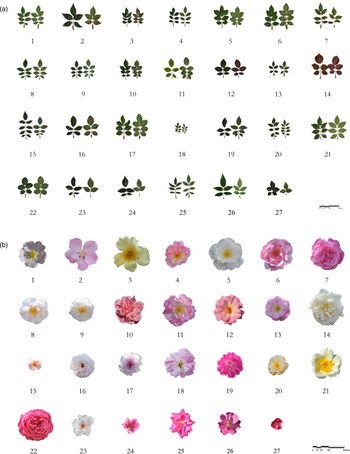
All measurements were obtained using an electronic Vernier caliper (with a precision of 0.01 mm). To measure the leaflet length and width, two leaflets were selected from materials with three leaflets; three were selected from those with five leaflets; four were selected from those with seven leaflets and five were selected from those with nine leaflets. The traits described above were measured on the top leaflets. The measurements were conducted on three different leaflets and the average values were calculated. Statistics on the number of leaflets per leaf were conducted based on visual observation and three leaves were counted for each sample. Fig. 2(a) shows the leaf traits (both sides) of all materials.
Rosa materials examined for leaf (a) and flower (b) traits.

For the flower measurements, the style length (from the top of ovary to top of stigma), stamen length, flower diameter and peduncle length were measured in the full-bloom stage by randomly selecting three flowers from each plant and average values were calculated for computation later. Measurements of the sepals and petals were also conducted in the full-bloom stage by randomly selecting three sepals or three petals on each flower and calculating the average values for sepals and petals separately.
CIELAB colour space was used to analyse the flower colour. It expresses colour as three values: L* for the lightness, a* from green to red and b* from blue to yellow. Flower colour was measured on three petals for each material using an NF555 (Nippon Denshoku Industries Co. Ltd., Bunkyo-ku, Japan). The selected petals were placed on a white background and the averages of L*, a* and b* were calculated. The duration of blooming represents the number of days for a single flower from the beginning of the colouration of a flower bud until the petals dropped and the flowers lost their ornamental value. Three flowers were observed per sample during the duration of blooming. Fig. 2(b) shows the flower traits of all materials.
Data Analysis
We performed morphological variation analysis, inter-trait correlation analysis, principal component analysis and clustering analysis on tested R. x odorata materials. Microsoft Excel 2018 was used to arrange the test data and calculate the coefficient of variation, thus reflecting the degree of trait variation. IBM SPSS Statistics v. 24.0 (IBM, Inc., Armonk, NY, USA) was used to perform principal component analysis to explore the trait indices that contributed the most to morphological variation. R (with package ‘Hmisc’) (R Development Core Team, 2013) was used to conduct Pearson correlation analyses on the data to reveal inter-trait correlations. Clustering analysis was also performed with R 3.5.1 to reveal the relationships among different types of R. x odorata germplasm.
Results
Variations in the morphological traits of R. x odorata
Table 1 indicates that all the traits of 27 germplasm materials showed different degrees of variation, with the variation coefficients falling within the range of 18.0–184.04% (order of variation coefficients from high to low: b*>a*>number of petals>peduncle length>style length>stamen length>leaflet width>leaflet length>blooming duration>sepal length>sepal length/width>L*>number of leaflets> flower diameter>sepal width>leaflet length/width). As indicated by these results, the 16 morphological traits of the R. x odorata resources examined all showed different degrees of variation and presented a rich morphological diversity. The coefficient of variation (CV, %) reflects the degree of variation. Khadivi-Khub and Etemadi-Khah (Reference Khadivi-Khub and Etemadi-Khah2015) indicated that the CV may be an indicator to distinguish between genotypes based on morphology. However, a high CV also reflects that the traits are substantially influenced by the environment. In this research, the number of leaflets and flower diameter had a relatively low CV, but they were important traits to distinguish R. x odorata and R. lucidissima according to the Flora of China (Ku and Robertson, Reference Ku, Robertson, Wu and Raven2003). Therefore, traits with low CV value tend to be consistent within the same species and can be used as an important phenotypic index in the classification process.
The variation of 16 morphological traits of Rosa odorata

The CV values of L*, a* and b* showed that the materials examined were highly varied. The tested materials were different in terms of flower colour and flower type (Fig. 2(b)). For example, the flower colour could be divided into pure colour type and transition colour type. In the surveys, it was found that the colouration of the individual flowers also differed significantly. In addition, as can be seen from Fig. 2(a), the materials examined also showed different degrees of variation in their stipule morphology.
Inter-trait Correlation analysis
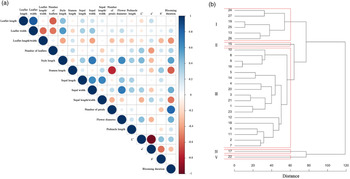
According to the Pearson correlation analysis, significant positive and negative correlations could be observed among several important traits (online Supplementary Table S1, Fig. 3(a)). The correlation between leaflet length and leaflet width was extremely significantly positively correlated, with a correlation coefficient of 0.836. The number of petals and duration of blooming was also significantly positively correlated, with a correlation coefficient of 0.793. The sepal width and flower diameter were also positively correlated, with a correlation coefficient of 0.715. For flower colour, the L* value and a* value had a significantly strong negative correlation, with a correlation coefficient of −0.961. The number of petals and stamen length were also negatively correlated, with a correlation coefficient of −0.703. These data indicate that the more petals there are, the higher the degree of stamen petalization.
Inter-trait correlation analysis (a) and cluster analysis (b).

Principal Component analysis
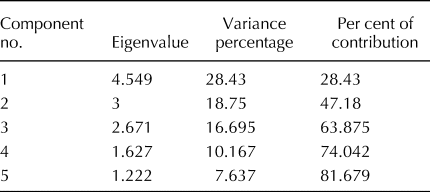
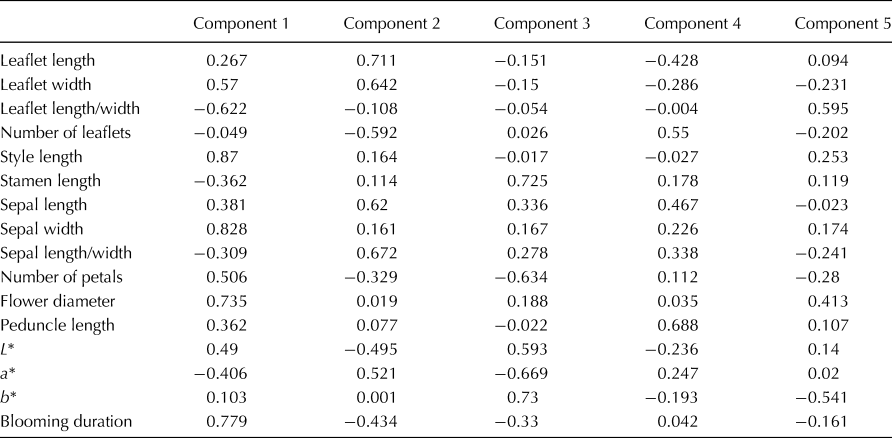
In the principal component analysis on the 16 morphological traits, the first five principal components were extracted and their cumulative rate of contribution was 81.679% (Table 2), suggesting that the first five principal components could explain the majority of morphological variation. The first principal component, with an eigenvalue of 4.549, contributed the most to the variance (28.43%). Among the 16 morphological traits, style length, sepal width, duration of blooming and flower diameter had relatively large eigenvector values (Table 3). These five traits primarily determined the corolla size of R. x odorata, so they could be summarized as corolla size factors. The second principal component had a variance contribution rate of 18.75%. The leaflet length and width, sepal length/width, sepal length and the number of leaflets had relatively large eigenvector values, so it could be deduced that the second principal component was a leaf size factor. The number of leaflets exerted a negative influence on the leaf traits of R. x odorata. The third principal component had a variance contribution rate of 16.695%. The stamen length and b* value had a positive influence; yet the number of petals and a* value had a negative influence. The third component was generalized as flower architecture and colour factor. The fourth and fifth components contributed 10.167 and 7.637% of the variation, respectively. The traits comprising the fourth and fifth components were summarized as peduncle factor and leaf type factor, respectively.
Principal component analysis of morphological traits

Weight of principal components for morphological traits

Clustering Analysis
The group-average clustering method was used to conduct a systematic clustering analysis on 27 germplasm resources, as detailed in Fig. 3(b). The dendrogram showed that all of the material clustered into five groups. Most non R. x odorata resources were clustered into Group I, including R. chinensis var. spontanea (#24), R. chinensis ‘Old Blush’ (#26), and R. lucidissima (#27), indicating that the materials recorded as #13 and #19 were more closely related to the R. chinensis group (Group I) rather than the R. x odorata group (Group III). Group III contained 18 germplasm resources, including the three varieties (#3, #6, #20) recorded in the Flora of China (Ku and Robertson, Reference Ku, Robertson, Wu and Raven2003). The germplasm resources that had the single-lobe trait, i.e. #1 and #23, had a very close morphological relationship. These two resources were a sister of R. x odorata var. gigantea (#3) and #21. It is presumed that these four materials came from original wild species in sect. Chinenses, and thus had a very close morphological relationship.
The germplasm resources #15, #17 and #22 were separately classified into Groups II, IV and V. It was deduced that the flower diameter and number of petals exerted key influences on the clustering results, since #15 had the smallest flower diameter, and #17 and #22 had the greatest number of petals out of all the materials examined.
Discussion
Rosa x odorata is regarded by Hessayon as the first aristocrat of the rose world (Hessayon, Reference Hesami and Rahmati-Joneidabad2010). However, the morphological descriptions of R. x odorata in Flora of China are not specific enough (Ku and Robertson, Reference Ku, Robertson, Wu and Raven2003). For instance, leaflets are described as ‘suddenly or progressively sharp at the front end’, pedicels are described as ‘hairless or having glandular hairs’ and stipules are described as ‘hairless, except glandular hairs on the edge or at the base only’. Therefore, obvious uncertainties are present with such descriptions (Ku and Robertson, Reference Ku, Robertson, Wu and Raven2003). In addition, the only monograph has no exact descriptions of other traits of R. x odorata, such as flower fragrance and flower colour, so there are still great debates on these traits (Wang, Reference Wang2015).
The coefficient of variation reflects the degree of dispersion of morphological traits; the greater the coefficient of variation, the higher the degree of dispersion of the trait. This study found the variation coefficients of the 16 morphological traits of the tested R. x odorata were all above 18.0%, with a variation of 18.0–184.04%, indicating obvious variations. Morphological variation is related to the combined action of genes and the environment, and the more complex the environmental conditions, the more significant the morphological variations. In this study, Rosa materials were collected from a large geographical area with different climatic conditions and elevations at each collection site. These environmental differences may have resulted in morphological variations, chromosome doubling and other differences, as previously reported about Rosa spp. (Jian et al., Reference Jian, Zhang, Wang, Li, Zhang and Tang2013; Yu et al., Reference Yu, Luo, Pan, Sui, Guo, Wang and Zhang2014). In addition, there are significant differences in the coefficients of variation among different traits of R. x odorata, suggesting that different traits have different degrees of dispersion and stabilities. This is could have occurred because, under long-term natural selection, different traits have different adaptabilities to the environment, resulting in some traits having higher stability (such as leaf type and flower diameter), while others having lower stability (such as flower colour and the number of petals) (Si et al., Reference Si, Zhang, Zhao and Xu2012).
In the principal component analysis on the factors that influence the traits of the germplasm resources, several main influencing factors were defined. This allows for a more straightforward classification of germplasm resources. This study indicated that the five principal components reflected the majority of the variation of the germplasm resources examined and the components could be summarized as corolla size factor, leaf size factor, flower architecture and colour factor, peduncle factor and leaf type factor. Corolla size factor had the highest contribution to variance, which testified to the importance of flower traits in the morphological evaluation on R. x odorata. In fact, style length, duration of blooming and flower diameter were important indices for the evaluation of morphological diversity of flower traits. In the second principal component, the leaflet length and width and sepal length and width were important indices in evaluating leaf size traits, which was partially consistent with the results from previous studies (Jia, Reference Jian, Zhang, Wang, Li, Zhang and Tang2005; Bai, Reference Bai2009). This could be because of the selection of materials examined and trait indices.
Owing to the variability of the morphological traits of Rosa species, plants that grow in the wild have great diversity. Therefore, some species present no obvious differences (i.e. they are morphological similar) under natural growth conditions. In addition to the frequent crossing among Rosa species, the diversity of species ploidy level has posed many challenges on the study of genetic relationships and phylogenetics of Rosa (Scariot et al., Reference Scariot, Akkak and Botta2006). Based on morphological data, the Flora of China divides Rosa sect. Chinenses into R. chinensis, R. x odorata and R. lucidissima (Ku and Robertson, Reference Ku, Robertson, Wu and Raven2003). The main characteristics used to classify these species are habit, number of leaflets and flower diameter. The group-average clustering method used in this study differentiates these three species into three groups, which is partially consistent with the descriptions in Flora of China (Ku and Robertson, Reference Ku, Robertson, Wu and Raven2003). Only one R. chinensis var. spontanea resource was clustered with R. x odorata and had a close relationship with R. x odorata var. gigantea. Harkness (Reference Harkness2003) claimed both R. chinensis var. spontanea and R. x odorata var. gigantea are important progenitors of many Rosa resources, as they have been used in breeding many excellent ornamental cultivars. Based on the analysis of chloroplast and single-copy nuclear genes, Meng et al. (Reference Meng, Fougère-Danezan, Zhang, Li and Yi2011) suggested that parts of R. x odorata varieties could be hybrids of R. x odorata var. gigantea and R. chinensis. Moreover, R. chinensis var. spontanea might have been one of the parents of the first cross of R. chinensis ‘Old Blush’ and that R. multiflora and R. x odorata might have also taken part in the crossing. Scariot et al. (Reference Scariot, Akkak and Botta2006) conducted a microsatellite analysis and found that R. x odorata var. gigantea had a relatively distant relationship from R. chinensis ‘Old Blush,’ which is similar to the clustering result in this study. Thus, it is clear that Rosa chinensis and R. chinensis ‘Old Blush’ have a relatively complex origin and that their origin is possibly related to R. chinensis var. spontanea and R. x odorata. Hibrand et al. (Reference Hibrand Saint-Oyant, Ruttink, Hamama, Kirov, Lakhwani, Zhou, Bourke, Daccord, Leus, Schulz, Van de Geest, Hesselink, Van Laere, Debray, Balzergue, Thouroude, Chastellier, Jeauffre, Voisine, Gaillard, Borm, Arens, Voorrips, Maliepaard, Neu, Linde, Le Paslier, Bérard, Bounon, Clotault, Choisne, Quesneville, Kawamura, Aubourg, Sakr, Smulders, Schijlen, Bucher, Debener, De Riek and Foucher2018) constructed a doubled haploid rose line (‘HapOB’) from R. chinensis ‘Old Blush’ and analysed the genetic diversity of Rosa through species re-sequencing for seven diploids and one hexaploid. Their results indicated that there were relatively few differences between the reference sequence of HapOB and that of R. chinensis var. spontanea. For this reason, further in-depth studies are needed to understand the origin and relationships of the species and varieties investigated in this study.
In this study, the measurement of some traits could be easily influenced by environmental changes (i.e. the duration of blooming). Therefore, some measuring errors may have occurred in this study. In the selection of morphological traits, closer attention should also be paid to differences in flower fragrance, glandular hairs, stipule morphology, fruit traits and other characters because they are also highly diversified. In addition, observations over consecutive years also help to obtain more reliable morphological data.
The morphological traits of plants reflect the adaptation of their genotypes to environmental changes. Under long-term selection, stable variations occur and produce new characteristics that can be inherited. Thus, the results from our morphological analyses are more comprehensive and practical and provide information related to vital adaptive and evolutionary significance. However, we will be able to provide more precise data on the origin, classification and evolution of germplasm resources if modern biological technology is combined with studies on the differences in morphological traits. These combined data would lay a more solid foundation for the exploration and protection of germplasm and the modification and innovation of resources.
In summary, R. x odorata is considered to be an important parent of modern roses. A phenotypic diversity analysis is the fundamental research to conduct before these germplasm resources can be more effectively developed and utilized. Therefore, the study of wild R. x odorata resources is of substantial significance to the breeding of modern roses, particularly for tea scent roses. R. x odorata smells like a typical tea rose. Despite the continual interest in rose scent, most of the hybrid tea roses that are commonly used as cut flowers are non-scented. The results described above can provide a reference for the selection of core Rosa germplasms to conduct further research on genomic sequencing and explore the genetic mechanism of important traits, such as tea scent and flower colour. Simultaneously, it also provides a basis for the further protection of this precious germplasm.
Supplementary material
The supplementary material for this article can be found at https://doi.org/10.1017/S1479262120000179.
Acknowledgements
This research was supported by the Fundamental Research Funds for the Central Universities (2019ZY16) and National Key R&D Program of China (2019YFD1001001). The authors would like to thank Yuyong Yang (Kunming Yang Chinese Rose Gardening Co., Ltd.) for the help of collecting samples and Xiaokang Zhuo, Bei Nan, Hongjin Lu, Wanlu Wang, Junru Zhang and Zeyi Deng for the data analyses.
Conflict of interest
We declare that we do not have any commercial or associative interest that represents a conflict of interest in connection with the work submitted.