INTRODUCTION
The Transitional Government of Ethiopia restructured Ethiopia as an ethnic-based federal state in 1991. Ethnicity had been the foundation of the ethno-nationalist mobilisation movements against the previous Derg regime and was taken up in the 1995 Constitution in which ‘nation, nationality or people’ is defined as a ‘group of people who have or share a large measure of common culture or similar customs, mutual intelligibility of language, belief in a common or related identities, a common psychological make-up, and who inhabit an identifiable, predominantly contiguous territory’ (article 39/5). The new rulers thus conceived post-1991 Ethiopia as a combination of distinct ethnic groups (Donham Reference Donham2003). The idea to adopt ethnic federalist principles that resembled those of post-1945 Yugoslavia has been controversial and has been regarded by many as likely to become harmful within a short period of time (Bariagaber Reference Bariagaber1998; Hultin Reference Hultin2003). Although no other state in the world had constitutionally declared and established itself as a confederation of ethnic groups that explicitly until then, the underlying Marxist strategy of the 1991 Transitional Government aimed at facilitating the mobilisation of people for governmental programmes and a strong government administration (Clapham Reference Clapham, Nugent and Asiwaju1996; Vaughan Reference Vaughan2003). Ten years after its introduction, ethnic federalism appeared to have ethnified Ethiopian politics and engendered strong territorialisation of ethnicity (Vaughan Reference Vaughan2003; Abbink Reference Abbink2011). Ethnicity had become a means to mediate access to government resources and decision making, ethnic groups (or rather their elites) had occasionally reworked their ‘ethnicity’ so as to match their new interests within changing conditions, and primordialist ideas had influenced both popular and political discourses in Ethiopia (Vaughan Reference Vaughan2003; Kefale Reference Kefale2010; Abbink Reference Abbink2011).
The boundaries of the nine regions of post-1991 Ethiopia were drawn along presumed settlement patterns of particular ‘nations’ that were mainly defined based on ethno-linguistic features. This process was destined to lead to confusion because of vague group definition in some areas, former resettlement programmes and population movements, and because in general, geographical boundaries were ascribed multiple meanings by different people in multiple contexts (Clapham Reference Clapham, Nugent and Asiwaju1996). The ascription of these multiple meanings to boundaries has certainly occurred in Ethiopia, where geographical boundaries are mostly unmarked and often regarded as a transitional zone (Schlee Reference Schlee2003). Besides, the state-induced regional boundaries have had undesirable effects, especially in areas where pastoralist mobility cannot be reconciled with permanent boundaries (Adugna Reference Adugna2011).Footnote 1
Given that ethnicity came to condition access to political representation, local or regional administrative organization and resources, violent contestations of ethnic identity, territory and resource access have emerged along regional boundaries (Kefale Reference Kefale2010; Adugna Reference Adugna2011). Analysis of conflicts between the Dizi and Suri in Southern Ethiopia shortly after the introduction of regional boundaries (in 1992 and 1993) showed that ‘[s]ome of the ethno-regional tensions are of an ideological-political nature, while others have emerged because of insecurity over boundaries and over local authority, and in the absence of a strong central political administration they have led to violent confrontations which no-one seems able to check, let alone prevent’ (Abbink Reference Abbink1993: 675). Other studies – for example in Ethiopia's Western frontier zone with Sudan (Young Reference Young1999), its central Upper and Middle Awash Rift Valley (Mulugeta & Hagmann Reference Mulugeta and Hagmann2008) and its Eastern Mieso district (Beyene Reference Beyene2009) – confirmed that the new government's programme of ethnic regionalism intensified local conflicts. Furthermore, state interference appeared to lead to an increase in internal differentiation within customary authorities and a decline in their conflict management capacity (as observed by Hagmann & Mulugeta (Reference Hagmann and Mulugeta2008) and Beyene (Reference Beyene2009) respectively). Beyene (Reference Beyene2009) called for an increasing role of the state in establishing enforceable property rights institutions to ‘solve’ conflicts. But according to Hagmann & Mulugeta (Reference Hagmann and Mulugeta2008), the increase in (agro-) pastoral conflicts in the Ethiopian lowlands since 1991 is precisely caused by the expansion of the Ethiopian state from the central highlands to the peripheral lowlands. Their analysis of the link between (agro-) pastoral conflicts and processes of state-building showed that conflicts in borderlands are directly related to the Ethiopian government through the latter's mediation of resource governance, pacification efforts and group identity. Another point of dispute in the Ethiopianist literature about interregional conflicts concerns the principal motives for those conflicts. While Hagmann & Mulugeta (Reference Hagmann and Mulugeta2008) stated that conflicts in borderlands are not merely based on environmentalist or primordialist motives, Bariagaber (Reference Bariagaber1998) claimed that they certainly are based on economic motives and to a lesser extent on ethnic motives including religious ones.
With this article we would like to contribute new insights to the Ethiopianist literature about (agro-) pastoral conflicts along post-1991 regional boundaries. We present original ethnographic material from the Afar-Tigray regional boundary in North-East Ethiopia, an area that has not been included in the literature until now, and show findings that are counterintuitive in view of the existing body of political, geographical and anthropological studies about post-1991 changes in (agro-) pastoral conflicts in Ethiopia. Contrary to many other studies, conflicts appear to have reduced along the Afar-Tigray regional boundary over the past two decades. However, that observation needs to be contextualised and this article unravels the historical, political and social aspects of conflicts. Two key questions are addressed: First, we analyse how different groups lay future claims to land along the Afar-Tigray regional boundary. Second, we study the role of the post-1991 Ethiopian government in those claims to land including whether the government's involvement has led to a reduction in conflict or not. The case study reveals that people ‘materialise’ religion (through the building of mosques and churches) to lay future claims to land and that conflicts have reduced with increased involvement of the state over the past two decades, but that this reduction in conflict has come at a high cost and may therefore not be sustainable in the long term.
The study area and methodology are described in the following section. Next, the case study is spelled out and then discussed in two separate sections. Conclusions are drawn in a final section.
STUDY AREA AND METHODOLOGY
In Tigray Regional State, the majority of the population is sedentary and livelihood is based on rain-fed subsistence agriculture on the highland plateaux. Oxen draught power is indispensable within the agricultural system (RLUDP 2000; Yami et al. Reference Yami, Vogl and Hauser2011). During the main rainy season (July–September), cattle are grazed on common pastures that are yearly closed off for some months (hezati); in addition, most villages have separate pastures for oxen, called hezati be'eray.Footnote 2 Boundaries of hezati are not recorded in the land registration and certification, but descriptions of those boundaries are often written down in the local bylaws (serit) together with rules of use (Haile et al. Reference Haile, Witten, Abraha, Fissha, Kebede, Kassa and Reda2005).
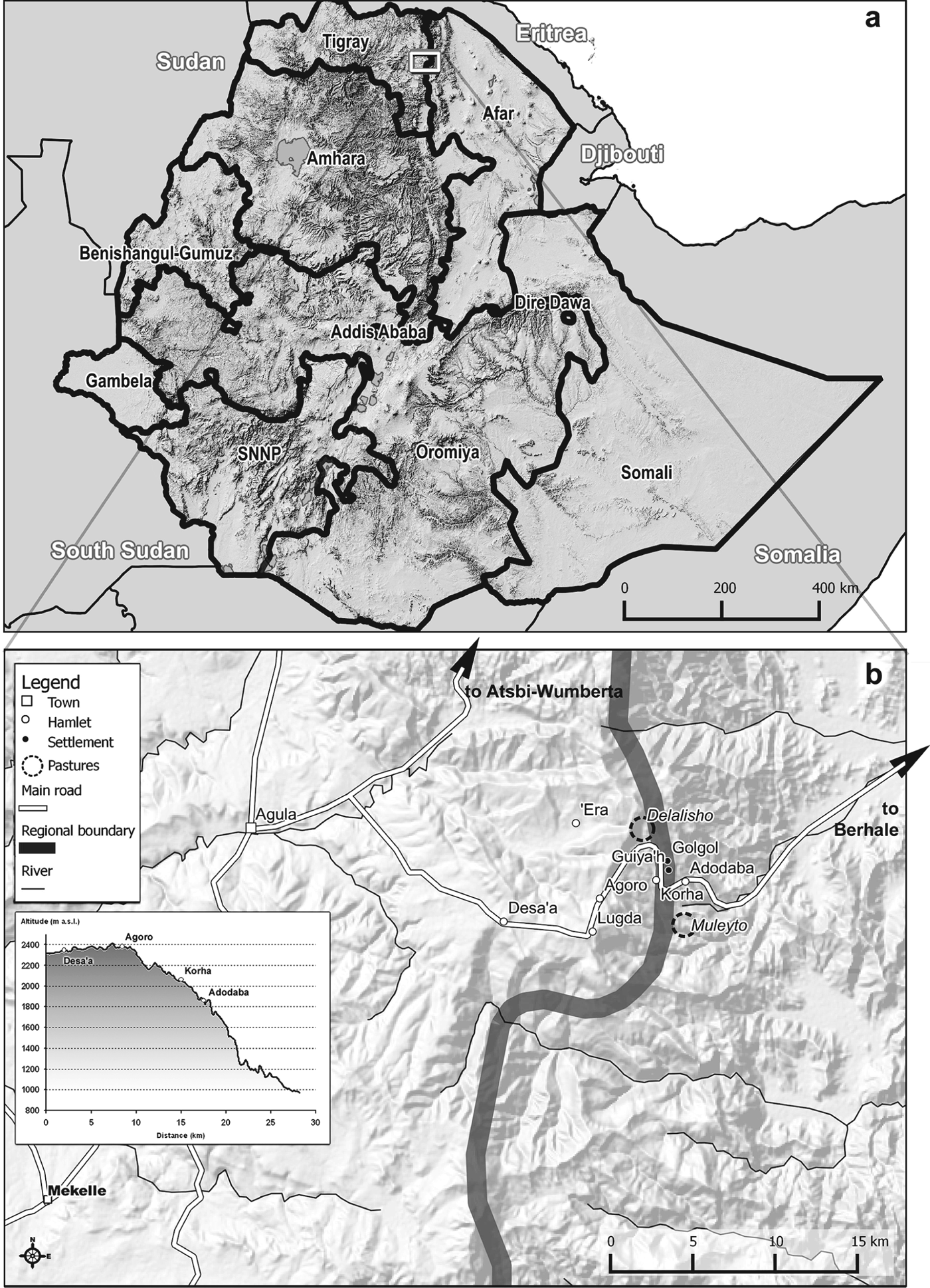
(a) Ethiopia, including regional borders and delineation of the research area in the North. (b) The research area, including elevation profile along the road from Desa´a to Berhale. Digital terrain image derived from SRTMv4 data obtained from http://srtm.csi.cgiar.org/.

In Afar region, the majority of the people are pastoralists whose livelihood is almost entirely based on animal production. The semi-arid to arid climate in the Afar lowlands requires a mobile lifestyle in order to have access to different pastures throughout the year. Clan elders make formal arrangements about seasonal access to pastures. Within clans, marriage, friendship and herding relationships enable access to land and resources of other groups (Kassa Negussie Reference Kassa Negussie1999). Over the past two decades, Afar pastoralists have adopted a more sedentary way of life and engaged in a kind of mixed economy where agricultural production and land enclosing are increasingly practiced. This change of livelihood occurred in response to challenges such as increasing natural hazards and expansion of neighbouring farming groups (Kassa Negussie Reference Kassa Negussie1999; Hundie Reference Hundie2008).
The Afar-Tigray regional boundary, drawn on a provisional map in 1991, was not demarcated on the ground. Nevertheless, natural geographical features are often ascribed to the boundary which thus distinguishes Afar pastoralists in the Rift Valley lowlands from Tigray farmers in the highlands (see Figure 1a). But this geographical classification overlooks extensive borderlands stretching along the Rift Valley escarpment. These borderlands are by no means no-man's land and make up a transitional zone where lowland and highland people have interacted for a long time. Farmer–pastoralist interactions bring along complementarities and mutual benefits for both groups, as well as competitive linkages that can result in conflict or adaptation of livelihoods (Hussein Reference Hussein1998; Benjaminsen et al. Reference Benjaminsen, Maganga and Abdallah2009). They often give way to transhumant lifestyles (Nyssen et al. Reference Nyssen, Descheemaeker, Zenebe, Poesen, Deckers and Haile2009), as is the case in the study area, where many people move with their herds over fairly regular routes and practise crop production, or engage in small-scale business activities such as the sale of firewood, charcoal, food and drinks to traders. Turner et al. (Reference Turner, Ayantunde, Patterson and Patterson2011) stated that the rather recent convergence of farmers' and pastoralists' livelihoods with increased transhumance can on the one hand trigger more farmer-herder conflicts, due to increased competition over natural resources, but, on the other hand, also lead to improved conflict mediation, due to intensified interaction and shared common interests. While Nyssen et al. (Reference Nyssen, Descheemaeker, Zenebe, Poesen, Deckers and Haile2009) claimed that there are no conflicts when herds of Tigray farmers are brought to pastures in Afar region, Kassa Negussie (Reference Kassa Negussie1999, Reference Kassa Negussie2001) stated that since the 1950s, Afar pastoralists in the central and southern parts of the region have increasingly been involved in intensified conflicts over access, use and tenure rights to land and natural resources, partly due to encroachment of land by outsiders.
Data were collected by the first author along the boundary between Atsbi-Wumberta district (Eastern Tigray) and Berhale district (Afar Zone 1) from September 2008 until December 2009 and from July to December 2010. The research was based in Agoro hamlet (13°39′17′′N 39°46′41′′E, altitude: 2400 m a.s.l.) in Atsbi-Wumberta (sub-district Desa´a), but trips to Adodaba (13°39′55′′N 39°49′21′′E, altitude: 1900 m a.s.l.) in Berhale (sub-district Shaygubi) were undertaken weekly, and trips further into Afar region to the settlements Guiya´h and Golgol (which are situated on or near to pastures), were undertaken at times of the year that informants were grazing their animals there (see Figure 1b).
The methodological approach of the research was ethnographic and the majority of the data were collected through participant observationFootnote 3 and face-to-face interviews.Footnote 4 Participant observation was done throughout the whole period of data collection. Interviews were done with the assistance of an interpreter fluent in the local languages Afarinya and Tigrinya. At first, interviews were informal and unstructured, covering respectively any topic the informants wanted to talk about or any topic related to pasture management, ethnicity or conflict. Over time, as data collection proceeded and analytical interpretations took shape, semi-structured interviews were done with key informants and specialised informants (Bernard Reference Bernard2006) in order to fill gaps in analytical interpretation and triangulate previously collected data. Furthermore, ‘grey literature’ – unpublished literature that does not get the label of ‘scientific’, for example bylaws, notes taken by elders during conflict mediation etc. – was collected.
In the presentation of the research results in the following section, a balance between grounded theory (Glaser & Strauss Reference Glaser and Strauss1967) and the extended case method (Van Velsen Reference Van Velsen and Epstein1979) has been made. In line with the extended case method, not only abstractions and inference from field material are presented, but also some of the material itself (Van Velsen Reference Van Velsen and Epstein1979). However, these descriptions of data are mainly used to illustrate concepts rather than as analytical tools (Glaser & Strauss Reference Glaser and Strauss1967; Tavory & Timmermans Reference Tavory and Timmermans2009).
THE CASE STUDY
A history of cooperation and conflict
Historically, Tigray and Afar men have been trading salt from the Dalol Lake in Afar region to the Tigray towns Agula and Mekelle (see Figure 1b). They have built up business relations and passed each other's settlements along the route. Some of those settlements originated or expanded when Tigray women started to sell food, drinks and sexual services to traders. Furthermore, as mobility of Afar pastoralists and Tigray transhumant agro-pastoralists gave way to interactions on pastures, they engaged in relations of friendship and mutual cooperation, and exchanged complementary goods or sold those on markets. Intermarriages between Afar, Christian Tigray and Muslim Tigray resulted in kinship relations. In Tigray region, 96% of the people are Orthodox Christians, while 95% of the population in Afar region are Muslim (CSA, 2007). In Agoro village, however, the two religions are almost equally represented, signifying a high degree of interaction. Muslims living in Agoro are mostly called ‘Afar’, while the Christians are referred to as Kistan (local pronunciation of Christian), which might pull analysts' attention towards Islam as a major factor in the construction of Afar ethnicity. Nonetheless, the ‘Afar’ living in the highlands and those living in the lowlands claim to be different from each other, a statement that the Christians also subscribe to. That distinction is, among others and with a myriad of exceptions, based on lifestyle, dressing and hair style, house construction and food preparation. For clarity and in line with the political delineation of 1991, the term ‘ethnic group’ will be used in this case study for both the Muslim, pastoralist ‘Afar’ and for the agro-pastoralist ‘Tigray’ of either Muslim or Christian faith.
Despite apparent peaceful relations across the ethnic boundary, raids and political struggle marked life in the research area in previous decades. Several stories narrate that kinship relationships between the Afar and the Christian Tigray originated because a girl of one group was abducted by a man of the other group and became his wife. Before the reign of emperor Haile Selassie (1930–1974), men of both ethnic groups could gain the prestigious title Hanta after having killed a man of the other ethnic group and having brought his intimate parts back home as proof.Footnote 5, Footnote 6 The prevalence of raids and conflicts diminished under the rule of emperor Haile Selassie because the Afar were politically and socially marginalised at that time while the Tigray were supported by parliamentarians, all highlanders with farming or urban backgrounds who regarded pastoralist livelihoods as ‘backward’ and unworthy of governmental support (Hundie Reference Hundie2008). Nevertheless, skirmishes between Tigray and Afar shepherds continued over places used for pasturing and watering their animals. Relations worsened again under the Derg rule (1974–1991). Like many other parts of Tigray region, the area was cut off from food aid in order to weaken the Tigray People's Liberation Front (TPLF)Footnote 7 that recruited new fighters from the villages, resided there and hid in the surrounding Desa´a forest. Many people fled the area in 1984/1985 because of the severe drought and consequent famine. All the more, Tigray villages were raided frequently by Ugugumo – a group of Afar soldiers supported by the Derg – which forced even more people to flee the area. Nevertheless, it was during Derg rule that meetings were organised to solve conflicts and settle compensations for the relatives of murdered persons. Shemagele,Footnote 8 men known for their ability to discuss and solve conflicts,Footnote 9 from both ethnic groups gathered in those meetings. They mediated in interpersonal disputes and conflicts over pastures, but not in conflicts with the Ugugumo, as those were initiated at a higher, political level. When the TPLF overthrew the Derg government in 1991, the raids stopped and a comparatively peaceful era began. However, interpersonal relationships and cooperation between Tigray and Afar people have reduced since then, with changes in livelihood. At the same time, labour migration to Arab countries has increased tremendously over the past decade, and remittances now make up a big part of local income and thus influence local relations, by allowing many local people more economic interdependence. Changing livelihoods, together with a very strong increase in population, have also changed interactions in pasture management. Access to pasture remains important for both groups, and both Afar and Tigray people claim pasture as theirs if it was grazed by their parents' or ancestors' cattle. This is worded as ‘This pasture is ours since ancient times’. In view of past and present transhumant migration, this perception yields overlapping claims over pastures. Many households of both ethnic groups used to, or currently have, more than one house and thus claim several pastures.
Conflicts between the two groups today mostly concern pastures which Tigray people claim as hezati be'eray. These hezati be'eray are open for grazing in a rotational system and guards are paid by oxen-owners. When loose animals are caught in a hezati, the guard will only give them back to the owner after the latter has paid a fine. This protective system is one of the major reasons why Afar people prefer to stay in the lowlands. But when rains are failing and feed in the lowlands gets scarce, Afar people negotiate agreements with Tigray people and mostly gain access to the hezati after the oxen have grazed. In addition to these agreements, through cross-boundary Muslim intermarriages, families can gain access to each other's pastures. But people are careful to spell that out loudly and say that ‘it is always good to have a place to stay everywhere’ (several interviews). Nevertheless, Muslim Tigray do not favour the presence of the cattle of their Afar relatives on the hezati be'eray, or as one of them stated: ‘Even if I would have a son living with the Afar in the lowlands, I would have to fight against him together with the Christians because I live here’ (elder Muslim Tigray man living in Agoro, 2008 int.).
Delalisho, where a church is burnt and rebuilt
Delalisho is a pasture situated on the boundary between ´Era and Wumberta, on the escarpment that connects the Tigray highlands with the Afar lowlands (see Figure 1b). ´Era has tight relations with Lugda (of which Agoro is part), although the two villages belong administratively to two different sub-districts. Together with Desa´a village, they have locally always been called Seleste ´Addi Desa´a (the three villages of Desa´a).Footnote 10
In 1984 an Afar family settled on Delalisho. Shortly after, Christians from ´Era went to the new settlement at night, killed the father and one daughter and set the houses on fire. The conflict that followed lasted several days and was joined by many. One Afar and two Tigray men were killed and Afar people set the church located on Delalisho on fire. Shemagele gathered and signed an agreement on compensations (in money or in kind) for the homicides and other violations to avoid a blood feud. The agreement stated that when Afar people would come to the highlands, the Tigray people were responsible for their property and lives, and vice versa. This rule would only be in force when people would come to the other area with permission and would not try to occupy the places that belonged to the people of the area. Additionally, nobody was allowed to construct either permanent or temporary houses in the borderlands. Although the conflict was settled accordingly, over the following years Afar people set fire to the church in Delalisho two more times, and the Christians from ´Era rebuilt it every time. However, Christians from the other villages of Seleste ´Addi Desa´a declared the church as ‘unwarranted’ because nobody was living nearby, and the Muslims stated that it was built and rebuilt only to claim Delalisho. These statements were in line with the customary rule saying ‘once there is a church, there has to be a village’. Another such rule is that ‘once there is a village, its people should get farmland’. Connection of these two customary rules turned the church into an asset for laying claims to the surrounding area, not only for pasture but also for farmland.
In the rainy season of 2008, conflict flared up again when people from Seleste ´Addi Desa´a told shepherds from Wumberta and Afar to leave Delalisho, claiming that it was their hezati be'eray. They asserted that when all land was declared state property during the Derg Land Reform of 1975, people from Wumberta and Afar had come to graze their animals on Delalisho, thus provoking them and creating a major reason for conflict since. A Tigray family that had settled in Delalisho was asked to leave as well to prevent a big conflict like the one in 1984. The shemagele again settled the conflict, albeit only after they had obtained official permission from the district officials to do so. They were granted permission under the condition that mediation would not take longer than half a day. The shemagele arranged for the necessary compensations, and the district officials assigned Delalisho to Wumberta but stated that ‘it should be grazed peacefully by all people from then onwards’. Although the people from Seleste ´Addi Desa´a agreed with the governmental decision only reluctantly, in September 2010 shepherds from ´Era, Wumberta and Afar region all grazed their animals in Delalisho peacefully. Nevertheless, local people stated that conflict could flare up any moment, initiated by disputes over Muleyto, another pasture located nearby.
Muleyto, where plans for a mosque led to gunshots
Muleyto, a shared pasture area, is situated in the borderland between Atsbi-Wumberta and Berhale district (see Figure 1b). People from Seleste ´Addi Desa´a close Muleyto off from mid-August (mid-rainy season) until mid-January (mid-dry season) as hezati be'eray. This practice regularly leads to conflicts with Afar people, especially in years when there is not enough grass in the lowlands at the moment that Tigray people want to close off Muleyto. But even when Afar and Tigray shepherds share pasture in Muleyto, they often have disputes over access to water. Conflicts between villages mostly start from fights between shepherds. Shemagele often manage to settle such disputes before all men of the respective groups get involved. Nevertheless, many adult men got involved in a conflict over Muleyto in the summer of 2008 when Afar people living on and near to Muleyto intended to construct a mosque there. Tigray people strongly opposed that plan, stating that Muleyto was hezati be'eray and that the Afar people only wanted to construct a mosque to lay claim to the pasture. They took the animals belonging to Afar people to their own village and requested a fine per animal, claiming that the rules of the hezati be'eray had been violated. When Afar people refused to pay, tension rose and Tigray men lined up armed with sticks, guns and axes and chased the Afar away (only using the sticks). The Afar men then lined up as well and a severe conflict was about to start. When a shot was fired, the soldiers of the army camp in Lugda intervened and threatened that whoever would fire again, would be shot by them. After this intervention, shemagele from both sides settled the conflict, together with the conflict over Delalisho mentioned earlier. But in 2010, people still feared that conflict could easily flare up again if Tigray people would close off Muleyto whenever rains stay out in Afar region. All the more, shemagele by then had stopped mediating in conflicts because government officials had taken the lead, despite people agreeing that conflicts were solved more smoothly when shemagele were mediating because they were better acquainted with the full context. Government officials were attempting to balance acknowledgement of the shemagele's contextual knowledge and their own duty to intervene in conflicts over land. When trying to settle the conflict about Muleyto, district officials looked for elderly people who would know where the border used to be in ancient times and how pastures were previously divided. But they were told that all persons with that knowledge had died. Nevertheless, during interviews, shemagele could list the access rights of all surrounding villages for every pasture in the borderland. When a district official went to a well-known shemagele, the latter refused to participate in conflict mediation, saying ‘I see the government officials always running here and there, but they cannot solve the conflict’ (elder Christian Tigray shemagele, 2009 int.). When the government official insisted, the shemagele went with him to Korha, the place where shemagele usually meet to settle conflicts between Tigray and Afar (Figure 1b). However, he commented that ‘the discussion was not like a discussion. […] It was like an assignment of peacekeeping: to say something and to go back.’ (elder Christian Tigray shemagele, 2009 int.). In addition, the government officials had not invited the shemagele from ´Era. As all shemagele of Seleste ´Addi Desa´a had always taken major decisions together, the shemagele of Lugda and Desa´a did not want to start mediation without those of ´Era, while the government officials regarded the latter as belonging to another administrative district. In the heat of the debate over the boundary, a district official shouted: ‘The land doesn't belong to the Afar; it doesn't belong to the Christians; it belongs to the government. So if you don't stop this, I will just put the border here!’ From then onwards, this statement was often quoted, by both Afar and Tigray people, and the place he had indicated was referred to as being ‘the real border’.
Korha, place of interplay
Korha, situated near to Muleyto, is part of Lugda village and is the last hamlet inhabited by Christian people along the way that goes down to Berhale (see Figure 1b). People living in Korha interact daily with Afar people from nearby settlements. The hamlet originated as a trade settlement along the salt trade route and at the start of the research, the sale of firewood, charcoal and wooden utensils flourished. But in 2010, nearly all people from Korha had left for Saudi Arabia because they were frustrated in their attempts to make a living in Korha.
Before, in 2008, the conflict about Muleyto and the expansion of wood and charcoal sale had led district officials to order the removal of all houses in Korha except for the ones that were constructed during the reign of emperor Haile Selassie. Tigray people had then started to demolish their houses, but had rebuilt them after they had noticed that Afar people were building a mosque and school in Adodaba, the next settlement along the road (see Figure 1b). In Kusurto, the village of which Adodaba is part, Afar people had replied to the officials' order: ‘When you ask us to remove our mosque, it is as if you ask us to change our religion. We can't do that’ (several interviews with both Tigray and Afar people). As a consequence, houses in Kusurto were not removed and the Christians complained that the Afar people used their mosque to claim the area, including Muleyto.
When another governmental order to remove houses came in 2010, frustrations of most people living in Korha reached a threshold and they left for Saudi Arabia. They were upset because they had only just rebuilt their houses and because of the news that the road would be asphalted, which would increase the number of customers for their businesses if only they were allowed to stay. The government's reasons for ordering removal and thus keeping the borderland free from settlements were twofold: to halt conflict between Afar and Tigray people and to prevent further destruction of the surrounding forest. The area around Korha had long been part of disputes and with the increasing sale of forest products, the hamlet started to play a major part in the degradation of Desa´a National Forest Priority Area (NFPA).Footnote 11 Confronted with people's frustrations and confusion, district officials wanted to establish the ‘real’ regional boundary. They brought the case to the regional administration from where it was passed on to the federal level because it concerned intra-state borders. Nevertheless, the head of the Peace and Security Office of Atsbi-Wumberta district stated that their previous orders of house removal had been based on a written agreement between Afar and Tigray districts dating back to 1988. According to that agreement, no houses could be constructed in the borderlands that stretched ‘from Raya up to IrobFootnote 12, every place where the border with the Afar region is.’ (Head of the Peace and Security Office of Atsbi-Wumberta district, 2009 int.). This agreement of 1988 appears to be similar to the agreement signed by the shemagele of Ala sub-district (Afar) and Desa´a sub-district (Tigray) after the conflict over Delalisho in 1984, mentioned earlier. The well-known shemagele mentioned earlier stated that the shemagele could easily refer to that contract to solve conflicts over pastures or construction in Korha if the government officials would give them the opportunity to mediate in conflicts properly.
DISCUSSION
First of all, this case study adds a new aspect to the Ethiopianist literature about (agro-) pastoral conflicts: i.e. ‘materialisation’ of religion, a process that has been accelerated by post-1991 ethnic-based federalism. People actualise their ‘ethnicity’ using tangible signs of religion or relations of descent to put forward future claims to land. Past temporary settlements, or even signs thereof, are used by claimants to substantiate their relation to a certain place and hence their access rights. Churches and mosques become assets for concretising claims to pastures for, respectively, Tigray and Afar people in spite of the fact that Islam transgresses the ‘ethnic boundary’ both in its constitutional definition and at the local level. But customary rules allow Christians to claim land around their churches and government officials do not enforce removal of houses around a mosque in a borderland village. As a result, struggle over resources and claims to land do not only draw ‘cognitive maps’ (Moore Reference Moore1998), but also create links between political and geographical categorizations of space. Gupta & Ferguson (Reference Gupta and Ferguson1992) stated in this regard that space and place can never be ‘given’ because they are socio-politically constructed when people move through them and re-construct them by giving them social or political meaning. Local actors’ daily practices of settling, grazing animals and farming draw overlapping cognitive maps of land use rights within the prevalent historical, cultural and power context (Moore Reference Moore1998). In conflicts over land, this means that different groups make strategic and context-specific decisions about the different political and social registers they will draw on (Lentz Reference Lentz2003). In this case, people chose to draw on the post-1991 political register of ‘ethnicity’ and to materialise their ethnicity through the building of mosques and churches to claim land. Institutional rules are consequently renegotiated, both by politicians, customary authorities and through people's day-to-day practices, which leads to a concretization of claims and their validation in political space. The materialization of religion appears to be an important way of concretizing claims to land along the Afar-Tigray regional boundary.
Second, this case study shows that conflicts have decreased along the Afar-Tigray regional boundary over the past two decades, which contrasts with the findings of Abbink (Reference Abbink1993), Young (Reference Young1999), Mulugeta & Hagmann (Reference Hagmann and Mulugeta2008) and Beyene (Reference Beyene2009) who all observed an increase in conflict along other parts of the post-1991 regional boundaries. The role played by the post-1991 Ethiopian government in the reduction of conflicts along the Afar-Tigray regional boundary – mainly in the accommodation of political categories of identity – cannot be denied. Donham (Reference Donham2003) regarded accommodation of ‘official’ identity categories created by the state as unavoidable because political categorisation conditions local social and cultural processes, either through reinforcement or through contradiction. The case study shows that in the Afar-Tigray borderlands, political categorisation indeed conditions processes at the local level. But rather than only reinforcing or contradicting one another, political categorisation and processes at local level mutually condition one another. Political categorisation can only gain public authority to define ethnicity and territory to the extent that it is reinforced, or contradicted and as such redefined at local level. Lund's (Reference Lund2006) analysis of public authority and local politics in Africa revealed assimilation of state and local institutions in processes of interplay of national and local political space. In line with Lund's analysis, the present case study reveals an interconnectedness of national and local political spaces that influences social and geographical boundary formation and place-making in borderlands. More importantly, this interconnectedness of national and local political space reveals the ambivalent role of the Ethiopian government in boundary formation and conflict mediation. At local level, district officials cannot pass over intersettlement in borderlands and the borderlands' importance for local livelihoods, while policies made at higher levels direct them towards keeping borderlands free from settlements. To find a way out of the deadlock between policy making and policy implementation, district officials tried to demarcate and impose boundaries based on a certain version of local memories. Doing so, they overlooked the local reality wherein those boundaries are zones rather than lines where flexible land tenure arrangements are constantly renegotiated. They encountered a similar deadlock in conflict mediation and again tried to incorporate local elders into processes of conflict mediation that fit into modernist ideas about boundaries and land tenure. The subsequent clash of ideas and approaches created frustration and resulted in the district officials calling on the state's de jure property rights over all land, transferring the delineation of regional boundaries to the federal level and declaring that natural resources belong to all people and should be used ‘by all people together and in peace’. The concept of a geographical line was thus forced upon people's minds and practices, and an open access management regime was established in contradiction to local tenure arrangements. While the state-imposed boundary was originally perceived as arbitrary by people in the borderlands, that same boundary was gradually integrated into their lives through processes of space appropriation which involved settling of conflicts over pasture. Lentz (Reference Lentz2003) and Flynn (Reference Flynn1997) observed similar processes along international boundaries in West Africa, where strategic use of those boundaries ‘hardened’ the boundary in the minds and practices of the people living in the borderlands. Although Ethiopia's intra-national boundaries were not drawn by colonial governments, modernist ideas about boundaries and land tenure were imposed on areas where fuzzy boundaries and flexible land tenure arrangements prevailed. This imposition of intra-national boundaries structured social order through the positioning of social groups within the federal structure. Although state-imposed attempts to fit local lives into state structures have often proved to be harmful to local livelihoods (Scott Reference Scott1998), in this case study the involvement of the government led to a diminishing of violence in conflicts. Nevertheless, the decrease in conflicts was obtained at a great cost, with many local people migrating to Arab countries out of frustration and dissatisfaction with the way the government handled the situation. Moreover, this decrease in conflicts may not last in the long term as the government's imposing intervention in conflict mediation was perceived as inappropriate by many.
Third, this case study contributes to the on-going debate in Ethiopianist literature about the prime motives for conflicts along post-1991 regional boundaries. As mentioned in the introduction, Hagmann & Mulugeta (Reference Hagmann and Mulugeta2008) stated that conflicts in borderlands are not merely based on environmentalist or primordialist motives, while Bariagaber (Reference Bariagaber1998) claimed that they certainly are based on economic motives and to a lesser extent on ethnic motives, including religious ones. On the one hand, the case study confirms the point of view held by Hagmann & Mulugeta, because the historical, political and social analysis of the conflicts along the Afar-Tigray regional boundary shows that the people involved do not regard ethnicity as a biological, psychological or cultural reality that exists without or in spite of political construction. Rather than a primordialist view, an instrumentalist view on ethnicity can be observed when people materialise religion to put claims to land. For a large part, ethnicity appears as a political phenomenon with the state as the arena, where ethnicity emerges for a purpose on which its persistence depends (Banks Reference Banks1996). On the other hand, Bariagaber's (Reference Bariagaber1998) statement is confirmed in this case study as well, although it has to be nuanced. The prime motive for conflicts is economic: more specifically it is the struggle over access to resources that become scarcer with increasing population pressure. However, while Bariagaber stated that ethnic and religious motives are also playing an important role, we would like to nuance this in view of the instrumental use of ethnicity within conflicts. More importantly, this instrumental use of ethnicity has been accelerated by post-1991 ethnic-based federalism, which is again in line with Hagmann & Mulugeta (Reference Hagmann and Mulugeta2008) who contributed a strong role to the expansion of the post-1991 Ethiopian government to the peripheral areas of the country in the occurrence of (agro-) pastoral conflicts.
Fourth and lastly, this case study sheds new light on the debate about whether the role of the state in establishing enforceable property rights institutions should be increased to solve conflicts (as stated by Beyene Reference Beyene2009) or, rather, should be decreased because the increase in (agro-) pastoral conflicts is merely the result of the expansion of the state (as stated by Hagmann & Mulugeta Reference Hagmann and Mulugeta2008). Although the case study shows a decrease in conflicts with the increasing involvement of the state over the past two decades, there is no doubt that this came at a high cost and might not be sustainable in the long term. The case study showed that interventions of district officials and the army can avoid conflicts or cool them down. But when these interventions lead to a deprivation of local people's livelihoods base (as was the case in Korha), they will not be sustainable in the long term because they lead to frustrations. A more sustainable decrease in conflicts might occur when the state takes up the role of observer or mediator between the different parties involved in conflict mediation, including in discussions over property rights.
CONCLUSION
Ten years after its installation, post-1991 ethnic-based federalism in Ethiopia proved to have ethnified conflicts along regional boundaries, including (agro-) pastoral conflicts. The case study presented in this article nuances this ethnification of conflicts along the Afar-Tigray regional boundary. Conflicts might seem based on ethnic motives including religious ones at first, but in-depth ethnographic study shows that religion is part of the post-1991 political register people draw on to lay future claims to land. People materialise their religion to claim land in a context-specific way of renegotiating institutional rules and so concretise and validate their claims to land. With a growing population struggling over scarce natural resources and materializing its ethnicity to gain access to resources, the prime motives for conflicts along post-1991 boundaries in Ethiopia turn out to be economic-environmentalist and instrumentalist.
Contrary to observations of several other case studies in the Ethiopianist literature, conflicts have decreased along the Afar-Tigray regional boundary over the past two decades. While the post-1991 Ethiopian government has played an important role in diminishing certain conflicts, its role is ambivalent. Political categorisation of group identity has conditioned processes of boundary formation and conflict mediation in the Afar-Tigray borderlands. This has indeed led to a reduction in conflicts in this case, but at a great cost and in an unsustainable way. In this regard, we suggest that the Ethiopian state should take up the role of observer-mediator, both in conflict mediation and the delineation of property rights along post-1991 regional boundaries.