

Competency in cross-cultural practice is an essential skill for clinical psychologists, especially in a multicultural society such as Singapore. The young island state is multi-ethnic, multi-religious and multi-linguistic, thereby presenting some unique challenges to psychological practice. A long history of migration into Singapore has yielded a diverse population of about 74 per cent Chinese-Singaporeans, 13 per cent Malay-Singaporeans, 9 per cent Indian-Singaporeans, and 3 per cent of people with other ethnicities including Eurasians and Caucasians (Department of Statistics, 2015). Singaporeans practice Buddhism, Islam, Taoism, Christianity and Hinduism (Tan, Reference Tan, Gernstein, Heppner, Aegisdóttir, Leung and Norsworthy2009) and other religions, often simultaneously with spirit and ancestor worship. The Singapore government proudly promotes its ‘multiracial’ society (Moore, Reference Moore2000; Prime Minister's Office, 2015), and endorses four languages: English, Mandarin, Malay and Tamil. In this diverse country, cross-cultural practice is an everyday reality for psychologists (Ow & Osman, Reference Ow and Osman2003; Tan & Goh, Reference Tan and Goh2002) and consequently, clinical psychologists need to be ready for culturally competent practice (Lange & Davison, Reference Lange, Davison, Lange and Davison2015a).
Cultural competence refers to the ability of clinical psychologists to practice in a culturally sensitive manner. The concept was introduced in the United States of America in the 1970s, and reflected the growing need for psychology to overcome its limited one-way engagement with cultural minority groups, and to take note of diverse voices within the profession and clientele (Ridley & Kleiner, Reference Ridley, Kleiner, Pope-Davis, Coleman, Liu and Toporek2003). Several models for cultural competence have been developed (e.g., Campinha-Bacote, Reference Campinha-Bacote2002; Carney & Kahn, Reference Carney and Kahn1984; Sodowsky, Taffe, Gutkin & Wise, Reference Sodowsky, Taffe, Gutkin and Wise1994; Sue et al., Reference Sue, Bernier, Durran, Feinberg, Pedersen, Smith and Vasquez-Nuttall1982; Sue, Arredondo & McDavis, Reference Sue, Arredondo and McDavis1992; Sue, Reference Sue2001). Collectively, research with these models shows that therapists’ cultural competence is positively related to their understanding of the cultural context of clients’ problems (Sue & Sue, Reference Sue and Sue2008), to their levels of cultural and emotional empathy (Burkard & Knox, Reference Burkard and Knox2004), to their verbalizations of both the cultural-specific and universal human aspect of suffering (Thompson, Worthington & Atkinson, Reference Thompson, Worthington and Atkinson1994), and to lower implicit racial prejudice (Castillo, Brossart, Reyes, Conoley & Phoummarath, Reference Castillo, Brossart, Reyes, Conoley and Phoummarath2007; Constantine, Reference Constantine2002; Neville et al., Reference Neville, Heppner, Louie, Thompson, Brooks and Baker1996). Psychologists’ cultural competence has a positive effect on client outcomes (Worthington, Soth-McNett & Moreno, Reference Worthington, Soth-McNett and Moreno2007), and it is increasingly incorporated into education programmes and diversity policies in psychology. Cultural competence could potentially assist psychologists in Singapore in their daily multicultural practice. However, at the time of writing, cultural competence is not included in the Singapore Psychological Society's Code of Professional Ethics (2017), and there is a lack of research into this area.
Recent literature has highlighted some of the daily challenges of clinical psychology practice in Singapore that reflect the need for cultural competence. This body of literature highlights the multicultural society, as well as the limited effectiveness of ‘western’ models and practices of psychology in Singapore (Fisher & Lim, Reference Fisher, Lim, Lange and Davison2015; Ow & Osman, Reference Ow and Osman2003; Tan & Goh, Reference Tan and Goh2002), which contribute to struggles to develop egalitarian therapeutic relationships with clients who are seeking to consult experts to ‘fix’ their problems rather than conduct psychotherapy (Lange & Davison, Reference Lange, Davison, Lange and Davison2015a; Ong & Yap, Reference Ong, Yap, Lange and Davison2015; Yeo, Reference Yeo, Othman and Awang1993). Furthermore, Singaporean clients may be reluctant to express their emotions and share personal information, which may be related to the stigma attached to mental illness, unfamiliarity with ‘western’ mental health care, or the desire to ‘save face’ (Foo, Merrick & Kazantzis, Reference Foo, Merrick and Kazantzis2006; Lange & Davison, Reference Lange, Davison, Lange and Davison2015b). Finally, a reliance on ‘western’ tools for assessment increases uncertainty in clinical diagnosis (Lange & Davison, Reference Lange, Davison, Lange and Davison2015b). These challenges demonstrate that culturally competent practice in Singapore not only entails the ability to work across cultural groups, but importantly, also includes the ability to adapt ‘western’ clinical psychology locally. However, there is a paucity of research into the strategies used by psychologists in preparation for multi-cultural practice.
One empirical study has explored the experiences of psychologists practicing in Singapore (Jennings, D'Rozario, Goh, Sovereign, Brogger & Skovholt, Reference Jennings, D'Rozario, Goh, Sovereign, Brogger and Skovholt2008). Analysis of nine interviews revealed that Singaporean therapists relied on personal characteristics, such as being empathic, non-judgemental and respectful, ongoing professional growth, a flexible approach to practice, and on their own professional and life experience, to deliver their psychology services. However, as only one of the nine interviewed therapists was trained locally (Jennings et al., Reference Jennings, D'Rozario, Goh, Sovereign, Brogger and Skovholt2008), these results provide little insight into preparation for practice through training programmes within Singapore. With the relatively recent development of graduate programmes in clinical psychology in Singapore (Geerlings, Thompson, & Lundberg, Reference Geerlings, Thompson and Lundberg2014), and with the first 150 clinical psychologists graduating from these programmes (Lange & Davison, Reference Lange, Davison, Lange and Davison2015a), it is timely to collect empirical evidence on how well these programmes prepare for multicultural practice in Singapore.
The present research aims to address this issue by exploring experiences of students, academics and alumni of clinical psychology programmes in Singapore. The study is conducted in the two universities that provide professional clinical psychology education in Singapore (Geerlings et al., Reference Geerlings, Thompson and Lundberg2014). Both provide two-year Master's programmes in clinical psychology. One also offers a joint Master's degree with an Australian university and the other also provides a three-year doctoral programme. Three of these four programmes are accredited by the Australian Psychological Accreditation Council, reflecting an Australian influence on curriculum (Geerlings et al., Reference Geerlings, Thompson and Lundberg2014). This is potentially problematic in a society that identifies as ‘essentially Asian’ (Yeo, Reference Yeo, Othman and Awang1993, p. 29). Consequently, insight into how universities in Singapore prepare students for culturally competent clinical psychology practice within Singapore is especially pertinent.
The present research uses a qualitative methodology to explore preparation for culturally competent practice in professional clinical psychology programmes in Singapore. It focuses on two research questions. First, how do students, academics and alumni of clinical psychology experience preparation for culturally competent clinical psychology practice in Singapore? Second, according to students, academics and alumni, how well is clinical psychology training meeting the needs for cultural competency? These questions are explored through Interpretative Phenomenological Analysis of interviews.
Method
Participants
Fifteen participants were interviewed: five students (age: M = 33.8, range: 26–40 years), five academics (age M = 49, range: 33–58 years), and five alumni of a clinical psychology programme (age: M = 31.6, range: 27–39 years). Student participants had completed at least one academic semester of their graduate training, and all had some clinical practice experience through either clinical placement or through work conducted prior to their graduate training. Academics’ and alumni's clinical experience ranged from a few years to over 20 years, and in both private and hospital settings inside and outside of Singapore. Fourteen participants were female. Eight participants identified as Chinese-Singaporean, two as Malay-Singaporean, one as Indian-Singaporean. Four people did not fit into these categories. Further demographic information was collected but not reported to maintain confidentiality.
Procedure
An interview outline of open-ended questions was designed to invite participants to describe and reflect upon their experiences of studying (e.g., ‘How much consideration for cultural issues is included in your training program?’), teaching (e.g., ‘How do you prepare students for multicultural practice in Singapore?’), or practicing clinical psychology in Singapore (e.g., ‘Can you tell me about a multicultural clinical practice situation you encountered?’). The outline was piloted with one clinical psychologist not otherwise involved in the study, and minor modifications were made.
After institutional ethics approval, students of clinical psychology programmes, academic staff teaching into these programmes and alumni of these programmes were invited to participate. Recruitment took place via online networks and snowball sampling. Interviews were conducted face-to-face by the first author at the participants’ university or workplace, or in another suitable venue, and took an average duration of 30 minutes. Upon informed consent, the interview outline was used flexibly and participants were invited to introduce topics or ideas related to the research topic. Interviews were audio-taped and were transcribed verbatim into NVivo analysis software. Participants were invited to check their transcripts for accuracy and sufficient de-identification; no modifications were requested.
Data analysis
Interpretative Phenomenological Analysis was used to gain insights into the lived experiences of events from the perspective of the participant (Larkin, Watts & Clifton, Reference Larkin, Watts and Clifton2006; Smith, Flowers & Larkin, Reference Smith, Flowers and Larkin2009). This approach allows for discovery of new themes and constructs, which is pertinent given the exploratory nature of this study.
NVivo was used as an organising tool for analysing the interview transcripts. After data familiarization, one of the researchers noted descriptive, linguistic and conceptual comments on each of the transcripts within NVivo. Based on the comments for each transcript, the researcher constructed themes that focused on the participant's experiences. These themes were organised into groups, with each group representing a superordinate theme, thereby generating a list of superordinate themes for each of the 15 transcripts. To form homogenous samples for IPA, student, academic and alumni interviews were then further analysed as three separate groups, focused on identifying patterns and constructing master themes that summarised the experiences of each group. Themes were included in master themes if they were present in half of the interviews or more (Smith et al., Reference Smith, Flowers and Larkin2009).
To ensure transparency over the interpretative role of the researcher, one analysis was participant-audited by an interviewee, and the analysis of another interview was independently audited by an experienced IPA researcher. While the absence of clear and quantifiable criteria to establish transparency of IPA should be acknowledged, both auditors considered the researcher's interpretations highly plausible and sufficiently similar to their own interpretations; thus, no further auditing was conducted.
Results
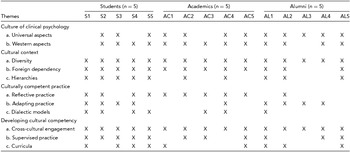
Table 1 shows considerable overlap in the superordinate themes for student, academic and alumni interviews. The analysis thus generated highly similar master themes for students, academic and alumni, which were collated into four themes: the culture of clinical psychology, the cultural context of training and practice, cultural competencies and pathways for developing cultural competency. In the discussion of the themes below, participant quotes are de-identified and are italicised for clarity, and brackets are used to identify material that was omitted or changed for clarification and confidentiality.
Distribution and overlap of superordinate themes per participant group

Culture of clinical psychology
All participants experienced some aspects of clinical psychology knowledge and practices to be universal; while other aspects were perceived as culturally ‘western’.
Universal aspects
All three participant groups experienced clinical psychology's ‘ethos’ such as the use of basic therapeutic skills and supporting clients through psychotherapy, as universally applicable. Participants explained that psychotherapy relates to universal human concerns, such as ‘the need for connection’. Hence, students, academics and alumni of clinical psychology experienced that in daily multicultural practice their basic clinical skills and psychotherapies are, to a certain extent, universally applicable as they draw on the ‘common basis to the human condition’.
However, there was less agreement between participants on whether clinical psychology knowledge and theories are universally applicable. Some participants emphasised that clinical psychology knowledge is ‘thoroughly tested through many research trials’, thus based on ‘objective evidence’ and therefore applicable across cultural groups inside and outside Singapore. However, some specific models were considered more applicable to some clients than others, and participants felt that ‘certain pieces of information are not applicable here’, which indicates that clinical psychology knowledge and theories may be not universally cross-culturally applicable.
‘Western’ aspects
During clinical practice, particular theories, tools, therapeutic approaches or psychotherapies were experienced as culturally ‘western’ and less appropriate for local clients. A frequently mentioned example of a ‘western’ psychotherapy was cognitive-behavioural therapy (CBT): ‘I think it's kind of like a dilemma. We were taught that [CBT] is accepted for anyone, but then again, I don't really think so, based on my own personal experience’. According to participants, CBT requires clients to be aware of their emotions and willing to discuss them, which participants considered normal for ‘western’ people, but not for Singaporeans: ‘Some patients even said: I'm not Caucasian, I don't want to talk about my feelings!’ In addition, CBT does not meet clients’ expectation of problem-solving (‘they expect solutions’), nor does it satisfy clients’ spiritual or religious needs. Furthermore, the underlying mode of thought was considered culturally ‘western’: ‘CBT, I think, is a very clear example of western-based thinking style: linear kind of relationships. Whereas my understanding of eastern kind of thinking is how things are more organic and interrelated’. Thus, underlying thinking styles, expectations and practices in CBT were perceived as culturally ‘western’. This highlights the need for future practitioners to be prepared to adapt ‘western’ psychotherapies to the non-western clientele in Singapore.
Cultural context of training and practice
The cultural context of Singapore brings challenges to culturally competent practice. Three challenges were identified: diversity, foreign dependency and hierarchies.
Diversity
Cultural and linguistic diversity in Singapore was experienced in clinical psychology practice. Often, participants perceived cultural influences as rather inconspicuous but nevertheless important influences on clients’ symptom expression and their interpretation of these symptoms and expectations for treatment. As such, (trainee) clinical psychologists automatically integrated culture into their diagnostic formulations and treatment plans. However, sometimes participants were suddenly confronted with cultural diversity, and reminded of the importance of cultural awareness:
Recently I [treated] a Malay couple and they shared how their family and relatives are so involved in their family problems. And that to me is a surprise, because I am a Singaporean but I am Chinese. So I thought: Wow! That's a culture new thing for me! . . . So I [have] to remind myself to always be open.
Next to cultural diversity, linguistic variety influenced clinical practice. Clinical psychology training was conducted in English, while students and alumni were at times required to practice in Tamil, Malay, Mandarin or Chinese dialects. This was challenging (‘a stretch for my brain’) for students and alumni, who had to provide translations on the spot, and for some academics who only spoke English. Consequently, the need for resources, such as test kits or psycho-educational materials, in the other languages used in Singapore was identified. Such formal translations are necessary as many psychological concepts do not translate directly: ‘How you explain depression to a patient who is using English or Mandarin, for instance, that will be quite different. It doesn't really map quite as nicely’.
Foreign dependency
A second factor for clinical psychology in Singapore was the dependency on foreign expertise: education programmes and resources from overseas. This theme connects to the western aspects theme as, according to participants, these ‘foreign’ programmes and resources advocated models, theories, therapies and practices of clinical psychology that were considered ‘western’, and not always suitable for practice in Singapore. In addition, students and alumni considered some of the skills they were taught at their universities incompatible with the professional culture in Singapore. For example:
Self-critique is not very accepted although we are groomed a lot to do it [during training]. Whereas I find that in some of the local settings that I've been [practicing], it is seen as a very bad thing to admit that there's a mistake, and everyone says: oh look, there's a mistake!
As resources were absent, students and alumni felt that they had to develop their own resources for negotiating these different demands. There were no textbooks or articles on best practices in Singapore that they could consult: ‘it is really hard to find articles relating to how to treat a Chinese or a Malay’. In addition, as most academics were not from Singapore, students and alumni felt that they couldn't always rely on good advice from their supervisors: ‘Sometimes things that they would recommend won't be helpful’. Consequently, students and alumni relied on their own resourcefulness for culturally competent practice.
Academics also recognised Singapore's dependency on foreign expertise and resources. Some academics experienced that their curricula were insufficiently tailored to practice in Singapore, and felt that students were more interested to discuss local cases. In addition, some of the non-local academics were hesitant to comment on culturally competent practice in Singapore, suggesting they may be uncertain about their understanding of local practice: ‘I guess I don't know how well I'm doing. I don't . . . part of my own continuing professional development [. . .] is to get a little bit more familiar with the actuality of the health care placements’. The context of foreign dependency was thus recognised by academics, students and alumni. It suggests that psychologists need to be resourceful for culturally modifying foreign knowledge and skills to the Singapore context.
Hierarchies
The third challenge, identified by students, alumni and some academics, were power differentials in professional relationships. Clinical psychology promotes egalitarian relationships between clients and practitioners, students and their supervisors. However, participants experienced that Singaporean clients prefer a more hierarchical relationship: ‘Because of our Asian culture [. . .] clients see me as someone who is in high authority compared to them, and they look up to us for answers and direction’.
Similarly, academics perceived an ‘extra level deference and respect’ from their students. Therefore, some non-local academics reported to invest in establishing an egalitarian relationship: ‘it is something that I actively try to do, to break down that hierarchy as much as possible’. As a result of their efforts, these academics experienced that local students opened up to them, and provided them with valuable cultural feedback: ‘They know that I'm very open to it [. . .] So they know me well enough to be able to say: that is very [western]’. Thus, these academics felt that the egalitarian supervisory relationship helped them to develop their cultural competency.
However, in contrast to academics’ perceptions, some students and alumni felt that supervisory relationships remained hierarchical despite academics’ efforts: ‘we still think that [academics] are higher than us and we are not in a position to be challenging their point of view’. The difficulty of overcoming power differentials in supervisory relationships was confirmed by nearly all Singaporean participants. Consequently, one academic felt ‘more effective when I can accept and be more comfortable with a power difference’. The academic acknowledged that this is not necessarily consistent with ‘western’ conceptualisations of ‘good practice’. This suggests that clinical psychologists may need to be prepared to work effectively with their clients even when they require more hierarchy and structure.
Culturally competent practice
Participants reported use of three strategies for culturally competent practice: reflective practice, adaptive practice and dialectic use of models.
Reflective practice
Students and academics emphasised the importance of cultural awareness for culturally competent practice. Students referred to cultural awareness mainly as being conscious ‘that there are nuances in how people see things differently because of their culture’. Therefore, students considered being ‘open-minded’ and ‘non-judgemental’ as essential to reflective practice. In addition, academics also emphasised the importance of being aware of one's own culture: ‘I know I also have my own standards but I realise that they may not be the only standards’. This also included an understanding of the cultural biases that clinical psychology may have.
Participants recalled practice situations in which clients presented mental health problems that were related to culture, such as relating to maintaining ‘face’. In such situations, participants tried to refrain from imposing clinical psychology solutions on their clients, but instead presented them as alternative solutions in order to ‘not try to change their minds but just to highlight to them that: you know not everyone sees [their problems] this way, there is one other way of looking at it. How does that sound for you?’ Reflective practice thus involved an awareness that the solutions offered by clinical psychology may not always be the best. This suggests a cultural relativist stance toward clinical psychology.
Adaptive practice
According to students and alumni, adapting clinical psychology practice was an important aspect of culturally competent practice. This included adjusting the therapeutic approach, ‘repackaging recommendations’ or advice to clients, altering standardised procedures for assessment or therapy, using Singlish (colloquial Singaporean English), or translating ideas or tests in other languages. Such adaptations depend largely on therapists’ understanding of their clients’ cultural needs:
I think it would take your own clinical and professional judgement to decide what works best for your client. Like there may be no straight following of a certain manual. So you just take out the piece that you think is most relevant and what would be most helpful, and use your judgement to fill in the gaps.
Such adaptations of clinical psychology were often shared through informal learning networks, rather than in clinical psychology training programmes: ‘I would say training in the adjustments is done quite informally. On the job training kind of thing, where you listen to people who have more experience and you learn from them’. However, as small adaptations were used more frequently, they slowly started to become new norms: ‘Well it is quite fortunate that most of the test kits have been used for a few years, so there is some sort of standardisation, so some agreement on answers that are more suitable for a country like here’. Interestingly, these ‘agreements’ on standardisation were not yet covered in clinical psychology curricula.
Holding dialectic models
A final cultural competency, identified mainly by students, was the ability to simultaneously work with different explanatory models in clinical practice. Participants sometimes experienced that clinical psychology models were incompatible with the cultural models or beliefs of their clients, or which they themselves held. An example provided by a few participants was seeing the ghosts of ancestors, which was experienced by some Chinese-Singaporean participants or their clients. A Chinese-Singaporean cultural explanatory model differs from the psychological explanation of hallucination. Participants solved this by simultaneously identifying with different perspectives:
I am constantly trying to appreciate where somebody else is coming from while at the same time holding the model of what might be quite different from where they're coming from. But without giving in on either of those, it is holding it up, it is a dialectic opposite of holding those models.
This simultaneous identification with different explanatory models, and being able to use these different models in clinical practice, was identified as an important cultural competency for clinical psychologists in Singapore. Culturally competent practice in Singapore requires clinical psychologists to be non-judgemental and respectful towards different beliefs, even if they are contrasting with clinical psychology models.
Cultural competency development
Participants identified the need for cultural competency in clinical practice. Three pathways to develop cultural competency were identified: cross-cultural engagement, supervised professional practice and clinical psychology training.
Cross-cultural engagement
Interacting with people of different cultural backgrounds, including culturally different colleagues, fellow students and academics was an important source of cultural learning for participants. Through cross-cultural encounters, participants developed awareness of diversity, gained confidence in their ability to engage cross-culturally and sharpened their knowledge of other cultures and religions.
Singaporean participants reported frequent cross-cultural encounters since a young age. Some believed that this results in all Singaporeans developing a baseline cultural competency: ‘People from Singapore are pretty well culturally exposed to the local multicultural society, they generally, I would like to think that they have a basic capacity to be sensitive enough to deal with people from different races’. In addition, the presence of foreign academics further broadened participants’ perspectives: ‘They give very different opinions and perspectives [. . .] that is a wealth of knowledge that we can actually tap into’. Thus, according to participants there are many opportunities for cross-cultural engagement in Singapore, and thus for developing cultural competency.
However, a few participants critiqued this idea that Singaporeans have a baseline cultural competency: ‘I think the issue is that there's this thinking that everyone is open and everyone is knowledgeable about each other, but they're not. And I think that the downside to that is that a lot of ignorant racism happens’. These participants argued that cross-cultural engagement needs to be more self-reflective, and perhaps facilitated through workshops, in order to overcome stereotypes and to develop cultural competency.
Supervised practice
A second pathway for cultural competency development was supervised practice. Local practice experience was considered important for learning how to apply clinical psychology knowledge and skills in the context of the health care system and the multicultural environment of Singapore: ‘it gives me a faster sort of route toward the way of what it is like to practice here in the real setting, after I graduate from the course’.
However, commencing practice in multicultural Singapore was challenging: ‘I kind of know Indian culture, I kind of know Malay or Chinese culture. But in terms of how I am going to apply that in my work, no one has taught me’. Supervision provided an important assurance for commencing practitioners: ‘As a new psychologist we have a lot of doubts about whether we are good enough, whether we are competent enough [. . .] so I think maybe that's where supervision is very important’. Supervision sessions were important to discuss difficult situations in practice, including cultural issues. The affirmation provided by supervision was empowering to students. Supervision helped students and alumni feel more confident about their competencies.
Curricula
Students pointed out to the need to integrate cultural training in their clinical psychology programmes. They felt that cultural training ‘tends to be like a touch and go kind of thing’ and identified several training needs, including addressing literature focusing on working with Asian clients, and discussing socio-historical knowledge of cultural groups in Singapore. Such cultural knowledge would help students feel more informed:
There could be just a course that you could do, in which you learn about like the Malay culture and the history or the Indian culture and the history [. . .]. Then at least when you go out there, you're not just carrying stereotypes in your mind.
In addition to cultural knowledge, students identified the need for training in cultural skills. However, they did not have clear ideas of what such skills would entail:
We bring across in class that: oh, we should try to be culturally competent! But then again that doesn't mean you have to do anything, but that you adopt an active and a curious approach to your client, and things like that. So . . . I'm not very sure if I'm satisfied with that response because it is really quite ambiguous.
These findings suggest that emphasising cross-cultural application of skills and theory in training programmes may increase students’ self-perceived cultural competency.
Discussion
This research used qualitative methods to explore experiences of preparation for multicultural practice in Singapore, and analysed whether these training programmes are meeting the needs of future psychologists for cultural competency. Generally, the findings demonstrate that students, academics and alumni (collectively called ‘clinical psychologists’ here) consider clinical psychology programmes valuable for improving mental health care in Singapore, however, the training programmes alone are not sufficient preparation for multicultural practice in Singapore.
Clinical psychologists in Singapore experience their discipline as partly culture-specific and partly universal. They recognised universally applicable therapeutic skills and theories of basic human needs and motives. The existence of this perceived universal ‘core’ of models and skills that is generalisable across cultures is an important foundation for cultural competency approaches to multicultural practice (Kitaoka, Reference Kitaoka2005). It suggests that ‘indigenisation from without’ is sufficient in Singapore (Tan, Reference Tan, Tan and Law2002, p. xxiii): clinical psychology needs to be modified for practice in Singapore, rather than completely discarded for cultural insensitivity. The findings reveal that such modifications are conducted by clinical psychologists at multiple levels: Asians, Singaporeans, members of specific groups within Singapore and at client level. Furthermore, the perception, expressed by some psychologists, that scientific evidence warrants universality of clinical psychology methods and tools highlights the need for cultural competence. Indeed, a large part of the research findings have yet to be replicated and validated in Singapore (Lange & Davidson, Reference Lange, Davison, Lange and Davison2015b), and therefore, culturally sensitive application is required.
Cultural experiences of clinical psychologists were multifaceted and covered ethnic culture, as well as linguistic and religious cultures. Interestingly though, clinical psychologists often described cultural differences in eastern-western and collectivist-individualist dichotomies, which is a ‘core societal values’ approach that reduces cultures to their position on a single dimension (Cooper & Denner, Reference Cooper and Denner1998). Another common cultural classification used by clinical psychologists was the four ‘racial’ groups as defined by the Singapore government (Chinese, Malay, Indian and Others). Such definitions, however, contrast with the multifaceted and multileveled experiences of culture, and suggest that more resources are needed to help clinical psychologists understand and conceptualise the various facets and different levels of culture in Singapore.
Clinical psychologists used specific competencies for culturally modifying their practice. An openness to diversity and a cultural relativist stance appear to be central. The themes reflective practice and holding dialectic models demonstrate the importance of being non-judgemental and respectful toward different beliefs or ideas. Syncretism of beliefs can be expected in Singapore, as clients often consult different types of health care practitioners and healers (Foo et al., Reference Foo, Merrick and Kazantzis2006; Lee, Reference Lee, Tan and Goh2002; Tan, Reference Tan, Gernstein, Heppner, Aegisdóttir, Leung and Norsworthy2009). This explains why some clinical psychologists in the present study personally held psychological models and contrasting cultural models simultaneously. In this context, it is not surprising that showing respect and being non-judgemental, as identified in a previous study (Jennings et al., Reference Jennings, D'Rozario, Goh, Sovereign, Brogger and Skovholt2008), were also identified here as being central to competent practice in Singapore. In addition to being respectful and non-judgemental, psychologists need to develop the confidence to address such beliefs, which may be outside of the focus of some models of psychotherapy. This includes a preparedness for addressing spiritual or religious issues (Jennings et al., Reference Jennings, D'Rozario, Goh, Sovereign, Brogger and Skovholt2008). How these competencies can be fostered through professional psychology curricula merits further research inquiry.
Other competencies for culturally sensitive practice identified in the present study are a flexible approach to practice, and resourcefulness. The themes foreign dependency and adaptive practice showed that clinical psychologists modified their therapeutic approach to the individual client, and the ‘western’ aspects of clinical psychology to the local context. The need to adapt ‘western’ psychology has previously been reported (Fisher & Lim, Reference Fisher, Lim, Lange and Davison2015; Lange & Davison, Reference Lange, Davison, Lange and Davison2015b; Ow & Osman, Reference Ow and Osman2003; Tan & Goh, Reference Tan and Goh2002; Yeo, Reference Yeo, Othman and Awang1993), and a flexible therapeutic approach was previously reported among Singaporean psychologists (Jennings et al., Reference Jennings, D'Rozario, Goh, Sovereign, Brogger and Skovholt2008). Moreover, the present findings and existing literature indicate that clinical psychologists based their strategies for flexibility on their professional and personal experiences, instead of on their training experiences or on resources such as textbooks (Jennings et al., Reference Jennings, D'Rozario, Goh, Sovereign, Brogger and Skovholt2008; Lange & Davison, Reference Lange, Davison, Lange and Davison2015b). This again highlights psychologists’ resourcefulness, ability to learn from professional and personal experiences, and flexibility.
Jennings et al. (Reference Jennings, D'Rozario, Goh, Sovereign, Brogger and Skovholt2008) described strategies for practice of Singaporean psychologists who mostly trained abroad and some competencies identified in the present study are consistent these strategies: being non-judgemental and respectful, willing to address spiritual issues, a flexible therapeutic approach and relying on professional and personal experiences. However, other strategies listed by Jennings et al. (Reference Jennings, D'Rozario, Goh, Sovereign, Brogger and Skovholt2008), such as a strength-based approach and self-doubt, were not identified in the present study. Conversely, the importance of linguistic skills and being comfortable with power differentials, identified in the present study, were not listed by Jennings et al. (Reference Jennings, D'Rozario, Goh, Sovereign, Brogger and Skovholt2008). This indicates both overlaps and differences in strategies for culturally competent practice between clinical psychologists who were trained in Singapore or abroad. What is not yet clear is whether local training or overseas training provides greater benefits to clinical psychologists in terms of effectiveness in local practice.
The findings reveal strengths of clinical psychologists in Singapore, however they also show where clinical psychology training can be improved. The adaptive practice theme indicates that cultural adaptations made in practice are not yet incorporated into training curricula. This could be related to Singapore's dependency on Australian curricula, which could hamper students’ training in local adaptations of psychology. The foreign dependency theme was prominent, and with the curricula theme demonstrates the need for more cultural content in clinical programmes. It may benefit clinical psychologists when universities review their curricula for cultural adaptability. Alternative pathways of learning through experiences may be activated when universities encourage cross-cultural social relations among students and academics, and pay attention to cultural exposure when assigning students to placements. Furthermore, while academics should be encouraged to explore cultural issues in their teaching and supervision, they may benefit from support in developing their knowledge of the cultural context in Singapore. The present findings suggested that academics viewed their cultural competency more favourably than students did. While this may be related to academics having longer and broader experience, investing in the cultural competency of academics may in turn improve the quality of preparation for clinical practice in Singapore.
These findings point to directions for further research that may benefit the training of future practitioners in Singapore and may further benefit culturally competent practice. An example is standardising the adaptations that are already made in practice. For example, developing local protocols and norms for assessments, and formally translating psycho-education materials are potential avenues for standardising cultural modifications. Once practitioners and researchers formalise their adaptations, their efficiency can be empirically verified and they can be integrated into training programmes. This would not only improve the standardisation of clinical psychology in Singapore, it may also solve the frustration with the dependency on non-Asian teaching resources that have limited relevance for Singapore, as identified here and by Lange and Davidson (Reference Lange, Davison, Lange and Davison2015b). Encouraging the development of standardised local resources may help embed the teaching of clinical psychology into the local context.
These interviews provide important insights into preparation for multicultural practice, however, some limitations must be acknowledged. All but one participant were female, which may reduce generalisability of the findings. However, cultural diversity was adequately sampled, with Chinese-Singaporean, Malay-Singaporean, Indian-Singaporean and non-Singaporean participants included. Also, self-selection bias is likely to occur in qualitative research, where people with the strongest opinion on the topic may be more likely to volunteer to participate. Consequently, the findings may overestimate the cultural challenges in clinical psychology training and practice. Thus, the present findings are considered as preliminary and more research is needed to help generalise the findings to the larger population of clinical psychology students, academics and alumni in Singapore.
Conclusion
This research demonstrated that ‘western’ clinical psychology models and practices need to be adapted for application in linguistically, religiously and culturally diverse Singapore. Adapting clinical psychology requires cultural competencies, such as reflectivity and adaptability. More research is needed to assess how universities can best integrate cultural competencies into curricula, and explore the potential benefits of investing in academics’ cultural sensitivity and knowledge in order to enhance students’ cultural competency development. In addition, this article identified the need for developing standardised culturally and linguistically modified resources, such as protocols, assessment norms and psycho-education materials.
Cultural competency is a priority issue for the continuing development of clinical psychology in Singapore. Sternberg (Reference Sternberg, Tan and Goh2002) believed that Singapore could play a key role in identifying strategies for multicultural psychology practice. The present findings suggest that with some additional research and training, Singapore could become a key example for culturally competent clinical psychology teaching and practice.
Acknowledgements
The authors thank all participants for sharing their experiences and dedicating their time, academic staff members who facilitated this research, Assoc. Prof Anita Lundberg, Dr Joanna Barlas, Dr Nenna Ndukwe and Dr Jane Tuomola for assistance in IPA.
Declaration of interest
None.