Implications
Better identifying outcomes of surgeries is a challenge for scientists and stakeholders in animal production. Here, we demonstrate that a multivariate analysis combining behavioural and physiological indicators is more effective to detect residual responses in sheep exposed to surgeries with various degrees of invasiveness, than analyses only based on behaviour or physiology.
Introduction
For husbandry reasons, ruminants, such as most farm animals, may be exposed to traumatic events (e.g. castration, dehorning caesarean, etc.) that cause stress or pain. ‘Pain’ is defined as ‘an aversive sensory experience that elicits protective motor actions, results in learned avoidance and may modify species-specific traits of behaviour, including social behaviour’ (Molony and Kent, Reference Molony and Kent1997). The term ‘stress’ is defined as ‘the nonspecific response of the body to any demand made upon it due to a common emotional experience’ (Veissier and Boissy, Reference Veissier and Boissy2007). Because of the absence of a verbal report, the emotional experiences of animals are generally assessed through the following two expressive components: the behavioural component and the physiological component (including activation of the hypothalamic–pituitary–adrenal (HPA) axis, activation of the autonomic nervous system (ANS), inflammation and oxidative stress) (Prunier et al., Reference Prunier, Mounier, Le Neindre, Leterrier, Mormede, Paulmier, Prunet, Terlouw and Guatteo2013). Collectively, these components constitute five responses to pain. In ruminants, various behavioural measurements can be used to assess pain, such as teeth grinding, feeding behaviour and social interactions (Rialland et al., Reference Rialland, Otis, de Courval, Mulon, Harvey, Bichot, Gauvin, Livingston, Beaudry, Hélie, Frank, del Castillo and Troncy2014). Hypothalamic–pituitary–adrenal axis activity, through the measurement of cortisol concentration, has been used to assess pain induced by challenges, such as dehorning (Stafford and Mellor, Reference Stafford and Mellor2005) or castration (Lonardi et al., Reference Lonardi, Scollo, Normando, Brscic and Gottardo2015). Changes in ANS activity in response to orthopaedic pain (Bussières et al., Reference Bussières, Jacques, Lainay, Beauchamp, Leblond, Cadoré, Desmaizières, Cuvelliez and Troncy2008) or post-abdominal surgical pain (Graubner et al., Reference Graubner, Gerber, Doherr and Spadavecchia2011) can be evaluated through the measurement of heart rate and heart rate variability (HRV). The intensity of the inflammatory response (through the measurement of cytokines and acute phase proteins) can be used to assess the presence and/or intensity of pain associated with castration (Earley and Crowe, Reference Earley and Crowe2002). Oxidative stress, which is reflected in an imbalance of oxidant and antioxidant substances in the body, is observed in numerous painful diseases (e.g. mastitis, respiratory and joint disease; Lykkesfeldt and Svendsen, Reference Lykkesfeldt and Svendsen2007). More precisely peroxynitrite and reactive oxygen precursor are critically important in the development of pain of several aetiologies. Oxidative stress is therefore an emerging field that deserves to be investigated in pain assessment (Salvemini et al., Reference Salvemini, Little, Doyle and Neumann2011). Despite the use of a large variety of behavioural and physiological indicators, the assessment of pain is difficult because these indicators are not pain specific. For instance, animal handling induces an increase in cortisol concentrations and heart rate (GrØndahl-Nielsen et al., Reference GrØndahl-Nielsen, Simonsen, Damkjer Lund and Hesselholt1999). Moreover, many of these indicators are used indiscriminately to evaluate the stress or pain experiences. The use of behavioural indicators to assess pain is further complicated by the fact that ruminants, such as most prey species, express very few signs of pain, sickness or weakness to avoid attracting the attention of predators (Vinuela-Fernandez et al., Reference Vinuela-Fernandez, Jones, Welsh and Fleetwood-Walker2007). Therefore, there is a need to assess the validity of pain indicators in ruminants by studying their sensitivity (the proportion of painful animals that test positive) and specificity (the proportion of pain-free animals that test negative) in traumatic situations. Validity information has only recently been provided in the pain literature on cattle (de Oliveira et al., Reference de Oliveira, Luna, do Amaral, Rodrigues, Sant’Anna, Daolio and Brondani2014) and sheep (McLennan et al., Reference McLennan, Rebelo, Corke, Holmes, Leach and Constantino-Casas2016).
Previous studies on how sheep experience pain are generally based on one or two types of indicators (see above). To our knowledge the combination of information from various indicators has hardly been explored, although it would increase the chance of detecting and assessing the intensity of pain experienced by the animals (Molony et al., Reference Molony, Kent and McKendrick2002; Prunier et al., Reference Prunier, Mounier, Le Neindre, Leterrier, Mormede, Paulmier, Prunet, Terlouw and Guatteo2013). Discriminant analysis is a multivariate technique that has been used in cellular biology and genetics (e.g. Kanehisa, Reference Kanehisa1988) to compare individuals belonging to several groups and to describe how groups differ in terms of variables (Perrière and Thioulouse, Reference Perrière and Thioulouse2003). The good results obtained in cellular biology convinced us to apply this method to sheep response to surgical procedures.
This study focusses on sheep exposed to three degrees of invasiveness of surgical procedures, namely Sham (fasting, anaesthesia, but no surgery), gastrointestinal cannulation (fasting, anaesthesia, rumen cannulation) and Rumen–Duodenal–Ileum (fasting, anaesthesia, cannulation of the rumen, duodenum and ileum). Sheep received the conventional combination of medication for laparotomy (i.e. anaesthesia and non-streroidal anti-inflammatory drug (NSAID)). However, it is possible that these medications were insufficient to alleviate all the impacts of surgery, and particularly visceral pain induced by tension in the mesentery. Hence, the general aim was to assess residual differences between treatment groups receiving the same therapeutic regimen. The first objective was to explore how the five pathways (behaviour, inflammation, oxidative stress, the HPA axis and the ANS) change in sheep exposed to three degrees of invasiveness of surgical procedures despite a therapeutic regimen. The second objective was to evaluate the ability of a multiparametric analysis (through analysis of its sensitivity and specificity) to discriminate between these situations. Timeline responses are highly variable between pathways (e.g. earlier behavioural response than physiological response; Prunier et al., Reference Prunier, Mounier, Le Neindre, Leterrier, Mormede, Paulmier, Prunet, Terlouw and Guatteo2013), within pathways (e.g. earlier reduced glutathione/glutathione disulfide (GSH/GSSG) response than malondialdehyde (MDA) response and also may vary between individuals; Prunier et al., Reference Prunier, Mounier, Le Neindre, Leterrier, Mormede, Paulmier, Prunet, Terlouw and Guatteo2013). We therefore chose to study the integrated response of sheep on a 5-day period rather than the time course of the responses.
Material and methods
Animals and housing
In all, 24 castrated Texel male sheep (18 months old, 54±3 kg (mean±SD) BW) were used. The number of animals to recruit per treatment was calculated according to Röhrig et al. (Reference Röhrig, du Prel, Wachtlin, Kwiecien and Blettner2010). We identified first the two most cited indirect indicators of pain from all indicators measured in pain studies (Prunier et al., Reference Prunier, Mounier, Le Neindre, Leterrier, Mormede, Paulmier, Prunet, Terlouw and Guatteo2013): cortisol and haptoglobin. For those two indicators, we then used our unpublished results from all follow-up measurements after surgical interventions (rumen, duodenal and/or ileal cannulae on sheep and cattle; (Durand D., personal communication), to calculate the required number of animals, haptoglobin concentrations varying from 0.05 to >1.00 mg/ml (with associated CV from 15% to 50%), cortisol concentrations varying from 5 to 25 ng/ml (with CV associated from 20% to 35%). All animals were housed under the same conditions (individual pen on sawdust allowing visual contact between sheep). Sheep received water ad libitum and an individual diet based on hay and Institut National de la Recherche Agronomique (INRA) concentrate (80% and 20% fresh matter, respectively) to satisfy their nutrient requirements and intake capacity. Feed ration was given twice per day at 0800 and 1900 h.
Study design and treatments
After 2 weeks of housing adaptation, the animals were randomly split into the following four groups: A Control group (no fasting, no anaesthesia and no surgery, C: n=6), a Sham group (fasting, anaesthesia but no surgery, S: n=6), a Rumen group (fasting, anaesthesia and rumen cannulation, R: n=6) and a Rumen–Duodenal–Ileum group (fasting, anaesthesia and cannulation of the rumen, duodenum and ileum, RDI: n=5). All animal procedures were approved by the Regional Ethics Committee for Experiments on Animals (CEMEA-Auvergne; CE9-09, CE9-10, CE9-13). All animals that underwent surgery were used subsequently in different experimental studies of cannulated sheep (CE 0149701).
Preparation of the animals and surgeries
To prepare S, R and RDI animals for general anaesthesia, eating was restricted for 2 days before surgery (day 2 before surgery, 50% of basal diet; day 1 before surgery, no food and no water). On the day of surgery (day 0), 30 min before leaving the sheepfold, animals received 2.5 mg/kg of glycopyrrolate bromide (ROBINUL®, 0.20 mg/ml; VETOQUINOL, Lure, France), which has an anti-muscarinic action. Upon arrival in the operating room, 20 ml intravenous sodium thiopental (NESDONAL®, 1 g; MERIAL, Lyon, France) were injected via jugular vein to induce anaesthesia. Then, anaesthesia was maintained during surgery with an oxygen/isoflurane mixture using an endotracheal tube. For 30 to 45 min, S animals were given no further treatment. Ruminal cannulation was realized through a laparotomy of 60 mm on the left flank about 50 to 70 mm below the backbone. After partial exteriorization of the rumen and incision of the rumen wall, a silicone rubber cannula (50-mm internal diameter) was implanted and exteriorized through the initial incision. Duodenal and ileal cannulation were realized through a second laparotomy (about 100 mm) on the right flank just above the floating ribs. T-shaped cannulas (silicone rubber, 17-mm internal diameter) were implanted in the proximal duodenum (about 70 mm downstream from the pylorus) and in the distal ileum (about 150 mm upstream of the ileocaecal junction). Cannulas were exteriorized through two round incisions (20-mm diameter) on the right flank between the initial incision and the backbone. The ruminal cannulation surgery lasted 43.0±6.3 min, and the ruminal–duodenal–ileal cannulation lasted 122.2±5.7 min.
After surgery, all animals were kept in individual pens until fully awake. Within 1 h after the end of surgery, all animals were returned to their home pen. All S, R and RDI animals received the following injections: (i) 3 ml/day flunixin meglumine (FINADYNE®, 50 mg; Intervet, MSD Santé Animale, Beaucouze, France), an anti-inflammatory, by intramuscular injection in the neck on the day of surgery and for 4 days post-surgery; (ii) 3 ml/day marbofloxacin (MARBOCYL®, 20 mg; VETOQUINOL), an antibiotic, by intramuscular injection in the neck on the day of surgery and for 4 days post-surgery; and (iii) 6 ml sodium salt clanobutine (BYKAHEPAR®, 100.07 mg/ml; Intervet), a pro-digestive, by intramuscular injection in the neck for 4 days post-surgery. During the postoperative period, the hay intake of S, R and RDI animals was progressively increased to 15%, 25%, 50%, 75% and 100% of their initial hay intake (on days 1, 2, 3, 4 and 5 post-surgery, respectively), but without any INRA concentrate.
Behavioural observations
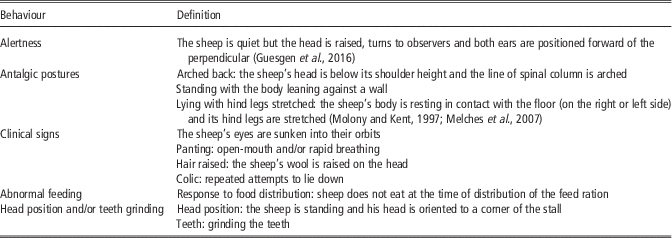
Behavioural observations were conducted by scan sampling (Martin and Bateson, Reference Martin and Bateson2013) every day (days 0, 1, 2, 3, 4 and 5) by observers trained to observe animal behaviour. On day 0, sheep were observed twice after surgery (one scan observation per sheep from 1330 to 1345 h, and one scan observation per sheep from 1900 to 1915 h). On days 1, 2, 3 and 4, sheep were observed three times (one scan observation per sheep from 1015 to 1030 h, one scan observation per sheep from 1330 to 1345 h, and one scan observation per sheep from 1900 to 1915 h). Sheep were observed twice on day 5 (one scan observation per sheep from 1015 to 1030 h, and one scan observation per sheep from 1900 to 1915 h). At each time point, the presence/absence of each behaviour defined in Table 1 was recorded for each sheep. Sheep response to food distribution (Table 1) was observed twice per day on days 0, 1, 2, 3, 4 and 5, at the time of feed ration distribution in the morning (0800 h) and in the evening (1900 h).
Behaviours recorded in sheep during the days after experimental surgery

Physiological measurements
Four blood samples were collected from each sheep by venipuncture from the jugular vein to determine physiological variables at 0700 h (just before a meal) on days 0, 1, 3 and 5. Blood samples were collected into Vacutainer® tubes (Vacutainer, Dutscher D., Brumath, France) containing ethylene-diamine-tetraacetic acid-Na2 (two tubes, 10 ml each) or lithium heparin (two tubes, 10 ml each).
Hypothalamic–pituitary–adrenal axis
Measuring HPA axis activity is the standard approach to the study of stress and welfare in farm animals. The plasma concentration of cortisol was determined by radioimmunoassay (Boissy and Bouissou, Reference Boissy and Bouissou1994).
Inflammation
Plasma haptoglobin concentrations were determined by immunoprecipitation (Auboiron et al., Reference Auboiron, Sparrow, Beaubatie, Bauchart, Sparrow, Laplaud and Chapman1990).
Autonomous nervous system
Heart rate variability was calculated in four sheep from each treatment group (S, C, R, RDI) on days 1, 3 and 5 from electrocardiogram (ECG) recordings. Three electrodes (HP 40489E; Hewlett Packard, Palo Alto, CA, USA) were held in place by an elastic belt strapped around the thorax. One electrode was placed between the shoulder blades, and the two other electrodes were placed on the sternum. The three electrodes were connected to a PowerLab System (ADInstruments, Sydney, Australia) associated with a computer for ECG monitoring and recording with ADInstruments Chart software. For the four groups, ECG recordings began simultaneously at 1200 h and lasted for 5 h. HRV measurements were made during three distinct 15-min phases, representing diurnal phases without any human intervention (e.g. care, food, blood samples). Heart rate variability was measured by determining the constantly changing temporal distance between consecutive heartbeats (R–R intervals). The root mean square of successive R–R interval differences (RMSSD) is a measure of the distance between consecutive heartbeats (R–R intervals). The ratio low frequency/high frequency (LF/HF) provides a measure of sympathovagal balance, with the HF band reflecting vagal control and the LF band reflecting both vagal and sympathetic control.
Oxidative stress
High-performance liquid chromatography was used to measure plasma concentrations of oxidized and reduced glutathione (GSH and GSSG, respectively) (Martin and White, 1991). Plasma malondialdehyde concentration was determined by colorimetric assay (Gobert et al., Reference Gobert, Martin, Ferlay, Chilliard, Graulet, Pradel, Bauchart and Durand2009). Measurement of total antioxidant status (TAS) was based on the absorbance of the 2,2’-azinobis-(3-ethylbenzothiazoline-6-sulfonic acid)+cation (Gobert et al., Reference Gobert, Martin, Ferlay, Chilliard, Graulet, Pradel, Bauchart and Durand2009). Plasma nitric oxide (NO) concentration was determined using a fluorometric assay kit (Item No. 780051; Cayman Chemical Company, MI, USA).
Statistical analyses
Discrete analysis of the five pathways
For behavioural responses, the average number of behavioural observations for each sheep was calculated as a percentage from day 0 to day 5. For physiological measurements, the integrated response for each animal and each indicator was calculated from the area under the curve between day 0 and day 5. This integrative variable was used for all further analyses. As sample sizes were small (n=6 sheep/treatment group) and measurements followed non-normal distributions, we used non-parametric analyses to compare treatment effects. Treatment effects were compared using the Kruskal–Wallis test. Pairwise group comparisons were made using Dunn’s post hoc test. For all analyses, statistical significance was set at P<0.05; P values between 0.05 and 0.1 were considered trends towards significance.
Multiparametric analysis
Six factorial discriminant analyses (FDA) were performed. Discriminant analysis highlights the variables on which the q groups differ and identifies at most q−1 linear combinations of variables that best discriminate between the groups (Lebart et al., Reference Lebart, Piron and Morineau1995). Four treatments were compared: Control (no fasting, no anaesthesia, no surgery), Sham (fasting, anaesthesia, no surgery), Rumen cannulation (fasting, anaesthesia, rumen cannulation) and Rumen–Duodenal–Ileum cannulation (fasting, anaesthesia, cannulation of the rumen, duodenum and ileum). The discriminant functions are of the form: Di=d i1 Z 1+d i2 Z 2+… +d ip Z p ; where D i is the score on the discriminant function I; d’s the weighting coefficients and Z’s the values of the p discriminant variables used in the discriminant analysis. Five FDA was performed, one on each pathway (i.e. behaviour, inflammation, oxidative stress, HPA and SNA). In addition, one FDA was performed using all behavioural and physiological (inflammation, oxidative stress, HPA and SNA) measures together (FDA full model). To identify linear combinations of variables that best discriminate the treatments, we simplified each FDA by a backward stepwise elimination of variables as follows: the threshold to maintain or remove a variable from the final model was set to P=0.05. To interpret the discriminant components of each FDA, we took into account variables with a correlation of absolute value >0.4 with at least one axis. Each FDA was followed by cross-validation to estimate the performance of the model (Arlot and Celisse, Reference Arlot and Celisse2010). Cross-validation enables to calculate the probability for each animal to be accurately classified in the right treatment group. The performance of the multiparametric analysis was estimated by its sensitivity (percentage of sheep correctly predicted to belong to a treatment; Se=True Positive/True Positive+False Negative) and specificity (percentage of sheep correctly predicted not to belong to a treatment; Sp=True Negative/True Negative+False Positive). Se and Sp were calculated after a leave-one-out analysis performed after each FDA. All analyses were performed using XLSTAT 2015 (Microsoft Excel). Significance threshold was set at P=0.05 and a trend was considered when 0.05<P<0.1.
Results
Discrete analysis of the response from individual pathways
Detailed responses day by day and for each experimental treatment (C, S, R and RDI sheep) are provided in Supplementary Materials.
Discrete analysis of the integrated response from individual pathways
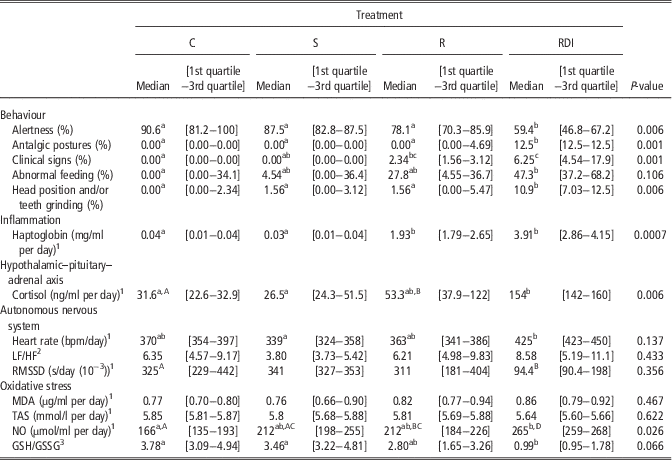
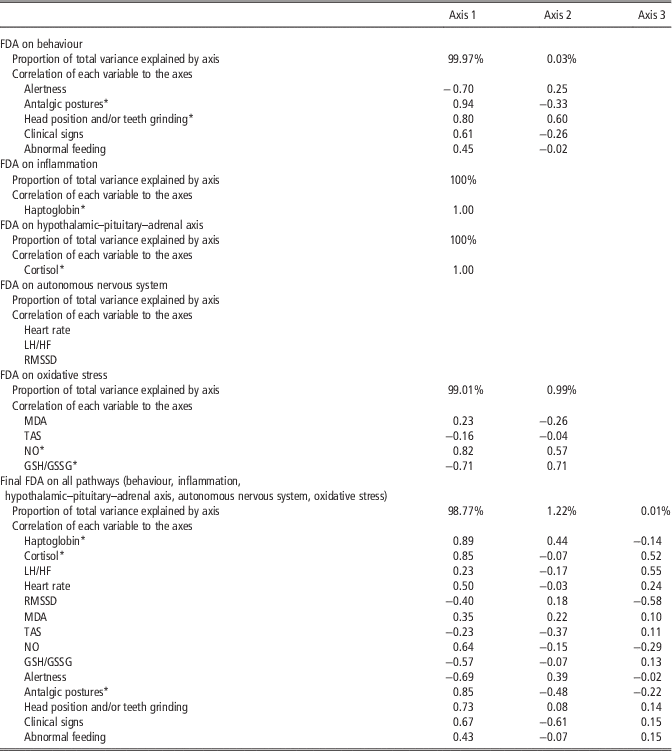
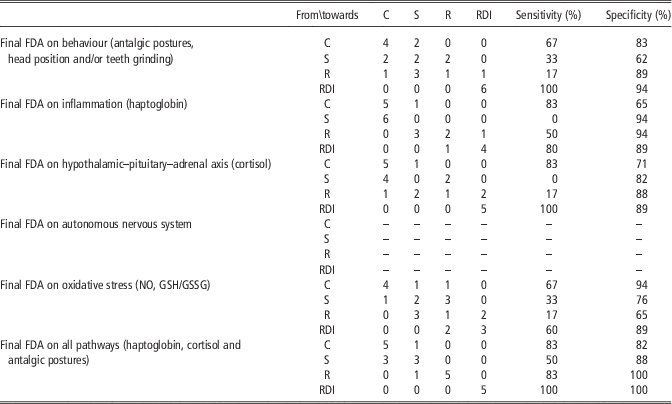
Integrated response for each treatment is described in Table 2. Factorial discriminant analysis performed for each pathway is described in Table 3, and its cross-validation is detailed in Table 4.
Effect of treatments (C, S, R and RDI) on behavioural responses (alertness, antalgic postures, clinical signs, abnormal feeding and head position and teeth grinding) and on area under the curve (AUC) physiological variables of inflammation, hypothalamic–pituitary–adrenal axis, autonomous nervous system and oxidative stress in Texel sheep; median [1st quartile−3rd quartile] and P values for treatment effect

C=Control: no fasting, no anaesthesia, no surgery (n=6); S=Sham: fasting, anaesthesia, but no surgery (n=6); R=fasting, anaesthesia, rumen cannulation (n=6); RDI=fasting, anaesthesia, cannulation of the rumen, duodenum and ileum (n=5); bpm=beat per minute; RMSSD=root mean square of successive R–R interval differences; TAS=total antioxidant status; MDA=malondialdehyde; LF/HF=ratio of low frequency/high frequency; NO=nitric oxide.
a,b,cDifferent superscripts within a row indicate a significant (P<0.05) difference between treatments (Dunn test).
A,B,C,DDifferent capital superscripts within a row indicate a trend (0.05<P<0.10) difference between treatments (Dunn test).
1 AUC from day 0 to day 5 after treatments.
2 LF and HF are expressed in ms2, but their ratio does not include unit.
3 GSH and GSSG are expressed in, nmole/ml but their ratio does not include unit.
Factorial discriminant analysis (FDA) performed on each pathway (behaviour, inflammation, hypothalamic–pituitary–adrenal axis, autonomous nervous system and oxidative stress) and on all pathways in C, S, R and RDI Texel sheep

C=Control: no fasting, no anaesthesia, no surgery (n=6); S=sham: fasting, anaesthesia, but no surgery (n=6); R=fasting, anaesthesia, rumen cannulation (n=6); RDI=fasting, anaesthesia, cannulation of the rumen, duodenum and ileum (n=5); RMSSD=root mean square of successive R–R interval differences; TAS=total antioxidant status; MDA=malondialdehyde; LF/HF=ratio of low frequency/high frequency; NO=nitric oxide.
The proportion of variance explained by the components (axes) and correlation of each variable to the components, and variables kept in final models is given.
* Represent variables kept in final FDA for each pathway and in final FDA on all pathways.
Cross-validation, sensitivity and specificity of the final factorial discriminant analyses (FDA) performed on each pathway (behaviour, inflammation, hypothalamic–pituitary–adrenal axis, autonomous nervous system and oxidative stress) and on all pathways in C, S, R and RDI Texel sheep

C=Control: no fasting, no anaesthesia, no surgery (n=6); S=sham: fasting, anaesthesia, but no surgery (n=6); R=fasting, anaesthesia, rumen cannulation (n=6); RDI=fasting, anaesthesia, cannulation of the rumen, duodenum and ileum (n=5); NO=nitric oxide.
Behavioural patterns
There was a gradient in the expression of behaviours from C sheep to S, R and RDI sheep (Table 2). Compared with C and S sheep, the RDI sheep were less alert (P<0.05), and showed more antalgic postures (P<0.05), lowered head and teeth grinding (P<0.05) and clinical signs (P<0.05). A similar but less pronounced pattern (P<0.10) was observed in the R sheep: they were more alert than RDI sheep (P<0.05) but similar to C and S sheep (P>0.05), they also showed less antalgic postures and lowered less their head than RDI sheep (P<0.05) but similar to C and S sheep (P>0.05) (Table 2). The RDI sheep were correctly classified into their original group by FDA, leading to a sensitivity of 100% and a specificity of 94% but the R sheep were not correctly classified into their original groups, leading to a sensitivity of 17% and a specificity of 89% (Table 4).
Inflammation
Haptoglobin concentrations were significantly increased in R and RDI sheep (22-fold and 37-fold, respectively; P<0.005) compared with the S sheep. Among the RDI sheep one RDI animal was classified as R sheep leading to a sensitivity of 80% and a specificity of 89%. The R sheep were not correctly classified into their original groups, leading to a sensitivity of 50% and a specificity of 94% (Table 4).
Hypothalamic–pituitary–adrenal axis
Cortisol concentrations were significantly increased (fourfold) in the RDI sheep compared with C and S sheep (P<0.05). R sheep also had an increase in cortisol concentrations, but not significantly different from C sheep (P<0.10) or S sheep (P>0.05) (Table 2). The RDI sheep were correctly classified into their original groups, leading to a sensitivity of 100% and a specificity of 89% but the R sheep were not correctly classified into their original groups, leading to a sensitivity of 17% and a specificity of 88% (Table 4).
Autonomous nervous system
Low frequency/high frequency ratios and RMSSD levels were not significantly different between the four experimental groups; only the RDI sheep presented a higher heart rate (+22%, P<0.05) compared with the S sheep (Table 2). Specificity and sensitivity were not computed for the ANS pathway as no model was found to be significant after stepwise simplification (Table 4).
Oxidative stress
Graded changes in the concentrations of oxidative stress indicators (GSH/GSSG and NO) were observed, and correlated with the degree of invasiveness of surgical procedures. The RDI sheep had the lowest ratio of GSH/GSSG and the highest concentration of NO (Table 2). No change was observed for MDA and TAS (P>0.05; Table 2). The R and RDI sheep were not correctly classified into their original groups, leading to a sensitivity of 17% and 60% and a specificity of 65% and 89%, respectively (Table 4).
Performance of the multiparametric approach
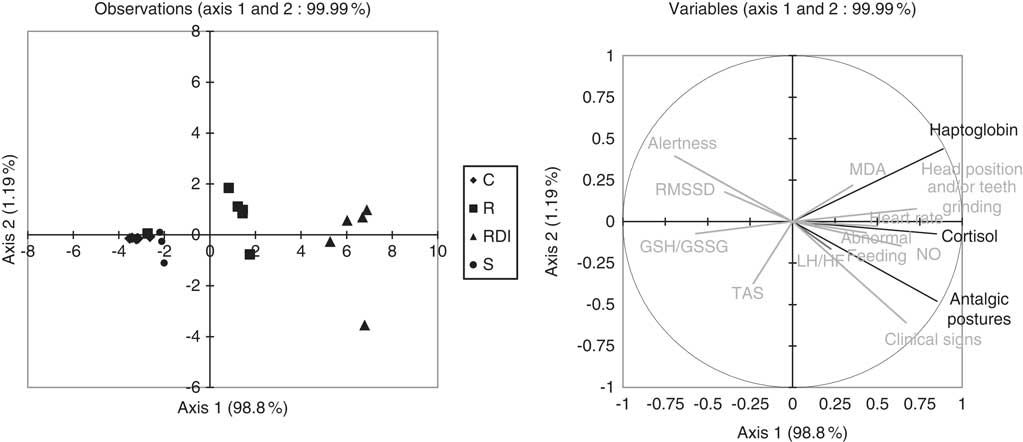
We compared the response from sheep of the four treatments (C, S, R and RDI) during the postoperative period by FDA using all behavioural and physiological (inflammation, oxidative stress, HPA and SNA) measures together (final model, Figure 1). The final FDA model axis 1 and 2 accounted for 98.8% and 1.19%, respectively, of the variance explained by the model. Axis 1 was explained by haptoglobin concentration (absolute correlation, 0.89), cortisol concentration (0.85) and antalgic postures (0.85) (Table 3). This axis opposed RDI sheep to C and S sheep, with R sheep being intermediate. Figure 1 suggests that the higher the cortisol concentration, the haptoglobin concentration and the antalgic postures, the higher the chance of belonging to the RDI treatment. After cross-validation, RDI sheep were correctly classified into their original treatment group, leading to a sensitivity of 100% and a specificity of 100%. Among the R sheep, one R sheep was classified as S sheep leading to a sensitivity of 83% and a specificity of 100%. Among the S sheep, three S sheep were classified as C sheep leading to a sensitivity of 50% and a specificity of 88%. Among the C sheep, one C sheep was classified as S sheep leading to a sensitivity of 83% and a specificity of 100% (Table 4).
Factorial map of the two discriminant axes of the final analysis on all pathways (full model) on four treatments of sheep: Control (C; no fasting, no anaesthesia, no surgery, n=6), Sham (S; fasting, anaesthesia, but no surgery, n=6); Rumen (R; fasting, anaesthesia, rumen cannulation, n=6) and Rumen–Duodenum–Ileum group (RDI; fasting, anaesthesia, cannulation of the rumen, duodenum and ileum, n=5). The map on the left side represents the variables kept (in black) or not (in grey) in final model, and the map on the right side represents the individuals. RMSSD=root mean square of successive R–R interval differences; TAS=total antioxidant status; MDA=malondialdehyde; LF/HF=ratio of low frequency/high frequency; NO=nitric oxide.

Discussion
This study describes the global response of five pathways following exposure of sheep to three degrees of invasiveness of surgical procedures, namely Sham (fasting, anaesthesia, but no surgery, ‘S’), Rumen–gastrointestinal cannulation (fasting, anaesthesia, rumen cannulation, ‘R’) and Rumen–Duodenal–Ileum cannulation (fasting, anaesthesia, cannulation of the rumen, duodenum and ileum, ‘RDI’), despite a therapeutic regimen. This study also explores the ability of a multiparametric FDA, which combines information from these pathways, to discriminate between the responses to these experimental situations. Analysis of individual pathways provided acceptable discrimination between the four experimental situations, but that remained partial. In contrast, the multiparametric analysis gathering information from all pathways enhanced the discrimination between different experimental situations by describing how sheep differ in terms of variables.
Discrete analysis of individual pathways in different post-traumatic situations
The Sham (S) group was subjected to fasting, transport, anaesthesia, administration of medicine and taking of blood samples. The concentrations of cortisol in groups C and S were similar, confirming that 5 to 7 days of food restriction in ruminants does not alter cortisol concentrations (Fisher et al., Reference Fisher, Verkerk, Morrow and Matthews2002). Behaviour, inflammation, oxidative stress and ANS responses were not affected by fasting nor anaesthesia. The absence of an oxidative stress response was surprising in S sheep because NO concentrations typically increase following stress and anaesthesia (Gadek-Michalska et al., Reference Gadek-Michalska, Spyrka and Bugajski2005). However, postoperative injection of NSAIDs may have decreased the activity of nitric oxide synthase, the enzyme required for NO synthesis. Overall, exposure of sheep to fasting and anaesthesia alone (group S) did not seem to induce significant stress.
Surgical implantation of a rumen cannula (R group) induced an inflammatory response but no changes in behaviour, HPA axis, ANS activity or oxidative stress compared with the S group on the 5-day period. Rialland et al. (Reference Rialland, Otis, de Courval, Mulon, Harvey, Bichot, Gauvin, Livingston, Beaudry, Hélie, Frank, del Castillo and Troncy2014) also reported an increase in inflammatory response in cattle following a rumenotomy. The limited responses of the other pathways was surprising: sheep show behavioural and physiological response following painful events (Kent et al., Reference Kent, Molony and Robertson1993). As some behavioural changes were observed on day 0 in R group, the lack of response could be due to the integrative analysis across the 5 days post-surgery. It could also be due to the postoperative injection of NSAIDs. NDAIS administration may have (i) reduced oxidative stress because flunixin is known to decrease the synthesis of enzymes essential to the production of NO during inflammation; (ii) inhibited cyclooxygenase enzyme activity, resulting in reduced synthesis of prostaglandins, key mediators of stress-induced corticotropin-releasing hormone secretion (Gadek-Michalska et al., Reference Gadek-Michalska, Spyrka and Bugajski2005); and (iii) inhibited noradrenaline synthesis, a neurotransmitter that is essential to ANS function (Güllner, Reference Güllner1983). However, R sheep showed more clinical signs than C sheep. Therefore, despite the postoperative administration of NSAIDs, sheep in the R group may have experienced residual impact including some apparent discomfort and/or pain.
Implantation of cannulas in the rumen and in the intestines (RDI group) resulted in an increase in haptoglobin concentration, oxidative stress and pain-related behavioural responses: sheep were less alert and expressed more antalgic postures. This could be explained by the seriousness of the surgery: in humans, open surgery induces more oxidative stress than a simple laparoscopy (Ruzic et al., Reference Ruzic, Tomaskovic, Trnski, Kraus, Bekavac-Beslin and Vrkic2005). The implantation of two cannulas in the intestines increased tension in the mesentery, and presumably increased pain (Payne and Poulton, Reference Payne and Poulton1923). Activation of HPA axis and of ANS activity was also increased in RDI sheep: these sheep had higher cortisol concentrations and cardiac frequency than the S group, a finding that is consistent with studies on other painful situations (e.g. dehornin;: Stafford and Mellor, Reference Stafford and Mellor2005). The implantation of three cannulas resulted in changes in all pathways, suggesting that postoperative administration of NSAIDS to treat inflammation was not sufficient to limit the global impact of surgery, including pain, in RDI sheep. Although an antalgic effect of finadyne on visceral pain has been described in horses (Valverde and Gunkel, Reference Valverde and Gunkel2005), the visceral pain felt by RDI sheep did not appear to be sufficiently alleviated by NSAID administration.
The extent of the response varied with the intensity of the experimental situation: one pathway was affected in group S, three pathways were affected in group R and five pathways were affected in group RDI. However, analysis of each pathway on its own provided acceptable but partial discrimination between these experimental situations, as shown by the sensitivity and specificity of detection when considering only behaviour (Se, 17% to 100%, Sp, 62% to 94%), inflammation (Se, 0% to 83%, Sp, 65% to 89%), HPA axis (Se, 0% to 100%, Sp, 71% to 89%), ANS (no model) or oxidative stress (Se, 17% to 67%, Sp, 65% to 94%).
Multiparametric analysis of the responses
We tested the ability of a multiparametric FDA, gathering information from five pathways, to enhance the discrimination between sheep responses to these experimental situations. The FDA showed that sheep differed in terms of variables from three pathways when they experienced a more or less invasive surgery (RDI and R sheep) or no surgery at all (C and S sheep). Surgery induced a higher inflammation (i.e. haptoglobin), HPA axis activation (i.e. elevated cortisol concentrations) and changes in behaviour (i.e. increased antalgic postures). These changes increased along with the surgery invasiveness. These results are consistent with those reported in the literature; visceral surgery or castration has been reported to increase inflammation, HPA axis activation and behaviour pathways (Earley and Crowe, Reference Earley and Crowe2002; Rialland et al., Reference Rialland, Otis, de Courval, Mulon, Harvey, Bichot, Gauvin, Livingston, Beaudry, Hélie, Frank, del Castillo and Troncy2014). The multiparametric approach performed well for this discrimination, as reflected by the high level of sensitivity (83% for R sheep and 100% for RDI sheep). The multiparametric analysis also gave information on the relative contribution of each pathway to the global sheep response. Input from all pathways, and especially from inflammation, HPA axis and behaviour, was necessary to better identify animals belonging to the R and RDI groups, showing the complexity of assessment in different surgical situations.
Conclusion
The discrete analysis of the individual pathways provided acceptable discrimination between the four experimental situations (C, S, R and RDI). It also gave additional knowledge on the sensitivity and the specificity of each of the five pathways to discriminate between these situations. The multiparametric analysis, which combines information from the five pathways, enhanced the effectiveness in discriminating between the experimental situations, with high sensitivity and specificity to detect R and RDI animals. Moreover, the multiparametric analysis provided additional information, on the relative contribution of each pathway to the global sheep response and on the main variables that best discriminate the treatments. The response patterns were found to vary depending on the severity of the surgical procedure. Therefore, the multiparametric approach seems to be a promising tool to discriminate between different degrees of invasiveness of surgical procedures. In the future, it will be interesting to validate this multiparametric approach in other pain-inducing situations or in other species.
Acknowledgements
The authors wish to acknowledge André Guittard, Michel Fabre, Sebastien Alcouffe, Philippe Gaydier and Daniel Thomas for their excellent technical assistance during the experiments, and Agnès Thomas, Anne-Sophie Bage, Hervé Chandèze, Eric Delval, Stéphane Andanson and Christine Ravel for their assistance with the laboratory analyses. The authors wish to acknowledge American Journal Experts for their editorial support.
Supplementary Material
To view supplementary material for this article, please visit https://doi.org/10.1017/S1751731117000805