Since the Industrial Revolution, the use of fossil fuels has enabled unprecedented growth in wealth and welfare, but at the cost of a rapid increase in the concentration of carbon dioxide in the atmosphere, causing global warming and climate change. Decarbonization—the eradication of anthropogenic carbon dioxide (CO2) emissions—is necessary to keep global warming from reaching levels that endanger ecosystems and human lives.Footnote 1 It requires a comprehensive energy transition, but deep or even superficial decarbonization has yet to materialize.Footnote 2 Despite several decades of governmental policies and business initiatives to develop and invest in renewable energy, more than 80 percent of the world's primary energy still came from burning fossil fuels in 2018.Footnote 3
Energy transitions are complex processes of systems change. Over the course of a century, a seamless web of technologies, institutions, actors, and sociocultural practices has evolved around fossil fuels and perpetuates their use.Footnote 4 The system's inertia creates barriers for new technologies and behaviors to break through, and the transition to a low-carbon energy system is therefore a nonlinear, drawn-out process of change.Footnote 5 Technological innovation and relative prices explain part of the transition process, but political interventions and sociocultural change are key ingredients as well.Footnote 6 Regulations or subsidies help new technologies to emerge and create new markets but are sensitive to the shifting sands of politics and cannot sustain new industries and markets alone.Footnote 7 Big incumbent industries have the necessary scale and sophistication to contribute to broad adoption of new technologies, but their existing markets and vested interests form barriers to change.Footnote 8
As one of the biggest of the incumbent fossil fuel industries, the oil and gas industry has often been singled out as the main culprit for the persistence of the use of fossil fuels. The industry has been sued and condemned for knowingly contributing to climate change, spreading false claims to influence public opinion and policy, and misrepresenting the financial and environmental risks of climate change for its business model.Footnote 9 Along with increasing public criticism, however, global demand for the industry's products has continued to grow unabated, especially in developing countries where coal, oil, and gas remain vital to sustain growth and development.Footnote 10 The industry, therefore, faces a fundamental dilemma. It is expected to significantly contribute to decarbonization, while simultaneously growing the low-cost supply of fossil fuels.
This article examines how the oil industry has faced this fundamental dilemma since climate change emerged as an environmental issue in the late 1980s. The industry's response to climate change is discussed in the framework of the industry's wider history of environmental regulation. Throughout the twentieth century, societies struggled to find a balance between the benefits of cheap energy and the costs of environmental degradation.Footnote 11 From the 1950s onward, growing pollution gave rise to an expanding body of environmental regulation. Society came to perceive business as incapable of solving the problem. But in the 1990s, this perception changed under the framework of sustainability. Not regulation but markets would provide the right incentive for businesses to become sustainable, aligning the pursuit of profit with protection of the environment.Footnote 12
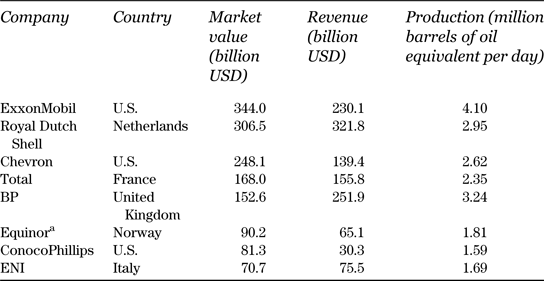
From this long-run perspective on business and the environment, the article argues that the oil industry embraced sustainability to demonstrate its efforts toward decarbonization and a sustainable energy system, especially when facing the possibility of restrictive regulations on CO2 emissions. However, growing demand for fossil fuels, the industry's vested interests, and the voluntary nature of sustainability as the overarching framework for environmental governance have inhibited the industry's contribution to deep decarbonization. Historical interest in the environmental record and regulation of the oil industry has grown in recent years.Footnote 13 However, business historians have yet to scrutinize the strategies deployed by the oil industry to navigate the increasing public pressure toward decarbonization of the energy system.Footnote 14 Based on extensive secondary material, the article focuses on publicly listed U.S. and European multinational oil companies because of their global scale and presence across energy value chains (Table 1). Moreover, they are part of a core group of around one hundred major carbon emitters that is responsible for over half of cumulative CO2 emissions since 1980.Footnote 15
Top Eight U.S. and European Public Oil and Gas Companies

Sources: For revenue: oil and gas operations in “The World's Largest Public Companies: 2018 Ranking,” Forbes, accessed 19 Dec. 2018, https://www.forbes.com/global2000/list/; for production: Total production of hydrocarbons in 2016, Robert Rapier, “The 25 Biggest Oil and Gas Companies in the World,” Forbes, 30 Mar. 2016, https://www.forbes.com/sites/rrapier/2016/03/30/the-worlds-largest-public-oil-and-gas-companies.
a Formerly Statoil.
The first section briefly discusses different pathways to reduce CO2 emissions and ways these might affect the oil industry. The second section charts the history of the regulation of environmentally harmful emissions by the oil industry. The third section brings the two previous sections together in a discussion of the oil industry's response to the climate change governance regime that evolved in the 1990s. The fourth section considers the oil industry's involvement with renewable energy since the 1970s and discusses its contribution to oil industry decarbonization. The final section concludes that some oil companies, especially European ones, have fundamentally changed their strategies and investments since the early 1990s, but doubts remain as to whether they contribute significantly to decarbonization.
Pathways to Decarbonization
Fossil fuels made up 81 percent of the global primary energy supply in 2016, only marginally lower than in 1973 (87 percent).Footnote 16 Although the share of oil dropped from 46 to 32 percent, reflecting its substitution by coal and gas in growing electrification, demand for transportation fuels continued to grow. With few substitutes for motor fuels, transportation was responsible for over 60 percent of total oil consumption in 2016, up from 40 percent in 1973.Footnote 17 Moreover, because of its high energy density and relatively low transportation costs, oil remains a critical source of energy for developing economies.Footnote 18 As such, oil is difficult to replace and deep decarbonization has yet to materialize.Footnote 19
Decarbonization can be accomplished through different means. Broadly speaking, there are four avenues: the restriction of emissions, the adoption of low- or zero-emission substitutes, the removal of carbon dioxide, and the restriction of fossil fuel supplies. Measures targeting CO2 (and other greenhouse gas) emissions have focused mostly on demand-side interventions—i.e., targeting emissions occurring from the use of fossil fuels—such as emissions trading schemes, carbon taxes, and mandatory emission limits. Other demand-side instruments have targeted the use of clean technologies and renewable energy sources through subsidies and tax credits. Demand-side stimuli for substitutes are often combined with supply-side incentives, such as subsidies, tax credits, and feed-in tariffs, aimed at accelerating the development of clean technologies. In general, direct restrictions on emissions are politically controversial because they impose direct costs on industries and consumers. Subsidies and tax credits are politically less contentious, but also less effective, as the history of renewable-energy technologies in the West makes abundantly clear.Footnote 20
Another decarbonization measure pursued by fossil fuel industries in particular is carbon dioxide removal (CDR), such as large-scale afforestation or carbon capture and storage (CCS) technologies. Their large-scale adoption requires a price on CO2, either through carbon taxes or emissions trading schemes providing a market for carbon. Decarbonization through CDR is an attractive option for fossil fuel industries because it would not restrict fossil fuel consumption itself. However, it is doubtful whether unrestricted use of fossil fuels in combination with CDR will be effective in limiting climate change. The Intergovernmental Panel on Climate Change (IPCC) has demonstrated that decarbonization pathways that allow for continued intensive use of fossil fuels will most likely overshoot the warming limit of 1.5°C and rely heavily on CDR to stabilize global warming at 1.5°C by 2100.Footnote 21 The IPCC notes, however, that this is unlikely to be feasible or sustainable with the current potential of available CDR options. Other pathways that are not likely to overshoot the warming limit contain reductions in the primary energy supply from oil of between 50 and 87 percent by 2050, in line with what others had argued earlier.Footnote 22
The inability of existing instruments to bring down global CO2 emissions has strengthened the call for restrictions on the production of fossil fuels.Footnote 23 The discourse of climate justice, arguing for an equitable distribution of the costs of climate change mitigation in which fossil fuel industries bear a commensurate share of the burden, have added to that call.Footnote 24 Others argue that decarbonization along current pathways and with current instruments simply makes too little progress and that only the restriction of oil, gas, and coal production will be effective.Footnote 25
Ever since the United Nations Framework Convention on Climate Change (UNFCCC), the treaty governing global efforts to stabilize global warming in force since 1994, the oil industry has, unsurprisingly, professed that climate change mitigation should be market-based and voluntary, and should refrain from direct restrictions on emissions or the production of fossil fuels. This position can be explained not only as flagrant self-interest but also from the industry's long-run experience with the fundamental debate over how to manage environmental pollution from oil production and consumption—a debate that emerged in the nineteenth century.
The Oil Industry and the Environment
Public concerns over pollution and human health deriving from industrialization emerged in the late nineteenth century.Footnote 26 Both Hugh Gorman and Joseph Pratt argue that the U.S. oil industry in this period failed to consider the environment, driven by a strong growth ethic and a highly competitive market.Footnote 27 Over time, however, rampant air and water pollution fostered an emerging ethic of efficiency among oil companies. The efficiency ethic equated polluting wastes with inefficiency, which required technical solutions. Efficiency gains were initially successful in reducing pollution across the oil value chain.Footnote 28
Public environmental concerns gave way to economic hardship in the 1930s and technological optimism after 1945 but resurfaced in the 1960s as the rapid acceleration of industry and welfare was matched by an equal acceleration of environmental pollution. Growing pollution demonstrated that the efficiency ethic was no longer sufficient.Footnote 29 In the context of the late 1960s and early 1970s, business and the environment were thought to be fundamentally incompatible; only regulation could bring business in line.Footnote 30
The oil industry strongly opposed outright government regulation during most of the 1970s.Footnote 31 During the 1980s, however, the industry moved to compliance and gradually adopted a more proactive stance on environmental issues, giving rise to corporate environmentalism, or strategic environmentalism, in the 1990s.Footnote 32 The environment became a strategic concern because public and political attention on environmentalism further expanded during the decade, fueled by environmental and human health disasters, including major oil spills.Footnote 33 The environmental movement became mainstream and proved adept at mobilizing public attention. This growing complexity of the issues led businesses to integrate environmental factors in their corporate decision-making.
The adoption of corporate environmentalism was further strengthened by the emergence of sustainable development as an overarching paradigm in the 1990s.Footnote 34 However, in contrast to the regulation ethic, sustainability presented a framework for green capitalism in which the pursuit of economic growth or business profit was not contradictory to environmental protection.Footnote 35 The World Business Council for Sustainable Development (WBCSD), founded by business leaders in 1992, argued for a sustainable business case that was eco-efficient and produced win-win outcomes.Footnote 36 Also instrumental was the work of John Elkington in the 1980s and 1990s. Through his writings and consultancy firm, SustainAbility, he was influential in framing sustainability as a concept integrating people, planet, and profit—also called the triple bottom line.Footnote 37 The overarching premise was that businesses could drive change, transforming themselves into green, sustainable enterprises. The premise of greening hitherto unsustainable industries gave rise to a multitude of sustainability indices, voluntary certification schemes, and sustainability reporting standards that aided businesses in demonstrating their efforts toward sustainability.Footnote 38 Sustainability also gave business a new role in environmental governance. Big corporations became increasingly proactive on environmental issues, partnering with governments and environmental pressure groups to co-develop environmental regulation on the premise of voluntary action.Footnote 39 Sustainability constituted a paradigmatic shift: markets and voluntary action, not regulation, were to align environmental and business objectives.
Climate Change: From Reactive to Proactive
Over the course of the twentieth century, the oil industry had gradually come to accept government regulation of its environmental impact. However, that acceptance did not extend to climate change mitigation.Footnote 40 If CO2 emissions were to become stringently regulated and limited, there were no easy technological fixes to allow oil companies to continue with business as usual. Although some oil companies had been aware since the 1970s of the possibility of carbon emissions driving global warming, the industry did not address it before it became a public issue in the late 1980s with the establishment of the IPCC to assess the science on human-made climate change.
The first response was to close ranks and deny the existence of human-made climate change, such as through the Global Climate Coalition (GCC), a business advocacy group of U.S. fossil fuel industries, established in 1989.Footnote 41 Some companies, most prominently Exxon, were aware of the problem. In fact, Exxon had been at the forefront of climate science since the late 1970s and was intimately aware of the causes and effects of climate change.Footnote 42 However, the company buried the alarming results of its own research in the late 1980s, choosing to deny and discredit scientific proof for climate change instead. This course of events was only exposed in 2015 and led several U.S. states and cities to sue ExxonMobil for lying to the public and seeking compensation for the costs of climate change mitigation.Footnote 43 Although it was mostly U.S. companies that outright denied the possibility of human-made climate change, the industry was collectively opposed to the regulatory responses that climate change might illicit from governments.Footnote 44 European oil companies, for instance, lobbied hard to block an EU-wide carbon tax proposed by the European Commission in the early 1990s.Footnote 45
The efforts of the GCC targeted politicians and public opinion, questioning the validity of climate research and highlighting the costs that greenhouse gas (GHG) regulations would impose on society.Footnote 46 These efforts were supported by influential but flawed and deliberately deceptive scientific reports from conservative think tanks in the United States that received generous funding from the oil industry.Footnote 47 These reports denied human-made climate change and counseled consecutive U.S. administrations not to implement restrictive GHG regulations and to keep the United States out of binding international treaties on GHG reductions.Footnote 48 These efforts created an influential discourse of climate skepticism in the U.S. that continues to be an influential political current.
In Europe, climate denial and deception by the oil industry was less malicious and outspoken, and oil companies started to change their tune in the run-up to the Kyoto Conference in 1997. In Kyoto, the parties to the UNFCCC discussed concrete measures to cut GHG emissions. The EU demanded that all developed countries commit to substantial and binding cuts on CO2 emissions. Although the United States did not necessarily oppose binding emissions cuts, it demanded that the Kyoto agreement would be binding not just for developed countries but for all signatories to the UNFCCC. Moreover, Europe and the United States diverged on the instruments with which emissions cuts were to be realized. Europe was in favor of imposing mandatory emission limits while the United States favored market-based instruments such as an emissions trading system, which the U.S. had successfully implemented to combat acid rain in the mid-1990s.Footnote 49
The differences between the U.S. and European policy preferences for the reduction of GHG emissions contributed to a divide between U.S. and European oil companies. Companies such as BP and Shell began to acknowledge climate change, left the GCC, supported the Kyoto Protocol, and adopted voluntary measures to mitigate climate change. Although U.S. companies began to reluctantly acknowledge the existence of climate change, culminating in the dissolution of the GCC in 2002, several companies, most notably ExxonMobil, remained staunchly opposed to any policies for reducing GHG emissions.Footnote 50 In contrast, the proactive climate strategy of the European oil companies consisted of three elements: support for the reduction of GHG emissions, commitment to lower emissions from the industry's own operations, and facilitation of the decarbonization of the energy system by reorienting their businesses to providing cleaner fuels and developing clean energy technologies.Footnote 51
The shift toward proactive climate strategies by the European oil companies was primarily driven by changes in national climate policies and the ways these policies played out in the evolving international climate regime.Footnote 52 In Europe, both public and political support for climate policies created a context conducive to the emergence of proactive corporate environmental strategies, unlike in the United States.Footnote 53 Under mounting public pressure, European oil company leaders perceived a need for greater public commitment by their companies to the mitigation of climate change and sustainable development in general.Footnote 54 On the international level, a proactive climate strategy was stimulated and facilitated by the sustainability framework that transformed thinking about the role of business in environmental governance.
A pivotal event was the Earth Summit, the United Nations Conference on Environment and Development (UNCED) in Rio de Janeiro in 1992, where the responsibilities of business featured prominently on the agenda.Footnote 55 The conference's secretary general, Maurice Strong, after a career in financing oil, was a driving force behind the development of transnational business organizations on sustainable development, including the forerunner of the WBCSD.Footnote 56 From the Earth Summit onward, moreover, business advocacy groups were allowed as observers to attend the subsequent meetings and conferences of the parties that were held under the UNFCCC. The Kyoto Protocol itself was an outgrowth of the sustainability framework. Although the protocol contained a commitment to reduce GHG emissions below 1990 levels on the part of developed countries, it relied on so-called flexibility mechanisms that provided market-based instruments to realize emissions reductions. The market-based framework of the Kyoto Protocol dovetailed with the conceptions of corporate sustainability and eco-efficiency that were professed by the WBCSD. Markets and voluntary action, not regulation, would entice industries to pursue sustainable business goals.
The development of the corporate sustainability framework provided a context conducive to the proactive climate strategies of European oil companies.Footnote 57 Many oil companies started publishing sustainability reports in the late 1990s and early 2000s, using Elkington's triple bottom line or similar concepts.Footnote 58 Reporting was more comprehensive among European oil companies than among their U.S. counterparts.Footnote 59 European oil companies used their increasingly voluminous sustainability reports as a tool to communicate their contributions to mitigating climate change. The most eye-catching case was BP's transformation from a traditional oil company to an energy company focused on decarbonization, rebranding itself “beyond petroleum” in 2001.Footnote 60 The re-branding backfired when BP was exposed for having cut environmental and safety corners, leading to the Deepwater Horizon oil spill in the Gulf of Mexico in 2010. Nonetheless, at the turn of the century, BP appeared to lead the way in transforming the oil industry.Footnote 61 The emergence of proactive climate strategies seems to have fostered progress in adjusting the strategies and investments of European oil companies toward decarbonization.Footnote 62 However, there was also reason for skepticism.
The win-win premise of the sustainability framework has increasingly attracted criticism for its optimistic expectations of the role of business and its failure to precipitate genuine greening of unsustainable industries.Footnote 63 In general, the simultaneous rise of shareholder value and quarterly capitalism stressing profit over planet or people was not conducive to strengthening corporate commitment to environmentalism and sustainability.Footnote 64 More specifically, the efficacy of the voluntary nature of environmental governance under the sustainability framework has been questioned, arguing that self-regulation without sanctions is not effective.Footnote 65 Others have pointed out that sustainability is a fuzzy concept, allowing for lofty green claims without much substance.Footnote 66
The proliferation of corporate sustainability labels, reports, initiatives, and concepts made it difficult for stakeholders to ascertain whether assertions of corporate sustainability were more than mere greenwashing.Footnote 67 One example is the self-reported voluntary commitment of some oil companies to reduce GHG emissions from their own operations. In 1999, Shell and BP pledged to reduce their own CO2 emissions by 10 percent from 1990 levels before 2002 and 2010, respectively.Footnote 68 At the company level, great strides appeared to be made, but the lack of harmonized carbon disclosure rules made it hard to benchmark and track company-level, let alone industry-level, progress.Footnote 69 The diffusion of a voluntary business-sector reporting standard, the Greenhouse Gas Protocol developed by the WBCSD and the World Resources Institute, and a global data repository, the Carbon Disclosure Project, have helped to make emissions reporting more comparable.Footnote 70 However, without a regulated common international framework, the quality and veracity of voluntary measurement and reporting of emissions remains questionable.Footnote 71
Adding to the general critique of sustainability as a framework is a growing skepticism over the substance of the proactive climate strategies of oil companies. John Ashton, Britain's chief climate diplomat between 2006 and 2012, put it most succinctly in an open letter to Shell CEO Ben van Beurden in 2015, arguing that the industry's commitment to fighting climate change is a “commitment . . . to a transition that ends where it began.”Footnote 72 In Ashton's view, the oil industry's proactive climate strategy was a euphemism for pursuing business as usual. There is merit in Ashton's characterization. Concretely, the strategy consisted (and still does) of five key elements: increasing the production and consumption of natural gas as the least-carbon-intensive fossil fuel; developing carbon offsets and CDR technologies; instituting a system for carbon pricing and emissions trading; lobbying for voluntary schemes for GHG emissions reductions; and investing in the development of clean energy technologies.Footnote 73
Through its access to the UNFCCC meetings, the industry gained an influential voice in the global climate regime, contributing to the adoption of flexible, market-based mechanisms rather than mandatory emissions limits to achieve global emissions reductions.Footnote 74 Such instances of corporate influence have made corporate lobbying in the global climate regime increasingly controversial.Footnote 75 Nonetheless, oil industry influence was found to have contributed to the adoption and diffusion of carbon emissions markets as one of the three central policy instruments in the Kyoto Protocol.Footnote 76 Pioneering internal emissions trading schemes, BP and Shell contributed with their experiences to the establishment of the EU Emissions Trading System (EU ETS) for CO2 emission allowances in 2005. The flexibility of emissions trading, which in its early phase was plagued by overallocation of allowances, was further enhanced by the many opportunities for transferring carbon allowances from CO2 reduction or offset projects in developing countries through another Kyoto policy instrument, the Clean Development Mechanism.Footnote 77 The flexibility mechanisms imposed limited regulatory pressure on the industry.
By putting a price on CO2 emissions, the trading of emission allowances also created a market for carbon removal and usage technologies such as carbon capture and storage (CCS). Pioneered by the oil industry, CCS had been capturing and reinjecting CO2 into oil wells to enhance the recovery of oil since the 1970s.Footnote 78 Requiring the same technologies for exploring and developing underground reservoirs as for oil and gas, CCS was a natural fit for the industry and logically developed into one of its preferred mitigation options. After the introduction of a carbon tax in Norway in 1991, for instance, Norwegian state-owned oil company Statoil (now Equinor) pioneered the offshore storage of CO2 from gas production on the Sleipner field (1996) in the Norwegian section of the North Sea and the Snøhvit field (2008) in the Norwegian Sea.Footnote 79 With these projects, Statoil managed to reduce its carbon tax bill as well as reducing the number of required allowances after Norway joined the EU ETS in 2007. In a similar vein, oil companies lobbied intensively for the inclusion of CCS projects in the Kyoto Protocol's Clean Development Mechanism, which was accomplished during the UNFCCC 2011 Conference of the Parties in Durban.Footnote 80 It allowed oil companies to claim carbon allowances in the EU ETS based on CCS projects in developing countries, offsetting rather than actually reducing the companies’ own emissions.
Although CCS is recognized by many international organizations, including the IPCC, as a potentially high-impact mitigation technology, it is still largely untested at scale. Total current storage capacity from operational CCS projects globally stands at 31 million tons of CO2, less than 0.1 percent of total CO2 emissions in 2016.Footnote 81 Scaling, however, is hard to realize because of the difficulty of the storage part of the technology. The most promising option is to store CO2 in so-called saline aquifers, underground formations holding nonpotable salt water.Footnote 82 However, conditions of saline aquifers differ and require costly appraisal and monitoring of each individual aquifer, which complicates the scaling of the technology.Footnote 83 Another drawback is that CCS is viable only for relatively large point sources of carbon emissions.Footnote 84 Its application for the oil industry's own emissions—so-called scope 1 emissions that exclude emissions from the use of its products—captures only a fraction of the total CO2 emissions from oil and gas, typically no more than 10 percent, something that both BP and Shell already acknowledged in the late 1990s.Footnote 85 The biggest challenge is to decarbonize the industry's largest market, transportation. It requires a commitment to renewable energy and clean mobility technologies.
Oil companies have been active in renewable energy since the 1970s. However, oil companies long struggled to find the right mode of engaging with renewable energy and other clean technologies. These technologies and products were often far removed from oil and gas competencies and it was often unclear what oil companies added to the development of these technologies and vice versa. The industry's engagement with renewable energy evolved in three phases.
New Energy
The first phase occurred during the first renewables boom in the United States in the 1970s. The oil crises of 1973 and 1979 sparked energy market interventions to improve energy security. A minor amount of these interventions targeted renewable energy, but to considerable effect.Footnote 86 Tax incentives and feed-in tariffs, introduced in the United States in the late 1970s, stimulated a boom in wind and solar energy.Footnote 87 The incentives attracted oil companies to the capital-constrained fledgling solar industry. Major U.S. oil companies first invested in and later acquired full ownership of virtually all the major solar ventures, subsequently becoming the largest purveyors of photovoltaic (PV) solar technology.Footnote 88
The oil industry's engagement with renewables stemmed from a wider strategy of diversification after the maturing market of the late 1960s and the oil shocks of the 1970s had stunted the growth of oil consumption.Footnote 89 Investments in renewables did not reflect a strong commitment to renewables beyond the potential for tax credits and future growth markets. Nonetheless, breakthroughs were accomplished in solar PV technology that would not have occurred without the involvement of the oil companies.Footnote 90 However, it proved difficult for oil companies to pursue opportunities in unrelated technologies, which required a commitment that was beyond the expertise and willingness of some companies, such as Exxon, to develop a technology that might not bear fruit in the short term.Footnote 91
By the late 1980s, the boom turned into a bust. The diffusion of neoliberal promarket policies and the oil price crash of 1986 dissolved whatever public support there had been for renewable energy. Under President Ronald Reagan, tax incentives and subsidies in the United States were discontinued.Footnote 92 Lower oil prices and fading government incentives for renewables led most oil companies to divest their diversifications in renewable-energy projects and refocus on improving the cost-efficiency of their core business.Footnote 93 An overarching imperative of a sustained transition to renewable energy was absent in the 1980s.
The overarching imperative emerged in the 1990s as climate change altered the long-term prospects of the oil industry, ushering in a second phase of investments in renewable energy.Footnote 94 Around the turn of the millennium, both BP and Shell renewed their efforts in solar PV panel manufacturing, making BP the world's second largest PV panel manufacturer by 2002.Footnote 95 However, both Shell and BP struggled to make money from their solar businesses, resulting from a lack of financial and strategic dedication internally as well as a lack of expertise to advance the technology and bring down costs.Footnote 96 There were also company-specific reasons for divestment. Shell made a strategic shift to biofuels and more experimental solar technologies in 2007, while BP had to divest activities after the 2010 Deepwater Horizon oil spill.Footnote 97
The exit from solar PV panel manufacturing ushered in a third phase of oil company investments in renewable energy. In solar, instead of manufacturing, oil companies focused on the development of large-scale PV power stations after 2010. French oil company Total was among the first, acquiring a majority share in a U.S. company developing solar power stations.Footnote 98 Total undertook the investment in a bid to strengthen its position in the electricity value chain, from production to wholesale trading to marketing.Footnote 99 Total's example was recently followed by BP (2017), Shell (2018), and Equinor (2017), investing in PV power station developers in Britain, the United States, and Brazil, respectively.Footnote 100 PV power plants were briefly experimented with in the United States in the 1980s, but only after substantial changes to electricity regulations—primarily feed-in tariffs for renewable energy—in Europe, the United States, and elsewhere have PV power stations become more common.Footnote 101
For oil companies, PV power stations were closer to their existing involvement in natural gas and electricity markets. After the liberalization of gas and electricity markets in the EU and United States in the 1990s and early 2000s, oil companies invested in gas-burning power stations and expanded their power trading and marketing activities.Footnote 102 Several oil companies, including Total, Shell, and Equinor, have recently expanded these activities substantially.Footnote 103 Moreover, with the growing adoption of electric vehicles (EVs), oil companies with large retail networks, such as Shell, BP, and Total, have recently invested in the charging infrastructure for EVs, complementing the strategy for a fully integrated electricity value chain.Footnote 104
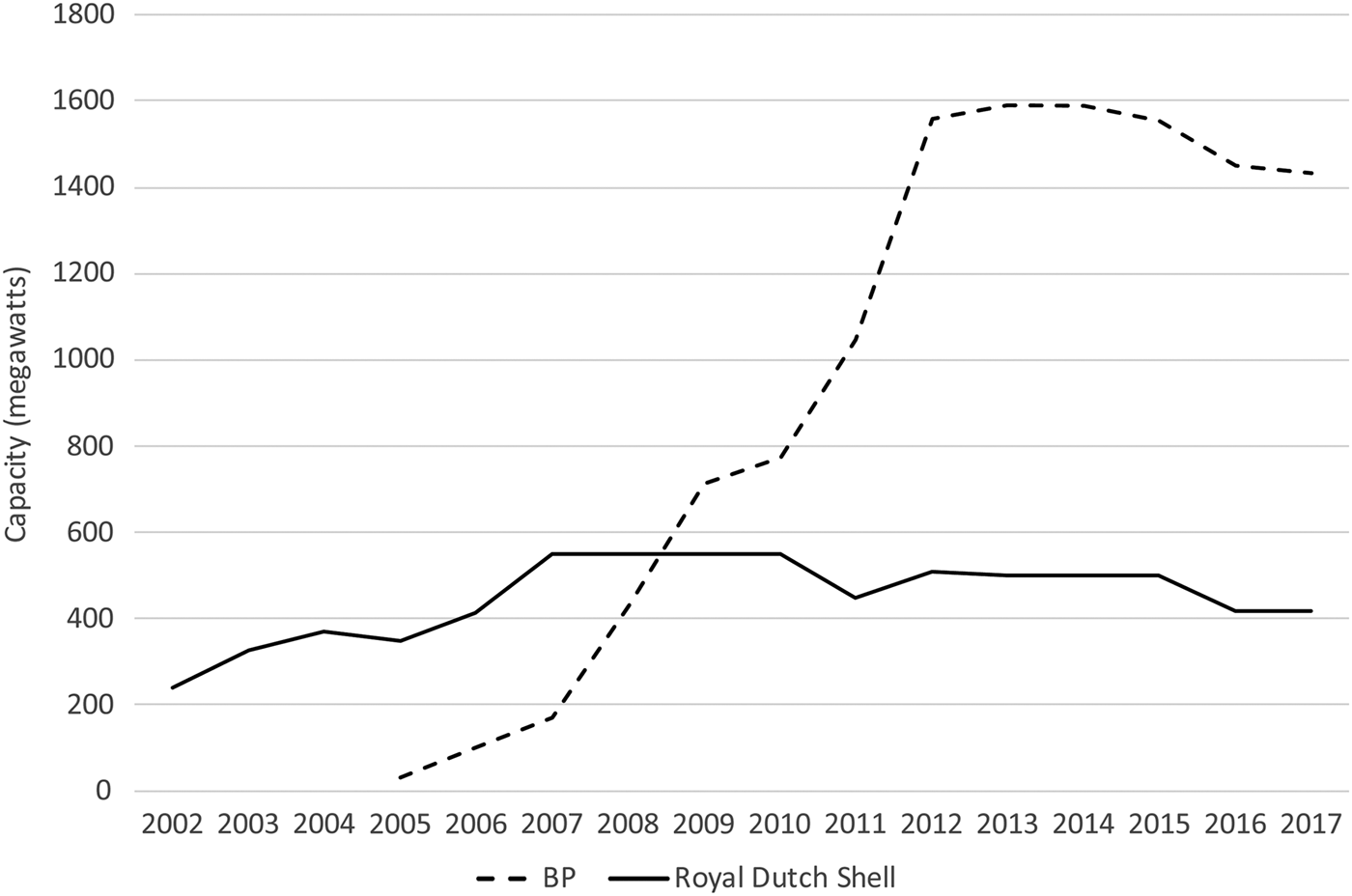
Increasing activities in gas and power markets also drove oil companies to wind energy, in particular, on- and offshore wind parks. In addition, wind park development allowed oil companies to leverage their financial, project management, and (offshore) engineering capabilities. Shell and BP were among the first to expand in wind energy (Figure 1), starting in Europe and then the United States, which overtook Europe as the boom market for wind after the 2000s.Footnote 105 However, as with solar, Shell's strategic shift of 2007 halted its wind investments, while BP scaled back investments after the Deepwater Horizon disaster in 2010 (Figure 1).Footnote 106
Net wind power generation capacity for BP and Royal Dutch Shell, 2002–17. (Sources: Author's calculations based on BP, Annual Reports, 2002–17; and Royal Dutch Shell, Annual Reports, 2002–17.)

While Shell's and BP's wind investments languished, Equinor entered wind energy around 2010. Building on its offshore drilling and engineering experiences in the North Sea, the company quickly expanded and currently controls 2 gigawatts (GW) of wind generation capacity in Europe and the United States.Footnote 107 Although the oil industry's joint capacity is just a fraction of the global total of 434 GW (2015), wind power is among the largest and more sustained renewable and clean technology investments by the oil industry.Footnote 108 As in solar, the main strategy was to invest in power generation rather than technology as it was more compatible with existing activities, although Equinor's commitment to developing floating wind parks is an exception.
The third main renewable-energy investment target was biofuels from biological material. Mandatory blending of biofuels, among others in the EU and United States, since the early 2000s enticed some oil companies to integrate backward into biofuels production. Although the industry generally opposed mandatory blending policies, biofuels are compatible with existing technologies, refining processes, and the majority of motor vehicles, making biofuels perhaps the most closely related form of renewable energy for the industry. Starting in the early 2000s, BP and Shell invested heavily in Brazilian ethanol production, but also in research and development in Europe and North America. Total, ENI, and the Finnish company Neste became active in the production of biodiesel in Europe.Footnote 109 Overall, however, oil companies have remained minor producers in a market otherwise dominated by vertically integrated agricultural businesses.Footnote 110 Moreover, sustainability issues, arising from the use of food crops for biofuels and increasing CO2 emissions from changes in land use from fuel crop production, enticed some oil companies, including Shell, BP, ExxonMobil, and Chevron, to focus on research and development of (still highly experimental) biofuels from nonfood plant matter and algae.Footnote 111
European oil companies appear to have engaged with renewable energy more than their American counterparts. Although U.S. oil and gas companies did invest in nonhydrocarbon energy projects, their investments seem to have been more conservative, while the companies have also maintained a lower public profile on their renewable-energy activities.Footnote 112 ExxonMobil and Chevron, for instance, have focused on biofuels R&D instead of integrating backward into production like some of the European companies.Footnote 113 Other opportunities in battery and fuel cell technologies were explored through corporate venture capital.Footnote 114 In wind and solar, both ExxonMobil and Chevron have focused on utilizing renewable-energy technologies to enhance core oil and gas activities.Footnote 115 An exception was Chevron's long-standing geothermal activities, but these were divested in 2017 to raise cash for costly offshore oil and gas developments and maintain dividends during the post-2014 slump in oil prices.Footnote 116
Over the course of five decades, the oil industry has invested in renewable and clean technologies but not consistently and with substantial variation between companies. Whereas the first two phases were characterized by investments that were hard to incorporate into the core business, the third phase witnessed investments in technologies and projects that were more compatible with existing business lines. As such, it appears that oil companies are finally adjusting to the decarbonization and increasing electrification of energy and transportation systems.Footnote 117 As one of the first oil companies, Shell announced in 2018 that it aims to reduce its net carbon footprint—emissions from the full life cycle of its products, including scope 3—in step with the targets of the Paris Agreement.Footnote 118 This ambition differs radically from the industry's position in the 1990s and testifies to how far some of the major oil companies have come. However, Shell's pathway to realize its objective relies in part on carbon offsets, that is, carbon sinks such as large-scale afforestation, CDR, and a larger share for natural gas.Footnote 119 Real emissions reductions are expected from biofuels, which is still small in scale and with considerable uncertainty about its technological development, and electric mobility, which requires renewable electricity to properly reduce life-cycle emissions.Footnote 120 It is not clear how and when this pathway will be realized and whether it will result in a transition that ends where it began—with natural gas, CDR, and carbon sinks—or whether it will accomplish a genuine decarbonization of energy and transportation through widespread adoption of renewable energy. Shell's clear-sounding but ambiguous climate strategy is symptomatic of the industry as a whole.
Conclusion
When climate change emerged as a major environmental concern in the late 1980s, the oil industry was still adjusting to the increasingly stringent environmental regulation that had started in the 1970s. If a regulation ethic was applied to the reduction of GHG emissions, however, the oil industry faced an existential threat. During the 1990s, a united oil industry opposed the imposition of policies restricting and taxing CO2 emissions, most avidly in the United States but also in Europe. The industry's position was fortified by the continued global dependence on fossil fuels, despite attempts to diversify energy supply in the 1970s and early 1980s. Moreover, under the sustainable development framework that emerged simultaneously, the role of private industry in environmental governance was changing. Instead of solely being the object of regulation, business actors were increasingly perceived as contributors to environmental governance. Businesses could become sustainable by aligning business and environmental goals, producing win-win outcomes. The international regime that developed under the UNFCCC after 1992 bore the hallmarks of sustainability. Private industry was recognized as a relevant voice in subsequent UNFCCC meetings and conferences, contributing to the market-based flexibility mechanisms that formed the basis for the emissions-reduction targets formulated in the 1997 Kyoto Protocol and its subsequent refinement.
The protocol imposed little direct pressure on the oil industry to decarbonize. However, the protocol's outcome was a compromise between the proregulation position of the EU and the promarket position of the United States. With the United States not ratifying the Kyoto Protocol and remaining ambivalent toward climate change, U.S. oil companies faced a very different public and political environment than their European counterparts. Greater public and political support for climate change policies in EU member states stimulated European oil companies to change tack. While most U.S. oil companies continued to reject both the science on climate change and the legitimacy of climate policies, European oil companies came out in support of the Kyoto Protocol and formulated proactive climate strategies. Shell and BP, considered industry leaders on climate change, started reporting on their sustainability, voluntarily committed to reducing their own emissions, and pioneered internal emission trading systems, in anticipation of the EU trading system. Both companies also expanded their investments in renewable energy. Other European oil companies followed suit. Although the renewable-energy activities of these companies changed significantly over time and showed wide variety between companies, it appears that European oil companies have committed to decarbonization in step with global targets. The U.S. oil industry is still lagging behind.
Despite cause for optimism there is also room for skepticism. By actively lobbying for flexibility and limited regulation, the oil industry contributed to a climate governance regime that imposed little direct pressure on the industry. Although voluntary reporting and emission targets were groundbreaking in the 1990s, transparency and comparability of self-reported results remain problematic. Moreover, proactive strategies for decarbonization of oil companies, such as Shell's recently published commitment, rely on unproven or uncertain offset and emission-reduction measures. Despite increasing investments in renewable-energy technologies and applications, it remains unclear whether oil companies are substantially decarbonizing their businesses and driving innovation and commercialization, just as it was during earlier phases of renewable-energy investments by oil companies in the 1970s and 1980s. Finally, by relying heavily on carbon offsets, CO2-removal technologies, and natural gas as transition fuel, the industry envisions a decarbonization pathway that is unlikely to limit global warming to 1.5°C, according to the IPCC.
This article has attempted to give a broad overview of how the oil industry responded to the challenge of decarbonizing the energy system to prevent catastrophic climate change. The article has touched on many different aspects of this question and it is clear that much work remains to be done by business historians to put these aspects into proper historical context and understanding their full significance and impact. This article is meant as both a contribution to the literature and a call for further research and debate in equal measure.