Introduction
Olfaction may be phylogenetically the oldest sense that humans possess, yet it remains the least understood of all our senses, despite the fact that olfactory disturbances are common complaints in the general population.Reference Wysocki and Gilbert1 This relative lack of understanding, compared with knowledge regarding vision or hearing, is partly due to the very subjective nature of this sensory modality. Psychometrics play a large part in the process of olfaction,Reference Olsson and Cain2 but there are also infinite combinations of odours which can be detected. The exact ‘smell map’ remains to be defined, although there have been attempts to realise this ‘visualisation’ of olfaction.Reference Carrie, Scannell and Dawes3, Reference Dawes, Dawes and Williams4
Adaptation is a common feature of all sensory modalities.Reference Dalton5 Odour adaptation has been referred to as ‘the ability of the olfactory system to adjust its sensitivity at different stimulus intensities’.Reference Zufall and Leinders-Zufall6 Olfactory adaptation is a time-dependent, reversible reduction in sensitivity due to prior odour exposure, or during steady stimulation with odours.Reference Zufall and Leinders-Zufall6 Adaptation in olfaction allows the olfactory system to maintain equilibrium with the odourant concentrations in the ambient environment, yet respond to the appearance of novel odours or changes in odourant concentration.Reference Dalton5 Reductions in sensory system responses to stimuli may occur throughout the sensory pathway,Reference Best and Wilson7 from olfactory receptors,Reference Zufall, Shepherd and Firestein8 through olfactory second order neurones,Reference Potter and Chorover9, Reference Mair, Gesteland and Blank10 to olfactory primary and higher order cortical areas.Reference McCollum, Larson, Otto, Schottler, Granger and Lynch11, Reference Wilson12 Recovery will likewise occur throughout the pathway.
This study attempted to quantify olfactory adaptation and clearance times in the presence of a saturated solution, in a number of human volunteers, in order to determine whether these times were consistent within and between individuals. Our hypothesis was that intra-subject variance would be low. Recovery times are important when assessing a subject's sense of smell. For example, during otorhinolaryngological assessment, when presenting an individual with a particular odour, how long should the patient be allowed to rest before the odour is presented again? Although previous studies have assessed adaptation times for odours,Reference Aronsohn13 to date no published study appears to have demonstrated olfactory clearance times for phenethyl alcohol in humans.
Methods
Full ethical approval from a regional ethics committee was obtained prior to commencement.
Fourteen healthy volunteers were recruited, both men and women, with an age range of 22 to 61 years. Information was recorded regarding smoking status, previous nasal problems, past medical history and current medication. Information was also obtained upon each visit regarding exposure to strong smells within the previous 48 hours, and the presence of upper respiratory tract symptoms. Visual analogue scores were used to record each individual's perceived sense of smell, nasal symptoms, tiredness and mood.
Peak inspiratory nasal flow was recorded using a Youlton peak flow meter (Clement Clarke, Harlow, UK), and temperature and humidity were recorded with a thermohygrometer (Fisher Scientific, Loughborough, UK).Reference Philpott, Goodenough, Robertson, Passant and Murty14 The nose was examined using a Thudicum's speculum and light source.
Initial thresholds were determined using 3 ml dilutions of phenethyl alcohol in mineral oil,Reference Philpott, Goodenough, Wolstenholme and Murty15 which were placed in small, stoppered, 28 ml glass bottles (VWR International, Lutterworth, UK), with concentrations ranging from 10−9 (log vol/vol) (least concentrated) to −10−2 (most concentrated). Individuals were then asked when they could detect phenethyl alcohol, on being presented with sequentially stronger concentrations from weakest to strongest, using an ascending technique.Reference Doty, Gregor and Settle16 Air was passed through a Buckner flask containing a saturated solution of phenethyl alcohol, which was then presented via a facemask at a flow rate of 3 l per minute. A saturated solution was used, as it was found that individuals took much longer to adapt to weaker solutions. The time taken for individuals to be unable to smell phenethyl alcohol at concentrations of 1 per cent (10−2) was recorded in seconds. Once an individual was unable to smell phenethyl alcohol at 10−2, the pump was stopped, and the time taken for the subject's olfactory detection of phenethyl alcohol to return was recorded by alternating a few breaths of fresh air with a sniff of the glass vials containing phenethyl alcohol, starting at 10−2 and working back to the subject's original threshold (and beyond if an individual was able, in half log steps). This process was repeated on 10 separate occasions, with readings separated by a minimum of 48 hours (four subjects did not perform all 10 tests – see Results section).
The time taken (in seconds; y axis) was plotted against the olfactory threshold measured in logarithmic steps from 10−2 to the lowest threshold detected (x axis), using Axum (Adept Scientific, Letchworth, UK). A best-fit line was drawn using linear least squares, and the gradient was recorded, representing the time taken in seconds for each clearance interval (i.e. the time taken for olfactory detection of phenethyl alcohol to return by one logarithmic interval). The results were otherwise analysed using Stata software (Stata SE for Windows Version 9.1, Statacorp LP, College Station, Texas, USA).
Results
Fourteen volunteers were recruited, eight women and six men. Ten subjects (six women and four men) completed 10 sets of data; two women completed nine and five sets of data, variously, and two men completed only three data sets. The mean age of the group was 39.1 years. Seven subjects were non-smokers, four were smokers and three were ex-smokers.
Initial olfactory thresholds
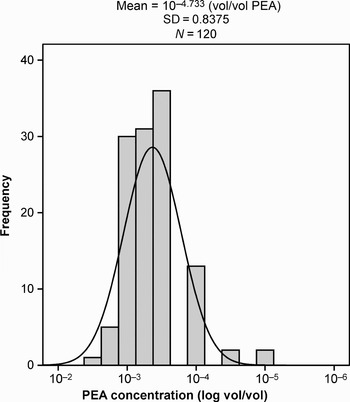
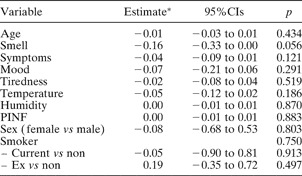
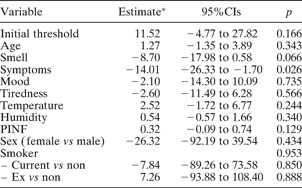
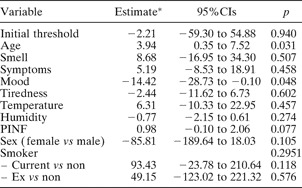
Due to the non-normal distribution, the bootstrap algorithm based on 1000 iterations was used to derive p values and confidence intervals (CIs) from the linear mixed model. The initial olfactory thresholds did not show any significant relationship to any of the variables examined (Table I); the distribution of the initial olfactory thresholds is seen in Figure 1, with a mean value of 10−4.739 log vol/vol (range 10−3–10−8).
Initial olfactory thresholds. SD = standard deviation

Relationship of recorded variables to initial olfactory thresholds

*Estimated increase in initial olfactory threshold due to a unit change in the variable. CI = confidence interval; PINF = peak inspiratory nasal flow; non = non-smoker; ex = ex-smoker
Olfactory adaptation times
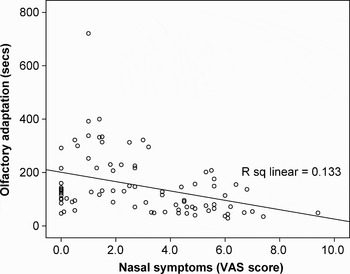
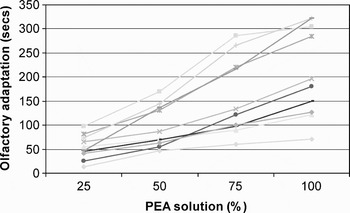
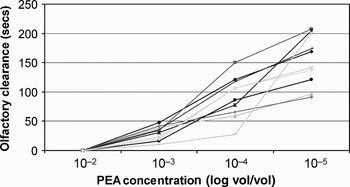
The mean time required for olfactory adaptation to phenethyl alcohol to occur was 157.7 seconds (range 29 to 721). Due to the non-normal distribution, the bootstrap algorithm based on 1000 iterations was used to derive p values and CIs from the linear mixed model. Univariate analysis of these variables revealed that only nasal symptoms, as documented using visual analogue scale (VAS) scores, had a relationship with adaptation time (β = −14.01, p < 0.026; Table II, Figure 2). This meant that an increase of one VAS unit in reported symptoms reduced the time to adaptation by 14 seconds (95 per cent confidence interval −26 to −1.7). There was no significant relationship between the initial olfactory threshold and the olfactory adaptation time. An example of olfactory adaptation times for one subject is displayed in Figure 3.
Severity of nasal symptoms (expressed as visual analogue scale (VAS) scores) versus olfactory adaptation time. Secs = seconds

Olfactory adaptation times for subject 1. Different symbols plot different adaptation times on separate occasions. PEA = phenethyl alcohol

Relationship of recorded variables to olfactory adaptation times

*Estimated increase in initial olfactory threshold due to a unit change in the variable. CI = confidence interval; PINF = peak inspiratory nasal flow; non = non-smoker; ex = ex-smoker
Olfactory clearance times
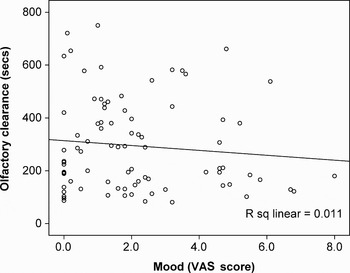
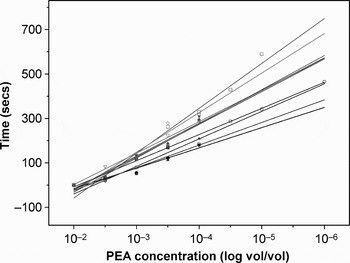
The mean olfactory clearance time for phenethyl alcohol was 170 seconds (range 81–750). Again, due to the non-normal distribution, the bootstrap algorithm based on 1000 iterations was used to derive p values and CIs from the linear mixed model. Univariate analysis of the variables showed a relationship with age (p = 0.031) and mood (p = 0.029) see figure 4; however, in a multivariate model (not shown), neither of these variables were significant (Table III). An example of olfactory clearance times for one subject is displayed in Figure 5. The influence of the variables on clearance time meant that for each yearly increase in age, the clearance time increased by 3.94 seconds (95 per cent CI 0.35–7.52), and for each one-unit increase in VAS mood score (i.e. worsening mood), the clearance time decreased by 14.42 seconds (95 per cent CI 0.10–28.73).
Worsening mood (expressed as visual analogue scale (VAS) score) versus olfactory clearance time. Secs = seconds

Olfactory clearance times for subject 2. Different symbols plot different clearance times on separate occasions.

Olfactory clearance curves for subject 3. Different clearance curves for one individual.

Relationship of recorded variables to olfactory clearance times

*Estimated increase in initial olfactory threshold due to a unit change in the variable. CI = confidence interval; PINF = peak inspiratory nasal flow; non = non-smoker; ex = ex-smoker
Analysis of the olfactory clearance curves revealed an average gradient of 133.24 (standard deviation = 89.64, minimum = 16.383, maximum = 443). Olfactory clearance significantly differed between individuals (p < 0.0001), based on a log-transformed analysis of variance (Table IV). The within-subject variation was estimated at 0.5 (on the log-transformed scale), so that the 95 per cent CI for the slope is, on the original scale, by 39.08 to 273.77 seconds.
Analysis of variance for olfactory clearance curves

Relationship of olfactory adaptation times to olfactory clearance times
We used a linear mixed model with time to olfactory adaptation as the independent variable and time to olfactory clearance as the dependent variable. Once again, due to the non-normal distribution, the bootstrap algorithm based on 1000 iterations was used to derive p values and CIs; this analysis revealed no evidence of a relationship between olfactory adaptation time and clearance time (p = 0.353, 95 per cent CI −0.19–0.54). A comparison of olfactory adaptation times to clearance times showed a mean difference of 149 seconds (95 per cent CI 119–179, p < 0.0001), using a paired t-test.
Variation within and between subjects
The intra-class correlation coefficient was used as a measure of reliability. The intra-class correlation coefficient for olfactory clearance time was 47 per cent (95 per cent CI 24–71 per cent) and for olfactory adaptation time was 61 per cent (95 per cent CI 39–82 per cent). That is to say that 47 per cent of the variation in clearance times was due to variation between subjects.
Discussion
Olfactory clearance times showed large variations between and within subjects, with the intra-class correlation coefficient results indicating that subjects were less consistent within themselves, as compared with other subjects, and took longer on average to clear than to adapt. The time constant for olfactory adaptation is not easy to determine, because the expired air contains little of the inspired odorant. Thus, the olfactory epithelium experiences an alternating high and low dose during each breath of the adaptation process, and this necessitates using a higher concentration of odorant to achieve adaptation at any particular level. Phenethyl alcohol was chosen as it is a pure chemical widely used in smell testing, having an odour reminiscent of roses and being reasonably well tolerated at high strength. Determination of clearance times does not suffer from this disadvantage, as the odour exposure of the olfactory epithelium is essentially zero throughout the respiratory cycle and, apart from the occasional sniff from a test bottle, the odorant should migrate from the nasal mucus exponentially, according to dilution theory. Although only a small number of subjects were included in the study, more than 100 readings were obtained; the results were thus considered to present a reliable reflection of human olfactory clearance times. Clearly, further data collection in this respect will add weight to these findings, and is the subject of ongoing research, but from our findings it can be implied that olfactory clearance occurs at a logarithmic rate.
Previous work in this field has however shown that the extent of olfactory adaptation induced is a function of both the duration and concentration of the stimulus applied.Reference Doty, Laing and Doty17, Reference Koster, de Wijk, Laing, Doty and Breipohl18 From the clearance curves determined in our study, one notable observation is that, for physiological data, the consistent pattern of the decay times was remarkable, albeit with significant intra-subject variability from one reading to the next. In concurrence with our previous findings, the variables measured did not have any bearing on the initial olfactory thresholds achieved, and this therefore negates the need to control for these factors.Reference Philpott, Goodenough, Robertson, Passant and Murty14 The absence of a significant relationship between olfactory adaptation and clearance is in contrast to the work of others in this field.Reference Doty, Laing and Doty17, Reference Koster, de Wijk, Laing, Doty and Breipohl18 It was however noted that, just as olfactory function is noted to decline with age,Reference Murphy, Schubert, Cruickshanks, Klein, Klein and Nondahl19 our findings demonstrated an age-related increase in clearance times. A ‘grumpier’ mood was also observed to decrease clearance times. This latter finding demonstrates that olfactory testing is affected by the subjective nature of this sensory modality. Olfactory adaptation time was also affected by nasal symptoms, whereby an increase in symptoms was related to a decrease in adaptation time.
• This study attempted to quantify olfactory adaptation and clearance times, on presentation of a saturated solution, in a number of human volunteers, in order to determine whether these times were consistent within and between individuals
• Fourteen subjects performed 120 tests in total. Despite consistent linear trends within individuals, olfactory clearance times varied widely within and between individuals
• When testing a person's sense of smell in a clinical setting, recent exposure to similar smells should be noted, and a period of 15 minutes needs to be allowed before retesting
Using the maximum value for olfactory clearance of phenethyl alcohol by one logarithmic threshold step would mean, for example, that a subject who achieves a threshold of 10−4 may potentially need a maximum of 15 minutes to allow full reversal of olfactory adaptation. The key clinical application of these results is that a period of at least 15 minutes should be left, once a subject has (potentially) adapted to phenethyl alcohol, before further olfactory testing can meaningfully be conducted on that subject, especially if they have a lower threshold. This time can be adapted, using our clearance data, according to the initial threshold achieved. This does of course make the assumption that the subject does achieve olfactory adaptation, which may not necessarily be the case; however, by making this assumption, any errors in further testing can be avoided. This may be relevant when testing with similar odours, in which case cross-reactivity is a potential issue. These issues have certainly been considered in the well established University of Pennsylvania smell identification testReference Doty, Shaman and Dann20 and in the quantification of odour quality.Reference Wise, Olsson and Cain21
Previous work in this field assessed olfactory adaptation and recovery times in the elderly, and found that they were more prone to adaptation and were slower to recover their threshold sensitivity.Reference Stevens, Cain, Schiet and Oatley22 Another study found that humans adapt more rapidly to malodours, such as amyl acetate, valeric acid, skatol and butyric acid, than to pleasant odours such as cis-3-hexenol and linalool.Reference Jacob, Fraser, Wang, Walker and O'Connor23 This study also found that the degree of adaptation was inversely proportional to the stimulus strength, and that women responded differently to men for certain odours.
More recent work in animal models suggests that the mechanism for olfactory adaptation is a physiological one which occurs at the receptor level and is calcium-dependent.Reference Reidl, Borowski, Sensse, Starke, Zapotocky and Eiswirth24–Reference Yee and Wysocki26 Active pumping of calcium ions into the receptor cells results in shortening of the action potentials generated by the receptor cell axons and therefore a decreased neuronal response to the stimulus. The rise in intraciliary Ca2+ concentration has two opposing effects: activation of an unusual excitatory Cl− conductance, and negative feedback actions on various stages of the odour transduction mechanism.Reference Matthews and Reisert27 It has also been shown that the psychological response to prolonged olfactory stimuli can be demonstrated using olfactory event-related potentials, but this process probably represents olfactory habituation rather than adaptation.Reference Wang, Walker, Sardi, Fraser and Jacob28
Conclusions
The main clinical implications of our olfactory testing results are that, although olfactory recovery times vary greatly both within and between individuals, sufficient rest intervals should be allowed between testing of similar odours – a minimum duration of 15 minutes is recommended in the case of phenethyl alcohol.