Introduction
The uncontrolled release of radiation into the environment associated with the accident at the Chornobyl nuclear power plant in April 1986 is the worst such disaster to date. The consensus report of the United Nations Chernobyl Forum estimated that 6.6 million people were exposed to radioactive fall-out (Chernobyl Forum, Reference Chernobyl2006). After reviewing the scientific evidence, the Forum report concluded that thyroid cancer was the only significant health effect in exposed children. However, locally there is serious concern about damage to the developing brain, which stems from the elevated rates of mental retardation and schizophrenia in children exposed in utero to the bombings of Hiroshima and Nagasaki (Otake & Schull, Reference Otake and Schull1984; Imamura et al. Reference Imamura, Nakane, Ohta and Kondo1999; Schull & Otake, Reference Schull and Otake1999). The pathways by which ionizing radiation affect the brain have been described, but the question of whether a lower-bound threshold exists remains unresolved (Schull & Otake, Reference Schull and Otake1999).
Extending research initiated by the World Health Organization (WHO, 1995), investigators in Ukraine (Nyagu et al. Reference Nyagu, Loganovsky and Loganovskaja1998) and Belarus (Kolominsky et al. Reference Kolominsky, Igumnov and Drozdovitch1999; Igumnov & Drozdovitch, Reference Igumnov and Drozdovitch2000) reported significantly elevated rates of borderline intelligence and International Classification of Diseases (ICD)-10 developmental disorders in 6- to 12-year-old exposed children compared with non-exposed controls. The presentation of the methodology and results was difficult to follow, but it was clear that the raters were not blind to exposure status, the exposed and non-exposed samples differed socio-economically, the exposure estimates were imprecise, and the analysis did not adjust for parental intelligence or education. The Belarus studies attributed the differences to socio-environmental factors. The Ukraine study reported a dose–response effect and attributed the results to radiation exposure. In contrast, two Western studies found no significant differences in cognitive functioning between exposed and non-exposed children. The first was conducted in Kiev by our research group and compared evacuees and their classmates at age 11 years on measures of intelligence, attention, and memory, as well as school grades (Litcher et al. Reference Litcher, Bromet, Carlson, Squires, Goldgaber, Panina, Golovakha and Gluzman2000). The second study, conducted in Israel with 12- to 18-year-old adolescents who had emigrated from high-, low- and non-contamination areas of the former Soviet Union, found no differences on the Raven Standard Progressive Matrices Test administered to the children and maternal ratings of hyperactivity and attention problems (Bar Joseph et al. Reference Bar Joseph, Reisfeld, Tirosh, Silman and Rennert2004). Thus, the findings of the two Western studies differed sharply from the results of the local investigations.
Consistent with the local findings of higher rates of cognitive deficits, which were widely disseminated in the local media, our study of 11-year-old children in Kiev also found that mothers of the evacuee children were seven times as likely as mothers of the classmates to report that their children had memory problems. These subjective reports contrasted sharply with the children's performance on objective tests of memory (Litcher et al. Reference Litcher, Bromet, Carlson, Squires, Goldgaber, Panina, Golovakha and Gluzman2000). The evacuee children also rated their level of scholastic competence more negatively (Bromet et al. Reference Bromet, Goldgaber, Carlson, Panina, Golovakha, Gluzman, Gilbert, Gluzman, Lyubsky and Schwartz2000) although their grades at school were comparable with those of their classmates (Litcher et al. Reference Litcher, Bromet, Carlson, Squires, Goldgaber, Panina, Golovakha and Gluzman2000). Thus, we embarked on a follow-up study to determine whether the groups would continue to perform similarly on objective measures when they reached young adulthood, to examine the longitudinal stability of cognitive functioning in exposed relative to non-exposed children, to test whether in utero exposure conferred additional risk, and to assess the long-term subjective appraisals of memory problems.
To date, none of the studies using neuropsychological tests have had access to local normative data. To provide a platform for standardizing the test results and hence evaluate whether the children's performance was within the expected normal range, we also assessed a random sample of young adults in Kiev.
Method
Sample and procedure
In 1997, we evaluated 300 children evacuated from the contaminated area around Chornobyl and 300 gender-matched homeroom classmates (Bromet et al. Reference Bromet, Goldgaber, Carlson, Panina, Golovakha, Gluzman, Gilbert, Gluzman, Lyubsky and Schwartz2000). The inclusion criteria for the evacuees were being born between 1 February 1985 and 31 January 1987 (in utero to age 15 months when the accident occurred), living in the 30 km zone around the plant when the accident happened, and residing in Kiev in 1997 when the study was undertaken. Although precise figures are not available, thousands of evacuated families had been sent to Kiev located approximately 80 miles from Chornobyl.
The sampling frame was created by integrating the Chornobyl Registry of the Ministry of Health with lists from two large, humanitarian organizations: Help for Families from Chornobyl and Children of Chornobyl for Survival. Children were randomly selected until we reached the goal of 300 evacuees. The neuropsychological assessment took place in respondents' homes. The response rates were 92% for evacuees and 85% for classmates. (For more detail, see Bromet et al. Reference Bromet, Goldgaber, Carlson, Panina, Golovakha, Gluzman, Gilbert, Gluzman, Lyubsky and Schwartz2000.)
Most of the evacuee families (80.7%) came from Pripyat located 1 mile from Chornobyl; the rest were from small villages in the 30 km zone. The majority of mothers reported either being outdoors or having their windows open at various times of the day on 26 or 27 April 1986 (94.8% of village families; 86.8% of Pripyat families). All but four of the families were evacuated in April–May 1986, and 85.9% arrived in Kiev that same year. According to the Chernobyl Forum (Reference Chernobyl2006) report, the average effective dose received by people who were evacuated from the 30 km zone in the spring and summer of 1986 was about 33 mSv although some evacuees received considerably higher exposure. It is important to note that these estimates are based on dose reconstruction efforts performed later because reliable information about exposure was unavailable at the time of the accident.
An 8-year follow-up of the sample was conducted from April 2005 to July 2006 by the Kiev International Institute of Sociology (KIIS), a survey research organization located at Kiev-Mohyla University. Overall, 265 evacuees (88% of the initial sample) and 261 classmates (87% of the initial sample) participated. Sample loss was not influenced by demographic characteristics (Guey et al. unpublished observations), or by neuropsychological test performance or maternal reports of memory problems in the child in 1997 (data not shown).
A population-based control group from Kiev was also recruited in 2005–2006. The eligibility criteria were (1) born in 1985–1986, (2) being in Kiev in 1997 when the original study was fielded, and (3) not evacuated from an area contaminated by Chornobyl. KIIS sampling software was used to generate a random list of households in Kiev. Using telephone screening (97% of households in Kiev have telephones), 327 children (representing 85.4% of eligible households) participated.
Twenty-eight interviewers were trained in small groups over a 1-week period by V.Z., who received training on the neuropsychological testing by an experienced neuropsychologist (S.R.). A refresher training session took place during the course of the fieldwork. The training sessions included didactic presentations, group exercises, one-on-one practice sessions, and pilot testing. Each interviewer was observed at least once in the field. Two-thirds of the interviews (66.4%) were conducted in participants' homes; the remainder took place either at KIIS or at a neutral location, such as a library.
The study procedures were approved by institutional review boards of Stony Brook University and KIIS. The consent forms were translated into Russian and Ukrainian. Written informed consent was obtained.
Neuropsychological assessment
For practical reasons, the neuropsychological testing was limited to 1 h and the measures chosen were those that could be accomplished efficiently and with the least cultural bias. Three domains hypothesized to be affected by Chornobyl were assessed: intelligence, attention, and memory. All measures were translated into Russian and back-translated into English following standard WHO procedures (Kessler & Üstün, Reference Kessler and Üstün2004) except for the Wechsler Adult Intelligence Scale (WAIS) and Hopkins Verbal Learning Test (HVLT), for which Russian versions were available. A Ukrainian version of the test battery was also produced, but 97% of the children elected to do the assessment in Russian. The test battery was piloted in Kiev with 10 adolescents, aged 18–19 years, prior to starting the fieldwork. The interview session lasted about 2¼ h, and all of the neuropsychological tests were administered in the middle of the interview except the Hopkins immediate recall which was administered at the beginning. All interviews were administered in the same order.
Intelligence
Two verbal (Similarities and Information) and two performance (Picture Completion and Block Design) subtests of the Russian WAIS were administered (Wechsler, Reference Wechsler1981; Filimonenko & Timofeev, Reference Filimonenko and Timofeev1995). The Russian WAIS contains small modifications to ensure cultural appropriateness. For example, the items on the Similarities and Information tests were arranged somewhat differently to maintain the rank ordering by progressive difficulty. These tests were scored blindly at Stony Brook by a psychologist from Russia and a linguist from Ukraine trained by S.R.; inter-rater agreement (intra-class correlation coefficients) on 159 tests was 0.97 for Similarities and 0.99 for Information. The interviewers scored the two performance tasks during test administration.
Attention
The black-and-white and color tasks of the Visual Search and Attention Test (VSAT) involves crossing out as many target letters or symbols as possible in 60 s (Trenerry et al. Reference Trenerry, Crosson, DeBoe and Leber1990; Lezak, Reference Lezak1995). The black-and-white tasks assess simple scanning speed, and were previously administered in 1997. The number correctly crossed out on each task was recorded. The color tasks assess interference control and were administered only at follow-up. The number correctly crossed out on the left and right sides of the page and their combination were recorded.
Parts A and B of the Trail-Making Test assess processing speed and divided attention (Reitan, Reference Reitan1958). Part A of the Trail-Making Test requires connecting 25 numbered circles in sequential order (maximum time was 3 min) and was also included in 1997. Part B of the Trail-Making Test requires connecting numbers and letters in sequential order (maximum time was 5 min). The number of seconds to complete each task was recorded. All respondents completed part A in the allotted time, but 27 respondents took longer than 5 min on part B; they were excluded from the analysis since we did not know whether this reflected administration problems or respondents' performance.
The ‘underline-the-words’ test was developed in Kiev for the original study and entails underlining words hidden in a line of scrambled letters in 3 min. There were 25 words, some of which related to Chornobyl. This task was designed to be a culturally sensitive measure of processing speed and simple attention. The total number of words correctly underlined was coded by V.Z.
Memory
Form A of the Benton Visual Retention Test (BVRT) was administered at both times to measure short-term visual memory (Benton, Reference Benton1974). Respondents viewed 10 cards containing progressively more complex designs for 10 s each, after which the card was withdrawn and the respondents drew the designs. Scoring of number correct and number of errors was done at Stony Brook by two raters trained by S.R. who were blind to evacuee status. The correlation was r=−0.93. Thus we included only the number of designs correctly recalled (inter-rater reliability across 83 tests=0.93).
The Russian modification of the HVLT (Brandt, Reference Brandt1991) was administered to measure immediate and delayed verbal memory (Russia Longitudinal Monitoring Survey, 2005). The interviewers read 10 words, and respondents repeated them back immediately and again after a 20-min delay. The numbers of words correctly recalled at each trial was coded by the interviewer.
Subjective reports of memory problems
As part of a list of 11 general health symptoms, respondents were asked whether they were bothered by memory problems during the past year (not at all, somewhat, very much). This question was asked after the HVLT immediate recall and before all other neuropsychological tests. Their mothers were also independently asked the same question about their children at follow-up and in 1997. At follow-up, only eight children (1.5%) and 24 mothers (4.8%) said ‘very much’. Thus, subjective memory problems were dichotomized into present/absent.
Demographic characteristics
The variables examined were current age, in utero status at the time of the explosion (determined from date of birth), gender, attendance at university (versus working, attending technical school, or unemployed), and parents' education (university graduate versus less education).
Data analysis
The neuropsychological test scores were standardized using the population-based control group. Specifically, the Russian WAIS raw scores were transformed to scaled scores with a mean=10 and standard deviation (s.d.)=3 in the population-based controls. All other neuropsychological test scores represent t scores (mean=50, s.d.=10).
The comparisons of the evacuees and classmate controls were conducted using SAS version 9.1 (SAS Publishing, 2004). Demographic characteristics were compared using χ2 tests for categorical variables and t tests for continuous variables. Evacuee and classmate performance on the neuropsychological tests in 2005–2006 was compared using t tests. To examine changes in performance on tests administered at both times (BVRT, VSAT black-and-white forms, Trail-making A, and underline-the-words), raw scores were analyzed using repeated-measures analysis of variance in PROC MIXED (Little et al. Reference Little, Milliken, Stroup and Wolfinger1996). PROC MIXED uses a likelihood-based estimation method and is thus able to utilize all available data without deleting observations in a list-wise manner. PROC MIXED assumes the data to be missing at random. Parallel analyses were conducted for the in utero subgroup. Odds ratios (ORs) and 95% confidence intervals (CIs) were computed for the comparison of self-reported memory problems. Bonferroni adjustments were set for each series of comparisons.
Since children's performance on cognitive tasks is significantly correlated with parental intelligence, and we did not have a formal measure of parental intelligence quotient, the analysis was stratified by parental education (either parent graduated from university versus neither) (Rowe et al. Reference Rowe, Jacobson and Van den Oord1999). We also note that given the substantial (non-random) discrepancy in parental education across the groups, stratification was deemed more appropriate than a statistical control (Miller & Chapman, Reference Miller and Chapman2001).
Results
Sample characteristics
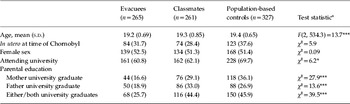
The median age of the evacuees, classmate controls, and population-based controls was 19 years. Although the mean age of the groups differed significantly (Table 1), the effect size was extremely small (η2=0.03). A similar proportion of each group was in utero at the time of the accident. About half of each group was female. More of the population-based controls were attending university, while the proportion of evacuees and classmates at university was comparable (about 60% of each group). However, the groups differed significantly in terms of the proportion with a parent who was a university graduate, with significantly fewer evacuees coming from highly educated households compared with both the classmate and population-based control groups.
Demographic characteristics of evacuees, classmate controls, and population-based controls at follow-up

s.d., Standard deviation.
Values are given as n (%) except for age.
a For χ2 test, degrees of freedom=2.
* p<0.05, *** p<0.001.
Neuropsychological test performance
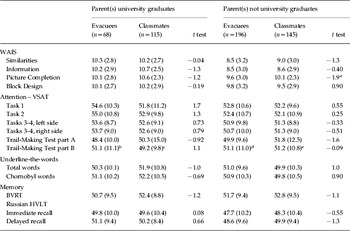
The means and standard deviations for the neuropsychological measures are presented in Table 2. No significant differences were found between the evacuees and classmates from either the high or the low education households, and all groups scored within the normal range.
Neuropsychological performance of evacuees and classmates stratified by parental education

WAIS, Wechsler Adult Intelligence Scale; VSAT, Visual Search and Attention Test; BVRT, Benton Visual Retention Test; HVLT, Hopkins Verbal Learning Test; s.d., standard deviation.
Values are given as mean (s.d.).
One evacuee and one classmate control did not complete the neuropsychological test battery.
a Satterthwaite's approximation for unequal variances utilized by t test.
b Missing (n=3). c Missing (n=5). d Missing (n=12). e Missing (n=7).
The results for the in utero subsample were similar. Among those from highly educated households, the evacuees (n=19) performed similarly to their classmate counterparts (n=28) on all of the measures. Among respondents from less educated households, the evacuees (n=65) performed similarly to the classmates (n=46) on all tests except Picture Completion, on which the evacuees scored more poorly [9.07 (s.d.=3.39) v. 10.82 (s.d.=2.03); t=−3.38, df=106.1, p=0.001, d=0.60]. However, all of the scores were in the normal range (data available from author).
Change over time
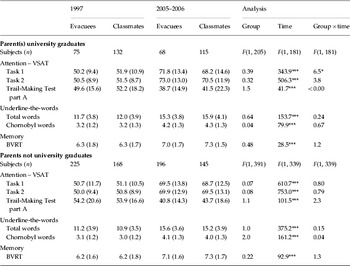
The mean time from baseline to follow-up was 8.5 years for both evacuees and classmates. Table 3 shows that performance on each of the neuropsychological measures improved over time (analyses based on raw scores). Using a Bonferroni-adjusted significance level of 0.01 (0.05/5), none of the group×time interaction terms was statistically significant.
Temporal stability of neuropsychological test performance among evacuees and classmates: raw scores

VSAT, Visual Search and Attention Test; BVRT, Benton Visual Retention Test; s.d., standard deviation.
Values are given as mean (s.d.).
* p<0.05, *** p<0.001.
Similar results were obtained in the replication for the in utero subsample (data not shown) although the power to detect effects was reduced.
Subjective reports of memory problems
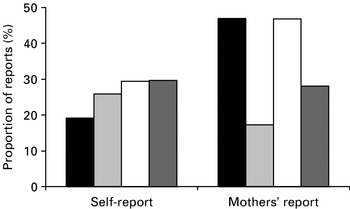
Consistent with their performance on the BVRT and Russian HVLT, the percentage of evacuees reporting memory problems was not significantly different from that of the classmate controls (Fig. 1; OR for high education households=0.7, 95% CI 0.3–1.4; OR for low education households=1.0, 95% CI 0.6–1.6). However, the evacuee mothers from highly educated households were more than four times as likely (OR 4.2, 95% CI 2.1–8.5, p<0.001) and the evacuee mothers from less educated households were more than twice as likely (OR 2.3, 95% CI 1.4–3.6, p<0.001) to report that their children had problems with their memory. There were no significant relationships between mother or child reports of memory problems and the neuropsychological tests of memory (data not shown).
Subjective reports (%) of memory problems of evacuees (■) and classmate controls ( ) from high education households and evacuees (□) and classmate controls (
 ) from low education households.

Overall, the evacuee mothers' reports of memory problems in 1997 significantly predicted reporting at follow-up (OR 5.2, 95% CI 2.9–9.5, p<0.001), but the OR for the control mothers was non-significant (OR 2.3, 95% CI 0.8–6.6).
Discussion
Although the mothers of evacuee children continued to be much more concerned about their offsprings' memory functioning than the mothers of the classmate controls, the current study showed that at age 19 years, the evacuees and classmates were similar with respect to objective measures of cognitive functioning, university attendance and self-reported memory problems. Both groups improved in their neuropsychological test performance from age 11 to age 19 years, and the pattern of improvement was similar. Furthermore, with the exception of the Picture Completion scores among respondents from less educated households, the evacuees who were in utero at the time of the accident did not appear to be differentially affected. These results are consistent with the findings of Bar Joseph et al. (Reference Bar Joseph, Reisfeld, Tirosh, Silman and Rennert2004) and extend the results of our 1997 study. Moreover, they confirm the conclusions of the Chornobyl Forum (Reference Chernobyl2006) report. Given the estimated exposure level of the evacuee population (Bard et al. Reference Bard, Verger and Hubert1997), our findings most likely reflect the true absence of an effect. However, we cannot rule out the possibility that there are subtle cognitive effects that could not be detected with the measures we administered.
Our study had a number of strengths. One was the recruitment of the population-based control group from which we were able to establish normative data for our measures that was in line with the cultural and historical background of our subjects. Hence, we were able to show that the evacuees and their classmates performed in the normal range relative to an unaffected, representative control group. Second, the sample of evacuees was unbiased with respect to ascertainment. Third, the follow-up response rates were reasonably good. Fourth, we presented longitudinal analyses whereas, to our knowledge, all other published studies on Chornobyl, including those having follow-up assessments, treated their data cross-sectionally.
Our study also had some important limitations. The settings in which the testing took place were not uniform or without distractions, and the testers who were trained to administer the battery were not professional neuropsychologists. Despite the fact that the testers were experienced interviewers and understood the importance of creating a test environment that was as quiet and focused as possible, their level of experience with test administration could have had a negative impact on the testing situation. On the other hand, these constraints were similar across the three groups and therefore would not have differentially affected test performance. Time limitations also influenced the number of tests and the domains that were selected for evaluation. We can only generalize from the tests we administered, and thus it is possible that the groups might differ on other aspects of cognitive functioning that we did not assess. Lastly, the in utero subsample was fairly small and underpowered, and we were unable to do separate analyses by trimester. However, the findings for the in utero subgroup as a whole mirrored those of the larger sample.
The present study illuminates two important points. First, it adds new and important evidence that Chornobyl did not have an adverse effect on the neuropsychological functioning of exposed children. Our conclusions held true across three major domains of cognitive functioning, intelligence, attention, and memory, using tests that were either modified in Russia or culturally appropriate. Moreover, the evacuees' performance on the neuropsychological measures was within the normal range as established from a representative, population-based control group in Kiev. Similar proportions of evacuees and classmates were attending university, and similar percentages reported having memory problems. Thus, in all respects, the evacuees were indistinguishable from their classmates.
The second point is that despite finding no evidence of poor cognitive functioning in a representative sample of exposed children on objective measures, the evacuee mothers still remained concerned about their children's memory. Indeed, their initial belief that their children had memory problems was a strong predictor of their current belief. After completing our study in 1997, we presented the findings at a town-hall-style meeting in Kiev that was attended by several hundred people. We explained all of our major findings, including the fact that the evacuee children had similar grades at school and performed like their classmates on the neuropsychological measures. S.F.G. explicitly stated that recent newspaper stories of increased rates of dementia and schizophrenia in exposed children were untrue, and urged the audience to believe our findings because the American investigators had no stake in how the results turned out. Nevertheless, 8 years later, the evacuee mothers were still significantly more concerned about this issue than the controls, albeit somewhat less so compared with 1997. In part, this reflects their overall worry about Chornobyl's effects on their children's health. It also reflects the continuing media coverage of this issue and sensational documentaries like ‘Chernobyl Heart’ which shows local doctors attributing a range of horrific congenital malformations to Chornobyl (De Leo, Reference De Leo2004). The greater salience of media reports over scientific data is a well-established effect (Tversky & Kahneman, Reference Tversky and Kahneman1974), as is the pronounced fear associated with nuclear power plant accidents (Slovic, Reference Slovic, Ricks, Berger and O'Hara1991).
In conclusion, the infants evacuated from contaminated areas around Chornobyl, now young adults, show no signs of cognitive impairment. The current findings confirm and extend our earlier results, when the evacuees were 11 years old. The fact that similar proportions of evacuees and classmates are attending university suggests that Chornobyl did not lead to functional disability. The failure to detect such effects is not surprising since the highest level of radiation exposure was considerably lower than the lowest level at which these effects were demonstrated in offspring of survivors of Hiroshima and Nagasaki. It should be reassuring, nevertheless, that our findings, even with the limitations of our research, provide strong evidence that Chornobyl did not lead to widespread cognitive dysfunction in the young children who lived near the plant when the meltdown occurred.
Acknowledgements
This study was funded by the National Institute of Mental Health (MH51947). The authors thank Charles Webb for directing the fieldwork, Vladimir Paniotto for designing the sampling methodology for the population-based control group, and the interviewers and programmers at the Kiev International Institute of Sociology; Evgenii Golovakha and Natalia Panina for their work on developing the protocol, Margaret Bloom, Anna Geisherik and Svetlana Stepukhovich for their careful translations and back-translations, and, most of all, the participants who graciously gave their time to this project. This research was conducted at Stony Brook University in collaboration with the Kiev International Institute of Sociology and the Ukrainian Psychiatric Association.
Declaration of Interest
None.