Sepsis is one of the most frequent healthcare-associated infections in neonatal intensive care units. Several risk factors are associated with neonatal sepsis, including low birth weight, prematurity, and use of invasive devices, especially central venous catheters (CVCs).Reference Rosado, Camargos and Anchieta1,Reference Russel2
The definitive diagnosis of catheter-related bloodstream infection (CRBSI) requires proof that the CVC is the focus of infection. Therefore, the microorganism identified in the peripheral blood culture must be also present in the catheter culture, that is, in blood samples drawn from the catheter or from the CVC tip when the device is removed.Reference Mermel, Allon and Bouza3
In this study, we analyzed the criteria for CRBSI diagnosis in neonates using catheter-drawn blood samples and catheter-tip cultures. We compared these 2 methods, and we evaluated the association between catheter-drawn blood sampling and the occurrence of adverse events.
Methods
This cross-sectional analysis of data collected from a cohort study was conducted from January 2012 to December 2018 at a referral center. The inclusion criteria considered all high-risk newborns admitted to the neonatal unit who received at least 1 CVC during the study period. All episodes of laboratory-confirmed bloodstream infection (LCBI) were reported, and cases that met criteria for CRBSI were notified.
The LCBI diagnosis was confirmed in neonates with a recognized pathogen cultured from 1 or more blood cultures, and the organism was not related to an infection at another site. LCBI was also confirmed in neonates with signs associated with sepsis in which the common skin contaminant organism was detected from 2 or more blood cultures or coagulase-negative Staphylococcus was detected from at least 1 peripheral blood culture from a patient with a CVC.4
The definitive diagnosis of CRBSI requires the isolation of the same organism from percutaneous blood culture and catheter sample. The diagnosis requires that 2 blood samples be drawn from a catheter hub and a peripheral vein, respectively, that, when cultured, meet the criteria for differential time to positivity, which is the growth of microbes from a blood sample drawn from the catheter at least 2 hours before microbial growth is detected in a blood sample obtained from a peripheral vein. The diagnostic criteria for CRBSI when the device is removed is the growth of >15 colony-forming units (CFU) from a 5-cm segment of the catheter tip by semiquantitative culture.Reference Mermel, Allon and Bouza3
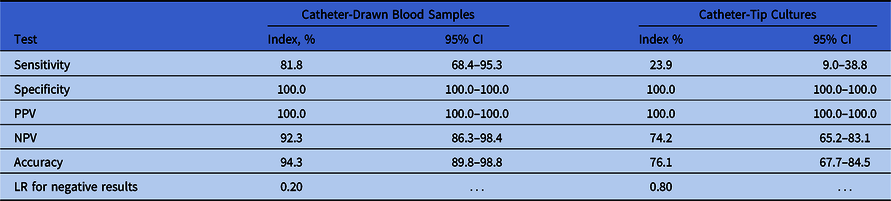
We analyzed the sensitivity, specificity, positive predictive value (PPV), negative predictive value (NPV), likelihood ratio for negative results, and accuracy for catheter-drawn blood samples and catheter-tip cultures, considering notifications of CRBSI filled using both criteria and those reported using only 1 of the methods. Cases that did not met CRBSI criteria, that is, cases with positive percutaneous blood culture but negative catheter-tip culture and negative catheter-drawn blood sample, were considered negative for both criteria. The gold standard was considered to be a diagnosis recorded using both methods according to guidelines definitions.Reference Mermel, Allon and Bouza3
The χ2 test was used to evaluate the association between catheter-drawn blood sampling and the occurrence of adverse events with CVCs. Statistical significance was defined as P < .05.
This study was approved by the institutional review board.
Results
In total, 1,983 high-risk newborns were admitted to the neonatal unit, among whom 1,495 patients (75.39%) received at least 1 CVC and were included in the study.
Of the 399 total reported episodes of LCBI, 102 cases met the criteria for CRBSI using catheter-drawn blood samples and/or catheter-tip cultures.
Among all reported CRBSI cases, 77 (75.49%) were notified only based on criteria from catheter-drawn blood cultures, 18 (17.65%) were notified only from catheter-tip culture, and 7.0 (6.86%) were notified using both criteria. In total, 11 cases were considered negative for CRBSI for both criteria with negative catheter-tip culture and negative catheter-drawn blood sample.
We observed greater sensitivity for the catheter-drawn blood culture method (81.8%) for the diagnosis of CRBSI compared to those for catheter-tip cultures (23.9%). Therefore, we identified more CRBSI-positive results using catheter-drawn blood cultures criteria compared to the number of cases identified using catheter-tip cultures. The gold standard was considered all CRBSI diagnoses recorded; the specificity and PPV were 100% for both criteria. The likelihood ratio for negative results indicates that catheter-drawn blood samples showed lower probability of a false negative compared to catheter-tip cultures. The results of the analysis of catheter-drawn blood samples and catheter-tip cultures are shown in Table 1.
Diagnosis of Catheter-Related Bloodstream Infection

Note. CI, confidence interval; PPV, positive predictive value; NPV, negative predictive value; LR, likelihood ratio.
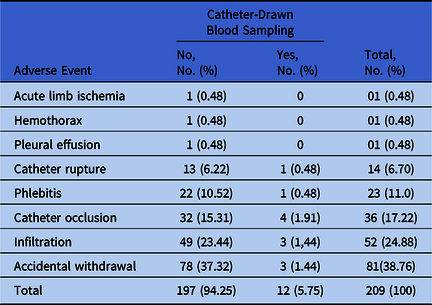
During the study period, 2,783 CVCs were used, among which 2,643 were not manipulated for catheter-drawn blood sampling. In total, 209 adverse events related to the use of CVCs were identified. The most frequent adverse events related to the use of CVCs were accidental withdrawal (38.76%), infiltration (24.88%), and catheter occlusion (17.22%) (Table 2).
Adverse Events Associated to the Use of Central Venous Catheters

Most of the adverse events reported had no previous record of catheter-drawn blood sampling from the devices. Among patients with catheters that were not manipulated for catheter-drawn blood sampling, 197 adverse events were reported, compared to 12 adverse events for the group of patients in which catheter-drawn blood sampling was performed.
The comparative analysis of the occurrence of adverse events between groups (ie, those catheters manipulated for blood sampling and those not manipulated) showed no association between catheter-drawn blood sampling and the occurrence of line complications (χ2; P = .625).
Discussion
In this study, 102 episodes of CRBSI were reported. The frequency of confirmed CRBSI episodes was higher in catheter-drawn blood samples (84 cases), with a sensitivity of 81.8%. Greater accuracy (a higher percentage of correct diagnoses) was also observed for catheter-drawn blood samples (94.3%).
Studies on CRBSI in neonatal populations are scarce and most generally describe device removal, with the use of tip culture or catheter fragment cultures to confirm the diagnosis. However, the catheter removal must be weighed against the difficulty of obtaining alternate venous access for children, especially in premature and low-birth-weight newborns.Reference Mermel, Allon and Bouza3,Reference Vasudevan and McGuire5,Reference Ferreira, Camargos, Clemente and Romanelli6
Catheter removal and new venous access are difficult in clinical practice in newborns. Thus, catheter-drawn blood sampling may help in the confirmation and clinical management of CRBSI, such as time duration of antibiotic therapy and the need for further laboratory testing.7,Reference Tsai, Hsu and Lien8
In total, 209 adverse events related to the use of CVCs were reported in this study. We observed a higher frequency of adverse events with CVCs in which catheter-drawn blood sampling was not performed. Thus, catheter-drawn blood sampling was not a factor significantly associated with the occurrence of adverse events related to the use of these devices.
In the present study, we did not evaluate other possible factors and variables associated with the occurrence of adverse events with CVCs; this analysis was outside the scope of this study.
Adverse events related to the use of CVCs are frequent in neonatology, especially catheter occlusion. The many causes of catheter occlusion include mineral, lipid, and drug precipitates; catheter bending; sutures that are too tight; and improper positioning of the device tip.Reference Pedreira9,Reference Pettit10
The results of this study indicated the greater sensitivity and accuracy of catheter-drawn blood samples compared to catheter-tip cultures, with increased identification of CRBSI-positive cases in a neonatal population. Blood samples drawn from CVCs did not show any increase in line complications. Thus, the implementation of routine catheter-drawn blood sampling is recommended in neonatology clinical practice in cases of suspected CRBSI.
Acknowledgments
Financial support
No financial support was provided relevant to this article.
Conflicts of interest
All authors report no conflicts of interest to this article.