Implications
This work lays the basis for the design of optimal natural-ventilated barns for cows to suppress thermal heat stress. Our research took into considerations the main contributors to heat stress including ambient temperature, humidity and wind speed. The latter was previously ignored in heat-stress models. The results indicate that with proper design, potential heat stress can be reduced thus decreasing or even eliminating the decline of milk production of dairy animals.
Introduction
Designers of dairy barns should seek to provide an optimal environment, resulting in excellent welfare, to enable cows to maximize their milk production. The heat energy produced by a cow increases with milk production, and during hot seasons cows accumulate additional heat from the environment. This heat must be dissipated lest the cows be exposed to high-temperature stress that might impair and reduce milk production and fertility. Dairy barns are designed for 15 to 30 years of use, and therefore their design should take into account the increase in extreme environmental events expected to accompany anticipated climate changes. Thus, achievement of an optimal environment, in particular for the high-yield cow, is a challenging goal.
Numerous studies have addressed the problem of relieving the dairy cow of heat stress. Those were conducted under controlled environments aiming at reducing heat accumulation, but only a few dealt with the contribution of barn design to the cow's response to heat stress. Some discussed the direct effects of evaporative cooling, achieved through a combination of sprinklers and fans, on milk yield and fertility (e.g. Flamenbaum et al., Reference Flamenbaum, Wolfenson, Mamen and Berman1986 and Reference Flamenbaum, Wolfenson, Kunz, Maman and Berman1995; Her et al., Reference Her, Wolfenson, Flamenbaum, Folman, Kaim and Berman1988; Wolfenson, Reference Wolfenson, Flamenbaum and Berman1988a and Reference Wolfenson, Flamenbaum and Berman1988b; Kadzere et al., Reference Kadzere, Murphy, Silanikove and Maltz2002). The effects of barn structural components on ambient temperature at cow level in free-stall barns were examined in several studies: temperature differences between the inside and outside of naturally ventilated free-stall barns with curtain side walls were below 0.4°C during the warmest month of the year (Stowell et al., Reference Stowell, Gooch and Inglis2001b). Relative humidity inside the barn was found to be higher than that outside throughout the year (Janni and Allen, Reference Janni and Allen2001; Stowell et al., Reference Stowell, Gooch and Inglis2001a). Also tunnel ventilation was compared with natural ventilation (Stowell et al., Reference Stowell, Gooch and Inglis2001a and Reference Stowell, Gooch and Inglis2001b). Under freezing weather roof insulation combined with thermal curtains inside the barn was maintained a uniform temperature of 20°C (Buffington et al., Reference Buffington, Collier and Canton1983), but in hot weather the temperature inside the barn was 1°C to 3°C higher than outside (Stowell et al., Reference Stowell, Bickert and Nurnberger1998). In a free-stall barn roof insulation reduced the air temperature under the roof, but had no effect on that at cow level (Stowell et al., Reference Stowell, Bickert and Nurnberger1998). A Marginal height of 3.2 m was found to be less effective than greater marginal heights (3.6 to 4.8 m) in reducing ambient temperature at animal level (Bray et al., Reference Bray, Beede, Delorenzo, Wolfenson, Gresig, Bucklin and Means1990), and orientation of a four-row free-stall barn with a 33% roof slope had no effect on ambient temperature at cow level (Stowell et al., Reference Stowell, Bickert and Nurnberger1998).
In several studies respiratory rate (RR) was used as an indicator of heat stress (Armstrong et al., Reference Armstrong, Hillman, Meyer, Smith, Stockes and Harner1999; Kadzere et al., Reference Kadzere, Murphy, Silanikove and Maltz2002; Berman, Reference Berman2005): a roof slope of 30% reduced the difference between the morning and afternoon RR of uncooled cows from 10.5% (under slopes of 19% to 21%) to 2.5% and the increase in RR between morning and afternoon was reduced by increasing the height of the roof margin from 3.2 to 3.6 m. Armstrong et al. (Reference Armstrong, Hillman, Meyer, Smith, Stockes and Harner1999) also found that an open ridge roof was superior to a capped-gable (i.e. pagoda) roof, regarding changes in RR between morning and afternoon: the changes were 7.3% and 30.3%, respectively.
Temperature humidity index is another indicator of stress, but it ignores the influence of wind speed (Hahn, Reference Hahn1983; West, Reference West2003). However, the latter parameter was subsequently included in the development of a heat-stress model that simulates the ambient threshold temperature (THRT). In the latter model, a cow would increase its RR in response to the development of heat-stress conditions (Berman, Reference Berman2005), and calculation of THRT took into account wind speed, relative humidity, ambient temperature, milk yield, milk content and fur thickness. The higher the THRT, the better the animal can tolerate a harsh environment before suffering stress. This proposed model calculated the THRT for wind speeds of 0.2 to 2.2 m/s and ambient temperatures of 20°C to 45°C.
The goal of the present study was to determine optimum barn characteristics, under the hypothesis that these affect the THRT, which, in turn, takes into account ambient temperature, relative humidity, and wind speed.
Material and methods
Barn types
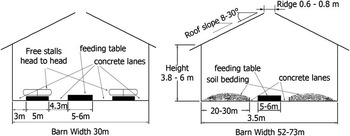
Three barn types are commonly used in Israel: loose housing is the dominant type, which accounts for 92% of barns in Israel, provides 22 m2/cow, including a bedding area of 16 to 18 m2/cow; corral, commonly used only in dry areas, accounts for 1%, provides 20 m2/cow, of which 8 m2/cow reserved for bedding, the rest being an open concrete-paved yard; free-stall barns, which account for about 7% (personal data), provide 10 m2/cow and are commonly equipped with head-to-head stalls and two concrete lanes without an open yard (Figure 1). Corral barns are no longer compliant with contemporary environmental regulations, and therefore they were excluded from this study.
Section of typical barn types: left – free stalls, and right – loose housing.

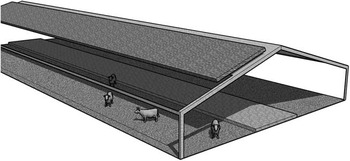
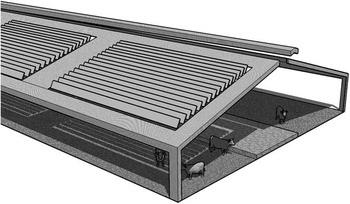
Until recently, Israeli barn design included an adjacent open yard where the cows tend to lie, mostly at night when the temperature difference between body and ambience is at most. Contemporary environmental regulations forbid cows’ assembly in an open yard during the rainy season (October to April) in regions where yearly precipitation is above 20 mm (most of the country). Heat stress may also develop during the rainy season; thus, in order to reduce heat accumulation a mobile-roof design was introduced. Two mobile-roof designs are commonly used: sliding roof, in which ∼50% of the roof slides can be opened (Figure 2); and shutter roof, in which ∼40% of the roof can be opened automatically, in response to the sun's relative position (Figure 3).
Structure with sliding roof.

Structure with shutter roof.

During the summers of 2004 and 2005 ambient conditions in 39 barns in 34 different locations were recorded. Four roof types were compared, including: conventional, single slope, sliding and shutter. Roof ridge for the conventional roofs include: open ridge, and pagoda, that is, open ridge surmounted by a cover.
Measurements
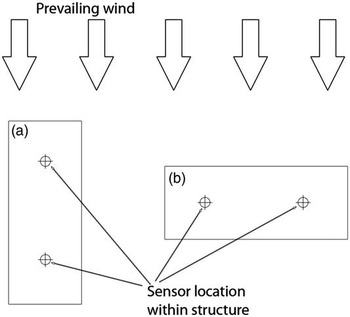
Two meteorological stations were installed inside each barn, mounted 2.2 m above the bedding (Figure 4), and a third station was mounted in an open field, clear of obstacles, 6 m above the ground (to reduce distortion of the measurements) and ∼50 m from the barn, in the prevailing upwind direction. Measurements conducted in and near each barn for 3 to 5 consecutive days during the summer included: ambient temperature and relative humidity with a CS500 temperature and humidity probe (Campbell Scientific, Logan, Utah, USA); radiation with an LI-2005Z pyranometer (LI-COR, Lincoln, Nebraska, USA); wind speed with a Rimco cup anemometer (Rauchfuss, Melbourne, Australia), which was tested in a wind tunnel and was found responsive starting at 0.2 m/s; wind direction; and black-bulb temperature. Data were recorded every minute throughout the day, and 10-min averages were recorded with a CR10 Micrologger (Campbell Scientific). Before determination of THRT, as formulated by Berman (Reference Berman2005), the water vapor pressure (WVP) was calculated according to Stamov et al. (Reference Stamov, Cendov, Nachef, Markov, Stoichkov, Kyrili, Kyrov and Karlson1990):
 $$ {WVP\,=\, 271.98\times {{10}^{{\rm{ - }}5}} (0.01\times (273.16 + T)\,\cr &{\rm{ - }\,1.628)^8} \times Rh\; \; {\rm{(0}}{\rm{.1)}}$$
where WVP is the water vapor pressure (kPa), T is the ambient temperature (°C) and Rh is the relative humidity (%).
 $$ {THRT\,=\,33.7 + 7.9\times V\,{\rm{ - }}\,3.8\times {{V}^2} \,{\rm{ - }}\,3.3\times WVP \cr &+ 1.6\times V\times WVP\; \; {\rm{(0}}{\rm{.1)}}$$
where V is the wind speed (m/s).
Overhead view of sensors’ location in structure with respect to wind direction. Different structures with respect to direction of prevailing wind: (a) narrow side facing prevailing wind; (b) long side facing prevailing wind.

Simulation and statistical analysis
In the present study we adopted the formula proposed by Berman (Reference Berman2005), which assumes a cow with a fur thickness of 3 mm and a daily yield of 45 kg milk with 3.5% fat.
Statistical analyses were based on the GLM procedure of SAS (SAS, 1992) with THRT as the dependent variable. All statistical models were based on repeated measurements, and the significance of the difference between least squares means (LSMEANS) categories of each parameter was measured as the probability difference (PDIFF). Three measurement stations were installed in each site. One of the stations was placed outside, in the vicinity of the barns. The data collected by this outside station were used as covariate so that measurements taken at different sites at different dates could be compared.
Barn characteristics were used as independent variables for the THRT model. For the statistical analysis, characteristics were grouped into the following categories: type of barn: free stalls, loose housing; orientation: north-south and east-west; marginal height (H): (a) 3.9 ⩽ H < 4.3, (b) 4.3 ⩽ H < 4.7, (c) 4.7 ⩽H < 5, (d) 5.0 ⩽ H < 6.0; roof slope (S): (a) S < 12%, (b) 12 ⩽S < 15%, (c) 15 ⩽ S < 22%, (d) 22 ⩽ S < 30%; roof type: single slope, shutter, slide and conventional; roof ridge: single slope, open ridge and pagoda; and barn width (W): (a) 18 ⩽ W < 30, (b) 30 ⩽ W < 42, (c) 42 ⩽ W < 51, (d) 50 ⩽ W < 64. Interactions between barn characteristics and time of day (morning, noon, evening, night) were taken into account.
Results
Barn type
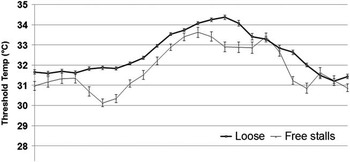
The daily mean THRT in free-stall structures (31.6°C) was found to be lower than that in loose housing (32.1°C). The difference in favor of loose housing was evident throughout most hours of the day (P < 0.05; Figure 5).
Diurnal average changes in threshold temperature during the day in barn types: loose housing (▪) and free stalls (◊). Bars denote standard error of the mean.

Barn orientation
In most farms the prevailing wind direction was between 290 and 300°, which is typical for the local summer.
Barns oriented north-south (perpendicular to prevailing wind direction) were found to have higher daily mean THRT than east-west oriented ones: 32.7°C and 31.8°C, respectively (P < 0.05), and this difference was consistent throughout most of the day except around midday, that is, 1100 to 1300 h. The advantage of the north-south orientation was evident in both loose-housing and free-stall barns, but was greater for the free-stall barns: the difference in THRT between the two orientations was 1.4°C for free-stall barns and only 0.4°C for loose housing.
Roof ridge
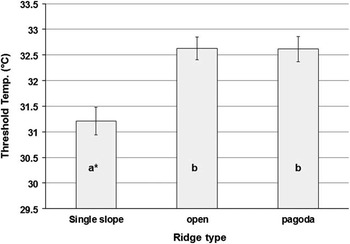
Single slope was least effective with regard to its effect on THTR compared with open ridge and pagoda. However, no statistical difference was observed between open ridge and pagoda (P > 0.05; Figure 6). Barn orientation had no significant effect on THRT for any given ridge type.
Effects of ridge types on least square means of threshold temperature ± s.e.m. Bars denote standard error of the mean. *Means marked with different letters are significantly different (P < 0.05).

Roof slope
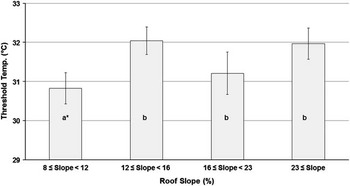
Roof slopes below 12% were found inferior to all others (P < 0.05; Figure 7), among which no significant difference was observed.
Threshold temperature with various roof slopes. Bars denote standard error of the mean. Means marked with different letters are significantly different with P < 0.05.

Marginal height
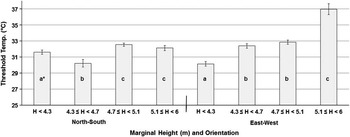
As the marginal height of the structures increased from 2.5 to 6 m, the THRT rose accordingly (P < 0.05). Marginal height above 5 m was superior to others (P < 0.05). However, the interaction between structure and orientation elicited that in north-south orientation the THRT of marginal height above 4.7 m was significantly higher than marginal height below it (Figure 8; P < 0.05). In east-west orientated structures the marginal height above 5 m was superior to all other marginal heights below it within the same orientation but also to all other combinations.
Effects of marginal height and orientation on threshold temperature. Bars denote standard error of the mean. Means marked with different letters are significantly different (P < 0.05).

Barn width
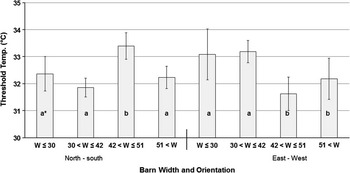
The interaction between barn width and orientation with respect to THRT was significant (Figure 9; P < 0.05). In north-south-oriented structures, widths in the 43 to 51 m range were superior compared with lower width of 43 m but also to higher than 51 m. For barns oriented east-west higher width than 42 m was found to be inferior compared with lower width of 42 m.
Effects of barn width (W) and orientation on threshold temperature. Bars denote standard error of the mean. Means marked with different letters are significantly different (P < 0.05).

Roof type
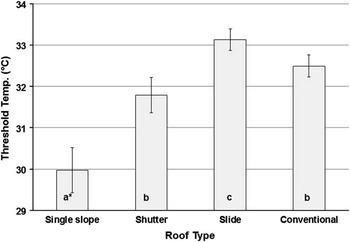
The sliding roof was found to lead to a significantly (P < 0.05) higher THRT than all other roof types (Figure 10; P < 0.05), whereas no significant difference was observed between shutter and conventional roofs. Single slope roof was found by far inferior compared with the others. Interactions between roof type and barn orientation indicated that all roof types achieved results, similar to the above, for north-south-oriented barns, whereas for east-west-oriented barns the THRT of shutter and sliding roof were found to be similar (P > 0.05) to one another and better than the conventional roof.
Effects of roof type on threshold temperature. Bars denote standard error of the mean. Means marked with different letters are significantly different (P < 0.05).

Discussion
During 2000, a constitutional reform was applied to cattle husbandry in Israel in order to comply with contemporary environmental regulations that aimed to prevent water and soil contamination by waste seepage. The new regulations banned the raising of cattle in open yards, and this stimulated the erection of barns of various types, sizes, orientations and roof types.
Under hot conditions and with natural ventilation, the respiration rate of a cow housed in a free-stall barn will increase earlier compared with loose housing. This could be partly attributed to the greater animal density in free-stall barns, but it could also be due to the presence of typical additional structural elements, such as dividers, columns and embankments, that obstruct air flow. This hypothesis was supported in the present study by the finding that the difference in THRT between north-south- (which was perpendicular to the prevailing wind) and east-west-oriented free-stall barns was higher (1.5°C) than in loose-housing barns (0.6°C).
Open barns are ventilated mainly by natural air flow, which has a significant influence on THRT, as confirmed by the present finding that ambient temperature and relative humidity were not significantly different between the two sides (west and east side) of barns that were oriented north-south, while wind air speed significantly decreased during passage of the wind through the barn. These results do not agree with those of temperature measurements near the cows, in which wind speed was ignored (Stowell et al., Reference Stowell, Gooch and Inglis2001a). Cow congregation might also be influenced by wind speed, a hypothesis that is supported by observations that cow congregation was less severe in north-south than in east-west orientated barns (personal observations).
We found that the orientation of the barn in relation to the prevailing wind direction significantly affected cows’ heat-stress relief in both loose-housing and free-stall barns, a finding that is compatible with those of Barrington et al. (Reference Barrington, Zemanchik and Cheiniere1994) who indicated that ventilation rates rely heavily on the exposure and orientation of the building relative to prevailing winds. The effect should be more pronounced in structures that are designed for free ventilation and thus do not have closed side walls as described by Barrington et al. (Reference Barrington, Zemanchik and Cheiniere1994).
When the marginal height of the barns was less than 4.3 m it was found that orienting a barn perpendicular to the prevailing wind led to better THRT levels than a parallel orientation, but no significant effect of marginal height on THRT was observed in structures with marginal heights over 4.8 m in north-south-oriented barns. These findings support the conclusions of Bray et al. (Reference Bray, Beede, Delorenzo, Wolfenson, Gresig, Bucklin and Means1990) and of Stowell and Bickert (Reference Stowell and Bickert1994). However, structures that are oriented east-west oriented barns (i.e. parallel to the prevailing wind) showed significant effect of marginal height above 5 m. This result might indicate that higher marginal height of east-west-oriented barns is required to compensate for the lack of air circulation.
It is evident in the present findings that barns oriented east-west are tended to cause earlier heat-stress conditions if the width is greater than 42 m compared with 51 m in north-south-oriented barns. It might give a clue that natural air circulation in the former direction is inferior compared to those barns which its longitudinal axis of which is perpendicular to the prevailing wind. Better air circulation might also be the reason of the relative advantage of width between 43 and 51 m in north-south oriented compared with either narrower or wider structure widths.
Zappavigna and Liberti (Reference Zappavigna and Liberti2002) demonstrated that wind-driven ventilation was the dominant factor for environmental control, and that adequate barn orientation and matching sidewall height contributed to maintaining animal condition. These results are in agreement with our present findings.
In the present study, increasing roof slope above 11% contributed to reduction of animal stress, but unlike the findings of Armstrong et al. (Reference Armstrong, Hillman, Meyer, Smith, Stockes and Harner1999) further increases in slope did not achieve further improvement in THTR.
Our results, showing similar effect on THRT of open ridge and pagoda are not in agreement with results of Armstrong et al. (Reference Armstrong, Hillman, Meyer, Smith, Stockes and Harner1999) who showed the advantage of open ridged roof over pagoda.
In our study it was also clearly evident that single slope was not only inferior to open ridge and pagoda but also inferior to other roof types (i.e. conventional roof, sliding and shutter). As to our knowledge no such results were previously published.
As mentioned above, open-roof technology was developed in Israel in order to conform to new regulations that aimed to reduce environmental contamination. Two roof technologies were developed and adopted: sliding roof and shutter roof. Our results showed the sliding roof to be more effective in minimizing animal heat stress. We suggest that, as long as the roof sliding is from the outer edge inwards so that the area that is covered is smaller, it reduces the effective barn width, and thereby contributes to improved climatic conditions inside the barn.
Summary
The present study was the first to employ a novel heat-stress model that enhanced other contemporary models by taking the effect of wind velocity into account. It generated the following findings:
(a) Of the barn types commonly used in Israel, loose housing proved superior to free stalls in relieving heat stress in cows.
(b) Barns should be oriented so that the longitudinal axis is perpendicular to the direction of the prevailing wind.
(c) Marginal height should be over 5 m for east-west-oriented barns, whereas it could be slight lower for north-south oriented ones.
(d) No significant improvement was gained by increasing roof slope beyond 11%.
(e) The optimal barn width lies between 43 and 51 m for north-south-oriented barns and between 19 and 42 m for east-west-oriented barns.
(f) Open ridge roofs and pagoda (i.e. capped-gable) were superior to single slope but did not differ from each other.
(g) Use of sliding roofs improves environmental conditions for the animals. Among the existing systems, the sliding roof proved better than the shuttered roof.
Acknowledgments
This work was partially funded by the Israeli Milk Marketing Board. The authors wish to express their gratitude to them, to the dairy farmers who cooperated in the project and to R. Brikman and A. Levi for their assistance.