


Introduction
The flow law of polycrystalline ice is of primary importance in modelling the movement of glaciers and ice sheets. The relationship between the minimum strain rate ε’ij and deviatoric stresses σ’ij for laboratory-prepared polycrystalline ice is well described by the relation

(τ is the effective shear stress). The constant B is a specific function of the temperature and orientation of crystals. According to laboratory experiments the exponent n ranges from 1 at low stresses to 3 at stresses >105Pa (Reference HookeHooke 1981). Inclinometer data of bore holes can be explained by a flow law where n<2 (Reference Doake and WolffDoake and Wolff 1985, Reference Duval and LliboutryLliboutry and Duval 1985, Reference Pimienta, Duval and LipenkovPimienta and Duval 1987). Lattice and grain-boundary diffusion are too slow to explain this low value of the exponent. A kind of superplastic behavior linked with grain-boundary migration has been suggested by Reference Duval and LliboutryDuval and Lliboutry (1985). It seems to have been demonstrated that dislocation glide accommodated by grain-boundary migration controls the deformation of polar ice (Reference Pimienta, Duval and LipenkovPimienta and Duval 1987).
Studies of deep ice cores have revealed the formation of strong single-maximum fabrics (Reference Gow and WilliamsonGow and Williamson 1976, Reference Russell-Head and BuddRussell-Head and Budd 1979, Herron and others 1985). The development of these fabrics must be analyzed in relation to the deformation mechanisms discussed above. The rotation of c-axes by dislocation glide seems to be the mechanism for the formation of fabrics in polar ice (Pimienta and others 1987). A quantitative relationship between the rotation angle of c-axes and the cumulative strain in uniaxial compression was obtained by Reference Azuma and HigashiAzuma and Higashi (1985); it describes very well the development of a broad single-maximum fabric in the first 800 m of the Dye 3 core. The rotation of crystals becomes easier because grain-boundary migration occurs to accommodate the incompatible deformation that arises in neighboring grains of different lattice orientation.
A clear relationship between strain-rates and fabrics has been shown both by laboratory tests and by bore-hole tilting measurements (Reference Russell-Head and BuddRussell-Head and Budd 1979, Duval and Le Gac 1982, Shoji and Lang way 1984). Fabric enhancement factors can have a value of 10 with a strong single-maximum fabric and a value of 0.1 in the case of hard basal glide (Pimienta and others 1987). An impurity enhancement factor has also been suggested to explain the low viscosity of glacial ice in several ice cores (Reference Shoji and LangwayShoji and Langway 1984). Indeed, high levels of impurities are found in samples from glacial stages (Petit and others 1981, Reference Palais and LegrandPalais and Legrand 1985, De Angelis and others 1987).
A good opportunity to verify the influence of these factors on the viscosity of ice was provided by study of the 2083 m Vostok ice core. This core was drilled at Vostok Station (Antarctica) by members of the Soviet Antarctic Expeditions. A 150 000 year climatic record was obtained from this core (Lorius and others 1985). A very detailed profile of soluble and insoluble impurities is given by Legrand and others (in press). In this study we have examined the mechanical behavior of several samples from different depths.
Experimental Procedure
Specimens
Six ice-core samples were selected over the profile from depths of 1025, 1425, 1507, 1806, 1852 and 2039 m. The δ18O profile given by Lorius and others (1985) indicates the successive climatic stages. The 1806 and 1852 m ice samples date from the last interglacial period, whereas the 1025, 1425, 1507 and 2039 m samples date from cold periods. These samples were free of cracks before each test. Their ice fabric is given in Figure 1, with histograms showing the angular distribution of the c-axes. A detailed analysis of the anisotropic behavior of the 2039 m ice sample is given by Pimienta and others (1987).
Biaxial compression tests
The testing apparatus was the biaxial press described by Duval and others (1982). It has been designed for deforming ice samples in compression in two perpendicular directions at constant velocities. Samples were rough-cut with a band-saw and the surface was finished with a microtome to about 5×5×5 cm3. Specimens were prepared so that the applied stresses were along the symmetry axes of the fabric.
Compression–creep tests
Uniaxial compression–creep tests were conducted with the torsion–compression apparatus described by Reference DuvalDuval (1979). Samples were cylindrical, with a diameter of 57 mm. They were prepared so that the symmetry axis was along the core axis. The torsion–compression apparatus and the biaxial press were put in a laboratory cold-room which was kept at −15 ±0.1°C. The temperature of samples was measured during the experiments. The maximum temperature fluctuation was 0.2 °C for each test.
c-axis orientation of ice samples along the 2040 m Vostok core. The core axis is YY’


Experimental Results
Results of the biaxial and uniaxial compression tests carried out with the biaxial press on several samples from between 1025 and 2039 m are presented in Table I. Biaxial tests were performed by compressing samples along the XX’ and YY’ axes (cf. Fig.1). In uniaxial compression tests, ice samples were compressed along the ZZ’ axis. These stress configurations were selected in order to estimate the ice viscosity in the in-situ stress field. The constant B of the flow law where n = 3 varies between 0.6 and 1.9 MPa−3 a−1. The value of B for isotropic ice being about 10 MPa−3 a−1 at –15°C (Pimienta and others 1987), the enhancement factor is therefore smaller than 1. This is because the fabrics shown in Figure 1 do not promote basal glide when ice samples are compressed as indicated above.
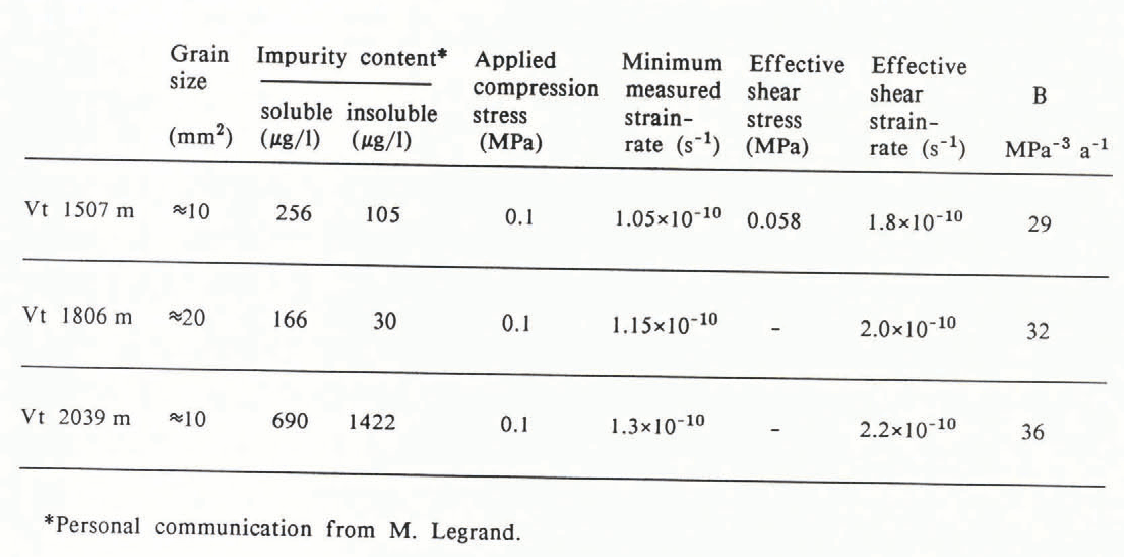
Table II gives results obtained in compression-creep tests. Samples were compressed along YY’, i.e. along the core axis. We have quoted the strain-rates measured at the end of experiments. The total strain was about 10−3 for each test. There was no significant variation of the minimum creep rate in samples.
Results given in Tables I and II show no evident correlation between the viscosity of ice and impurities, in spite of important variations in the impurity content, especially in the ice samples from 1806 and 2039 m.
Discussion
As stated above, the viscosity of the ice samples from the Vostok ice core which have been studied does not change significantly with depth. The high concentration of soluble and insoluble impurities in the 2039 m ice sample does not appear to modify its mechanical behavior. This assertion is possible because the variation with depth of the fabric-enhancement factor is probably very small, as indicated in Figure 1. At Byrd Station or Dye 3 the change in the impurity content is accompanied by a concomitant change in the orientation of crystals (Reference Gow and WilliamsonGow and Williamson 1976, Reference Herron, Langway, Langway, Oeschger and DansgaardHerron and Langway 1985, Herron and others 1985, Reference Palais and LegrandPalais and Legrand 1985). It is therefore very difficult to separate the influence of both parameters. For the ice sample from 1814 m depth of the Dye 3 core an enhancement factor of about 10 was found by Reference Shoji, Langway, Langway, Oeschger and DansgaardShoji and Langway (1985). A maximum value of 4 was assumed for the fabric-enhancement factor. The remnant factor of 2–3 was therefore caused by impurities. If, as shown by these experiments, impurities do not influence the mechanical behavior of Vostok ice, the enhancement factor must be caused only by the preferential orientation of the c-axes. By assuming that the ice fabrics given in Figure 1 result from the rotation of basal planes by intragranular slip, Vostok ice should be deformed in tension along the horizontal ZZ’ axis down to 2040 m (Pimienta and others 1987). This strain field is very close to that imposed by the biaxial pressure. Therefore the in-situ viscosity of Vostok ice must be high in comparison with that of isotropic ice. The orientation of c-axes in a vertical plane (Fig.l) indicates that the horizontal shear is probably of little significance along this core. But Vostok Station is located on the high Antarctic plateau, where the ice thickness is 3700 m and the surface slope is smaller than 2 ×10⁻³. On the other hand, the horizontal shear, which increases with depth, will settle more slowly than in other polar ice cores with a broad single-maximum fabric. Indeed, at Byrd Station and Dye 3, the vertical compression in the first 100 m induces the formation of a broad vertical single maximum. This fabric promotes the horizontal shear which itself induces the strong vertical maximum fabric. The high enhancement factor for the horizontal shear in the Dye 3 core is probably caused only by the vertical orientation of the c-axes. However, this study on the Vostok core cannot be compared in all respects with other cores, which show very different fabrics.
Conclusion
Mechanical tests were carried out in the laboratory on the 2040 m Vostok ice core. The ice viscosity does not change significantly with depth and is not influenced by impurities.
The enhancement factor, measured in various stress fields, appears to be caused mainly by the orientation of the c-axes.
Acknowledgements
We are grateful to Soviet participants in drilling, field work and ice sampling. This work was supported in France by PNEDC (Programme National d’Etudes de la Dynamique du Climat) and in the U.S.S.R. and on Vostok Station by members of the Soviet Antarctic Expeditions.



