Background
User Experience Surveys have become an integral part of monitoring quality and ensuring accountability of public-sector services in Britain (Chesterman, Bauld and Judge Reference Chesterman, Bauld and Judge2008; Edwards and Staniszewska Reference Edwards and Staniszewska2000; Francis and Netten Reference Francis and Netten2004). Consistent findings from these surveys show that people from Black and Minority Ethnic (BME) groups are less satisfied with social services compared with the ‘White’ group (e.g. NHS Information Centre 2012; NHS Information Centre Adult Social Care Statistics 2009). This finding is important because services should be appropriate for the whole population, and also because satisfaction leads to greater compliance and future help seeking (Hausmann et al. Reference Hausmann, Gao, Mor, Schaefer and Fine2013; Williams Reference Williams1994). The present study aimed to use qualitative methods to explore the experiences with adult social care services among people from two broad ethnic groups: South Asian and White British.
Literature review
Defining ethnicity
Ethnicity can be defined as a sense of belonging to a group of people because of a shared culture, religion, language, skin colour or ancestral homeland (Bulmer Reference Bulmer, Coleman and Salt1996; Modood et al. Reference Modood, Berthoud, Lakey, Nazroo, Smith, Virdee and Beishon1997). Ethnicity is a self-defined and socially constructed label, which is fluid and can alter throughout life depending on experience or commitment to a sense of ethnic identity (Fanshawe and Sriskandarajah Reference Fanshawe and Sriskandarajah2010).
In the present study the terms ‘South Asian’ and ‘White British’ are used. The focus in this study was on a small number of ethnic groups, because studying only a few groups in greater depth enables a more nuanced understanding. Having said that, the term ‘South Asian’ refers to a heterogeneous group, incorporating a great diversity of religious, cultural, national and linguistic groups originally from the Indian sub-continent (comprising India, Pakistan and Bangladesh). This choice therefore provided an excellent opportunity to explore many locations of ‘difference’ and how these might influence satisfaction with services. It was also important to include a comparison group of the majority population, White British, in order to identify which aspects of satisfaction are related to religion, language, culture, and so on, and which aspects are more universal. White British is also a heterogeneous group, with their own ethnic identity that may influence their experience of services, and it is important to capture their distinctive views.
Defining social care
In this study, social care was defined as help or support with activities of daily living provided or funded by the public sector. This support involves, among other things, visits from a domiciliary care worker to help a client bathe, delivered meals, a placement at a day centre, adaptations to a home such as grab rails and long-term residential care in a care home.
Defining satisfaction
Satisfaction is an affective state which is a state of ‘contentedness’ with one's experience (Hills and Kitchen Reference Hills and Kitchen2007: 245). The concept of satisfaction is complex, and satisfaction is informed both by expectations of, and experiences with, services (Thompson and Sunol Reference Thompson and Sunol1995). Expectations are shaped by past experiences and social norms (Collins and Nicolson Reference Collins and Nicolson2002).
Satisfaction with social care
There is a large body of literature on satisfaction with health care (Owens and Batchelor Reference Owens and Batchelor1996), while literature on satisfaction with social care is relatively scarce (e.g. Bauld, Chesterman and Judge Reference Bauld, Chesterman and Judge2000). Factors leading to satisfaction can be divided into characteristics of the service and characteristics of the service user. Aspects of the service that lead to higher satisfaction are similar in both health care and social care, including: the care staff's manner such as respect, cheeriness and warmth (Francis and Netten Reference Francis and Netten2004; Henwood, Lewis and Waddington Reference Henwood, Lewis and Waddington1998; Townsend and Kosloski Reference Townsend and Kosloski2002); a caring attitude (Collins and O'Cathain Reference Collins and O'Cathain2003); a willingness to do more than stated in the care plan (Francis and Netten Reference Francis and Netten2004); punctuality (Townsend and Kosloski Reference Townsend and Kosloski2002); continuity of staff (Henwood, Lewis and Waddington Reference Henwood, Lewis and Waddington1998; Manthorpe et al. Reference Manthorpe, Moriarty, Rapaport, Clough, Cornes, Bright and Iliffe2008b ); skilled staff (Francis and Netten Reference Francis and Netten2004; Manthorpe et al. Reference Manthorpe, Moriarty, Rapaport, Clough, Cornes, Bright and Iliffe2008b ); and minimal bureaucracy or red tape (Townsend and Kosloski Reference Townsend and Kosloski2002). Turning to the characteristics of the patient or service user, Hall and Dornan's (Reference Hall and Dornan1990) review found that the most satisfied patients are white, male, older, of a higher social class and married. These characteristics are linked to power and privilege, suggesting that people in less advantaged groups may not have the same expectations of, or experiences within, services. More accurate and clear expectations have been associated with higher satisfaction with respite services (Townsend and Kosloski Reference Townsend and Kosloski2002). Finally, family carers of people with dementia who had little support from friends and relatives reported lower satisfaction with respite services compared to more supported family carers (Nicoll et al. Reference Nicoll, Ashworth, McNally and Newman2002).
Ethnicity and satisfaction with social care
As mentioned earlier, User Satisfaction Surveys have consistently revealed lower satisfaction with social care services among minority ethnic groups compared with the White group (NHS Information Centre 2011, 2012). For example, the 2012–13 Personal Social Services Adult Social Care Survey found that the Asian/Asian British and the ‘Other’ ethnic groups were the least likely to say that they were ‘extremely or very satisfied’ (54%), compared with 65 per cent of the White group (Health and Social Care Information Centre 2013).
In other studies, factors which have been shown to be important to BME service users include the care staff speaking the same language as the client, and care staff understanding a client's specific customs and food needs (Francis and Netten Reference Francis and Netten2004). Certain good examples of culturally appropriate care have been reported, e.g. residential care in Scotland where residents were assisted to observe fasting times (Bowes, Avan and Macintosh Reference Bowes, Avan and Macintosh2011), although particular issues of cultural insensitivity were noted in other studies (Hubert Reference Hubert2006).
The stereotype that people from South Asian groups tend to ‘look after their own’ and have large close-knit extended families and community networks (Murray and Brown Reference Murray and Brown1998) is evident in some of the literature. For example, in the study of elder abuse in Scotland by Bowes and Avan and Macintosh (Reference Bowes, Avan and Macintosh2008), BME participants reported that the services assume that their input is not required. Similarly, in Hubert's (Reference Hubert2006) study of carers of people with learning disabilities in London, an Indian carer reported that their social worker did not check up on them because of an assumption that there was an extended family network providing care. Instead, the majority of care was provided by a single family member, as previously reported by Katbamna et al. (Reference Katbamna, Ahmad, Bhakta, Baker and Parker2004) in their study of South Asian carers. The stereotype is not limited to social care workers; it has also been found among general practitioners (GPs) (e.g. Bowes Reference Bowes2006) and manifested in the GPs not referring minority ethnic patients to relevant agencies such as housing or social care services (Manthorpe et al. Reference Manthorpe, Iliffe, Moriarty, Cornes, Clough, Bright and Rapaport2009).
The present study
The aim of the present study was to conduct individual in-depth interviews to explore experiences and satisfaction with social services among people from South Asian and White British groups. The research took place in Hampshire, Southampton and Portsmouth. South Asian groups formed 6.9 per cent of Southampton's and 4.8 per cent of Portsmouth's population in the 2011 Census (Office for National Statistics 2012). Most research on ethnic diversity in Britain has taken place in larger cities with a high proportion of BME groups. Minority ethnic groups in the predominantly ‘White’ South of England, in contrast, have been under-researched to date. The majority of users of adult services are older people, which is reflected in our sample.
Methods
Sample
In total, 46 service users and 36 family carers were interviewed, from South Asian (N = 39) and White British (N = 43) backgrounds. They represented a variety of faiths, including Hindu, Sikh, Muslim and Christian. There were also some atheists and agnostics. The service users' ages ranged from 25 to 90 (modal age category 70–79). The family carers' ages ranged from 18 to 82 (modal age category 60–69). The needs of service users, and those cared for by family carers, included physical disabilities, chronic health conditions, mental illnesses, dementia and learning disabilities. Participants used the following services provided by or funded through the local authority: day centres, lunch clubs, domiciliary care, meals-on-wheels, care homes, respite care, received direct payments, had an adaptation made to their home, and culturally specific day centres, lunch clubs and carers' groups. Many of the South Asian participants used culturally specific services but some also used mainstream services. Thirty-nine service provider/practitioners were also interviewed, but those data are not the focus of this paper.
Recruitment
A range of recruitment strategies was employed, informed by the advisory panel and gatekeepers. Recruitment packs were translated into relevant South Asian languages (Hindi, Gujarati, Bengali). Local authorities posted recruitment packs directly to existing service users. Researchers promoted the project at organised groups, e.g. day centres, lunch clubs, social clubs, temples and churches. The research fellow volunteered at a culturally specific carers' group. An information stall was held at the Southampton Mela, an Asian arts festival, and another at a pre-Christmas arts and crafts fair. Two of the research team speak a range of South Asian languages, which helped facilitate recruitment events. Posters advertising the project were placed in shops, libraries, GP surgeries and pharmacies. Finally, the snowballing technique was used, where participants were asked to suggest members of their social network as potential participants. Ethical approval was granted by the Social Care Research Ethics Committee and the University of Southampton Research Ethics Committee, and research governance approval was granted by the three Local Authorities in the study area. The project was funded by the National Institute for Health Research School for Social Care Research.
Interview procedure
Qualitative in-depth interviews were carried out by two of the research team. One of the researchers was British Indian, and conducted interviews in Hindi and Gujarati where required, and also in English. The other researcher was White Irish, and conducted interviews only in English. Ethnic matching for the interviews was not planned, but this sometimes happened as a result of language matching. Both interviewers were female, so gender matching was not possible with male participants. Interview guides were developed with the help of the advisory panel, piloted and revised. There were similar guides for service users and carers, although the focus of the questions differed (e.g. ‘the service you receive’, or ‘the service your relative receives’). The interview questions did not assume that South Asian participants would have had poorer experiences than White British participants, despite the findings from the national surveys. Thus, the possibility was allowed that issues of service quality and the evaluation of satisfaction may have little to do with ethnicity or culture (or religion, or language, etc.). However, those issues were probed for specifically within the interviews with the South Asian participants. Interviews were carried out at a place and time convenient to the participant, e.g. the participant's own home, their day centre or the university. Interviews lasted between 30 and 90 minutes. Informed consent was received from all participants.
Analysis
Interview recordings were transcribed, translated into English where necessary and anonymised. The data were analysed using thematic analysis (Braun and Clarke Reference Braun and Clarke2006) facilitated by the NVivo 10 software. An open coding approach was adopted, where codes are used to categorise topics and meanings in the transcripts without a pre-existing code list (e.g. ‘staff really care’ and ‘day centre closed’). The content of these initial codes was compared using constant comparison, and codes of similar meaning were merged or renamed as appropriate (Mason Reference Mason2002). Later, codes were moved into clusters of the same type of concept to form coding trees (e.g. ‘interpersonal skills’ and ‘service structure’). The relationship between the clusters of codes and the research question was explored using conceptual models in NVivo, and tested for robustness by returning to the data fragments and the full transcripts to view the quotes in their original context. Differences between ethnic groups, religions and project role were considered using matrix queries in NVivo. Names were given to the resulting explanations for differences in satisfaction with social care services; these were the themes that emerged from the data. The exploration of the participants' experiences resulted in an overarching theme called understanding of the social care system. Two members of the research team coded the interviews, held coding meetings and revised the coding strategy. After coding, themes were proposed and tested in the data. Analysis meetings with the whole research team refined the themes, and the team collaborated in writing up the findings. Themes were discarded if they did not have enough evidence to support them. Other themes were strengthened and amended through the process of exploring the data, and discussion within the team. At times in the results section the frequency of particular codes or themes in each ethnic group is reported. Although coding frequency is not an indication of importance or quality of a theme, it is relevant to examine whether some topics are raised more by one group than the other since the research question necessitates comparing the perspectives of White British and South Asian participants. However, caution should be applied to these numbers, because not all topics were discussed in all interviews, as befits the nature of semi-structured interviews. Identification labels were given to each participant following their role in the project: family carer (Carer), service user (SU); their participant number; and their ethnicity: White British (WB) or South Asian (SA). Thus, the abbreviation ‘SU 10, WB’ refers to a White British service user who was the tenth service user interviewed.
Findings
The main theme that distinguished satisfied from dissatisfied participants was understanding of the social care system, which enabled working with the system. This theme was more important than ethnicity in explaining reasons for satisfaction. Other factors leading to satisfaction were continuity of care and good workforce skills. Experiences with social care were broadly similar among the White British and South Asian participants. There were some aspects that differed, including language, religion, food and expectations of family care, which will be discussed later.
Understanding of the social care system
Participants could be distinguished from one another by whether or not they had a good understanding of how social care services were organised, funded and operated. Participants who had a good understanding tended to discuss the more structural and organisational aspects of the social care system, although the structural aspects were not the only aspects of care they discussed. These participants were able to lay blame for problems with their care on the ‘system’ rather than the individual care staff:
I think the actual provision of the services in most cases is very good and the carers do a very good job under very difficult circumstances with a very wide spectrum of needs and personalities of the person they're providing the care for. It's just the whole red tape and the amount of paperwork, how it's funded is always seen as an issue. (Carer 33, WB)
In contrast, participants who did not understand the social care system were often frustrated because they could not identify the cause of any problems with care. They did not know why day centres had been closed, or why they were not entitled to more hours of domiciliary care. These participants did not discuss the organisational aspects, and instead focused more on their unmet need:
Well, I used to go to [day centre] … And they've taken on different people – I had a letter to say I was not suitable to go. And I think they're taking people that take a while to learn things – have difficulty in learning – and are paying to go there. I don't know much about it, really. All I know is I had a letter to say I can't go. (SU 10, WB)
So that lady told me, that, sorry, she says, you are not physically disabled or anything. You can do all that, so we can't take you as a member [of a carers' group]. I said why not? If all people are coming here then why are we not? (SU 44, SA)
White British and South Asian participants were represented among both those who had a good understanding of the social care system, and those who did not. However, there were more White British (N = 31/43) than South Asian (N = 13/39) among those with a good understanding, and more South Asians (N = 23/39) than White British (N = 6/43) among those with a poor understanding (other participants were classified as having a ‘mixed’ understanding).
Working with the system
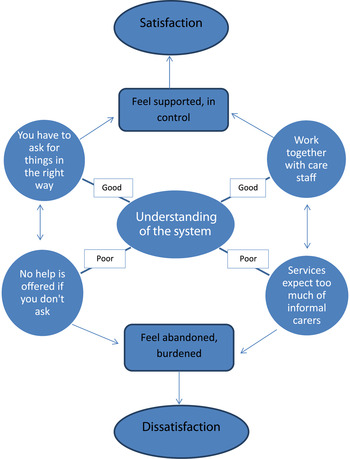
Figure 1 portrays a model of the theory of the way the component nodes of working with the system relate to understanding of the system and satisfaction. To the left of the model are two nodes relating to asking for help. Some service users and carers understand how to work within the system, or ask for things in the right way. Those who have not reached this point are dissatisfied, because their experience is that no help is offered if you don't ask. The participants who ask for things in the right way have a good understanding of the system, but those with a poor understanding do not know the ‘magic words’ that open the door to services.
Proposed theoretical model of how working with the system leads to higher satisfaction.

In the following quote, the White British participant explains how she discovered that she had to convey during the carer's assessment that she was no longer able to cope with caring for her disabled daughter at home. She had felt that she needed to portray a strong face to the world, and it went against her inclinations to show how great her need was:
So when I was trying to get my daughter into a residential home, one social worker said, ‘You must have a carer's assessment and you have to have a carer's assessment that shows that you can't cope.’ And I'm actually the kind of person who can't bear to be thought not to be able to cope. So the advice that she gave me was just absolutely crucial because, I suppose I wasn't coping actually. (Carer 21, WB)
Once she learned how to ask for things in the right way, she was able to access the support she needed. Others reported that asking for things in the right way involved using certain trigger words, indicating that services respond to particular indicators of need:
They're not just simple forms – you have so many questions on them, and you have to explain, and you need to be making sure that you're using the right vocabulary too. (Carer 16, SA)
Unfortunately, not all participants knew what the correct trigger words were. The next participant could be said to have asked for help but not received it, because they did not ask in the right way:
Some magic wording … we don't know. How did they get that? I don't know (laughs). (SU 20, SA)
Other participants argued that one needs to know what is available in order to ask for something specifically. The full range of options was not offered to them:
There are so many things they [social services] provide, but we don't understand what is available and what is not available. There must be so many things we don't know yet. We don't know what we are entitled to or not. How can we get things if we don't know they exist? (SU 14, SA)
There was a sense of services rationing support, and only supplying it to people who knew the ‘magic words’ to ask for it. In other words, services wait for carers (or service users) to tell them that they need help, and therefore no help is offered if you don't ask, as described by a practitioner:
I think there's also been the belief that if people really need us [social services] they will come to us. Whereas a lot of the evidence and research quite clearly shows that for those client groups [BME groups] you have to physically be going to them and not look to [them to] come in. (Practitioner 39, WB)
Unfortunately, if people do not know that they have to ask for help, or even what service to ask for, this leaves them with unmet needs. Here, a South Asian participant reports that he was not offered any additional help to care for his father with dementia, and he did not know to ask for it because he assumed that was normal:
There was never any talk of any kind of additional care or respite or anything like that. We just took that as normal. (Carer 26, SA)
This participant went on to explain how the services told him that they knew he would not want their help, ‘because we were Asian there was an assumption that you're doing it all already anyway’. This experience acted as a barrier to him asking for help, because he felt guilty not living up to the assumption about Asian families.
To the right of the model are two nodes relating to the way family carers view their interactions with care staff. Some family carers felt that they have adapted to work together with care staff in order to ensure that the cared-for person's needs are met. They shared the load between them, and were satisfied. On the other hand, some family carers felt that the services were putting too much of the load on them, and that services expect too much of family carers.
This White British carer reported her reasoning for asking the domiciliary care worker to enable her mother to make lunch, which the care worker was happy to accommodate. This adaptation in activity worked to support not only the service user (Carer 28's mother), but also gave the family carer the sense that she was proactively making the best use of the offer from the services:
And we have changed it … and they were really happy to go along with that really, as long as my mum's okay with that. But because I just really feel the more my mum's able to do still, the better it is. So you know, I was making sandwiches for her at lunchtime and I thought, ‘Hang on, she could sit down and do this with the carer’ and then make it for dad as well and things like this … So yeah I think we work together and that's really good, yeah. (Carer 28, WB)
However, other participants felt burdened by the amount of care they still had to provide, even though they were receiving some help from services. These participants believed that services expect too much of family carers. Some carers said that they were allocated too few hours of care, and they had to cope alone for the rest of the day or week. Others reported that care workers could not carry out some tasks, such as lifting someone out of bed, due to health and safety regulations. In one case, an 85-year-old woman was required to lift her husband out of bed because the care workers said they were not allowed to. Two South Asian participants reported being expected to manage medical procedures for their parents during times when the care workers were not around, including injecting insulin, and as the following quote shows, fix a catheter:
If my Dad had a problem with his catheter say for example, they would, I mean the nurses would expect us to sort it out and I'm barely at home. My mum can barely speak English and it's just like they expect my mum to sort it out or us to learn it and it's like, it's not our job. (Carer 30, SA)
Continuity of care
A common source of dissatisfaction among both South Asian and White British participants was a lack of continuity of care staff, both domiciliary care workers and social workers. For domiciliary care this was linked to the nature of tasks involved, as participants felt more comfortable being helped with bathing by someone with whom they had developed a relationship. Other participants reported more practical concerns, e.g. that new care workers did not know how to work their shower. One White British participant explained that new care workers did not seem to know his case, and had not read his file in advance:
We'd like it to be the same people but they aren't and you have to explain what's got to be done and what's not got to be done, which isn't a good thing in my reckoning. I think it would be better if we had the same people looking after you all the time and they know what's what and what's good for you and what's not. Because one carer came in and put a lot of soap in the water and it brought my skin up something terrible, only because of not looking into things properly. (SU 03, WB)
Lack of continuity is particularly difficult when the care workers do not know what tasks they are needed for. They often expect the service user to tell them. One White British family carer said that her father with physical disabilities was too embarrassed to ask the care workers to help him bathe, and so the care workers used their visit to make him breakfast instead. The problems caused by lack of continuity of domiciliary care workers were intensified among South Asian service users, because of culturally specific needs that had been incorporated into the care plan. For example, one carer explained that his mother with physical disabilities should be bathed several times a day, but the care worker was confused by this:
But it's like when they tell them to do a job you've got to repeat it. ‘This is what we need doing.’ But they say, ‘Well she doesn't need it. She doesn't need washing, she's had a wash in the morning.’ I don't know about some people, we wash twice, a lot of Asians wash twice a day. They'll have a shower in the morning like five o'clock then they'll have a shower in the evening, some of them three times. But with English people, it's like, ‘Well you've had one, that's enough.’ (Carer 19, SA)
Continuity of care staff was also considered important when it came to social workers. Participants wanted to have the same social worker for the duration. However, there were reports that after the care package had been arranged the service user was dropped from the social worker's caseload. Participants reported feeling very unsettled by this. It meant that they did not have a named contact to call if there was a problem with the care package, or they needed a reassessment. Instead, they had to ring central numbers and leave a message, but sometimes this call back never came.
Workforce skills
The professional and interpersonal skills of social care staff (domiciliary care workers, care home staff, social workers and day centre staff) were discussed positively and negatively by many White British participants, but less so by South Asian participants. The White British participants valued social workers at assessment stage who were good listeners, who provided choices, ensured clients were not disabled by the care and were knowledgeable. Some social workers were criticised for not asking the right questions at assessment, leading to unmet need, or for not explaining the reasons for decisions about eligibility. In particular, social workers were criticised for a lack of understanding about the effect withdrawing a service would have on the service user. Interpersonal skills that were valued among social workers and care workers were empathy, understanding, politeness, respect, and friendliness. Service users and carers were reassured when it was obvious that staff members enjoyed their work. These quotes refer to social workers and sheltered housing staff, respectively:
Everybody that we've met from social services has been absolutely charming. You hear terrible stories about social services, don't you, but nobody we've met has been like – they've all been absolutely, really understanding, really empathetic. (Carer 14, WB)
The staff are really, genuine caring, genuinely caring people and again you see, for elderly people that's so reassuring. (SU 25, WB)
Both South Asian and White British participants reported feeling happy with the care they or their family members received, including these two family carers (who had relatives with dementia and physical disabilities, respectively) living in care homes:
Mum had her own room, and they were all like a family, the residents, the carers. I would recommend it, that place, to anybody, because it was such a lovely place. (Carer 18, WB)
And it's gone smoothly, touch wood, there's been no, you know, interruptions, any difficulties in the process in the past year, so that's what we're grateful for, was actually fine, they're looking after her, and she's happy with the care they give. (Carer 32, SA)
Domiciliary care workers, day centre staff and care home staff were praised for their warmth and caring attitudes. Problems identified with some care workers included speaking in a patronising way to clients, not being able to do household cleaning properly and being rough when providing personal care. Carers and service users were distressed when they perceived that service providers only cared about running a business, rather than providing care. A recommendation one family carer made was that staff involved in social services should live with a family carer and their cared-for person for a week so they could get a full understanding of what their lives are like.
Issues specific to Asian participants
Although there were some shared aspects between South Asian and White British participants, there were also aspects of experiences that were particular to the South Asian participants. These allow an examination of differences within the ‘South Asian’ group, including language, migration and religion. Many of the South Asian participants could not speak English, or had only a basic level of English, which reflects the fact that many of the older participants were first-generation migrants; some had lived in Britain for decades while others had moved relatively recently. This led to a practical difficulty in not only using services on a day-to-day basis, but also learning about services in the first place, which impacts on understanding of the system. The language needs of some participants were not met within mainstream services, and so culturally specific day centres, lunch clubs, sheltered housing and care homes were preferred as a result, even if it meant going out of the local area. Alternatively, a language-matched carer or social worker was wished for. For example, Carer 26 reported preferring to use a respite service where some of the staff members could speak Punjabi, because he believed that unmet language needs within respite care could add to the feeling of abandonment he anticipated his father would experience. Related to this was the idea of a friendly relationship built up with domiciliary care workers; if service users do not share a language with their care workers then this relationship is impossible. One South Asian carer spoke poignantly about his mother not having the English words to tell the domiciliary care workers that she was in pain, and so she had to wait three hours until he came home from work to ask for a painkiller:
And the carer, if [they could speak] Punjabi they could say to my mum, ‘What do you need? Any problems?’ My mum was in pain yesterday for three hours because the carer come and she couldn't tell them, she didn't know how to say ‘paracetamol’. (Carer 19, SA)
Language needs were also mentioned when participants were asked about whether they would prefer to have a care worker from the same ethnic background. Ethnic matching of care staff was not important in itself; it was the language matching that participants valued.
Several South Asian participants spoke about needing to have particular food provided, either at any day centre or care home they attended, or as a delivered meals service. Some people specified that they wanted spicy food and not English food, while many Hindu and Sikh participants said that vegetarian food suited all their religious requirements. Two participants had received Indian meals-on-wheels, but one person said the portions were too small as there were no chapattis – essentially meaning half the meal was missing. There are also limitations to culturally specific services and food – when cooking for a group the food needs to be milder, so people who like the food spicier are not satisfied. One participant's mother lived in a culturally specific care home, but she was in a caste-minority, and so the food that was served was appropriate to the majority group, not her group. Other participants spoke about not eating garlic or onions due to their religion (Jainism, and the Swaminarayan Dharma Hindu sect). Finally, one of the participants spoke about jhootha (avoiding contamination between food and mouth, usually through unwashed hands or cutlery), but catering staff did not understand the concept which meant his father refused to eat the food they offered. They had not washed their hands in between drinking a cup of coffee and before serving his food, so it was jhootha. Jhootha is a Hindi word, and the concept may not be shared by speakers of other Asian languages, e.g. it was unfamiliar to a Sylheti speaker on the advisory panel.
Examples of good care that met the religious needs of South Asian participants were reported. For example, this Sikh participant with physical disabilities was asked about her religious needs during the assessment process:
I will say that upon assessment I was asked whether there are any specific cultural needs that needed to be noted, i.e. did I need to be in contact with my local Gurdwara [Sikh temple] or whatever it was that I needed. (SU 31, SA)
This Muslim participant's mainstream day centre for mental health service users had appropriate facilities for praying:
Like in [day centre] there was quiet silent room that you would need for prayers and I appreciated that they gave me a room for prayers. (SU 12, SA)
South Asian participants were asked if they thought there was a cultural expectation to provide family care, and there was a mix of responses. Many said that they did expect and prefer family care. Three people said that family care is part of their culture and that they will try to cope with family care as long as possible, but it is only when the situation gets desperate that they would approach services. The participant in the next quote relates these expectations to her religion (Islam):
Asian people, well, I don't know about Asian people but you know Muslim families are expected to look after their own. It's only when they can't do it and they need extra support that they will, you know, ask social services and social support. Yeah, because I tried my best to do it myself, it was only when I couldn't do it, when the condition was really bad, that I had to ask for help otherwise you know, I've been doing it, you know, for ten years on my own really yeah so I wouldn't really ask them until I really needed it. (Carer 17, SA)
There were other references to religion, that if a person has ‘good karma’ (Hindu) they will look after their parents, or ‘with the hand of god’ (Sikh) your children will care, or that ‘with Muslims we're expected to look after our elderly’ (Islam). Among 13 South Asian participants there was a belief that the expectation to provide family care is no longer reasonable, because life is ‘busy’, ‘fast’, and both husband and wife have to go out to work to ‘support the family’. The cultural shift is reluctant, forced by necessity, by life ‘nowadays’. It is not limited to the United Kingdom either – ‘even in India’ children move out of the family home after marriage. Interestingly, two White British participants also linked providing care for others, particularly non-relatives, to their religious (Christian) beliefs.
Discussion
This qualitative research examined the experiences of people from South Asian and White British backgrounds with social care services and the reasons for satisfaction. The qualitative approach enabled the development of understandings that shed light on the findings in the User Experience Surveys, where people from BME groups were less satisfied than the White population. The first key finding is that a poor understanding of the social care system limits people's ability to make the best of it. Participants who had a good understanding of the social care system were able to find ways to work within its restrictions, and so they felt supported, in control and hence satisfied. Those participants who had less of an understanding of the inner workings of the system felt more burdened, abandoned and hence dissatisfied. The poor understanding is exacerbated among the South Asian group due to lack of information, language barriers and migration from countries without welfare states. The greater frustration caused by uncertainty of the social care system among South Asian participants could have led to the greater dissatisfaction expressed in User Experience Surveys. The second key finding is that there were similarities as well as differences between South Asian and White British participants' experiences with social services, perhaps more similarities than might have been expected.
A good understanding of the social care system leads to clear and accurate expectations of the services. As found by Townsend and Kosloski (Reference Townsend and Kosloski2002) in a study of respite services, clearer expectations were related to higher satisfaction. Satisfaction in part derives from the gap between expectations and experiences (Thompson and Sunol Reference Thompson and Sunol1995). If an individual has no expectations, or is not clear about what services can provide, they are in a less advantageous position when it comes to help seeking. Furthermore, they may be less able to adapt to the culture of the social services once accessed.
Developing a good understanding of the social care system is central to satisfaction, so it is worth considering how membership of a minority ethnic group relates to opportunities for this development. The participants who had a good understanding had developed it through one of two ways: (a) past experience with social care services, e.g. caring for a family member or through personal use of social services for many years, or (b) having worked for local authorities, housing, health care or social care services. South Asian participants were less likely than White British participants to have past experience with services, due to the historically lower levels of social service use among this group combined with the experience of being a first-generation migrant. Most first-generation migrant participants were not joined by their own parents in migration, and so did not share the opportunities White British participants had to explore services in the past on behalf of older relatives. The knowledge and familiarity with social services gained by having generations of the same family living in Britain was exhibited by some of the younger South Asian carers, themselves second- or third-generation migrants. A minority of the participants, both White British and South Asian, had worked in some connection with social services; the older Asian participants who had migrated relatively recently would not have had this opportunity. Finally, the language barrier is crucial to developing an understanding of services. Although social services departments have developed excellent written materials in different languages, these may not raise awareness as thoroughly as knowledge based on experience within a social network. White British participants were therefore advantaged in their opportunities to develop a good understanding of the social care system.
It is important to reiterate that several of the White British participants had a poor understanding of the services, reporting a lack of awareness of how to get help and a lack of information. The difficulties experienced by this group ought not to be underestimated, and shows that outreach is needed not only among BME groups. However, it is argued that these issues are particularly problematic for the South Asian group, who had additional barriers to this knowledge including some of the participants having migrated relatively recently, language barriers and outreach not ‘reaching’ sufficiently.
Issues specific to South Asian participants
Past studies have found that aspects related to higher satisfaction among the BME population included the staff sharing a language with the client, and understanding customs and dietary needs (Francis and Netten Reference Francis and Netten2004). Each of these aspects was also shown to be important in the present study.
It is clear that there are situations when language needs were urgent and unmet, as in the case when a service user could not convey to the domiciliary care worker that she was in pain. The past literature mentions language as a barrier to accessing services (Desai Reference Desai2012; Patel Reference Patel1990). The present study shows that language not only acts as a barrier to accessing services, but also influences the experience once people are using services. The link between language and low satisfaction is strong, and ought to be addressed. South Asian participants' wish for language needs to be met did not necessarily have to be through either ethnic matching of staff to client, or through culturally specific services. Language matching is not the same thing as ethnic matching.
A need for food appropriate to religious requirements (e.g. vegetarian, no onions or garlic, halal) was expressed. Most participants felt that these needs were met, mainly through culturally specific services. Meeting dietary needs in mainstream services might mean they are viewed as more appropriate for South Asian service users. However, among the South Asian participants mainstream day centres and lunch clubs were not perceived as useful because of language barriers inhibiting socialising with other clients and staff. There is a demand for culturally specific services, primarily to meet language and dietary requirements. Where some such services had closed, there was nothing to replace them.
Religion was linked to concepts of duty to provide family care, as has been found in studies of Muslim carers (Ahmed and Rees Jones Reference Ahmed and Rees Jones2008) and Hindu carers (Adamson and Donovan Reference Adamson and Donovan2005) in Britain. Expectations of family care were quite common within the South Asian sample, although a minority said that the culture was in transition. Such expectations may influence people's evaluation of the quality of social care services. One Sikh participant expressed that the care home his grandmother lived in exceeded his expectations and so he was happy with the care. The expectation of family care was used negatively in one case, where another Sikh carer was shamed into not asking for respite care because of services' assumption that he would not wish to use it. This finding, along with other recent research (Bowes Reference Bowes2006; Manthorpe et al. Reference Manthorpe, Iliffe, Moriarty, Cornes, Clough, Bright and Rapaport2009), shows the continued negative impact of the assumption that minority ethnic families prefer to ‘look after their own’. On the contrary, some of the Hindu and Muslim participants reported that services were indeed desired once a certain level of need was reached. Therefore, in this study the use of social services was not incompatible with the view that family care is preferred.
Interestingly, relatively few South Asian participants mentioned interpersonal and professional skills compared with White British participants, perhaps indicating a reluctance to comment on the staff members among the South Asian participants. White British participants may have felt more comfortable in asserting their opinions about individual staff members due to a sense of confidence in their place in society. Asian participants may not have wished to complain about staff if they were more concerned about potential retribution, such as withdrawal of services (Bauld, Chesterman and Judge Reference Bauld, Chesterman and Judge2000). Alternatively, it could be because more of the White British participants used domiciliary care compared with the South Asian participants, and many of the statements about staff skills related to domiciliary care workers. Finally, the difference could be because language skills took priority in the narratives of the Asian participants.
Shared sources of satisfaction and dissatisfaction
Several aspects related to satisfaction were shared among the South Asian and White British participants. Aspects related to higher satisfaction among general population studies included the manner of individual care staff, including social workers, day centre staff, care home staff and domiciliary care workers, such as warmth and a caring attitude (Collins and O'Cathain Reference Collins and O'Cathain2003; Henwood, Lewis and Waddington Reference Henwood, Lewis and Waddington1998). These attributes were valued by both White British and South Asian participants in this study. The sense that staff really cared about their clients was very important, particularly to family carers, and crosses cultural and language boundaries.
Continuity of care staff was valued, although not often achieved, in this study. The importance of continuity of care staff has been reported previously (Henwood, Lewis and Waddington Reference Henwood, Lewis and Waddington1998; Manthorpe et al. Reference Manthorpe, Iliffe, Clough, Cornes, Bright and Moriarty2008a ), and it is disappointing that problems of this kind still occur. The participants pointed out how continuity of care staff was important for building a sense of trust in people receiving intimate personal care, such as bathing. The care plan should contain all the information domiciliary care workers need to know about each case, and act as a back-up when continuity is not possible. However, care workers do not always have the time to read the care plan. This can be problematic, as in the case of the service user who was too ashamed to ask the new domiciliary care worker to help him bathe. Language and cultural differences increase the problems; if a service user cannot speak English they cannot verbally discuss the care tasks, and if there is a cultural difference in understanding how a particular task should be accomplished (e.g. bathing), then this may be missed, leading to dissatisfaction.
Some participants reported unhappiness at learning that they had been discharged from a social worker's caseload, which meant they had to ring the central enquiry number if they needed to discuss their care. This had its own problems, such as long periods on hold, and long waits for return calls. One of the local authority areas in the study area had made a change in policy to always have a named social worker, which was appreciated by participants.
A repeated discussion within the interviews with both White British and South Asian participants was the negative impact of no longer receiving a service that participants had greatly valued. Several participants used to attend a day centre or lunch club which had been the centre of their social lives. In some cases the facility had been closed due to budget cuts. In other cases the eligibility criteria had changed. These participants reported a sense of betrayal, abandonment and anger with the service. They felt that the importance of the centre to their lives had been underestimated by services, and they had not been offered anything adequate to replace it. Participants spoke about being in tears and even developing depression as a result of their service being withdrawn. These painful stories demonstrate the real impact the recession is having on service users.
Limitations
This study took a case study approach to Hampshire, Southampton and Portsmouth, and hence the results are not fully generalisable to other local authority areas. Furthermore, the sampling technique and qualitative approach are not conducive to generalisability. The research fellow recruited for the study spoke two of the relevant South Asian languages (Hindi and Gujarati), which was essential for recruitment and data collection, but other relevant languages (e.g. Punjabi) were not spoken by our research team. Nonetheless, participants included members of different South Asian groups, including Indian, Pakistani and Bangladeshi. Furthermore, a variety of religions was represented. Therefore, this study allows for the voices of these ‘seldom heard’ groups of service users to be included in the debate.
Recommendations
The overarching theme in this study was understanding of the social care system. Participants who had a good understanding, and who had learned to work with the system, felt more in control and supported. Participants without this understanding felt abandoned and frustrated. A good understanding is contingent on clarity of communication at all stages in the social care process, which requires a multi-phase strategy.
This strategy includes improved outreach to all community members. The aim should be to raise awareness of what services are available, and to inform people how to ask for help. It should also seek to explain more of the structure of the social care system, to foster clear expectations of the service. One way to achieve this would be to provide case study examples of people who are eligible for a service, compared with people who are not. This outreach should be targeted towards all members of the community, as both White British and South Asian participants reported a lack of information and a lack of understanding. South Asian participants were welcoming of speakers at culturally specific day centres and lunch clubs, and also at temples and festivals such as the Mela. Translated leaflets are already available, but perhaps should be distributed at GP surgeries and temples, with a targeted letterbox drop in ethnically diverse neighbourhoods.
The assessment meeting is the ideal opportunity to address service users' and family carers' expectations and understandings of the service. It is vital that language needs are met during the assessment, ideally through an independent interpreter (Barron et al. Reference Barron, Holterman, Shipster, Batson and Alam2010). Furthermore, once a care plan is in place, domiciliary care workers should be enabled to have enough time to read the plan before they arrive at a new client's house.
Language needs are also important once the care plan has been put in place, but domiciliary care workers cannot easily be language matched to service users, especially given the inconsistency in staff. The ideal solution is for language matching, but this may not always be feasible. Alternative solutions include pictorial flash cards if the service user needs to communicate an urgent change in their situation, such as requiring painkillers, or needing to call the doctor. The care worker could also use flash cards to communicate about care tasks, e.g. a picture of a shower, clothes or food. More technological solutions could be implemented, such as an interpreting call centre or telephone app for immediate electronic translation.
A further facilitator of good communication between service and client is to have a named social worker who makes follow-up calls or visits to the clients. If a client's needs change, they need to be able to contact a trusted person within the services. This would enable consistency, and avoid the frustration of new staff not being familiar with clients' history. A further lesson is that some of the South Asian carers reported that care would be acceptable in the future, but they felt they could cope at present. Social workers should periodically offer help to Asian carers even if it is refused at first.
Finally, there needs to be better communication of the reasons why a client is being discharged from a service or a service is being closed. Better information at all stages of the process, as set out here, ought to facilitate this understanding. However, the wellbeing of the clients ought to be assured even if services are closed, including suitable alternatives.
Conclusion
The findings reported here identified both good and poor aspects of social care in Hampshire, Portsmouth and Southampton, experiences which were shared across the White British and South Asian participants. The good aspects of care included genuinely caring staff, care appropriately meeting religious needs, and service users and carers feeling supported. The poor aspects of care included closure of services and lack of continuity in staff. These issues are common to local authorities across the country. Knowledge of services, and the understanding of how to make the most of social services, was linked to participants' past experiences, and first-generation migrants had less opportunity to develop this experience. Further complexities regarded cultural or religious expectations of family care and the appropriate time to access social services. Language barriers were very important to Asian participants. Although the English-language abilities of the older South Asian population in the United Kingdom will increase as second- and third-generation migrants age, newer migrant groups may well have similar language barriers in the future, e.g. Somali or Polish older people. Therefore, social services should continue to view meeting the language needs of their clients as a high priority. Overall, the study revealed that service users and carers can successfully work with services to meet their needs, providing their understandings of the service are facilitated by good communication at all stages of the process. This finding applies equally to South Asian and White British service users and family carers, but communication efforts need to be even more concerted for minority groups.
Acknowledgements
We would like to thank the participants who volunteered their time and shared their experiences with us. We would also like to thank all the members of the advisory panel for their guidance, and the social services staff and members of the community who helped us to carry out this project. This paper presents independent research funded by the National Institute for Health Research (NIHR) School for Social Care Research (SSCR) (grant number T976 T11-017 USRW). The views expressed are those of the authors and not necessarily those of the SSCR, the National Health Service, the NIHR or the Department of Health.