There are different ideal models of democracy (Held Reference Held2006) with distinct views on the role of citizens in a democratic system. Different conceptions of democracy have highly contrasting views on what is the best way to organize democracy and what role citizens ought to play in it (Cronin Reference Cronin1989). Some models assume that citizens are politically (highly) competent or able to acquire political skills, and logically assign them a very active role in shaping democratic communities (Barber Reference Barber1984; Pateman Reference Pateman1970). Other models of democracy hold a more pessimistic view of citizen political abilities and limit their role to that of passive voters, only assigning credit or blame on the day of the election (Reference SchumpeterSchumpeter 1942/1976).
From a theoretical standpoint, political sophistication helps the individual citizen to understand politics and to participate in democratic governing (Delli Carpini and Keeter Reference Delli Carpini and Keeter1996). Consequently, the significance that citizens' ability to participate in politics has to the democratic process depends on how extensive a role the citizens are provided. Based on this premise, we argue that linking political sophistication to the various fundamental notions of democracy can increase our understanding of how citizens reason about democratic processes.
The topic of our study is inspired by the ongoing debate both inside and outside academia about the (alleged) popular demand that the current mode of party-based electoral democracy should be reformed. It is often assumed that the process of modernization – including, among other things, a general increase in political skills and access to information – has created stronger public demand for participatory decision-making procedures (Dalton et al. Reference Dalton, Bürklin and Drummond2001; Ingelhart and Welzel Reference Inglehart and Welzel2005). During the last decades scholars as well as policymakers have pursued an array of projects aiming at engaging citizens in participatory modes (Grönlund et al. Reference Grönlund, Setälä and Herne2010; Koskimaa and Rapeli Reference Koskimaa and Rapeli2020; Michels and de Graaf Reference Michels and de Graaf2010; Scarrow Reference Scarrow2001, Reference Scarrow, Cain, Dalton and Scarrow2004; Smith Reference Smith2009).
We contribute to the line of research, which has demonstrated that citizens themselves also hold different views on how democratic processes should be organized (Bengtsson Reference Bengtsson2012; Christensen and von Schoultz Reference Christensen and von Schoultz2018; Coffé and Michels Reference Coffé and Michels2014; Font et al. Reference Font, Wojcieszak and Navarro2015; Goldberg et al. Reference Goldberg, Wyss and Bächtiger2020; Webb Reference Webb2013). However, the extent to which political sophistication has a role in structuring beliefs about democratic practices, and whether the views held by citizens correspond to the assumptions made about sophistication in different theoretical conceptions of democracy, has not previously been explored in detail. Instead of examining general political attitudes or socio-demographic characteristics as determinants of support for different conceptions of democracy as much of the previous literature has done (e.g. Bengtsson and Christensen Reference Bengtsson and Christensen2016; Bengtsson and Mattila Reference Bengtsson and Mattila2009; Bowler et al. Reference Bowler, Donovan and Karp2007; Coffé and Michels Reference Coffé and Michels2014; Hibbing and Theiss-Morse Reference Hibbing and Theiss-Morse2002; Webb Reference Webb2013), this study adds to the field by focusing on the impact of citizen sophistication.
The study explores the impact of political sophistication from a wide perspective, including a personal and an impersonal dimension. First, by looking at the effect of both objective (Delli Carpini and Keeter Reference Delli Carpini and Keeter1993) and subjective political knowledge (Craig et al. Reference Craig, Niemi and Silver1990), the study explores the possibility that the (self-perceived) ability of individuals to engage in politics affects their views of how democratic process ought to be structured. Second, the analysis evaluates the impact of perceptions of the political sophistication of the ‘generalized other’ (Mead Reference Mead1962[1934]; Mutz Reference Mutz1998). By including this impersonal dimension, the scope of the analysis expands beyond a person's own sophistication, thus acknowledging that democracy is about solving collective problems and that everyone in a democratic society depends on the abilities of all those that partake in the political process.
The study uses the Finnish National Election Study 2011 (FNES 2011), a post-election survey that includes a rich selection of survey items on political decision-making processes. In addition, the data offer three distinct measures of political sophistication: political knowledge, internal political efficacy and assessment of the generalized other's political abilities. Our findings demonstrate that both personal and impersonal dimensions of sophistication are relevant for explaining citizen preferences for how political decision-making processes should be designed. In particular, the assessment of other people's political sophistication is found to be strongly connected to preferences for political decision-making processes. Negative perceptions of the generalized other's political abilities are related to support for delegation of power to democratically elected representatives or to policy experts, while positive perceptions are related to support for citizen-oriented processes. We also find that support for a representative model is positively related to both objective and subjective levels of personal political sophistication.
Conceptions of democracy and political sophistication
Conducting an extensive review, Jean-Paul Gagnon (Reference Gagnon2010: 4) discovered 40 different definitions of the concept ‘democracy’. Luckily, this overwhelming multitude of ideas can be condensed in various ways. A widely used typology which accounts for variations in the political ability of citizens is that by David Held. Originally published in 1987, Held's Models of Democracy (Reference Held2006) provides a suitable guideline for the argument that ideas about citizen sophistication and engagement differ between different normative ideas about democracy.
At a very fundamental level, different theoretical models or conceptions of democratic rule can be divided into two rough categories. In one category are those elitist models which assign a very limited role to ordinary citizens. In these models, citizens are given access to decision-making through regularly held elections. According to Held (Reference Held2006: 157), these competitive elitist democracy models require a relatively ignorant and disengaged public if the political elite wishes to rule without an active dialogue with ordinary citizens. The mass–elite dialogue is channelled through parties, which compete for votes. Being very sceptical of the political sophistication of commoners, elitist democracy ‘means only that the people have the opportunity of accepting or refusing the men who are ruling them’, as the widely used quote from Joseph Schumpeter (Reference Schumpeter1942/1976: 284) rather bluntly puts it.
The other category emphasizes citizen participation and seeks a more balanced distribution of power between the public and the elite. Usually called participatory democracy, its earlier form was influential during the 1960s and 1970s, when political activism gained ground in Western democracies both theoretically and in practice. Echoing perhaps the most prominent theorist of this tradition, Carole Pateman, Held underscores the importance of direct citizen involvement, through which ordinary citizens also become more politically informed (see also Thompson Reference Thompson1970: 60ff.). As Held notes, participatory democracy is committed to making citizens informed, thus showing great confidence in their capacity for self-governance (Held Reference Held2006: 215).
Democratic theory is arguably still on the path it took in the 1990s when, as John Dryzek put it, democratic theory took a turn towards deliberative democracy (Dryzek Reference Dryzek2000: 1). Deliberative democracy can in many ways be seen as the more recent manifestation of the same ideas that participatory democracy supported several decades ago. What is important here is that both believe in the educative function of citizen participation. For Held, a ‘strong civic education program’ is also a condition that makes deliberative democracy possible in the first place (Reference Held2006: 253). The stark contrast concerning citizen sophistication between these two overarching models of democracy is obvious. The elitist model builds on the principle of representation and presupposes public ignorance about politics. The participatory and deliberative models put faith in politically competent citizens, who become even better informed through participation.
There is also a third alternative, perhaps not quite qualifying as a theoretical model of democracy, which approaches democracy and citizen sophistication from a slightly different angle. This ‘model’, proposed by John Hibbing and Elizabeth Theiss-Morse (Reference Hibbing and Theiss-Morse2002) as a ‘folk philosophy’ of democracy in their book Stealth Democracy, examines popular support for technocratic decision-making. The authors find that the general public is just not very enthusiastic about getting engaged in politics and that they would rather see the government as an effective allocator of resources. Also called stealth democracy or epistemic democracy, the variants of this ‘model’ support neither strongly partisan-based representative democracy nor a participatory model of democracy that heavily involves ordinary citizens. Instead, it endorses decision-making based on efficiency and expertise, in contrast to partisan interests and personal evaluations. In a technocratic model of democracy, experts, instead of politicians or citizens, are given a dominant role in identifying the common good in a society (see e.g. Caramani Reference Caramani2017). Since the technocratic model relies on the judgement of professionals, it does not require citizens to be particularly informed about politics. Unlike elitist democracy, however, this technocratic view on democracy does not necessarily assume that citizens are incompetent. It assumes instead that they need not be engaged, or even become politically sophisticated.
To highlight the point made once more, different conceptions of democracy relate differently to the degree of political sophistication among the citizenry. This, in turn, relates to how much engagement and political awareness are required from the individual democratic citizen; the more involvement that is expected, the more sophistication is expected at the same time. What makes the framework more complex is that there are, unsurprisingly, various ways to conceptualize political sophistication. In this study, we will highlight two distinct dimensions of political sophistication which can be expected to have different implications for people's conceptions of the ideal democratic process, the personal and the impersonal.
The personal dimension focuses on concepts which emanate from the idea of emphasizing the importance of the ‘enlightened citizen’ in representative democracy. Perhaps most notably presented by Michael Delli Carpini and Scott Keeter (Reference Delli Carpini and Keeter1996), this strain of thought considers political knowledge as the most important component of political sophistication. In this view, sophistication is primarily a question of being informed; when citizens in a democracy are well and equally informed about politics, they can both discern their true interests and communicate them to elected decision-makers. Although the term ‘sophistication’ could entail something more than mere knowledgeableness, it is typically operationalized as political knowledge, measured in terms of correct answers to knowledge questions in surveys about political matters with the purpose of grasping the amount of factual information about politics that a person has (Grönlund and Milner Reference Grönlund and Milner2006). Politically knowledgeable citizens are more capable of taking in and interpreting political information. They tend to show several key characteristics of politically engaged citizens, such as political interest and a high propensity to vote (e.g. Delli Carpini and Keeter Reference Delli Carpini and Keeter1996; Eveland and Scheufele Reference Eveland and Scheufele2000). In an attempt to capture the importance of political knowledge for democracy, it has even been described as the ‘currency of democratic citizenship’ (Delli Carpini and Keeter Reference Delli Carpini and Keeter1996).
Another relevant aspect of personal political sophistication is the subjective side of things. Whereas political knowledge is usually conceptualized as the objective level of knowledge, political engagement has also been demonstrated to be positively associated with subjective political sophistication (Finkel Reference Finkel1985; Gallego and Oberski Reference Gallego and Oberski2012). Subjective political sophistication, often labelled internal political efficacy, refers to the personal belief about one's own ability to understand and to participate effectively in politics (Craig et al. Reference Craig, Niemi and Silver1990: 290). In political life it is hence not only what you know that matters, political self-confidence or belief that one understands what is going on in politics also plays an important role. It is here important to distinguish it from external political efficacy, which targets citizen perceptions of government responsiveness, while internal efficacy focuses solely on perceptions of personal ability in the political realm (Niemi et al. Reference Niemi, Craig and Mattei1991: 1407–1408).
While citizens with high levels of objective and subjective political sophistication can be considered well equipped to participate in politics, and the theory of cognitive mobilization expects people with high cognitive skills to be more supportive of direct citizen involvement in political decision-making processes, previous research has found knowledge to be related to scepticism towards tools of direct democracy (Dalton et al. Reference Dalton, Bürklin and Drummond2001; Donovan and Karp Reference Donovan and Karp2006). In a study on the Canadian case, Cameron Anderson and Elizabeth Goodyear-Grant (Reference Anderson and Goodyear-Grant2010) demonstrate that political knowledge is negatively related to support of referenda, and elaborate on how this finding is related to confidence in government and concerns for minority rights. Åsa Bengtsson and Mikko Mattila (Reference Bengtsson and Mattila2009), in turn, find political knowledge to be negatively related to support for alternatives to a representative process. In their study based on Finnish data, both direct and ‘stealth’ democracy are advocated by people with lower levels of cognitive skills, which would indicate that high political knowledge is connected to support for the status quo (see also Coffé and Michels Reference Coffé and Michels2014).Footnote 1 Internal political efficacy, or subjective political competence, has been less frequently studied in relation to different decision-making processes, and findings have tended to be inconsistent (Anderson and Goodyear-Grant Reference Anderson and Goodyear-Grant2010; Bengtsson and Mattila Reference Bengtsson and Mattila2009).
So far the explanations presented for preferences for decision-making procedures have focused on sophistication at the personal level, both in terms of actual and perceived skills. However, as we learn from the economic voting literature, it is not always personal experiences that have the greatest impact on political judgements, but rather perceptions about society as a collective (Kinder and Kiewet Reference Kinder and Kiewet1981; Lewis-Beck and Paldam Reference Lewis-Beck and Paldam2000). The term ‘the generalized other’ dates back to 1934 (Mead (Reference Mead1962[1934]) and largely refers to perceptions of behaviours, attitudes or norms of others who are situated beyond the realm of personal contacts such as friends (Mutz Reference Mutz1998). Research has also demonstrated that personal and impersonal judgements tend to be quite distinct (Mutz Reference Mutz1998). Even if a person considers him/herself to be politically sophisticated, and perhaps is highly qualified in terms of political knowledge, that person might still be distrustful of other people's political abilities.
Considering that democratic decision-making inevitably rests on collective action and that even an elitist model of democracy gives all adult citizens a voice at the ballot box, it seems highly plausible that judgements about other people's political abilities play a role in forming democratic preferences. The potential link between attitudes concerning the generalized other's political competence and preferences for political processes has previously been highlighted by Anderson and Goodyear-Grant in what they label the ‘incompetent public explanation’ (Reference Anderson and Goodyear-Grant2010: 227). Lacking trust in the generalized other's political ability may cause concerns related to the quality of output of decisions made with participatory procedures (Anderson and Goodyear-Grant Reference Anderson and Goodyear-Grant2010). In their analysis of support for referenda as a specific tool for decision-making, Anderson and Goodyear-Grant do not, however, find support for their outlined expectations. The connection between assessments of others’ political sophistication and democratic process preferences is nevertheless still largely unexplored and warrants further examination.
Let us in the following draw hypotheses from this intersection of democracy models and conceptualizations of citizen sophistication.
Hypotheses
This study looks at how two dimensions and three concepts of political sophistication relate to preferences concerning three different conceptions of democracy: a participatory, a representative and a technocratic model.
Fundamentally, participatory democracy models support the notion of a sophisticated and deeply engaged citizenry. Personal political sophistication in terms of the actual level of knowledge and a positive belief in one's capacity both constitute important resources for being an involved citizen. Without political sophistication and the ability to understand what is happening in the political arena, interest in being involved decreases (Reichert Reference Reichert2010; Verba et al. Reference Verba, Schlozman and Brady1995). Highly sophisticated individuals are, however, also likely to be well aware of the complexities of contemporary decision-making (Galston Reference Galston2001), which in turn might make them less inclined to favour participatory processes.
It hence appears plausible that objective and subjective political sophistication work in different directions, with objective knowledge decreasing support for a participatory model due to insights in the complexity of real-world politics, and subjective sophistication increasing support due to a strong belief in the ability to take part in political decision-making in an effective manner. Expectations concerning the political abilities of the generalized other are more straightforward. Citizens who do not consider others (in a general sense) to be able to make sensible political evaluations are not very likely to advocate more political power in the hands of the people.
Based on the arguments above, we hypothesize that support for a participatory model is found among citizens with low levels of political knowledge (H1a), high internal political efficacy (H1b) and among citizens with a positive view of the generalized other's political ability (H1c).
Moving on to the technocratic model, we recall the fact that this model emphasizes the judgement of professionals. Relating to the stealth democracy hypothesis, the model advocates decision-making based on efficiency and expertise, rather than partisan interests and personal evaluations. As such, it does not require citizens to be particularly informed about politics and it appears as likely that a preference for a technocratic model is related to low confidence in both the general citizens' and elected politicians' ability to make wise political decisions. Previous empirical work has established a negative link between political knowledge and support for ‘stealth’ democracy (Bengtsson and Mattila Reference Bengtsson and Mattila2009), while the findings for internal efficacy have been mixed (Anderson and Goodyear-Grant Reference Anderson and Goodyear-Grant2010; Bengtsson and Mattila Reference Bengtsson and Mattila2009).
We hypothesize that support for a technocratic model is found among citizens with low levels of political knowledge (H2a) and internal political efficacy (H2b), and among citizens with a negative view of the generalized other's political ability (H2c).
The model for political decision-making dominating most political systems today, the representative model, is closely associated with the elitist democracy ideal. It advocates the selection of political leaders in competitive elections in order for political power to rest on those better equipped to rule. Division of labour and different capabilities are hence central parts of this model; the expectations concerning the capacity of people in general to make sensible political evaluations is hence not very high.
Previous empirical findings demonstrate (Coffé and Michels Reference Coffé and Michels2014) or suggest (Bengtsson and Mattila Reference Bengtsson and Mattila2009) that politically sophisticated people are inclined to favour representation as a model for political decision-making. This effect is likely to be due to the previously discussed assumption that high levels of knowledge raise awareness of the complexities involved in political decision-making, which in turn is likely to make people with advanced political insights prefer delegation of power over participatory procedures. The mechanisms for assignment of accountability associated with a representative model are, in turn, likely to make politically insightful people inclined to support this alternative compared to a technocratic model.
We hence hypothesize that support for a representative model is found among people with a high level of political knowledge (H3a) and high internal efficacy (H3b) but a negative view of the generalized other's political ability (H3c).
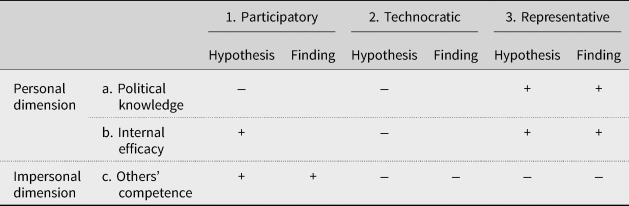
Our hypotheses, also outlined in Table 1, will be tested in the analysis to examine whether the various aspects of citizen sophistication correspond in predictable ways with different conceptions of democracy. The following section presents the data used in the analysis.
Hypotheses

Data and variables
The data used to explore the connection between political sophistication and citizens' conceptions of democracy come from the Finnish National Election Study 2011 (FNES2011, FSD2653), a post-election study run after the parliamentary election on 17 April 2011. The FNES is a national representative cross-sectional survey performed in two stages involving face-to-face interviews with a total of 1,298 respondents based on quota samplingFootnote 2 and a self-administered questionnaire, returned by mail by 806 respondents.
The choice to study Finnish conceptions of democracy is a pragmatic one, based on data availability. Previous research on the topic (Bengtsson Reference Bengtsson2012; Bengtsson and Christensen Reference Bengtsson and Christensen2016) indicates that the democratic process preferences held by Finnish citizens correspond well with preferences found in other contexts, such as in Spain (Font et al. Reference Font, Wojcieszak and Navarro2015) and in the Netherlands (Coffé and Michels Reference Coffé and Michels2014). Hence, there appears to be little reason to consider Finland as a deviating case. Finland is an example of a European country with proportional representation, a dominating tradition of representative decision-making complemented by a very restrictive use of consultative referenda.Footnote 3 As in many other countries, there has been an expansion of opportunities for citizen participation, especially at the local level, but also at the national level with the introduction of the Citizen Initiative in 2012 (Christensen et al. Reference Christensen, Karjalainen and Nurminen2015). The introduction of this new tool for direct participation at the national level did, however, take place after the FNES analysed here was performed. Moreover, Finland appears to be a standard case also in terms of political sophistication, when measured as political knowledge. The findings by Kimmo Elo and Lauri Rapeli (Reference Elo and Rapeli2010) concerning the individual-level determinants show close resemblance to similar findings from elsewhere.
Previous research has noted that public conceptions of democratic processes are, to some extent, mixed with people preferring more than one, mutually exclusive model at the same time (e.g. Bengtsson and Mattila Reference Bengtsson and Mattila2009). However, as Bengtsson (Reference Bengtsson2012) has shown, citizen opinion on different democracy models shows remarkable consistency when it is measured through principal component analysis of the items in the FNES 2011 (for similar results see Font et al. Reference Font, Wojcieszak and Navarro2015). Using the same data, we build on previous work by Bengtsson (Reference Bengtsson2012; see also Bengtsson and Christensen Reference Bengtsson and Christensen2016).
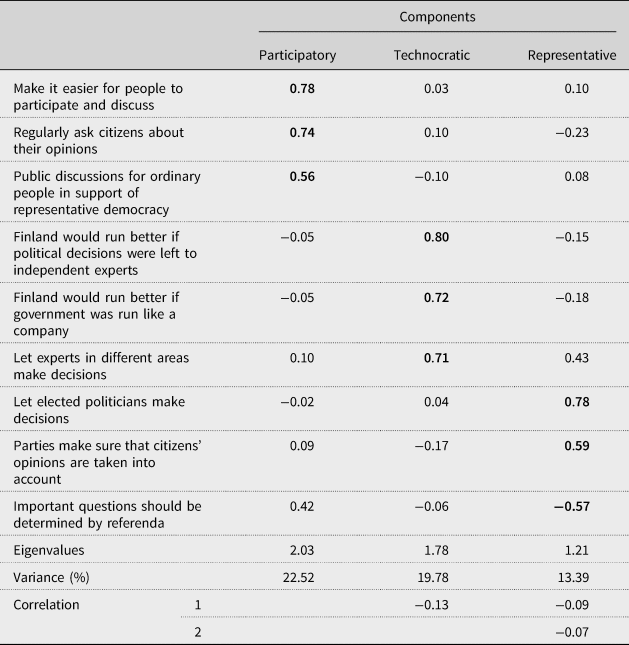
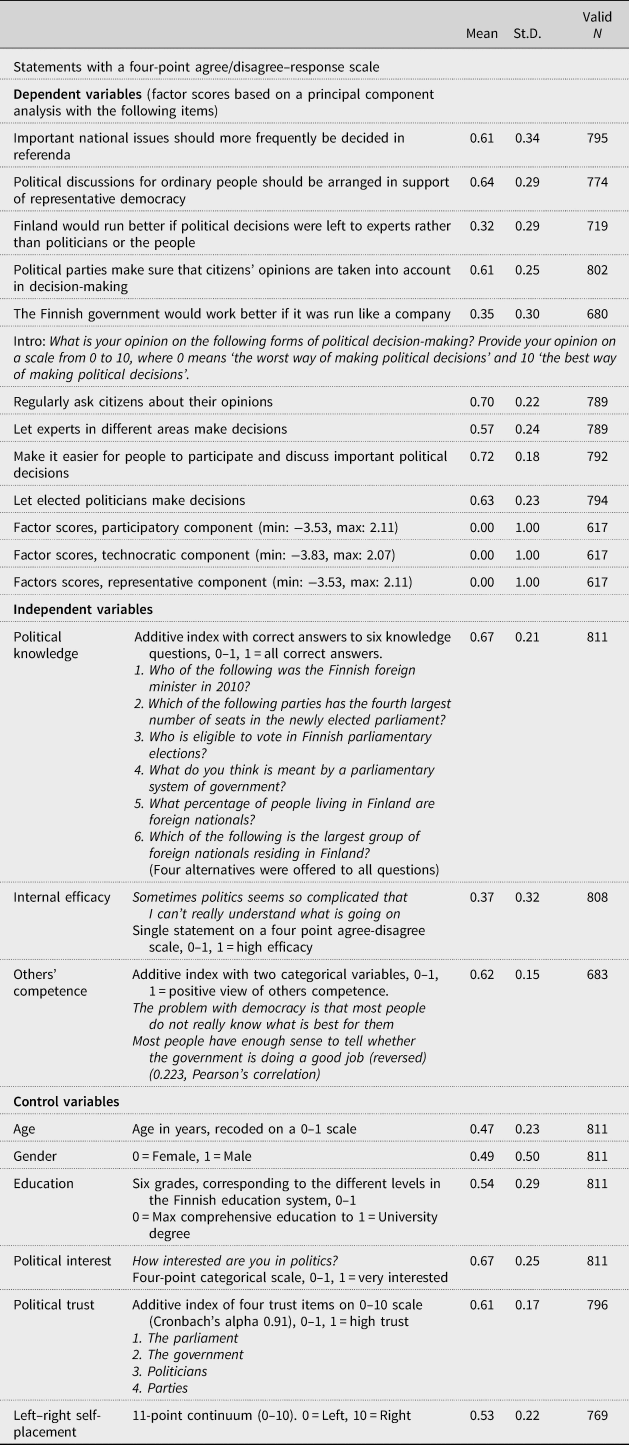
The data comprise nine items that target views on political decision-making and the preference for actors that should be involved in the process. Four items ask respondents to rate four different alternatives under a common introduction about ‘the best way to make political decisions’ with the following alternatives: (1) ‘Make it easier for people to participate and discuss important political decisions’; (2) ‘Regularly ask citizens about their opinions’; (3) ‘Let experts in different fields make decisions’; and (4) ‘Let elected politicians make decisions’ (ranked on an 11-point continuum from 0 to 10, later rescaled to 0–1). In addition, we include five statements with four-point Likert-like agree–disagree scales concerning the use of referenda and political discussions, parties' capability to function as links between citizens and the political arena, if government should be run like a company and area experts as decision-makers. Table 2 reports the oblimin rotated component matrix of the seven items.Footnote 4
Public Opinion of Democracy Models, Principal Component Analysis (Pattern Matrix)

Note: Extraction method: principal component analysis. Rotation method: oblimin with Kaiser normalization. Loadings above 0.5 are in bold.
As Table 2 indicates, a clear pattern of support for three distinct conceptions of democracy – a participatory, a technocratic and a representative dimension – emerges when all nine items are included in the analysis.Footnote 5 It is notable that the referenda item loads stronger (and negatively) on the representative, compared to the participatory dimension. The latter hence primarily identifies preference for extensive involvement of people in a role where they consult and inform, rather than possess the power to make final political decisions.
The continuous factor scores obtained by the principal component analysis constitute the dependent variables of the study and are used as the dependent variables of the study and analysed with OLS regression in the following section. Two different models will be applied: one model which only includes the independent variables of focal interest and one full model which controls for socio-demographic background and political attitudes.
Three measures of sophistication make up the independent variables of the study. The two measures of personal sophistication are:
1. Political knowledge, which is operationalized as an additive index based on five knowledge questions, where each correct answer is awarded one point.Footnote 6
2. Internal efficacy, which is a person's subjective assessment of ability to understand politics, measured in Likert-scale responses to the claim ‘Sometimes politics seems so complicated that I can't really understand what's going on’ (see Morrell Reference Morrell2003).
The impersonal dimension is constituted by a measure of:
3. The generalized other's political competence. This measure is identical to the one used by Anderson and Goodyear-Grant (Reference Anderson and Goodyear-Grant2010), which is an index consisting of agreement to two statements, measured using the Likert scale: ‘The problem with democracy is that most people do not really know what is best for them’ and ‘Most people have enough sense to tell whether the government is doing a good job’.
The three measures are only weakly inter-correlated. The strongest correlation is found between internal efficacy and political knowledge, 0.253 (Pearson, significant at the 0.01 level, two-tailed). A very low Cronbach's alpha (0.281) confirms that the three indicators are not measuring a single construct, but constitute three separate aspects of sophistication.
Gender, age and education are added as socio-demographic control variables. Education is an especially important control variable, since it is closely linked to sophistication and has also been demonstrated to influence citizens' conceptions of democracy (Coffé and Michels Reference Coffé and Michels2014). Moreover, three attitudinal variables, political interest, political trust and left–right self-placement, are included in the full model as controls since in previous research they have been found to be related to conceptions of democracy (Bengtsson and Mattila Reference Bengtsson and Mattila2009; Coffé and Michels Reference Coffé and Michels2014; Webb Reference Webb2013).Footnote 7 Political interest is measured on a four-point categorical scale. Political trust is operationalized as an additive index consisting of four different confidence items measured on an 11-point continuum (0–10). Cronbach's alpha for the four items is 0.911, which suggests very high scale reliability. Inter-item correlations range between 0.645 and 0.809 (all statistically significant at the 0.01 level), which also suggests very high reliability for the political trust scale. Left–right self-placement is measured on an 11-point continuum (0–10). All variables have been recoded into scales that vary between 0 and 1. See the Appendix for more detailed information of all of the included variables.
Results
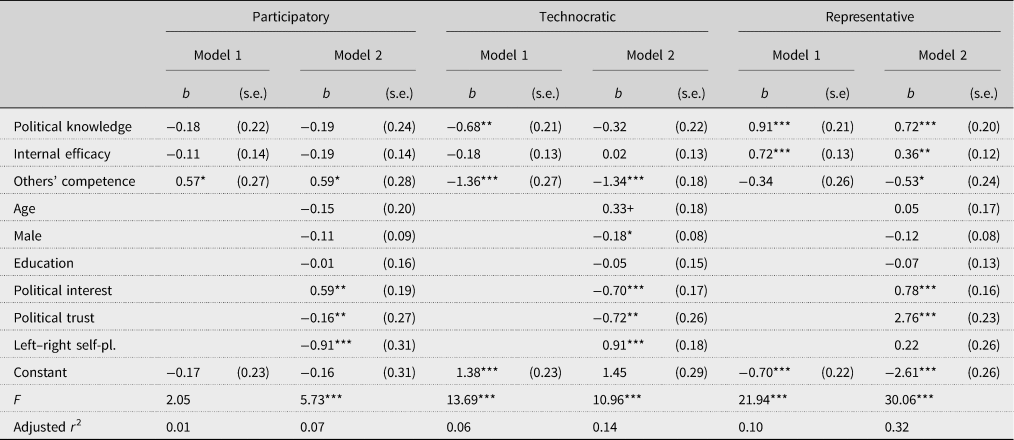
In order to examine the hypothesized links between political sophistication and different conceptions of democracy we run six different OLS regression models, which are presented in Table 3. For each dependent variable – that is, preferences for three alternative conceptions of democracy – two analytic models are applied; the baseline model, which only includes the three sophistication variables, and the full model, which adds socioeconomic factors and political attitudes in order to control for potential spurious relations.
Political Sophistication and Conceptions of Democracy (OLS regression)

Notes: +p < 0.10, * p < 0.05, ** p < 0.01, *** p < 0.001, dependent variable: factor scores based on principal component analysis in Table 2. All independent and control variables are measured on a scale between 0 and 1. Multicollinearity diagnostic statistics show no cause for concern. Variance inflation factor (VIF) values (in Model 2) are below 1.3 (mean VIF is 1.1).
In terms of the hypotheses, the analyses offer a mixed bag of results. The two assumptions made in H1, that the participatory model is supported by the people with low levels of political knowledge (H1a) and high levels of internal political efficacy (H1b), do not gain empirical support, either in the baseline or the full model. H1c is, however, confirmed. Having a positive perception of the political ability of the generalized other has a statistically significant and positively related effect on support for participatory processes.
Moving on to the technocratic model, we find a corresponding pattern. The personal level of political sophistication, measured as the objective (H2a) and subjective level (H2b), both turn out to be unrelated to support for a technocratic model. A negative effect for political knowledge was detectable in the first model, but the effect does not hold when including the control variables in the full model. Low levels of personal political sophistication are therefore not connected to support for a technocratic form of decision-making. Again, we do, however, find that the impersonal dimension of political sophistication matters. A strong and stable effect in line with the expectation that people who lack trust in other people's political ability support a technocratic conception of democracy is hence found (H2c).
By contrast, the full Hypothesis 3, which suggested that politically knowledgeable people (H3a), those with high internal political efficacy (H3b) and those who have a negative perception of the generalized other's political capacity (H3c) support representative democracy, is clearly supported on all counts. A comparison of the outlined hypotheses and findings are presented in Table 4.
Hypotheses and Findings

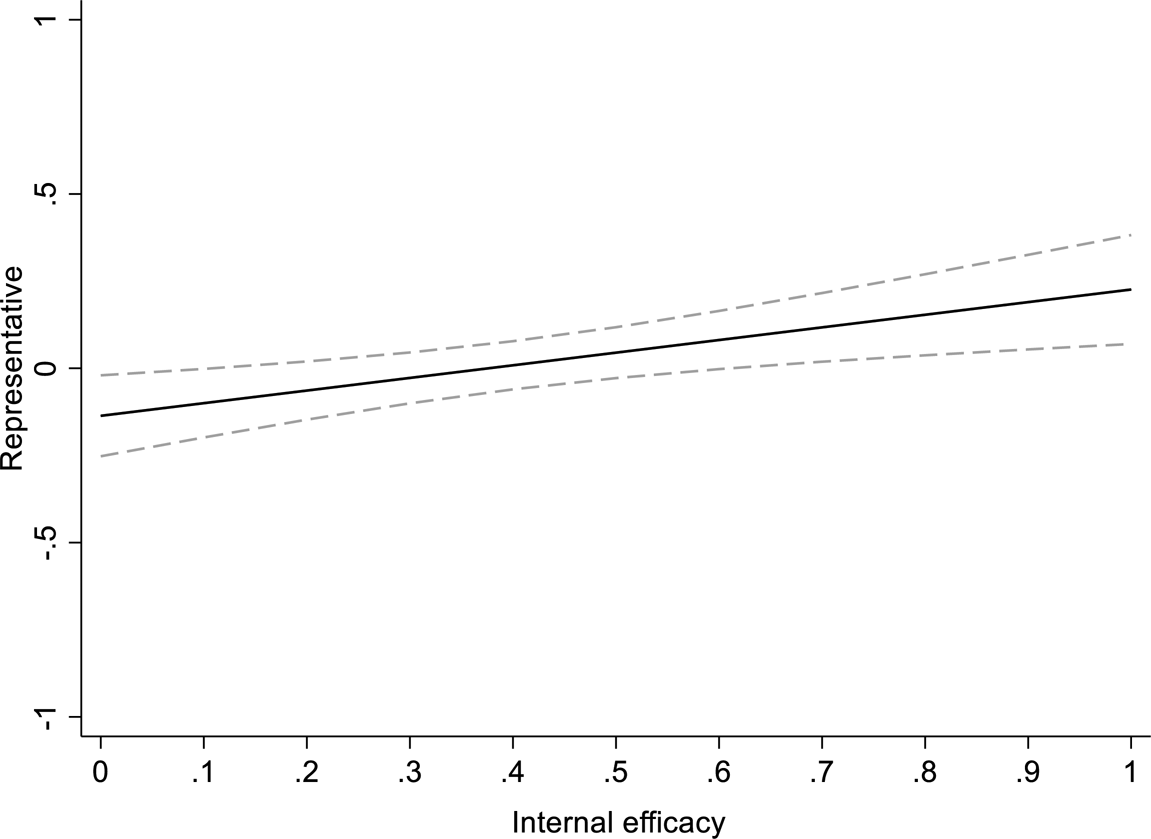
To illustrate the statistically significant findings, the estimated values based on the full models in Table 3 are presented in Figures 1–5, where all other variables are set at their mean values. We first consider the effect of political knowledge on support for a representative model. As demonstrated in Figure 1, the estimated position on the representative scale increases quite dramatically with political knowledge. The difference between respondents with the lowest and the highest degree of political knowledge on the representative scale corresponds to about one standard deviation, which can be considered a substantial effect. The effects of internal efficacy (Figure 2) and the perception of other people's political abilities (Figure 3) are in comparison less dramatic. Turning to Figures 4 and 5, both present the impact of impersonal judgements about the political ability of the average citizen; Figure 4 displays the estimated values for supporting a participatory model, and Figure 5 a technocratic model. For the technocratic model, the effect is strongly negative and corresponds to about 1.5 standard deviation. The effect for the participatory model is positive, but not of the same magnitude.
Estimated Values for Support for a Representative Model by Political Knowledge (All Other Values Set at Means, 95% Confidence Interval)

Estimated Values for Support for a Representative Model by Internal Efficacy (All Other Values Set at Means, 95% Confidence Interval)

Estimated Values for Support for a Representative Model by Perception of the Generalized Other's Political Competence (All Other Values Set at Means, 95% Confidence Interval)

Estimated Values for Support for a Participatory Model by Perception of the Generalized Other's Political Competence (All Other Values Set at Means, 95% Confidence Interval)

Estimated Values for Support for a Technocratic Model by Perception of the Generalized Other's Political Competence (All Other Values Set at Means, 95% Confidence Interval)

A finding of a more general character is that the two models explain a good deal of variation in support for representative democracy, but do worse in explaining support for participatory and technocratic conceptions of democracy. First, this suggests that variations in political sophistication are much more strongly related to support for representative than to support for participatory or technocratic democracy, which is in line with the non-significant effects of the personal political sophistication measures included in the models. Second, given also that the control variables do not significantly enhance the explanatory power of the model for participatory or technocratic democracy, it seems that citizen attitudes towards the more ‘exotic’ models are not structured along highly predictable socio-demographic or attitudinal lines.
The socio-demographic controls generally turn out to be insignificant, while political interest is, unsurprisingly, positively related to support for a representative and a participatory model, and negatively related to support for a technocratic model. Trust in political institutions is, in turn, the most powerful single determinant of support for representative democracy.
Discussion
Drawing on the assumptions made in different theoretical models of democracy, there are substantial reasons to believe that political sophistication structures people's conceptions of democracy. The question of whether it is personal sophistication or perceptions of the generalized other's political abilities that matters is, however, less obvious. Concerning the personal dimension of political sophistication, one plausible assumption is that politically sophisticated individuals would support a participatory model of democracy, while politically less sophisticated individuals would support models that restrict citizen participation to a minimum. The evidence presented in this study does not suggest such a general pattern in terms of the personal level of sophistication. Instead, it appears that political sophistication, whether measured through objective levels of political knowledge or subjective competence perceptions, shows a positive association with the standard model of representative democracy.
There are three possible explanations for this somewhat counter-intuitive finding. First, as previous studies have also admitted (e.g. Bengtsson and Mattila Reference Bengtsson and Mattila2009), popular attitudes towards democracy are not always logical or consistent. Second, a more theoretically fruitful explanation could be that it reflects the fundamental idea behind participatory ideals of democracy, namely that gaps in the understanding of politics are best remedied by participation. It nevertheless seems clear that whether a person desires more direct involvement in political matters is detached from assessments of ability to understand politics, as well as from objectively verifiable knowledge about politics. Third, knowledgeable people might be more supportive of representative democracy because they are aware of the risks commonly associated with the alternatives. Their lack of support for participatory democracy could, for example, reflect a concern that it may require an unrealistic amount of engagement from the public. The strong negative relationship with sophistication and technocratic democracy could emanate from a fear of losing control. If realized in the way described by Daniele Caramani (Reference Caramani2017), a technocratic model of democracy would greatly diminish the role of ordinary citizens in defining the common good in a society and high-sophistication individuals might understandably be averse to such a scenario. Their support for representative democracy could imply that it is the best of the alternatives they are aware of, because they are better aware of the problems in the other options than their less sophisticated counterparts are.
While individual variations in sophistication do not contribute much to distinguishing between different democratic ideals, the impersonal dimension – that is, the perceptions people have of other people’s political abilities – is far more influential and straightforward. Understandably, doubting others is connected to supporting limited citizen involvement in political decision-making. People who have doubts about the political abilities of their peers are hence significantly more likely to support models in which power is delegated to democratically elected representatives or to policy experts and professionals, in a technocratic form of decision-making. When forming fundamental attitudes towards a technocratic conception of democracy, it hence seems that people are more concerned about how they judge other people's ability to participate in politics instead of their own, which is likely to be linked to considerations regarding the quality of decisions that are made (see also Anderson and Goodyear-Grant Reference Anderson and Goodyear-Grant2010).
Although citizen preferences do not always follow theoretical expectations, the sophistication–democracy attitude linkages that were revealed are by no means illogical. The firm positive association between political sophistication and representative democracy reflects a strong commitment among politically aware individuals to the existing political system and its institutions. As Åsa Bengtsson and Henrik Christensen (Reference Bengtsson and Christensen2016) show, this section of the citizenry not only values representative democracy, but also acts accordingly through electoral participation. From the perspective of elite theories of democracy, however, they deviate from the expectation that a representative democracy led by the (party) elite only requires relatively incompetent citizens.
It is also important to keep in mind that the dimensions which emerged from the empirical analysis are not mutually exclusive. It is likely that many respondents would endorse at least certain aspects of, for example, a participatory democracy, even if they supported representative democracy more strongly. The dimensions capture the strength of preference, rather than (an unlikely) total absence of support for any of the dimensions, which means that, in the minds of the respondents, the lines between the three conceptions of democracy are probably more blurred than our treatment of the data might suggest.
The overall impression is that there are important linkages between citizen conceptions of democracy and the theoretical framework of citizen sophistication. Attitudes towards different models of democracy are, however, not as strongly connected to the personal level of sophistication (objective or subjective) but rather to impersonal evaluation of the political ability of others. This finding highlights the relevance of including evaluations of the generalized other's competence in subsequent analyses of political sophistication. Previous literature concerning sophistication has only included measures of personal ability, but in a similar vein to Anderson and Goodyear-Grant (Reference Anderson and Goodyear-Grant2010), this study also suggests that the assessment of others' ability is just as important, perhaps even more important, as a predictor of democracy attitudes.
There are, of course, also other conceptualizations of the broader question of citizen sophistication. Our focus on sophistication excludes the equally relevant, competing view of political sophistication as abilities to communicate and to consider other people's needs, which are important traits of a competent citizen in the deliberative democracy paradigm (e.g. Jacobs et al. Reference Jacobs, Cook and Delli Carpini2009). For many theorists of deliberative democracy, instead of being knowledgeable, it is more pertinent that citizens are able to revise existing attitudes, if needed, in order to make enlightened decisions (Rosenberg Reference Rosenberg and Rosenberg2007) and that they unselfishly consider others' interests and tolerate other opinions besides their own (e.g. Mansbridge Reference Mansbridge1990; Mansbridge et al. Reference Mansbridge, Bohman, Chambers, Estlund, Føllesdal, Fung, Lafont, Manin and Martí2010). Although considering the communicative and empathetic abilities as indicators of political competence falls outside the boundaries of our analysis, they constitute a significant alternative approach to the question of democratic political competence. Future research should perhaps turn the focus to look at how this alternative account of democratic competence relates to different ideas about how democratic governance should be designed.
Acknowledgements
This work was supported by the Academy of Finland under Grants 316239, 312676 and 312671; and the centre of excellence The Future of Democracy, funded by the Åbo Akademi University Foundation.
Appendix
Variables