INTRODUCTION
Innovation is often cited as a key factor to an increasing standard of living, high-quality jobs, and to an overall better quality of life (Government of Ontario, 2008; Thomson & Webster, Reference Thomson and Webster2013). The Federal and Provincial governments in Canada have conducted many studies and issued many reports on issues related to innovation (Industry Canada, 2006). Nonetheless, the innovation performance of Canadian firms routinely has been given a poor grade (Conference Board of Canada, 2014).
This study develops a theoretical framework that enables a focus on the link between human resource management (HRM) practices and innovation outcomes (Jimenez-Jimenez & Sanz-Valle, Reference Jimenez-Jimenez and Sanz-Valle2005; Messersmith & Guthrie, Reference Messersmith and Guthrie2010; Cabello-Medina, Lopez-Cabrales, & Valle-Cabrera, Reference Cabello-Medina, Lopez-Cabrales and Valle-Cabrera2011; Jiang, Lepak, Hu, & Baer, Reference Jiang, Lepak, Hu and Baer2012), but with a focus on whether the relationship is robust when persistent characteristics are evaluated. There is a limited literature exploring the theoretical relationship between persistent HRM practices and persistent innovation; we explore the factors that contribute to persistent innovation. The availability of a data set that contains detailed information on the HRM practices and innovation performance of a larger number of workplaces over an 8-year period is of great value in this investigation. Statistics Canada’s Workplace and Employee Survey (WES) 1999–2006 employer/workplace data are used in the analysis. This data set explores a broad range of issues related to workplaces and employees, but specifically includes questions on the workplaces’ competitiveness, innovation, technology use, and HRM practices (Statistics Canada, 2007).
By focusing on persistent characteristics (i.e., HRM practices, work organization practices and control variables) we are attempting to give a more adequate theoretical and empirical account of innovation behavior of workplaces and the factors that are associated with persistent levels of innovation. We define persistent characteristics as factors that are not transitory or highly variable over time, rather they are factors that exist or endure over time. Persistent characteristics implies that workplaces (and more specifically the individuals that manage them) form their expectations and make decisions based on an ‘average outcome’ over time and that transitory outcomes or extreme variations are discounted in decision making. Further, characteristics are persistent if they are invariant over a specific time period, or variant outcomes can be derived to be persistent by averaging varying outcomes over a trend (i.e., a period of time, and in our case 1999–2006). Thus, under this conceptualization persistence does not require consecutive calendar time continuity, but rather that it occurs with some frequency and/or substantiveness within an epoch. This approach differs from traditional approaches (that look at the occurrence of innovation from period to period (often year to year) (Geroski, VanReenen, & Walters, Reference Geroski, VanReenen and Walters1997; Ganter & Hecker, Reference Ganter and Hecker2013) by focusing on an epoch for organizations so as not to necessarily require a continuous stream or particular periodicity of output; thus, restrictions or constraints around an organization’s own idiosyncratic internal innovation cycles are not imposed in order to allow for workplace specific or irregular cycles.
Given Canadian workplaces’ poor grade on innovation performance (Conference Board of Canada, 2014), this study contributes to the literature by developing a theoretical framework that enables the investigation of persistent workplace factors that are associated with persistent innovation performance. In particular, the main question this research asks is: are differences in persistent HRM practices and work organization practices associated with workplace innovation persistence (or lack of it)? We contribute to the literature by extending work by Clausen, Pohjola, Sapprasert, and Verspagen (Reference Clausen, Pohjola, Sapprasert and Verspagen2011) that focused on differences in workplace strategies as an explanation for why workplaces are persistently innovative; and by adapting work by Cavagnoli’s (Reference Cavagnoli2011) that looks at the connection between HRM practices and continuous innovation outcomes. Thus, we add HRM practices and work organization practices to the Clausen et al. (Reference Clausen, Pohjola, Sapprasert and Verspagen2011) framework to aid in developing a more comprehensive understanding of how persistent HRM practices and work organization practices contribute to the persistent innovation relationship. In particular, Clausen et al. (Reference Clausen, Pohjola, Sapprasert and Verspagen2011) argue that some activities (such as R&D activities, but extended in the current study to HRM and work organization practices) should not be seen as something that can be easily discontinued from 1 year to the next since many of these types of activities are a part of long-term decision making and planning. The persistent factors approach used in this study is an initial attempt to better account for long-term decision making. The findings from the current study can contribute to the development of policy at both federal and provincial levels of government, which seeks to improve long-term innovation performance outcomes.
LITERATURE REVIEW AND HYPOTHESES
Firm and workplace innovativeness has been the subject of hundreds of research studies (Rogers, Reference Rogers2003). Many characteristics of innovative organizations have been identified including industry structure, organization characteristics, organization processes, and institutional influences (Ahuja, Lampert, & Tandon, Reference Ahuja, Lampert and Tandon2008). In particular, industry structure includes factors such as market concentration (Schumpeter, Reference Schumpeter1942), and the role of knowledge spillover from customers (von Hippel, Reference von Hippel1988), suppliers (Harhoff, Reference Harhoff1996), and partners (Gans, Hsu, & Stern, Reference Gans, Hsu and Stern2002). Organization characteristics include the size and scope of the organization (Cohen, Reference Cohen1995), alliances with other organizations (Lane & Lubatkin, Reference Lane and Lubatkin1998), and the impact of organizational slack (Cyert & March, Reference Cyert and March1963; Nohria & Gulati, Reference Nohria and Gulati1996). Organization processes include organizational structures (Burns & Stalker, Reference Burns and Stalker1994), governance and incentives (Zahra, Reference Zahra1996), and organizational learning processes (Levinthal & March, Reference Levinthal and March1993). The institutional influences on innovation that have been studied include the supply of scientific research (Cohen & Levinthal, Reference Cohen and Levinthal1990), and the appropriability conditions (Teece, Reference Teece1986).
Despite studies having identified a large number of factors that affect the innovativeness of organizations, much of the evidence from these studies is inconclusive or contradictory (Rogers, Reference Rogers2003; Ahuja, Lampert, & Tandon, Reference Ahuja, Lampert and Tandon2008). This is an indication that the factors affecting organization innovativeness are not yet well understood (Nonaka, Kodama, Hirose, & Kohlbacher, Reference Nonaka, Kodama, Hirose and Kohlbacher2014). In this study, we focus on specific organization processes, namely, HRM practices and work organization practices. HRM practices include the hiring of individuals with appropriate skills and competencies, job and work design, training, and compensation schemes that provide incentives and motivation to employees to meet organizational goals, and autonomy and opportunity to act to help ensure that individual actions can implement the organization’s strategic objectives (Jørgensen, Hyland, & Kofoed, Reference Jørgensen, Hyland and Kofoed2008; Jiang et al., Reference Jiang, Lepak, Hu and Baer2012). The inclusion of skill-, motivation-, and opportunity-enhancing practices in the framework implies the current study is building on work by Jiang et al. (Reference Jiang, Lepak, Hu and Baer2012) and Chowhan (Reference Chowhan2016) which look at the relationship between ability, motivation, and opportunity factors and organizational operational performance outcomes, such as innovation. Laursen and Foss (Reference Laursen and Foss2003) argue that appropriate HRM practices have an important relationship with innovative performance. Leede and Looise (Reference Leede and Looise2005) suggest that HRM practices have an important association with a number of stages of the innovation process. These include identifying opportunities for innovation, developing strategies and plans for selecting and acting on opportunities, and putting together the individuals and teams that will develop and implement the innovation.
In addressing the main research question, we focus on four main HRM practices and three work organization practices that can help support the development and implementation of consistent innovation. The HRM elements are: (1) the presence of highly qualified personnel capable of supporting the development and implementation of new innovations; and (2) skill-enhancing, (3) motivation-enhancing, and (4) opportunity-enhancing practices that create high levels of knowledge, skill-improvement, incentive and motivation, and the opportunity to participate and contribute effectively to organizational outcomes. The work organization practices are the degree of integration and collaboration between organizational units and with other firms, the introduction of organizational changes, and the implementation and use of technology. In the following sections, we provide a discussion of the relationship between each of these practices and workplace-level innovation.
Highly qualified personnel
Highly qualified personnel with engineering and scientific backgrounds and the relationships and the social networks they develop are critical to the research and development phases of innovation (Daniel & Dawson, Reference Daniel and Dawson2011). Individuals with expertise in commercialization, law, and commerce are particularly critical to the implementation phase of innovation (Porter, Reference Porter1990; Galende & de la Fuente, Reference Galende and de la Fuente2003; Government of Ontario, 2008). Further, the hiring of personnel with professional experience and recent graduates are contributors to knowledge assets of the organization, and knowledge assets have been found to be associated with new product development (De Saa-Perez, Diaz-Diaz, & Ballesteros-Rodriguez, Reference De Saa-Perez, Diaz-Diaz and Ballesteros-Rodriguez2012). Consequently, we hypothesize that:
Hypothesis 1 : There will be a positive association between the persistent use of highly qualified personnel and persistent innovation outcomes.
Skill-enhancing practices
In addition to hiring highly qualified personnel, it is necessary to have on-going training activities to maintain these skills (Kale, Reference Kale2009). In addition, training can help to increase the absorptive capacity of individuals thereby helping them to identify new knowledge that may lead to the development of innovations (Cohen & Levinthal, Reference Cohen and Levinthal1990; Hu, Reference Hu2014; Chowhan, Reference Chowhan2016). Consequently, we hypothesize that:
Hypothesis 2 : There will be a positive association between the persistent use of skill-enhancing practices and persistent innovation outcomes.
Motivation-enhancing practices
Motivation-enhancing practices (including group incentive pay, profit-sharing, and employee benefits) have been found to have a substantial positive effect on both incidence and importance of innovations (Curran & Walsworth, Reference Curran and Walsworth2014). Other motivation practices, such as pay-for-performance individual and group schemes and promotion opportunity, have been associated with eliciting employee behaviors such as discretionary effort, initiative, and creativity, which is associated with positive innovation outcomes (Delery & Doty, Reference Delery and Doty1996; Liao, Toya, Lepak, & Hong, Reference Liao, Toya, Lepak and Hong2009).
Hypothesis 3 : There will be a positive association between the persistent use of motivation-enhancing practices and persistent innovation outcomes.
Opportunity-enhancing practices
Work practices can have a significant effect on what a workplace does and what it accomplishes. We are interested in practices that may affect the innovativeness of a workplace especially because previous research has shown that HRM is important to strategic change (Den Hertog, Van Iterson, & Mari, Reference Den Hertog, Van Iterson and Mari2010). HRM practices that give employees autonomy and opportunity to participate in knowledge sharing and collaboration are important to innovation (Jimenez-Jimenez & Sanz-Valle, Reference Jimenez-Jimenez and Sanz-Valle2005; Jiang et al., Reference Jiang, Lepak, Hu and Baer2012; Chowhan, Reference Chowhan2016). HRM practices that enhance opportunity and that can support this knowledge sharing and collaboration can include: information sharing with employees, the use of problem-solving teams, and the creation of self-directed work groups. Consequently, we hypothesize that:
Hypothesis 4 : There will be a positive association between the persistent use of opportunity-enhancing practices and persistent innovation outcomes.
Integration and collaboration
Innovation often involves combining knowledge from numerous sources (Grant, Reference Grant1996). Consequently, it has been suggested that greater integration and collaboration between functional areas in a firm can have positive effects on innovation (Rochford & Rudelius, Reference Rochford and Rudelius1992). There is also evidence that collaboration with other firms improves the innovativeness of firms; though not all studies support this conclusion (Ahuja, Lampert, & Tandon, Reference Ahuja, Lampert and Tandon2008). We hypothesize that:
Hypothesis 5 : Workplaces that persistently introduce greater integration among different functional areas or greater inter-firm collaboration in R&D, production, or marketing are more likely to be persistent innovators.
Introduction of organizational changes
Organizations evolve over time and changes are often introduced to effect strategic or operational goals (Teece, Pisano, & Shuen, Reference Teece, Pisano and Shuen1997). These changes may involve changing organizational structures such as the degree of centralization in the workplace, changing employment practices such as downsizing or increasing reliance on temporary workers, or changing work practices such as reengineering business processes or reducing the number of management layers. These organizational changes may be introduced for a variety of reasons, such as to reduce costs, increase productivity, or to increase the amount of innovative activity in the workplace. However, not all organizational changes introduced by workplaces achieve their desired effect (Hughes, O’Brien, Randall, Rouncefield, & Tolmie, Reference Hughes, O’Brien, Randall, Rouncefield and Tolmie2001). Nonetheless, we anticipate that the introduction of significant organizational changes within a workplace often will lead to the desired effect. Consequently, we hypothesize that:
Hypothesis 6 : Workplaces that persistently introduce organizational changes with the objective of increasing innovation are more likely to be persistent innovators.
Use of technology
‘High tech’ firms are the poster children of innovation; consequently, there is a presumption that firms that make greater use of technology are more innovative. Moreover, there is evidence that technology, such as computer-aided design and manufacturing, speed up the development of new products (Millson, Raj, & Wileman, Reference Millson, Raj and Wileman1992). The adoption of new technology is often considered an integral part of the innovation cycle (Acemoglu, Reference Acemoglu1997), and new technology adoption is seen as a tool that can expand the boundaries of the possible (Thomke, Reference Thomke2006). Further, more recent studies have explored the positive association between technology use and innovation (Gressgard, Amundsen, Aasen, & Hansen, Reference Gressgard, Amundsen, Aasen and Hansen2014). Consequently, we hypothesize that:
Hypothesis 7 : Workplaces that persistently introduce new technologies are more likely to be persistent innovators.
METHODOLOGY
Data
The workplace micro-data files of the Workplace and Employee Survey (WES) 1999–2006 from Statistics Canada are used for this paper. The WES includes all non-government business sector employers stratified by industry, region, and workplace employment size (Statistics Canada, 2007). The reference period for each annual sample includes the last 12-month period ending in March of the reference year. Statistics Canada’s Business Register is used as the survey frame and workplaces are sampled from this list.
The 1999 and 2006 WES data, available through Statistics Canada Research Data Centres Program, have response rates of 95.2 and 74.9%, respectively. The response rates declined each year due to year over year attrition. For this study, only for-profit organizations and workplaces that have total employment 10 or greater are retained (n=3,610). Further, because this research focuses on workplaces that continue over the 1999–2006 period, the sample we use is reduced to include only the 2,326 workplaces continuing in all years from 1999 to 2006. Continuing workplaces include those organizations that are still in-business and in-scope for the survey from the 1999 target population only; thus, workplaces that are added for ‘top-up’ purposes in 2001, 2003, and 2005 are not included as part of this particular population of interest. The final data set is representative of 96,488 of the 1999 population of workplaces in Canada in 2006.
All analyses are generated using the survey sample weight, which is the inverse probability of being selected into the sample. The use of a complex survey design to select the sample results in workplaces being selected with varying probabilities of selection and representativeness (i.e., a simple random sample is not used). Thus, when the sample weight is used, each workplace represents the number of workplaces in the population equal to its sample weight. For analyses where we make inferences, bootstrap weights, and techniques are used to generate unbiased standard errors (Mann & Chowhan, Reference Mann and Chowhan2011).
Variables
Two main types of variables are used in the analyses: (1) temporally variant and (2) variables assumed to be invariant. All variables are temporally variant that have the possibility of changing from year to year over the 1999–2006 reference period. Variables that are invariant, and that are assumed not to change, include workplace size, industry of the workplace, HR department structure, and presence of a union. Given that a main focus of this paper is to look at the effects of ‘persistent’ changes in factors on innovation, our temporally variant variables are typically defined as averages over the 1999–2006 period. The persistent-characteristic hypothesis suggests that workplaces make decisions to innovate based on trend (average) characteristics and not annual variations. In other words, workplaces do not make decisions based on transitory (one-time) changes, but rather consider anticipated and planned changes. A detailed discussion of the generation of the variables used in the analyses follows.
Dependent variable
The dependent variable categorizes workplaces’ innovation performance. Workplaces were asked to report whether they had introduced any innovations in the form of new products or services, new processes, improved products or services, or improved processes during the reporting period. An innovation performance index was generated that incrementally increases for each year the organization reports improved products or services or improved processes, and increases with a greater weight when the organization has new products or services or new processes. Workplaces that reported no innovations over the 1999–2006 period have the lowest score and workplaces that report new products, services, and process in every year have the highest score.
Independent variables
The temporally variant HRM variables are as follows: highly qualified personnel characteristics, skill-, motivation-, and opportunity-enhancing bundles of practices. The work organization temporally variant grouping of variables include: organization change, objectives of organizational change, and technology use. Each of these variables (or group of variables) are calculated as persistent measures and are used in the analyses as the average over the 1999–2006 period. For variables that are continuous or percentages, the average is a continuous value or an average percentage. For dichotomous variables, the average of 0’s and 1’s will be a proportion bounded by 0 and 1 over the 1999–2006 period.
The highly qualified personnel employee characteristic variables include percent of employees earning over $80,000 per year, the percent of employees who are professionals, and the interaction of both of these variables. The percent of employees earning over $80,000 per year is an estimate of the number of permanent full-time and part-time employees with earnings $80,001 and above divided by the total number of employees at the workplace. The percent of employees who are professionals is the number of full-time plus part-time professionals divided by the total number of employees at the workplace.
The skill-, motivation, and opportunity-enhancing bundles of practices are index variables that compile sets of individual measures of practices where the individual measures are selected based on previous theoretical and empirical support from the literature (Jiang et al., Reference Jiang, Lepak, Hu and Baer2012; Chowhan, Reference Chowhan2016). The indexes used in the current study have been adopted from Chowhan (Reference Chowhan2016), which additively combines standardized practices (i.e., z-score transformed categorical or continuous scales) into an aggregate index (multiplicatively weighting practices to account for intensity of use across groups of employees when possible). Z-score transformations are used to standardize the units of measure so that variations in magnitudes of variable measures do not imply undue importance. The skill-, motivation-, and opportunity-enhancing bundles z-score standardized indexes were each averaged over the 1999–2006 period to get a persistent measure for the characteristic. The elements of each bundle are briefly presented below.
The skill-enhancing bundle of practices includes recruitment, selection, and training measures. For the following elements organizations report whether or not they used the practice. Items such as newspaper or internet help wanted advertisements, news stories, job fairs, recruitment on-campus, recruitment agency, and direct recruitment by employer are included to capture the concept of recruitment. For the selection practices: tests for specific skills; aptitude or other personality testing; recruitment agency tests; other testing or screening; interview; job-related knowledge test; and general knowledge test (Statistics Canada, 2005). To measure the effectiveness of the recruitment and selection practices a measure of vacancy is used to measure whether sufficient applicant pools are generated given demand levels. Training is measured by looking at types of classroom and on-the-job training including: computer/hardware; computer/software; other equipment; group decision-making or problem-solving; managerial/supervisory; professional; sales and marketing; and team-building, leadership, communication. Finally, the types of classroom and on-the-job training taken measure breadth, while the number of employees receiving classroom training, the number receiving on-the-job training, and the costs of classroom training are used to measure intensity of training.
The motivation-enhancing practices bundle has three main elements. First, compensation practices including: (1) individual, (2) group productivity, (3) profit-sharing, (4) merit or skill-based, and (5) employee stock plan incentive plans and systems (Statistics Canada, 2005). Second, promotion opportunities focuses on how vacant positions are usually staffed for each of the occupation groups. Third, a benefits measure is used to cover indirect compensation benefits including the presence of: life insurance, dental care, supplemental medical, supplemental employment insurance benefits, pension plan, group Registered Retirement Savings Plan, and stock purchase.
The opportunity practices bundle includes the following elements: employee’s suggestion program, flexible job design, information sharing with employees, problem-solving teams, joint labor-management committees, self-directed work groups, a measure for autonomy (i.e., that looks at who is responsible for decision-making across a variety of activities), and a grievance process.
Two organizational change dichotomous variables are included in the analyses: (1) greater integration among different functional areas (=1 if yes, and =0 if otherwise), and (2) greater inter-firm collaboration in research and development, production, or marketing (=1 if yes, and =0 if otherwise).
The impact of the most significant organizational changes is also considered by identifying when workplaces indicated the following outcomes were the main objectives of the organizational change: (1) introduce new technology, (2) increase product differentiation, (3) increase product and service quality, and (4) increase the pace of innovation. For each of these outcomes, a dichotomous variable was generated with the value =1 if the workplace identified the outcome as an objective and =0 otherwise.
For the dichotomous variables organizational change and organizational objectives, to generate a persistent measure for each variable the average value over the 1999–2006 period of the dichotomized responses is calculated; thus, the persistent measure is the percentage of times the workplace indicated the outcome over the reference period.
Finally, employee use of technology is considered by including the percentage of employees who used computers, and by using dichotomous variables that reflect technology implementation. The percentage of employees using computers is calculated by dividing the total number of employees who use computers as part of their normal working duties by the total number of employees in the workplace. Machines and equipment, such as microcomputers, personal computers, minicomputers, mainframe computers, or laptops that can be programmed and that perform a variety of operations are all considered computers. Of the workplaces that have employees using computers, the following dichotomous technology implementation variables were calculated: (1) implementation of new software application or hardware (if yes=1, otherwise=0), (2) implementation of computer-controlled/assisted technology (if yes=1, otherwise=0), and (3) implementation of other technologies or machinery (if yes=1, otherwise=0).
Control variables
In our analyses, we include control variables related to the size and industry of the workplace because these may affect the amount of firm innovation (Ahuja, Lampert, & Tandon, Reference Ahuja, Lampert and Tandon2008). We also include control variables related to the size of the workplace’s human resources (HR) unit and union presence because these factors may affect the HRM practices adopted by the organization (Chowhan, Reference Chowhan2005; Zeytinoglu, Cooke, Harry, & Chowhan, Reference Zeytinoglu, Cooke, Harry and Chowhan2008). These variables are also included to avoid attributing effects on innovation outcomes to other variables of interest that may proxy for workplace size, industry, HR department or union presence.
The temporally invariant variables include workplace size, industry, and human resource unit (or department) structure. Workplace size refers to the total number of employees on the organization payroll in the last pay period. In the model two dummy variables are included medium (workplaces with 100–499 workers) and large (workplaces with 500 or more workers) with small workplaces (<100) being the reference group. For industry, a manufacturing dummy variable is included in the model. The nature of the organization’s HR unit is measured by including two dummy variables full-time many (there is a separate HR unit in this workplace employing more than one person) and full-time one (one full-time person in this workplace is responsible for HR matters) with the remaining categories being the reference (i.e., part-time HR, HR outside workplace, and HR unassigned and handled as needed). The presence of a collective bargaining agreement is used to measure the presence of a union (if yes=1, otherwise=0).
The temporally variant variables are categorized as follows: workplace revenue, market share, and product innovation and improvement business strategies. As discussed above, each of these variables are calculated as persistent measures (i.e., an average over the 1999–2006 period). For variables that are continuous or percentages, the average is a continuous value or an average percentage; and for binary variables, the average of 0’s and 1’s will be a proportion bounded by 0 and 1. Specifically, the log of workplace revenue is the logarithmic transformation of gross operating revenue from the sale or rental of all products and services. The market share variable combines the percentage of total sales from all products and services from the United States and rest of the world. Finally, we also include variables related to the strategic goals and objectives of the organization because firms that have a strategic goal to innovate may be more likely to actually innovate than firms that do not identify innovation as a strategic objective (Porter, Reference Porter1985; March, Reference March1991; Liu & Chen, Reference Liu and Chen2015). Workplaces were asked to rate the relative importance of general business strategies in their workplace using the following scale: crucial, very important, important, slightly important, not important, or not applicable. We created binary variables dichotomizing whether workplaces identified strategies as crucial, very important, or important (=1) as opposed to the other categories (=0) for the following four specific strategies: (1) undertaking research and development, (2) developing new products/services, (3) developing new production/operating techniques, and (4) improving product/service quality.
RESULTS
Descriptive statistics
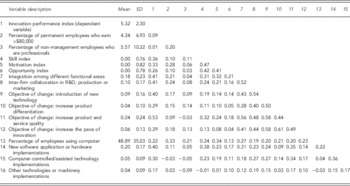
Table 1 presents descriptive statistics means, standard deviations and correlations of the independent variables. A review of the HRM and innovation bivariate estimates indicates that the motivation and skill indexes have moderate and significant positive association with innovation (r=0.33 and 0.36, respectively), while opportunity has a weaker positive significant association (r=0.26). For the work organization variables, the increase product and service quality has a strong positive association with innovation (r=0.53) followed by the variables integration among different functional areas (r=0.41) and inter-firm collaboration in R&D, production or marketing (r=0.41). All of the work organization variables have significant positive associations with innovation.
Means and standard deviations for the dependent, independent, and control variables

Notes. The skill, motivation, and opportunity indexes are standardized with mean zero; correlations whose absolute values are >0.06 are significant at p<.05; n=2,326.
Source. 1999–2006 Workplace and Employee Survey (WES), Statistics Canada.
Most of the workplaces are small with 90% of the population having fewer than 100 employees. The workplaces that are manufacturers represent about 20% of the organizations. Only about 19% of the workplaces have one or more full-time persons in the human resources unit of the workplace. Sales from the United States and the rest of the world, on average, are about 4.5% of sales for organizations.
Regression results
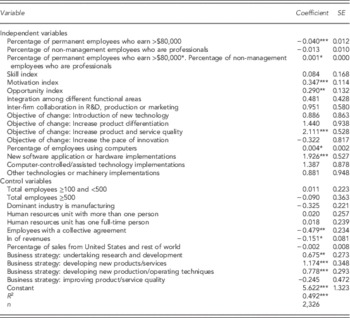
Table 2 presents the ordinary least squares results, where the relationship between the dependent variable innovation performance index and the independent variables are explored. The model provides a good fit to the data with an R 2 of 0.49 (F(28, 73)=20.95, p<.0001).
Results of ordinary least squares regression (dependent variable innovation performance index)

Note. *p<.10; **p<.05; ***p<.01.
Source. 1999–2006 Workplace and Employee Survey (WES), Statistics Canada.
Highly qualified personnel
The interaction of the percentage of permanent employees who earn >$80,000 and percentage of non-management employees who are professionals is positive and statistically significant (p<.10) indicating some support for Hypothesis 1. However, the magnitude of the change in innovation for every 1% increase is somewhat low. Nonetheless, the greater supply of highly qualified personnel (i.e., high earning professionals) is associated with innovation outcomes that are more persistent.
Skill-enhancing
Although positive the skill-enhancing bundle of practices is not statistically significant. Consequently, no support is provided for Hypothesis 2 that workplaces that provide persistently higher training in the form of various types of classroom and on-the-job training at higher levels of intensity for their employees have persistent innovation outcomes.
Motivation-enhancing
The motivation-enhancing bundle of practices index has a positive significant relationship with innovation, indicating support for Hypothesis 3. The magnitude of the association is not surprising given the significant and substantive relationships between direct and indirect compensation factors and innovation outcomes found by Curran and Walsworth (Reference Curran and Walsworth2014).
Opportunity-enhancing
The opportunity-enhancing bundle of practices has a positive significant (p<.05) relationship with innovation. Thus, there is support for Hypothesis 4 that workplaces that use persistently higher levels of practices involving information sharing with employees, problem-solving teams, or self-directed work groups have more persistent innovation outcomes.
Integration and collaboration
Two factors related to integration and collaboration were examined: (1) greater integration among different functional areas, and (2) greater inter-firm collaboration in research and development, production, or marketing. Both of the coefficients were in the expected direction but failed to reach statistical significance. Thus, the results provide no support for Hypothesis 5 that workplaces that introduce greater integration among different functional areas or greater inter-firm collaboration in R&D, production, or marketing are more likely to be persistent innovators.
Introduction of organizational changes
The introduction of organizational changes related to the following main objectives were examined: (1) introduce new technology, (2) increase product differentiation, (3) increase product and service quality, and (4) increase the pace of innovation. Only the increase in product and service quality measure was statistically significant in the model. Consequently, there is some support provided for Hypothesis 6 that workplaces that introduce organizational changes with the objective of increasing innovation are associated with more persistent innovation outcomes.
Use of technology
Finally, to investigate the use of technology within the workplace the percentage of employees using computers and three types of technology implementation were examined. The types of technology implementation included: (1) implementation of new software application or hardware, (2) implementation of computer-controlled/assisted technology, and (3) implementation of other technologies or machinery. The coefficients for all of these variables were in the expected direction and the coefficients for the percentage of employees using computer and implementing new software applications or hardware were statistically significant. Consequently, there is some support for Hypothesis 7 that workplaces that persistently introduce new technologies have more persistent innovation outcomes.
In summary, support was found for Hypotheses 1, 3, 4, 6, and 7, while no supporting evidence is found for Hypotheses 2 and 5.
Finally, some of the key findings for the control variables are discussed below. Organizations with a union present are less likely to be persistent innovators. Workplaces that have one or more full-time HR person are not significantly more innovative than other HR unit structures. Larger organizations, as measured by revenues, were also less persistently innovative than smaller organizations. Organizations with strategic goals related to undertaking research and development, developing new products/services, and developing new production/operating techniques were significantly more persistently innovative than organizations that did not identify the importance of these business strategies. This finding is consistent with Clausen, Pohjola, Sapprasert, and Verspagen (Clausen et al., Reference Clausen, Pohjola, Sapprasert and Verspagen2011) results that showed organizations that pursued business strategies such as ‘market driven,’ ‘R&D intensive,’ and ‘science based’ were more persistent innovators.
DISCUSSION
This study tested the theoretical framework that identifies persistent HRM and work organization practices as contributors to persistent innovation performance, by examining a large number of Canadian for-profit organizations characterized by a large variety of workplace sizes and industry groups over the 8-year period from 1999 to 2006. The 8-year time period enabled us to see the effects of these practices over as expansionary business cycle which was critical to understanding the innovation cycle for an organization (Rogers, Reference Rogers2003).
Winter (Reference Winter2003) describes an organizational capability as ‘a high-level routine (or collection of routines) that, together with its implementing input flows, confers upon an organization’s management a set of decision options for producing significant outputs of a particular type’ (p. 991). Innovation can be viewed as such an organizational capability. Key to Winter’s definition is the concept of a routine, implying a patterned and repetitious activity. By focusing on persistent HRM and work practices rather than those in existence at a particular point in time, our study contributes to our understanding of how persistent HRM and work practices can contribute to an organization’s innovation capability.
Further, we contribute to the literature by identifying a number of persistent characteristics of workplaces, including their HRM practices, work organization practices, and other control characteristics. This framework enabled a more adequate account of persistent innovation behavior and its association with persistent characteristics of the workplace. This study identifies that workplaces that persistently hire highly qualified personnel, that sufficiently motivates its employees, and that gives them the opportunity to contribute are more likely to be persistent innovators. Further, workplaces that persistently focus on product and service quality, have a high percentage of employees using computers, and that consistently have new software application or hardware implements will be more likely to be a workplace that is a persistent innovator producing new/improved products, services, and processes.
Limitations
This study is subject to a number of limitations. The first limitation is that the WES database is based on self-report data. Previous research on innovation has raised questions about whether the data provided by one individual in the firm adequately represents the innovative behavior of the entire firm (Rogers, Reference Rogers2003). For example, Bingham and Frendreis (Reference Bingham and Frendreis1978) found significant differences between officers in the same organizations concerning whether that firm had adopted a particular innovation. A second limitation is that a number of variables measured the existence or non-existence of particular practices (e.g., a particular workplace practice), but they do not measure the importance or effectiveness of these practices within the organization. This limitation applies broadly to the measures used, but is common among studies using survey instruments to gather the data. Further, some variables are included as proxies of concepts that ideally could be more precisely measured – the highly qualified personnel variables are an example of ‘proxy’ use.
Implications
These findings have a number of implications for organizations looking to increase their innovativeness. One key finding is that workplaces that placed greater strategic importance on the development of new products and services are more persistently innovative than those that did not place strategic importance on innovation. This finding supports the view that innovation is hard work and is not something that just happens. Few innovative ideas actually become successful new products (Stevens & Burley, Reference Stevens and Burley1997). In the face of these odds, managers and employees are unlikely to persist and overcome the obstacles to innovation they face without a clear message that innovation is important to the organization. The importance can be indicated through appropriate incentive mechanisms giving employees guided motivation to perform. Further, employees that have the opportunity to participate and contribute will not feel constrained in delivering the expected behaviors.
We also found that persistent skill-enhancing practices did not have a significant positive relationship with persistent innovation outcomes, which is in contrast to the strong association that has been found between skill-enhancing or training practices and innovation in studies with more limited time frames (Acemoglu, Reference Acemoglu1997; Chowhan, Reference Chowhan2013). An explanation for the observed differences may be due to the difference between stock and flow outcomes, where the exploration of persistent effects may only be capturing skill-enhancing levels that maintain their given levels of human capital (on average), but that do not push workplaces to increase training levels beyond a skills replacement or depreciation rate. In other words, workplaces may need to have a leap forward in skill-levels to get onto the persistent innovation path, but once on the path they may only need to maintain the skill-levels that deliver persistent innovation. Future work can explore these nuances.
Finally, we found evidence that a workplace’s use of technology is related to its innovativeness. As demonstrated by the impact of the internet on business, technological changes often lead to innovation by enabling new ways to do old things and by allowing new things to be done that were not possible previously.
Government innovation policy is often focused on technology development and intellectual property (Rennings, Reference Rennings2000). Our findings suggest that government innovation policy also needs to support effective management practices, particularly in the areas of HRM and work organization practices. In particular, this study suggests that governments of all levels interested in encouraging consistent innovation, should focus policy on supporting and enabling organizations to enhance motivation and opportunity for employees, to adopt new technologies, and craft a culture of innovation that understands the importance of new product and service development.
CONCLUSIONS
In summary, our findings suggest that HRM and work organization practices can affect the innovativeness of organizations. Based on our findings, managers wishing to increase the innovativeness of their workplace are encouraged to ensure that the development of new products and services is an on-going persistent strategic priority. Further, they should ensure employees are motivated and given the opportunity to consistently innovate. Managers also need to consistently monitor advances in technology to determine how these changes can enable innovation in their organizations.
Acknowledgments
This research is supported by a grant from the Social Sciences and Humanities Research Council of Canada. The research and analysis are based on data produced by Statistics Canada and accessed at Statistics Canada McMaster Research Data Centre. The opinions expressed do not represent the views of Statistics Canada.
The analysis presented in this paper was conducted at the McMaster University Research Data Centre which is part of the Canadian Research Data Centre Network (CRDCN). The services and activities provided by the McMaster RDC are made possible by the financial or in-kind support of the SSHRC, the CIHR, the CFI, Statistics Canada, and McMaster University. The views expressed in this paper do not necessarily represent the CRDCN’s or that of its partners’.