Introduction
Clinical descriptions of adults with attention deficit hyperactivity disorder (ADHD) frequently describe emotional lability (EL), that is long-lasting negative emotional traits, such as irritability, alongside emotional instability. Clinical descriptions of EL in ADHD include ‘feelings of irritability’, ‘shifts from normal mood to depression or mild excitement’ (Reimherr et al. Reference Reimherr, Marchant, Strong, Hedges, Adler, Spencer, West and Soni2005) and mood that is ‘highly volatile’ and ‘changing around four- to five-times a day’ (Asherson, Reference Asherson2005). Most studies of emotional symptoms in ADHD report data from self-report rating scales in adults or parent and teacher ratings in children and adolescents. These studies consistently show enhanced negative and unstable emotions in ADHD, compared to healthy control groups (Barkley & Murphy, Reference Barkley and Murphy2010; Anastopoulos et al. Reference Anastopoulos, Smith, Garrett, Morrissey-Kane, Schatz, Sommer, Kollins and Ashley-Koch2011; Skirrow & Asherson, Reference Skirrow and Asherson2013). However, rating-scale measures are subject to a variety of recall biases that may compromise their validity. People tend to ignore the duration of an experience (Fredrickson & Kahneman, Reference Fredrickson and Kahneman1993; Fredrickson, Reference Fredrickson2000) and give more weight to peak experiences, positive affect and current mental state (Bower, Reference Bower1981; Hedges et al. Reference Hedges, Jandorf and Stone1985; Mayer et al. Reference Mayer, Mccormick and Strong1995; Redelmeier & Kahneman, Reference Redelmeier and Kahneman1996; Kihlstrom et al. Reference Kihlstrom, Eich, Sandbrand, Tobias, Stone and Turkkan2000; Stone et al. Reference Stone, Broderick, Kaell, DelesPaul and Porter2000). Moreover, recall biases can operate differently in psychiatrically ill and healthy populations (Taylor & Brown, Reference Taylor and Brown1988; Ebner-Priemer et al. Reference Ebner-Priemer, Kuo, Welch, Thielgen, Witte, Bohus and Linehan2006).
These problems can be circumvented by ambulatory assessment, which captures repeated ratings of subjective experiences in real time. Ambulatory assessment has effectively measured emotional dynamics in a range of psychiatric conditions including borderline personality disorder (Ebner-Priemer et al. Reference Ebner-Priemer, Kuo, Kleindienst, Welch, Reisch, Reinhard, Lieb, Linehan and Bohus2007), major depression (Chepenik et al. Reference Chepenik, Ten Have, Oslin, Datto, Zubritsky and Katz2006) and bipolar disorder (BD) (Bauer et al. Reference Bauer, Glenn, Grof, Pfennig, Rasgon, Marsh, Munoz, Sagduyu, Alda, Quiroz, Sasse and Whybrow2007). In ADHD, a study using ambulatory assessments in children found increased levels of anger and sadness and reduced positive moods in everyday life (Whalen et al. Reference Whalen, Henker, Ishikawa, Jamner, Floro, Johnston and Swindle2006a , Reference Whalen, Henker, Jamner, Ishikawa, Floro, Swindle, Perwien and Johnston b ). Another study comparing emotional dynamics in a child with ADHD and a child with ADHD co-morbid with BD concluded that episodicity of emotional symptoms in the child with suspected BD was the key difference (Rosen & Epstein, Reference Rosen and Epstein2010).
Although a strong relationship between EL and ADHD in adults has been shown using retrospective rating-scale measures (Skirrow & Asherson, Reference Skirrow and Asherson2013), it remains unclear whether the key characteristic is an overall difference in the level of negative or positive emotions experienced, instability of emotions or both. Moreover, it is not known whether EL in ADHD represents a normal reaction to an increased frequency of daily adverse events or increased emotional reactivity to daily events, or reflects endogenously driven changes of emotional experiences. Daily experiences of positive and negative events may play a contributing role to EL. For example, people with ADHD may simply experience heightened EL because of more frequent negative events in their daily life. Risk for ADHD is elevated in children who experience greater environmental adversity (Biederman et al. Reference Biederman, Milberger, Faraone, Kiely, Guite, Mick, Ablon, Warburton, Reed and Davis1995, Reference Biederman, Faraone and Monuteaux2002). In adults, adverse life events correlate with ADHD symptom severity (Muller et al. Reference Muller, Mandelli, Serretti, DeYoung, De Luca, Sicard, Tharmalingam, Gallinat, Muglia, De Ronchi, Jain and Kennedy2008). Moreover, EL in adults with ADHD has been linked with various adverse outcomes (Barkley & Fischer, Reference Barkley and Fischer2010; Barkley & Murphy, Reference Barkley and Murphy2010). The present study aimed to characterize affective states and their relationship to good and bad events, captured by ambulatory assessment, in adults with ADHD without co-morbidity, current medication or substance abuse, and a matched control group. We tested the hypotheses that adults with ADHD would report: (1) greater intensity of negative emotions; (2) greater instability of emotions; and (3) more frequent bad events that would be associated with change in reported emotions; and (4) that negative and unstable emotions in daily life would correlate with EL reported in retrospective self-report measures.
Method
Participants
Participant recruitment and assessment are described in detail in Skirrow & Asherson (Reference Skirrow and Asherson2013), which reports findings from retrospective ratings of EL in this sample. In brief, 41 male adults with ADHD were recruited from the Adult ADHD Service at the Maudsley Hospital, London. Psychiatric evaluations were carried out by consultant psychiatrists trained in the diagnosis and treatment of ADHD. DSM-IV criteria were applied using a structured clinical interview, establishing onset of symptoms and impairment before age 7 years, chronicity of symptoms throughout childhood to the time of the adult assessment, and confirming the presence of six or more symptoms of hyperactivity-impulsivity and/or inattention in both childhood and adulthood (Conners et al. Reference Conners, Epstein and Johnson2001). Co-morbidities were excluded by screening case records, telephone screening using a checklist of common mental health conditions, systematic face-to-face screening including use of the revised version of the Clinical Interview Schedule (CIS-R; Lewis et al. Reference Lewis, Pelosi, Araya and Dunn1992), and clinical opinion from the consultant psychiatrist conducting the ADHD assessments.
A comparison sample of 47 healthy male participants was recruited from volunteer databases held at King's College London, and through advertising around the university and local community.
Exclusion criteria were equivalent for both groups: current Axis I or II co-morbid psychiatric diagnosis, personal history of Axis I psychiatric disorders (except depression, unless recurrent or those in a depressive episode at time of contact), current or previous substance abuse, head injury or neurological conditions, IQ < 70, and recent exposure to psychoactive medication; 1-month minimum wash-out for stimulant medication (except one patient who took a single dose of stimulant medication 3 days before participating), 6 months for other psychoactive medication. Control participants were screened using the Barkley Adult ADHD Rating Scale (BAARS; Barkley, Reference Barkley1998) to ensure they scored below clinical thresholds. The study protocol was approved by the South London and Maudsley and Institute of Psychiatry Research Ethics Committee. Written consent was obtained from all participants.
Momentary assessment of emotions
Participants were given an electronic diary programmed with the software iMonitor (Malliaris, Reference Malliaris2010), loaded onto a Palm® Z22 PDA (Palm, Inc., USA), and a vibration-alarmed wristwatch. Vibration signals were emitted by the wristwatch, continuing for 20 s unless stopped by the user, on a pseudo-randomized schedule at eight pre-programmed times a day (65- to 195-min intervals). The electronic diary was synchronized to display during each signal.
Each report enquired about the participant's current emotions (e.g. ‘how angry do you feel NOW?’), rated on visual analogue scales with values ranging from 0 (not at all) to 100 (extremely). Emotional items using this format included: happy, excited, frustrated, irritable and angry. The list of emotions was derived from clinical descriptions of emotions in adults with ADHD, with the exception of happy, which was included for positive balance. These were taken from a larger ambulatory assessment battery that included ADHD-like experiences (restlessness and focus), arousal measures (tired, alert), positive and negative self-esteem and functional impairment. During each report, questions were administered in the same order, mood items were interleaved with other items, and within the test battery mood items were administered in the following order: irritable, excited, frustrated, angry, happy.
Participants were also asked to report good or bad events occurring during the hour preceding each signal. They responded yes/no to the questions ‘Did any good things happen to you in the PAST HOUR?’ and ‘Did any bad things happen to you in the PAST HOUR?’ Where participants responded affirmatively to either or both of these questions, they reported the impact of the event (‘How much are you affected by them NOW?’) on an identical visual analogue scale. Participants were not asked to further qualify good and bad events. Participants completed reporting of good and bad events at the end of each report, with bad events reported first. All responses were automatically time-stamped by the software program.
During assessments, research staff demonstrated use of the electronic diaries, emphasizing timely responding. Participants completed an electronic diary report to ensure comprehension and ability to use the equipment. Participants commenced ambulatory assessment the Monday following their research appointment and continued over 5 consecutive days. Start and end times were the same for each day and were programmed to fit with participants' sleep schedules. Participants were given an instruction leaflet, including a telephone number to contact the research team in the event of any problems. Furthermore, the research team contacted participants by telephone, including the first day of ambulatory assessment and mid-week, to provide assistance.
Other measures
EL was assessed using the Affective Lability Scale – Short Form (ALS-SF; Oliver & Simons, Reference Oliver and Simons2004). ADHD symptoms of hyperactivity-impulsivity and inattention were assessed using the BAARS (Barkley, Reference Barkley1998). IQ was assessed using the Wechsler Abbreviated Scale of Intelligence (WASI; Psychological Corporation, 1999).
Pre-processing of ambulatory assessment data
As in previous research (Delespaul et al. Reference Delespaul, deVries and van Os2002; Simons et al. Reference Simons, Wichers, Derom, Thiery, Myin-Germeys, Krabbendam and van Os2009; Solhan et al. Reference Solhan, Trull, Jahng and Wood2009), reports were recorded as valid when made within 15 min of the signal. This avoids the self-selection of monitoring instances, which can introduce participant biases, whereby participants select some instances while overlooking others (Bolger et al. Reference Bolger, Davis and Rafaeli2003). Compliance was calculated as the percentage of all signalled reports completed by each participant (maximum 40). Successive responses were defined as consecutive reports, with inter-response intervals not exceeding 6 h. Participants with less than 30% successive response rates were excluded from analyses.
The squared successive difference (SSD) for each emotion was calculated by taking the squared value of the difference between successive responses. The SSD emphasizes larger changes (Trull et al. Reference Trull, Solhan, Tragesser, Jahng, Wood, Piasecki and Watson2008) and incorporates aspects of amplitude, frequency and temporal dependency [the degree of change, the rate of change and the sequence in which reports are made respectively; see Ebner-Priemer et al. (Reference Ebner-Priemer, Kuo, Kleindienst, Welch, Reisch, Reinhard, Lieb, Linehan and Bohus2007) for a detailed comparison of different measures of emotional change], and is robust to systematic time trends in time series data (Jahng et al. Reference Jahng, Wood and Trull2008). The mean squared successive difference (MSSD) was calculated by averaging SSDs within each day and then averaging across days (Solhan et al. Reference Solhan, Trull, Jahng and Wood2009).
Mean intensity ratings for each emotion were calculated by averaging raw data across reports for each individual, and group mean intensities were then calculated from these individual averages. For participants registering more than one good and/or bad event, mean ratings of impact for each event type were calculated.
Statistical analysis
Analyses were carried out in SAS-9.3 and SigmaPlot-12.2. α was held at 0.05 (two-tailed). Where multiple comparisons were carried out, Bonferroni correction was applied. Mean ratings were computed for each self-report measure and compared between groups. For simple group comparisons, normality of data was assessed with the Kolmogorov–Smirnov statistic, and parametric and non-parametric tests were used, as appropriate. Online Supplementary Table S1 lists additional descriptive statistics.
Multilevel models were used that take into account correlated observations nested within individuals, and perform well with missing data (individuals with a greater number of valid reports contribute more to the estimation of group means (Jahng et al. Reference Jahng, Wood and Trull2008). Analyses investigated group differences in: (1) intensity of emotions using raw data and (2) instability of emotion ratings using SSDs. Raw data for happy were normally distributed and analysed with a linear mixed model with a random intercept and the default error covariance matrix (variance components: SAS command PROC MIXED). Alternative specifications of the error covariance structure, including autoregressive and unstructured covariance structures, were explored but did not improve the model fit. The random effects model was therefore left unchanged. All other data (including SSDs and raw data for irritable, angry, frustrated and excited) followed a χ 2 distribution, and were analysed with a series of multilevel models with gamma error distributions and log links (SAS command PROC GLIMMIX). Models of emotion intensity were adjusted according to time-on-task, to control for fatigue and day-of-week effects. Analyses of emotion instability were adjusted according to time intervals between reports because more proximal assessments tend to be more highly correlated (Bolger et al. Reference Bolger, Davis and Rafaeli2003; Jahng et al. Reference Jahng, Wood and Trull2008). Methods for analysis of SSDs have been described previously (Jahng et al. Reference Jahng, Wood and Trull2008; Trull et al. Reference Trull, Solhan, Tragesser, Jahng, Wood, Piasecki and Watson2008).
As change is limited when mean ratings are very high or very low (Eid & Diener, Reference Eid and Diener1999), some suggest that investigations of instability should control for the mean and/or squared mean ratings (Russell et al. Reference Russell, Moskowitz, Zuroff, Sookman and Paris2007). To ensure that the identified effects were specific to within-person variability, we controlled for the mean or squared mean effects of emotion. The squared mean effect specifically controlled for floor and ceiling effects within the data, where necessary. Linear and quadratic relationships between means and MSSDs of each emotion item were first modelled using F tests for comparison of curves. Here we present investigations of instability, before (model 1) and after (model 2) controlling for mean/squared mean effects, with the best predictors (linear or quadratic mean effect) taken forward for inclusion as covariates in model 2, alongside an interaction term with participant group.
The influence of good and bad events on emotions was investigated for measures that differed significantly between participant groups after controlling for mean effects. Good and bad events and their impact were incorporated as predictors in each model. Additional models were investigated that specified a group-by-event interactive effect to investigate potential group differences in reactivity to good and bad events. The relationship between ambulatory assessment and retrospective self-report of EL was investigated with bivariate correlations between the ALS-SF self-reported EL scale and MSSDs for each emotion.
Where significant group differences in multilevel analyses were seen, analyses were repeated that (a) covaried for compliance and (b) compared results in a reduced sample with groups randomly matched for compliance (27 controls, 27 ADHD). As this yielded no change in the pattern or significance of the results, we present only findings from analysis in the whole sample.
For a finer-grained analysis of emotional change in response to good and bad events, consecutive reports completed before and during reported events, with a maximum inter-response interval of 2 h, were investigated. Emotional change was calculated by subtracting earlier from latter reports. For emotions showing a significant change in response to reported events, data were taken from subjects providing reports both prior to (T − 1) and after (T + 1) a reported event, with durations between reports not exceeding 2 h. A further consecutive report within 4 h of the reported event (T + 2) was also investigated, where available. Where individual participants provided more than one such time series, average ratings for each time point were taken.
Ethical standards
All procedures contributing to this work comply with the ethical standards of the relevant national and institutional committees on human experimentation and with the Helsinki Declaration of 1975, as revised in 2008.
Results
Participant characteristics and compliance
Data from six ADHD and three control participants were excluded because of low response rates. Excluded clinical cases did not differ from the remainder of the group on demographic measures (age: z = − 0.44, p = 0.68; years in education: z = − 0.93, p = 0.39; IQ: t 39 = 1.2, p = 0.23) or self-reported ADHD symptoms (inattention: t 39 = − 0.43, p = 0.67; hyperactivity-impulsivity: t 39 = 1.1, p = 0.28).
The remaining sample comprised 35 participants with ADHD and 44 controls, aged 18–65 years (controls: mean age = 29.1 years, s.d. = 10.7; ADHD: mean age = 28.5 years, s.d. = 8.6), with a high average IQ (controls: mean = 113.1, s.d. = 13.5; ADHD: mean = 110.1, s.d. = 15.6). Groups did not differ by age (z = − 0.09, p = 0.93), IQ (z = − 0.91, p = 0.36) or years in education (z = − 0.07, p = 0.95). Compliance was lower in the ADHD group compared with the controls (64% v. 72.3%, t 77 = 2.41, p = 0.02).
Visualizing emotions
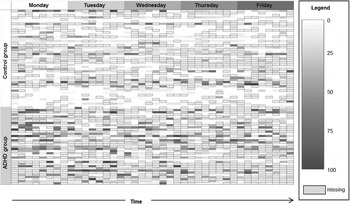
Figure 1 provides a ‘heat map’ for the emotion ratings of irritable over the monitoring period. Each row represents a participant, each square corresponds to a report and the shade of grey denotes the level of irritable (darker squares indicating higher ratings). Variability in the length of individual bars indicates differences in compliance, with longer bars indicative of greater compliance. The fast-changing intensity seen in the upper portion of the figure represents the high within-subject variability and the darker shade overall suggests a greater proportion of high ratings of irritable in the ADHD group, indicative of greater intensity and instability of irritability in the clinical group.
Irritability ratings for attention deficit hyperactivity disorder (ADHD) and control participants over 5 days. Each row represents a participant and each square a self-report. The shade denotes the level of irritability (white = no irritability, grey = mild irritability, black = high irritability). Missing data are presented as boxed squares.

Emotional intensity
Mean changes
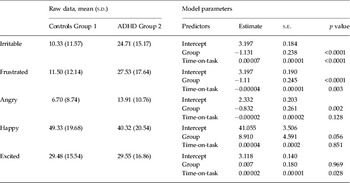
Multilevel models revealed significantly elevated intensity of irritable, frustrated and angry in participants with ADHD (Table 1). No group differences were seen for positive emotions (excited, happy), although participants with ADHD showed a trend towards lower ratings of happy (p = 0.056). Significant negative effects of time-on-task were seen for irritable and frustrated (declining during the week), and positive effects (increasing during the week) for excited.
Descriptive statistics [group overall mean emotions (s.d.)] and between-group differences and time-on-task effects on emotion intensity as estimated by multilevel modelling

ADHD, Attention deficit hyperactivity disorder; s.d., standard deviation; s.e., standard error.
Emotional instability
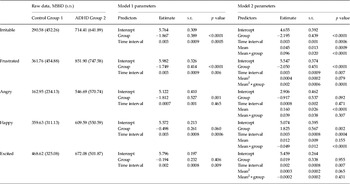
As shown in Table 2, significantly elevated emotional instability was seen for irritable, frustrated and angry in the ADHD group (model 1), where no adjustments were made for mean or squared mean differences between groups. No group differences were seen for positive emotions, although there was a trend for instability of happy (p = 0.06).
Descriptive statistics [group overall MSSD (s.d.)] and between-groups differences in emotional instability as estimated by multilevel modelling
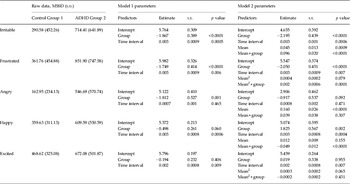
MSSD, Mean squared successive difference; ADHD, attention deficit hyperactivity disorder; s.d., standard deviation; s.e., standard error.
F tests for comparison of curves for associations between mean ratings and MSSDs revealed a significantly better fit for quadratic functions for excited (F 1,76 = 11.24, p = 0.04) and frustrated (F 1,76 = 12.12, p = 0.04) but not for angry (F 1,76 = 0.22, p = 0.81) happy (F 1,76 = 5.66, p = 0.10) or irritable (F 1,76 = 9.0, p = 0.054). Where quadratic functions provided a significantly better fit for the data, squared mean effects rather than mean effects were included as predictors in model 2. After covarying for mean/squared mean effects (model 2), higher instability remained in the ADHD group only for irritable and frustrated. By contrast, the negative group estimate for happy in model 1, indicative of enhanced instability in the ADHD group, was reversed in model 2.
The effects of mean emotion ratings on emotional instability were significant for items irritable and angry in model 2, the positive estimate being in line with the observation that variability is limited when ratings are low. The positive estimate for the interactive effect of mean/squared mean with group for irritable and frustrated shows that the positive adjustment for a lower mean was applied to group 1 (controls), who had lower levels of irritability and frustration overall (Table 1). The negative estimate for the item happy shows the opposite to be the case: higher ratings of happy were associated with lower variability.
Time interval was positively associated with SSD for all measures of instability with the exception of angry. The value zero was reported most frequently for angry compared with other items (55.3% of responses compared to less than 40% for other emotions), which probably resulted in strong correlations for distal and also proximal time points.
Good and bad events
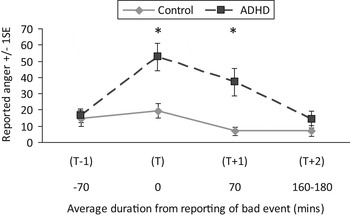
Bad events were reported more frequently by participants with ADHD (bad: z = − 2.12, p = 0.03; good: z = − 0.68, p = 0.50). Participants with ADHD reported a greater impact of both good (t 65 = − 2.23, p = 0.03) and bad events (t 60 = − 4.15, p < 0.001). Analysis of change in emotion from reports immediately preceding and during the reporting of good and bad events (consecutive reports within 2 h, obtained from 23 ADHD and 23 controls) revealed enhanced anger in the ADHD group after bad events only (z = 2.39, p = 0.017 uncorrected for multiple comparisons, all other emotions minimum p = 0.14). Anger response was then further investigated in participants who provided successive reports within 2 h before (T – 1) and after (T + 1) logging a bad event (18 ADHD, 20 controls). A further consecutive report within 4 h (T + 2) after a reported bad event was available in 15 ADHD participants and 18 controls (Fig. 2). Anger was elevated in individuals with ADHD during instances where bad events were concurrently reported (T: z = − 2.75, p = 0.005), remaining elevated at T + 1 (z = − 2.98, p = 0.004). No group differences were seen at T + 2 (z = − 0.92, p = 0.36) or at T – 1 (z = − 0.501, p = 0.61). Significant findings were robust to Bonferroni correction, and duration between reports did not differ between groups (minimum p = 0.54). Analyses were repeated after excluding time series during which an additional bad event was logged at T + 1, with anger at T + 1 remaining elevated in the ADHD group (z = − 2.19, p = 0.04, uncorrected for multiple comparisons).
Time-based investigation of the influence of a reported bad event on anger. Number of participants at each time point T − 1, T and T + 1: 20 controls, 18 ADHD, at T + 2: 18 controls, 15 ADHD. The asterisks indicate a significant group difference.

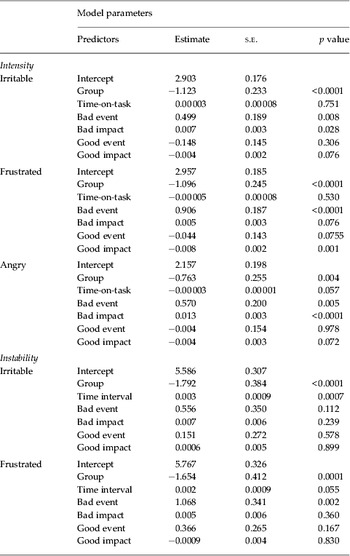
Multilevel models for intensity of irritable, frustrated and angry and instability for irritable and frustrated were repeated, after including bad and good events and their impact as predictors (Table 3). Group differences for all models remained significant after the inclusion of good and bad events as predictors. Bad events, but not their reported impact, predicted overall greater intensity of irritable, frustrated and angry and instability of frustrated. Good events did not significantly influence intensity or instability; however, higher impact of good events predicted lower intensity of frustrated.
Between-group differences in intensity and instability as estimated by multilevel modelling after the inclusion of good and bad event data
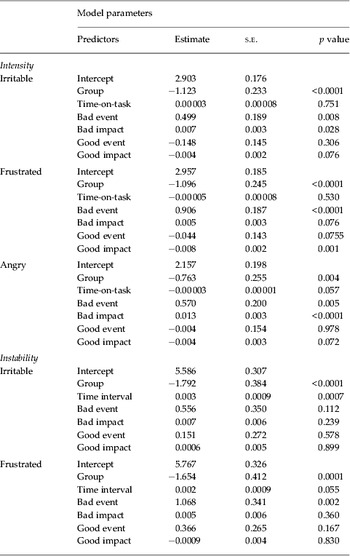
s.e., standard error.
To investigate a potential heightened affective response after experiencing good and bad events in the ADHD group, multilevel models were repeated after including an interaction term for bad and good events with group. These revealed significant group by bad event interactions for intensity of irritable (estimate = 0.452, s.e. = 0.199, p = 0.023), frustrated (estimate = 0.671, s.e. = 0.199, p < 0.001) and angry (estimate = 0.744, s.e. = 0.211, p < 0.001). Findings indicate a greater negative emotion response to bad events in the ADHD group. However, again group differences between ADHD and control participants were highly significant after covarying for such interactive effects within these models (minimum p = 0.001).
Self-reported EL
Correlations between the MSSDs and means with ALS-SF mean scores were carried out, confirming moderate correlations in control participants (irritable mean: ρ = 0.40, p = 0.006, MSSD: ρ = 0.43, p = 0.004; frustrated mean: ρ = 0.46, p = 0.002, MSSD: ρ = 0.51, p < 0.001; angry mean: ρ = 0.49, p = 0.001), and slightly weaker correlation coefficients in the ADHD group [significant only for frustrated mean (ρ = 0.40, p = 0.02) and MSSD (ρ = 0.48, p = 0.004) and irritable MSSD (ρ = 0.37, p = 0.03), maximum correlation coefficient for other comparisons = 0.26, p range = 0.0.13–0.36]. Differences in correlation coefficients with ALS-SF scores between groups were non-significant.
Discussion
Although previous research has linked EL to ADHD, a detailed characterization of the nature of EL is lacking. Using real-time ambulatory assessment of emotions, we confirm our hypotheses of increased instability and intensity of negative emotions in ADHD, complementing clinical descriptions (Wender et al. Reference Wender, Reimherr, Wood and Ward1985; Asherson, Reference Asherson2005; Reimherr et al. Reference Reimherr, Marchant, Strong, Hedges, Adler, Spencer, West and Soni2005) and research using rating scales (Barkley & Fischer, Reference Barkley and Fischer2010; Barkley & Murphy, Reference Barkley and Murphy2010; Surman et al. Reference Surman, Biederman, Spencer, Yorks, Miller, Petty and Faraone2011). Specifically, ADHD in adults is associated with both increased intensity of anger, frustration and irritability and heightened instability of frustration and irritability, in comparison with healthy controls. Our findings are illustrated by heat maps of real-time data and supported by statistical modelling of data.
Our results are derived from an untreated male-only sample without co-morbidity. The patient sample studied here was carefully screened to include only individuals who were free from medication, co-occurring clinical conditions and substance use problems. This indicates that the findings cannot be accounted for by other clinical conditions, but are likely to reflect a feature of ADHD itself. Although participants in a depressive state at the time of assessment were excluded, we did not exclude individuals with past non-recurrent depressive states, from either the ADHD or control groups. Future research would benefit from including co-morbid ADHD patients for comparison. Larger studies would be required to allow comparison with individuals with concurrent or previous psychiatric conditions. Moreover, research including female participants would allow for the investigation of gender effects.
Our results support findings from rating-scale measures that show elevated EL in adults with ADHD. However, small-to-moderate correlations were seen between the questionnaire measures of EL and ambulatory assessment measures in the ADHD group. This is in line with previous research on bulimia nervosa and personality disorders (Delespaul et al. Reference Delespaul, deVries and van Os2002; Links et al. Reference Links, Heisel and Garland2003; Anestis et al. Reference Anestis, Selby, Crosby, Wonderlich, Engel and Joiner2010) and a small study of parental ratings in children with ADHD (Rosen et al. Reference Rosen, Epstein and Van Orden2013), and indicates that data from ambulatory assessment and retrospective self-report cannot be considered equivalent.
We hypothesized that EL in ADHD could be explained by more frequent adverse events. The ADHD group reported more bad events, an exaggerated anger response to bad events and a slow return to baseline anger levels. In addition, the ADHD group reported that both bad and good events had a larger impact than control participants. This may suggest that ADHD is associated with either more extreme difficulties, along with successes in everyday life, or differences in the appraisal of everyday events. This was supported by findings from multilevel models that showed that intensity of irritable, frustrated and angry showed greater enhancement in ADHD participants when bad events were reported.
Bad events were associated with increased instability of frustrated and intensity of irritable, frustrated and angry, supporting our hypothesis that EL is associated with adversity in daily life. However, even after covarying for good and bad events, group differences in emotional intensity and instability remained. Our results therefore suggest that higher intensity and instability of negative emotions result in part from increased emotional reactions to adverse events, and in part from endogenous changes in emotional states. We further infer that, because we find effects of negative emotional intensity and instability independently from reported good and bad events, aspects of EL must occur independently of daily events and may therefore form a core symptom of ADHD.
There are, however, study limitations to consider when drawing these strong conclusions. The sampling frequency used in this study prohibited the continuous investigation of good and bad events, and no information on the nature of these events was collected. A combined event-contingent (provide reports when experiencing certain environmental events) and signal-contingent (respond to random prompts) paradigm would be required to investigate environmental reactivity directly (Trull et al. Reference Trull, Solhan, Tragesser, Jahng, Wood, Piasecki and Watson2008). Conversely, our findings rely on self-reported perception of events, which may be affected by individuals recognizing recent events as significant following emotional changes. This may potentially enhance the link between events and emotions. Replication of our findings, with further detail on the nature of bad and good experienced events, would be merited.
Clinical descriptions highlight instability in positive emotions, such as excitability, in adults with ADHD (Reimherr et al. Reference Reimherr, Marchant, Strong, Hedges, Adler, Spencer, West and Soni2005; Asherson et al. Reference Asherson, Chen, Craddock and Taylor2007). However, the current study showed no group differences for excitement, and equivocal results for happiness. Replication using a larger sample or more frequent sampling may be required to identify meaningful differences in reported intensity or instability of positive emotions. Although our study focused more strongly on emotional features, which are commonly noted as accompanying ADHD, the greater emphasis on negative emotional items may have exerted a reporting bias on participants. We cannot preclude this possibility, and suggest that future studies include a balance of positive and negative emotion measures. Overall, our results suggest that enhanced and changeable negative emotions are more characteristic of ADHD in adulthood.
Symptom overlap has been highlighted between ADHD and BD, particularly with regard to EL (Skirrow et al. Reference Skirrow, Hosang, Farmer and Asherson2012). Mixed episodes in BD can be characterized as an irritable mood state (APA, 1994, 2000), and in children and adolescents chronic irritability is reported as the hallmark of mania by some investigators (Wozniak et al. Reference Wozniak, Biederman, Kiely, Ablon, Faraone, Mundy and Mennin1995; Biederman et al. Reference Biederman, Mick, Faraone, Spencer, Wilens and Wozniak2000). It has been suggested that, in contrast to BD, ADHD is associated with generally normal moods with short-lived frustration or anger following emotional challenges, with these emotions not forming distinct protracted episodes (Biederman et al. Reference Biederman, Spencer, Lomedico, Day, Petty and Faraone2012). Our results do not support these assertions, but instead indicate that protracted irritability is a common feature of adult ADHD (see Fig. 1). Moreover, no association was seen between instability of irritability and bad events, indicating that instability of irritability is not as contingent on the environment as suggested by some authors (Rosen & Epstein, Reference Rosen and Epstein2010; Biederman et al. Reference Biederman, Spencer, Lomedico, Day, Petty and Faraone2012), but may instead be driven by endogenous emotional changes. Although a direct comparison of ambulatory monitoring data from BD and ADHD groups is required to fully clarify this issue, our results suggest that protracted irritability is unlikely to clinically differentiate ADHD from BD.
Minimal missing data are crucial for the assessment of instability measured by successive scores from one occasion to the next (Bolger et al. Reference Bolger, Davis and Rafaeli2003; Ebner-Priemer & Trull, Reference Ebner-Priemer, Trull, Mehl and Conner2011) and in the current study compliance was moderate, similar to studies of out-patients with schizophrenia (Granholm et al. Reference Granholm, Loh and Swendsen2008) and healthy adolescents (Hedeker et al. Reference Hedeker, Mermelstein, Berbaum and Campbell2009). Multilevel models are the primary method for analysing ambulatory assessment data because these can handle data that are correlated within subjects, and missing at random (Gueorguieva & Krystal, Reference Gueorguieva and Krystal2004). In this study, findings from multilevel models were supported by more rudimentary analyses of group differences using mean ratings and variability indices (within-subject standard deviation): irritable mean: z = − 4.34, p < 0.001, s.d.: z = − 4.49, p < 0.001; frustrated mean z = − 4.22, p < 0.001, s.d.: z = − 4.12, p < 0.001; angry mean: z = − 3.02, p = 0.003. This indicates that the findings reflect a true effect, regardless of the statistical methods used.
Conclusions
Overall, our study reveals increased intensity and instability of negative emotions in individuals with ADHD, compared with healthy controls. The lack of psychiatric co-morbidity in this sample indicates that increased emotional instability in ADHD cannot be accounted for by other co-occurring mental health disorders, confirming findings of the close association of ADHD with EL reported using rating-scale data. Furthermore, differences in emotional intensity and instability were not accounted for by increased adverse events experienced by participants with ADHD, and seem to include both an environmentally reactive component and an endogenous component. Taken together with evidence of a correlated treatment response of EL and ADHD symptoms (Reimherr et al. Reference Reimherr, Marchant, Strong, Hedges, Adler, Spencer, West and Soni2005, Reference Reimherr, Marchant, Olsen, Halls, Kondo, Williams and Robinson2010), and evidence of shared aetiology from behavioural genetic research (Merwood et al. Reference Merwood, Chen, Rijsdijk, Skirrow, Larsson, Thapar, Kuntsi and Asherson2014), this suggests that EL may be viewed as a third correlated domain of adult ADHD. The main clinical implication arising from this work is the need to screen for ADHD in all adults presenting with chronic mood instability showing the characteristic features reported in this study.
Supplementary material
For supplementary material accompanying this paper visit http://dx.doi.org/10.1017/S0033291714001032.
Acknowledgements
We thank J. Bastiaansen, S. Bates, H. Collyer, B. Jegede, T. Mellow, J. Mika and P. Reid, and the National Adult ADHD Clinic at the South London and Maudsley Hospital, for assistance and support with the research, and all participants who contributed their time to the study.
This study was supported by a grant from the Research for Innovation, Speculation and Creativity (RISC) funding programme of the National Institute of Health Research (reference: RCPG0308-10245) to P. Asherson, D. Murphy and C. Skirrow.
Declaration of Interest
C. Skirrow has received funds for sponsored talks for Novartis. P. Asherson has received funds for consultancy or sponsored talks on behalf of King's College London (KCL) for Shire, Lilly, Novartis, Janssen and PCM Scientific. He has also received research or education funds on behalf of KCL from Shire, Lilly, Novartis, Janssen, Vifor Pharma and QbTech. Y. Malliaris has received funds for presenting iMonitor on behalf of the Hellenic Bipolar Organization from Astrazeneca. I. Reinhard, J. Kuntsi and U. Ebner-Priemer report no conflicts of interest.