

Introduction
A key benchmark of democratic performance is the extent to which public opinion is reflected in public policy. When responsiveness is lacking, institutional reforms that strengthen the electoral connection between public opinion and elite decision-making are often proposed. Political scientists champion these changes. Yet, institutions that strengthen the electoral connection may conflict with another cherished democratic value: equality. As Abizadeh (Reference Abizadeh2021) writes, “when push comes to shove, majoritarianism ultimately jettisons the democratic commitment to equality” (743). Comparative studies find empirical support for Abizadeh’s (Reference Abizadeh2021) claim; majoritarian institutions are systematically related to higher income inequality among developed countries (e.g., Birchfield and Crepaz Reference Birchfield and Crepaz1998).
In the field of American state politics, the tension between majoritarian institutions and equality has almost exclusively focused on how direct democracy affects minority rights (Gamble Reference Gamble1997; Lewis Reference Lewis2011; Schildkraut Reference Schildkraut2001). While important, ballot initiatives are just one way of measuring majoritarian rule in the American states. Institutions related to campaign finance laws (Barber Reference Barber2016; La Raja and Schaffner Reference La Raja and Schaffner2015), voter registration laws (Mitchell and Wlezien Reference Mitchell and Wlezien1995; Wolfinger and Rosenstone Reference Wolfinger and Rosenstone1980), and legislative professionalism (Maestas Reference Maestas2000; Squire Reference Squire1993) in addition to ballot initiatives and popular referendums (Gerber Reference Gerber1996; Matsusaka Reference Matsusaka2018) strengthen the role of the median voter and increase electoral incentives for elites to follow public opinion (LaCombe Reference LaCombe2021).
How are majoritarian institutions related to social inequalities across the states? Under what conditions do majoritarian institutions exacerbate inequalities in the American states? Our argument is that equality is most likely to be threatened under majoritarian institutions when there are (1) systemic participatory biases and/or (2) there are widespread prejudices about particular groups in society. For both reasons – either participatory biases or biased public opinion, increasing electoral incentives may push elected officials toward a less pro-equity stance than would be observed under other institutional designs.
We use a racial equity lens to test our arguments. As explained by Michener (Reference Michener2019), “American public policy is (and always has been) profoundly racialized” (423). We focus on how state institutional designs exacerbate racial disparities in health, educational attainment, and poverty. In so doing, we contribute to the ongoing literature about how institutional designs contribute to the systematic exclusion and marginalization of racial and ethnic minority groups. We find that more majoritarian institutions are associated with larger disparities between White and Black life expectancy and poverty rates, but not differences in educational attainment. In two-way fixed effects models, we also find that this effect is moderated by racial context, with majoritarian institutions being associated with greater disparities for states with diverse racial contexts and smaller disparities in more homogenous states. These findings suggest that majoritarian institutions operate to the benefit of the White majority, while coming at the cost of minority population outcomes when a racial threat is perceived, and presumably, public opinion is biased.
When does responsiveness exacerbate equality?
We argue that who participates, and the popularity of prejudiced beliefs play a critical role in determining the extent to which majoritarian institutions exacerbate inequality in the states. Majoritarian institutions will exacerbate inequality under two conditions: when there are systemic participatory biases in the political process and when the majority public opinion is prejudiced. There are likely other conditions that increase state inequalities, and our analyses include a range of other variables. However, for determining whether majoritarian institutions translate into gross disparities in social outcomes, who participates and the extent to which constituents are prejudiced play a crucial role in pushing elected officials toward more particularized policies that, years later, widen inequalities on key social outcomes.
Participatory bias
If there are systemic biases in who participates in politics, then majoritarian institutions are more likely to lead to larger social inequalities. Politicians strive to respond to their constituents (Miller and Stokes Reference Miller and Stokes1963), yet the messages they receive may very well be distorted if there are systemic participatory biases. A long strand of research finds that the American electorate is indeed biased toward wealthy, educated, politically interested, and healthy citizens (Burden et al. Reference Burden, Canon, Mayer and Moynihan2017; Pacheco and Fletcher Reference Pacheco and Fletcher2016; Schlozman et al. Reference Schlozman, Brady and Verba2018; Verba et al. Reference Verba, Schlozman and Brady1995; Wolfinger and Rosenstone Reference Wolfinger and Rosenstone1980). This participatory bias extends to the 50 states as well although there is variation in the size of these biases (Avery Reference Avery2015; Avery and Peffley Reference Avery and Peffley2005; Hill and Leighley Reference Hill and Leighley1992; Pacheco Reference Pacheco2021).
Participatory biases are of less concern if the political preferences of active citizens are representative of the electorate as a whole. While some research suggests marginal differences in preferences between voters and nonvoters (Wolfinger and Rosenstone Reference Wolfinger and Rosenstone1980), more recent research finds that Republicans and conservatives are overrepresented by voters (Leighley and Nagler Reference Leighley and Nagler2014). Differences in opinion are even bigger when looking at political acts beyond voting; those who made large campaign contributions are considerably more conservative on economic issues compared to all citizens, all voters, and even all contributors (Schlozman et al. Reference Schlozman, Brady and Verba2018). Because politically active individuals are less likely to need government support, public officials hear less about issues related to basic human needs (Schlozman et al. Reference Schlozman, Brady and Verba2018), which may encourage less pro-equity policy proposals, which eventually lead to more social inequality.
Work at the local level suggests that participatory biases can lead to greater inequalities. Hajnal and Trounstine (Reference Hajnal and Trounstine2005) find that racial turnout disparities in local and off cycle elections lead to lower rates of representation for Latino, Asian American, and African American voters. Sances compares towns in New York with direct elections compared to appointed tax accessors and finds that the influence of participatory biases on inequality was substantial; by one estimate, the difference in effective tax rates between the richest and poorest homes were 26 percentage points higher in towns with elections (Reference Sances2016). In the case of New York towns, the reality of unequal participation led to incentives that made elected accessors more biased in their decision making than they would have been if appointed. Sances (Reference Sances2016) points out that inequality in effective taxation existed in all towns regardless of how the accessor was selected. However, the bias was exacerbated by the presence of elections.
Prejudiced public opinion
Even if there were no participatory biases, we suspect that majoritarian institutions will lead to more unequal outcomes if the majority of citizens oppose equality for all. This opposition may arise because of explicit or implicit prejudices or a general belief system that inequality is caused by individual behaviors instead of institutional structures. In reality, it is difficult to separate the two factors since prejudices are often intertwined with beliefs about attributions of blame. For instance, Americans who score high on the racial resentment scale tend to explain racial inequality in terms of individual behavior instead of structural inequalities (Kam and Burge Reference Kam and Burge2018). In regards to health disparities, individuals are more likely to blame poor health on individual behaviors instead of biological or systemic factors when groups suffering ill health are defined in racial, class, or gender terms (Gollust and Lynch Reference Gollust and Lynch2011). Individualism (Cozzarelli et al. Reference Cozzarelli, Wilkinson and Tagler2001; Feldman Reference Feldman1983; Smith and Stone Reference Smith and Stone1989) and racial animus (Rabinowitz et al. Reference Rabinowitz, Sears, Sidanius and Krosnick2009) are also significant factors explaining public opinion toward poverty and welfare programs.
The argument that majoritarian institutions might exacerbate inequalities – precisely because of prejudiced public opinion – is at the core of the debate over direct democracy. Critics of direct democracy suggest that minority rights are endangered when citizens vote directly on legislation. Unlike institutions of direct democracy, a representative democracy holds elected officials accountable for their decisions – both through electoral incentives and nonelectoral constraints – which provides a check on a powerful, prejudiced majority. In the case of minority rights, elected officials are less likely to make outwardly biased decisions than voters, even if they are no less prejudiced (Hainmueller et al. Reference Hainmueller, Hangartner and Yamamoto2015). While some studies find little evidence that direct democracy hurts minoritized groups (e.g., Hajnal et al. Reference Hajnal, Gerber and Louch2002), others find that states with direct democracy have anti-minority policies, such as laws defining English as the official language (Preuhs Reference Preuhs2005), affirmative action bans (Chavez Reference Chavez1998), same-sex marriage bans (Lewis Reference Lewis2011), and are also more likely to have the death penalty (Caron Reference Caron2021; Gerber Reference Gerber1999). Gamble (Reference Gamble1997) looks at patterns across three decades of referendums/initiatives on five major civil rights areas, including housing for racial minorities, school desegregation, gay rights, English only laws, and AIDS policies; she finds that voters approved over three-quarters of these laws, providing strong evidence that direct democracy promotes majority tyranny on civil rights. These policies, in turn, have obvious implications for the equality of social outcomes.
Using a racial equity lens
We use a racial equity lens to test our arguments. Race is a fundamental factor in American public policy generally (e.g., Michener Reference Michener2019) and specifically in state politics (e.g., Hero and Tolbert Reference Hero and Tolbert1996). Devolution since the 1980s has only heightened the role that states play in exacerbating or eliminating racial disparities across a variety of outcomes including health (e.g., Rodriguez Reference Rodriguez2019), education (e.g., Meier and Rutherford Reference Meier and Rutherford2016), incarceration (e.g., Yates 1997), housing (e.g., Michener Reference Michener2023; Michener and Brower Reference Michener and Brower2020), poverty (e.g., Soss et al. Reference Soss, Fording and Schram2008), and so forth. Most of the research on the determinants of racial inequalities in the American states has focused on policy design and implementation (e.g., Soss and Schram Reference Soss and Schram2007), party control and electoral competition (e.g., Rodriguez Reference Rodriguez2019; Yates and Fording Reference Yates and Fording2005), as well as racial/ethnic diversity (e.g., Hero and Tolbert Reference Hero and Tolbert1996; Matsubayashi and Rocha Reference Matsubayashi and Rocha2012). We contribute to the ongoing literature about how institutional designs related to majoritarian rule are associated with the systematic exclusion and marginalization of racial and ethnic minority groups, which in turn contributes to racial disparities.
Hypotheses
We suspect that strengthening majoritarian institutions in the American states will lead to racial inequalities in and of itself, but in states where the inputs are biased either because of who participates or prejudiced opinions, elected officials will have even greater incentives to promote proposals with particularized benefits. In turn, racial inequalities widen. This provides us with specific hypotheses about conditions under which equality is threatened under majoritarian institutions.
Majoritarian Hypothesis: States with strong majoritarian institutions have larger racial disparities than states with weak majoritarian institutions.
Participatory Interaction Hypothesis: The influence of majoritarian institutions on state racial inequalities will increase as the amount of participatory bias increases.
Opinion Interaction Hypothesis: The influence of majoritarian institutions on state racial inequalities will increase as the prejudice of state residents increases.
Measuring social inequality in the American states
To test our hypotheses, we collected data from a variety of sources on state racial disparities related to the health, education, and income. Due to the challenging nature of finding reliable state-level estimates disaggregated by race, there is significant variation in the sample size depending on the outcome, with some outcomes having over 30 years of reliable data and others only having a decade at most. For all outcomes, our dependent variable is the absolute value of the difference between state-level estimates by race. Larger values indicate larger inequalities between White and Black populations. Due to data limitations, our models for life expectancy only include states with at least 3% of the population being Black.Footnote 1
Health
To measure racial disparities on health in the states, we use data from Harper et al. (Reference Harper, MacLehose and Kaufman2014) who collect data on life expectancy for Black and White populations from 1990 to 2009. Life expectancy at birth is an estimate of the number of years a (Black or White) newborn is predicted to live based on period life table calculations (see Harper et al. Reference Harper, MacLehose and Kaufman2014). We generate measures of the difference between Black and White life expectancy at birth. Figure 1 shows the overtime variations in all 50 states with values mapped for the first and last year of data available. While the disparity has been shrinking overtime, in 2009, there is still a nearly 4-year gap between White and Black life expectancy with the largest gap being 8.5 years. The states with the largest average disparities are found in the Midwest (Illinois, Michigan, and Wisconsin) and the South/border states (Maryland, Louisiana, Missouri, Florida). The states with the largest gaps tend to have relatively large Black populations, while those with the smallest average gaps tend to have larger White populations (Maine, New Hampshire, Utah, West Virginia). Out of the 45 states with large enough Black populations to provide estimates, all but Wisconsin and Hawaii saw the disparity shrink, with New York seeing the largest decline (4.2 years) and an average decrease of 1.7 years.
Disparity between Black and White life expectancy at birth in the American states in 1990 and 2009.

Educational attainment
In addition to racial health disparities, we also estimate racial disparities in educational attainment across the states. We use the CDC’s Behavioral Risk Factor Surveillance System (BRFSS). This over the phone survey is one of the most comprehensive public surveys with up to 500,000 respondents per year across all 50 states. With the proper use of weights, data from the BRFSS are representative of state populations. We calculate the absolute value of the difference between the percentage of Black individuals in a state with a high school degree and the percentage of White individuals with a high school degree. In our sample, 91% of the White population and 86% of the Black population had at least a high school degree. The BRFSS data spans from 1993 to 2016 and is shown in Figure 2. As shown in Figure 2, which maps the outcome variable in 1995 and 2015, the educational attainment gap between the White and Black populations appears to be shrinking somewhat. Notable, state-level variation appears to be shrinking overtime as the gap becomes similar across all states in the sample. We again find that Wisconsin is one of the states with the largest racial disparities, followed by several Southern states (Florida, Mississippi, and Louisiana). The disparity has been reduced on average by 3.8 percentage points, but eight states have seen the gap grow since 1993.
Disparity between Black and White percentage of population with at least high school degree in the American states in 1995 and 2015.

Poverty
Finally, we use data from the American Community Survey 2009–2019 to measure racial inequalities in poverty across the states. Here, our outcome variable is the difference in the poverty rate between Black and White populations across the states. The average poverty rate is much higher for Black populations (27%) compared to the White ones (10%), and Figure 3 shows how stark the geographic variation is in both 2009 and 2019. States with small Black populations see the highest disparities (the Dakotas, Vermont, Idaho) while non-Southern, more diverse states tend to see the smallest average disparity (Delaware, Arizona, New York). From 2009 to 2019, the average difference has shrunk from over 18% to less than 14%, and most states see a downward trend. This measure is much noisier than the other two population outcomes, with some states with small Black populations seeing shifts of up to 10% in a very short period. The national mean never shifts more than 4%.Footnote 2
Disparity in Black and White poverty rate in the American states in 2008 and 2019.

Measuring majoritarian institutions
Our first task is to test the Majoritarian Hypothesis, which suggests that states with strong majoritarian institutions have larger disparities than states with weak majoritarian institutions. To test this hypothesis, we measure state majoritarian institutions using a latent scale developed by LaCombe (Reference LaCombe2021). As described by LaCombe (Reference LaCombe2021), the measure was calculated from a Bayesian factor analysis using institutional data from all 50 states from 1975 to 2016. LaCombe (Reference LaCombe2021) identifies one of the dimensions from this factor analysis as accountability pressure. States high in accountability pressure have an easy-to-use initiative process, relatively strict campaign finance laws, and high levels of legislative professionalism. Evidence suggests that many of these institutions – when studied separately – increase the association between public opinion and policy (Gerber Reference Gerber1996; Maestas Reference Maestas2000; Pacheco Reference Pacheco2013; La Raja and Schaffner Reference La Raja and Schaffner2015), although the evidence is mixed with others finding null results (Caughey and Warshaw Reference Caughey and Warshaw2018). LaCombe (Reference LaCombe2021) argues that by combining these institutions into a comprehensive measure scholars can more fully account for the influence of institutions. LaCombe argues that when accountability pressure is high, states have stronger incentives to respond to the majority public opinion. These scores have been made publicly available, and LaCombe (Reference LaCombe2021) notes that there has been a sizable increase nationally in accountability pressure over the past four decades, but there is still significant heterogeneity across states, with accountability on average being lower in Appalachian states and higher in states west of the Mississippi River (see appendix for a more detailed visualization of the published scores). Scores are normally distributed with a mean of 0 and standard deviation of 1.
The composite scale also matters; states with higher levels of accountability pressure have higher rates of opinion-policy congruence across dozens of policies (LaCombe Reference LaCombe2020, Reference LaCombe2021) and are more responsive to economic and social policies (LaCombe Reference LaCombe2023). Pacheco and LaCombe (Reference Pacheco and LaCombe2022) use these data to demonstrate that accountability pressure has population health implications with states higher in accountability pressure having lower infant mortality rates.Footnote 3 Across multiple studies, this measure has been found to be associated with more responsive policymaking, but questions remain whether this comes at the cost of being less responsive to voters outside of a governing majority.
Participatory bias
As described above, there are two conditions under which majoritarian institutions will exacerbate racial inequalities: when there are systemic participatory biases in the political process and when the majority public opinion is prejudiced. We use two measures to test the Participatory Interaction Hypothesis. First, we use the Current Population Survey (CPS) to calculate the turnout gap between White and Black voters from 1994 to 2018. We interpolated values if the data were missing using a linear trend for each state to fill in missing values by averaging the previous and following year’s turnout bias.Footnote 4 Higher values indicate higher White levels of voting, and the mean across the time-series-cross-sectional data are 4.6% with a standard deviation of 11%. We include this measure in our two-way fixed effect models and interact it with accountability pressure.
We include a second measure of participatory bias based on income because there is evidence that racial differences in turnout are the result of differences in socioeconomic status (e.g., Leighley and Vedlitz Reference Leighley and Vedlitz1999; Verba et al. Reference Verba, Schlozman and Brady1995). We include a measure of income bias in voter turnout from 1996 to 2012 (Avery Reference Avery2015), which is measured using questions about income and turnout in the CPS Voter Supplement file. The measure is the “percent of people in the top fifth of the income distribution who voted divided by the percent of the people in the bottom fifth of the income distribution who voted” (Avery Reference Avery2015, 962). We use the same interpolation procedure explained above to fill in nonelection years. If the voting population is biased toward higher income individuals, then there is an incentive structure for political elites to craft policies that are favored by wealthy citizens, potentially leading to increased social disparities. We therefore interact this measure with the accountability variable. The two measures of participatory bias are very weakly correlated (.09) suggesting that they are distinct.
Biased public opinion
We test the Opinion Interaction Hypothesis using two different approaches. First, we include a measure of state racial resentment (Smith et al. Reference Smith, Kreitzer and Suo2020). Smith et al. (Reference Smith, Kreitzer and Suo2020) use small area estimation techniques on the American National Election Studies (ANES) data to produce state-level measures of racial attitudes, with higher values indicating stronger levels of racial resentment. We expect that in majoritarian systems designed to maximize the influence of public opinion, these attitudes may have an even stronger effect on increasing racial disparities in population outcomes. On the other hand, if public opinion had low levels of racial resentment, we would expect to see majoritarian institutions lead to smaller disparities between majority and minority groups as elites have fewer incentives to craft policies that cater to voting populations with high levels of racial resentment. We interact this measure with accountability pressure to evaluate if disparities that emerge from majoritarian institutions are larger when racial resentment is high. We again used interpolation using a linear trend to fill in missing values of the resentment score, which were estimated originally in 4-year increments.Footnote 5
Because the state racial resentment measure is unavailable across the timespan, we also measure prejudiced public opinion using a simpler method to proxy a state’s racialized context. Specifically, we use Hero and Tolbert’s (Reference Hero and Tolbert1996) categorization of states based on racial and ethnic diversity. They categorize states as homogenous, heterogeneous, and bifurcated. Homogenous states have low levels of both racial and ethnic diversity, while bifurcated states include those with large minority populations but small White ethnic populations, and heterogeneous states have high levels of both. Growing diversity may be perceived as a racial threat by White voters, which leads to higher levels of biased public opinion. Under this scenario, greater diversity leads the White population to feel threatened by political, economic, and social competitions from non-White voters (Avery and Fine Reference Avery and Fine2012; Huckfeldt and Kohfeld Reference Huckfeldt and Kohfeld1989). For example, Avery et al. (Reference Avery, Fine and Marquez2017) find that states with a larger Latino population pass more restrictive immigration laws, particularly when Latino voter engagement is low. Tolbert and Grummel (Reference Tolbert and Grummel2003) find that Whites living in more diverse census tracts were more likely to support bans on affirmative action. In this scenario of racial threat, majoritarian institutions may empower White populations to enact policies stemming that either disproportionately benefit White populations or harm non-White groups.Footnote 6 Similar to the other analyses, we include an interaction term to test for our hypothesis.
Empirical strategy
Proper identification of the modeling strategy requires an understanding about the source of variation in the dependent and independent variables as well as the limitations of the data.
ANOVA analyses indicate the source of variation for the dependent variables differs with some variables (life expectancy and poverty) having a majority of variance between states and others having a majority of variance within states (educational attainment).
Additionally, a major concern is omitted variable bias, either from the omission of systemic factors (e.g., national level policies) or unit-specific forces (e.g., state economics). Systemic factors can accounted for by using variables that capture time trends (e.g., cubic spline or year fixed effects). State fixed effects may be included to account for unit heterogeneity. Including these variables, however, are atheoretical, may lead to an over-parameterization of the model (e.g., Achen Reference Achen2005), or even create biased estimates if included with a lagged dependent variable (LDV; e.g., Nickell Reference Nickell1981). A random-effects estimator may be preferable, even in the presence of bias, to reduce variance in cases when predictors change gradually over time (Clark and Linzer Reference Clark and Linzer2015).
We report the results using multiple model specifications. First, we model the dependent variables as the 1-year difference and include an LDV to correct for autocorrelation (Beck and Katz Reference Beck and Katz1996). This type of model is called an error correction model (ECM) and we include panel corrected standard errors (Beck and Katz Reference Beck and Katz2011). Modeling our dependent variables as first differences has two benefits. First, these types of models essentially purge the regression of any unobserved state-specific fixed effects. ANOVA analyses on the differenced dependent variables confirm that virtually all the variation is within states. Second, we allow for the possibility that the treatment effect of majoritarian institutions on disparities requires some extended period of time. An ECM allows for the estimation of both the short- and long-term effects of independent variables and tells us how quickly the system returns to equilibrium or the overall mean after being disrupted. Since our measure of political accountability is time varying, we include differenced and lagged versions.Footnote 7 We also include fixed effects of year to capture common trends. For the dynamic models, we decide against state fixed effects because the differenced outcomes are already purged of the between state variation and because our main independent variables, while dynamic, are slow to change (see Clark and Linzer Reference Clark and Linzer2015).
Because not including state fixed effects may result in omitted variable bias, we present a second set of models that describe the between state association of majoritarian institutions and racial disparities. For these models, the estimate of the effect of political accountability is contemporaneous and non-time varying. Like the dynamic models, we still control for common time trends by including fixed year effects and the model includes fixed effects for state to incorporate unmodeled state variation. We cluster standard errors by state.
All dependent variables are the absolute value of the difference between the two groups (White and Black populations at the state level).Footnote 8 For each outcome, we estimate the model without control variables first and then estimate a parallel model that includes a lagged and difference measure for unified Democratic control and the percentage of the population that is Black. We expect for states that are dominated by Democrats to have lower disparities (e.g., Gamm and Kousser Reference Gamm and Kousser2021) and for states with large Black populations to have higher disparities.
For the interaction models, we primarily move to two-way fixed effects models because our expectations about the interactive effects are non-time-dependent. We use these models to interact accountability pressure with the interactions mentioned earlier on income bias in turnout and our two measures of prejudiced opinion, including racial resentment and the Hero and Tolbert racial/ethnic diversity classification.
Results: Dynamic models
Table 1 shows the results for racial disparities in life expectancy across the states. Recall that the dependent variable is the difference between White and Black populations. Therefore, negative coefficients indicate an association with smaller disparities while a positive coefficient indicates an association with larger disparities. We find support for our majoritarian hypothesis that higher levels of accountability pressure in the previous year are associated with greater disparities in life expectancy between Black and White populations in the current year. We do not find a significant relationship between differenced accountability pressure and racial disparities in life expectancy. The only significant control variables in the model are that states with larger Black populations in the previous year have smaller disparities, albeit with the difference being substantively small.
Error correction model predicting difference in life expectancy by race

Note: Panel-corrected standard errors in parentheses.
* p < .05
** p < .01
Error correction model predicting disparities education attainment

Note: Panel-corrected standard errors in parentheses.
* p < .05.
** p < .01.
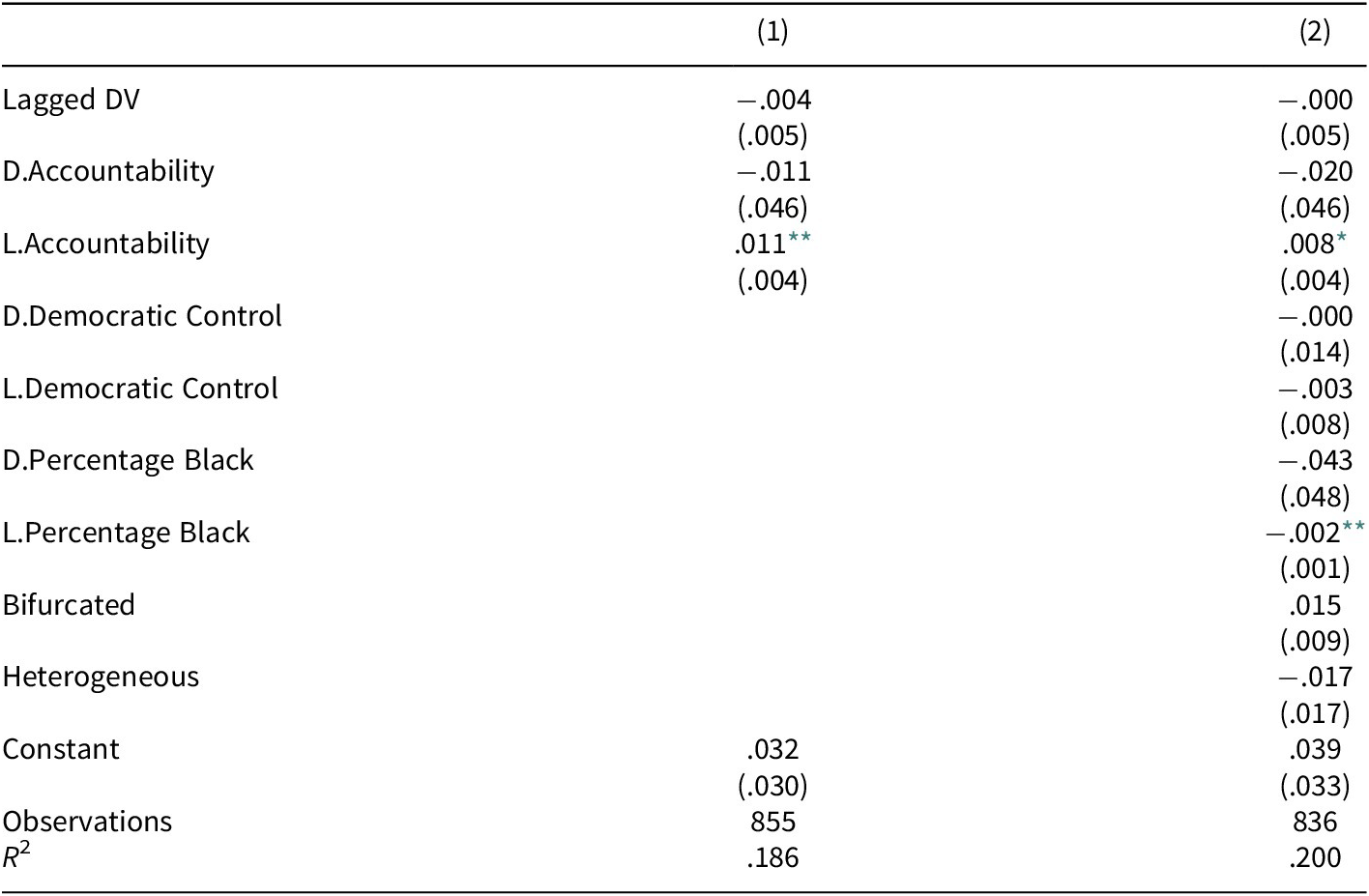
We next move to racial disparities in the proportion of the population with at least a high school degree. Unlike the life expectancy models, the lagged term is significantly related to disparities. In both models, we find that both differences in accountability and lagged accountability pressure are strongly related to increased disparities. When institutions are more majoritarian or become more majoritarian, racial disparities in educational attainment are significantly larger. We also find that unified democratic control is associated with smaller disparities, and bifurcated states have smaller disparities than homogenous states, while states with larger Black populations see somewhat larger disparities, although the effect size is again much smaller than other coefficients. These results support our majoritarian hypothesis.
Table 3 shows the results of the disparity between Black and White poverty rates (percentage). In both models, we find that accountability pressure is associated with greater differences in poverty, supporting our majoritarian hypothesis. Democratic control is associated with smaller gaps in poverty rates, while bifurcated and heterogeneous states see smaller gaps than homogenous ones. Across all three sets of models, we find that more majoritarian institutions are related to larger disparities in health, educational, and economic outcomes in every specification. We next turn to our two-way fixed effect models to evaluate our interactive hypotheses.
Error correction model predicting Black–White gap in poverty

Note: Panel-corrected standard errors in parentheses.
* p < .05.
** p < .01.
Results: Two-way fixed effects models
Across five of the six models in Table 4, we do not find a significant association between accountability pressure and disparities. Furthermore, we do not find evidence that racial resentment or biases in turnout moderate this relationship. However, we do find support for our hypothesis that racial context moderates the effect of majoritarian institutions on social disparities. According to the model, in homogenous states, more majoritarian institutions are associated with lower disparities in life expectancy, whereas in bifurcated and heterogeneous states, we find a positive interactive effect. This suggests a racial-threat dynamic where majoritarian institutions lead to inequality when White groups feel threatened by a sizable minority population. In the other models, we do not find any significant interaction, and the only significant coefficient is that heterogeneous states see smaller disparities than homogenous ones. Figure 4 shows the marginal effects of accountability pressure to interpret the interaction term more clearly. There is no significant difference in the effect of accountability pressure on life expectancy between bifurcated and homogenous states, but accountability pressure is associated with lower disparities in heterogeneous states, particularly when accountability pressure is low. As accountability pressure rises, the benefit of living in a heterogeneous racial context with respect to racial disparities weakens. This highlights the conditional nature of institutional effects. Accountability pressure cuts the influence of racial context nearly in half, reducing the difference in disparity between homogenous and heterogeneous states from 4.3 to 2.3 years, a substantively large effect.
Two-way fixed effects model of White versus Black life expectancy disparity

Note: Clustered standard errors in parentheses.
* p < .05.
** p < .01.
Marginal effect of accountability pressure on life expectancy in years (results from Table 4, Model 2).

Moving to educational outcomes, Table 5 shows the two-way fixed effects results for education disparities. We do not find any significant relationship between accountability pressure and racial gaps in education rates, and we also do not find any significant interactive effects. Again, the only significant variables are for racial context, with heterogeneous states having significantly lower disparities than homogenous states in all models, and bifurcated states seeing lower disparities in model 2. Finally, in Table 6, we also do not find support for any of our hypotheses, with accountability pressure being unrelated to racial gaps in poverty. We also do not find any significant interactive effects with heterogeneous states seeing smaller disparities in four of the six models.
Disparity in the percentage of the population with at least a high school degree

Note: Clustered standard errors in parentheses.
* p < .05.
** p < .01.
Two-way fixed effects Black–White gap in poverty

Note: Clustered standard errors in parentheses.
* p < .05.
** p < .01.
Synthesizing results
In sum, in our panel-corrected standard error models, we find strong support for our first hypothesis, with almost every model indicating accountability pressure is associated with higher levels of racial disparities between White and Black citizens along health, education, and economic outcomes. However, our two-way fixed effect models show a very different story, with accountability pressure largely unrelated to racial disparities in population outcomes, with the exception of a significant interactive effect for racial context.
Discussion
Using a variety of model specifications, we find suggestive evidence that majoritarian institutions are associated with racial disparities in health, education, and economic outcomes in the American states. When levels of accountability pressure are high, we observe larger differences between White and Black life expectancy, high school graduation rates, and poverty rates.
One clear pattern is that our empirical decisions about how to incorporate temporal and geographic dependency influence our conclusions. While the panel models demonstrate consistently that accountability pressure is associated with greater racial disparities across all outcomes (five of the six models), we find much more limited support for our majoritarian hypothesis in the two-way fixed effects models. At the same time, in the 21 models included across the six tables, every model either shows accountability pressure being associated with larger racial gaps in population outcomes or being unrelated. Thus, while more work is clearly needed to better understand the role of institutions on population disparities, there is no evidence that majoritarian institutions are capable of reducing racial disparities.
Our results may appear to lead to a perverse implication: if we want to decrease racial inequalities, we should get rid of majoritarian – and essentially democratic – institutions. Our position is that democratic institutions are always preferred over nondemocratic ones. At the same time, as we suggest in this article, majoritarian institutions are not a panacea to inequality. Under certain conditions – for instance, when there are participatory biases or prejudiced opinions – majoritarian institutions might inadvertently exacerbate inequalities especially for minoritized groups. One solution is to decrease participatory biases in the electorate, perhaps, by easing electoral laws. Unfortunately, many of the laws aimed at decreasing the costs of voting are ineffective at decreasing participatory bias and, in some cases, may exacerbate it (e.g., Burden et al. Reference Burden, Canon, Mayer and Moynihan2014; Rigby and Springer Reference Rigby and Springer2011). Another solution is to decrease prejudiced opinions. Here again, the remedy is unclear. Although individuals who are confronted with their own racial prejudices report lower levels of explicit racism (Czopp et al. Reference Czopp, Monteith and Mark2006) and less stereotypical attitudes (e.g., Chaney and Sanchez Reference Chaney and Sanchez2018), behavioral change in the form of antiracism action is challenging, especially for White Americans (Davis and Wilson Reference Davis and Wilson2022).
Another option might be to focus less on the public and more on factors that incentivize elected officials to prioritize equity, even in the face of participatory bias or prejudiced public opinion. The fear of litigation based on discrimination may be one mechanism that promotes equity among elected officials (e.g., Hainmueller and Hangartner Reference Hainmueller and Hangartner2019). Officials who are constrained by professional norms of equality may also be more likely to value equity (Sances Reference Sances2016). We see this as a fruitful avenue for future research.
We see additional critical paths forward for continuing this research. First, due to challenges in data collection, the temporal coverage of each outcome varies from nearly 30 years to less than 10 years. Expanding the time series to incorporate racial disparities over more years will not only allow for more comparable modeling strategies across outcomes, but also provide an opportunity to further explore how best to incorporate both time and geographic factors as relevant factors.
Taken in conjunction with earlier findings that accountability pressure is associated with lower rates of infant mortality in the overall state population (Pacheco and LaCombe Reference Pacheco and LaCombe2022), these results have important implications for how we think about the role of democratic governance in population educational, health, and economic outcomes. Higher levels of democratic governance may result in better population outcomes, but leave a society where benefits are not equally distributed across racial groups.
Supplementary material
The supplementary material for this article can be found at http://doi.org/10.1017/spq.2024.21.
Data availability statement
Replication materials are available on SPPQ Dataverse at https://doi.org/10.15139/S3/EMEDI0 (LaCombe and Pacheco Reference LaCombe and Pacheco2024).
Funding statement
The authors received no financial support for the research, authorship, and/or publication of this article.
Competing interest
The authors declared no potential conflicts of interest with respect to the research, authorship, and/or publication of this article.
Author biographies
Julianna Pacheco is a professor of Political Science and Program Director at the Politics and Policy Research Program at the University of Iowa. Her research interests include political behavior, public opinion, state and local politics, and health policy, widely defined (her subfields include youth voter turnout, dynamic state public opinion, policy diffusion, state agenda setting, dynamic policy responsiveness, and anti-smoking legislation).
Scott LaCombe is an assistant professor of Government and Statistical and Data Sciences at Smith College. He studies the role of political institutions in the American states. His primary research interests focus on institutional design and its effect on state politics, particularly how institutions can strengthen or weaken the influence of public opinion on policy. He also researches state policy diffusion and innovation, with an emphasis on using big data to answer key longstanding questions about why some policies spread quickly across the country while others do not.