


1. Introduction
On May 21, 1928, Huey Long became the governor of Louisiana. During the campaign, he promised poor white voters neglected by Louisiana’s powerful Democratic establishment better roads and better public schools. He won the election with a coalition anchored by poorer, rural voters in the state’s majority-white northern parishes.Footnote 1 Olin Johnston’s political ascent, which culminated in his victory in South Carolina’s Democratic Party primary for governor, proceeded similarly. He promised an energetic state government that would redirect funding for public benefits away from the wealthy lowcountry and toward the poorer, majority-white upcountry. From here, however, their trajectories diverged. Long’s administration delivered substantial benefits to the state as a whole, but particularly to poor rural whites in North Louisiana. State funds flowed to the region’s white public schools and ensured that new, high-quality highways connected formerly isolated communities to the rest of the state and beyond. In South Carolina, Johnston found himself stymied by the legislature and the courts, unable to fulfil his promises to increase funding to schools in the poor, majority white upcountry.Footnote 2
These conflicts between voters, party factions, and political institutions over the provision of key public goods produced dissimilar outcomes in Louisiana and South Carolina. This divergence poses a question: Why did the states of the Jim Crow South vary in both their overall level and geographic distribution of public goods? Given these states’ similar political economies, racialized barriers to political participation, and repressive single-party politics, the fact that they varied as much as they did is surprising. I argue that an important and overlooked contributor to this variation is the historical legacy of poor white farmers’ opposition to the imposition of single-party authoritarian rule across the Deep South. Far from a uniform process, or the fait accompli described by V.O. Key, conservative elites encountered varying levels of opposition to their antidemocratic project.Footnote 3
After Reconstruction, southern states experienced roughly two decades of multiparty competition and social movement mobilization.Footnote 4 White small farmers, angered by a weak agricultural economy and the increasing power that creditors and powerful firms exercised over their lives, channeled their anger into the economic sphere through the Farmers Alliance. In some states, those same farmers succeeded in building an autonomous political movement via the Populist Party that was, aided by Black voters and sometimes the local Republican Party, able to credibly threaten the political dominance of the Democratic Party.Footnote 5 Partially in response to this new local threat to their power between 1890 and 1901, elite Democrats, sometimes aided by rural agrarians who stayed loyal to the Democratic Party, convened state constitutional conventions. At these conventions, these Democrats aimed to safeguard their economic and political dominance by disenfranchising Black voters and many poor whites, entrenching single-party rule, and building antidemocratic institutions that could impede poor agrarians from exercising political power.Footnote 6 The Populists sought, with varying success, to contest the effort by elite Democrats to codify their own dominance.
In this article, I compare two relatively similar states in the Deep South: Louisiana and South Carolina. I show that in Louisiana, where the Populists mounted a strong challenge to the Democratic Party, the Populists succeeded in forcing the Democratic Party to compromise on the design of the state’s newly constitutionally entrenched institutions, specifically the apportionment of the legislature, the state’s tax capacity, and the power and independence of the executive branch. Consequently, Louisiana experienced a “compromised” authoritarian founding. Conversely, South Carolina underwent a “quiescent” authoritarian founding. There, elite Democrats succeeded in defusing agrarian discontent and coopting it back into the Democratic Party. The state’s new political institutions reflected the undiluted preferences of the state’s conservative elite. These contrasting authoritarian foundings represented a critical juncture in southern political development and produced divergent historical legacies.Footnote 7 In Louisiana, political institutions and party factions were far more responsive to the preferences of small white farmers than they were in South Carolina. By the 1920s and 1930s, these states diverged substantially in both the overall amount and geographic distribution of spending on both public highways and funding for white public schools.
This variation in public goods provision matters because it reveals the lasting influence of the historical legacy of the Populist movement. That legacy extended well into the twentieth century and exerted a considerable influence on Southern politics. Elizabeth Sanders argues eloquently that Wilson’s “New Freedom” agenda and the congressional coalitions that enacted it were influenced by agrarian reform movements, including Populism.Footnote 8 Complementing this work, I argue that Populism’s legacy helps to explain variation in the political institutions, Democratic Party factions, and policy output of Southern states during the first half of the twentieth century.
By highlighting the historical legacy of the Populist mobilization, my analysis suggests that political competition with material stakes continued after the consolidation of authoritarian rule in the region, and that the substance and intensity of this political competition is explicable in terms of historical legacies from the late nineteenth century. Authoritarian political institutions defined the region between the late 1890s and early 1970s.Footnote 9 However, materially responsive politics could, in certain circumstances, coexist with these authoritarian politics. While a “compromised” founding did not hasten the demise of these enclaves, it did help create the conditions for the erstwhile constituency of Populism—discontented white farmers and workers—to extract more material concessions from their states. In this framework, variation in public goods provision is noteworthy because it is a way to observe the balance of power between different factions within an authoritarian polity and explore the substance and evolution of the political settlements that entrench these polities. I explore the circumstances in which authoritarians compromise with other collective actors, and join other scholars in arguing that compromises made during a founding moment are particularly consequential, because this is when key institutions are designed and entrenched.Footnote 10
This article also seeks to broaden our understanding of the role that state constitutions play in establishing new polities. I join recent scholarship in emphasizing state constitutional conventions as important “founding” moments.Footnote 11 I bring to the fore the importance of self-reinforcing aspects of state constitutions, such as legislative malapportionment, in establishing the boundaries within which subsequent political contestation takes place.
2. Methods
Many existing explanations for the trajectory of Southern politics draw heavily on slavery and its aftermath, the region’s political economy, and the trajectory and ultimate failure of Reconstruction.Footnote 12 These accounts illuminate important features of the region’s political development in the late nineteenth and early twentieth centuries. They also converge on a rough set of predictions that Outer South states with more diversified economies and weaker legacies of slavery should provide more public goods (Mickey, Reference Mickey2015).Footnote 13 However, these explanations are less satisfying when deployed to explain unexpected variation within the Deep South.
These accounts are also theoretically incomplete due to their inattention to the mediating role played by institutions—the political parties and state constitutions that entrench the rules by which political power was acquired and deployed. A renewed focus on “bringing the state back in” has led to greater scholarly interest in how institutions, forged at earlier moments of political confrontation, preserve their own autonomous political logic in the face of significant changes in economic and social conditions.Footnote 14
Furthermore, these existing approaches can lapse into a kind of determinism where the economic endowment of a region sets it on an unalterable path. They lack a treatment of the consequences of political mobilization, elite agency, and contingent politics. How do the choices of movements and the elites that lead them create patterns of political competition and institutional design that constrain subsequent political leaders? The elites that entrenched authoritarian rule in the South are often portrayed as free from political constraints, their opponents vanquished by violence and fraud. In fact, as I will show, these elites—at least in some places—had to contend with popular movements that contested their efforts to entrench their power. Similarly, the political leaders who administered, and competed for power within, the regimes these local founders built are portrayed as either clients of regional economic interests or demagogues putting on a show for the (white) masses. They rarely appear as strategic actors navigating institutional constraints. Consequently, we lose sight of Southern politics, both the movements that mobilized hundreds of thousands and the institutions that imposed the rules of the game for how politics would play out in each state.
I employ a legacy account to describe and understand this facet of variation in Southern political development. Collier and Collier describe a historical cause as something that “shapes a particular outcome or legacy at one point or period, and subsequently the pattern that is established reproduces itself without the recurrence of the original cause.”Footnote 15 One mechanism by which these legacies are reproduced is via the influence that historical causes exercise on critical junctures. These “series of events” often “lead to a phase of political uncertainty in which different options for radical institutional change are viable; antecedent conditions define the range of institutional alternatives available to decision makers but do not determine the alternative chosen; one of these options is selected; and its selection generates a long-lasting institutional legacy.”Footnote 16
I utilize a mixed-methods approach, utilizing both qualitative and quantitative evidence. I combine within-case process tracing with cross-case controlled comparisons.Footnote 17 My period of interest begins in 1888 and ends in 1940. As South Carolina and Louisiana are both Deep South states, I am able to control for a number of potential features that might explain the surprising variation in my outcomes of interest, including demographics, economic structure, and the degree of single-party dominance.Footnote 18
3. Alternative explanations
By paying closer attention to the origins and subsequent operation of state-level political institutions, I show that this approach performs better than explanations that foreground resource endowments, economic modernization, or factional splits within the Democratic Party—three popular alternative explanations for my outcome of interest. Several scholars have analyzed the durable and defined factional rivalry between Long and his opponents. Jennings argues that the political competition and corresponding informational signals helped mitigate the “issueless” politics of “friends and neighbors” that Key identified as one of the primary disadvantages of one-party, as opposed to multiparty, governance where the distinct brands of each party help voters make informed choices.Footnote 19 In Louisiana, voters were able to select candidates from a distinct party faction who promised more generous public policy, and then reward them electorally when they followed through.
However, as I suggested above and will discuss in detail below, other Deep South states elected governors who sought to increase the provision of public goods and services to poorer white voters. These political leaders often shared Long’s rhetorical hostility toward established, wealthy elites, and cultivated allies and followers so as to build a like-minded faction within their state Democratic Party. Even South Carolina, in the words of V.O. Key, a state where “the race question muffles conflict over issues latent in the economy,” elected Olin Johnston in 1934.Footnote 20 However, once elected, these leaders quickly found their agendas blocked by their state’s antidemocratic institutions.Footnote 21 A legible factional cleavage between rich and poor whites in the Democratic Party was necessary but not sufficient to increase expenditures on public goods. Louisiana’s institutions allowed Long and his allies to translate their electoral majorities, anchored on disaffected rural whites, into effective control of the fiscal and policymaking aspects of the state. Those institutions were shaped by Louisiana’s “compromised” authoritarian founding.
Louisiana’s plentiful reserves of oil, which offered the state an alternative source of revenue to property taxes on farmland, also set it apart from its Deep South peers. One school of thought holds that these endowments swelled Louisiana’s coffers and eliminated the tradeoff between higher taxes and the more generous provision of public goods.Footnote 22 However, my collection of county-level spending data on public schools reveals the influence of political institutions on the dissemination of this general increase in revenue. As I describe below, Long and his successors did not just increase the overall provision of public benefits, but shifted their distribution to poorer, rural whites. That shift was the result of political choices, and those political choices were facilitated by the design of Louisiana’s institutions. Additionally, and in defiance of theoretical expectations, the flow of wealth from Louisiana’s natural resources did not dampen political competition or participation in the state. On the contrary, voter turnout rose throughout the 1930s due to the contrasting agendas and fierce competition of the Long and anti-Long factions of the Democratic Party.Footnote 23
This article’s approach also demonstrates, in line with other recent scholarship on the Deep South, that political institutions can refract and distort the translation of economic influence into political power. Mickey showcases how Georgia’s peculiar electoral system prevented the city of Atlanta, and the modernizing firms that catalyzed its growth, from exercising political power in proportion to its economic clout.Footnote 24 Likewise, my case studies suggest that the secular growth or decline of various economic sectors or regional constituencies did not mechanically shift the balance of political power necessary to produce increases in public goods provision. These changes took place in the context of existing state institutions that had been entrenched when local elites founded these regimes. Louisiana’s institutions created the possibility that the state’s poorer, rural whites could exercise policy-making control of the state. In South Carolina, even as the state’s upcountry, white-majority counties grew in absolute population and as a relative share of the state—driven by the state’s burgeoning textile sector—they were unable to fully control state policy. The extreme malapportionment of the South Carolina state senate blunted their influence in state politics, even as workers in this region flexed their economic power via a series of strikes in the 1930s.Footnote 25 For this reason, this article contends that we must consider the role of state constitutions and the political institutions they entrenched when examining variation within policy-making and public goods provision within the Deep South.
My approach is also informed by limits on data availability. The Clemson University archives contain reports by nearly all the county-level Farmers Alliance organizations to the statewide organization in South Carolina. These reports contain the amount they collected in membership dues and their corresponding membership numbers. From this information, I was able (to my knowledge, for the first time) to reconstruct a county-level dataset of Farmers Alliance membership in South Carolina. Unfortunately, no equivalent records from the Louisiana Farmers Alliance have survived. Consequently, I cannot conduct a comparative analysis of how different agrarian conditions or spatial distributions of voters contributed to variation in Farmers Alliance membership patterns or the Populist Party voter base in Louisiana and South Carolina.
4. Roadmap
This article has three components. First, I compare the origins and subsequent trajectory of the agrarian mobilizations in both Louisiana and South Carolina. Second, I draw on archival materials and newspaper sources, along with a new analysis I conducted of key subcommittees and convention roll-call votes to demonstrate how these divergent trajectories of Populism influenced state constitutional conventions to produce different outcomes. In particular, I show that Populist forces pushed conservative Democrats in Louisiana to make important concessions with regard to the power and malapportionment of the legislature, the power and independence of the executive branch, and state tax capacity. Third, drawing on an original dataset of state- and county-level disbursements for public school funding for white schools and public highway construction, I show that these different foundings contributed to an important legacy: a significant and enduring difference in the overall provision and geographic distribution of both white public school funding and highway construction.
5. A critical period: southern politics between reconstruction and autocracy
Reconstruction failed.Footnote 26 However, the 1877 end of Reconstruction in the South did not automatically usher in the region’s age of authoritarianism. The post-Reconstruction (1877–1901) era of southern politics was highly contingent.Footnote 27 The Republican Party continued to mount effective, if diminished, efforts to protect the voting rights of African Americans.Footnote 28 The Democratic Party continued to utilize political violence and racist appeals to white solidarity to preserve their rule. However, violence was neither efficient nor wholly effective. The same weak political institutions that had made the gains of Reconstruction vulnerable to rollback also preserved space for new movements to organize in the political sphere, build new political vehicles, and experiment with different coalitional strategies.Footnote 29 The Populists were only the largest of several third-party movements. Below I discuss my specific cases, South Carolina and Louisiana, to show how these conflicting dynamics played out on the ground during this period.
6. Compromised foundings: populism and the contested birth of southern authoritarianism
6.1. South Carolina: division and cooptation
In this period, South Carolina was divided between two broad areas.Footnote 30 To the north was the state’s “upcountry,” defined by the hills of the Piedmont. The region was majority white, in part because the poorer soil quality had prevented both the establishment of large plantations and the importation of large numbers of enslaved people. In the decades before the Civil War, the region had transitioned from subsistence agriculture to cotton production, enmeshing it in new national markets. White farmers generally eked out an existence on small farms worked by their families and a few hired employees.Footnote 31 To the south lay the state’s coastal plain, the “lowcountry.” The lowcountry was geographically larger—about two-thirds of the state’s land area and a majority of its counties. This region was majority Black, and dominated by white-owned plantations. Its continuing political dominance partially obscured its economic decline as poor infrastructure and inefficient farming took their toll.Footnote 32
6.1.1. Mobilization
Political and economic conflict between wealthy white landowners and discontented white yeoman produced significant agrarian discontent in South Carolina. In the early 1880s, upcountry yeoman and lowcountry planters battled over whether agricultural land would be governed by “fence” laws, generally favored by poor farmers, or “stock” laws supported by wealthier landowners. Planters were surprised at the intense backlash to a statewide stock law passed in 1881, and rushed to shield themselves from the blowback.Footnote 33 They also clashed over passage of the so-called eight-box law in 1882.Footnote 34 Intended to prevent African Americans from voting, many poorer whites interpreted it as targeting them as well. These factors, layered on top of broader trends in the agricultural economy, made farmers receptive when the Farmers Alliance entered the state in 1887. McMath, using data from Appleton Annual Cyclopedia and Register of Important Events of the Year 1890, estimates that the South Carolina Alliance had roughly sixty thousand members, fifty thousand of them white men over the age of twenty-one who could vote. As a result, McMath claims that the Alliance signed up about 48 percent of those (white, employed in agriculture) eligible to join.Footnote 35
However, I have reviewed Alliance membership data from South Carolina that it appears McMath did not have access to. The Clemson University archives have a collection of reports by county-level Alliances to the statewide organization that includes their membership dues and, critically, the membership numbers their per-capita dues were based on. The Alliance organizations in thirty of South Carolina’s then thirty-six counties catalogued their total county membership as of 1890. The remaining six included the number of local Alliance chapters active in the county but did not include membership numbers. To get a rough estimate of total membership for the entire state, I calculated the average membership per chapter in the thirty counties where the complete membership information was available. I then used that number to estimate county-level membership for the six counties that did not report their total membership. I arrived at a total membership of 29,795, considerably less than McMath’s estimates.Footnote 36
One potential reason for the Alliance’s smaller membership base in South Carolina is that, unlike in Louisiana, the Alliance was not the only force seeking to manufacture political power from agrarian discontent.Footnote 37 In 1884 Ben Tillman, a wealthy planter, founded an agricultural club. The goal of this organization, apart from serving as a vehicle for Tillman’s ambitions, was to organize white farmers (and only white farmers) into a common identity and interest group. In 1886, at least a year before the Farmers Alliance came to South Carolina, Tillman called for a farmers convention. That April, over three hundred delegates from thirty counties assembled—a testament to the reach of Tillman’s movement.Footnote 38 In his address, Tillman called for farmers to assert their rights as “men who own the soil of South Carolina and pay three fourths of the taxes.” Despite his rhetoric, his policy ambitions were modest: he supported the foundation of an agricultural college, a modest reapportionment of the lower house to benefit the upcountry, and the introduction of primary elections, restricted to white Democrats, to pick the party’s nominees. Tillman couched his movement’s legitimacy in the legacy of the violent overthrow of Reconstruction in 1876. His argument was simple: the white upcountry had redeemed the state, and so deserved a larger say in how it was governed.Footnote 39
Tillman’s speech highlighted the reality that, for all their talk of “white man’s government,” traditional conservatives allowed Black voters who did not challenge white supremacy to participate in politics. Governor Wade Hampton III had sought, and won, Black votes during his campaign for reelection in 1878. He bragged that he had lowered property taxes for Black landowners, and he promised greater investments in Black schools. He also made liberal use of the pardon power, extending clemency to dozens of African Americans convicted of crimes in a show of paternalistic patronage.Footnote 40 Running for reelection in 1878, he won about twenty-five thousand more votes than he did in 1876—many of them likely from African Americans. As late as 1882, there were over two thousand African Americans enrolled in Barnwell County’s Democratic Clubs.Footnote 41 Tillman skillfully linked this limited, unequal biracial political cooperation with the unpopular economic policies his movement opposed. He argued that the continuation of Black participation in politics allowed elites to frustrate the interests of white farmers. Tillman argued that railroad executives had “bamboozled” the legislature into opposing a bill mandating segregated railroad cars.Footnote 42 Unlike in Louisiana, Tillman succeeded in merging a hardline white supremacist ideology, one that sought to remove African Americans from politics, with the demand of poor white agrarians for a fairer economy and more political influence.
Despite Tillman’s strong organization and innovative rhetoric, the Farmers Alliance made rapid inroads with the state’s poor farmers. The Alliance’s growth in the state caught Tillman by surprise. He himself belatedly joined the organization in 1889, recognizing that the Alliance was now a leading agrarian voice.Footnote 43 However, the Alliance’s growth occurred in the context of Tillman’s earlier organizational efforts, and the two organizations became entangled. The first president of the statewide Alliance had been a leader in Tillman’s organization, and both organizations hosted speakers from the other. However, Tillman’s movement had an easier path into electoral politics, and a simpler relationship with the Democratic Party, than the Farmers Alliance.Footnote 44 In states without a rival reform movement, the Alliance could enter the political arena despite its delayed embrace of electoral politics. In South Carolina, Tillman’s early organizing allowed him to sideline the Alliance and become the primary political vehicle for poor white farmers.
Tillman won the governor’s office in 1890 with the support of the state’s discontented white farmers. Once in office, Tillman refused to endorse the Alliance’s subtreasury plan and resolutely condemned any effort to engage in electoral politics outside of the Democratic Party. He pursued few of the Alliance’s agenda items while governor. He did oversee the creation of an agricultural college—Clemson University. He also succeeded in pressuring the lower house of the state legislature to reapportion itself, granting (slightly) more representation to the upcountry. These modest policy wins cemented Tillman’s credibility with the state’s farmers. This credibility helped him redirect agrarian discontent away from the Democratic Party.Footnote 45
6.1.2. Incorporation
Consequently, South Carolina’s 1895 constitutional convention originated as a demand of a movement of upcountry farmers.Footnote 46 Tillman publicly described it as a tool to eliminate Black South Carolinians from politics.Footnote 47 However, the process of calling the convention highlighted fissures within the Democratic Party and between Tillman and his supporters. Legislators defeated the first effort to call a convention. The sticking points were Tillman’s opposition to both limits on the convention’s power and a requirement that the new document be approved by a popular referendum.Footnote 48 Newly reelected in 1892, Tillman used his increased power and popularity to push a clean convention bill through in 1893. The bill did require a referendum to call the convention, and the state held the vote in 1894. The state’s remaining Black voters opposed the convention, but so did many poor white voters fearful that they too would be excluded from the electorate. Tillman declared that his suffrage plan would safeguard the franchise of “every white man who is worthy of a vote,” but his use of the qualifier upset many poor whites.Footnote 49 Only sixty thousand people participated in the referendum, and the pro-referendum side won by just two thousand votes. The pro-convention side won the referendum narrowly, in a very low turnout election. Only sixty thousand men participated in the referendum, and the pro-referendum side won by just two thousand votes. Tillman himself alluded to the fact that many poor whites from the upcountry voted against calling the convention during his address to the constitutional convention, when he complained that “Spartanburg, which had never suffered from negro domination, which can never suffer in its local affairs from negro domination, voted overwhelmingly against the Constitutional Convention.”Footnote 50
Conservative whites from Black majority counties used the selection of convention delegates to contest Tillman’s dominance of the convention without endangering Democratic Party unity. They negotiated with Tillman’s faction to divide the delegates between them.Footnote 51 Tillman’s faction got a large majority of delegates, but traditional conservatives obtained over a third of convention delegates.Footnote 52 The convention played to the strengths of conservative political actors unaccustomed to mass politics but comfortable maneuvering between elite factions. Tillman exercised firm control over the convention. One journalist described his power over the gathering as “absolute.”Footnote 53 His main goal was to disenfranchise the state’s Black voters and entrench single-party rule by the Democratic Party. Conservatives sought to ensure a dominant political position for themselves within South Carolina’s new constitutional order. As a result, the convention was dominated by elite entrenchment and populist white supremacy—two tendencies that occasionally clashed, but proved compatible. There was no organized faction of poor farmers inside or outside the convention to meaningfully contest South Carolina’s authoritarian founding.
Tillman chaired the suffrage committee. He ensured that the committee was stacked with both his allies and representatives from majority Black counties—a dynamic he hoped would produce both personal loyalty and maximally suppressive reforms.Footnote 54 Nine of eleven members of the committee hailed from Black majority counties. His keynote address to the convention focused on the urgency of cementing disenfranchisement in the new state constitution. His committee members proved their loyalty in early November when another delegate, John Irby, who had become one of Tillman’s chief rivals inside the convention, called a vote to weaken the suffrage clauses by eliminating the property requirement. The convention rejected his proposal 65-44.Footnote 55 None of the eleven members of the suffrage committee defied Tillman by supporting Irby’s proposal.
However, other committees proved very influential in determining how political power would be distributed among the state’s whites. Chief among them was the legislative committee—tasked by the convention with apportioning the state legislature. Traditional conservatives had a stronger presence on this committee. It was stacked, as was the suffrage committee, with delegates from majority Black counties. However, five of the eleven members of the committee (including its chairman) defied Tillman and backed the Irby amendment, and two more missed the vote.Footnote 56 The committee, in their report to the convention, preserved the system giving each county equal representation in the state senate. They also chose to continue to apportion the lower house by population. Both of these choices allowed low county elites to preserve their political power even if their opponents controlled the governor’s office.
Having entrenched the dominance of traditional elites over the legislature, the convention proceeded to concentrate additional power in the legislature. The convention gave the legislature the power to determine both the powers and the mode of selection of the state’s railroad commissioners. The convention also abolished democratic home rule for counties. Rolling back one of Reconstruction’s most important legacies, the legislature took control of local government and, critically, the local tax rate. The result, as others have noted, was to place each county more or less under the control of their legislative delegations.Footnote 57 With so much power concentrated in a malapportioned legislature, the incentives of elite actors shifted. Unlike most southern states, South Carolina’s constitution contained no provision limiting local taxation—the state legislature was empowered to set those limits.Footnote 58
6.1.3. Aftermath and legacy
In South Carolina’s new authoritarian system, the same state legislators charged with regulating local taxation were now also the de facto rulers of their home counties.Footnote 59 They could raise revenue for local priorities via local property taxes secure in the knowledge that the money would not be redistributed geographically by the state. The severe malapportionment of the state legislature dramatically inflated the power of the state’s rural, landowning elite. The white primary gave nonelite whites a path to installing their allies as governor.Footnote 60 However, governors were at the mercy of the powerful state legislature, and largely unable to impose their will via the state’s underpowered executive branch agencies. Overall, the result of the state’s new constitution was a political system where nonelite whites lacked the institutional tools or political capacity to win the increased provision of public goods they desired. The concentration of power in a highly malapportioned legislature ensured that state policy would be set by rural, landowning elites from Black majority counties. Constituencies of white farmers or workers, even if they secured a majority of the state’s shrunken electorate, struggled to translate their preferences into policy. Laxer limits on local taxation caused South Carolina to rely more on local property taxes. Tillman’s co-optation of agrarian discontent into the Democratic Party also diminished the independence and autonomy of agrarian politics: no faction in the South Carolina Democratic Party would consistently organize to represent the interests of poor agrarians in the twentieth century.
6.2. Louisiana: fusion and repression
Louisiana was more geographically and demographically fractured than South Carolina was during the post-Reconstruction era of 1877–1901. The state’s northern parishes, which largely produced cotton, were divided between majority white parishes in the state’s less fertile interior and majority Black parishes that bordered the Mississippi River and were dominated by large plantations. The southeastern region of the state, bounded to the west by the Bayou Teche and the east by the Mississippi River, grew sugar on large plantations worked by Black laborers who worked for wages, rather than a share of the crop.Footnote 61 The region’s French and Spanish heritage had left a lasting imprint in the form of Catholicism. New Orleans, the state’s cultural and commercial capital, was, during this period, by far the largest urban center in the South. The city’s political leaders allied with the state’s conservative landowners in exchange for the resources the city needed to grow and sustain itself.Footnote 62 I will lay out some of the political consequences of these regional and cultural cleavages in more detail below.
6.2.1. Mobilization
The Democratic Party’s neglect of Louisiana’s public schools contributed to conditions that favored biracial, agrarian cooperation. After 1877, conservative Democrats implemented a program of regressive tax cuts and racialized austerity. Funding for the state’s public school system declined precipitously—adversely affecting both white and Black schools.Footnote 63 One measure of the severity of these cuts is that between 1880 and 1890 Louisiana declined, relative to its Deep South peers, in the percentage of both whites and blacks who were literate. White illiteracy in Louisiana actually rose slightly between 1880 and 1890—from 19.8 to 20.3 percent—a testimony to the severity of the cuts. In comparison, between 1880 and 1890 white illiteracy in Alabama fell from 25 to 18.4 percent and from 22.4 to 18.1 percent in South Carolina. In 1900, white illiteracy in Louisiana was still higher than in Alabama and South CarolinaFootnote 64 High illiteracy among whites, coupled with pervasive poverty, made poor white agrarians more vulnerable to literacy and property requirements in order to vote. Conservative elites insulated themselves from popular accountability through fraud. After 1877, Democrats passed new election laws that, notably, did not criminalize election falsification. This allowed Democratic elites to manipulate and fabricate election results.Footnote 65 The Democratic Party’s internal processes for selecting party nominees also encouraged fraud because inflated vote totals gave parishes more delegates, and hence more influence over the party conventions that decided which candidates were nominated for statewide offices.
The far-reaching agrarian mobilization of the 1890s was informed by earlier, more limited, agrarian reform efforts. White farmers and farmworkers organized in the political sphere via the Greenback-Labor Party, and joined the Grange to agitate for changes in the state’s agricultural economy. Some of these white dissenters organized biracially—several local lodges of the Grange allowed African Americans to join.Footnote 66 The state’s labor movement also had a biracial character, most prominently through the formation of biracial labor unions in New Orleans during the early 1890s (Hair, Reference Hair1969: 175).Footnote 67 Labor organizing on Louisiana’s sugar plantations, including the large 1887 strike by Black sugar workers in Thibodaux, signaled that agrarian dissatisfaction extended beyond the cotton economy.Footnote 68
Three important cleavages defined Louisiana’s political-economy—creating both challenges and opportunities for the state’s agrarian organizers. The first was racial. A large majority—over 70 percent—of cotton sharecroppers in Louisiana were Black. In most of the rest of the South, the majority of sharecroppers were white.Footnote 69 The second, between Anglo-Saxon protestants in the north and French-Acadian Catholics in the South, was religious and cultural. This divide created suspicion among Catholics about the organizational structure of the Farmers Alliance.Footnote 70 The third cleavage was economic. Northern Louisiana produced cotton; Southern Louisiana, on the other hand, mainly produced sugar. The political economy of sugar was different at both the local level—it encouraged wage labor over sharecropping—and at the national level, where large sugar producers tended to favor protectionism over free trade.Footnote 71 Crucially, these divides produced schisms between both small cotton producers and sugar plantation workers and elite owners of cotton and sugar plantations.Footnote 72
In this context, poor farmers in Louisiana began to organize. In 1881, farmers in majority-white, cotton-producing Lincoln Parish founded the Louisiana Farmers Union (LFU). Despite being predominantly composed of white farmers and farmworkers, the organization had a biracial component.Footnote 73 By early 1887, the LFU had about four thousand members. By the end of 1887, the LFU had grown to over three hundred chapters. As it grew, the limits of the LFU—refusing to organize sugar workers and a hostility to labor organizing among agricultural workers—became apparent.Footnote 74 Despite these limits, the movement continued to grow. By 1890, the organization had between twenty-five and thirty thousand dues-paying members. However, even at its peak, the LFU never achieved the density among the state’s farmers and farmworkers that its sibling organization did in South Carolina.Footnote 75
Louisiana’s conservative Democratic establishment sought to compromise the LFU’s autonomy and fold it back into the Democratic Party.Footnote 76 Their efforts failed until they offered the position of state commissioner of agriculture to the president of the LFU in 1890. This proved more effective because it opened up a fissure between the membership of the LFU and some of its wealthier leaders. The disorganization wrought by these split loyalties contributed to a decline in LFU membership after 1890.Footnote 77 However, the unexpected fracture of the Democratic Party into competing factions over the course of 1891–1892 helped revive and radicalize Louisiana’s agrarian movement. The party came apart over the issue of the Louisiana Lottery.Footnote 78 Seeking an advantage over their erstwhile copartisans, Democrats opposed to the continuation of the state lottery offered to enter into a coalition with the LFU in late 1890. Joining forces with Anti-Lottery Democrats was met with skepticism within the LFU. That skepticism was warranted: at the joint LFU-antilottery convention, Democrats succeeded in convincing key LFU leaders to abandon their substantive demands and accede to the nomination of a conservative Democrat for governor.Footnote 79 Louisiana’s Democratic congressmen also refused entreaties by the Alliance to endorse the subtreasury proposal.Footnote 80 The Democratic Party’s resistance to reform and fracture over the lottery pushed the LFU toward independent politics and created an opening for them to enter the electoral arena.
The remaining members of the LFU founded the Populist Party of Louisiana in late 1891. The founders sought to appeal to voters regardless of racial identity or past partisan affiliation. The party’s platform was addressed to “the People of Louisiana…irrespective of class, color or past political affiliation.”Footnote 81 The subsequent 1892 nominating convention was an impressive gathering. The convention was biracial—with black delegates attending from several parishes. The People’s Party entered a chaotic, five-candidate race election for governor. However, the Populist Party was unable to transcend the geographic limitations of the LFU’s constituency. The Populist candidate for governor won a little under ten thousand votes out of one hundred and seventy-six thousand cast. Those votes were disproportionately concentrated in the northern parishes of Winn, Grant, Catahoula, and Vernon.Footnote 82 Despite this relatively weak showing, overall electoral opposition to the Democratic Party, including by African Americans, remained reasonably robust. The two Republican candidates for governor combined for over forty-two thousand votes. Combined, Republican and Populist candidates won about 30 percent of the vote. The unified constituency of the Populist and Republican Parties was a potentially significant electoral constituency, and circumstances began to create the conditions for greater electoral cooperation between them.Footnote 83
Facing the most potent electoral opposition to their rule since Reconstruction, the new Democratic administration turned to repression to entrench its rule. Between 1894 and 1895 Democrats attempted to constitutionally entrench new restrictions on suffrage. Their chosen mechanism was a constitutional amendment, rather than a full rewrite of the state constitution. Democrats passed the measure out of the legislature, over the opposition of Populist and Republican legislators, but the constitution required that voters ratify the amendment in a statewide referendum. The amendment was quite draconian—imposing a literacy test and property requirement of $200.Footnote 84 Given the high levels of white illiteracy in Louisiana, the amendment threatened to disenfranchise many poor whites in addition to nearly all of the state’s Black voters.
The backlash to the proposed amendment was swift and intense. Hardy Brian, a prominent Populist leader and newspaper editor, denounced the proposed amendment as “a stepping stone to perpetually placing this government in the hands of the rich.”Footnote 85 Even newspapers controlled by the Democratic Party denounced the proposal as extreme.Footnote 86 Many opponents of the amendment focused on its potential to disenfranchise poor, illiterate whites in addition to African Americans. General William Behan, a former Confederate officer who joined the Republican Party in the early 1890s, made this point in a letter published by the New Orleans Times Democrat. While claiming to support other limits on the franchise, he said he was “unwilling now, as I was unwilling then, to take away the right of suffrage from those citizens whom the state through its insufficient system of education, has not qualified to exercise that right.”Footnote 87
Shared opposition to the proposed suffrage restriction created a community of interest between African Americans and white Populists. Both groups feared that the amendment would restrict their political rights and destroy their ability to organize against the Democratic Party. The vocal opposition of the Populist Party to the suffrage amendment—particularly when framed without reference to race—helped draw African American voters into closer cooperation with the Populist Party.Footnote 88 At this critical moment, a fissure opened up among Louisiana’s economic elite—wealthy sugar planters, irate over the repeal of a federal sugar subsidy, defected from the Democratic Party. The resources of Louisiana’s sugar planters became the final, crucial component of the burgeoning Populist-Republican fusion coalition. Money from these wealthy planters helped to expand the writing, printing, and distribution capacity of the Populist press.Footnote 89
Populists and Republicans agreed to field a single candidate for governor in 1896: John N. Pharr, a wealthy sugar planter from St Mary’s Parish. Pharr supported bimetallism and opposed constitutional disenfranchisement, making him acceptable to both white populists and African American voters. The campaign itself became a battle over whether Bourbon Democrats or Populist-Republicans could more effectively exploit the state’s racial, economic, and religious cleavages.Footnote 90 Faced with the greatest threat to their control of Louisiana since Reconstruction, the Democratic Party resorted to violence and fraud to defeat the Populist-Republican Fusion ticket.Footnote 91 Subterfuge was necessary because of the scale of Louisiana’s agrarian mobilization. White yeomen, Black sharecroppers, and Black sugar workers—backed by money from wealthy sugar planters—had organized themselves into a potent political coalition. The official returns showed Murphy defeating Pharr 116,116 to 87,698. Excluding the twelve Black majority, cotton-producing parishes where Democrats controlled the election machinery, Pharr received around two thousand more votes than Murphy. Officially, roughly 70 percent of voters participated in the election; more than triple the turnout generated by Mississippi Populists and South Carolina independents during the 1890s.Footnote 92 Democratic and Populist-Republican voters came together to handily defeat the suffrage amendment, virtually abandoned by the Democratic Party by the end of the campaign.Footnote 93
6.2.2. Incorporation
Unlike in South Carolina, Louisiana’s economic and political elite demanded a constitutional convention, over the objection of rural agrarians, in order to entrench their rule. A sizable group of non-Democrats—Populists, Republicans, progressive reformers from New Orleans—were elected to the Louisiana legislature in 1896. However, Democrats still held sizable majorities in both houses of the legislature. They used these majorities to call a constitutional convention. However, the legislature first passed several laws designed to shrink the electorate.Footnote 94 It was this shrunken electorate that elected the delegates charged with crafting the state’s new constitution. Only one Populist, Bryant Bailey of Winn Parish, and one Republican, J. Dubliex of the sugar parish of Iberville, managed to secure election. The remainder of the elected delegates were Democrats.
Agrarian radicals, despite their defeat in the 1896 elections and subsequent legal repression, continued to inspire fear in prominent Democrats and influence the workings of the convention as it opened in 1898. E.B. Kruttschnitt, elected by his fellow delegates as president of the convention, declared in his opening address that the task of the convention was “to eliminate from the electorate the mass of the corrupt and illiterate voters who have during the last quarter century degraded our politics.” Kruttschnitt clarified in two other sets of public remarks that he believed in both the necessity and the desirability of limiting both Black and white suffrage.Footnote 95 A durable cleavage had opened up between poor, rural white voters and the state’s conservative political and economic elite. Kruttschnitt was also clear that the agrarian electoral mobilization influenced the timing of the convention. He explained in a speech that “This convention was called midway between the exciting gubernatorial campaign of 1896, and that of 1900, which bids fair to be just as exciting, in both national and state politics, as that of 1896. Thus the legislature set the time when political antagonisms were at their lowest.”Footnote 96 Kruttschnitt and his allies did not see the Populist movement as a thing of the past—instead they saw it as a continuing threat requiring both repression and, crucially, conciliation.
As in South Carolina, the suffrage committee was a focal point of the convention. Kruttschnitt and his allies stacked the committee with delegates from black majority counties, as well as urban conservatives from New Orleans. However, the convention’s deliberations on the suffrage provisions were fraught. Fights about the poll tax threatened to “split the party wide open.” At one point, two opposing caucuses formed in the convention—one supportive and the other opposed to the measure.Footnote 97 An “understanding” clause divided the convention as well. In another example of the enduring influence of Populism, Kruttschnitt argued that the “understanding clause” posed a danger because the political opposition (the Populists) might win control of local election machinery and then allow their voters to register.Footnote 98
Many scholars of this period of Louisiana’s history, despite other disagreements, largely see the convention as mostly a formality—the constitutional entrenchment of an already existing nondemocratic reality. They see Populists as exercising little influence, and the new constitution as the reincarnation of existing documents, with suffrage restrictions welded on.Footnote 99 Perman paints a picture of a convention riven by factionalism and internal tumult that saw different coalitions control the outcomes of different provisions that, at critical moments, left its final outcome in doubt. However, despite outlining the conflict that characterized the process of the convention, Perman largely hews to conventional wisdom about the result. The “other changes” the convention made to the 1879 constitution, Perman argues, “were relatively insignificant.”Footnote 100
While these accounts capture key aspects of the political and coalitional dynamics that influenced the outcome of Louisiana’s 1898 constitutional convention, they do not fully describe the lingering influence of the Populist insurgency on the design of Louisiana’s governing institutions. Perhaps the most important oversight of existing scholarship is the neglect of the apportionment committee—the committee charged with updating the formula by which the constitution apportioned seats in the Louisiana House and Senate. The members of this committee represented a different set of regions and constituencies than the members of equivalent committees in South Carolina. In South Carolina, the apportionment committee was stacked with representatives from majority-black counties who tended to be political opponents of Tillman—a double incentive to ensure that apportionment favored the Black Belt. In Louisiana, the committee drew a narrow majority of its members from Parishes that were majority-white—many of which had voted for the Populist-Republican ticket in 1896. Delegates from New Orleans also secured representation on the committee—the chair of the committee was from New Orleans.Footnote 101
The apportionment scheme proposed by the committee and ultimately included in the constitution by the convention afforded fairer representation to white voters who had backed the Populist-Republican ticket in 1896. Utilizing the Loosemore–Hanby index as a measurement tool, the Louisiana Senate was more fairly apportioned on the basis of white population in 1900 than state senates in South Carolina. When compared to the apportionment included in Louisiana’s 1879 constitution, the 1898 constitution actually apportioned Louisiana’s state senate more fairly. In contrast, the total malapportionment of Louisiana’s lower house was similar to the distortion of representation in South Carolina’s lower house.
However, a metric of the total degree of malapportionment does not tell the full story. It does not capture which constituencies or regions are disenfranchised and which receive representation disproportionate to their numbers. In Louisiana, the constituencies that formed the core of the Populist-Republican coalition were much better represented after their state’s authoritarian founding than their Deep South Peers. In 1900, the 50 percent of the white population of Louisiana that lived in the parishes where the Populist-Republican ticket performed the best (which did not include New Orleans) in 1896 had about 45 percent of the seats in the Louisiana House of Representatives and 46 percent of the seats in the Louisiana State Senate. Combined, this was only about a 4.5 percent gap between the chosen apportionment formula and an equal apportionment on the basis of white population. In Louisiana, a potential future political faction that reassembled the surviving elements of the Populist-Republican coalition would only need to pick off a few opportunistic representatives from New Orleans to field a working majority in the state legislature.
It is possible that rural white landowners from majority-black parishes accepted this apportionment scheme because they believed they had entrenched their dominance of state politics in other ways. Right before the convention passed the final suffrage provision, delegates from majority-black parishes inserted a final modification. The last-minute amendment stated that the delegates to party conventions called to select nominees be apportioned based on total population, rather than the vote at the last election.Footnote 102 This would ensure that party conventions—in 1898 still the method by which Louisiana Democrats selected their nominees for statewide office—would continue to be dominated by rural landowners from majority-black counties. However, this factional advantage would last only a few years, until the introduction of the white primary in Louisiana between 1904–1906. Tellingly, Kruttschnitt vociferously opposed the white primary. The New Orleans Times Democrat, summarizing a public statement he made, said that Kruttschnitt “regards general primaries as revolutionary and as tending to produce discord and other party evils to a greater degree than the good sought by the advocates of direct elections.”Footnote 103 He likely realized that the adoption of the white primary destabilized the delicate balance achieved in the convention and opened up a path—however narrow—for a coalition of agrarian reformers and urban dissenters to achieve control over both the executive and legislative branches of state government.
The continuing influence of the Populist mobilization is also evident in how the convention approached the issue of railroad regulation. Originally, the proposal to create a railroad commission was referred to the committee on corporations.Footnote 104 However, on March 29, 1898, Phanor Breazeale, a delegate from Natchitoches, motioned to refer the proposal to the committee on general provisions instead. Breazeale supported the creation of a strong railroad commission, and before making his motion, he urged those with a financial interest in the question to recuse themselves—a signal that he believed that railroads favored the corporations committee maintaining jurisdiction over the issue. His motion passed with sixty-four votes in support, and thirty-five opposing. Twenty-Eight delegates abstained. Figure 1 plots the relationship beteween Parish-level vote share received by the Populist-Republican ticket and the propensity of delegates from those parishes to vote in favor of Breazeale’s motion. Of the sixty-four yes votes, twenty-eight came from parishes where the Populist-Fusion ticket received at least 49 percent of the vote, including delegates from twelve parishes that were also majority-white. Of the thirty-five no votes, only four came from parishes where the Populists had received above 49 percent of the vote—the rest came from parishes where Foster Murphy had won a clear majority of the vote in 1896.
Relationship between the Parish-Level Vote Share for the Populist-Republican Ticket in Louisiana and Propensity of Convention Delegates to Assign the Proposal to Create a Railroad Commission to the Committee Favored by the Commission’s Chief Supporter.

Five of the eleven members of the corporations committee came from majority-black parishes—a sixth represented Rapides, which was just 51 percent white. Moreover, only two of the delegates came from parishes where the fusion ticket had won a majority, and only one of those parishes (Calcasieu) was also majority-white. By contrast, seven of the nine members of the committee on general provision came from majority-white parishes, two of which had also given a majority to the Populist ticket. This was potentially more favorable ground for reform. The subsequent article that the committee drafted was surprisingly robust. The commission itself, including an outline of its powers and responsibilities, was entrenched in the constitution. Just as importantly, its political structure and method of election were also constitutionally established—cutting off avenues for the legislature to dominate the commission via alterations to its mandate and method of election.Footnote 105
6.2.3. Aftermath and legacy
In Louisiana, unlike South Carolina, the constitution protected key executive agencies from domination and manipulation by the state legislature. Any candidate who could remobilize the surviving elements of the old Populist constituency would have a good chance to win election to an independent and highly visible executive branch agency. The legislature itself was less severely malapportioned—offering greater representation to the state’s poor, white agrarians. The state’s conservative elite had succeeded in constructing a stable authoritarian enclave. However, due to the constitutional compromises conservative elites had been forced to make to secure their rule, poor rural whites had significantly more institutional levers at their disposal in order to align state policy with their own material preferences. Populism’s enduring influence had helped maintain a path—however narrow—for agrarian discontent to reassert itself within the Democratic Party.
7. The institutional legacy of populist contestation
South Carolina and Louisiana entered the twentieth century with different institutional configurations entrenched in their new, authoritarian state constitutions. These differences continued to mediate the degree to which political coalitions could translate electoral majorities into their preferred policy outcomes decades after each state’s authoritarian founding. I focus on three types of variation: legislative malapportionment, local and state tax capacity, and the power and autonomy of the executive branch.
7.1. Legislative malapportionment
Between 1900 and 1930, variation in legislative malapportionment between South Carolina and Louisiana increased. Wealthy elites in South Carolina took advantage of how they had structured and apportioned the legislature in the 1895 state constitution to further expand their power in subsequent decades. Between 1895 and 1919, South Carolina Democrats created eleven new counties. Seven of them were majority Black and dominated by wealthy, white plantation owners. Consequently, even as the white population of the upcountry region grew much faster than that of the lowcountry during this period, wealthy lowcountry whites strengthened their domination over the powerful state senate, in which each county had one senator. In contrast, in Louisiana, a more favorable institutional starting point allowed poor whites to maintain, and even strengthen, their position in the legislature. All five new parishes created by the legislature after 1898 were majority white, and Louisiana’s 1921 legislative reapportionment contributed to an overall decrease in malapportionment between 1900 and 1930. Consequently, in Louisiana, poorer whites who lived in white-majority, rural counties—the electoral base of populism—achieved fairer representation in the legislature than did their peers in South Carolina.
The stability of the discrepancy in legislative malapportionment between South Carolina and Louisiana points to the durability of the constitutional equilibriums established in 1895 and 1898. In Miller’s terms, legislative malapportionment was a “self-referencing” institution—it allowed those who benefitted from it to protect it.Footnote 106 Any change in malapportionment—via either legislation or constitutional amendment—had to originate from the malapportioned legislature.
Malapportionment interacted with the political system to block and distort the distribution of public goods in three ways. First, it prevented majority coalitions from translating their numbers into commensurate political power. If a majority coalition within the voting public resides in legislative districts that together constitute only a minority of seats, they will not be able to elect a legislature responsive to their preferences. Second, malapportionment allowed legislative power to be exercised by a minimum winning coalition that was a minority of the voting public. This minority often has distinct interests and preferences that conflict with the preferences of the majority. Sometimes, these minority coalitions prefer lower taxes and less redistribution overall.Footnote 107 At other points, they may prefer to use their outsize political power to secure a greater share of resource transfers for themselves.Footnote 108 Third, malapportionment shielded recalcitrant legislators from either electoral backlash or political pressure from otherwise popular statewide political figures. If an antiredistribution legislator knows that his or her voters approve of their actions, and the legislative majority they are a part of is secure, they can ignore both popular protest and attempted arm-twisting by a pro-redistribution governor.
I observe all three of these mechanisms at work in the South during this period and offer examples of each in the analysis below. When wealthy, conservative landowners entrenched nondemocratic rule in the South in the 1890s, they designed legislative apportionment schemes that would allow them to wield legislative power far in excess of their numbers. Consequently, wealthy white landowners were over-represented in the South Carolina and Louisiana legislatures. This allowed them to use legislative institutions in their states to impose their preferences with regard to redistribution on the rest of the voting public. Protected from electoral sanction, they could also ignore popular pressure and the entreaties of pro-redistribution governors. Consequently, the degree of malapportionment mattered a great deal. In Louisiana, the majority coalition that Huey Long constructed was eventually able to command legislative majorities and enact much of his redistributionist agenda. In South Carolina, the popular majorities that supported Governor Olin Johnston were not able to win control of South Carolina’s legislature. Consequently, his policy agenda with regard to public goods provision largely was not enacted into law.
I pay special attention to the state senate in both Louisiana and South Carolina for two additional reasons. In South Carolina, the Senate was the more malapportioned of the two houses. Consequently, it was the limiting factor on what legislation could pass—a fact I observe repeatedly in the 1920s and 1930s. Moreover, the constitution delegated to the Senate in both states the power to hold trials for impeached governors, rendering it the final arbiter of many of the most intensive conflicts between the executive and legislative branches. Table 1 contains a side by side comparison of legislative malaportionment in South Carolina and Louisiana before and after their constitutional conventions. The table uses several metrics to quantify post-convention legislative malapportionment.
Effect of Malapportionment on Populism’s Former Voting Base

Table 1 Long description
Malapportionment levels are listed for South Carolina and Louisiana before their constitutional conventions and again for the upper house in 1900 and 1920, alongside who dominated each convention’s apportionment committee. South Carolina’s pre-convention malapportionment is 0.160 for the upper house in 1880, with 9 of 11 committee members from majority-Black counties; Louisiana’s is 0.167 in 1880, with 8 of 15 members from majority-white parishes. In South Carolina, upper-house malapportionment increases from 0.174 in 1900 to 0.284 in 1920, indicating a substantial rise in unequal representation over time. In Louisiana, upper-house malapportionment is lower and changes little, moving from 0.145 in 1900 to 0.137 in 1920. For 1920 lower-house seat allocation in Louisiana, the half of the white population living in parishes with the highest Populist vote share in 1896 receives 48 percent of seats; South Carolina has no comparable Populist measure. Also in 1920, the half of the white population living in the whitest counties or parishes receives 41 percent of lower-house seats in Louisiana and 36 percent in South Carolina, with South Carolina’s state senate figure noted as 28 percent. Values are based on white population counts, reflecting that the effective electorate in these states at the time was overwhelmingly white.
* To compute these numbers, I utilized census data detailing white population by county in 1900 and 1920. I accessed the data online (https://www.socialexplorer.com/a9676d974c/explore). I aggregated the data up to the legislative district when necessary. I used the white population because after the consolidation of southern authoritarianism, the electorate in South Carolina and Louisiana was practically entirely white. In the context of an all-white electorate, white agrarians sought to achieve legislative apportionment that would be fairer relative to past formulas when calculated on the basis of white population alone. The Loosemore–Hanby index—a popular metric for computing and comparing malapportionment—adds up the gaps between the percentage of a population in a legislative district and the percentage of seats that district is awarded. The final score is derived by summing the absolute value of all of those numbers and dividing the resulting number in half, for the measure of how much legislative power favored districts would have to give up to generate a proportional legislature (Mickey, Reference Mickey2015; Samuels and Snyder Reference Samuels and Snyder2001).
† I included measurements for both the Louisiana House and the South Carolina Senate because both were limiting factors among their state’s political institutions. The Louisiana House was more malapportioned than the Louisiana Senate, and the South Carolina Senate was far more malapportioned than the South Carolina House.
7.2. Tax capacity
The variation in southern states’ fiscal capacity, now entrenched in newly durable state constitutions, persisted during the early decades of the twentieth century. Louisiana’s constitution contained stronger limits on the local taxation of property than South Carolina’s constitution did. Under the state’s 1898 constitution, the state was forbidden to levy more than six mills of taxation on property.Footnote 109 Parishes could raise their property taxes as high as ten mills, with municipalities allowed to impose another ten mills of taxation. Thus, Louisiana’s limit on property taxation overall was twenty-six mills. South Carolina, by contrast, had laxer limits on local property taxes. The state’s 1895 constitution imposed fewer limits on how county and local governments could tax and spend. Consequently, by the mid-1920s, the rate of property taxation levied ranged from a high of fifty-two mills in Abbeville to 38.6 mills in Georgetown.Footnote 110 Higher rates masked the fragility and inequality that defined South Carolina’s tax system. Revenue from property taxes was highly sensitive to economic downturns, and varied tremendously between rich and poor counties. In contrast, the relative lack of property tax revenue in Louisiana pushed the state to utilize other sources of revenue collected directly by the state.
7.3. The balance of power between legislatures and governors
There was variation in how the Louisiana and South Carolina constitutions distributed power between the legislative and executive branches. The Louisiana constitution provided for a stronger executive branch than the South Carolina constitution did. For instance, governors in South Carolina had, relative to their counterparts in Louisiana, very weak powers of appointment and little patronage to distribute, as the state senate exercised an unusually high degree of influence and control over executive branch appointments.Footnote 111 In Louisiana, by contrast, governors had reasonably expansive appointive powers, including over state boards that controlled large budgets and workforces.Footnote 112 As a result, it was harder for South Carolina governors to cement factional loyalty via patronage or to get the state’s relatively weak executive agencies to align with the governor’s priorities. After he was elected in 1910, Cole Blease sought to reward his friends with jobs and patronage so as to strengthen his influence in the South Carolina Democratic Party. He broke precedent by ignoring the recommendations of the Spartanburg legislative delegation and appointed his own choices as local magistrates. The Senate refused to confirm his magistrate appointees, and a subsequent ruling from the state Supreme Court ejected those he had already installed.Footnote 113
This variation in how power was allocated among the branches of government had implications for the balance of factional power within the Democratic Party because of the newly instituted white primary. After first appearing at the local level in the 1870s, by the first decade of the twentieth century the white primary was entrenched throughout the South—including in South Carolina and Louisiana.Footnote 114 As its name suggests, the white primary restricted voting in Democratic Primaries only to white voters—provided they had paid their poll tax. It served as an additional tool of disenfranchisement, since winning the Democratic nomination was tantamount to election in the South during this period. For white voters, however, the white primary was a democratizing reform because the power to determine party nominees was taken away from county and state party conventions and given to the (white) electorate. Party primaries allowed candidates disfavored by elite actors and interests to win the Democratic nomination and, subsequently, election. This is why, as I outline above, E.B. Kruttschnitt (the conservative chair of Louisiana’s 1898 constitutional convention) publicly opposed the introduction of the white primary in Louisiana.
Statewide primaries, relatively speaking, favored candidates supported by poor workers and agrarians because these constituencies (if united) formed a majority of the electorate. Malapportioned legislatures favored conservative, elite interests because they were largely insulated from majoritarian pressure. A constitutional system that allocated more power to the governor at the expense of the legislature (as was the case in Louisiana) was one where pro-redistributionist governors, when elected, would likely wield more power in service of their agendas. In states such as South Carolina, where the governor was very weak, even a popular mandate for increased public goods provision would likely founder on the shoals of an intransigent, insulated conservative legislative majority. As I detail below, both states followed this theoretical expectation.
Differences in the distribution of power among the branches of government affected other executive branch agencies beyond the office of the governor. The differences between each state’s railroad commission were also stark. South Carolina’s commission could be strengthened or weakened at will by the legislature. In Louisiana, the commission’s powers and method of election were entrenched in the constitution, granting the agency an unusual degree of power and autonomy from interference by the state’s legislature. That power attracted savvy, ambitious politicians to the office, which proved a powerful launching pad. T. Harry Williams describes how Huey Long, prior to his 1918 run for railroad commissioner, looked up the powers and responsibilities of the agency in the state constitution and, seeing its potential, decided to run for the position.Footnote 115 He narrowly won the election.
8. Variation in public school funding in the Deep South
I now turn to the first of two outcomes these different paths into subnational authoritarianism help to explain: variation in the amount and distribution of education funding for white students in Louisiana and South Carolina during the Jim Crow era. In 1923 and 1930, respectively, South Carolina and Louisiana substantially expanded the funding they allocated for their public school systems. In this section, using a new dataset I compiled from the annual reports of each state’s Department of Public Education between 1919 and 1938, I analyze interstate variation in the distribution of public school funding. My analysis suggests that these states’ founding moments contributed to this variation. In this chapter, I explore how institutional constraints and intraparty competition shaped each state’s expansion of this key public good, and offer some early, suggestive evidence about how variation in the design of state-level political institutions contributed to subsequent public policy provision.
Examining my case study, a basic question presents itself: if variation in policy-making and factional competition within the Democratic Party is the result of the Populist electoral mobilization, why do those variations only arise in earnest two decades after the institutionalization of each state’s authoritarian regime? I offer five reasons why it is reasonable to expect the emergence of a policy legacy from Populism only after a period of political quiescence.Footnote 116
First, after the Populist defeat, it took time to rebuild institutions that could facilitate agrarian collective action under authoritarian politics. Only after rebuilding some capacity would those constituencies be in a position to test the limits—and possibilities—of the new political systems in which they lived. An example of this dynamic is the Farmers Union. Founded in Texas in 1902, the organization grew steadily over the next two decades. It slowly built partnerships with labor unions and, by the 1920s, began to play a role in Democratic Party primaries.Footnote 117 Second, new political leaders needed to develop. Defeated former Populist leaders often retreated into anonymity, conservatism, or bitter demagoguery. The new generation of political leaders would have one foot in the Democratic Party, now completely dominant in each of these states, and one in the currents of agrarian politics that continued to simmer on the periphery in each state.
Third, leaders needed time to understand how their respective political institutions functioned. It was often not clear if key political institutions could serve as a springboard for agrarian politics—particularly because they were often quickly captured by conservatives after the ratification of each state’s new constitution.Footnote 118 Fourth, the interaction of static institutions with economic development slowly eased poor whites back into electoral politics. Each state’s constitution set poll taxes and property requirements at nominal rates even as economic growth and inflation slowly chipped away at their effective power. Rising literacy also diminished the barrier of literacy tests and the secret ballot. Lastly, economic growth and technological change opened up new, less contentious sources of tax revenue. The most notable example was taxes on gasoline as car ownership rose rapidly after World War I. With state governments able to provide a greater quantity of public goods and infrastructure, divergent preferences over both the overall amount and their distribution began to structure state politics to a greater degree.
8.1. Public schools and southern political development
The development of public education in the South is heavily bound up with the expansion and contraction of southern democracy.Footnote 119 The final consolidation of single-party, authoritarian rule in the South via the passage of each state’s authoritarian constitution freed Democratic Party elites from the dual threats of black political action and interparty competition.Footnote 120 Consequently, elite Democratic lawmakers were free to target their austerity and neglect more precisely without the fear of electoral blowback. The result was a public education system defined by grievous racial inequality, achieved via a variety of formal and informal methods.Footnote 121 However, the oligarchic nature of authoritarian rule in the South resulted in large disparities in public school funding among whites as well.Footnote 122 Poor white agrarians, who had evinced a preference for more generous funding of public schools since the antebellum period, chafed at this arrangement and struggled to change it.Footnote 123
Their efforts were often frustrated by powerful, malapportioned legislatures keen on protecting the property and prerogatives of wealthy conservatives. Cole Blease was elected governor of South Carolina in 1910 and 1912 thanks to strong support among mill workers in South Carolina’s majority white upcountry region.Footnote 124 In 1913, Blease proposed a one-mill statewide property tax to increase funding for public schools. Channeling the preferences of his supporters, Blease wanted the money to be held in a general fund and distributed by the State Board of Education. Doing so would ensure that white students in poorer counties got a larger share of the new funding. The legislature drastically altered the legislation before passing it, decreeing that counties would retain half the revenue from the new tax within their borders—making the measure far less redistributive.Footnote 125 Blease’s popular mandate—and the preferences of his supporters—was no match for the institutionally insulated legislators of South Carolina’s General Assembly.
Beginning in the early 1920s, several political and economic shifts combined with the longstanding preference of white agrarians for more school funding to produce large expansions of state support for education. Political elites became increasingly embarrassed by white illiteracy, and so-called New South boosters believed a better educated workforce would draw in investment and cure the ills of incipient industrialization.Footnote 126 South Carolina enacted its expansion of state support for its public schools in 1923. Louisiana followed suit in 1930. Consequently, public school systems came to be some of the most capacious and best-funded state bureaucracies in the region, and a vital nexus between state and local political authority. This section utilizes a mixed-methods approach, employing both historical process tracing and statistical analysis. I explore three different types of variation in each state’s distribution of public school funds between 1920 and 1938: (1) the strength of the linkage between vote choice and the provision of school funding, (2) variation in the geographic distribution of funding for white schools among each state’s counties, (3) the durability of the reforms in the face of economic dislocation from the Great Depression.
8.2. The politics of public education in the Deep South
The politics surrounding the enactment of expanded state support for public education in Louisiana and South Carolina differed. In Louisiana, Huey Long rallied popular support for expanded funding; first during his unsuccessful bid for the Democratic nomination for governor in 1924, and then during his successful run in 1928. Long campaigned against illiteracy—particularly white illiteracy—and touted his proposal for free school textbooks as a way of decreasing inequality among students in the public school system.Footnote 127 In an example of the rhetoric he employed in his campaign, Long drew on the imagery of Longfellow’s poem Evangeline to remind his audience that “Evangeline is not the only one who has waited here in disappointment. Where are the schools that you have waited for your children to have, that have never come?”Footnote 128 Long’s campaign events drew large and enthusiastic crowds. In Terrebourne Parish, supporters packed a theatre to hear him speak, with a “large number” unable to enter the venue due to lack of space.Footnote 129 A newspaper in Vermillion Parish estimated that one thousand people came to hear Long speak on Christmas Eve, 1927—right before the election.Footnote 130 Turnout in the Democratic primary for governor doubled between 1920—the last election where Long was not on the ballot—and 1928, when he won the primary.
In South Carolina, by contrast, expanded state support for public education did not arise out of political campaigns rooted in agrarian discontent. Thomas McLeod, the governor elected in 1922, was no agrarian champion. Rather, reform was an elite-driven effort.Footnote 131 Despite efforts by reformers, during the 1923 legislative session, to create an appearance of unified and widespread white support for education reform via rallies and mass meetings, “few South Carolinians were involved in these well-orchestrated but largely ceremonial gatherings.”Footnote 132
Enthusiasm aside, who were the voters who supported the governors who ultimately oversaw the passage and implementation of the expansion and reform of public education funding in their respective states? First, I examine how closely county-level support for Populist candidates for governor approximated county-level support for each state’s governor during their campaign. Second, using data from the annual reports of each state’s auditor, I compiled a county-level dataset of per capita taxable wealth.Footnote 133 My results show important differences in the political coalitions of the governors who implemented education funding expansions. As shown in Figure 3, Thomas McLeod drew his strongest support from wealthier counties, as measured by per capita white wealth, in his successful 1922 campaign for governor. In contrast, as shown in Figures 2 and 4 Huey Long’s drew his strongest support from the poorest parishes and parishes that had supported the Populists in 1896. My analysis confirms claims made by Key and Sindler about the composition of Long’s coalition.Footnote 134
Correlation between the Parish-Level Vote Share for Huey Long in 1928 and Populist Candidate John Pharr in 1896.

Correlation between Parish-Level Per Capita Wealth and 1922 McLeod Vote Share.

Correlation between Parish-Level Per Capita Wealth and 1928 Long Vote Share.

However, winning the gubernatorial election was necessary but not sufficient for Long, and the coalition he represented, to enact an expansion of public school funding. Long needed the cooperation of the Louisiana legislature. He enjoyed more success on this front than his peers in South Carolina for two reasons. The legislature itself was less malapportioned, and Louisiana governors controlled a significant amount of patronage via influence over large state agencies. Long was considerably more aggressive than his predecessors at bringing agencies such as the state Highway Commission and Orleans Parish Levee Board under his personal control. This allowed him to offer jobs to those who agreed to go along with his agenda. As a result, Long was able to get his favored candidates chosen as leaders of both the upper and lower houses of the legislature, and exert considerable influence over the chairs of key committees.Footnote 135
During his first year in office, Long benefitted even more directly from Louisiana’s more fairly apportioned legislature when his political opponents in the legislature, despite the opposition of legislators Long had elevated, initiated impeachment proceedings against him. He faced nineteen indictments in total, including bribery and abuse of executive authority, of which only eight were brought as formal charges.Footnote 136 The lower house of the Louisiana legislature impeached him, sending the charges to the state senate for a trial. Working with his allies in the senate, Long managed to convince fifteen senators—enough to acquit him—to sign a statement declaring that they would vote to find him innocent. Eleven of these senators were from parishes that had backed the Populists in 1896, and then backed Long in his election as governor. Two others were from New Orleans. Had Louisiana’s legislature—particularly its senate—been apportioned less favorably to poor, rural whites, Long would likely have been unable to reach this crucial one-third threshold to prevent his removal from office. Louisiana’s political institutions created opportunities for political leaders, like Long, to win control over powerful offices in the executive branch. The state’s legislative apportionment—which was, at least compared to South Carolina, relatively favorable to poor whites—then played a role in enabling these leaders to stay in office and maintain their power.
8.3. The design of Deep South education reforms
Despite their different paths to winning and maintaining their respective offices, both Long and McLeod faced a common challenge of designing legislation that could satisfy their respective coalitions and be enacted by their legislatures. South Carolina reformed its educational system in 1923, with Louisiana following in 1930. Though these plans had similar goals, reformers—responding to the different political and institutional constraints of their respective states—designed them differently.
Both states legislated minimum education standards. For the first time, these states would guarantee the necessary funding to close any gap between what the county or parish could appropriate for its white students and what was needed to implement the new state standard. South Carolina legislated a minimum school term of 7 months (Laws of South Carolina 1923). Louisiana chose to tie the standard to a minimum dollar amount that would be appropriated for each student.Footnote 137 Louisiana included an “equalization fund” designed to direct money to less wealthy, predominantly white and rural counties and parishes that lacked local sources of revenue.Footnote 138 South Carolina structured their legislation specifically to pay, and equalize, the salaries of all the teachers in the state for 6 months, provided counties put up the money for an additional month.
To fund these new minimum standards, reformers enacted new taxes that would serve as a dedicated funding stream for the public schools. Louisiana included the new taxes necessary to fund the expansion of state support for public education in the reform bill itself. Long and the legislature structured the bill as a constitutional amendment, which opened up more policy possibilities. One of them was an increase in the state limit on property taxes, allowing the state to levy an additional two and a half mills of property taxation. Louisiana also imposed new taxes on malt liquor and natural resource extraction.Footnote 139 South Carolina, in contrast, chose to rely almost entirely on new property taxes in order to fund their education legislation.Footnote 140 Section two of the legislation stipulated that “To meet the amount provided for in Section 1 of this Act, there is hereby levied upon all the taxable property of each county of this State (4) mills” of additional taxation.Footnote 141
8.4. Linkage between vote choice and the provision of school funding
Did these reforms allow Long to deliver expanded public school funding to his poor, white rural supporters? Put more broadly: Did the political choices of voters in South Carolina and Louisiana have material stakes? To answer this question, I examine whether the voters who supported the governors who enacted funding expansions received larger funding increases for their local schools after the relevant election. I constructed a panel of county- or parish-level, per-capita education spending on white students in both states. Each panel includes 3 years before the election of the reforming governor, and 3 years after the implementation of the reform package—encompassing the period both before and during the Great Depression. I utilize a postelection dummy and interaction term regression model to test whether any subsequent changes in funding patterns are plausibly attributable to the election of a reforming governor. The model specifications, including year and county fixed effects, are as follows:
 \begin{align*}
\text{Funding per capita}_{it}& = {\unicode{x03B2}}_{0} + {\unicode{x03B2}}_{1}(\text{Post}_{t}) + {\unicode{x03B2}}_{2}(\text{VoteShare}_{i})\\
&\quad + {\unicode{x03B2}}_{3}(\text{Post}_{t} \times \text{VoteShare}_{i}) + {\unicode{x03B1}}_{i} + {\unicode{x03B3}}_{t} + {\unicode{x03B5}}_{it}
\end{align*}
Here, FundingPerCapitait is the county level, per capita spending on white students in a given year, β0 is the intercept, and β1(Post1) is the postelection dummy, which equals 1 for years after the election and 0 for years before. β2(VoteShare) is the county-level vote share for the winning candidate in the relevant primary. It is time-invariant (the same value for all years within a county), so it is absorbed by county fixed effects αi in models that include them. β3(Post × VoteShare) is the interaction term and thus the key coefficient in the model. It is the product of the postelection dummy and vote share. β3 is the central estimate: how much more (or less) funding a county received in the postelection period for each additional unit of vote share, relative to its own pre-election baseline. This is the difference-in-differences coefficient. αi represents county fixed effects, which absorb all time-invariant differences between counties. γt represents year fixed effects, which absorb statewide shocks that affect every county equally in a given year. Lastly, εit is an error term, a residual. Tables 2 and 3 contain the results of the regression analysis for Louisiana and South Carolina:
Effect of 1928 Gubernatorial Election Outcomes on Per-Capita White School Funding in Louisiana

Table 2 Long description
Regression results relate per-capita white school funding in dollars to an interaction between the post-election period and Huey Long’s 1928 county vote share, estimated under four specifications. The key interaction term is consistently positive and statistically significant in every model, with an estimate of about 36.145 and standard errors around 12.4 to 13.7. In the model without fixed effects, the post-election indicator alone is negative at about 11.844 and marginally significant, while Long vote share alone is negative at about 56.773 and statistically significant; these main effects are omitted when absorbed by fixed effects in other specifications. Constants range from about 32.784 to 71.903 and are statistically significant across models. Model fit varies by specification: R-squared is highest with two-way fixed effects at 0.759, compared with 0.205 with no fixed effects, 0.414 with year fixed effects only, and 0.549 with county fixed effects only. All models use 384 observations covering 64 counties. Standard errors are clustered at the county level, so statistical significance reflects within-county correlation adjustments.
Notes: Clustered standard errors at the Parish level (HC1) in parentheses. The dependent variable is per-capita white school funding in dollars. Long Vote Share is the county-level vote share for Huey Long in the 1928 Democratic gubernatorial primary. Post-Election Dummy equals 1 for years 1933, 1935, and 1938, and 0 for years 1920, 1921, and 1927. Model (1) is the preferred specification (shaded).
† Post-Election Dummy is absorbed by year fixed effects and omitted.
‡ Long Vote Share is time-invariant and absorbed by county fixed effects and omitted.
*** p < 0.01; **p < 0.05; *p < 0.10
Effect of 1922 Gubernatorial Election Outcomes on Per-Capita White School Funding in South Carolina

Table 3 Long description
Regression results estimate how the winning candidate’s 1922 county vote share relates to later changes in per-capita white school funding, using 276 county-year observations from 46 counties. The main interaction of post-election period with candidate vote share is 10.765 in every specification, with standard errors around 18 to 20, indicating no statistically reliable effect. The post-election indicator is about 5.8 dollars in models without year fixed effects, but it is omitted when year fixed effects are included. Candidate vote share alone is about 32.7 dollars and statistically significant at the 10 percent level in models without county fixed effects, but it is omitted when county fixed effects are included. Model fit varies: R-squared is highest with two-way fixed effects at 0.712, compared with 0.186 with no fixed effects, 0.445 with year fixed effects only, and 0.453 with county fixed effects only. Constants range from about 8.3 to 24.8 dollars, with statistical significance in the two-way and county fixed-effects models. Standard errors are clustered by county, and the key takeaway is that the post-election interaction does not show a robust, statistically significant association across specifications.
Notes: Clustered standard errors at the county level (HC1) in parentheses. The dependent variable is per-capita white school funding in dollars. Candidate Vote Share is the county-level vote share for the winning candidate in the 1922 South Carolina Democratic gubernatorial primary. Post-Election Dummy equals 1 for years 1929, 1933, and 1937, and 0 for years 1920, 1921, and 1922. Model (1) is the preferred specification (shaded). The interaction term is not statistically significant in any specification.
† Post-Election Dummy is absorbed by year fixed effects and omitted.
‡ Candidate Vote Share is time-invariant and absorbed by county fixed effects and omitted.
*** p < 0.01; **p < 0.05; *p < 0.10
The key coefficient is positive and statistically significant for Louisiana. For every ten percentage point increase in a county’s vote share for Huey Long, that county received approximately $3.61 more per capita in funding for white public schools in the years after Long’s election (and the subsequent reform and expansion of Louisiana’s public education system) relative to its own pre-election baseline. This analysis is robust to the inclusion of two-way fixed effects. In South Carolina, by contrast, the key coefficient is not statistically significant. This signifies that there is not a statistically significant relationship between the election results immediately preceding the enactment of South Carolina’s reform of its public school system and subsequent public school funding increases during my period of interest.
8.5. Decreasing inequality and decoupling school funding from local wealth
Prior to these reforms, school funding for whites in both South Carolina and Louisiana was highly unequal. Since most funding came from local property taxes, wealthier counties and parishes were able to appropriate and spend far more per enrolled white pupil than their poorer counterparts. This discrepancy worsened after the onset of authoritarianism in the South, a material reflection of the unequal distribution of political power among whites.Footnote 142 Moreover, the continuing exclusion of African Americans from the political sphere enabled wealthy counties with large black populations to take, with no fear of political backlash, money nominally apportioned by the state for black students and direct it instead to schools that served whites. The result, shown in Figures 5 and 6, was stark intrawhite funding gaps in Louisiana and South Carolina, driven by a pernicious combination of economic inequality and racialized hoarding of resources. In South Carolina for the 1922 school year (just before the state passed its reform package), Beaufort County, a wealthy, black majority county in the lowcountry, spent \$101.35 per enrolled white pupil. That same year, Cherokee County, a poor majority-white county in the upcountry, spent just \$20.37. In Louisiana for the 1927 school year (just before Long was elected), poor, majority-white Lincoln Parish spent \$29.14 per enrolled white pupil while wealthy, majority-black Tensas Parish spent \$79.08.
Correlation between White Wealth and School Funding in South Carolina Prereform.

Correlation between White Wealth and School Funding in Louisiana Prereform.

Both states’ reforms decreased intercounty funding inequality, as they directed more money to poorer counties and parishes. However, the scale and aggressiveness of Louisiana’s efforts to close interparish funding gaps far exceeded South Carolina’s more limited efforts. While South Carolina narrowed the gaps in funding that existed between poor and wealthy counties, it was not able to break the relationship between local wealth and school funding. In 1923, prior to the reforms, per capita spending on white students was moderately correlated with how much taxable property existed per white person in the county. In 1938, 15 years after the state had implemented the reforms, that correlation (documented in Figure 7) strengthened (the correlation coefficient rose from .53 to .76), even as its scale shrank somewhat. The poorer the county, the less the local public schools spent per white student.
Correlation between White Wealth and School Funding in South Carolina Postreform.

The shifts in Louisiana, visualized in Figure 8, were far more extensive. In 1927, on the eve of Long’s ascension to the governorship, large white landowners in black belt counties appropriated and spent far more per white student than other regions of the state. Education spending correlated with local wealth, just as it did in South Carolina. In particular, the geographic heart of the old populist movement suffered from some of the lowest levels of per capita education funding in the state. The reforms of the Long administration decreased funding inequality (it fell 37 percent between 1927 and 1938) and helped poor, majority white parishes increase their per capita funding. Critically, Long’s reforms succeeded in decoupling the relative amount of school funding available to each parish from the value of the taxable property in that parish. The correlation coefficient between wealth and school funding declined from .51 to just .13.
Correlation between White Wealth and School Funding in Louisiana Postreform.

The trajectory of education spending in Jackson and Union parishes, both white majority parishes in the state’s north, is illustrative of how this change played out in individual parishes. In 1927, Union and Jackson ranked near the bottom of all Louisiana parishes in both per capita white school funding and per capita taxable property. In 1938, the two parishes remained among the poorest in the state, but now ranked 8th and 24th out of sixty-four parishes in per capita white school funding. Louisiana accomplished this, in part, by having the state take on a greater share of the responsibility for funding schools. By 1938, the Louisiana state government provided about half of all school funding. Parishes and municipalities split the remainder. In the same year, the South Carolina state government only provided about 38 percent of the state’s education funding.
8.6. The great depression and durability of southern education reform
The Great Depression was a calamity for the southern economy.Footnote 143 The economic crisis was particularly harmful to the region’s public schools. Property tax revenue that played a huge role in sustaining public schools cratered as land values fell and farmers, short on cash, failed to pay their taxes. How durable would the region’s reforms of its education systems be in the face of economic disruption and heightened scarcity?
Overall, between 1929 and 1934, property tax revenue collected by counties and local districts in South Carolina fell by 25 percent. State appropriations for education in South Carolina only fell by around 7.5 percent during the same time period (Report of South Carolina State Superintendent of Education 1934).Footnote 144 These declines in revenue led to sharp cuts in spending. In 1934, per capita funding per enrolled student fell 39.6 percent from 1929. Funding remained depressed through the end of the decade. By 1940, per capita funding per attending student was still 25 percent below 1929 levels.
The political and institutional context for the trajectory of South Carolina spending on its public schools is Governor Olin Johnston’s losing battle with South Carolina’s powerful state legislature. I elaborate on Johnston’s struggle against South Carolina’s political institutions in the following section. He was elected in 1934 as a champion of poor upcountry whites in the state (Simon, Reference Simon1998).Footnote 145 Johnston pledged to shift state resources from highway construction to the public school system. He aimed to raise the salaries of public school teachers. He bemoaned the state of affairs where the state spent tens of millions of dollars to build roads in black-majority parishes dominated by wealthy whites and the public school system only received a few million dollars per year. In a 1935 message to the South Carolina House of Representatives, Johnston wrote,
In addition to the longer school term, I supported an increase in salary for the teachers, because they have loyally stood by the State, in her dark hour of depression, and with the help of other patriotic citizens, have kept open the doors of opportunity for the boys and girls of South Carolina.Footnote 146
The South Carolina legislature rejected Johnston’s proposals to shift state resources from the highway commission to state support for the public schools.Footnote 147 Consequently, he was not able to reshape and redirect education funding to the degree that he wanted to.
Louisiana followed a different trajectory. Tax revenue collected by counties and municipalities only declined by about 16 percent between 1929 and 1934. Thanks to the implementation of the state’s reforms, revenue from the state actually increased 20 percent during the same period. The funding decline in Louisiana, while sharp, was less severe. Due in part to the loss of “nonrevenue receipts” (primarily short-term loans from banks no longer capable of lending), spending fell 27.3 percent for enrolled students from predepression peaks. The central state’s greater role in financing public education helped shield school funding from the declines in local property tax revenue. Consequently, education funding in Louisiana also recovered more rapidly, as state tax revenue bounced back more quickly than local tax collection. The central state was able to tax a wider variety of sectors and activities, providing a shield against the catastrophic revenue shortfalls experienced by counties and localities. Moreover, state tax collectors were far less subject to capture by powerful local elites than local property tax assessors. Reformers all across the South sought to shift funding and tax collection responsibilities from localities to the state for this reason.Footnote 148 Long’s administration, after the enactment of their initial reform package, passed additional legislation to shift the responsibility for collecting school taxes from localities to the state.Footnote 149 Louisiana began to appropriate more money per enrolled white student than South Carolina in 1931, and by 1938 Louisiana spent 28 percent more per white student than South Carolina. Louisiana exceeded its previous peak of per capita education funding in 1938, while also achieving a more equal distribution of funding among whites. Counties maintained a far greater degree of their power and fiscal autonomy in South Carolina, reflecting the preferences of the state’s wealthy, landowning elite. A greater degree of political accountability and centralization of funding and tax collection helped Louisiana surpass South Carolina in education funding during this period.
The fact that Louisiana expanded its education funding—usually thought of as a longer-term investment—in the teeth of an economic crisis that caused immediate hardship is one measure of how intensely the state’s rural agrarians desired increased school funding. As the 1930s drew to a close, the Depression notwithstanding, Louisiana was spending more money per capita on white public schools than it ever had before. The state paired this increased outlay of funds with a far more equal distribution of money between wealthy and poor white students. Consequently, education spending in poorer, white parishes increased significantly. In South Carolina, the drop in education funding was much steeper, and the recovery was much slower. The state continued to spend less than it had in the final years of the 1920s, and made no further progress toward a more equal distribution of funding among white students.
9. Divergent patterns of highway construction in the Deep South
Next, I turn to the construction of public highways, a central activity of southern state governments. Beginning in the early twentieth century, southern states took steps to replace their patchwork, badly maintained local roads with comprehensive state highway systems. Poor farmers and farmworkers were suspicious of railroads due to their recent battles with monopolistic corporations, and saw public roads as a superior alternative.Footnote 150 Southern businessmen and entrepreneurs, along with self-styled “progressives” and other advocates of the so-called New South, saw good roads as a way to modernize their region and spur economic growth. Up until the second decade of the twentieth century, local control and limited fiscal capacity hamstrung southern road construction.
Two exogenous changes, one political and the other technological, kicked off this struggle over the distribution and overall provision of public highways. First, the passage of the Federal Aid Road Act in 1916 kicked off a major shift in policymaking across the region. This law stipulated that, conditional on the establishment of a state highway commission to manage the funds, states would be eligible for federal matching funds for “farm-to-market road construction.” Combined with the fact that southern legislatures generally required state agencies to make annual reports of their activities, this shift created both a region-wide increase in highway construction and a major improvement in the quality of the available data on highway construction. Federal intervention dovetailed with the democratization of the automobile. A growing constituency of car owners began to boost demand for improved public infrastructure.Footnote 151 These exogenous changes create a point of departure in the early 1920s where a common impetus to expand highway construction was filtered through the varying institutional structures and party factions in each state.
I selected public highways for closer study for three reasons. First, poor rural whites desired that the state build public highways that could serve as “farm to market” roads that would aid them in bringing their crops to market. Politicians aligned with this constituency, such as Huey Long, regularly campaigned on promises to enhance rural prosperity by connecting these areas to key markets throughout the state. Poor, rural whites wanted the state to prioritize highway building in their communities rather than in areas dominated by wealthy, conservative landowners. Second, higher quality roads allowed for school consolidation within rural counties. Economies of scale would allow more students to access a wider range of courses, services, and enrichment activities that would improve their educational experience. It would also help counties and the state provide a higher quality education more cost-efficiently.
Numerous state educational reports from this period mention school consolidation as a policy goal, with improved public highways as one of the necessary preconditions to make it possible. South Carolina’s 1930 report stated “On account of better roads than we had in former years it has been possible to consolidate many rural schools and to transport pupils to and from school. More consolidations will be carried out when the provisions of the [1929 highway bond act] are carried out” (Report of the South Carolina State Superintendent 1930).Footnote 152 Lastly, public highways were a way for states to indirectly limit the power of railroad corporations—a longtime goal of poor rural whites. For decades, railroads had a near monopoly on efficient transportation and long-distance shipping. Public highways, particularly when paired with the new technology of the automobile, offered a publicly owned and financed alternative to private railroads.
Political institutions ultimately mediated the extent to which poor and elite whites came to see increases in state funding for public highways as desirable. They also contributed to different patterns of public goods provision, structuring conflicts that arose over how these investments would be financed, who would pay for them, and how newly constructed public infrastructure would be distributed. This section provides a cross-state examination of variation in the funding for and construction of public highway systems in Louisiana and South Carolina between 1916 and 1932. I focus on how differences in these states’ political institutions and party structures—rooted in these regimes’ “founding moments”—contributed to variations in the amount and distribution of public highway construction. I collected and reviewed the annual reports of the highway departments in these two states to build a novel dataset of overall and county-level highway construction over time. My analysis of this data shows that there was significant variation in the amount and geographic distribution of both spending on highway construction and total miles of highway constructed. I demonstrate how the design of each state’s constitutional institutions contributed to this variation.
9.1. Louisiana: a highway construction program for small-time farmers
Louisiana established a state highway commission in 1910, 6 years before the federal government made it a precondition to receiving federal highway aid. However, it remained an underfunded, administratively threadbare agency for most of the next decade. Consequently, newly available automobiles were largely restricted to the state’s urban areas where more extensive, higher quality roads already existed.Footnote 153 That changed in 1921, when newly elected governor John Parker, a good-roads enthusiast with progressive, centralizing instincts, worked with the legislature to increase the Highway Commission’s capacity and give it a dedicated revenue stream. The legislature instituted a gasoline tax and a registration fee on trucks operating within the state. The highway commission would be led by three commissioners, all appointed by the governor. The governor also had the power to designate one of the three commissioners as chair, and to fill any vacancies that arose if a commissioner resigned early or died in office. Crucially, the governor could also remove a commissioner for “inefficiency, malfeasance, or neglect of duty.”Footnote 154 Taken together, the new Highway Commission constituted a significant expansion of gubernatorial power, as the commissioners effectively served at his pleasure. In insulating the highway commission from the legislature, Louisiana followed patterns of institutional design entrenched in the state’s 1898 constitution.
However, in a concession to conservative opponents of taxes and government debt, the legislature refused to supplement these tax- and fee-based streams with bonded debt. Although the state could now construct and manage a statewide system of public highways, it would do so via a mechanism of “pay as you go.”Footnote 155 Road building accelerated, with Louisiana putting an average of about five hundred miles of new public highways under construction per year between 1922 and 1928. However, the sluggishness and unequal distribution of the state’s highway construction program created an opening for Huey Long, who promised voters living in poorer, more isolated parishes more and better quality roads (Sindler, Reference Sindler1956: 54).Footnote 156
In his 1928 gubernatorial campaign, Long promised an improved state highway system alongside his calls for increased school funding.Footnote 157 During his time in office, he greatly accelerated aggregate highway construction. Louisiana put an average of 1,710 miles of new highways under construction per year—more than three times higher than the state average in the previous 6 years. Long’s administration also improved the quality of public highways. About 29 percent of the roads constructed during Long’s governorship were paved, as opposed to being surfaced with packed dirt or gravel. In the 6 years prior to his term in office, the share of newly constructed highways that was paved was around 10 percent. Highway funding quadrupled from roughly twenty-four million between 1924 and 1928 to a little over ninety-seven million between 1928 and 1932. Louisiana’s agrarian coalition succeeded in greatly increasing the overall provision of essential public infrastructure.Footnote 158
How was highway construction distributed among Louisiana’s parishes? Did that distribution change after Long’s election? I find that after Long’s election in 1928, the distribution of both total miles of highway construction and state highway funding shifted toward both poorer and whiter parishes that constituted the core of Long’s electoral coalition. As shown in Figure 9, in the 4 years before 1928, black majority parishes received about 29 percent of all new miles of highway construction in Louisiana, despite containing only 15.7 percent of the state’s total population. Between 1928 and 1932, that percentage dropped to 25 percent. A similar shift occurred in the distribution of spending on new highways, with the share of money going to black majority parishes dropping from 25 to 21 percent.
The Graph on the Left Shows the Correlation between the Share of a Parish’s Population that was Black and Miles of Highway Construction in Louisiana between 1924 and 1928. On the Right Shows the Same Correlation for the Period 1928–1932. Note the Increase in Total Construction and Distributional Shift Toward Whiter Parishes.

Long and his political faction also shifted both new spending and construction away from wealthier parishes and toward poorer ones. In the 4 years before 1928, parishes above the state average in taxable property per white resident received about 28.4 percent of all new miles of highway construction in Louisiana, even though they contained roughly 50 percent of the state’s total population. Between 1928 and 1932, that percentage dropped slightly to 26.5 percent. A more pronounced shift occurred with respect to the distribution of spending on new highways, with the share of money going to the richest parishes dropping from 38.1 to 31 percent. This shift was even more pronounced among the wealthiest quarter of the state’s parishes. In the 4 years prior to 1928, the fifteen wealthiest parishes in the state (out of sixty-four in total) received about 32.5 percent of all of Louisiana’s highway construction dollars. In the 4 years after 1928, that percentage dropped to 22 percent. Between 1928 and 1932, new highway construction and funding were negatively correlated with both the black share of a parish’s population and its per capita wealth.
9.2. South Carolina: accelerated highway construction leaves poor whites behind
South Carolina’s highway construction program developed differently than Louisiana’s. The state’s constitution simultaneously centralized power in a highly gerrymandered state legislature while devolving a considerable amount of taxing authority from the state to the county.Footnote 159 The result was a highly uneven pattern of highway construction as individual counties (and their legislative delegations) pursued highway construction largely on their own. This took the form of local bills passed by the state legislature that allowed county governments to borrow money and charged them with building and maintaining new highways. The title of a bill passed during the 1921 testifies to the degree of micromanagement the State Senate exercised over counties. The bill was entitled
An Act to create a County Highway Commission for Oconee County and to authorize and empower said Commission to issue coupon bonds of the county of Oconee in the sum of four hundred thousand dollars for the purpose of road and bridge improvement, and to provide for the payment of said bonds (South Carolina Laws 1921: 4).Footnote 160
The highway building programs of larger and more populous counties could be quite substantial. Greenville County, a majority white county in the state’s northwestern upcountry, passed a million-dollar road bond several years before the outbreak of World War I.Footnote 161 Rural white landowners in majority black counties resisted increases in the local taxes necessary to fund highway construction. The result in the aggregate was the inverse of Louisiana. Before 1929, the number of miles of public roads in a county was negatively correlated with the share of the population that was Black. The wealthy white landowners who dominated these counties did not want to pay for public infrastructure, whereas the small farmers and textile factory operators who populated the state’s upcountry were willing to finance public highways.
South Carolina did not establish a highway commission until incentivized to do so by the federal government in 1916.Footnote 162 When the legislature established the Commission, it ensured that it would not become a source of gubernatorial power and patronage. The initial Highway Commission was composed of five members, with only two appointed by the governor. Throughout the 1920s, the legislature modified the structure of the highway commission several times. It increased the number of commissioners to seven, then to fourteen. However, while the governor now had the power to appoint members of the commission when their terms expired, those appointments had to be approved by the state senate.Footnote 163
Unlike in Louisiana, South Carolina’s major expansion of highway construction was a project of the state’s conservative landowners. In 1929, the state’s highway commissioners formulated a proposal to float sixty-five million dollars in highway bonds to provide more financing for statewide highway construction in South Carolina. The proposal was controversial and split the state legislature. The state senate, gerrymandered to favor white elites from black majority counties which stood to benefit from the bond issue, passed the legislation easily. In the lower house, a body less favorable to rural, Black majority counties, opposition was stronger. Figure 10 showcases the geographic split in the support and opposition for the measure. In the end, it passed over significant legislative opposition, 60-41.
Geographic Breakdown of Legislative Vote on 1929 South Carolina Highway Bond.

Why was the plan controversial? White majority counties that had already committed resources to highway construction resented having their taxes support state bonds that would disproportionately fund highway construction in the landowner-dominated, black majority lowcountry. John G. Richards, who won the 1926 governor election and supported the legislation, came to office backed by a constituency drawn mostly from white voters from black majority counties. In essence, political leaders from poorer, white majority counties were angry that wealthy conservative elites from black majority counties had engineered a way to get the whole state to pay to build highways in their counties.
Political leaders from the poorer, white majority upcountry were right to be suspicious. As shown in Figure 11, in the 2 years after the passage of the 1929 legislation authorizing the bond issue, overall highway construction accelerated, and the distribution shifted toward black majority counties. Before 1929, black majority counties contained about 44 percent of all the state’s public highways. Between 1929 and 1931, black majority counties received 52 percent of all new miles of public highways constructed in the state. The richest half of South Carolina’s counties, by taxable property per white resident, went from receiving 42 percent of all new construction before the bond issue to 46 percent of all new construction after. Louisiana’s state-driven buildout of its highways benefitted the state’s poorer white agrarians. In South Carolina, increased state involvement in public infrastructure benefitted the wealthiest, most politically influential of the state’s white voters.
The Graph on the Left Shows the Correlation between the Share of a County’s Population that Was Black and Miles of Highway Construction in South Carolina up Until 1929. The Graph on the Right Shows the Same Correlation for 1930–1931. Note the Sharp Distributional Shift *Away* from White Majority Counties.

Wealthy elites’ use of South Carolina’s fiscal and bureaucratic capacity for their own narrow benefit shaped the rhetoric and priorities of Olin Johnston’s successful 1934 campaign for governor. Johnston had been born in Anderson County and worked in a Spartanburg textile mill in his youth. Both counties were located in South Carolina’s upcountry region, and the demographics and political economy of the area shaped Johnston’s politics. He gained widespread attention for his vociferous opposition, as a member of the state house, to the 1929 bond issue. He ran for governor as a champion of the state’s poorer, white voters. In his first attempt, in 1930, Johnston narrowly lost while assembling a coalition anchored by the state’s poorest voters. He won in 1934 after expanding his coalition and reassuring voters outside his base that he could be trusted.Footnote 164 Johnston most enthusiastic supporters—poor whites from the upcountry—were angry about the distribution of state resources, including the unfair apportionment of new highway construction funded by the 1929 bond issue. His ultimately successful 1934 campaign included promises to build more roads in poorer, white majority counties and redirect a portion of the funding for highway construction to the state’s struggling public schools (Simon, Reference Simon1998: 135).Footnote 165 Once elected, Johnston sought to bring the highway commission under his control by firing several commissioners. This touched off a dramatic conflict between the South Carolina legislature—which backed the commissioners and wanted them to remain in their posts—and Johnston. South Carolina’s political institutions ultimately stymied Johnston’s ambitions to reorder the balance of power in the state.Footnote 166 The highly malapportioned legislature reinstated the original commissioners, and then further weakened the governor’s power over the commission. The state senate, the institutional citadel of entrenched conservative power in the state, also rejected nearly all of Johnston’s legislative initiatives. In one instance, a bill supported by Johnston to limit the workload that could be imposed on any individual millworker (the “stretch out” in industrial parlance) passed the lower house 94-6 only to be killed by the Senate after a brief discussion.Footnote 167 Unlike Huey Long, Johnston was neither able to enact his legislative agenda nor overcome institutional impediments to his broader program. Johnston and his allies were never able to seriously challenge the legislature during the remainder of his term.
In 1936, 2 years into his term, Johnston made a concerted effort to defeat legislators hostile to his agenda by supporting primary challenges by candidates aligned with him. His efforts made little headway in the heavily malapportioned senate—only one senator hostile to Johnston lost his election. Johnston had more success in the lower house, to the point that soon after the election Johnston believed that his faction in the legislature would be able to elect its favored candidate speaker of the state house. However, in the end divisions within the Johnston faction allowed the conservative candidate for speaker to win by five votes (Miller, Reference Miller1976: 237–243).Footnote 168 For the last 2 years of his term, Johnston would once again face a legislature organized and led by hostile forces.
Consequently, Johnston failed to shift the distribution of highway construction and was also unable to speed up the slow and unequal recovery in South Carolina’s support for its public schools. Funding for public goods in general, and benefits for poor whites in particular, languished in South Carolina during Johnston’s term. Johnston’s defeat at the hands of the legislature illustrates the power of institutions, rather than technocratic need or the expressed preferences of electoral majorities, in determining the geographic distribution of key public goods in South Carolina.
10. Conclusion
This article shows that Louisiana and South Carolina varied more in their distribution and overall allocation of key public goods and infrastructure than previously understood. I argue that an important and overlooked contributor to this variation is the differing founding moments that birthed each state’s authoritarian political order. By further probing the origins and consequences of variation in the authoritarian institutions through which political elites exercised power during the Jim Crow era, I am able to shed new light on the historical legacy of the Populist movement. I am also able to bring new data and cases to bear on the questions surrounding the long-term consequences of authoritarian foundings. My theory and findings also provide a new framework for understanding variation in public policy outcomes and the factional structure of the Democratic Party across the Deep South. My argument raises the question of whether this framework is applicable outside the Deep South. Can we look to Populism’s legacy to explain variation in authoritarian political institutions in the Outer South as well? I believe we can, although any inquiry must proceed cautiously because, as I explained above, the differences in the demographics and economic structure of the Outer South introduce confounding variables. These differences make isolating the potential effect of Populism more challenging. Further work in this vein should take into fuller account the spatial distribution of the white and black populations along with other structural features of the agrarian economy in order to account for the variation between Deep South and Outer South states. North Carolina is an especially promising case study due to the availability of high-quality data on Farmers Alliance membership in the state paired with the existence of a strong Populist mobilization in the 1890s. I hope to pursue this line of inquiry, building on a related project that seeks to more fully explain the rise and fall of the Republican Party coalition in North Carolina between 1865 and 1898 (Blinderman, Mickey and Waldner 2026).Footnote 169
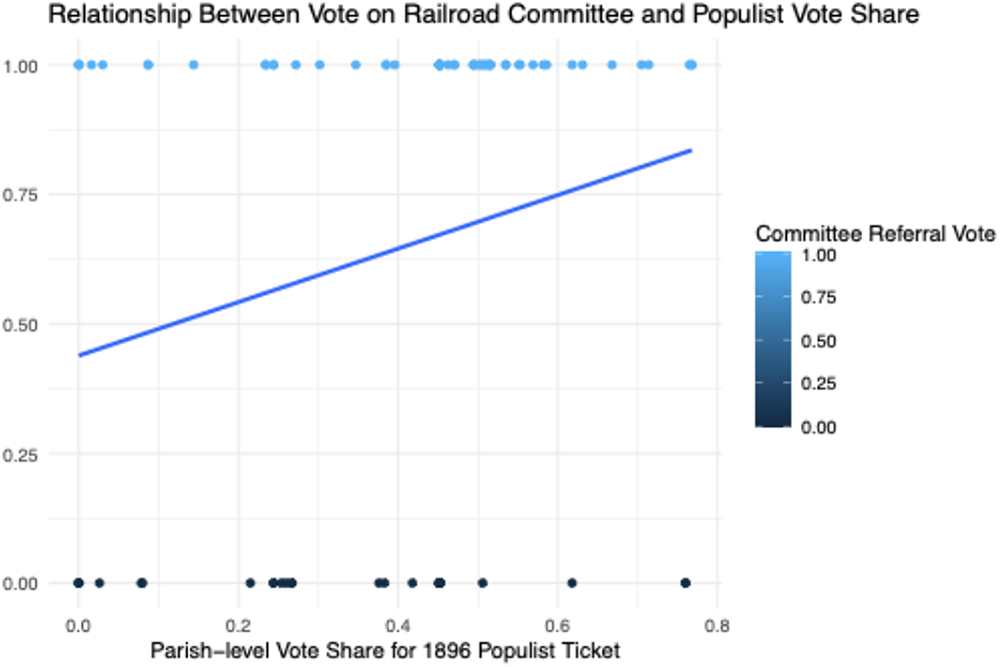
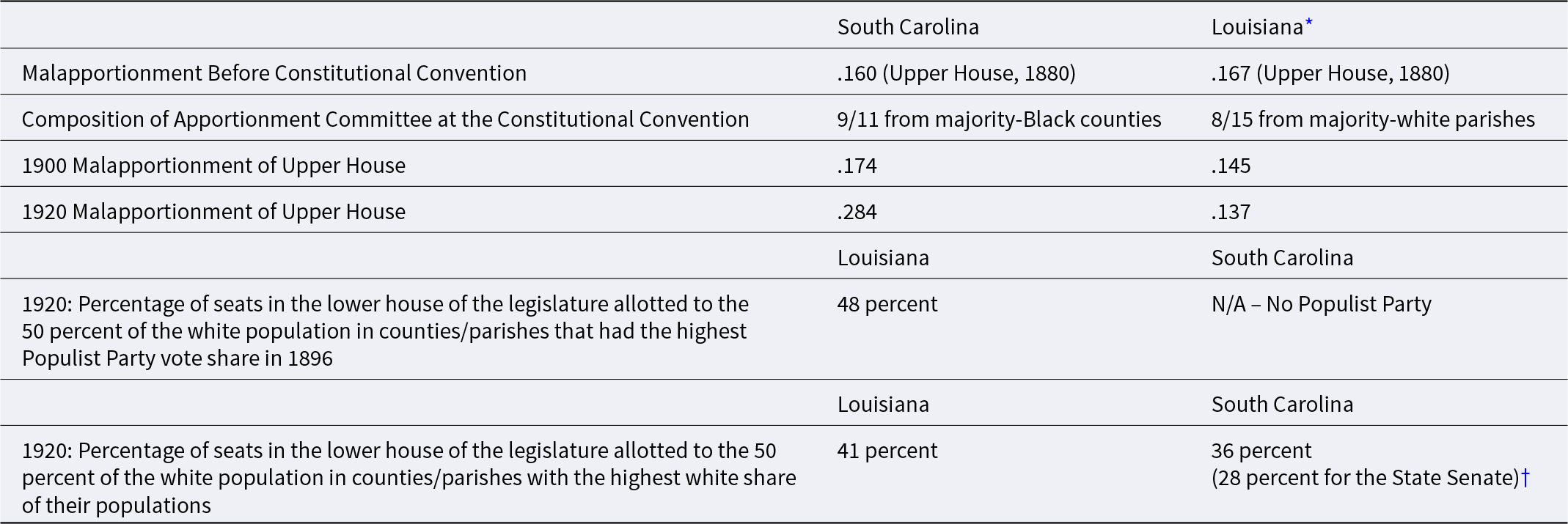
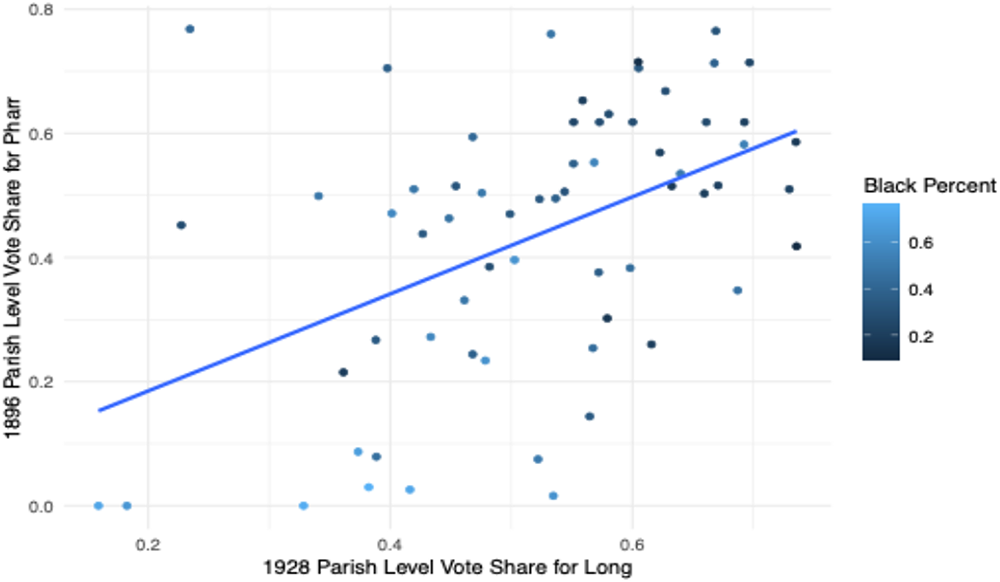
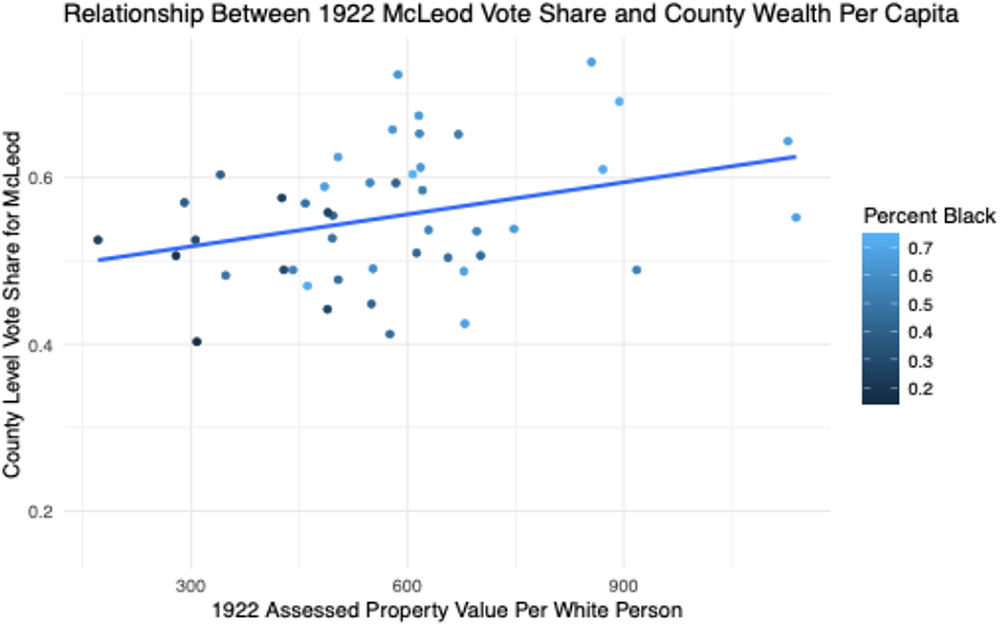
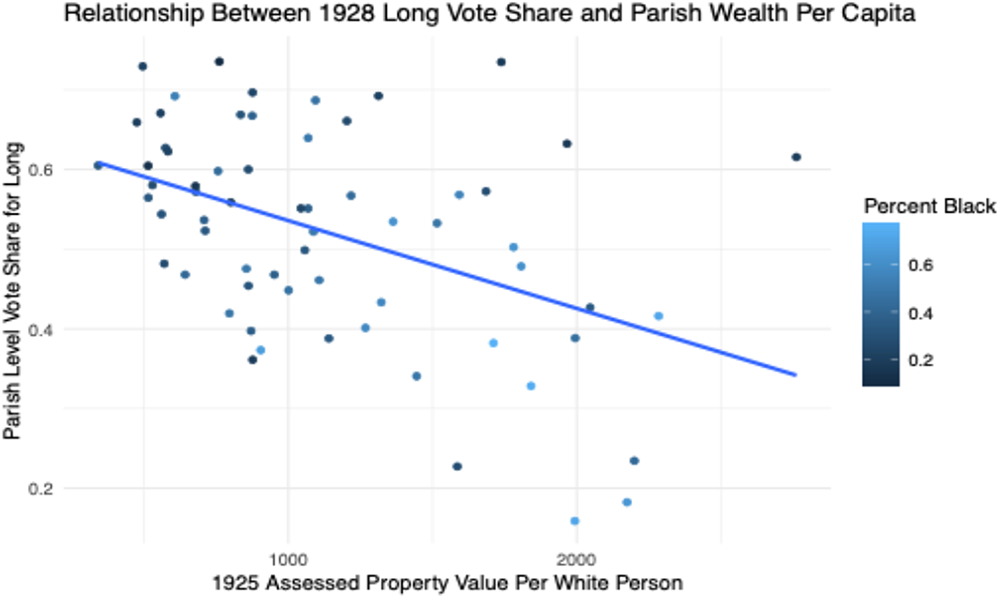
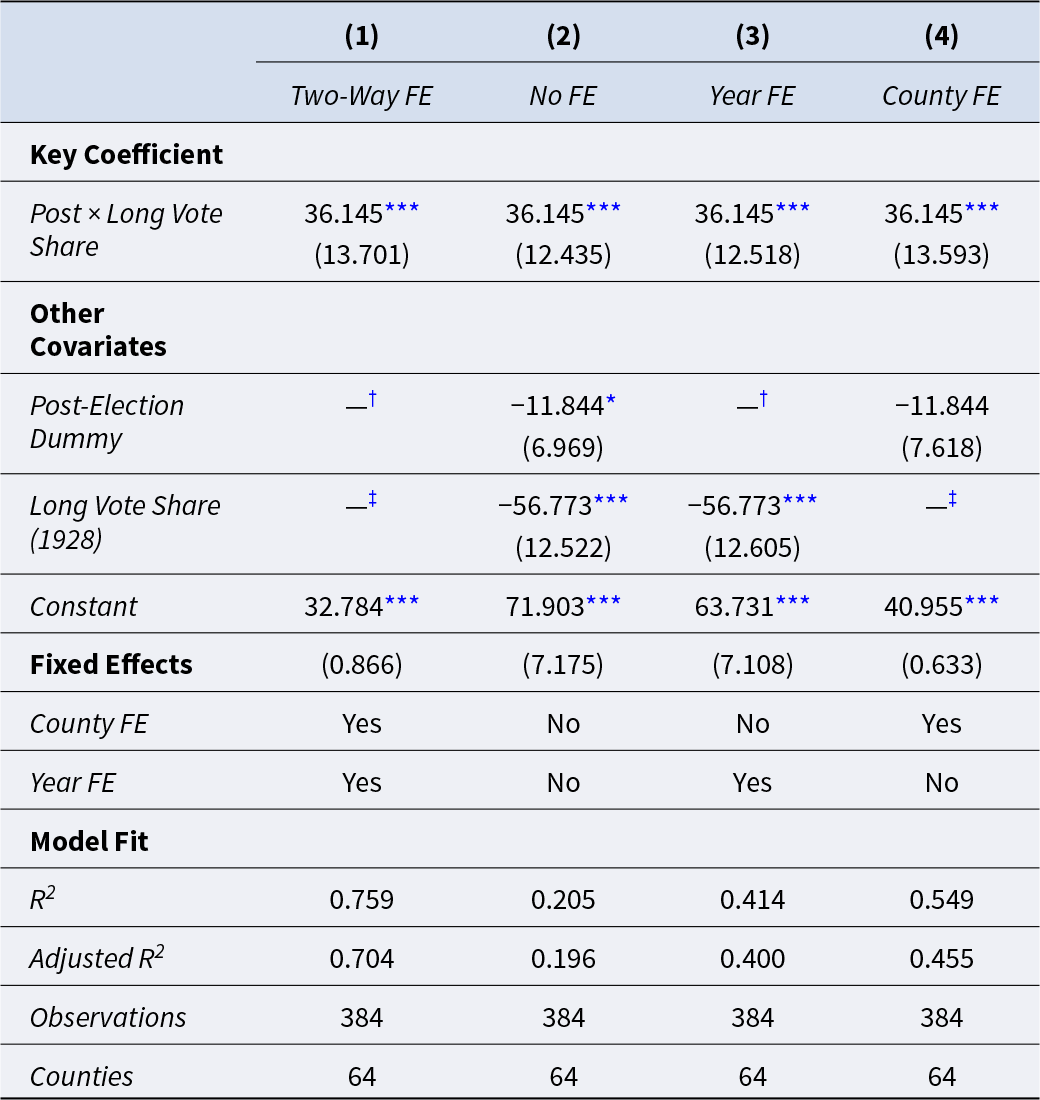
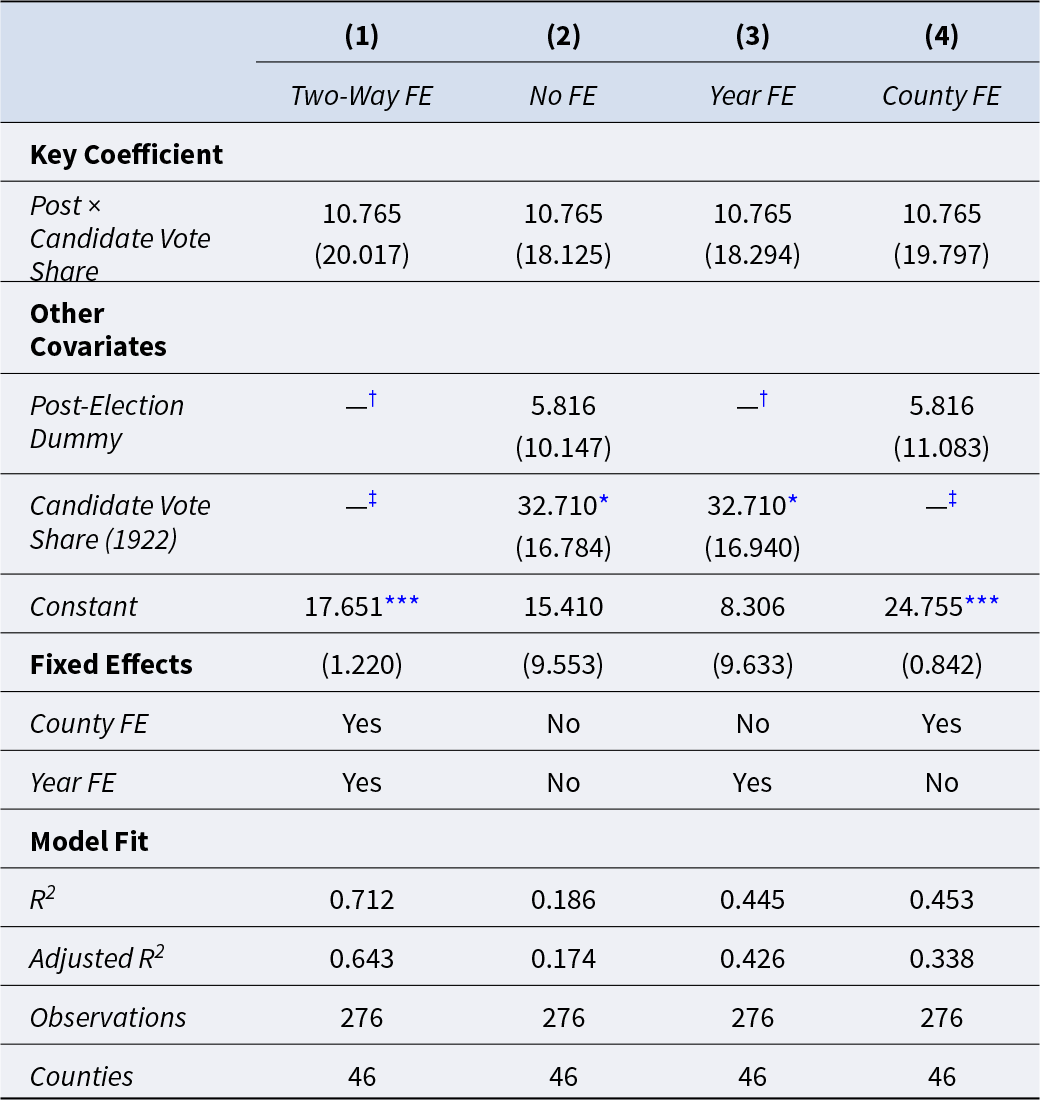
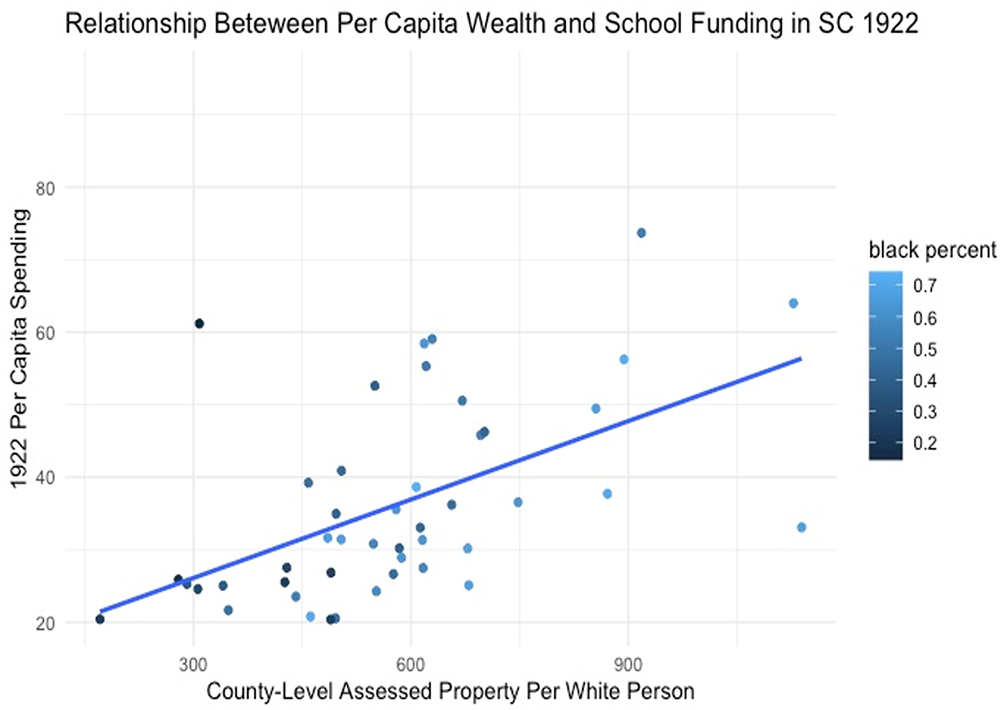
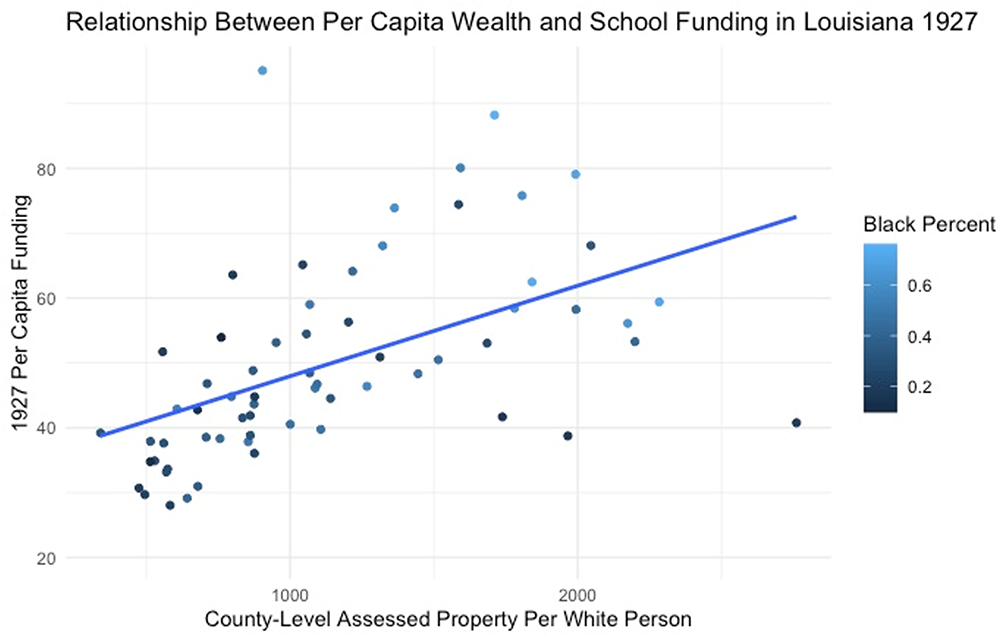
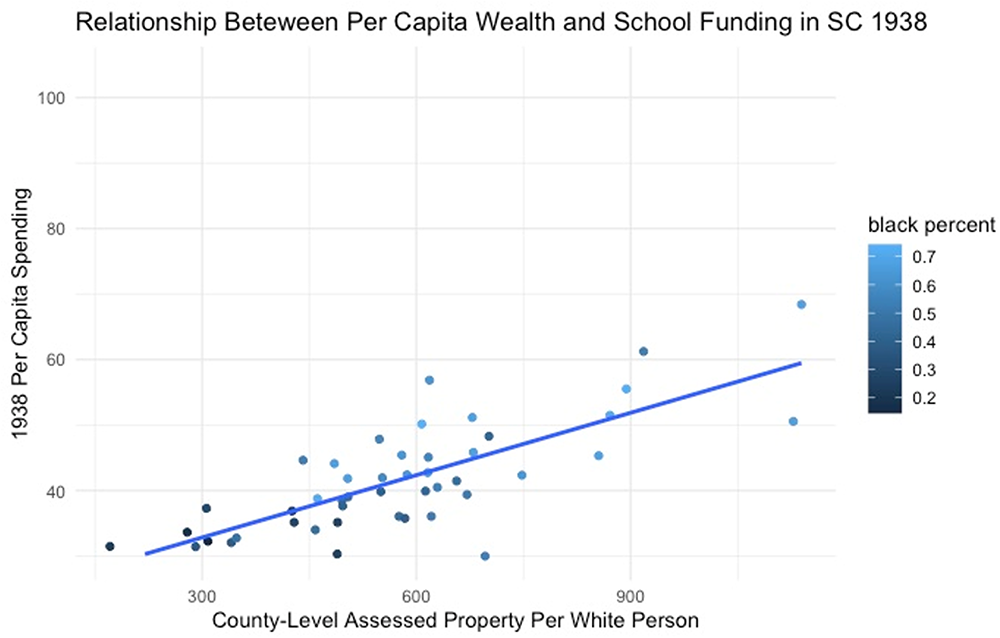
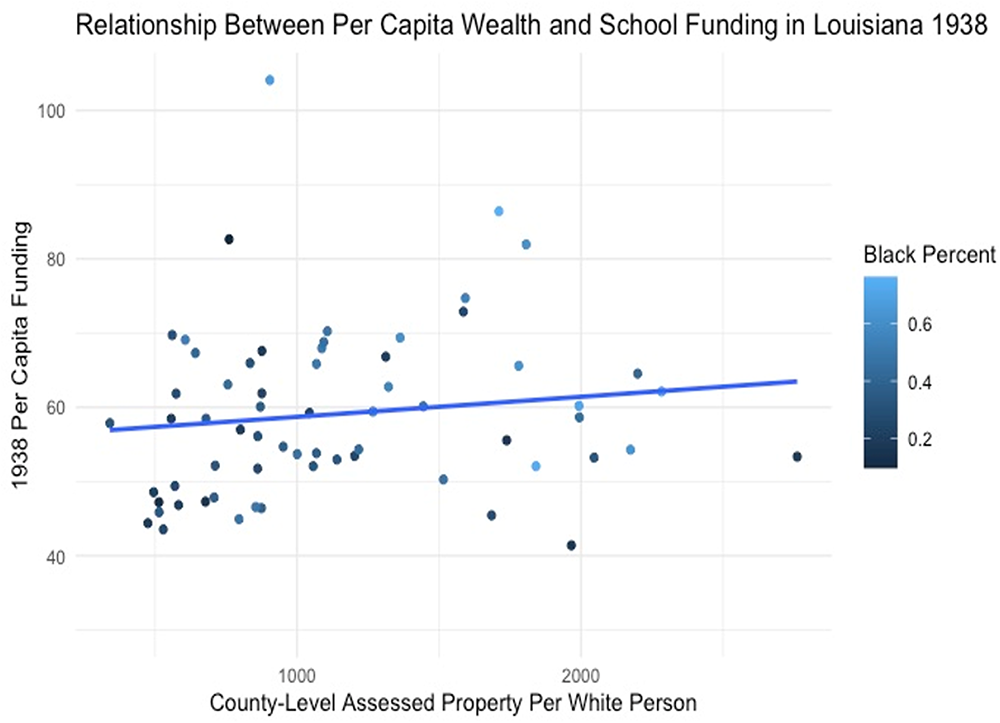
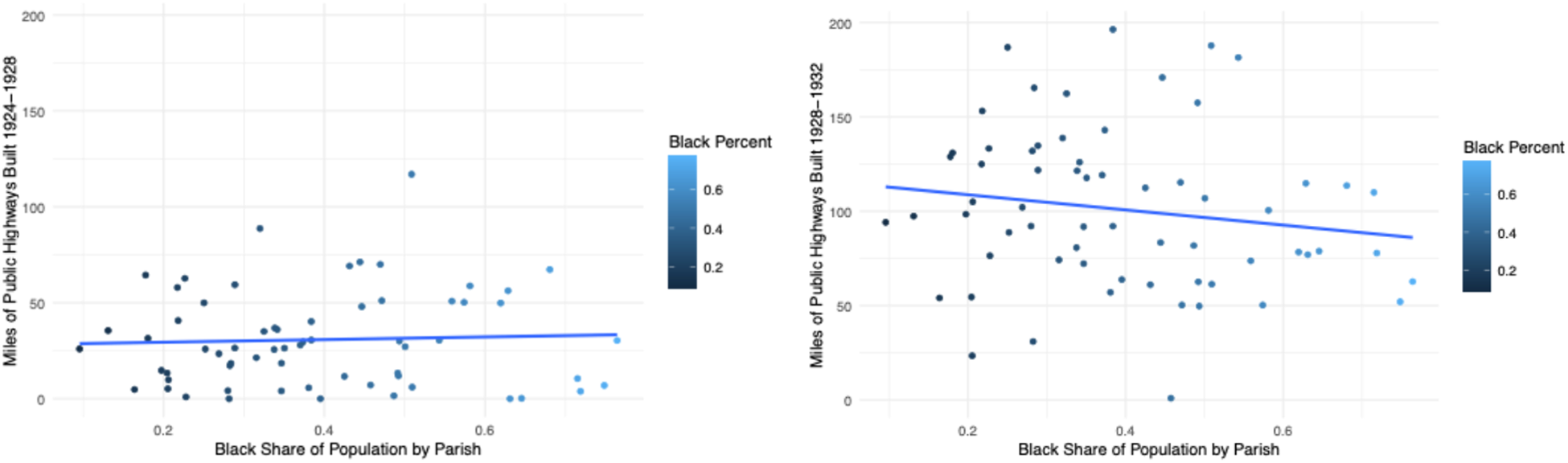
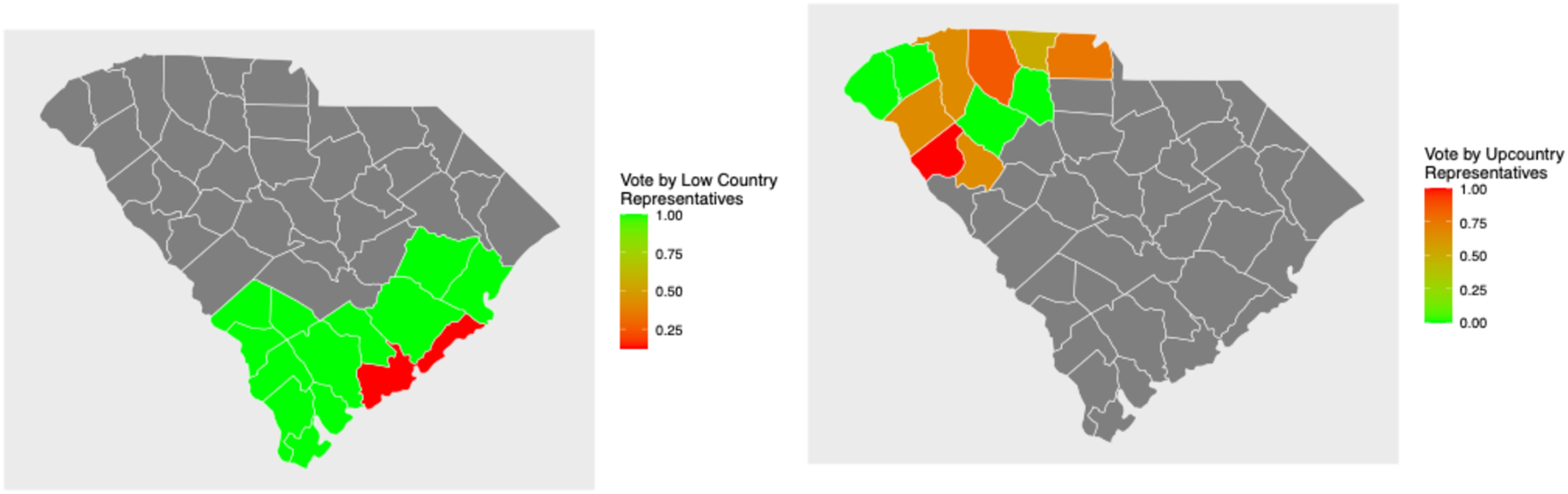
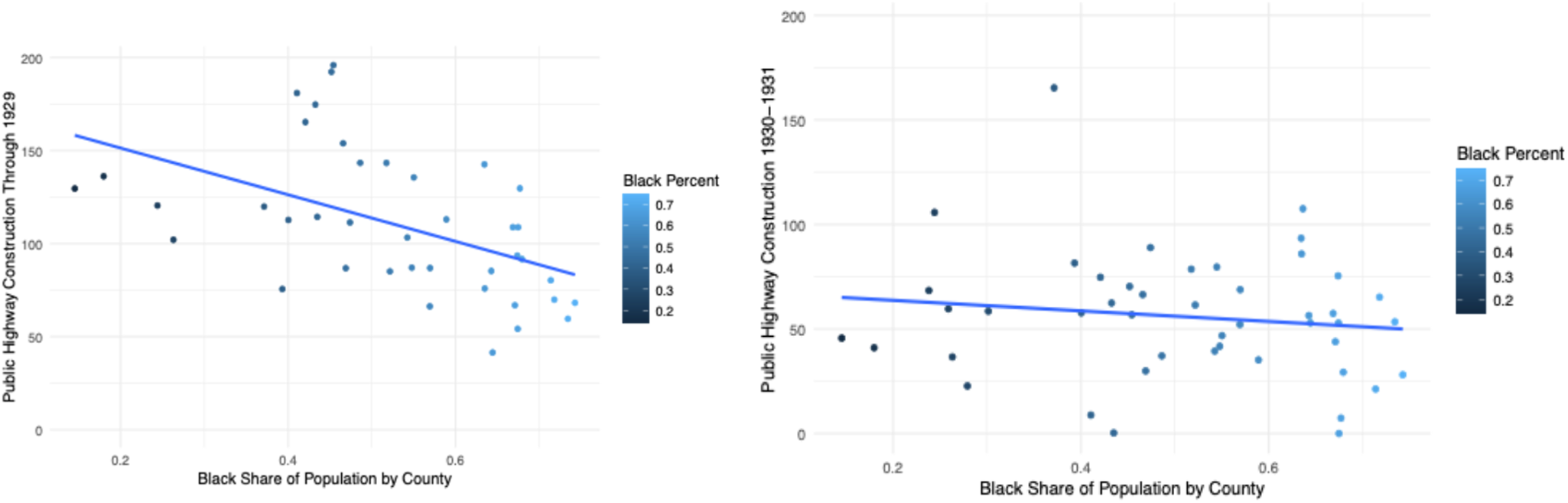

 Open access

