Mullite is the only stable binary phase in the Al2O3–SiO2 system at atmospheric pressure, and it is often present in the form of 3Al2O3⋅2SiO2. Mullite ceramics are promising materials for industrial applications due to their excellent infrared transmission properties, good dielectric properties and thermal stability in high-temperature environments (Schneider et al., Reference Schneider, Schreuer and Hildmann2008; Yu et al., Reference Yu, Chen, Guo, Luo, Li and Li2018; Li et al., Reference Li, Ge, Yuan, Zhang, Zhang and He2021; Romero et al., Reference Romero, Padilla, Contreras and López-Delgado2021). In addition, mullite is also a critical matrix material for ceramic-based composites (Li et al., Reference Li, Ma, Tian, Wang, Zhou and Wu2017). For instance, mullite–corundum composite ceramics are functional ceramics with superior properties to pure corundum and mullite. Therefore, they have become suitable candidates for high-tech applications, such as in aerospace applications and high-temperature engines (Wu et al., Reference Wu, Ding, Xu, Liu and Wang2021b, Reference Wu, Ding, Xu, Zhou, Zhou and Zhang2021c).
Mullite is rare in nature and typically is prepared via heat treatment of Al–Si compounds at high temperatures according to mullite stoichiometry (Yuan et al., Reference Yuan, Kuang, Huang and Yu2022). The synthesis of mullite ceramics via pure raw materials is costly and requires high-temperature sintering. In recent years, some scholars have proposed novel processes for synthesizing mullite from mineral raw materials at low cost. For example, Alves et al. (Reference Alves, Silva, Campos, Torres, Dutra and Macedo2016) prepared mullite ceramics using a mixture of clay and kaolin waste via a reaction sintering technique. Moreover, Zhang et al. (Reference Zhang, Ma, Ye, Jin, Yang and Ding2019) synthesized high-porosity mullite ceramics using kaolin as the raw material.
The decomposition of kaolin to form mullite also yields cristobalite (Sainz et al., Reference Sainz, Serrano and Amigo2000; Sahnoune et al., Reference Sahnoune, Belhouchet, Saheb, Heraiz, Chegaar and Goeuriot2013; Aswad et al., Reference Aswad, Alfatlawi and Saud2021), which transforms into an amorphous phase at high temperatures and impacts the mechanical properties of mullite composite ceramics negatively. To improve the mechanical strength and fracture resistance of mullite composite ceramics, some recent papers have focused on the modification of mullite through the introduction of secondary phases (Ji et al., Reference Ji, Fang and Huang2013; Mahmood et al., Reference Mahmood, Gafur and Hoque2017; Qian et al., Reference Qian, Zeng, Xiong, Ye, Lun and Hu2020; Qin et al., Reference Qin, Tian, Hao, Li, Zhou and Bai2020; Sarker et al., Reference Sarker, Mumu, Al-Amin, Zahangir Alam and Gafur2022). Some agents, such as Al2O3 (Wu et al., Reference Wu, Hu, Xu, Ma and Zhang2016), ZrO2 (Sistani et al., Reference Sistani, Kiani-Rashid and Beidokhti2019) and SiC (Jing et al., Reference Jing, Deng, Li, Bai and Jiang2014), have been employed as secondary phases to reinforce mullite ceramics. The introduced Al2O3 reacts with excess cristobalite to form secondary mullite crystals (Bella et al., Reference Bella, Hamidouche and Gremillard2021). Simultaneously, mullite–corundum composite ceramics can also be prepared. Generally, the presence of ZrO2 promotes phase transformation toughening, which is achieved through the consumption of external energy via the phase transformation of ZrO2 (t-ZrO2 → m-ZrO2, where t denotes the tetragonal phase and m denotes the monoclinic phase; Mazzei & Rodrigues, Reference Mazzei and Rodrigues2000). For instance, Wu et al. (Reference Wu, Ding, Xu and Chen2021a) prepared Al2O3–mullite–ZrO2–SiC composite ceramics with excellent flexural strength using kaolin, α-Al2O3 and ZrO2 as the raw materials, and the retention range of the flexural strength increased by 13.63% after 30 thermal-shock cycles. Serragdj et al. (Reference Serragdj, Harabi, Kasrani, Foughali and Karboua2018) prepared mullite–zirconia composite ceramics successfully using kaolin, feldspar and quartz as the raw materials and introduced ZrO2 as an additive to improve their mechanical strength. ZrO2 plays a prominent role in strengthening ceramic materials; in addition, the sintering parameters can be altered to tune the mechanical properties of ceramic materials (Prochazka et al., Reference Prochazka, Wallace and Glausen1983; Miranzo et al., Reference Miranzo, Pena, Moya and Deaza1985; Yuan et al., Reference Yuan, Tan and Jin1986; Koyama et al., Reference Koyama, Hayashi and Yasumori1994, Reference Koyama, Hayashi and Yasumori1996). Therefore, it is necessary to further explore the effects of ZrO2 on the sintering behaviour and mechanical properties of mullite-based composite ceramics.
The current study utilizes kaolin and Al2O3 as raw materials and introduces ZrO2 as an additive to fabricate mullite-based composite ceramics via solid-state reaction sintering. Moreover, the influences of ZrO2 content and sintering temperature on the bulk density, phase composition, microstructure and mechanical properties of these composite ceramics is studied systematically. In particular, the ZrO2-assisted toughening mechanism of mullite-based ceramics is investigated in detail.
Experimental
Raw materials
Kaolin (dark yellow, d 50 = 11.2 μm, Anhui Jinyan Kaolin Technology Co. Ltd, China) and alumina (white, Al2O3, analytically pure, Xilong Scientific Co. Ltd, China) powders were used as starting materials. Zirconia (white ZrO2, purity >99%, Tianjin Fuchen Chemical Reagent Factory, China) was used as an additive and magnesium oxide (white MgO, purity >99.9%, Sinopharm Chemical Reagent Co. Ltd, China) was used as a sintering aid. The chemical composition of kaolin was determined using X-ray fluorescence (XRF) spectroscopy (Table 1). The X-ray diffraction (XRD) trace of the kaolin is presented in Fig. S1. The main crystalline phases of kaolin are kaolinite (Al4(Si4O10)(OH)8, PDF #78-2109) and quartz (SiO2, PDF #82-511). The material characterization and detailed experimental procedures can be provided in the Supplementary Materials.
The chemical composition of the starting materials (wt.%).

LOI = loss on ignition.
Composite preparation and characterization
The starting materials were mixed for 1 h using a planetary ball mill according to the desired proportions (Table S1). Then, polyvinyl alcohol solution (5 wt.%) was used as a wet granulation binder. The mixtures were pressed into the desired green bodies (cylindrical samples: Φ15 mm × 5 mm, rectangular samples: 40 mm × 40 mm × 5 mm) under a uniaxial pressure of 20 MPa. After being dried at 100°C for 24 h, the samples were heated in a muffle furnace at 1450°C, 1500°C, 1520°C, 1540°C and 1560°C for 3 h, with a heating rate of 5℃ min–1. The sintered samples were labelled as AZS0, AZS3, AZS6, AZS9 and AZS12 corresponding to the ZrO2 contents of 0, 3, 6, 9 and 12 wt.%, respectively (Table S1).
The bulk density and apparent porosity of the as-sintered ceramics were measured using the Archimedes method, as reported elsewhere (Ma et al., Reference Ma, Li, Cui and Zhai2010). The as-sintered ceramic phase compositions were examined using an X-ray diffractometer (Cu-Kα radiation, λ = 0.154186 nm, Smartlab SE, Japan) at 30 mA and 40 kV. The scan speed was 5° min–1, the scanning step was 0.02° and the lattice parameters and phase contents were calculated using Jade 6.5 software based on the XRD results (Peng & Qin, Reference Peng and Qin2019) and PDF database (PDF2-2004). The phase-transformation process and thermal decomposition during heat treatment were investigated using a thermal analyser (thermogravimetry-differential scanning calorimetry (TG-DSC), STA 409, Netzsch, Germany). The ceramics were heated from room temperature to 1100°C at a heating rate of 10°C min–1 in air. The prepared samples were gold-coated, and the microstructures of the fractured surfaces of the as-sintered ceramics were observed using a scanning electron microscope (SEM; Hitachi S4800, Japan) equipped with an energy-dispersive spectrum (EDS) analyser. The flexural strength and fracture toughness of the as-sintered ceramics were analysed using a ceramic bending strength tester (WDW-50, Kaiqiangli, China). The flexural strength was measured using a three-point bending method (Behera & Bhattacharyya, Reference Behera and Bhattacharyya2020). Similarly, the fracture toughness was measured using a single-edge notched beam method (Lian et al., Reference Lian, Liu, Wang, Dong, Wang and Zhu2021a). The span length and loading speed were 30 mm and 0.5 mm min–1, respectively. The calculation process for the mechanical properties of the ceramics is given in the Supplementary Materials.
Results and discussion
Thermal analysis
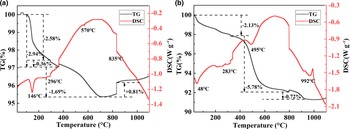
Figure 1 shows the TG-DSC curves of the starting mixtures (kaolin, Al2O3) with and without 12 wt.% ZrO2. The AZS0 sample presents endothermic and exothermic peaks at ~146°C and 296°C, respectively, in the range of room temperature to 400°C, corresponding to the loss of adsorbed water and the combustion of impurities. The overall mass loss was 2.94 wt.%. An indistinct endothermic peak appeared at 570°C, originating from the removal of structural water from kaolin and corresponding to a mass loss of 1.69 wt.%. At temperatures greater than 835°C, the ceramic mass increased slightly (0.81 wt.%) due to the oxidation of iron within the raw materials. Correspondingly, the TG-DSC curve of the sample with 12 wt.% zirconia is shown in Fig. 1b. Comparatively, the AZS12 sample exhibited a significant mass loss (8.63 wt.%) in three distinct stages (2.13 + 5.78 + 0.72 wt.%). The endothermic peak at 48℃ corresponds to the evaporation of free water, while the exothermic peak at 283℃ is related to the combustion of impurities. The second endothermic peak occurred at 495℃, which is attributed to the removal of lattice water from kaolin and its conversion into metakaolin. This process was similar to that observed in the AZS0 sample. At >800℃, there were significant differences between AZS0 and AZS12 samples. A clear exothermic peak appeared at 992℃ in the curve of the AZS12 sample due to the initiation of mullite crystallization. These results are consistent with those of previous work (Mojumdar et al., Reference Mojumdar, Prasad and Sun2009; Vyazovkin et al., Reference Vyazovkin, Burnham, Criado, Pérez-Maqueda, Popescu and Sbirrazzuoli2011; Bella et al., Reference Bella, Hamidouche and Gremillard2021).
TG-DSC curves of the composite ceramics with various amounts of ZrO2: (a) AZS0 and (b) AZS12.

Phase analysis
Figure 2 presents the XRD traces of the AZS6 ceramics after sintering at various temperatures. The main crystalline phase in the sample was mullite (PDF #74-2419) and the secondary crystalline phase was corundum (PDF #74-1081). In addition, small amounts of t-ZrO2 (tetragonal, PDF #81-1314) and m-ZrO2 phases (monoclinic, PDF #86-1450) were observed in the AZS6 ceramics. The intensity of the mullite peaks increased progressively when the sintering temperature increased to 1500°C. The increase in mullite content was related to the production of secondary mullite due to the added alumina reacting with the quartz by-product from the transformation of kaolin into mullite. The reactions can be described as in Equations 1 and 2 (Ptáček et al., Reference Ptáček, Frajkorová, Šoukal and Opravil2014; Liu et al., Reference Liu, Lian, Su, Luo and Wang2019):


XRD traces of AZS6 ceramics sintered at various temperatures.

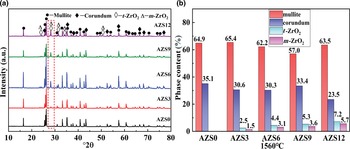
The XRD traces of the AZS ceramics sintered at 1560°C with various ZrO2 contents are shown in Fig. 3a. In the absence of ZrO2, the main crystalline phases were mullite and corundum. When the 3 wt.% ZrO2 content was added, the characteristic peaks of t-ZrO2 and m-ZrO2 were detected in the AZS3 sample. When the ZrO2 content was increased further to 6 wt.%, the intensity of the mullite peaks decreased slightly, suggesting that mullite may exist in the form of a solid solution. In addition, the intensity of the ZrO2 peaks increased at ZrO2 contents of >6 wt.% (Fig. 3b). Kwon & Jung (Reference Kwon and Jung2022) suggested that the Al2O3–SiO2 system describes sufficiently the coexistence of two phases at 1140 K (867℃) in the ternary phase diagram of Al2O3–SiO2–ZrO2. However, the Al2O3–SiO2–ZrO2 system cannot form ternary compounds, although it can still include mullite, Al2O3 and ZrO2 in the liquid phase at 1823 K (1550℃). The corundum phase originated from the transformation of excessive Al2O3, whereas the introduction of ZrO2 led to increased t-ZrO2 contents. Based on phase transformation toughening, t-ZrO2 can improve the mechanical properties of ceramics (Ma et al., Reference Ma, Li, Cui and Zhai2010; Lian et al., Reference Lian, Liu, Zhu, Wang, Liu and Wang2021b; Weinberg et al., Reference Weinberg, Goeuriot, Poirier, Varona and Chaucherie2021).
(a) XRD traces and (b) phase contents of ceramics with various amounts of ZrO2 after sintering at 1560℃.

The lattice parameters of the mullite of as-sintered ceramics were calculated using Jade 6.5 software from the XRD results (Table 2). The mullite was orthorhombic and the unit-cell parameters changed slightly with the addition of ZrO2. More specifically, the lattice parameters (a, b and c) and unit-cell volumes of mullite increased slightly after ZrO2 addition, probably because the radius of Zr4+ (60.5 pm) is greater than that of Al3+ (53.5 pm). As Zr4+ replaced Al3+ in the aluminium oxide octahedral sites when forming a mullite solid solution, the lattice parameters (a, b and c) and unit-cell volume increased slightly. Therefore, the crystal structure of mullite was distorted after ZrO2 addition, accelerating mass transfer and promoting the mullite reaction (Deng et al., Reference Deng, Fu, Mingxing, Li, Yao and He2022).
Lattice parameters of mullite in the composite ceramics with various amounts of ZrO2 after sintering at 1560°C.

Sintering behaviour
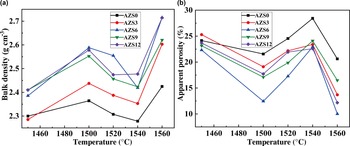
Figure 4 presents the bulk density and apparent porosity of the as-sintered ceramics with various amounts of ZrO2 after sintering at various temperatures. With increasing sintering temperature, the bulk density and apparent porosity of the ceramics exhibited complex trends. The bulk density increased initially with increasing temperature from 1450°C to 1500°C, followed by a slight decrease from 1500°C to 1540°C, and then a sudden increase after sintering at 1560°C. The significant increase in bulk density after sintering at 1560℃ is attributed to the dense structure formed by the interleaving of rod-like mullite and the increasing amount of liquid phase filling the pores. In addition, the slight reduction in bulk density at 1500–1540°C is related to the expansion of secondary mullite formation and the phase transition of zirconia (i.e. t-ZrO2 to m-ZrO2) during cooling (Cui et al., Reference Cui, Zhang, Fu, Wang and Zhang2020; Lian et al., Reference Lian, Liu, Zhu, Wang, Liu and Wang2021b). This phase transition resulted in volumetric expansion and decreased the bulk density.
(a) Bulk density and (b) apparent porosity of ceramics with various amounts of zirconia and after sintering at various temperatures.

Moreover, the bulk density of the ceramics increased significantly after the addition of zirconia. With increasing ZrO2 content from 0 to 12 wt.%, the bulk density increased from 2.29 to 2.72 g cm–3 and the porosity decreased from 24.2% to 10.0%. The greatest bulk density of 2.72 g cm–3 was exhibited by AZS6 and AZS12 ceramics after sintering at 1560°C. In the case of AZS6, the liquid phase filled the pores, thereby increasing the bulk density (Fig. 5c,d). In the case of AZS12, excellent densification was achieved because rod-shaped mullite crystals were staggered and connected to form a dense network structure (Fig. 5g,h).
SEM images of the fracture surfaces of ceramics after sintering at various temperatures: (a,b) AZS6 at 1500°C, (c,d) AZS6 at 1560°C, (e,f) AZS12 at 1500°C and (g,h) AZS12 at 1560°C.

Microstructural analysis
Figure 5 shows the fracture surfaces of AZS6 and AZS12 ceramics after sintering at various temperatures. At 1500°C, pores are observed in the sample (Fig. 5a,b). The number of pores decreased after sintering at 1560°C (Fig. 5c,d), and columnar and rod-shaped mullite phases formed. Increasing sintering temperature also increased the proportion of the liquid phase, which filled the pores and grain boundaries. The presence of a liquid phase affected adversely the mechanical properties of the ceramics. The maximum bulk density of the AZS6 ceramic was 2.72 g cm–3, while the flexural strength was only 84.1 MPa. This can be attributed to the introduction of zirconia, which distorted the lattice and increased the mass transfer, promoting the reaction between Al2O3 and SiO2 (Feng et al., Reference Feng, Wu, Ji, Zhou, Wang and Hao2022). In addition, rod-shaped mullite crystals were staggered and connected to form a dense network structure (red ellipse in Fig. 5g). The zirconia particles (brighter grains in Fig. 5) are distributed randomly at the grain boundaries, leading to a strong pinning effect (Fig. 5e,f). The pinning effect of zirconia grains hindered the movement of the grain boundaries, endowing the ceramics with excellent mechanical strength.
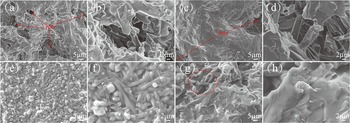
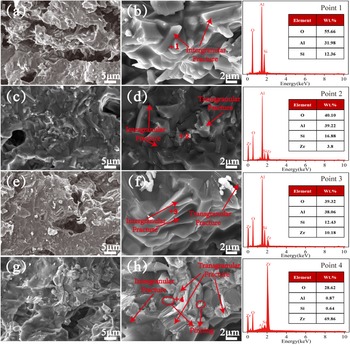
Figure 6 presents SEM images of the ceramics with various amounts of ZrO2 after sintering at 1560°C. AZS0 exhibited a loose columnar microstructure (Fig. 6a,b). According to the EDS analysis of AZS0 (Fig. 6, point 1), the ratio of Al and Si atoms was ~3:1, suggesting mullite composition. The grain boundaries became obvious in the AZS3 ceramic after adding 3 wt.% ZrO2 (Fig. 6c,d). When the ZrO2 content increased to 9 wt.%, the structure of the as-sintered ceramic became loose (Fig. 6e,f), and the fracture modes of the ceramics were intergranular and transgranular (Lian et al., Reference Lian, Liu, Wang, Dong, Wang and Zhu2021a). In addition, a small number of grains were pulled out on the fracture surface of the AZS12 ceramic, and the transgranular fracture was the main pathway for cracks (Fig. 6g,h). The transgranular fractures consumed a great amount of energy. Furthermore, the pinning effect of the zirconia particles (circular areas marked in Fig. 6h) deflected the grain boundaries and absorbed a great amount of fracture energy, improving the mechanical properties of the ceramics. Thus, the AZS12 ceramic exhibited the greatest strength (Fig. 7). Moreover, Fig. 6 (points 2 and 3) shows the EDS patterns of the AZS3 and AZS9 ceramics. The elements detected were Al, Si, O and Zr. The Zr content at point 3 in Fig. 6 (10.18%) was significantly greater than that at point 2 in Fig. 6 (3.8%), which is consistent with the greater contents of the zirconia phase with increasing ZrO2 (Fig. 3b). The energy spectrum analysis of point 4 in Fig. 6 demonstrates that this is due to zirconia particles based on the proportion of Zr and O. The high Zr content may be related to the partial agglomeration of zirconia particles.
SEM images and EDS analyses of ceramics with various amounts of ZrO2 at 1560℃: (a,b) AZS0, (c,d) AZS3, (e,f) AZS9 and (g,h) AZS12.

Influence of ZrO2 content on (a) flexural strength and (b) fracture toughness of the as-sintered ceramics.

Mechanical characterization
Figure 7a shows the effect of ZrO2 content on the flexural strength of ceramics after sintering at 1500℃ and 1560℃. The flexural strength increased with increasing sintering temperature, which is consistent with the trends for bulk density and apparent porosity (Fig. 4). With increasing ZrO2 content, the connections between particles became tighter, increasing the strength and toughness of the ceramics. In addition, the occurrence of transgranular fractures also increased the strength of the as-sintered ceramics. Although the ceramics exhibit a combination of intergranular and transgranular fractures (Fig. 6), the t-ZrO2/m-ZrO2 ratio increased (Fig. 3b) with increasing ZrO2 content, and the transgranular fractures became dominant (Lian et al., Reference Lian, Liu, Zhu, Wang, Liu and Wang2021b). Therefore, when the ZrO2 content increased to 12 wt.%, the flexural strength of the AZS12 ceramic reached a maximum value of 91.6 MPa and the fracture toughness reached a maximum value of 2.47 MPa m–1/2, corresponding to increases of 37.6% in flexural strength and 29.6% in fracture toughness (Fig. 7b). As confirmed using SEM analysis (Fig. 6g,h), the cracks passed through partially and destroyed the ZrO2 particles, consuming large amounts of energy and increasing the mechanical strength of the as-sintered ceramics. The distribution of the secondary phase in the matrix also affected the flexural strength of the ceramics (Song et al., Reference Song, Zhu, Liang and Zhang2018). Herein, zirconia particles were pinned at the grain boundaries, resulting in stress-induced transformation and microcrack toughening as the main mechanisms that improved the mechanical properties of the mullite composite ceramics.
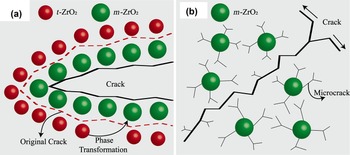
Figure 8a presents a schematic illustration of ZrO2-induced transformation toughening. The tetragonal ZrO2 phase is transformed into a monoclinic phase through stress induction and exhibits volumetric expansion. The strain effect counteracts the influence of stress and absorbs energy, thereby alleviating stress concentration at the crack tip and improving the fracture toughness of the as-sintered ceramics. Figure 8b presents a schematic diagram of ZrO2-induced microcrack toughening. The tetragonal phase in the matrix is transformed easily into the monoclinic phase, resulting in microcracks with increasing ZrO2 grain size. As the size of the main crack begins to increase, the microcracks around the m-ZrO2 particles absorb energy, reduce the stress concentration of the main crack, change the direction of crack propagation and, in turn, improve the mechanical properties of the as-sintered ceramics (Cui et al., Reference Cui, Zhang, Fu, Wang and Zhang2020). Therefore, the synergistic influence of phase-transformation toughening and microcrack toughening promotes the mechanical properties of the as-sintered ceramics.
Toughening mechanism of the zirconia additive: (a) phase-transformation toughening and (b) microcrack toughening.

Conclusions
The solid-state synthesis of mullite-based composite ceramics has been achieved using kaolin and Al2O3 as the starting materials. The sintering temperature (1450–1560°C) and ZrO2 content affected the properties and morphologies of the composite ceramics significantly. In general, increasing sintering temperature increased the amount of the liquid phase, which was conducive to densification sintering. However, the bulk density decreased due to the expansion of secondary mullite and zirconia phase transformation in the temperature range 1500–1540°C. The interlocked structure was dominated by mullite, and the zirconia particles were dispersed at the grain boundaries, leading to a pinning effect. The AZS12 ceramic, sintered at 1560℃ for 3 h, demonstrated the greatest bulk density and flexural strength values of 2.72 g cm–3 and 91.6 MPa, respectively. The addition of ZrO2 increased the flexural strength by ~37.6% due to the synergistic effect of zirconia phase transformation and ZrO2 pinning at the grain boundaries. These results provide useful insights into the preparation of high-performance mullite-based composite ceramics using low-cost kaolin as a raw material.
Financial support
This work was supported by the National Natural Science Foundation of China (Grant No. 11872001), the Key Technologies R&D Program of Anhui Province of China (Grant No. 202104a05020033), the Foundation of State Key Laboratory of High-Efficiency Utilization of Coal and Green Chemical Engineering (Grant No. 2021-K19), the Anhui Provincial Major Science and Technology Special Program (Grant No. 18030901049), the School–Enterprise Cooperation Projects (Grant No. HX2021062279) and the College Students Innovation and Entrepreneurship Training Program (Grant No. S202110361147).
Supplementary material
To view supplementary material for this article, please visit https://doi.org/10.1180/clm.2022.25.