INTRODUCTION
Frugivorous primates play an important role as seed dispersers in tropical forests (Terborgh et al. Reference TERBORGH, PITMAN, STILMAN, SCHICHTER, NUÑEZ, LACEY, SILVA and GALETTI2002), and a growing number of studies provide data on the potential of primates for the dispersal of seeds (Russo & Chapman Reference RUSSO, CHAPMAN, CAMPBELL, FUENTES, MACKINNON, PANGER and BEARDER2011). Primates vary considerably in body size and ranging behaviour, influencing the types of fruit and the size of seeds ingested, as well as their potential for dispersal. In general, larger-bodied species tend to ingest larger seeds and disperse them over greater distances, although a number of other factors, such as ranging patterns, diet and gut transit times, may determine the effective contribution of the primate to the dispersal process.
Gut transit times determine the dispersal potential of a species, given that the distance travelled from the source of the seeds will be related primarily – but not exclusively – to the time the seeds are retained in the gut. Given this, the identification of the factors that determine or influence gut transit time may provide important insights into the dispersal potential of a species, as well as the variation in this potential in relation to different ecological contexts. The available data indicate that, while body size is a primary determinant of gut transit times (Caton et al. Reference CATON, HILL, HUME and CROOK1996), it may not necessarily be a good predictor of transit times, considering the anatomical, physiological and dietary variation among taxa (Clauss et al. Reference CLAUSS, STREICH, NUNN, ORTMANN, HOHMANN, SCHWARM and HUMMEL2008, Reference CLAUSS, STEUER, MÜLLER, CODRON and HUMMEL2013; Lambert Reference LAMBERT1998).
Estimates of gut transit times are available for a number of platyrrhine species, based on the monitoring of both captive (Milton Reference MILTON, RODMAN and CANT1984, Norconk et al. Reference NORCONK, OFTEDAL, POWER, JAKUBASZ and SAVAGE2002, Price Reference PRICE1993) and free-ranging animals (Dew Reference DEW2001, Garber Reference GARBER1986, Julliot Reference JULLIOT1996, Oliveira & Ferrari Reference OLIVEIRA and FERRARI2000, Russo Reference RUSSO2003, Stevenson Reference STEVENSON2000, Wehnke et al. Reference WEHNKE, HUBBELL, FOSTER and DALLING2003, Reference WEHNKE, VALDEZ and DOMINGUEZ2004). While data on feeding behaviour and faecal samples may be relatively easy to obtain, it can be difficult to estimate gut transit times reliably, given the difficulty of tracing faecal residues (primarily seeds and insect fragments) to specific feeding sites, especially where the animals feed sequentially at a large number of food patches.
The present study provides data on the gut transit times and dispersal distances of seeds in free-ranging groups of the titi monkey Callicebus coimbrai resident at two sites in north-eastern Brazil, the first data of their kind for this small-bodied platyrrhine monkey (adult body weight in C. coimbrai = 1.03–1.30 kg: Kobayashi & Langguth Reference KOBAYASHI and LANGGUTH1999). Based on the data available for other primates (Edwards & Ullrey Reference EDWARDS and ULLREY1999, Remis Reference REMIS2000, Remis & Dierenfeld Reference REMIS and DIERENFELD2004), this study tested the hypothesis that differences in the feeding ecology of the species at the two study sites are reflected in significant differences in gut transit times and the potential for seed dispersal.
METHODS
Study sites and groups
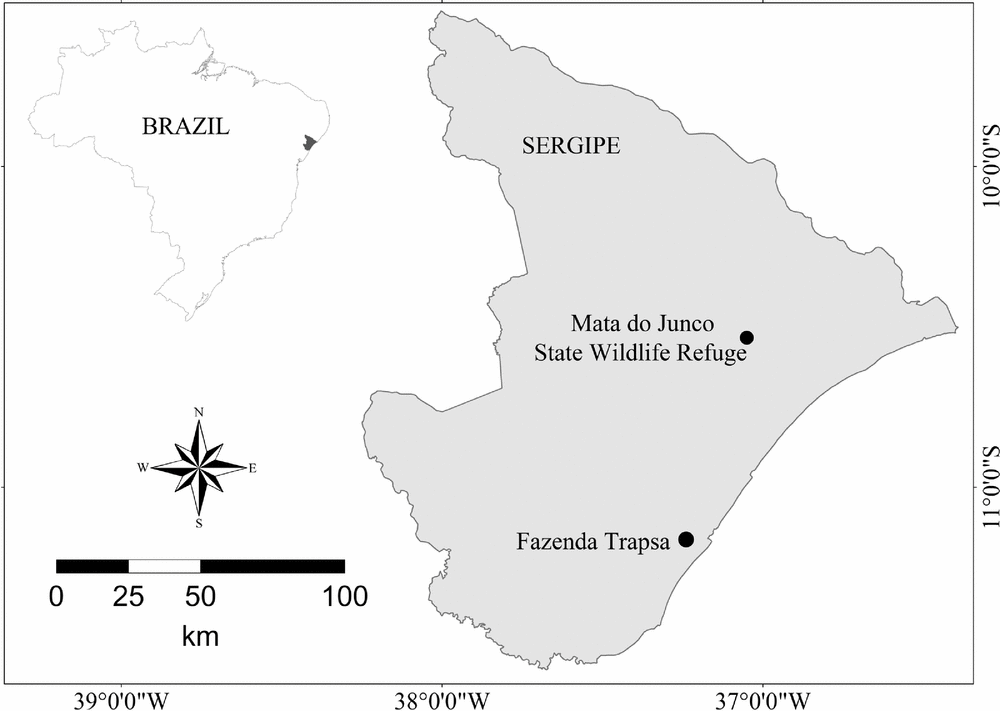
Free-ranging groups of C. coimbrai were monitored at two sites in the north-eastern Brazilian state of Sergipe – the Fazenda Trapsa (11°12′S, 37°14′W) in the municipality of Itaporanga D’Ajuda, and the Mata do Junco State Wildlife Refuge (10°32′S, 37°03′W) in Capela (Figure 1). The Trapsa group inhabits an isolated 14-ha fragment of Atlantic Forest within a complex of larger fragments of up to 120 ha, while the Junco group occupies the northernmost extreme of a 516 ha fragment surrounded mostly by sugarcane plantations. The two groups nevertheless occupy home ranges of similar size, approximately 10.9 ha for the Trapsa group, and 9.1 ha for the Junco group (Baião Reference BAIÃO2013).
Location of the Callicebus coimbrai study sites in the north-eastern Brazilian state of Sergipe.

Mean annual precipitation and temperatures are similar at the two sites, with mean rainfall of 1422 ± 87.3 mm at Fazenda Trapsa (2000–2010), and 1347 ± 75.7 mm at Mata do Junco (2003–2011), and mean monthly temperatures of 22°C–26°C at both sites. The rainy season, when the vast majority (> 80%) of precipitation occurs normally coincides with the austral autumn and winter (April–September), but in contrast with most, but not all tropical rain forests, fruit availability tends to be higher during the late dry season (Souza-Alves Reference SOUZA-ALVES2013), even though fruit feeding was highest during the rainy season.
Both groups had been habituated to the presence of human observers in previous studies (Santana Reference SANTANA2012, Souza-Alves et al. Reference SOUZA-ALVES, FONTES, CHAGAS and FERRARI2011). During the period of the present study, between April and July, 2012, the Trapsa group initially contained five individuals (two adult males, one adult female, one sub-adult female and one juvenile male), but the adult female disappeared in June, leaving only four individuals in the last month of the study period. The Junco group contained six individuals – an adult breeding pair, one subadult, two juveniles and an infant – throughout the study period.
Data collection
Each study group was monitored on 5 d mo−1 (except for 1 d in May at Mata do Junco) for the collection of quantitative data on foraging behaviour through the identification and mapping of fruit feeding sites and defecation events. All trees or lianas at which group members were observed feeding on fruit were marked and identified, the position of the feeding patch was tagged using a handheld GPS model Garmin 60CSx, and the time of the visit was recorded (other data on feeding behaviour were collected, but are not presented here). All defecation events were also recorded and whenever possible, the faeces were collected in standard 50-ml plastic pots, which were kept under refrigeration until analysis in the laboratory. The samples were processed in Petri dishes in a 70% ethanol medium and examined under a Wild M3Z stereoscopic microscope, whenever necessary. All the seeds found within the faecal material were separated for identification through comparisons with material collected directly from the sources in the field, and a representative sample (5–10 seeds, when available) measured (maximum dimension) in order to provide data on seed size. The geographic coordinates of defecation sites were also recorded by GPS.
The composition of the diet was estimated simultaneously by Souza-Alves (Reference SOUZA-ALVES2013) using continuous scan sampling, with a 1-min scan being conducted at 5-min intervals throughout the daily activity period of each study group, with the item being recorded for each feeding record. Data collection was non-invasive and satisfied the legal requirements of the Brazilian Environment Institute (IBAMA) for the study of non-human primates.
Data analysis
Gut transit times – the first appearance of a marker (seed) in the faeces – were estimated by identifying the probable source of seeds found in the faecal samples. The seeds were first identified by comparison with samples of the fruits collected from the feeding sites, and the probable source of the seeds in a given faecal sample was identified by tracing back to the feeding events recorded during the preceding hours. As individuals in both groups defecated as many as six or seven times during a given day (Baião Reference BAIÃO2013), it was assumed that, in most cases – except for the earliest events of the day – that the source of the seeds found in the faecal samples was visited on the same day, although an arbitrary minimum passage time of 1 h was established a priori for the evaluation of the records. In practice, however, no faecal samples were linked to fruit sources visited within the preceding hour.
Gut transit times were estimated by subtracting the recorded time of the presumed feeding bout from that of the defecation event. When more than one possible source of the seeds in the faecal samples was identified, i.e. when two or more fruit patches of the same species were visited (or a patch was revisited) during the preceding 24 h, the event was not included in the analysis. All plant samples were identified and deposited at the Lauro Pires Xavier herbarium at the Federal University of Paraíba in João Pessoa.
Dispersal distances were estimated by mapping the coordinates of feeding trees and the corresponding defecation sites in ArcGis 9.3 and calculating the straight-line distance between the pairs of points corresponding to the source and end location of dispersal events. Given the non-parametric characteristics of the data (and the small sample size in the case of dispersal distances), between-group differences in the size and number of the seeds found in the faecal samples and dispersal distances were assessed using Mann–Whitney U-tests, run in BioEstat 5.0, considering α = 0.05.
RESULTS
Feeding behaviour
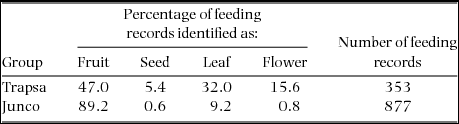
On average, the Junco group visited 11.4 ± 5.1 fruit feeding patches (trees and some lianas) d−1 during the study period (n = 228), whereas the Trapsa group visited only 2.5 ± 2.1 patches d−1 (n = 58). In both groups, the diet was complemented primarily by leaves (Table 1), although in the case of the Trapsa group, a considerable number of flowers were also consumed. Overall, then, while just under half the diet of the Trapsa group was composed of potentially high-fibre items, these items contributed only 11% of the feeding records for the Junco group.
Composition of the diet of the Callicebus coimbrai study groups at the Fazenda Trapsa and RVS Mata do Junco, Sergipe, based on the proportion of feeding records collected in scan samples between April and July, 2012. Data obtained from Souza-Alves (Reference SOUZA-ALVES2013: Tables 3.9 and 3.10, pp. 143–144).
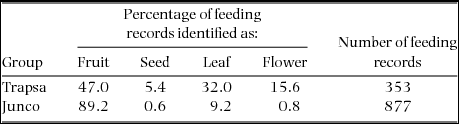
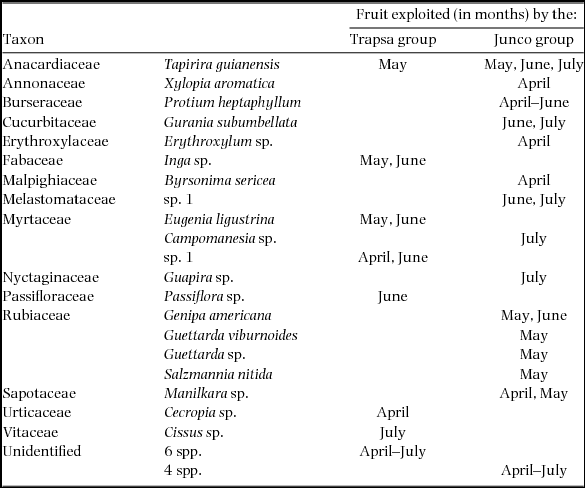
Considerable differences between sites were also found in the plant species exploited for fruit (Appendix 1). While roughly similar numbers of species (13 at Trapsa and 18 at Junco) were used during the study period at the two sites, only two – Tapirira guianensis and Inga sp. – were consumed at both sites (Jaccard similarity index = 0.069). While most fruits were small drupes and berries, which were normally ingested whole, only the pulp of some relatively large fruits (e.g. Genipa americana, Passiflora sp. and Inga sp.) was consumed. In some cases – Protium, Manilkara – the seeds were often spat out, although they were found in the faecal samples, indicating that at least some seeds were ingested together with the pulp.
Slightly larger seeds, on average, were found in the faecal samples collected from the Junco group (mean maximum dimension of seed morphotypes = 6.5 ± 3.2 mm) in comparison with the Trapsa group (mean = 5.3 ± 2.9 mm), although the difference was not significant (U = 67.5, P = 0.383). Similarly, while slightly more seeds were found in the Junco samples, on average (mean number of seeds per faecal sample = 3.0 ± 2.8, maximum = 14) in comparison with the Trapsa group (mean number = 2.1 ± 2.1, maximum = 12), the difference was again not significant (U = 952, P = 0.0636). In addition to consuming a larger proportion of fruit in comparison with the Trapsa group, then, the faeces produced by the members of the Junco group contained larger numbers of relatively larger seeds, on average, in comparison with the Trapsa group.
Gut transit times
We observed a total of 421 defecation events in the two study groups over the 39 d of monitoring, a mean of 10.8 ± 6.8 events per observation day, with 38.4% more records being collected for the Junco group, which was expected according to its larger size (Table 2). There was considerable variation among days, however, with between four and 23 events being observed on a given day in the Trapsa group, and 1–30 in the Junco group. As the number of events we recorded on some days was lower than the number of group members, it seems likely that the total number of events was underestimated on most, if not all days, and this was reflected in the results, including the relatively small number of events for which transit times could be estimated reliably. This conclusion is reinforced by the fact that individual group members were observed defecating as many as six (Junco) or seven (Trapsa) times during a single day, and in 2013, one member of the Junco group was observed defecating 15 times during a single day (FABC, pers. obs.). In many cases, however, events were closely spaced and probably represented the residues of the same feeding event.
Details of the defecation events observed and faecal samples collected during the present study of Callicebus coimbrai at two sites in the Brazilian state of Sergipe, between April and July, 2012.

Faecal sample collection followed a very similar pattern in the two groups, with faecal samples being collected from approximately 60% of the observed events in both cases. However, a much larger proportion of the samples from the Junco group contained seeds (Table 2). This is consistent with the difference in the diet of the two groups (Table 1), but less than might have been expected according to the overall difference in fruit feeding. This is probably at least partly related to the fact that during the consumption of larger fruits – which were more typical of Junco – only the pulp was ingested. Combining this index (percentage of faeces containing seeds) with the mean number of seeds found per sample, an average of 1.44 seeds was dispersed per defecation event, overall, in the Junco group, while the value was only 0.71 in the Trapsa group.
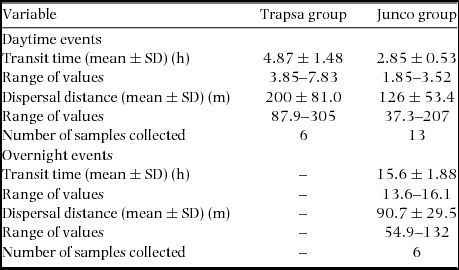
Gut transit times could only be estimated reliably for a small portion of the samples containing seeds (Table 3), but they provide a clear measure of the difference between groups, with the minimum value recorded for the Trapsa group being 0.33 h longer than the maximum value recorded for the Junco group. Even if the outlier (7.83 h) is omitted from the Trapsa data, the mean would be 4.27 ± 0.35 h, still almost 1.83 h (or 49.7%) longer than the mean value for the Junco group.
Gut transit times (h:m) and dispersal distances (m) estimated for the two Callicebus coimbrai study groups monitored between April and July, 2012, in north-eastern Brazil.
This difference is reflected in the mean dispersal distances recorded at each site (Table 3), with the mean distance recorded at Trapsa being 58.8% longer than that at Junco. Despite the significant difference found between sites (U = 13, z = 2.24, P = 0.0251), there was only a weak relationship between gut transit times and dispersal distances, with the outlier transit time (7.83 h) returning only the fourth longest dispersal distance (188 m).
It was possible to trace a further six events in the Junco group back to fruit sources visited during the preceding day. These events returned a mean gut transit time of 15.6 ± 1.88 h, more than five times longer than the mean recorded for daytime events. As the group typically spent more than 12 h in the nightly roost each day during the study period, however, this value equates to little more than 3 h of activity time, and the mean dispersal distance recorded for these events (90.7 ± 29.5 m, n = 6) was considerably shorter than the mean for daytime events in the Junco group (Table 3), which may reflect differences in ranging patterns at the beginning and end of the day.
DISCUSSION
While seed dispersal has received increasing attention in recent years (Russo & Chapman Reference RUSSO, CHAPMAN, CAMPBELL, FUENTES, MACKINNON, PANGER and BEARDER2011, Seidler & Plotkin Reference SEIDLER and PLOTKIN2006, Shivanna & Tandon, Reference SHIVANNA, TANDON, SHIVANNA and TANDON2014), reliable estimates of gut transit times in the wild are still unavailable for most primate species or even genera, including Callicebus, and the present study provides the first data for the titi monkey. In general, the daytime transit times recorded here were similar to those reported for most other platyrrhines, ranging from the small-bodied callitrichids (Garber Reference GARBER1986, Oliveira & Ferrari Reference OLIVEIRA and FERRARI2000, Price Reference PRICE1993) to the large frugivores, such as Ateles and Lagothrix (Dew Reference DEW2001, Russo Reference RUSSO2003, Stevenson Reference STEVENSON2000, Zhang & Wang Reference ZHANG and WANG1995), although retention times may vary considerably in these species (Caton et al. Reference CATON, HILL, HUME and CROOK1996). Only the folivorous howlers (Alouatta spp.) present longer transit times (Julliot Reference JULLIOT1996, Milton Reference MILTON, RODMAN and CANT1984, Pavelka & Knopff Reference PAVELKA and KNOPFF2004, Souza Reference SOUZA1999, Zhang & Wang Reference ZHANG and WANG1995), which appear to be related to the high-fibre diet of these monkeys (Clauss et al. Reference CLAUSS, STREICH, NUNN, ORTMANN, HOHMANN, SCHWARM and HUMMEL2008).
However, the only data available for the sakis (Pithecia), which not only represent the genus closest to Callicebus in phylogenetic terms (Silva et al. Reference SILVA, FIGUEIREDO, FERRARI, VEIGA, BARNETT, FERRARI and NORCONK2013), but also the most similar in body size and ecology (Norconk & Setz Reference NORCONK, SETZ, VEIGA, BARNETT, FERRARI and NORCONK2013), indicate much longer gut transit times, of 20 h for Pithecia monachus (Milton Reference MILTON, RODMAN and CANT1984) and 15 h for Pithecia pithecia (Norconk et al. Reference NORCONK, OFTEDAL, POWER, JAKUBASZ and SAVAGE2002). The latter authors proposed that the relatively long transit times recorded in Pithecia may be related to the predation of seeds by the sakis, although Milton (Reference MILTON, RODMAN and CANT1984) recorded much shorter times (5 h) for captive Cacajao calvus and Chiropotes albinasus, larger-bodied pitheciines that feed on much higher proportions of seeds in the wild (Barnett et al. Reference BARNETT, BOWLER, BEZERRA, DEFLER, VEIGA, BARNETT, FERRARI and NORCONK2013, Veiga & Ferrari Reference VEIGA, FERRARI, VEIGA, BARNETT, FERRARI and NORCONK2013). These times are consistent with those recorded in field studies of the similarly sized capuchins, Cebus spp. (Rowell & Mitchell Reference ROWELL and MITCHELL1991, Wehnke et al. Reference WEHNKE, HUBBELL, FOSTER and DALLING2003, Reference WEHNKE, VALDEZ and DOMINGUEZ2004, Zhang & Wang Reference ZHANG and WANG1995).
Overall, then, while the daytime transit times recorded in the present study for Callicebus coimbrai are more consistent with those from other platyrrhine field studies, the overnight times recorded for the Junco group are more similar to those recorded in captive Pithecia. There appear to be a number of reasons for assuming that this is related more to methodological differences among studies rather than absolute contrasts in the digestive tract or physiology of these species, that might reflect distinct dietary adaptations. One is the fact that Ferrari & Lopes (Reference FERRARI and LOPES1995) found no pronounced difference in the gut morphology of Callicebus and Pithecia. In addition, a similar degree of difference has been found between daytime and overnight events in Lagothrix lagothricha (Stevenson Reference STEVENSON2000) and Callithrix jacchus (Caton et al. Reference CATON, HILL, HUME and CROOK1996). The considerable variation in gut transit times encountered in most studies emphasizes the importance of standardizing procedures, which can be problematic in the field, due to the lack of control on most variables. In the present study, daytime and overnight events were analysed separately to ensure the reliability of comparisons between sites, and this would be a recommendation for future studies.
While it was possible to trace only a small proportion of the observed defecation events to specific feeding trees, differences in estimated gut transit times between sites are considerable – the mean times recorded for the Trapsa group were at least half as long again as those recorded during the daytime for the more frugivorous Junco group. Similar variation has been recorded in other primates (Edwards & Ullrey Reference EDWARDS and ULLREY1999, Remis Reference REMIS2000, Remis & Dierenfeld Reference REMIS and DIERENFELD2004). Garber (Reference GARBER1986) and Stevenson (Reference STEVENSON2000) also found evidence of the possible contribution of seed size to transit time. In the present study, however, no significant difference was found between groups in the size of the seeds ingested, nor the number of seeds per faecal sample.
The marked differences in gut transit times recorded between sites were also reflected in dispersal distances, with significantly longer distances being recorded in the Trapsa group. While the more folivorous members of this group ingested far fewer seeds than those of the more frugivorous Junco group, then, this difference in their diets may have contributed to the greatly enhanced dispersal distances recorded at Fazenda Trapsa.
ACKNOWLEDGEMENTS
This study was supported by graduate stipends from FAPITEC (SAAB) and CAPES (FBAC), and CNPq through project number 503122/2010-6 and research stipend to SFF (303994/2011-8). We are especially grateful to Sr. Ari Ferreira for permitting the study on the Fazenda Trapsa and SEMARH-SE authorizing research at Mata do Junco. We would also like to thank João Souza Alves, Patrício Rocha, Marcelo ‘Guigó’ Silva, Adriano Rodrigues, Valdineide Santana and Jasmine Craig for their respective contributions to different aspects of the study, and Marcus Clauss for his helpful review of the original manuscript.
Plant species exploited for fruit by the Trapsa and Junco Callicebus coimbrai study groups during the study period (April–July 2012).