Introduction
Offspring of Wistar rats fed a high multivitamin (HV) diet during gestation have increased food intake in early life and develop characteristics of the metabolic syndrome in later life when fed either the AIN-93G purified dietReference Szeto, Aziz and Das 1 or an obesogenic diet.Reference Szeto, Das, Aziz and Anderson 2 It is unclear, however, if the increase in food intake is solely driven by altered expression of feeding systems regulating energy intake or those regulating macronutrient preference. In addition to energy intake, protein and carbohydrate intake are an aspect of feeding behaviour that is regulated in animals allowed to make food choices.Reference Anderson 3 – Reference Anderson, Li and Glanville 5 The serotonin system is known to be involved in this regulation,Reference Anderson 3 , Reference Anderson and Johnston 6 , Reference Fernstrom 7 but the role of serotonin receptors in regulating food selection has not been described. However, it is known that serotonin receptors 5-HT1A act presynaptically, and when activated, increase food intake.Reference Dourish, Hutson, Kennett and Curzon 8 In contrast, increased activity of the postsynaptic receptors, 5-HT2A/2C has been associated with hypophagia and disruption of feeding cascade in animals.Reference De Vry and Schreiber 9 5-HT2C is expressed by proopiomelanocortin (POMC) neurons, and both 5-HT2C and POMC co-regulate energy balance and food intake due to the direct neural circuitry between the serotonergic and melanocortin system.Reference Qiu, Xue and Bosch 10 – Reference Lam, Przydzial and Ridley 12 Thus, we hypothesized that, when compared to offspring from dams fed the RV diet, those from dams fed the HV diet during gestation have altered diet choice as well as energy intake, and that their food intake behaviour could be associated with altered expressions of serotonin receptors and POMC in the hypothalamus.
Therefore, the objective of this study was to examine the effect of feeding an HV diet during pregnancy on food intake, the selection of protein and carbohydrate and the expression of hypothalamic serotonergic receptors and POMC of the melanocortin system in the offspring.
Methods
Animals and diets
First-time pregnant Wistar rats (Charles River Inc., Quebec, Canada) were received on day 3 of pregnancy and housed individually in ventilated plastic transparent cages with bedding and room temperature of 22 ± 1°C in a 12-h light/12-h dark cycle (lights on at 0700 h). The pregnant rats had free access to water by an automated water system. The University of Toronto Animal Care Committee approved the protocol and maintenance of the animals conformed to the guidelines of the Canadian Council on Animal Care.
From day 3 of pregnancy to term, dams were fed the AIN-93G dietReference Reeves, Nielsen and Fahey 13 containing either the recommended (RV, recommended vitamin) or 10 times HV content by addition of the AIN-93 vitamin mix (n = 10 dams/gestational diet). The composition (in g/kg) of the AIN-93G diet was casein (200), cornstarch (529.4), sucrose (100), soybean oil (70), cellulose (50), vitamin mixture (10), mineral mixture (35), choline bitartrate (2.5) and tert-butylhydroquinone (0.014). Cornstarch, high-protein casein (87%) and cellulose were purchased from Harlan Teklad (Madison, WI, USA). The vitamin mixture, mineral mixture, choline bitartrate and tert-butylhydroquinone were purchased from Dyets (Bethlehem, PA, USA), whereas sucrose and soybean oil were purchased from local suppliers in Toronto, Canada (Allied Food Service and Loblaws, respectively). The composition of the vitamin mixture (in mg/kg RV diet) was nicotinic acid (30), calcium pantothenate (16), pyridoxine-HCl (7), thiamin-HCl (6), riboflavin (6), folic acid (2), D-biotin (0.2), vitamin B12 (25), vitamin E as all-rac-α-tocopheryl acetate (15), vitamin A as all-trans-retinyl palmitate (8), vitamin D3 (2.5), vitamin K-1 (0.75) and powdered sucrose (9750). As sucrose is the carrier in the vitamin mix, the 88.7 g/kg of sucrose added to the HV diet was compensated for by removing the same amount of sucrose normally added to the RV diet. The vitamin additions used in the HV diet are below that reported to have adverse effects in rats, 14 and none have been observed in previous studies.Reference Szeto, Aziz and Das 1 , Reference Szeto, Das, Aziz and Anderson 2
At birth, each litter was culled to 12 pups, and the pups were weaned at day 17 rather than day 21 because exposure to the gestational diet after that time is a determinant of protein selection by the offspring.Reference Morris and Anderson 15 During lactation, dams were fed the RV diet. At weaning, pups were housed individually in ventilated plastic transparent cages with bedding. Male offspring, one from each dam, for each diet group (n = 10/group), were weaned to a choice of 10% (LP, low protein) and 60% (HP, high protein) casein diets, as used in a previous study.Reference Morris, Li, MacMillan and Anderson 16 Food was available for 12 h each day (1900–0700 h). This feeding schedule yields similar growth rates compared to 24 h ad-libitum fed animals as reported previously.Reference Johnson, Li, Coscina and Anderson 17 The position of the food cups were alternated daily to control for possible position preference. The composition (in g/kg) of the LP pup diet was casein (100), cornstarch (614), sucrose (116), soybean oil (70), cellulose (50), vitamin mixture (10), mineral mixture (35), choline bitartrate (2.5) and tert-butylhydroquinone (0.014). The composition (in g/kg) of the HP pup diet was identical except for casein (600), cornstarch (193) and sucrose (37). Pup diets had equal caloric densities of 3.95 kcal/g, were fed in jars equipped with a mesh insert to minimize spillage and were secured to a stainless steel base to add stability and catch spillage. A stainless steel partition separated the two diets in order to distinguish spillage and ensure accurate food intake measurements.
Study procedures
Food and macronutrient intake were measured daily, and body weight of the offspring was measured at birth, weaning and twice weekly from weaning to 7 weeks post-weaning. At 4 and 6 weeks post-weaning, the effect of tryptophan (TRP), a serotonin precursor,Reference Morris, Li, MacMillan and Anderson 16 and mCPP, a 5HT2c receptor agonistReference Fiorella, Rabin and Winter 18 , Reference Halford, Harrold, Boyland, Lawton and Blundell 19 were used to examine serotonergic function. Macronutrient choice was measured after an overnight fast in response to saline (control), TRP (L-form, as methylester) and mCPP (1-(3-chlorophenyl)piperazine) injections. On separate days (day 1 or 3), male pups received i.p. injections of either TRP (1 ml/200 g, 75 mg/kg) or saline (1 ml/200 g) 45 min before food was provided, with a 1-day washout between the injections. Food intake of LP and HP diets was measured for 1 h after the TRP injections, and 1 h and 12 h after saline injections. On day 5 or 7, male pups received i.p. injections of either mCPP (0.5 ml, 10 mg/kg) or saline (0.5 ml) 10 min before food was provided, and intake of LP and HP diets was measured over 12 h after the presentation of food cups in pups receiving mCPP, and 1 h and 12 h after the presentation of food cups in pups receiving saline. Food intake data were expressed as total food intake (g), protein intake (g), carbohydrate intake (g) and protein energy intake (% of total energy intake).
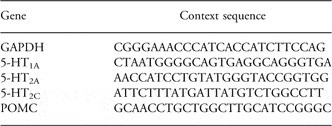
At birth, weaning and 7 weeks post-weaning, rats from both gestational diet groups were sacrificed by decapitation. Fat pad mass (FPM; sum of abdominal, peri-renal and epididymal fat pads) was collected upon sacrifice at 7 weeks post-weaning. Brains were rapidly removed and immediately frozen by placing them on plastic cassettes on top of powdered dry ice and then stored at −80°C. mRNA levels of serotonin receptor 1A (5-HT1A), 2A (5-HT2A) and 2C (5-HT2C), and POMC in the hypothalamus were determined at birth, weaning and 7 weeks post-weaning. The oligonucleotide primer and fluorogenic probe sets for Taqman™ real-time PCR were purchased from Applied Biosystems Inc. (Foster City, CA, USA; Table 1). RNA extraction, reverse transcription and real-time PCR were carried out as described previously.Reference Duan, Choi, Hartzell, Della-Fera, Hamrick and Baile 20
Probes used in real-time PCR

GAPDH, glyceraldehyde-3-phosphate dehydrogenase; 5-HT1A, serotonin receptor 1A; 5-HT2A, serotonin receptor 2A; 5-HT2C, serotonin receptor 2C; POMC, proopiomelanocortin.
Statistical analysis
Gestational diet effect on body weight at birth, weaning and 7 weeks post-weaning were analysed by Student’s unpaired t-test. Post-weaning body weight, food and macronutrient intake data were analysed by a two-factor repeated-measures ANOVA using the mixed model (PROC MIXED procedure in SAS) with gestational diet and day as main factors. Long-term food and macronutrient intake data were analysed for days 1–27 and 36–41 post-weaning. Weeks 4 (days 28–35) and 6 (days 42–48) were excluded from long-term food intake and selection patterns because of the experimental manipulations occurring at those times. When an interaction was declared, post-hoc comparisons were analysed by Student’s unpaired t-tests.
Food intake at 1 h and 12 h and diet selection at 4 and 6 weeks were analysed by two-factor repeated-measures ANOVA with gestational diet and injection as main factors. When an interaction was declared, mean comparisons were made using a one-factor ANOVA with a general linear model (GLM) procedure followed by Tukey’s post-hoc test. Treatment effects on FPM at 7 weeks post-weaning, and on hypothalamic mRNA gene expression at birth, weaning and 7 weeks were determined by Student’s unpaired t-tests.
Significance was declared if P < 0.05. All data are expressed as mean ± s.e.m. The experimental data (e.g. body weight) of pups born to the same dam were averaged to obtain one value for the litter.Reference Wainwright 21 All statistical analyses were performed using the SAS System for Windows (version 9.1, SAS Institute, Cary, NC, USA).
Results
There was no difference in litter size between RV- and HV-fed dams (13.4 ± 0.9 v. 13.9 ± 0.6, P = NS), as observed previously. Following culling at birth, pups from RV and HV-fed dams were 41.2% and 43.0% male, respectively.
Body weight
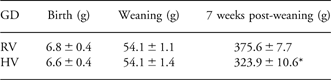
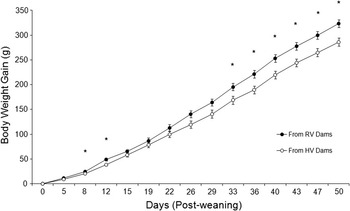
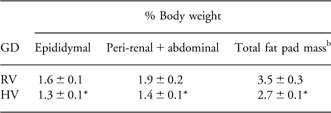
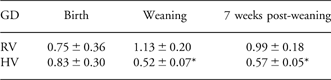
At birth and weaning, there was no difference in body weight between pups from HV- and RV-fed dams (Table 2). However, at 7 weeks post-weaning, pups from HV-fed dams weighed 14% less than RV pups (P < 0.01). From weaning to sacrifice (7 weeks post-weaning), there was a trend toward an effect of gestational diet (F 1,18 = 3.11, P = 0.09) and an effect of day (F 13,288 = 1408.83, P < 0.0001; Fig. 1). A gestational diet by day interaction (F 13,288 = 5.84, P < 0.01) on body weight gain occurred because pups from HV-fed dams gained less weight than pups from RV-fed dams, with the magnitude of difference between groups increasing with time. The difference was statistically different by Student’s t-test on days 8 and 12, and from day 33 to day 50. At sacrifice, pups from HV-fed dams had 19% less epididymal fat (P < 0.05), 26% less peri-renal plus abdominal fat (P < 0.05) and a 23% lower total FPM (sum of epididymal, peri-renal and abdominal fat pads) as a percentage of total body weight (P < 0.05; Table 3).
Body weight of the offspring at birth, weaning and 7 weeks post-weaningFootnote a ,Footnote b

GD, gestational diet; RV, recommended vitamin; HV, high vitamin.
a Mean ± s.e.m.; n = 10 litters/group.
b The body weights of pups born to the same mother were averaged to obtain one value for the litter; *P < 0.01 by Student’s unpaired t-test within the same column.
Body weight gain to 7 weeks post-weaning (mean ± s.e.m.; n = 8–10 rats/group; GD (P = 0.09), day (P < 0.0001), GD × day (P < 0.01); *mean differences by Student’s unpaired t-test, P < 0.05. GD, gestational diet; RV, recommended vitamin; HV, high vitamin).

Fat pad mass at 7 weeks post-weaningFootnote a

GD, gestational diet; RV, recommended vitamin; HV, high vitamin.
a Mean ± s.e.m.; n = 10 rats/group. Percentage of adipose tissue (adipose tissue/body weight × 100); *P < 0.05 by Student’s unpaired t-test within the same column.
b Sum of the epididymal, peri-renal and abdominal fat pads.
Long-term food and macronutrient intake
Food intake (g)
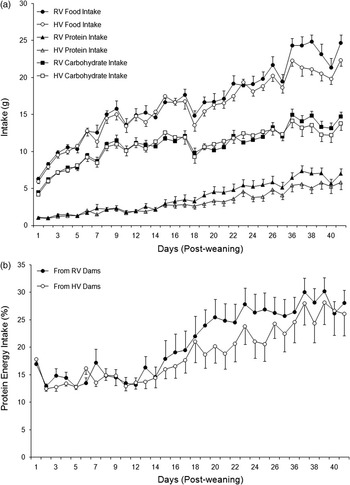
Gestational diet (F 1,22 = 6.47, P < 0.05) and day (F 32,682 = 29.85, P < 0.0001), with no interaction, affected total food intake (Fig. 2a). Pups from HV-fed dams ate a lower amount of food compared to pups from RV-fed dams.
(a) Long-term food, protein, carbohydrate and (b) protein energy intake (days 1–27 and 36–41 post-weaning; mean ± s.e.m.; n = 8–10 rats/group for each time point; food intake: GD (P < 0.05), day (P < 0.0001), GD × day (P = NS); protein intake: GD (P = NS), day (P < 0.0001), GD × day (P = NS); carbohydrate intake: GD (P = NS), day (P < 0.0001), GD × day (P = NS); protein energy intake: GD (P = NS), day (P < 0.0001), GD × day (P = NS); protein energy intake (%) = [protein intake (g) × 4.0 (kcal/g)]/[food intake (g) × 3.95 (kcal/g)] × 100%; GD, gestational diet; RV, recommended vitamin; HV, high vitamin).

Protein and carbohydrate intake (g)
Gestational diet did not affect protein or carbohydrate intake, but there was an effect of day (protein: F 32,682 = 39.56, P < 0.0001; carbohydrate: F 32,682 = 17.43, P < 0.0001; Fig. 2a). As pups aged, protein and carbohydrate intake increased. There was no interaction between gestational diet and day.
Protein energy intake (%)
Gestational diet did not affect protein energy intake, but there was an effect of day (F 32,682 = 15.80, P < 0.0001; Fig. 2b). As pups aged, protein energy intake increased. There was no interaction between gestational diet and day.
Short-term food and macronutrient intake
Saline injection
Food, protein and carbohydrate intake (g)
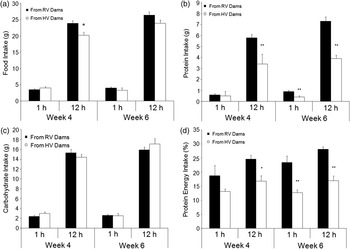
There was no effect of gestational diet on food intake over 1 h, following overnight food deprivation and the control saline injection before food access, at 4 and 6 weeks post-weaning (Fig. 3a). However, food intake over 12 h was lower in pups from the HV-fed dams at week 4 (P < 0.05). Gestational diet did not affect 1 h protein intake following saline injection at 4 weeks, but at 6 weeks, pups from HV-fed dams had lower intakes (P < 0.01) (Fig. 3b). But, over 12 h, lower protein intake was observed at both 4 (P < 0.01) and 6 (P < 0.0001) weeks. There was no effect of gestational diet on 1 h or 12 h carbohydrate intake at either 4 or 6 weeks (Fig. 3c).
(a) Short-term food, (b) protein, (c) carbohydrate and (d) protein energy intake following saline injection (mean ± s.e.m., n = 6–9 means/group (each mean is the average intake following two saline injections received by each animal at 4 and 6 weeks post-weaning); *student’s unpaired t-test, P < 0.05; **P < 0.01; Saline intraperitoneally (1 ml/200 g) 45 min before lights out, or 0.5 ml 10 min before lights out and access to 10% and 60% casein diets in rats adapted to a 12-h nocturnal feeding period; protein energy intake (%) = [protein intake (g) × 4.0 (kcal/g)]/[food intake (g) × 3.95 (kcal/g)] × 100%; RV, recommended vitamin; HV, high vitamin).

Protein energy intake (%)
There was no effect of gestational diet on 1 h protein energy intake following overnight food deprivation at 4 weeks (Fig. 3d). However, pups from HV-fed dams had a lower protein energy intake over 1 h at 6 weeks (P < 0.01), and over 12 h at both 4 (P < 0.05) and 6 (P < 0.0001) weeks, compared to pups from RV-fed dams.
Tryptophan injection
Food, protein and carbohydrate intake (g)
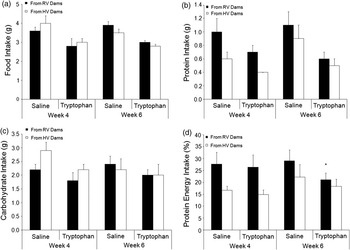
There was neither gestational diet effect, nor an interaction between gestational diet and injection on 1 h food (Fig. 4a), protein (Fig. 4b) or carbohydrate (Fig. 4c) intake at 4 or 6 weeks post-weaning. However, TRP injection decreased 1 h food and protein intake compared to the saline control at both 4 (food: F 1,20 = 13.38, P < 0.01; protein: F 1,20 = 12.80, P < 0.01) and 6 (food: F 1,20 = 7.95, P < 0.05; protein: F 1,20 = 9.43, P < 0.05) weeks, but carbohydrate intake at 4 weeks only (P < 0.01).
Effect of tryptophan injection on (a) food, (b) protein, (c) carbohydrate and (d) protein energy intake during a 1-h feeding period. (mean ± s.e.m., n = 8–10 rats/group; macronutrient selection and food intake following saline and tryptophan injections were compared by two-way ANOVA with gestational diet and injection as main factors; *P = 0.05 by Tukey’s test; tryptophan (as methylester, 1 ml/200 g, 75 mg/kg) or saline (1 ml/200 g) was given intraperitoneally 45 min before lights out and access to 10% and 60% casein diets in rats adapted to a 12-h nocturnal feeding period; food intake: week 4: GD (P = NS), injection (P < 0.01), GD × injection (P = NS); week 6: GD (P = NS), injection (P < 0.05), GD × injection (P = NS); protein intake: week 4: GD (P = NS), injection (P < 0.01), GD × injection (P = NS); week 6: GD (P = NS), injection (P < 0.01), GD × injection (P = NS); carbohydrate intake: week 4: GD (P = 0.09), injection (P < 0.01), GD × injection (P = NS); week 6: GD (P = NS), injection (P = NS), GD × injection (P = NS); protein energy intake: week 4: GD (P < 0.05), injection (P = NS), GD × injection (P = NS); week 6: GD (P = NS), injection (P = 0.05), GD × injection (P = 0.09); protein energy intake (%) = [protein intake (g) × 4.0 (kcal/g)]/[food intake (g) × 3.95 (kcal/g)] × 100%; GD, gestational diet; RV, recommended vitamin; HV, high vitamin).

Protein energy intake (%)
Pups from HV-fed dams had a lower 1 h protein energy intake at 4 weeks (F 1,21 = 4.37, P < 0.05), but not 6 weeks (Fig. 4d). TRP injection decreased protein energy intake in both groups, but only at 6 weeks (P = 0.05).
mCPP injection
Food, protein and carbohydrate intake (g)
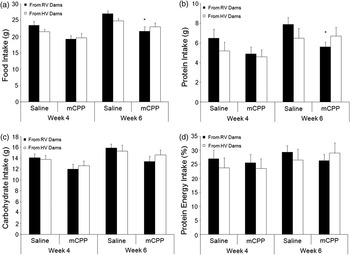
There was no effect of gestational diet on 12 h food (Fig. 5a), protein (Fig. 5b) or carbohydrate (Fig. 5c) intake at 4 or 6 weeks. mCPP injection decreased food, protein and carbohydrate intake at both 4 (food: F 1,20 = 10.15, P < 0.05; protein: F 1,20 = 7.14, P < 0.05; carbohydrate: F 1,20 = 6.97, P < 0.05) and 6 (food: F 1,20 = 16.48, P < 0.01; protein: F 1,20 = 5.45, P < 0.01; carbohydrate: F 1,20 = 13.06, P < 0.01) weeks. Only at 6 weeks, there was an interaction between gestational diet and injection on 12 h food (F 1,20 = 3.92, P = 0.06) and protein (F 1,20 = 9.55, P < 0.01), but not carbohydrate intake. In pups from RV-fed dams but not HV-fed dams, mCPP decreased food and protein intake (P < 0.01).
Effect of mCPP injection on (a) food, (b) protein, (c) carbohydrate and (d) protein energy intake during a 12-h feeding period (mean ± s.e.m., n = 8–10 rats/group; macronutrient selection and food intake following saline and mCPP injections were compared by two-way ANOVA with gestational diet and injection as main factors; *P < 0.01 by Tukey’s test; mCPP (0.5 ml, 10 mg/kg) or saline (0.5 ml) was given intraperitoneally 10 min before lights out and access to 10% and 60% casein diets in rats adapted to a 12-h nocturnal feeding period; food intake: week 4: GD (P = NS), injection (P < 0.01), GD × injection (P = NS); week 6: GD (P = NS), injection (P < 0.0001), GD × injection (P = 0.06); protein intake: week 4: GD (P = NS), injection (P < 0.01), GD × injection (P = NS); week 6: GD (P = NS), injection (P < 0.05), GD × injection (P < 0.01); carbohydrate intake: week 4: GD (P = NS), injection (P < 0.05), GD × injection (P = NS); week 6: GD (P = NS), injection (P < 0.01), GD × injection (P = NS); protein energy intake: week 4: GD (P = NS), injection (P = NS), GD × injection (P = NS); week 6: GD (P = NS), injection (P = NS), GD × injection (P < 0.05); protein energy intake (g) = [protein intake (g) × 4.0 (kcal/g)]/[food intake (g) × 3.95 (kcal/g)] × 100%; GD, gestational diet; RV, recommended vitamin; HV, high vitamin).

Protein energy intake (%)
There was no effect of gestational diet or injection on 12 h protein energy intake at 4 or 6 weeks (Fig. 5d). There was an interaction between gestational diet and injection (F 1,20 = 4.67, P < 0.05) at 6 weeks. mCPP decreased protein energy intake in pups from RV-fed dams, but increased it in pups from HV-fed dams.
Hypothalamic 5-HT1A/2A/2C and POMC mRNA levels
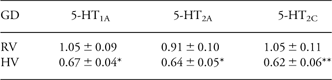
At weaning, male pups from HV-fed dams had significantly lower hypothalamic 5-HT1A (P < 0.01), 5-HT2A (P < 0.01) and 5-HT2C (P < 0.01) expression (Table 4). However, at birth and 7 weeks post-weaning, expression hypothalamic 5-HT1A, 5-HT2A and 5-HT2C of the male pups was not different between the groups.
Hypothalamic 5-HT1A/2A/2C mRNA expression levels at birth, weaning and 7 weeks post-weaningFootnote a ,Footnote b

GD, gestational diet; RV, recommended vitamin; HV, high vitamin; 5-HT1A, serotonin receptor 1A; 5-HT2A, serotonin receptor 2A; 5-HT2C, serotonin receptor 2C; GAPDH, glyceraldehyde-3-phosphate dehydrogenase.
a Mean ± s.e.m.; n = 5–6 rats/group; *P < 0.01, by Student’s unpaired t-test within the same column.
b Data were normalized to the GAPDH values and then expressed as relative quantification.
At birth, pups from RV- and HV-fed dams also had similar hypothalamic POMC expression levels (Table 5). However, at weaning and 7 weeks post-weaning, male pups from HV-fed dams had lower hypothalamic POMC (P < 0.05 at weaning and 7 weeks post-weaning).
Hypothalamic POMC mRNA expression levels at birth, weaning and 7 weeks post-weaningFootnote a ,Footnote b

GD, gestational diet; RV, recommended vitamin; HV, high vitamin; POMC, proopiomelanocortin; GAPDH, glyceraldehyde-3-phosphate dehydrogenase.
a Mean ± s.e.m.; n = 5–6 rats/group’; *P < 0.05 by Student’s unpaired t-test within the same column.
b Data were normalized to the GAPDH values and then expressed as relative quantification.
Although food selection of the female offspring was not studied, the expression of 5-HT1A (P < 0.01), 5-HT2A (P < 0.05) and 5-HT2C (P < 0.01) at weaning was lower in females born to the HV-fed dams (Table 6).
Hypothalamic 5-HT1A/2A/2C mRNA expression levels of female offspring at weaningFootnote a ,Footnote b

GD, gestational diet; RV, recommended vitamin; HV, high vitamin; 5-HT1A, serotonin receptor 1A; 5-HT2A, serotonin receptor 2A; 5-HT2C, serotonin receptor 2C; GAPDH, glyceraldehyde-3-phosphate dehydrogenase.
a Mean ± s.e.m.; n = 5–6 rats/group; *P < 0.05, **P < 0.01 by Student’s unpaired t-test within the same column.
b Data were normalized to the GAPDH values and then expressed as relative quantification.
Discussion
These results support the hypothesis that increased vitamin content of the gestational diet affects both energy intake and macronutrient intake regulation and alters the expression of serotonin receptors and POMC in the hypothalamus of the offspring. Compared with pups born to dams fed the RV diet, pups born to HV dams had lower weight gain and food intake for the duration of the study. Following an overnight fast, they had lower food and protein intake when expressed as a proportion of total energy intake, reduced sensitivity to TRP and mCPP injections, lower serotonin receptor expression at weaning and POMC expression at weaning and 7 weeks post-weaning. However, the effects of the HV gestational diet on pups given access to a food choice feeding paradigm are in contrast to that observed in rats weaned to a single diet. Rats born to dams fed the HV diet ate more and gained more weight on both the AIN-93G dietReference Szeto, Aziz and Das 1 and obesogenic diet.Reference Szeto, Das, Aziz and Anderson 2
Change in the regulation of food choice in offspring due to consumption of an HV diet by the dams was demonstrated. Protein intake by those rats from the RV dams averaged approximately 25% of the total dietary energy, consistent with previous reports of protein selection in rats given similar dietary choice.Reference Musten, Peace and Anderson 22 – Reference Whitedouble dagger, Porter and Martin 24 Although the long-term intake of protein was not statistically different between groups, evidence for altered regulation due to the HV gestational diet was clear in the short-term studies. Absolute protein and protein intake expressed in proportion to energy intakes were lower following an overnight fast during 12 h of feeding at 4 weeks post-weaning, and during both 1 h and 12 h at 6 weeks post-weaning (Fig. 3), while carbohydrate intake was unchanged.
Evidence for involvement of the serotonergic system in this food preference following an overnight fast was supported by the feeding responses to the agonists, TRP and mCPP. Because response to these agonists occurred in offspring from RV, but not HV-fed dams, it can be suggested that postsynaptic sensitivity was reduced in offspring born to HV-fed dams. Following TRP injection, the proportion of energy as protein decreased over 1 h at 6 weeks post-weaning in pups from RV dams (Fig. 4), and was consistent with the longer-lasting effects of mCPP. Over 12 h, mCPP resulted in lower protein energy intake in pups from RV, but not HV-fed dams (Fig. 5).
Evidence that the HV diet impacted on the function of the serotonergic system is suggested by lower 5-HT1A/2A/2C receptor gene expression found in both male and female offspring at weaning (Tables 4 and 6). Unfortunately, differences were not seen at birth, making the role of in utero programming of gene expression uncertain. Although the HV diet was fed only during gestation, it may have also affected postnatal development through the vitamin composition of the mothers’ milk. Higher levels of fat-soluble vitamins would be predicted to be present in the breast milk due to storage in liver and adipose tissue during gestation, and then mobilization during lactation. A single subcutaneous dose of vitamin A given to newborn male rats decreased serotonergic activity in the brain of the rats as adultsReference Tekes, Gyenge, Folyovich and Csaba 25 and in the next generation.Reference Tekes, Gyenge, Hantos and Csaba 26
The reduced expression of 5-HT1A/2A/2C receptors at weaning and of POMC at weaning and 7 weeks post-weaning may have contributed to the feeding behaviour of the offspring born to the HV dams. However, it does not explain why offspring selecting from HP and LP diets and born to HV-fed dams weighed less and had less body fat at 7 weeks post-weaning. The lower food intake in pups from HV-fed dams is consistent with the results obtained after brain serotonin depletion, which results in hypophagia.Reference Dourish, Hutson, Kennett and Curzon 8 However, decreased 5-HT2A/2C mRNA has been positively correlated with obesity and adiposity in animals,Reference Dourish, Hutson, Kennett and Curzon 8 , Reference De Vry and Schreiber 9 and is consistent with higher food intake, adiposity and body weight gain in offspring fed either the AIN-93G dietReference Szeto, Aziz and Das 1 or the obesogenic dietReference Szeto, Das, Aziz and Anderson 2 and born to dams fed the HV diet.
As there is direct neuronal circuitry between the serotonergic and melanocortin systems,Reference Xu, Jones and Kohno 11 , Reference Lam, Przydzial and Ridley 12 the reduction of hypothalamic POMC gene expression in HV offspring at weaning and 7 weeks post-weaning suggests a long-term disruption of the hypothalamic feeding regulatory system may have resulted from the gestational HV diet. Downstream effectors of POMC, such as agouti-related protein and melanocortin-4 receptor, are thus prime candidates to be altered in this condition and warrant future investigation.Reference Lam, Przydzial and Ridley 12 In rodents, the generation of serotonergic neurons begins as early as embryonic day 10Reference Ballion, Branchereau, Chapron and Viala 27 and continues during the first three postnatal weeks of life.Reference Herlenius and Lagercrantz 28 , Reference Rajaofetra, Sandillon, Geffard and Privat 29 Although serotonin receptor expression did not differ at 7 weeks post-weaning, this may be expected. Serotonin receptor gene expression is altered by frequent administration of serotonin receptor agonists,Reference Tilakaratne, Yang and Friedman 30 and because two doses of mCPP were given at 4 and 6 weeks post-weaning, the mRNA levels measured were likely confounded. In addition to the mRNA levels of serotonin receptors and POMC, the measurement of their protein expressions would complement the findings, especially in the offspring at 7 weeks post-weaning.
Why access to two diets resulted in lower food intake, body weight and body fat in offspring from the HV diets (Tables 2 and 3, Figs 1 and 2a), whereas previous studies in rats fed only one diet result in increased food intake, body weight and adiposity,Reference Szeto, Aziz and Das 1 , Reference Szeto, Das, Aziz and Anderson 2 is unclear. The food choice paradigm provided the rat offspring in this study was the only overall difference in study design compared to the previous publications. This choice paradigm has been widely used previously to elucidate mechanisms regulating food intake, and has illustrated that many neural pathways, including the serotonergic system, participate in both energy intake and food choice.Reference Anderson and Li 4 – Reference Anderson and Johnston 6 , Reference Fernstrom 31 In addition, the composition of the single-diet paradigm markedly affects the regulation of food intake as illustrated by the increased body fat in rat offspring fed high fat and highly palatable diets.Reference Szeto, Das, Aziz and Anderson 2 There are many examples illustrating the effects of the pup diet and sex on the expression of intake regulatory mechanism.Reference Szeto, Aziz and Das 1 , Reference Vickers, Breier, Cutfield, Hofman and Gluckman 32 – Reference Gluckman and Hanson 35 In previous studies of the HV gestational diet, increased food intake, body weight and obesity was found in male, but not female offspring fed the AIN-93G diet.Reference Szeto, Aziz and Das 1 However, when they were fed an obesogenic diet, the female rats ate more and developed obesity more quickly than the male rats.Reference Szeto, Das, Aziz and Anderson 2 Thus, it can be concluded that the lower body weight, adiposity and food intake of pups from the HV dams arose from an interaction between the effect of the HV diet of the dams on expression of intake regulatory systems in the offspring and the food choices provided.
The relevance to humans of these effects of high multivitamin intakes during pregnancy on food intake, selection and body weight in the rat is uncertain at present, but it may be an indication of unexpected consequences of excess intakes on food intake regulation in humans. There is considerable evidence that many women consume high amounts of vitamins, and increased availability and consumption of fortified foods and dietary supplements have occurred in recent years. In the United States, in 2000, 28% of all adults consumed a multivitamin daily, up from 17% in 1987.Reference Radimer, Bindewald, Hughes, Ervin, Swanson and Picciano 36 Furthermore, pregnant women and women of childbearing age are advised to take a daily multivitamin supplement to ensure adequacy for both mother and foetus, and to protect against neural tube defects,Reference Ottley 37 and many gestational multivitamin supplements contain 100% or more of the recommended daily intake of one or more of the nutrients.Reference Radimer, Bindewald, Hughes, Ervin, Swanson and Picciano 36 A recent survey conducted in Boston estimated micronutrient intakes by pregnant women in the upper third quartile to be two to seven times the RDA for 10 vitamins.Reference Lagiou, Mucci and Tamimi 38
In conclusion, intake of multivitamins above the requirements during pregnancy affects body weight, food intake, macronutrient choice and expression of the serotonergic and the melanocortin systems in the hypothalamus of Wistar rats. Additional study is needed to further elucidate which vitamins are involved and the mechanisms by which in utero programming of systems regulating food intake and macronutrient choice occurs.
Acknowledgements
This study was supported by the Canadian Institute of Health Research, Institute of Nutrition, Metabolism and Diabetes Strategic Initiative (CIHR-INMD): ‘Excellence, Innovation and Advancement in the Study of Obesity and Healthy Body Weight’ (Grant no. OOP-77980) and the Bristol-Myers Squibb/Mead Johnson Freedom to Discover Grant.
Statement of Interest
None.