In the decades since the bicentenary of the French Revolution, theatre scholarship has been transformed by the publication of large-scale corpus analyses of dramatic programming. The foundational contributions of André Tissier and Emmet Kennedy, together with the electronic database César – collectively containing records of over 100,000 performances – have enabled scholars to reframe a number of ingrained assumptions about theatrical life during the 1790s.Footnote 1 Significantly, the datasets of both Tissier and Kennedy demonstrate that the tragedies and pièces de circonstance that have long drawn attention from the academy formed only a small subset of the overall repertory. What proliferated most impressively on Parisian stages were lightweight comedies and classic works from the Old Regime – a fact that seems to confound both politically dominated readings of Revolutionary theatrical production and conventional narratives of aesthetic rupture after 1789.Footnote 2
These broad trends also hold true in the operatic realm. That is, few ‘textbook’ examples of Revolutionary opera – the spectacle-laden, musically progressive works of Luigi Cherubini and Etienne-Nicolas Méhul, for instance, or the military-inspired occasional compositions of François-Joseph Gossec – enjoyed a noteworthy statistical presence within the repertory.Footnote 3 The list of most frequently staged pieces is heavily populated by an older generation of lyric comedies: translations of Italian opera buffa, vaudeville plays in the fair tradition and opéras comiques from earlier in the century.Footnote 4 Indeed, in purely numerical terms, the most successful opera of the Revolutionary period was a rustic-themed work entitled Les deux chasseurs et la laitière (1763), with a score by Egidio Duni and a libretto by Louis Anseaume.Footnote 5 This opéra comique was nearly thirty years old when the Bastille fell, and it contained topical allusions not to Revolutionary politics but to the Seven Years War. None the less, during the 1790s it was positively ubiquitous, with at least 355 performances at more than twenty different Parisian theatres.Footnote 6
Les deux chasseurs has benefited of late from a wider (and long overdue) resurgence of interest in opéra comique of the French Enlightenment; it was produced at the Jean de La Fontaine festival in Château-Thierry in 2012 and recorded for the first time in 2016.Footnote 7 Yet the work remains something of a novelty, and contemporary theatre historians have had difficulty accounting for the degree to which it resonated with Revolutionary audiences. Tissier describes the status of Les deux chasseurs during the 1790s as ‘surprising’, explaining its predominance as a result of shifting demographics amongst spectators in the capital. He posits that this comic bluette must have pleased ‘the new, working-class public that then thronged to [Parisian] theatres’ (‘un public populaire et nouveau, qui se rendait en foule au théâtre’).Footnote 8 Kennedy, for his part, surmises that Les deux chasseurs became embedded in Revolutionary programming because it engaged an interest in escapist subjects, appealing to a broad preference for ‘comedy over tragedy’ and ‘laughter over rhetoric’ during troubled times.Footnote 9
The present article draws upon musical and archival evidence to establish a more complete performance history of Les deux chasseurs, and a more nuanced explanation for its enduring hold within the operatic repertory. First, I recover the roots of the work's Revolutionary-era popularity by examining its remarkable prevalence – in France and elsewhere in Europe, on public stages and in private theatres, in full and reduced scorings – during the final three decades of the Old Regime. Duni's opéra comique had exceptional staying power because it was situated at the vanguard of developments both aesthetic and institutional. On the one hand, Les deux chasseurs offered an important example of Italianization of the native lyric idiom and drame-inspired reform of acting style, traits that were crucial to the modernization of opera in late eighteenth-century France. On the other hand, the work's spread was promoted by material factors, its first run coinciding with an influential reorganization of Parisian theatres and a massive expansion of musical commerce. Situated within this context, the success of Les deux chasseurs during the Revolution appears markedly less out of place; it had, after all, been presented in Paris in every theatrical season since its premiere.
My second aim, moving into the 1790s, is to broaden our consideration of Les deux chasseurs beyond critical reception to include the pragmatics of production. In so doing, I address the advantages and limitations of corpus-based analysis for delineating the operatic canon. Previous chroniclers of Revolutionary theatre have focused largely (and not inappropriately) on spectatorial experience, analysing changes in repertory through the lens of evolving political circumstances and shifting audience demand.Footnote 10 Those studies that do address the supply side of the equation tend to concentrate on government intervention, examining staging decisions made on the basis of censorship and state-dictated programming policy.Footnote 11 Les deux chasseurs must also have been performed, however, because it was eminently reproducible, appealing strongly to impresarios. Although Duni's opera was originally commissioned by a crown-supported institution, the Comédie Italienne, during the Revolution it was predominantly presented by boulevard troupes, upstart companies formed after the deregulation of the French dramatic industry (the so-called ‘liberty of the theatres’) in 1791. To these new and often resource-challenged theatres, the work offered a paradigmatic blend of audience pull and practical viability. Its musical idiom was well established but not yet entirely outdated; its comedic setting was sufficiently forward-looking but relatively easy to stage; and its libretto and score were by long-deceased authors, and therefore unaffected by recent laws mandating payment under copyright.
It is clear, then, that large-scale studies of theatrical programming have shed new light on a facet of the Revolutionary experience that has often been neglected in recent scholarship: the rich and varied history of the petits théâtres of Paris. But delving more deeply into the particularities of these companies also serves as a cautionary tale about the kinds of broad claims occasionally generated in repertory analysis. In the case of Les deux chasseurs, statistics that might seem counterintuitive when applied to the Parisian landscape as a whole can be explained logically at the level of the individual troupe. And conversely, arguments that make sense in relation to the output of the fair and boulevard theatres cannot always be extended to more famous centres of lyric production like the Opéra, Comédie Italienne and Théâtre Feydeau.Footnote 12 This in turn raises questions about how we define a representative repertory for posterity and engages an emerging body of musicological literature centred on the operatic canon.Footnote 13 In late eighteenth-century Paris, observers were already beginning to identify a chasm between the reality of their theatre-going experiences and the reactions of critics and scholars: Was a true piece of ‘Revolutionary’ theatre one that was heralded as emblematic of its time, or one, like Les deux chasseurs, that was so frequently seen that it hardly elicited a mention in the printed record?
TWO HUNTERS AND A MILKMAID UNDER THE OLD REGIME
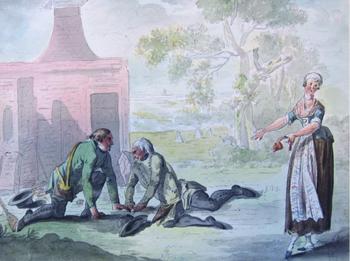
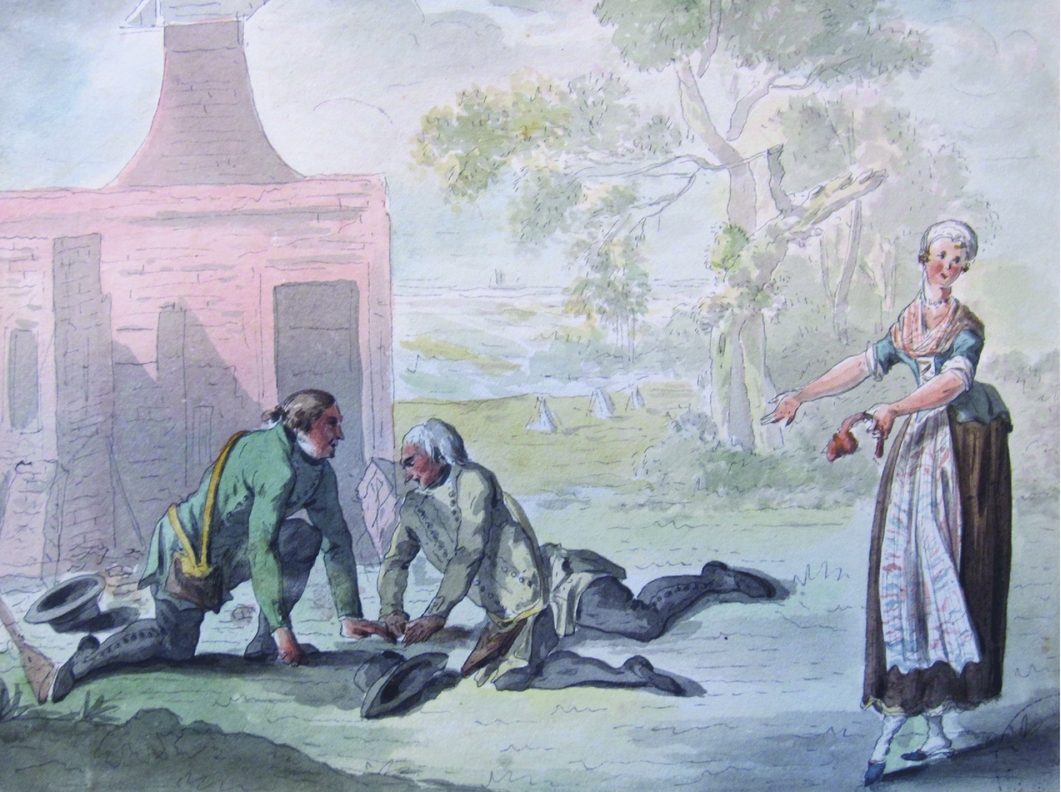
Les deux chasseurs premiered at the Comédie Italienne in Paris on 23 July 1763. The plot of the opera is straightforward but charming, a conglomeration of two well-known fables of Jean de La Fontaine. The hunters of the work's title, Guillot and Colas, spend much of the comedy's duration tracking a bear and dreaming of the fortune they will acquire once they catch it and sell its pelt. Unfortunately, as the work opens, the two men are already greatly in debt, having fixed the delivery date of the animal before they have worked out how to trap it. The pair soon encounter a milkmaid, Perrette, with equally grand and unrealistic life ambitions. She hopes to capitalize lavishly on her single pail of milk: trading it for eggs to raise into chickens, which she will then swap for a whole flock of barnyard animals. In the end, none of the characters are successful. Guillot and Colas are terrified of bears, and their target, along with their promised fortune, repeatedly slips through their grasp. Meanwhile Perrette is clumsy, breaking her pail and spilling her milk on the way to market. The group shares a moment of despair, as Guillot half-heartedly attempts to hang himself from the framing of a small shanty. But this sombre atmosphere is quickly dispelled when the roof of the building collapses, foiling Guillot's plans, comically rousing a sleeping Colas and bringing both men to their senses (Figure 1).Footnote 14 By the finale, all involved have learned not to count their chickens before they hatch and, more generally, to refrain from making light of life's misfortunes. The refrain of the closing vaudeville is a citation from La Fontaine: ‘Et ne vendez la peau de l'ours / qu'après l'avoir couché par terre’ (one should not sell the skin of a bear before capturing it).Footnote 15
Atelier Ziesenis, Scene 9 from Les deux chasseurs et la laitière, watercolour and ink. Bibliothèque nationale de France, Album Ziesenis, Fol-O-ICO-003. Used by permission
Les deux chasseurs was very quickly established within the repertory of the Comédie Italienne, staged more than thirty times in the second half of 1763 alone.Footnote 16 This early surge of performances, while not entirely unusual for a new commission at this theatre, was enhanced by the opéra comique's conjunction with important historical events. In the first months of its run, it was paired with Charles-Simon Favart's occasional divertissement Les fêtes de la paix and included in the festivities that marked the end of the Seven Years War and the unveiling of a new statue of the monarch in the Place Louis XV (the present-day Place de la Concorde). At the conclusion of Les deux chasseurs, the characters mourn their lost bear pelt, curse their spilt milk and then – rather abruptly – take a turn towards current affairs, reflecting on the thwarted extension of France's Atlantic seaports:

While the link might appear incongruous, such an external political or literary reference was a common gambit within strophic finales of mid-century opéras comiques. Kennedy has proposed that the text alludes to the foreign minister, Étienne-François, duc de Choiseul, or perhaps even to the seventeenth-century finance minister Jean-Baptiste Colbert.Footnote 18 It is more plausible, however, that it describes the recently disgraced Intendant of New France, François Bigot, or one of his associates in the corruption scandal known as the ‘Affaire du Canada’. During the summer of 1763 Bigot was at the centre of a widely publicized show trial – having emerged as a (rightful) scapegoat for the large-scale fiscal fraud that had contributed to the nation's disastrous defeat in North America. (He would be found guilty and banished to Switzerland by year's end.) The reference to Bigot would seem compatible with Les deux chasseurs’ inclusion in state-sponsored events; while the stanza appears critical upon first reading, it actually mirrors the manner in which the monarchy had ‘officially’ assigned blame for its mismanagement of the war effort.Footnote 19
The precise nature of the political associations in Les deux chasseurs, and their influence on revivals of the work, may never be fully recoverable and have elicited some consternation from modern scholars. As one critic describes it, the move beyond the rustic frame during the vaudeville finale is so sudden and so seemingly ‘defeatist’ that ‘one wonders why Revolutionary audiences found it so compelling’.Footnote 20 Two important clarifications, neither featuring in the standard literary or musicological reception of the opera, are worth making here. First, the moral of Les deux chasseurs cannot be interpreted without its musical accompaniment. If the text of the finale has an air of pessimism, the tune – a brisk and jovial triple-metre dance in an unproblematic G major – undercuts this entirely. Given the self-aware tone of the opera as a whole, the jab appears more light-heartedly cheeky than despondent or pointed. Second, it is clear from later editions of the libretto that the politically charged portion of Les deux chasseurs was ultimately excised from the work.Footnote 21 We are left, instead, with the characters leaving the stage acknowledging their recent hardships but vowing none the less to muddle onwards – a more benign and reassuring message that might potentially be applied in any number of contexts. Indeed, despite the very specific circumstances of its conception, Les deux chasseurs seems to have profited during the Revolution because it became so politically malleable, an idea that I will explore in further detail below.
Les deux chasseurs was thus brought to prominence by its connection with the conclusion of hostilities in 1763. But more relevant to our present inquiry is the consistency and longevity of the work within the repertory of the Comédie Italienne, a condition that can be attributed less to politics than to the music and comedy of the opera itself. In simplest terms, Duni's was a work that aged well – not because it remained exceptional within the theatrical corpus, but because it anticipated a host of similar works and could therefore be programmed seamlessly alongside them in the decades that followed. (This was a not inconsequential factor for a company that presented two lyric comedies per evening, five evenings per week, for all but a few weeks of the year.) Les deux chasseurs encapsulated the ‘modern’ musical style then being forged within opéra comique. As has been ably documented by Daniel Heartz and David Charlton, amongst others, the 1750s and early 1760s marked a turning-point in the history of this genre.Footnote 22 In the first half of the eighteenth century, the music of French lyric comedy had been drawn nearly exclusively from the popular vaudeville tradition. In the aftermath of the querelle des bouffons, however, the form was subject to rapid development: following the watershed examples of Jean-Jacques Rousseau's Le devin du village (1752) and Antoine Dauvergne's Les troqueurs (1753), the vaudeville was discarded and replaced by newly composed Italianate ariettes modelled on the style of imported opera buffa. This changing fashion within the lyric idiom coincided with and was abetted by a contemporaneous reorganization of Parisian theatres. In 1762 the traditional fairground producers of opéra comique were folded into the royalty-backed Comédie Italienne, granting additional resources and legitimacy to the genre and setting the stage for a period of extraordinary creative expansion.
Although Duni is hardly a household name today, he was a leading agent in this shift – one of the principal composers at the Comédie Italienne, as well as its music director, at the time of opéra comique's governmental legitimation.Footnote 23 Duni was schooled in Naples but arrived in France via the Bourbon-controlled court of Parma, where the Francophile tastes of the royal family had fostered a culture of cosmopolitan experimentation. The composer produced work in a variety of genres: a Metastasian opera seria (Olimpiade) in 1755, and in 1756 both a Goldonian opera buffa (the first setting of La buona figliuola) and an opéra comique (Le retour au village).Footnote 24 In 1757 he wrote his first lyric comedy for Paris, Le peintre amoureux de son modèle, the resounding triumph of which prompted him to move permanently to the French capital. Le peintre amoureux de son modèle was marketed effectively (if falsely) as a translation of a pre-existing opera buffa – evidence of Duni's skilful deployment of his Neapolitan musical training within a new Parisian context, as well as his canny capitalizing on the post-bouffons vogue for performative ‘Italianism’.Footnote 25 And, indeed, the composer would soon be credited with the most persuasive blending to date of ultramontane melody with the demands of Gallic dramatic structure and poetry, and with it a pivotal contribution to the emerging new school of opéra comique. Denis Diderot underscored Duni's role in this stylistic evolution in Le Neveu de Rameau, acknowledging that it was ‘a foreigner, an Italian . . . who came to teach us the proper accents for our own music’ (‘un étranger, un Italien . . . vienne nous apprendre à donner de l'accent à notre musique’).Footnote 26 The final line of Duni's obituary cemented this claim: ‘It is astonishing that an Italian could have known and observed so well the prosody of the French language: the entire nation acknowledges his achievements in this regard’ (‘Il est étonnant qu'un Italien ait aussi bien connu & aussi bien observé la prosodie de la langue française; toute la Nation lui a rendu cette justice’).Footnote 27
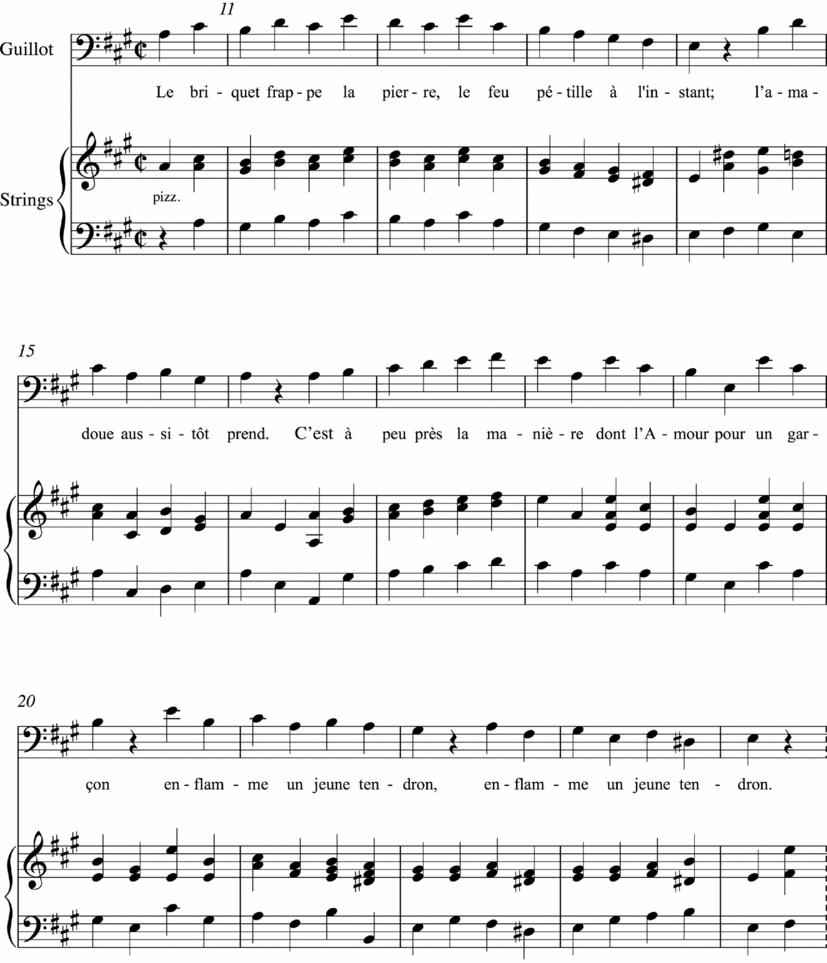
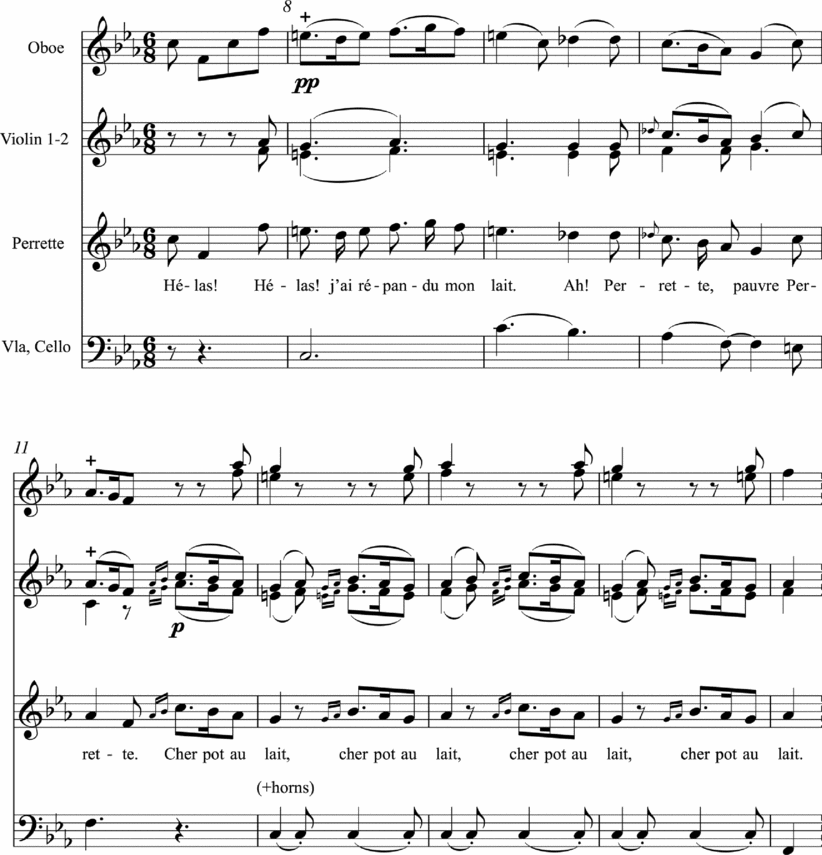
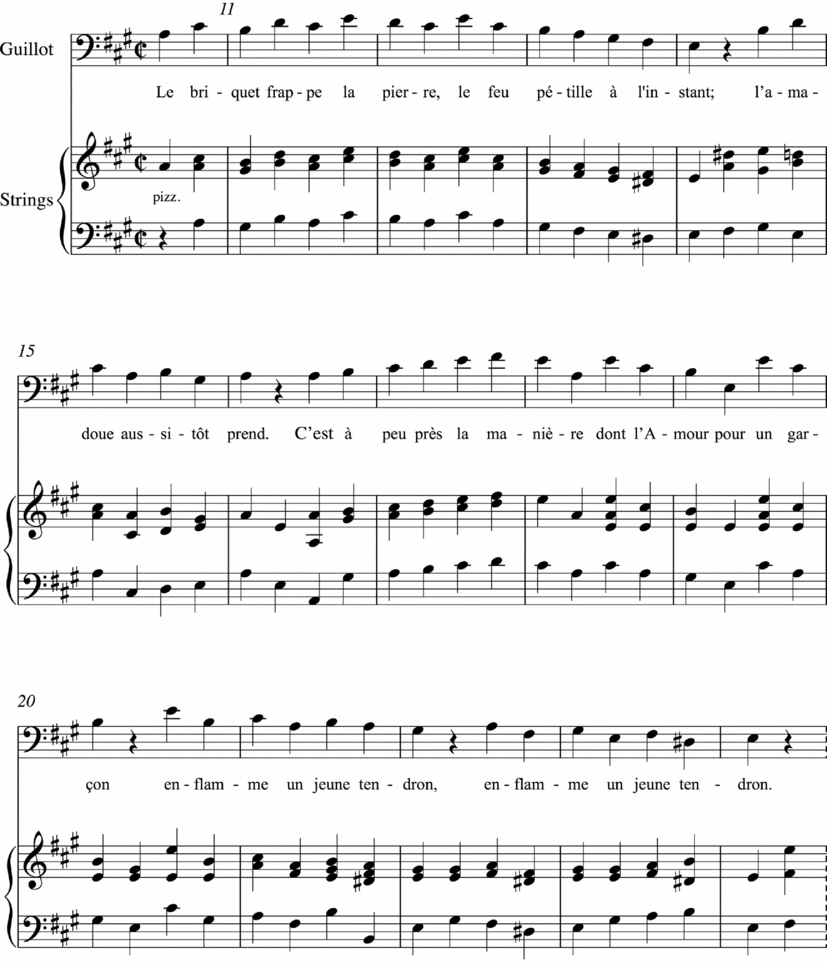
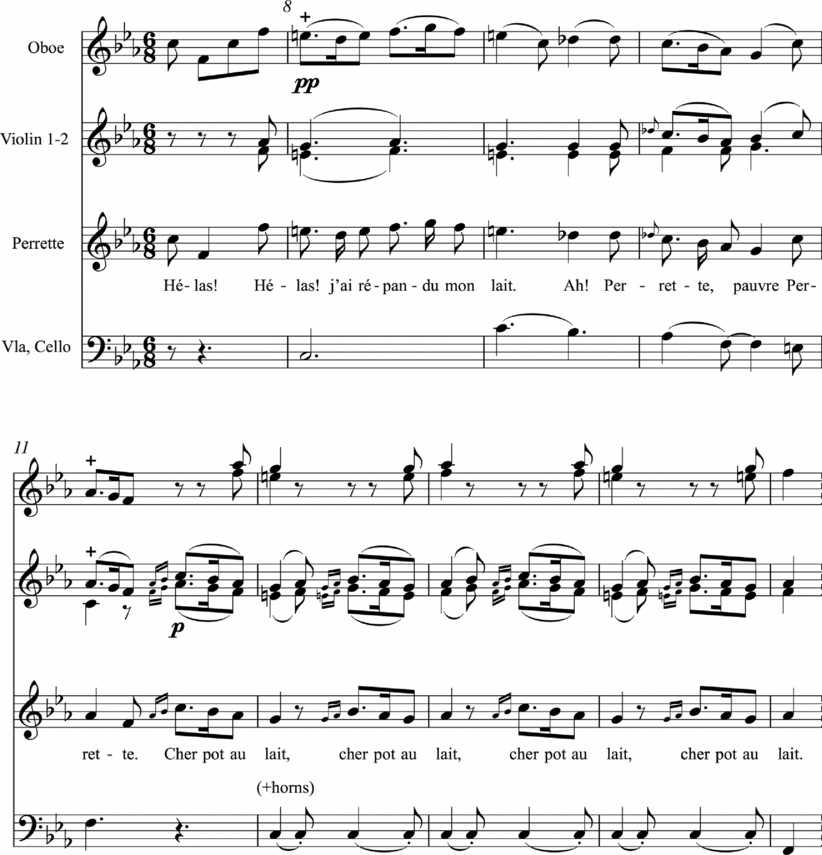
Duni's most successful opéras comiques were his collaborations with the librettist Anseaume, a veteran of the fair theatres and another key figure in the transition away from vaudeville comedy. In Les deux chasseurs the two authors carefully balance the old and the new, alluding to the heritage of the foires within a distinctly progressive and Italianate musical edifice. The literary basis of the work was quintessentially French, exploiting a deep audience familiarity with the fables of La Fontaine as well as a long-standing tradition of similar subjects within the native lyric idiom.Footnote 28 Duni also included several stylized gestures of homage to musical conventions of the vaudeville. Guillot's ‘Le briquet frappe la pierre’ (Scene 3), for instance, is an adept imitation of the French popular sound: a gavotte with a limited micro-rhythmic profile and plucked, guitar-like accompaniment (Example 1).Footnote 29 Perrette's introductory ‘Voilà la petite Laitiere’ (Scene 4) likewise highlights the structural features of the chanson, explicitly cast ‘en forme de ronde’.Footnote 30 Elsewhere, by contrast, Duni provides an attractive primer on the innovations of the contemporary Neapolitan school. As Perrette obsesses over her spilt pail of milk (Scene 8, ‘Hélas! J'ai répandu mon lait’), she does so in a lilting siciliana rhythm and with the plangent support of a solo oboe, clear markers (albeit tongue-in-cheek) of an elevated, pastoral topos (Example 2). This is polished, faux-rustic music – a distinct contrast to the fair practice, and one that would increasingly be associated with opéra comique from this point forward.
Egidio Duni, ‘Le briquet frappe la pierre’, Les deux chasseurs et la laitière, Scene 3, bars 11–24. ‘The flint strikes the stone and the flame crackles to life; the tinder too alights. In much the same way Love ignites a young maiden for a young man.’ This and following examples follow the first edition of the full score (Paris: Sr Hue, 1763)
‘Hélas! J'ai répandu mon lait’, Les deux chasseurs et la laitière, Scene 8, bars 8–15. ‘Alas! I've spilt my milk. Ah, Perrette, poor Perrette! Dear pail of milk, dear pail of milk.’
Even more important to Duni's aesthetic is the flexible integration of comedic action within musical set pieces – a kind of ‘natural’ synergy between movement suggested by the orchestra and reactions of the singer. Charlton describes this defining characteristic of the buffa repertory as a compositional and acting style that presents ‘a simulacrum of sentiments in real time’.Footnote 31 In its most straightforward iterations, this might take the form of onomatopoeic musical translations of physical gestures. An example is found in the trio of Scene 9, as the hunters react with despair after the collapse of their shanty and the milkmaid, passing by, punctures their hyperbolic self-pity with palpable glee. The score veritably bristles with comic energy; it simultaneously depicts the exaggerated cries of Colas, who has tumbled from the roof (‘Je tombe’, in repeated descending figures), and the rapid-fire laughter of the mocking Perrette (Example 3). The most solemn moment in the opera, the suicide attempt of Guillot, is immediately transmuted through the light-hearted nature of the ensemble writing; the milkmaid does not take the hunters’ hopelessness too seriously and neither, it is implied, should the audience.
‘Je tombe’, Les deux chasseurs et la laitière, Scene 9, bars 5–16. Colas: ‘I'm falling, I'm falling . . . Ah! Catch me . . . Help me’. Perrette: ‘What an ordeal! The shack is collapsing. Ha! Ha ha ha’. Guillot: ‘The shack, the shack is falling on me.’

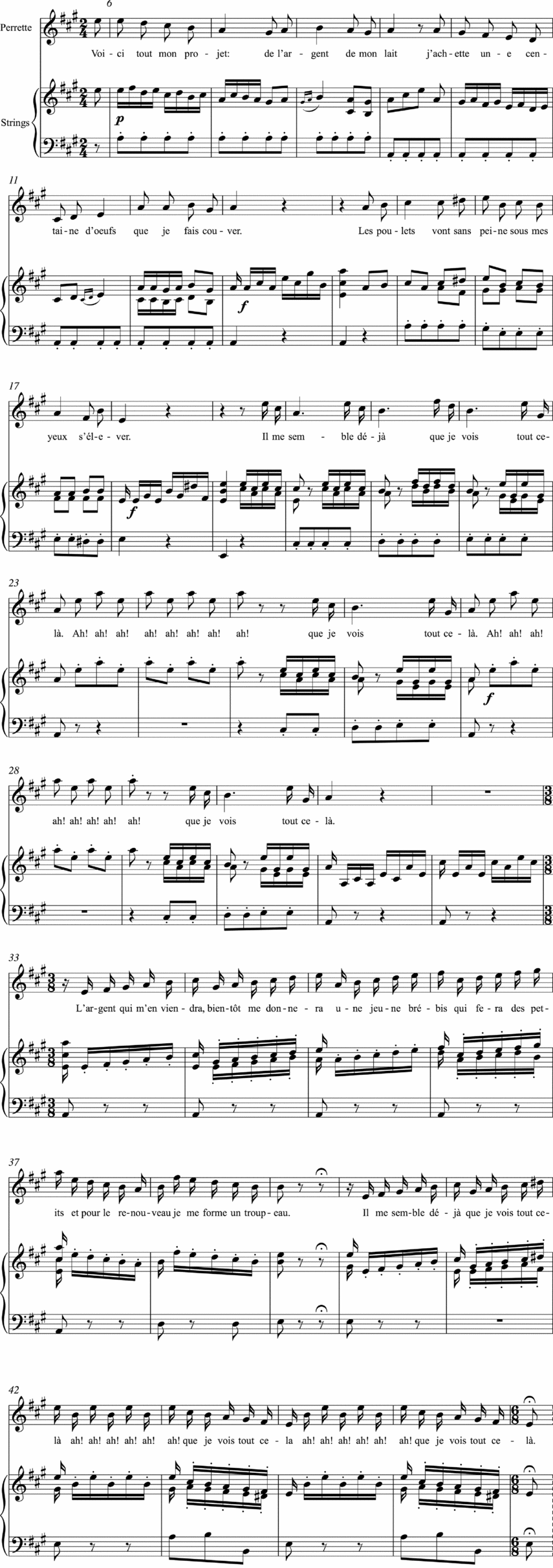
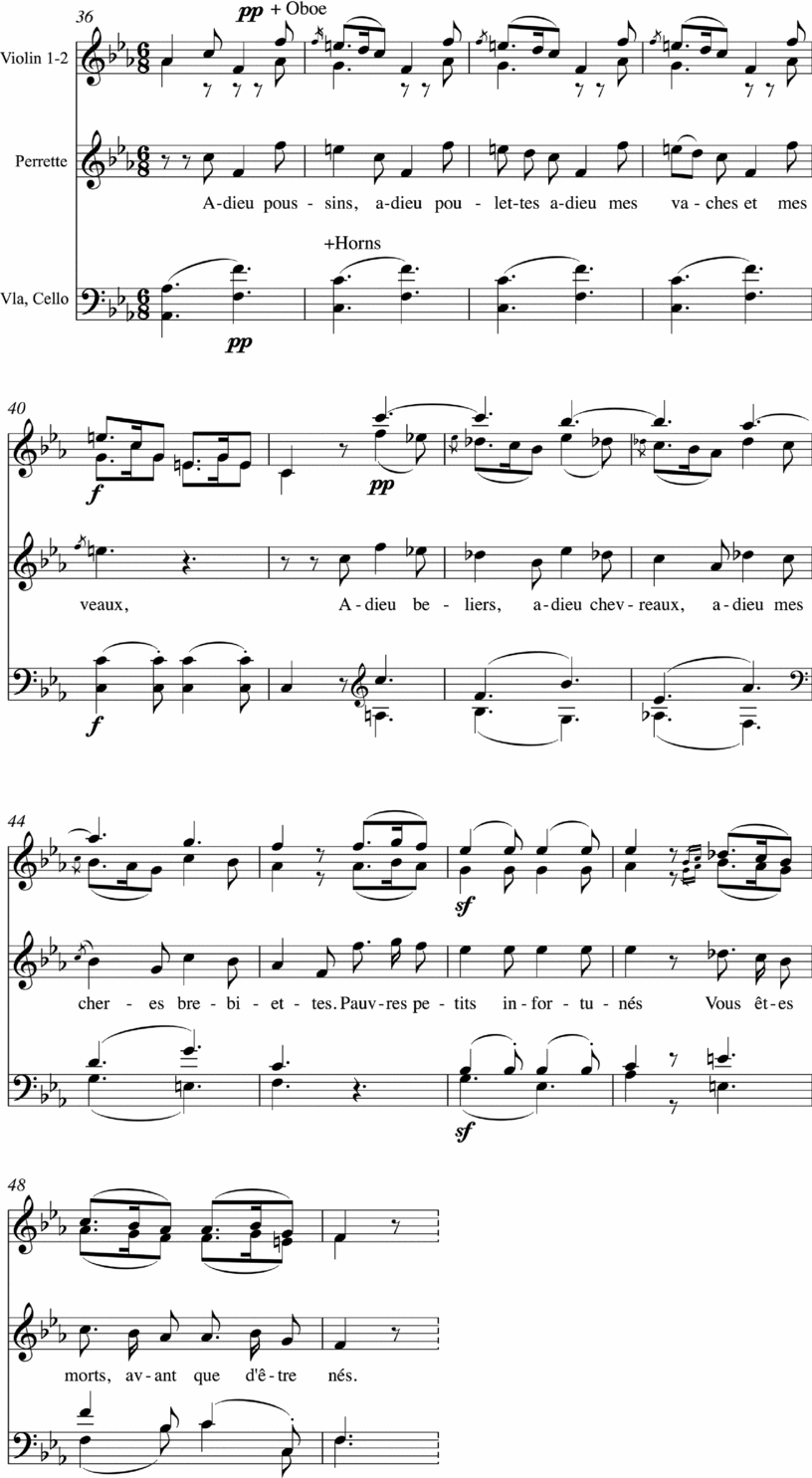
In a more nuanced fashion, Duni's stylistic approach might encompass characters and emotions established through action rather than reflection, in the rapid play and development of topical allusions on the musical surface. In Perrette's ‘Voici tout mon projet’ in Scene 4 (Example 4) the milkmaid enthusiastically outlines her plans for advancement; as she envisions an ever-multiplying profit from her pail of milk, her pacing accelerates rapidly – the patter shifting from quavers to semiquavers and from duple to triple metre, and spilling into endlessly repeated exclamations of delight (‘Ah! I can practically see it already!’). This is music that responds dynamically and with ingenious effect to the moment-by-moment suggestions of the text. Or, to borrow an apt turn of phrase from Wye Jamison Allanbrook, this is music of energeia, an ariette that captures Perrette's inner essence by depicting her outwardly ‘at work’.Footnote 32 It should be noted that this emphasis on comic immediacy does not prevent Duni from building more extended musical relationships over the course of Les deux chasseurs. At the conclusion of the opera, Perrette's mournful reflection on her lost milk features an explicit reference to the unrealized hopes of ‘Voici tout mon project’. The milkmaid bids farewell to her flock of barnyard animals – never more than fantasy, but mourned all the same – with a coy play on the defining gestures of her previous number. An exaggerated list again unfolds, though now languorous in tempo, overlaid with suspensions and in a despondent minor mode (Example 5).Footnote 33 As in the Scene 9 trio discussed above, the impact depends on a clever interaction of the dramatic situation and its ever-evolving musical realization. Les deux chasseurs is a comedy without a happy ending, and its libretto is threaded through with moments of loss. The sober undertones of Anseaume's text, however, are consistently offset through the humour and vibrancy of Duni's setting; the melancholy of the opera is undone through its music, a deftly hewn balance that might go some way toward explaining the work's enduring appeal.
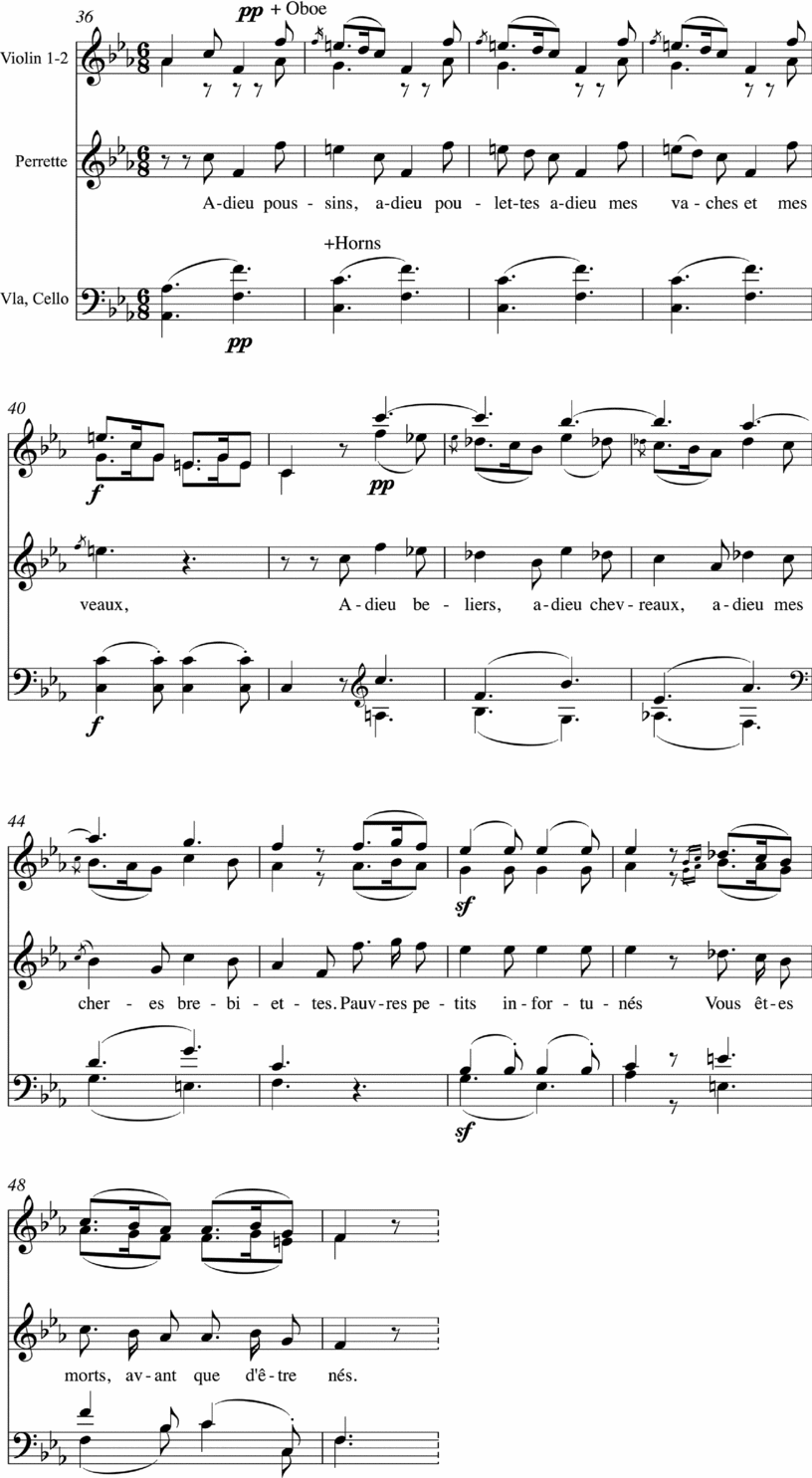
‘Voici tout mon projet’, Les deux chasseurs et la laitière, Scene 4, bars 6–46. ‘Here is my plan: With the money from my milk I'll buy a hundred eggs that I will hatch. The chickens will be raised easily under my watch. Ah! I can practically see it already. The income from this endeavour will get me a young sheep that will have its own offspring; and to renew the cycle, I'll have myself a little flock. Ah! I can practically see it already.’

‘Hélas! J'ai répandu mon lait’, Les deux chasseurs et la laitière, Scene 8, bars 36–49. ‘Farewell chicks, farewell hens, farewell my cows and my calves, farewell rams, farewell goats and farewell my dear baby sheep. Poor little unfortunate ones, you have died even before coming to life.’
If audiences were drawn to the ‘natural’ directness of Duni's lyric writing, this effect was amplified by complementary developments in production and acting style at the Comédie Italienne. Commentators emphasized a gulf between the impression Les deux chasseurs made on the page and the impact it created in the theatre. The Correspondance littéraire remarked that while one could read the librettos of Anseaume (and his contemporary Michel-Jean Sedaine) with a ‘modest amount of pleasure, their tremendous success on the stage could not be fully comprehended without seeing them performed’ (‘On les lit avec un médiocre plaisir, et, quand on ne les a point vu jouer, on a de la peine à concevoir le prodigieux succès qu'elles ont eu au théâtre’).Footnote 34 This was not so much a critique of Anseaume's text – which the review judged to be ‘redolent of both naturalness and truth’ (‘rempli de naturel et de verité’) – as it was an affirmation of the comic company's forward-looking approach to realism in operatic performance.Footnote 35 One artist identified with this trend was Duni and Anseaume's original Guillot, the renowned baritone Joseph Caillot. Commentators were especially taken with Caillot for his innovative commitment to the characters he inhabited, and for the manner in which he scorned self-importance of costume and conventionalized tropes of gesture in the pursuit of dramatic (or rather, comedic) verisimilitude.
This branch of theatrical evolution is widely associated, of course, with the English actor David Garrick, who expanded the traditional expectations of tragedy to incorporate greater naturalness of expression – for example, continuing to move about the stage while reciting monologues and taking care that his attire was adapted to match the station of the characters he portrayed.Footnote 36 But while French critics revered Garrick, favourably contrasting his flexible style of declamation with the rigid mannerisms of the Comédie Française, they recognized that the actors of the Comédie Italienne had adopted an even more extreme attitude towards the attainment of ‘truth’ in dress and action. The troupe's leading comédienne, Marie-Justine-Benoîte Favart, was frequently lauded for her authenticity, known to ‘spare no expense and overlook no detail to heighten the degree of theatrical illusion’ (‘elle n’épargnait et ne négligeait rien pour augmenter le prestige de l'illusion théâtrale’).Footnote 37 Or, as the Correspondance littéraire reflected on Caillot's career in 1769:
Le jeu de Caillot . . . est, je crois, une des choses les plus intéressantes qu'on puisse voir sur aucun théâtre. Ce charmant acteur a mis dans son jeu tant de vérité, tant de finesse, tant de perfection, qu'il est impossible de concevoir au-delà. Je défie Garrick, le grand Garrick, de jouer mieux ce rôle.Footnote 38
Caillot's acting . . . is, I think, one of the most interesting things that one can experience in any theatre. This charming actor has put into his performance so much truth, so much finesse, so much perfection, that it is impossible to conceive of anyone going further. I defy Garrick, the great Garrick, to play this role any better.
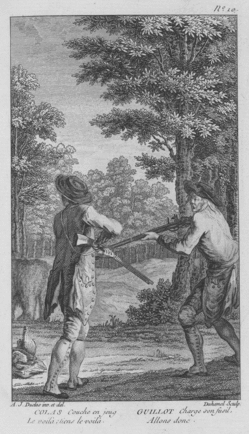
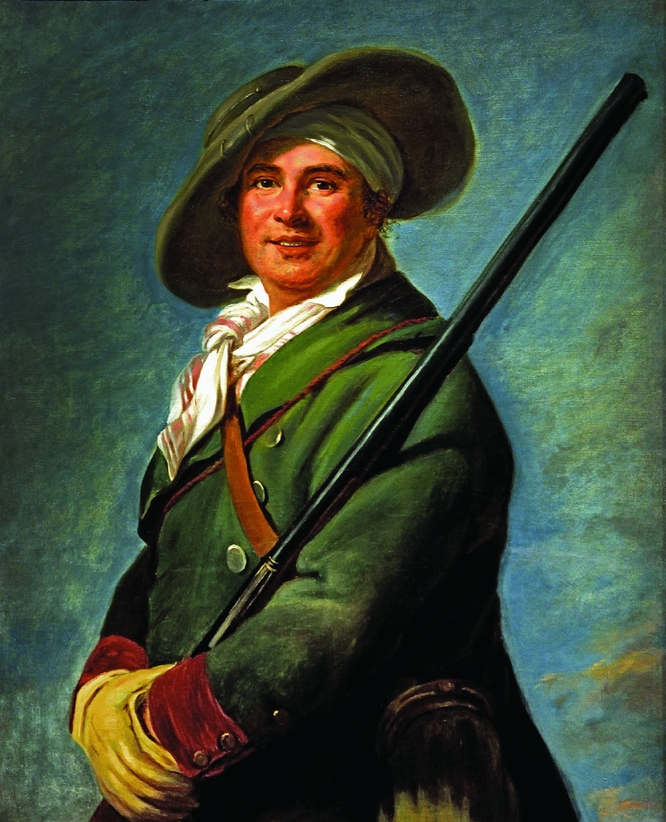
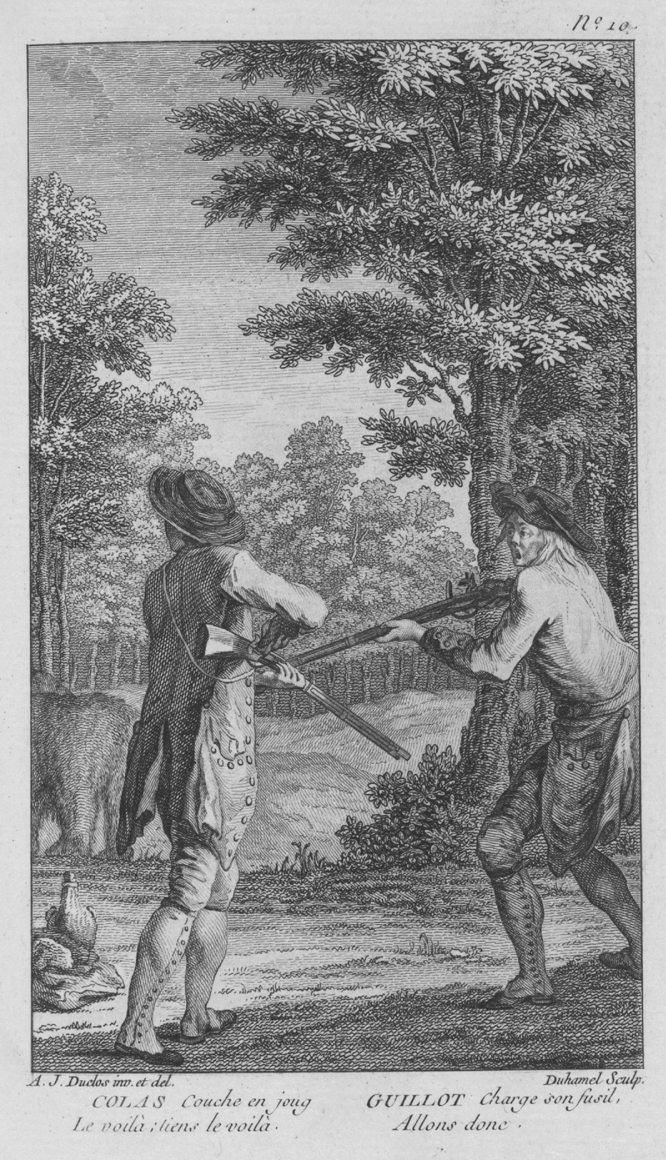
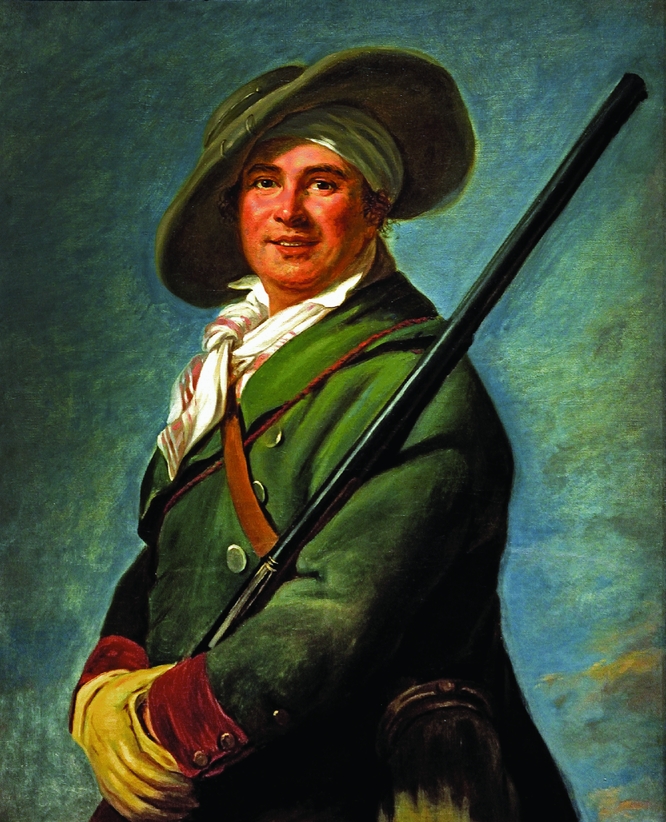
The reference here is to the role of the peasant Blaise in André-Ernest-Modeste Grétry's Lucile. To complete the illusion, Caillot claimed to have purchased clothing off the back of an impoverished country-dweller to wear during the performance. In this same production, he made the apparently unprecedented decision to appear onstage without a wig, drawing praise for sacrificing his own vanity at the altar of ‘extrême vérité’.Footnote 39 Caillot's attention to detail in Les deux chasseurs was such that it was still being commemorated in the visual arts decades after the work's premiere. There are several extant representations of the role that Caillot originated in Duni's opéra comique, including a set of engravings by Antoine Jean Duclos (Figure 2) and a series of rare decorative fans.Footnote 40 And the most famous portrait of the artist (‘Joseph Caillot en costume de chasse’), made by Élisabeth Vigée Le Brun in 1787, portrays him as he appeared in Les deux chasseurs – a testament to the degree to which both the comedy and the actor's careful construction of character had entered the popular consciousness by the end of the Old Regime (Figure 3).Footnote 41
Antoine Jean Duclos, ‘Colas et Guillot’ (1770). Spencer Collection, The New York Public Library. Used by permission
Élisabeth Vigée Le Brun, ‘Joseph Caillot en costume de chasse’ (1787). Peter Horee/Alamy. Used by permission
The printed libretto and score of Les deux chasseurs provide further confirmation of the privileged position of opéra comique and its actors in the landscape of theatrical reform around mid-century. Duni and Anseaume's work was one of a small constellation of lyric comedies – alongside Le devin du village and Sedaine's collaborations with François-André Danican Philidor and Pierre-Alexandre Monsigny – that foregrounded, validated and explicitly detailed the expressive gestures of the ‘bas comique’.Footnote 42 Remarkable from the perspective of theatrical realism are the kinds of coarse and everyday actions prescribed in the stage directions of Les deux chasseurs. In the third scene, for instance, Guillot fusses with a pipe while delivering a monologue; in each of the pauses for reflection, he is instructed to smoke and spit.Footnote 43 In Colas's longest soliloquy, the character declaims his lines while drinking from a bottle of wine and becoming progressively inebriated. The text indicates that the extract is to be ‘babbled’ and delivered ‘in the manner of a drunk man gradually falling asleep’ (‘Il balbutie ce qui suit du ton d'un homme ivre qui s'endort’).Footnote 44 Les deux chasseurs stands as an important early example of the importation of the tenets of the Diderotian drame – the emphasis on materiality of gesture, verisimilitude of staging and depiction of the (relatively) unvarnished circumstances of the nation's third estate into the lyric domain. Or, more precisely, as Jacqueline Waeber has described, it represents an engaging fusion of these forward-looking traits with the older, pantomimic tradition of the fair theatres.Footnote 45 These didascalies might thus be interpreted as a scenic equivalent of Caillot's borrowed country garb, a landmark attempt at repurposing both the ‘true’ manners of the French peasantry and the popular heritage of the foires before an elite operatic public.
It would be difficult to overstate how starkly the nuanced and detailed stage directions of Les deux chasseurs differ from those found within recent tragédies lyriques. For example, the libretto of Joseph de Mondonville's Titon et l'Aurore, the most frequently performed work at the Opéra in 1763, contains essentially no indications of stage movement and character interaction. The only written instructions are for mid-scene exits (‘elle sort’, for instance), and the names of characters who are being addressed in speech (‘à Eole’).Footnote 46 The action of Duni and Anseaume's work, by comparison, is rendered with breathless urgency and precision, as in the climactic encounter with the bear in Scene 6:

The scene begins with a slapdash sense of movement, with Guillot running breathlessly onto the stage and Colas calling after him from the wings. The hapless escape that follows is painted in great detail for a maximum of comedic effect: Guillot scrambles into a tree for safety, while the clumsy Colas plays dead until the bear loses interest. The absence or presence of scripted action, to be sure, does not offer perfect insight into the actual state of performance, and recent scholarship has somewhat tempered the notion of an uncompromising system of gesture within French serious opera around this time.Footnote 48 But Anseaume's libretto, when considered alongside period accounts of the actors who performed it, does imply a stark divergence in value systems, with the artists of opéra comique placing a greater (and highly progressive) weight on the rapid pacing and naturalistic interchange of characters onstage.
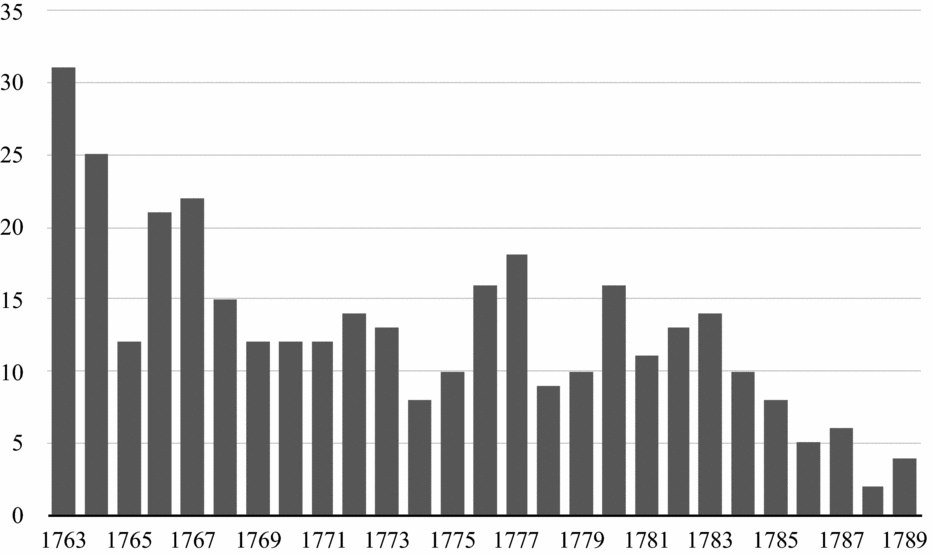
The position of Les deux chasseurs at the leading edge of these key aesthetic movements helped to ensure the work's lasting standing at the Comédie Italienne. Even as it aged, it remained within the repertory as a widely adaptable opening act, produced to complement subsequent generations of operas – by Grétry, Nicolas Dezède and Nicolas Dalayrac, amongst others – that drew upon and substantially deepened its innovations in Italianate music and drame-inspired staging practice. And while the frequency of public performance of Les deux chasseurs did decline gradually over the next three decades, as documented in Figure 4, the opera enjoyed a healthy parallel existence within the private sphere – clear evidence of the processes of ‘domestication’ and their role in the shaping of broader repertory systems.Footnote 49 The success of Duni's comedy was reinforced and prolonged by material developments that coincided with the moment of its premiere; the work was sustained, in other words, in a symbiotic feedback loop between public programming and emerging practices of popular culture.
Performances of Les deux chasseurs et la laitière at the Comédie Italienne, 1763–1789. Compiled from Clarence D. Brenner, The Théâtre Italien: Its Repertory, 1716–1793 (Berkeley: University of California Press, 1961)

As Anik Devriès-Lesure has shown, the second half of the eighteenth century witnessed unprecedented growth in music publishing in Paris. If there had been only two dedicated music shops in the city during the early reign of Louis XV, there was practically ‘no year after 1760 that did not see the opening of a new establishment for music sale’Footnote 50 – a trend that applied equally to the industries of instrument manufacturing and engraving.Footnote 51 The first circulating music library in France, the ‘bureau d'abonnement musical’ of Antoine de Peters, opened its doors in 1765, facilitating the lending of scores and ensuring a far wider transmission than might be suggested by the numbers of any individual print run.Footnote 52 Many shops specialized in extracts and arrangements for amateur performers; if such compositions had certainly existed before mid-century, they proliferated markedly afterwards,Footnote 53 including one of the earliest subscription-based periodicals for printed music, the Journal de Clavecin of Charles-François Clément, from 1762 onwards.Footnote 54 And to take stock of this increasingly vibrant marketplace, a category of supporting publications also emerged: the first sales catalogues, almanacs and dedicated journals of French music criticism.Footnote 55 The status of Paris at the centre of European musical commerce was unambiguous. By 1804, the Tableau des libraires, imprimeurs et éditeurs could rightfully claim that there existed ‘no other city in Europe . . . where so much music is engraved; [in Paris] they publish not only all of French composition, but the majority of foreign works arrive there in manuscript and are naturalized as well’ (‘point de ville en Europe où l'on grave autant de musique qu’à Paris; non seulement on y grave tous les ouvrages français, mais la plupart des oeuvres étrangères y arrivent manuscrites et s'y naturalisent’).Footnote 56
It may be no coincidence that this expansion of musical commerce corresponded precisely with the solidification and institutionalization of opéra comique as a genre. Lyric comedy was both a beneficiary of and a driving force within the musical print market, a process for which the wildly popular Les deux chasseurs provides an apt example. The opera, as we have seen, was first staged at the end of July 1763. By early August, the text was available from Duchesne, a new bookshop devoted especially to librettos from the Comédie Italienne.Footnote 57 Shortly thereafter a set of ‘detached airs’ from the opéra comique, as well as a full score, were available for purchase, the latter produced and sold (as was customary) by Duni himself. Within six weeks of the premiere, independent ‘unofficial’ spin-offs and arrangements had already begun to appear.Footnote 58 A repurposed ariette from Les deux chasseurs was included in a keyboard suite in the September issue of Clément's Journal de Clavecin; six additional numbers from the work were included in various volumes of the subsequent year.Footnote 59 From here the publications multiplied, with dozens of extracts, including arrangements for keyboard, harp, guitar and string trio, appearing as late as 1785.Footnote 60
An opéra comique like Les deux chasseurs was a prime candidate for such amateur circulation because it struck a fine balance between fashionable style and accessible technique. An aria like ‘Hélas! J'ai répandu mon lait’ (Example 2 above) had all of the tuneful hallmarks of the Italian school without the accompanying demands of virtuosity – a trait that did not necessarily hold in the work of composers just a generation removed from Duni. What is more, arrangements of opéras comiques fell within a loophole in existing copyright protections for authors: while texted music and full scores could not be copied, reproductions of music without text could be made freely. Thus, any French citizen could engrave, publish and sell the music of a popular lyric comedy, so long as the words had been stripped from the melody in instrumental form (as in the keyboard suites of Clément). The circulation of many works was dependent on their legal status within the system of privilège. To cite one pertinent example: within months of Duni's death (and the corresponding cessation of his author's rights) in 1775, his entire catalogue of full scores, including Les deux chasseurs, had been appropriated and reprinted by the firm of Jean-Georges Sieber.Footnote 61
In addition to its widespread transmission in reduced arrangement, Les deux chasseurs was frequently staged by private theatrical troupes, or théâtres de société, a practice greatly in vogue amongst French aristocrats and salonnières in the waning Old Regime. While there were large numbers of such companies in the French capital, the best-known is that of Marie Antoinette, the so-called troupe des seigneurs, which mounted eleven different opéras comiques at the Petit Trianon theatre in the early 1780s.Footnote 62 (The group programmed Les deux chasseurs on 6 June 1783, with the queen starring as the milkmaid Perrette.) In making this repertory choice, Marie Antoinette and other budding theatrical practitioners were probably following the advice of contemporary handbooks of aristocratic leisure – compendiums like André-Guillaume Contant d'Orville's Manuel des chateaux, which instructed society women in the arts of assembling a library, directing an acting troupe and otherwise ‘diversifying the pleasures of the salon’.Footnote 63 Duni's opera is one of a handful of lyric works highly recommended for amateurs. According to Contant d'Orville, the most effective pieces for private performance should possess an inherent literary appeal and occupy a middle ground between freshness of idiom and ease of reproduction. He warned that ‘some [pièces à ariettes] are too elaborate in their scenographic demands; others require too great a number of talented actors. One must therefore choose those [operas] that are the simplest to perform while none the less showcasing the voices of the ladies involved’ (‘les unes exigent trop d'appareil; les autres un trop grand nombre d'Acteurs d'un certain talent. Il faut donc choisir les plus faciles à jouer, mais qui cependant soient susceptibles de faire briller les voix des Dames’).Footnote 64
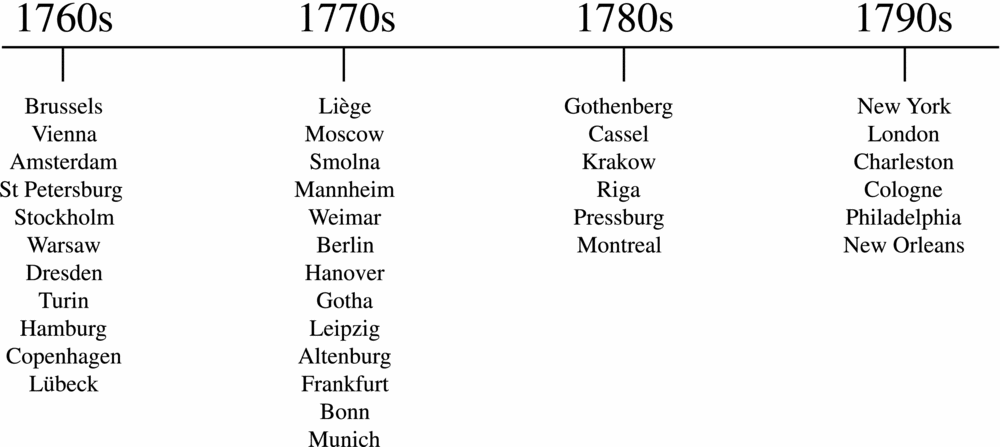
Les deux chasseurs fitted both of these criteria. The female protagonist was ‘charming’ and granted many ‘graceful’ ariettes.Footnote 65 At the same time, the work was remarkably straightforward to stage, with a single, generic set (the libretto specifies simply that the action take place in ‘a forest’) and just three speaking parts.Footnote 66 The fourth, mute role – that of the bear – was apparently even more desirable amongst amateur players. Comédie Française actor Abraham Joseph Bénard (known as Fleury) recalls in his memoirs that casting the animal from the ranks of the troupe des seigneurs was so controversial that Louis XVI was ultimately forced to intervene. In this case, even those aristocrats who were not normally capable of taking on a substantial character had requested consideration; the plum role enjoyed ample time on stage but, enticingly, ‘required no speaking or singing whatsoever’ (‘[Le rôle] ne s'agissait ni de parler ni de chanter’).Footnote 67 And while it is beyond the scope of this article to provide a full account of the diffusion of Les deux chasseurs, the same factors that influenced the work's popularity amongst amateur troupes in Paris and Versailles almost certainly affected its success elsewhere (Figure 5). While some provincial and foreign opéra-comique companies were well equipped, many others had sparser resources.Footnote 68 The first opera theatre in Quebec, for instance, owned only three, simple sets – a forest, a room and a street. It is all too appropriate, then, that the rustic Les deux chasseurs was amongst the first lyric works it staged, in December of 1789.Footnote 69
Foreign premieres of Les deux chasseurs et la laitière by decade. Compiled from Alfred Loewenberg, Annals of Opera, 1597–1940, third edition (London: Calder, 1978) and O. G. Sonneck, Early Opera in America (New York: Schirmer, 1915)

This early reception of Les deux chasseurs provides additional nuance to our understanding of old-regime France as a crucial site in the development of enduring repertory systems. It was not only the unique political demands of the absolutist court that encouraged the remarkable persistence of lyric works, as William Weber has shown regarding the musique ancienne of Jean-Baptiste Lully,Footnote 70 but also the pragmatic concerns and scheduling requirements of the prolific theatres in Paris. And it was in the comic domain – even above that of the more highly esteemed tragédie lyrique – where the popularity of an opera was sustained through the mutually dependent interaction and frequently ambiguous boundaries between public and private spheres. Ready familiarity rather than novelty was prized in both programming and commerce.
The Revolutionary production of Duni's opéra comique offers an example of both the complexities of corpus-based analysis and the manner in which such approaches might inform a broader study of canon formation around the turn of the nineteenth century.Footnote 71 As James A. Parakilas has recently stressed, the afterlife of an opera depended not simply on repeated performance but on a confluence of cultural factors that included journalism, publication, pedagogy and public discourse. That is, to define the ‘operatic canon’ is to consider not only the statistically noteworthy persistence of older repertory, but also to interrogate how the genre itself ‘evolved as a business, a system of training, a popular entertainment, a cultural touchstone, and an object of study’.Footnote 72 And indeed, the fate of Les deux chasseurs demonstrates starkly how prolonged success on the stage was an important but insufficient criterion in establishing a lasting compositional legacy; the proliferation of Duni's opéra comique seems to have meant little to the nascent theatrical history of the Revolution without a contemporaneous critical response.
TWO HUNTERS AND A MILKMAID DURING THE REVOLUTIONARY DECADE
We have extensively documented why an older opéra comique like Les deux chasseurs was primed for continued success during the Revolutionary decade. The (initially) forward-looking nature of its musical and comedic aesthetic, coupled with its modest technical demands, had rendered the opera a long-standing favourite of both the Comédie Italienne and amateur troupes in the French capital and elsewhere. But of course, even if Les deux chasseurs is a finely constructed and eminently ‘reproducible’ work, the same could be said for any number of other compositions from the foundational years of ‘modern’ lyric comedy, including settings of the librettos of Favart, Monsigny's Rose et Colas and On ne s'avise jamais de tout and the early output of Philidor and Grétry, to name just a few. What was it, then, that granted Les deux chasseurs its particular attraction to the theatres and audiences of the 1790s? And more importantly, how can the opera's second rise to prominence inform our understanding of the French Revolutionary repertory more broadly, and of the corpus studies that have attempted to define it?
As mentioned above, theatre historians and literary scholars have offered several provisional hypotheses about how the themes of Les deux chasseurs might have been interpreted by various constituencies of spectators in the final years of the eighteenth century. Kennedy describes Duni's opera as reflective of a need for escapism amongst audiences of diverse political persuasions. In this view, the work offered a kind of nostalgic throwback for those who were ‘disaffected by the Revolution and sought solace in the theatre’; at the same time, it might also attract those of more radical outlook that craved ‘diversion in the evening from taxing political commitments of the day’.Footnote 73 Stéphanie Fournier has similarly stressed the widespread appeal of the opéra comique, emphasizing the finely balanced construction of its characters and the manner in which its traditionally ‘French’ subject maintained its relevance across social classes.Footnote 74 Mark Ledbury offers a more nuanced, text-based perspective, linking the longevity of Duni's work to the persistent popularity of the ‘pastoral spectrum’ in the art and theatre of the Revolution. Beyond its potential function as escapist fantasy, Ledbury argues, the pastoral mode found parallels in emerging patterns of political thought. Significant in Les deux chasseurs are the directness and informality of Anseaume's language (a common marker of rustic settings in opéra comique), as well as the general atmosphere of self-reflexivity – the ironic deflation of a bucolic world in the characters’ comic defeat. The former might be read as a commentary on the ‘transparent visual language’ prized by successive iterations of Revolutionary leadership, the latter as a more broadly resonant metaphor for those spectators negotiating ‘complex experiences of debt, disappointment and loss’.Footnote 75
This final point is particularly important. From the earliest stages of its history, Les deux chasseurs had been perceived as an extremely relatable work for the manner in which it found humour in melancholy and misfortune – an outlook with quite obvious continuing relevance throughout the 1790s. As Grimm described the subject in his initial review of 1763, ‘Nothing is more commonplace than men who deceive themselves with improbable hopes and in the end have little to show for them besides worry and torment. . . . Anseaume has created a story true to life itself’ (‘Rien de plus commun que de voir les hommes se bercer de vaines espérances, et, pour profit, n'en jamais retirer que soucis et tourmens. . . . M. Anseaume a fait l'histoire de la vie’).Footnote 76 And it is notable that, unlike many other comedies of its immediate generation that assign blame to authority figures and social unequals (corrupt bailiffs, scheming noblemen and the like), Les deux chasseurs lacks an obvious villain. The characters’ downfalls are instead caused by a combination of human frailty and bad luck, a trait that would have enabled the work to transcend a variety of shifting social and political circumstances.
Chroniclers of the Revolutionary period have thus raised several plausible, and not necessarily incompatible, explanations for the continued success of Les deux chasseurs amongst Parisian spectators. However, these ideas must be considered in conjunction with an assessment of the ‘supply’ side of the theatrical equation, with chronologically and geographically specific information about the producers of these proliferating performances. If statistical overviews of the repertory provide an indication of general trends, they fail to capture the ‘on-the-ground’ contingencies of an evolving dramatic landscape – and, especially, that Duni's opera was subject to a highly diverse set of trajectories depending upon the companies that staged it. Les deux chasseurs did not enjoy an immediate surge of performances after the fall of the Bastille, and, indeed, the programming of the Comédie Italienne at first gave little hint of the Deux chasseurs mania that was soon to come. The opéra comique was presented only four or five times per season in the first years of the Revolution, continuing the general pace of production from the 1780s. The turning-point was the declaration of the liberty of the theatres, on 13 January 1791 (also known as the Le Chapelier law after its author, the lawyer Isaac René Guy le Chapelier). At this time, the Legislative Assembly deregulated the French theatrical industry, abolishing the monopolies that the crown-supported companies had long held on their respective repertories. The ruling made it legal for any citizen to open a public theatre and removed all restrictions on programming, moving the vast holdings of the former royalty-sponsored organizations, including Les deux chasseurs, into the public domain.Footnote 77 The legislation also instated ground-breaking protections for the creators of theatrical content, mandating payments to living authors (and to their heirs for five years after their deaths) in exchange for the rights to perform or otherwise reproduce their works.
The enactment of the Le Chapelier law was in keeping with the optimistically modernizing spirit of the early Revolutionaries. Debates around its establishment echoed the discourse surrounding the loosening of ‘despotic’ control of other national industries (the abolishment of trade guilds, for example). The antiquated system of privilège, Le Chapelier argued, hampered the creativity of France's leading authors; it was only by granting true freedom to these artists and entrepreneurs that French theatrical writing might progress towards perfection.Footnote 78 In practice, however, as Michèle Root-Bernstein has persuasively shown, the law's implementation was fraught with paradoxes, with many of its effects running counter to its stated aims of equity and progressive liberalization. The legislation did result in a near-immediate multiplication in the number of theatrical companies in the capital. During the 1780s there had been at most eleven dramatic institutions operating in Paris; by the end of 1791, the total had more than tripled, to thirty-five.Footnote 79 Yet the free market for dramatic production by no means implied a true parity amongst these institutions. In effect, the Opéra, Comédie Française and Comédie Italienne retained their elite status, benefiting from their well-established audiences and financial reserves. For many of the newly emerging troupes, by contrast, existence was fraught and resources scant. As the Almanach général de tous les spectacles reported in 1792, ‘even if the new Constitution is based upon equality, there are still deeply ingrained theatrical hierarchies, based on the natural inequality of the talents and personal qualities of various actors, directors and spectators’ (‘quoique la Constitution décrète l’égalité, il n'en existe pas moins entre les spectacles de Paris des rangs irrévocablement établis par l'inégalité naturelle des talens et les ressources personnelles des Acteurs, des Directeurs et des Spectateurs’).Footnote 80 The heightened atmosphere of competition forced many companies to be nimble and asset-efficient in their staging practices. Even then, very few theatres founded in the immediate aftermath of 1791 were still flourishing by the end of the Revolutionary decade.
Trends in programming after the enactment of the Le Chapelier law were also frequently more reflective of external logistics than of the lofty principles articulated by the governmental assembly. Rather than inspiring a surge of creativity or politically charged new work, the legislation had its most palpable impact on the circulation of venerable plays and operas from the stocks of the former crown theatres. The liberalization of the theatrical enterprise spurred upstart impresarios to look not forward but backwards, as the most time-effective manner to establish an audience and repertory – at least at first – was to draw upon well-known material from the Old Regime. As one critic complained of the Théâtre de la Gaîté, the manager seemed to have concluded that ‘he might in the future stop producing new works altogether; he no longer presents anything but the old repertory of the privileged theatres’ (‘il peut à l'avenir se passer de pièces; il ne joue plus que les anciens ouvrages des grands Théâtres’).Footnote 81 This statement is not entirely hyperbolic regarding the emerging ranks of Parisian fair and boulevard troupes; the Lycée-Dramatique, for instance, performed almost exclusively works once belonging to royalty-sponsored institutions, while many other companies relied on older plays for forty per cent or more of their programming.Footnote 82
The widespread success of Les deux chasseurs must be interpreted with an eye toward the liberty of the theatres and the subsequent expansion of pre-1789 repertory. On 3 February, a mere three weeks after the passage of the legislation, Duni's opéra comique was presented by the Variétés comiques et lyriques, its first public performance in Paris outside of the Comédie Italienne.Footnote 83 By the end of the year it had been taken up by more than a dozen upstart theatres in the capital. Not only was Les deux chasseurs well liked and straightforward to stage, but, unlike other small-scale works of its era, its text and music were entirely free to reproduce. If many librettists and composers from the formative years of the genre (including Favart, Sedaine, Monsigny, Philidor and Grétry) lived into the 1790s and beyond, both Duni and Anseaume were long deceased; in consequence, their output was both liberated from the hold of the Comédie Italienne and, crucially, unaffected by the new statutes of the droits d'auteur.Footnote 84
While they have gone largely undiscussed in scholarly treatments of Les deux chasseurs, legal remunerations and other practical considerations were, quite unsurprisingly, a matter of significance to the many fledgling theatrical impresarios of the period. It was not uncommon for contemporary programming manuals to stress such mundane details as running time, lines per character, required props and copyright costs (based on the status, living or dead, of the authors they described).Footnote 85 And, logically enough, Duni's opera seems to have been a first choice of repertory for the smaller enterprises that proliferated in reaction to the Le Chapelier law, many of which were direct descendants of, and hardly better resourced than, the private theatres that had flourished before the Revolution. In many cases, these institutions would not have had enough actors – let alone sufficient financial reserves – to stage a more complex opéra comique from the 1770s or 1780s.
The Théâtre de la Concorde, for example, had originated as an amateur troupe that made passable attempts at lyric comedy. Immediately after the theatrical deregulation, its members opened their doors to the public on the rue Renard-Saint Merri. They produced a handful of works in the spring of 1791, including Les deux chasseurs, but by June had declared bankruptcy and folded.Footnote 86 The company that took over their venue, the Théâtre de Jean-Jacques Rousseau, fared no better, lasting only a few days before closing.Footnote 87 (In this time it did manage, quite impressively, to squeeze in two performances of Duni's opera.) This trajectory was repeated by numerous other theatres and was especially common amongst the class of institutions that could afford to present little more than modest comedies. The Variétés comiques et lyriques was open for a few short months before its collapse (including three performances of Les deux chasseurs); the same can be said of the Théâtre de la Liberté (one performance) and the Théâtre du cirque national (four performances). So strong a link was there between these rather precariously situated troupes and Les deux chasseurs that one was even eulogized with lines from Anseaume's text. When the Théâtre d’émulation (two performances) was shuttered in July of 1791, a critic compared its sorry fate to that of Perrette's sadly unrealized flock of barnyard animals: ‘Poor little unfortunate ones! You have died even before coming to life!’ (‘Pauvre petits infortunés! / Vous êtes morts avant que d’être nés!’).Footnote 88
Of course, many of the troupes that staged Les deux chasseurs were not in dire creative or financial straits. Even at a large and well-established company, however, organizational make-up continued to exert an important influence on programming choices. From the perspective of the theatrical administration, in other words, there were occasionally specific circumstances that contributed to the attraction of Duni's opera, even beyond its general acceptance amongst audiences. Perhaps the most intriguing case is that of the Ambigu-Comique, whose 135 performances of Les deux chasseurs made it by far the most prolific producer of the work during the Revolutionary decade. Founded in 1769 by the actor Nicolas-Médard Audinot, the Ambigu-Comique was one of the best regarded theatres on the boulevard du Temple in northeastern Paris. It had a healthy repertory of its own even before the dismantling of the French dramatic industry, along with expert stage designers and a hall that accommodated 1,500 spectators. The theatrical almanacs of 1792 deemed it the independently-backed company that put the most care into its productions, as well as the one with the ‘least mediocre’ actors.Footnote 89 Notably, it would survive Napoleon's revocation of theatrical liberties in 1807, becoming one of the four ‘official’ secondary companies of Paris under the Empire and beyond.Footnote 90
If the Ambigu-Comique was amongst the most highly reputed of the boulevard troupes, it simultaneously had the most serious history of grievances against the system of theatrical privilège, and especially against the impositions of the Comédie Italienne. The company's founder, Audinot, was himself a disgruntled former employee of the royal institution and had performed roles in most of the early production runs of Duni and Anseaume's oeuvre in the 1760s. (He was, in fact, one of the first interpreters of Colas in Les deux chasseurs and must have worked personally with the composer.) After leaving the Comédie Italienne in a bitter salary dispute in 1767, Audinot expressed his lingering resentment in a series of new dramatic enterprises. He first founded a marionette theatre at the Saint-Germain fair, known as Les comédiens de bois and devoted principally to the ridicule of his old colleagues (the ‘wooden comedians’ were puppets that Audinot had commissioned in their exact likenesses).Footnote 91 He soon moved onto the boulevard – and to a string of lawsuits for producing works too closely modelled on those of the privileged stages. In the final years of the Old Regime, both the Comédie Italienne and the Opéra subjected the Ambigu-Comique to hefty fines and restrictions over property infringement. The size of Audinot's orchestra was constrained, for example, and for an extended period he was forced to employ child actors rather than adults.Footnote 92
Audinot was thus both intimately acquainted with the operas of Duni and perpetually aggrieved with the theatre that for decades had held the exclusive rights to their performance. During the Revolution, he seems to have reclaimed this repertory with an almost palpable sense of glee. He mounted his first Duni–Anseaume collaboration (Mazet, of 1761) exactly a week after the Le Chapelier bill was passed into law, and thereafter programmed a number of other works from his time of employment with the Comédie Italienne, including Duni's Les deux chasseurs, Le peintre amoureux de son modèle and La clochette (1766).Footnote 93 Audinot was clearly a shrewd businessman – his nearly half-century-long career on the boulevard stage would have been impossible otherwise. But if there was an element of audience and scheduling appeal in these programming choices, it does not seem too far of a stretch to posit a personal motivation – or perhaps a hint of vindication – on the part of the director as well. When the entire corpus of the Comédie Italienne was opened for production elsewhere, Audinot drew from it heavily but selected nearly exclusively those opéras comiques that he had performed in his brief career at the royal theatre and which had remained off limits to him in the three intervening decades. More than a third of the Revolutionary-era appearances of Les deux chasseurs can thus be attributed to the intervention of a single entrepreneur with a unique relationship to the work.
CONCLUSIONS: TWO HUNTERS, A MILKMAID AND THE HISTORIOGRAPHY OF THE REVOLUTION
This survey of just a handful of boulevard and fair enterprises is enough to suggest both the benefits and pitfalls of drawing broad conclusions from corpus studies of Revolutionary performance. On the one hand, it is clear that the statistical approaches of Kennedy and Tissier provide an important corrective to the standard view of Parisian theatrical life during the turbulent 1790s, foregrounding the experiences of the petits théâtres and demonstrating how widespread appeal, rather than specific political content, might contribute to the success of an opera. Les deux chasseurs was not exactly apolitical, but it was malleable enough to attract a variety of spectator constituencies over a sustained period; it was showcased in equal measure at the Théâtre d’émulation – run by an entrepreneur who conserved his old-regime habits ‘as stubbornly as was possible’ (‘sa mise est demeurée celle de l'ancien régime tant qu'il a pu la conserver’)Footnote 94 – and at the Délassements Comiques, whose actors greeted the fall of the Bastille with cries of ‘Vive la liberté’ from the stage.Footnote 95 On the other hand, it is apparent that these repertory analyses must be approached with a measure of circumspection, for they simply cannot capture the diversity of meanings that the opéra comique generated, nor reflect aberrations (like that of the director Audinot) that inevitably skew representations of its popularity. Les deux chasseurs was, in the end, a piece of theatre that enjoyed several simultaneous, and often contradictory, trajectories. During the same period that it underwent a gradual, unremarkable decline at the Comédie Italienne, the opera sprang up and disappeared amongst a dozen ephemeral boulevard troupes and gained a durable standing at another, the Ambigu-Comique.
The proliferation of Les deux chasseurs also raises broader questions about the gulf between the day-to-day reality of theatrical practice during the 1790s and the repertory that has since been identified as emblematic of the era.Footnote 96 The persistence of Duni's opéra comique, in other words, exposes a rift in long-standing narratives of artistic progress around the fault line of 1789, and acts as a counterweight to the ideal – propagated most vociferously by the Revolutionaries themselves – that the moment marked a ‘point of no return’ on the path to aesthetic modernity. As such, Les deux chasseurs offers an important case study (or, perhaps, cautionary tale) of the ways that targeted analyses of programming might interact with wider studies of operatic canon formation. At the turn of the nineteenth century, commentators had already begun to grapple with the paradoxical status of a composition like Les deux chasseurs – to identify what Joseph Kerman would later conceptualize as the imperfect alignment between repertories and canons, or the works most frequently performed and those most highly esteemed in converging systems of critical, pedagogical and popular discourse.Footnote 97
It is important to note that contemporary chroniclers of Revolutionary art were eager to capture the nuance and symbiotic interplay of the world that flourished around them. In a remarkable retrospective of the dramatic season of 1791, for example, the editors of the Almanach général de tous les spectacles offered a lengthy aesthetic and economic analysis of two of the year's biggest (and most highly contrasting) lyric hits: Cherubini's Lodoïska and Louis-Abel Beffroy de Regny's Le club des bons gens. The former is one of the most famous pieces of the decade, and one of only a handful of such works to survive on the modern stage. The latter is a small-scale comedy like Les deux chasseurs, a ‘folie’ in vaudevilles that had disappeared from Parisian theatres (and largely into obsolescence) by 1797. The editors are thoroughly impressed by Lodoïska, praising the grandeur of its music, the design of its custom-built sets and, most of all, the magnificent effect of its final conflagration scene. And yet, they note, all of these luxuries come at a price. If Cherubini's ‘comédie héroïque’ drew large crowds, it could be performed at most once or twice a week, for it had exorbitant fixed costs and made heavy demands of its singers. Le club des bon gens offered a different set of drawbacks and advantages. While not overwhelming in scope or innovation, it aimed unabashedly to please through ‘the gaiety of its characters, the variety of its scenes . . . [and] the finely-tuned talents of its actors’ (‘par la gaîté des caractères, par la varieté des scènes . . . [et] par la perfection du jeu des acteurs’).Footnote 98 The light comedy was, moreover, a paragon of financial efficiency. Its simple country backdrop required no new scenery or costumes, and it could be programmed night after night without incurring excessive fees or tiring its performers.
In the end, the authors concluded, it was difficult to compare Lodoïska and Le club des bons gens because the functions of the two pieces of theatre were so distinct: ‘Lodoïska is what we might call a great work; Le club is what we term a good work’ (‘Lodoïska est ce qu'on appele un grand ouvrage. Le club est ce qu'on appelle un bon ouvrage’).Footnote 99 To be sure, every first-rate company should aspire to develop one or two extravagant operas like that of Cherubini, establishing its reputation and helping it to stand out in the competitive, deregulated landscape of the French capital. But to support the staging of a single grand ouvrage, a troupe also needed a sizeable stock of practical, appealing pieces like Le club des bons gens or – we might equally venture – like Les deux chasseurs. This kind of balance in programming was the only way to ‘survive the deluge of rivals’ (‘survivre au naufrage de leur rivaux’) that defined production in post-1789 Paris.Footnote 100 The Almanach général essay demonstrates how precariously the Revolutionary decade was poised between the Old Regime and the new. The authors are doggedly ‘unromantic’ in a literal sense, clear-eyed about the pragmatic compromises of theatrical production and the interdependent relationship of the path-breaking and the familiar within performing repertories.Footnote 101 At the same time, however, their perspective also looks tantalizingly forward, articulating as a laudable value the enduring, reputation-making nature of the grand ouvrage.
Les deux chasseurs survived well into the nineteenth century, including a revival on the occasion of the Bastille centennial in 1889. The sort of fine-tuned appraisal of Revolutionary opera offered by the Almanach général, by contrast, proved less resilient; the petits théâtres were increasingly effaced from musical narratives that took stock of the 1790s. The agency in this shift seems to lie with the authors of early, academically inclined histories of French lyric theatre, works that began to proliferate under the Directory, Consulate and Empire. For these writers, who drew upon both the broader rhetoric of Revolutionary history and the pedagogical outlook of the new Conservatoire, the logic of operatic development was unabashedly teleological, admitting none of the repertorial complication that had persisted just a few years earlier. These treatments of opera are quite similar in design, sketched as series of chronological ‘schools’ (or, in some cases, ‘revolutions’) leading inexorably towards the present. Alexandre Choron's Dictionnaire historique des musiciens, for example, outlines six steps from Italianate origins to Cherubini;Footnote 102 Jérôme-Joseph de Momigny's essay on ‘Opéra’ in the Encyclopédie méthodique (Musique) six from Lully to Méhul;Footnote 103 and Jacques Daniel Martine's De la musique dramatique en France five from Cambert to Spontini.Footnote 104
For these authors the Revolution represented a break with tradition on multiple, intersecting levels. The political and institutional systems of the eighteenth century, certainly, had been overturned; equally important, the denser textures of Austro-Germanic instrumental music, especially that of Haydn and Mozart, had mounted an unprecedented challenge to the tuneful, ultramontane style that had flourished at the end of the Old Regime. These two forces coalesced and were expressed, for better or for worse, as ‘bruit’ – in the noisier, that is, more orchestrally complicated and politically charged, aesthetic of composers coming of age after 1789.Footnote 105 These discussions of successive musical ‘revolutions’ employed the term in a manner reflective of the modern, politicized ideal. After all, a revolution was no longer a potential cycle of deviation and return, but a moment of irreparable rupture with the historical past.Footnote 106 In theory – though not always, as we have seen, in practice – emerging developments did not coincide with existing ones, but rather superseded them.
As it happens, Duni's obituary contains a perceptive (if surely inadvertent) foreshadowing of the impact and ultimate fate of his work, which hinges on the notion of musical ‘bruit’:
Aussi lui a-t-on quelquefois reproché de ne pas faire assez de bruit; mais il répondait à cela: Je desire pouvoir être chanté long-temps.Footnote 107
They sometimes reproached [Duni] for not making enough noise; but he would respond to this: I rather desired [for my music] to endure.
In the end, the composer was partially correct and partially mistaken in the assessment of his own legacy. On the one hand, it was precisely his repudiation of ‘bruit’ in operatic composition, his rejection of textural density and virtuosic and orchestral adornment, that had assured his popularity amongst generations of theatre directors and amateur performers, and that had granted him such a vaunted status in the foundational years of opéra comique. On the other hand, it was this same stylistic approach – or, more specifically, this failure to conform to the ‘noisy’ image of the 1790s – that facilitated the erasure of Duni's works from the critical record of the Revolutionary experience.